Article

Analysis of High-Power Electromagnetic Pulses Effect on Unmanned Aerial Vehicles

by
Kyoung Joo Lee
1,
Sung-Man Kang
1,
Dong-Wook Park
2,
Ji-Hun Kim
2 and
Jeong Min Woo
2,*
1
Electrical Environment Research Center, Korea Electrotechnology Research Institute, Changwon 51543, Republic of Korea
2
Department of Electrical Engineering, Incheon National University, Incheon 22012, Republic of Korea
*
Author to whom correspondence should be addressed.
Drones 2026, 10(4), 272; https://doi.org/10.3390/drones10040272
Submission received: 3 March 2026 / Revised: 1 April 2026 / Accepted: 8 April 2026 / Published: 9 April 2026

Highlights

What are the main findings?
  • The primary failure mechanism of unmanned aerial vehicles under electromagnetic pulse (EMP) was a “soft-kill” disruption, where induced noise violates the logic thresholds of pulse-width-modulation motor control signals, leading to system paralysis rather than immediate physical destruction.
  • High-fidelity simulations demonstrate that EMP induces asymmetric differential mode (DM) noise in the drone arm wiring, resolving the discrepancy between conventional plane-wave models and near-field experiments.
What are the implications of the main findings?
  • Standard EMC measures like ferrite beads and twisted cables are ineffective against EMP-induced DM noise; effective protection requires full-body shielding or specialized DM filtering to ensure signal integrity.
  • These findings enable the design of more energy-efficient anti-drone systems by optimizing pulse repetition rates to exploit control logic vulnerabilities instead of relying on high-power physical damage.

Abstract

This study investigates the “soft-kill” mechanism of unmanned aerial vehicles (UAVs) under high-power electromagnetic pulse (EMP) exposure. Unlike previous research focused on hardware destruction, we identify flight control paralysis caused by Pulse Width Modulation (PWM) signal logic threshold violation as the primary failure mode. To resolve discrepancies between theory and experiment, a 1 × 1 m loop antenna model was implemented in CST Studio Suite. Results demonstrate that EMP coupling in drone arm wiring predominantly generates differential mode (DM) noise. This explains why conventional ferrite beads fail while full-body shielding remains effective. Our findings provide a theoretical basis for low-power anti-drone system optimization and hardened UAV design guides.

1. Introduction

The scope of unmanned aerial vehicle (UAV) applications is expanding rapidly, considering technologies related to UAV, such as battery capacity, GPS technology, wireless control, position control, and motor performance optimization, continue to advance [1,2,3,4,5]. In military operations, UAVs are employed for reconnaissance and special missions [6,7,8], whereas, in civilian life, they serve various purposes, including cargo transportation, archeological exploration, nondestructive inspection of high-rise structures, and wildfire prevention [9,10,11,12]. However, the increasing use of UAVs has resulted in various problems, such as unauthorized entry into no-fly zones such as military facilities and airport infrastructure, invasion of personal privacy, and use for terrorist purposes, prompting the development of various methods to prevent unauthorized UAV intrusions. Countermeasures such as nets, kinetic interception using ammunition, deploying eagles, and employing lasers have been explored. Recently, anti-UAV systems that utilize electromagnetic pulses (EMPs) have garnered significant attention.
An EMP is a short, intense burst of electromagnetic energy that can damage electronic devices and power systems owing to high-intensity radiation. EMPs can originate from natural phenomena, such as solar storms, or can be induced by human activities, such as nuclear explosions or the operation of high-power electromagnetic pulse generators. EMP threats are generally categorized into nuclear EMPs (NEMPs), including high-altitude nuclear EMPs (HEMPs), and non-nuclear EMPs (NNEMPs) [13]. HEMPs are generated by a nuclear explosion at high altitudes, where gamma rays produced by detonation interact with molecules in the atmosphere, creating a powerful electromagnetic wave that can cover a vast area and cause significant damage to electronic devices and infrastructure. In contrast, NNEMP devices generate electromagnetic energy through chemical explosions or electronic devices, typically employing high-current, high-voltage circuits to store the energy, which is discharged instantaneously to produce an EMP. As a result, NNEMP devices are effective against targeted attacks on specific areas or devices, enabling localized disruptions or damage.
The impact of an EMP on electronic devices can be classified into two main mechanisms: front-door and back-door coupling [14]. Front-door coupling occurs when EMP energy enters through antennas, cables, sensors, or other components intended to receive or transmit signals to the external environment. In contrast, back-door coupling involves the indirect entry of EMP energy into a device through unintended pathways, such as structural openings, shielding gaps, or cable entry points. Back-door coupling is of particular concern when the structural defenses of a protected device are inadequate to prevent unintended entry.
Consequently, small UAVs such as drones are particularly vulnerable to EMPs. UAVs consist of electronic circuits, motors, and communication equipment—all susceptible to immediate malfunctions or severe damage upon exposure to an EMP. The primary effect of an EMP on a UAV is communication disruption, possibly resulting in a UAV system losing its connection to the ground control system, rendering it uncontrollable. In most cases, the UAV attempts to land at the nearest point to its current location but may also exhibit unpredictable behavior. Additionally, an EMP can affect the power of the UAV system. If the EMP impacts the battery or battery management system, it can disrupt the power supply or cause overvoltage, potentially damaging internal systems and leading to sudden stoppages or crashes. Existing research indicates that the extent of an EMP’s impact on a UAV depends on its intensity and the level of protection. However, the critical electronic components of UAVs are generally considered highly susceptible to malfunctions caused by EMP exposure [14,15]. Li et al. [16] investigated small-UAV susceptibility under external RF exposure, which is more closely related to a far-field condition. In contrast, the present study examines pulsed EMP exposure in a loop-antenna-based near-field environment and back-door coupling into motor-control lines.
The vulnerability of UAV systems to EMP exposure is typically categorized into two primary failure mechanisms: “soft kill” and “hard kill” [17]. A soft kill refers to the temporary functional disruption or “upset” of electronic systems without causing permanent physical damage. This phenomenon occurs when induced EMP energy violates the logic thresholds of critical signals, such as Pulse Width Modulation (PWM) signals used for motor control, or disrupts sensors like the Inertial Measurement Unit [14,18]. Conversely, a hard kill involves permanent, irreversible physical damage to the internal hardware components. This mechanism is primarily driven by high-energy thermal stress and over-electric stress, where EMP coupling leads to junction burnout in semiconductor devices like MOSFETs, the melting of metallization layers, or the fusion of internal bonding wires [19]. Unlike soft kill incidents, a hard kill necessitates the physical repair or replacement of the affected electronic modules, as the structural integrity of the components is compromised beyond recovery [20].
To protect electronic devices from EMPs, researchers have focused on EMP protection techniques that primarily include shielding, filtering, and grounding. To defend against front-door coupling, EMP filters are installed between the antennas and cables to prevent electromagnetic waves from penetrating electronic equipment. These EMP filters are frequency-selective; i.e., they allow normal signals to pass while blocking high-frequency EMP waves. For back-door coupling protection, shielding techniques are applied to the external casing of the device to minimize electromagnetic wave entry.
This study investigated the impact of EMPs radiating through the air on UAVs, specifically examining their effects on UAV motor control systems. Motor control is a crucial factor determining the flight performance and stability of UAVs, and various methods have been employed for this purpose. UAV motors control the position and orientation of the UAV by adjusting its rotation speed and direction using different control methods. One common method is PWM, which controls the motor speed by varying the pulse width while maintaining a constant voltage [21]. PWM is widely used for UAV motor control because of its rapid response, low power loss, and simplicity. Additionally, proportional integral–derivative control is often employed for UAV motor control to stabilize the attitude and position of the UAV by adjusting the motor output based on the difference between the current and target states [22].
Historically, research on the electromagnetic susceptibility of UAVs has predominantly focused on “hard-kill” mechanisms, characterizing the physical destruction of internal circuitry due to high-energy thermal stress [23]. However, as UAV architectures integrate increasingly sophisticated and sensitive digital control logic, the threshold for operational failure has shifted toward “soft-kill” disruptions—system paralysis occurring well below the levels required for hardware damage. Furthermore, the inherent “floating ground” characteristic of UAVs in flight poses significant challenges for conventional electromagnetic compatibility (EMC) mitigation; standard common-mode suppression techniques and filters often prove ineffective as they rely on a stable earth reference. This study addresses these critical gaps by investigating the induction of asymmetric differential-mode (DM) noise in motor control lines and demonstrating that PWM signal logic threshold violations are the primary driver of system failure. By employing a high-fidelity loop antenna simulation model to resolve discrepancies between plane-wave theory and near-field experiments, this research establishes a novel framework for analyzing operational vulnerability and designing optimized protection for airborne platforms.

2. Analysis Method of High-Power Electromagnetic Pulse Effect

2.1. Numerical Modeling and Loop-Antenna Simulation Setup

Electromagnetic simulations were performed using commercial software (CST Studio Suite V2025). The open boundary conditions were imposed in all directions. The incident plane-wave pulse has a 20 ns rise time, a 120 ns FWHM, and a peak amplitude of 600 V. These pulse parameters were selected to approximate the measured waveform of the UWB generator used in the experiments (20 ns rise time, 120 ns FWHM, and 618 V peak amplitude), representing the short-pulse source employed for HEMP protection-device testing. Accordingly, the CST simulation was used mainly to examine coupling tendency and hotspot distribution under UWB-like input conditions, rather than to provide a direct quantitative prediction of the experimentally induced voltages. The UAV consisted of a metallic arm frame with plastic wings and a body frame. In general, the wiring within the arms of the drone may be approximated as dipole-like receiving structures [24,25], and the resonant frequency can be estimated by the following expression:
f r e s o n a n t = c / 2 l
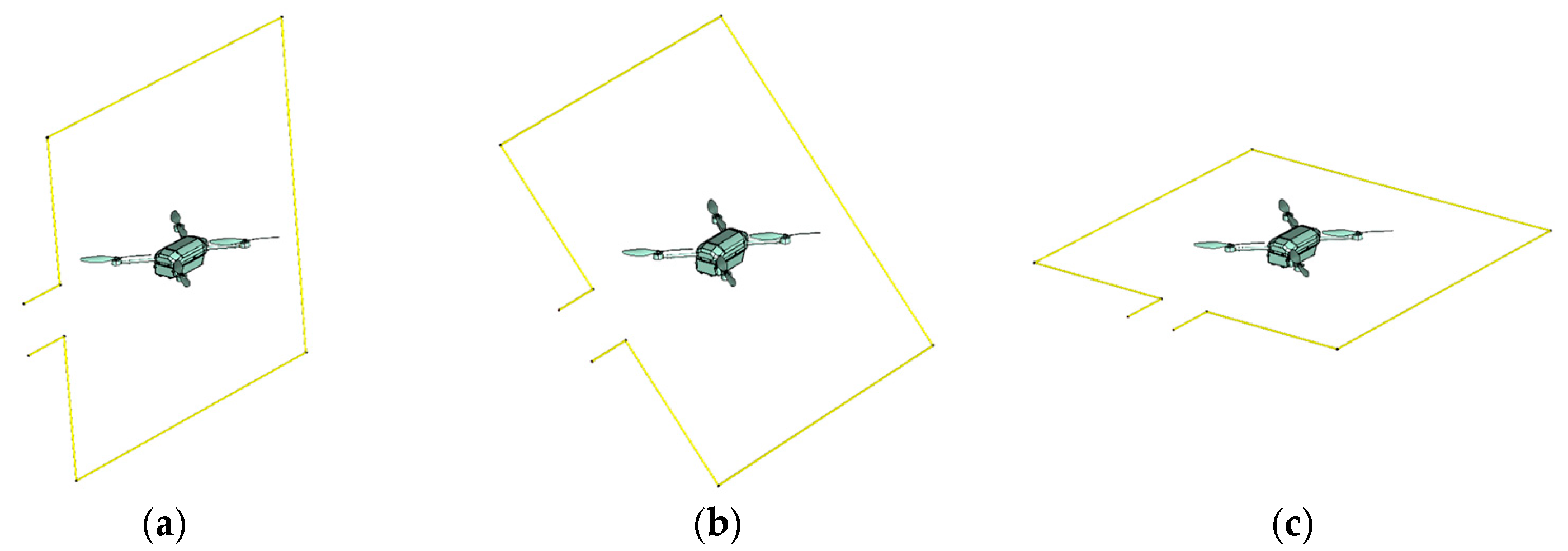
where l denotes the length of the drone arm and c is the propagation speed of the electromagnetic wave. The UAV was modeled with a diagonal dimension of 270 mm (excluding the propeller blades), yielding fresonant ≈ 556 MHz. Accordingly, CST simulations were conducted at 200 MHz (below resonance) and 500 MHz (near resonance) to capture frequency-dependent coupling trends. Figure 1 defines the CST near-field loop-antenna configuration and the three rotation angles (0°, 45°, and 90°) used to change the field polarization relative to the UAV arm wiring (Figure 1a–c).

2.2. Simulation Results of EMP Coupling Characteristics

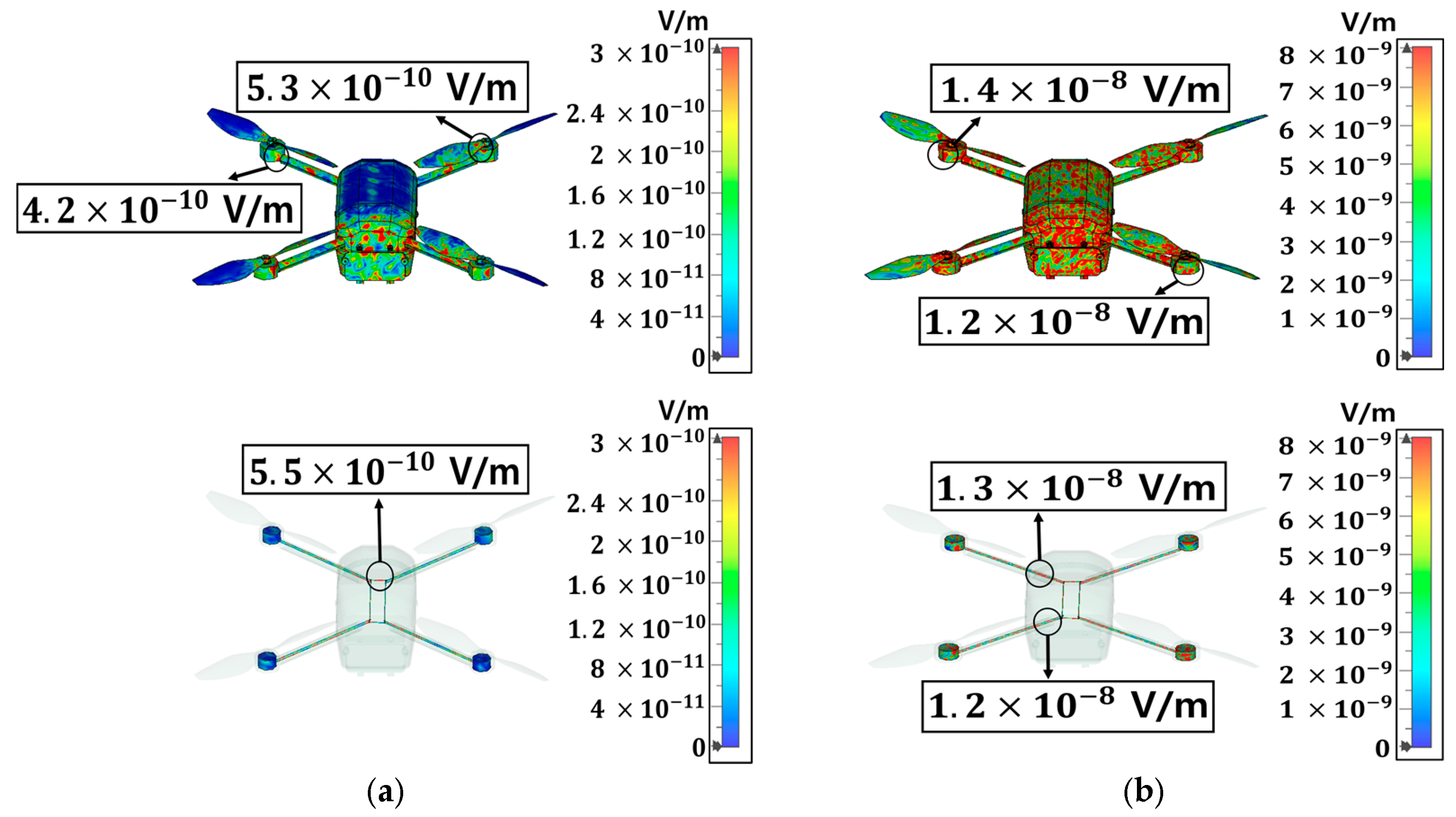
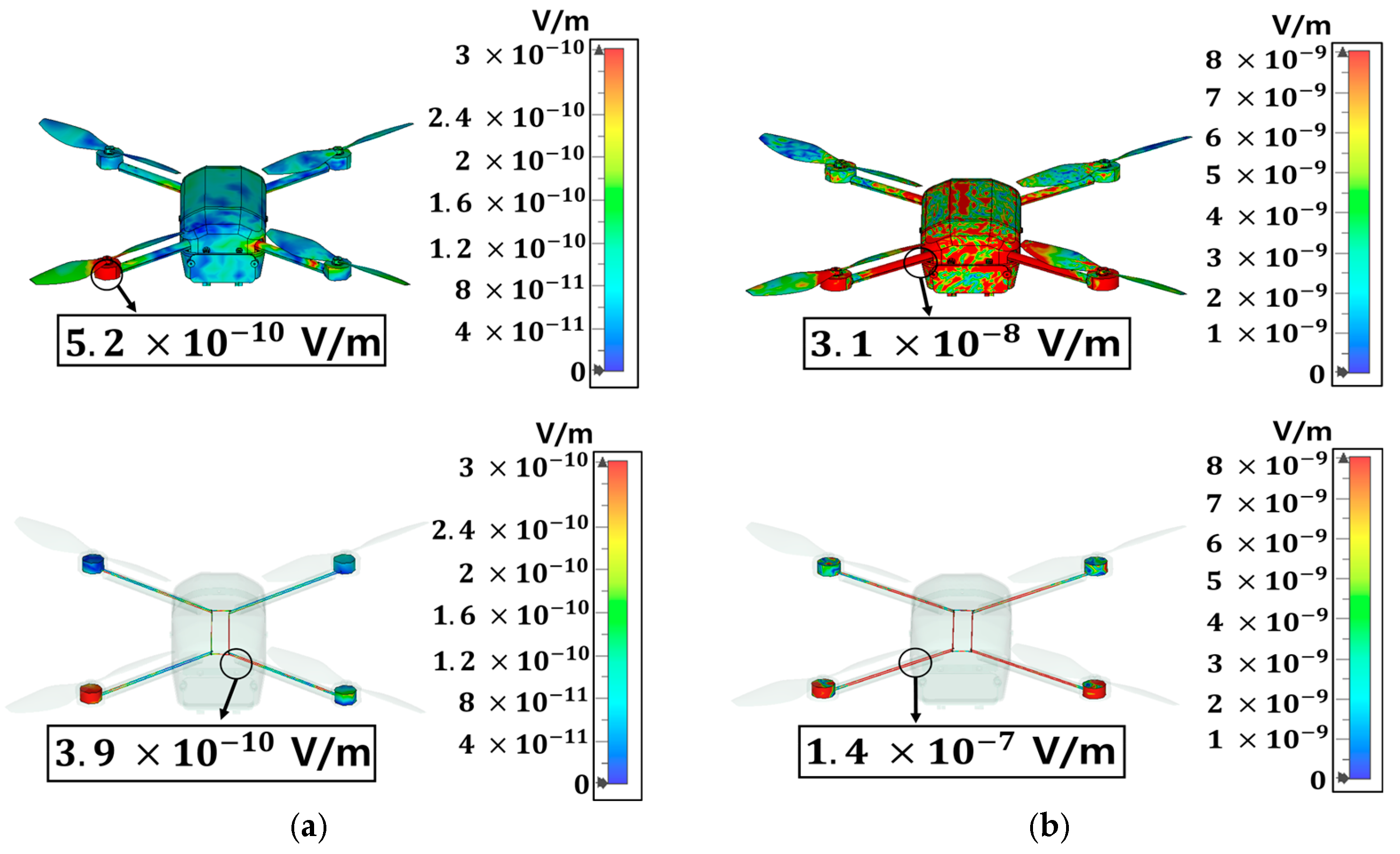
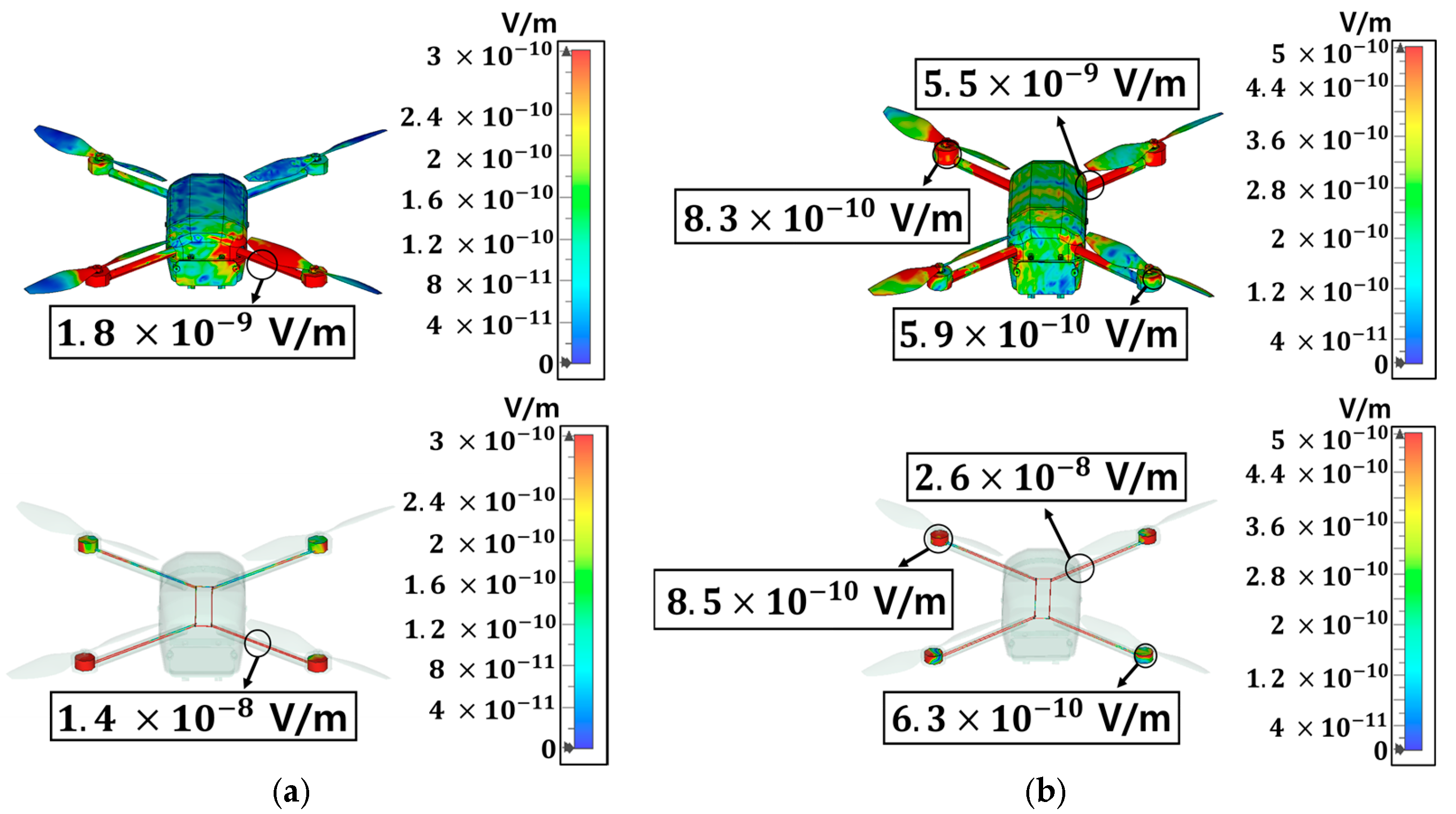
The resulting electric-field distributions exhibit strong dependence on both frequency and loop rotation angle. For the 0° rotation case (Figure 2), the 200 MHz distribution (Figure 2a) shows local hotspots near the motor/arm regions with a peak annotated value of 5.2 × 10⁻¹⁰ V/m, while the arm–body wiring region is on the order of 3.9 × 10⁻¹⁰ V/m. At 500 MHz (Figure 2b), the field magnitude increases markedly: the annotated peak values reach 3.1 × 10⁻⁸ V/m in the arm junction region and as high as 1.4 × 10⁻⁷ V/m along the arm wiring, indicating substantially stronger near-resonant coupling. For the 45° rotation case (Figure 3), the 200 MHz result (Figure 3a) exhibits higher localized concentrations than the 0° case, with annotated peaks up to 1.8 × 10⁻⁹ V/m; in the top-view wiring region, values reach 1.4 × 10⁻⁸ V/m, implying enhanced coupling into asymmetric arm-loop paths. At 500 MHz (Figure 3b), the dominant hotspot in the upper arm wiring reaches 2.6 × 10⁻⁸ V/m, whereas the motor-adjacent regions remain on the order of ~(0.6–0.9) × 10−9 V/m in the annotated probes, demonstrating that the strongest coupling shifts to specific arm/wiring segments depending on polarization. For the 90° rotation case (Figure 4), the 200 MHz distribution (Figure 4a) remains on the order of 4.2 × 10⁻¹⁰ V/m to 5.3 × 10⁻¹⁰ V/m around the motor/arm regions, with a maximum annotated value of 5.5 × 10⁻¹⁰ V/m on the arm-wiring section in the top view. At 500 MHz (Figure 4b), the distribution becomes comparatively more uniform than the 0° case, with peaks around 1.4 × 10⁻⁸ V/m and arm-wiring values typically ~(1.2–1.3) × 10−8 V/m. Overall, these results confirm that near-field coupling into the UAV structure is highly sensitive to polarization and that operation near the wiring resonance (here, 500 MHz) can increase localized electric fields by orders of magnitude relative to sub-resonant excitation (200 MHz), with hotspots repeatedly appearing along arm wiring and motor/electronic speed controller (ESC)-adjacent regions—consistent with back-door coupling paths into motor-control lines. Accordingly, the CST simulation was used mainly to examine relative coupling tendency and hotspot distribution under UWB-like input conditions, rather than to provide a direct quantitative prediction of the experimentally induced voltages or a one-to-one correspondence with the outdoor 55 kV/m exposure.
To better interpret the experimentally observed near-field coupling behavior, this study implemented a near-field coupling simulation environment featuring a 1 × 1 m loop antenna model in CST Studio Suite. Compared with Hamdalla et al. [24], the present work further examines pulsed loop-antenna EMP exposure and the resulting motor-control-line disturbances and soft-kill behavior of the UAV. While far-field analysis assumes uniform plane-wave propagation, the loop-antenna configuration considered in this study represents a near-field induction environment, in which the magnetic field (H-field) distribution is highly non-uniform and dependent on the antenna geometry and distance. Therefore, the indoor loop-antenna tests were intended to compare induced responses under controlled near-field excitation, rather than to provide a calibrated plane-wave field value that is directly comparable to the 55 kV/m outdoor result. The magnetic flux density B at a distance z along the center axis of a square loop antenna with side length ω and peak current I is given by
B ( z ) = μ 0 I 2 π ω 2 ( z 2 + ω 2 4 ) 3 / 2
The coupling of this pulsed magnetic field into the internal UAV wiring is governed by Faraday’s Law of Induction. The induced electromotive force (EMF) in the motor control signal loops, which are critical back-door paths, is determined by the time rate of change in the magnetic flux Φ B through the effective loop area A of the wiring:
e m f = d Φ B d t = A B t · d A
In the CST near-field setup (Figure 1), the loop antenna was evaluated with three rotation angles (0°, 45°, and 90°) to capture polarization-dependent coupling, and the resulting near-field response is reported at 200 MHz and 500 MHz (Figure 2, Figure 3 and Figure 4). The field maps show that coupling hotspots repeatedly appear along the arm wiring and motor/arm junctions, consistent with flux-linkage being dominated by the arm-loop geometry. Across all three rotation cases (Figure 2, Figure 3 and Figure 4), the coupled field becomes more pronounced at 500 MHz than at 200 MHz, while the dominant hotspots remain concentrated near the arm wiring and junction regions. The loop rotation also changes the distribution and relative intensity of these hotspots, indicating clear polarization-dependent coupling. These angle-dependent variations support the conclusion that the UAV’s non-uniform geometry and “floating-ground” return paths promote asymmetric coupling and DM disturbance on motor-control wiring—effects that are not captured by far-field plane-wave assumptions. In turn, such induced transients provide a plausible mechanism for logic-level perturbation of PWM control signals, consistent with the observed “soft-kill” failure mode. Based on the CST results, the subsequent experiments were designed to examine whether the predicted polarization-dependent coupling tendency along the arm wiring and motor/ESC-adjacent regions is consistent with the induced disturbances measured on the UAV motor-control lines.

2.3. Experimental Configuration and Measurement Methodology

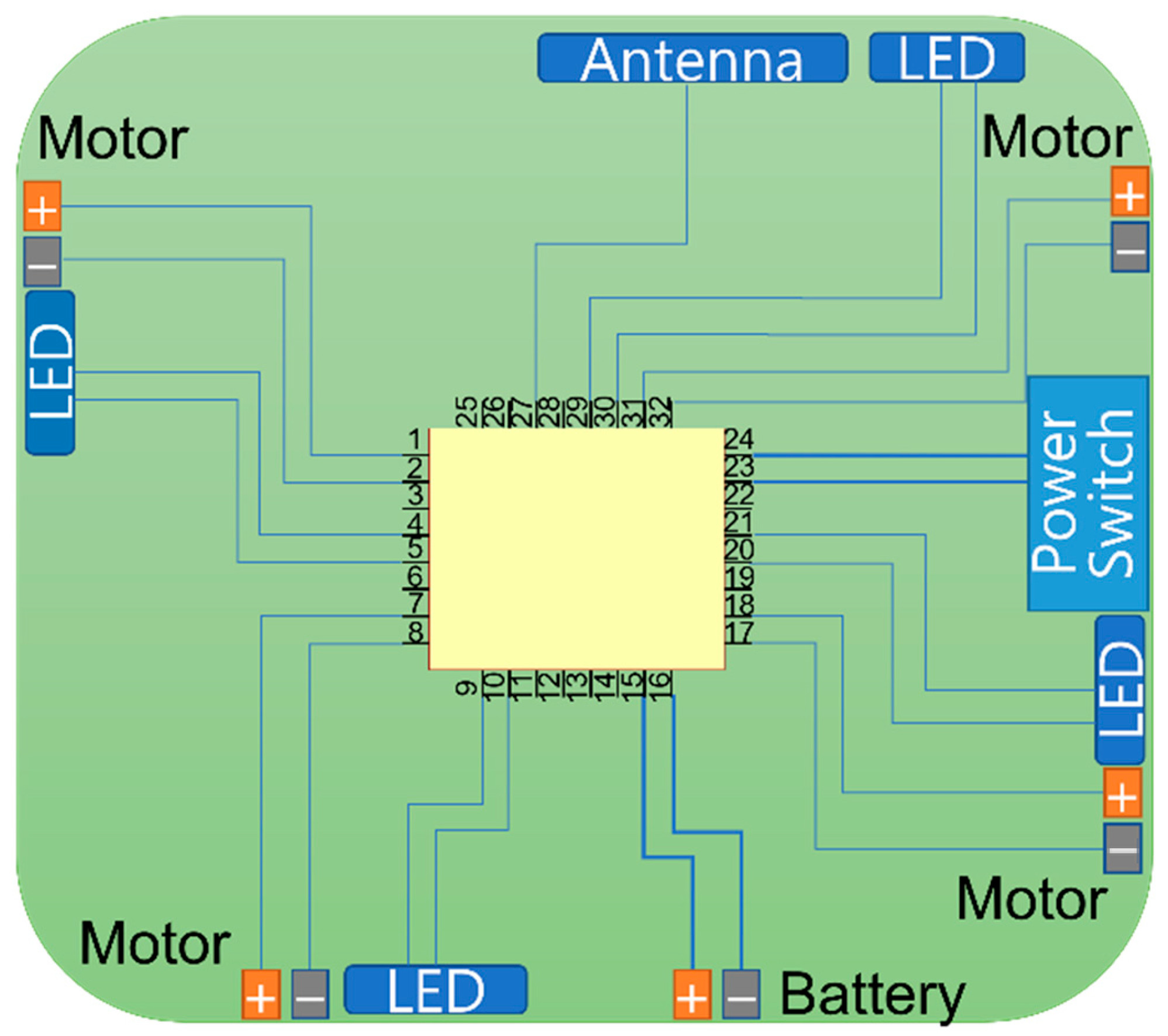
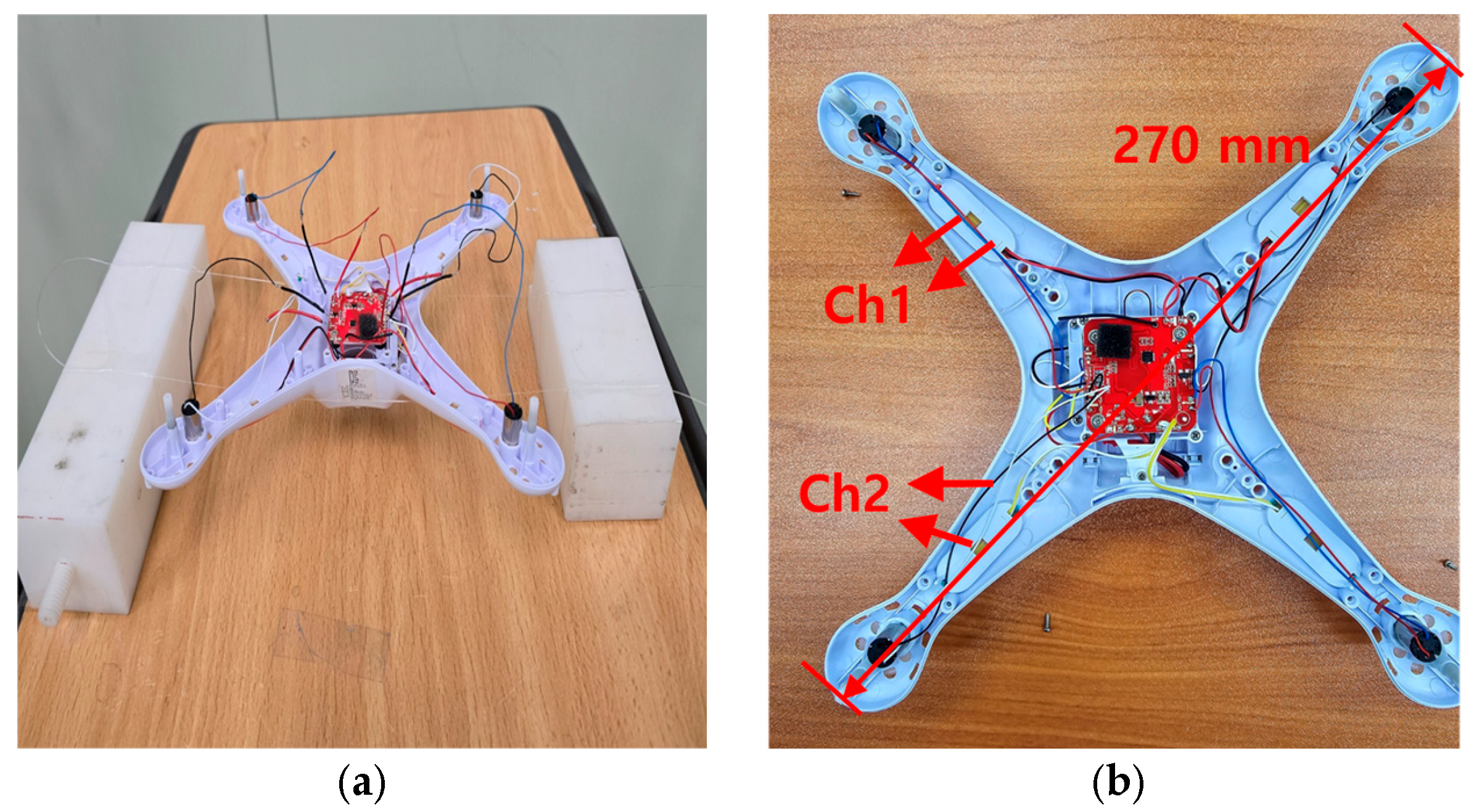
The effect of high-power EMP on UAV was investigated by indoor radiation experiments. As shown in Figure 5a, the UAV is positioned between transparent polyethylene (PE) lines to facilitate the observation of its movement in response to motor control. As shown in Figure 5b, the UAV measures 270 mm diagonally from end to end without blades and 370 mm with blades attached. The UAV used in this study was a commercial 2.4 G RC DRONE-B5 manufactured by Yiwu JZ Trading Co., Ltd. (Yiwu, China). The UAV is equipped with four DC motors and powered by a 3.7 V, 500 mAh lithium-polymer (Li-poly) battery. Communication with the controller is achieved via a 2.4 GHz wireless connection. A schematic of the printed circuit board (PCB) located at the center of a UAV is shown in Figure 6. Although simplified, Figure 6 indicates the relative positions of the battery, antenna/receiver path, power switch, and four motor branches connected to the central PCB, which are relevant to the EMP-coupling paths discussed in this study.
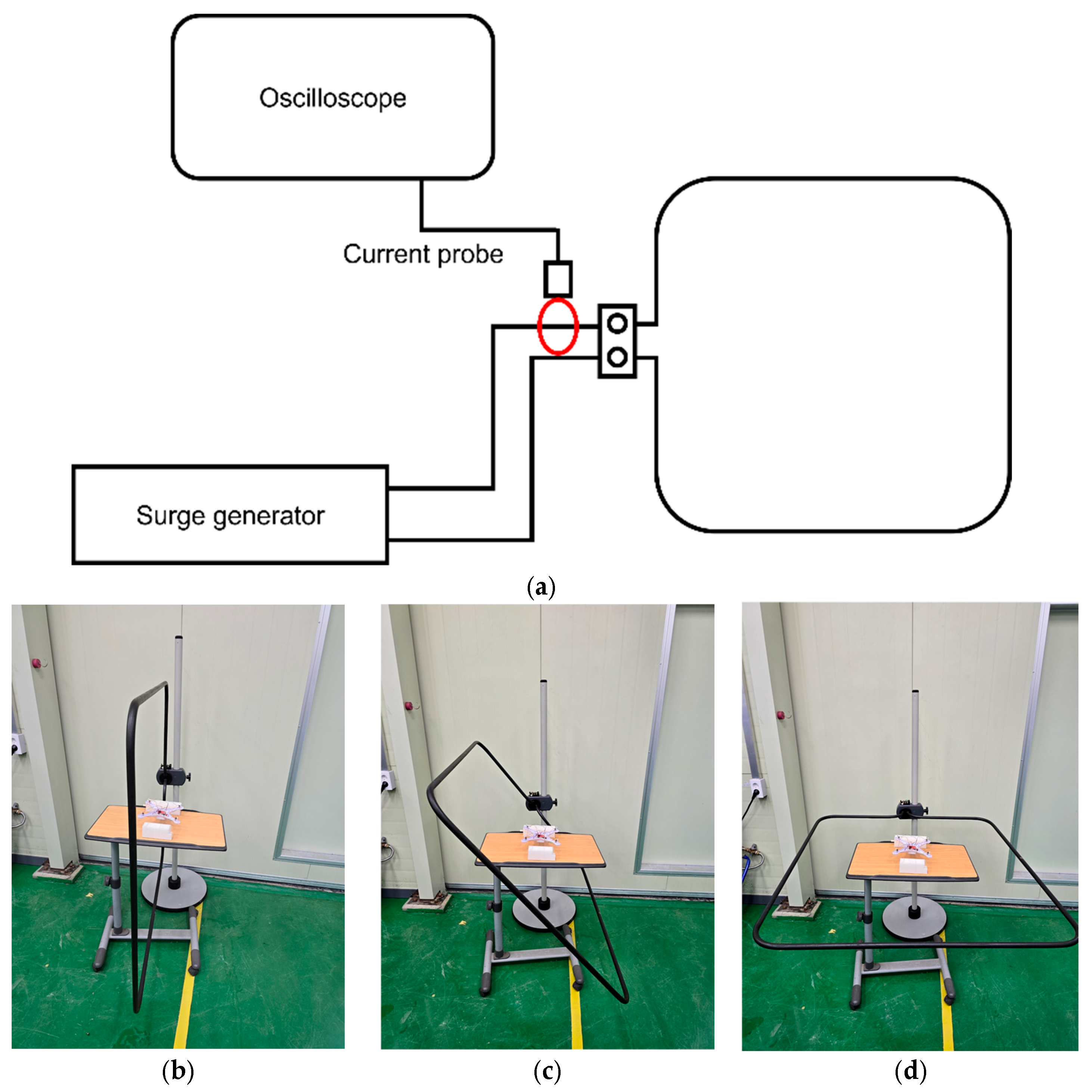
The impact of electromagnetic pulses (EMPs) on the UAV was evaluated based on the IEC 61000-4-9 standard [26], which, as a part of the EMC requirements, specifies a test method for assessing the immunity of electronic equipment to pulsed radiated fields. The experimental setup is illustrated in Figure 7a, with the loop antenna used for testing measuring 1 × 1 m. The energy of the impulse waveform is predominantly distributed in the MHz range. To radiate this energy, the RS 105 test can be performed. Alternatively, tests can be conducted up to 30 MHz using a loop antenna. Depending on the orientation of the loop antenna, either the electric field (E-field) or magnetic field (H-field) component can become dominant. Specifically, within or near the center of the loop, the direction perpendicular to the plane of the loop predominantly exhibits a strong H-field, whereas the direction parallel to the loop plane exhibits a stronger E-field component. The actual configurations of the loop antenna is shown in Figure 7b–d. To investigate the effect of the polarization direction of the input waveform, experiments were conducted by rotating the loop antenna to 0°, 45°, and 90°, respectively, to assess the impact of the EMP on the UAV. The experiments were conducted in two stages: indoor loop-antenna irradiation tests for direct measurement of EMP-induced transients on the motor-control lines, followed by open-field irradiation tests to examine the resulting UAV behavior during hovering flight.
In general, an impulse–current waveform can be mathematically expressed using a double exponential function as follows:
i ( t ) = I m ( e α t e β t )
where Im is the maximum of current, α and β are characteristic parameters, and t is time [27]. This double exponential waveform is typically obtained by ensuring an R-L-C series circuit operates under overdamped conditions. This method generally requires only a single switch, which enhances the operational reliability, making it the preferred approach in most cases. The capacitor is charged to a DC voltage through an external charging circuit. When the gap switch is triggered at time t = 0, the impulse current becomes overdamped according to the oscillation conditions.
R > 2 L C

2.4. Excitation Sources and Measured Induced Responses

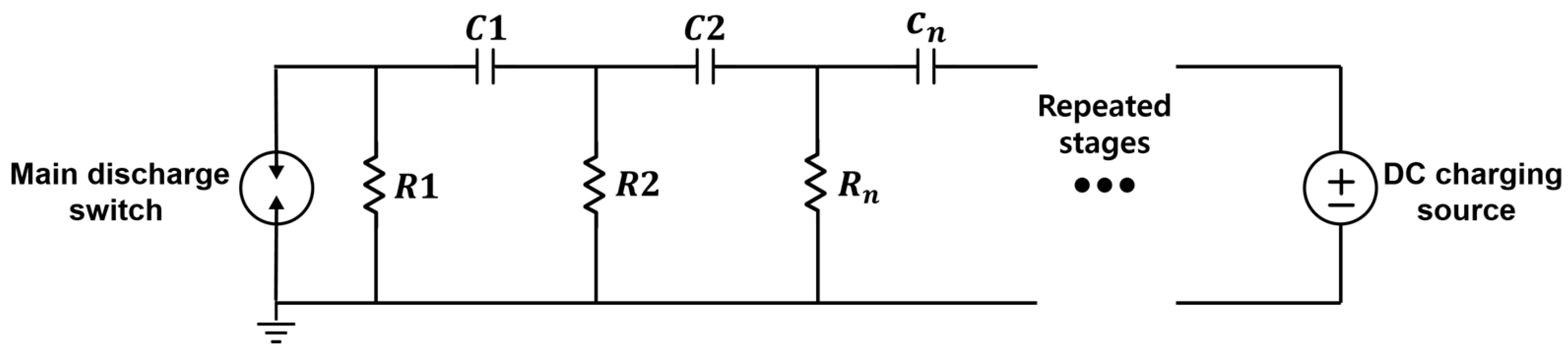
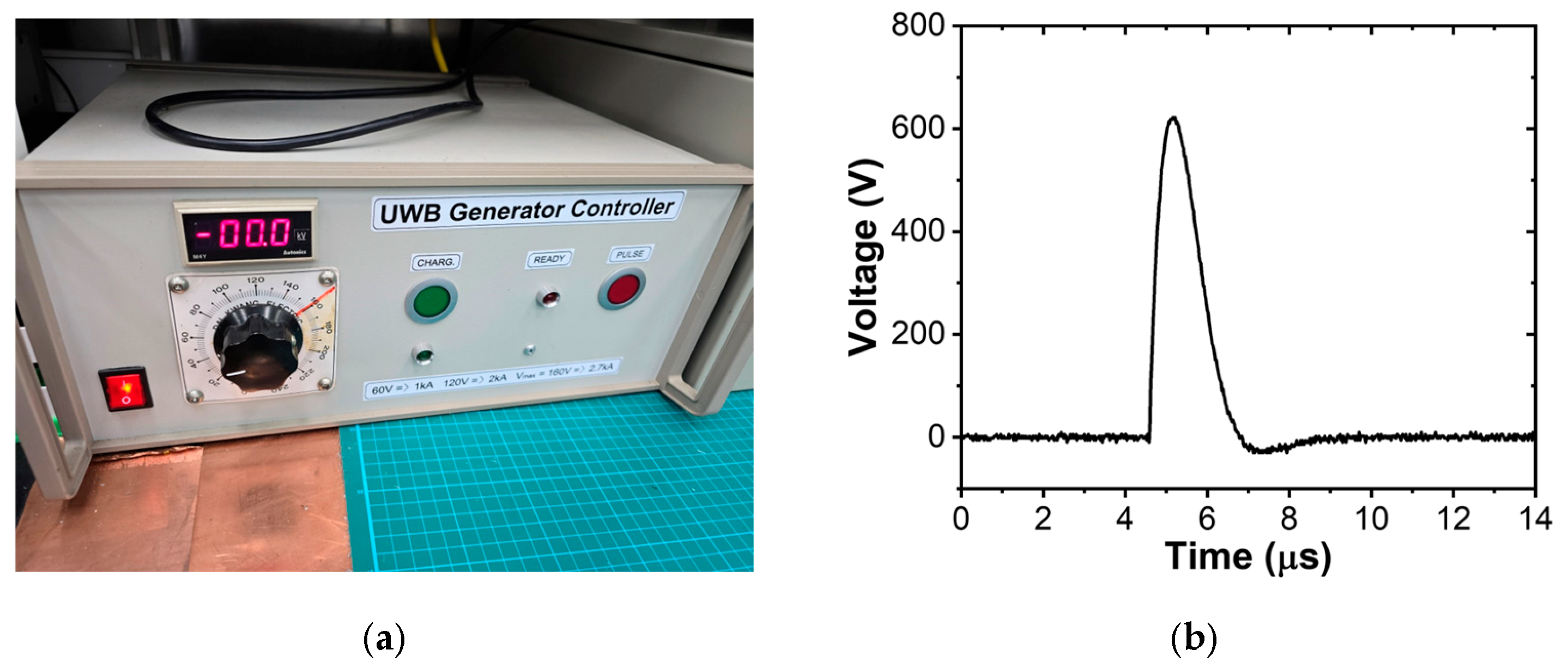
Two excitation sources were employed within the same loop-antenna-based test platform. The first source was the ultra-wideband (UWB) generator developed for the acceptance and verification testing of HEMP protection devices. According to MIL-Std-188-125-1 [28], waveforms are classified as short, medium, and long pulses based on the rise time and FWHM of the waveform. The UWB generator used in this study was classified as a short-pulse generator with a rise time of less than 20 ns (extremely fast) and a peak current specification exceeding 2.5 kA. In this section, the source characteristics are first described, and the corresponding induced-signal results are then presented for each excitation source. For clarity, a simplified equivalent circuit of the single-pulse UWB generator is shown in Figure 8.
The UWB generator consists of a high-voltage power supply rated at 160 kV, including a pulse transformer, a voltage-doubling circuit, a charging capacitor, a main discharge switch, and source impedance resistors that form the main body of the generator. In addition, it included a controller that managed the charging voltage, displayed the current voltage state, and provided a switch-trigger function. When the main switch is activated by a trigger signal from the controller, an impulse current is generated at the output.
The charging voltage is adjusted using a voltage regulator in the controller. Once charging is completed to the preset voltage level, charging automatically stops, with a trigger signal generated to produce the output current. In this system, a mechanical magnetic switch was used as the main discharge switch. This design allows the switch to operate regardless of the voltage across its terminals and even when the capacitor is undercharged, thereby enabling the generation of low-output currents.
The magnitude and shape of the waveform input into the loop antenna were measured using a current probe. A Pearson wide-band current monitor (model 110 A), which has sensitivity of 0.1 Volt/Ampere, was utilized. Oscilloscope channels were set to 50 Ω, and the converted voltage was shown for the comparison of further results. The UWB generator and waveform utilized are shown in Figure 9. The input waveform measured using the current transformer exhibited a rise time of 20 ns, an FWHM of 120 ns, and a maximum amplitude of 618 V. Here, the reported 618 V denotes the converted voltage of the loop-antenna input waveform measured by the current probe under the 50 Ω oscilloscope setting, rather than the local field strength at the UAV position.
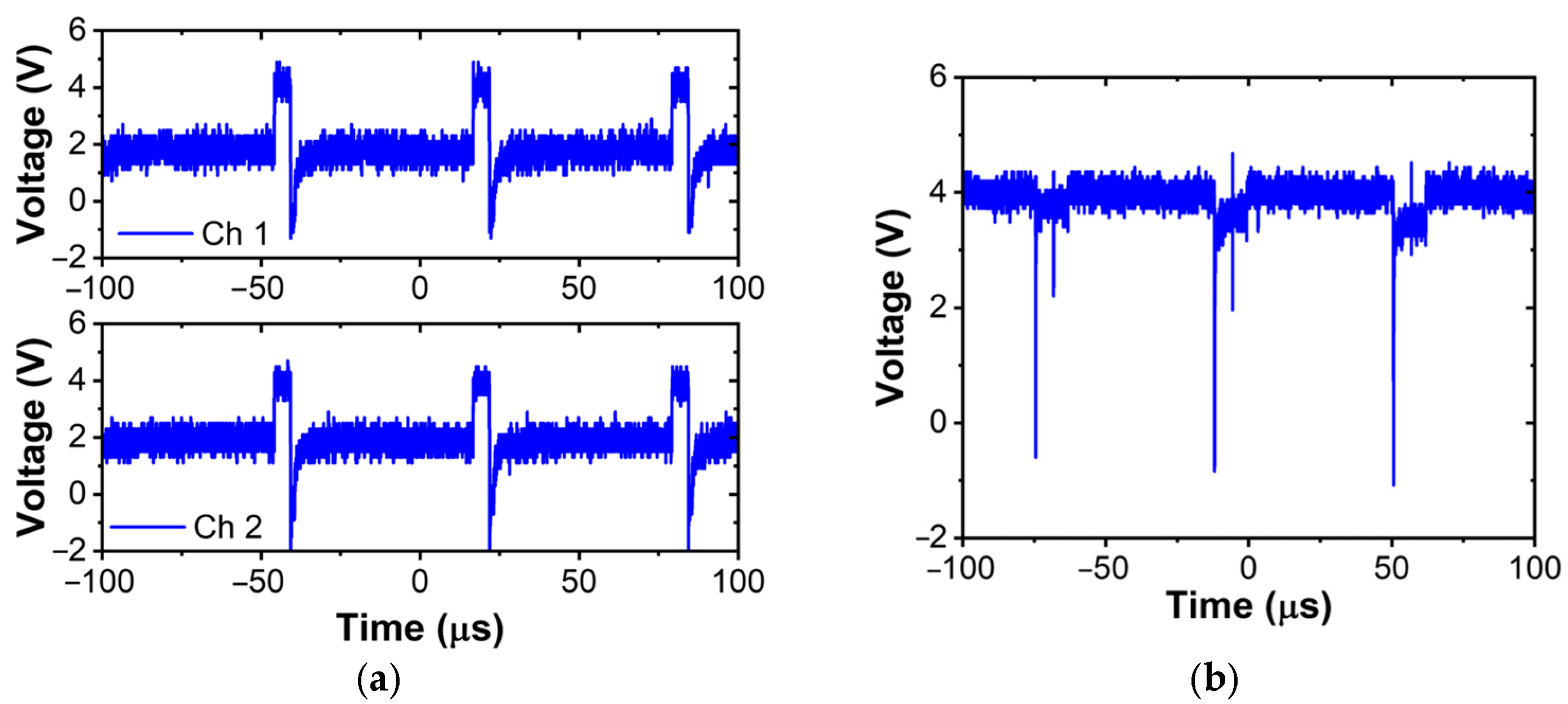
The results obtained by removing the insulation in the middle of the motor signal line of the UAV and using a differential probe are shown in Figure 10. For the baseline PWM measurement, the UAV was operated without EMP irradiation, and the differential probe was connected to the exposed section of each motor-control line. Channels 1 and 2 correspond to motor signal lines for motor 1 and motor 2, respectively. And motor 1 and motor 2 are located at the front side and back side of UAV, respectively, as shown in Figure 5. The PWM signal was given as a baseline for comparing EMP-induced distortions, helping quantify the EMP’s impact. As shown in Figure 10a, when the motor is initially operating at the lowest speed, the offset voltage increases by 2 V, and a PWM signal with a pulse width of 5 µs, a maximum amplitude of 4.3 V, and a period of 60 µs is observed. When the rotational speed of the motor is increased to the maximum via wireless signal control, allowing the UAV to ascend, the DC motor rotates at its highest speed, with an input waveform of 4.2 V across most intervals, as shown in Figure 10b.
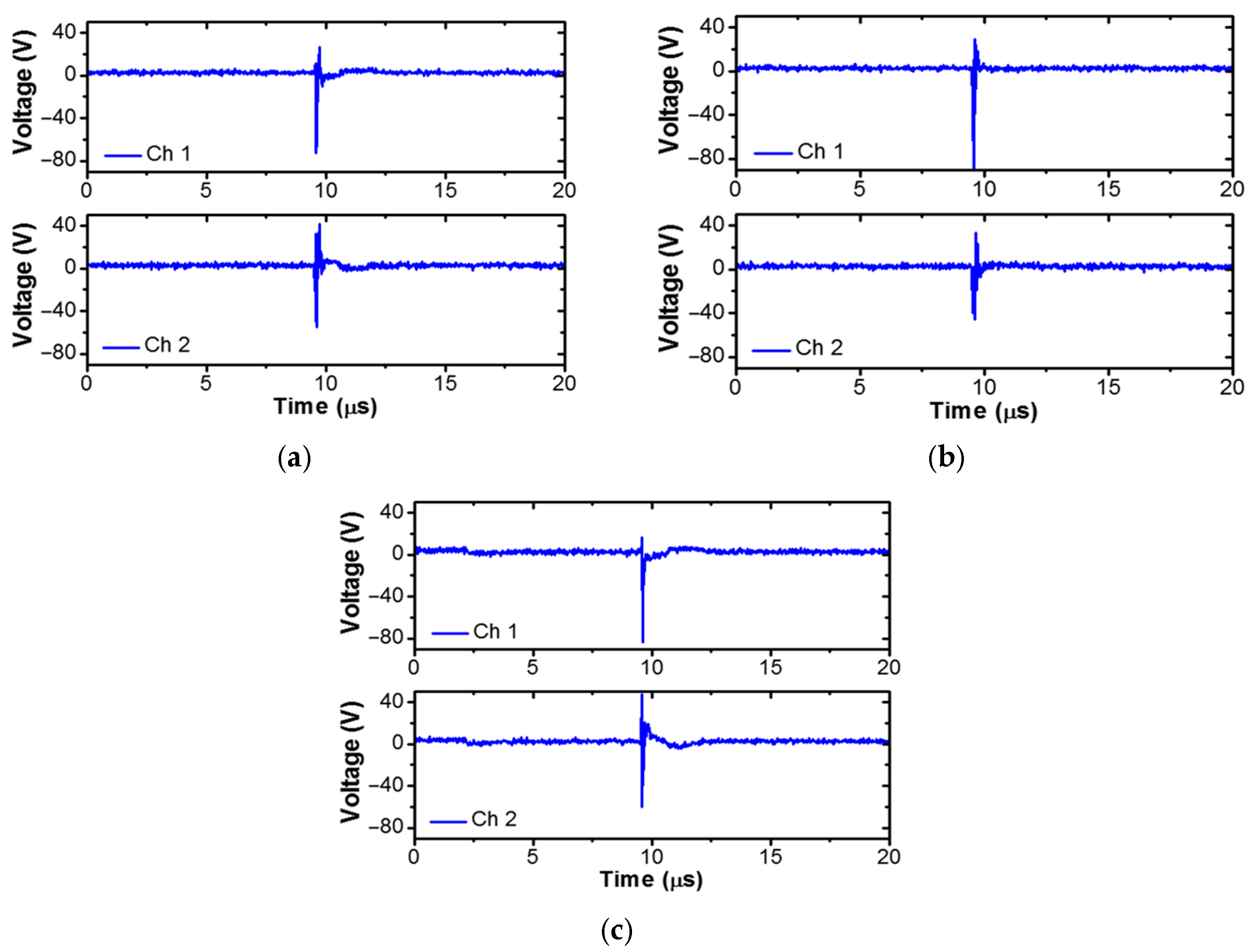
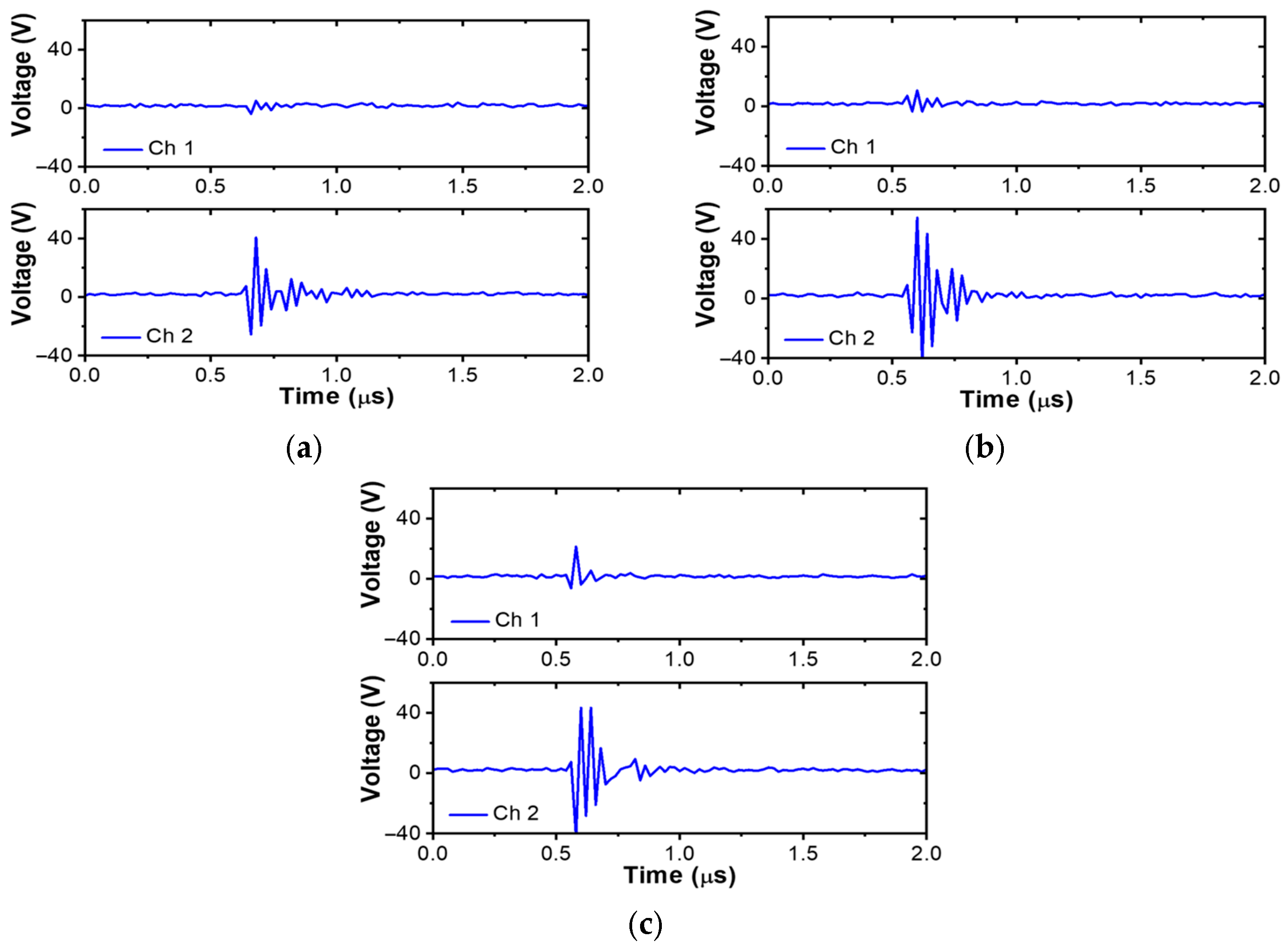
Figure 11 illustrates the impact of the UWB generator connected through a loop antenna on the UAV. The evaluation was conducted with the loop antenna rotated to angles of 0°, 45°, and 90°, as shown in Figure 7b–d, with the rotational speed of the UAV set to the lowest possible level. The EMP-superimposed PWM waveforms were measured at the same exposed motor-control-line locations used for the baseline measurements in Figure 10. The signals from each motor were measured using differential probes to assess the influence of the EMP on each signal line. At a loop antenna rotation angle of 0°, as shown in Figure 11a, the maximum amplitudes of the measured motor control signals were 26.8 V and 41.2 V, respectively. At a 45° rotation angle, the maximum amplitudes were 29.2 V and 33.2 V, respectively. At a 90° rotation angle, the maximum amplitudes were 16.4 V and 47.6 V, respectively. These results indicated that the induced voltage varied according to the polarization of the incident EMP waveform. In particular, when the loop antenna rotation angle was set to 45°, both signal lines exhibited similar maximum amplitudes. In addition, EMP-induced voltages of different magnitudes were superimposed on the normal motor control signal lines, which had a nominal amplitude of 5 V, and used for PWM, thus demonstrating that the polarization of the incident EMP can significantly affect the voltages induced by motor control signals. Although the UAV was positioned near the center of the loop antenna, the internal wiring paths, motor/ESC placement, and floating return paths were electrically asymmetric. Therefore, the effective loop area and flux linkage for Ch 1 and Ch 2 could vary with antenna rotation angle, plausibly contributing to the higher induced voltage often observed on motor 2. This channel-to-channel imbalance indicates that the EMP coupling is not purely common-mode; instead, it generates a differential component between the paired signal conductors, i.e., DM noise, which directly perturbs the PWM logic-level signals.
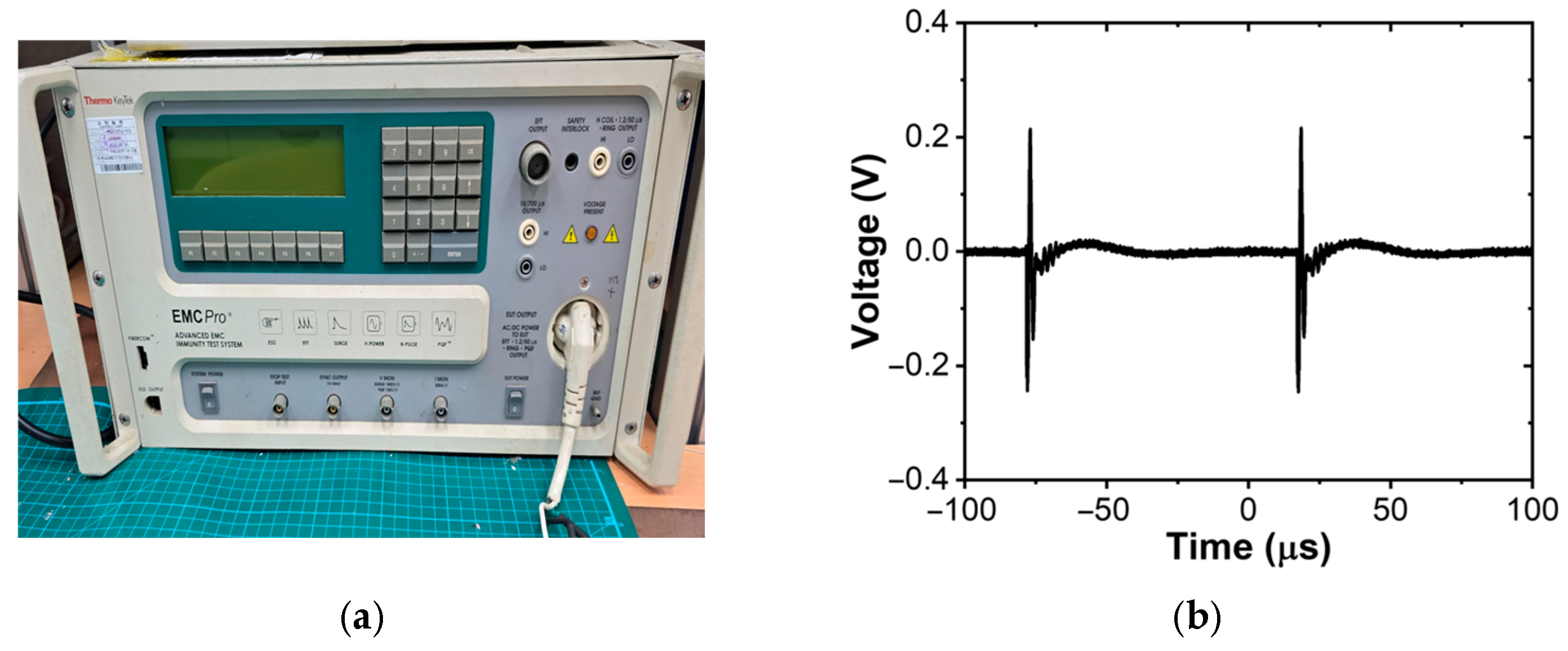
As a second excitation source, a surge generator compliant with IEC 61000-4-4 [29] was employed. To compare the UWB-induced response with another transient source, the impact of the EMP was investigated based on the IEC 61000-4-4 standard, focusing on the effects of varying repetition rates. IEC 61000-4-4 specifies immunity tests for electronic equipment against electrical fast transients, characterized by bursts with a 5 ns rise time and a 50 ns duration. The tests used pulses up to 4 kV at 5 or 100 kHz repetition rates, simulating conditions such as switch operations, to assess equipment resilience against transient disturbances. As shown in Figure 12a, equipment from EMC Pro Advanced was used to satisfy these requirements. This equipment offers a burst frequency range from 1 to 100 kHz and can generate output signals from 200 to 4400 V, supporting both the conducted and radiated emission tests. The settings included a burst frequency of 100 kHz and an output voltage of 800 V. Likewise, the reported 800 V denotes the surge-generator output-voltage setting rather than the local field quantity at the UAV location. The output signal measured by the current transformer (Figure 12b) has a rise time of 5 ns and a duration of 50 ns.
Figure 13 illustrates the impact of the surge generator on the UAV. The test configuration is consistent with that shown in Figure 11. At a loop antenna rotation angle of 0°, as shown in Figure 13a, the maximum amplitudes of the measured motor control signals were 5.0 V and 40.6 V, respectively. When the loop antenna was rotated to 45°, the maximum amplitudes were 10.6 V and 54.2 V, respectively. At a 90° rotation angle, the maximum amplitudes were 21.4 V and 43.4 V, respectively. For the Ch 1 motor signal line, the signal amplitude increased with the rotation angle, reaching its maximum at a 45° angle. In all cases, the difference in the induced voltage between the Ch 1 and Ch 2 signal lines exceeded 20 V.
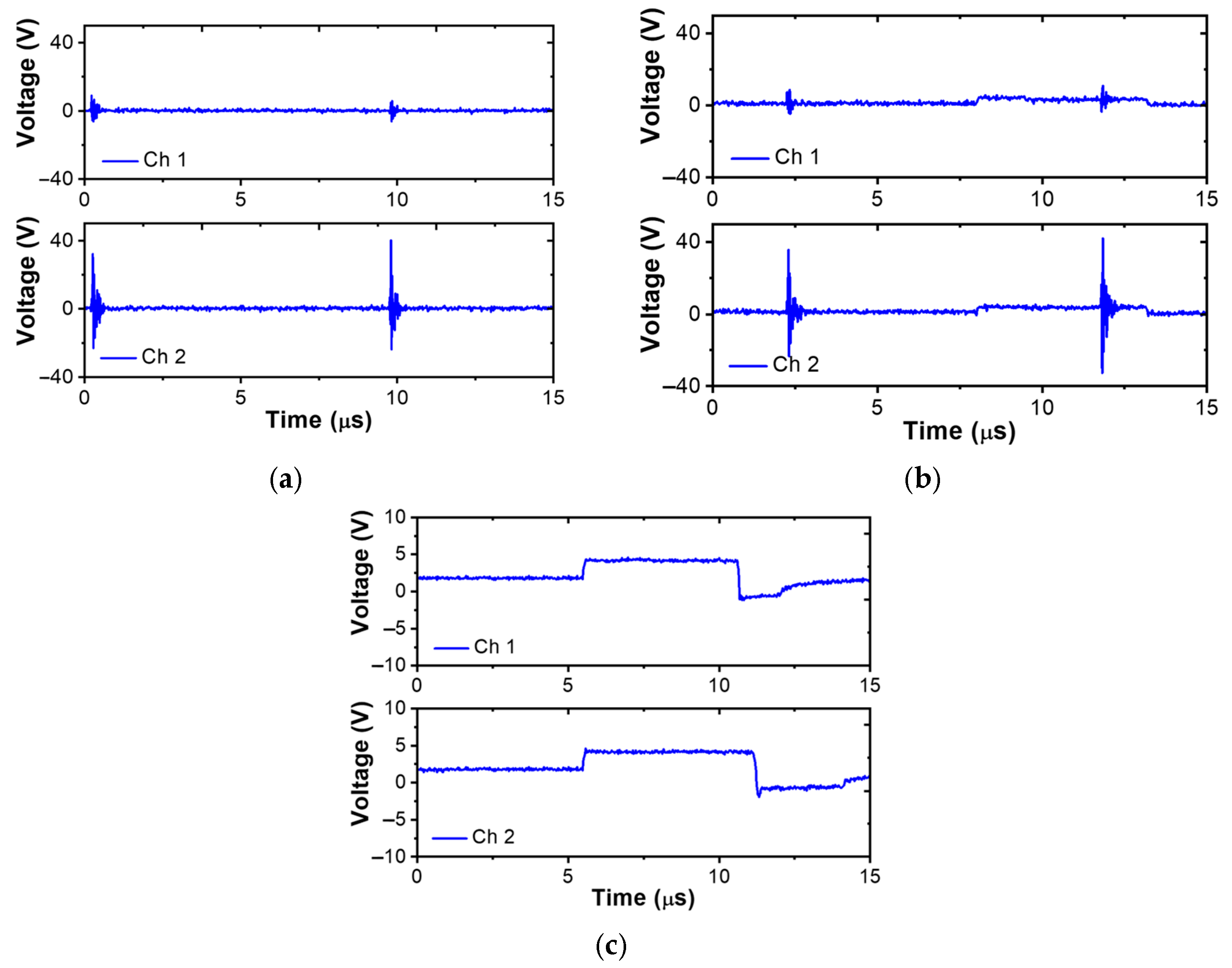
Considering the EMP is radiated via a loop antenna, protective measures focus on mitigating transient signals. In Figure 14a, the induced waveform is measured on the motor signal lines when the UAV is not in operation, whereas in Figure 14b, the measurement is performed when the UAV is operating at its lowest speed. In both cases, transient signals of approximately 16 V on the signal control line Ch 1 and 40 V on Ch 2 were observed. Ferrite beads were installed on the motor-control signal lines as a common countermeasure for common-mode noise; however, the transient levels showed little change, indicating limited suppression effectiveness under the present test conditions. Furthermore, Figure 14c illustrates the results obtained when the entire UAV was wrapped with metallic foil, which proved to be more effective in suppressing transient signals.
Protective measures, including the installation of ferrite beads and localized shielding of cables or PCBs, were found to be ineffective, as EMP coupling occurred throughout the UAV, resulting in a general increase in voltage across all components. These findings suggest that, when exposed to EMP signals, varying voltages are induced in the motor control signal lines, resulting in differential motor speeds that cause the UAV to lose balance and eventually crash. And the different induced voltage at the front-side and back-side motor signal line was caused by different motor positions and EMP incidence angles, as shown in Figure 11, Figure 13 and Figure 14. Under the specific indoor and outdoor exposure conditions used in this study, no obvious loss of the wireless control link was observed. Since the spectral content of the applied UWB pulse was predominantly in the MHz range, whereas the wireless communication link operates at 2.45 GHz, the dominant effect appears to have been disturbance of the motor-control lines rather than communication-link failure. Unlike Li et al. [16], these results suggest that back-door coupling was more significant than front-door coupling under the present test conditions. This suggests that front-door coupling, primarily caused by the antenna, was not the main pathway for EMP entry. Instead, back-door coupling, where EMP energy indirectly enters the device through unintended pathways such as structural components, was identified as the primary coupling mechanism. The results suggest that the EMP causes minimal physical damage to the controller, battery, and motor, acting instead through a soft-kill mechanism that disrupts signal control lines, as opposed to a hard kill that leads to irreversible damage and prevents recovery.

3. Open Field Experiments and Results

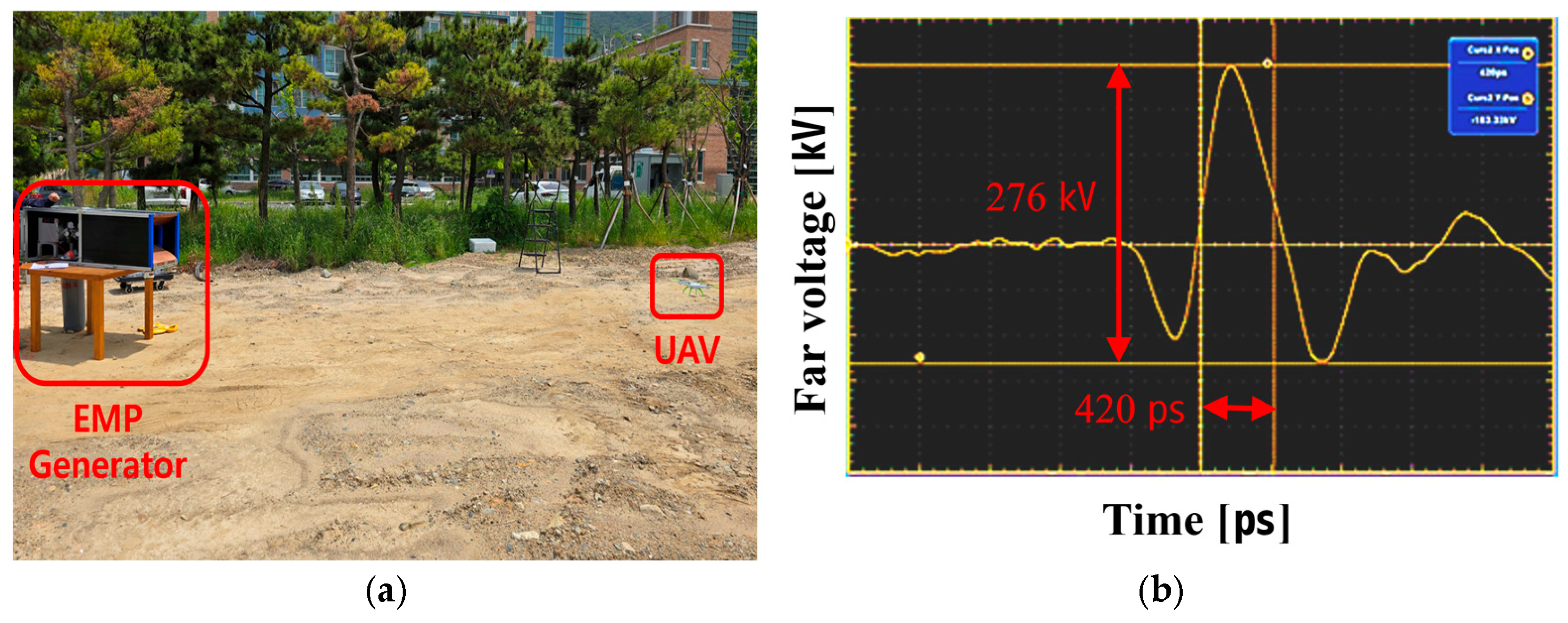
To directly assess the impact of EMP on the UAV flight, EMP radiation was directed at the UAV in an open field, as shown in Figure 15a. The UAV utilized in this experiment was the same 2.4 G RC DRONE-B5 model used in the laboratory experiments. The radiated EMP waveform has a pulse width of 420 ps, as shown in Figure 15b. The detailed specifications of the EMP generator are listed in Table 1. During the experiment, the distance between the UAV and EMP generator was set to 5 m to achieve a maximum electric field strength of 55 kV/m, with a repetition rate of 5 Hz. The UAV is positioned to hover in alignment with the EMP generator. At the start of each test, the UAV was stabilized in hovering flight under wireless remote control and then exposed to the radiated EMP while its posture change was visually monitored. To ensure accurate results, potential interfering factors near the EMP generator and test site were eliminated, with both personnel and vehicles restricted to mitigate any risks.
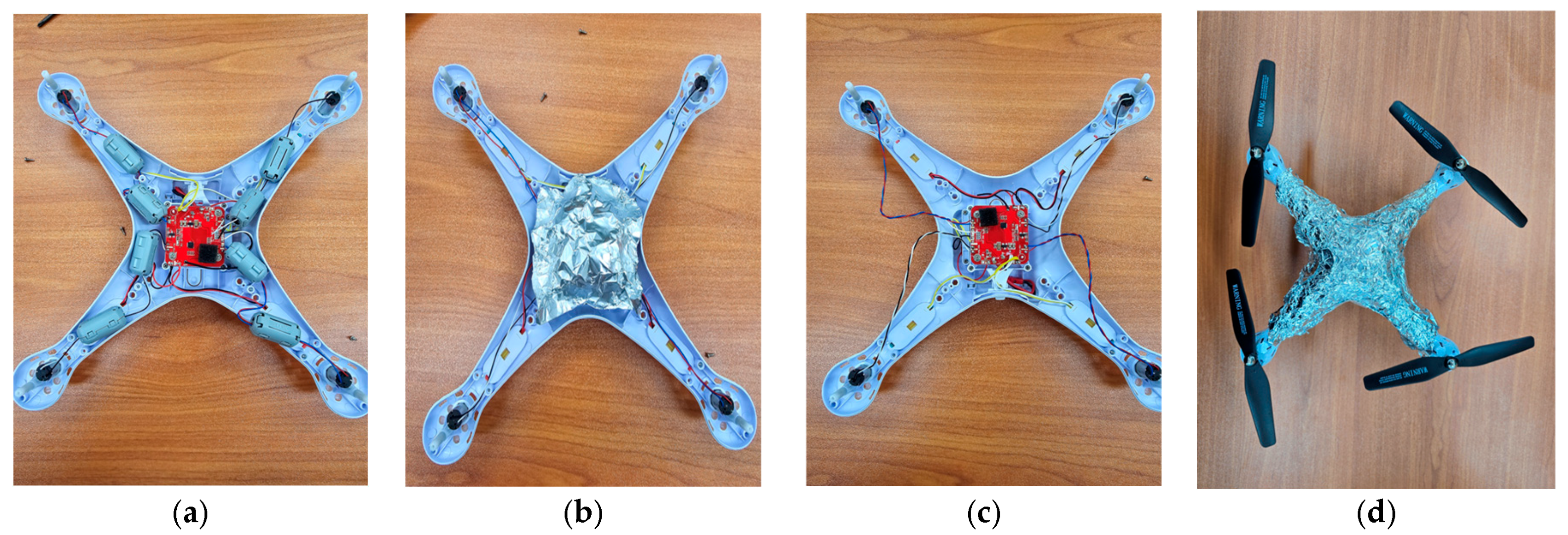
As shown in Figure 16, various methods were explored to establish EMP protection measures for the UAV. Figure 16a shows the installation of beads on the motor-control signal lines. As shown in Figure 16b, aluminum foil was used for shielding, ensuring electrical isolation from the main body to prevent electrical shorts. In Figure 16c, the motor-control signal lines are replaced with twisted cables. As shown in Figure 16d, all parts of the UAV, except the propellers and antenna, were shielded with aluminum foil. The results of these measurements are presented in Figure 17. Accordingly, the observations include not only photographic evidence of hovering, tilting, and crash behavior, but also direct waveform measurements of baseline PWM signals and EMP-induced transients under different excitation and protection conditions.
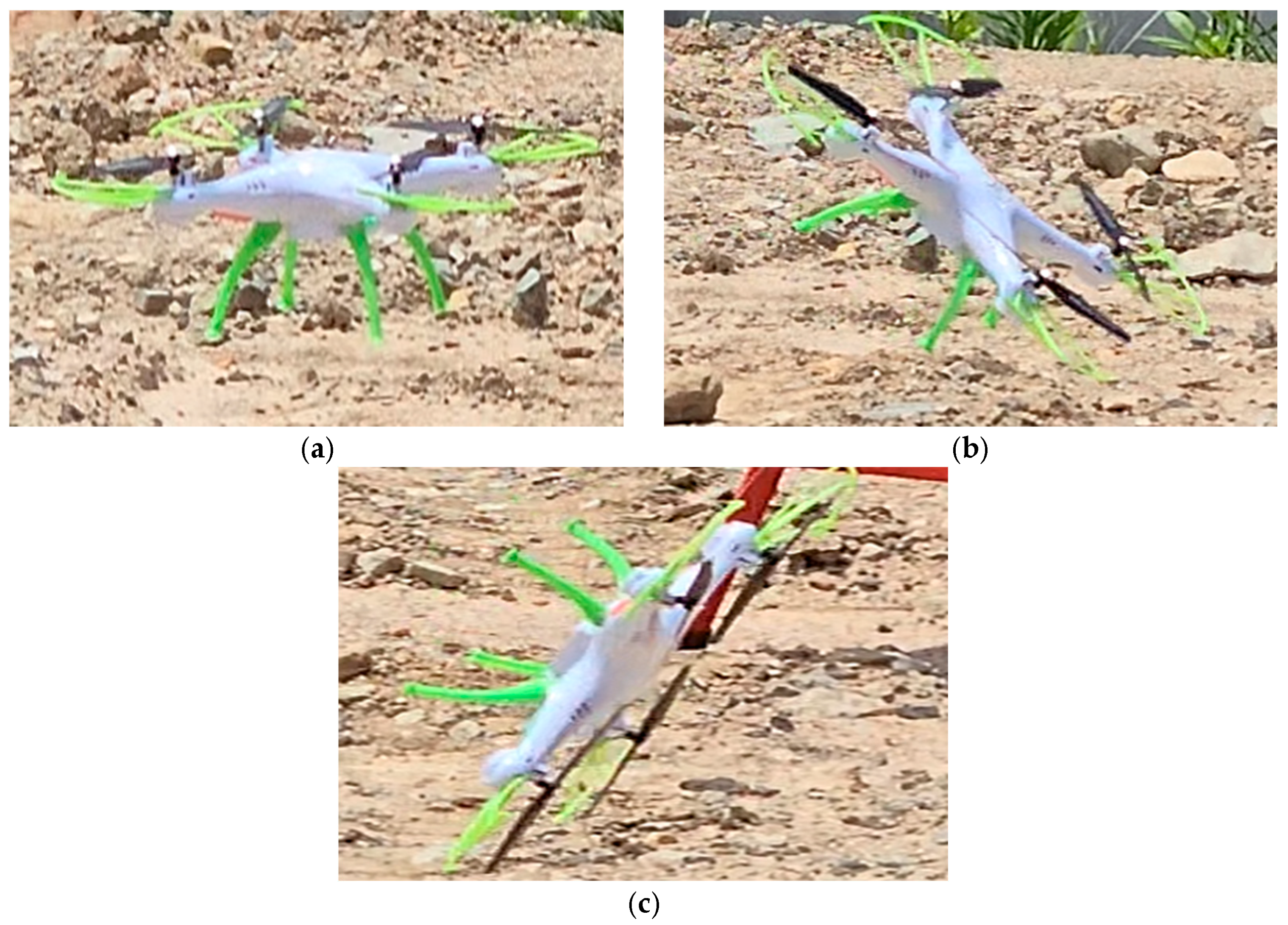
For the purpose of this study, impact was identified from the image sequence as stable hovering before EMP exposure, persistent forward/backward tilt after exposure, and eventual loss of attitude leading to ground crash. In the protection methods shown in Figure 16a–c and as depicted in Figure 17a, the UAV initially maintained a hovering posture. However, upon activation of the EMP generator, as the motors continued to operate, the posture of the UAV tilted forward or backward, as shown in Figure 17b, ultimately leading to a flip and a crash on the ground, as shown in Figure 17c. Ferrite beads and twisted cables are commonly used to suppress common-mode noise. However, the results indicate that the failure of the UAV may be caused by DM noise. In this case, the noise source was connected in series with the voltage source. Only in the case where the entire UAV was shielded with aluminum foil, as shown in Figure 16d, did the UAV remain unaffected by the EMP. Since DM noise is assumed to be the main cause of UAV malfunction, common suppression methods include the use of filters and surge protection devices. However, the simplest and most effective approach may be electromagnetic shielding. Additionally, in all cases where the UAV malfunctioned or crashed under different EMP protection measures, turning the power switch off and on restored normal operation. To further investigate the findings of this study, experiments were conducted in an indoor environment by connecting probes directly to the drone.

4. Discussion

This study shifts the interpretation of UAV vulnerability to EMP from component destruction to signal integrity. The evidence supports a predominantly “soft-kill” mechanism: transient interference corrupts PWM motor commands, destabilizes the flight-control loop, and leads to loss of attitude in flight. Because the nominal PWM signal is only a few volts in amplitude with a pulse width of approximately 5 µs, EMP-induced transients of several tens of volts can distort the effective PWM timing seen by the ESC, momentarily producing unequal motor commands and consequent thrust imbalance. The fact that the platform can often recover after a power cycle suggests logic-level upset rather than irreversible electrical overstress.
A key observation is that the dominant disturbance is differential-mode (DM) noise on the motor control signal pairs, not only common-mode (CM) coupling. In real UAVs, perfect wiring symmetry is difficult due to discontinuous geometries, mixed materials, conductive motor structures, and the absence of a ground reference during flight. These factors promote CM-to-DM conversion, producing unequal induced voltages on adjacent conductors. Measurements are consistent with this: while PWM levels are only a few volts, EMP-induced transients can reach tens of volts on motor signal lines, and their amplitudes differ across channels. Such asymmetric superposition can distort logic timing by stretching or truncating perceived PWM duty cycles at the ESC input. System-wise, asymmetric DM injection translates directly into divergent thrust commands. When each ESC interprets a slightly different PWM perturbation, motors accelerate/decelerate unevenly, and the quadrotor’s torque/thrust balance breaks down faster than the controller can compensate, causing rapid tilt and crash.
The simulation results show that the motor/terminal region acts as an EM hotspot, concentrating the electric field and coupling efficiently into the arm wiring. This supports a back-door coupling path from the motor assembly to the ESC signal interface, explaining why the RF link may remain intact even as the vehicle loses stability and why some conventional CM-focused mitigations (e.g., limited ferrites or partial shielding) may underperform compared with whole-body shielding that reduces overall coupling and conversion.
Table 2 highlights the contribution relative to prior EMP/HPM UAV studies: many emphasize hard-kill damage modes, whereas this work clarifies a recoverable soft-kill regime driven by PWM corruption, implying disruption thresholds can be below destruction thresholds. The threshold difference between Zhao et al. (2022) [15] and the present study should be interpreted cautiously, because the two studies used different waveforms, failure modes, and test conditions. Zhao et al. addressed narrowband HPM-induced hard-kill damage in GHz regime, whereas the present work addresses pulsed EMP-induced soft-kill behavior. Susceptibility may also vary with UAV hardware and wiring geometry. The comparison also reinforces that UAV hardening should be assessed at the system level, focusing on asymmetry, harness routing, motor-terminal field enhancement, and ESC input susceptibility.
Limitations include partial channel coverage in measurements, the need for tighter quantitative linkage between simulated hotspots and induced line voltages/logic-threshold violations, and platform dependence on PWM/ESC sampling. Future work should expand synchronized multi-channel measurements with controller logs and evaluate DM-oriented countermeasures such as improved harness symmetry, shielded/terminated signal pairs, localized motor/ESC interface shielding, and robust input-stage transient limiting without degrading PWM edges.

5. Conclusions

We investigated the effects of EMP on UAVs and their potential protective effects. To assess the impact of EMP on UAV flight, an EMP waveform with a pulse width of 420 ps, a maximum electric field strength of 55 kV/m, and a repetition rate of 5 Hz was irradiated through a TEM antenna in an open field. The experimental results showed that the EMP coupling generally affected the UAV; the UAV operated normally only when completely shielded with aluminum foil. In all other cases, the EMP induced transient signals of varying magnitudes on the motor control signal lines, leading to fluctuations in motor rotational speeds and ultimately causing the UAV to crash. To validate the impact of the EMP, indoor experiments were performed. During the lowest motor speed condition, an increase of 2 V in the offset voltage was observed, along with a PWM signal characterized by a pulse width of 5 µs, a maximum amplitude of 5 V, and a period of 60 µs. A UWB generator was connected to a loop antenna, with a single pulse with a rise time of 20 ns, full width at FWHM of 120 ns, and peak amplitude of 618 V radiated toward the UAV. The induced voltage varies depending on the angle of the loop antenna, with a maximum voltage of 47.6 V measured at an angle of 90°. To examine the effect of the EMP repetition rate, a waveform with a burst frequency of 100 kHz and an output voltage of 800 V was radiated through the loop antenna using a surge generator. A 45° rotation of the loop antenna resulted in a maximum induced voltage of 54.2 V. In both cases with the UWB and surge generators, transient signals of different magnitudes were induced in motor control signal lines Ch 1 and Ch 2. Furthermore, the effect of EMP was identified as soft kill rather than hard kill. The results of this study are expected to contribute to the development of anti-UAV systems based on EMP.

Author Contributions

Conceptualization, K.J.L. and J.M.W.; methodology, K.J.L.; software, D.-W.P. and J.-H.K.; validation, K.J.L., D.-W.P., J.-H.K. and J.M.W.; formal analysis, K.J.L., D.-W.P. and J.-H.K.; investigation, K.J.L.; resources, S.-M.K.; data curation, K.J.L., D.-W.P. and J.-H.K.; writing—original draft preparation, K.J.L.; writing—review and editing, K.J.L., D.-W.P., J.-H.K. and J.M.W.; visualization, D.-W.P. and J.-H.K.; supervision, J.M.W.; project administration, S.-M.K. and J.M.W.; funding acquisition, J.M.W. All authors have read and agreed to the published version of the manuscript.

Funding

This research was supported by Korea Electrotechnology Research Institute (KERI) Primary research program through the National Research Council of Science & Technology (NST) funded by the Ministry of Science and ICT (MSIT) (No. 26A01061).

Data Availability Statement

The authors confirm that the data supporting the findings of this study are available within this article. Further inquiries can be directed at the corresponding author.

Conflicts of Interest

The authors declare no conflicts of interest.

Abbreviations

The following abbreviations are used in this manuscript:
CMCommon Mode
CSTCST Studio Suite
DCDirect Current
DMDifferential Mode
EMCElectromagnetic Compatibility
EMFElectromotive Force
EMPElectromagnetic Pulse
ESCElectronic Speed Controller
FCSFlight Control System
FWHMFull Width at Half Maximum
GaAsGallium Arsenide
GaNGallium Nitride
GPSGlobal Positioning System
HEMPHigh-Altitude Nuclear Electromagnetic Pulse
HPMHigh-Power Microwave
IECInternational Electrotechnical Commission
Li-polyLithium-Polymer
LNALow-Noise Amplifier
MOSFETMetal-Oxide-Semiconductor Field-Effect Transistor
NNEMPNon-Nuclear Electromagnetic Pulse
PCBPrinted Circuit Board
PEPolyethylene
PWMPulse Width Modulation
RFRadio Frequency
TEMTransverse Electromagnetic
UAVUnmanned Aerial Vehicle
UWBUltra-Wideband

References

  1. Kim, J.; Choi, Y.; Jeon, S.; Kang, J.; Cha, H. Optrone: Maximizing Performance and Energy Resources of Drone Batteries. IEEE Trans. Comput.-Aided Des. Integr. Circuits Syst. 2020, 39, 3931–3943. [Google Scholar] [CrossRef]
  2. Saha, A.; Kumar, A.; Sahu, A.K. FPV Drone with GPS Used for Surveillance in Remote Areas. In Proceedings of the Third International Conference on Research in Computational Intelligence and Communication Networks (ICRCICN), Kolkata, India, 3–5 November 2017; pp. 62–67. [Google Scholar]
  3. Mozaffari, M.; Saad, W.; Bennis, M.; Debbah, M. Communications and Control for Wireless Drone-Based Antenna Array. IEEE Trans. Commun. 2019, 67, 820–834. [Google Scholar] [CrossRef]
  4. Chen, W.; Dong, Y.; Duan, Z. Manipulating Drone Position Control. In Proceedings of the IEEE Conference on Communications and Network Security (CNS), Washington, DC, USA, 10–12 June 2019; pp. 1–9. [Google Scholar]
  5. Islam, M.S.; Husain, I.; Mikail, R. Slotless Lightweight Motor for Drone Applications. In Proceedings of the IEEE Energy Conversion Congress and Exposition (ECCE), Cincinnati, OH, USA, 1–5 October 2017; pp. 5041–5048. [Google Scholar]
  6. Zhang, J.; Zhang, Y. A Method for UAV Reconnaissance and Surveillance in Complex Environments. In Proceedings of the 6th International Conference on Control, Automation and Robotics (ICCAR), Singapore, 20–23 April 2020; pp. 482–485. [Google Scholar]
  7. Ko, Y.; Kim, J.; Duguma, D.G.; Astillo, P.V.; You, I.; Pau, G. Drone Secure Communication Protocol for Future Sensitive Applications in Military Zone. Sensors 2021, 21, 2057. [Google Scholar] [CrossRef] [PubMed]
  8. Sharma, R.; Chopra, S.R.; Gupta, A.; Kaur, R.; Tanwar, S.; Pau, G.; Sharma, G.; Alqahtani, F.; Tolba, A. Deployment of Unmanned Aerial Vehicles in Next-Generation Wireless Communication Network Using Multi-Agent Reinforcement Learning. IEEE Access 2024, 12, 69517–69538. [Google Scholar] [CrossRef]
  9. Huang, C.; Ming, Z.; Huang, H. Drone Stations-Aided Beyond-Battery-Lifetime Flight Planning for Parcel Delivery. IEEE Trans. Autom. Sci. Eng. 2023, 20, 2294–2304. [Google Scholar] [CrossRef]
  10. Hill, A.C. Economical Drone Mapping for Archaeology: Comparisons of Efficiency and Accuracy. J. Archaeol. Sci. Rep. 2019, 24, 80–91. [Google Scholar] [CrossRef]
  11. Jung, S.; Song, S.; Youn, P.; Myung, H. Multi-Layer Coverage Path Planner for Autonomous Structural Inspection of High-Rise Structures. In Proceedings of the IEEE/RSJ International Conference on Intelligent Robots and Systems (IROS), Madrid, Spain, 1–5 October 2018; pp. 1–9. [Google Scholar]
  12. Aydin, B.; Selvi, E.; Tao, J.; Starek, M.J. Use of Fire-Extinguishing Balls for a Conceptual System of Drone-Assisted Wildfire Fighting. Drones 2019, 3, 17. [Google Scholar] [CrossRef]
  13. Wang, D.; Li, Y.; Dehghanian, P.; Wang, S. Power Grid Resilience to Electromagnetic Pulse (EMP) Disturbances: A Literature Review. In Proceedings of the 2019 North American Power Symposium (NAPS), Wichita, KS, USA, 13–15 October 2019; pp. 1–6. [Google Scholar]
  14. Zhang, Z.; Zhou, Y.; Zhang, Y.; Qian, B. Strong Electromagnetic Interference and Protection in UAVs. Electronics 2024, 13, 393. [Google Scholar] [CrossRef]
  15. Zhao, M.; Chen, Y.; Zhou, X.; Zhang, D.; Nie, Y. Investigation on Falling and Damage Mechanisms of UAV Illuminated by HPM Pulses. IEEE Trans. Electromagn. Compat. 2022, 64, 1412–1422. [Google Scholar] [CrossRef]
  16. Li, J.; Alvestegui, D.G.-G.; Rodriguez-Morales, F.; Leuschen, C. Testing and Assessment of Small Unmanned Aerial Vehicle Susceptibility to Environmental Radio Frequency Interference. IEEE TEMC 2024, 66, 728–748. [Google Scholar] [CrossRef]
  17. Kopp, C. The Electromagnetic Bomb—A Weapon of Electrical Mass Destruction. Airpower J. 1996, 10, 1–26. [Google Scholar]
  18. Min, S.-H.; Jung, H.; Kwon, O.; Sattorov, M.; Kim, S.; Park, S.-H.; Hong, D.; Kim, S.; Park, C.; Hong, B.H.; et al. Analysis of Electromagnetic Pulse Effects under High-Power Microwave Sources. IEEE Access 2021, 9, 137351–137361. [Google Scholar] [CrossRef]
  19. Zheng, R.; Li, C.; Liu, S.; Gu, Y.; Xue, Z.; Zhou, Z.; Tang, S. Simulation Study on Thermal Damage of a GaAs pHEMT LNA under L-Band High-Power Microwave Injection. J. Comput. Electron. 2026, 25, 5. [Google Scholar] [CrossRef]
  20. Zhen, Z.; Feng, H.; Zhao, T.; Chai, C. High-Power Microwave (HPM) Pulses Induced Failure Analysis of the GaN-Based Low-Noise Amplifier. IEEE Trans. Electron Devices 2026, 73, 200–207. [Google Scholar] [CrossRef]
  21. Mao, Q.; Xiang, Z.; Huang, L.; Meng, J.; Wang, H.; Yang, C.; Cui, Y. High-Power Microwave Pulse-Induced Failure on Unmanned Aerial Vehicle System. IEEE Trans. Plasma Sci. 2023, 51, 1885–1893. [Google Scholar] [CrossRef]
  22. Ezhil, V.R.S.; Sriram, B.S.R.; Vijay, R.C.; Yeshwant, S.; Sabareesh, R.K.; Dakkshesh, G.; Raffik, R. Investigation on PID Controller Usage on Unmanned Aerial Vehicle for Stability Control. Mater. Today Proc. 2022, 66, 1313–1318. [Google Scholar] [CrossRef]
  23. Li, Y.; Chen, Y.; Zhao, M.; Zhang, X. Investigation of Effects and Protection from UWB EMP on UAVs. IEEE Trans. Electromagn. Compat. 2025, 68, 87–99. [Google Scholar] [CrossRef]
  24. Hamdalla, M.Z.M.; Caruso, A.N.; Hassan, A.M. Electromagnetic Compatibility Analysis of Quadcopter UAVs Using the Equivalent Circuit Approach. IEEE Open J. Antennas Propag. 2022, 3, 1090–1101. [Google Scholar] [CrossRef]
  25. Baklezos, A.T.; Kapetanakis, T.N.; Vardiambasis, I.O.; Capsalis, C.N.; Nikolopoulos, C.D. An Approach for Modelling Harnesses in the Extreme near Field for Low Frequencies. Appl. Sci. 2022, 12, 3202. [Google Scholar] [CrossRef]
  26. IEC 61000-4-9:2016; Electromagnetic Compatibility (EMC)—Part 4-9: Testing and Measurement Techniques—Impulse Magnetic Field Immunity Test. International Electrotechnical Commission: Geneva, Switzerland, 2016.
  27. Mao, C.; Zhou, H. Novel Parameter Estimation of Double Exponential Pulse (EMP, UWB) by Statistical Means. IEEE Trans. Electromagn. Compat. 2008, 50, 97–100. [Google Scholar] [CrossRef]
  28. MIL-STD-188-125-1; High-Altitude Electromagnetic Pulse (HEMP) Protection for Ground-Based C4I Facilities Performing Critical, Time-Urgent Missions, Part 1: Fixed Facilities. U.S. Department of Defense: Arlington, VA, USA, 1998.
  29. IEC 61000-4-4:2012; Electromagnetic Compatibility (EMC)—Part 4-4: Testing and Measurement Techniques—Electrical Fast Transient/Burst Immunity Test. International Electrotechnical Commission: Geneva, Switzerland, 2012.
Figure 1. Simulated electric field distributions for various loop antenna configurations: (a) 0°, (b) 45°, and (c) 90° rotation.
Drones 10 00272 g001
Figure 2. Simulated electric field distributions for 0° rotation-loop antenna: (a) 200 MHz, (b) 500 MHz.
Drones 10 00272 g002
Figure 3. Simulated electric field distributions for 45° rotation-loop antenna: (a) 200 MHz, (b) 500 MHz.
Drones 10 00272 g003
Figure 4. Simulated electric field distributions for 90° rotation-loop antenna: (a) 200 MHz, (b) 500 MHz.
Drones 10 00272 g004
Figure 5. (a) Photograph of the test UAV (2.4 G RC DRONE-B5). (b) UAV dimension and channel locations.
Drones 10 00272 g005
Figure 6. Schematic image of UAV controller.
Drones 10 00272 g006
Figure 7. Schematic image of the testbed and loop-antenna configuration: (a) testbed schematic; (b) 0°, (c) 45°, and (d) 90° rotation.
Drones 10 00272 g007
Figure 8. Simplified equivalent circuit of the single-pulse UWB generator.
Drones 10 00272 g008
Figure 9. (a) Photograph of UWB generator. (b) Measured impulse waveform.
Drones 10 00272 g009
Figure 10. PWM signal of drone: (a) lowest and (b) highest rotational speed.
Drones 10 00272 g010
Figure 11. EMP signal superimposed on the PWM signal of the UAV. Antenna rotation angle: (a) 0°; (b) 45°; (c) 90°.
Drones 10 00272 g011
Figure 12. (a) Photograph of surge generator. (b) Measured impulse waveform.
Drones 10 00272 g012
Figure 13. EMP signal superimposed on the PWM signal of the UAV. Antenna rotation angle: (a) 0°; (b) 45°; (c) 90°.
Drones 10 00272 g013
Figure 14. EMP signal induction in the UAV signal line under different conditions: (a) UAV powered off with ferrite bead, (b) UAV powered on with ferrite bead, (c) UAV powered on with metallic foil.
Drones 10 00272 g014
Figure 15. (a) Photograph of EMP radiation on a UAV in an open field. (b) Pulse waveform.
Drones 10 00272 g015
Figure 16. EMP protection on UAV: (a) Bead-based; (b) Aluminum foil at the PCB mainboard; (c) Twisted cable; (d) Entire drone shielded with aluminum foil.
Drones 10 00272 g016
Figure 17. Photograph of UAV crash: (a) Hovering at beginning; (b) Early exposure to EMP; (c) Final event after exposure to EMP.
Drones 10 00272 g017
Table 1. Key Performance Indicators of an EMP Generator.
ParametersValue
Far voltage (electric field × distance)276.67 kV
Electric field deviation9.5%
Pulse directionDirectional TEM antenna
Pulse width420 ps
Operation frequency regime500 MHz–2.75 GHz
Pulse repetition rate1–10 Hz
Electric field waveformDoublet
Power sourceBattery
Table 2. Comparative Summary of EMP/HPM Attack and Failure Characteristics.
Comparison ItemThis StudyZhao et al. (2022) [15]
Primary attack targetMotor PWM control logic (FCS/ESC)MOSFETs inside the electronic speed controller (ESC)
Analysis principleLogic-threshold violation induced by differential-mode (DM) noiseHigh-voltage induction due to cable resonance, followed by insulation breakdown
Dominant failure modeSoft-kill: transient paralysis; recoverable after rebootHard-kill: MOSFET burnout; irreversible hardware damage
Excitation waveformUWB EMP (double-exponential)L-band narrowband HPM
Failure threshold
(field strength)
55 kV/m (induces crash during flight)7.5 kV/m (functional interruption); 30 V/m (control anomaly)
Coupling pathBack-door coupling (wiring inside drone arms)Back-door coupling (internal interconnect cables)
Implications for protectionFull-body shielding is essentialEnhanced electromagnetic shielding of cables is recommended
Mao et al. (2023) [21]Zheng/Zhen et al. (2026) [19,20]
Primary attack targetRotor motor and ESC control unitRF front-end (GaAs/GaN LNA)
Analysis principleMotor over-speed and burnout caused by induced spoofed/modulated signalsElectric-field breakdown, thermal coupling, and thermal-runaway pattern analysis
Dominant failure modeHard-kill: motor burnout and physical circuit damageHard-kill: junction melting in semiconductor devices and permanent damage
Excitation waveformC-band and L-band HPML-band HPM injection
Failure threshold
(field strength)
Threshold for data-link loss (variable)100 V (damage threshold under indirect injection)
Coupling pathBack-door coupling (ESC–motor interconnection lines)Front-door coupling (RF ingress through antenna)
Implications for protectionApplication of EMI attenuators and filtersGate-length optimization and use of multilayer insulation
Disclaimer/Publisher’s Note: The statements, opinions and data contained in all publications are solely those of the individual author(s) and contributor(s) and not of MDPI and/or the editor(s). MDPI and/or the editor(s) disclaim responsibility for any injury to people or property resulting from any ideas, methods, instructions or products referred to in the content.