
Multi-Station UAV–UGV Cooperative Delivery Scheduling Problem with Temporally Discontinuous Service Availability Under Diverse Urban Scenarios

Highlights
- To fill the gap in existing studies that inadequately capture UAV–UGV cooperative operating characteristics and overlook real-world transport conditions, station operations, and regulatory constraints, we propose the MSUUCDSP, develop a corresponding MILP model and a Hybrid Large Neighborhood Search (HLNS) algorithm, and implement an ArcGIS-based 3D simulation for routing visualization.
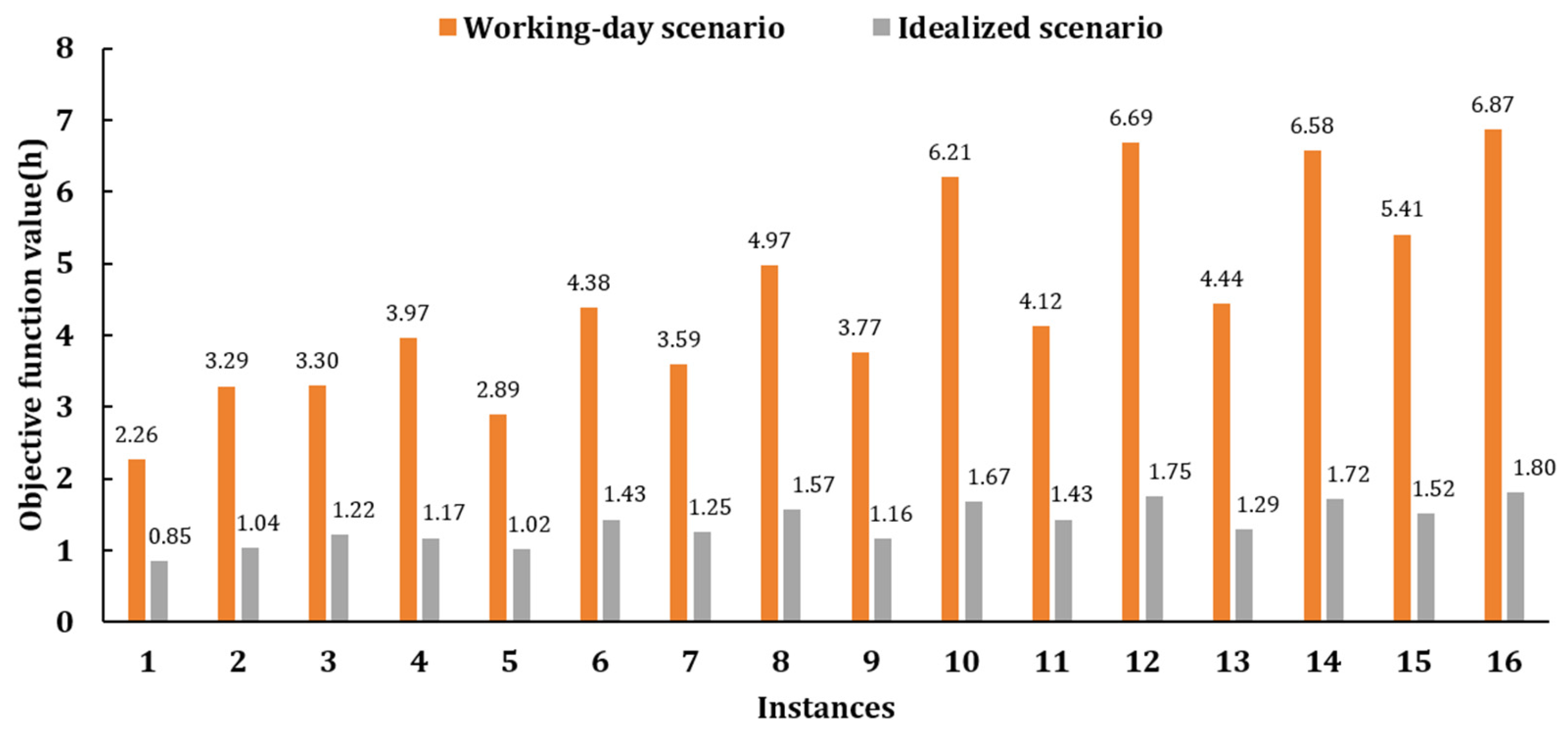
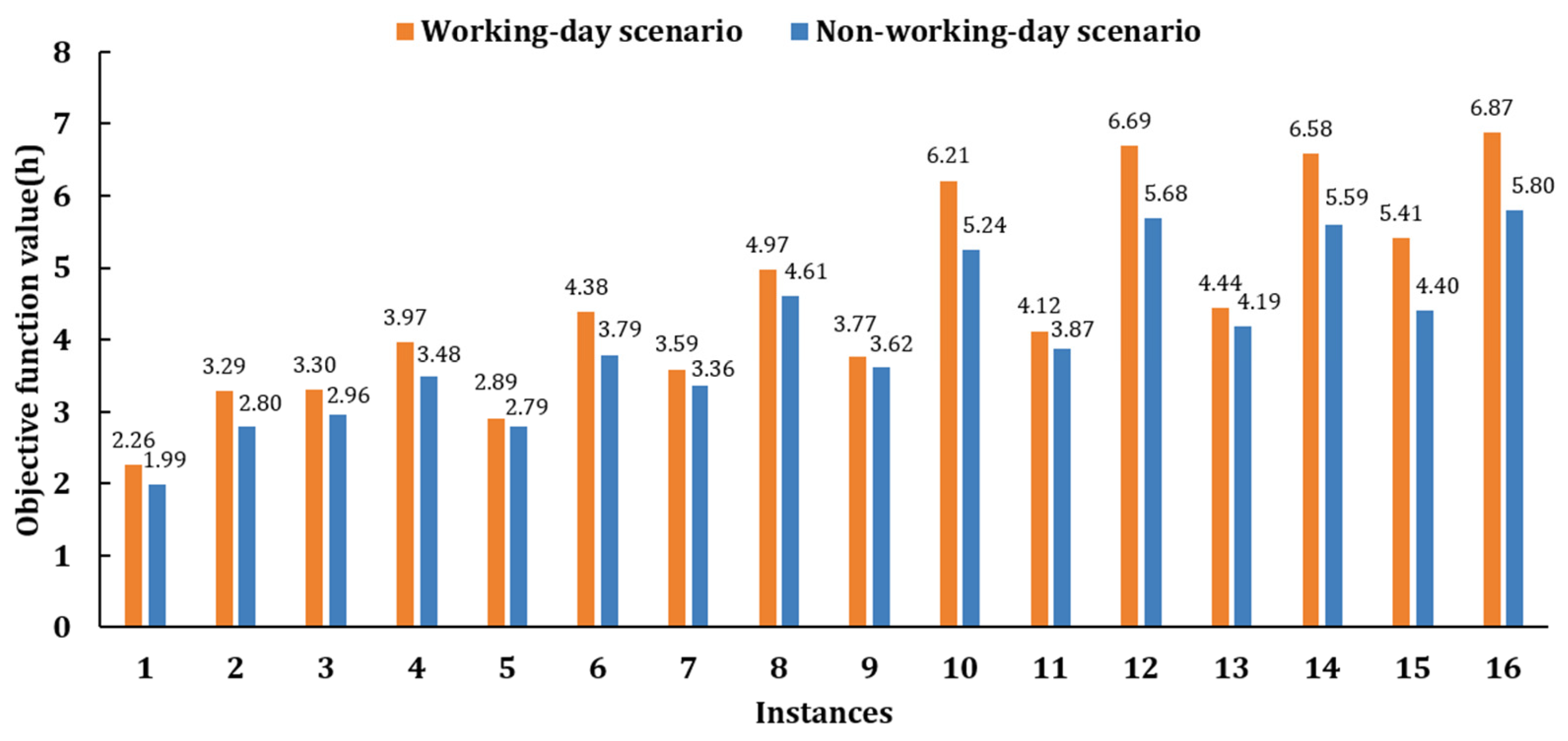
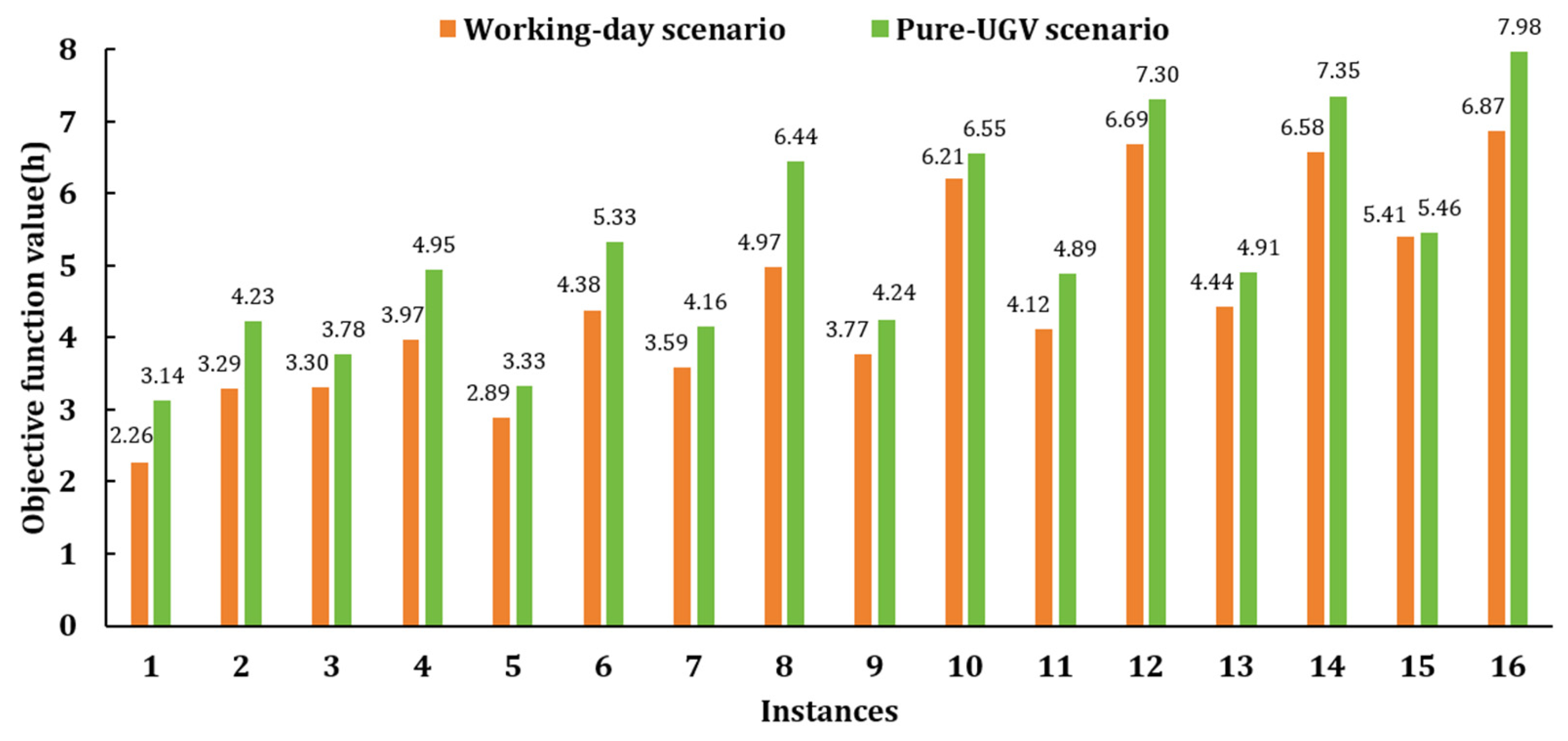
- By adopting an HMM-based map-matching algorithm and big data techniques, we generate instances across four diverse scenarios. Results show that UAV–UGV cooperative delivery reduces total time cost by 17.12% and highlights significant differences between idealized assumptions and realistic conditions.
- The MILP model incorporates a novel mathematical formulation to obtain exact solutions, while the HLNS algorithm combines greedy strategies, LNS, local search, and simulated annealing to achieve high-quality solutions with an average deviation of 0.22% from the optimal. Together, they provide a scalable and efficient approach for multi-carrier delivery scheduling under complex urban constraints.
- The simulation maps optimized routes onto urban road networks, bridging the gap between optimization results and practical operations, reducing execution uncertainty, and facilitating the engineering implementation of UAV–UGV cooperative delivery.
Abstract
1. Introduction
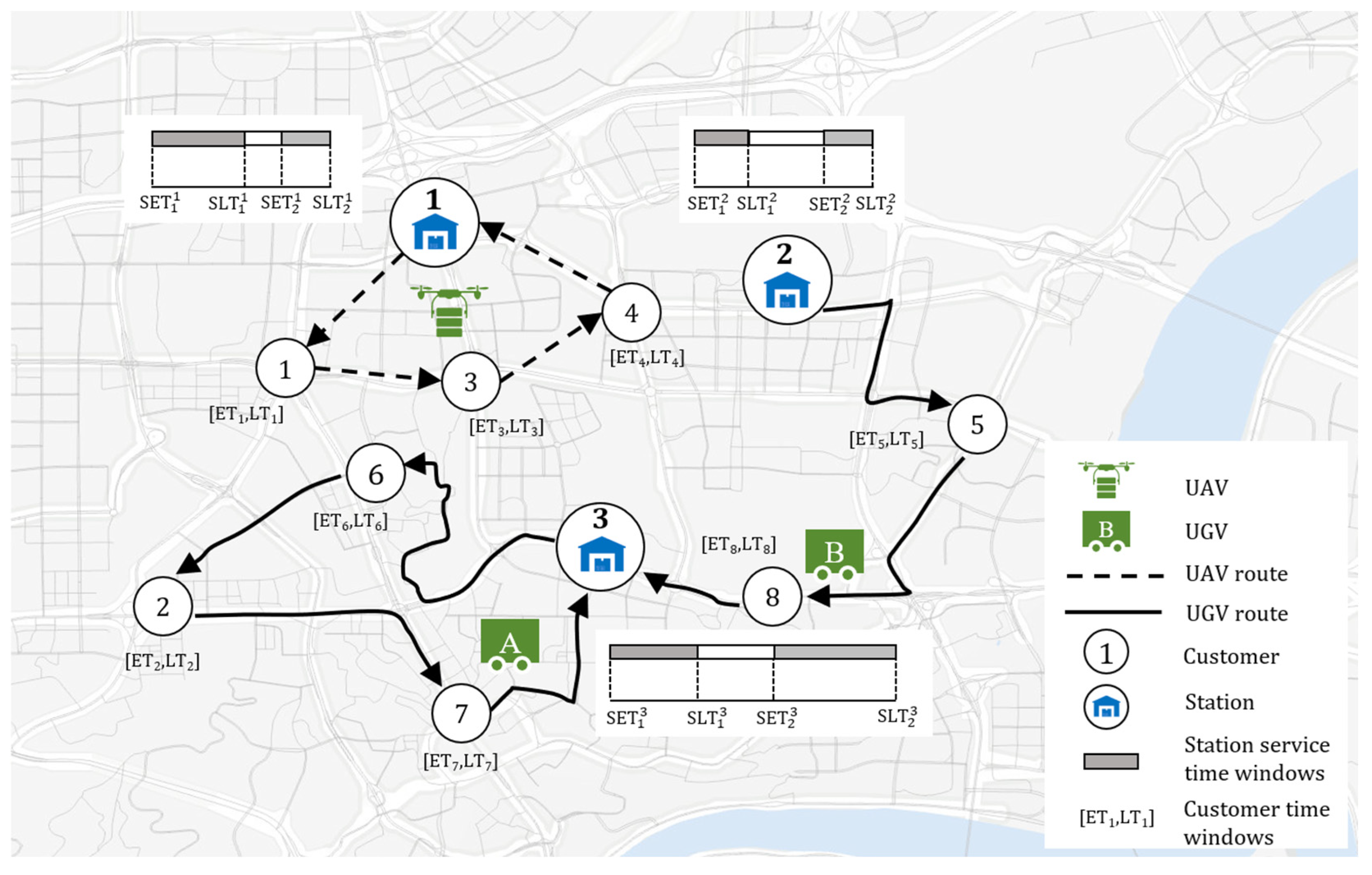
- We introduce the MSUUCDSP, a novel framework that incorporates a variety of realistic features, including multiple stations, station-specific multiple time windows, customer time windows, heterogeneous delivery carriers, half-open routing, and endurance constraints.
- We propose an MILP model and develop an HLNS algorithm that integrates greedy strategies, large neighborhood search (LNS), local search, and simulated annealing. The MILP model can be solved optimally using IBM ILOG CPLEX Optimization Studio (CPLEX) [17]. In particular, a novel mathematical approach is introduced to define the temporally discontinuous service availability mechanism.
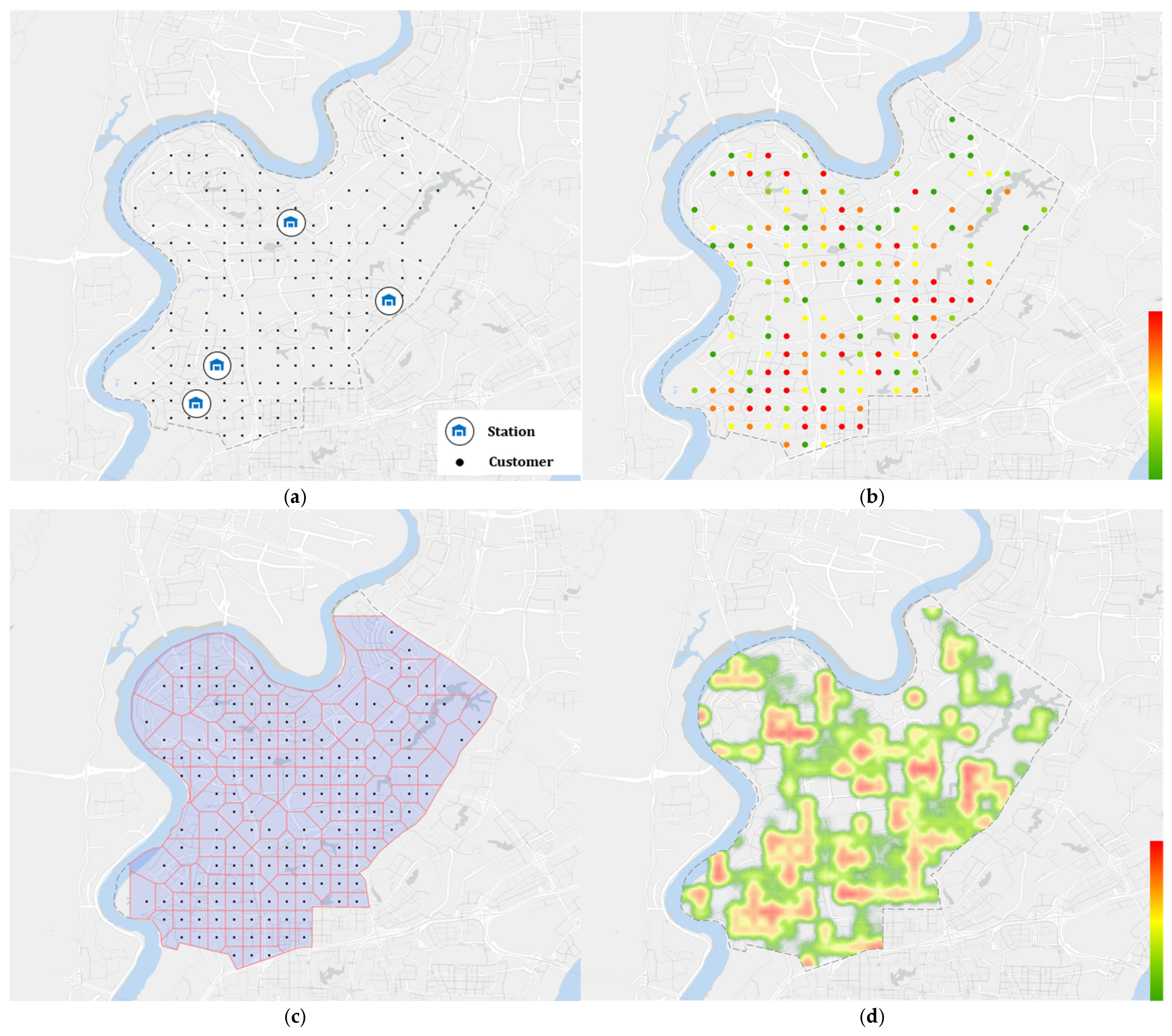
- By adopting a Hidden Markov Model (HMM)-based map-matching method and big data techniques, we construct two types of realistic instances and design four representative scenarios, resulting in a total of 82 computational experiments. The experimental results demonstrate that the MILP model and the proposed heuristic method outperform existing methods, and that UAV–UGV cooperative delivery offers efficiency advantages while highlighting the significant differences between idealized modeling assumptions and realistic urban operating conditions.
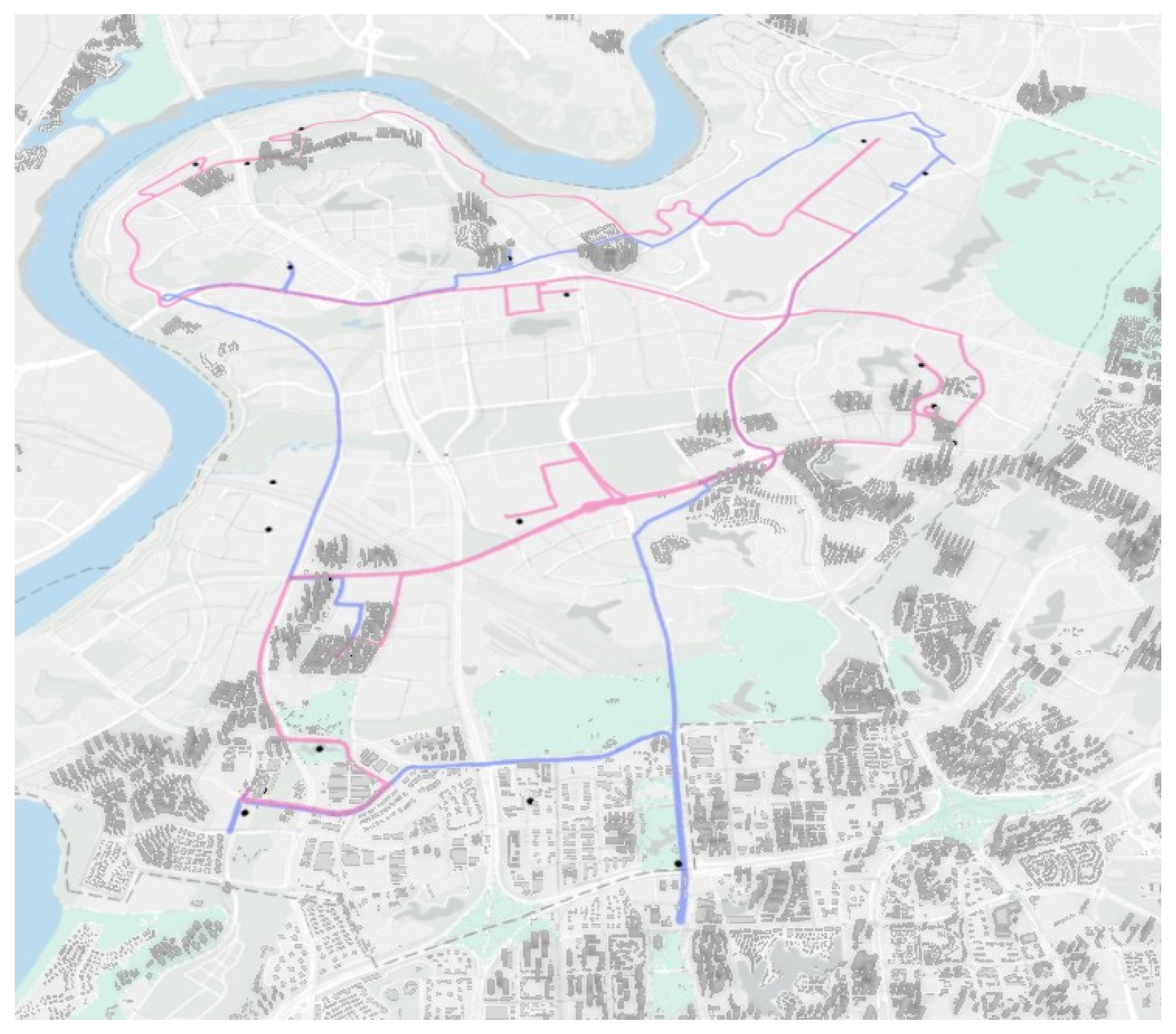
- We further develop an urban road network simulation based on Arc Geographic Information System (ArcGIS Pro 2.6) [18] to enable realistic 3D visualization of the delivery solutions. The simulation provides detailed route guidance for UGVs and offers an intuitive and actionable decision-support tool for logistics operators and engineering applications.
2. Related Work
2.1. UAV Routing Problem
2.2. UAV–UGV Scheduling Problem
2.3. Solution Methods
2.4. UAV–UGV Delivery System Applications
3. Problem Description and Methods
3.1. Problem Statement
- The delivery network is composed of a set of stations and a set of customers. Each station stores goods destined for customers and serves as a dispatch and return node for unmanned delivery carriers. The geographic locations of all stations and customers are known in advance. Delivery carriers may start their delivery missions from one station and terminate at the same or a different station, with a half-open routing scheme.
- The total number of available UAVs and UGVs in the delivery network is limited, while each station is assumed able to dispatch carriers as long as the overall fleet size constraint is satisfied. The payload capacity and endurance of each unmanned delivery carrier, as well as the loading speed at stations, are known and fixed.
- The demand of each customer is known and indivisible. Service to each customer is provided by one unmanned delivery carrier. Each customer may be served by either a UAV or a UGV, and the selection of the delivery carrier type is treated as a decision variable in the optimization process. The stations are assumed to have sufficient inventory to satisfy all customer demands.
- Due to operational and regulatory constraints, the temporally discontinuous service availability of stations is implemented as a service mechanism within specific time periods. Each station is associated with multiple time windows during which loading, dispatching, and recovery operations are allowed. Unmanned delivery carriers can only be loaded and dispatched when the corresponding station is available. After completing customer service, the delivery carriers must return to a station within its availability time window, and early arrival with waiting is prohibited.
- Customer service time windows define the allowable service intervals. Unmanned delivery carriers may arrive earlier than the time window but must initiate service within the specified interval. Late arrivals beyond the customer time window are not permitted.
- Real-world delivery conditions are considered to distinguish different transport characteristics of unmanned delivery carriers. UAVs are assumed to travel directly between nodes, and their travel distances are calculated based on Euclidean distances. In contrast, UGVs are constrained by the urban road networks, and their delivery routing must follow the actual road topology.
3.2. Mathematical Formulation
- Routing constraints
- Assignment constraints
- Temporally discontinuous service availability constraints
- Customer time window and time continuity constraints
- Unmanned delivery carrier use constraints
- Other constraints
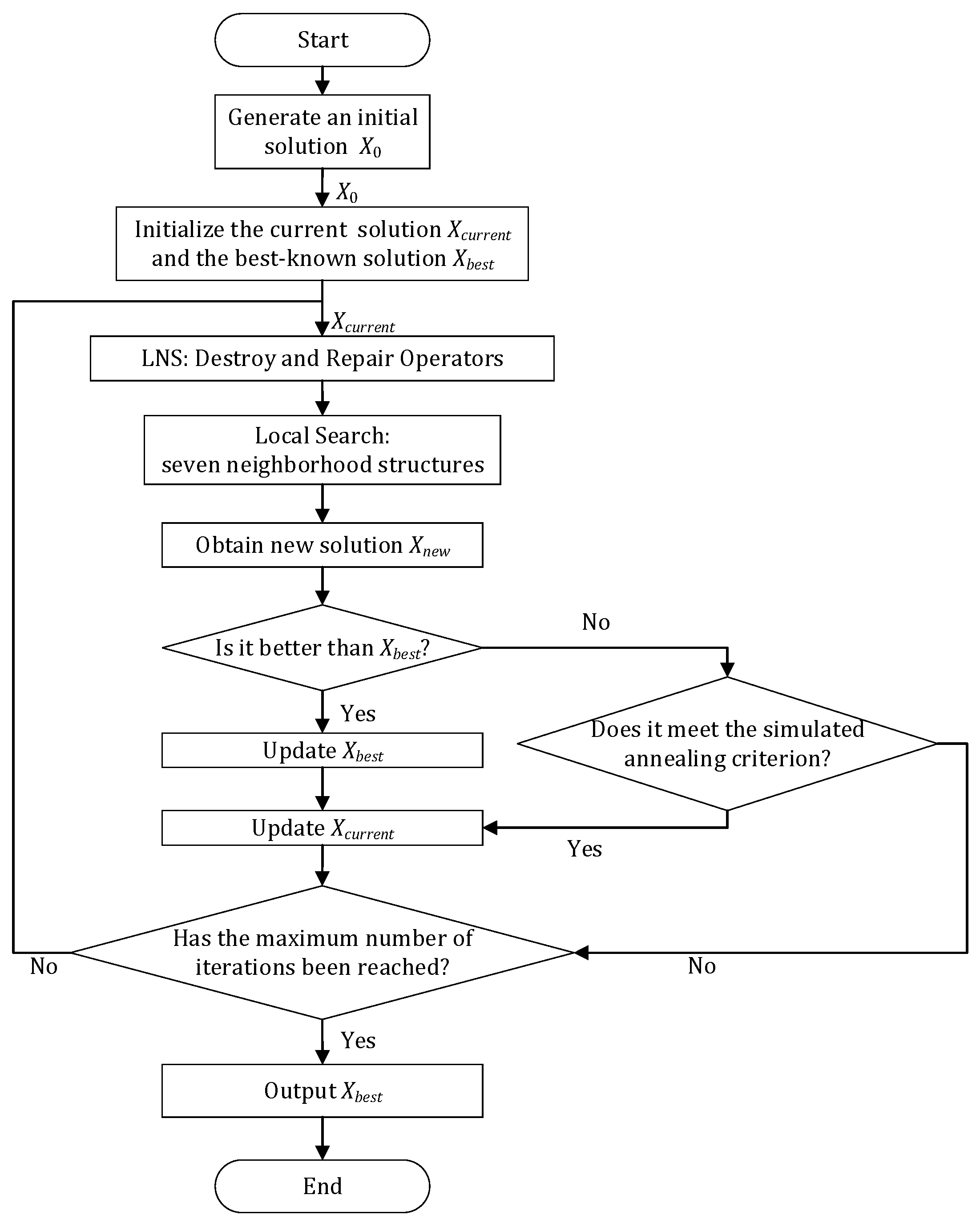
3.3. Hybrid Large Neighborhood Search Algorithm
| Algorithm 1: HLNS algorithm | |
| Input: instance data | |
| 1 | Generate initial solution X0 |
| 2 | Xcurrent = X0 |
| 3 | Xbest = X0 |
| 4 | for iter = 1 to maximum number of iterations do |
| 5 | Xnew = Repair (Destroy (Xcurrent)) |
| 6 | Xnew = Local Search (Xnew) |
| 7 | if f(Xnew) < f(Xbest) then |
| 8 | Xbest = Xnew |
| 9 | Xcurrent = Xnew |
| 10 | else |
| 11 | if acceptance criterion is satisfied then |
| 12 | Xcurrent = Xnew |
| 13 | end if |
| 14 | end if |
| 15 | end for |
| 16 | return Xbest |
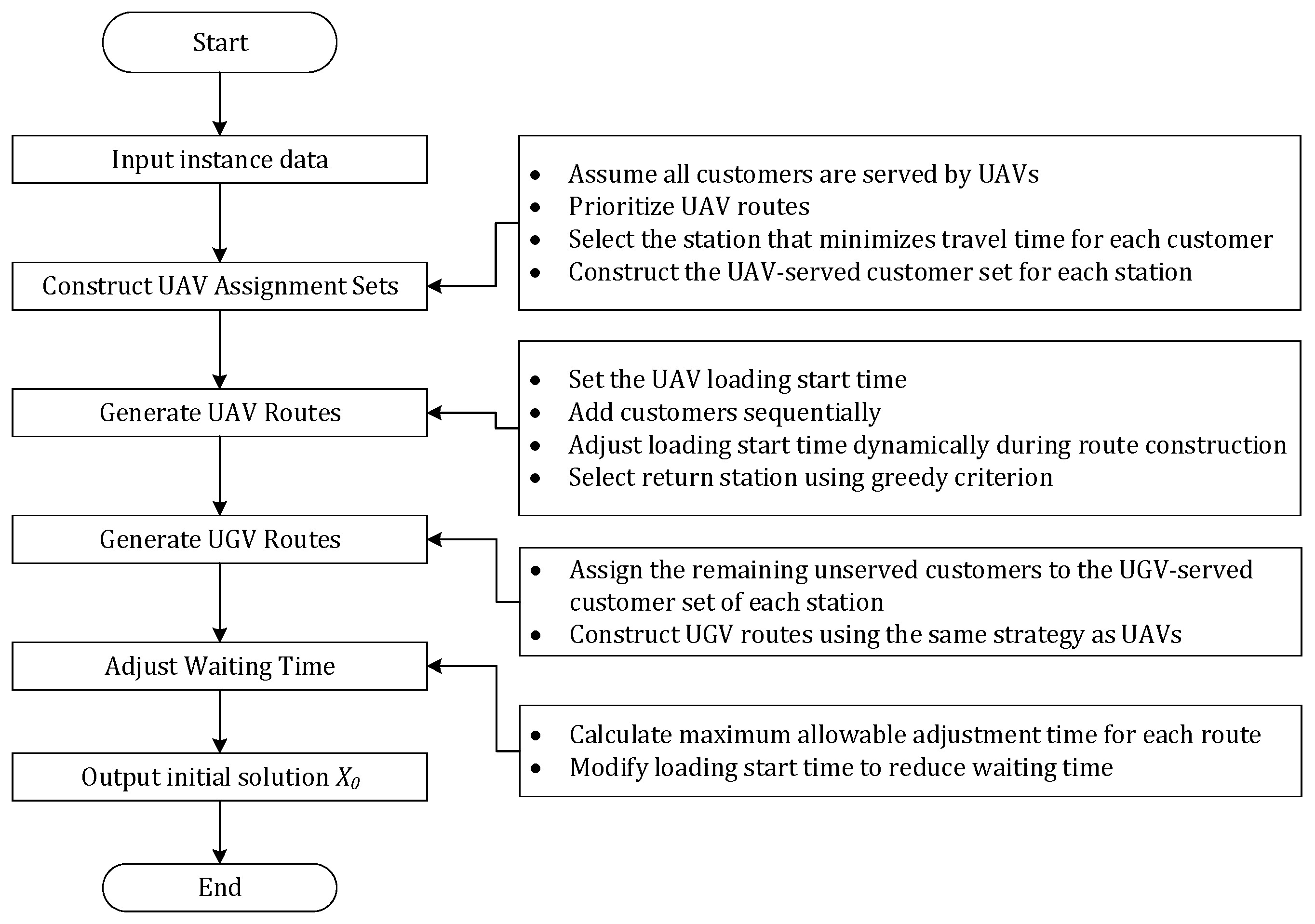
3.3.1. Initial Solution
3.3.2. Large Neighborhood Search and Local Search
3.3.3. Simulated Annealing Criterion
3.4. HMM-Based Map-Matching Approach
4. Computational Experiments
4.1. Test Instances and Scenario Settings
4.2. Computational Results
4.2.1. Results of the Exact Algorithm
4.2.2. Results and Comparison of the Heuristic Algorithm
4.2.3. Sensitivity Analysis
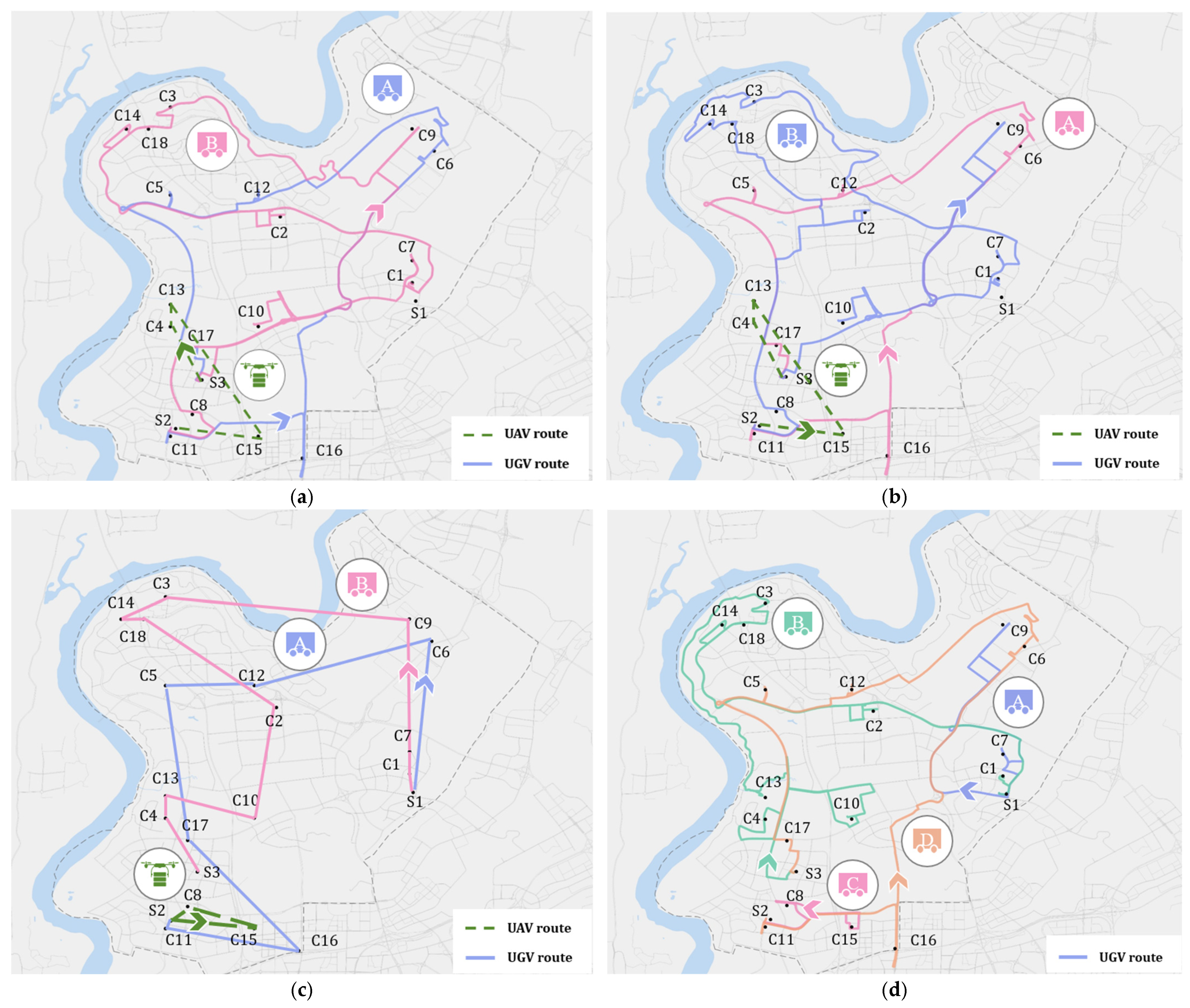
4.3. Delivery Scheme Simulation
5. Discussion
- Coordinated UAV–UGV fleet configuration can improve operational efficiency and reduce the objective value. The experimental results show that UAV–UGV cooperation significantly enhances efficiency, reducing the total time cost by 17.12% compared with single-mode delivery. This highlights the important role that UAVs play in urban delivery systems and demonstrates that significant value can be achieved with minimal investment. Under collaborative modes, the number of customers served by UAVs is relatively limited. Their primary role is not to replace ground vehicles, but to complement UGV operations by improving temporal coordination. Specifically, UAVs are better suited for serving customers with short service distances and highly overlapping time window requirements, whereas UGVs leverage their superior endurance to handle large-scale delivery tasks and achieve economies of scale. Moreover, the results indicate that not all stations participate in dispatching and recovery operations across all instances, and the assignment relationships between stations and customers are not fixed. Therefore, for logistics enterprises, it is essential to strike an appropriate balance between UAV flexibility and UGV scale efficiency through coordination mechanisms. At the same time, factors such as the spatial distribution of customers, time-window characteristics of stations and customers, road topology, and traffic conditions should be jointly considered when designing optimal delivery plans.
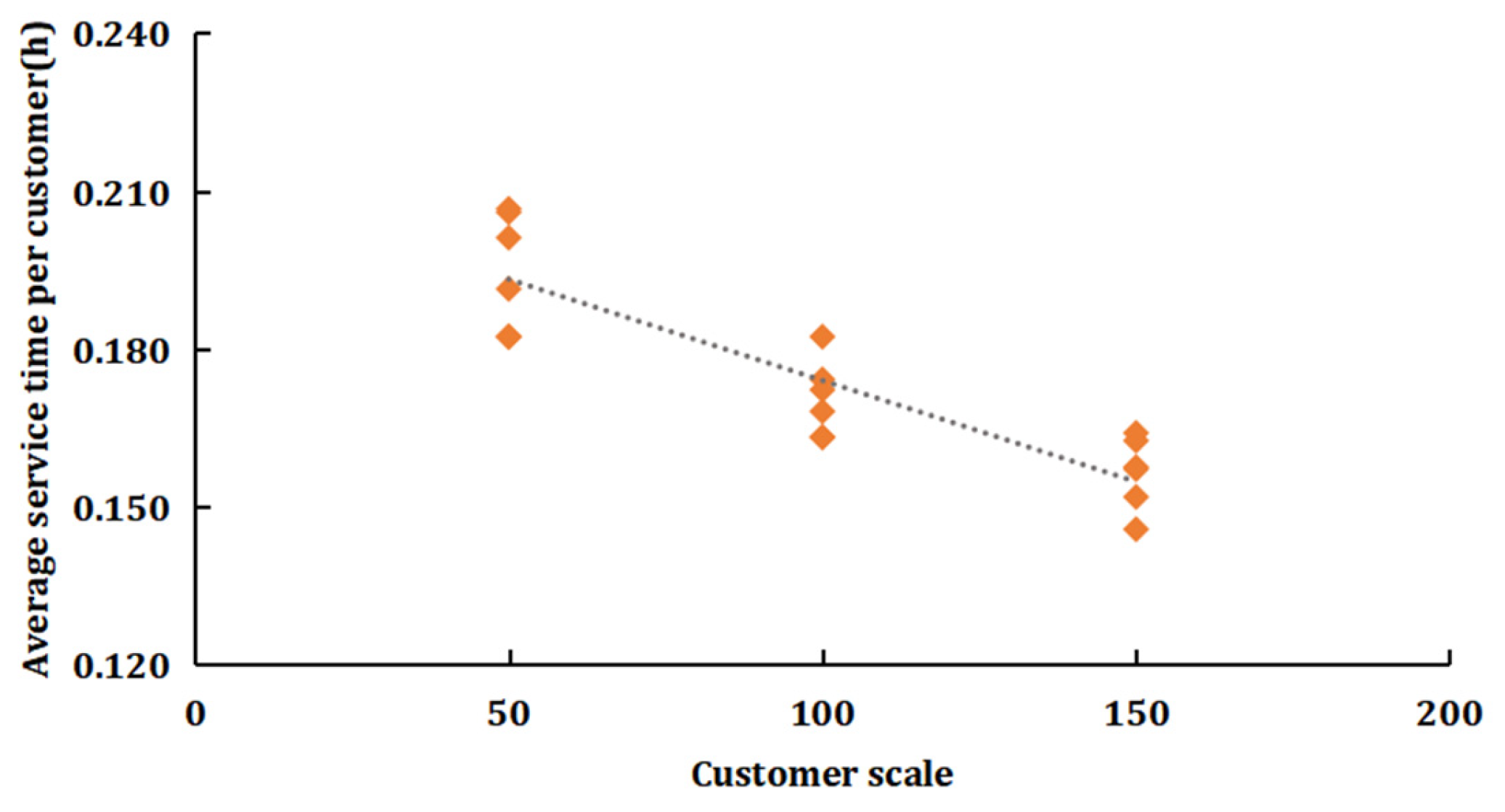
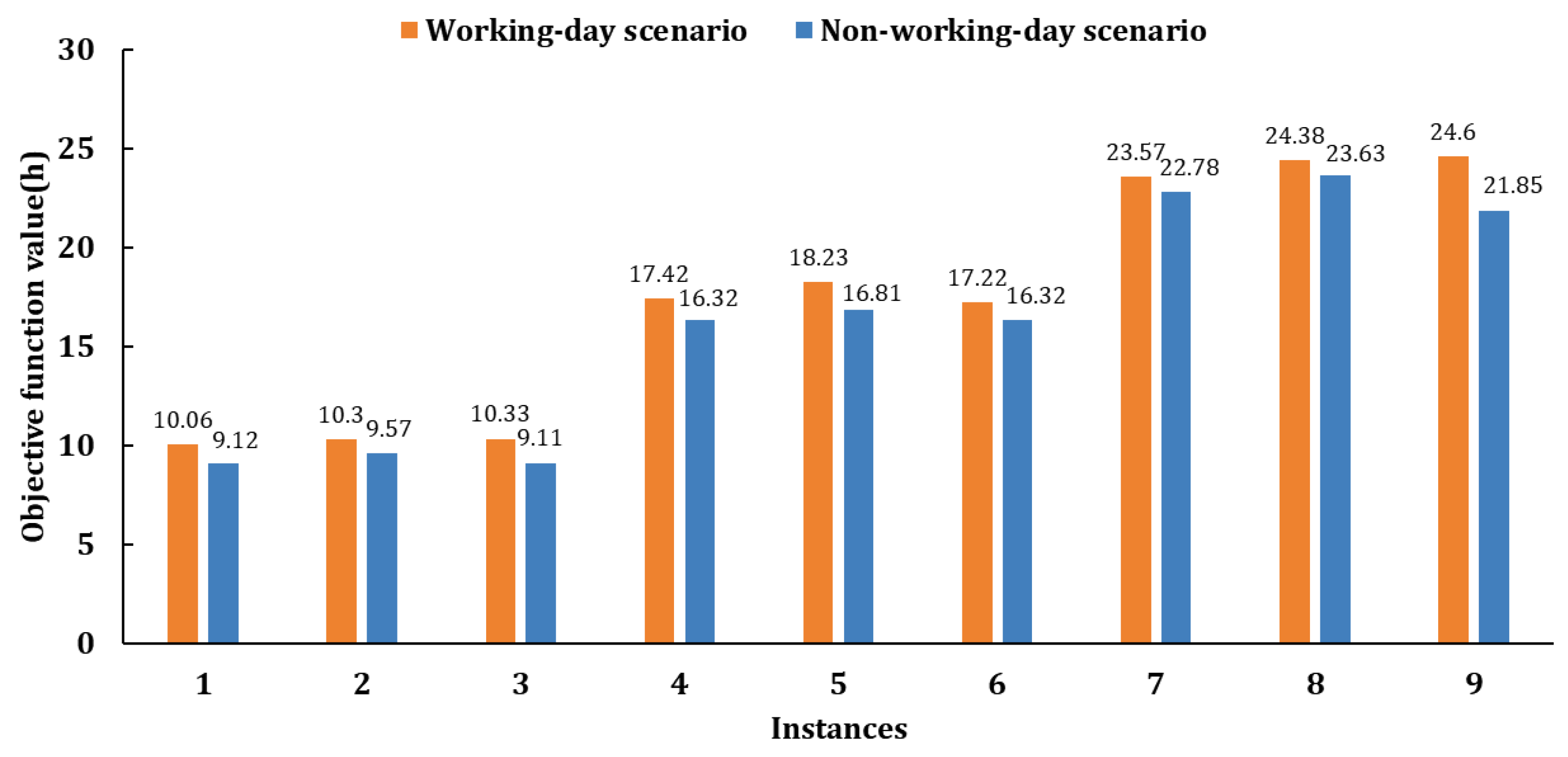
- Expanding the operational network can reduce the average service time per customer. Computational results for larger-scale realistic instances (Figure 9) show that, as the service area expands and customer density increases, unmanned delivery carriers can lower the average service time per customer. This characteristic of economies of scale suggests that, although logistics enterprises need to invest more resources during the initial network deployment, significant cost advantages can be realized in the long term, particularly in regions with high population density and concentrated demand.
- Modeling assumptions have a direct and significant impact on time cost estimation and operational decision-making. The substantial differences observed among solutions under different scenarios indicate that idealized assumptions, such as simplified road network representations or constant vehicle speeds, often lead to considerable deviations from real-world operations. In addition, factors that directly affect travel time between nodes, including traffic congestion levels and traffic flow, also exert a systematic influence on overall time costs. This implies that, in planning and dispatching decisions, logistics enterprises should rely as much as possible on realistic road networks and traffic information rather than overly simplified planning assumptions, in order to avoid underestimating operational time costs or generating solutions that are infeasible in practice. Enterprises can incorporate real-time traffic information into their optimization framework, integrate with an urban traffic management platform, and access traffic flow monitoring data, thereby enabling delivery route planning to dynamically adapt to changing traffic conditions.
- Integrating optimization models with urban simulation environments enhances the engineering applicability of solutions. Mapping routing solutions onto real-world road networks and implementing them in 3D simulations effectively bridges the gap between mathematical optimization results and logistics operations in practice. In particular, this integration helps resolve execution uncertainty arising from the existence of multiple feasible paths between nodes and provides intuitive and reliable support for refined operational management.
6. Conclusions
Author Contributions
Funding
Data Availability Statement
Conflicts of Interest
References
- Jeong, H.Y.; Song, B.D. Optimizing Urban Logistics: Vehicle Routing Problem with Underground Transportation. IEEE Trans. Intell. Transp. Syst. 2025, 26, 6393–6413. [Google Scholar] [CrossRef] [Scilit]
- Fagundes-Júnior, L.A.; Barcelos, C.O.; Silvatti, A.P.; Brandão, A.S. UAV–UGV Formation for Delivery Missions: A Practical Case Study. Drones 2025, 9, 48. [Google Scholar] [CrossRef] [Scilit]
- Khoufi, I.; Laouiti, A.; Adjih, C. A Survey of Recent Extended Variants of the Traveling Salesman and Vehicle Routing Problems for Unmanned Aerial Vehicles. Drones 2019, 3, 66. [Google Scholar] [CrossRef] [Scilit]
- Dantzig, G.B.; Ramser, J.H. The Truck Dispatching Problem. Manag. Sci. 1959, 6, 80–91. [Google Scholar] [CrossRef] [Scilit]
- Kyriakakis, N.A.; Marinaki, M.; Matsatsinis, N.; Marinakis, Y. A Cumulative Unmanned Aerial Vehicle Routing Problem Approach for Humanitarian Coverage Path Planning. Eur. J. Oper. Res. 2022, 300, 992–1004. [Google Scholar] [CrossRef] [Scilit]
- Liu, J.; Tong, L.; Xia, X. A Genetic Algorithm for Vehicle Routing Problems with Time Windows Based on Cluster of Geographic Positions and Time Windows. Appl. Soft Comput. 2025, 169, 112593. [Google Scholar] [CrossRef] [Scilit]
- Calamoneri, T.; Corò, F.; Mancini, S. Management of a Post-Disaster Emergency Scenario Through Unmanned Aerial Vehicles: Multi-Depot Multi-Trip Vehicle Routing with Total Completion Time Minimization. Expert Syst. Appl. 2024, 251, 123766. [Google Scholar] [CrossRef] [Scilit]
- Mondal, M.S.; Ramasamy, S.; Humann, J.D.; Dotterweich, J.M.; Reddinger, J.P.F.; Childers, M.A.; Bhounsule, P.A. Cooperative Multi-Agent Planning Framework for Fuel Constrained UAV-UGV Routing Problem. J. Intell. Robot. Syst. 2025, 111, 12. [Google Scholar] [CrossRef] [Scilit]
- Leng, K.; Li, S. Distribution Path Optimization for Intelligent Logistics Vehicles of Urban Rail Transportation Using VRP Optimization Model. IEEE Trans. Intell. Transp. Syst. 2021, 23, 1661–1669. [Google Scholar] [CrossRef] [Scilit]
- Wouda, N.A.; Lan, L.; Kool, W. PyVRP: A High-Performance VRP Solver Package. INFORMS J. Comput. 2024, 36, 943–955. [Google Scholar] [CrossRef] [Scilit]
- Wang, F.; Li, H.; Xiong, H. Truck–Drone Routing Problem with Stochastic Demand. Eur. J. Oper. Res. 2025, 322, 854–869. [Google Scholar] [CrossRef] [Scilit]
- Li, Y.; Wang, S.; Zhou, S.; Wang, Z. A Mathematical Formulation and a Tabu Search Heuristic for the Joint Vessel-UAV Routing Problem. Comput. Oper. Res. 2024, 169, 106723. [Google Scholar] [CrossRef] [Scilit]
- Guerriero, F.; Surace, R.; Loscri, V.; Natalizio, E. A Multi-Objective Approach for Unmanned Aerial Vehicle Routing Problem with Soft Time Windows Constraints. Appl. Math. Model. 2014, 38, 839–852. [Google Scholar] [CrossRef] [Scilit]
- Cattaruzza, D.; Absi, N.; Feillet, D. The Multi-Trip Vehicle Routing Problem with Time Windows and Release Dates. Transp. Sci. 2016, 50, 676–693. [Google Scholar] [CrossRef] [Scilit]
- Lau, H.C.; Sim, M.; Teo, K.M. Vehicle Routing Problem with Time Windows and a Limited Number of Vehicles. Eur. J. Oper. Res. 2003, 148, 559–569. [Google Scholar] [CrossRef] [Scilit]
- Hoogeboom, M.; Dullaert, W.; Lai, D.; Vigo, D. Efficient Neighborhood Evaluations for the Vehicle Routing Problem with Multiple Time Windows. Transp. Sci. 2020, 54, 400–416. [Google Scholar] [CrossRef] [Scilit]
- IBM. IBM ILOG CPLEX Optimization Studio CPLEX User’s Manual. 2019. Available online: https://www.ibm.com/products/ilog-cplex-optimization-studio (accessed on 4 January 2026).
- Environmental Systems Research Institute. GIS Tutorial for ArcGIS Pro 2.6. 2020. Available online: https://pro.arcgis.com/en/pro-app/2.6/get-started/get-started.htm (accessed on 8 January 2026).
- Khoufi, I.; Laouiti, A.; Adjih, C.; Hadded, M. UAVs Trajectory Optimization for Data Pick Up and Delivery with Time Window. Drones 2021, 5, 27. [Google Scholar] [CrossRef] [Scilit]
- Shi, J.; Mao, H.; Zhou, Z.; Zheng, L. Adaptive Large Neighborhood Search Algorithm for the Unmanned Aerial Vehicle Routing Problem with Recharging. Appl. Soft Comput. 2023, 147, 110831. [Google Scholar] [CrossRef] [Scilit]
- Stodola, P.; Kutěj, L. Multi-Depot Vehicle Routing Problem with Drones: Mathematical Formulation, Solution Algorithm and Experiments. Expert Syst. Appl. 2024, 241, 122483. [Google Scholar] [CrossRef] [Scilit]
- Wen, J.; Wang, F.; Su, Y. A Bi-Layer Collaborative Planning Framework for Multi-UAV Delivery Tasks in Multi-Depot Urban Logistics. Drones 2025, 9, 512. [Google Scholar] [CrossRef] [Scilit]
- Wang, Y.; Wang, Z.; Hu, X.P.; Xue, G.Q.; Guan, X.Y. Truck–Drone Hybrid Routing Problem with Time-Dependent Road Travel Time. Transp. Res. Part C 2022, 144, 103901. [Google Scholar] [CrossRef] [Scilit]
- Lu, F.Q.; Gao, Z.Y.; Jiang, R.X.; Bi, H.L. Routing Optimization of Takeout Delivery Routes under Joint Delivery Model of Drones, Occasional Drivers, and Riders. IEEE Trans. Intell. Transp. Syst. 2025, 26, 12. [Google Scholar] [CrossRef] [Scilit]
- Han, Y.Q.; Li, J.Q.; Liu, Z.; Liu, C.; Tian, J. Metaheuristic Algorithm for Solving the Multi-Objective Vehicle Routing Problem with Time Window and Drones. Int. J. Adv. Robot. Syst. 2020, 17, 1729881420920031. [Google Scholar] [CrossRef] [Scilit]
- Luo, Q.; Wu, G.; Ji, B.; Wang, L.; Suganthan, P.N. Hybrid Multi-Objective Optimization Approach with Pareto Local Search for Collaborative Truck-Drone Routing Problems Considering Flexible Time Windows. IEEE Trans. Intell. Transp. Syst. 2021, 23, 13011–13025. [Google Scholar] [CrossRef] [Scilit]
- Lenstra, J.K.; Kan, A.R. Complexity of Vehicle Routing and Scheduling Problems. Networks 1981, 11, 221–227. [Google Scholar] [CrossRef] [Scilit]
- Fischetti, M.; Toth, P.; Vigo, D. A Branch-and-Bound Algorithm for the Capacitated Vehicle Routing Problem on Directed Graphs. Oper. Res. 1994, 42, 846–859. [Google Scholar] [CrossRef] [Scilit]
- Song, B.D.; Park, K.; Kim, J. Persistent UAV Delivery Logistics: MILP Formulation and Efficient Heuristic. Comput. Ind. Eng. 2018, 120, 418–428. [Google Scholar] [CrossRef] [Scilit]
- Meng, S.; Guo, X.; Li, D.; Liu, G. The Multi-Visit Drone Routing Problem for Pickup and Delivery Services. Transp. Res. Part E Logist. Transp. Rev. 2023, 169, 102990. [Google Scholar] [CrossRef] [Scilit]
- Coelho, B.N.; Coelho, V.N.; Coelho, I.M.; Ochi, L.S.; Haghnazar, R.; Zuidema, D.; Lima, M.S.F.; da Costa, A.R. A Multi-Objective Green UAV Routing Problem. Comput. Oper. Res. 2017, 88, 306–315. [Google Scholar] [CrossRef] [Scilit]
- Ribeiro, R.G.; Cota, L.P.; Euzébio, T.A.; Ramírez, J.A.; Guimarães, F.G. Unmanned-Aerial-Vehicle Routing Problem with Mobile Charging Stations for Assisting Search and Rescue Missions in Postdisaster Scenarios. IEEE Trans. Syst. Man Cybern. Syst. 2021, 52, 6682–6696. [Google Scholar] [CrossRef] [Scilit]
- Jolfaei, A.A.; Alinaghian, M. Multi-Depot Vehicle Routing Problem with Roaming Delivery Locations Considering Hard Time Windows: Solved by a Hybrid ELS-LNS Algorithm. Expert Syst. Appl. 2024, 255, 124608. [Google Scholar] [CrossRef] [Scilit]
- Zhang, Z.; Luo, Z.; Baldacci, R.; Lim, A. A Benders Decomposition Approach for the Multivehicle Production Routing Problem with Order-Up-to-Level Policy. Transp. Sci. 2021, 55, 160–178. [Google Scholar] [CrossRef] [Scilit]
- Faiz, T.I.; Vogiatzis, C.; Noor-E-Alam, M. A Column Generation Algorithm for Vehicle Scheduling and Routing Problems. Comput. Ind. Eng. 2019, 130, 222–236. [Google Scholar] [CrossRef] [Scilit]
- Rabbouch, B.; Saâdaoui, F.; Mraihi, R. Efficient Implementation of the Genetic Algorithm to Solve Rich Vehicle Routing Problems. Oper. Res. 2021, 21, 1763–1791. [Google Scholar] [CrossRef] [Scilit]
- Cuervo, D.P.; Goos, P.; Sörensen, K.; Arráiz, E. An Iterated Local Search Algorithm for the Vehicle Routing Problem with Backhauls. Eur. J. Oper. Res. 2014, 237, 454–464. [Google Scholar] [CrossRef] [Scilit]
- Nucamendi-Guillén, S.; Angel-Bello, F.; Martínez-Salazar, I.; Cordero-Franco, A.E. The Cumulative Capacitated Vehicle Routing Problem: New Formulations and Iterated Greedy Algorithms. Expert Syst. Appl. 2018, 113, 315–327. [Google Scholar] [CrossRef] [Scilit]
- Vincent, F.Y.; Redi, A.P.; Hidayat, Y.A.; Wibowo, O.J. A Simulated Annealing Heuristic for the Hybrid Vehicle Routing Problem. Appl. Soft Comput. 2017, 53, 119–132. [Google Scholar] [CrossRef] [Scilit]
- Ananda, S.P.; Baizal, Z.K.A.; Wulandari, G.S. Improved Whale Optimization Algorithm with Variable Neighbourhood Search Strategy (WOA-VNS) in Solving Vehicle Routing Problem (VRP) for Recommending Multi-Days Tourist Routes in Yogyakarta. Int. J. Intell. Eng. Syst. 2024, 17, 5. [Google Scholar] [CrossRef] [Scilit]
- Özkır, R.; Coban, E. ALNS Algorithm for Load Handling and AGV Routing with Trolleys. Comput. Ind. Eng. 2025, 208, 111334. [Google Scholar] [CrossRef] [Scilit]
- Munasinghe, I.; Perera, A.; Deo, R.C. A Comprehensive Review of UAV-UGV Collaboration: Advancements and Challenges. J. Sens. Actuator Netw. 2024, 13, 81. [Google Scholar] [CrossRef] [Scilit]
- Kanarskyi, Y.; Kharchenko, V.; Orekhov, O.; Ponochovnyi, Y. Markov Modelling of Human–Machine Interaction in an Augmented Reality Environment for UAV/UGV-Based Hazardous Area Monitoring Systems. Radioelectron. Comput. Syst. 2025, 4, 35–54. [Google Scholar] [CrossRef] [Scilit]
- Lin, J.; Zhou, W.; Wolfson, O. Electric Vehicle Routing Problem. Transp. Res. Procedia 2016, 12, 508–521. [Google Scholar] [CrossRef] [Scilit]
- Belhaiza, S.; Hansen, P.; Laporte, G. A Hybrid Variable Neighborhood Tabu Search Heuristic for the Vehicle Routing Problem with Multiple Time Windows. Comput. Oper. Res. 2014, 52, 269–281. [Google Scholar] [CrossRef] [Scilit]
- Shaw, P. Using Constraint Programming and Local Search Methods to Solve Vehicle Routing Problems. In Proceedings of the International Conference on Principles and Practice of Constraint Programming, Berlin, Germany, 26–30 October 1998; pp. 417–431. [Google Scholar] [CrossRef] [Scilit]
- Eskandarpour, M.; Dejax, P.; Péton, O. A Large Neighborhood Search Heuristic for Supply Chain Network Design. Comput. Oper. Res. 2017, 80, 23–37. [Google Scholar] [CrossRef] [Scilit]
- Li, C.; Zhu, Y.; Lee, K.Y. Route Optimization of Electric Vehicles Based on Reinsertion Genetic Algorithm. IEEE Trans. Transp. Electrif. 2023, 9, 3753–3768. [Google Scholar] [CrossRef] [Scilit]
- Huang, H.; Yang, S.; Li, X.; Hao, Z. An Embedded Hamiltonian Graph-Guided Heuristic Algorithm for Two-Echelon Vehicle Routing Problem. IEEE Trans. Cybern. 2021, 52, 5695–5707. [Google Scholar] [CrossRef] [Scilit]
- Atia, M.M.; Hilal, A.R.; Stellings, C.; Hartwell, E.; Toonstra, J.; Miners, W.B.; Basir, O.A. A Low-Cost Lane-Determination System Using GNSS/IMU Fusion and HMM-Based Multistage Map Matching. IEEE Trans. Intell. Transp. Syst. 2017, 18, 3027–3037. [Google Scholar] [CrossRef] [Scilit]
- Shlezinger, N.; Farsad, N.; Eldar, Y.C.; Goldsmith, A.J. ViterbiNet: A Deep Learning Based Viterbi Algorithm for Symbol Detection. IEEE Trans. Wirel. Commun. 2020, 19, 3319–3331. [Google Scholar] [CrossRef] [Scilit]
- Lou, Y.; Zhang, C.; Zheng, Y.; Xie, X.; Wang, W.; Huang, Y. Map-Matching for Low-Sampling-Rate GPS Trajectories. In Proceedings of the 17th ACM SIGSPATIAL International Conference on Advances in Geographic Information Systems, Seattle, WA, USA, 4–6 November 2009; pp. 352–361. [Google Scholar] [CrossRef] [Scilit]
- Python Software Foundation. 2022. Available online: https://docs.python.org/3.11/tutorial/index.html (accessed on 5 January 2026).
- Chin, K.; Huang, H.; Horn, C.; Kasanicky, I.; Weibel, R. Inferring Fine-Grained Transport Modes from Mobile Phone Cellular Signaling Data. Comput. Environ. Urban Syst. 2019, 77, 101348. [Google Scholar] [CrossRef] [Scilit]
- Liu, Y.; Shi, X.; Liu, J.; Qin, P.; Tang, C. Warehouse-Distribution Integration Routing Problem Under Real-World Transport Conditions with Multiple Time Windows and Variable Loading Efficiency. Transp. Res. Part E Logist. Transp. Rev. 2025, 203, 104343. [Google Scholar] [CrossRef] [Scilit]
- Vaidya, O.S.; Kumar, S. Analytic Hierarchy Process: An Overview of Applications. Eur. J. Oper. Res. 2006, 169, 1–29. [Google Scholar] [CrossRef] [Scilit]
- Muthulakshmi, M.; Shanmugapriya, M.M. Shortest Path Algorithm and Its Implementation. Int. J. Math. Trends Technol. 2016, 36, 82–85. [Google Scholar] [CrossRef] [Scilit]
- Liu, F.; Yu, H.; Gao, H.J.; Dai, H.L.; Ma, J. Design Optimization and Strength Analysis of a Heavy-Duty Quadrotor UAV. Adv. Aeronaut. Sci. Eng. 2018, 9, 99–106. [Google Scholar] [CrossRef]






| Notation | Meaning |
|---|---|
| Sets | |
| Station set. | |
| Customer set. | |
| Unmanned delivery carriers, where denotes the set of UAVs and denotes the set of UGVs. | |
| Parameters | |
| Payload capacity of each unmanned delivery carrier, | |
| The travel time of a UAV from node i to j, where | |
| The travel time of a UGV from node i to j, where | |
| The loading speed at stations. | |
| Time required for an unmanned delivery carrier to serve customer i. | |
| Station time window count. | |
| Customer time window, including earliest service time and latest service time where | |
| Station time windows, including earliest opening time and latest opening time where , | |
| The maximum number of UAVs. | |
| The maximum number of UGVs. | |
| Customer demand, where | |
| The maximum endurance of each UAV. | |
| The maximum endurance of each UGV. | |
| M | A large enough positive integer. |
| Variables | |
| Binary decision variable equal to 1 if unmanned delivery carrier k travels from node i to node j, and 0 otherwise, where | |
| Binary decision variable equal to 1 if unmanned delivery carrier k is used, and 0 otherwise, where | |
| Binary decision variable equal to 1 if unmanned delivery carrier k visits customer and 0 otherwise, where | |
| Binary decision variable equal to 1 if the goods of customer i are assigned to station m, and 0 otherwise, where | |
| Binary decision variable equal to 1 if customer i, assigned to station m, is visited by unmanned delivery carrier k, and 0 otherwise, where | |
| Continuous variable indicating the loading start time of unmanned delivery carrier k at station m, where | |
| Continuous variable indicating the departure time of unmanned delivery carrier k from station m, where | |
| Continuous variable indicating the arrival time of unmanned delivery carrier k at node i, where | |
| Continuous variable indicating the waiting time of unmanned delivery carrier k at customer i, where | |
| Auxiliary binary decision variable equal to 1 if the loading start time of unmanned delivery carrier k at station m is after the earliest opening time of the -th time window, and 0 otherwise, where | |
| Auxiliary binary decision variable equal to 1 if the loading start time of unmanned delivery carrier k at station m is before the latest opening time of the -th time window, and 0 otherwise, where | |
| Binary decision variable equal to 1 if the loading start time of unmanned delivery carrier k at station m falls within the -th time window, and 0 otherwise, where | |
| Auxiliary binary decision variable equal to 1 if the return time of unmanned delivery carrier k at station m is after the earliest opening time of the -th time window, and 0 otherwise, where | |
| Auxiliary binary decision variable equal to 1 if the return time of unmanned delivery carrier k at station m is before the latest opening time of the -th time window, and 0 otherwise, where | |
| Binary decision variable equal to 1 if the return time of unmanned delivery carrier k at station m falls within the -th time window, and 0 otherwise, where |
| No. | N | S | C | UAVWD | SDPRWD | SRPRWD | ObjWD | TimeWD | ObjWD-E | TimeWD-E | DevObj-E | DevTime-E |
|---|---|---|---|---|---|---|---|---|---|---|---|---|
| 1 | 12 | 3 | 9 | 22.22% | 66.67% | 66.67% | 2.259 | 0.65 | 2.259 | 0.87 | 0.00% | 33.85% |
| 2 | 12 | 3 | 9 | 22.22% | 66.67% | 66.67% | 3.288 | 1.00 | 3.288 | 1.96 | 0.00% | 96.00% |
| 3 | 12 | 2 | 10 | 10.00% | 50.00% | 100.00% | 3.304 | 3.07 | 3.304 | 3.46 | 0.00% | 12.70% |
| 4 | 12 | 2 | 10 | 20.00% | 100.00% | 50.00% | 3.965 | 5.54 | 3.965 | 6.82 | 0.00% | 23.10% |
| 5 | 15 | 3 | 12 | 25.00% | 100.00% | 100.00% | 2.894 | 3.22 | 2.894 | 4.25 | 0.00% | 31.99% |
| 6 | 15 | 3 | 12 | 25.00% | 33.33% | 66.67% | 4.383 | 7.95 | 4.383 | 28.24 | 0.00% | 255.22% |
| 7 | 15 | 2 | 13 | 15.38% | 50.00% | 100.00% | 3.589 | 5.69 | 3.589 | 7.40 | 0.00% | 30.05% |
| 8 | 15 | 2 | 13 | 23.08% | 100.00% | 100.00% | 4.972 | 18.35 | 4.972 | 34.58 | 0.00% | 88.45% |
| 9 | 18 | 3 | 15 | 20.00% | 66.67% | 100.00% | 3.765 | 21.05 | 3.765 | 34.88 | 0.00% | 65.70% |
| 10 | 18 | 3 | 15 | 13.33% | 100.00% | 100.00% | 6.210 | 5400.00 | 6.224 | 5400.00 | 0.23% | —— |
| 11 | 18 | 2 | 16 | 18.75% | 100.00% | 100.00% | 4.121 | 14.13 | 4.121 | 17.42 | 0.00% | 23.28% |
| 12 | 18 | 2 | 16 | 18.75% | 100.00% | 100.00% | 6.690 | 2609.59 | 6.690 | 3346.41 | 0.00% | 28.24% |
| 13 | 21 | 3 | 18 | 16.67% | 66.67% | 66.67% | 4.436 | 177.78 | 4.436 | 249.01 | 0.00% | 40.07% |
| 14 | 21 | 3 | 18 | 16.67% | 33.33% | 66.67% | 6.582 | 5400.00 | 6.624 | 5400.00 | 0.64% | —— |
| 15 | 21 | 2 | 19 | 10.53% | 100.00% | 100.00% | 5.405 | 5400.00 | 5.448 | 5400.00 | 0.80% | —— |
| 16 | 21 | 2 | 19 | 15.79% | 100.00% | 100.00% | 6.873 | 5400.00 | 7.195 | 5400.00 | 4.68% | —— |
| No. | N | S | C | UAVNWD | SDPRNWD | SRPRNWD | ObjNWD | TimeNWD | Dev1 |
|---|---|---|---|---|---|---|---|---|---|
| 1 | 12 | 3 | 9 | 22.22% | 66.67% | 66.67% | 1.992 | 0.43 | −13.40% |
| 2 | 12 | 3 | 9 | 33.33% | 33.33% | 66.67% | 2.802 | 1.05 | −17.34% |
| 3 | 12 | 2 | 10 | 10.00% | 50.00% | 100.00% | 2.960 | 4.49 | −11.62% |
| 4 | 12 | 2 | 10 | 20.00% | 100.00% | 50.00% | 3.481 | 3.62 | −13.90% |
| 5 | 15 | 3 | 12 | 25.00% | 100.00% | 100.00% | 2.793 | 4.42 | −3.62% |
| 6 | 15 | 3 | 12 | 25.00% | 33.33% | 66.67% | 3.790 | 4.58 | −15.65% |
| 7 | 15 | 2 | 13 | 23.08% | 50.00% | 100.00% | 3.364 | 8.94 | −6.69% |
| 8 | 15 | 2 | 13 | 23.08% | 100.00% | 100.00% | 4.607 | 8.19 | −7.92% |
| 9 | 18 | 3 | 15 | 20.00% | 66.67% | 66.67% | 3.624 | 38.71 | −3.89% |
| 10 | 18 | 3 | 15 | 13.33% | 66.67% | 66.67% | 5.243 | 1960.59 | −18.44% |
| 11 | 18 | 2 | 16 | 18.75% | 100.00% | 100.00% | 3.872 | 22.82 | −6.43% |
| 12 | 18 | 2 | 16 | 12.50% | 100.00% | 100.00% | 5.684 | 12.03 | −17.70% |
| 13 | 21 | 3 | 18 | 16.67% | 66.67% | 66.67% | 4.189 | 355.82 | −5.90% |
| 14 | 21 | 3 | 18 | 16.67% | 100.00% | 66.67% | 5.591 | 5400.00 | −17.72% |
| 15 | 21 | 2 | 19 | 15.79% | 100.00% | 100.00% | 4.404 | 98.45 | −22.73% |
| 16 | 21 | 2 | 19 | 15.79% | 100.00% | 100.00% | 5.804 | 5400.00 | −18.42% |
| No. | N | S | C | UAVI | SDPRI | SRPRI | ObjI | TimeI | Dev2 |
|---|---|---|---|---|---|---|---|---|---|
| 1 | 12 | 3 | 9 | 22.22% | 100.00% | 100.00% | 0.850 | 0.70 | −62.37% |
| 2 | 12 | 3 | 9 | 22.22% | 66.67% | 100.00% | 1.038 | 1.18 | −68.43% |
| 3 | 12 | 2 | 10 | 10.00% | 100.00% | 100.00% | 1.216 | 2.43 | −63.20% |
| 4 | 12 | 2 | 10 | 20.00% | 50.00% | 100.00% | 1.171 | 2.66 | −70.47% |
| 5 | 15 | 3 | 12 | 8.33% | 66.67% | 66.67% | 1.023 | 3.86 | −64.65% |
| 6 | 15 | 3 | 12 | 16.67% | 66.67% | 33.33% | 1.429 | 6.05 | −67.40% |
| 7 | 15 | 2 | 13 | 7.69% | 100.00% | 100.00% | 1.249 | 6.25 | −65.20% |
| 8 | 15 | 2 | 13 | 7.69% | 100.00% | 50.00% | 1.572 | 5.50 | −68.38% |
| 9 | 18 | 3 | 15 | 13.33% | 66.67% | 66.67% | 1.161 | 7.31 | −69.16% |
| 10 | 18 | 3 | 15 | 13.33% | 66.67% | 66.67% | 1.672 | 37.62 | −73.08% |
| 11 | 18 | 2 | 16 | 12.50% | 100.00% | 100.00% | 1.429 | 7.98 | −65.32% |
| 12 | 18 | 2 | 16 | 12.50% | 50.00% | 100.00% | 1.746 | 85.51 | −73.90% |
| 13 | 21 | 3 | 18 | 11.11% | 66.67% | 66.67% | 1.289 | 9.50 | −70.94% |
| 14 | 21 | 3 | 18 | 11.11% | 66.67% | 100.00% | 1.720 | 1303.57 | −73.87% |
| 15 | 21 | 2 | 19 | 10.53% | 100.00% | 100.00% | 1.518 | 37.48 | −71.91% |
| 16 | 21 | 2 | 19 | 10.53% | 100.00% | 100.00% | 1.801 | 518.72 | −73.80% |
| No. | N | S | C | SDPRP-UGV | SRPRP-UGV | ObjP-UGV | TimeP-UGV | Dev3 |
|---|---|---|---|---|---|---|---|---|
| 1 | 12 | 3 | 9 | 100.00% | 100.00% | 3.135 | 1.67 | 38.78% |
| 2 | 12 | 3 | 9 | 33.33% | 66.67% | 4.226 | 1.45 | 28.53% |
| 3 | 12 | 2 | 10 | 50.00% | 100.00% | 3.775 | 1.50 | 14.26% |
| 4 | 12 | 2 | 10 | 100.00% | 50.00% | 4.945 | 4.07 | 24.72% |
| 5 | 15 | 3 | 12 | 100.00% | 100.00% | 3.328 | 5.17 | 15.00% |
| 6 | 15 | 3 | 12 | 33.33% | 100.00% | 5.332 | 5.75 | 21.65% |
| 7 | 15 | 2 | 13 | 100.00% | 100.00% | 4.157 | 7.04 | 15.83% |
| 8 | 15 | 2 | 13 | 100.00% | 50.00% | 6.441 | 35.84 | 29.55% |
| 9 | 18 | 3 | 15 | 100.00% | 100.00% | 4.242 | 40.50 | 12.67% |
| 10 | 18 | 3 | 15 | 66.67% | 100.00% | 6.554 | 898.06 | 5.54% |
| 11 | 18 | 2 | 16 | 100.00% | 100.00% | 4.891 | 81.51 | 18.68% |
| 12 | 18 | 2 | 16 | 100.00% | 100.00% | 7.301 | 2585.65 | 9.13% |
| 13 | 21 | 3 | 18 | 100.00% | 100.00% | 4.913 | 219.38 | 10.75% |
| 14 | 21 | 3 | 18 | 100.00% | 66.67% | 7.354 | 5400.00 | 11.73% |
| 15 | 21 | 2 | 19 | 100.00% | 100.00% | 5.463 | 246.55 | 1.07% |
| 16 | 21 | 2 | 19 | 50.00% | 50.00% | 7.976 | 5400.00 | 16.05% |
| No. | UAVWD-HLNS | ObjWD-HLNS | TimeWD-HLNS | Dev4 |
|---|---|---|---|---|
| 1 | 22.22% | 2.259 | 11.80 | 0.00% |
| 2 | 22.22% | 3.288 | 11.87 | 0.00% |
| 3 | 10.00% | 3.323 | 9.08 | 0.58% |
| 4 | 20.00% | 3.965 | 9.17 | 0.00% |
| 5 | 25.00% | 2.917 | 13.20 | 0.79% |
| 6 | 25.00% | 4.383 | 13.91 | 0.00% |
| 7 | 15.38% | 3.589 | 11.07 | 0.00% |
| 8 | 23.08% | 4.972 | 11.32 | 0.00% |
| 9 | 20.00% | 3.765 | 17.05 | 0.00% |
| 10 | 13.33% | 6.224 | 18.09 | 0.23% |
| 11 | 18.75% | 4.157 | 13.81 | 0.87% |
| 12 | 18.75% | 6.690 | 12.66 | 0.00% |
| 13 | 16.67% | 4.455 | 19.42 | 0.43% |
| 14 | 16.67% | 6.587 | 19.70 | 0.08% |
| 15 | 10.53% | 5.405 | 16.37 | 0.00% |
| 16 | 15.79% | 6.876 | 16.40 | 0.04% |
| No. | UAVNWD-HLNS | ObjNWD-HLNS | TimeNWD-HLNS | Dev5 |
|---|---|---|---|---|
| 1 | 22.22% | 1.992 | 11.50 | 0.00% |
| 2 | 33.33% | 2.802 | 12.04 | 0.00% |
| 3 | 10.00% | 2.970 | 9.07 | 0.34% |
| 4 | 20.00% | 3.481 | 9.84 | 0.00% |
| 5 | 25.00% | 2.793 | 13.98 | 0.00% |
| 6 | 25.00% | 3.849 | 13.69 | 1.56% |
| 7 | 23.08% | 3.364 | 12.13 | 0.00% |
| 8 | 23.08% | 4.625 | 11.42 | 0.39% |
| 9 | 20.00% | 3.655 | 17.56 | 0.86% |
| 10 | 13.33% | 5.243 | 18.01 | 0.00% |
| 11 | 18.75% | 3.872 | 13.81 | 0.00% |
| 12 | 12.50% | 5.684 | 13.49 | 0.00% |
| 13 | 16.67% | 4.189 | 19.79 | 0.00% |
| 14 | 16.67% | 5.596 | 19.83 | 0.09% |
| 15 | 15.79% | 4.410 | 15.36 | 0.14% |
| 16 | 15.79% | 5.836 | 16.30 | 0.55% |
| No. | N | S | C | UAV | Obj | Time | |
|---|---|---|---|---|---|---|---|
| 1-w | 55 | 5 | 50 | 8.00% | 0.201 | 10.06 | 72.23 |
| 1-nw | 55 | 5 | 50 | 10.00% | 0.182 | 9.12 | 78.25 |
| 2-w | 55 | 5 | 50 | 8.00% | 0.206 | 10.30 | 74.14 |
| 2-nw | 55 | 5 | 50 | 8.00% | 0.191 | 9.57 | 70.16 |
| 3-w | 55 | 5 | 50 | 10.00% | 0.207 | 10.33 | 74.58 |
| 3-nw | 55 | 5 | 50 | 8.00% | 0.182 | 9.11 | 77.50 |
| 4-w | 110 | 10 | 100 | 8.00% | 0.174 | 17.42 | 277.21 |
| 4-nw | 110 | 10 | 100 | 7.00% | 0.163 | 16.32 | 291.19 |
| 5-w | 110 | 10 | 100 | 10.00% | 0.182 | 18.23 | 281.43 |
| 5-nw | 110 | 10 | 100 | 7.00% | 0.168 | 16.81 | 294.35 |
| 6-w | 110 | 10 | 100 | 14.00% | 0.172 | 17.22 | 313.15 |
| 6-nw | 110 | 10 | 100 | 12.00% | 0.163 | 16.32 | 313.36 |
| 7-w | 165 | 15 | 150 | 14.00% | 0.157 | 23.57 | 613.04 |
| 7-nw | 165 | 15 | 150 | 16.00% | 0.152 | 22.78 | 604.96 |
| 8-w | 165 | 15 | 150 | 12.67% | 0.163 | 24.38 | 612.37 |
| 8-nw | 165 | 15 | 150 | 12.67% | 0.158 | 23.63 | 636.00 |
| 9-w | 165 | 15 | 150 | 14.00% | 0.164 | 24.60 | 587.45 |
| 9-nw | 165 | 15 | 150 | 14.00% | 0.146 | 21.85 | 592.54 |
| No. | N | S | C | ObjVNS | TimeVNS | DevVNS | ObjALNS | TimeALNS | DevALNS |
|---|---|---|---|---|---|---|---|---|---|
| 1-w | 55 | 5 | 50 | 10.34 | 76.64 | 2.78% | 10.07 | 86.79 | 0.10% |
| 1-nw | 55 | 5 | 50 | 9.49 | 78.59 | 4.06% | 9.38 | 89.27 | 2.85% |
| 2-w | 55 | 5 | 50 | 10.68 | 77.55 | 3.69% | 10.47 | 85.70 | 1.65% |
| 2-nw | 55 | 5 | 50 | 9.96 | 75.23 | 4.08% | 9.75 | 93.97 | 1.88% |
| 3-w | 55 | 5 | 50 | 10.53 | 78.23 | 1.94% | 10.46 | 87.87 | 1.26% |
| 3-nw | 55 | 5 | 50 | 9.36 | 77.01 | 2.74% | 9.36 | 91.60 | 2.74% |
| 4-w | 110 | 10 | 100 | 17.98 | 283.49 | 3.21% | 17.80 | 313.04 | 2.18% |
| 4-nw | 110 | 10 | 100 | 16.86 | 295.23 | 3.31% | 16.54 | 323.54 | 1.35% |
| 5-w | 110 | 10 | 100 | 18.80 | 303.06 | 3.13% | 18.63 | 342.86 | 2.19% |
| 5-nw | 110 | 10 | 100 | 17.36 | 312.04 | 3.27% | 17.28 | 333.82 | 2.80% |
| 6-w | 110 | 10 | 100 | 17.87 | 328.41 | 3.77% | 17.76 | 349.75 | 3.14% |
| 6-nw | 110 | 10 | 100 | 16.68 | 340.12 | 2.21% | 16.57 | 355.70 | 1.53% |
| 7-w | 165 | 15 | 150 | 24.41 | 638.32 | 3.56% | 23.89 | 680.10 | 1.36% |
| 7-nw | 165 | 15 | 150 | 23.17 | 635.69 | 1.71% | 23.08 | 656.75 | 1.32% |
| 8-w | 165 | 15 | 150 | 25.27 | 618.69 | 3.65% | 24.79 | 675.40 | 1.68% |
| 8-nw | 165 | 15 | 150 | 24.29 | 640.94 | 2.79% | 23.70 | 694.65 | 0.30% |
| 9-w | 165 | 15 | 150 | 25.14 | 624.86 | 2.20% | 24.97 | 684.60 | 1.50% |
| 9-nw | 165 | 15 | 150 | 22.67 | 606.40 | 3.75% | 22.50 | 668.55 | 2.97% |
| No. | N | S | C | UAV | Obj | Time | |
|---|---|---|---|---|---|---|---|
| 1-w | 55 | 5 | 50 | 4.00% | 0.216 | 10.78 | 73.36 |
| 1-nw | 55 | 5 | 50 | 4.00% | 0.194 | 9.71 | 73.34 |
| 2-w | 55 | 5 | 50 | 2.00% | 0.218 | 10.92 | 80.43 |
| 2-nw | 55 | 5 | 50 | 2.00% | 0.201 | 10.07 | 73.92 |
| 3-w | 55 | 5 | 50 | 8.00% | 0.222 | 11.09 | 80.70 |
| 3-nw | 55 | 5 | 50 | 6.00% | 0.191 | 9.56 | 76.16 |
| 4-w | 110 | 10 | 100 | 5.00% | 0.184 | 18.40 | 276.60 |
| 4-nw | 110 | 10 | 100 | 4.00% | 0.174 | 17.40 | 275.41 |
| 5-w | 110 | 10 | 100 | 6.00% | 0.184 | 18.35 | 289.85 |
| 5-nw | 110 | 10 | 100 | 8.00% | 0.176 | 17.63 | 284.70 |
| 6-w | 110 | 10 | 100 | 11.00% | 0.188 | 18.82 | 307.43 |
| 6-nw | 110 | 10 | 100 | 10.00% | 0.182 | 18.16 | 316.04 |
| 7-w | 165 | 15 | 150 | 7.33% | 0.163 | 24.51 | 605.53 |
| 7-nw | 165 | 15 | 150 | 4.00% | 0.159 | 23.80 | 616.78 |
| 8-w | 165 | 15 | 150 | 6.00% | 0.170 | 25.54 | 614.88 |
| 8-nw | 165 | 15 | 150 | 5.30% | 0.164 | 24.60 | 613.50 |
| 9-w | 165 | 15 | 150 | 5.33% | 0.172 | 25.76 | 609.54 |
| 9-nw | 165 | 15 | 150 | 7.33% | 0.158 | 23.75 | 599.84 |
| Working-day scenario | |
| UAV route | S3-C4-C13-C15-S2 |
| UGV route 1 | S2-C11-C16-C6-C12-C5-C17-S3 |
| UGV route 2 | S3-C10-C9-C3-C18-C14-C2-C1-C7-C8-S2 |
| Non-working-day scenario | |
| UAV route | S2-C15-C13-C4-S3 |
| UGV route 1 | S2-C11-C16-C6-C12-C5-C17-S3 |
| UGV route 2 | S3-C10-C9-C1-C7-C3-C14-C18-C2-C8-S2 |
| Idealized scenario | |
| UAV route | S2-C15-C8-S2 |
| UGV route 1 | S1-C6-C12-C5-C17-C16-C11-S2 |
| UGV route 2 | S1-C1-C7-C9-C3-C14-C18-C2-C10-C13-C4-S3 |
| Pure-UGV scenario | |
| UGV route 1 | S1-C9-C7-S1 |
| UGV route 2 | S3-C4-C10-C13-C3-C18-C14-C2-C1-S1 |
| UGV route 3 | S2-C15-C8-S2 |
| UGV route 4 | S2-C11-C16-C6-C12-C5-C17-S3 |
Disclaimer/Publisher’s Note: The statements, opinions and data contained in all publications are solely those of the individual author(s) and contributor(s) and not of MDPI and/or the editor(s). MDPI and/or the editor(s) disclaim responsibility for any injury to people or property resulting from any ideas, methods, instructions or products referred to in the content. |
© 2026 by the authors. Licensee MDPI, Basel, Switzerland. This article is an open access article distributed under the terms and conditions of the Creative Commons Attribution (CC BY) license.
Share and Cite
Liu, Y.; Liu, J.; Shi, X.; Tang, C. Multi-Station UAV–UGV Cooperative Delivery Scheduling Problem with Temporally Discontinuous Service Availability Under Diverse Urban Scenarios. Drones 2026, 10, 269. https://doi.org/10.3390/drones10040269
Liu Y, Liu J, Shi X, Tang C. Multi-Station UAV–UGV Cooperative Delivery Scheduling Problem with Temporally Discontinuous Service Availability Under Diverse Urban Scenarios. Drones. 2026; 10(4):269. https://doi.org/10.3390/drones10040269
Chicago/Turabian StyleLiu, Yinying, Jianmeng Liu, Xin Shi, and Cheng Tang. 2026. "Multi-Station UAV–UGV Cooperative Delivery Scheduling Problem with Temporally Discontinuous Service Availability Under Diverse Urban Scenarios" Drones 10, no. 4: 269. https://doi.org/10.3390/drones10040269
APA StyleLiu, Y., Liu, J., Shi, X., & Tang, C. (2026). Multi-Station UAV–UGV Cooperative Delivery Scheduling Problem with Temporally Discontinuous Service Availability Under Diverse Urban Scenarios. Drones, 10(4), 269. https://doi.org/10.3390/drones10040269