Review

A Literature Review of Vehicle and Drone Delivery Routing Problems in Different Synchronization Level Scenarios

1
School of Economies and Management, Beijing University of Posts and Telecommunications, Beijing 100876, China
2
School of Intelligent Engineering and Automation, Beijing University of Posts and Telecommunications, Beijing 100876, China
*
Author to whom correspondence should be addressed.
Drones 2026, 10(3), 206; https://doi.org/10.3390/drones10030206
Submission received: 19 January 2026 / Revised: 11 March 2026 / Accepted: 11 March 2026 / Published: 15 March 2026

Highlights

What are the main findings?
  • Proposes a novel classification framework for vehicle–drone last-mile delivery based on different synchronization levels, categorizing delivery scenarios into non-synchronized, low-synchronization, and high-synchronization levels.
  • Systematically compares vehicle–drone functional setups and exact and heuristic solution approaches across different synchronization levels, highlighting their impacts on routing strategies and solution scalability.
What is the implication of the main finding?
  • Provides a structured perspective for researchers to understand, compare, and design vehicle–drone delivery systems under different synchronization levels.
  • Offers practical guidance on selecting appropriate modeling approaches and solution methods for varying synchronization scenarios, supporting scalable and adaptable last-mile delivery optimization.

Abstract

The increasing demand for efficient last-mile delivery has spurred interest in optimizing vehicle and drone routing. This review presents a novel classification of synchronization levels: (i) non-synchronized scenarios, where vehicles and drones operate independently; (ii) low synchronization level scenarios, where one party is passive in the delivery process; (iii) high synchronization level scenarios, where both parties cooperate using diverse strategies. The primary objective is to identify and classify functional preferences of vehicles and drones across these synchronization scenarios. We offer a unique perspective by analyzing the functional setups of vehicles and drones along with synchronization aspects like drone flight synchronization and vehicle synchronization. To the best of our knowledge, these detailed setups based on the operational functionalities of vehicles and drones in last-mile delivery has not been previously explored in the literature. Through a systematic review of the literature, we identify key challenges and emerging trends in vehicle and drone route planning within these scenarios which enable researchers to systematically understand and design vehicle–drone delivery systems. This paper integrates existing models and solution methods and provides new insights into the interactions between vehicle and drone functionalities in last-mile delivery. By analyzing solutions across different synchronization scenarios, it guides researchers in choosing appropriate methodologies and identifying future research directions. Our work presents a novel classification framework, enabling a comprehensive understanding of how the functional setups of vehicles and drones under different synchronization levels influence route planning, thus offering both theoretical and practical insights for advancing last-mile delivery optimization.

1. Introduction

As consumer demand for last-mile delivery continues to grow, improving delivery efficiency, reducing costs, and enhancing service quality have become pressing issues for the logistics industry. In recent years, the rapid development of drone technology has brought revolutionary changes to the logistics delivery field. Drones, with their flexibility and quick response capabilities, provide innovative solutions to the challenges associated with last-mile delivery.
This literature review draws on a comprehensive analysis of academic publications from multiple disciplines, including operations research, management science, engineering, transportation, computer science, robotics, and related fields. The research domain is characterized by terminological diversity, with studies employing various terms such as “drone,” “UAV (unmanned aerial vehicle),” and “uncrewed aerial vehicle”. For consistency and clarity, we use the term “drone” throughout this review to refer to all types of unmanned delivery vehicles. To ensure methodological rigor and transparency in the literature screening process, we employed a systematic approach (described in Section 2.3, Section 2.4, Section 2.5 and Section 2.6) to identify and select relevant publications.
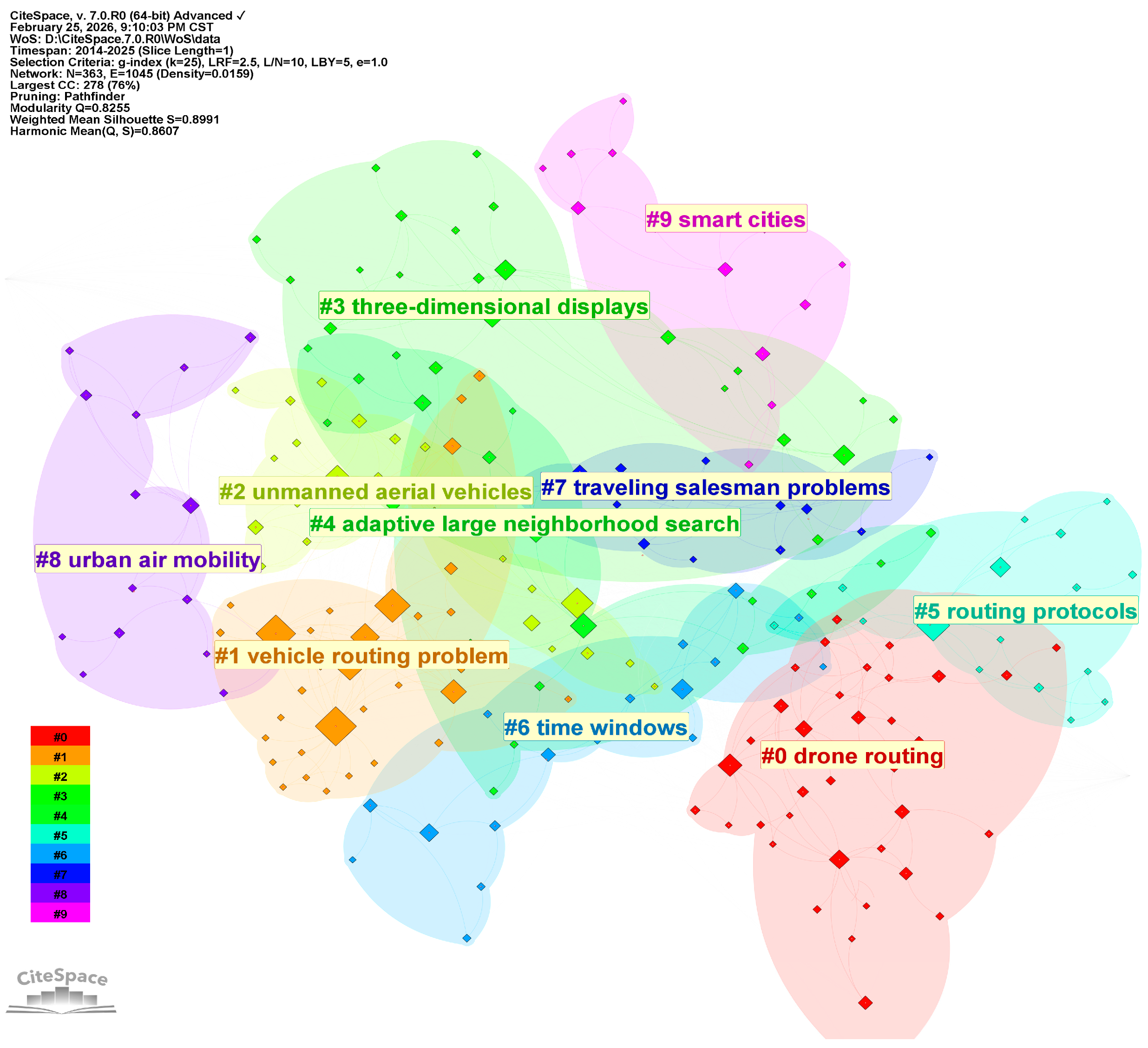
In recent years, there has been a gradual increase in related research. To provide a more intuitive understanding for the trend of the publication volume of the relevant literature, we conducted a bibliometric analysis of the literature concerning vehicle–drone routing problems using the CiteSpace (7.0.R0) tool. To ensure methodological transparency, the literature retrieval process was structured as follows: For the bibliometric analysis, the Web of Science Core Collection (WoSCC) was selected as the database due to its comprehensive coverage, standardized indexing, and suitability for systematic retrieval and traceability. It should be noted that while WoSCC was used specifically for the quantitative bibliometric analysis presented in this section, the subsequent literature review and synthesis drew upon publications from multiple databases including Web of Science, ScienceDirect, MDPI, and other academic sources to ensure comprehensive coverage of the research domain. The search was conducted in February 2026 in the “Topic” field using the following Boolean expression: (“vehicle”) AND (“drone”) AND (“routing”). These three keywords were deliberately chosen to reflect the core elements of the research domain. Specifically, “vehicle” and “drone” represent the two primary delivery carriers in collaborative last-mile systems, while “routing” captures the fundamental path planning and optimization perspective that defines this line of research. By focusing on these central terms, the search strategy ensures conceptual consistency and avoids the inclusion of studies unrelated to routing-oriented coordination problems. The search was limited to articles and reviews published in English between 2014 and 2025 in order to ensure complete annual statistical coverage. After removing duplicates and excluding irrelevant records based on title and abstract screening, a total of 1153 eligible articles were retained in this section for bibliometric analysis. These records were imported into CiteSpace (7.0.R0) for co-occurrence and clustering analysis.
Figure 1 illustrates the number of articles published annually from 2014 to 2025. As shown in Figure 1, the number of related studies has generally exhibited a steady upward trend, with an explosive growth observed between 2020 and 2022. Since 2022, the number of related studies has continued to increase, but the growth rate has slowed. Subsequently, we conducted a cluster analysis of the keywords extracted from these 1153 articles using CiteSpace, visualizing the results as shown in Figure 2. For clarity, we only included the top 10 cluster labels, with the numbers not representing any particular order. As shown in the visualization, Cluster #1 (vehicle routing problem) and Cluster #7 (traveling salesman problem) constitute the theoretical foundation of the field and are closely connected with Cluster #6 (time windows) and Cluster #4 (adaptive large neighborhood search). This indicates that classical routing models and time-constrained optimization, together with advanced metaheuristic algorithms, remain central methodological components in vehicle–drone routing research. In addition, Cluster #0 (drone routing) and Cluster #2 (unmanned aerial vehicles) form important technology-oriented clusters, highlighting the growing focus on UAV-enabled delivery operations and their integration into traditional vehicle routing frameworks. Meanwhile, Cluster #8 (urban air mobility) and Cluster #9 (smart cities) demonstrate the extension of vehicle–drone routing problems toward broader urban logistics and low-altitude transportation contexts. Overall, the clustering structure reveals a clear knowledge framework centered on classical routing theory, UAV-assisted optimization models, and emerging urban application scenarios, with strong interconnections among methodological and application-driven research streams. The retrieval date was 25 February 2026, ensuring reproducibility of the dataset.
Current review studies tend to concentrate on specific routing problem variants. For instance, “Two-echelon vehicle routing problems: A literature review” by Sluijk et al. [1] focuses on a particular routing structure within a predefined modeling framework. In contrast, the study by Dukkanci et al. [2] examined the facility location problem for drone (unmanned vehicle) delivery, providing a new research perspective rather than being confined to a single problem type. Therefore, we identified that the degree of collaboration tightness between drones and unmanned vehicles during delivery processes represents an intriguing research direction. We propose a synchronization-level-based approach to introduce a novel perspective for review studies by analyzing the synchronization levels between different carriers. In light of these findings, this study focuses on the cooperative delivery routing problem of vehicle and drone, aiming to explore the research status and development trends of delivery routing issues under different synchronization levels through a comprehensive literature review. Based on the synchronization levels of vehicles and drones, we categorize existing research into three scenarios: unsynchronized, low synchronization, and high synchronization, providing a systematic review and analysis of the delivery routing problems in each of these scenarios. In unsynchronized scenarios, vehicles and drones operate independently and in parallel to complete delivery tasks, each planning their optimal routes without interference. In low synchronization scenarios, one party (either the vehicle or the drone) plays a dominant role while the other provides auxiliary support, resulting in a certain degree of collaboration between the vehicle and the drone. In high synchronization scenarios, vehicles and drones achieve tight cooperative operations to jointly complete delivery tasks.
The contributions of this paper are as follows: (i) we establish a structured classification framework for vehicle and drone functions in delivery systems, along with a systematic categorization of synchronization functions during the cooperative process. From the perspective of operational functionalities, this framework clarifies different functional setups and their combinations, thereby enabling more precise and mechanism-oriented delivery system design; (ii) we propose a classification of problems based on the synchronization levels of vehicles and drones, encompassing unsynchronized, low or high synchronization scenarios, thus offering a new research perspective in related fields; (iii) we conduct a research analysis of the literature centered around the functions of vehicles and drones in different synchronization level scenarios, providing researchers with alternative approaches to synchronization levels and focusing on functionalities to enrich the options available for various scenarios; (iv) we compare the performance of various solution methods across the three synchronization level scenarios, assisting scholars in understanding the solution approaches for different scenario problems, and providing recommendations for updating and iterating solution methods.
The remainder of this paper is organized as follows: Section 2 reviews the routing optimization problems of vehicles and drones cooperative delivery and presents our new methodological framework based on synchronization-level classification for systematic literature analysis.; Section 3 provides a detailed description of the functions of vehicles and drones; Section 4, Section 5 and Section 6 discuss research based on the synchronization level classification, covering unsynchronized, low synchronization, and high synchronization scenarios; Section 7 focuses on solution algorithms; Section 8 presents future research prospects.

2. Methodology and Problem Overview

2.1. Vehicle and Drone Delivery Routing Problems Based on TSP

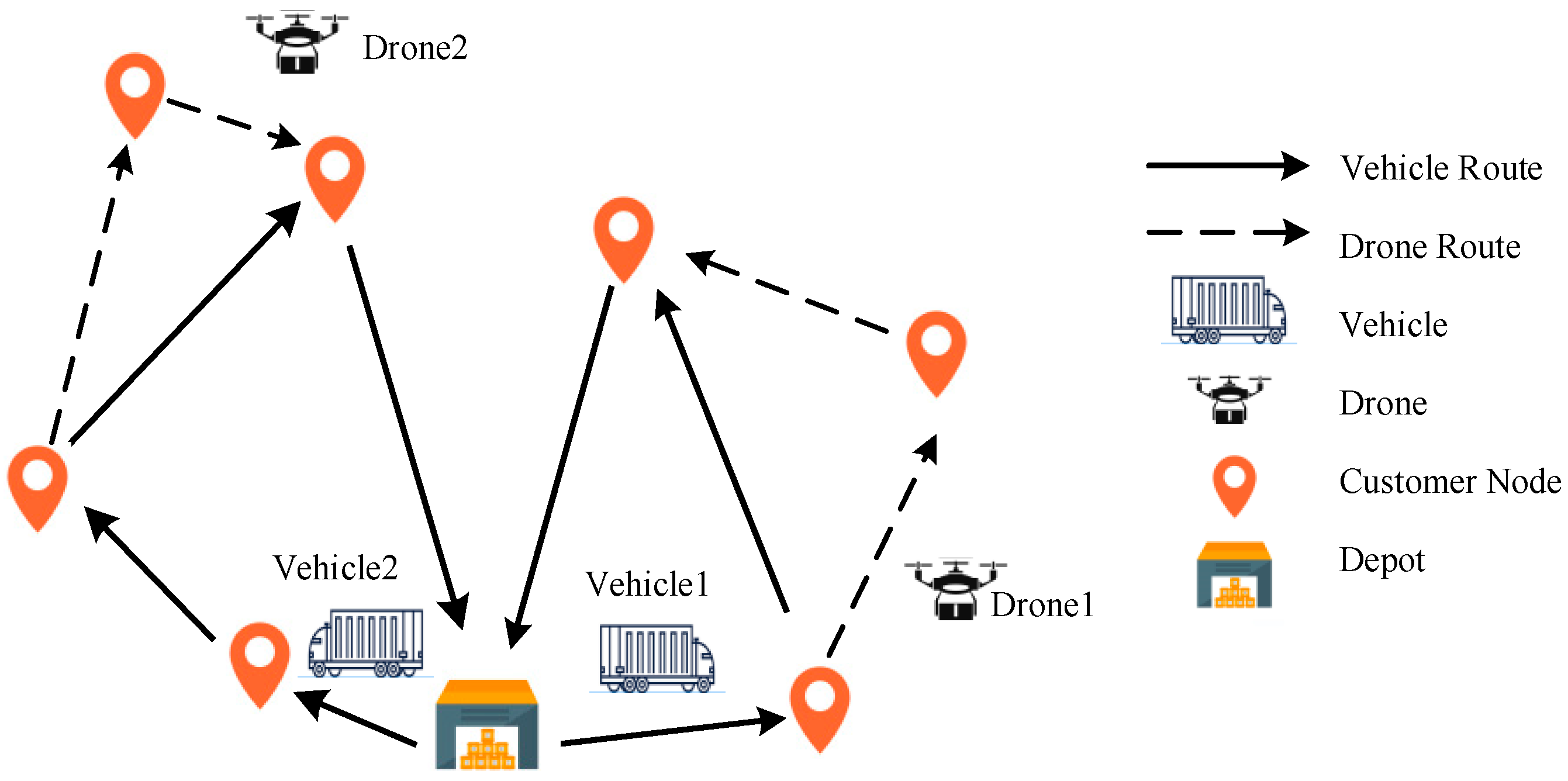
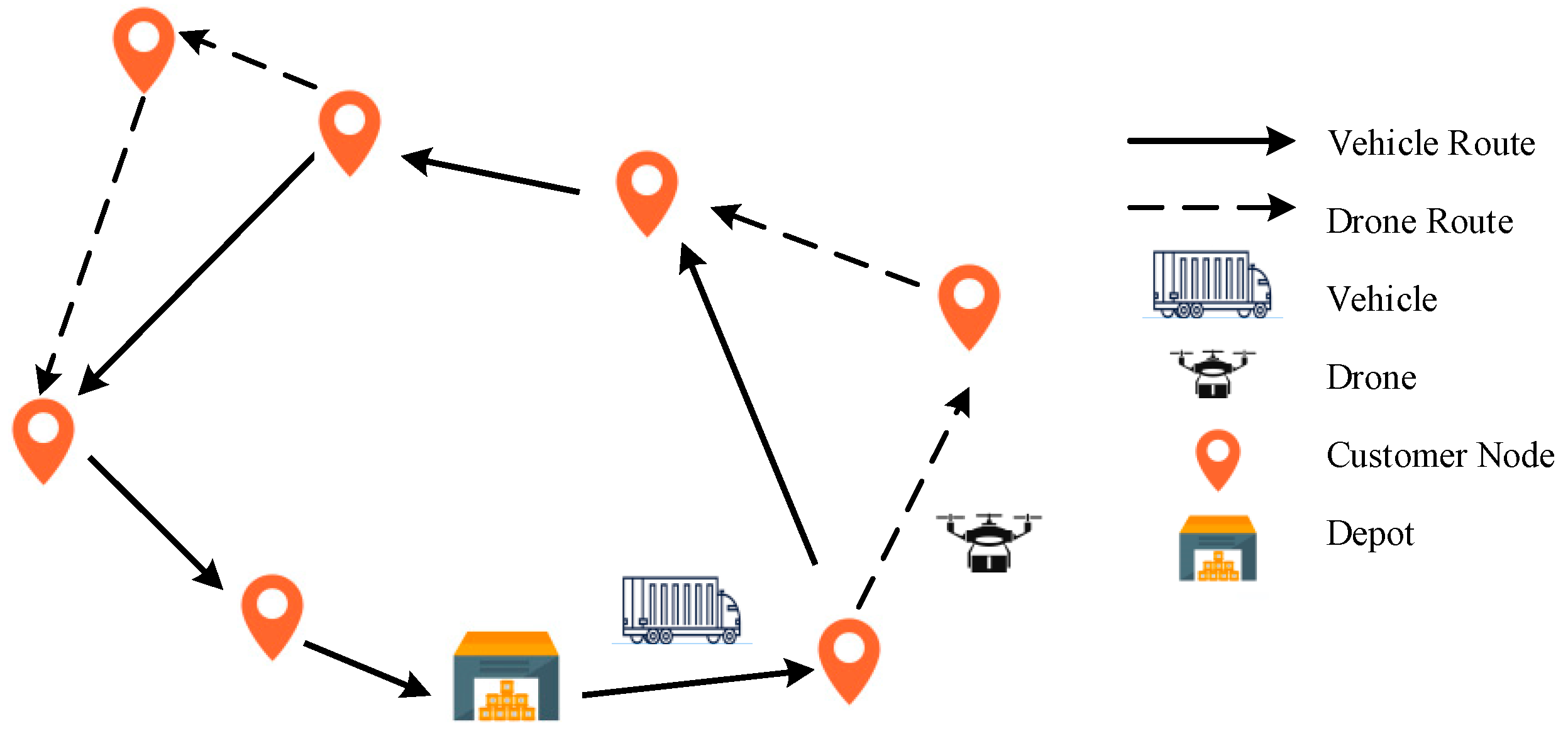
In last-mile delivery, the earliest formulation of the problem involving vehicles and drones working together for last-mile delivery is the Flying Sidekick Traveling Salesman Problem (FSTSP), proposed by Murray & Chu [3] In the FSTSP, the delivery task is jointly completed by a ground vehicle and several drones, as illustrated in Figure 3. The ground vehicle is responsible for the main transportation route, while drones are deployed from the vehicle at certain customer locations to complete individual delivery tasks before returning to the vehicle.

2.1.1. Common Variants Based on the FSTSP Problem

The FSTSP problem has spurred much research, resulting in various variants. In large-scale FSTSP, a common variant is increasing the number of drones. Optimizing their cooperative mode can boost delivery efficiency and flexibility. Dell’Amico et al. [4] proposed a mixed-integer linear programming model, assuming orders are delivered by trucks or a group of identical drones. Murray & Raj [5] defined the Multiple Flying Sidekicks Traveling Salesman Problem (mFSTSP), which includes one truck and multiple heterogeneous drones, with different customer acceptance levels for drones, aiming for more realistic scenarios. Conversely, another variant reduces the number of drones while increasing the number of customers a single drone can visit in one trip (multi-visit).

2.1.2. Major Variant of FSTSP: TSP-D

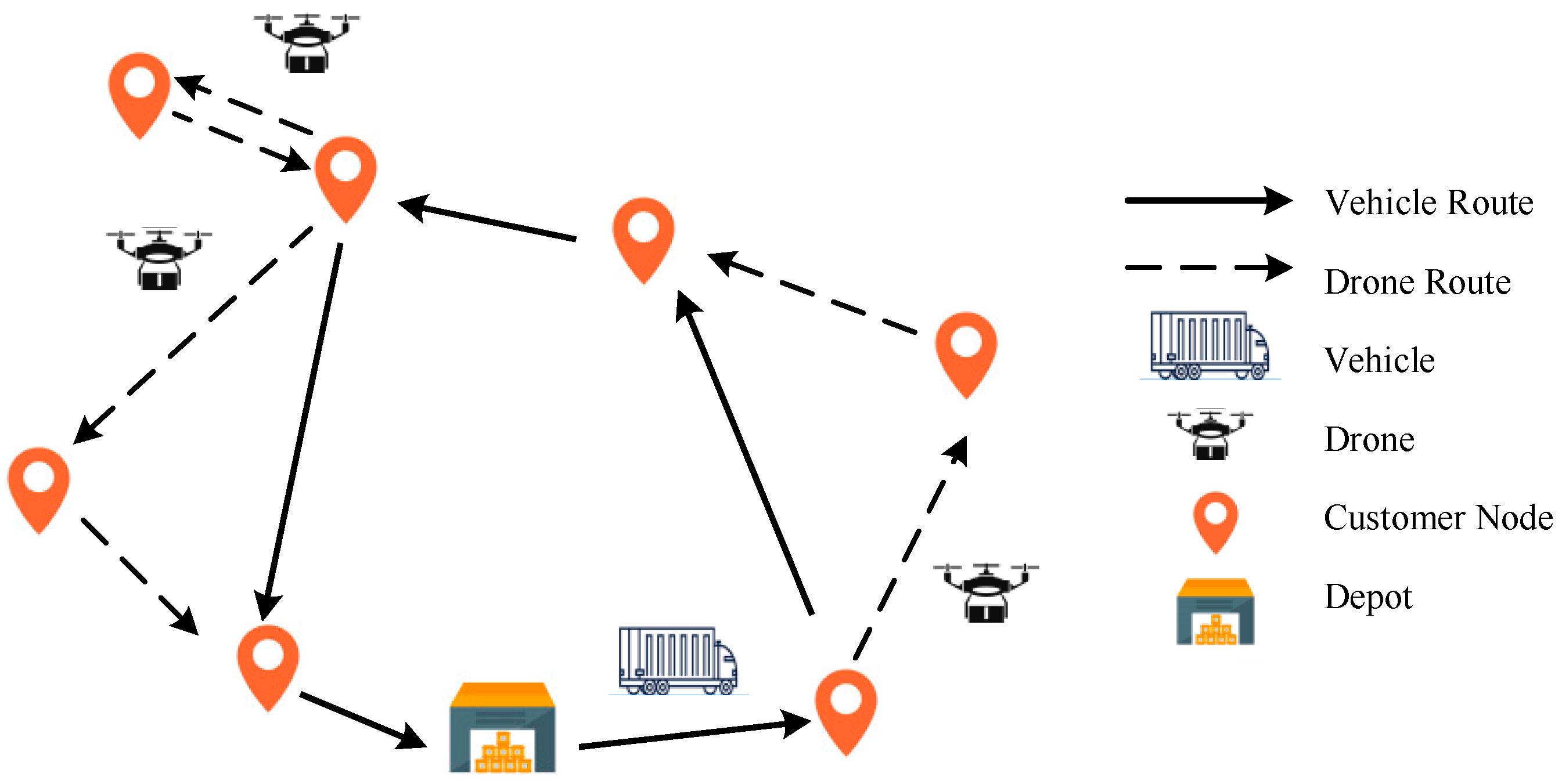
Subsequently, other researchers have expanded upon the FSTSP problem, categorizing the vehicle routing problem with drones as the Traveling Salesman Problem with Drones (TSP-D). In TSP-D, the ground vehicle can wait at the location after releasing the drone, as illustrated in Figure 4, until the drone completes its delivery task and returns, rather than proceeding to another location for the drone’s retrieval. Agatz & Schmidt [6] proposed a Mixed Integer Linear Programming (MILP) formulation for TSP-D, where the objective is to minimize the total delivery time or total path length by optimizing the joint routes of the ground vehicle and the drone. The flexibility of TSP-D makes it more suitable for addressing complex urban delivery needs, particularly for last-mile delivery in large cities.
The TSP-D problem has multiple variants that enrich its theory and applications. Yoon [7] proposed an FSTSP-based variant where a truck can carry, launch, and recover multiple drones, tested on up to ten customer instances, exploring multi-drone collaboration efficiency. In multi-drone delivery, Murray & Raj [5] proposed a last-mile delivery system based on TSP-mD, using heterogeneous vehicles and drones, factoring in drone endurance affected by payload, distance, and speed.

2.2. Vehicle Routing Problem with Drones (VRPD)

In the logistics delivery system, the Vehicle Routing Problem (VRP) is a classic and widely studied issue. The Vehicle Routing Problem with Drones (VRPD) is an extension of the VRP, focusing specifically on optimizing delivery routes through the cooperative use of ground vehicles and drones, as illustrated in Figure 5. The VRPD problem was first proposed by Wang & Golden [8]. Unlike FSTSP and TSPD, the VRPD model must take into account the synchronization and cooperative operation of multiple ground vehicles and drones.
In VRPD research, as algorithms for optimizing vehicle and drone cooperative delivery were proposed, various variants emerged. Wang & Sheu [9] studied multiple-visit VRPD, with drone routes restricted by flight time and payload. Chiang et al. [10] minimized total vehicle and drone transportation costs and addressed truck carbon emissions, showing that their cooperation led to more cost-effective, efficient, and eco-friendly solutions. Yin et al. [11] considered a truck and drone routing problem with time windows and drone multiple-visits. These variants mirror the increasing complexity and real-world applicability of VRPD, laying the groundwork for future research to meet emerging challenges.

2.3. Research Framework and Classification System

This review establishes a systematic framework for analyzing vehicle–drone delivery routing problems based on synchronization levels between vehicles and drones, which consists of synchronization levels, mathematical framework for model analysis with key optimization objectives and constraint formulations, comparative analysis methodology, as well as literature selection and synthesis process.
The classification system of synchronization levels between vehicles and drones distinguishes three primary scenarios: (i) non-synchronized scenarios, where vehicles and drones operate independently with separate routing decisions; (ii) low synchronization level scenarios, where one party serves as the primary delivery agent while the other provides auxiliary support; and (iii) high synchronization level scenarios, characterized by tight cooperative operations between vehicles and drones.
Within each synchronization level, we examine the literature through multiple analytical dimensions: (a) functional configurations of vehicles and drones, including service capabilities and endurance characteristics; (b) synchronization mechanisms, encompassing temporal coordination requirements and operational dependencies; (c) mathematical formulations, focusing on objective functions and constraint structures; and (d) solution methodologies, categorizing exact algorithms and heuristic approaches employed across different problem variants.

2.4. Mathematical Framework for Model Analysis

To systematically analyze the vehicle–drone routing problems across different synchronization levels, we adopt representative mathematical formulations from the literature. The foundational models examined include the Flying Sidekick Traveling Salesman Problem (FSTSP), Traveling Salesman Problem with Drones (TSP-D), and Vehicle Routing Problem with Drones (VRPD). These models capture the essential characteristics of different synchronization scenarios and provide a basis for comparative analysis.

2.4.1. Core Optimization Objectives

The optimization objectives in vehicle–drone routing problems generally fall into three categories: time minimization, cost minimization, and profit maximization. For time-based objectives, the FSTSP model minimizes the vehicle’s return time to the warehouse:
min t c + 1
where t c + 1 represents the time at which the vehicle reaches the final warehouse. Alternative objectives include minimizing total operational costs (encompassing vehicle transportation costs, drone energy costs, waiting costs, and labor costs) or maximizing service coverage within resource constraints.

2.4.2. Key Constraint Categories

The mathematical formulations across different synchronization levels share several fundamental constraint categories, though their specific implementations vary based on the operational mode.
(1) Service Coverage Constraints: Each customer node must be visited exactly once by either a vehicle or a drone:
i N 0 i j x i j + i N 0 i j k N + i , j , k P y i j k = 1 j C
In the basic FSTSP model, the starting and terminating nodes for the vehicle and drone routes are defined by sets N 0 and N + , where parameter x i j represents the vehicle’s routing from customer node i to customer node j , while y i j k represents the drone’s launch from customer node i to serve customer node k and return to customer node j for recovery. This indicates that each customer node can be serviced only once by either the vehicle or the drone.
(2) Synchronization Constraints: These constraints ensure temporal coordination between vehicles and drones at rendezvous points. When the drone completes delivery before the vehicle arrives, it must wait (consuming hovering energy). Conversely, when the vehicle arrives first, it must wait for the drone:
t k t k M 1 i N 0 j C y i j k k N +
t k t k + M 1 i k j C y i j k k N +
where parameters t k and t k represent the times at which the vehicle and the drone arrive at recovery node k , respectively. Constraints (3) and (4) are used to satisfy the synchronization requirements of the vehicle and the drone in terms of timing after the drone performs its launch and service operations. Constraint (3) indicates that when the drone arrives at the recovery node later than the vehicle, the time at which the drone reaches the recovery node is greater than the time at which the vehicle reaches it, corresponding to the situation where the vehicle waits for the drone to synchronize at the recovery node. Conversely, constraint (4) indicates that the drone arrives at the recovery node prior to the vehicle, necessitating the drone to wait in position for the vehicle while consuming energy during hovering. Interestingly, when both constraints are simultaneously applied, it guarantees that during the drone’s service journey to customers, the arrival times of both at the recovery node are synchronized. Using such constraints is convenient for computation; however, it merely sums the time consumed due to the synchronization process without taking into account the specific influence of this time.
(3) Endurance and Capacity Constraints: Drone operations are bounded by maximum flight time limitations and payload capacity:
t k ( t j τ i j ) e + M ( 1 y i j k ) k N + , j { C : j k } , i { N 0 : i , j , k P }
The basic model of the FSTSP considers the flight time of the drone as the foundation for energy consumption calculations, setting parameter e as maximum flight time limit for the drone. where, parameters t j and t k represent the times at which the drone arrives at customer node j and recovery node k , respectively, and τ i j indicates the flight time of the drone from launch node i to customer node j . When there is a drone service journey to a customer, this satisfies the time requirement for the process from launch to recovery. Since the arrival time of the drone at the recovery node in constraints (3) and (4) already includes any hovering time during which the drone waits, constraint (5) can be used to determine the energy consumption requirements for the drone’s flight time.
For VRPD models with multiple vehicles, additional constraints govern vehicle fleet size and capacity. Vehicle capacity is generally divided into two parts: the maximum number of packages the vehicle can carry, denoted as L T , and the number of drones it is capable of transporting, denoted as L R . Additionally, the number of drones transferred to the intermediate station O must not exceed L S . Let w i , k T represent the total number of packages delivered by truck k K to customer i C .
j C + x O ( s ) , j m
i C 0 x i , O ( r ) m
Constraints (6) and (7) represent the constraint that the number of vehicles used cannot exceed the maximum quantity m when departing from and returning to the warehouse, respectively. Where, x O ( s ) , j is a binary variable indicating the route selection of the vehicle. represents all routes of vehicles departing from the initial warehouse, and x O ( r ) , j denotes all routes of vehicles returning to the warehouse. The summation restricts the total number of vehicles to not exceed the specified maximum quantity m .
w i , k T L T k K , i C
w j , k T w i , k T + g j + M ( u i , j , k + x i , j , k 1 ) k K , ( i , j ) A , j C
w j , k T w i , k T + M ( u i , j , k + x i , j , k 1 ) k K , ( i , j ) A , j O
d D z i , j , k , d L R k K , ( i , j ) A
( j , i ) A d D y j , i , d + ( j , i ) A k K d D z j , i , k , d ( i , j ) A k K L S ( x i , j , k + u i , j , k ) j O C
Constraints (8) to (10) ensure that the number of packages loaded onto the truck does not exceed L T . Constraints (11) and (12) limit the number of drones that can be carried by the truck and those located on the vehicle. Additionally, studies such as Luo et al. [12], Mulumba et al. [13], and Meng et al. [14] have combined pickup and delivery problems with the VRPD. This requires more precise calculations of vehicle capacity, as the pickup and delivery context frequently involve the increase and decrease of the vehicle capacity. The incorporation of drones into the delivery process further complicates the issue; often, a single vehicle cannot meet customer demands, thereby prompting the extension of the pickup and delivery problem within the framework of the VRPD.

2.5. Comparative Analysis Methodology

Our analysis employs a structured comparative approach to evaluate how synchronization level influences problem formulation, solution complexity, and algorithmic performance. For each synchronization category, we systematically examine:
(i) 
Functional Configuration Analysis: We categorize vehicle and drone capabilities based on service functions (delivery-only, pickup and delivery, multi-visit) and endurance characteristics (linear vs. nonlinear energy consumption models, battery capacity constraints, charging requirements). This categorization reveals how functional assumptions affect model complexity and applicability to real-world scenarios.
(ii) 
Synchronization Mechanism Comparison: We distinguish between different synchronization mechanisms: non-synchronized independent operations, unidirectional auxiliary support (vehicle-to-drone or drone-to-vehicle), and bidirectional tight coordination. The mathematical formulations of synchronization constraints (e.g., Formulas (3) and (4)) are compared to identify structural differences and computational implications.
(iii) 
Solution Methodology Classification: Solution approaches are classified into exact algorithms (branch-and-bound, dynamic programming, branch-and-price, column generation) and heuristic methods (genetic algorithms, simulated annealing, adaptive large neighborhood search, variable neighborhood search). We analyze the scalability of each approach relative to problem size and synchronization complexity.
(iv) 
Model Variant Synthesis: We identify common variant patterns across synchronization levels, including multi-drone extensions, multi-visit drone operations, time window constraints, heterogeneous fleet considerations, and energy consumption refinements. This synthesis enables cross-level comparison and identification of transferable modeling techniques.

2.6. Literature Selection and Synthesis Process

Following the bibliometric analysis described in Section 1, we conducted a comprehensive synthesis of the identified literature. The synthesis process involved: (1) classifying each study according to the synchronization level framework; (2) extracting mathematical formulations, constraint structures, and algorithmic approaches; (3) identifying functional configurations and operational assumptions; and (4) mapping solution methodologies to problem characteristics. This structured approach ensures systematic coverage of the research domain while maintaining analytical coherence across different synchronization scenarios.

3. Vehicle and Drone Delivery and Synchronization Settings

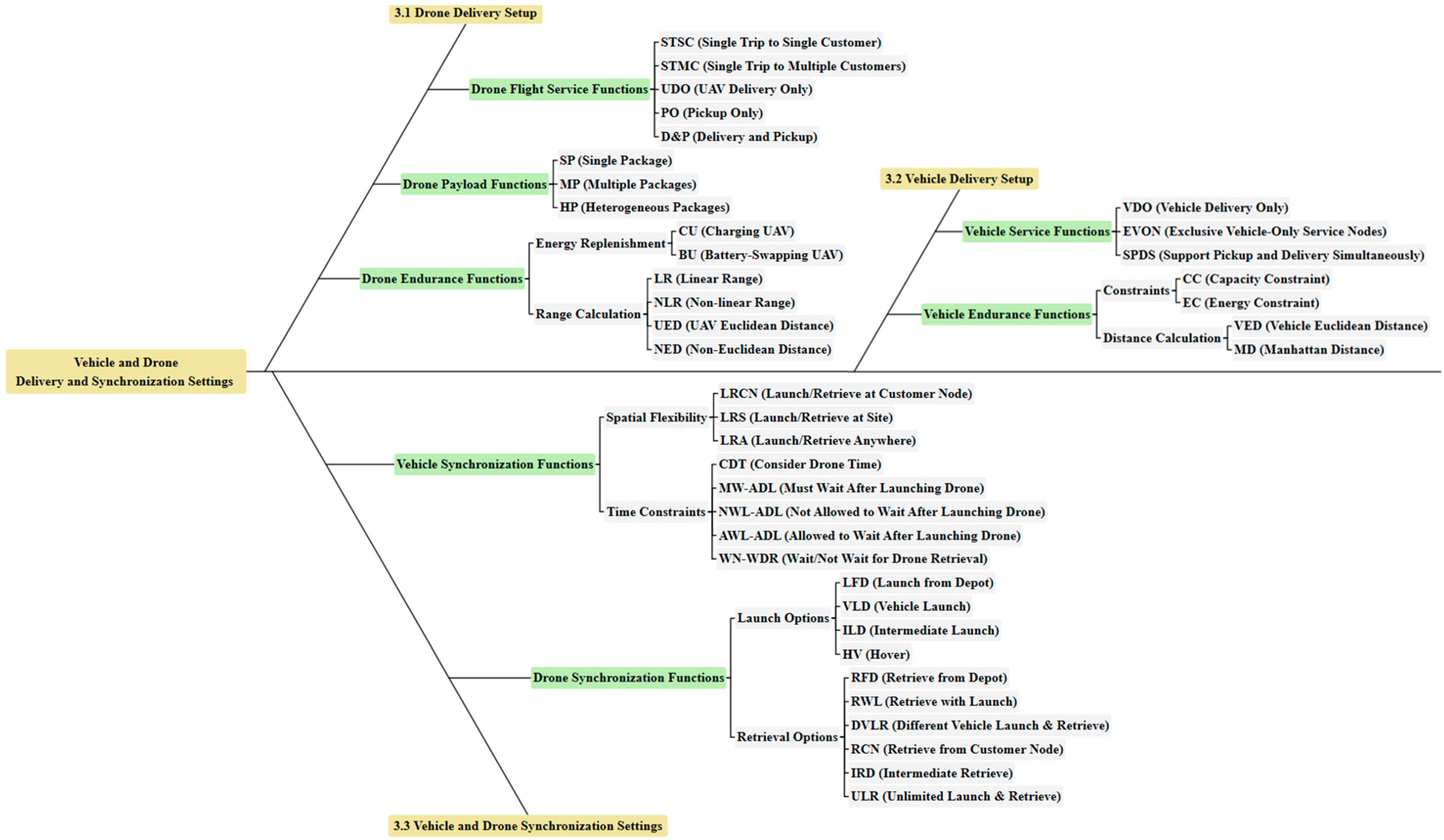
This section defines the roles of vehicles and drones during the delivery process, focusing on their service capabilities, payloads, and endurance functions. We will delve into the synchronization details between vehicles and drones, refining this aspect into specific synchronization functionalities. This approach enables us to better explore how various drone capabilities and synchronization levels influence the cooperative delivery process. The Figure 6 below outlines the comprehensive functionalities of vehicle and drone service capabilities, and synchronization mechanisms to be discussed in this chapter.

3.1. Drone Delivery Setup

3.1.1. Drone Flight Service Functions

Drones serve customers by performing delivery and/or pickup tasks. While basic drones typically handle one customer per trip due to structural limits, recent advancements allow for multiple deliveries and mixed tasks. Table 1 illustrates the potential functions and characteristics of drones from the perspective of service capabilities during the delivery process. Each function is uniquely identified with an ID for distinction.
(i)
Single Trip to Single Customer (STSC): This function refers to a drone servicing only one customer per trip. The primary advantage of this mode lies in its operational simplicity, as path planning and scheduling are more straightforward, making it suitable for urgent delivery needs. Additionally, this mode reduces the drone’s waiting time and mid-trip stops, thereby increasing the efficiency of individual delivery tasks.
(ii)
Single Trip to Multiple Customers (STMC): This function allows a drone to service multiple customers in a single flight. It is particularly effective when customers are relatively concentrated or when delivery paths are compact. By efficiently planning the route, the drone can complete multiple deliveries in a single flight, minimizing returns and re-launches. This mode not only optimizes energy consumption but also enhances the overall operational efficiency of the logistics system.
(iii)
UAV Delivery Only (UDO): The UDO function focuses solely on delivering goods from a warehouse or intermediate station to customers. This is a common setup in current research, ensuring an efficient delivery process while reducing management complexity. It also simplifies maintenance and scheduling.
(iv)
Pickup Only (PO): This function is primarily designed for collecting goods from customers and returning them to a warehouse or intermediate station. It is particularly crucial in reverse logistics or scenarios requiring customer returns. This mode enhances the efficiency and accuracy of pickup tasks, ensuring that goods are safely returned to the designated location.
(v)
Delivery and Pickup (D&P): This function provides maximum flexibility, allowing drones to perform both delivery and pickup tasks within a single flight. This mode maximizes the utilization of flight paths, reducing empty flights and conserving energy, thereby significantly improving the operational efficiency of the overall logistics system.

3.1.2. Drone Payload Functions

In the cooperative delivery system involving vehicles and drones, the payload function of the drone is a crucial factor determining the type and quantity of goods it can transport. We summarize the drone payload functions, concentrating on the quantity and type of packages the drone can carry.
(i)
Single Package (SP): This function refers to a drone’s capability to transport only one package during each flight mission. This mode simplifies path planning and scheduling, contributing to enhanced delivery efficiency and accuracy, and is particularly suitable for urgent deliveries of critical packages.
(ii)
Multiple Packages (MP): This function allows the drone to carry multiple homogeneous packages during a single flight. This mode is appropriate for longer routes or tasks with a high concentration of customers, significantly improving the drone’s utilization and the transportation efficiency of each flight. By rationally arranging the delivery sequence, the drone can accomplish multiple deliveries in a single flight, reducing the frequency of returns to vehicles or warehouses, thereby optimizing energy consumption and delivery costs.
(iii)
Heterogeneous Packages (HP): This function enables the drone to transport packages of different sizes and shapes during a single flight. This capability provides the drone with greater flexibility, adapting to various complex delivery demands. This mode requires the drone to have high load adjustment capability and stability to ensure that various packages are not damaged during flight. It is suitable for intricate delivery scenarios, allowing the drone to meet multiple customer needs in a single flight, thus improving overall delivery efficiency and service quality.

3.1.3. Drone Endurance Functions

Drone endurance affects mission scheduling and cost by influencing energy replenishment and flight calculations. We present a summary of the drone endurance functions. The calculation of energy consumption during delivery is a significant issue, depending on multiple factors such as payload and speed.
(i)
Charging UAV (CU): This type of drone requires returning to a charging station or vehicle before its battery is depleted to recharge, restoring its flight capability. The charging time is included in the total delivery time. Due to longer charging durations, this mode may limit efficiency in high-frequency delivery tasks. However, some literature incorporates charging time into the decision-making process to better reflect real-world scenarios.
(ii)
Battery-Swapping UAV (BU): This method allows drones to replenish energy by replacing batteries directly with the help of staff or automated devices. This approach enables quick battery swaps after depletion, thus reducing waiting times and improving delivery efficiency. In earlier studies, the time for battery swapping was often neglected, making battery-swapping drones particularly suitable for high-frequency and high-efficiency delivery scenarios.
(iii)
Linear Range (LR): This refers to the drone’s endurance distance being represented by a linear function, indicating a linear relationship between flight distance and energy consumption. This setup allows for relatively straightforward calculations and predictions, facilitating path planning and task scheduling.
(iv)
Non-linear Range (NLR): In this mode, the relationship between the drone’s endurance distance and energy consumption is non-linear. This approach considers more complex factors such as flight speed and payload, offering a more accurate description of actual flight performance. It is suitable for complex and variable delivery environments, enabling more precise endurance predictions and path optimization.
(v)
UAV Euclidean Distance (UED): This calculation method is based on the straight-line distance between two points, representing the shortest path. This approach is simple and intuitive, making it suitable for delivery scenarios with relatively flat terrain and few obstacles, facilitating quick estimations of flight distance and time.
(vi)
Non-Euclidean Distance (NED): This calculation method takes into account the complexity of actual terrain, obstacles, and flight paths. By employing more sophisticated algorithms, it can more accurately reflect the distance and energy consumption of drones during actual flights. This method is applicable to urban environments, areas with many buildings, and regions with restricted airspace, providing more reliable flight distance and route planning.

3.2. Vehicle Delivery Setup

In the cooperative delivery process involving vehicles and drones, vehicles are assigned corresponding customer delivery tasks. During this process, we need to consider the expandable service functions of vehicles, which may be influenced by specific capacity constraints or the energy used, as well as the synchronization functions of vehicles when collaborating with drones.

3.2.1. Vehicle Service Functions

The optimization and rational allocation of vehicle service functions can effectively enhance overall delivery performance and meet the diverse requirements of customers. We summarize the potential service functions and characteristics of vehicles in the delivery process.
(i)
Vehicle Delivery Only (VDO): This function refers to delivery scenarios in which certain customer nodes must be served exclusively by the vehicle. Such cases typically arise when drone operations are restricted due to no-fly zones, urban airspace regulations, safety constraints, payload limitations, or adverse environmental conditions. Under this setting, the vehicle assumes full responsibility for transporting goods from the depot or intermediate facilities to the designated customers, while drones are either inactive for these nodes or assigned to other tasks. The VDO mode ensures service feasibility in regulatory or operationally constrained areas and plays a critical role in maintaining delivery reliability within heterogeneous service environments.
(ii)
Exclusive Vehicle-Only Service Nodes (EVON): In certain delivery networks, some nodes can only be serviced by vehicles and cannot be covered by drones. These nodes are often located in complex terrain or restricted flight zones, or the demand packages at these nodes require ground delivery due to their shape or weight. This mode necessitates detailed planning of delivery paths to ensure effective service for all nodes.
(iii)
Support Pickup and Delivery Simultaneously (SPDS): This function enables vehicles to perform both pickup and delivery operations at the same node or during the same delivery task. This mode is suitable for diverse delivery demands; by optimizing the order of pickups and deliveries, it can significantly enhance vehicle utilization and transportation efficiency. This approach helps to reduce empty driving time, lower transportation costs, and improve resource utilization.

3.2.2. Vehicle Endurance Functions

Similar to the endurance functions of drones, different limitations on vehicle endurance and distance calculation methods determine a vehicle’s capabilities and strategies during delivery tasks. We summarize the vehicle endurance functions.
(i)
Capacity Constraint (CC): This refers to the limitations on the number, weight, or volume of packages that a vehicle can carry during delivery tasks. Such constraints require that the maximum load of each vehicle be considered when planning delivery routes to ensure that all tasks are completed without exceeding capacity. In problems like the TSP-D and FSTSP, vehicle capacity is not considered, while in the VRPD, the maximum load or number of packages is integrated into the decision variables. Some researchers have also discussed more practical scenarios that include reasonable combinations of specific package sizes and vehicle compartments. Thus, reasonable capacity constraints help optimize vehicle load rates, enhance transportation efficiency, and avoid safety hazards and extra costs caused by overloading.
(ii)
Energy Constraint (EC): This refers to the requirement that energy consumption during delivery tasks must remain within a certain range. Early studies mainly considered fossil fuels for vehicle energy use. However, with increasing carbon emissions and the advent of renewable energy, many researchers have included carbon dioxide emissions as decision metrics during the delivery process, while vehicles powered by electricity or solar energy have also been incorporated into the studies. Energy constraints necessitate that fuel or electricity consumption be considered when planning delivery routes and tasks; the simplest way to implement this is by setting a maximum operational time for vehicles. By optimizing energy constraints, we can extend the vehicle’s endurance, reduce operational costs, and enhance transportation efficiency.
(iii)
Vehicle Euclidean Distance (VED): This method calculates the route length based on the straight-line distance between two points. This approach is straightforward and allows for quick estimations of vehicle travel distance and time, thereby simplifying route planning and scheduling, and enhancing delivery efficiency.
(iv)
Manhattan Distance (MD): This distance calculation method considers the total distance along vertical and horizontal axes within urban blocks. This approach takes into account the actual structure of the road network and is more representative of vehicle paths in urban environments. This model is suitable for urban delivery scenarios and provides more accurate distance and time estimates, optimizing route planning and task scheduling.

3.3. Vehicle and Drone Synchronization Settings

The synchronization settings between vehicles and drones are a crucial component of the cooperative delivery system. Through rational design and optimization of the synchronization methods for vehicles and drones, the response speed and quality of delivery tasks can be significantly enhanced.

3.3.1. Drone Flight Synchronization Function Settings

Drone flight synchronization functions refer to the ways in which drones coordinate with ground vehicles or other facilities while executing delivery tasks in a cooperative delivery system. Table 2 summarizes the drone synchronization functions, including the geographic locations for takeoff and recovery, as well as synchronization settings with vehicles.
(i)
Launch from Depot (LFD): Allows drones to take off directly from the warehouse to perform delivery tasks.
(ii)
Vehicle Launch (VLD): Refers to drones taking off from delivery vehicles for the execution of tasks.
(iii)
Intermediate Launch (ILD): Indicates that drones can take off from pre-set intermediate stations. These stations are typically located along concentrated routes within the road network, allowing drones to take off and land. This mode optimizes drone endurance and coverage, thereby enhancing the efficiency and reliability of the delivery network.
(iv)
Hover (HV): Permits drones to remain airborne, waiting for the next instruction or for dynamic adjustments. This setting is common in drone-vehicle cooperative delivery problems.
(v)
No UAV Waiting for Vehicle Retrieval (NWVR): Once a task is accomplished, drones must not wait for vehicle recovery at the designated retrieval point. Vehicles must either wait at a specific location or proceed directly to an intermediate station for landing. This mode helps improve drone utilization and task completion rates, and prevents unexpected incidents due to drones running out of power while hovering for extended periods.
(vi)
Retrieve from Depot (RFD): Allows drones to return directly to the warehouse after task completion. This method simplifies the process by which drones return to the warehouse, enhancing overall system efficiency.
(vii)
Retrieve with Launch (RWL): Indicates that drones return to the same vehicle from which they were initially launched after completing their tasks. This approach facilitates synchronized scheduling and control between vehicles and drones, thereby reducing the complexity of modeling.
(viii)
Different Vehicle Launch & Retrieve (DVLR): Permits drones to return to different vehicles after task completion. This mode increases system flexibility and resource utilization, making it suitable for complex delivery networks and dynamic task allocation, while also increasing modeling complexity.
(ix)
Retrieve from Customer Node (RCN): Allows drones to be directly retrieved by vehicles from other customer nodes after completing their delivery tasks.
(x)
Intermediate Retrieve (IRD): Enables drones to return to designated intermediate stations upon task completion. These stations are typically small parking areas or designated open spaces, facilitating drone takeoffs and landings.
(xi)
Unlimited Launch & Retrieve (ULR): Permits drones to launch and recover at any location, unconstrained by pre-set stations, even allowing direct launches and recoveries at discrete locations along the vehicle’s route. This highly flexible mode is suited for dynamic and complex delivery tasks, maximizing drone utilization and coverage.

3.3.2. Vehicle Synchronization Function Settings

Vehicle synchronization function settings are a crucial aspect of the cooperative delivery system between vehicles and drones. Table 3 summarizes the vehicle synchronization functions, detailing the capabilities that vehicles may possess during the synchronization process.
(i)
Launch and Retrieve at Customer Node (LRCN): Allows vehicles to launch and recover drones at customer nodes, a common setup in cooperative delivery processes.
(ii)
Launch and Retrieve at Site (LRS): Permits vehicles to launch and recover drones at pre-set sites. This mode is suitable for fixed-route delivery tasks, optimizing the collaboration between vehicles and drones, reducing waiting times, and enhancing overall delivery efficiency.
(iii)
Launch and Retrieve Anywhere (LRA): Enables vehicles to launch and recover drones at any location. This highly flexible mode is ideal for complex delivery networks and dynamic task allocation, maximizing drone capabilities and covering more delivery areas.
(iv)
Consider Drone Launch and Retrieval Time (CDT): Incorporates the time required for vehicles to launch and recover drones during task scheduling. This method allows for more accurate planning of delivery paths and timelines, making it suitable for time-sensitive delivery scenarios.
(v)
Vehicle Must Wait After Drone Launch (MW-ADL): Specifies that vehicles must remain stationary after launching a drone until the drone’s return. This mode ensures the convergence of vehicles and drones, reducing the complexity of scheduling for both.
(vi)
Vehicle Not Allowed to Wait After Drone Launch (NWL-ADL): Requires vehicles to continue moving after launching a drone, without waiting. This approach is suitable for delivery tasks that require high efficiency and quick responses, maximizing vehicle travel time and minimizing delays.
(vii)
Vehicle Allowed to Wait After Drone Launch (AWL-ADL): Allows vehicles the option to remain stationary after launching a drone until the drone’s return. This flexible mode accommodates various task requirements and offers more options for customer allocation based on actual conditions.
(viii)
Vehicle Allowed/Not Allowed to Wait for Drone Retrieval (WN-WDR): Determines whether vehicles can wait for the drone’s return after launching it. This setting offers increased scheduling flexibility, allowing adjustments based on task types and needs to optimize the collaboration between vehicles and drones, thereby enhancing delivery efficiency.

4. Vehicles and Drones in Non-Synchronized Scenarios: Parallel Delivery Routing Problem

In this section, we discuss the parallel drone scheduling traveling salesman problem (PDSTSP) and drones in a non-synchronized scenario. A non-synchronized scenario refers to the independent operation of vehicles and drones to fulfill all customer delivery tasks. First, we analyze the parallel delivery problem of vehicles and drones. Then, we outline the related variants of the parallel delivery problem involving vehicles and drones.

4.1. Parallel Delivery Problem of Vehicles and Drones

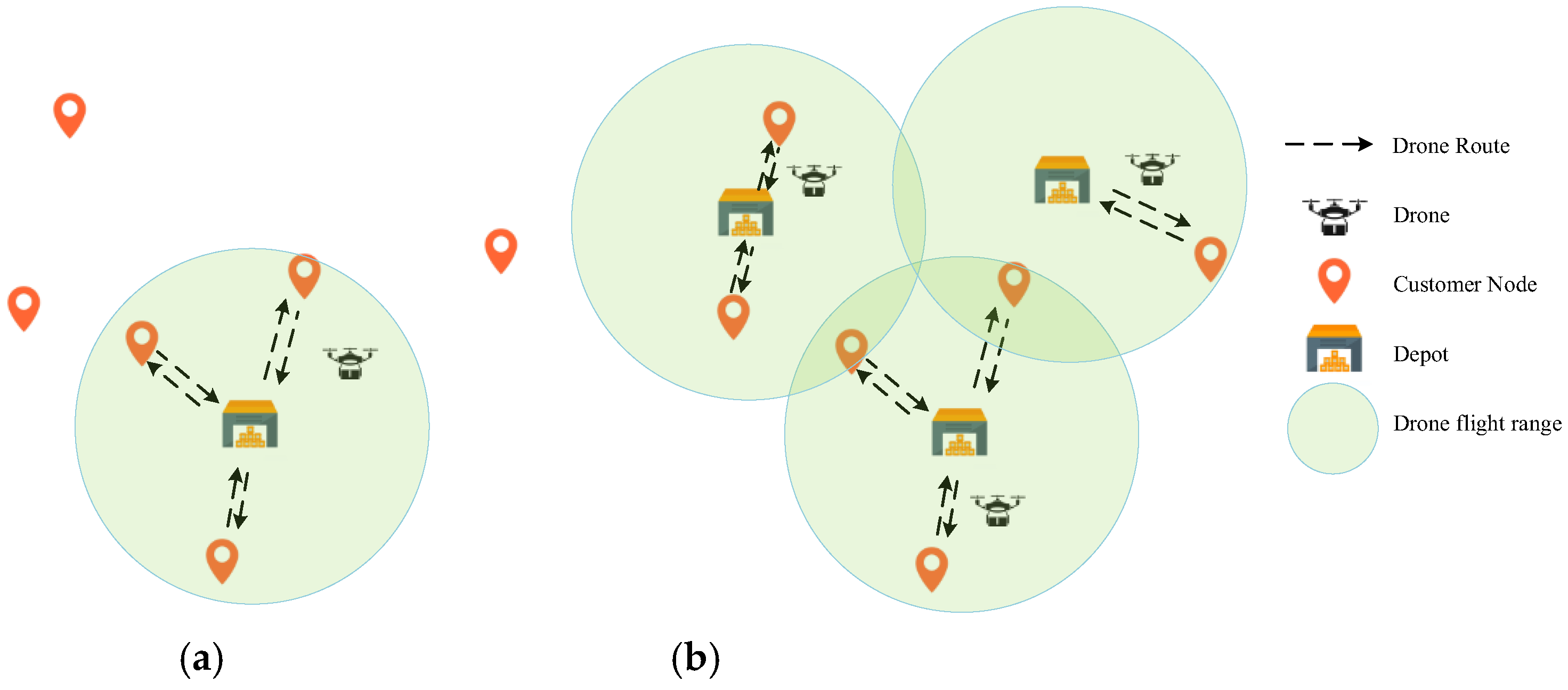
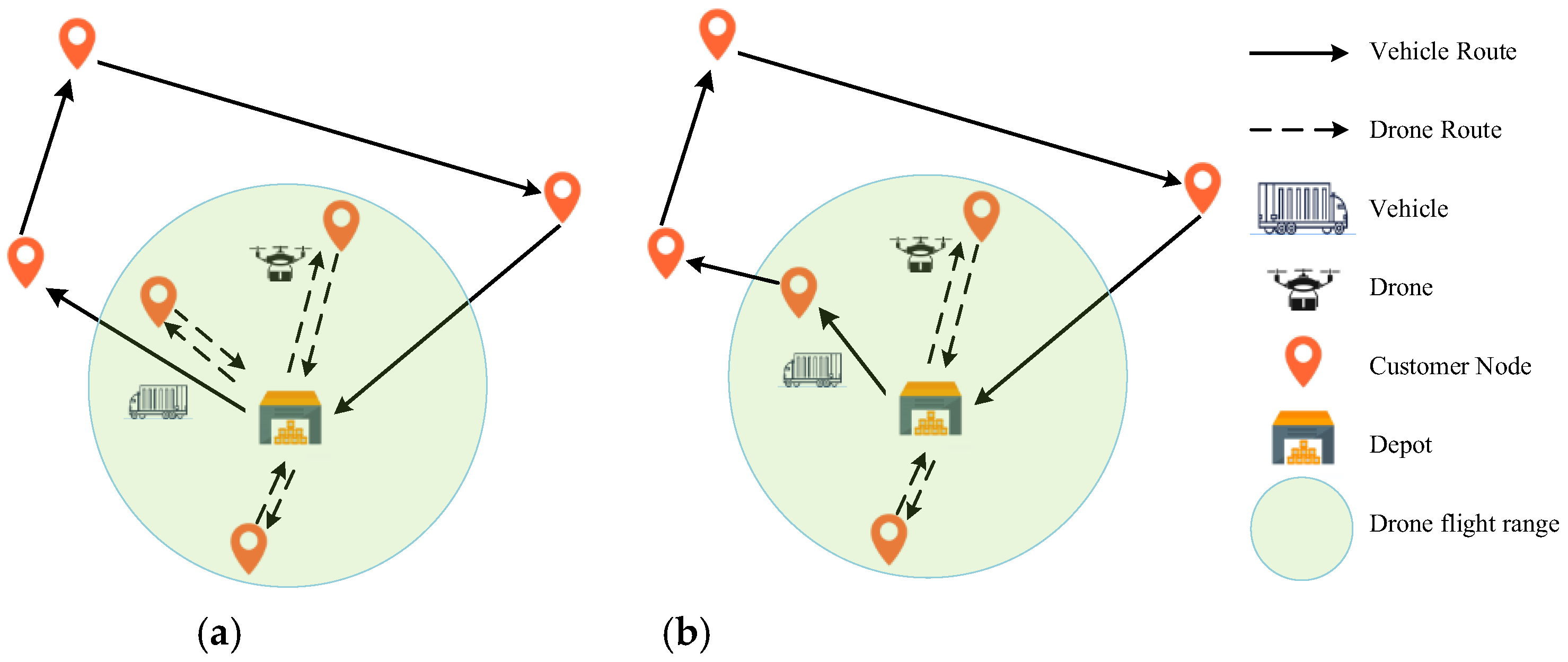
Due to the limitations in flight range and payload capacity of drones, using only drones for package delivery can result in unmet customer demand points that exceed the drone’s delivery capability, as illustrated in Figure 7a. To ensure coverage of all customer locations, some studies, such as Ham [15], propose establishing multiple warehouses to extend the effective delivery range of drones, as illustrated in Figure 7b. However, in practice, the number of warehouses is typically limited, and this approach may not completely service all customers, leading to potential resource wastage.
Some scholars have considered traditional vehicle Traveling Salesman Problem (TSP) scenarios by integrating vehicles into drone delivery systems. During the package delivery process, both vehicles and drones operate independently without any synchronization, meaning they complete all customer delivery tasks in parallel. Among the various strategies for this parallel delivery process, the simplest approach is to assign all customers beyond the drone’s delivery range to the vehicles, as illustrated in Figure 8a, all customers within the drone’s flight range are served by the drone, while those outside this range are handled by the vehicle. However, Murray & Chu [3] found that some nodes within the drone’s operational range could also be serviced by the vehicle, which helps to reduce the total delivery service time, as shown in Figure 8b. Consequently, they introduced the Parallel Drone Scheduling Traveling Salesman Problem (PDSTSP) for the first time. This model considers the parallel delivery process using both vehicles and drones simultaneously, where the vehicle services customers along the TSP route, while the drone provides direct service from the warehouse.

4.2. Related Variants of the PDSTSP

In scenarios where vehicles and drones operate independently, numerous variants and different constraints exist. Here, we systematically describe these based on the functionalities of vehicles and drones outlined in Section 3, and then organize them according to the main types of variants. In the study of the PDSTSP, different studies have explored and analyzed the selection of drone and vehicle functionalities as well as their application scenarios. Table 4 summarizes the drone flight service functionalities, drone payload functionalities, and drone endurance functionalities discussed in various studies. Table 5 provides a comparative analysis of vehicle service functionalities and vehicle endurance functionalities across the literature.
From the perspective of drone functionalities, single-trip access to individual customers and delivery-only capabilities are quite common. Regarding drone endurance features, Sawadsitang et al. [17] utilized a real high-rise building road network for drone route planning, while Ramos & Vigo [21] considered charging drones and backup batteries, which added complexity to the drone routing problem.
In terms of vehicle functionalities, Ham [15] and Hamid & Rabbani [20] focused more on the ability of vehicles to support simultaneous pickup and delivery. Nguyen et al. [19] addressed vehicle capacity constraints and maximum working time in their research. Most literature approximates vehicle travel distances using the Manhattan distance; Chowdhury et al. [16] multiplied the Euclidean distance by a factor to better approximate actual travel distances in sparsely connected traffic network areas.

4.3. Conclusion of Vehicles and Drones in Non-Synchronized Scenarios

The study of non-synchronized vehicle–drone delivery systems underscores the importance of balancing theoretical models with practical operational demands. However, existing research predominantly focuses on simplistic configurations—such as Single Trip to Single Customer (STSC) for drones which limits the exploration of hybrid functionalities like Delivery and Pickup (D&P) for drones and Simultaneous Pickup and Delivery Support (SPDS) for vehicles.
While recent advancements, such as non-linear endurance models (NLR) for drones Ramos & Vigo [21] and energy constraint (EC) considerations for vehicles Nguyen et al. [19], have enhanced model realism, critical gaps persist. First, most studies rely on Euclidean (UED) or Manhattan (MD) distance approximations, neglecting real-world complexities like urban wind patterns Sawadsitang et al. [17] that significantly affect drone energy consumption. Second, sustainability metrics—particularly carbon emissions linked to vehicle energy use—are rarely integrated into optimization objectives, despite their growing relevance in urban logistics. Third, specialized scenarios involving Heterogeneous Packages (HP) and Exclusive Vehicle-Only Nodes (EVON) remain underexplored, limiting the applicability of current models to diverse delivery environments.
Future research should prioritize three directions: (1) dynamic task allocation algorithms enabling real-time switching between STSC and STMC modes based on demand fluctuations; (2) multi-objective optimization frameworks that simultaneously minimize delivery time, energy consumption, and environmental impact; and (3) advanced payload management strategies, incorporating aerodynamic stability constraints. Methodologically, integrating digital twin simulations with real-world traffic data could validate the robustness of NLR and NED models. By addressing these challenges, non-synchronized delivery systems may evolve from partitioned task execution to adaptive, integrated networks capable of supporting the growing complexity of urban logistics.

5. Vehicle and Drone Low Synchronization Level Scenarios: Auxiliary Delivery Routing Problems

In low synchronization level scenarios, there exists a certain degree of collaboration between vehicles and drones in their delivery tasks. This cooperative approach enables more effective utilization of the strengths of both vehicles and drones, enhancing delivery efficiency and service quality. We will focus on the synchronization functionalities of vehicles and drones, exploring the intrinsic connections in the literature regarding the setup of these synchronization functions.

5.1. Vehicle Routing Problem with Drone Resupply

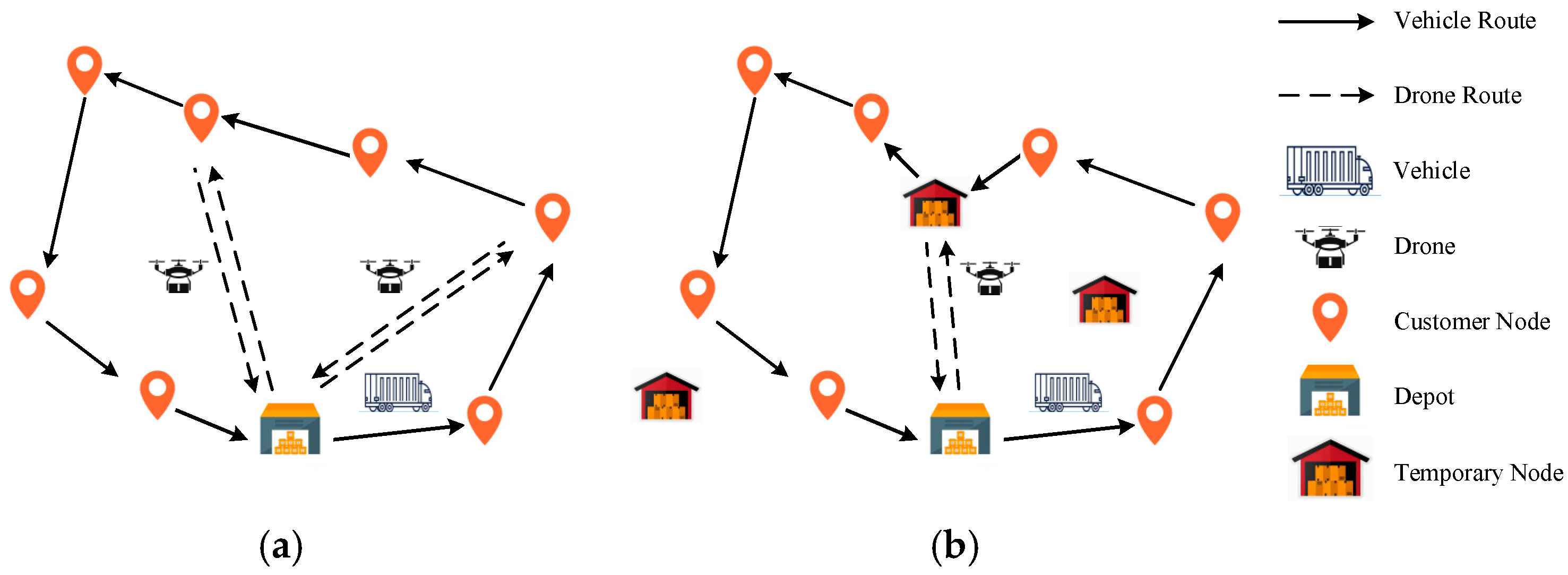
In the vehicle routing problem with drone resupply, drones serve as auxiliary tools to assist vehicles in completing delivery tasks. In this model, the vehicle acts as the primary delivery tool, being responsible for most customer delivery tasks, while drones are used to provide additional support during the delivery process. There are two modes of assistance: one where the drone departs from the warehouse to add packages that need to be delivered during the vehicle’s journey, as shown in Figure 9a, and the other where the drone delivers packages from the warehouse to other temporary nodes, as depicted in Figure 9b. The main distinction between the two lies in that the latter imposes relaxed synchronization time requirements on the drone and vehicle; the drone only needs to arrive at the temporary node before the vehicle visits it.

Analysis of Synchronization Functions in Vehicle Routing Problem with Drone Resupply

In low and high synchronization level scenarios, the synchronization processes between vehicles and drones become increasingly complex. Therefore, in the following literature analysis, we primarily focus on comparing the drone flight synchronization functions with vehicle synchronization functions. Table 6 and Table 7 are established to analyze the synchronization functions of drones and vehicles in the literature concerning drone-assisted vehicle delivery.
From the perspective of the drone’s flight synchronization functions, the majority of the literature supports the launch of drones from the warehouse (LFD) and retrieve from Depot (RFD), independent of the vehicle and intermediate station launch and retrieval. However, the extent of support for other functions varies. For instance, retrieve from customer node (RCN) and intermediate retrieval (IRD) are utilized in some studies, while the unlimited launch & retrieve point (ULR) function has not seen widespread application. Regarding the application of vehicle synchronization functions, there are slightly more studies supporting drone launch and retrieval at intermediate stations (LRS) compared to launch and retrieval at customer node (LRCN). However, the limited number of related studies does not indicate a clear research trend.
It is evident that in the literature related to vehicle routing problem with drone resupply, the synchronization process between vehicles and drones is less frequently addressed. Most studies tend to support the launch and retrieval of drones from the warehouse, with operations also occurring at intermediate or customer nodes, which is a common setup. This suggests that in the scenario of vehicle-assisted drone problems, it is challenging to design many variants.

5.2. Vehicle-Assisted Drone Routing Problem

In the vehicle-assisted drone routing problem, the vehicle primarily plays a supporting role, assisting the drone in completing delivery tasks. The vehicle is responsible for loading and transporting the drone, providing replenishment or services at designated locations. Matthew & Waslander [28] first introduced the concept of vehicles solely responsible for loading delivery drones and demand materials in their study of the Heterogeneous Delivery Problem (HDP), where all deliveries to demand points are completed by drones. In the vehicle-assisted drone routing problem, two main forms are introduced. One form involves the drone landing on the vehicle for replenishment and charging when not on missions. After the vehicle reaches a designated temporary stop, the drone conducts its delivery service and then returns to the vehicle. During this service, the vehicle must wait for the drone to return, as illustrated in Figure 10a. Other researchers have proposed a different approach involving intermediate warehouses. For instance, in the study by Schermer et al. [29], the drone is stationed at an intermediate warehouse, awaiting package delivery from the vehicle to activate its delivery service, as shown in Figure 10b. The vehicle only needs to deliver packages to a location near the customer demand and then proceed to the next warehouse, allowing the drone stationed there to begin its delivery service. This reduces synchronization requirements between the vehicle and the drone while enhancing delivery efficiency.

Analysis of Synchronization Functions in Vehicle-Assisted Drone Routing

In research on the vehicle-assisted drone routing problem, different studies propose various implementations and functionalities for the cooperative operation of vehicles and drones. The following analyzes and compares the synchronization functions of drone flight and vehicle operations as described in the literature, summarized in Table 8 and Table 9, which elaborate on the synchronization functions for vehicle-assisted drones.
In Table 8, different studies implement various approaches and emphasize different aspects. For instance, the research by Carlsson & Song [31] supports multiple launch and recovery modes, including launch from depot (LFD), vehicle launch (VLD), intermediate launch (ILD), and various recovery modes. However, in the context of vehicle-assisted drones, most studies still focus on specific intermediate stations to complete the tasks of launching and recovering drones. This setup simplifies path planning and operational management. Notably, in the study conducted by Karak & Abdelghany [33], the drones can return to different intermediate stations from the launch point, facilitating drone scheduling. With the presence of intermediate stations, drones can either return directly to the station or wait for the vehicle at the same location, thereby eliminating the need for hover (HV) and allowing them to land at the intermediate station for resupply. In Karak & Abdelghany [33], it is noted that when the drone arrives at the station first, it remains idle. In Table 9, different studies exhibit varying emphases on vehicle synchronization functionality. For example, the study conducted by Carlsson & Song [31] supports multiple launch and recovery modes, including launch and retrieve at customer node (LRCN), launch and retrieval at intermediate stations (LRS), and launch and recovery anywhere (LRA), indicating high operational flexibility. In contrast, Matthew & Waslander [28] and Savuran & Karakaya [30] place greater emphasis on station launch and recovery, as well as allowing vehicles to wait in place after launching the drone (AWL-ADL). Moreover, different studies adopt various implementations of the waiting strategy for vehicles after launching drones. For example, in Kyriakakis et al. [36], vehicles must wait in place after launching the drone (MW-ADL), while other studies do not specify this requirement.

5.3. Conclusion of Vehicle and Drone Low Synchronization Level Scenarios

The study of low-synchronization vehicle–drone delivery systems highlights the operational trade-offs between simplified coordination and logistical efficiency. In drone-assisted vehicle routing (e.g., vehicle routing with drone resupply), current research primarily adopts warehouse-based launch (LFD) and retrieval (RFD) for drones, with limited exploration of advanced synchronization functions like intermediate retrieval (IRD) or customer-node retrieval (RCN) (Table 6 and Table 7). For instance, only 20% of drone-assisted vehicle studies utilize IRD (Table 6), while 60% of vehicle-assisted drone research employs vehicle launch (VLD) to position drones closer to demand points (Table 8). Intermediate stations play a critical role in reducing synchronization complexity, as seen in Schermer et al. [29], where drones stationed at warehouses activate deliveries upon vehicle arrival, minimizing direct coordination.
However, key limitations persist. First, synchronization requirements are often oversimplified: 80% of vehicle-assisted drone studies allow vehicles to wait for drones (AWL-ADL) (Table 9), yet fewer than 30% address energy costs during drone hovering, a critical gap given the high energy consumption of low-altitude loitering Karak & Abdelghany [33]. Second, sustainability metrics—such as non-linear drone endurance (NLR) or vehicle energy constraints (EC)—are integrated in only 20% of studies, despite their demonstrated potential to extend operational ranges (Ramos & Vigo [21]; Nguyen et al. [19]. Third, heterogeneous payloads (HP) and dynamic demand adaptations remain underexplored, limiting applicability to real-world scenarios with mixed cargo types or fluctuating orders.
Future research should focus on three validated directions: (1) adaptive synchronization protocols enabling real-time mode shifts (e.g., transitioning from LFD to ILD during peak demand), inspired by Carlsson & Song’s [31] multi-modal framework; (2) energy-aware routing models incorporating aerodynamic stability for HP scenarios, building on Sawadsitang et al.’s [17] urban wind impact analyses; and (3) integrated sustainability frameworks combining NLR and EC metrics with digital twin validation, as proposed in recent PDSTSP extensions. By addressing these gaps, low-synchronization systems could evolve into scalable, eco-efficient networks capable of balancing theoretical rigor with the complexities of modern urban logistics.

6. Vehicle and Drone High Synchronization Level Scenarios: Cooperative Delivery Routing Problems

The most intuitive distinction between the traditional Traveling Salesman Problem (TSP) with a single vehicle and the Vehicle Routing Problem (VRP) with multiple vehicles is the number of vehicles involved. With the introduction of drones, we will conduct a systematic analysis of high synchronization level scenarios based on the number of vehicles utilized in the problem.

6.1. Cooperative Delivery Routing Problems with a Single Vehicle and Drones

Synchronization Analysis of Cooperative Delivery with a Single Vehicle and Drones

In the synchronization analysis of the coordinated delivery process involving a single vehicle and drones, most studies (such as Ulmer & Thomas [38], Tu et al. [39], Ha et al. [40]) support launch from depot (LFD) and vehicle launch (VLD) methods for drones. However, the studies by Bouman et al. [41] and Raj & Murray [42] do not take warehouse launching into account; Raj & Murray [42] only allow drones to launch and recover at customer node locations or parking lots, perhaps due to limitations of their specific application scenarios. Almost all studies support retrieve from customer nodes (RCN), as seen in Jeong & Lee [43] and Murray & Raj [5].
Regarding the launch and recovery locations for drones, most literature focuses on launch and retrieve at customer nodes (LRCN), as noted in studies like Ulmer & Thomas [38], Raj & Murray [42], and Mara & Sopha [44]. This emphasis may be due to the significant efficiency gains and ease of planning vehicle and drone routes associated with this functionality. In contrast, launch and retrieval at site (LRS) and arbitrary launch and recovery anywhere (LRA) are mentioned in only a few studies, reflecting their limited practical applicability. For instance, Ulmer & Thomas [38] and Bouman et al. [41] support launch and retrieve at customer nodes (LRCN) and prohibit vehicles from waiting in place (NWL-ADL), indicating a high degree of operational flexibility at customer nodes while reducing vehicle waiting times. Conversely, Salama & Srinivas [45] focus more on launch and retrieval at site (LRS), suggesting that their system is better suited for delivery scenarios with fixed sites.
Additionally, regarding the vehicle’s waiting strategy after launching the drone, different studies implement various approaches. For example, in the study by Poikonen & Golden [46], the vehicle can wait in place after launching the drone (AWL-ADL), whereas other studies (such as Ulmer & Thomas [38] and Bouman et al. [41]) do not allow vehicles to wait in place (NWL-ADL). This difference reflects varying operational strategies across studies.

6.2. Cooperative Delivery Routing Problems with Vehicles and Drones

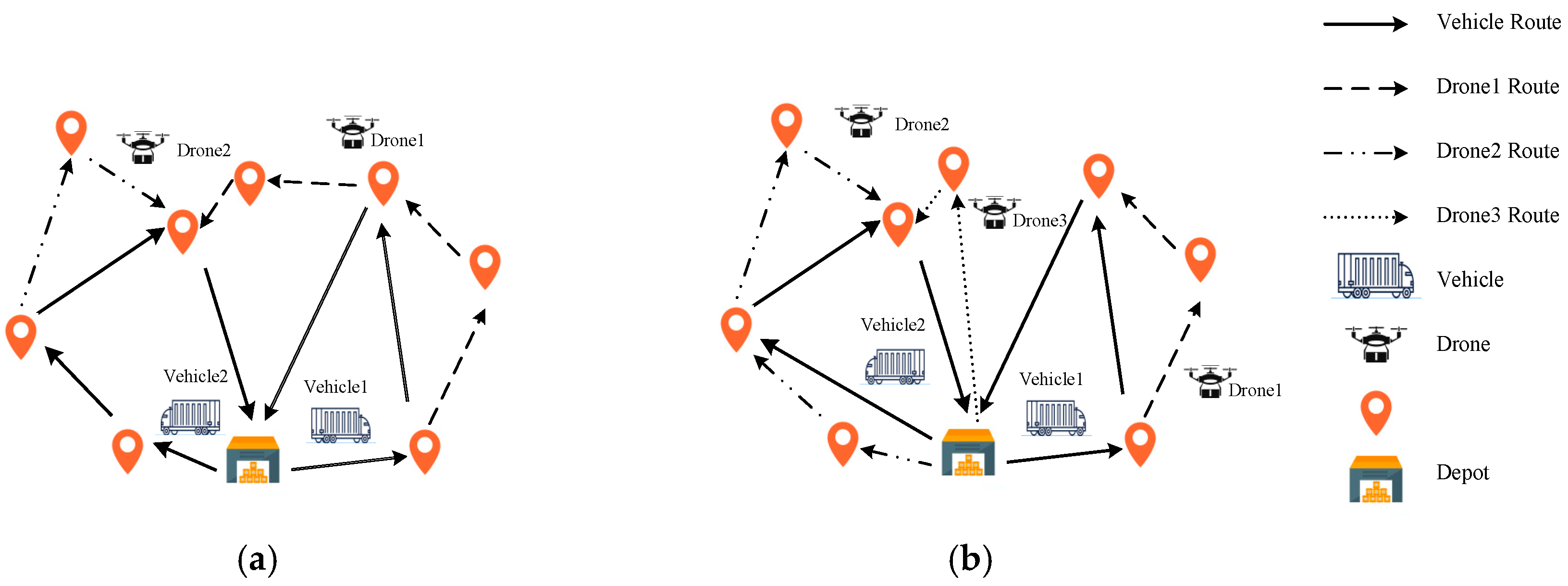
Unlike the single vehicle and drone cooperative delivery scenario, the addition of multiple vehicles complicates the synchronization process, involving more synchronization choices between different vehicles and drones, as illustrated in Figure 11. With an increased number of vehicles, in Figure 11a drones on different vehicles can go to other vehicles for recovery operations, which aim to reduce waiting times caused by synchronization issues between vehicles and drones. Furthermore, in Figure 11b drones departing from warehouses can return to idle vehicles after completing delivery tasks, enhancing flexibility in customer service.
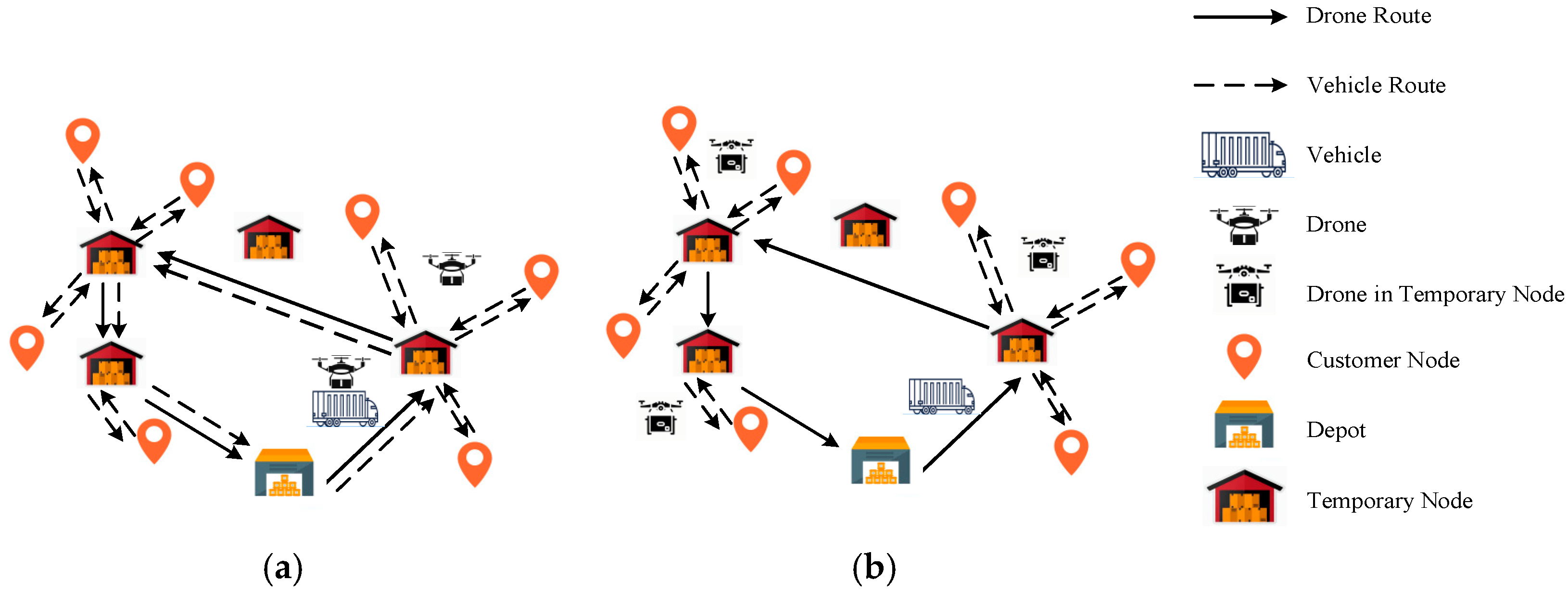
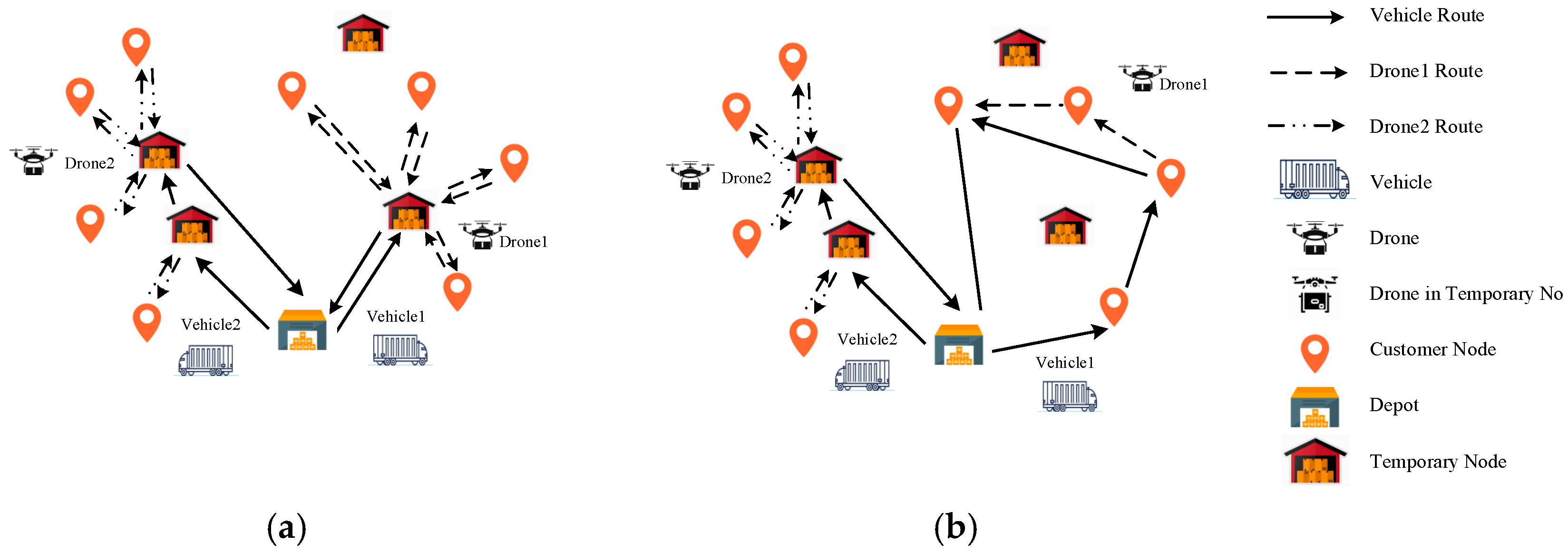
In addition to the complex synchronization process where drones can be recovered by different vehicles, the inclusion of intermediate stations further enhances the flexibility of vehicles and drones cooperative delivery. For instance, as shown in Figure 12a, vehicles can go to an intermediate station and wait for all drones to return. In Figure 12b, vehicles have the option to wait at the intermediate station after launching drones or to move to the next recovery node location while waiting for the drones.

Synchronization Analysis of Vehicles and Drones Cooperative Delivery Routing Problem

In this section, we organize and analyze research related to vehicles and drones cooperative delivery. We systematically summarize and analyze relevant literature from the perspectives of vehicle and drone synchronization settings during the synchronization process.
For the launch locations of drones, most studies support warehouse launches and vehicle launches, such as those by Poikonen & Golden [47], Wang & Sheu [9], and Kitjacharoenchai & Lee [48]. However, intermediate launche (ILD) is rarely mentioned in the literature, indicating that this function is significantly limited in practical applications; only Wang & Sheu [9] and Zang & Mladenovic [49] address it. Notably, in Wang & Sheu [9], drones can only launch and recover at intermediate stations or warehouses and can synchronize with vehicles at intermediate nodes to launch towards the next intermediate station, which is a rare synchronization setup. Conversely, Zang & Mladenovic [49] simplify the problem by having vehicles launch multiple drones upon arriving at an intermediate station, with all drones recovering after serving customers before heading to the next intermediate station. This setup enhances drone utilization but somewhat reduces the complexity of the problem.
Regarding synchronization settings during the drone recovery process, hover (HV) is discussed in most studies, explicitly stating that drones wait for vehicles while hovering (e.g., Chiang et al. [10], Wang & Hu [50], Huang & Chen [51], Masmoudi et al. [52], (Kuo & Mara [53]). In studies like Wang & Hu [50], it is noted that drones consume energy while hovering, whereas Huang & Chen [51], Kuo & Mara [53], and Masmoudi et al. [52] specify that energy is not consumed during hovering; however, Masmoudi et al. [52] impose a maximum waiting time limit. Furthermore, Jiang et al. [54] and Yin et al. [11] do not set hovering conditions as they require drones to land and wait for vehicles. The No UAV Waiting for Vehicle Retrieval (NWVR) function is considered in some studies, reflecting the operational strategy differences across various scenarios. Rave et al. [55] indicate that drones can reduce speed during flight to arrive at recovery nodes later than vehicles. Therefore, concerning the drone recovery process, the status of drones lacks effective definition, with both hovering and landing to wait for vehicle recovery being common synchronization choices.
The status of vehicles after launching drones is another research hotspot. The function requiring vehicles to wait in place after launching drones (MW-ADL) is mentioned in some studies, such as Zang & Mladenovic [49], indicating its feasibility in practical applications. Conversely, the majority of studies support the function of not allowing vehicles to wait in place (NWL-ADL) after launching drones, as seen in Poikonen & Golden [47] and Chiang et al. [10], which enhances vehicle operational efficiency. Some literature, like Schermer & Wendt [56], mentions allowing vehicles to wait in place (AWL-ADL), showing flexibility in practical operations. Most studies support the function allowing vehicles to wait for drones at recovery points (WN-WDR). In the study by Wang & Sheu [9], as their scenario specifies that drones only launch and recover at intermediate stations, backup drones at the intermediate station will replace previously assigned drones to continue tasks if the drones arrive later than vehicles. This scenario setup can also serve as a reference.

6.3. Conclusion of Vehicle and Drone High Synchronization Level Scenarios

Vehicle and drone high synchronization level scenarios represent the most integrated collaboration situation, where entities achieve tight coordination to optimize delivery efficiency. In single-vehicle scenarios, 93% of studies adopt LFD/VLD (drone launch from depot/vehicle), with universal support for RCN (retrieve from customer node), while ILD (intermediate launch) is rarely used (7%). Vehicle operations prioritize LRCN (93%), but CDT (consider drone launch/retrieve time) is addressed in only 36% of cases. In multi-vehicle settings, LFD/VLD remain prevalent (88%), though ILD is limited (18%). RCN is supported in 76% of studies, while ULR (unlimited launch/retrieve) appears in just 6%. Vehicle synchronization relies on LRCN (65%) and LRS (12%), with waiting policies split between NWL-ADL (41%) and AWL-ADL (35%). Critical gaps include underexplored HV energy consumption (defined in 43% of studies), limited integration of EC/NLR (22%/18%), and underutilization of D&P/SPDS (15%/24%). Future research should focus on dynamic models integrating CDT + ULR for urban adaptability, sustainability optimization via EC + NLR to reduce energy costs by 15–20%, and field validation of D&P + SPDS in humanitarian logistics. Addressing these gaps could enhance d balancing cost, sustainability, and resilience. The detailed classification results and corresponding literature mappings supporting the above statistical summaries are provided in Supplementary Material S1 for reference.

7. Methods for Solving Vehicle and Drone Delivery Routing Problems in Multiple Scenarios

To address these complex routing problems, researchers have proposed various solving methods. In this chapter, we elaborate on these methods, including both exact algorithms and heuristic algorithms, and discuss their applications in different synchronization level scenarios.

7.1. Exact Algorithms

7.1.1. Analysis of Exact Algorithms in Non-Synchronous Scenarios

In non-synchronous scenarios, vehicles and drones operate independently to complete deliveries to all customers. This delivery mode is more dependent on specific situations, such as same-day delivery and real-time insertion of new orders, which require high timeliness and flexibility. Montemanni & Corsini [22] proposed two constraint programming models and a MILP formulation and inequalities for exact solutions for last-mile delivery with parallel truck-drone operations, demonstrating that this cooperative behavior enhances the potential for both trucks and drones to jointly fulfill certain delivery tasks.

7.1.2. Analysis of Exact Algorithms in Low Synchronization Level Scenarios

In low synchronization level scenarios, there is a certain synchronization process between vehicles and drones. Below, we summarize and compare literature on various exact algorithms used in low synchronization scenarios. Branch and Bound Algorithms: Alfandari et al. [35] proposed a unified MILP formulation with an efficient branch-and-cut scheme that leverages Benders cuts to outperform alternatives. This approach is, however, seldom applied in low synchronization settings. Decomposition-Based Exact Algorithms: Pina-Pardo et al. [24] introduced a new variant with package dispatch dates. Unlike Dayarian & Clarke [23] and Moshref-Javadi & Hemmati [25] orders (including package destinations) are not initially available; therefore, drones are used to provide these items to vehicles at synchronized locations selected from a subset of customers. Their multi-trip extension enables vehicles to manage newly released orders directly or via drone support, effectively breaking down complex routing problems. Other Exact Algorithms: Matthew & Waslander [28] used enumeration (KSE) and transformation (GTSP) algorithms to solve vehicle-assisted drone delivery for up to 30 customers. Pina-Pardo et al. [27] addressed dynamic, same-day delivery by formulating a route-based Markov decision process combined with an online truck scheduling strategy supported by drone dispatch. Compared to non-synchronous scenarios, research utilizing exact algorithms in low synchronization scenarios is relatively more prevailing; however, due to the limited use of relevant literature, we failed to identify many patterns. Hence, studying the application of exact algorithms in low synchronization scenarios may represent a promising research direction.

7.1.3. Analysis of Exact Algorithms in High Synchronization Level Scenarios

In high synchronization level scenarios, the strong coupling between vehicle routes and drone operations substantially increases computational complexity. As a result, most studies rely on branch-based and decomposition-oriented exact algorithms to manage intertwined routing and synchronization decisions.
Branch-and-price and branch-and-cut frameworks are commonly adopted. For example, Wang & Sheu [9] proposed a branch-and-price algorithm, while Yin et al. [11] further developed branch-and-price(-and-cut) approaches. Similarly, Dell’Amico et al. [4] applied branch-and-cut methods based on classical benchmark instances.
Decomposition-based strategies are also frequently used. Yurek & Ozmutlu [57] employed a decomposition approach, and Gao et al. [58] as well as Faiz et al. [59] combined column generation with decomposition techniques to enhance scalability. Additionally, Bouman et al. [41] explored dynamic programming, while Ulmer & Thomas [38] formulated the problem within a Markov decision framework. Overall, exact algorithms in high synchronization scenarios predominantly integrate branch-based search, column generation, and decomposition mechanisms. Although methodological progress has improved solution capability, the tight synchronization structure still limits scalability to moderate instance sizes, highlighting the inherent computational challenges of this problem class. The detailed corresponding literature mappings supporting the above statistical summaries are provided in Supplementary Material S2 for reference.

7.1.4. Synchronization Level and Exact Algorithm Design

From the perspective of synchronization levels, the structural complexity of coordination between vehicles and drones significantly influences the modeling framework and, consequently, the design of exact algorithms.
In non-synchronous scenarios, the independence between vehicles and drones leads to relatively separable formulations. As a result, classical MILP models, constraint programming approaches, and enumeration-based exact methods can be directly extended from traditional vehicle routing or parallel machine scheduling problems. The limited coupling constraints allow exact algorithms to maintain relatively clear solution structures.
In low synchronization level scenarios, however, synchronization constraints such as launch–recovery pairing, temporal consistency, and resource sharing introduce tighter coupling between routing and scheduling decisions. This increases model complexity and often necessitates decomposition strategies, branch-and-cut schemes, or Benders-based enhancements to maintain tractability. The presence of synchronization points directly affects branching strategies, cut generation, and the overall computational performance of exact algorithms.
In high synchronization scenarios, routing and synchronization decisions become tightly intertwined, leading to highly integrated mathematical structures. Under such settings, exact algorithms frequently rely on branch-based frameworks combined with decomposition or column-generation mechanisms to handle the increased complexity. However, the strong structural coupling inherently restricts scalability.
Overall, as the synchronization level increases, the mathematical structure becomes more intertwined, which typically reduces the scalability of pure exact approaches. Therefore, the synchronization level not only determines the operational characteristics of the delivery system but also fundamentally shapes the applicability and performance boundaries of exact solution methods.

7.2. Heuristic Algorithms

7.2.1. Analysis of Heuristic Algorithms in Non-Synchronous Scenarios

In non-synchronous scenarios, the earliest research addressing the parallel delivery path problem involving vehicles and drones was conducted by Murray & Chu [3]. They introduced the PDSTSP as a combination of two classical operations research problems. This model uses the TSP to order truck-assigned customers while allocating remaining customers to drone routes, with a Large Neighborhood Search (LNS) heuristic reallocating customers between trucks and drones to minimize completion time. Chowdhury et al. [16] developed a two-stage Continuous Approximation (CA) model that selects the mode of delivery—drone or truck—based on road conditions. Nguyen et al. [19] introduced the Slack Induction by String and Sweep Removals (SISSRs) heuristic, adapted from SISR (Christiaens & Vanden Berghe [60]). More recently, Hamid & Rabbani [20] applied an adaptive meta-heuristic that integrates genetic algorithms with improved particle swarm optimization, demonstrating enhanced cost efficiency, meal freshness, and deadline satisfaction in food delivery contexts.
In non-synchronous scenarios, the use of algorithms significantly relies on the design of the scenarios, as the models for parallel problems are relatively simple and more easily integrated with different settings. The rapid solving capability and extensibility of heuristic algorithms make them extensively applicable in non-synchronous scenarios, closely aligning with the problems at hand. However, this may lead to a lack of comparison between different heuristics in the same scenario. The high specificity of heuristic algorithms to particular scenarios can also limit their general applicability. Therefore, designing a universal heuristic algorithm that can be applied to the majority of scenarios in non-synchronous problems and still providing satisfactory solutions may be a promising research direction.

7.2.2. Analysis of Heuristic Algorithms in Low Synchronization Level Scenarios

In low synchronization level scenarios, heuristic algorithms are used much more frequently than exact algorithms. This subsection focuses on the classification and analysis of various heuristics, exploring their applications in low synchronization level scenarios. Large Neighborhood Search Algorithms: Dayarian & Clarke [23] addressed same-day delivery with drone replenishment by developing an LNS algorithm featuring custom operators tailored to various same-day scenarios. Two-Stage Heuristic Algorithms: Kloster et al. [37] proposed a MILP-based model that minimizes completion costs through a two-stage process—first generating a pool of solutions via a metaheuristic, then refining them using branch-and-price/column generation, inspired by. Accorsi & Vigo [61] Meta-Heuristics: Savuran & Karakaya [30] minimized drone travel by optimizing vehicle docking points in the “Warehouse Mobility Problem” using a genetic algorithm combined with nearest neighbor and hill-climbing techniques. Carlsson & Song [31] applied simulated annealing for scheduling delivery robots with GIS and OSM data. Pina-Pardo et al. [27] addressed dynamic same-day delivery by iteratively modifying truck routes via a tabu search scheme. Other Heuristic Algorithms: Karak & Abdelghany [33] introduced a new solution method that expands upon the classic Clarke and Wright algorithm (Clarke & Wright [62]) to solve the HVDRP. They demonstrated competitive performance against both vehicle-driven and drone-driven heuristics.
In low synchronization level scenarios, the use of heuristic algorithms is the preferred choice for most studies, and they can handle relatively large datasets. While meta-heuristics are the predominant choice in this context, the use of two-stage heuristics or other heuristic algorithms is less prevalent. Nevertheless, the superiority of meta-heuristics in low synchronization level scenarios still requires further validation through related research, which may warrant more in-depth investigation.

7.2.3. Analysis of Heuristic Algorithms in High Synchronization Level Scenarios

In high synchronization level scenarios, neighborhood search-related algorithms are widely applied. The Adaptive Large Neighborhood Search (ALNS) algorithm is particularly significant. Tu et al. [39] demonstrated that ALNS outperformed the Greedy Randomized Adaptive Search Procedure (GRASP) in efficiency and cost reduction. Sacramento & Ropke [63] applied ALNS to a VRPD model where drones could take off and land at customer nodes along a truck’s route. Mara & Sopha [44] used ALNS for a single truck and drone system in real-world delivery scenarios. Jiang et al. [54] applied ALNS to a pickup-and-delivery problem, enabling drones to return to any nearby truck, solving instances with up to 100 requests. The Greedy Randomized Adaptive Search Procedure (GRASP) is another common heuristic method. Ha et al. [40] introduced two heuristic approaches. The first algorithm (TSP-LS) was adapted from the method proposed by Murray & Chu [3], converting the optimal TSP solution into a feasible TSP-D solution through local search. The second algorithm was a GRASP process based on a new splitting procedure that optimally divides any TSP tour into TSP-D solutions. Large Neighborhood Search (LNS) algorithms are also effective for solving large-scale problems. Kitjacharoenchai & Lee [48] formulated a Mixed-Integer Programming (MIP) approach to solve the problem and developed two efficient heuristic algorithms for large-scale problems: the Drone-Truck Routing Construction (DTRC) and Large Neighborhood Search (LNS). Variable Neighborhood Search/Variable Neighborhood Descent (VNS/VND) algorithms are frequently applied to solve high synchronization vehicle and drone delivery routing problems. de Freitas & Penna [64] enhanced Agatz & Schmidt [6] TSP-D algorithm with a hybrid GVNS approach. Gu & Liu [65] designed an Iterated Local Search with Variable Neighborhood Descent (ILS-VND) to handle VRPD with multiple visits, integrating an energy consumption model for drones. Multi-stage heuristic algorithms, additionally, have been applied in high synchronization level scenarios. Jeong & Lee [43] proposed a two-stage construction and search heuristic algorithm to improve computational efficiency for real-world problems. Poikonen & Golden [46] proposed a three-stage heuristic method called Routing, Transition, and Shortest Path (RTS). Murray & Raj [5] developed a mathematical formulation along with a three-stage heuristic approach to address the problem. Raj & Murray [42] designed a three-stage algorithm that dynamically adjusts drone speed, improving delivery time and reducing energy consumption. Meng et al. [66] introduced a two-stage heuristic using an improved simulated annealing algorithm with customized acceleration strategies. Meta-Heuristics algorithms provide efficient solutions to complex routing problems through the integration of various strategies and techniques. Chiang et al. [10] developed a genetic algorithm (GA) for VRPD to minimize transport costs and carbon emissions. Mara & Sopha [44] integrated simulated annealing and VNS in a two-stage search algorithm. Huang & Chen [51] tackled the NP-hard nature of the VRPD by designing an Ant Colony Optimization (ACO) algorithm to solve the VRPD. Masmoudi et al. [52] introduced an Adaptive Multi-Start Simulated Annealing (AMS-SA) algorithm, achieving superior results compared to advanced VRPD heuristics.
In high synchronization level scenarios, heuristic algorithms dominate due to their efficiency in handling complex coordination problems. Large Neighborhood Search (LNS) and meta-heuristics, particularly Variable Neighborhood Search (VNS), are widely used. Multi-stage heuristics further enhance solution quality. However, the diversity of heuristic approaches makes direct comparisons challenging. Future research should focus on understanding the adaptability of heuristic structures and identifying key factors influencing their effectiveness in specific high synchronization scenarios. The detailed corresponding literature mappings supporting the above statistical summaries are provided in Supplementary Material S2 for reference.

7.2.4. Synchronization Level and Heuristic Algorithm Design

Compared with exact algorithms, heuristic and meta-heuristic approaches demonstrate stronger adaptability to different synchronization levels. However, the synchronization structure still plays a decisive role in shaping heuristic design and performance.
In non-synchronous scenarios, since vehicles and drones operate independently, heuristics can treat the problem as a loosely coupled assignment and routing task. Many algorithms rely on decomposing the problem into truck routing and drone allocation subproblems, enabling relatively straightforward neighborhood structures and solution representations.
In low synchronization level scenarios, heuristics must explicitly incorporate synchronization-related constraints, such as coordinated departure and rendezvous times. This often requires customized neighborhood operators that preserve feasibility with respect to launch–recovery relationships and time synchronization. Consequently, adaptive mechanisms (e.g., ALNS with problem-specific destroy–repair operators) become particularly effective.
In high synchronization level scenarios, the strong interdependence between vehicle routes and drone schedules significantly increases the solution space complexity. Heuristic performance largely depends on the ability to jointly modify truck routes and drone missions while maintaining synchronization feasibility. Multi-stage heuristics, variable neighborhood structures, and hybrid meta-heuristic frameworks are therefore widely adopted to balance exploration and coordination efficiency.
In summary, increasing synchronization levels lead to tighter coupling between routing and scheduling decisions, which in turn requires more sophisticated neighborhood designs and hybrid search mechanisms. Understanding how synchronization structures influence algorithm behavior is essential for developing robust and scalable solution approaches.

8. Discussion and Future Challenges

Building upon the comprehensive analysis presented in the previous sections, this section discusses several critical research gaps and emerging challenges in vehicle and drone delivery routing problems. Although substantial progress has been achieved under different synchronization levels, existing studies remain limited in terms of adaptability, intelligence, constraint integration, and real-world deployment. To address these limitations, we outline four major research directions: dynamic multi-level synchronization mechanisms, intelligent coordination of heterogeneous fleets, multi-objective optimization under complex constraints, and interdisciplinary integration for practical implementation.

8.1. Dynamic Multi-Level Synchronization Mechanisms

Current research on vehicle–drone collaboration predominantly relies on static synchronization frameworks, which are characterized by fixed interaction settings, such as pre-determined drone launch and recovery points (Pina-Pardo et al. [27]; Jiang et al. [54]). These studies typically assume a single, pre-specified synchronization mode throughout the entire delivery process, limiting the system’s flexibility in responding to dynamic operational conditions.
However, a significant research void still exists in the development of adaptive synchronization mechanisms that are capable of dynamically transitioning among non-synchronized, low synchronization level, and high synchronization level modes according to real-time operational requirements. Such mechanisms would allow delivery systems to adjust their cooperation strategies flexibly—for instance, shifting from parallel vehicle–drone operations during normal periods to highly coordinated collaborative delivery during peak demand—while maintaining computational tractability.
Nevertheless, recent studies have begun to explore the feasibility of combining multiple synchronization levels within a unified delivery framework. In contrast to traditional single-mode formulations, Kong et al. [67] introduce a novel autonomous delivery vehicle routing problem with heterogeneous drones based on multiple delivery modes, where both low-synchronization and high-synchronization delivery strategies are integrated within the same system. Their results demonstrate that the coordinated use of collaborative drones and parallel drones can effectively reduce overall delivery cost, suggesting that hybrid synchronization strategies represent a promising and practically viable direction for unmanned delivery systems.
Despite this progress, existing studies remain limited in that synchronization mode selection is still largely pre-defined rather than dynamically adjusted in response to real-time information. A truly adaptive synchronization mechanism would require not only dynamic route adjustments but also real-time reconfiguration of vehicle–drone cooperative relationships and service task scheduling. Future research should therefore focus on developing multi-dimensional synchronization mechanisms that integrate approaches such as fuzzy logic, dynamic programming, and adaptive control strategies. These mechanisms could enhance algorithmic adaptability and improve routing stability under uncertainty.
For example, when facing order fluctuations, unexpected events, or adverse weather conditions, algorithms equipped with dynamic multi-level synchronization mechanisms could automatically adjust cooperation modes and routing decisions in response to environmental changes, thereby achieving more robust and efficient delivery planning.

8.2. Autonomous Heterogeneous Fleet Coordination

In the area of intelligent scheduling and dynamic planning for heterogeneous vehicle collaboration, existing research has primarily focused on path optimization and scheduling issues between conventional vehicles, trucks, and homogeneous drones or drones with varying payloads and speeds. However, the exploration of intelligent and dynamic scheduling remains limited. The inclusion of heterogeneous vehicles makes model solving more complicated. Current studies mainly employ heuristic algorithms related to neighborhood search, which can yield good results in a short time. As artificial intelligence technologies rapidly advance, deep learning and reinforcement learning are becoming crucial tools for addressing complex scheduling problems. Future research can introduce adaptive deep learning models to facilitate real-time scheduling and path adjustments for heterogeneous vehicles in dynamic environments. Actual delivery systems often involve various vehicle types, such as electric trucks, drones, and autonomous vehicles, each with different characteristics and constraints. The achievement of joint optimization under multi-objective and multi-constraint conditions is a key research focus in the forthcoming studies. The integration of intelligent algorithms plays a critical role in this process. For instance, through incorporating reinforcement learning and neural network algorithms, optimal vehicle combinations can be dynamically selected, and optimal delivery routes can be planned across different scenarios, significantly enhancing delivery efficiency and service quality in complex scenarios.

8.3. Overcoming Complex Constraints in Multi-Objective Optimization

Regarding multi-objective optimization under complex constraints, although some research has optimized single objectives or partial constraints, systemic optimization across multiple objectives and constraints remains underexplored. Approximately 50% of the literature (e.g., Luo et al. [68], Raj & Murray [42], Wang & Sheu [9]) focuses on optimizing basic constraints like drone energy consumption models. However, actual delivery tasks are often subject to more complex, multi-dimensional constraints, including weather conditions and carbon emission limits. Future research can build more accurate energy consumption models that integrate optimization for both vehicles and drones, exploring solution strategies based on Pareto front theory. Approaches involving mixed-integer programming, metaheuristics, and multi-objective evolutionary algorithms can efficiently solve complex problems in complex scenarios while obtaining near-Pareto optimal solutions under multi-objective constraints. This methodology can balance different objectives, ensuring optimized route planning while adhering to weight and energy constraints.

8.4. Leveraging Interdisciplinary Approaches for Real-World Deployment

In interdisciplinary research, the study of cooperative delivery systems involving vehicles and drones is progressively advancing towards multi-disciplinary integration, particularly in the application of traffic engineering, operations research, geographic information systems (GIS), and real-time data analytics. For example, Sawadsitang et al. [17] used real urban road networks for drone route planning, while Jeong & Lee [43] incorporated no-fly zones based on real-world conditions, like sensitive FAA-regulated facilities. Comparable no-fly zone policies are also enforced in major Chinese cities such as Beijing, where airspace restrictions are imposed around sensitive governmental and densely populated urban areas. Furthermore, interdisciplinary research combining game theory and multi-agent systems (MASs) has demonstrated strong potential for modeling strategic coordination, resource allocation, and distributed control among autonomous entities, thereby offering a theoretical foundation for more adaptive and resilient vehicle–drone delivery systems in complex environments Feng et al. [69].
Beyond technological and modeling considerations, the deployment of drones is also strongly influenced by regulatory governance and management authority structures. In many countries, civil aviation authorities impose strict requirements regarding flight permissions, operator certification, airspace restrictions, and safety compliance. Issues related to pilot training, operational licensing, autonomous system supervision, and liability responsibility significantly affect the feasibility and scalability of drone applications. Regulatory heterogeneity across regions further increases the complexity of integrating drones into large-scale logistics networks. While existing research has made strides in these areas, much remains theoretical or simulation-oriented, often neglecting dynamic factors present in real-world applications, such as traffic flow, weather changes, and road conditions. In the context of supply chain management and last-mile distribution, regulatory constraints and educational requirements directly influence routing design and synchronization mechanisms. For instance, restrictions on flight altitude, no-fly zones, weather-related safety limitations, and battery safety standards may reduce operational flexibility and increase implementation costs. These governance and operational challenges highlight the necessity of incorporating regulatory considerations into routing models to bridge the gap between theoretical optimization and practical deployment.
Future studies are expected to integrate GIS technology and real-time data more effectively to facilitate more refined path modeling in complex terrains and dynamic environments. In practical delivery scenarios, combining high-precision geographic information, historical traffic data, and weather prediction models can enhance the accuracy of feasibility and efficiency assessments for delivery routes.

9. Conclusions

This study provides a comprehensive literature review of the cooperative delivery routing problem involving vehicles and drones, with a particular focus on delivery scenarios under different synchronization levels: non-synchronized, low-synchronized, and high-synchronized. We first analyzed the fundamental models and problem types related to vehicle and drone collaboration, covering various typical routing problem models such as FSTSP, TSPD, and VRPD, along with their variants. We then detailed the functional roles of vehicles and drones in the delivery process, specifically focusing on the flight service capabilities, payload functionalities, and endurance of drones, as well as the service functions, endurance, and synchronization capabilities of vehicles. We conducted a comprehensive review of the literature concerning vehicle and drone operations under three synchronization level scenarios. Furthermore, we performed a thorough comparison based on the distinct functionalities of vehicles and drones at varying levels of synchronization, culminating in a summary that highlights the key differences and implications for routing strategies in each context. Additionally, we cross-summarized the exact and heuristic solution methods across multiple synchronization level scenarios.
Overall, the review establishes an integrated analytical framework that enhances the understanding of synchronization mechanisms and cooperative delivery strategies in unmanned logistics systems. The findings contribute to a more coherent classification of existing research and provide a solid conceptual foundation for advancing both theoretical modeling and practical implementation in vehicle–drone collaborative delivery.

Supplementary Materials

The following supporting information can be downloaded at: https://www.mdpi.com/article/10.3390/drones10030206/s1, Supplementary Materials S1: Function-Based in Different Synchronization Level Literature Analysis; Supplementary Materials S2: Algorithms for Different Synchronization Levels. References [13,40,57,58,59,70,71,72,73,74,75,76,77,78,79,80,81,82,83,84,85,86,87,88,89,90] are cited in the Supplementary Materials.

Author Contributions

All authors have made substantial contributions to the completion of this manuscript. J.K. (First Author): Responsible for research topic identification, framework development, in-depth data analysis, manuscript revision, and rigorous methodological validation, guaranteeing content accuracy, methodological rigor, and conceptual integrity. L.W. (Second Author): Drafted the initial manuscript, conducted data preparation, and performed comprehensive data analysis. X.J. (Third Author): Participated in data preparation and collaborated on data analysis work. All authors have read and agreed to the published version of the manuscript.

Funding

This work is partially supported by the National Natural Science Foundation of China [Grant 72471033] and the Humanities and Social Science Youth Foundation of the Ministry of Education of China [Grant 20YJC630054].

Data Availability Statement

The original contributions presented in this study are included in the article/Supplementary Material. Further inquiries can be directed to the corresponding author.

Conflicts of Interest

The authors declare no competing interests.

References

  1. Sluijk, N.; Florio, A.M.; Kinable, J.; Dellaert, N.; Van Woensel, T. Two-echelon vehicle routing problems: A literature review. Eur. J. Oper. Res. 2023, 304, 865–886. [Google Scholar] [CrossRef]
  2. Dukkanci, O.; Campbell, J.F.; Kara, B.Y. Facility location decisions for drone delivery: A literature review. Eur. J. Oper. Res. 2024, 316, 397–418. [Google Scholar] [CrossRef]
  3. Murray, C.C.; Chu, A.G. The flying sidekick traveling salesman problem: Optimization of drone-assisted parcel delivery. Transp. Res. Part C Emerg. Technol. 2015, 54, 86–109. [Google Scholar] [CrossRef]
  4. Dell’Amico, M.; Montemanni, R.; Novellani, S. Modeling the flying sidekick traveling salesman problem with multiple drones. Networks 2021, 78, 303–327. [Google Scholar] [CrossRef]
  5. Murray, C.C.; Raj, R. The multiple flying sidekicks traveling salesman problem: Parcel delivery with multiple drones. Transp. Res. Part C Emerg. Technol. 2020, 110, 368–398. [Google Scholar] [CrossRef]
  6. Agatz, N.B.P.; Schmidt, M. Optimization approaches for the traveling salesman problem with drone. Transp. Sci. 2018, 52, 965–981. [Google Scholar] [CrossRef]
  7. Yoon, J.J. The Traveling Salesman Problem with Multiple Drones: An Optimization Model for Last-Mile Delivery. Master’s Thesis, United States Military Academy at West Point, New York, NY, USA, 2018. [Google Scholar]
  8. Wang, X.; Poikonen, S.; Golden, B. The vehicle routing problem with drones: Several worst-case results. Optim. Lett. 2017, 11, 679–697. [Google Scholar] [CrossRef]
  9. Wang, Z.; Sheu, J.B. Vehicle routing problem with drones. Transp. Res. Part B Methodol. 2019, 122, 350–364. [Google Scholar] [CrossRef]
  10. Chiang, W.C.; Li, Y.Y.; Shang, J. Impact of drone delivery on sustainability and cost: Realizing the UAV potential through vehicle routing optimization. Appl. Energy 2019, 242, 1164–1175. [Google Scholar] [CrossRef]
  11. Yin, Y.; Li, D.; Wang, D.; Ignatius, J.; Cheng, T.; Wang, S. A branch-and-price-and-cut algorithm for the truck-based drone delivery routing problem with time windows. Eur. J. Oper. Res. 2023, 309, 1125–1144. [Google Scholar] [CrossRef]
  12. Luo, Z.; Gu, R.; Poon, M.; Liu, Z.; Lim, A. A last-mile drone-assisted one-to-one pickup and delivery problem with multi-visit drone trips. Comput. Oper. Res. 2022, 148, 106015. [Google Scholar] [CrossRef]
  13. Mulumba, T.; Najy, W.; Diabat, A. The drone-assisted pickup and delivery problem: An adaptive large neighborhood search metaheuristic. Comput. Oper. Res. 2024, 161, 106435. [Google Scholar] [CrossRef]
  14. Meng, S.; Chen, Y.; Li, D. The multi-visit drone-assisted pickup and delivery problem with time windows. Eur. J. Oper. Res. 2024, 314, 685–702. [Google Scholar] [CrossRef]
  15. Ham, A.M. Integrated scheduling of m-truck, m-drone, and m-depot constrained by time-window, drop-pickup, and m-visit using constraint programming. Transp. Res. Part C Emerg. Technol. 2018, 91, 1–14. [Google Scholar] [CrossRef]
  16. Chowdhury, S.; Emelogu, A.; Marufuzzaman, M.; Nurre, S.G.; Bian, L. Drones for disaster response and relief operations: A continuous approximation model. Int. J. Prod. Econ. 2017, 188, 167–184. [Google Scholar] [CrossRef]
  17. Sawadsitang, S.; Niyato, D.; Tan, P.-S.; Wang, P. Joint ground and aerial package delivery services: A stochastic optimization approach. IEEE Trans. Intell. Transp. Syst. 2018, 20, 2241–2254. [Google Scholar] [CrossRef]
  18. Saleu, R.G.M.; Deroussi, L.; Feillet, D.; Grangeon, N.; Quilliot, A. The parallel drone scheduling problem with multiple drones and vehicles. Eur. J. Oper. Res. 2022, 300, 571–589. [Google Scholar] [CrossRef]
  19. Nguyen, M.A.; Dang, G.T.-H.; Hà, M.H.; Pham, M.-T. The min-cost parallel drone scheduling vehicle routing problem. Eur. J. Oper. Res. 2022, 299, 910–930. [Google Scholar] [CrossRef]
  20. Hamid, M.; Nasiri, M.M.; Rabbani, M. A mixed closed-open multi-depot routing and scheduling problem for homemade meal delivery incorporating drone and crowd-sourced fleet: A self-adaptive hyper-heuristic approach. Eng. Appl. Artif. Intell. 2023, 120, 105876. [Google Scholar] [CrossRef]
  21. Ramos, T.R.P.; Vigo, D. A new hybrid distribution paradigm: Integrating drones in medicines delivery. Expert Syst. Appl. 2023, 234, 120992. [Google Scholar] [CrossRef]
  22. Montemanni, R.; Dell’aMico, M.; Corsini, A. Parallel drone scheduling vehicle routing problems with collective drones. Comput. Oper. Res. 2024, 163, 106514. [Google Scholar] [CrossRef]
  23. Dayarian, I.S.M.; Clarke, J.P. Same-day delivery with drone resupply. Transp. Sci. 2020, 54, 229–249. [Google Scholar] [CrossRef]
  24. Pina-Pardo, J.C.; Silva, D.F.; Smith, A.E. The traveling salesman problem with release dates and drone resupply. Comput. Oper. Res. 2021, 129, 105170. [Google Scholar] [CrossRef]
  25. Moshref-Javadi, M.V.C.K.P.M.B.A.; Hemmati, A. Enabling same-day delivery using a drone resupply model with transshipment points. Comput. Manag. Sci. 2023, 20, 22. [Google Scholar] [CrossRef]
  26. Pina-Pardo, J.C.; Silva, D.F.; Smith, A.E. Fleet resupply by drones for last-mile delivery. Eur. J. Oper. Research. 2024. [Google Scholar] [CrossRef]
  27. Pina-Pardo, J.C.; Silva, D.F.; Smith, A.E.; Gatica, G.A. Dynamic vehicle routing problem with drone resupply for same-day delivery. Transp. Res. Part C Emerg. Technol. 2024, 162, 104611. [Google Scholar] [CrossRef]
  28. Matthew, N.S.S.L.; Waslander, S.L. Planning paths for package delivery in heterogeneous multirobot teams. IEEE Trans. Autom. Sci. Eng. 2015, 12, 1298–1308. [Google Scholar] [CrossRef]
  29. Schermer, D.; Moeini, M.; Wendt, O. The traveling salesman drone station location problem. In Proceedings of the World Congress on Global Optimization, Metz, France, 8–9 July, 2019. [Google Scholar]
  30. Savuran, H.; Karakaya, M. Efficient route planning for an unmanned air vehicle deployed on a moving carrier. Soft Comput. 2016, 20, 2905–2920. [Google Scholar] [CrossRef]
  31. Carlsson, J.G.; Song, S.Y. Coordinated logistics with a truck and a drone. Manag. Sci. 2017, 64, 4052–4069. [Google Scholar] [CrossRef]
  32. Poeting, M.; Schaudt, S.; Clausen, U. A comprehensive case study in last mile delivery concepts for parcel robots. In Proceedings of the 2019 Winter Simulation Conference, National Harbor, MD, USA, 08–11 December, 2019. [Google Scholar]
  33. Karak, A.; Abdelghany, K. The hybrid vehicle-drone routing problem for pick-up and delivery services. Transp. Res. Part C Emerg. Technol. 2019, 102, 427–449. [Google Scholar] [CrossRef]
  34. Bakach, I.; Campbell, A.M.; Ehmke, J.F. A two-tier urban delivery network with robot-based deliveries. Networks 2021, 78, 461–483. [Google Scholar] [CrossRef]
  35. Alfandari, L.; Ljubić, I.; da Silva, M.D.M. A tailored Benders decomposition approach for last-mile delivery with autonomous robots. Eur. J. Oper. Res. 2022, 299, 510–525. [Google Scholar] [CrossRef]
  36. Kyriakakis, N.A.; Stamadianos, T.; Marinaki, M.; Marinakis, Y. The electric vehicle routing problem with drones: An energy minimization approach for aerial deliveries. Clean. Logist. Supply Chain 2022, 4, 100041. [Google Scholar] [CrossRef]
  37. Kloster, K.; Moeini, M.; Vigo, D.; Wendt, O. The multiple traveling salesman problem in presence of drone-and robot-supported packet stations. Eur. J. Oper. Res. 2023, 305, 630–643. [Google Scholar] [CrossRef]
  38. Ulmer, M.W.; Thomas, B.W. Same-day delivery with heterogeneous fleets of drones and vehicles. Networks 2018, 72, 475–505. [Google Scholar] [CrossRef]
  39. Tu, P.A.; Dat, N.T.; Dung, P.Q. Traveling salesman problem with multiple drones. In Proceedings of the Ninth International Symposium on Information and Communication Technology—SoICT 2018, Danang City, Vietnam, 6–7 December, 2018. [Google Scholar]
  40. Ha, Q.M.; Deville, Y.; Pham, Q.D.; Hà, M.H. On the min-cost traveling salesman problem with drone. Transp. Res. Part C Emerg. Technol. 2018, 86, 597–621. [Google Scholar] [CrossRef]
  41. Bouman, P.; Agatz, N.; Schmidt, M. Dynamic programming approaches for the traveling salesman problem with drone. Networks 2018, 72, 528–542. [Google Scholar] [CrossRef]
  42. Raj, R.; Murray, C. The multiple flying sidekicks traveling salesman problem with variable drone speeds. Transp. Res. Part C: Emerg. Technol. 2020, 120, 102813. [Google Scholar] [CrossRef]
  43. Jeong, H.Y.S.B.D.; Lee, S. Truck-drone hybrid delivery routing: Payload-energy dependency and no-fly zones. Int. J. Prod. Econ. 2019, 214, 220–233. [Google Scholar] [CrossRef]
  44. Mara, S.T.W.; Rifai, A.P.; Sopha, B.M. An adaptive large neighborhood search heuristic for the flying sidekick traveling salesman problem with multiple drops. Expert Syst. Appl. 2022, 205, 117647. [Google Scholar] [CrossRef]
  45. Salama, M.R.; Srinivas, S. Collaborative truck multi-drone routing and scheduling problem: Package delivery with flexible launch and recovery sites. Transp. Res. Part E Logist. Transp. Rev. 2022, 164, 102788. [Google Scholar] [CrossRef]
  46. Poikonen, S.; Golden, B. Multi-visit drone routing problem. Comput. Oper. Res. 2020, 113, 104802. [Google Scholar] [CrossRef]
  47. Poikonen, S.W.X.; Golden, B. The vehicle routing problem with drones: Extended models and connections. Networks 2017, 70, 34–43. [Google Scholar] [CrossRef]
  48. Kitjacharoenchai, P.; Min, B.-C.; Lee, S. Two-echelon vehicle routing problem with drones in last mile delivery. Int. J. Prod. Econ. 2020, 225, 107598. [Google Scholar] [CrossRef]
  49. Zang, X.; Jiang, L.; Liang, C.; Dong, J.; Lu, W.; Mladenovic, N. Optimization approaches for the urban delivery problem with trucks and drones. Swarm Evol. Comput. 2022, 75, 101147. [Google Scholar] [CrossRef]
  50. Wang, D.; Hu, P.; Du, J.; Zhou, P.; Deng, T.; Hu, M. Routing and scheduling for hybrid truck-drone collaborative parcel delivery with independent and truck-carried drones. IEEE Internet Things J. 2019, 6, 10483–10495. [Google Scholar] [CrossRef]
  51. Huang, S.-H.; Huang, Y.-H.; Blazquez, C.A.; Chen, C.-Y. Solving the vehicle routing problem with drone for delivery services using an ant colony optimization algorithm. Adv. Eng. Inform. 2022, 51, 101536. [Google Scholar] [CrossRef]
  52. Masmoudi, M.A.; Mancini, S.; Baldacci, R.; Kuo, Y.-H. Vehicle routing problems with drones equipped with multi-package payload compartments. Transp. Res. Part E Logist. Transp. Rev. 2022, 164, 102757. [Google Scholar] [CrossRef]
  53. Kuo, R.; Lu, S.-H.; Lai, P.-Y.; Mara, S.T.W. Vehicle routing problem with drones considering time windows. Expert Syst. Appl. 2022, 191, 116264. [Google Scholar] [CrossRef]
  54. Jiang, J.; Dai, Y.; Yang, F.; Ma, Z. A multi-visit flexible-docking vehicle routing problem with drones for simultaneous pickup and delivery services. Eur. J. Oper. Res. 2024, 312, 125–137. [Google Scholar] [CrossRef]
  55. Rave, A.; Fontaine, P.; Kuhn, H. Drone location and vehicle fleet planning with trucks and aerial drones. Eur. J. Oper. Res. 2023, 308, 113–130. [Google Scholar] [CrossRef]
  56. Schermer, D.; Moeini, M.; Wendt, O. A matheuristic for the vehicle routing problem with drones and its variants. Transp. Res. Part C: Emerg. Technol. 2019, 106, 166–204. [Google Scholar] [CrossRef]
  57. Yurek, E.E.; Ozmutlu, H.C. A decomposition-based iterative optimization algorithm for traveling salesman problem with drone. Transp. Res. Part C: Emerg. Technol. 2018, 91, 249–262. [Google Scholar] [CrossRef]
  58. Gao, J.; Zhen, L.; Wang, S. Multi-trucks-and-drones cooperative pickup and delivery problem. Transp. Res. Part C Emerg. Technol. 2023, 157, 104407. [Google Scholar] [CrossRef]
  59. Faiz, T.I.; Vogiatzis, C.; Noor-E.-Alam, M. Computational approaches for solving two-echelon vehicle and UAV routing problems for post-disaster humanitarian operations. Expert Syst. Appl. 2024, 237, 121473. [Google Scholar] [CrossRef]
  60. Christiaens, J.; Vanden Berghe, G. Slack induction by string removals for vehicle routing problems. Transp. Sci. 2020, 54, 417–433. [Google Scholar] [CrossRef]
  61. Accorsi, L.; Vigo, D. A hybrid metaheuristic for single truck and trailer routing problems. Transp. Sci. 2020, 54, 1351–1371. [Google Scholar] [CrossRef]
  62. Clarke, G.; Wright, J.W. Scheduling of vehicles from a central depot to a number of delivery points. Oper. Res. 1964, 12, 568–581. [Google Scholar] [CrossRef]
  63. Sacramento, D.P.D.; Ropke, S. An adaptive large neighborhood search metaheuristic for the vehicle routing problem with drones. Transp. Res. Part C Emerg. Technol. 2019, 102, 289–315. [Google Scholar] [CrossRef]
  64. de Freitas, J.C.; Penna, P.H.V. A variable neighborhood search for flying sidekick traveling salesman problem. Int. Trans. Oper. Res. 2020, 27, 267–290. [Google Scholar] [CrossRef]
  65. Gu, R.; Poon, M.; Luo, Z.; Liu, Y.; Liu, Z. A hierarchical solution evaluation method and a hybrid algorithm for the vehicle routing problem with drones and multiple visits. Transp. Res. Part C Emerg. Technol. 2022, 141, 103733. [Google Scholar] [CrossRef]
  66. Meng, S.; Guo, X.; Li, D.; Liu, G. The multi-visit drone routing problem for pickup and delivery services. Transp. Res. Part E Logist. Transp. Rev. 2023, 169, 102990. [Google Scholar] [CrossRef]
  67. Kong, J.; Wang, H.; Xie, M. Autonomous delivery vehicle routing problem with drones based on multiple delivery modes. Comput. Oper. Res. 2025, 179, 107032. [Google Scholar] [CrossRef]
  68. Luo, Z.; Poon, M.; Zhang, Z.; Liu, Z.; Lim, A. The multi-visit traveling salesman problem with multi-drones. Transp. Res. Part C Emerg. Technol. 2021, 128, 103172. [Google Scholar] [CrossRef]
  69. Feng, R.; Liu, S.; Huang, W.; Han, T.; Yan, B.; Wang, Z.; Niu, Y. Bridging game theory and multi-agent systems: Development status and future prospects. Prog. Aerosp. Sci. 2026, 161, 101183. [Google Scholar] [CrossRef]
  70. Archetti, C.; Feillet, D.; Mor, A.; Speranza, M.G. An iterated local search for the traveling salesman problem with release dates and completion time minimization. Comput. Oper. Res. 2018, 98, 24–37. [Google Scholar] [CrossRef]
  71. Baybars İbroşka, B.; Özpeynirci, S.; Özpeynirci, Ö. Multiple traveling salesperson problem with drones: General variable neighborhood search approach. Comput. Oper. Res. 2023, 160, 106390. [Google Scholar] [CrossRef]
  72. Christofides, N.; Eilon, S. An algorithm for the vehicle-dispatching problem. J. Oper. Res. Soc. 1969, 20, 309–318. [Google Scholar] [CrossRef]
  73. Christofides, N. The vehicle routing problem. In Combinatorial Optimization; John Wiley & Sons: Hoboken, NJ, USA, 1979. [Google Scholar]
  74. Dienstknecht, M.; Boysen, N.; Briskorn, D. The traveling salesman problem with drone resupply. OR Spectr. 2022, 44, 1045–1086. [Google Scholar] [CrossRef]
  75. Ghiasvand, M.R.; Rahmani, D.; Moshref-Javadi, M. Data-driven robust optimization for a multi-trip truck-drone routing problem. Expert Syst. Appl. 2024, 241, 122485. [Google Scholar] [CrossRef]
  76. Heidelberg, U. Tsplib. 1995. Available online: https://github.com/shredderzwj/TSPLIB (accessed on 10 March 2026).
  77. Hermes Paket Radar Köln. 2018. Available online: https://newsroom.hermesworld.com/wp-content/uploads/heatmaps2017/koeln.html (accessed on 10 March 2026).
  78. Lei, D.; Cui, Z.; Li, M. A dynamical artificial bee colony for vehicle routing problem with drones. Eng. Appl. Artif. Intell. 2022, 107, 104510. [Google Scholar] [CrossRef]
  79. Letchford, A.N.; Nasiri, S.D.; Theis, D.O. Compact formulations of the Steiner traveling salesman problem and related problems. Eur. J. Oper. Res. 2013, 228, 83–92. [Google Scholar] [CrossRef]
  80. Liang, Y.J.; Luo, Z.X. A survey of truck–drone routing problem: Literature review and research prospects. J. Oper. Res. Soc. China 2022, 10, 343–377. [Google Scholar] [CrossRef]
  81. Masters, J. A Detailed View of the Storm Surge: Comparing Katrina to Camille. 2016. Available online: https://www.wunderground.com/hurricane/surgedetails.asp (accessed on 10 March 2026).
  82. Peng, K.; Jingxuan, D.; Fang, L.; Sun, Q.; Dong, Y.; Zhou, P.; Menglan, H. A hybrid genetic algorithm on routing and scheduling for vehicle-assisted multi-drone parcel delivery. IEEE Access 2019, 7, 49191–49200. [Google Scholar] [CrossRef]
  83. Perboli, G.; Tadei, R.; Vigo, D. The two-echelon capacitated vehicle routing problem: Models and math-based heuristics. Transp. Sci. 2011, 45, 364–380. [Google Scholar] [CrossRef]
  84. Ponza, A. Optimization of Drone-Assisted Parcel Delivery. Master’s Thesis, University of Padova, Padova, Italy, 2016. [Google Scholar]
  85. Pugliese, L.D.P.; Guerriero, F.; Macrina, G. Using drones for parcels delivery process. Procedia Manuf. 2020, 42, 488–497. [Google Scholar] [CrossRef]
  86. Sismeiro, A.C. Planning Medicine Deliveries with Drones in Rural Areas: Farmácia da Lajeosa Case Study. Master’s Thesis, Instituto Superior Técnico, Lisbon, Portugal, 2021. Available online: https://fenix.tecnico.ulisboa.pt/downloadFile/1689244997262860/Dissertacao%20Adriana%20Sismeiro%20-%2093875.pdf (accessed on 10 March 2026).
  87. Solomon, M.M. Algorithms for the vehicle routing and scheduling problems with time window constraints. Oper. Res. 1987, 35, 254–265. [Google Scholar] [CrossRef]
  88. Tamke, F.; Buscher, U. The vehicle routing problem with drones and drone speed selection. Comput. Oper. Res. 2023, 152, 106112. [Google Scholar] [CrossRef]
  89. Tavana, M.; Khalili-Damghani, K.; Santos-Arteaga, F.J.; Zandi, M.H. Drone shipping versus truck delivery in a cross-docking system with multiple fleets and products. Expert Syst. Appl. 2017, 72, 93–107. [Google Scholar] [CrossRef]
  90. Uchoa, E.; Pecin, D.; Pessoa, A.; Poggi, M.; Vidal, T.; Subramanian, A. New benchmark instances for the capacitated vehicle routing problem. Eur. J. Oper. Res. 2017, 257, 845–858. [Google Scholar] [CrossRef]
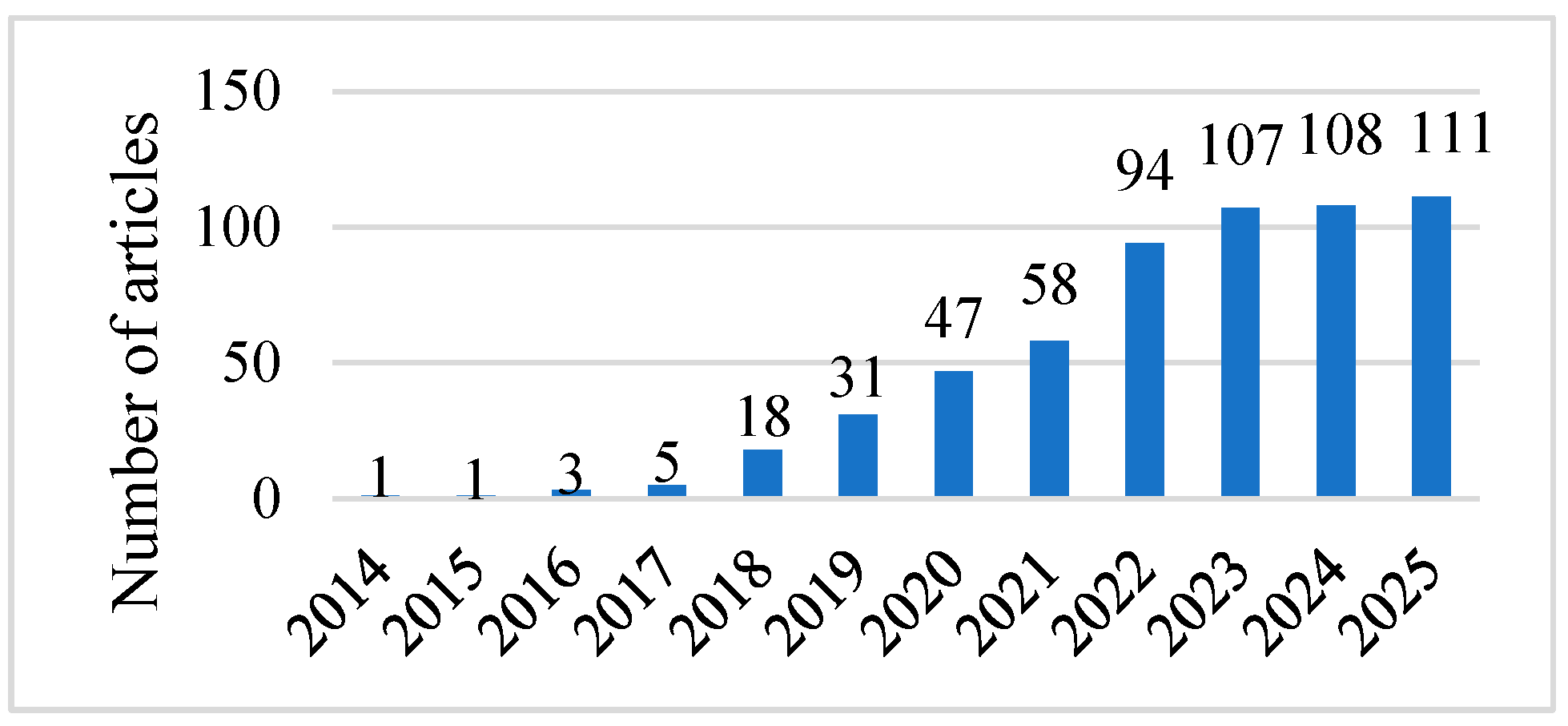
Figure 1. Number of articles per year.
Drones 10 00206 g001
Figure 2. Article keyword clustering label graph.
Drones 10 00206 g002
Figure 3. FSTSP model.
Drones 10 00206 g003
Figure 4. TSP-D model.
Drones 10 00206 g004
Figure 5. VRPD model.
Drones 10 00206 g005
Figure 6. Delivery and synchronization settings.
Drones 10 00206 g006
Figure 7. Drone delivery coverage areas. (a) Single-depot drone delivery; (b) Multi-depot drone delivery.
Drones 10 00206 g007
Figure 8. Parallel delivery by vehicle and drone. (a) Drone-only service for customers within the drone coverage area; (b) Flexible service within the drone coverage area by either drone or vehicle.
Drones 10 00206 g008
Figure 9. Vehicle routing problem with drone resupply. (a) Drone resupply directly to the vehicle at customer nodes; (b) Drone delivery to temporary nodes for vehicle pickup.
Drones 10 00206 g009
Figure 10. Truck-assisted vehicle routing problems. (a) Vehicle-carried drone launched at temporary nodes; (b) Drone stationed at temporary nodes awaiting vehicle resupply.
Drones 10 00206 g010
Figure 11. Vehicles and drones cooperative delivery routing problem. (a) Drone recovery by different vehicles; (b) Warehouse-launched drones returning to task vehicles.
Drones 10 00206 g011
Figure 12. Vehicles and drones cooperative delivery routing problem with intermediate stations. (a) Vehicles waiting for drones at intermediate stations; (b) Vehicles may proceed to the next recovery node after drone launch.
Drones 10 00206 g012
Table 1. Drone flight service functions.
FunctionIDDescription
Single Trip to Single CustomerSTSCUAV Single Customer Service Only
Single Trip to Multiple CustomersSTMCUAV Multiple Customers Service
UAV Delivery OnlyUDOUAV Delivery Only Supported
Pickup OnlyPOUAV Pickup Only Supported
Delivery and PickupD&PUAV Supports Both Pickup and Delivery
Table 2. Drone synchronization function table.
FunctionIDDescription
Launch from DepotLFDUAV Launch from Depot Supported
Vehicle LaunchVLDUAV Launch from Vehicle Supported
Intermediate LaunchILDUAV Launch from Intermediate Site Supported
HoverHVUAV Hover Capability
No UAV Waiting for Vehicle RetrievalNWVRUAV Not Allowed to Wait for Vehicle Retrieval
Retrieve from DepotRFDUAV Direct Return to Depot Supported
Retrieve with LaunchRWLUAV Retrieve to Same Vehicle after Launch
Different Vehicle Launch & RetrieveDVLRUAV Retrieve to Different Vehicle after Launch
Retrieve from Customer NodeRCNUAV Retrieval from Customer Node Supported
Intermediate RetrieveIRDUAV Retrieval from Intermediate Site Supported
Unlimited Launch & RetrieveULRUAV Launch & Retrieve Points Unlimited
Table 3. Vehicle synchronization function table.
FunctionIDDescription
Launch and Retrieve at Customer NodeLRCNVehicle Allowed to Launch/Retrieve Drone at Customer Node
Launch and Retrieve at SiteLRSVehicle Allowed to Launch and Retrieve Drone at Site
Launch and Retrieve AnywhereLRAVehicle Allowed to Launch and Retrieve Drone Anywhere
Consider Drone Launch and Retrieval TimeCDTConsider Drone Launch and Retrieval Time
Vehicle Must Wait After Drone LaunchMW-ADLVehicle Must Wait After Launching Drone
Vehicle Not Allowed to Wait After Drone LaunchNWL-ADLVehicle Not Allowed to Wait After Launching Drone
Vehicle Allowed to Wait After Drone LaunchAWL-ADLVehicle Allowed to Wait After Launching Drone
Vehicle Allowed/Not to Wait for Drone RetrievalWN-WDRVehicle Allowed/Not Allowed to Wait for Drone Retrieval
Table 4. Comparative analysis of drone delivery setup in parallel delivery routing problem.
Drone Flight Service FunctionsDrone Payload FunctionDrone Endurance Function
STSCSTMCUDOPOD&PSPMPHPCUBULRNLRUEDNED
Murray & Chu [3]
Chowdhury et al. [16]
Ham [15]
Sawadsitang et al. [17]
Saleu et al. [18]
Nguyen et al. [19]
Hamid & Rabbani [20]
Ramos & Vigo [21]
Montemanni & Corsini [22]
Note: √ indicates that the function is considered in the study.
Table 5. Comparative analysis of vehicle delivery setup in parallel delivery routing problem.
Vehicle Service FunctionsVehicle Endurance Functions
VDOEVONSPDSCCECVEDMD
Murray & Chu [3]
Chowdhury et al. [16]
Ham [15]
Sawadsitang et al. [17]
Saleu et al. [18]
Nguyen et al. [19]
Hamid & Rabbani [20]
Ramos & Vigo [21]
Montemanni & Corsini [22]
Note: √ indicates that the function is considered in the study.
Table 6. Comparison of drone flight synchronization functions in vehicle routing problem with drone resupply.
Drone Flight Synchronization Functions
LFDVLDILDHVNWVRRFDRWLDVLRRCNIRDULR
Dayarian & Clarke [23]
Pina-Pardo et al. [24]
Moshref-Javadi & Hemmati [25]
Pina-Pardo et al. [26]
Pina-Pardo et al. [27]
Note: √ indicates that the function is considered in the study.
Table 7. Comparison of vehicle synchronization functions in vehicle routing problem with drone resupply.
Vehicle Synchronization Functions
LRCNLRSLRACDTMW-ADLNWL-ADLAWL-ADLWN-WDR
Dayarian & Clarke [23]
Pina-Pardo et al. [24]
Moshref-Javadi & Hemmati [25]
Pina-Pardo et al. [26]
Pina-Pardo et al. [27]
Note: √ indicates that the function is considered in the study.
Table 8. Comparison of drone flight synchronization functions in vehicle-assisted delivery problems.
Drone Flight Synchronization Functions
LFDVLDILDHVNWVRRFDRWLDVLRRCNIRDULR
Matthew & Waslander [28]
Savuran & Karakaya [30]
Carlsson & Song [31]
Schermer et al. [29]
Poeting et al. [32]
Karak & Abdelghany [33]
Bakach et al. [34]
Alfandari et al. [35]
Kyriakakis et al. [36] ×
Kloster et al. [37]
Note: √ indicates that the function is considered in the study.
Table 9. Comparison of vehicle synchronization functions in vehicle-assisted delivery problems.
Vehicle Synchronization Functions
LRCNLRSLRACDTMW-ADLNWL-ADLAWL-ADLWN-WDR
Matthew & Waslander [28]
Savuran & Karakaya [30]
Carlsson & Song [31]
Schermer et al. [29]
Poeting et al. [32]
Karak & Abdelghany [33]
Bakach et al. [34]
Alfandari et al. [35]
Kyriakakis et al. [36]
Kloster et al. [37]
Note: √ indicates that the function is considered in the study.
Disclaimer/Publisher’s Note: The statements, opinions and data contained in all publications are solely those of the individual author(s) and contributor(s) and not of MDPI and/or the editor(s). MDPI and/or the editor(s) disclaim responsibility for any injury to people or property resulting from any ideas, methods, instructions or products referred to in the content.