Article

Enhancing Access to Cancer Diagnostics with Drone Delivery of PET Isotopes: The Significance of Weather and Clinical Workflows


by
Karl Arne Johannessen
1,2,*,
Paul G. Royall
3,
Anders Mjøs
4,
Thor Audun Saga
4 and
Mona-Elisabeth R. Revheim
1,5
1
The Intervention Centre, Oslo University Hospital, Sognsvannsveien 20, 0372 Oslo, Norway
2
Faculty of Medicine, Institute of Health and Society, University of Oslo, 0372 Oslo, Norway
3
Institute of Pharmaceutical Science, King’s College, Franklin-Wilkins Building, 150 Stamford Street, London SE1 9NH, UK
4
Norwegian Medical Cyclotron Centre, Sognsvannsveien 20, 0372 Oslo, Norway
5
Institute of Clinical Medicine, University of Oslo, Problemveien 7, 0372 Oslo, Norway
*
Author to whom correspondence should be addressed.
Drones 2026, 10(3), 202; https://doi.org/10.3390/drones10030202

Submission received: 26 January 2026 / Revised: 10 March 2026 / Accepted: 11 March 2026 / Published: 13 March 2026
(This article belongs to the Special Issue Advances in Drone Applications for Last-Mile Delivery Operations)

Highlights

What are the main findings?
  • Simulations using real-world data showed that long-range drone transport substantially reduces delivery times for PET radioisotopes, improving isotope preservation and enabling significant annual cost savings. However, actual flights have yet to be realized.
  • Weather is a critical operational constraint. In order to reap the potential benefits, cargo drones must be designed with the ability to travel faster than 200 km/h and be wind and rain-resistant.
What are the implications of the main findings?
  • Drone-enabled PET logistics should be developed to increase capacity and regional access.
  • Adoption of drone transport should prompt reconsideration of current practices of PET production and clinical scanning routines.

Abstract

The short half-life of positron emission tomography (PET) radioisotopes makes transport time a critical factor in medical logistics. While drones have demonstrated advantages in short-range medical deliveries, the feasibility and benefits of long-distance drone transport remain largely unexplored. In a comparative simulation-based modelling framework, this study explores whether long-range drone transport (117–376 km) can improve delivery performance of fluorodeoxyglucose-18 ([18F]FDG) PET isotopes compared with two existing ground-only routes (146 km and 348 km) and two combined car–airplane routes (532 km and 546 km). Simulated transport times, radioactive decay losses, and economic implications were estimated using drone speeds of 150, 200, and 250 km/h. Hourly weather data from 2023–2024 were incorporated to model flight feasibility and weather-related no-fly conditions. Time savings were translated into preserved radioactive activity and analyzed together with break-even transport costs. A drone speed of 150 km/h provided limited benefit, whereas speeds of 200–250 km/h preserved activity corresponding to a reduction from the current total use of 118 GBq to 72 and 65 GBq, respectively. Weather constraints reduced feasible winter flights by up to 30%. Estimated break-even drone costs ranged from EUR 3–18/km and increased to EUR 14–20/km when accounting for preserved isotopes, corresponding to annual economic gains of EUR 1.0–1.7 million. These results suggest that long-range drone transport could reduce isotope losses and improve diagnostic capacity, although feasibility depends on drone costs, weather resilience, and integration into clinical logistics systems.

1. Introduction

Drones are increasingly tested and used in the healthcare field for emergency response, delivery of blood products, vaccines, and medicines, and assistance for elderly populations [1,2,3,4,5,6,7,8,9,10,11,12,13,14,15,16,17,18,19,20]. During the COVID-19 pandemic, they maintained essential deliveries during lockdowns [17,21,22,23]. More advanced proposals include their use in organ transport, though clinical evidence remains limited [24,25].
Despite their potential, most drone healthcare projects rely on public or pilot funding and remain economically unproven. Prior studies largely focus on short-range, last-mile deliveries with small payloads, limiting claims of a logistics revolution.
Context is critical. In low-infrastructure regions, drones can provide essential access [7]. Similar needs exist in high-income countries with dispersed populations [11,26,27,28]. However, widespread adoption hinges on sustainable payment models and users’ willingness to pay [29,30]. Technological progress is enabling longer-range drones with greater payloads. However, sustainable business models must demonstrate measurable healthcare value. Within value-based care, higher drone costs must be justified by better outcomes or service quality. Drones may also inspire broader system change by shifting how logistics and services are organized.
The most commonly encountered aerodynamic effect of wind on small UAVs is reduced ground speed under headwind conditions, which directly constrains operational range and can compromise mission feasibility. Reliability is key, however. Predictable service is equally as critical as speed, particularly in the field of healthcare. Weather, wind, rain, and temperature extremes can significantly restrict drone operations [31,32,33,34,35,36]. Achieving dependable services requires resilient drone design and contingency planning. Important lessons can be derived from the study of Oakey et al. [36], documenting differing required wind tolerances across differing geographical locations ranging from 14 m/s to more than 23 m/s, and the studies of Bauranov et al. [37] and Choi et al. [38], in which the authors illustrated the impact of object avoidance from differing topography, buildings, and infrastructures at take-off and landing sites.
Beyond wind-induced performance penalties, in-flight icing also represents a critical safety risk for small fixed-wing drones operating in cold and humid environments [39,40,41]. Ice accretion substantially alters the local flow field, degrading lift, increasing drag, and impairing propulsive efficiency and control authority. Empirical evidence from a previous study conducted in Oslo indicates that meteorological conditions conducive to icing may occur on approximately 5–10% of winter days [39]. Consequently, routine winter operations in Norway and comparable climatic regions should be assumed to require ice protection systems (IPS), encompassing propellers, lifting surfaces, airspeed sensors, and potentially control surfaces. IPS implementation introduces substantial mass and energy penalties, which in turn reduce payload capacity and effective range, creating a trade-off between operational safety and transport efficiency. Despite the aforementioned constraints, research on new solutions is surging [32,40,41]. While route planning and mission timing can be adapted to minimize exposure to icing-prone atmospheric layers, the effectiveness of such operational mitigations is contingent on the accuracy and spatial resolution of icing forecasts. Continued advances in high-resolution meteorological modelling and onboard sensing are therefore pivotal to enabling reliable, year-round drone operations in cold-climate healthcare logistics.

May Drones Improve the Transport of PET Radioisotopes?

Positron emission tomography (PET) is a high-cost tool in medical imaging with increasing applications in oncology, cardiology, rheumatology, neuropsychiatry, and other diseases/conditions [42]. The principle of PET (positron emission tomography) imaging is that biologically active radiotracers emit positrons, which are detected by the PET scanner. A commonly used tracer is 18F-fluorodeoxyglucose (FDG), in which a glucose analogue is labelled with the radioactive isotope fluorine-18 (18F), which has a physical half-life of approximately 110 min. This isotope is used in the current study; however, multiple PET tracers and isotopes exist, all with different costs and half-lives. As many cancer cells exhibit increased glucose metabolism compared to healthy tissues (the Warburg effect), they accumulate FDG at a higher rate, resulting in areas of increased signal intensity (“hot spots”) on PET images, enabling the detection of primary tumors and metastases that may not yet be visible (or findings that are inconclusive) on CT or MRI. PET images are combined with CT or MRI to provide precise anatomical localization of metabolically active lesions that may appear morphologically normal on structural imaging alone. The same metabolic imaging principle is applied in the evaluation of infection, inflammation, neurodegenerative disorders, and other disease processes [43,44].
PET radioisotopes have a fixed physical half-life, and the time between production and delivery to PET facilities impacts the amount of activity available for clinical use. The interval between production and delivery to PET facilities is therefore critically important.
To ensure clinical value and maintain adequate image quality, the administered activity must remain above a certain threshold. While extending the acquisition time can partly compensate for reduced activity, there is a limit below which diagnostic information becomes insufficient. Consequently, PET radioisotopes present unique supply chain challenges compared to standard medical supplies.
The development of cost-effective digital PET scanners represents a significant advancement in medical diagnostics. Although the accelerating technological advancements reduce the cost of digital PET scanners, large disparities in access to imaging persist in low-income countries and across geographically isolated regions [45,46,47,48,49,50,51].
Radioisotope production is costly, and their short half-lives in relation to transport from the cyclotron to imaging centers present logistical constraints. For PET centers without local cyclotrons, service quality hinges on reliable and timely transport. Road congestion or airline delays exacerbate decay. Although some improvements have been achieved through service chain optimization [52], challenges remain.
While clinical PET imaging per se is not strictly time-sensitive, radiotracer decay begins immediately after production. Most scans occur during the daytime, requiring morning delivery, which restricts scheduling flexibility and complicates contingency plans for weather-related drone cancellations.
Drones suitable for long-distance PET transport must combine vertical take-off and landing (VTOL) and fixed-wing flight to achieve the desired speed. They must also ensure temperature control (typically 15–25 °C) to maintain radiopharmaceutical integrity. Payloads must therefore accommodate heavy shielding (15–30 kg), often needed for 18F-FDG.
A number of research groups have examined the economic and sustainability aspects of drone transport in both healthcare and parcel logistics [17,33,53,54,55,56,57,58,59,60,61,62,63,64], with most focusing on how drones can reduce delivery times by avoiding traffic congestion through lightweight, short-range, last-mile deliveries. Many of these studies were conducted in immature operational settings, i.e., relying on manual piloting and temporary landing infrastructure.
Economic studies are methodologically inconsistent and incomplete, as life cycle assessments (LCAs) of drones, particularly regarding battery manufacturing, composite materials, end-of-life disposal, and costs for regulatory solutions, have not been included [52,53,60], and a disconnect remains between technical feasibility and financial sustainability. While technical feasibility is increasingly demonstrated, economic viability remains a dominant bottleneck. Cornell et al. [63] demonstrated that labor costs account for up to 95% of delivery costs under current regulatory regimes (one operator per drone + visual observer), making drone delivery non-competitive with conventional vehicles. Grote et al. [62] estimated that drone costs would need to drop to ~19% of current levels to become competitive in multimodal healthcare logistics in the UK, an assumption that may remain unrealistic even under future automation scenarios. In contrast, Haidari et al. [17] determined cost savings in LMIC settings, suggesting that contextual factors (road quality, distance, labor cost, and geography) critically mediate economic performance, thus revealing a structural contradiction in the literature; drones may appear cost-effective in low-infrastructure, high-friction environments, but they are economically inferior in high-income, well-developed logistics systems. How will partial automation (e.g., remote supervision of multiple drones) alter the cost structure under realistic regulatory timelines?
There remains limited causal evidence linking drones to improved health outcomes. Although many study authors report improved response times and potential survival benefits [53], robust causal evidence of clinical impact remains sparse. Campbell et al. [60] explicitly note the lack of systematic evaluation of patient health outcomes and that most studies emphasize surrogate metrics (delivery time, distance, cost, and feasibility) rather than clinical endpoints (mortality, morbidity, transfusion delays avoided, and vaccine coverage improvements). Gauba et al. [55] demonstrated the technical feasibility of blood transport without degradation but did not quantify system-level effects on clinical outcomes (e.g., reductions in time-to-transfusion or mortality in trauma settings).
Simplified modelling assumptions are used in many studies. Under full life-cycle accounting, do healthcare delivery drones outperform existing solutions if battery lifespan, regulatory systems, and infrastructures are included in the cost assessments? In multiple reviews [53,60,64], the authors identify regulation, privacy, safety, and public acceptance as key barriers; however, these factors are typically treated as exogenous constraints, not endogenous design variables, although regulations directly shape cost structures [63], making governance a first-order determinant of economic feasibility.
Another unresolved issue is related to system-level integration research. The authors of most studies related to the transport of blood, defibrillators, medicine, and vaccines have paid little attention to interoperability with hospital integration into existing logistics workflows and workforce reconfiguration and institutional change management. Translation into sustainable institutional adoption has received little attention to date.
The existing literature indicates that economic assessments of drone solutions frequently overlook key costs by excluding critical components such as public infrastructure expenditures, airspace surveillance and traffic-management requirements, and broader environmental impacts. The authors of most drone logistics studies in health services focus on short-range and last-mile purposes, with real-world data on large-scale, long-range operations being scarce. Extrapolating from short-range parcel models is inappropriate. For example, costs for a 10-mile, 1 kg drone delivery of ~USD 13 cannot be scaled linearly to 100 miles or 50 kg [64]. In this study, we simulate data for scenarios requiring drones with payload capacities exceeding 50 kg, flight ranges of several hundred kilometers, and long-term regular flights. Break-even analyses were used to determine the km-based cost thresholds at which drone transport of PET isotopes becomes economically viable compared to existing car/airplane logistics.
In our analysis, we also treat activity preserved through reduced radioactive decay as a source of economic value. Furthermore, international regulations, particularly IAEA guidelines, govern the handling of radioactive materials and impose stringent requirements for packaging, labelling, and documentation, thereby adding to logistical complexity [65]. This factor could not be modelled in this study.
Decay and clinical value depend on isotope half-life. For example, 11C (t½ = 20 min) requires near-instant delivery, whereas 18F (t½ = 109 min) loses ~50% activity after 109 min, making efficient transport of [18F] FDG particularly valuable.
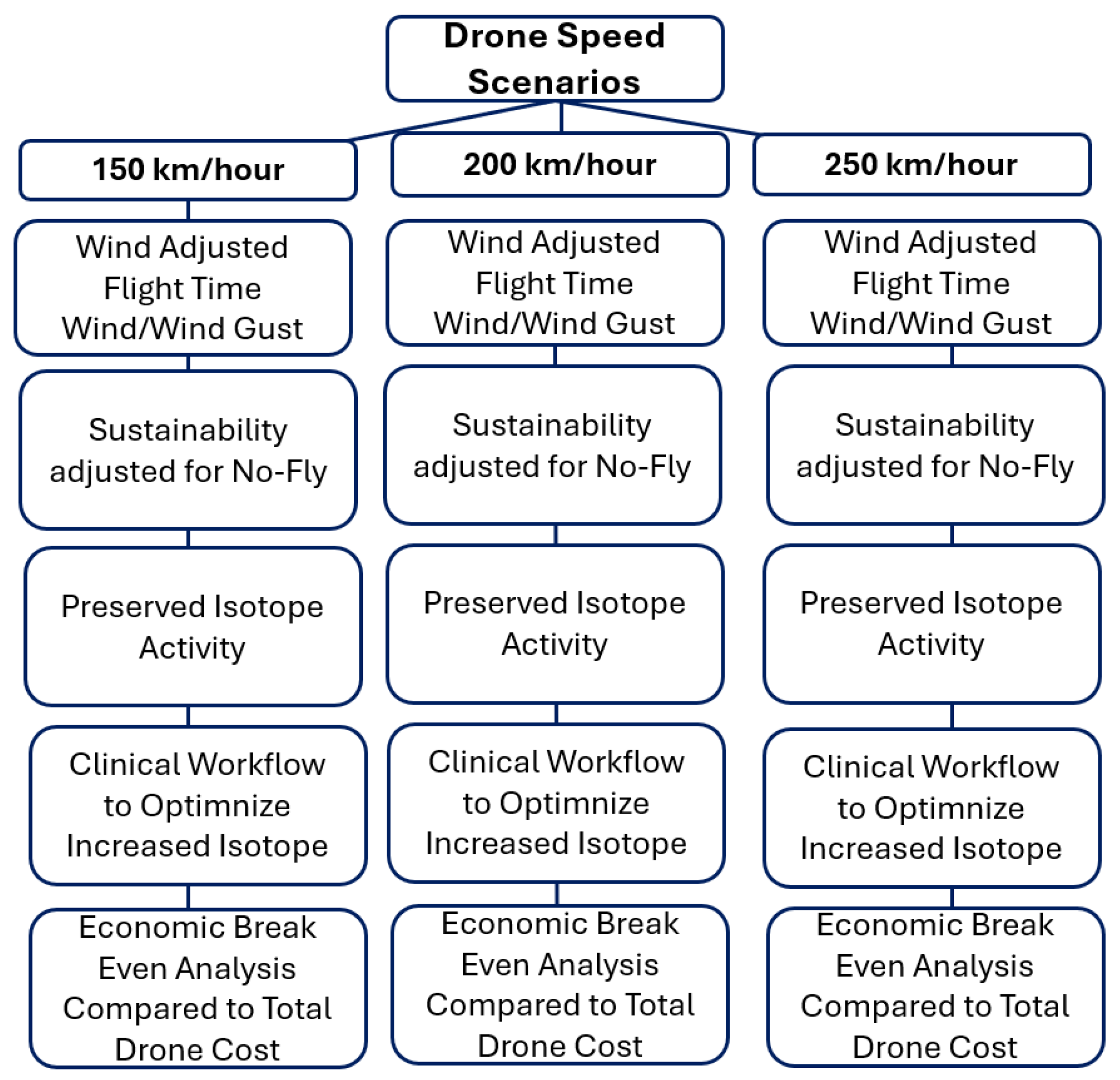
This study was organized with a modular design, whereby transport feasibility impacts economic viability and increases the availability of PET isotope capacity (Figure 1).
Research questions:
  • How much PET activity of 18FDG can be preserved during drone transport compared with current car/air transport across varying distances and drone speeds?
  • How do varying weather conditions affect drone reliability?
  • Can clinical routines be optimized to increase the value of drone transport?

2. Materials and Methods

The Norwegian Medical Cyclotron Centre (NMCC) (https://syklotronsenteret.no/en/, accessed on 12 February 2026) delivers PET radioisotopes to several regions in Norway and to all hospitals in the Health Region South-East with PET scanners. This coverage constitutes approximately 50% of Norwegian hospitals and more than 60% of the Norwegian population, in addition to Stavanger University Hospital in Health Region West and Aalesund Central Hospital in the Central Norway Regional Health Authority, located in central Norway.

2.1. Models Used in This Study

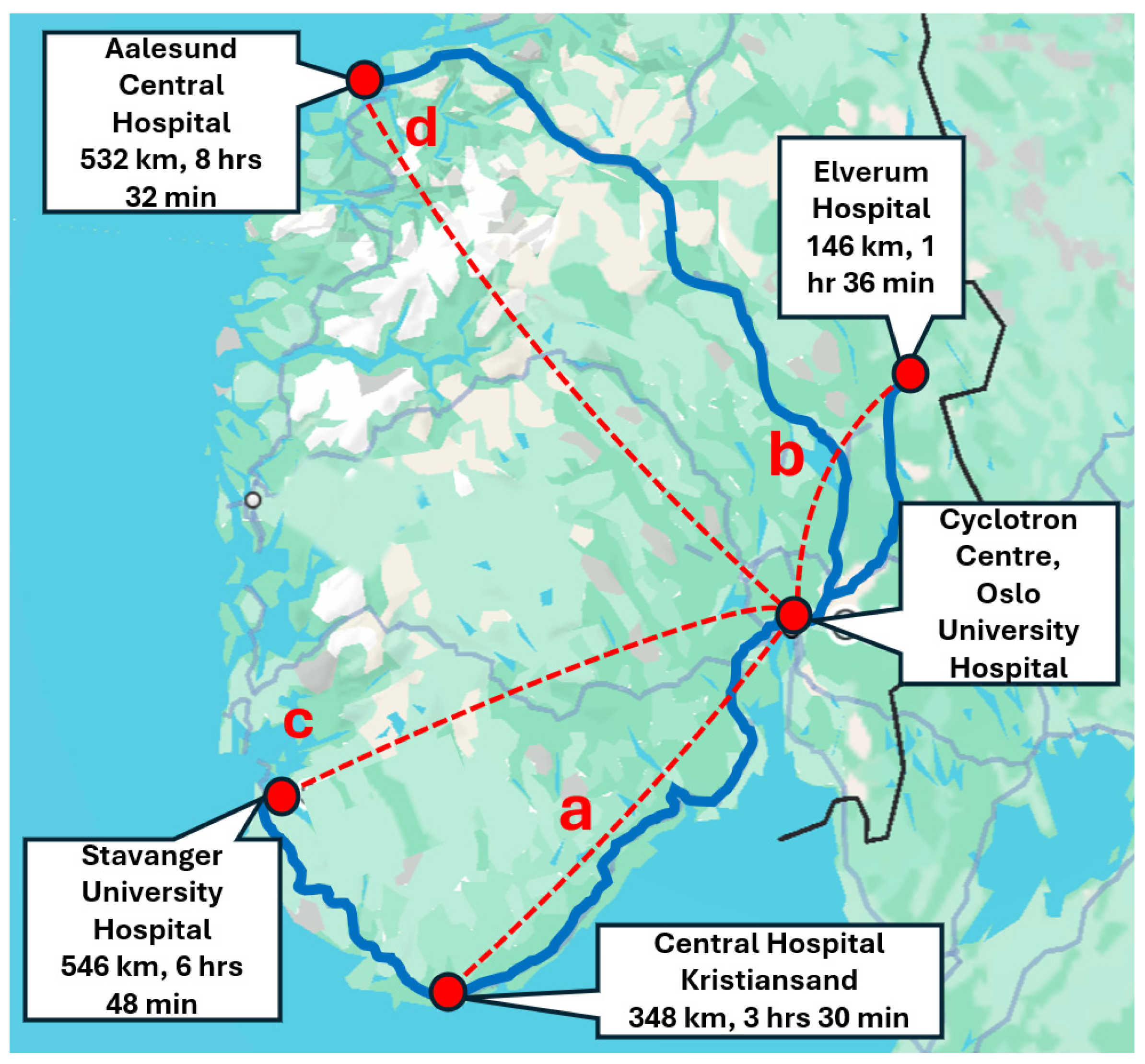
Drone solutions in four existing models (Figure 2) were compared:
  • a: Car transport to Central Hospital Kristiansand (KRS) (348 km road, 281 km air).
  • b: Car transport to Elverum Hospital (ELV) (146 km road, 117 km air).
  • c: Car + plane transport to Stavanger University Hospital (SVG) (546 km road, 302 km air).
  • d: Car + plane transport to Central Hospital Aalesund (AES) (532 km road, 376 km air).
Current departures occur at 5:15 a.m. to align with clinic schedules. Cancellations in ground transport due to snow/ice are rare (recorded once in 2023 and 2024) and were not modelled, potentially biasing the results, particularly in winter, with ground transport favored.
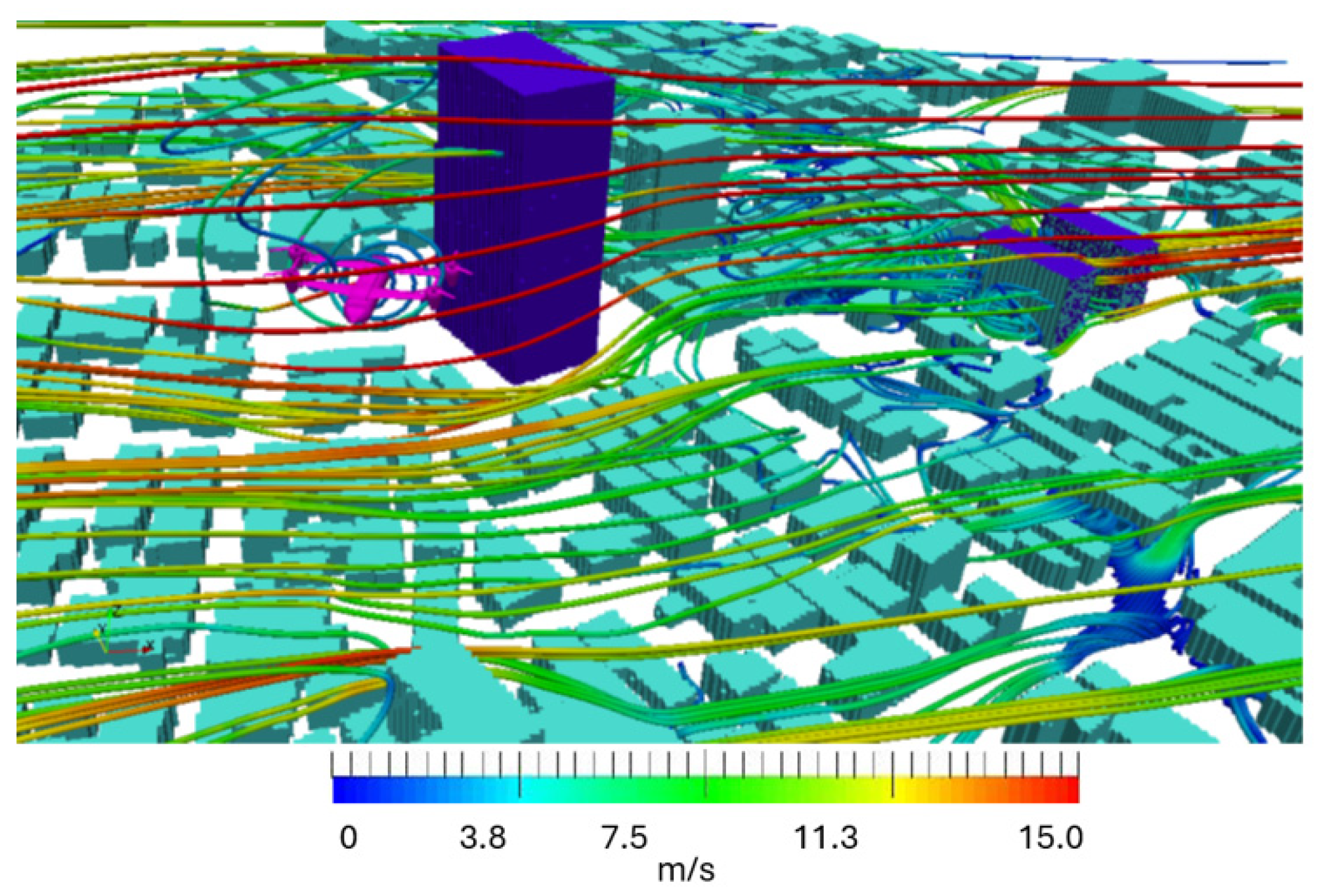
Drone solutions versus current transport routes match existing destination times with flights starting at 6 a.m. Haversine distances were used to estimate direct drone flight lengths, modelling drone speeds of 150, 200, and 250 km/h. Theoretical transport times were calculated as distance divided by drone speed. It will be necessary for drones developed in the future to comply with strict rules for the temperature regulation of cargo, as radiopharmaceuticals must be stored during transport within a defined temperature interval, with that for 18FDG being 15–25 °C. In a previous study conducted at the OUS hospital [66], take-off from the hospital depended significantly on local wind conditions and wind directions, in addition to the flight direction out of Oslo (Figure 3). In a previous unpublished pilot study at OUS, times for landing and take-off varied between 2 and 8 min. Therefore, an additional ten minutes was employed to compensate for the take-off and landing of all flights. No similar data for the receiving hospitals were available. However, all are located in lowlands without mountains and no adjacent high buildings; thus, a similar compensation strategy was applied.
The existing costs applied in the study are procurement costs to external transport providers, thereby absorbing total transport costs for the NMCC. Drawing on data from the NMCC and the receiving hospitals, in our analysis, it is assumed that existing clinical logistics components, such as packaging, radiopharmaceutical release, loading, receiving procedures, and handovers, could be transferred to the corresponding process for drones, as the landing sites will be located close to the current cargo central. Accordingly, the simulated drone transport times were compared to the ground transport time, which is currently measured from car departure to arrival.

2.2. Weather and Drone Flight Viability

To assess flight times and flight feasibility during varying weather conditions, hourly historical weather data from the Norwegian Meteorological Institute [67], covering the complete years 2023 and 2024, were used. Data were measured from ground weather stations located approximately every 50 km along the differing drone routings as a proxy for flight weather conditions. Parameters included wind speed, wind gusts, direction, temperature, and precipitation. Meteorological data for each flight segment were matched to the corresponding expected hour of drone passage. Wind impact on flight time was calculated using the trigonometric projection of wind angle relative to the flight path.
A standardized set of universally accepted quantitative weather limits (e.g., strict wind and rain thresholds) could not be identified in the published literature; rather, the operational thresholds vary according to drone design, payload characteristics, and mission profile. Based on the studies of Gao et al. [31] and Oakey et al. [36], no-fly days for the main analyses were defined with the following parameters:
  • Wind gusts > 15 m/s
  • Temperature < −20 °C
  • Precipitation > 10 mm/h.
In addition, we conducted simulations for no-fly days of wind-gust scenarios of 40, 50, and 60 km/h.
As stated in the Introduction, icing may represent a significant meteorological impact on drone flights. Data for such conditions were not available for this study.
A stepwise approach was used to assess the number of days in the year and per month during which these criteria would render drone flights infeasible due to weather conditions (no-fly days). On certain days, multiple weather variables exceeded tolerance limits, whereas on others, only a single variable was affected. Resulting times were used to estimate [18F] decay.

2.3. The Economics of Drone Transport for PET Radioisotopes

Cost-effectiveness was assessed as follows:
Net Gain = Revenue from Preserved Activity − (Current Transport Cost − Drone Cost)
The current total costs of existing NMCC transport solutions were used as benchmarks. As these services are procured from external providers, these costs were not decomposed into fixed and variable components; instead, the observed costs reflect the market rates for the complete transport service. Variations across existing routes are primarily driven by differences in transport distance, which affect driver time, vehicle utilization, and energy consumption, in addition to being driven by modal differences (e.g., ground versus air transport). As peer-reviewed cost analyses of drone-based logistics solutions that closely match the operational concept evaluated in this study were not identified, a detailed bottom-up costing of drone operations was considered to provide limited additional value relative to the study’s main objectives. Accordingly, the total costs of current transport solutions were compared with total drone transport costs derived from assumed cost-per-kilometer values. Drone cost thresholds (EUR/km) were then used to identify break-even levels across the different operational models and flight speeds considered. Lastly, potential revenue gains from reduced radioactive decay were estimated based on clinical applicability and dosing requirements.

2.4. Revenue Potential from Preserved Isotope Activity

While drone logistics do not lower the production cost of PET radioisotopes, they can reduce radioactive decay by shortening transport times, increasing the usable amount of the radioisotope upon arrival, potentially generating additional revenue, provided the saved activity can be applied effectively. The economic benefit depends on several factors, including cyclotron batch structure, the type of radioisotope used, pricing strategies, and the ability to reallocate or expand clinical scanning schedules.
A key consideration is the relationship between the cost of drone transport and the added value from preserved activity as a function of reduced transport time. A practical approach that can guide whether drone deployment is economically justifiable for a specific route is to compare drone transport costs directly to the monetary value of saved radioactivity.
Assume a radioisotope with half-life Ԏ1/2, a drone transport distance of d km, flight velocity v (km/h), and a theoretical drone cost c/km flight (EUR).
Then, drone transport time can be calculated as follows:
(1)
Td = d/v
and total drone cost as follows:
(2)
Cd = c × d.
The decay constant λ for a radioisotope quantifies the rate at which the isotope decays, i.e., how quickly a radioactive substance will lose its radioactivity, and is given by the following:
(3)
λ = ln (2)/Ԏ1/2.
Ln (2) is the natural logarithm of 2 and applies for all radioisotopes, whereas Ԏ1/2 is the halftime for the actual isotope (109.7 min for the 18F isotope in this study).
Assume a comparison of two differing transport times, Td1 = t and a longer Td2 = t + δ t. If Ro is the radioactivity at the start of transport, for Td1, the remaining radioactivity R1 for Ԏ1 is as follows:
(4)
R1 (t) = Ro × e λ t
For the longer transport time Td2 = (t + δ t),
(5)
R2 (t + δ t) = Ro × e λ ( t + δ t ) = R o   e λ t   ×   e λ ( δ t )
Then, the relative increase in the remaining radioactivity of transport 1 compared to the longer transport 2 will be as follows:
(6)
R1/R2 = R o   × e λ t R × e λ ( t ) × e λ ( δ t ) = e λ ( δ t )
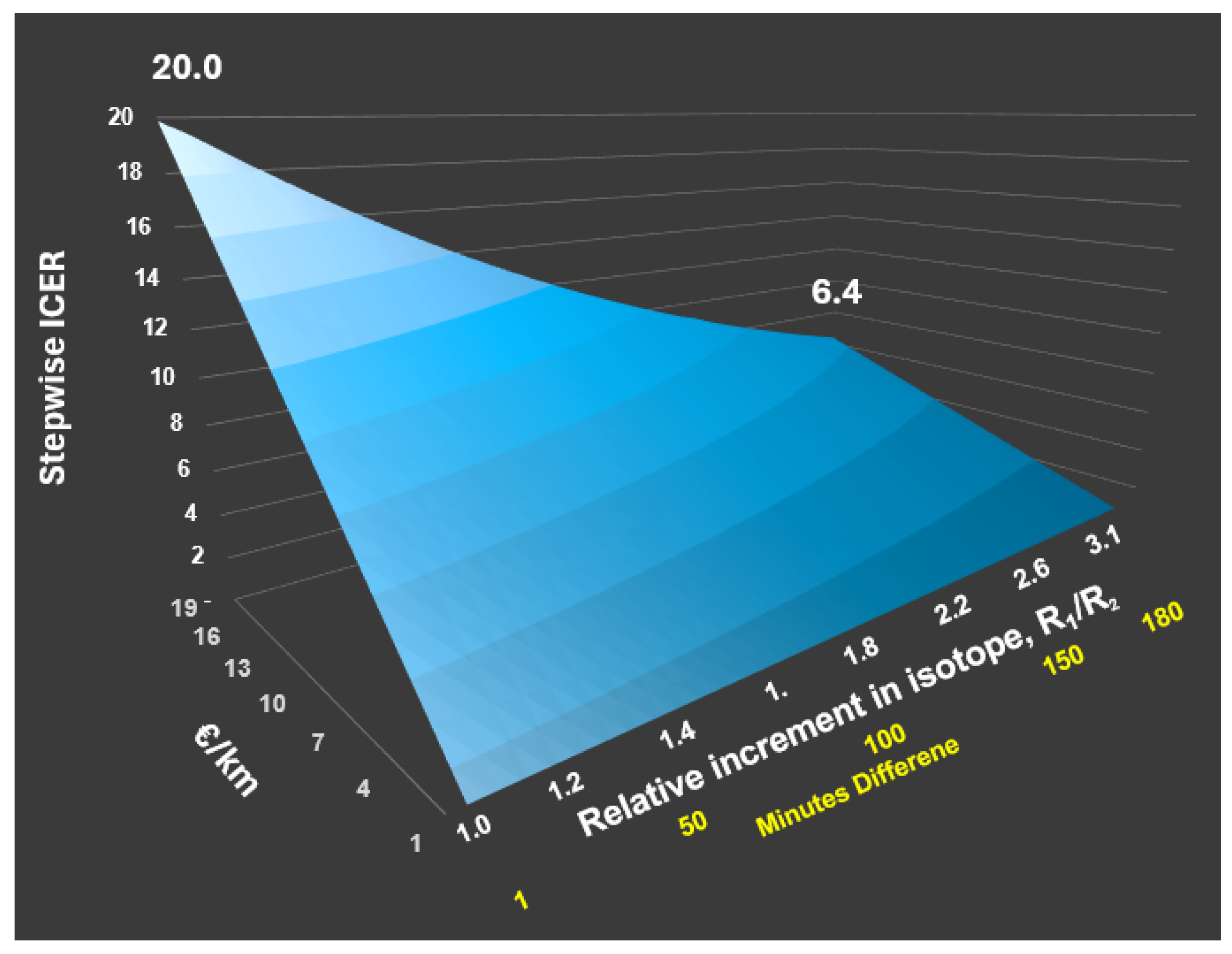
A stepwise incremental cost-efficient ratio (ICER) [68] may then be constructed as the ratio comparing the increased cost per km drone flight to the additional radioactive benefit (R1/R2) (Figure 4).

2.5. Drone Transport Times

All drone flights began at 6 a.m., aligning with current arrival schedules. Drones were assumed to combine VTOL and fixed-wing capacities. Simulations assessed speeds of 150, 200, and 250 km/h, speeds currently achievable for many commercially available drones in the EASA category C3 or above.

2.6. Patient Throughput and Isotope Utilization

In our analysis, we employed a simplified model that assumed an administered activity of 250 MBq per patient and 30 min injection intervals, reflecting common clinical practice.
Two approaches were analyzed:
  • Extend scanning schedules using increased arrival activity.
  • Maintain current arrival activity but reduce starting activity, reallocating the surplus to other imaging centers.

3. Results

3.1. Current Transport Characteristics

The total costs of the current transport models, including car drivers, vehicle, energy, and, for SVG and AES, flight costs, are summarized in Table 1. Accordingly, the current transport costs presented in Table 1 absorb all current delivery costs.
The information presented in the table demonstrates substantial variation in current transport costs across the different routes.

3.2. Simulated Time Gains

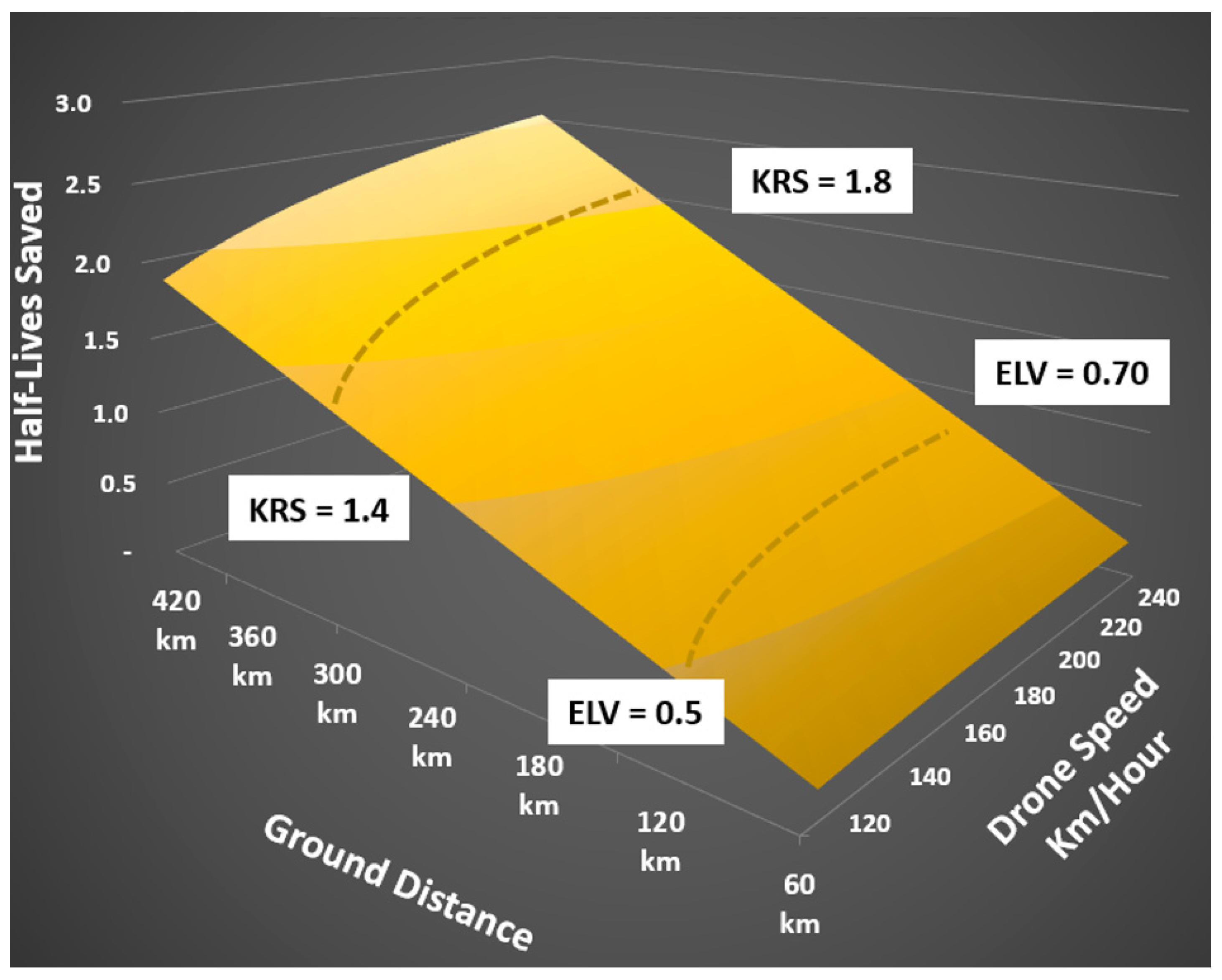
Time savings depended on drone speed and route distance. As an example, at 150 km/h, flights to KRS and ELV saved 1.4 and 0.5 half-lives of 18F, respectively. At 250 km/h, savings increased to 1.8 and 0.7 half-lives, though with diminishing returns (Figure 5).

3.3. Weather-Adjusted Drone Flight Times and No-Fly Days

Most mean drone speeds, including wind impacts, outperformed existing solutions, with the exception of the AES route at 150 km/h.
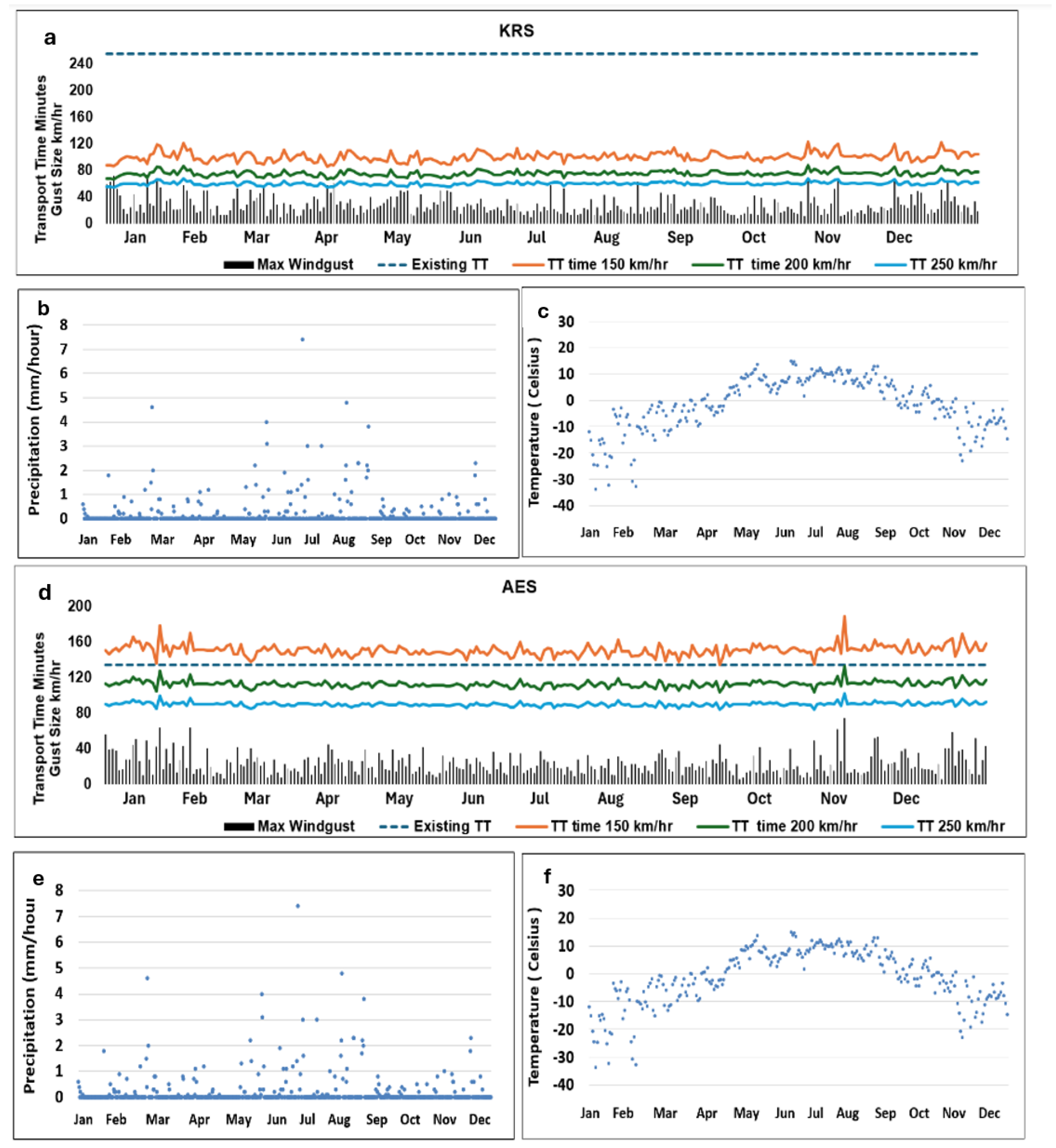
Figure 6 illustrates the simulation speeds and temperature and precipitation data for the KRS model, which exhibits the largest time potential, and the AES route, where gains were only obtained by mean velocities above 200 km/h. Some of the large deviations in transport times seen in Figure 6 occurred on days in which large wind gusts resulted in no-fly days and were not used when calculating maximum flight times among the differing routes.
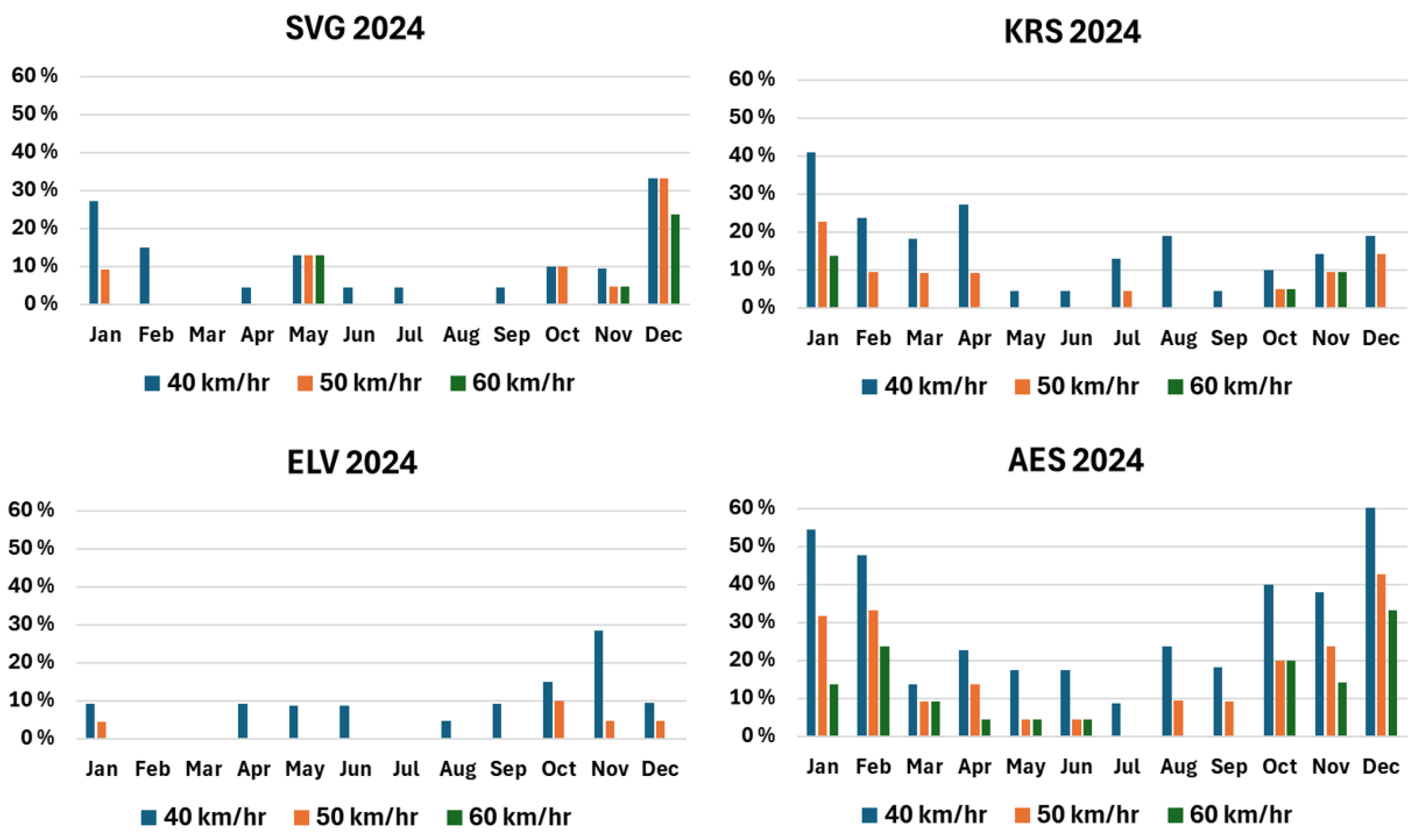
Wind gusts emerged as the major decisive weather factor for no-fly days, with substantial differences across the routes. The consequences of various drone wind gust tolerances are illustrated in Figure 7 for a gust tolerance of 40–60 km/h.
The information presented in Table 2 illustrates the occurrence of no-fly days as a percentage of days for the four routings, illustrating that a gust tolerance of 40 km/h. would not be sustainable for any of the routes.
As Figure 7 illustrates, differing no-fly wind-gust limits had significantly varying impacts across the routes. As seen in Table 2, most routes would be infeasible with a 40 km/h gust tolerance, resulting in no-fly days for 35% of the year and up to 65% in the most challenging month. In contrast, all routes would experience substantially fewer annual no-fly days with a tolerance above 60 km/h.
Based on the simulated transport times using the no-fly limit of 15 m/s, we estimated the corresponding time savings and reductions in radioactive decay for all routes (Table 3). The best case for transport time improvements was long-distance KRS ground transport, with the long-haul air transport of AES demonstrating the weakest performance.

3.4. Route Paths and Transport Viability

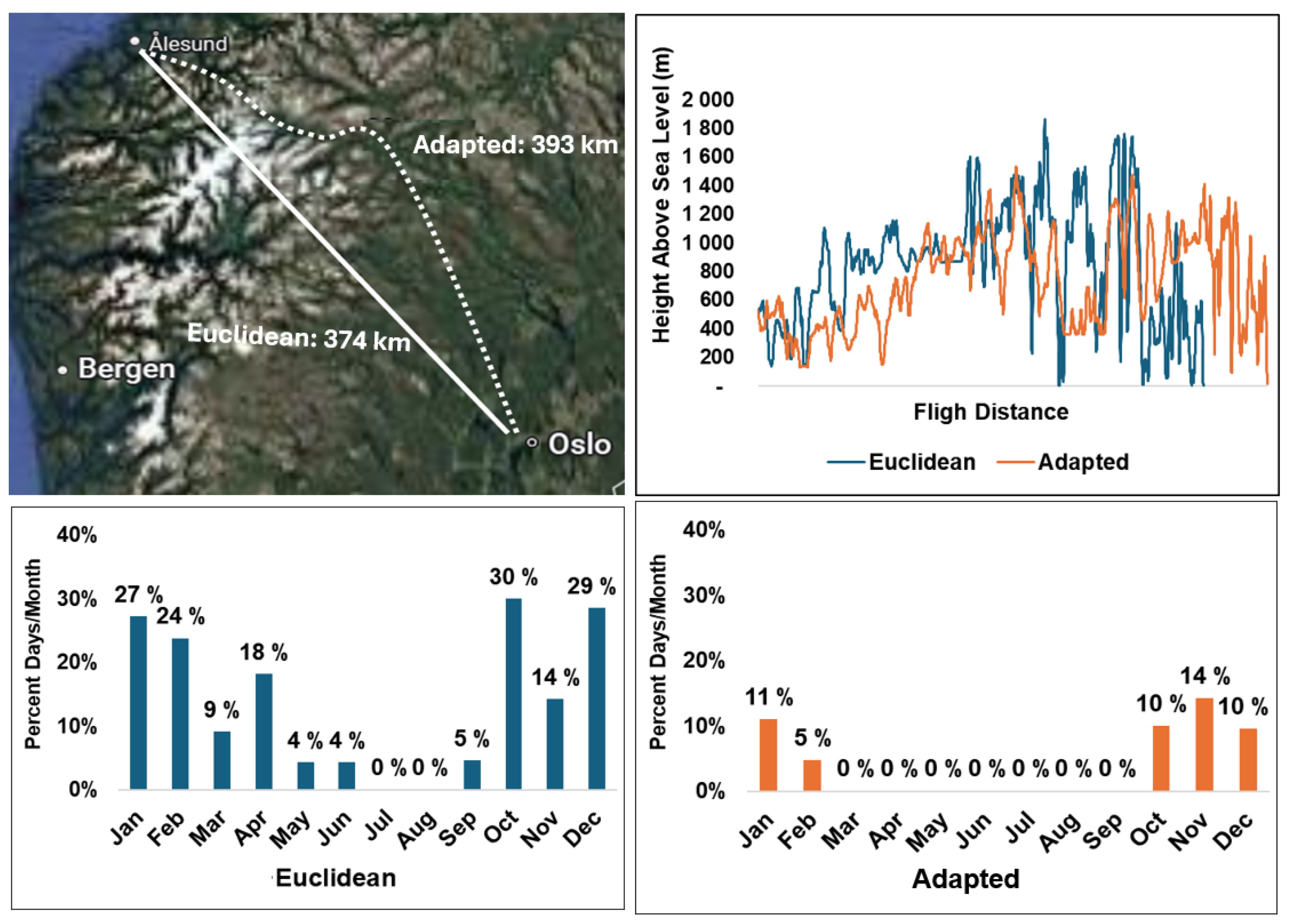
The long-haul routes, SVG and AES, exhibited the greatest variability in geographic terrain and climate for transport procedures. Using AES as a case, Figure 8 illustrates adaptive routing with a 19 km longer path, mitigating no-fly challenges.

3.5. PET Activity Savings

Compared to current solutions, shorter transport times allow for reduced starting activity or increased output. The results presented in Table 4 illustrate the estimated isotope savings (GBq) by route and drone speed. Figure 9 illustrates two approaches for utilizing saved activity, one with extended scanning schedules and one using parallel sessions.
By using the current starting activities as shown in Table 1 for the four transport modes, Table 4 illustrates the amount of PET isotopes preserved on arrival, i.e., increased remaining isotope activity.
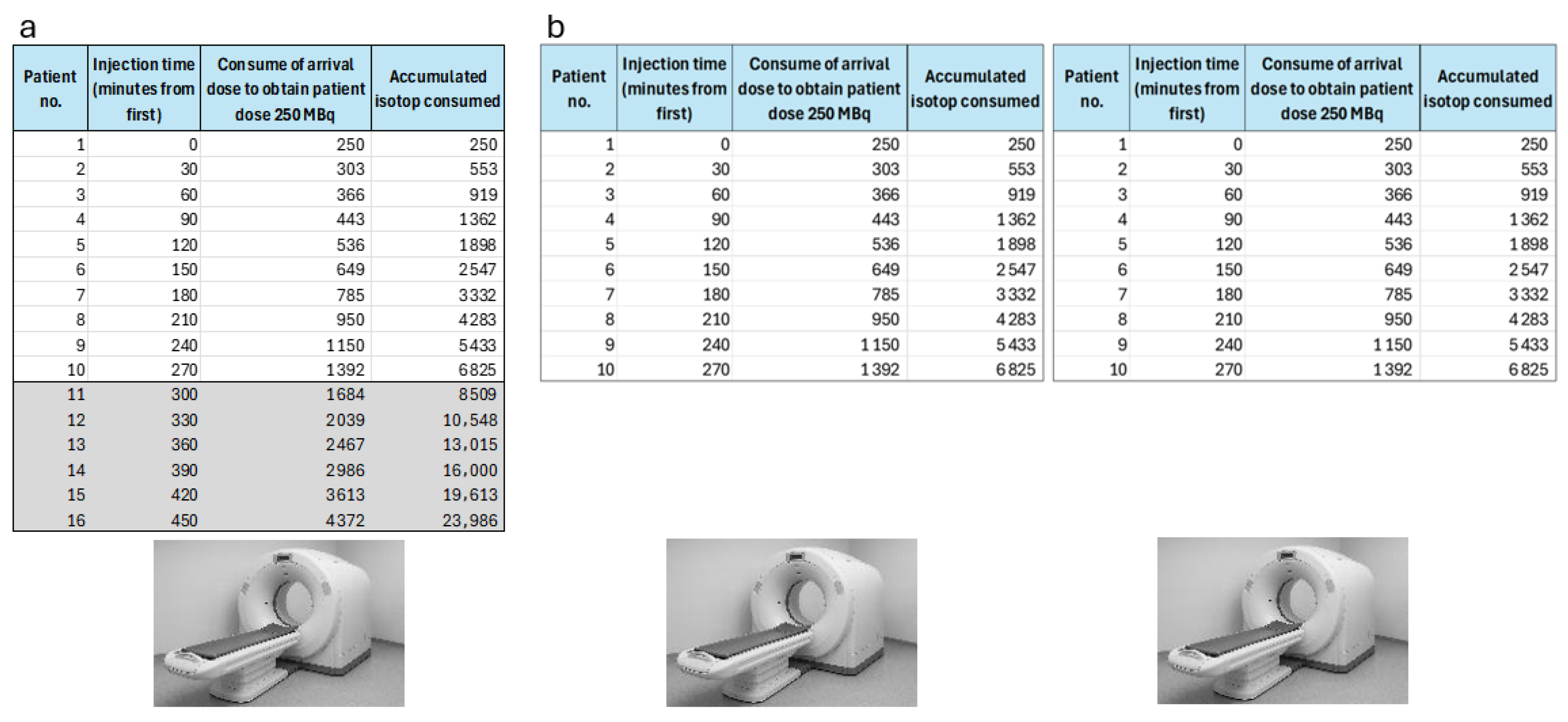
Figure 9 illustrates how different patient throughput configurations influence the effective utilization of available PET isotope activity. Upon arrival at the imaging facility, the isotope container is transported to the radio pharmacy or dispensing unit, where patient-specific doses are prepared. Tracer injection is typically performed with the patient in a quiet, reclined position, often in a dedicated uptake room adjacent to the scanner, using secure intravenous access; saline flushing is applied to ensure complete and safe administration of the radiotracer. For standard whole-body 18F-FDG PET examinations, injected activities commonly range from 150 to 400 MBq, depending on patient characteristics and scanner sensitivity. Following injection, an uptake period of approximately 30–60 min is observed to allow tracer distribution, after which PET image acquisition is performed over 20–60 min, frequently combined with CT or MRI for anatomical co-registration. Modern 3D PET systems with higher detection efficiency enable lower administered activities (typically ~150–250 MBq), thereby reducing patient radiation exposure while maintaining diagnostic image quality and improving overall tracer utilization efficiency.
Patients are scheduled consecutively throughout the day, and due to continuous radioactive decay, later examinations require higher fractions of the initially delivered activity to achieve the same injected dose.
By using the drone speed of 150 km/h on the KRS route, 23.9 GBq of PET isotope would be saved. Assuming 16 patients are scanned sequentially on a single scanner, as illustrated in Figure 9 (Model a), the theoretical activity consumption per patient is 1.49 MBq. In contrast, when two scanners are available and operated in parallel, enabling higher patient throughput (Model b), up to 20 patients can be examined with an average activity consumption of only 0.68 MBq per patient. While such gains are contingent on the availability of parallel scanning capacity, the figure serves primarily to illustrate the substantial impact of patient flow organization and scanner throughput on overall isotope utilization efficiency.
The two differing approaches illustrate the outcomes if current departure activity is maintained. The utilization of the saved isotope is related to the local scanning capacity. With only one scanner at KRS, six more patients could be scanned with today’s delivery using an extended-day schedule. Depending on the scanner capacity, a substantially greater number of patients could be scanned with two scanners, using almost 10 MBq less activity per patient, provided other resources such as personnel and reimbursement are in place.
Another strategy could involve reducing departure activity and distributing surplus PET isotopes to other imaging centers as new centers are established.

3.6. Economic Advantages

Transport Costs

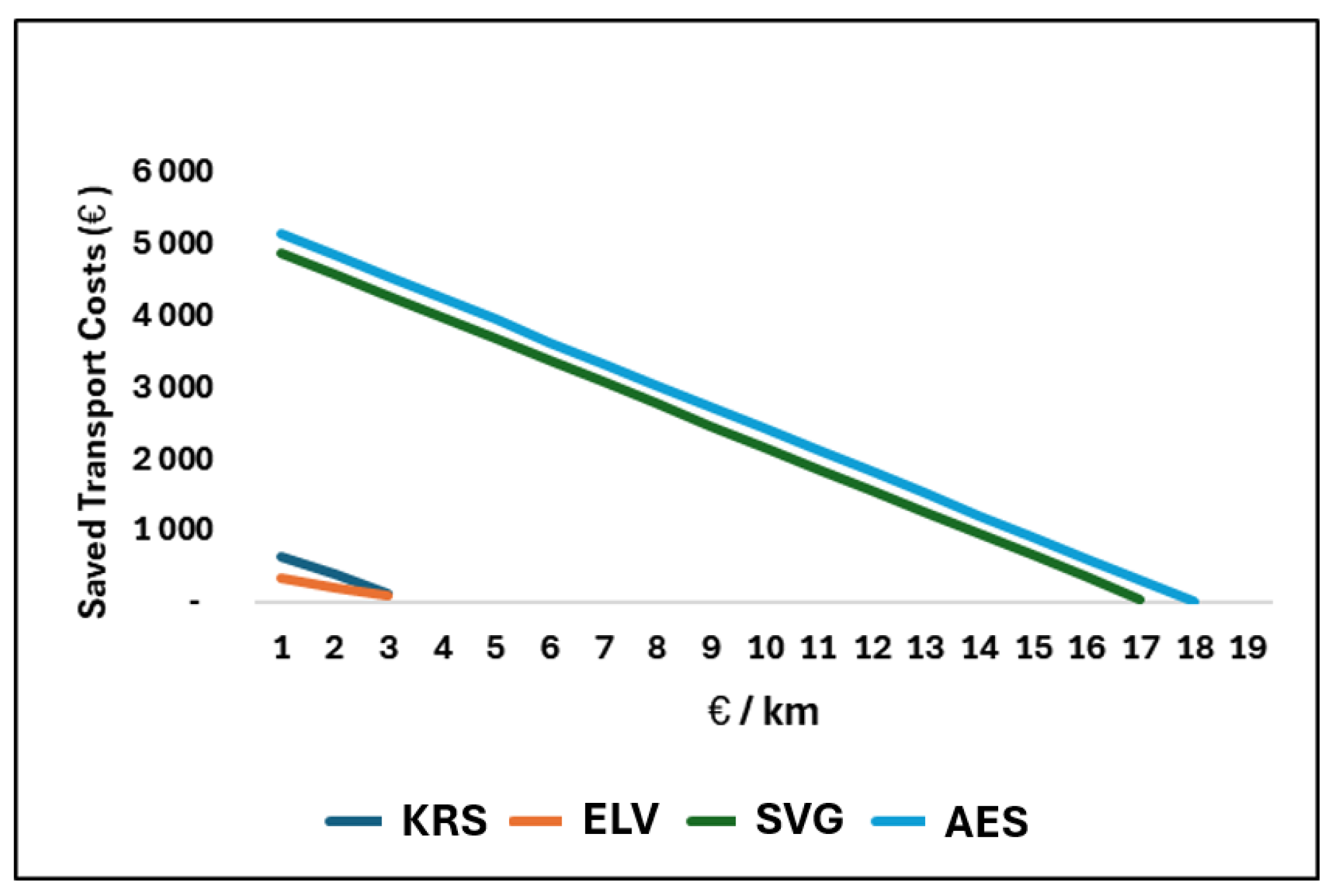
The break-even drone transport costs varied by route. Those of the KRS and ELV routes must remain below EUR 3/km, whereas the SVG/AES routes could tolerate up to EUR 17–18/km due to the current reliance on high-cost air transport (Figure 10).

3.7. Potential Increased Revenue from Saved Isotopes

The results presented in Table 4 illustrate how the use of drones reduces decay-related losses during transport, thereby lowering the required initial PET activity per shipment and potentially freeing capacity for additional doses. This surplus activity could be reallocated for redistribution or sale to other imaging centers. Isotope prices vary substantially across suppliers and isotope types, making exact revenue calculations difficult. A corresponding estimate of the potential income effects is presented in Table 5.
The estimates are based on the current mix of isotope deliveries (with differing substances and isotopes having different prices) and assume an average dose price of EUR 525 (range EUR 350–700). It is further assumed that the increase in usable activity translates proportionally into increased billable doses and, consequently, higher income. While PET isotopes are not traded in a fully liberalized market, public hospitals remunerate suppliers based on delivered doses. This pricing structure implies that improved delivery efficiency can increase revenues for producers and service providers, helping to offset higher production and transport costs associated with drone-based logistics.

3.8. Break-Even Analysis

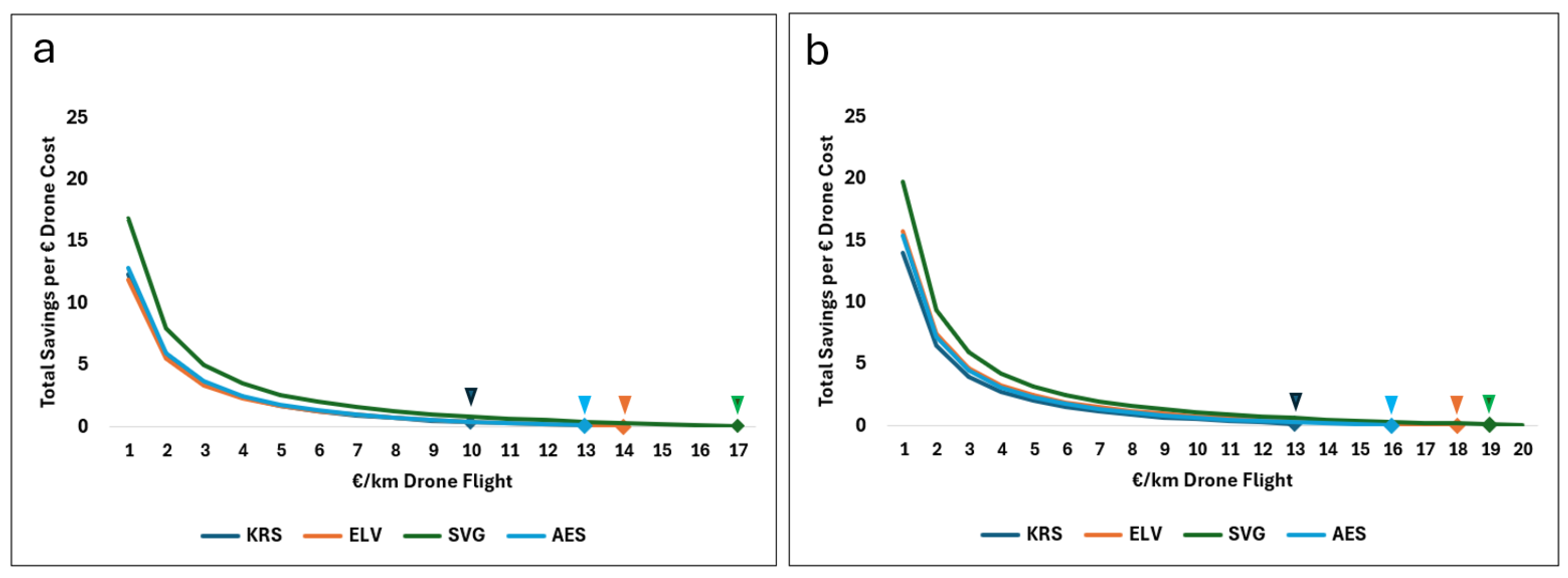
By combining the transport-related and PET-related savings, the analysis modelled break-even scenarios across drone operating costs ranging from EUR 1 to 20/km. For these cost estimates, total drone expenditures were assumed to be fully absorbed within the kilometer rate, including platform acquisition, certification, infrastructure, airspace services, staffing, insurance, and operational overheads. Figure 11 illustrates the resulting route-specific cost thresholds at which drone operations outperform existing logistics models.

4. Discussion

4.1. Principle Findings

Our findings illustrate that drone transport can significantly reduce delivery times for PET radioisotopes across long distances, enhancing isotope preservation and enabling substantial annual cost savings. Our work demonstrates the potential impact and provides a framework for evaluating early feasibility in sandbox exercises. Future test flights may provide real-life data to demonstrate a reduction in isotope loss.
However, the magnitude of these benefits depends on several factors: transport distance, drone speed, isotope half-lives, clinical workflow integration, available drone fleet and infrastructure, and, last but not least, meteorological conditions. Weather emerged as a key barrier to consistent drone operations, suggesting up to 30–60% of flights could be disrupted during some winter months, depending on wind gust tolerance. In particular, routes exposed to coastal or mountainous conditions are vulnerable, aligning with prior research indicating that wind gusts, precipitation, and temperature extremes limit drone reliability [31,36,66,69,70,71,72,73].
Operational adaptations may possibly mitigate these challenges. Fallback to ground transport based on high-resolution weather forecasts, seasonal route suspension, flexible scheduling, or reconfiguring route paths are examples of possible actions (Figure 7).

4.2. Drone Design and Technical Considerations

Drone feasibility for PET logistics requires designs capable of carrying ≥ 50 kg to accommodate shielded, temperature-controlled containers (15–25 °C). Long-range missions necessitate hybrid VTOL-fixed wing systems that balance vertical mobility with cruising efficiency.
Battery-powered drones lack range and remain unsuitable for long-distance flights in cold climates due to limited energy density and cold-weather degradation. Despite the fact that recharging infrastructure has been proposed [62,74,75,76], recharging or battery exchange would consume valuable time and remain impractical for PET transport over remote areas with no infrastructure. Although fuel-powered systems involve higher operating costs and emissions, they offer superior range and will be necessary for the distances and payloads studied until battery energy densities improve [62,74,75,76].
It should be acknowledged that sustained drone speeds of 200–250 km/h over long distances while carrying payloads suitable for PET isotope transport are not feasible with current technology, the increasing regulations for such larger drones operating in public space are developing and may spark further technological development [77]. Nevertheless, both high-speed drones and platforms designed for heavy payloads or extended range are under active development. Importantly, however, high payload capacity and long operational range represent partially conflicting design objectives, reflecting fundamental trade-offs in energy efficiency, aerodynamics, and propulsion systems [78,79]. To support such industrial development, it is essential to document scalable and sustainable use cases that are economically viable for both operators and customers. In this regard, the operational concept explored in this study may contribute by illustrating a potentially viable demand scenario and application context for future high-performance drone systems.

4.3. Organizational and Economic Implications

Drones have the potential to catalyze broader changes in PET logistics. Faster delivery may enable increased capacity through extended scanning hours or parallel scanner usage, as illustrated in Figure 9, maximizing clinical throughput. Alternatively, shorter transport durations could support isotope reallocation to underserved sites, enhancing regional imaging access.
There is a historical analogy to be drawn from the evolution of theragnostics, once limited to iodine treatments for thyroid cancer, now a cornerstone of precision oncology [80]. Similarly, integrating drone logistics may reconfigure how PET services are designed and delivered. Adopting drones may prompt reconsideration of current practices, such as current single-batch isotope productions. Drones allow for staggered deliveries, reducing waste and increasing responsiveness to clinical demand. Furthermore, combining drone logistics with next-generation whole-body PET scanners, requiring lower doses, could defer the need for costly cyclotron expansion.
However, unidirectional flights present inefficiencies. Economically viable implementation may depend on backhaul use, transporting other medical goods or diagnostics. Integrating PET deliveries with other services, via mixed on-demand and scheduled flights, will require redesigning ground logistics, drone ports, and digital infrastructure [62,74,75,76].
The cost-effectiveness of drones is highly context specific. Extensive literature exists on optimizing drone routing strategies [81,82,83,84,85,86]. While last-mile drone deliveries have shown potential cost savings [62,87,88,89,90], this evidence does not extend to long-haul healthcare logistics, however. Our simulations highlight that drone solutions are more economically viable on routes currently reliant on expensive air transport (e.g., AES), with reduced viability for routes with low-cost road delivery (e.g., KRS).
Cost optimization remains essential and must balance speed, regulatory compliance, and operational expense to meet stakeholder expectations. The evolving U-space regulatory framework in Europe will be critical to ensure safe and cost-efficient integration [91].
Overall, drone logistics for PET require further empirical validation, full cost modelling (including infrastructure and staffing), and robust regulatory alignment.

4.4. Limitations

Several limitations of this study should be acknowledged.
First, there are currently no publicly available real-world operator data for routine drone-based transport of PET isotopes against which to benchmark the modelled performance and cost estimates. Although regulatory frameworks for beyond-visual-line-of-sight (BVLOS) operations are evolving, substantial additional costs are likely to arise from future infrastructure requirements, including drone ports and landing platforms, airspace management and surveillance systems, certification processes, and compliance with public aviation regulations. At present, the authors were unable to identify peer-reviewed studies providing empirically grounded cost estimates for these elements. To avoid introducing speculative or poorly substantiated assumptions, in our analysis, we compare ground transport costs with aggregate drone delivery costs, implicitly assuming that the latter internalize all UAV-related expenditures, including platform acquisition, certification, infrastructure, airspace services, staffing, insurance, and operational overhead. The authors of future studies should seek to validate and refine these estimates using real-world pricing from operational drone service providers, including explicit cost components for airspace usage, drone port access, and regulatory compliance.
Second, the weather inputs applied in this study were derived from ground-level meteorological observations. While sufficient for indicative scenario modelling, this approach does not capture vertical wind profiles, localized turbulence, or icing risk at flight altitudes. Integration with aviation-grade meteorological data and forecasting systems will be essential to support operationally robust flight planning and to improve the fidelity of performance and reliability estimates.
Weather-related delays in ground transport were ignored as such issues occurred only once in the two years, 2023 and 2024. This condition favors ground solutions, with the assumptions related to gains from drones remaining valid.
Third, the routing assumptions employed in this study are idealized. Although the modelled results capture the direct impact of wind on flight speed, adverse weather conditions may necessitate dynamic rerouting to avoid no-fly zones, hazardous meteorological cells, or controlled airspace. In such cases, longer and less direct flight paths may be operationally preferable to mission cancellation, leading to deviations from the great-circle (Haversine) distances assumed herein.
Similarly, future airspace management constraints and deconfliction requirements may further limit route optimality, introducing additional detours and time penalties not captured in the current simulations. In addition, transport of radioactive materials is subject to regulations of dangerous goods, which will most likely influence flight planning and costs [92,93].
Lastly, local infrastructure effects, including wind shear and turbulence in the vicinity of urban landing and take-off sites, rooftop installations, and confined terminal areas, were not explicitly modelled. Based on very similar geographical topography and information from the receiving hospitals, similar wind conditions at the receiving hospitals were assumed. Despite obtaining weather data from these locations, uncertainties in this assumption should be acknowledged. Such micro-scale aerodynamic effects may have a substantial influence on safety margins, energy consumption, and operational reliability, particularly in dense urban environments.

4.5. Future Directions

The authors of future studies should explore hybrid logistics models that dynamically switch between drone and ground transport based on weather forecasts or clinical urgency. Multi-sectoral partnerships may also enable shared drone services, increasing utilization and cost-efficiency beyond PET transport.
Comprehensive modelling of drone logistics costs, including infrastructure, airspace access, and staffing, is critical. Standardizing these inputs would improve comparability across studies and strengthen the evidence base for drone integration in healthcare logistics.

5. Conclusions

This study evaluated the feasibility and potential benefits of long-distance drone transport for PET radioisotope logistics by comparing simulated drone operations with existing ground and combined ground–air transport solutions. Using weather-resolved modeling and route-based comparisons, the analysis quantified transport time savings, preserved radioactive activity, and economic implications for drone delivery distances of 117–376 km.
The results indicate that drone transport can significantly reduce isotope decay losses when operating at speeds of 200–250 km/h, preserving 46–53 GBq of activity, i.e., reducing the total current use of 118 GBq to 72–65, respectively. At these speeds, break-even operating costs ranged from EUR 3–18/km, increasing to EUR 14–20/km when accounting for the economic value of preserved isotopes, corresponding to estimated annual gains of EUR 1.0–1.7 million. However, weather constraints remain a key operational factor, with up to 30% of winter flights potentially restricted.
These findings suggest that long-range drone transport could improve delivery efficiency and increase diagnostic capacity by reducing radioactive decay losses and enabling more flexible distribution of PET isotopes. Realizing these benefits will require integration of drone operations into existing clinical logistics systems, as well as further advances in weather resilience, regulatory frameworks, and cost-efficient drone technologies. Rather than simply replacing current transport methods, drones could enable a broader transformation in medical logistics. With system-wide planning and stakeholder coordination, drone logistics may become a cornerstone of a more flexible, decentralized, and responsive healthcare infrastructure.

Author Contributions

Conceptualization, K.A.J., P.G.R. and M.-E.R.R.; methodology, K.A.J.; basic information, data, and characteristics of current Cyclotron services, A.M. and T.A.S.; data curation and simulations, K.A.J.; initial draft preparation, K.A.J.; writing, development of the final concept, and manuscript editing, K.A.J., P.G.R., A.M., T.A.S. and M.-E.R.R. All authors have read and agreed to the published version of the manuscript.

Funding

This research received no external funding.

Data Availability Statement

The applied weather data used in the study may be shared upon request to the corresponding author.

Conflicts of Interest

The authors declare no conflicts of interest and that there are no potential commercial interests.

References

  1. Aggarwal, S.; Gupta, P.; Mahajan, N.; Balaji, S.; Singh, K.J.; Bhargava, B.; Panda, S. Implementation of drone based delivery of medical supplies in North-East India: Experiences, challenges and adopted strategies. Front. Public Health 2023, 11, 1128886. [Google Scholar] [CrossRef]
  2. Hertelendy, A.J.; Al-Wathinani, A.M.; Sultan, M.A.S.; Goniewicz, K. Health sector transformation in Saudi Arabia: The integration of drones to augment disaster and prehospital care delivery. Disaster Med. Public Health Prep. 2023, 17, e448. [Google Scholar] [CrossRef]
  3. Knoblauch, A.M.; de la Rosa, S.; Sherman, J.; Blauvelt, C.; Matemba, C.; Maxim, L.; Defawe, O.D.; Gueye, A.; Robertson, J.; McKinney, J. Bi-directional drones to strengthen healthcare provision: Experiences and lessons from Madagascar, Malawi and Senegal. BMJ Glob. Health 2019, 4, e001541. [Google Scholar] [CrossRef]
  4. Scott, J.; Scott, C. Drone delivery models for healthcare. In Proceedings of the 50th Hawaii International Conference on System Sciences, Hilton Waikoloa Village, HI, USA, 4–7 January 2017. [Google Scholar]
  5. Zailani, M.A.H.; Sabudin, R.Z.A.R.; Rahman, R.A.; Saiboon, I.M.; Ismail, A.; Mahdy, Z.A. Drone for medical products transportation in maternal healthcare: A systematic review and framework for future research. Medicine 2020, 99, e21967. [Google Scholar] [CrossRef]
  6. Zailani, M.A.H.; Sabudin, R.Z.A.R.; Rahman, R.A.; Saiboon, I.M.; Ismail, A.; Mahdy, Z.A. Drone technology in maternal healthcare in Malaysia: A narrative review. Malays. J. Pathol. 2021, 43, 251–259. [Google Scholar]
  7. Ackerman, E.; Koziol, M. The blood is here: Zipline’s medical delivery drones are changing the game in Rwanda. IEEE Spectr. 2019, 56, 24–31. [Google Scholar] [CrossRef]
  8. Nisingizwe, M.P.; Ndishimye, P.; Swaibu, K.; Nshimiyimana, L.; Karame, P.; Dushimiyimana, V.; Musabyimana, J.P.; Musanabaganwa, C.; Nsanzimana, S.; Law, M.R. Effect of unmanned aerial vehicle (drone) delivery on blood product delivery time and wastage in Rwanda: A retrospective, cross-sectional study and time series analysis. Lancet Glob. Health 2022, 10, e564–e569. [Google Scholar] [CrossRef] [PubMed]
  9. Scott, J.E.; Scott, C.H. Models for drone delivery of medications and other healthcare items. In Unmanned Aerial Vehicles: Breakthroughs in Research and Practice; IGI Global: New York, NY, USA, 2019; pp. 376–392. [Google Scholar]
  10. Fakhrulddin, S.S.; Gharghan, S.K.; Al-Naji, A.; Chahl, J. An advanced first aid system based on an unmanned aerial vehicles and a wireless body area sensor network for elderly persons in outdoor environments. Sensors 2019, 19, 2955. [Google Scholar] [CrossRef]
  11. Ling, G.; Draghic, N. Aerial drones for blood delivery. Transfusion 2019, 59, 1608–1611. [Google Scholar] [CrossRef]
  12. Sanfridsson, J.; Sparrevik, J.; Hollenberg, J.; Nordberg, P.; Djärv, T.; Ringh, M.; Svensson, L.; Forsberg, S.; Nord, A.; Andersson-Hagiwara, M. Drone delivery of an automated external defibrillator–a mixed method simulation study of bystander experience. Scand. J. Trauma Resusc. Emerg. Med. 2019, 27, 40. [Google Scholar] [CrossRef] [PubMed]
  13. Amukele, T.K.; Sokoll, L.J.; Pepper, D.; Howard, D.P.; Street, J. Can unmanned aerial systems (drones) be used for the routine transport of chemistry, hematology, and coagulation laboratory specimens? PLoS ONE 2015, 10, e0134020. [Google Scholar] [CrossRef]
  14. Rosser, J.C., Jr.; Vignesh, V.; Terwilliger, B.A.; Parker, B.C. Surgical and Medical Applications of Drones: A Comprehensive Review. JSLS J. Soc. Laparoendosc. Surg. 2018, 22, e2018.00018. [Google Scholar] [CrossRef] [PubMed]
  15. Scalea, J.R.; Restaino, S.; Scassero, M.; Blankenship, G.; Bartlett, S.T.; Wereley, N. An Initial Investigation of Unmanned Aircraft Systems (UAS) and Real-Time Organ Status Measurement for Transporting Human Organs. IEEE J. Transl. Eng. Health Med. 2018, 6, 4000107. [Google Scholar] [CrossRef] [PubMed]
  16. Claesson, A.; Fredman, D.; Svensson, L.; Ringh, M.; Hollenberg, J.; Nordberg, P.; Rosenqvist, M.; Djarv, T.; Österberg, S.; Lennartsson, J. Unmanned aerial vehicles (drones) in out-of-hospital-cardiac-arrest. Scand. J. Trauma Resusc. Emerg. Med. 2016, 24, 124. [Google Scholar] [CrossRef] [PubMed]
  17. Haidari, L.A.; Brown, S.T.; Ferguson, M.; Bancroft, E.; Spiker, M.; Wilcox, A.; Ambikapathi, R.; Sampath, V.; Connor, D.L.; Lee, B.Y. The economic and operational value of using drones to transport vaccines. Vaccine 2016, 34, 4062–4067. [Google Scholar] [CrossRef]
  18. Hassanalian, M.; Abdelkefi, A. Classifications, applications, and design challenges of drones: A review. Prog. Aerosp. Sci. 2017, 91, 99–131. [Google Scholar] [CrossRef]
  19. Amukele, T.K.; Hernandez, J.; Snozek, C.L.; Wyatt, R.G.; Douglas, M.; Amini, R.; Street, J. Drone Transport of Chemistry and Hematology Samples Over Long Distances. Am. J. Clin. Pathol. 2017, 148, 427–435. [Google Scholar] [CrossRef]
  20. Kim, S.J.; Lim, G.J.; Cho, J.; Côté, M.J. Drone-aided healthcare services for patients with chronic diseases in rural areas. J. Intell. Robot. Syst. 2017, 88, 163–180. [Google Scholar] [CrossRef]
  21. Kumar, A.; Sharma, K.; Singh, H.; Naugriya, S.G.; Gill, S.S.; Buyya, R. A drone-based networked system and methods for combating coronavirus disease (COVID-19) pandemic. Future Gener. Comput. Syst. 2021, 115, 1–19. [Google Scholar] [CrossRef]
  22. Zhu, W.; Oakey, A.; Royall, P.G.; Waters, T.P.; Cherrett, T.; Theobald, K.; Bester, A.M.; Lucas, R. Investigating the influence of drone flight on the stability of cancer medicines. PLoS ONE 2023, 18, e0278873. [Google Scholar] [CrossRef]
  23. Theobald, K.; Zhu, W.; Waters, T.; Cherrett, T.; Oakey, A.; Royall, P.G. Stability of Medicines Transported by Cargo Drones: Investigating the Effects of Vibration from Multi-Stage Flight. Drones 2023, 7, 658. [Google Scholar] [CrossRef]
  24. Scalea, J.R.; Pucciarella, T.; Talaie, T.; Restaino, S.; Drachenberg, C.B.; Alexander, C.; Al Qaoud, T.; Barth, R.N.; Wereley, N.M.; Scassero, M. Successful implementation of Unmanned aircraft use for delivery of a human organ for transplantation. Ann. Surg. 2021, 274, e282–e288. [Google Scholar] [CrossRef]
  25. Sage, A.T.; Cypel, M.; Cardinal, M.; Qiu, J.; Humar, A.; Keshavjee, S. Testing the delivery of human organ transportation with drones in the real world. Sci. Robot. 2022, 7, eadf5798. [Google Scholar] [CrossRef]
  26. Oigbochie, A.; Odigie, E.; Adejumo, B. Importance of drones in healthcare delivery amid a pandemic: Current and generation next application. Open J. Med. Res. 2021, 2, 1–13. [Google Scholar] [CrossRef]
  27. Hawkins, A.J. Wing’s Delivery Drones Take Flight for the First Time in Virginia. The Verge. 2019. Available online: https://www.theverge.com/2019/10/18/20921310/wings-delivery-drones-virginia-first-flight (accessed on 22 February 2026).
  28. UPS Flight Forward, CVS to Launch Residential Drone Delivery Service in Florida Retirement Community to Assist in Coronavirus Response. 2021. Available online: https://www.ipc.be/news-portal/general-news/2020/04/28/08/26/ups-flight-forward-cvs-to-launch-residential-drone-delivery-service-in-florida-retirement-community (accessed on 22 January 2026).
  29. Moshref-Javadi, M.; Winkenbach, M. Applications and Research avenues for drone-based models in logistics: A classification and review. Expert Syst. Appl. 2021, 177, 114854. [Google Scholar] [CrossRef]
  30. Hiebert, B.; Nouvet, E.; Jeyabalan, V.; Donelle, L. The Application of Drones in Healthcare and Health-Related Services in North America: A Scoping Review. Drones 2020, 4, 30. [Google Scholar] [CrossRef]
  31. Gao, M.; Hugenholtz, C.H.; Fox, T.A.; Kucharczyk, M.; Barchyn, T.E.; Nesbit, P.R. Weather constraints on global drone flyability. Sci. Rep. 2021, 11, 12092. [Google Scholar] [CrossRef]
  32. Müller, N.C.; Løw-Hansen, B.; Borup, K.T.; Hann, R. UAV icing: Development of an ice protection system for the propeller of a small UAV. Cold Reg. Sci. Technol. 2023, 213, 103938. [Google Scholar] [CrossRef]
  33. Hu, Z.; Chen, H.; Lyons, E.; Solak, S.; Zink, M. Towards sustainable UAV operations: Balancing economic optimization with environmental and social considerations in path planning. Transp. Res. Part E Logist. Transp. Rev. 2024, 181, 103314. [Google Scholar] [CrossRef]
  34. Giersch, S.; El Guernaoui, O.; Raasch, S.; Sauer, M.; Palomar, M. Atmospheric flow simulation strategies to assess turbulent wind conditions for safe drone operations in urban environments. J. Wind Eng. Ind. Aerodyn. 2022, 229, 105136. [Google Scholar] [CrossRef]
  35. Ivanytskyi, M.; Znakovska, Y.; Averyanova, Y. Software for UAS Control and Navigation Support using the Centered Meteorological Dataspace. In Proceedings of the 2024 2nd International Conference on Unmanned Vehicle Systems-Oman (UVS), Muscat, Oman, 12–14 February 2024. [Google Scholar]
  36. Oakey, A.; Cherrett, T. Quantifying Weather Tolerance Criteria for Delivery Drones-A UK Case Study. In Proceedings of the 2023 International Conference on Unmanned Aircraft Systems (ICUAS), Warsaw, Poland, 6–9 June 2023. [Google Scholar]
  37. Bauranov, A.; Rakas, J. Designing airspace for urban air mobility: A review of concepts and approaches. Prog. Aerosp. Sci. 2021, 125, 100726. [Google Scholar] [CrossRef]
  38. Choi, D.S.; Hong, K.J.; Shin, S.D.; Lee, C.-G.; Kim, T.H.; Cho, Y.; Song, K.J.; Ro, Y.S.; Park, J.H.; Kim, K.H. Effect of topography and weather on delivery of automatic electrical defibrillator by drone for out-of-hospital cardiac arrest. Sci. Rep. 2021, 11, 24195. [Google Scholar] [CrossRef]
  39. Hansbø, M.; Hoelsæter, Ø. Icing and Wind—Implications and Mitigations in High-Intensity, Safety-Critical Drone Operations in Norway; Norwegian Defence Research Establishment (FFI): Oslo, Norway, 2022; Available online: https://www.ffi.no/en/publications-archive/icing-and-wind-implications-and-mitigations-in-high-intensity-safety-critical-drone-operations-in-norway (accessed on 18 September 2025).
  40. Lindner, M.; Hann, R. UAV Icing: Icing Effects on Control Surfaces. In Proceedings of the Aiaa Aviation Forum and Ascend 2025, Las Vegas, NV, USA, 21–25 July 2025. [Google Scholar]
  41. Facco, L.; Parin, R.; Basso, M.; Martucci, A.; Colusso, E. Passive ice protection systems for unmanned aerial vehicles applications: A review. Small 2025, 21, 2412465. [Google Scholar] [CrossRef]
  42. Revheim, M.; Alavi, A. PET-Based Novel Imaging Techniques with Recently Introduced Radiotracers; Elsevier: Cham, Switzerland, 2021; Volume 16, p. 145. [Google Scholar]
  43. Kapoor, M.; Heston, T.F.; Kasi, A. PET Scanning; StatPearls Publishing: Treasure Island, FL, USA, 2025.
  44. Katal, S.; Eibschutz, L.S.; Saboury, B.; Gholamrezanezhad, A.; Alavi, A. Advantages and applications of total-body PET scanning. Diagnostics 2022, 12, 426. [Google Scholar] [CrossRef]
  45. Berger, M.; Gould, M.K.; Barnett, P.G. The cost of positron emission tomography in six United States Veterans Affairs hospitals and two academic medical centers. Am. J. Roentgenol. 2003, 181, 359–365. [Google Scholar] [CrossRef]
  46. Hajari, V.R.; Chawda, A.D.; Khan, S.; Goel, E.O.; Verma, P. Developing Cost-Effective Digital PET Scanners: Challenges and Solutions. Mod. Dyn. Math. Progress. 2024, 1, 1–39. [Google Scholar] [CrossRef]
  47. Hricak, H.; Prior, J.O.; Muellner, A.; Abdel-Wahab, M.; Allen, B.; Atun, R.; Cerri, G.G.; Ngwa, W.; Hierath, M.; Scott, A.M. Strengthening medical imaging capacity: The time is now. Lancet Oncol. 2025, 26, 7–9. [Google Scholar] [CrossRef] [PubMed]
  48. Ackermann, D. EURASIS European Rare Stable Isotope Supply for Research: Searching for a Way Out from Supply Shortage; Taylor & Francis: New York, NY, USA, 2024. [Google Scholar]
  49. Connolly, M.-L. Radioisotope Shortage Could Cause Cancer Treatment Delays. BBC News, 30 October 2024. Available online: https://www.bbc.com/news/articles/c2e7gzvdz0wo (accessed on 12 December 2025).
  50. Currie, G.; Hawk, K.E.; Rohren, E. Challenges confronting sustainability in nuclear medicine practice. Radiography 2024, 30, 1–8. [Google Scholar] [CrossRef] [PubMed]
  51. Hricak, H.; Abdel-Wahab, M.; Atun, R.; Lette, M.M.; Paez, D.; Brink, J.A.; Donoso-Bach, L.; Frija, G.; Hierath, M.; Holmberg, O. Lancet Oncology Commission on Medical Imaging and Nuclear Medicine. Lancet. Oncol. 2021, 22, e136. [Google Scholar] [CrossRef]
  52. Ducharme, J.; Goertzen, A.L.; Patterson, J.; Demeter, S. Practical aspects of 18F-FDG PET when receiving 18F-FDG from a distant supplier. J. Nucl. Med. Technol. 2009, 37, 164–169. [Google Scholar] [CrossRef]
  53. Habibi, S.; Ivaki, N.; Barata, J. A Systematic Literature Review of Unmanned Aerial Vehicles for Healthcare and Emergency Services. arXiv 2025, arXiv:2504.08834. [Google Scholar] [CrossRef]
  54. Garg, V.; Niranjan, S.; Prybutok, V.; Pohlen, T.; Gligor, D. Drones in last-mile delivery: A systematic review on Efficiency, Accessibility, and Sustainability. Transp. Res. Part D Transp. Environ. 2023, 123, 103831. [Google Scholar] [CrossRef]
  55. Gauba, P.; Nangia, A.; Bahadur, S.; Pahuja, S.; Dang, S.; Pathak, R.; Agarwal, K.; Sharma, S.; Ambalkar, D.; Jha, M. Adopting drone technology for blood delivery: A feasibility study to evaluate its efficiency and sustainability. Arch. Public Health 2025, 83, 163. [Google Scholar] [CrossRef] [PubMed]
  56. Hyun, D.; Han, J.; Hong, S. Development of hybrid-powered, sustainable multi-purpose drone system: An analysis model. Int. J. Hydrogen Energy 2024, 61, 762–773. [Google Scholar] [CrossRef]
  57. Lawrence, I.D.; Agnishwar, J.; Vijayakumar, R. Revolutionizing Healthcare Delivery: The Role of Medicare Drones in Ensuring Sustainability. Eur. Chem. Bull. 2023, 12, 1264–1275. [Google Scholar]
  58. Yanpirat, N.; Silva, D.F.; Smith, A.E. Sustainable last mile parcel delivery and return service using drones. Eng. Appl. Artif. Intell. 2023, 124, 106631. [Google Scholar] [CrossRef]
  59. Mitchell, S.; Steinbach, J.; Flanagan, T.; Ghabezi, P.; Harrison, N.; O’reilly, S.; Killian, S.; Finnegan, W. Evaluating the sustainability of lightweight drones for delivery: Towards a suitable methodology for assessment. Funct. Compos. Mater. 2023, 4, 4. [Google Scholar] [CrossRef]
  60. Campbell, H.A.; Bosiocic, V.; Hvala, A.; Brady, M.; Campbell, M.A.; Skelton, K.; Luiz, O.J. Emerging research topics in drone healthcare delivery. Drones 2024, 8, 258. [Google Scholar] [CrossRef]
  61. Otto, A.; Agatz, N.; Campbell, J.; Golden, B.; Pesch, E. Optimization approaches for civil applications of unmanned aerial vehicles (UAVs) or aerial drones: A survey. Networks 2018, 72, 411–458. [Google Scholar] [CrossRef]
  62. Grote, M.; Oakey, A.; Pilko, A.; Krol, J.; Blakesley, A.; Cherrett, T.; Scanlan, J.; Anvari, B.; Martinez-Sykora, A. The effects of costs on drone uptake in multi-modal logistics systems within a healthcare setting. Transp. Econ. Manag. 2024, 2, 58–75. [Google Scholar] [CrossRef]
  63. Cornell, A.; Kloss, B.; Presser, D.J.; Riedel, B. Drones Take to the Sky, Potentially Disrupting Last-Mile Delivery; McKinsey & Company Aerospace & Defense Report; McKinsey & Company: New York, NY, USA, 2023. [Google Scholar]
  64. Li, X.; Tupayachi, J.; Sharmin, A.; Martinez Ferguson, M. Drone-aided delivery methods, challenge, and the future: A methodological review. Drones 2023, 7, 191. [Google Scholar] [CrossRef]
  65. Poliart, C. Transport Experts. Nuclear Medicin Working Group. 2025. Available online: https://nuclearmedicineeurope.eu/transport-experts/ (accessed on 21 October 2025).
  66. Tabib, M.V.; Midtbø, K.H.; Skaslien, T.; Rasheed, A.; Kvamsdal, T. Towards understanding wind impact for drone operations: A comparison of wind models operating on different scales in a nested multiscale setup. In Proceedings of the 14th International Conference on CFD in 6 Oil & Gas, Metallurgical and Process Industries SINTEF, Trondheim, Norway, 12–14 October 2020. [Google Scholar]
  67. Norwegian Meteorological Institute. 2025. Available online: https://seklima.met.no/observations (accessed on 11 February 2026).
  68. Drummond, M.F.; Sculpher, M.J.; Claxton, K.; Stoddart, G.L.; Torrance, G.W. Methods for the Economic Evaluation of Health Care Programmes; Oxford University Press: Oxford, UK, 2015. [Google Scholar]
  69. Thibbotuwawa, A.; Bocewicz, G.; Nielsen, P.; Zbigniew, B. Planning deliveries with UAV routing under weather forecast and energy consumption constraints. IFAC-PapersOnLine 2019, 52, 820–825. [Google Scholar] [CrossRef]
  70. Vural, D.; Dell, R.F.; Kose, E. Locating unmanned aircraft systems for multiple missions under different weather conditions. Oper. Res. 2021, 21, 725–744. [Google Scholar] [CrossRef]
  71. Bajaj, A.; Philips, B.; Lyons, E.; Westbrook, D.; Zink, M. Determining and communicating weather risk in the new drone economy. In Proceedings of the 2020 IEEE 92nd Vehicular Technology Conference (VTC2020-Fall), Victoria, BC, USA, 4–7 October 2020. [Google Scholar]
  72. Kirschstein, T. Comparison of energy demands of drone-based and ground-based parcel delivery services. Transp. Res. Part D Transp. Environ. 2020, 78, 102209. [Google Scholar] [CrossRef]
  73. McInnes, H. Wind, Visibility and Icing over Oslo and Use of Unmanned Aircrafts. 2021. Available online: https://www.met.no/publikasjoner/met-report/met-report-2021 (accessed on 10 January 2026).
  74. Benarbia, T.; Kyamakya, K. A literature review of drone-based package delivery logistics systems and their implementation feasibility. Sustainability 2021, 14, 360. [Google Scholar] [CrossRef]
  75. Li, Z.; Zhou, S.; Wang, B.; Zhang, T.; Guo, S. Beyond the last-mile: Environmental and economic assessment of the upcoming drone takeaway delivery system. Sustain. Cities Soc. 2025, 120, 106134. [Google Scholar] [CrossRef]
  76. Bocewicz, G.; Nielsen, P.; Banaszak, Z.; Thibbotuwawa, A. Deployment of battery swapping stations for unmanned aerial vehicles subject to cyclic production flow constraints. In Proceedings of the International Conference on Information and Software Technologies, Vilnius, Lithuania, 4–6 October 2018. [Google Scholar]
  77. Drones for EU Operations. Available online: https://www.easa.europa.eu/en/domains/drones-air-mobility/drones-evtol-designs/drones-eu-operations (accessed on 20 February 2026).
  78. Big Drones & Heavy Lift Drones: A Comprehensive Guide for Drone Pilots. Available online: https://www.dronepilotgroundschool.com/big-drones/?utm_source=chatgpt.com (accessed on 20 February 2026).
  79. 7 Best Heavy Lift Drones for Sale 2026 (Very Large Drones). Available online: https://www.jouav.com/blog/heavy-lift-drone.html (accessed on 20 February 2026).
  80. Seidlin, S.; Rossman, I.; Oshry, E.; Siegel, E. Radioiodine therapy of metastases from carcinoma of the thyroid: A six-year progress report. J. Clin. Endocrinol. 1949, 9, 1122–1137. [Google Scholar] [CrossRef]
  81. Murray, C.; Raj, R. The Multiple Flying Sidekicks Traveling Salesman Problem: Parcel Delivery with Multiple Drones. Transp. Res. Part C Emerg. Technol. 2020, 110, 368–398. [Google Scholar] [CrossRef]
  82. Dell’Amico, M.; Montemanni, R.; Novellani, S. Drone-assisted deliveries: New formulations for the Flying Sidekick Traveling Salesman Problem. arXiv 2019, arXiv:1905.13463. [Google Scholar] [CrossRef]
  83. Taş, D.; Gendreau, M.; Jabali, O.; Laporte, G. The traveling salesman problem with time-dependent service times. Eur. J. Oper. Res. 2016, 248, 372–383. [Google Scholar] [CrossRef]
  84. Vu, D.M.; Boland, N.; Hewitt, M.; Savelsbergh, M. Solving time dependent traveling salesman problems with time windows. Optim. Online 2018, 6640, 785. [Google Scholar]
  85. Ha, Q.M.; Deville, Y.; Pham, Q.D.; Ha, M.H. On the min-cost traveling salesman problem with drone. Transp. Res. Part C Emerg. Technol. 2018, 86, 597–621. [Google Scholar] [CrossRef]
  86. Amorosi, L.; Puerto, J.; Valverde, C. Coordinating drones with mothership vehicles: The mothership and drone routing problem with graphs. Comput. Oper. Res. 2021, 136, 105445. [Google Scholar] [CrossRef]
  87. Bao, D.; Yan, Y.; Li, Y.; Chu, J. The Future of Last-Mile Delivery: Lifecycle Environmental and Economic Impacts of Drone-Truck Parallel Systems. Drones 2025, 9, 54. [Google Scholar] [CrossRef]
  88. Oakey, A.; Grote, M.; Smith, A.; Cherrett, T.; Pilko, A.; Dickinson, J.; AitBihiOuali, L. Integrating drones into NHS patient diagnostic logistics systems: Flight or fantasy? PLoS ONE 2022, 17, e0264669. [Google Scholar] [CrossRef] [PubMed]
  89. Borghetti, F.; Caballini, C.; Carboni, A.; Grossato, G.; Maja, R.; Barabino, B. The use of drones for last-mile delivery: A numerical case study in Milan, Italy. Sustainability 2022, 14, 1766. [Google Scholar] [CrossRef]
  90. Betti Sorbelli, F. UAV-based delivery systems: A systematic review, current trends, and research challenges. J. Auton. Transp. Syst. 2024, 1, 1–40. [Google Scholar] [CrossRef]
  91. Marcin, S.; Ilias, C.; Chiara, L.; Michal, R.; Jakub, Z.; Monica, G.; Alessandro, M. Research and Innovation on Drones in Europe. 2024. Available online: https://coilink.org/20.500.12592/h9w1275 (accessed on 14 April 2025).
  92. Grote, M.; Cherrett, T.; Theobald, K.; Pilko, A.; Barber, O. Challenges for the Drone Logistics Sector in Complying with Dangerous Goods Regulations: A Case Study in a UK Healthcare Setting. Drones 2026, 10, 113. [Google Scholar] [CrossRef]
  93. Mohamed, A.; Mohamed, M. Unmanned aerial vehicles in last-mile parcel delivery: A state-of-the-art review. Drones 2025, 9, 413. [Google Scholar] [CrossRef]
Figure 1. Illustration of the structure of the study.
Drones 10 00202 g001
Figure 2. Transport routes by drone (red lines) and car (blue lines). Transport routes a and c comprise a path exposed to intermediate coast/inland weather. These transport routes are mainly exposed to an inland climate, whereas route d is exposed to more variation in wind conditions, with an initial leg subjected to inland weather conditions and the final route subjected to coastal and mountain wind and precipitation conditions. Transport b is exposed to inland weather only. Map: Google.com.
Drones 10 00202 g002
Figure 3. Illustration of wind directions around Oslo University Hospital. Analyses from a previously published study conducted as part of our project [66]. Wind conditions differ with height, the presence of buildings, and across terrains.
Drones 10 00202 g003
Figure 4. X-axis: A time difference scale from 1 to 180 min of saved transport time (yellow labels). The relative increment in isotopes saved is calibrated to the same axis (white labels). The Z-axis = ICER cost/gained radioactivity, calculated across a 20-fold increase in EUR/km drone flight (Y-axis).
Drones 10 00202 g004
Figure 5. Illustration of the relative half-life savings for differing ground distances and drone speeds. The curved surface illustrates that the relative effect of increased drone speed is converging, whereas the effect of ground distance produces a linear impact. The illustration is produced assuming no weather-related impacts.
Drones 10 00202 g005
Figure 6. Simulated transport times as a function of wind, wind gust, precipitation, and temperature along the KRS and AES routes. (a) Transport time. (b) Precipitation. (c) Temperature. (d) Transport time. (e) Precipitation. (f) Temperature.
Drones 10 00202 g006
Figure 7. Percent of no-fly days in the four routings simulating wind gusts of 40, 50, and 60 km/h as the no-fly limit.
Drones 10 00202 g007
Figure 8. Illustration of how alternative routes for AES may represent differing occurrences of no-fly days, assuming a 54 km/h wind gust (15 m/s) as the no-fly limit.
Drones 10 00202 g008
Figure 9. Two differing hypothetical approaches for the application of the saved isotope at KRS; (a) Sixteen patients scanned in a single line (Consumption of 23.99 GBq). (b) Twenty patients scanned in two parallel lines, each scanning 10 patients (Consumption of 13.83 GBq).
Drones 10 00202 g009
Figure 10. Saved transport costs as a function of EUR/km drone flight compared to existing transport costs.
Drones 10 00202 g010
Figure 11. Potential savings and break-even points of total costs as a function of drone flight costs and speeds along the differing transport routes. Panel (a): 150 km/h; panel (b): 250 km/h.
Drones 10 00202 g011
Table 1. Descriptive data on existing isotope transport.
KRSELVSVGAES
Isotope Activity at the Start of Transport (GBq)40262626
Current Transport Costs (Euro)82043552225222
Departure Time from the Cyclotron Centre05:1505:1505:1505:15
Arrival Time at the Imaging Centre09:3007:0007:3007:30
Total Transport Time (hours)04:1501:4502:1502:15
Typical Isotope Activity at Arrival (GBq)7.99.19.19.1
Table 2. Average percent of no-fly days per year and maximum no-fly percent in a month related to no-fly limits of wind gusts of 40, 50, and 60 km/h (flight days per year: 250).
RouteVariable40 km/h50 km/h60 km/h
SVGAverage no-fly/year12%7%4%
Highest Month33%33%24%
KRSAverage no-fly/year19%8%3%
Highest Month41%23%14%
ELVAverage no-fly/year10%2%0%
Highest Month29%10%0%
AESAverage no-fly/year35%19%12%
Highest Month62%43%33%
Table 3. Statistical data of simulated time for drone speeds of 150, 200, and 250 km/h and savings and isotope activity for the four routings.
Saved Transport TimeSaved PET Half-Life
Route 150 km/h200 km/h250 km/h150 km/h200 km/h250 km/h
KRSMax165.2184.1196.41.521.691.80
Min106.6152.0176.10.981.391.62
Mean143.5171.2187.91.321.571.72
SD6.23.52.2
50% Perc. 151.8176.3191.31.391.621.75
95% Perc.161.1181.6194.81.481.671.79
ELVMax66.875.080.30.610.690.74
Min43.662.372.30.400.570.66
Mean57.869.776.80.530.640.70
SD2.71.51.0
50% Perc.57.569.576.70.530.640.70
95% Perc. 61.872.078.30.570.660.72
SVGMax41.860.873.40.380.560.67
Min−24.524.350.2−0.220.220.46
Mean14.744.762.70.140.410.58
SD4.92.21.4
50% Perc.14.644.762.70.130.410.58
95% Perc.21.148.365.10.190.440.60
AESMax12.438.655.50.110.350.51
Min−67.4−4.728.3−0.62−0.040.26
Mean−16.721.544.3−0.150.200.41
SD5.93.32.1
50% Perc.−12.724.248.5−0.120.220.43
95% Perc.−4.229.149.6−0.040.270.46
Table 4. Estimated PET isotope savings (GBq) with shorter drone transport times, assuming current activity (number of scans) at arrival.
TransportCurrent Starting GBqStarting GBq Required with 150 km/hStarting GBq Required with 200 km/hStarting GBq Required with 250 km/hSaved GBq with 150 km/hSaved GBq with 200 km/hSaved GBq with 250 km/h
KRS 4016.113.512.123.926.527.9
ELV2617.616.315.68.49.710.4
SVG2623.619.517.42.46.58.6
AES2628.922.619.6−2.93.46.4
ALL118867265324653
Percent saved isotope capacity27.0%39.1%45.2%
Table 5. Estimated increase in income (EUR) for amplified delivery capacity compared to existing solutions, assuming 250 transport days per year.
RouteDrone Speed 150 Km/hDrone Speed 200 Km/hDrone Speed 250 Km/h
KRS/Transport 249027602901
ELV/Transport 135215561671
SVG/Transport 37810351373
AES/Transport −4585371027
All/Transports 376258886971
All/Year940,5591,471,9641,742,863
Disclaimer/Publisher’s Note: The statements, opinions and data contained in all publications are solely those of the individual author(s) and contributor(s) and not of MDPI and/or the editor(s). MDPI and/or the editor(s) disclaim responsibility for any injury to people or property resulting from any ideas, methods, instructions or products referred to in the content.