1. Introduction
Road markings are critical roadway assets; they provide lane guidance for drivers and serve as essential cues for advanced driver-assistance systems (ADAS) such as Lane Keeping Assistance (LKA). Field studies have shown that marking conditions and visibility influence detectability by LKA and relate to safety outcomes, underscoring the need for scalable and timely assessment of marking health [
1]. Surveys using specialized retroreflectivity measurement vehicles (vans equipped with vehicle-mounted/mobile retroreflectometers, often with auxiliary sensors such as GNSS and/or cameras) are labor-intensive, episodic, and difficult to scale across large networks, which can delay maintenance decisions and reduce the consistency of records [
2].
Recent advances in high-resolution drone imaging and deep learning enable fine-grained analysis of linear pavement assets at the object level. In this work, we target three practical questions for road-marking management from drone imagery: Where is each marking (localization), what type of marking is it (categorization), and how deteriorated is it (damage quantification). Our pipeline exploits a modern one-stage detector, YOLOv9, to propose candidate markings, then performs pixel-accurate delineation using a VGG16-UNet segmentation model applied to detector-cropped patches (UNet originally introduced by Ronneberger [
3]). To estimate the condition, we model appearance statistics within each segmented instance and separate intact from distressed material using kernel density estimation (KDE) and Gaussian mixture modeling (GMM). KDE has classical foundations in nonparametric density estimation [
4,
5], while mixture separation commonly relies on the Expectation Maximization (EM) algorithm [
6]. We summarize per-object condition with a damage ratio, the proportion of pixels labeled as distressed within the marking, and georeference all outputs to real-world coordinates to support map-based visualization and integration with asset inventories.
The remainder of this article is organized as follows.
Section 2 reviews related work on road marking detection, segmentation, and condition assessment.
Section 3 presents the proposed method:
Section 3.1 describes the datasets and annotation protocol;
Section 3.2 outlines the end-to-end framework;
Section 3.3 details road marking detection using YOLO;
Section 3.4 describes the segmentation of detector crops; and
Section 3.5 introduces damage estimation via KDE and GMM.
Section 4 reports the experimental results.
Section 5 concludes with key findings and directions for future work.
2. Related Works
UAV and road scene imagery: UAV imagery has been leveraged to extract individual markings at centimeter-level geometry and to flag defective markings directly from photos, highlighting the promise of aerial surveys for network-scale inspection [
7,
8]. Street-view or vehicle platforms have also been used to build automated inspection systems that estimate a “damage ratio” after segmentation and inverse perspective mapping [
9], but they are constrained by viewpoint and occlusion, motivating the complementary UAV use.
Object detection for road markings: One-stage detectors in the YOLO family dominate recent practice due to their speed and accuracy. YOLOv8, in particular, moves to an anchor-free head (it predicts bounding boxes directly per feature map location without predefined anchor boxes) with modern training refinements and is a common starting point for marking or small-object detection in aerial scenes [
7,
10,
11]. In this study, we use YOLOv8 as the baseline starting point and further evaluate later variants (YOLOv9 and YOLOv10) for road marking detection. For UAV perspectives, improved YOLO variants have been tailored to markings and symbols, underscoring the utility of detector-first pipelines. In contrast, flight height (above 100 m in urban areas) may reduce accuracy when segmenting directly compared to the sequential process of detection-segmentation.
Segmentation of markings (and available datasets, pixel-accurate delineation): It remains essential for measuring shape, width, and fine wear patterns. UNet is a widely adopted architecture for thin, high-contrast structures and remains competitive for road surface elements [
12]. Beyond generic lane datasets, domain-specific corpora have emerged for symbolic road markings; the Road Marking Detection (RMD) dataset provides more than 3 thousand pixel-labeled images across many classes and has catalyzed segmentation methods tuned to road graphics [
12]. Other segmentation networks tailored to markings built on DeepLab-style encoders report strong mIoU on dedicated datasets, illustrating the benefits of context and attention for small, linear targets [
13].
Condition and damage quantification: Image-based condition assessment typically segments markings and then estimates deterioration using geometric/photometric cues or projective normalization. Examples include hierarchical semantic segmentation with dynamic homography for objective damage scoring and street-view systems that compute the damage ratio after inverse perspective mapping (IPM) [
9,
14]. Probabilistic modeling offers a principled route to separate “intact” vs. “damage” appearances within a segmented instance (nonparametric KDE and GMM for partitioning heterogeneous pixel distributions) [
5,
6]. While deep learning semantic segmentation excels at multi-class damage categorization, in the binary setting of “damage” vs. “non-damage” pixels, our instance-wise probabilistic decision model achieves higher accuracy and yields more stable damage ratios.
From these analysis, we next situate road marking analysis within the broader literature by comparing how different sensing platforms and their associated methods work.
Table 1 summarizes representative recent studies on road marking analysis across different sensing platforms. Vehicle and street-view systems have been the main choices for continuous inspection and for computing damage ratios at the segment level (contiguous connected components/segments in the mask, such as a continuous lane-marking segment) or instance level (evaluation of each individual road-marking object as a unit, such as crosswalks and arrows), whereas UAV-based studies have largely focused on detecting or extracting markings from aerial views without explicit condition indices. This overview highlights that existing approaches typically emphasize either sensing platform design or algorithmic advances for detection/segmentation, and that only a subset of vehicle-based methods estimates damage explicitly, usually without georeferenced, per-object outputs.
Positioning of our work: As summarized above, most existing studies use vehicular cameras for data collection or concentrate on either detecting or segmenting road markings, or they evaluate conditions at an aggregate level without providing per-instance, georeferenced results. In addition, damage-focused methods are mainly based on vehicle-mounted or street-view cameras. In this work, we use drone imagery and combine detector-guided cropping, segmentation, and KDE/GMM-based pixel statistics to obtain, for each marking, both a damage ratio and a location in map coordinates. While the individual components have been explored separately in previous studies, our contribution is to bring them together in a single UAV-based inspection workflow and to test its behavior in urban areas that were not seen during training.
3. Proposed Method
3.1. Study Site, Drone Flight Planning, and Data Acquisition
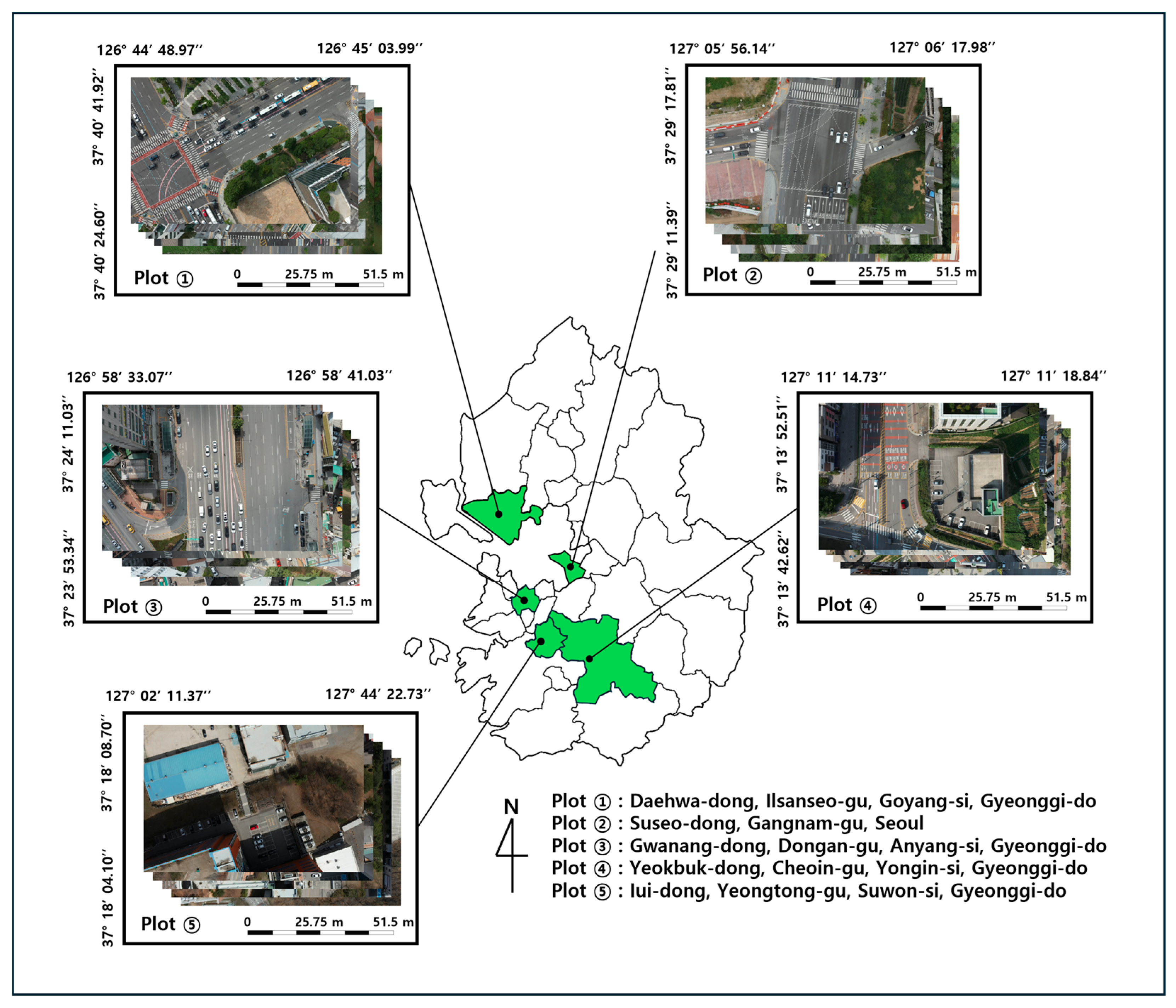
UAV surveys were carried out at five urban plots in urban settings (
Figure 1). The plots include signalized intersections and multi-lane corridors in Daehwa-dong (Goyang-si), Suseo-dong (Seoul), Gwanang-dong (Anyang-si), Yeokbuk-dong (Yongin-si), and Iui-dong (Suwon-si). These sites were selected to cover typical road-marking configurations in dense urban traffic, including crosswalks, stop lines, turn arrows, and parking symbols adjacent to mid-rise buildings. Each plot is mapped by a local UAV block with nadir imagery so that horizontal markings appear with minimal perspective distortion. We used areas 1, 3, 4, 5 for the training dataset and area 2 for testing our workflow.
To ensure uniform radiometric quality and sufficient spatial detail, we used a UAV-mounted camera with the following specifications: a 35.9 × 24 mm sensor, 8192 × 5460 px image resolution, a 50 mm focal length, and JPEG image format.
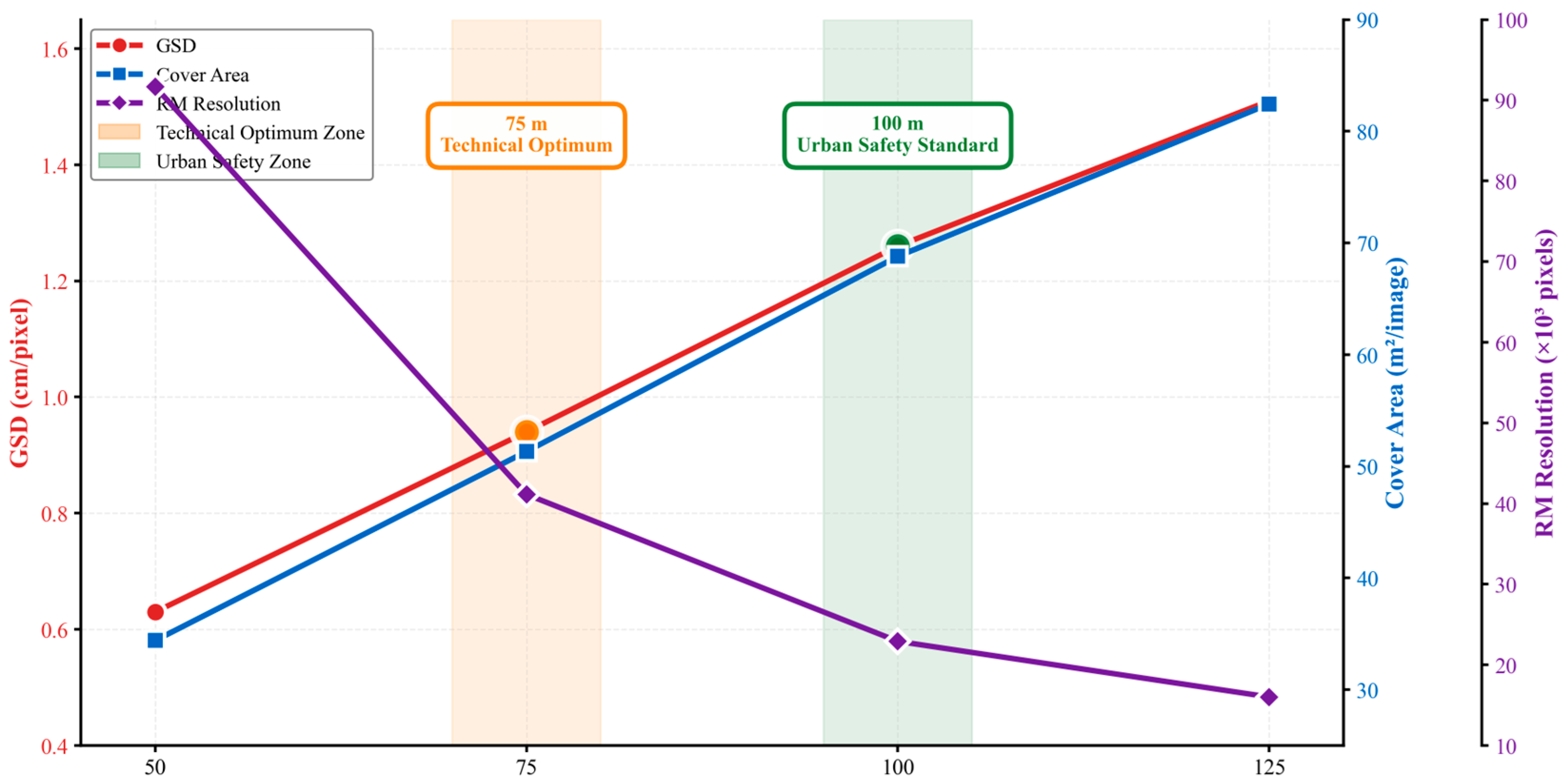
All images are acquired with a DJI Matrice 300 RTK (DJI, China) equipped with a Zenmuse P1 camera. Before defining the operational altitude, we analyzed the trade-off between ground sampling distance (GSD), ground area covered per image, and the pixel footprint of a representative road marking (
Figure 2). For candidate heights of 50, 75, 100, and 125 m, we computed the GSD from the camera geometry, derived the corresponding ground area per frame, and measured the average width–height in pixels of a standard longitudinal marking. Lower flights (50 m) yield a very fine GSD but limited coverage per image, increasing flight time, whereas higher flights (125 m) increase coverage but coarsen the GSD, reducing the pixel footprint of road markings to only a few hundred pixels per instance and, for thin or worn markings, sometimes to fewer than 60 foreground pixels (an amount insufficient for reliable condition estimation). Considering this trade-off, 75 m is technically optimal; however, in accordance with local operational guidelines that restrict routine UAV flights over urban corridors to approximately 100–150 m above ground level (above building height), we used 100 m as the nominal altitude. At this altitude, the GSD is approximately 1.26 cm/pixel, the per-image coverage remains sufficient for efficient corridor mapping, and typical road-marking instances still occupy on the order of several hundred foreground pixels in area (pixel count within the segmented mask), noting that markings are generally elongated and therefore this footprint is not distributed equally across both image directions.
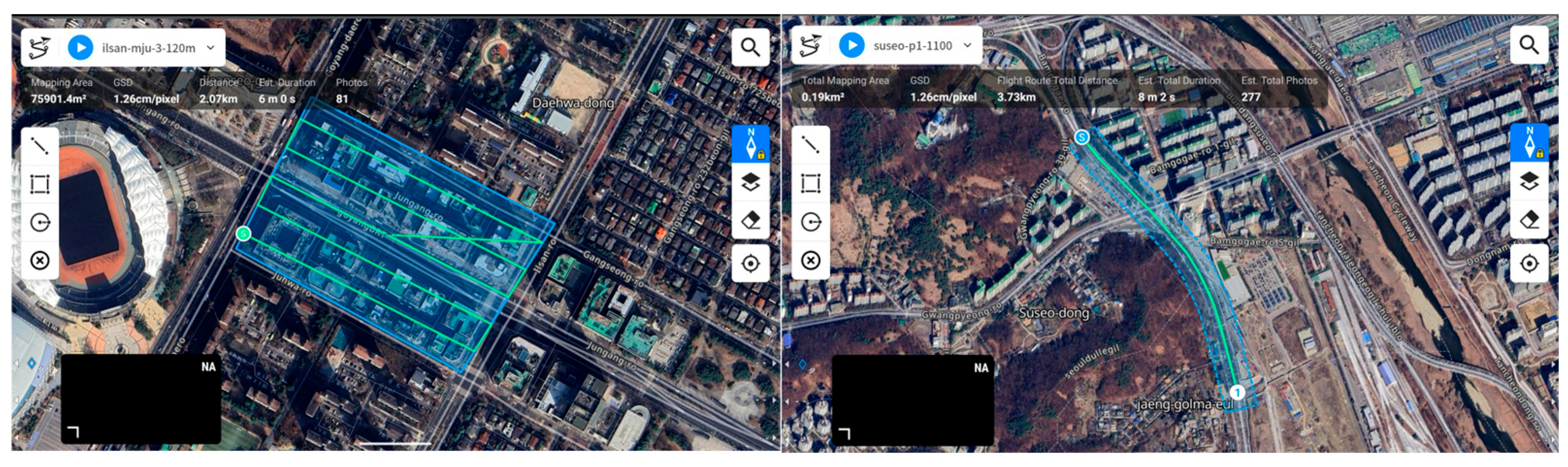
With the platform and height fixed, we planned mapping patterns using the manufacturer’s flight planning software (
Figure 3) with the green line and the blue area standing for the drone path and the coverage area, respectively. For block-shaped plots around intersections, we used a rectangular mapping block with parallel flight lines aligned approximately with the main road axes, ensuring high overlap and sidelap for both photogrammetric reconstruction and small-object analysis. For elongated arterial segments, we used a corridor-mapping pattern in which the drone follows the road centerline with parallel passes covering both directions of traffic. In both cases, the missions are flown at 100 m altitude with nadir camera orientation, overlap settings chosen to maintain continuous coverage, and total path lengths on the order of 2 to 4 km per mission, with several tens to a few hundred images per plot. These UAV acquisitions form the raw image sets used in the subsequent steps of dataset construction, model training, and evaluation.
The flight planning prioritized image redundancy and high spatial resolution to support robust photogrammetric processing. The mission was configured with 80% forward overlap, 70% sidelap, and a flight altitude of 100 m, resulting in a 1.26 cm ground sampling distance (GSD).
Annotation protocol: Labels are provided at two levels to support the two-stage pipeline: (1) instance-level bounding boxes with class IDs for RMD; and (2) pixel-accurate polygons delineating each marking for Road Marking Segmentation (RMS). Quality control included visual cross-checks and correction passes on ambiguous cases.
Data organization (matching
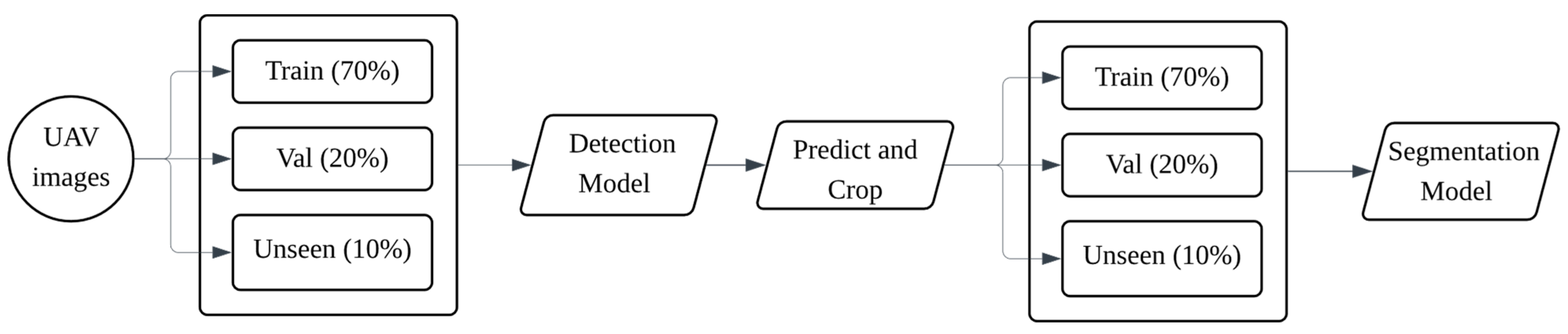
Figure 4): Scenes are partitioned once at the image/scene level into Train (70%), Val (20%), and Unseen (10%) for RMD. The best detection model (selected on unseen IoU) is then applied to the full set to predict and crop detector-centered patches. Detector-centered patches refer to image crops extracted around the center of each detector-predicted bounding box (with a fixed-size window or a box-based crop expanded by a margin and clipped to the image bounds) and then resized to the network input size for downstream segmentation/condition estimation. These patches constitute the RMS dataset, which is split into Train (70%), Val (20%), Unseen (10%) for segmentation training and evaluation. The unseen splits are held out for external generalization tests.
3.2. Proposed Framework
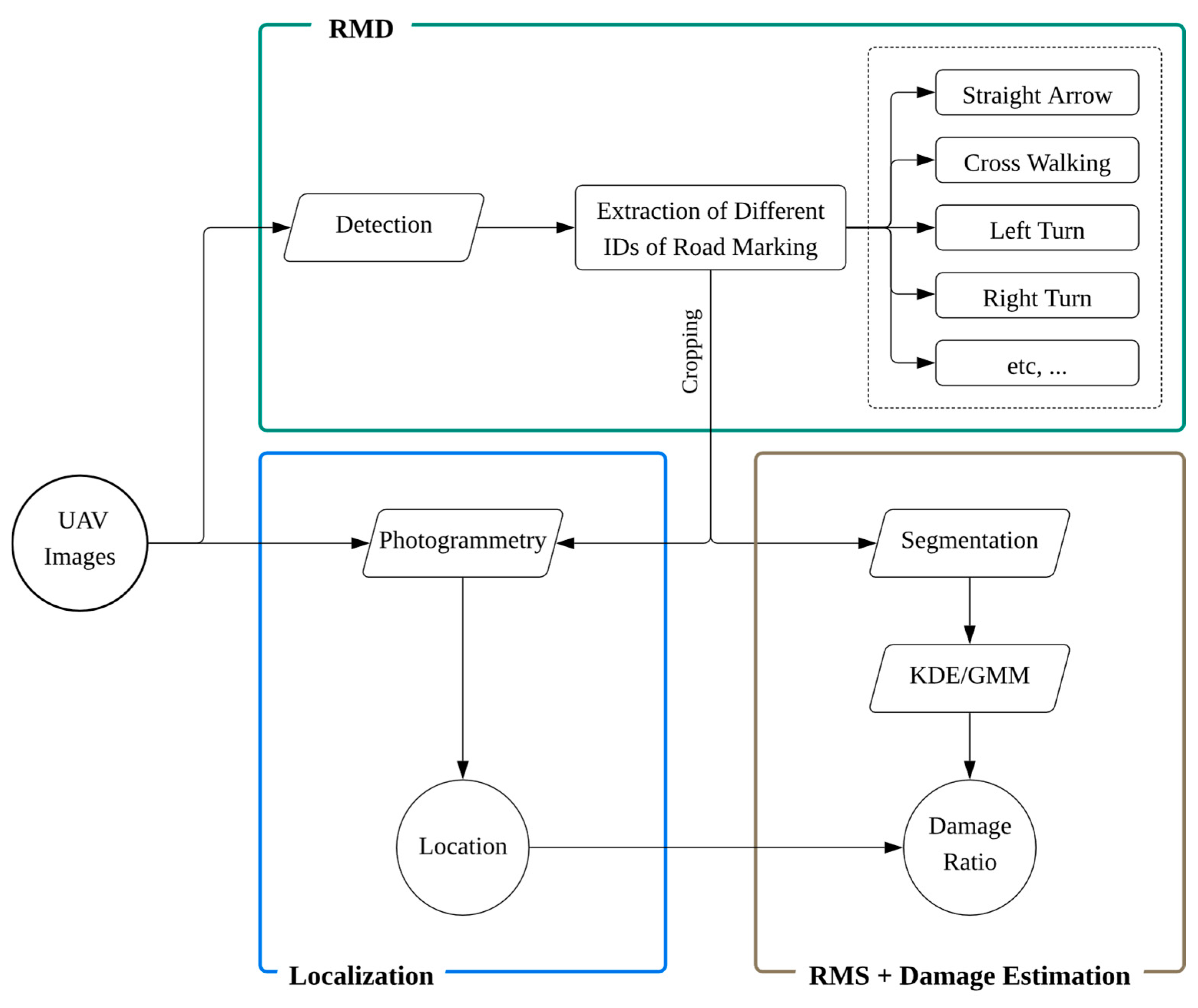
Figure 5 illustrates the proposed framework, consisting of three interconnected modules that process UAV images. This pipeline generates a per-object record, comprising the road-marking class, its georeferenced position (location), and a damage ratio derived from appearance statistics.
In this study, we present the development of an automated methodology for assessing the condition of road markings, leveraging scalable UAV imagery. The primary objective of this process is to accurately identify and quantify the damage ratio resulting from degradation, such as breakage, blurring, and general material deterioration. Ultimately, this enables the derivation of quantitative assessments for road marking defects from the analyzed data points. Our proposed system integrates a sophisticated framework encompassing detector-guided cropping, segmentation, and a novel application of statistical methods (KDE/GMM) for precise pixel-level damage quantification, yielding georeferenced outputs for asset management.
3.3. Road Marking Detection (RMD)
UAV surveys generate large image volumes with markings that are small, thin, and repetitive. We focus on discrete road-marking instances (e.g., crosswalks, arrows, and other localized symbols) rather than continuous or dashed lane lines for two main reasons. First, instance-type markings typically provide a larger pixel footprint at a given GSD, which is important for stable intensity-based condition estimation (e.g., damage ratio) within the segmented region. Second, continuous/dashed lines often extend beyond the field of view and are frequently fragmented by occlusions and orthomosaic stitching, requiring additional line-linking/tracking and polyline-level modeling to obtain consistent condition indices, which are beyond the scope of this study. A detector is needed to preserve recall on small/extreme-aspect objects, run fast enough for mission-scale processing, and produce stable class hypotheses for downstream segmentation and damage estimation. As a powerful model in the field of object detection, YOLO satisfies these requirements by casting detection as a single pass over the image, avoiding the proposal stage and delivering a favorable speed–accuracy trade-off for infrastructure mapping (original single-stage formulation in [
15]). In our pipeline, YOLO provides reliable instance hypotheses that seed segmentation and photogrammetric georeferencing, so misses and false positives are minimized early, where they are most costly (
Figure 6).
Feature extraction: A convolutional backbone computes multi-scale feature maps from the input image.
Prediction on a grid: A lightweight prediction head maps features to a dense grid. Implementation-wise, this is a stack of 1 × 1 and small k × k convolutions rather than a fully connected layer.
Outputs per cell: At each grid location, the head emits class logits and bounding box parameters relative to that cell/stride. Multi-scale heads (not drawn for clarity) ensure that both small and large markings are covered; this corresponds to the feature pyramid practice in contemporary YOLO designs [
16,
17].
Post-processing: Predictions from all scales are merged and filtered using non-maximum suppression to produce the final set of instances used by RMS and the damage module.
Task-specific advantages:
Sensitivity to thin structures. Dense, multi-scale predictions retain cues for strokes only a few pixels wide;
Aspect ratio flexibility. Modern, largely anchor-free heads avoid hand-tuned anchor shapes, improving boxes for elongated symbols. This trend follows anchor-free detectors, such as Fully Convolutional One-Stage Object Detection (FCOS) [
18];
Throughput. One-stage inference enables tiling or batched processing for entire missions;
Clean interface. Each detection provides a class ID and a tight box; we pad the box with a small fixed margin before cropping for VGG16-UNet, which preserves full shapes for segmentation and stabilizes the later KDE/GMM decision.
Implementation notes: We train the detector on the training split and use the validation split for model selection while keeping the test split held out for final reporting. The best checkpoint is defined as the model state that achieves the highest validation performance, monitored using an IoU threshold of 0.5, 0.5 to 0.95 and F1-score (mAP50, mAP50-95 and F1). The selected checkpoint is then used to generate detections for all images in the subsequent processing. For the segmentation stage, we extract margin-padded crops from each detected bounding box (i.e., an image patch obtained by expanding the tight box by a fixed padding margin on all sides, clipping to the image boundary, and resizing to the network input size). Finally, the resulting detection centroids (and mask centroids after segmentation refinement) are used as inputs to the photogrammetric mapping step. The mask centroid refers to the geometric centroid of the segmented foreground pixels within the corresponding crop (the mean (x, y) coordinates of pixels labeled as road markings).
3.4. Road Marking Segmentation (RMS)
RMS converts each detector-centered crop into a pixel-accurate, class-agnostic mask of the road marking. This mask preserves thin strokes and boundaries for geometric use and defines the support set for damage modeling, where KDE/GMM operates only within the predicted marking. In practice, high recall from RMD keeps true markings in the crop, while RMS provides the spatial precision that a bounding box cannot.
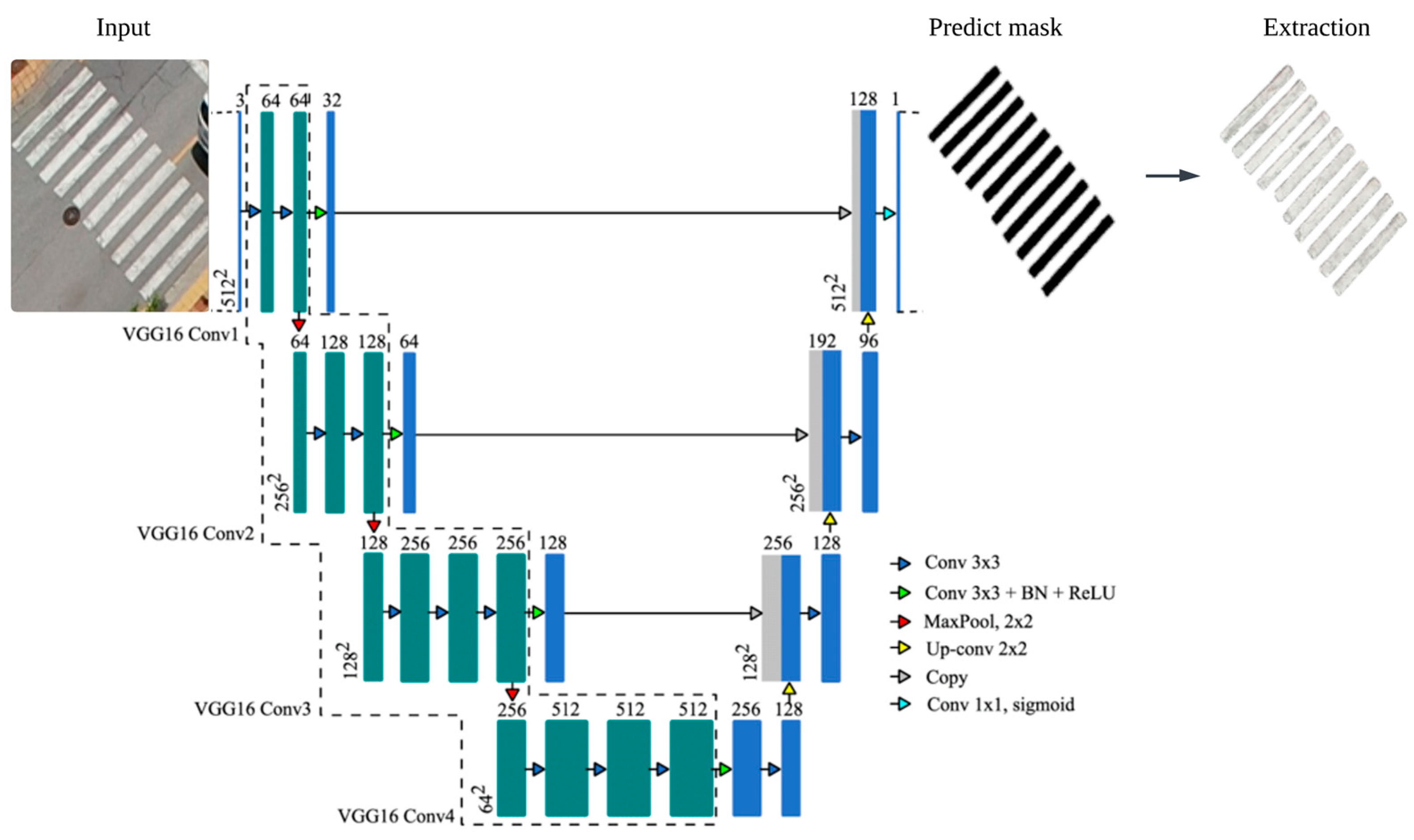
We used a UNet with a VGG16 encoder (pretrained) and a symmetric decoder. The encoder supplies four resolution stages of features; the decoder upsamples stepwise using transposed 2 × 2 convolutions. Skip connections reconcile high-level context with fine spatial detail crucial for narrow arrows and crosswalk bars. Each block in
Figure 7 follows a lightweight recipe: Conv 3 × 3 + BN + ReLU, repeated twice, followed by downsampling (max-pool) in the encoder or upsampling in the decoder; the final 1 × 1 convolution with a sigmoid yields a probability map. UNet is a standard choice for the crisp delineation of thin structures [
3], while VGG16 provides stable, well-understood features and benefits from large-scale pretraining [
19].
Skip connections and the shallow-kernel decoder preserve edges and narrow strokes that are easily lost in downsampling;
VGG16’s pretrained filters accelerate convergence and help when the target appearance varies due to paint aging and surface texture;
The model is compact, exportable, and decoupled from detection (RMD) proposes instances and IDs; RMS focuses solely on pixel-accurate shapes, keeping the pipeline modular and easy to maintain.
Figure 7.
VGG16-UNet architecture for segmentation.
Figure 7.
VGG16-UNet architecture for segmentation.
For each detection, the corresponding crop is forwarded through the network to produce a probability map. A threshold chosen on the validation set (applied uniformly at test time) converts probabilities into a binary mask. The mask centroid (or polygon) is passed to the photogrammetry module for georeferencing; the mask itself defines Mi for downstream KDE/GMM-based damage estimation.
3.5. Damage Estimation
We model the gray-level appearance of each detected road marking instance using a two-step statistical procedure. First, we obtain a smooth, nonparametric estimate of the gray-level distribution within the instance mask via KDE. Second, we approximate this KDE with a two-component GMM by maximizing a weighted log-likelihood on the intensity grid where the KDE is evaluated. The resulting mixture provides a compact, interpretable model of the apparent bimodality between intact (brighter) and distressed (darker) material, which we then use for pixel-wise Bayes classification and to compute a per-instance damage ratio. KDE follows the classical formulation of Rosenblatt and Parzen and the practical guidelines of Silverman [
4,
5,
20].
Given gray levels
inside the instance mask, the Gaussian-kernel KDE with bandwidth
[
4] is:
In practice, we evaluate on a uniform grid (8-bit intensities). We selected the KDE bandwidth h using a classical plug-in (normal-reference) rule of thumb (i.e., a data-driven bandwidth computed from the sample spread under a Gaussian reference model). The bandwidth h controls the smoothness of the estimated density: smaller h yields an under-smoothed, noisy density with spurious local extrema and unstable valley/threshold locations, whereas larger h produces an over-smoothed density that can blur or suppress bimodality and shift the decision threshold. In our experiments, we used h = 15 as the nominal setting and assessed robustness under nearby values. This grid-based KDE yields a stable bimodal density estimate (i.e., It reliably reveals the two dominant modes and a consistent valley/threshold between them) even when the number of pixels per instance is modest, and it facilitates the subsequent weighted EM fitting.
Rather than fitting a GMM directly to raw pixels, we fit the mixture to the KDE so that the mixture curve adheres to the smoothed empirical density.
Let
denote the two-component Gaussian mixture model:
, where
and
. On the grid
, assign nonnegative weights
which Δx denotes the grid spacing on the intensity axis, i.e., the difference between two consecutive grid points (histogram-bin centers) used to discretize the 0–255 grayscale range (normalized so that
). We maximize the weighted log-likelihood using the EM algorithm [
6]. We fit a two-component Gaussian mixture to the grayscale intensity distribution inside each segmented marking instance using a weighted EM procedure, where the KDE evaluated on an intensity grid provides sample weights. Specifically, the KDE is computed on a discrete grid. These density values are normalized and treated as weights so that the EM updates are performed on the grid rather than on all pixels. The EM iterations are run for at most 80 iterations and stopped early when the change in log-likelihood becomes smaller than 10
−6. After fitting, each pixel intensity is assigned to the component with the larger posterior score, i.e., the larger value of the unnormalized posterior. The “damage” component is then identified based on the darker intensity assumption (the component with the smaller mean), and the damage ratio is computed as the fraction of pixels assigned to that component within the instance.
Let the darker component represent “damage” (configurable if illumination inverts the contrast). For a pixel of gray level
, we assign the label with the larger posterior unnormalized score. The decision boundary
solves the equality of posterior scores:
For a marking instance with pixel set
and predicted labels
, we report the damage ratio.
which summarizes the fraction of degraded material used in downstream mapping and inventory summaries. The “I” is an indicator function, equal to 1 if the condition y
p is the damage label and 0 otherwise.
We evaluate four unsupervised pixel partitioners within each segmented marking: Otsu thresholding, K-means (k = 2), direct GMM on raw pixels, and our KDE/GMM procedure. To quantify how closely a method’s parametric density
(the density associated with each baseline method) matches the smoothed empirical distribution
(the KDE-estimated reference density), we report the integrated absolute error (IAE) and integrated squared error (ISE) standard criteria in density estimation that directly assess the fidelity of a fitted model to a target density [
20]:
Otsu thresholding: Otsu selects the gray level
t* maximizing the between-class variance computed from the image histogram [
21]:
where
and
denote the cumulative class probability and mean for class
. In practice, Otsu can be sensitive to class imbalance and weak bimodality;
- 2.
K-means (k = 2): With two clusters,
-means minimizes the within-cluster sum of squares; in 1-D the decision boundary is the midpoint of the two centroids. The classical objective and Lloyd-type algorithm are well documented (Lloyd, 1982), and improved seeding strategies such as
-means++ enhance robustness [
22].
- 3.
Direct GMM on raw pixels: A two-component Gaussian mixture is fitted using the EM algorithm, and labels are assigned by the Maximum A Posteriori (MAP) decision rule. Mixture modeling texts provide extensive discussion of convergence/local optimum issues in finite mixtures [
23].
where
is the mixture weight (mixing proportion) of component k with
≥ 0. The Gaussian density has a mean
and a variance
. We initialize EM using a 1D k-means split and apply a minimum-variance regularization (
≥ 9.0) to avoid degenerate components.
Mask “core” for fair evaluation. All methods use an eroded core of each instance mask to suppress boundary mixing. The set-theoretic erosion of a binary set
by the structuring element
[
24] is:
3.6. Localization
We estimate absolute 3D coordinates of detected road markings (RM) by registering each incoming frame to a pre-built 3D reference model. The workflow comprises two parts:
Structure from Motion/Multi-View Stereo (SfM/MVS) reconstruction: UAV multi-view imagery is processed with Collective Mapping (COLMAP) to run SfM/MVS; features are detected and matched across images, and camera intrinsic/extrinsic parameters are estimated and globally refined by bundle adjustment. Then, per-pixel parallax yields a dense RGB-D point cloud [
25,
26].
Outlier removal and database building: The cloud is denoised with statistical outlier removal (SOR) and radius outlier removal (ROR) to suppress artifacts from reflections, inter-image brightness differences, and texture heterogeneity [
27]. The cleaned cloud, together with per-image features, per-pixel 3D coordinates, and camera parameters, is stored as a database used later for localization.
- 2.
Assigning 3D coordinates to new detections
We carried out feature matching between input and reference images using Scale-Invariant Feature Transform (SIFT) [
28], which is robust to rotation, scale, and illumination variations [
29]. Each matched input pixel is linked to its corresponding 3D point in the reference model, giving absolute coordinates in the common frame.
For every detected RM, we select the five nearest matched points (Euclidean distance in the image domain) around the RM pixel and apply inverse distance weighting (IDW) to their 3D coordinates to obtain the RM’s absolute position [
30]. Using five neighbors captures local depth/surface variation while avoiding over-smoothing; distance weighting stabilizes estimation on sloped or structurally varying pavement.
3.7. Implementation Details and Hyperparameter Settings
To facilitate the replication of our experiments, we report the final implementation details and the key hyperparameter values used for each module in the proposed pipeline (
Table 2), including detection, segmentation, and condition estimation. The listed values correspond to the settings used to produce the results reported in
Section 4. Unless otherwise stated, parameters not included in
Table 2 were kept at their default values in the adopted training framework.
For training, we used a fixed budget of 200 epochs to ensure convergence across architectures, and selected the final checkpoint following the evaluation protocol in
Section 4. Unless otherwise specified, all remaining settings (e.g., scheduler details, initialization, and non-critical augmentation options) followed the default implementation of the adopted frameworks.
For the condition-estimation step, we operated in an 8-bit grayscale space; therefore, KDE was computed on 256 bins. The core region was defined using a morphological erosion with a kernel size of 5 to reduce boundary contamination from segmentation uncertainty. A two-component mixture model was adopted to reflect the intended binary partitioning into damage and non-damage pixels within the marking region; k-means (k = 2) and a two-component direct GMM were included as baseline partitioning strategies.
4. Results
4.1. Road Marking Detection Results
We trained and validated several YOLO families on the UAV image split described earlier. For fairness, all detectors used the same input resolution and augmentation policy; confidence and IoU thresholds were tuned on the validation set and then fixed. Performance is summarized in
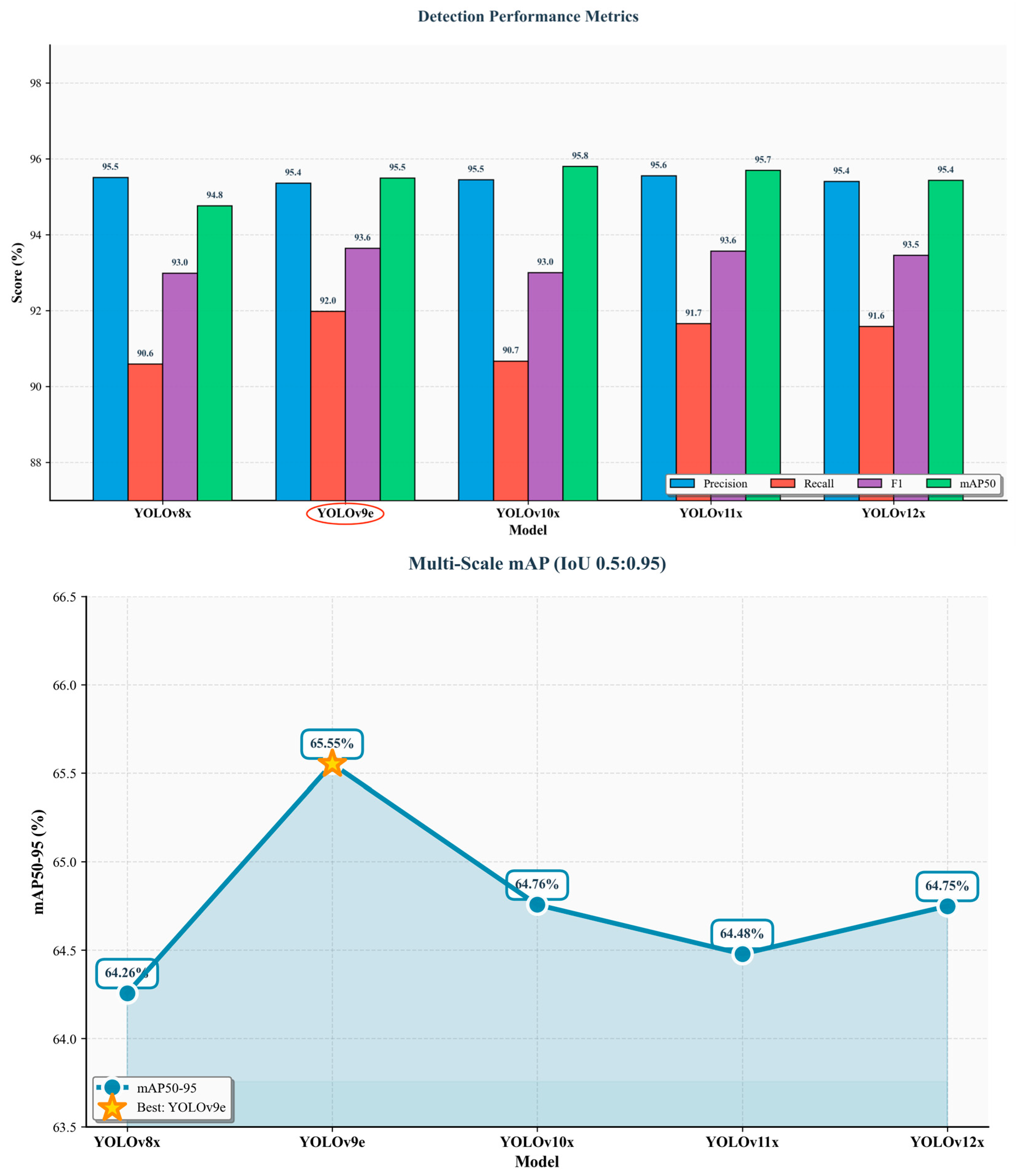
Table 3 using precision, recall, F1, mAP50, mAP50–95, and computational cost (speed, GFLOPs). We emphasize F1 (the balance of misses and false alarms) and mAP50–95 (localization quality across IoU thresholds), because these criteria most strongly affect the downstream segmentation crops and, in turn, the reliability of damage estimation (
Figure 8).
Detection performance across the evaluated YOLO variants is broadly comparable, with relatively small gaps in the headline metrics. Therefore, in addition to accuracy, efficiency (runtime/compute) and downstream implications for the detector-first pipeline are also relevant criteria for selecting the default model.
YOLOv8x offers balanced precision/recall but falls short of YOLOv9e in both F1 (92.984%) and mAP50–95 (64.256%). YOLOv9e provides the strongest overall operating point for our pipeline: it achieves the highest F1 (93.642%) and the highest mAP50–95 (65.553%), together with the highest recall (91.982%) among the tested variants, while maintaining a competitive runtime (0.8 ms/image; 189.2 GFLOPs). In a detector-first workflow, this combination is desirable because higher recall reduces the number of markings that never reach segmentation, and stronger mAP50–95 reflects more reliable localization for generating well-centered, margin-padded crops.
YOLOv10x attains the best mAP50 (95.803%) and is faster in our measurements, which makes it an attractive option when throughput is the primary objective. However, its slightly lower mAP50–95 (64.757%) and F1 (92.999%) indicate weaker performance under stricter localization requirements, which can translate into less consistent crop quality for elongated symbols when fixed-margin expansion is applied. YOLOv11x shows the highest precision (95.556%) but lower recall (91.66%), implying more missed instances; in our setting, recall is critical because missed detections do not proceed to downstream segmentation/condition estimation. YOLOv12x is close in F1 (93.454%) yet does not surpass YOLOv9e in mAP50–95 (64.749%) and is the heaviest among the high performers (1.3 ms/image; 198.6 GFLOPs).
Overall, given that accuracy differences are small, our selection is guided by a balanced accuracy–efficiency trade-off: YOLOv9e offers the best validation accuracy while remaining efficient enough for mission-scale processing. We note that YOLOv10x may be preferred in scenarios where speed constraints dominate and a marginal reduction in strict localization metrics is acceptable.
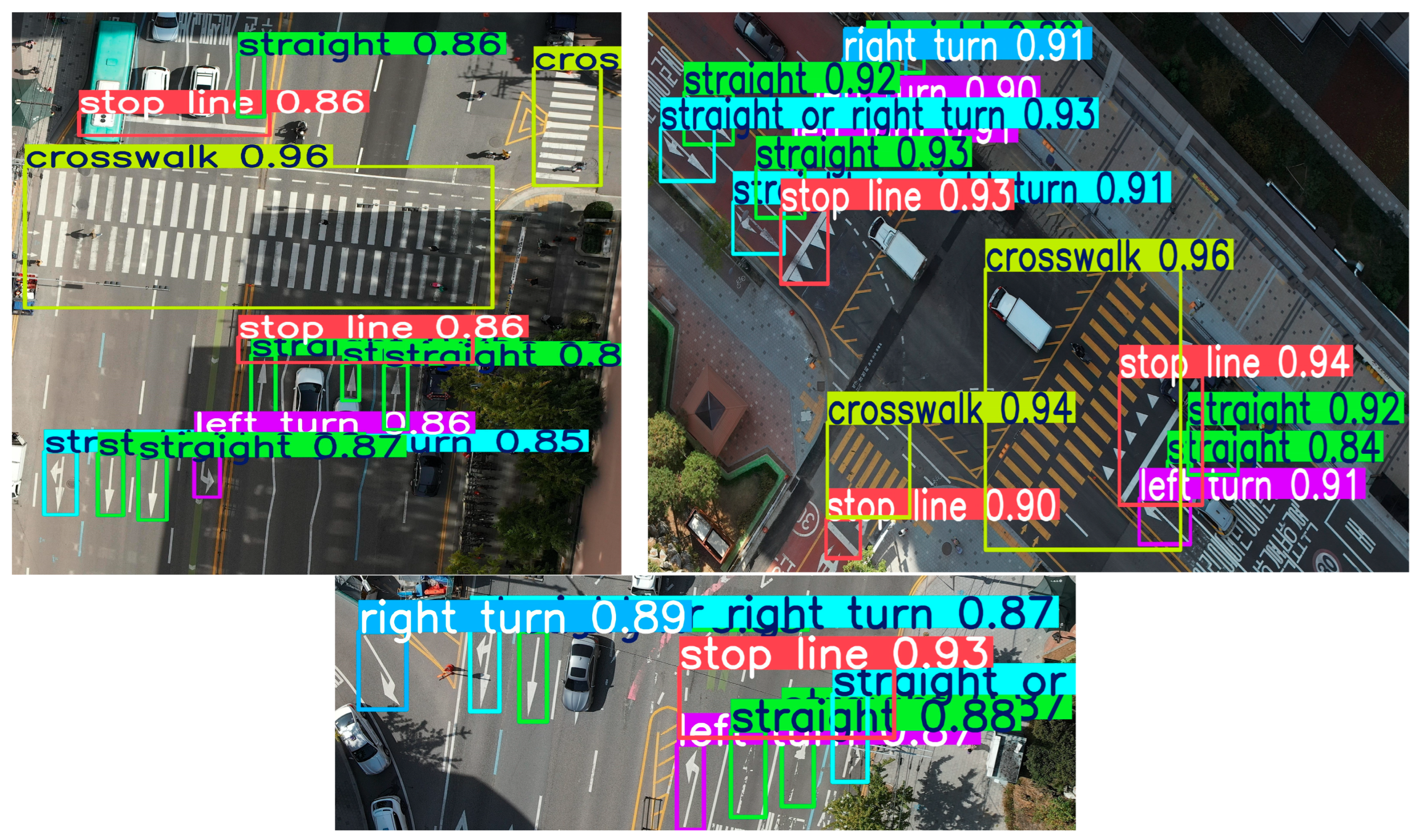
Based on these results, we adopt YOLOv9e for all subsequent experiments (illustrated in
Figure 9). The best checkpoint selected on validation F1 and mAP50-95 is used to generate margin-padded crops for U-Net. Confidence and NMS thresholds remain fixed throughout test and unseen-scene evaluations to ensure comparability. This choice prioritizes high recall and high-quality localization, aligning detector behavior with the needs of the segmentation and damage modules and yielding more reliable per-object records (ID, location, DR).
4.2. Road Marking Segmentation Results
We evaluate segmentation on detector-centered crops using the same train/val/unseen split as in
Section 3.1. Metrics include mIoU and F1 (higher is better) and MAE (lower is better). All models are trained with identical data augmentation and loss settings; early stopping and model selection are performed on the validation split.
Following
Figure 10 and
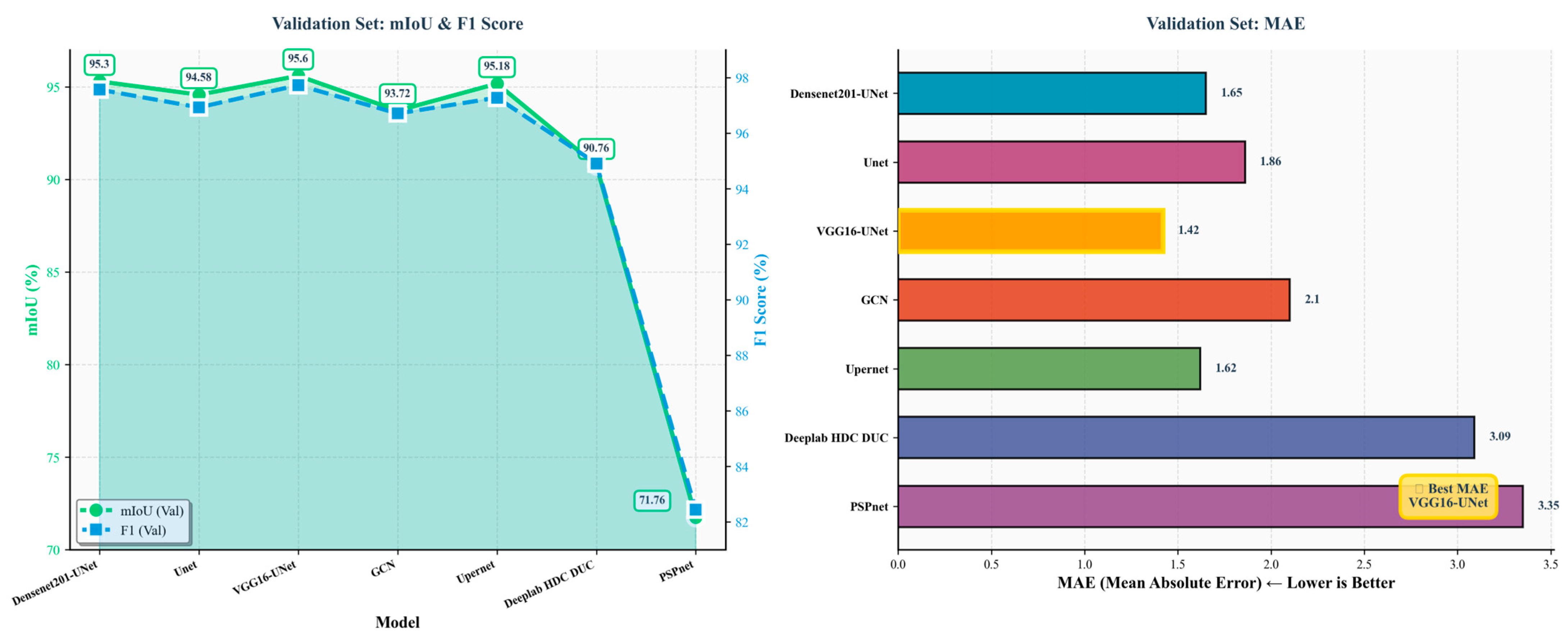
Table 4, VGG16-U-Net delivers the strongest overall performance, achieving the best scores on the unseen split: mIoU = 94.21%, F1 = 97.00%, and the lowest MAE (Mean Absolute Error) = 2.12. Validation results show the same trend (mIoU = 95.60%, F1 = 97.73%, MAE = 1.42), indicating stable training and good generalization. Densenet201-U-Net and the plain U-Net are close runners-up (unseen mIoU ≈ 93.9% and 93.8%, respectively; F1 ≈ 96.8% and 96.7%), while GCN, Deeplab HDC-DUC, and PSPNet trail by a wider margin, particularly on F1 and MAE, suggesting that heavier context modules do not necessarily translate to better delineation of thin strokes in this setting.
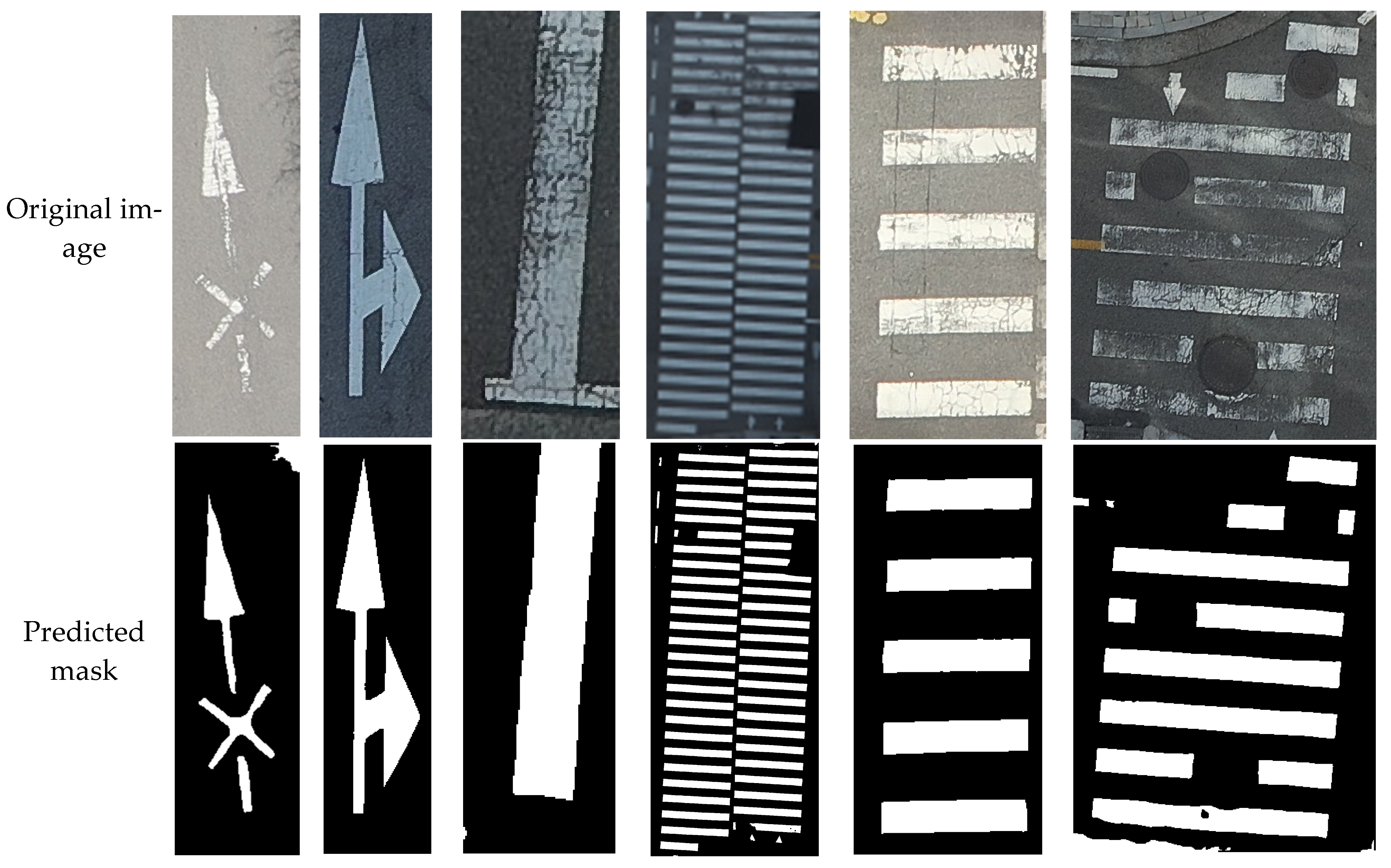
The gains of VGG16-U-Net are most visible on elongated symbols and dense line patterns (e.g., crosswalk bars). Higher mIoU reflects fuller coverage of the painted region, while the F1 score indicates cleaner foreground–background separation. The MAE reduction implies fewer holes and spurious fragments, important because such artifacts would bias the pixel pool used by KDE/GMM in the damage module.
Residual errors concentrate in two cases:
Very worn markings with low contrast, where small gaps appear along the stroke;
Occlusions that occasionally enter the mask.
Compared with alternatives, VGG16-U-Net better preserves narrow strokes and recovers dashed elements, but it may slightly overfill around high-contrast cracks. Light post-processing (hole filling, tiny component removal) abates most of these issues without eroding thin structures.
Given its superior unseen performance and consistent behavior across categories, VGG16-U-Net is used as the RMS module for all subsequent analyses. Using tighter, cleaner masks reduces variance in the damage estimation stage.
Figure 11 illustrates a typical outcome, and the model delineates thin strokes and parallel bars with sharp edges and minimal leakage onto the asphalt background. Failure cases (rightmost examples) illustrate minor overfill near cracks and partial misses where the paint is severely faded.
4.3. Damage Estimation Methods
We evaluate the damage estimator described in
Section 3.5 on held-out scenes. For each detected road-marking instance, gray levels within the instance mask are modeled by a KDE and approximated by a two-component GMM using the weighted EM objective. Pixel labels are assigned by Bayes’ rule with the operating point given by the intersection closest to the KDE valley, see Equation (4), and the per-instance damage ratio (DR) is computed as in Equation (5).
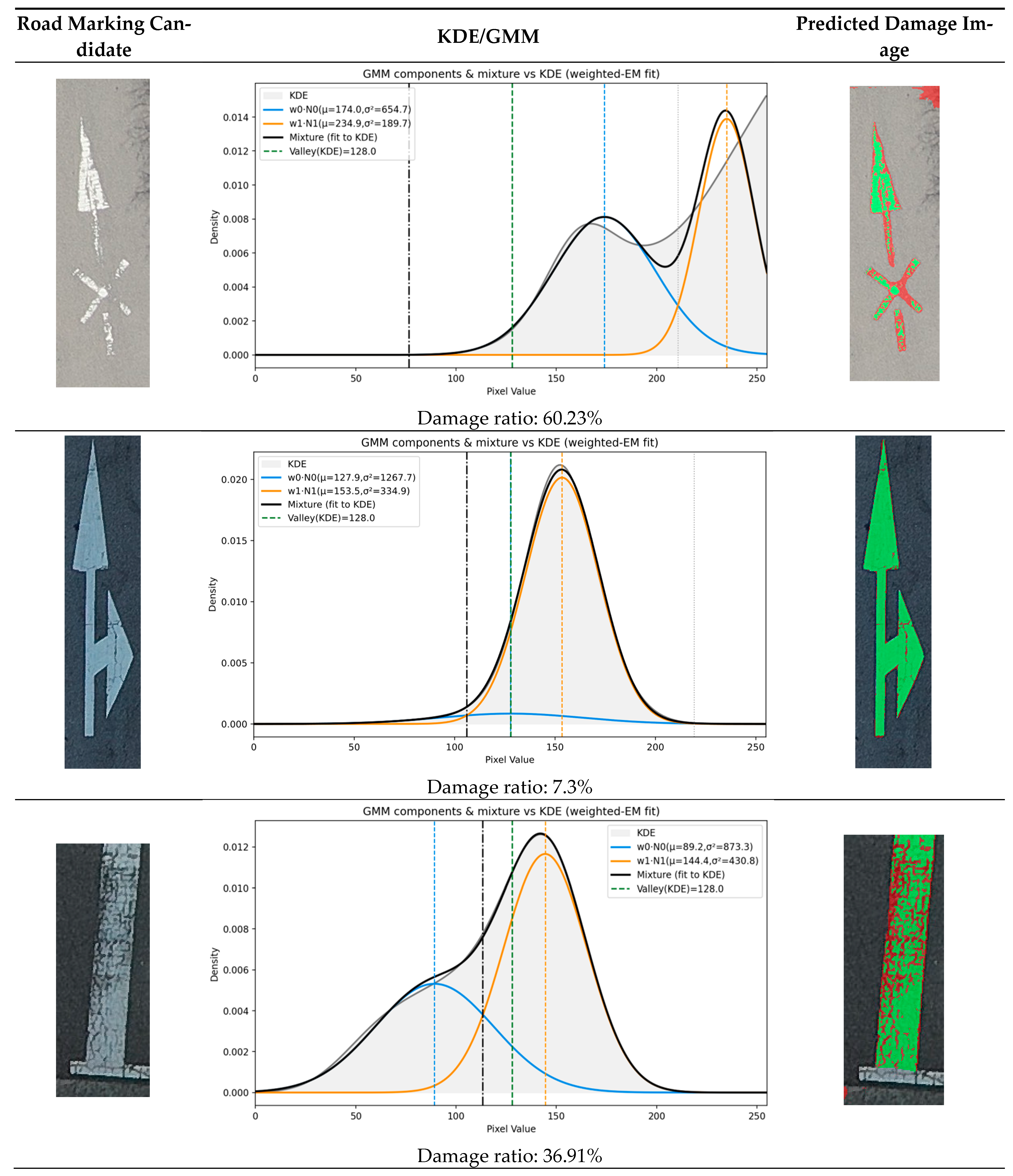
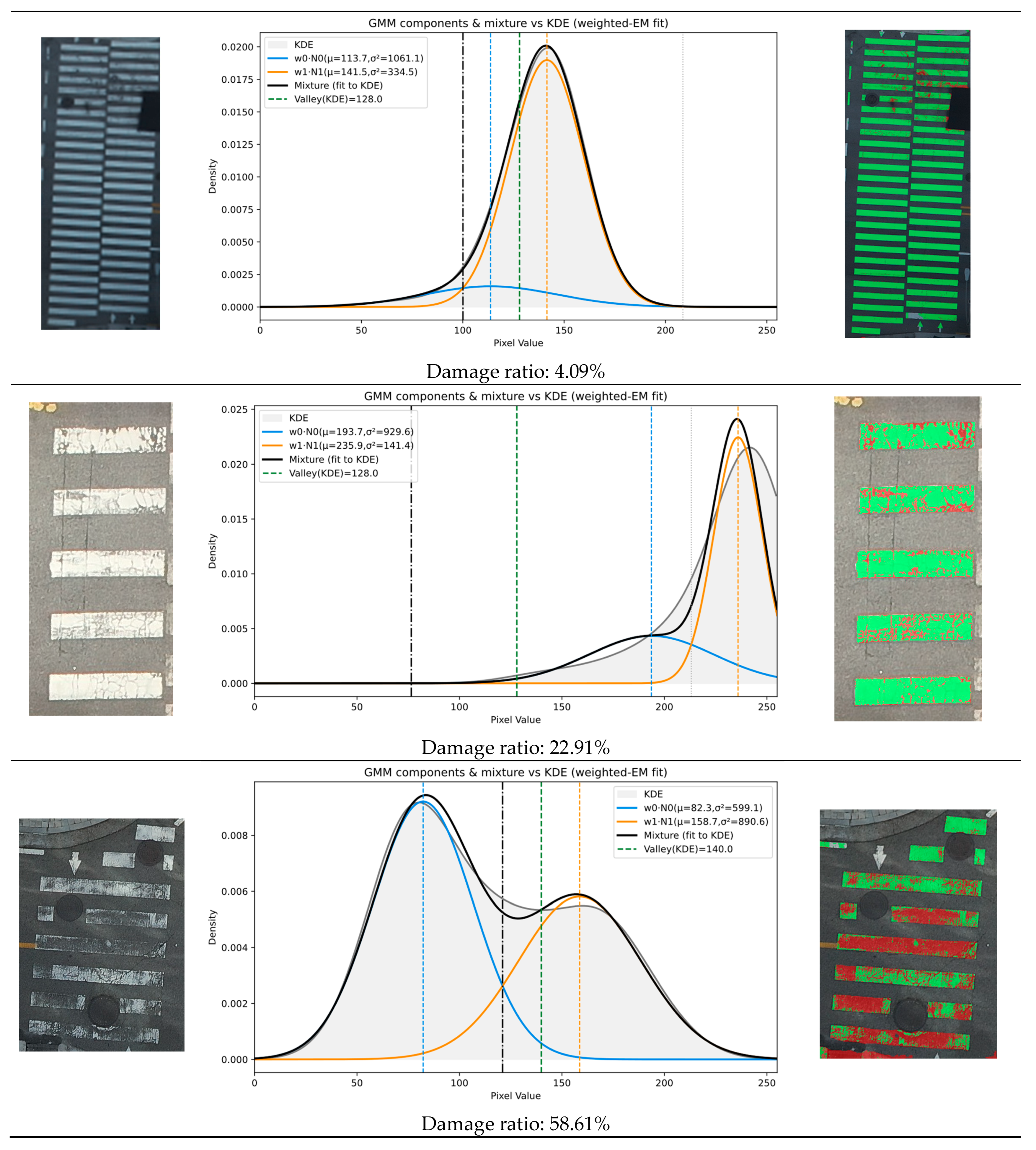
Figure 12 illustrates representative instances spanning high, moderate, and low deterioration. The center panels overlay the two-component mixture (black) and its Gaussian parts (blue/orange) on the KDE of in-mask gray levels (gray fill). Across cases, the fitted mixture closely tracks the smoothed density, including the inter-mode valley when present, which confirms that the weighted EM step adheres to the nonparametric shape rather than the raw histogram. The vertical line marking the posterior intersection lies near the valley of the KDE, and the component means shift consistently with the intensity distribution: heavily distressed markings exhibit a darker mode with larger weight and a decision threshold displaced toward brighter values; largely intact markings show a dominant bright mode and a threshold nearer the dark tail. In the density plots, the dashed blue and dashed orange vertical lines indicate the peak locations (means) of the two fitted Gaussian components (μ1 and μ2). The black dash-dotted vertical line indicates the decision threshold t, selected as the intersection of the two Gaussian components closest to the KDE valley, and used to assign pixels to the damage and intact classes.
The right panels map the Bayesian labels (red = damaged, green = intact) back to image space. The predicted maps respect object structure solid cores and stroke interiors are preserved while deterioration appears as fragmented regions along edges, gaps, and eroded paint. This correspondence between the 1D density partition and the 2D spatial pattern supports the use of a single, instance-wise threshold derived from the mixture posteriors. The reported damage ratio (DR) below each row matches the visual impression: larger red coverage in the overlay is reflected by higher DR values and vice versa.
Misclassifications are most likely at strong illumination transitions (specular flecks or shadows) where the modes partially overlap; in such cases the densities approach unimodality, and the posterior intersection becomes less separated from the dominant mode. The core erosion step reduces boundary leakage and improves stability, but thin strokes with severe wear may still produce small islands of uncertain labeling.
The examples demonstrate that KDE/GMM yields mixtures that conform to the empirical appearance statistics of each marking and produce interpretable, instance-specific thresholds. This behavior motivates the quantitative analysis in
Section 4.4, where we compare against histogram-based and centroid-based baselines and report divergence from the KDE reference and the variability of DR under controlled perturbations.
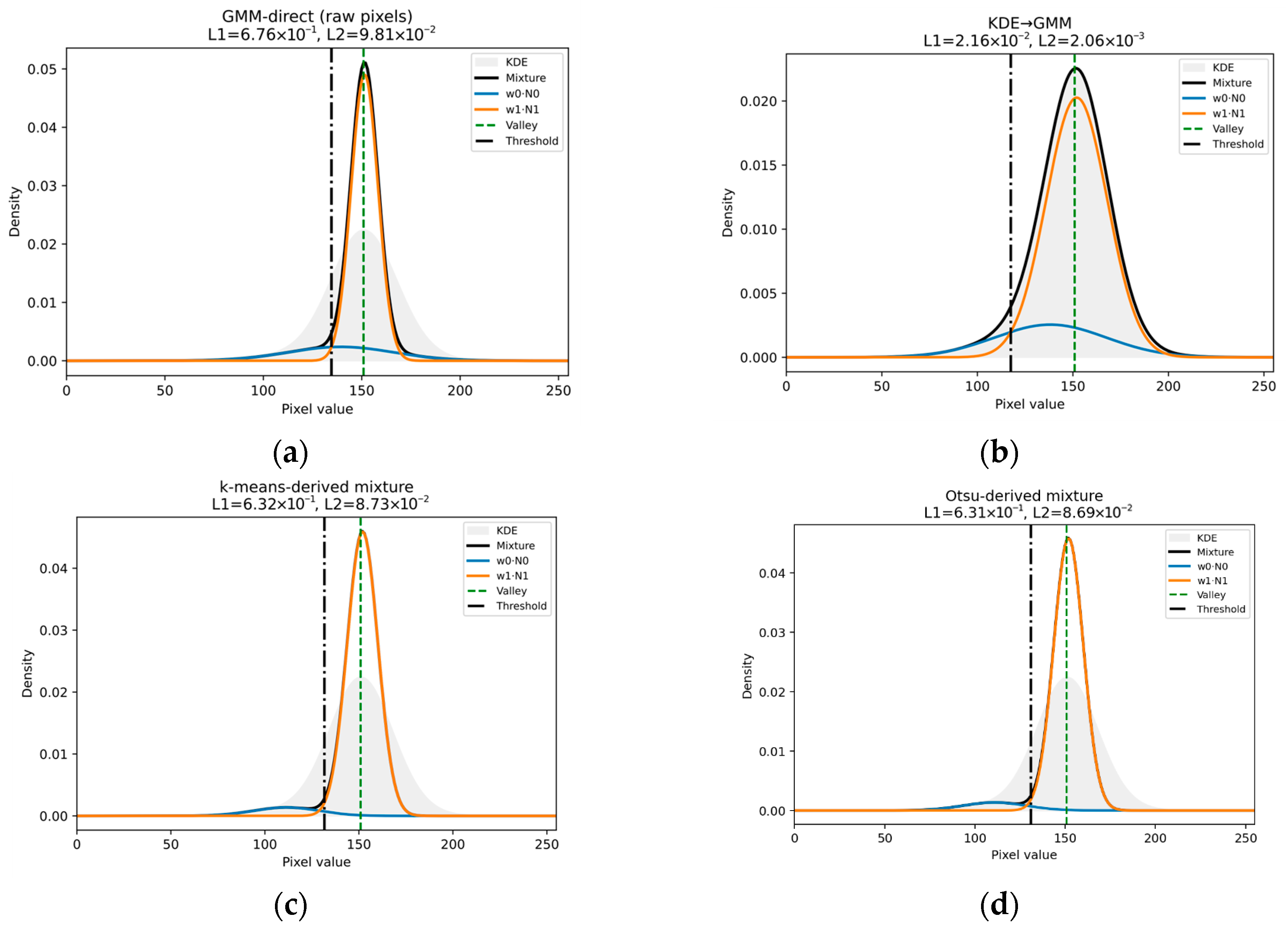
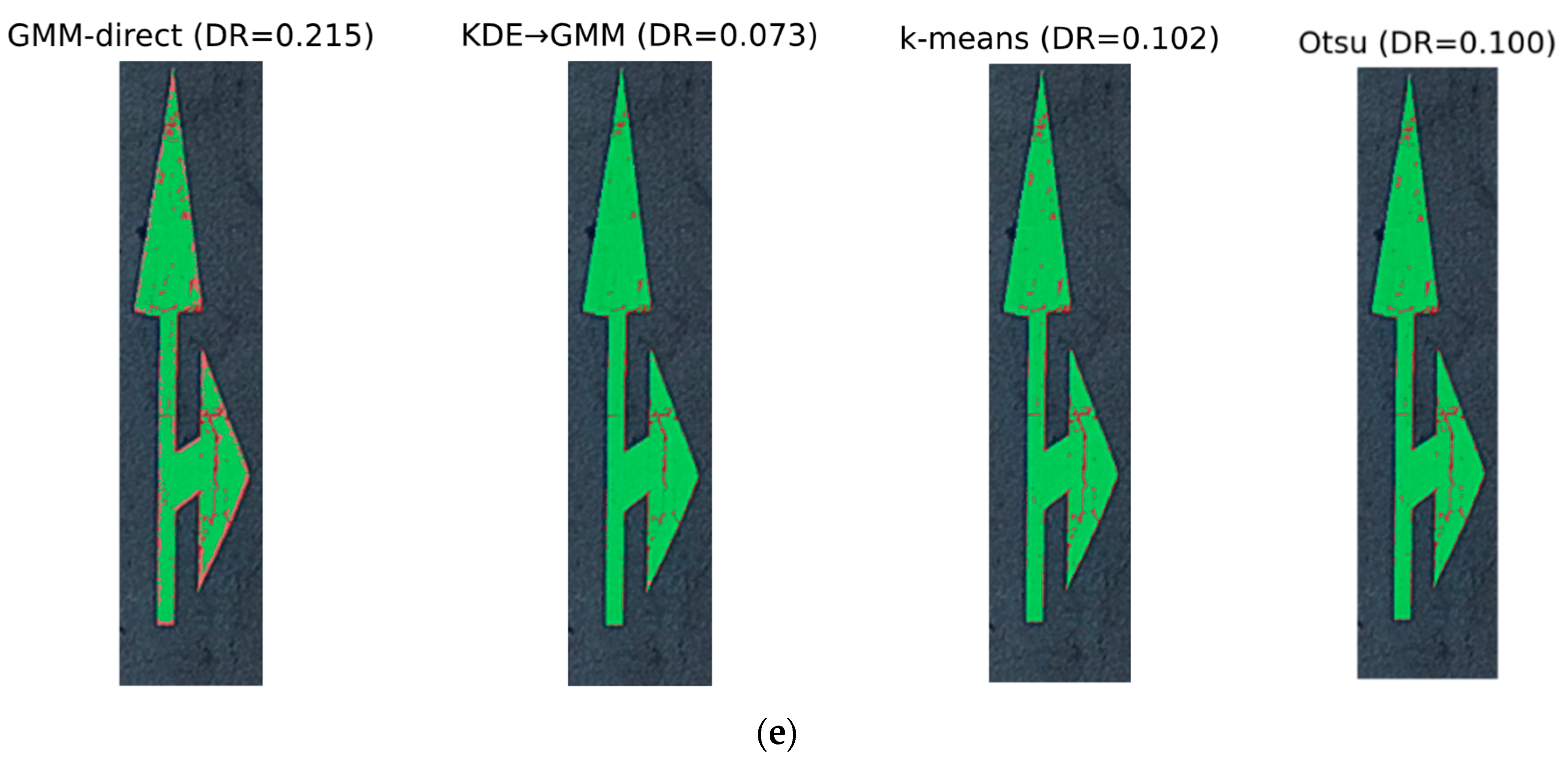
Our procedure first stabilizes the empirical shape with a KDE, then fits a two-Gaussian mixture that matches the smoothed density using weighted EM on the pixel grid; subsequent partitioning uses the posterior intersection rather than a midpoint. This design reduces sensitivity to sampling/initialization and discourages spurious modes, in line with the long-standing practice of evaluating parametric fits against a nonparametric reference via integrated error.
In skewed or weakly bimodal gray-level statistics, Otsu and k-means tend to misplace the cut (class imbalance, centroid bias), while direct GMM can follow local optima. In contrast, KDE/GMM explicitly fits the smoothed density and then separates classes at the posterior intersection, which is consistent with IAE/ISE diagnostics, yielding lower divergence
and more stable damage-rate estimates under modest bandwidth/core perturbations [
36] (see
Table 5 and
Figure 13).
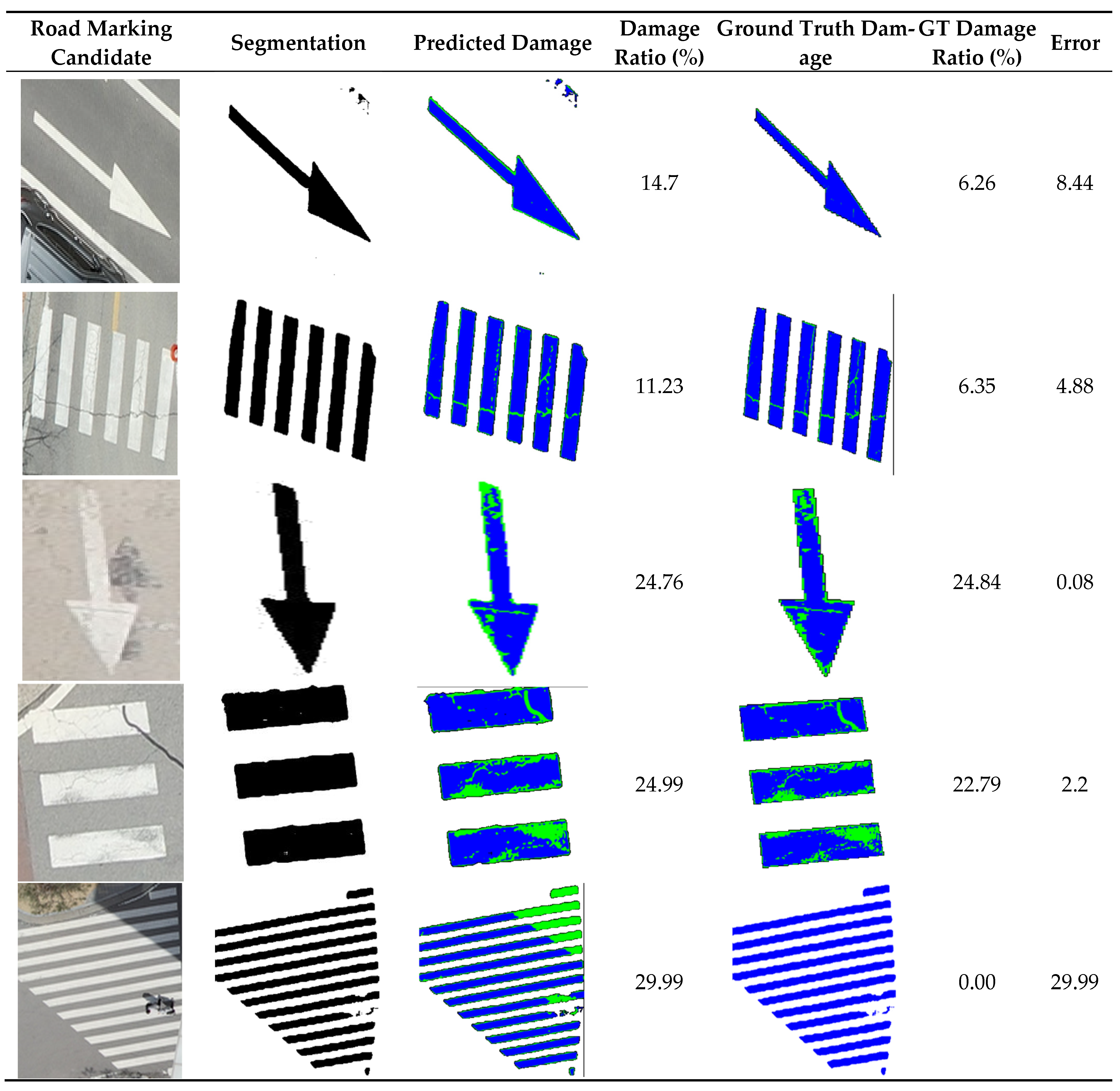
Figure 14 compares predicted and annotated damage at the instance level. For each road-marking candidate (first column), we show the segmentation mask, the predicted damage map with its damage ratio, the ground truth damage map with its ratio, and the absolute error between the ratios. (blue and green are representing intent and damage, respectively).
4.4. Minor Localized Failure Cases
Despite the overall performance reported in
Section 4.1,
Section 4.2 and
Section 4.3, several failure modes were consistently observed in challenging scenarios. Reporting these cases is important for two reasons: (i) to clarify the operational limits of the proposed pipeline under real-world imaging conditions, and (ii) to provide practical guidance on when additional quality control or manual review may be required.
Table 6 presents representative examples and summarizes the most common failure categories, their typical causes, and their impacts on results.
4.5. Localization Results
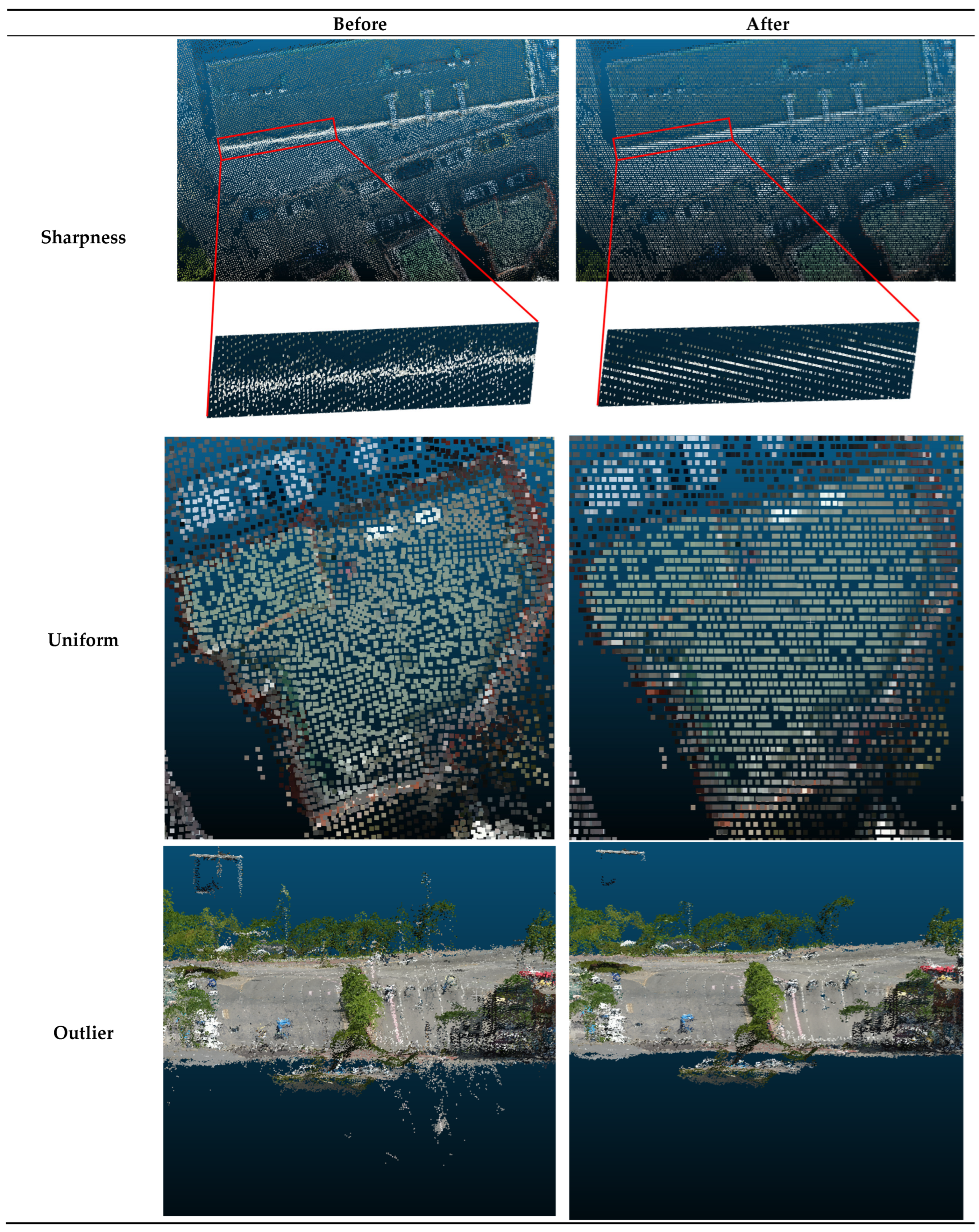
Figure 15 contrasts the raw dense reconstruction with the cleaned model. The red boxes highlight regions where spurious floating points and boundary noise are effectively suppressed after applying statistical and radius outlier removal. The cleaned reference cloud shows a more uniform density and sharper structural edges, conditions required for stable 2D–3D correspondence in later steps.
We performed feature matching between the input imagery and the reference model database. Matches were well distributed across roadway surfaces and façades, indicating adequate scene coverage and robustness to viewpoint and illumination changes. These results confirm the reliability of the first online step in
Section 3.6—2 (Assigning 3D coordinates to new detections).
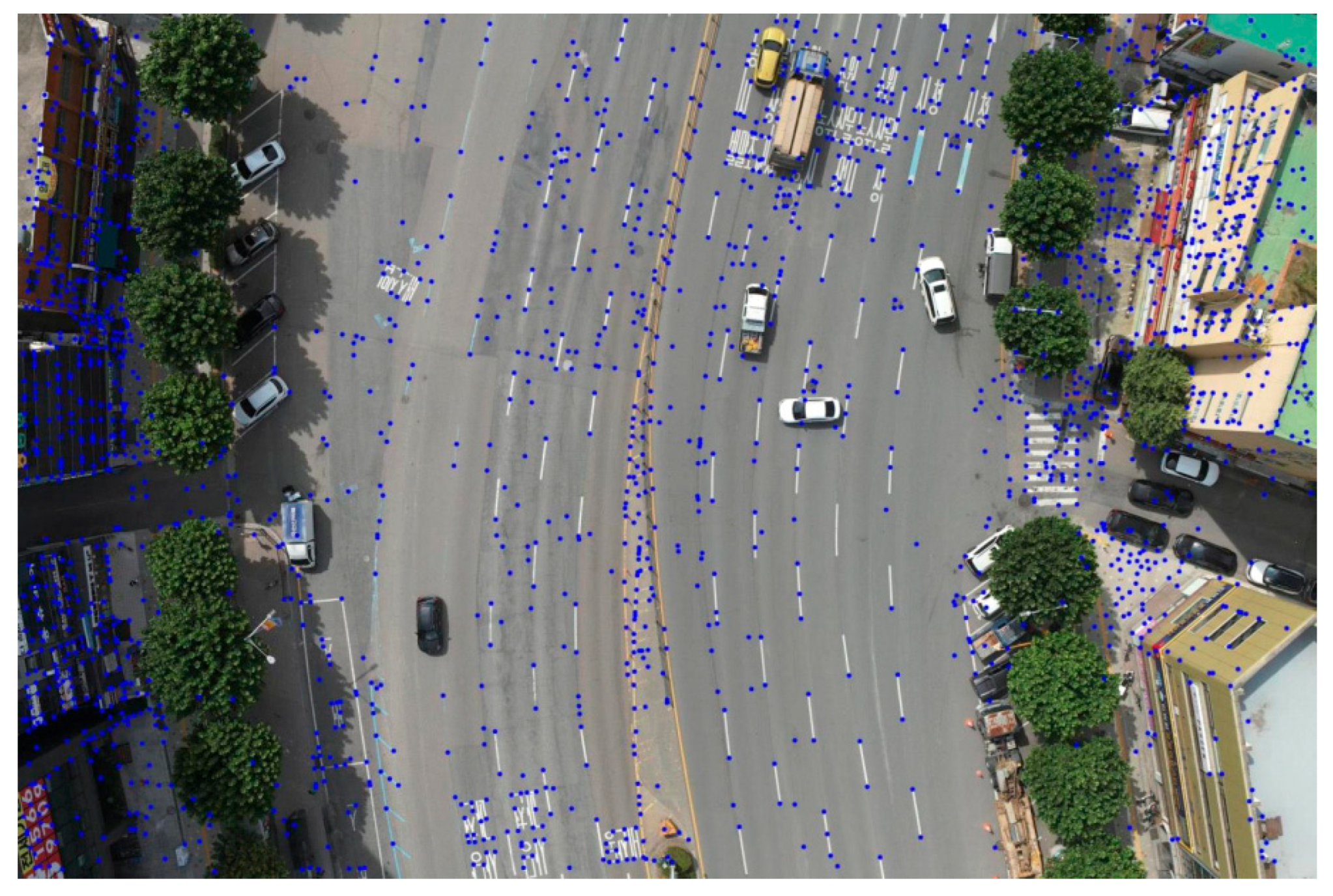
We performed feature matching between the input UAV images and a 3D reference model (a cleaned dense point cloud reconstructed offline from a reference image set). Given the established correspondences, each matched 2D keypoint (image pixel location) in the input image is assigned the 3D coordinates of its corresponding point in the reference model, thereby transferring the reference coordinate frame to the new observations.
Figure 16 illustrates the resulting 3D positions associated with the matched key points across the scene. This step converts image-plane evidence into absolute coordinates while remaining in the same spatial frame as the reference model, which is essential for consistent localization across missions.
To obtain the final location of each detected RM, we take the five nearest matched points around the RM pixel and compute an inverse distance-weighted estimate in 3D. This local scheme captures pavement-level depth variation without over-smoothing and is robust to small geometric discrepancies between missions.
In
Figure 17,
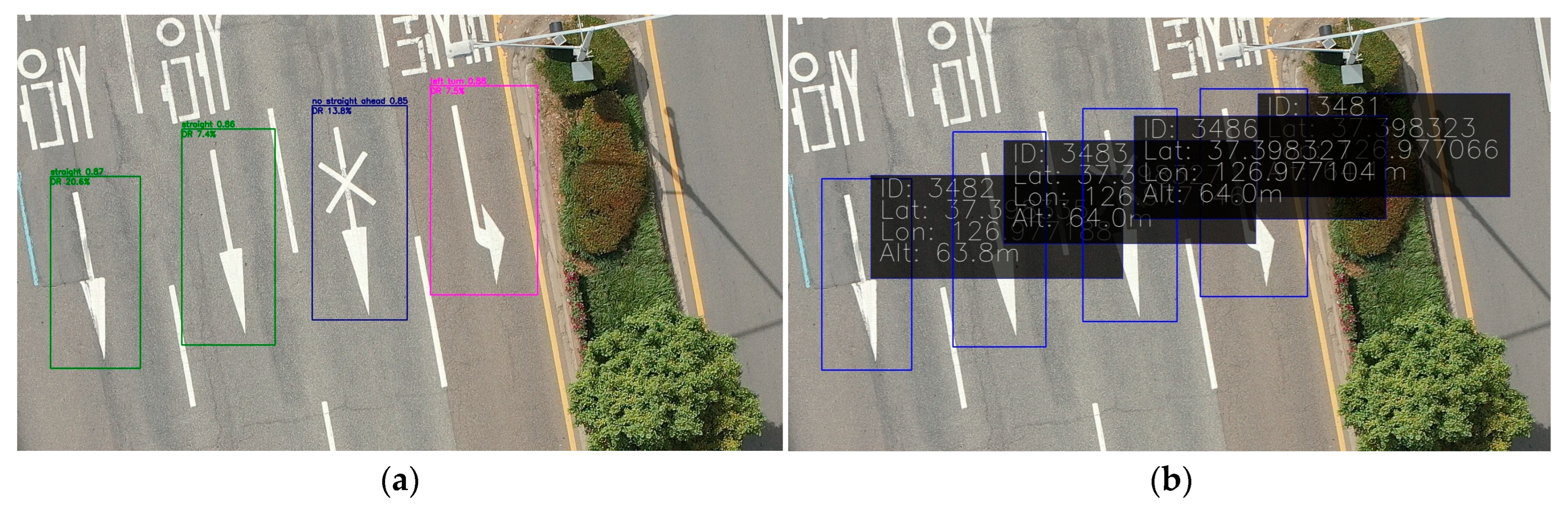
Figure 17a shows the RM detections produced by the object detector.
Figure 17b overlays the assigned absolute 3D coordinates for each detection after the localization process. These results confirm that detections can be reliably grounded in a single spatial reference.
To illustrate the end-to-end deliverable,
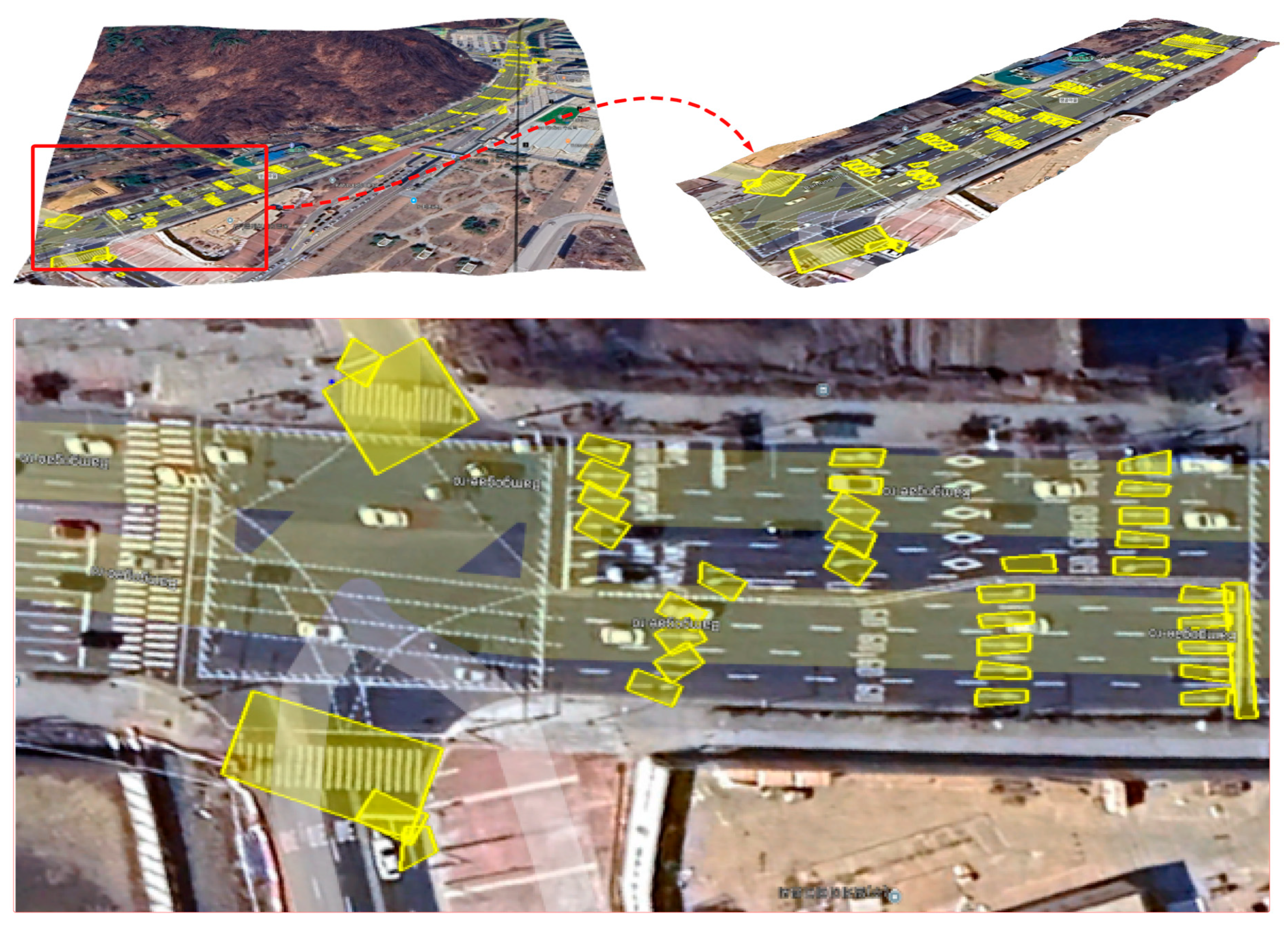
Figure 18 overlays the detected road-marking instances on a base map (Google Earth). The yellow polygons/boxes indicate the localized instances produced by the detector and refined by the downstream steps. The zoomed view shows consistent alignment of crosswalks, straight arrows, left turns, right turns, and stop lines, etc., indicating that the outputs are map-ready and retain the spatial structure of the scene.
We summarize the final outputs as an instance-level inventory (
Table 7). For each road-marking object, the table reports its category, geodetic centroid (latitude/longitude), and the estimated damage ratio. The examples span a broad range of conditions from lightly worn markings to heavily degraded ones, demonstrating that the pipeline yields actionable records for prioritizing maintenance at scale.
5. Conclusions and Discussion
This research introduces a pragmatic, comprehensive methodology for evaluating road-marking conditions utilizing unmanned aerial vehicle imagery. This methodology concurrently performs road marking detection, localization, and quantification at the individual instance level. The architecture employs an initial detector stage to generate robust proposals, which are subsequently refined by a distinct VGG16-U-Net module to produce pixel-accurate masks. Following this, appearance characteristics within each identified instance are analyzed using KDE, followed by a GMM procedure. This enables the differentiation between intact and degraded material, culminating in the reporting of a per-object damage ratio. All the resultant data are finally integrated into a georeferenced spatial framework.
Experimental evaluations demonstrate the pipeline’s robust generalization capabilities to novel environments and sustained high performance across its various stages. In the detection phase, the selected YOLOv9e variant exhibited superior performance in terms of recall, F1-score, and mean Average Precision (mAP50–95) compared to alternative models, resulting in enhanced input quality for subsequent stages and a reduction in downstream processing errors. For segmentation, the VGG16-U-Net attained the highest mean Intersection over Union (mIoU) and F1-score on previously unobserved data, alongside the lowest Mean Absolute Error. This precision is crucial for accurately delineating fine lines and boundaries, which are critical for reliable damage assessment. Within the damage quantification module, the application of a compact two-Gaussian mixture model to a smoothed Kernel Density Estimation successfully generates distributions that closely approximate the empirical data density. This approach positions the decision boundary effectively near the inter-mode valley when distinguishable, thereby producing posterior label maps consistent with observed visual wear patterns. Relative to simpler benchmark methods, the KDE/GMM approach demonstrated reduced L1/L2 divergence from the KDE reference and exhibited diminished variability in damage ratios under controlled experimental conditions, thereby validating its suitability for consistent, instance-specific damage quantification.
Despite its efficacy, the system presents several limitations. Notably, challenges arise predominantly from adverse lighting conditions, particularly pronounced shadows and abrupt illumination changes. Under intense shading, the gray-level distributions of the imagery can converge towards a unimodal or skewed configuration, thereby diminishing the distinctiveness between material components and exacerbating ambiguity at the posterior intersection. This phenomenon can lead to either over- or underestimation of damage along shadowed boundaries. Furthermore, the assessment of extremely thin, severely deteriorated markings remains susceptible to mask erosion parameter settings, occasionally yielding isolated regions of ambiguous classification.
Additionally, future work will investigate oriented bounding box (OBB) detection to further tighten proposals for elongated markings and reduce background noise in cropped patches. We also plan to explore segmentation foundation models (e.g., SAM) to accelerate annotation and derive OBB/shape priors from mask-based ground truth.
This study makes the following contributions:
End-to-end marking assessment from drone imagery. We present a practical workflow that localizes, segments, and rates the condition of road markings, producing georeferenced outputs suitable for maintenance planning.
Detector-guided, segmentation-refined delineation. Detections from YOLOv9 guide crops, and a VGG16-UNet refines boundaries and thin structures to obtain pixel-level masks.
Distribution-based damage quantification. We operationalize KDE/GMM within each segmented instance to partition intact versus distressed appearances and derive an interpretable damage ratio for each object.
Generalization to unseen areas. We evaluate the pipeline on urban scenes not used in training and report standard object detection and segmentation metrics alongside stability analyses of the damage ratio, demonstrating readiness for operational deployment (contextualized by the role of marking conditions in ADAS and safety).
In conclusion, the proposed UAV-based pipeline is operationally robust, achieving high detection and segmentation quality, converting pixel distributions into interpretable, instance-level condition metrics, and anchoring results within a geographical framework. Addressing sensitivities to illumination, especially shadows in conjunction with broader cross-city validation will be paramount for transitioning from reliable prototypes to routine, network-scale deployment.
Author Contributions
Conceptualization, M.D.B.; Methodology, M.D.B., J.L. and K.C.; Software, H.K.; Validation, C.K.; Formal analysis, M.D.B., J.L. and K.C.; Investigation, H.K.; Data curation, J.L.; Writing—original draft, M.D.B.; Writing—review & editing, C.K.; Supervision, C.K.; Project administration, C.K. All authors have read and agreed to the published version of the manuscript.
Funding
This research was funded by the Korea Agency for Infrastructure Technology Advancement (KAIA) grant from the Ministry of Land, Infrastructure, and Transport, grant number RS2022-00143782 (Development of Fixed/Moving Platform Based Dynamic Thematic Map Generation Technology for Next Generation Digital Land Information Construction).
Data Availability Statement
The data presented in this study are available on request from the corresponding author (The restrictions related to the project data-use agreement and confidentiality obligations).
Acknowledgments
The authors are grateful to KICT (Korea Institute of Civil Engineering and Building Technology) for helping to collect the necessary datasets for this research.
Conflicts of Interest
The authors declare no conflicts of interest.
References
- Babić, D.; Fiolić, M.; Babić, D.; Gates, T. Road Markings and Their Impact on Driver Behaviour and Road Safety: A Systematic Review of Current Findings. J. Adv. Transp. 2020, 2020, 7843743. [Google Scholar] [CrossRef]
- Mahlberg, J.A.; Sakhare, R.S.; Li, H.; Mathew, J.K.; Bullock, D.M.; Surnilla, G.C. Prioritizing Roadway Pavement Marking Maintenance Using Lane Keep Assist Sensor Data. Sensors 2021, 21, 6014. [Google Scholar] [CrossRef] [PubMed]
- Ronneberger, O.; Fischer, P.; Brox, T. U-Net: Convolutional Networks for Biomedical Image Segmentation. In Proceedings of the International Conference on Medical Image Computing and Computer-Assisted Intervention, Munich, Germany, 5–9 October 2015. [Google Scholar]
- Rosenblatt, M. Remarks on Some Nonparametric Estimates of a Density Function. Ann. Math. Stat. 1956, 27, 832–837. [Google Scholar] [CrossRef]
- Parzen, E. On Estimation of a Probability Density Function and Mode. Ann. Math. Stat. 1962, 33, 1065–1076. [Google Scholar] [CrossRef]
- Dempster, A.P.; Laird, N.M.; Rubin, D.B. Maximum Likelihood from Incomplete Data Via the EM Algorithm. J. R. Stat. Soc. Ser. B Stat. Methodol. 1977, 39, 1–22. [Google Scholar] [CrossRef]
- Guan, H.; Lei, X.; Yu, Y.; Zhao, H.; Peng, D.; Marcato Junior, J.; Li, J. Road Marking Extraction in UAV Imagery Using Attentive Capsule Feature Pyramid Network. Int. J. Appl. Earth Obs. Geoinf. 2022, 107, 102677. [Google Scholar] [CrossRef]
- Bu, T.; Zhu, J.; Ma, T. A UAV Photography–Based Detection Method for Defective Road Marking. J. Perform. Constr. Facil. 2022, 36, 04022035. [Google Scholar] [CrossRef]
- Wu, J.; Liu, W.; Maruyama, Y. Street View Image-Based Road Marking Inspection System Using Computer Vision and Deep Learning Techniques. Sensors 2024, 24, 7724. [Google Scholar] [CrossRef] [PubMed]
- Yaseen, M. What Is YOLOv8: An In-Depth Exploration of the Internal Features of the Next-Generation Object Detector. arXiv 2024, arXiv:2409.07813. [Google Scholar]
- Song, L.; Zhao, F.; Han, J.; Li, S.; Hu, J. Road Marking Detection from UAV Perspective Based on Improved YOLOv3. In International Conference on Image, Signal Processing, and Pattern Recognition (ISPP 2024), Guangzhou, China, 1–3 March 2024; Bilas Pachori, R., Chen, L., Eds.; SPIE: Guangzhou, China, 2024; p. 30. [Google Scholar]
- Wu, J.; Liu, W.; Maruyama, Y. Automated Road-Marking Segmentation via a Multiscale Attention-Based Dilated Convolutional Neural Network Using the Road Marking Dataset. Remote Sens. 2022, 14, 4508. [Google Scholar] [CrossRef]
- Dong, Z.; Zhang, H.; Zhang, A.A.; Liu, Y.; Lin, Z.; He, A.; Ai, C. Intelligent Pixel-Level Pavement Marking Detection Using 2D Laser Pavement Images. Measurement 2023, 219, 113269. [Google Scholar] [CrossRef]
- Wei, C.; Li, S.; Wu, K.; Zhang, Z.; Wang, Y. Damage Inspection for Road Markings Based on Images with Hierarchical Semantic Segmentation Strategy and Dynamic Homography Estimation. Autom. Constr. 2021, 131, 103876. [Google Scholar] [CrossRef]
- Redmon, J.; Divvala, S.; Girshick, R.; Farhadi, A. You Only Look Once: Unified, Real-Time Object Detection. In Proceedings of the IEEE Conference on Computer Vision and Pattern Recognition, Boston, MA, USA, 7–12 June 2015. [Google Scholar]
- Lin, T.-Y.; Dollar, P.; Girshick, R.; He, K.; Hariharan, B.; Belongie, S. Feature Pyramid Networks for Object Detection. In Proceedings of the 2017 IEEE Conference on Computer Vision and Pattern Recognition (CVPR), Honolulu, HI, USA, 21–26 July 2017; pp. 936–944. [Google Scholar]
- Liu, S.; Qi, L.; Qin, H.; Shi, J.; Jia, J. Path Aggregation Network for Instance Segmentation. In Proceedings of the IEEE Conference on Computer Vision and Pattern Recognition, Salt Lake City, UT, USA, 18–22 June 2018. [Google Scholar]
- Tian, Z.; Shen, C.; Chen, H.; He, T. FCOS: Fully Convolutional One-Stage Object Detection. In Proceedings of the 2019 IEEE/CVF International Conference on Computer Vision (ICCV), Seoul, Republic of Korea, 27–28 October 2019; pp. 9626–9635. [Google Scholar]
- Simonyan, K.; Zisserman, A. Very Deep Convolutional Networks for Large-Scale Image Recognition. arXiv 2014, arXiv:1409.1556. [Google Scholar]
- Silverman, B.W. Density Estimation for Statistics and Data Analysis, 1st ed.; Routledge: Abingdon-on-Thames, UK, 2018; ISBN 978-1-315-14091-9. [Google Scholar]
- Otsu, N. A Threshold Selection Method from Gray-Level Histograms. IEEE Trans. Syst. Man Cybern. 1979, 9, 62–66. [Google Scholar] [CrossRef]
- Choo, D.; Grunau, C.; Portmann, J.; Rozhoň, V. K-Means++: Few More Steps Yield Constant Approximation. In Proceedings of the International Conference on Machine Learning, Vienna, Austria, 12–18 July 2020. [Google Scholar]
- McLachlan, G.; Peel, D. Finite Mixture Models. In Wiley Series in Probability and Statistics, 1st ed.; Jonh Wiley and Sons: Hoboken, NJ, USA, 2000; ISBN 978-0-471-00626-8. [Google Scholar]
- Soille, P. Morphological Image Analysis: Principles and Applications, 2nd ed.; Springer: Berlin/Heidelberg, Germany, 2010; ISBN 978-3-642-07696-1. [Google Scholar]
- Schonberger, J.L.; Frahm, J.-M. Structure-from-Motion Revisited. In Proceedings of the 2016 IEEE Conference on Computer Vision and Pattern Recognition (CVPR), Las Vegas, NV, USA, 27–30 June 2016; pp. 4104–4113. [Google Scholar]
- Ito, K.; Ito, T.; Aoki, T. PM-MVS: PatchMatch Multi-View Stereo. Mach. Vis. Appl. 2023, 34, 32. [Google Scholar] [CrossRef]
- Rusu, R.B.; Cousins, S. 3D Is Here: Point Cloud Library (PCL). In Proceedings of the 2011 IEEE International Conference on Robotics and Automation, Shanghai, China, 9–13 May 2011; pp. 1–4. [Google Scholar]
- Lindeberg, T. Scale Invariant Feature Transform. Scholarpedia 2012, 7, 10491. [Google Scholar] [CrossRef]
- Lowe, D.G. Distinctive Image Features from Scale-Invariant Keypoints. Int. J. Comput. Vis. 2004, 60, 91–110. [Google Scholar] [CrossRef]
- Shepard, D. A Two-Dimensional Interpolation Function for Irregularly-Spaced Data. In Proceedings of the 1968 23rd ACM National Conference, New York, NY, USA, 27–29 August 1968; pp. 517–524. [Google Scholar]
- Khozaimi, A.; Darti, I.; Anam, S.; Kusumawinahyu, W.M. Hybrid Dense-UNet201 Optimization for Pap Smear Image Segmentation Using Spider Monkey Optimization. arXiv 2025, arXiv:2504.12807. [Google Scholar] [CrossRef]
- Zhang, L.; Li, X.; Arnab, A.; Yang, K.; Tong, Y.; Torr, P.H.S. Dual Graph Convolutional Network for Semantic Segmentation. arXiv 2019, arXiv:1909.06121. [Google Scholar]
- Xiao, T.; Liu, Y.; Zhou, B.; Jiang, Y.; Sun, J. Unified Perceptual Parsing for Scene Understanding. In Proceedings of the European Conference on Computer Vision (ECCV), Munich, Germany, 8–14 September 2018. [Google Scholar]
- Chen, L.-C.; Zhu, Y.; Papandreou, G.; Schroff, F.; Adam, H. Encoder-Decoder with Atrous Separable Convolution for Semantic Image Segmentation. In Proceedings of the European Conference on Computer Vision (ECCV), Munich, Germany, 8–14 September 2018. [Google Scholar]
- Zhao, H.; Shi, J.; Qi, X.; Wang, X.; Jia, J. Pyramid Scene Parsing Network. In Proceedings of the IEEE Conference on Computer Vision and Pattern Recognition, Las Vegas, NV, USA, 27–30 June 2016. [Google Scholar]
- Kuhn, J.W.; Padgett, W.J.; Surles, J.G. Absolute Error Criteria for Bandwidth Selection in Density Estimation from Censored Data. J. Stat. Comput. Simul. 2001, 70, 215–230. [Google Scholar] [CrossRef]
Figure 1.
Illustration of the location of the flight areas.
Figure 1.
Illustration of the location of the flight areas.
Figure 2.
Flight Height Optimization for Drone-based Road Marking Detection Trade-off Analysis: Resolution vs. Coverage Effficiency.
Figure 2.
Flight Height Optimization for Drone-based Road Marking Detection Trade-off Analysis: Resolution vs. Coverage Effficiency.
Figure 3.
Example of flight missions.
Figure 3.
Example of flight missions.
Figure 4.
Dataset organization and cross-stage data flow.
Figure 4.
Dataset organization and cross-stage data flow.
Figure 5.
Proposed pipeline.
Figure 5.
Proposed pipeline.
Figure 6.
YOLO detection model architecture.
Figure 6.
YOLO detection model architecture.
Figure 8.
Illustration comparing YOLO versions on the UAV dataset for RM detection.
Figure 8.
Illustration comparing YOLO versions on the UAV dataset for RM detection.
Figure 9.
Example of Yolov9e experiments.
Figure 9.
Example of Yolov9e experiments.
Figure 10.
Validation performance of multiple segmentation methods.
Figure 10.
Validation performance of multiple segmentation methods.
Figure 11.
Examples of VGG16-U-Net segmentation results. Top row: original crops (arrows, turn symbols, dense crosswalk bars). Bottom row: predicted masks.
Figure 11.
Examples of VGG16-U-Net segmentation results. Top row: original crops (arrows, turn symbols, dense crosswalk bars). Bottom row: predicted masks.
Figure 12.
Example of damage estimation on a road marking instance.
Figure 12.
Example of damage estimation on a road marking instance.
Figure 13.
Multi-method for damage extraction (a) GMM direct. (b) KDE/GMM. (c) K-means. (d) Otsu. (e) Damage ratio of each method.
Figure 13.
Multi-method for damage extraction (a) GMM direct. (b) KDE/GMM. (c) K-means. (d) Otsu. (e) Damage ratio of each method.
Figure 14.
Instance-wise comparison of predicted vs. ground truth damage. (blue and green are representing intent and damage, respectively).
Figure 14.
Instance-wise comparison of predicted vs. ground truth damage. (blue and green are representing intent and damage, respectively).
Figure 15.
Point cloud cleaning of the 3D reference model.
Figure 15.
Point cloud cleaning of the 3D reference model.
Figure 16.
Three-dimensional position information associated with input image keypoints (blue dots) is based on the reference model.
Figure 16.
Three-dimensional position information associated with input image keypoints (blue dots) is based on the reference model.
Figure 17.
(a) Detected objects in the input image; (b) estimated absolute 3D coordinates for each detected object.
Figure 17.
(a) Detected objects in the input image; (b) estimated absolute 3D coordinates for each detected object.
Figure 18.
Visualization of localization results on Google Earth (Suseo Station, Korea).
Figure 18.
Visualization of localization results on Google Earth (Suseo Station, Korea).
Table 1.
Overview of the research on road assets.
Table 1.
Overview of the research on road assets.
| Author | Year | Platform | Sensor/Data | Method | Main Task | Damage Assess |
|---|
| Mahlberg et al. [2] | 2021 | Vehicle | LKA lane-marking detectability signal + GPS | ADAS/LKA sensor-data analytics | Maintenance prioritization | ☐ |
| Wei et al. [14] | 2021 | Vehicle | RGB camera images | Hierarchical semantic segmentation + tracking/homography fusion | Damage inspection; damage ratio estimation | ☑ |
| Guan et al. [7] | 2022 | Drone | UAV RGB imagery | ACapsFPN (attentive capsule FPN) | Road marking extraction | ☐ |
| Bu et al. [8] | 2022 | Drone | UAV photography (RGB images) | UAV-photography-based defect detection pipeline | Defective road marking detection | ☐ |
| Wu et al. [12] | 2022 | Vehicle | RGB image dataset | MSA-DCNN (multiscale attention + dilated CNN) | Road-marking segmentation (lane + symbols) | ☑ |
| Dong et al. [13] | 2023 | vehicle | 2D laser pavement images | Marking-DNet (DeepLabV3+-based) | Pixel-level pavement marking detection | ☐ |
| Song et al. [11] | 2024 | Drone | UAV RGB imagery | Improved YOLOv3 | Road marking detection (small objects/UAV view) | ☐ |
| Wu et al. [9] | 2024 | Vehicle | Vehicle-mounted digital camera | YOLOv11x + IPM + segmentation/thresholding | End-to-end inspection | ☑ |
Table 2.
Final implementation details and hyperparameter settings used for replication.
Table 2.
Final implementation details and hyperparameter settings used for replication.
| Module | Category | Hyper Parameter | Final Value Used |
|---|
| Detection | Input | Input image size | 512 |
| Training | Batch size | 32 |
| Epochs | 200 |
| Optimizer | AdamW |
| Initial learning rate | 0.001 |
| Weight decay | 0.0005 |
| Momentum | 0.937 |
| Segmentation | Model | Architecture | VGG16-UNet |
| Pretrained backbone | True |
| Output stride | 8 |
| Input/Data | Classes/Channels | num_classes = 2/in_channels = 3 |
| Patch/crop size | 128 |
| Base size (resizing reference) | 256 |
| Training | Batch size | 32 |
| Epochs | 200 |
| Optimizer | Adam |
| Learning rate | 1 × 10⁻⁴ |
| Loss | Cross-entropy |
| Condition | Input | Intensity space | 8-bit grayscale (0–255) |
| Region for fitting | kernel size | 5 |
| KDE | Histogram bins | 256 |
| Bandwidth | 15.0 |
| KDE/GMM | Components | 2 |
| K-means | k value | 2 |
| GMM-direct | Components | 2 |
Table 3.
Training experiments of different YOLO versions.
Table 3.
Training experiments of different YOLO versions.
| Model | Precision (%) | Recall (%) | F1 (%) | mAP50 (%) | mAP50–95 (%) | Speed
(ms Per Image) | GFLOPs |
|---|
| YOLOv8x | 95.506 | 90.592 | 92.984 | 94.764 | 64.256 | 0.6 | 257.5 |
| YOLOv9e | 95.363 | 91.982 | 93.642 | 95.497 | 65.553 | 0.8 | 189.2 |
| YOLOv10x | 95.451 | 90.669 | 92.999 | 95.803 | 64.757 | 0.1 | 160.0 |
| YOLOv11x | 95.556 | 91.66 | 93.567 | 95.693 | 64.478 | 0.5 | 172.6 |
| YOLOv12x | 95.402 | 91.583 | 93.454 | 95.433 | 64.749 | 1.3 | 198.6 |
Table 4.
Model training and evaluation using different methods of segmentation.
Table 4.
Model training and evaluation using different methods of segmentation.
| Model | mIoU | F1 | MAE |
|---|
| Train | Val | Unseen | Train | Val | Unseen | Train | Val | Unseen |
|---|
| Densenet201-UNet [31] | 95.09 | 95.30 | 93.88 | 97.46 | 97.57 | 96.81 | 1.73 | 1.65 | 2.33 |
| Unet [3] | 94.11 | 94.58 | 93.84 | 96.97 | 96.93 | 96.72 | 1.95 | 1.86 | 2.25 |
| VGG16-UNet | 95.53 | 95.60 | 94.21 | 97.69 | 97.73 | 97.00 | 1.49 | 1.42 | 2.12 |
| GCN [32] | 93.5 8 | 93.72 | 92.58 | 96.72 | 96.71 | 95.95 | 2.12 | 2.10 | 2.82 |
| Upernet [33] | 94.87 | 95.18 | 93.79 | 97.36 | 97.28 | 96.59 | 1.71 | 1.62 | 2.28 |
| Deeplab HDC DUC [34] | 90.6 | 90.76 | 90.44 | 95.08 | 94.91 | 94.84 | 3.12 | 3.09 | 3.53 |
| PSPnet [35] | 69.77 | 71.76 | 72.86 | 80.89 | 82.44 | 83.47 | 3.32 | 3.35 | 4.34 |
Table 5.
Outcomes of methodological evaluation.
Table 5.
Outcomes of methodological evaluation.
| Method | IAE Median | ISE Median |
|---|
| KDE/GMM | 0.021 | 0.002 |
| Otsu | 0.063 | 0.086 |
| k-means (k = 2) | 0.063 | 0.087 |
| GMM-direct | 0.067 | 0.098 |
Table 6.
Common minor localized failure modes and typical causes.
Table 7.
Illustration of final results at Suseo Station, Korea (samples shown).
Table 7.
Illustration of final results at Suseo Station, Korea (samples shown).
| Identification (ID) | Location | Condition
(Percentage of Damage %) |
|---|
| Latitude | Longitude |
|---|
| Crosswalk | 37°28′55.9″ N | 127°06′16.38″ E | 3.5 |
| Left Turn | 37°29′15.89″ N | 127°06′04.04″ E | 20.0 |
| Right Turn | 37°29′13.67″ N | 127°06′08.32″ E | 7.1 |
| Right Turn | 37°29′13.12″ N | 127°06′08.32″ E | 53.8 |
| Straight and Left Turn | 37°28′56.78″ N | 127°06′16.38″ E | 25.4 |
| Straight Arrow | 37°28′56.80″ N | 127°06′16.52″ E | 58.5 |
| Straight Arrow | 37°28′56.82″ N | 127°06’16.63″ E | 2.7 |
| Disclaimer/Publisher’s Note: The statements, opinions and data contained in all publications are solely those of the individual author(s) and contributor(s) and not of MDPI and/or the editor(s). MDPI and/or the editor(s) disclaim responsibility for any injury to people or property resulting from any ideas, methods, instructions or products referred to in the content. |