
Cooperative V2X-Based UAV Detection in Rural Transportation Corridors




Highlights
- A calibrated simulation study indicates that sparsely deployed V2X roadside units (RSUs) can be augmented with passive RF sensing to support UAV detection in rural and semi-rural corridors, focusing on RF-emitting targets in unlicensed ISM bands.
- Cooperative processing across multiple RSUs improves detection robustness compared with single-RSU sensing, particularly under weak signals, terrain masking, and narrowband interference.
- The approach is positioned as a supplementary early warning layer intended to cue follow-on sensing and tracking, rather than to provide continuous coverage or high-precision localization.
- Low-bandwidth feature exchange and distributed correlation support a dual-use extension of existing V2X infrastructure through functional and spectral separation from standards-compliant ITS safety messaging.
Abstract
1. Introduction
- A cooperative RF-sensing framework for sparse RSU networks, combining spectral analysis, cross-correlation, and distributed bearing estimation.
- A dual-use RSU architecture designed to preserve core ITS functions through functional and spectral separation, with sensing confined to unlicensed ISM bands.
- Performance validation under realistic RF conditions using the IEEE DataPort V2X IQ-sample dataset for calibration.
- A discussion of deployment trade-offs and feasibility, including scalability considerations across major international intelligent transportation system programs.
2. Related Work
3. System Design and Methodology
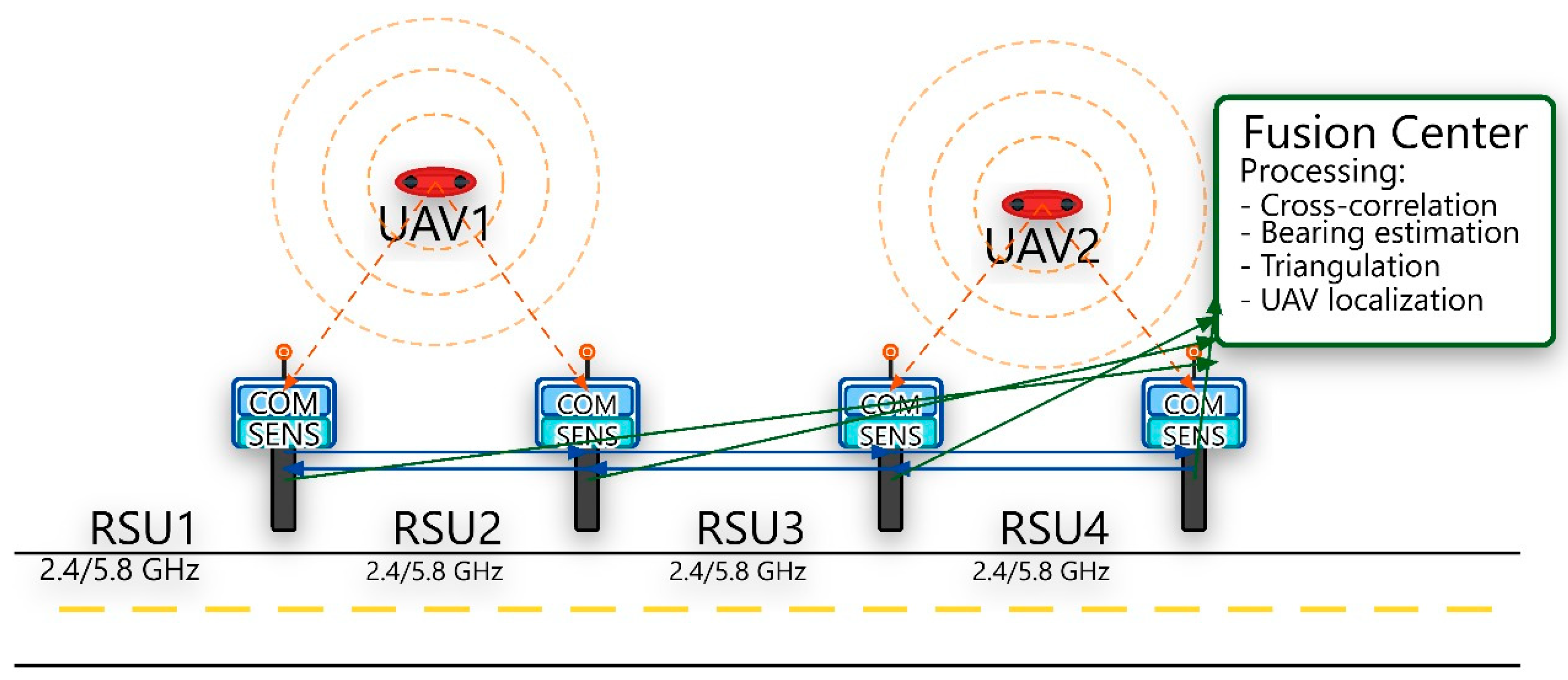
- Local RF monitoring and feature extraction at each RSU.
- Feature-level correlation among adjacent RSUs.
- Bearing fusion and track filtering at the fusion center.
4. Results
5. Discussion
6. Conclusions
Author Contributions
Funding
Data Availability Statement
Acknowledgments
Conflicts of Interest
Abbreviations
| Abbreviation | Full term |
| 3GPP | Third Generation Partnership Project |
| ADS-B | Automatic Dependent Surveillance–Broadcast |
| C-V2X | Cellular Vehicle-to-Everything |
| CI | Confidence Interval |
| COM | Communication (subsystem/module) |
| CP | Cooperative Perception |
| DAB | Digital Audio Broadcasting |
| dB | Decibel |
| dBm | Decibel-milliwatt |
| DVB-T | Digital Video Broadcasting–Terrestrial |
| EIRP | Effective Isotropic Radiated Power |
| EO/IR | Electro-Optical/Infrared |
| ETSI | European Telecommunications Standards Institute |
| FSPL | Free-Space Path Loss |
| GHz | Gigahertz |
| GPS | Global Positioning System |
| IEEE | Institute of Electrical and Electronics Engineers |
| IQ | In-phase and Quadrature |
| ISAC | Integrated Sensing and Communication |
| ISM | Industrial, Scientific, and Medical |
| ITS | Intelligent Transportation Systems |
| ITS-G5 | Intelligent Transport Systems at 5.9 GHz |
| LoS | Line-of-Sight |
| LTE | Long-Term Evolution |
| RF | Radiofrequency |
| RSU | Roadside Unit |
| SDR | Software-Defined Radio |
| SENS | Sensing (subsystem) |
| SINR | Signal-to-Interference-plus-Noise Ratio |
| sUAV | Small Unmanned Aerial Vehicle |
| TEN-T | Trans-European Transport Network |
| TMS | Transportation Management System |
| UAV | Unmanned Aerial Vehicle |
| UDP | User Datagram Protocol |
| V2X | Vehicle-to-Everything |
References
- Airservices Australia. ADS-B Coverage; Airservices Australia: Canberra, Australia, 2020; Available online: https://www.airservicesaustralia.com/about-us/projects/ads-b/ads-b-coverage/ (accessed on 1 December 2025).
- Eurocontrol. Air Traffic Control Surveillance Coverage Maps; Eurocontrol: Brussels, Belgium, 2019; Available online: https://www.eurocontrol.int/publication/air-traffic-control-surveillance-coverage-maps (accessed on 1 December 2025).
- European Commission. C-ITS Platform Final Report Phase II; European Commission: Brussels, Belgium, 2017; Available online: https://www.connectedautomateddriving.eu/wp-content/uploads/2023/06/CITS-Platform-Phase-II-final-report_01-09-2017_EC.pdf (accessed on 1 December 2025).
- U.S. Department of Transportation. Connected Vehicle Pilot Deployment Program; USDOT: Washington, DC, USA, 2024. Available online: https://www.itskrs.its.dot.gov/briefings/executive-briefing/connected-vehicle-pilot-deployment-program-2024-update (accessed on 1 December 2025).
- Queensland Government; Department of Transport and Main Roads. Ipswich Connected Vehicle Pilot (ICVP); Queensland Government: Brisbane, Australia, 2021. Available online: https://www.qld.gov.au/transport/projects/cavi/ipswich-connected-vehicle-pilot (accessed on 1 December 2025).
- Austroads. Advanced Connected Vehicles Victoria (ACV2); Austroads: Sydney, Australia, 2022. Available online: https://austroads.gov.au/drivers-and-vehicles/vehicles-and-technology/trials/acv2 (accessed on 1 December 2025).
- Guerna, A.; Bitam, S.; Calafate, C.T. Roadside Unit Deployment in Internet of Vehicles Systems: A Survey. Sensors 2022, 22, 3190. [Google Scholar] [CrossRef]
- Liang, B.; Lu, W.; Ran, B. Deploying Roadside Unit Efficiently in VANETs: A Multi-Objective Delay-Based Optimization Strategy Using Lagrangian Relaxation. IEEE Trans. Intell. Transp. Syst. 2024, 25, 1646–1660. [Google Scholar] [CrossRef]
- Nair, A.; Tanwar, S. Resource Allocation in V2X Communication: State-of-the-Art and Research Challenges. Phys. Commun. 2024, 64, 102351. [Google Scholar] [CrossRef]
- IEEE Std 802.11-2020; IEEE Standard for Information Technology—Telecommunications and Information Exchange Between Systems—Local and Metropolitan Area Networks—Specific Requirements—Part 11: Wireless LAN Medium Access Control (MAC) and Physical Layer (PHY) Specifications. IEEE: New York, NY, USA, 2021.
- ETSI EN 302 663 V1.3.1; Intelligent Transport Systems (ITS); ITS-G5 Access Layer Specification for Intelligent Transport Systems Operating in the 5 GHz Frequency Band. ETSI: Sophia Antipolis, France, 2020.
- Sheikh, A.; Bandi, K. IQ Samples for V2X Communication System Combined with Narrow-Band Interference; IEEE DataPort: Piscataway, NJ, USA, 2025. [Google Scholar] [CrossRef]
- Federal Aviation Administration. Title 14 Code of Federal Regulations Part 107—Small Unmanned Aircraft Systems; U.S. Government Publishing Office: Washington, DC, USA, 2025. [Google Scholar]
- European Union Aviation Safety Agency. Commission Implementing Regulation (EU) 2019/947 on the Rules and Procedures for the Operation of Unmanned Aircraft, as Amended by Regulations (EU) 2020/639, 2020/746, and 2021/1166; EASA: Cologne, Germany, 2021. [Google Scholar]
- ITU. Radio Regulations, Edition of 2024; International Telecommunication Union: Geneva, Switzerland, 2024. [Google Scholar]
- Song, Z.; Xie, T.; Wen, F.; Li, J. Wireless Communication as an Information Sensor for Multi-Agent Cooperative Perception: A Survey. arXiv 2025, arXiv:2505.00747. [Google Scholar] [CrossRef]
- Ji, Y.; Zhou, Z.; Yang, Z.; Huang, Y.; Zhang, Y.; Zhang, W.; Xiong, L.; Yu, Z. Toward Autonomous Vehicles: A Survey on Cooperative Vehicle-Infrastructure System. iScience 2024, 27, 109751. [Google Scholar] [CrossRef]
- Zimmer, W.; Wardana, G.A.; Sritharan, S.; Zhou, X.; Song, R.; Knoll, A.C. TUMTraf V2X Cooperative Perception Dataset. In Proceedings of the IEEE/CVF Conference on Computer Vision and Pattern Recognition (CVPR), Seattle, WA, USA, 17–21 June 2024; pp. 22295–22305. [Google Scholar]
- Hawlader, F.; Robinet, F.; Frank, R. Cooperative Perception Using V2X Communications: An Experimental Study. In Proceedings of the 2024 IEEE 100th Vehicular Technology Conference (VTC2024-Fall), Washington, DC, USA, 7–10 October 2024. [Google Scholar] [CrossRef]
- Zhang, P.; Chen, S.; Zheng, X.; Li, P.; Wang, G.; Wang, R.; Wang, J.; Tan, L. UAV Communication in Space–Air–Ground Integrated Networks (SAGINs): Technologies, Applications, and Challenges. Drones 2025, 9, 108. [Google Scholar] [CrossRef]
- Yoshizawa, T.; Singelée, D.; Mühlberg, J.T.; Delbruel, S.; Taherkordi, A.; Hughes, D.; Preneel, B. A Survey of Security and Privacy Issues in V2X Communication Systems. ACM Comput. Surv. 2023, 55, 185:1–185:36. [Google Scholar] [CrossRef]
- Wang, B.; Li, Q.; Mao, Q.; Wang, J.; Chen, C.L.P.; Shangguan, A.; Zhang, H. A Survey on Vision-Based Anti Unmanned Aerial Vehicles Methods. Drones 2024, 8, 518. [Google Scholar] [CrossRef]
- Pereira, A.; Warwick, S.; Moutinho, A.; Suleman, A. Infrared and Visible Camera Integration for Detection and Tracking of Small UAVs: Systematic Evaluation. Drones 2024, 8, 650. [Google Scholar] [CrossRef]
- Semenyuk, V.; Kurmashev, I.; Lupidi, A.; Alyoshin, D.; Kurmasheva, L.; Cantelli-Forti, A. Advances in UAV Detection: Integrating Multi-Sensor Systems and AI for Enhanced Accuracy and Efficiency. Int. J. Crit. Infrastruct. Prot. 2025, 49, 100744. [Google Scholar] [CrossRef]
- Arapoglou, F.; Zacharia, P.; Papoutsidakis, M. Intelligent Counter-UAV Threat Detection Using Hierarchical Fuzzy Decision-Making and Sensor Fusion. Sensors 2025, 25, 6091. [Google Scholar] [CrossRef] [PubMed]
- Cordill, B.; Fang, D.; Xu, S. A Comprehensive Survey of Security and Privacy in UAV Systems. IEEE Access 2025, 13, 117843–117866. [Google Scholar] [CrossRef]
- Sazdić-Jotić, B.; Pokrajac, I.; Bajčetić, J.; Stefanović, N. Review of RF-Based Drone Classification: Techniques, Datasets, and Challenges. Vojnoteh. Glas. 2024, 72, 764–789. [Google Scholar] [CrossRef]
- Shi, Y.; Shan, T.; Dong, H. Integrated Detection of Weak Drone Signals: From Parameter Estimation to Sensitive Classification. Digit. Signal Process. 2025, 145, 105524. [Google Scholar] [CrossRef]
- Ahirrao, Y.V.; Yadav, R.P.; Kumar, S. RF-Based UAV Detection, and Identification Enhanced by Machine Learning Approach. IEEE Access 2024, 12, 177735–177745. [Google Scholar] [CrossRef]
- Tang, Z.; Ma, H.; Qu, Y.; Mao, X. UAV Detection with Passive Radar: Algorithms, Applications, and Challenges. Drones 2025, 9, 76. [Google Scholar] [CrossRef]
- Antoshchuk, S.; Hodovychenko, M. Deep Learning-Based UAV Detection. In Proceedings of the 2024 IEEE 7th International Conference on Actual Problems of Unmanned Aerial Vehicles Development (APUAVD), Kyiv, Ukraine, 22–24 October 2024. [Google Scholar] [CrossRef]
- Zhang, J.; Lu, W.; Xing, C.; Zhao, N.; Al-Dhahir, N.; Karagiannidis, G.K.; Yang, X. Intelligent Integrated Sensing and Communication: A Survey. Sci. China Inf. Sci. 2025, 68, 131301:1–131301:42. [Google Scholar] [CrossRef]
- Wen, D.; Zhou, Y.; Li, X.; Shi, Y.; Huang, K.; Letaief, K.B. A Survey on Integrated Sensing, Communication, and Computation. IEEE Commun. Surv. Tutor. 2025, 27, 3058–3098. [Google Scholar] [CrossRef]
- Magbool, A.; Kumar, V.; Wu, Q.; Di Renzo, M.; Flanagan, M.F. A Survey on Integrated Sensing and Communication with Intelligent Metasurfaces: Trends, Challenges, and Opportunities. IEEE Open J. Commun. Soc. 2025, 6. [Google Scholar] [CrossRef]
- Jabeen, N.; Lei, H.; Muhammad, A.; Ali, A.; Khan, Z.U.; Pan, G. Localization in ISAC: A Review. IEEE Internet Things J. 2025, 12, 46526–46552. [Google Scholar] [CrossRef]
- Althobaiti, T.; Khalil, R.A.; Saeed, N. Robust ISAC Localization in Smart Cities: A Hybrid Network Approach for NLOS Challenges with Uncertain Parameters. J. Sens. Actuator Netw. 2024, 13, 2. [Google Scholar] [CrossRef]
- Krayani, A.; William, N.J.; Marcenaro, L.; Regazzoni, C. Jammer Detection in Vehicular V2X Networks. In Proceedings of the 2022 IEEE 21st Mediterranean Microwave Symposium (MMS), Pizzo Calabro, Italy, 8–10 May 2022; pp. 1–5. [Google Scholar] [CrossRef]
- Sohail, M.S.; Portomauro, G.; Gaggero, G.B.; Patrone, F.; Marchese, M. Performance Analysis and Security Preservation of DSRC in V2X Networks. Electronics 2025, 14, 3786. [Google Scholar] [CrossRef]
- Talukder, M.; Xie, J. SymJam: Symbiotic Jamming Attacks on NR-V2X. In Proceedings of the 2024 IEEE Global Communications Conference (GLOBECOM), Cape Town, South Africa, 8–12 December 2024. [Google Scholar] [CrossRef]




| Research Area | Key Studies | Main Focus | Key Limitations w.r.t Corridor-Scale RSU Sensing |
|---|---|---|---|
| V2X infrastructure deployment | [3,4,5,6,7,8,9] | Corridor-scale V2X programs; RSU planning and optimization; identification of typical rural RSU spacing (2–5 km); spectrum and resource constraints. | RSUs are modeled primarily as communication infrastructure; sensing functionality is not considered. |
| Cooperative perception (CP) | [16,17,18,19] | Message forwarding, RSU-assisted scheduling, feature/ROI compression, datasets, and experiments improving shared situational awareness. | Focus on ground traffic and dense urban deployments; sparse RSU spacing and airborne targets are not central assumptions. |
| Air–ground communication architectures | [20] | UAV-assisted communication and space–air–ground integrated networks for coverage extension. | Address connectivity rather than sensing or UAV detection using roadside infrastructure. |
| Vision- and acoustic-based UAV detection | [22,23,24,25,26] | Radar, EO/IR, acoustic, and multisensor UAV detection for fixed-site monitoring. | Dense static installations; limited range and sensitivity to weather, clutter, and ambient noise; not suited for long rural corridors. |
| RF-based UAV detection (SDR) | [27,28,29] | RF fingerprinting, modulation analysis, and direction-of-arrival estimation using ISM-band emissions. | Compact receiver clusters with meter-scale baselines; interference and spectrum congestion are rarely modeled systematically. |
| Passive-radar UAV detection | [30] | UAV detection using illuminators of opportunity: system-level surveys and reported detection ranges. | Static receiver geometries; cooperative fusion across kilometer-spaced roadside receivers is rarely evaluated. |
| Multisensor fusion and learning-based methods | [23,24,25,28,29,30,31] | Fusion and machine-learning approaches combining radar, RF, EO/IR, and acoustic data. | Assume colocated sensors, stable propagation conditions, and substantial computational resources. |
| Integrated sensing and communications (ISAC) | [32,33,34,35,36] | Waveform-level sensing, cooperative ISAC architectures, and localization through coordinated processing. | Depend on modified physical layers or dense node layouts; sparse ISM-band sensing with RSUs is not targeted. |
| V2X interference and coexistence | [37,38,39] | Analysis of interference effects and mitigation strategies to preserve V2X communication performance. | Interference is primarily treated as a communication impairment rather than as part of the sensing environment. |
| This work | — | Cooperative passive RF sensing using sparsely deployed RSUs (2–5 km) for sUAV detection in the 2.4/5.8 GHz ISM bands under calibrated interference conditions. | Focused on RF-emitting UAVs; non-RF sensing modalities are outside the scope. |
| Parameter | Value | Source/Note |
|---|---|---|
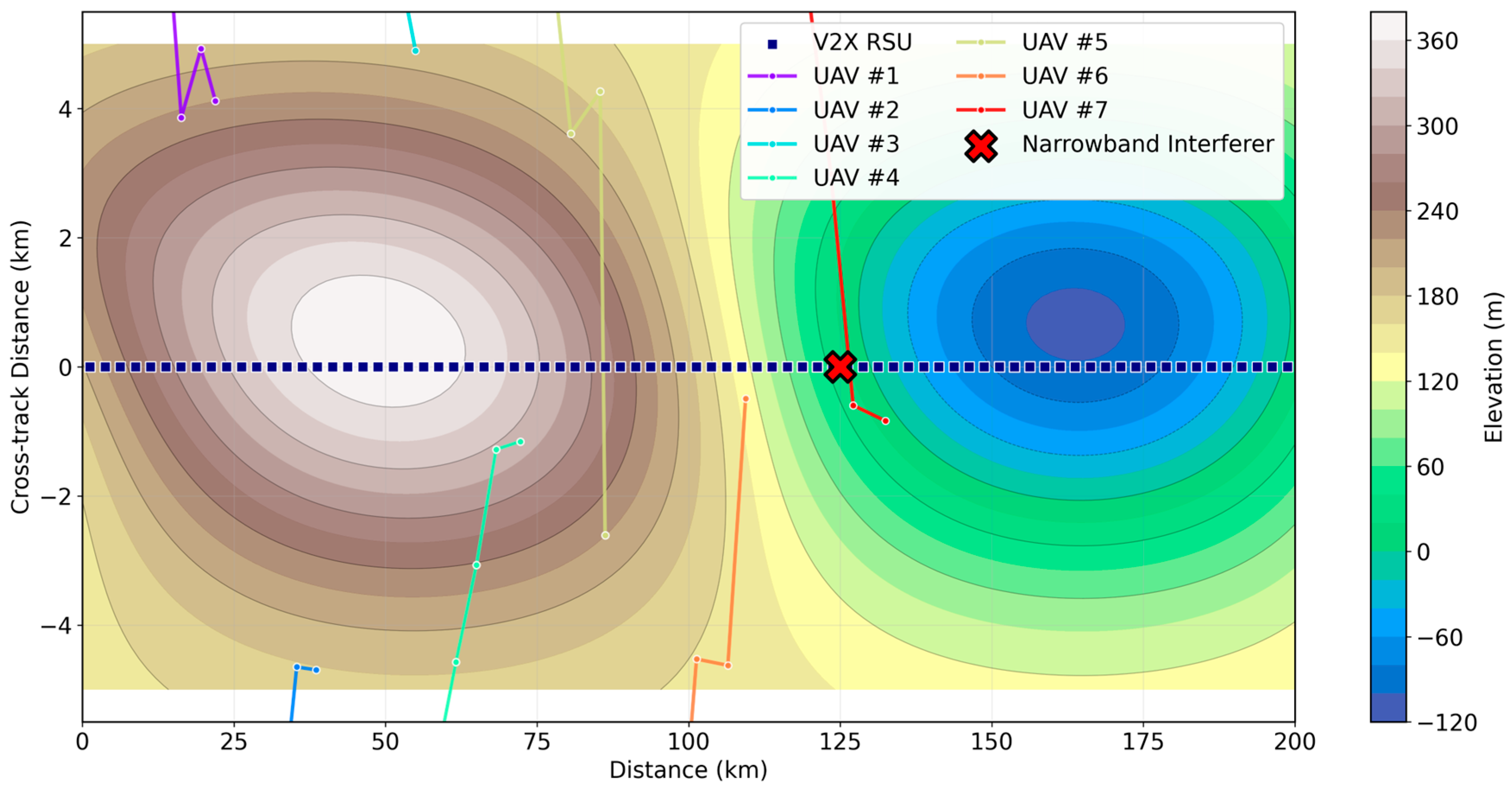
| Corridor length | 200 km | Scenario definition |
| Number of RSUs | 80 | Fixed topology |
| RSU spacing | 2.5 km | Representative rural corridor spacing (deployment studies) |
| UAV count | 7 | Multi-target scenario |
| UAV speed | 50 m/s | Scenario definition |
| UAV altitude | 500–1200 m | Low-altitude corridor flights |
| Bands monitored (SENS) | 2.4 GHz, 5.8 GHz | ISM bands; separated from the 5.9 GHz ITS safety band |
| Time step/engagement | 1 s/600 s | Simulation horizon |
| Monte Carlo runs | 20 | Independent realizations |
| Detection rule | k-out-of-N validation | k = 1 single-RSU; k ≥ 2 cooperative validation |
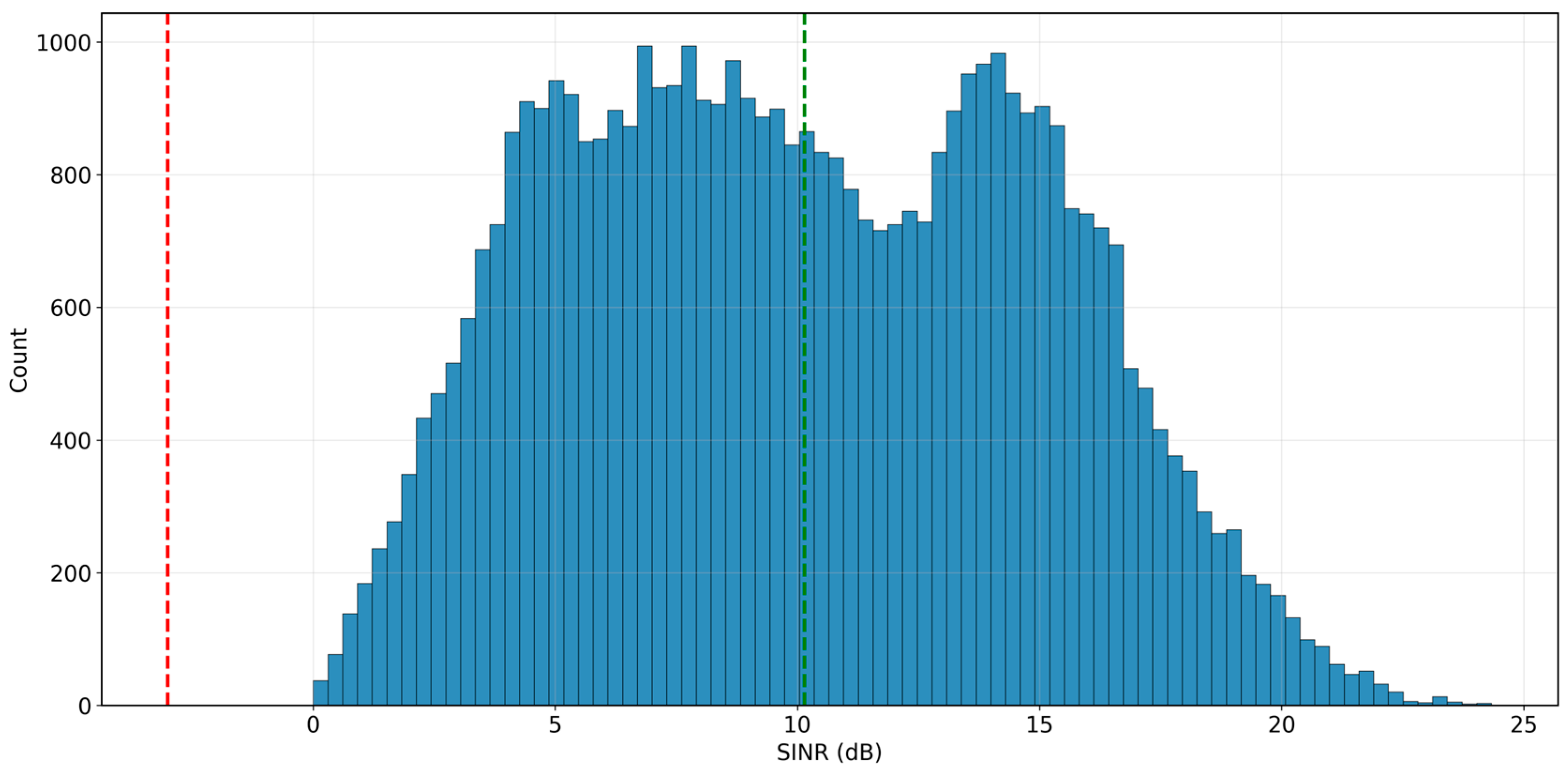
| Detection threshold γ | −3 dB SINR | Pre-cooperation detection gate (fixed configuration) |
| Mean SINR of confirmed detections (observed; not a design parameter) | ~10 dB (observed after validation; indicative) | Observed output (post-validation); not a design parameter. |
| Cooperation radius | ~7.5 km | Neighbor RSU set |
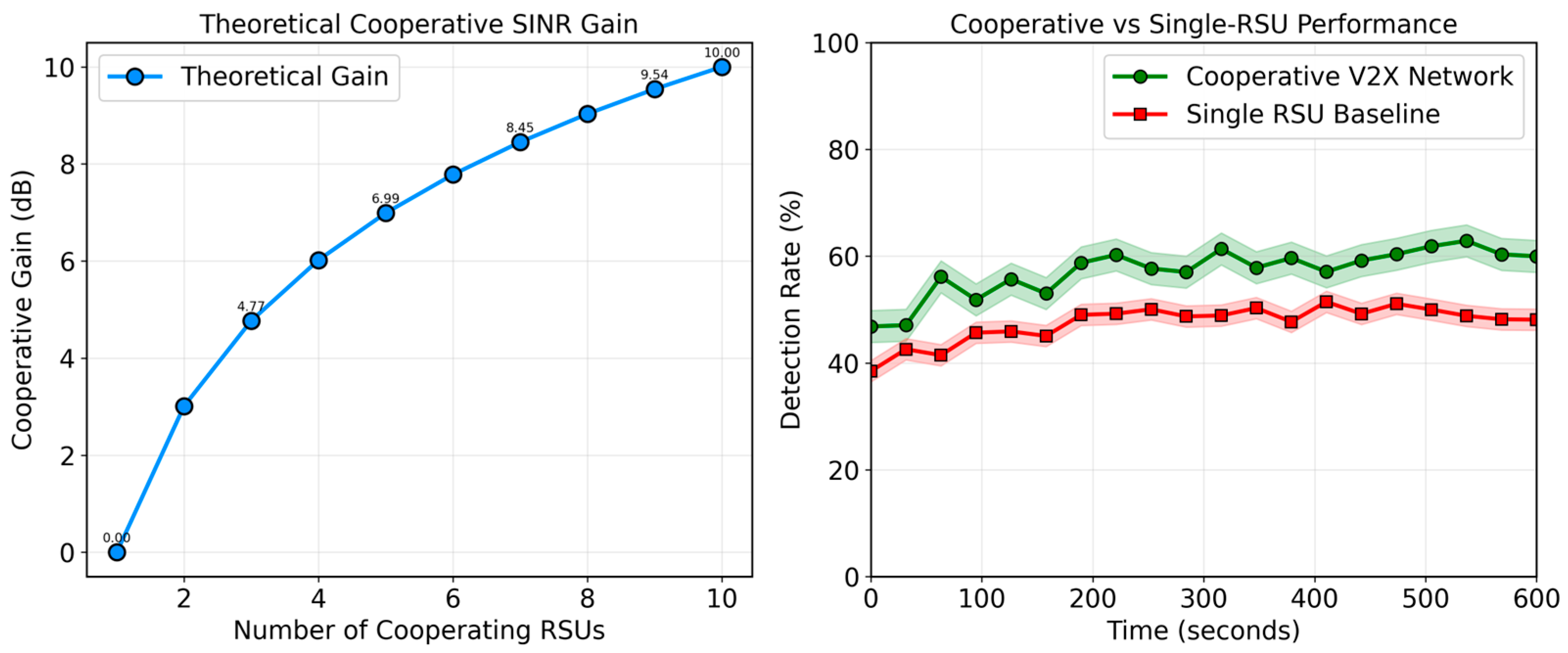
| Cooperative window N | 3–5 RSUs | Diminishing returns beyond ~6 |
| Interferer location | 130 km | Scenario definition |
| Interferer EIRP | 38 dBm | Scenario design (interference-limited case) |
| Interferer model | Structured narrowband interference (frequency-swept); 20 MHz BW; 80% duty | This section |
| Noise floor | −107 dBm | Receiver NF/BW assumption; calibrated |
| Background interference | −103 dBm | IEEE DataPort IQ dataset |
| Metric | Uncalibrated Model | Calibrated Model |
|---|---|---|
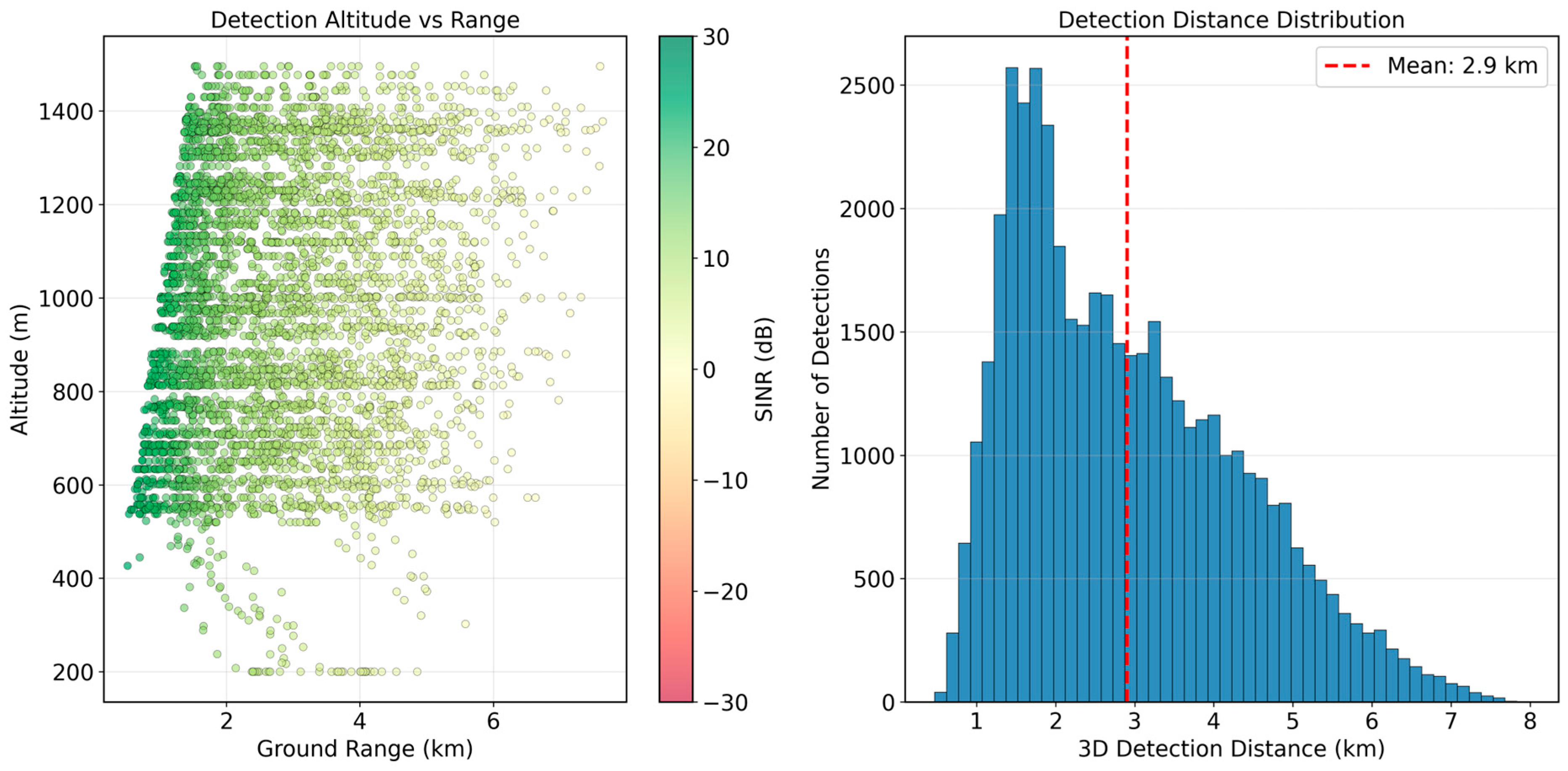
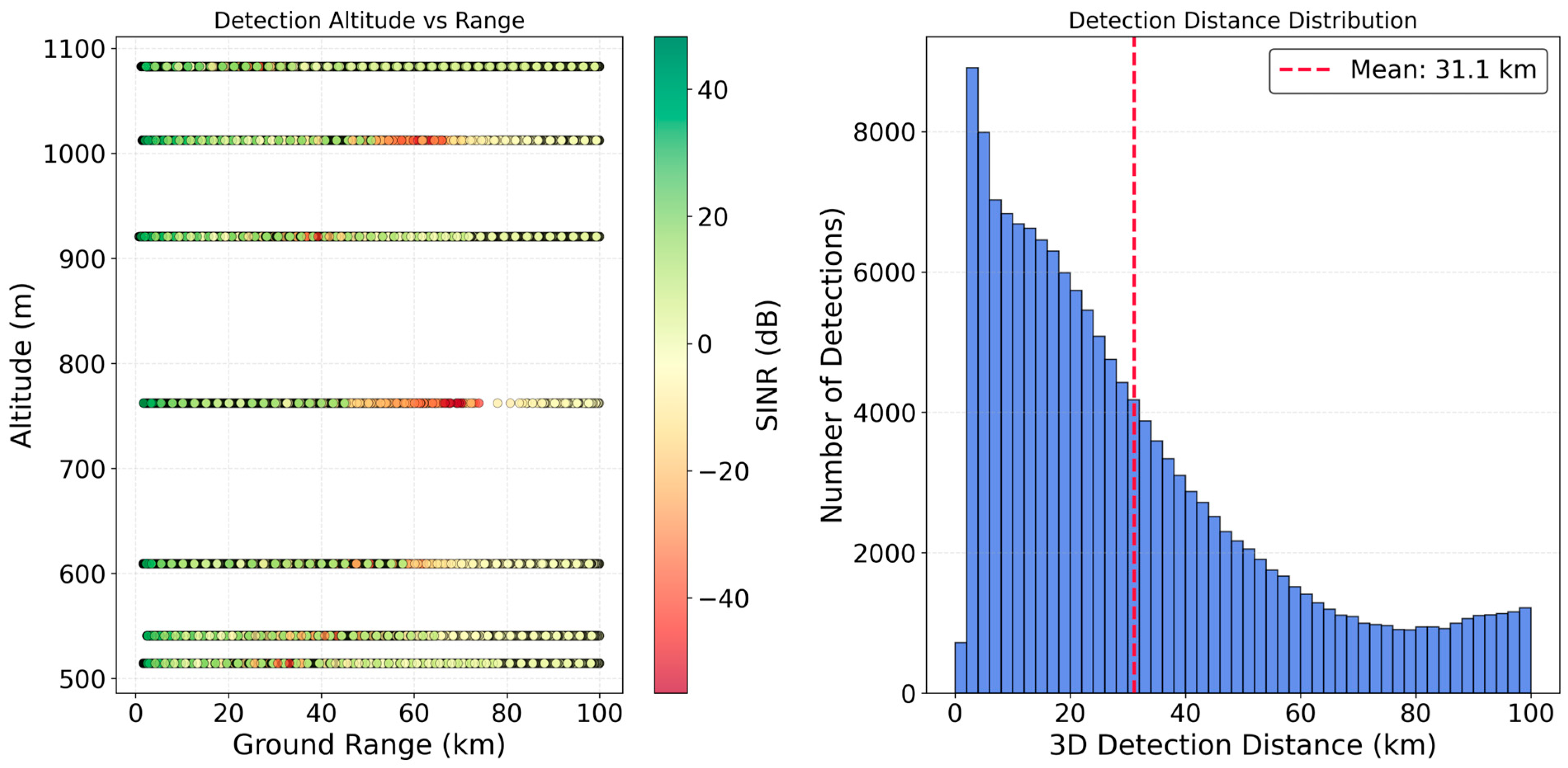
| Mean 3D detection distance | 32.4 km | 2.9 km (95% CI: [2.7, 3.1], SD: 0.8 km) |
| Detection-range envelope | Detections up to 80–90 km (non-physical artifact) | Detections concentrated within 1–6 km |
| Detection geometry | Bimodal pattern with far-field clusters | Compact near-field cloud with continuous altitude support |
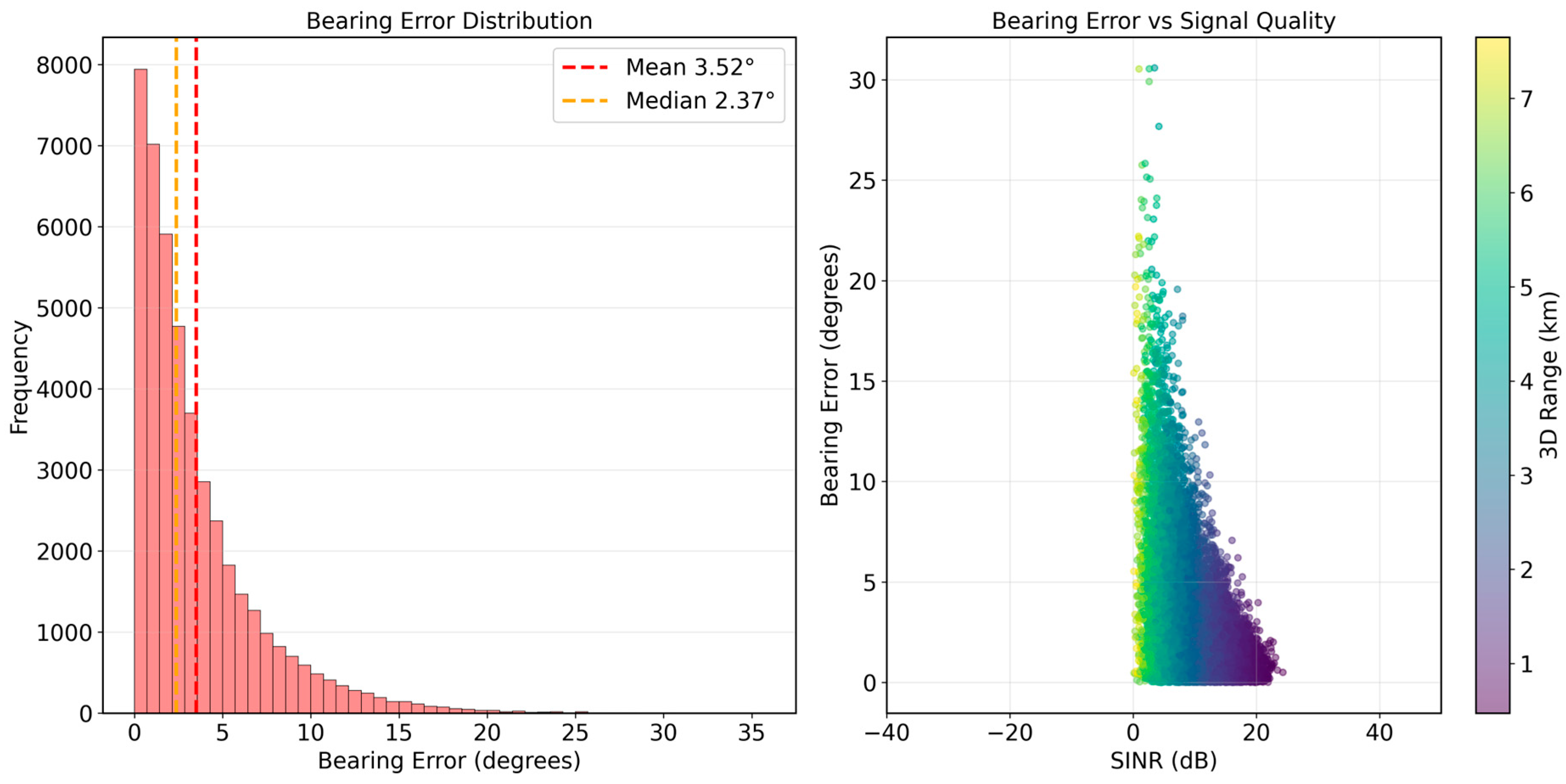
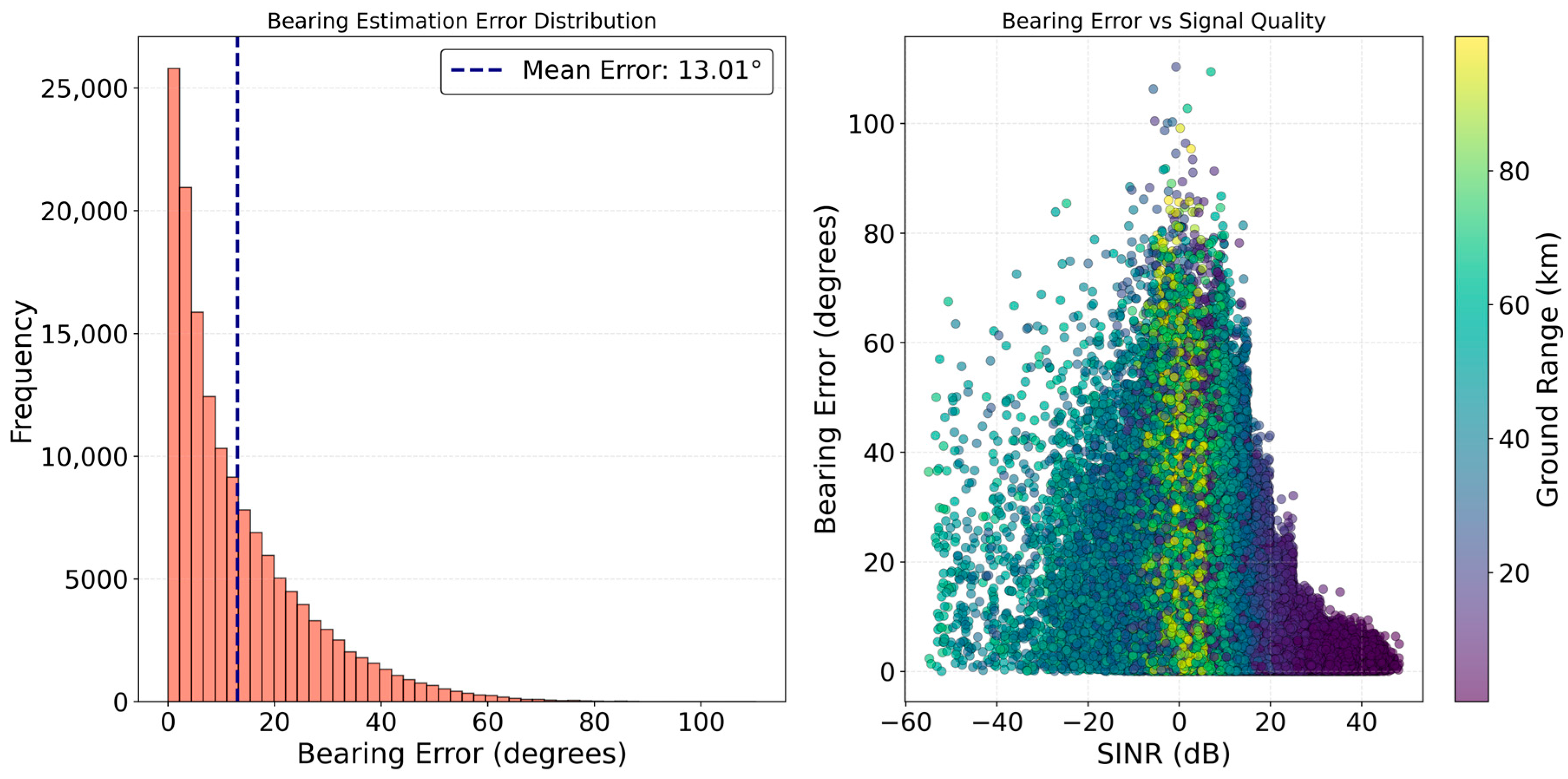
| Mean bearing error | 11.7° | 19.8° (95% CI: [19.8°, 19.9], SD: 16.3°) |
| Mean SINR | Not calibrated | −17.0 dB (95% CI: [−17.1, −16.9], SD: 8.7 dB) |
| Cooperative epoch-level verified detection coverage | Not representative | 54.72% (95% CI: [53.84%, 55.60]) |
| Single-RSU epoch-level verified detection coverage | Not representative | 2.67% |
| Cooperative gain | Not defined | ≈20× relative gain (≈52 pp absolute) |
Disclaimer/Publisher’s Note: The statements, opinions and data contained in all publications are solely those of the individual author(s) and contributor(s) and not of MDPI and/or the editor(s). MDPI and/or the editor(s) disclaim responsibility for any injury to people or property resulting from any ideas, methods, instructions or products referred to in the content. |
© 2026 by the authors. Licensee MDPI, Basel, Switzerland. This article is an open access article distributed under the terms and conditions of the Creative Commons Attribution (CC BY) license.
Share and Cite
Partyka, O.; Imoize, A.L.; Li, C.-T. Cooperative V2X-Based UAV Detection in Rural Transportation Corridors. Drones 2026, 10, 153. https://doi.org/10.3390/drones10020153
Partyka O, Imoize AL, Li C-T. Cooperative V2X-Based UAV Detection in Rural Transportation Corridors. Drones. 2026; 10(2):153. https://doi.org/10.3390/drones10020153
Chicago/Turabian StylePartyka, Olha, Agbotiname Lucky Imoize, and Chun-Ta Li. 2026. "Cooperative V2X-Based UAV Detection in Rural Transportation Corridors" Drones 10, no. 2: 153. https://doi.org/10.3390/drones10020153
APA StylePartyka, O., Imoize, A. L., & Li, C.-T. (2026). Cooperative V2X-Based UAV Detection in Rural Transportation Corridors. Drones, 10(2), 153. https://doi.org/10.3390/drones10020153