


Highlights
What are the main findings?
- A cooperative UAV–UGV forward-reconnaissance operation is investigated, in which a UAV advances ahead of a UGV.
- A control framework based on dynamically varying modulation matrices is developed to maintain Line-of-Sight (LOS) connectivity and enable obstacle avoidance between the UAV and UGV.
What are the implications of the main findings?
- Enable adaptive motions that adjust online to dynamic environments while maintaining LOS connectivity.
- Improve computational efficiency and real-time performance over traditional methods under the same LOS constraint.
Abstract
Cooperative operations in which a UAV advances ahead of a UGV to conduct forward reconnaissance are critical in disaster relief and urban inspection missions. Prevalent air–ground coordination methods operate under the assumption of ideal communication or treat connectivity as a secondary objective. However, obstacle occlusion, such as high-rise buildings in urban areas and mountainous terrain, results in Non-Line-of-Sight (NLOS) conditions, disrupting communication between the two platforms. To address these challenges, this paper introduces a cooperative control framework based on dynamically varying modulation matrices for both the UAV and the UGV. By evaluating and mapping occlusion risks in real time, the cooperative motions of the UAV and UGV are adaptively adjusted to maintain Line-of-Sight (LOS). An LOS assessment function is designed and mapped to the eigenvalues of the modulation matrices, enabling smooth and adaptive coordination under changing environmental conditions while avoiding the limitations of traditional discrete mode-switching strategies. Theoretical analysis and simulation results confirm that the proposed approach not only ensures stable LOS connectivity but also enhances trajectory smoothness, adaptability, and computational efficiency.
1. Introduction
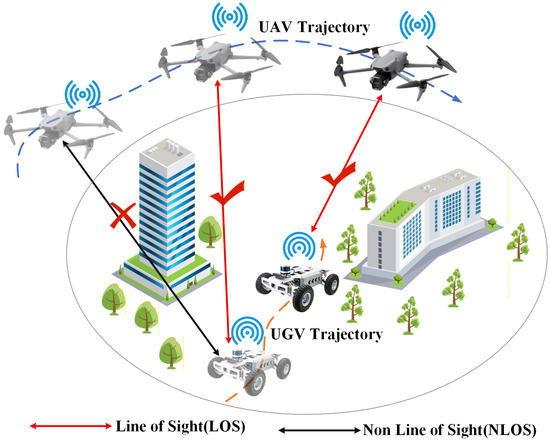
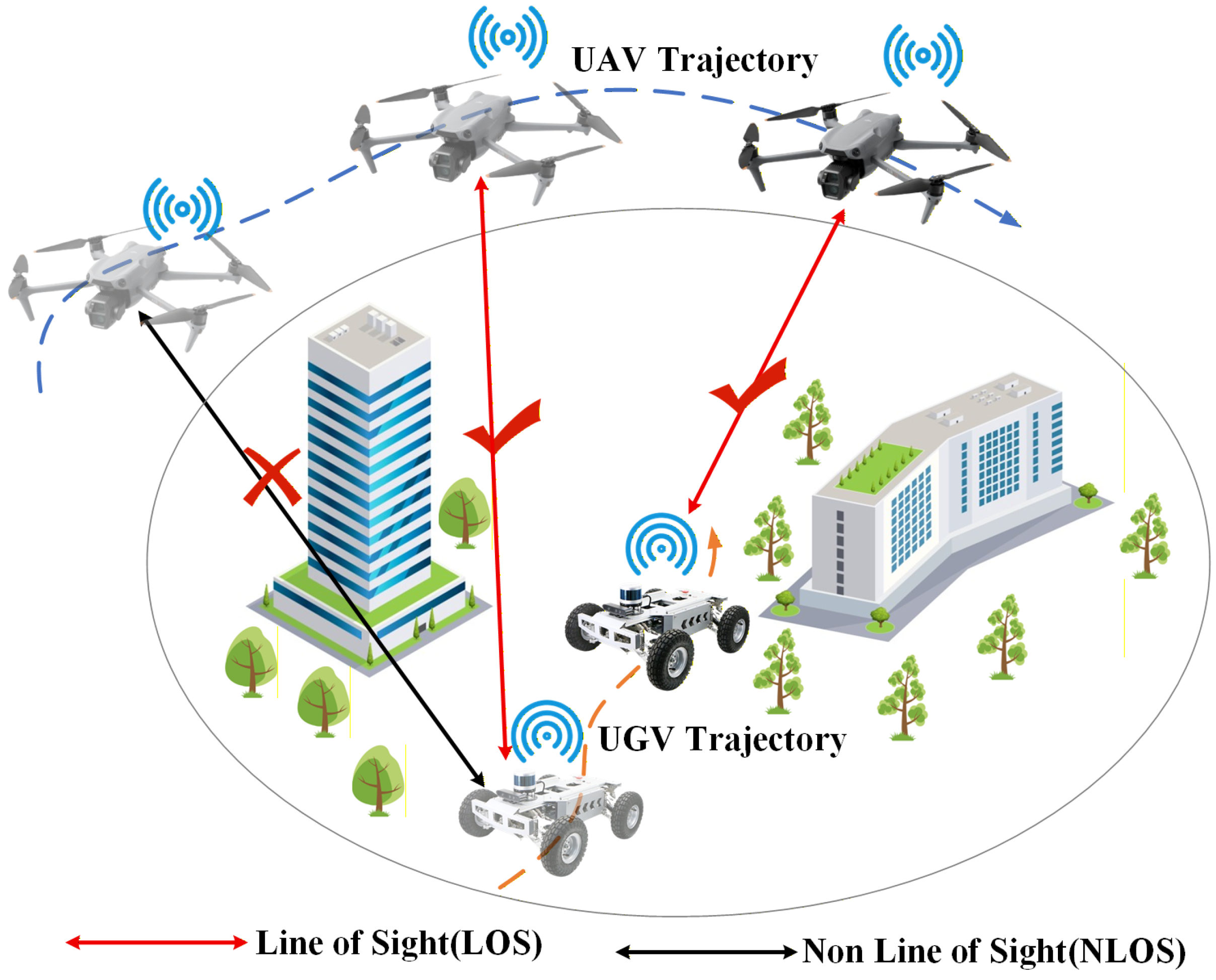
The heterogeneous cooperative system comprising UAVs and UGVs leverages their complementary advantages: UAVs provide wide-area perception and high maneuverability, while UGVs offer extended deployment capability and substantial payload capacity. This synergy demonstrates considerable potential in applications such as search and rescue, environmental monitoring, precision agriculture, and military reconnaissance [1,2,3]. In such missions, a typical operational mode involves a UAV advancing ahead of a UGV to conduct forward reconnaissance of the route and environment, with the UGV subsequently utilizing this information for navigation and decision-making [4], as illustrated in Figure 1. Related studies have also explored heterogeneous UAV–UGV collaborative path planning for long-duration urban monitoring tasks while explicitly modeling building occlusions [5]. Recent research on UAV–UGV cooperation has extensively addressed key challenges, including path planning [6,7], task allocation [8,9], and energy optimization [10,11], fostering the development of advanced cooperative control methods based on deep reinforcement learning [12,13] and model predictive control [14,15,16].
Figure 1.
Illustration of LOS and NLOS scenarios.
Nevertheless, a stable and reliable communication link between the aerial and ground platforms remains a fundamental prerequisite for any cooperative strategy. In complex environments, terrain variations and obstacles frequently cause communication blockages, leading to NLOS propagation [17,18] and severe signal attenuation. Such communication failures prevent the UAV from providing global perception to the UGV and disrupt the transmission of ground data from the UGV, thereby rendering the cooperative system ineffective [19,20]. Consequently, proactively maintaining LOS connectivity (i.e., LOS communication link) during cooperative motion in UAV forward reconnaissance operations is critical for ensuring both system reliability and mission execution efficiency.
To maintain stable LOS connectivity during autonomous missions, Communication-Aware Path Planning (CAPP) has emerged as a prominent research domain in the robotics field, and recent surveys have summarized UAV path-planning and obstacle-avoidance methods [21]. Fundamentally, CAPP involves explicitly modeling communication quality as a constraint or optimization objective within the path planning process. The existing literature typically quantifies communication performance through channel modeling, integrating these metrics into the planner’s cost function [22,23,24]. For example, Grøtli et al. utilized mixed-integer linear programming to generate feasible UAV trajectories while satisfying communication quality thresholds [25]. Similarly, Zeng et al. performed a joint optimization of UAV flight trajectories and communication resource allocation to guarantee throughput while minimizing energy consumption [26]. However, despite these advancements, most CAPP frameworks prioritize communication metrics without explicitly treating LOS maintenance as a dedicated control objective. Consequently, their applicability to heterogeneous UAV–UGV systems remains limited, often failing to guarantee the continuity of cooperative behaviors under real-time conditions.
The LOS challenge can also be interpreted as a connectivity issue within multi-agent network topology. Aggravi et al. use algebraic graph theory tools, such as the Laplacian matrix, to analyze and control network connectivity [27]. By ensuring that the algebraic connectivity of the communication graph remains positive, the overall network connectivity can be mathematically guaranteed. Other distributed strategies based on dissipativity theory aim to maintain connectivity in heterogeneous robot teams [18,28]. Recent work has also introduced the Line-of-Sight Connectivity Barrier Certificate (LOS-CBC), offering a rigorous mathematical guarantee for inter-agent visibility [29], while Yang et al. developed minimally constraining coordination methods for LOS maintenance in multi-robot systems [30]. These approaches provide valuable insights into UAV–UGV LOS preservation.
However, many connectivity-based methods still rely on discrete switching or piecewise controllers, which can introduce discontinuities and instability during transitions. Furthermore, such frameworks frequently overlook uncertainties arising from environmental dynamics, limiting their robustness in real-world LOS maintenance.
The challenge of LOS maintenance is also intricately linked with cooperative obstacle avoidance [31,32]. Existing studies have treated visibility as a hard constraint in cooperative motion planning and have explored UAV–UGV coordination under visibility constraints [33,34,35]. Recent approaches have leveraged UGVs equipped with 3D LiDAR to guide UAVs carrying onboard cameras, actively sustaining mutual visibility in complex settings [36,37]. Nonetheless, strict enforcement of LOS constraints can severely restrict the motion freedom of the robotic agents, consequently impairing overall task performance [1,38]. For instance, a UAV executing forward reconnaissance might be compelled to deviate from its optimal trajectory or forgo a superior vantage point to maintain continuous visibility with its UGV partner. Therefore, achieving robust LOS maintenance without excessively limiting the system’s maneuverability and flexibility presents a persistent challenge. This challenge is further compounded by the absence of a unified modeling and control framework capable of adaptively satisfying LOS constraints during the cooperative motion of heterogeneous platforms under uncertain dynamic environments.
To address the aforementioned challenges, this paper proposes a dual-agent cooperative motion control method based on modulation matrices. By constructing a modulation matrix within a global coordinate framework, the proposed approach simultaneously modulates the velocity vectors of both the UAV and the UGV. This formulation specifically targets cooperative scenarios where the UAV performs forward reconnaissance, enabling coordinated obstacle avoidance and the proactive maintenance of LOS connectivity in complex environments.
Compared with conventional communication-related coordination methods, existing studies have largely emphasized communication channel modeling and connectivity-aware optimization, whereas proactive LOS maintenance, which constitutes a fundamental prerequisite for reliable communication, is often not explicitly formulated as a primary control objective in heterogeneous UAV–UGV forward reconnaissance. In this work, LOS maintenance is treated as a first-class objective, and a unified continuous control framework is developed by embedding a real-time occlusion-aware LOS assessment into the eigenvalue modulation of the UAV and UGV modulation matrices. This formulation allows both platforms to adjust their motions smoothly in response to time-varying environmental occlusions, while concurrently achieving task-oriented convergence and proactive LOS maintenance, promoting clearance-based obstacle avoidance. It is anticipated that the proposed framework can serve as a principled and practical foundation for further studies on active LOS maintenance and communication reliability in heterogeneous cooperative systems.
The main innovative contributions of this work can be summarized as follows:
- A cooperative control framework based on dynamically varying modulation matrices that explicitly prioritizes LOS maintenance as a primary control objective to mitigate communication interruptions caused by NLOS conditions in heterogeneous UAV–UGV coordination;
- A real-time LOS assessment function mapped to the eigenvalues of the UAV and UGV modulation matrices, allowing both platforms to adaptively adjust their motion in response to environmental occlusion and thereby sustain stable LOS connectivity;
- An adaptive modulation mechanism driven by the relative geometry of obstacles and LOS connectivity, which effectively balances collision avoidance with LOS connectivity maintenance while optimizing trajectory smoothness and computational efficiency.
2. Proposed Method
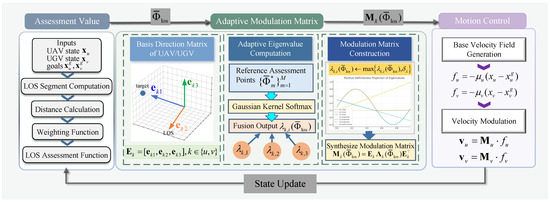
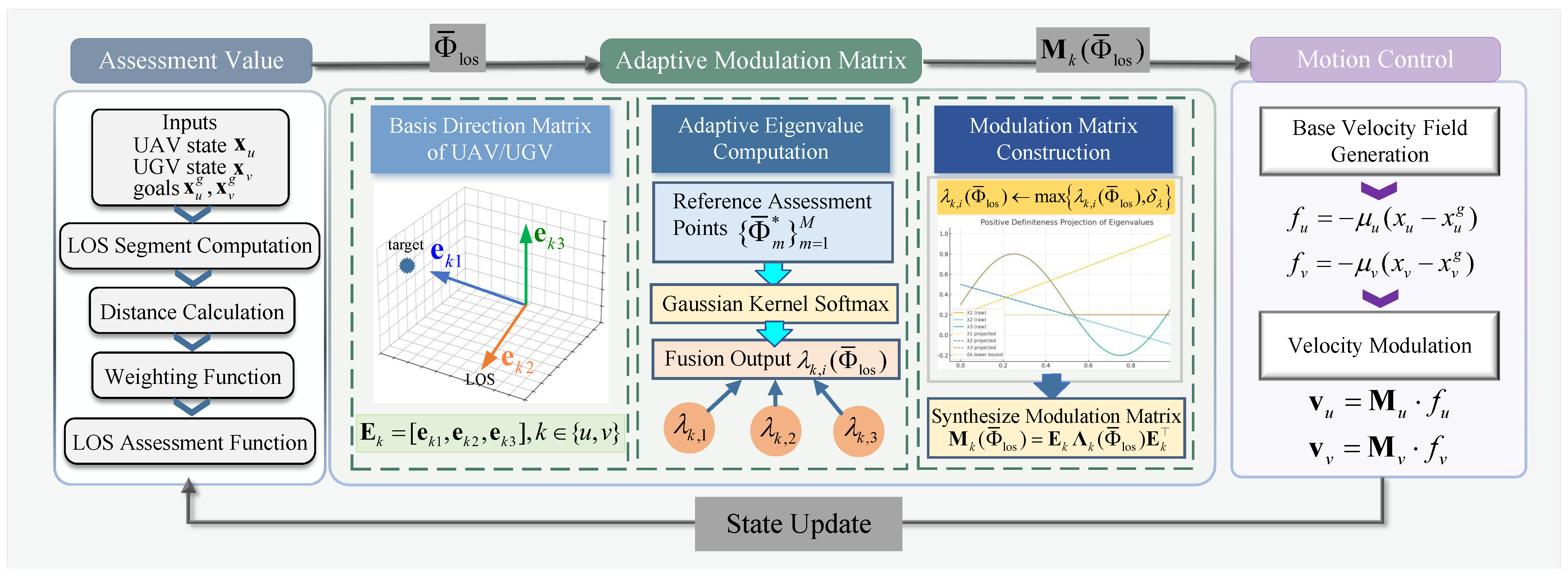
As illustrated in Figure 2, the proposed framework adopts a dynamically varying modulation-matrix-based approach. Through a workflow comprising environmental threat assessment, adaptive eigenvalue modulation, and velocity generation via the modulation matrices, the system achieves cooperative motion control for the UAV and UGV, ensuring both obstacle avoidance and LOS connectivity in complex environments.
Figure 2.
Framework of the proposed method.
We consider a forward-reconnaissance UAV–UGV team operating in a cluttered 3D environment. The UGV is assigned a navigation goal , while the UAV is assigned a reconnaissance goal . Although the UAV supports the UGV, it still needs a designated goal to define the nominal task motion; meanwhile, both platforms actively cooperate to maintain the inter-vehicle LOS connectivity and avoid obstacles by modulating their nominal velocities online. In typical forward reconnaissance, can be specified by a higher-level mission planner and may be chosen as a function of the UGV task; our controller accommodates both derived and independently specified goal pairs.
2.1. Cooperative Control Framework for UAV–UGV LOS Maintenance
Let the states of the UAV and the UGV be , where the UGV is constrained to the horizontal plane () while the UAV moves freely in 3D space. In real-world deployment, and are obtained from onboard localization and thus subject to sensor noise and localization errors. The proposed LOS assessment is computed from these estimated states; for notational simplicity, we use throughout the derivations. A conservative robustness margin is incorporated in the LOS clearance computation below, and the original formulation is recovered by setting .
For the UAV and UGV, indexed by , define the state spaces and . We define the nominal goal-attractive vector field as the mapping :
where is the proportional gain employed in this study.
To incorporate environmental constraints imposed by the obstacle set , we employ a modulation matrix that varies with the current states, yielding the control velocity :
The efficacy of this framework depends on the spectral decomposition properties of the modulation matrix. By conceptually decoupling the control logic into directional components (representing constraints such as obstacles and LOS) and scalar intensities (representing system reactivity), the system can independently manage path direction and safety reactivity. This enables an adaptive mechanism in which the control response is dynamically adjusted based on the real-time assessment value, ensuring that constraint-related modulation is strengthened only when necessary.
In forward reconnaissance missions, the UAV is required to remain ahead of the UGV in the horizontal projection. Let denote the horizontal projection operator. The UGV forward unit vector is defined by
The horizontal projection of the UAV relative to the UGV is quantified by
The UAV-ahead constraint is expressed as the half-space condition . To enforce it without introducing additional tuning parameters, we define the violation magnitude using a hinge function
and construct a push-forward field that is activated only when the UAV is not ahead:
Accordingly, the nominal vector field of the UAV is augmented as
while the UGV nominal field remains as in Equation (1). The control velocities are still generated through Equation (2) using the modulation matrices.
To operationalize this adaptive strategy, it is essential to establish an efficient computational pipeline for environmental perception and LOS assessment. In complex obstacle environments, maintaining LOS requires not only preserving the geometric relationship between the UAV and the UGV but also evaluating potential risks to the communication link in real time.
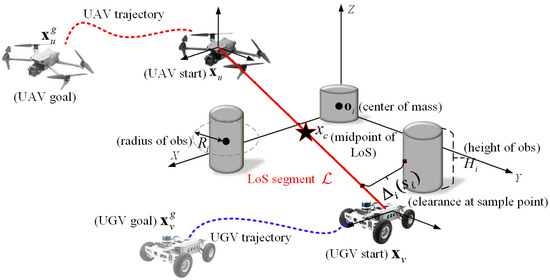
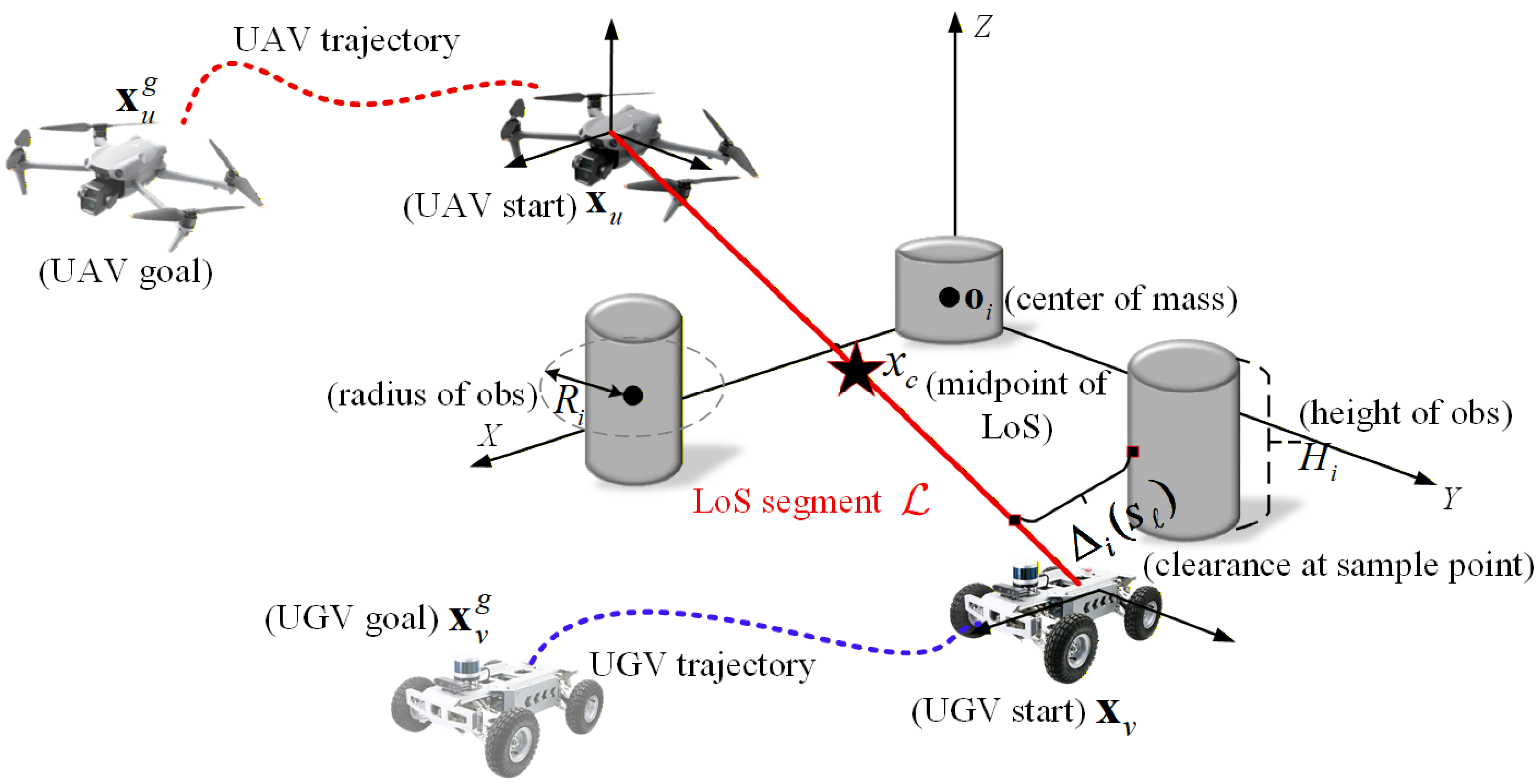
Therefore, this paper introduces an LOS assessment function . The LOS segment , as illustrated in Figure 3, is defined as
which represents the physical LOS communication link that supports LOS connectivity between the two platforms.
Figure 3.
Illustration cooperative modulation framework, showing the UAV–UGV configuration, goal states , obstacle representation, and the geometric parameters used for LOS assessment.
To account for the fact that each obstacle occupies a finite volume, we model obstacle i as a vertical cylinder with base center , radius , and height , whose axial interval is . Note that this cylinder model is not restricted to be ground-attached: the lower endpoint can be greater than 0, which allows for modeling elevated occluders that block the UAV–UGV LOS without creating any ground-level obstruction. This is also reflected in the vertical clearance term in Equation (11), which explicitly uses and .
Sensor noise and localization errors may perturb the sampled LOS points and lead to false-safe LOS clearance estimates. Since uncertainty modeling is not the main focus of this work, we adopt a lightweight but effective conservative safeguard by inflating each obstacle radius with a safety buffer :
This inflation is applied consistently in both the LOS-segment clearance and the agent-wise clearance used for computing . The original formulation is recovered by setting . In practice, b can be selected from a known localization error bound.
We quantify the LOS assessment function using the minimum clearance between the LOS segment and the obstacle surface. Specifically, we sample S points along the LOS segment to approximate the LOS communication link:
For each sample point , the radial and vertical clearances to obstacle i are computed as
The point-to-cylinder clearance is approximated by
To obtain a differentiable approximation of the minimum clearance along the LOS, we use a soft-min operator:
where controls the sharpness of the approximation.
To emphasize obstacles that are more relevant to the current cooperative formation, we introduce a spatial weighting function based on a reference point . We define as a convex combination of the UAV and UGV positions:
where are nonnegative indicators reflecting the local obstacle constraints around each agent.
For each agent at position , we compute its point-to-cylinder clearance to obstacle i using the same cylinder model:
We then aggregate the local clearance via a differentiable soft-min:
and define
where controls the sharpness and is a small constant for numerical stability.
The spatial weighting function is then defined as
where controls the spatial decay rate.
Finally, the LOS assessment function is defined as
where is a small constant for numerical stability.
In practice, LOS may already be blocked at the start of a mission or become suddenly blocked when the perceived obstacle set changes. To explicitly define a recovery protocol for such cases, we use the already-computed obstacle-wise LOS clearances to form a global minimum-clearance indicator via a soft-min across obstacles:
We then define a continuous blockage activation magnitude using a hinge function:
When , a recovery action is activated.
To obtain a smooth approximation of the dominant occluder, we define soft weights
and the corresponding effective occluder center
Let and define the horizontal recovery direction
where is a small constant. The UAV recovery field is constructed as
Meanwhile, to avoid exacerbating occlusion, the UGV nominal field is smoothly attenuated by
Finally, the UAV nominal field is augmented as . Since is evaluated online at each control step, this protocol naturally handles both NLOS initialization and sudden LOS loss caused by changes in , and vanishes automatically when LOS is restored.
2.2. Modulation Matrix Design for LOS Preservation
With the LOS assessment formulation established (including the obstacle model, LOS-segment sampling, and the LOS assessment function ), the explicit structure of the modulation matrix can now be formulated. Building upon the spectral decomposition strategy outlined in Section 2.1, the modulation matrix is designed to translate the assessed risks into precise, direction-specific corrections. This construction allows the system to differentiate between the three-dimensional unconstrained motion of the UAV and the planar motion constraints of the UGV. Consequently, the distinct control velocities for the UAV () and the UGV () are defined as follows:
where is the nominal goal-attractive vector field defined in Equation (1), and is augmented by the UAV-ahead push-forward term in Equation (7) to maintain the forward reconnaissance configuration. Moreover, when LOS is blocked, and are updated online by the recovery rules in Equations (23)–(29) before applying the modulation matrices.
This structure decouples the design into two components: the basis matrix , which determines the modulation directions, and the eigenvalue matrix , which regulates the modulation intensity.
The basis matrix defines a local orthonormal coordinate system according to the geometric configuration of the respective vehicle. For the UAV, the basis matrix is formulated as , where the first basis vector is aligned with the nominal direction toward the target, characterizes the LOS alignment essential for connectivity, and is orthogonal to the plane spanned by the first two vectors, thereby providing the necessary degree of freedom for lateral obstacle avoidance.
The projection vector is obtained by projecting the normalized relative position vector onto the plane orthogonal to . The vertical unit vector is , and is a numerical stability threshold introduced purely to avoid ill-conditioned normalization when the projection magnitude is near zero (a geometrically degenerate case where the LOS direction is nearly collinear with the nominal tracking direction). Analogously, the UGV basis matrix is constructed to account for its planar motion constraint. The vector points from the current position to the target. For the LOS constraint, is derived within the horizontal plane: the relative position vector is projected onto the x–y plane as , and its projection onto the plane orthogonal to yields . When , . Otherwise, a horizontal unit vector orthogonal to is adopted. The third basis vector enforces the planar-motion constraint by restricting vertical motion.
Although the basis definition is piecewise, both branches return unit-norm directions and remains orthonormal by construction; together with bounded eigenvalues , this keeps bounded, and under safe LOS conditions (typically with ) we obtain so the commanded velocity is locally insensitive to variations of .
To prevent chattering when trajectories hover near the threshold in discrete-time implementation, we apply a small hysteresis band in the test (switch to fallback only if or and return only if , with ), which avoids rapid toggling without changing the method away from degeneracies.
With the directional framework established, the modulation intensity along these axes is governed by the eigenvalues, which are designed as explicit functions of the normalized LOS assessment in Equation (36). To ensure smooth and bounded modulation, we adopt saturating functions for the increasing components and an affine function for the decreasing component:
In Equation (35), (for ) denote nominal eigenvalues that determine the modulation level under a safe LOS condition; when , one has . In most implementations we set , which yields at and thus leaves the nominal vector field unchanged; are retained for generality to allow different nominal scaling when needed. The gains determine the adjustment amplitude, while and regulate the sensitivity of the saturating terms.
Since and is smooth and monotonically increasing on , and increase monotonically with , whereas decreases monotonically with to regulate the motion component along and thus emphasize LOS maintenance as the LOS assessment increases. To guarantee strict positivity in all cases, the lower-bound operation in Equation (38) with is applied.
In practice, Equation (35) can be evaluated at the reference points to predefine the anchor eigenvalues for Equations (37) and (38), i.e., . Moreover, strengthens the motion component along to preserve target convergence, amplifies the component along for lateral obstacle avoidance, and reduces the component along to constrain deviations that may compromise LOS connectivity. For the UGV, follows the same modulation logic for the planar components, while enforcing the planar-motion constraint by fixing .
2.3. Adaptive Modulation-Based Cooperative Control
Building on the directional framework established in the previous section, this paper proposes an adaptive modulation-based cooperative control mechanism. Specifically, the eigenvalues of the modulation matrix are adjusted online to regulate the trade-off between LOS maintenance and obstacle avoidance according to the real-time LOS assessment . To enable flexible and fine-grained adaptation in complex environments, we employ a modulation-based interpolation scheme. Since the raw LOS assessment in Equation (22) is generally unbounded for , we first map it to a bounded normalized variable
which is smooth and strictly increasing over , preserves when , and asymptotically saturates as . The normalized assessment is then used as the continuous input variable for interpolation. We define a set of discrete reference assessment points as anchors distributed over .
To implement the mapping from to the anchor-based eigenvalue set, we construct interpolation coefficients using a Gaussian kernel. Specifically, we denote by the normalized weight assigned to the m-th reference (anchor) point for a given measured . These weights are computed via a softmax-normalized Gaussian kernel, ensuring and thus forming a convex combination that enables smooth interpolation between predefined anchors.
where serves as a tuning parameter that determines the bandwidth of the Gaussian kernel. Physically, it regulates the spatial decay rate of the weighting coefficients, thereby defining the effective activation range of each reference point and controlling the smoothness of transitions between adjacent anchors. Let denote the nominal eigenvalue design pre-assigned to the m-th reference threat point. The real-time adaptive eigenvalues are continuously synthesized through the following kernel-weighted summation:
To ensure the modulation matrix remains strictly positive definite and computationally non-singular during this process, a numerical lower bound constraint is applied:
where is a small constant. Consequently, the adaptive modulation matrix is constructed as .
In practical implementation, smooth kernel weights help mitigate control chattering; this is supported by the continuous differentiability of in Equation (40). We verify this property by analyzing the gradient of the modulation weights and the resulting matrix. Let represent the deviation from the reference point. The gradient of the kernel weights with respect to the assessment value is derived as:
Since is composed of smooth exponential and rational operations, it is continuously differentiable, which guarantees that small variations in the LOS assessment lead to proportional changes in the weighting coefficients rather than abrupt jumps. This inherent smoothness in the weight transition directly translates to continuous variations in the synthesized eigenvalues via the convex combination in Equation (38), thereby ensuring that the resulting modulation matrix evolves smoothly over time. Such continuity is essential for preventing control chattering and maintaining stable system behavior during critical maneuvers where the LOS condition rapidly fluctuates. Furthermore, the gradient derived in Equation (40) confirms that the weight adaptation mechanism is well-behaved and responsive without introducing discontinuities.
The overall workflow of the proposed method is summarized in Algorithm 1.
| Algorithm 1 Overall Workflow of the Proposed LOS-Constrained UAV–UGV Coordinated Control Method |
| Input: Vehicle states ; goals ; obstacles ; anchors and designs ; parameters . |
| Output: Control velocities . |
|
2.4. Proof of System Stability
A Lyapunov candidate function is constructed to establish the asymptotic stability of the proposed control framework, ensuring target convergence and LOS maintenance, while promoting obstacle avoidance through clearance-based modulation.
Define error variables based on the nominal dynamics and goals established in Equation (1). Specifically, the position tracking errors for the UAV and UGV are defined as and , respectively. Furthermore, to quantify the connectivity constraint, the LOS distance error is introduced as
where represents the desired inter-agent distance.
To avoid relying on an unknown global minimum LOS assessment value over all feasible configurations, and to activate the LOS-related Lyapunov term only when LOS is endangered, we define a clearance-margin-based LOS measure
where is the minimum LOS clearance defined in Equation (23). Thus, indicates that the LOS clearance margin is satisfied (), and indicates blocked LOS. Note that is computed using the discrete sampling and soft-min approximations adopted in Equations (14) and (23); hence it provides a smooth numerical proxy of the continuous line-segment clearance that is directly used to evaluate the LOS margin and to construct the modulation intensities in the proposed controller. The system’s equilibrium point is characterized by the configuration in which all kinematic errors are zero (i.e., , , ) and the LOS margin is satisfied, i.e., .
In addition, the modulation-matrix construction is implemented without hard switching near degenerate cases, so that the resulting closed-loop vector field is piecewise Lipschitz and differentiable almost everywhere, which allows using almost-everywhere time derivatives in the following analysis.
Based on these definitions, a composite Lyapunov candidate function V is
where and are positive weighting coefficients introduced to balance the dimensional differences between state errors and constraint functions, and to prioritize control objectives. Since all terms are squared and , we have . Moreover, holds if and only if , , , and . Thus, V is a positive definite Lyapunov candidate function.
The time derivative of V is
Since , its time derivative exists almost everywhere and satisfies
under the smooth soft-min approximations adopted in Equations (14) and (23), for which is differentiable almost everywhere.
Under the modulation-matrix-based kinematics, the control velocities satisfy and . Using the nominal vector fields in Equation (1), and with , and assuming the goals are constant, the error dynamics simply become directly
Accordingly, the target convergence terms are
As and are symmetric positive definite with eigenvalues strictly bounded below by , these terms are negative definite:
The time derivative of the LOS distance error is
Let . The modulation matrix eigenvalues are adapted such that the radial relative velocity satisfies the contraction condition
which directly yields and thus
with equality implying .
For obstacle avoidance and LOS preservation, the modulation intensities are designed to increase with the LOS assessment function . Under the smooth soft-min approximations, is differentiable almost everywhere, and by the chain rule,
Since in Equation (22) is monotonically decreasing with respect to the LOS clearance, enlarging the clearance reduces . Accordingly, when the controller activates the LOS recovery actions to increase , which implies and hence, from Equation (45), . When (LOS margin satisfied), . Therefore, the term is negative semi-definite, and implies .
Combining all terms, the total time derivative of the Lyapunov function satisfies
Given that V is positive definite and is negative semi-definite, LaSalle’s Invariance Principle applies. The system trajectories converge to the largest invariant set where , which implies , , , and (i.e., the LOS margin constraint is satisfied). Therefore, the proposed UAV–UGV cooperative system is asymptotically stable with respect to the equilibrium defined above, ensuring robust target convergence while maintaining LOS connectivity and promoting clearance-based obstacle avoidance in complex environments.
3. Results and Discussion
To validate the proposed LOS-constrained UAV-UGV coordination framework, we conduct four simulation studies. We first verify the efficacy of the modulation matrix in cluttered environments with randomly generated 3D obstacles, then analyze the adaptive eigenvalue response to the normalized LOS assessment . Next, we demonstrate the overall performance in PyBullet, and finally compare against APF, VO, and DWA under the same LOS objective.
3.1. Efficacy Verification of Modulation Matrix
To empirically evaluate the performance of the proposed control framework, a simulation study is conducted in a cluttered, unstructured environment. The environment contains a set of obstacles, each characterized by its base center , a random safety radius , and a random height . Specifically, to enhance environmental diversity and realism, the geometric parameters are sampled from uniform distributions over specified bounds:
where denote independent uniform random variables.
In this efficacy-verification experiment, we adopt the symmetric setting in the reference point definition of Equation (15), which yields . Consequently, the spatial weights in Equation (21) are computed using the centroid reference, ensuring consistency with the centroid-based weighting while isolating the kinematic efficacy of the proposed modulation matrix.
The primary objective is to verify that the system achieves target convergence while maintaining continuous LOS connectivity and satisfying obstacle-avoidance constraints.
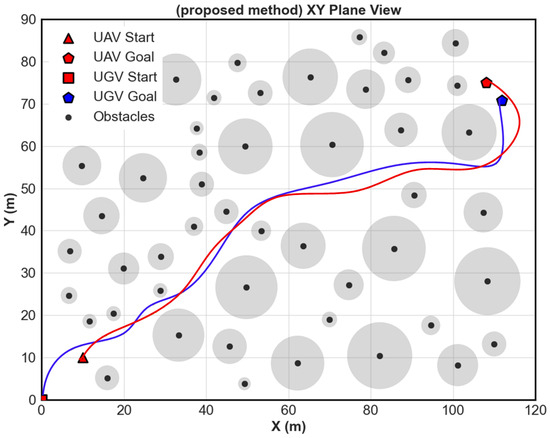
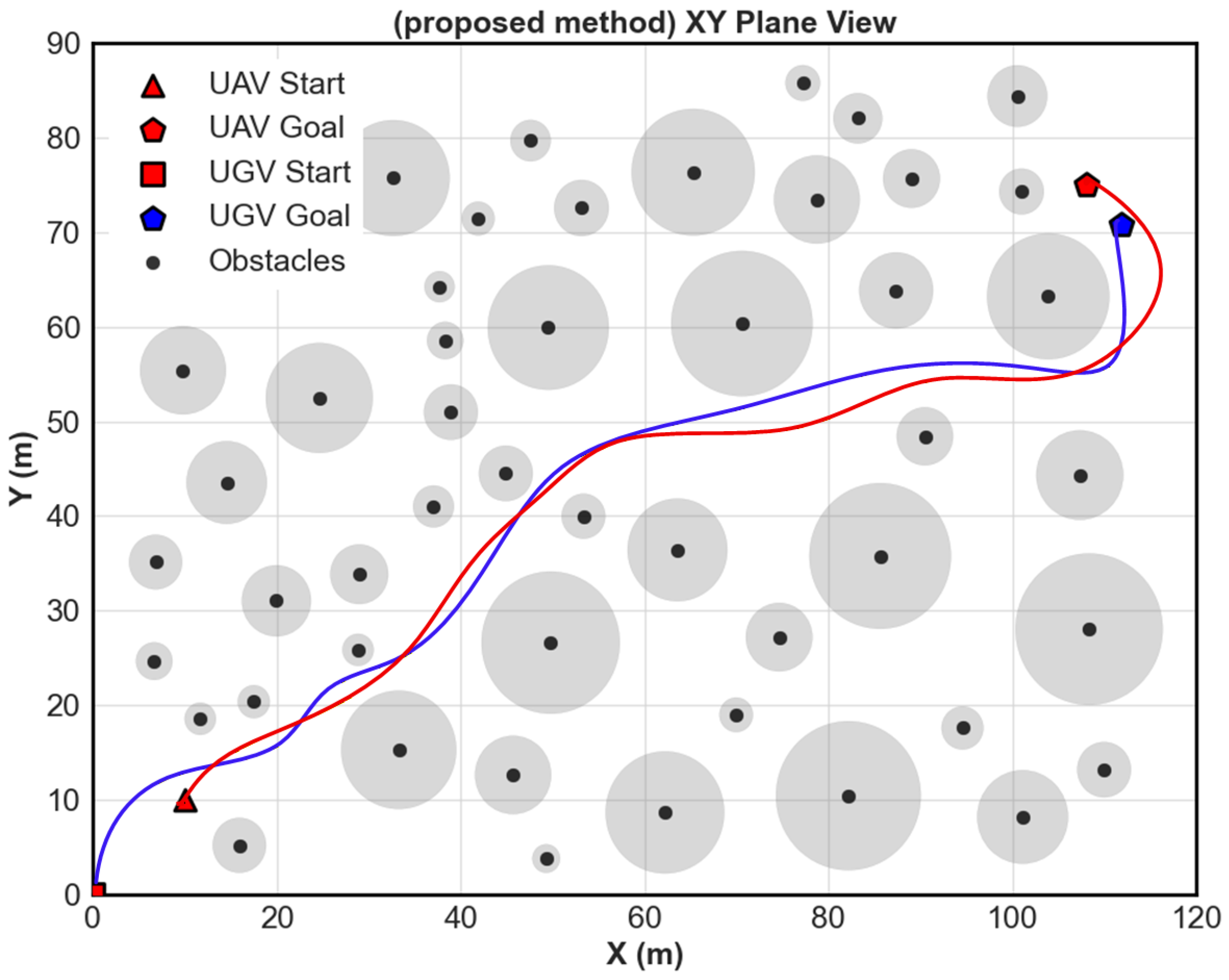
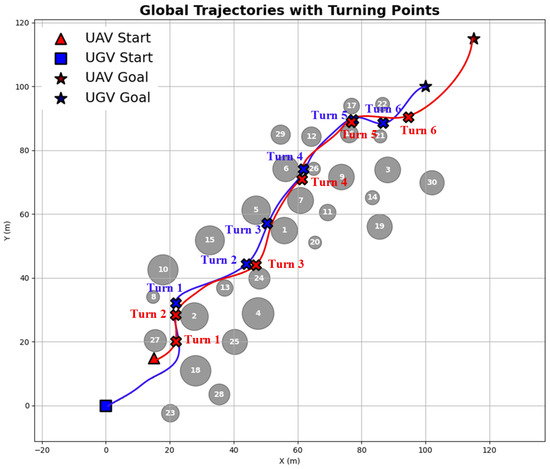
Figure 4 illustrates the performance of the cooperative system. The results indicate that both the UAV and the UGV achieve smooth cooperative motion, with the UAV advancing ahead, successfully avoiding obstacles while simultaneously maintaining LOS connectivity.
Figure 4.
Trajectory visualization of the UAV and UGV guided by the modulation matrix to achieve cooperative motion while preserving LOS connectivity. In this experiment, the reference point is set to the symmetric centroid, . The gray circles of varying sizes represent obstacles with different radii, simulating heterogeneous obstacles in realistic environments.
Within this setup, a fine-grained kinematic analysis is performed to validate the geometric effectiveness of the modulation matrix in transforming the nominal velocity into a safety-compliant velocity . Table 1 details the velocity vectors extracted from representative turning points, which were selected based on peaks in angular deviation in the dense obstacle environment. For the kinematic efficacy test in Section 3.1, the velocity magnitudes are saturated at and to highlight the modulation effects.
Table 1.
Analysis of velocity modulation at detected turning points for UAV and UGV during cooperative forward reconnaissance.
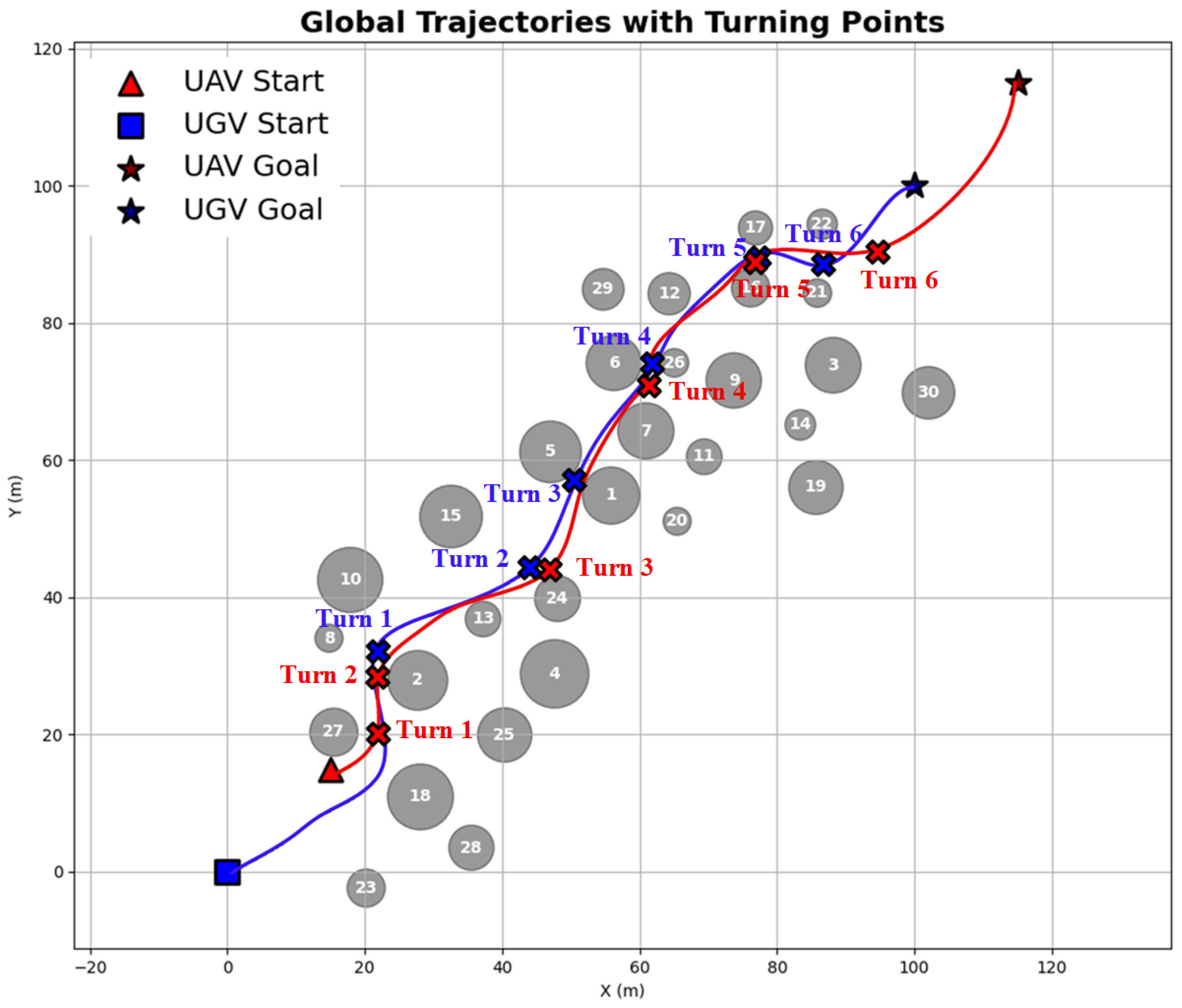
Figure 5 further depicts the local trajectories of the UAV and UGV navigating through specific obstacle clusters. The visualization corresponds to the modulation events listed in Table 1, highlighting the locations where the algorithm actively intervenes to adjust the kinematic states.
Figure 5.
Trajectory visualization illustrating adaptive velocity modulation at turning points via the proposed modulation-matrix framework to preserve LOS connectivity during obstacle avoidance. Each cross marker (×) indicates a turning point (Turn 1–Turn 6), corresponding to a key velocity-modulation time step used for the kinematic analysis.
Quantitative analysis reveals that the modulation strategies are coordinated to preserve the LOS connectivity. The UAV consistently exhibits speed attenuation to prioritize navigational precision, with reductions ranging from as little as at Turn 6 to at Turn 5, where the velocity drops to m/s. This deceleration enables accurate regulation of relative altitude and position. Conversely, the UGV demonstrates a dynamic adaptive response. In the initial phase (Turns 1–3), it accelerates beyond its nominal m/s, peaking at m/s (19.5% above nominal) to rapidly traverse potential occlusion zones. However, during Turns 4 and 5, the UGV transitions to a conservative deceleration (approximately ) to safely navigate immediate threats, before accelerating again in the final phase.
3.2. Dynamic Analysis of Adaptive Mechanism
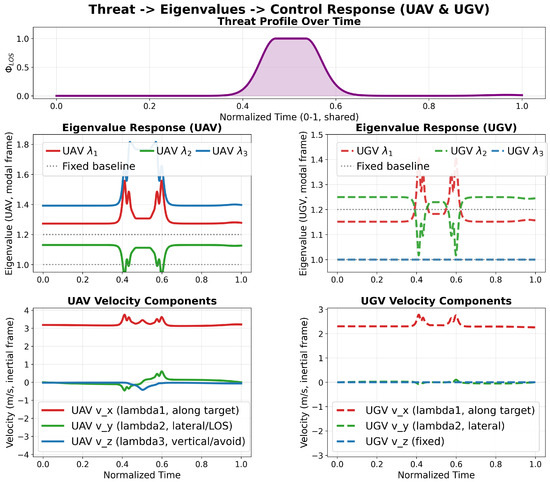
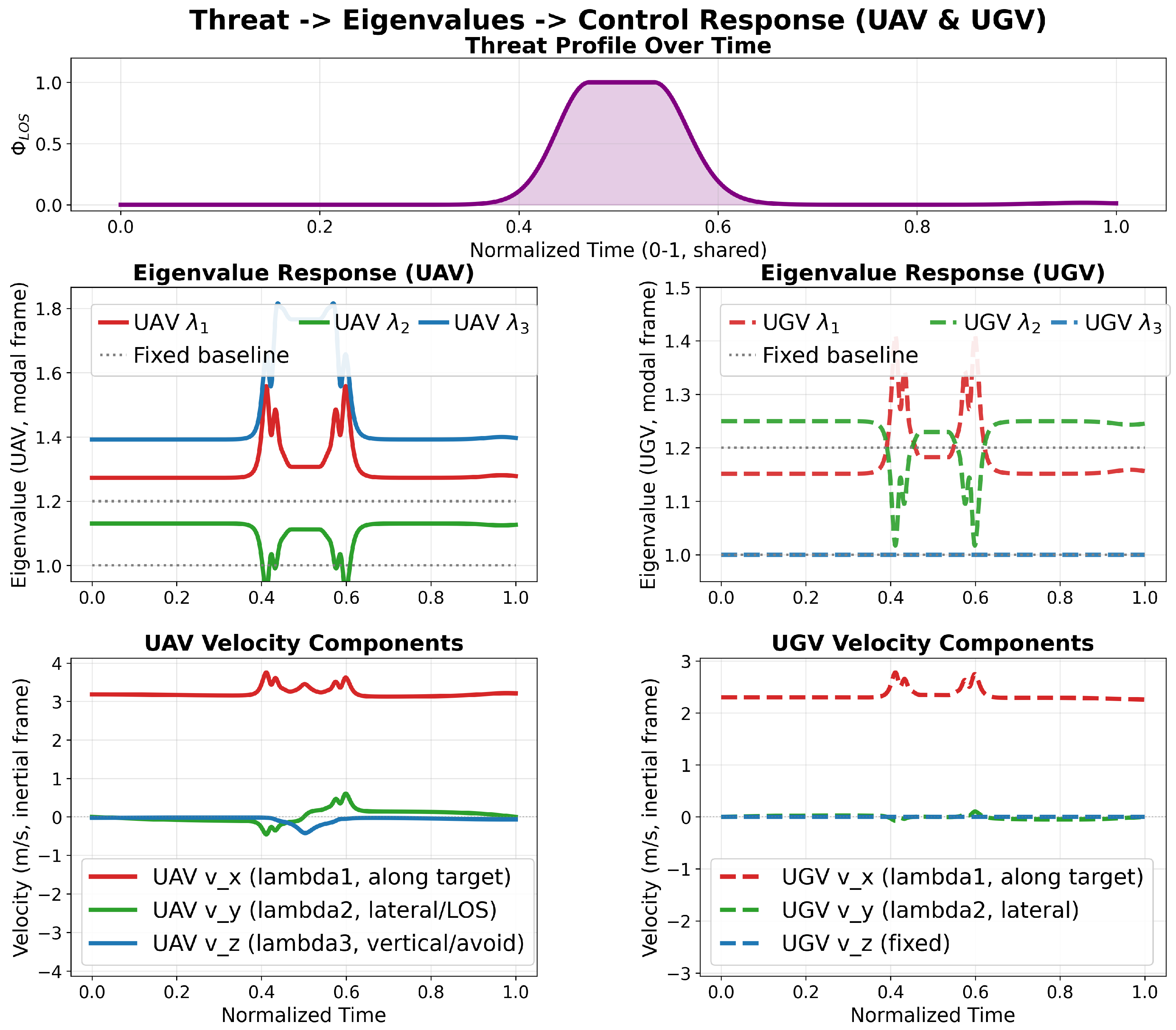
To validate the theoretical efficacy of the adaptive modulation strategy, we analyze the variation trends of the modulation matrix eigenvalues for both the UAV and UGV as the normalized LOS assessment value varies. For comparative analysis, a fixed baseline is introduced, representing a static control strategy in which the eigenvalues remain constant at their nominal values regardless of changes in . Figure 6 and Table 2 quantify the correlation between the assessment magnitude, eigenvalue adjustments, and the resultant kinematic responses relative to this baseline.
Figure 6.
Dynamic response analysis illustrating the effect of normalized LOS assessment value variation on the UAV and UGV modulation matrix eigenvalues and their resulting velocity vectors.
Table 2.
Quantitative assessment of UAV and UGV modulation matrix eigenvalues and corresponding velocity responses under discrete normalized LOS assessment values .
As the normalized LOS assessment value increases from 0 to , the UAV eigenvalues and rise markedly (from to and from to , respectively), indicating an intensified forward convergence and vertical/lateral avoidance tendency when the LOS risk starts to emerge.
For higher-risk regimes (), remains high (peaking at ) to maintain clearance-increasing behavior, while gradually decreases toward to avoid aggressive forward motion in dense-threat situations. Meanwhile, exhibits a risk-aware suppression at followed by a gradual recovery as approaches saturation, reflecting a trade-off between lateral deviation control and obstacle circumvention.
Collectively, these results validate that the eigenvalues dynamically evolve in response to (and thus to via the monotonic normalization in Equation (36)). This proactive modulation mechanism effectively prioritizes LOS preservation, ensuring robust connectivity maintenance that outperforms traditional fixed-parameter control strategies.
3.3. Experiment Settings
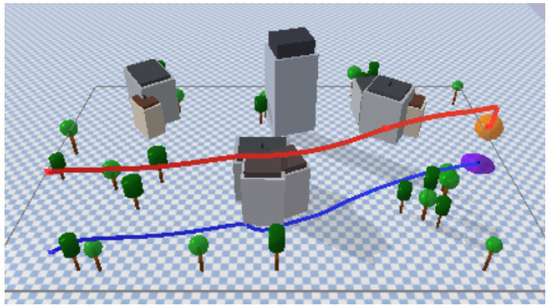
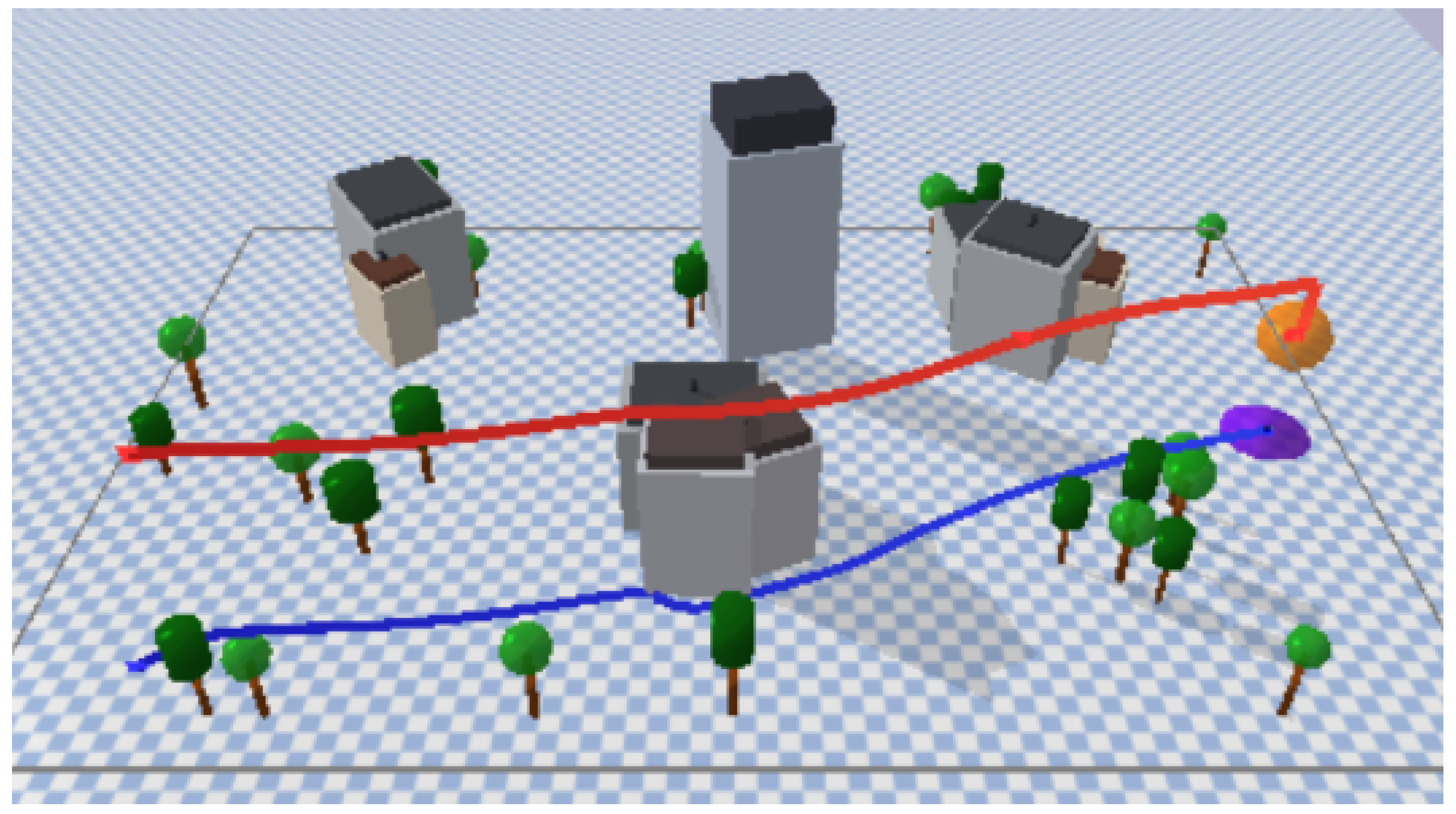
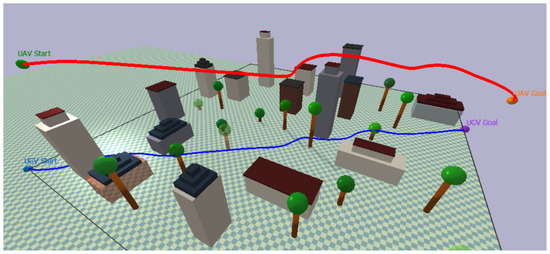
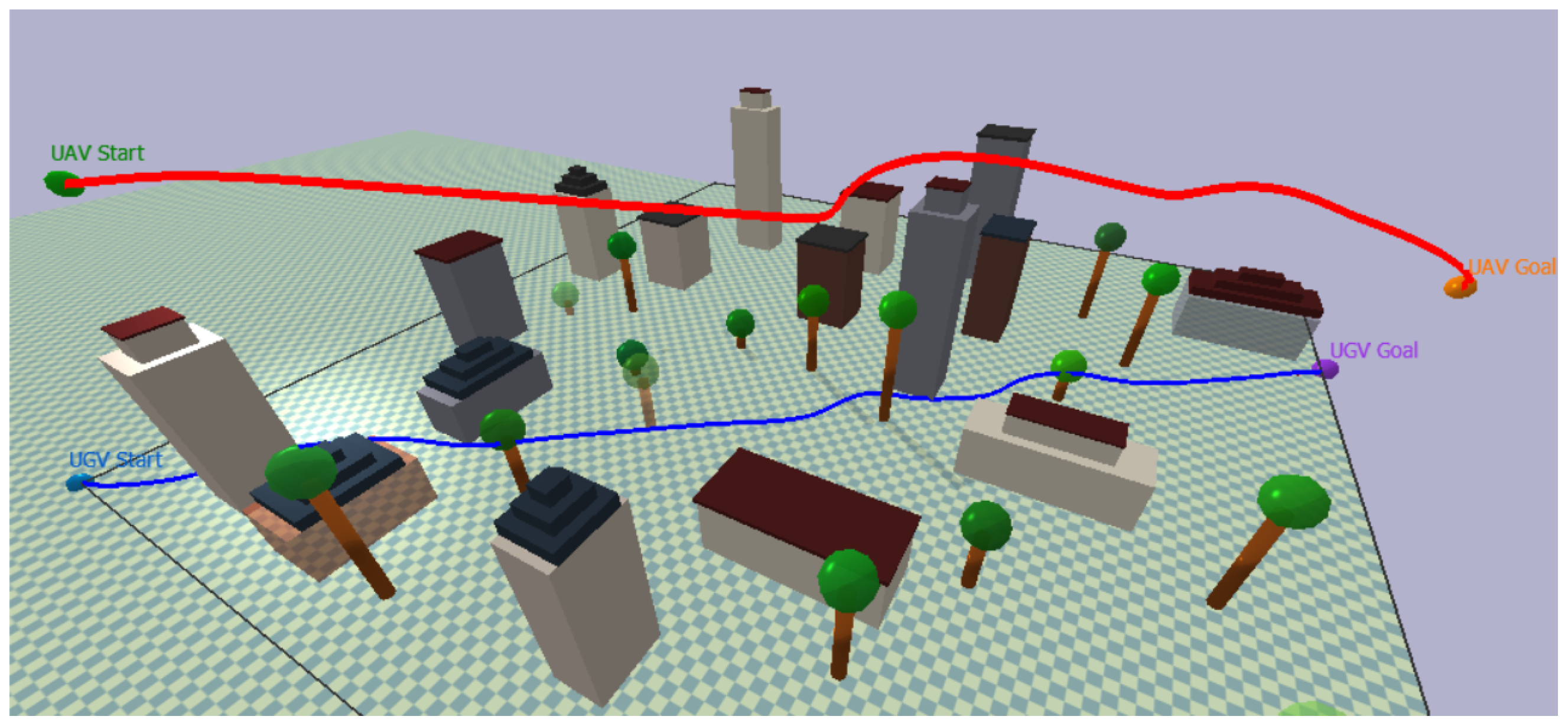
Systematic simulations were conducted in the PyBullet engine to validate the effectiveness of the proposed LOS-maintained cooperative motion method. The simulated environments consist of 3D workspaces with heterogeneous obstacle configurations, posing challenges to both collision avoidance and LOS connectivity. In these scenarios, the UAV advances ahead of the UGV to conduct forward reconnaissance, enabling earlier awareness of potential occlusions, as illustrated in Figure 7 and Figure 8.
Figure 7.
Simulation snapshot of the UAV-UGV cooperative platforms with an initial forward offset (horizontal projection), where the desired inter-agent distance is regulated to .
Figure 8.
Simulation snapshot demonstrating the UAV advancing ahead of the UGV with an initial forward offset (horizontal projection), enabling earlier obstacle observation while maintaining the regulated distance .
Both platforms start from prescribed initial configurations and navigate toward designated goal points under the same LOS constraints and environmental settings. Simulations are executed with a fixed time step of for up to 4000 steps (i.e., a maximum duration of ). A fixed random seed is used to ensure reproducible environments and fair comparisons. The simulation and controller parameters are summarized in Table 3. All simulations and evaluations were performed on a workstation equipped with a 12th Gen Intel(R) Core(TM) i7-12700H CPU (14 cores/20 threads) and 16 GB RAM (x64-based system).
Table 3.
Key simulation and controller parameters used throughout the experiments.
3.4. Performance Comparison with Existing Methods
A comparative analysis is conducted against three classical local obstacle-avoidance planners: the Artificial Potential Field (APF) method [39,40], the Velocity Obstacle (VO) method [41,42], and the Dynamic Window Approach (DWA) [43,44]. Briefly, APF steers the agent by combining goal-attractive and obstacle-repulsive potentials; VO selects a collision-free command by reasoning about the set of collision-inducing velocities in velocity space; and DWA evaluates short-horizon rollouts over admissible samples within dynamic bounds. All three baseline planners (including their LOS-augmented variants, denoted APF-LOS/VO-LOS/DWA-LOS) are implemented by the authors in the same simulation and velocity-level control loop to ensure a fair and reproducible comparison. Detailed implementations are provided below. Consistent with the forward reconnaissance configuration, the UAV advances ahead of the UGV to provide situational awareness.
To ensure a valid and reproducible comparison, all baseline planners are implemented in the same velocity-level control loop and evaluated in the same environment, using an identical obstacle representation and collision-checking routine. Unless otherwise noted, the simulation time step is fixed to with a maximum of 4000 steps, and speed limits are set to (UAV) and (UGV). In addition to sharing the same control loop and environment, every compared method uses the identical simulation time step and the same termination condition.
Moreover, to ensure a consistent treatment of LOS across methods, we adopt a unified LOS assessment metric and evaluation protocol for the proposed method and all baselines. At each control update, we compute and its normalized form as defined in Section 2.2. For any control input considered at the current update, LOS quality is evaluated over the same short-horizon prediction model under the unified as
where are predicted states obtained by applying for H steps using the same forward model. Accordingly, VO-LOS assigns an LOS term based on to each candidate velocity and incorporates it into candidate scoring; DWA-LOS assigns an LOS cost based on to each sampled rollout and incorporates it into rollout evaluation; APF-LOS evaluates the synthesized velocity command using the same and uses it to scale the LOS-induced component in the velocity synthesis; and the proposed method evaluates the LOS quality of its generated command using the same (with the same and H) and uses it to regulate its LOS-related decision term at each update. This unified protocol ensures that all methods are compared using the same LOS metric, the same prediction horizon H, and the same environment, while each method preserves its native obstacle-avoidance principle.
The desired inter-agent separation is set to , and the UGV motion is constrained to the ground plane; all velocity outputs are saturated to satisfy the same motion bounds used in this comparative study.
For DWA-LOS, we follow a standard dynamic-window procedure [45]: a dynamic window for linear and angular velocities is constructed from the current velocity and acceleration bounds, candidate controls are uniformly sampled within the window, and each candidate is evaluated via short-horizon rollouts under the unified . The total cost is a weighted sum of goal-reaching error, obstacle clearance along the rollout, velocity preference, and an LOS term computed from . In our implementation, the relative weights are set to for goal/obstacle/velocity/LOS terms.
For VO-LOS, we implement a sampling-based velocity-obstacle scheme [46]: 64 candidate velocities are generated around the goal-directed desired direction using multiple speed levels, and candidates leading to collision are rejected via a short forward simulation under the unified (with prediction steps). The final command is selected by maximizing a weighted score combining direction alignment, obstacle safety margin, speed preference, and an LOS-maintenance score computed from .
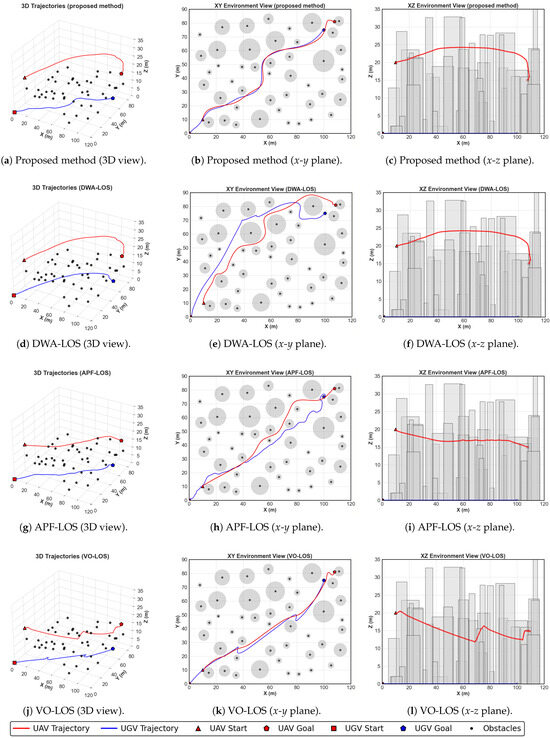
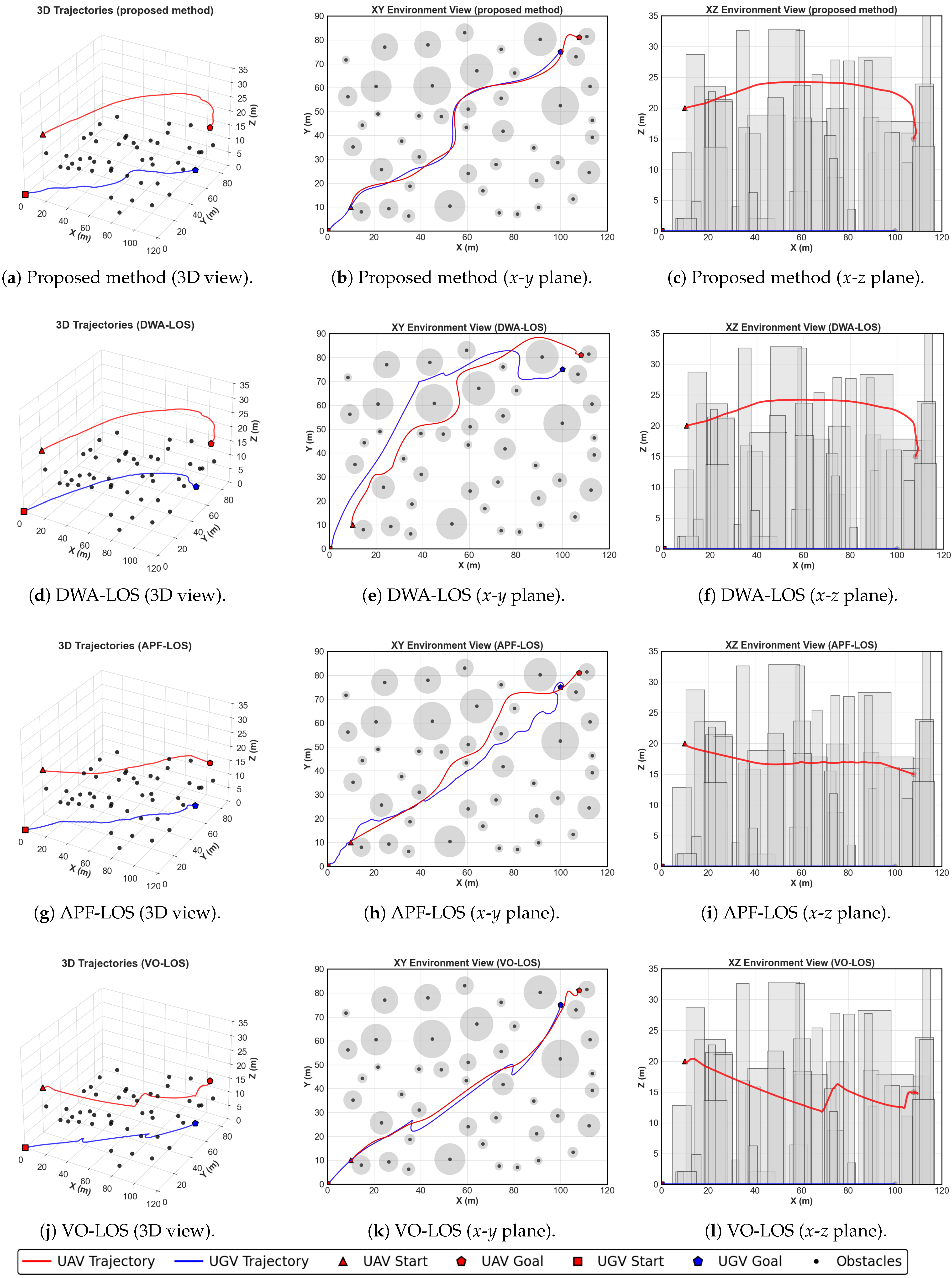
For APF-LOS, the velocity command is obtained by superposing a goal-attractive term, an obstacle-repulsive term with finite influence range, and an LOS-maintenance term [47]; we use , , , and a repulsive influence radius . LOS maintenance is enforced by distance regularization with a deadband: if the LOS term attracts, if it repels, otherwise it is set to zero. The resultant force is normalized and saturated by the same speed limits, and the UGV vertical component is set to zero. A comprehensive comparison of the methods is shown in Figure 9.
Figure 9.
Trajectory comparison under a consistent LOS evaluation protocol. Each row shows UAV–UGV cooperative trajectories using different algorithms.
Experimental results indicate that under the consistent LOS evaluation protocol, conventional methods encounter significant limitations, necessitating trade-offs among trajectory smoothness and computational efficiency, as summarized in Table 4. To explicitly quantify the cost–gain trade-off, we additionally report the metric (ms/m), i.e., the total computation time required to produce one meter of trajectory. The APF-LOS method exhibits trajectory oscillations in complex environments, consistent with the competition among goal attraction, obstacle repulsion, and LOS distance regularization in cluttered scenes. Although its per-step computation is low (), its trajectory quality degrades notably (smoothness ), and the resulting cost per meter is higher (). The DWA-LOS method generates smoother motion; however, it incurs a longer runtime () due to sampling and rollout-based evaluation, leading to a substantially increased . The VO-LOS method yields the shortest path length () and the best smoothness, but it imposes a prohibitive computational cost ( per step), which further results in an extremely large , limiting real-time applicability.
Table 4.
Performance comparison between the proposed method and baseline algorithms under a consistent LOS evaluation protocol (optimal values in bold). We additionally report a cost–gain metric, the total computation time required to produce one meter of trajectory.
From a cost–gain perspective, the proposed method achieves the lowest (), corresponding to a reduction of , , and compared with APF-LOS, DWA-LOS, and VO-LOS, respectively, while maintaining competitive trajectory quality (e.g., its path length is within of VO-LOS and the smoothness difference is marginal).
In contrast, the proposed method demonstrates superior performance by managing the UAV-ahead configuration. It maintains continuous LOS connectivity while achieving high computational efficiency, with a total time of , a single-step time of , and the lowest cost per meter in Table 4, indicating a more favorable cost–gain balance for real-time deployment.
The above step time is obtained under the default setting of anchor points. We further vary while keeping the same hardware, environment, and code path. Table 5 reports the measured mean and P95 step time, showing that the runtime increases monotonically with .
Table 5.
Measured step time versus the number of anchor points .
Furthermore, the method ensures trajectory smoothness, characterized by average turning angles of for the UAV and for the UGV, completing the task within 462 steps. These results confirm that the proposed approach effectively balances smoothness and real-time performance under LOS-constrained cooperative navigation scenarios.
4. Conclusions
This paper proposes a cooperative control framework based on dynamically modulated matrices to ensure strictly maintained LOS connectivity for UAV–UGV forward reconnaissance missions. By mapping real-time environmental occlusion risks to the eigenvalues of the modulation matrices, the nominal velocity vectors of the heterogeneous pair are actively reshaped, enabling proactive kinematic adjustments to prevent signal blockage in complex environments. Theoretical analysis confirms the asymptotic stability of the system, while comparative simulations validate that the proposed strategy significantly outperforms conventional obstacle avoidance algorithms in terms of safety, trajectory smoothness, and computational efficiency. Future work will extend this framework to address inevitable NLOS scenarios by incorporating an intermediate aerial relay node, thereby establishing a three-agent multi-hop LOS chain to restore and sustain LOS connectivity in severely occluded terrains.
Author Contributions
Conceptualization, B.H.; methodology, X.W.; software, X.W.; validation, B.H., X.W. and Y.C.; formal analysis, B.H.; investigation, B.H.; resources, Y.C.; data curation, X.W.; writing—original draft preparation, X.W.; writing—review and editing, B.H.; visualization, X.W.; supervision, Y.C., D.W. and Z.F.; project administration, Y.C.; funding acquisition, B.H. and Y.C. All authors have read and agreed to the published version of the manuscript.
Funding
This work was funded by the National Natural Science Foundation of China Youth Program under Grants No. 62003363 and No. 62303485, by the Shaanxi Province Natural Science Basic Research Program under Grant No. 2022KJXX-99, by the Fundamental and Frontier Innovation Program under Grant No. 2025-QYCX-ZD-03-026, and by the Natural Science Basic Research Plan in Shaanxi Province of China under Grant No. 2025-JC-YBMS-730.
Institutional Review Board Statement
Not applicable.
Informed Consent Statement
Not applicable.
Data Availability Statement
The data presented in this study are available on request from the corresponding author.
Conflicts of Interest
The authors declare no conflicts of interest.
References
- Munasinghe, I.; Perera, A.; Deo, R.C. A comprehensive review of uav-ugv collaboration: Advancements and challenges. J. Sens. Actuator Netw. 2024, 13, 81. [Google Scholar] [CrossRef] [Scilit]
- Farrell, S.; Li, C.; Yu, H.; Mojtahedi, H.; Gao, S.; Christensen, H.I. GLIDE: A Coordinated Aerial-Ground Framework for Search and Rescue in Unknown Environments. arXiv 2025, arXiv:2509.14210. [Google Scholar] [CrossRef] [Scilit]
- Zhao, F.; Sun, Y.; Lan, J.; Zhang, L.; Liu, X.; Imran, M.A. Adaptive Semantic Communication for UAV/UGV Cooperative Path Planning. arXiv 2025, arXiv:2510.06901. [Google Scholar] [CrossRef] [Scilit]
- Xiao, J. Vision-Based Learning for Drones in Collaborative and Adversarial Environments. Doctoral Thesis, Nanyang Technological University, Singapore, 2024. [Google Scholar]
- Xu, S.; Zhou, Z.; Liu, H.; Zhang, X.; Li, J.; Gao, H. A path planning method for collaborative coverage monitoring in urban scenarios. Remote Sens. 2024, 16, 1152. [Google Scholar] [CrossRef] [Scilit]
- Wang, Q.; Chen, H.; Qiao, L.; Tian, J.; Su, Y. Path planning for UAV/UGV collaborative systems in intelligent manufacturing. IET Intell. Transp. Syst. 2020, 14, 1475–1483. [Google Scholar] [CrossRef] [Scilit]
- Xu, C.; Xu, M.; Yin, C. Optimized multi-UAV cooperative path planning under the complex confrontation environment. Comput. Commun. 2020, 162, 196–203. [Google Scholar] [CrossRef] [Scilit]
- Chen, Y.; Liu, X.; Zhu, B.; Zhu, D.; Zuo, X.; Li, Q. UAV Image-Based 3D Reconstruction Technology in Landslide Disasters: A Review. Remote Sens. 2025, 17, 3117. [Google Scholar] [CrossRef] [Scilit]
- Ma, Z.; Xiong, J.; Gong, H.; Wang, X. Adaptive Depth Graph Neural Network-based Dynamic Task Allocation for UAV-UGVs Under Complex Environments. IEEE Trans. Intell. Veh. 2025, 10, 3573–3586. [Google Scholar] [CrossRef] [Scilit]
- Thelasingha, N.; Julius, A.A.; Humann, J.; Reddinger, J.P.; Dotterweich, J.; Childers, M. Iterative planning for multi-agent systems: An application in energy-aware uav-ugv cooperative task site assignments. IEEE Trans. Autom. Sci. Eng. 2024, 22, 3685–3703. [Google Scholar] [CrossRef] [Scilit]
- Oubbati, O.S.; Alotaibi, J.; Alromithy, F.; Atiquzzaman, M.; Altimania, M.R. A UAV-UGV Cooperative System: Patrolling and Energy Management for Urban Monitoring. IEEE Trans. Veh. Technol. 2025, 74, 13521–13536. [Google Scholar] [CrossRef] [Scilit]
- Wen, M.; Guo, Y.; Qiu, C.; Ren, B.; Zhang, M.; Luo, X. Gemini: A Cascaded Dual-Agent DRL Framework for Task Chain Planning in UAV-UGV Collaborative Disaster Rescue. Drones 2025, 9, 492. [Google Scholar] [CrossRef] [Scilit]
- Wei, C.; Li, Y.; Ouyang, Y.; Ji, Z. Deep reinforcement learning with heuristic corrections for UGV navigation. J. Intell. Robot. Syst. 2023, 109, 18. [Google Scholar] [CrossRef] [Scilit]
- Li, H.; Qiang, L.; Wu, Z.; Chen, J.; Sun, Y.; Li, X. MPC-ABCO: An MPC-Based Adaptive Bezier Curve Optimization Framework for UAV-UGV Cooperative Landing. IEEE Robot. Autom. Lett. 2025, 10, 11134–11140. [Google Scholar] [CrossRef] [Scilit]
- Tang, H.; Chen, Y.; Ali, I. Secure distributed model predictive control for heterogeneous uav-ugv formation under dos attacks. IEEE Trans. Intell. Veh. 2025, 10, 3504–3516. [Google Scholar] [CrossRef] [Scilit]
- Khan, S.; Guivant, J.; Li, Y.; Liu, W.; Li, X. Hybrid model predictive control for unmanned ground vehicles. IEEE Trans. Intell. Veh. 2023, 9, 1537–1546. [Google Scholar] [CrossRef] [Scilit]
- Anderson, S.O.; Simmons, R.; Golberg, D. Maintaining Line of Sight Communications Networks between Planetary Rovers. In Proceedings 2003 IEEE/RSJ International Conference on Intelligent Robots and Systems (IROS 2003); IEEE: Piscataway, NJ, USA, 2003; Volume 3, pp. 2266–2272. [Google Scholar]
- Rooker, M.N.; Birk, A. Multi-robot exploration under the constraints of wireless networking. Control Eng. Pract. 2007, 15, 435–445. [Google Scholar] [CrossRef] [Scilit]
- Tardioli, D.; Riazuelo, L.; Sicignano, D.; Rizzo, C.; Lera, F.; Villarroel, J.L.; Montano, L. Ground robotics in tunnels: Keys and lessons learned after 10 years of research and experiments. J. Field Robot. 2019, 36, 1074–1101. [Google Scholar] [CrossRef] [Scilit]
- Luo, J.; Wang, Z.; Xia, M.; Wu, L.; Tian, Y.; Chen, Y. Path planning for UAV communication networks: Related technologies, solutions, and opportunities. ACM Comput. Surv. 2023, 55, 193. [Google Scholar] [CrossRef] [Scilit]
- Debnath, D.; Vanegas, F.; Sandino, J.; Hawary, A.F.; Gonzalez, F. A review of UAV path-planning algorithms and obstacle avoidance methods for remote sensing applications. Remote Sens. 2024, 16, 4019. [Google Scholar] [CrossRef] [Scilit]
- Dixon, C.; Frew, E.W. Decentralized extremum-seeking control of nonholonomic vehicles to form a communication chain. In Advances in Cooperative Control and Optimization: Proceedings of the 7th International Conference on Cooperative Control and Optimization; Springer: Berlin/Heidelberg, Germany, 2007; pp. 311–322. [Google Scholar]
- Zhou, L.; Ma, H.; Yang, Z.; Zhou, S.; Zhang, W. Unmanned aerial vehicle communications: Path-loss modeling and evaluation. IEEE Veh. Technol. Mag. 2020, 15, 121–128. [Google Scholar] [CrossRef] [Scilit]
- Zhang, W.T.; Chi, M.; Liu, Z.W.; Xu, J.Z. Dynamic optimal formation control for mobile vehicles with minimizing communication path loss under topology switching. IEEE Trans. Intell. Veh. 2025, 10, 573–583. [Google Scholar] [CrossRef] [Scilit]
- Grøtli, E.I.; Johansen, T.A. Path planning for UAVs under communication constraints using SPLAT! and MILP. J. Intell. Robot. Syst. 2012, 65, 265–282. [Google Scholar] [CrossRef] [Scilit]
- Zeng, Y.; Xu, J.; Zhang, R. Energy minimization for wireless communication with rotary-wing UAV. IEEE Trans. Wirel. Commun. 2019, 18, 2329–2345. [Google Scholar] [CrossRef] [Scilit]
- Aggravi, M.; Sirignano, G.; Giordano, P.R.; Pacchierotti, C. Decentralized Control of a Heterogeneous Human–Robot Team for Exploration and Patrolling. IEEE Trans. Autom. Sci. Eng. 2022, 19, 3109–3125. [Google Scholar] [CrossRef] [Scilit]
- Wichmann, A.; Korkmaz, T.; Tosun, A.S. Robot control strategies for task allocation with connectivity constraints in wireless sensor and robot networks. IEEE Trans. Mob. Comput. 2017, 17, 1429–1441. [Google Scholar] [CrossRef] [Scilit]
- Tuck, V.; Pant, Y.V.; Seshia, S.A.; Sastry, S.S. DEC-LOS-RRT: Decentralized path planning for multi-robot systems with line-of-sight constrained communication. In Proceedings of the 2021 IEEE Conference on Control Technology and Applications (CCTA); IEEE: Piscataway, NJ, USA, 2021; pp. 103–110. [Google Scholar]
- Yang, Y.; Lyu, Y.; Luo, W. Minimally constrained multi-robot coordination with line-of-sight connectivity maintenance. arXiv 2023, arXiv:2303.04271. [Google Scholar]
- Shkurti, F.; Dudek, G. Maximizing visibility in collaborative trajectory planning. In Proceedings of the 2014 IEEE International Conference on Robotics and Automation (ICRA); IEEE: Piscataway, NJ, USA, 2014; pp. 3771–3776. [Google Scholar]
- Wang, J.; Wu, Y.X.; Chen, Y.Q.; Ju, S. Multi-UAVs collaborative tracking of moving target with maximized visibility in urban environment. J. Frankl. Inst. 2022, 359, 5512–5532. [Google Scholar] [CrossRef] [Scilit]
- Klodt, L.; Khodaverdian, S.; Willert, V. Motion Control for UAV–UGV Cooperation with Visibility Constraint. In 2015 IEEE Conference on Control Applications (CCA); IEEE: Piscataway, NJ, USA, 2015; pp. 1379–1385. [Google Scholar]
- Bisht, V. Visibility-Constrained Path Planning for Unmanned Aerial Vehicles. Ph.D. Thesis, Cornell University, Ithaca, NY, USA, 2023. [Google Scholar]
- Liu, X.; Ge, S.S.; Goh, C.H. Vision-Based Leader–Follower Formation Control of Multiagents with Visibility Constraints. IEEE Trans. Control Syst. Technol. 2019, 27, 1326–1333. [Google Scholar] [CrossRef] [Scilit]
- Pritzl, V.; Vrba, M.; Stasinchuk, Y.; Krátkỳ, V.; Horyna, J.; Štěpán, P.; Saska, M. Drones guiding drones: Cooperative navigation of a less-equipped micro aerial vehicle in cluttered environments. In Proceedings of the 2024 IEEE/RSJ International Conference on Intelligent Robots and Systems (IROS); IEEE: Piscataway, NJ, USA, 2024; pp. 10597–10604. [Google Scholar]
- Masnavi, H.; Shrestha, J.; Kruusamäe, K.; Singh, A.K. VACNA: Visibility-aware cooperative navigation with application in inventory management. IEEE Robot. Autom. Lett. 2023, 8, 7114–7121. [Google Scholar] [CrossRef] [Scilit]
- Yang, Y.; Lyu, Y.; Zhang, Y.; Yi, S.; Luo, W. Decentralized Multi-Robot Line-of-Sight Connectivity Maintenance under Uncertainty. In Proceedings of the Robotics: Science and Systems 2024, Delft, The Netherlands, 15–19 July 2024. [Google Scholar]
- Duan, Y.; Yang, C.; Zhu, J.; Meng, Y.; Liu, X. Active obstacle avoidance method of autonomous vehicle based on improved artificial potential field. Int. J. Adv. Robot. Syst. 2022, 19. [Google Scholar] [CrossRef] [Scilit]
- Li, W.; Wang, Y.; Zhu, S.; Xiao, J.; Chen, S.; Guo, J.; Ren, D.; Wang, J. Path tracking and local obstacle avoidance for automated vehicle based on improved artificial potential field. Int. J. Control. Autom. Syst. 2023, 21, 1644–1658. [Google Scholar] [CrossRef] [Scilit]
- Liu, W.; Zhang, B.; Liu, P.; Pan, J.; Chen, S. Velocity obstacle guided motion planning method in dynamic environments. J. King Saud Univ.-Comput. Inf. Sci. 2024, 36, 101889. [Google Scholar] [CrossRef] [Scilit]
- Huang, J.; Zeng, J.; Chi, X.; Sreenath, K.; Liu, Z.; Su, H. Velocity obstacle for polytopic collision avoidance for distributed multi-robot systems. IEEE Robot. Autom. Lett. 2023, 8, 3502–3509. [Google Scholar] [CrossRef] [Scilit]
- Kim, J.; Yang, G.H. Improvement of dynamic window approach using reinforcement learning in dynamic environments. Int. J. Control. Autom. Syst. 2022, 20, 2983–2992. [Google Scholar] [CrossRef] [Scilit]
- Yao, M.; Deng, H.; Feng, X.; Li, P.; Li, Y.; Liu, H. Improved dynamic windows approach based on energy consumption management and fuzzy logic control for local path planning of mobile robots. Comput. Ind. Eng. 2024, 187, 109767. [Google Scholar] [CrossRef] [Scilit]
- Fox, D.; Burgard, W.; Thrun, S. The dynamic window approach to collision avoidance. IEEE Robot. Autom. Mag. 2002, 4, 23–33. [Google Scholar] [CrossRef] [Scilit]
- Fiorini, P.; Shiller, Z. Motion planning in dynamic environments using velocity obstacles. Int. J. Robot. Res. 1998, 17, 760–772. [Google Scholar] [CrossRef] [Scilit]
- Khatib, O. Real-time obstacle avoidance for manipulators and mobile robots. In Proceedings. 1985 IEEE International Conference on Robotics and Automation; IEEE: Piscataway, NJ, USA, 1985; Volume 2, pp. 500–505. [Google Scholar]

Disclaimer/Publisher’s Note: The statements, opinions and data contained in all publications are solely those of the individual author(s) and contributor(s) and not of MDPI and/or the editor(s). MDPI and/or the editor(s) disclaim responsibility for any injury to people or property resulting from any ideas, methods, instructions or products referred to in the content. |
© 2026 by the authors. Licensee MDPI, Basel, Switzerland. This article is an open access article distributed under the terms and conditions of the Creative Commons Attribution (CC BY) license.