
A Visual Target Navigation Method for Quadrotor Based on Large Language Model in Unknown Environment



Highlights
- We propose a hierarchical prompt engineering framework that systematically integrates task instructions, scene prior knowledge, role definitions, and demonstration examples into structured prompt templates.
- We propose a novel integration method that bridges LLMs with quadrotor visual target navigation tasks, addressing the long-standing gap between natural language understanding and autonomous quadrotor navigation.
Abstract
1. Introduction
- We propose a hierarchical prompt engineering framework that systematically integrates task instructions, scene prior knowledge, role definitions, and demonstration examples into structured prompt templates. This design effectively guides LLMs in task comprehension and reliably meets downstream quadrotor navigation requirements.
- We develop a novel active search decision-making approach that integrates dataset-derived prior probabilities with LLMs. By jointly leveraging these two knowledge sources for search direction selection, our method achieves efficient target search in unknown environments, and its effectiveness is further validated through physical experiments.
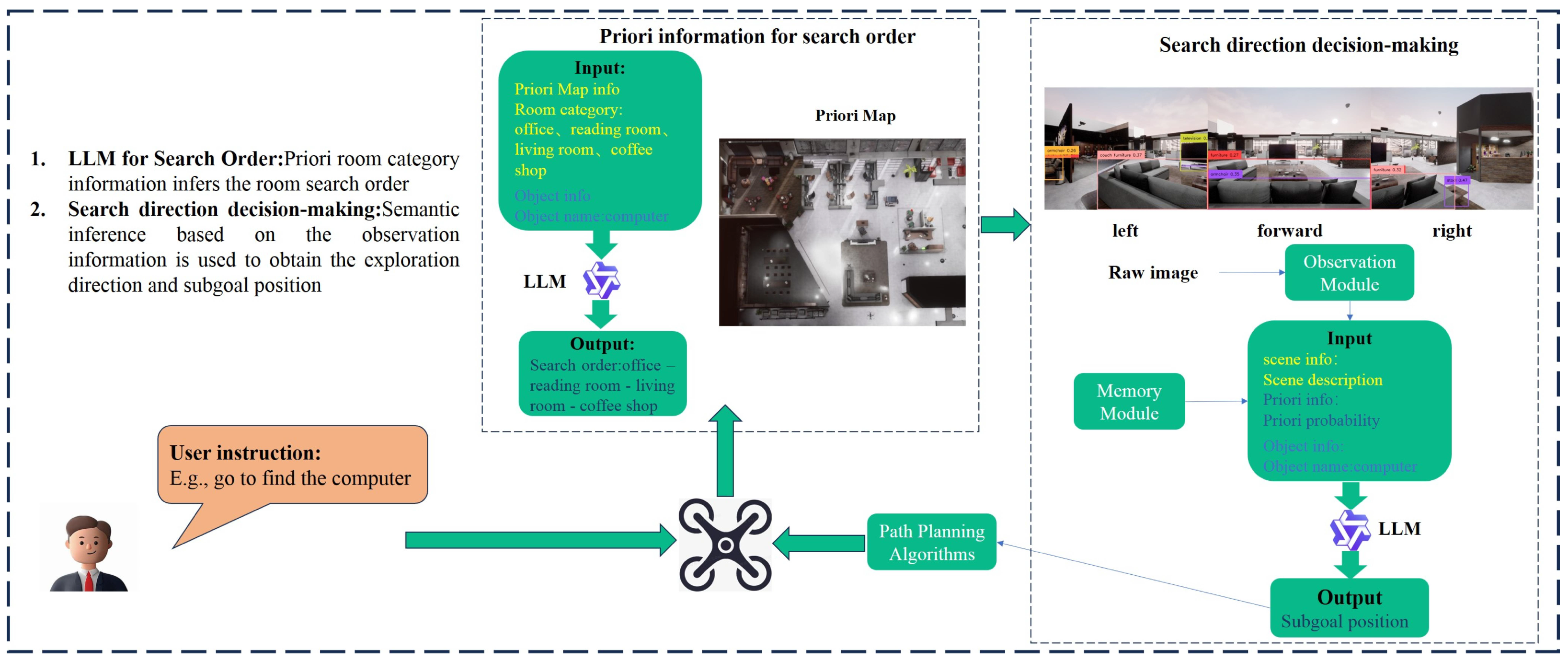
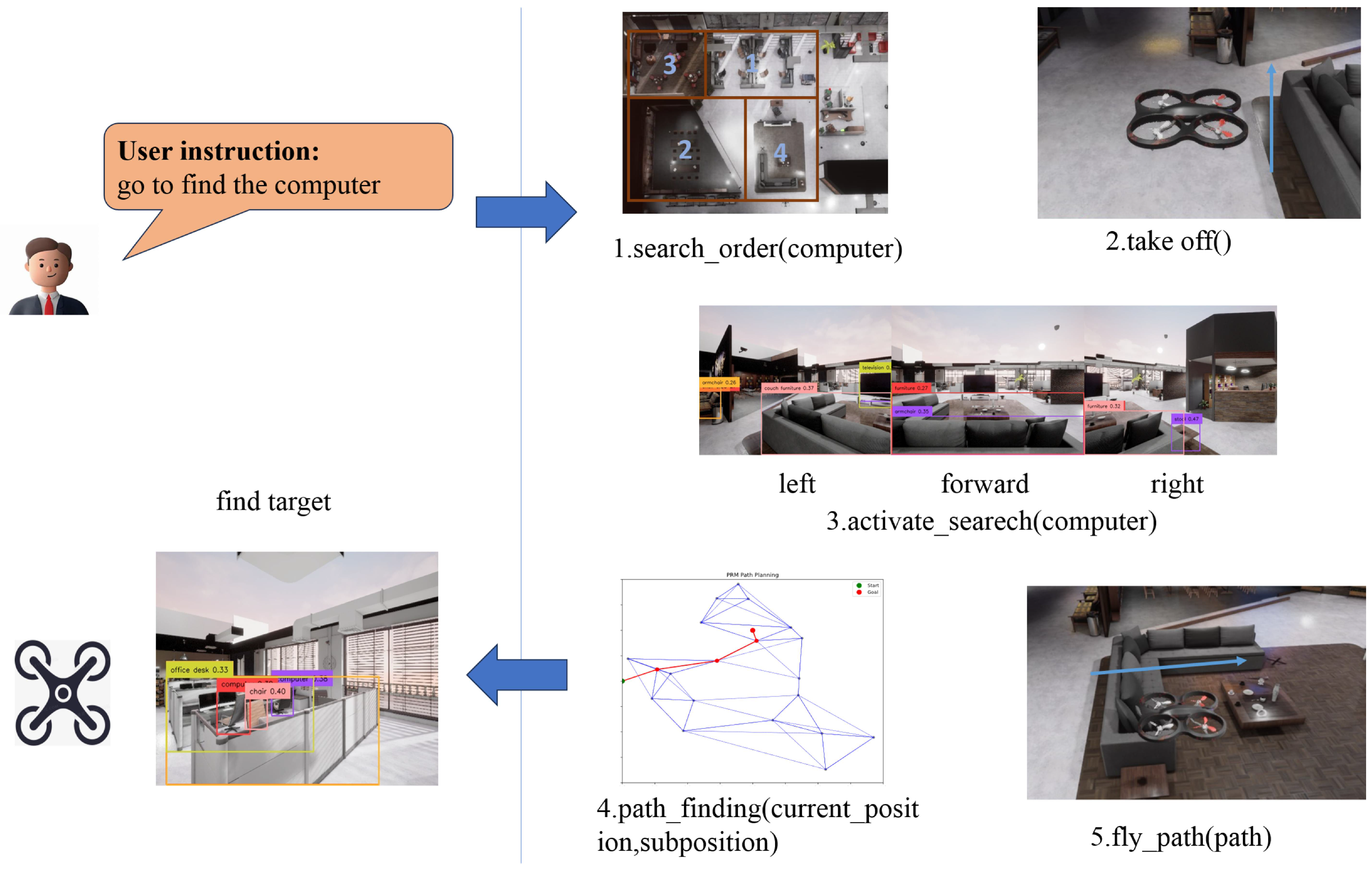
- We propose a novel integration method that bridges LLMs with quadrotor visual target navigation tasks, addressing the long-standing gap between natural language understanding and autonomous quadrotor navigation. This method is elaborated in Section 3, and its effectiveness is experimentally demonstrated in Section 4.
2. Related Works
2.1. LLM for Robot Control
2.2. Visual Target Navigation
3. Proposed Method
3.1. Overview
3.2. Priori Information for Search Order
3.3. Search Direction Decision-Making
| Algorithm 1 Search Direction Decision-Making |
|
3.3.1. Prior Probabilities for Search Direction
3.3.2. LLM for Search Direction
3.3.3. Fusing Prior Probabilities with LLM for Search Direction
| Algorithm 2 Fusion Strategy |
|
4. Experiments
4.1. Airsim-Based Simulation Experiments
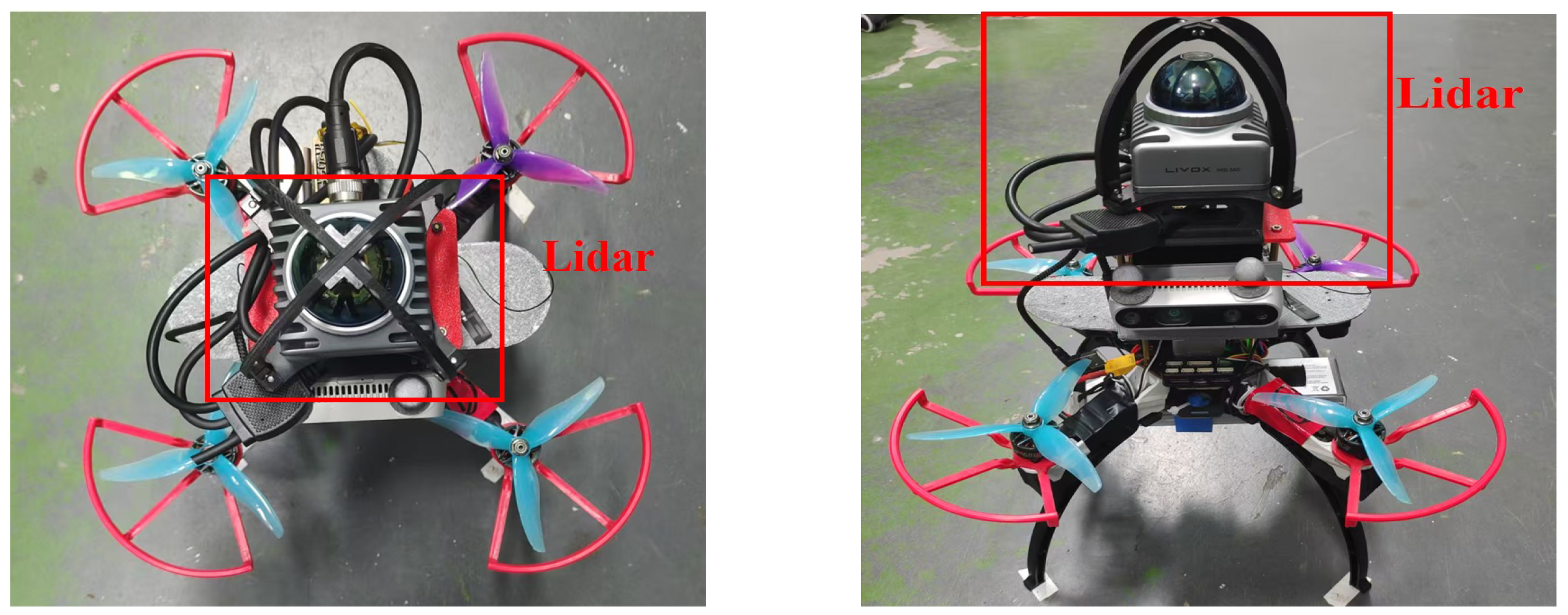
4.2. Physical Flight Experiments
4.2.1. Customized Indoor Scenes
- (1)
- Decision Program Anomalies: The large language model occasionally generated abnormal navigation decisions beyond predefined area labels.
- (2)
- Small-Target Detection Limits: When distant and small targets (e.g., oranges) were undetected by the perception module, premature region-completion decisions misled the quadrotor to the next area.
- (3)
- Localization System Failures: Near walls, motion capture system occlusion caused signal degradation or loss, risking collisions.
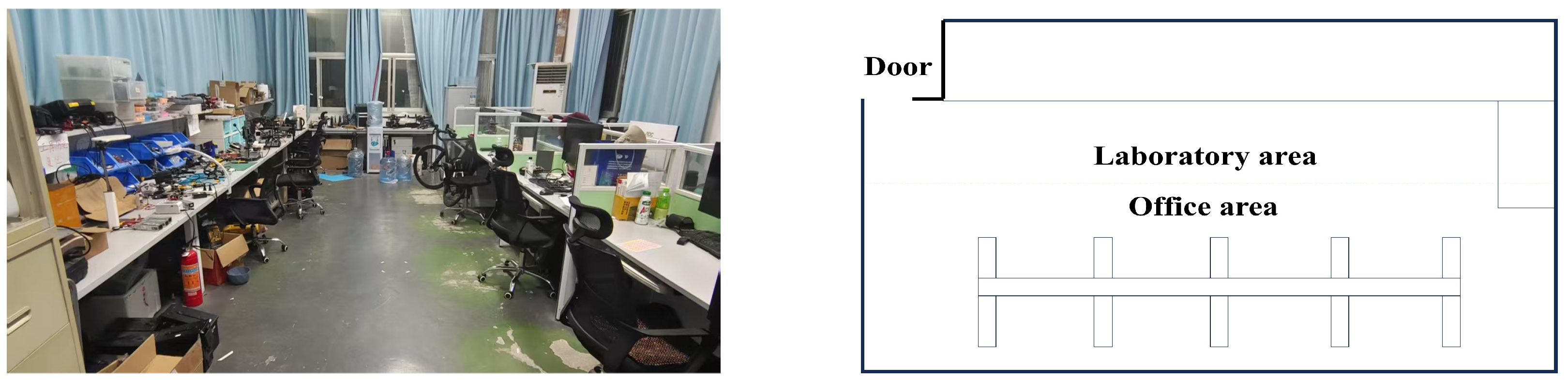
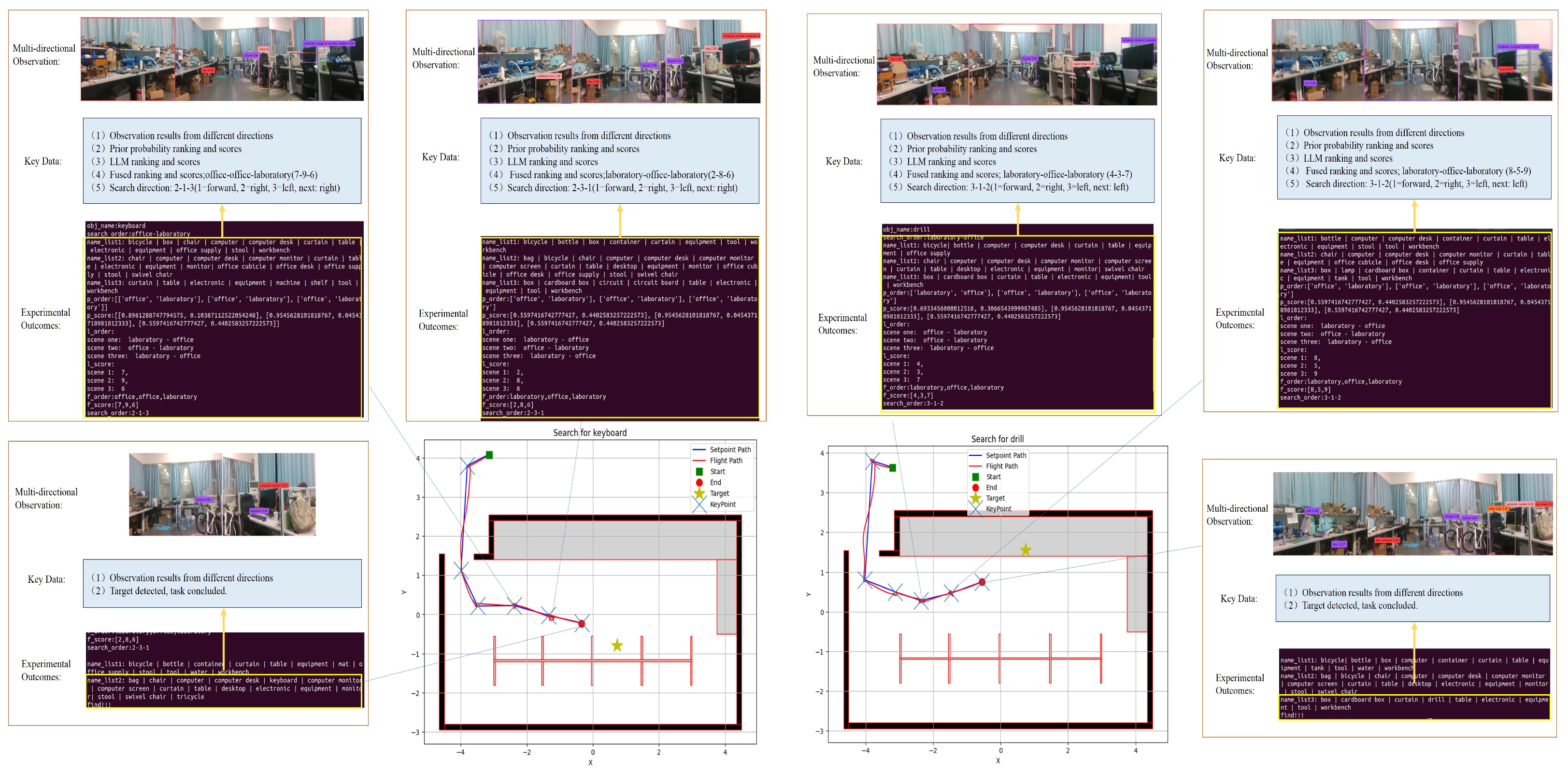
4.2.2. Indoor Structured Environment
4.3. Failure Analysis
5. Conclusions
Author Contributions
Funding
Data Availability Statement
Acknowledgments
Conflicts of Interest
Appendix A. Prompt Engineering Templates
Appendix A.1. Global Search Sequence Prompt
- (1)
- System Instruction
- (2)
- User Input Example
- (3)
- Model Output Requirement
Appendix A.2. Local Search Direction Prompt
- (1)
- System Instruction
- (2)
- User Input Example
- (3)
- Model Output Requirement
- (1)
- System Instruction
- (2)
- User Input Example
- (3)
- Model Output Requirement
Appendix A.3. Autonomous Control Agent Prompt
- (1)
- System Instruction
- (2)
- Key Function Definitions Provided
- (3)
- Task Logic Instruction
References
- Chaplot, D.S.; Gandhi, D.P.; Gupta, A.; Salakhutdinov, R.R. Object goal navigation using goal-oriented semantic exploration. Adv. Neural Inf. Process. Syst. 2020, 33, 4247–4258. [Google Scholar]
- Gervet, T.; Chintala, S.; Batra, D.; Malik, J.; Chaplot, D.S. Navigating to objects in the real world. Sci. Robot. 2023, 8, eadf6991. [Google Scholar] [CrossRef] [PubMed]
- Dharmadhikari, M.; Dang, T.; Solanka, L.; Loje, J.; Nguyen, H.; Khedekar, N.; Alexis, K. Motion primitives-based path planning for fast and agile exploration using aerial robots. In Proceedings of the 2020 IEEE International Conference on Robotics and Automation (ICRA); IEEE: New York, NY, USA, 2020; pp. 179–185. [Google Scholar]
- Yang, W.; Wang, X.; Farhadi, A.; Gupta, A.; Mottaghi, R. Visual semantic navigation using scene priors. arXiv 2018, arXiv:1810.06543. [Google Scholar] [CrossRef]
- Devlin, J.; Chang, M.W.; Lee, K.; Toutanova, K. Bert: Pre-training of deep bidirectional transformers for language understanding. In Proceedings of the 2019 Conference of the North American Chapter of the Association for Computational Linguistics: Human Language Technologies, Minneapolis, MN, USA, 2–7 June 2019; pp. 4171–4186. [Google Scholar]
- Brown, T.; Mann, B.; Ryder, N.; Subbiah, M.; Kaplan, J.D.; Dhariwal, P.; Neelakantan, A.; Shyam, P.; Sastry, G.; Askell, A.; et al. Language models are few-shot learners. Adv. Neural Inf. Process. Syst. 2020, 33, 1877–1901. [Google Scholar]
- Achiam, J.; Adler, S.; Agarwal, S.; Ahmad, L.; Akkaya, I.; Aleman, F.L.; Almeida, D.; Altenschmidt, J.; Altman, S.; Anadkat, S.; et al. Gpt-4 technical report. arXiv 2023, arXiv:2303.08774. [Google Scholar] [CrossRef]
- Liu, B.; Jiang, Y.; Zhang, X.; Liu, Q.; Zhang, S.; Biswas, J.; Stone, P. Llm+ p: Empowering large language models with optimal planning proficiency. arXiv 2023, arXiv:2304.11477. [Google Scholar] [CrossRef]
- Silver, T.; Hariprasad, V.; Shuttleworth, R.S.; Kumar, N.; Lozano-Pérez, T.; Kaelbling, L.P. PDDL planning with pretrained large language models. In Proceedings of the NeurIPS 2022 Foundation Models for Decision Making Workshop, New Orleans, LA, USA, 3 December 2022. [Google Scholar]
- Xie, Y.; Yu, C.; Zhu, T.; Bai, J.; Gong, Z.; Soh, H. Translating natural language to planning goals with large-language models. arXiv 2023, arXiv:2302.05128. [Google Scholar] [CrossRef]
- Kim, B.; Kim, J.; Kim, Y.; Min, C.; Choi, J. Context-aware planning and environment-aware memory for instruction following embodied agents. In Proceedings of the IEEE/CVF International Conference on Computer Vision, Paris, France, 1–6 October 2023; pp. 10936–10946. [Google Scholar]
- Hu, Y.; Lin, F.; Zhang, T.; Yi, L.; Gao, Y. Look before you leap: Unveiling the power of gpt-4v in robotic vision-language planning. arXiv 2023, arXiv:2311.17842. [Google Scholar]
- Zhu, M.; Zhu, Y.; Li, J.; Wen, J.; Xu, Z.; Che, Z.; Shen, C.; Peng, Y.; Liu, D.; Feng, F.; et al. Language-conditioned robotic manipulation with fast and slow thinking. In Proceedings of the 2024 IEEE International Conference on Robotics and Automation (ICRA); IEEE: New York, NY, USA, 2024; pp. 4333–4339. [Google Scholar]
- Yang, Y.; Neary, C.; Topcu, U. Multimodal Pretrained Models for Verifiable Sequential Decision-Making: Planning, Grounding, and Perception. arXiv 2023, arXiv:2308.05295. [Google Scholar]
- Zhou, Z.; Song, J.; Yao, K.; Shu, Z.; Ma, L. Isr-llm: Iterative self-refined large language model for long-horizon sequential task planning. In Proceedings of the 2024 IEEE International Conference on Robotics and Automation (ICRA); IEEE: New York, NY, USA, 2024; pp. 2081–2088. [Google Scholar]
- Majumdar, A.; Shrivastava, A.; Lee, S.; Anderson, P.; Parikh, D.; Batra, D. Improving vision-and-language navigation with image-text pairs from the web. In Proceedings of the Computer Vision–ECCV 2020: 16th European Conference, Glasgow, UK, 23–28 August 2020; pp. 259–274. [Google Scholar]
- Shah, D.; Osiński, B.; Ichter, B.; Levine, S. Lm-nav: Robotic navigation with large pre-trained models of language, vision, and action. In Proceedings of the Conference on Robot Learning, Atlanta, GA, USA, 6–9 November 2023; pp. 492–504. [Google Scholar]
- Xie, Q.; Zhang, T.; Xu, K.; Johnson-Roberson, M.; Bisk, Y. Reasoning about the unseen for efficient outdoor object navigation. arXiv 2023, arXiv:2309.10103. [Google Scholar] [CrossRef]
- Chen, W.; Hu, S.; Talak, R.; Carlone, L. Leveraging large (visual) language models for robot 3D scene understanding. arXiv 2022, arXiv:2209.05629. [Google Scholar]
- Yu, B.; Kasaei, H.; Cao, M. L3mvn: Leveraging large language models for visual target navigation. In Proceedings of the 2023 IEEE/RSJ International Conference on Intelligent Robots and Systems (IROS); IEEE: New York, NY, USA, 2023; pp. 3554–3560. [Google Scholar]
- Zhang, Y.; Huang, X.; Ma, J.; Li, Z.; Luo, Z.; Xie, Y.; Qin, Y.; Luo, T.; Li, Y.; Liu, S.; et al. Recognize anything: A strong image tagging model. In Proceedings of the IEEE/CVF Conference on Computer Vision and Pattern Recognition, Seattle, WA, USA, 16–22 June 2024; pp. 1724–1732. [Google Scholar]
- Liu, S.; Zeng, Z.; Ren, T.; Li, F.; Zhang, H.; Yang, J.; Jiang, Q.; Li, C.; Yang, J.; Su, H.; et al. Grounding dino: Marrying dino with grounded pre-training for open-set object detection. In Proceedings of the European Conference on Computer Vision; Springer: Berlin/Heidelberg, Germany, 2025; pp. 38–55. [Google Scholar]
- Zhou, B.; Zhao, H.; Puig, X.; Fidler, S.; Barriuso, A.; Torralba, A. Scene parsing through ade20k dataset. In Proceedings of the IEEE Conference on Computer Vision and Pattern Recognition, Honolulu, HI, USA, 21–26 July 2017; pp. 633–641. [Google Scholar]
- Anderson, P.; Chang, A.; Chaplot, D.S.; Dosovitskiy, A.; Gupta, S.; Koltun, V.; Kosecka, J.; Malik, J.; Mottaghi, R.; Savva, M.; et al. On evaluation of embodied navigation agents. arXiv 2018, arXiv:1807.06757. [Google Scholar] [CrossRef]
- He, Y.; Zhou, K.; Tian, T.L. Multi-modal scene graph inspired policy for visual navigation. J. Supercomput. 2025, 81, 107. [Google Scholar] [CrossRef]
- LaValle, S. Rapidly-Exploring Random Trees: A New Tool for Path Planning; Research Report 9811; Department of Computer Science, Iowa State University: Ames, IA, USA, 1998. [Google Scholar]
- Bhadani, R. Path Planning of Unmanned System using Carrot-chasing Algorithm. arXiv 2020, arXiv:2012.13227. [Google Scholar] [CrossRef]
- Xu, W.; Zhang, F. Fast-lio: A fast, robust lidar-inertial odometry package by tightly-coupled iterated kalman filter. IEEE Robot. Autom. Lett. 2021, 6, 3317–3324. [Google Scholar] [CrossRef]



| Method | Success Rate | SPL | DTG (m) |
|---|---|---|---|
| Qwen2 + Prior probabilities (Proposed) | 60% | 0.3816 | 2.4618 |
| Qwen2 | 44% | 0.2750 | 2.9901 |
| Prior probabilities | 36% | 0.2196 | 2.7473 |
| Ref. [25] | 40% | 0.2752 | 2.8949 |
| Model | Success Rate | SPL | DTG (m) |
|---|---|---|---|
| Qwen2 | 60% | 0.3816 | 2.4618 |
| Qwen2.5-VL | 64% | 0.3859 | 2.2545 |
| ERNIE-3.5 | 52% | 0.3064 | 2.6239 |
| Success Rate | SPL | DTG | |
|---|---|---|---|
| 60% | 0.3816 | 2.4618 | |
| 40% | 0.2464 | 5.3537 | |
| 24% | 0.2051 | 4.6973 |
| Layout | Success Rate | SPL | DTG |
|---|---|---|---|
| Cross | 56% | 0.3069 | 1.7741 |
| T-shaped | 48% | 0.3782 | 1.6327 |
Disclaimer/Publisher’s Note: The statements, opinions and data contained in all publications are solely those of the individual author(s) and contributor(s) and not of MDPI and/or the editor(s). MDPI and/or the editor(s) disclaim responsibility for any injury to people or property resulting from any ideas, methods, instructions or products referred to in the content. |
© 2026 by the authors. Licensee MDPI, Basel, Switzerland. This article is an open access article distributed under the terms and conditions of the Creative Commons Attribution (CC BY) license.
Share and Cite
Liu, Y.; Ma, Z.; Guo, J.; Sun, H.; Niu, Y.; Zhang, H.; Wang, M. A Visual Target Navigation Method for Quadrotor Based on Large Language Model in Unknown Environment. Drones 2026, 10, 134. https://doi.org/10.3390/drones10020134
Liu Y, Ma Z, Guo J, Sun H, Niu Y, Zhang H, Wang M. A Visual Target Navigation Method for Quadrotor Based on Large Language Model in Unknown Environment. Drones. 2026; 10(2):134. https://doi.org/10.3390/drones10020134
Chicago/Turabian StyleLiu, Yunzhuo, Zhaowei Ma, Jiankun Guo, Haozhe Sun, Yifeng Niu, Hong Zhang, and Mengyun Wang. 2026. "A Visual Target Navigation Method for Quadrotor Based on Large Language Model in Unknown Environment" Drones 10, no. 2: 134. https://doi.org/10.3390/drones10020134
APA StyleLiu, Y., Ma, Z., Guo, J., Sun, H., Niu, Y., Zhang, H., & Wang, M. (2026). A Visual Target Navigation Method for Quadrotor Based on Large Language Model in Unknown Environment. Drones, 10(2), 134. https://doi.org/10.3390/drones10020134