The Provision of Physical Protection of Information During the Transmission of Commands to a Group of UAVs Using Fiber Optic Communication Within the Group

 and
and
Highlights
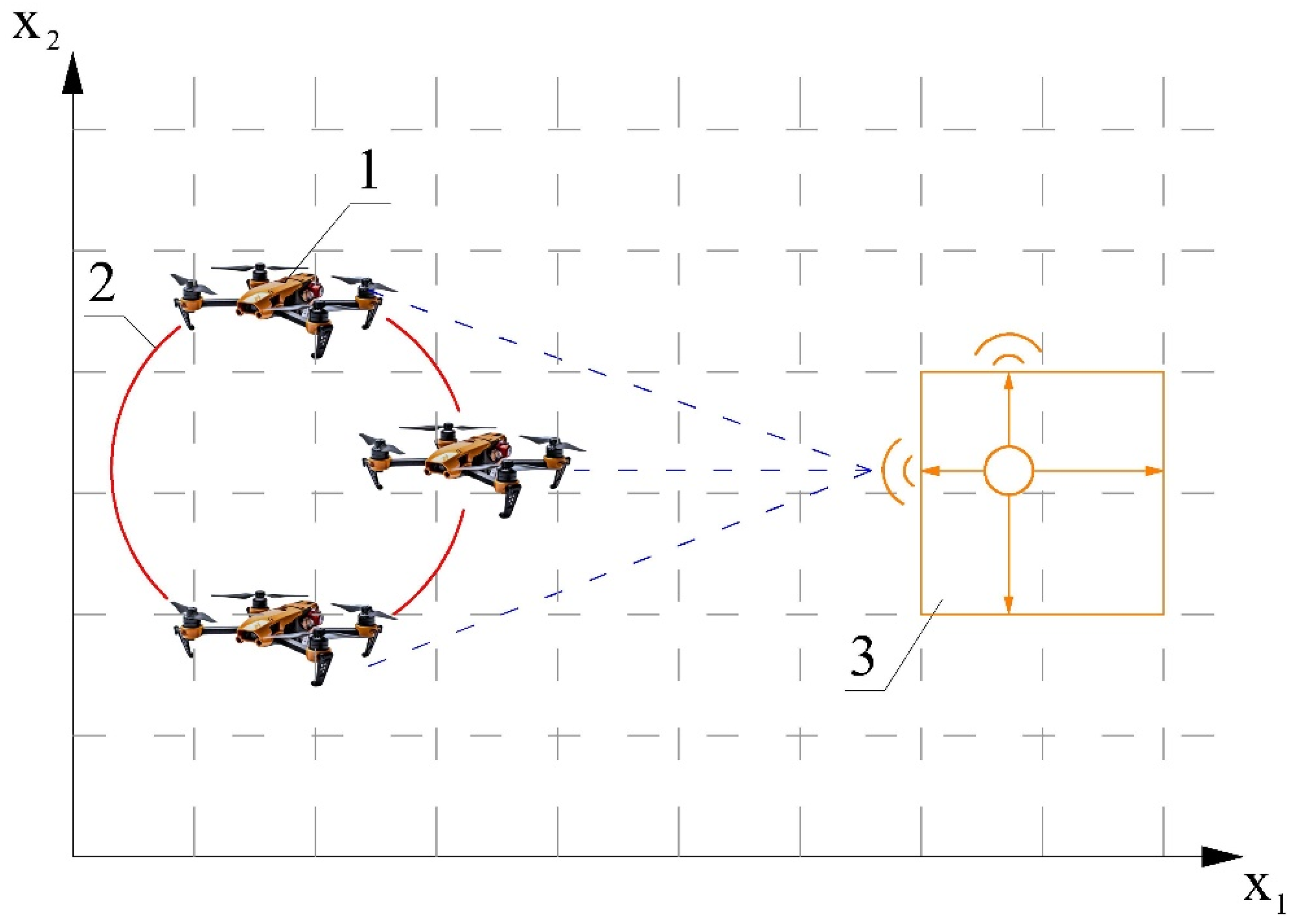
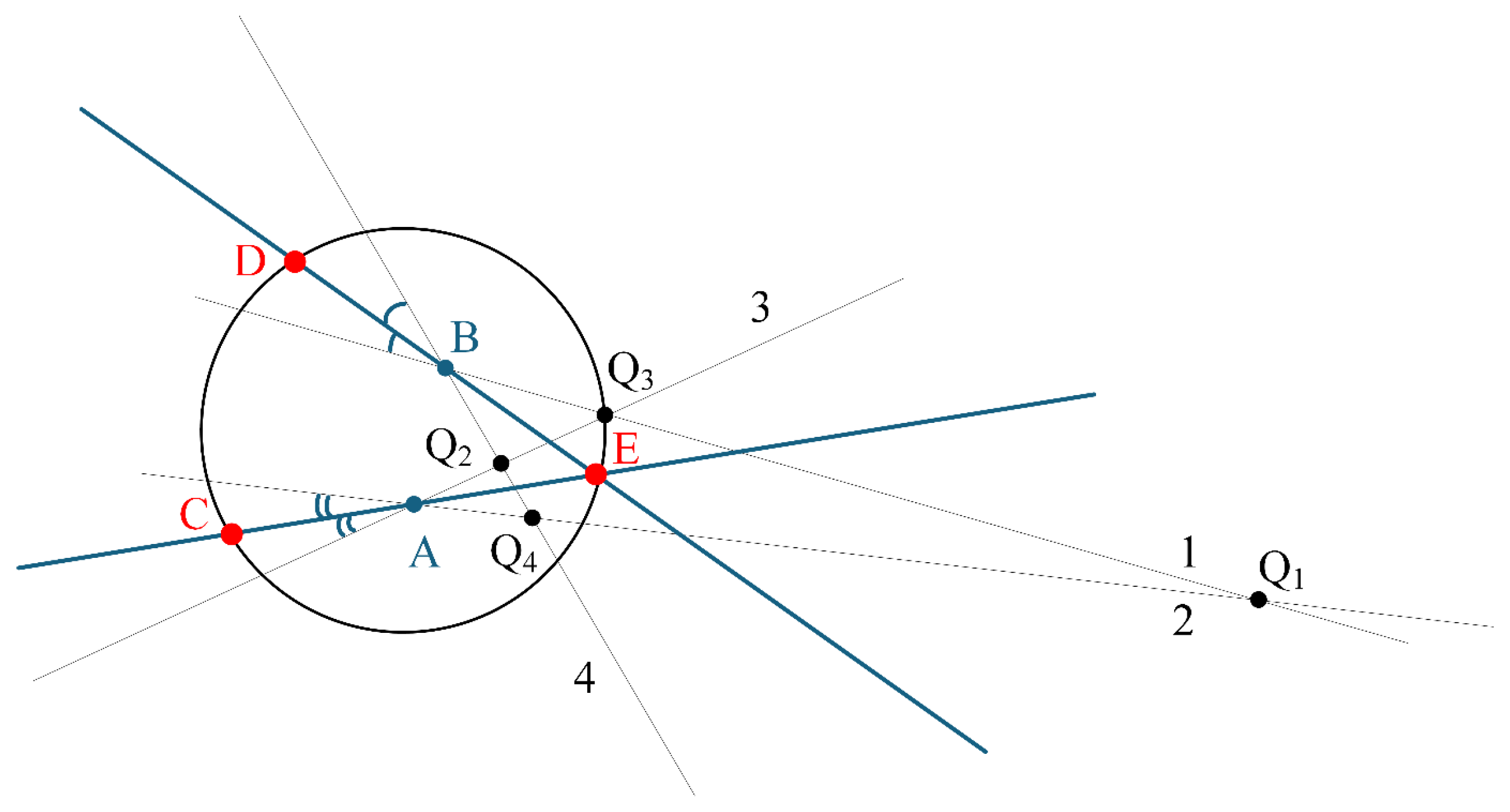
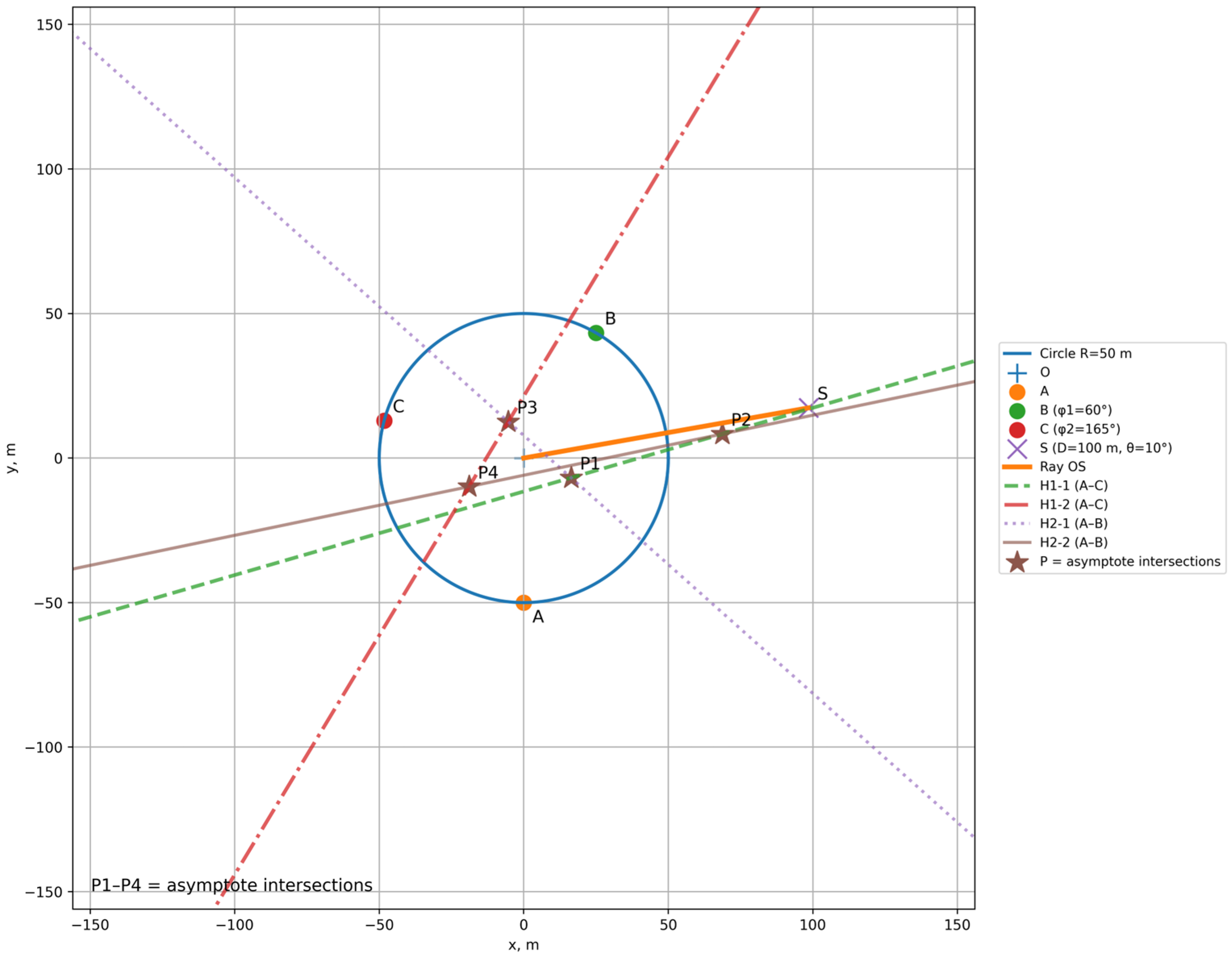
- The report introduces a geometric method for unambiguous localization of remote radio-signal sources using three UAVs connected by fiber-optic links, relying on the intersection of hyperbola asymptotes rather than full hyperbola curves.
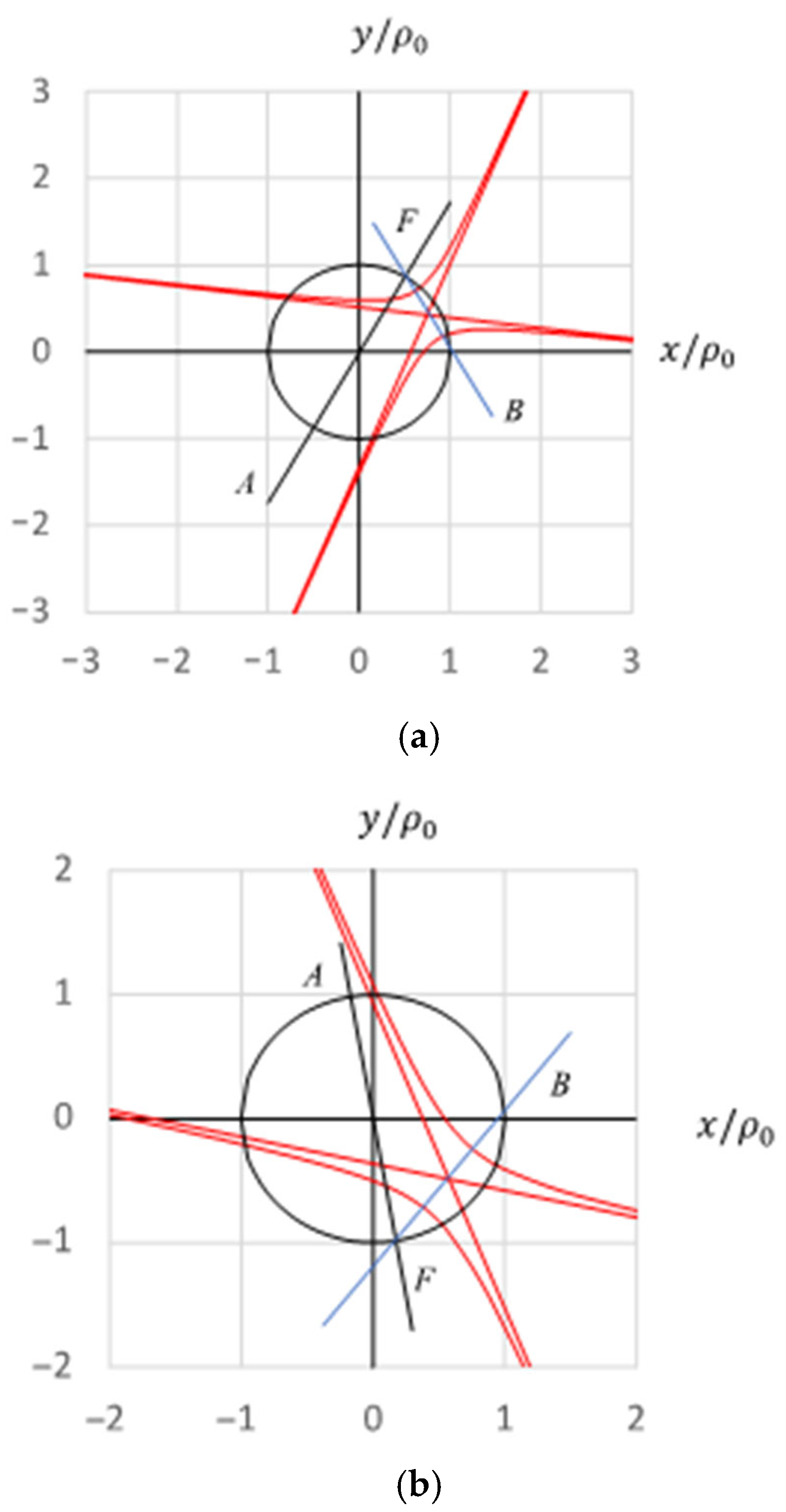
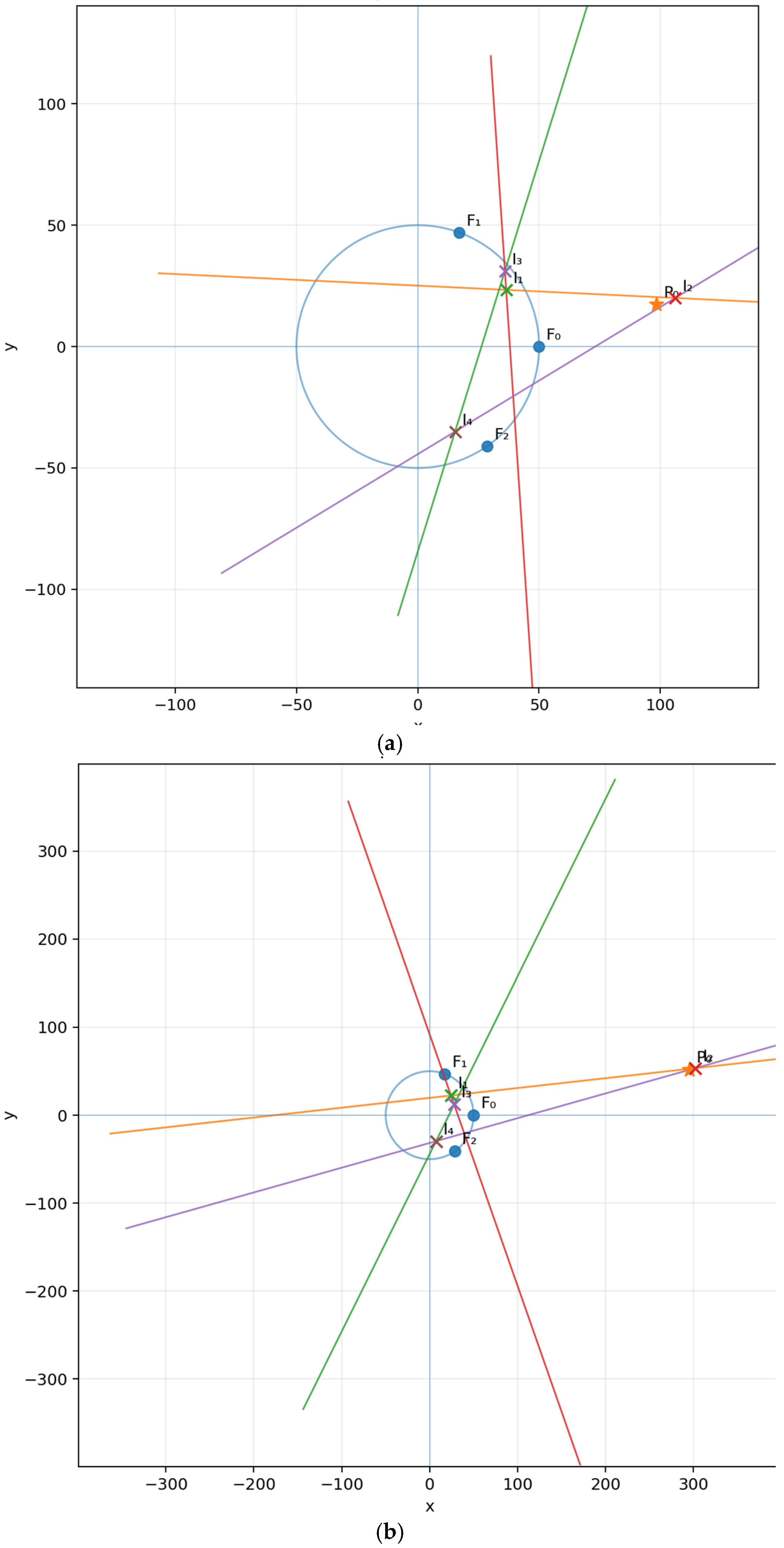
- It proves that the physically correct emitter location is always the asymptote-intersection point farthest from the UAV formation center, while all spurious solutions remain confined near the formation radius.
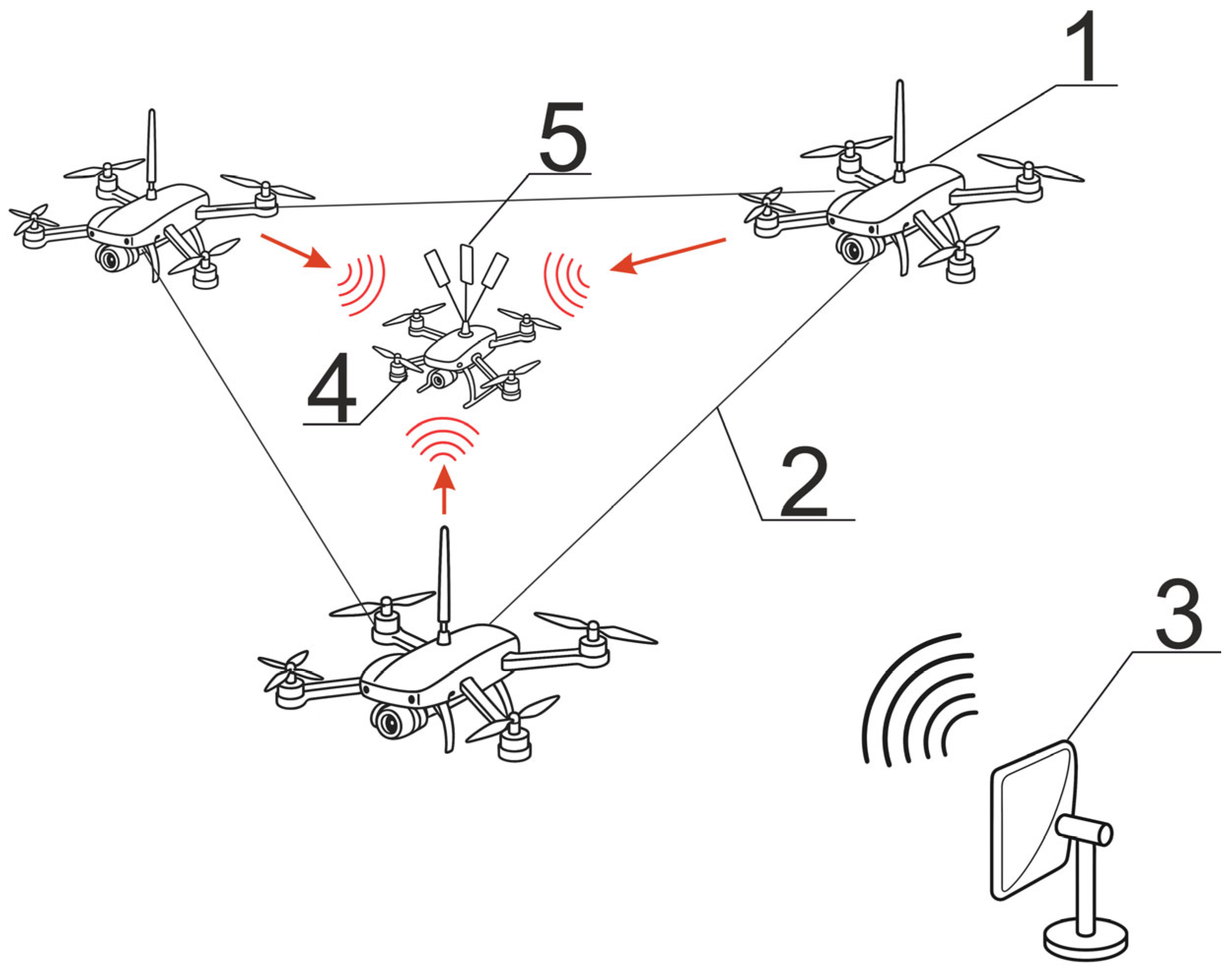
- The method enables secure, interference-resistant command transmission from the operator to the UAV group and supports the detection of external radio emitters (including operators and electronic-warfare systems) under line-of-sight conditions.
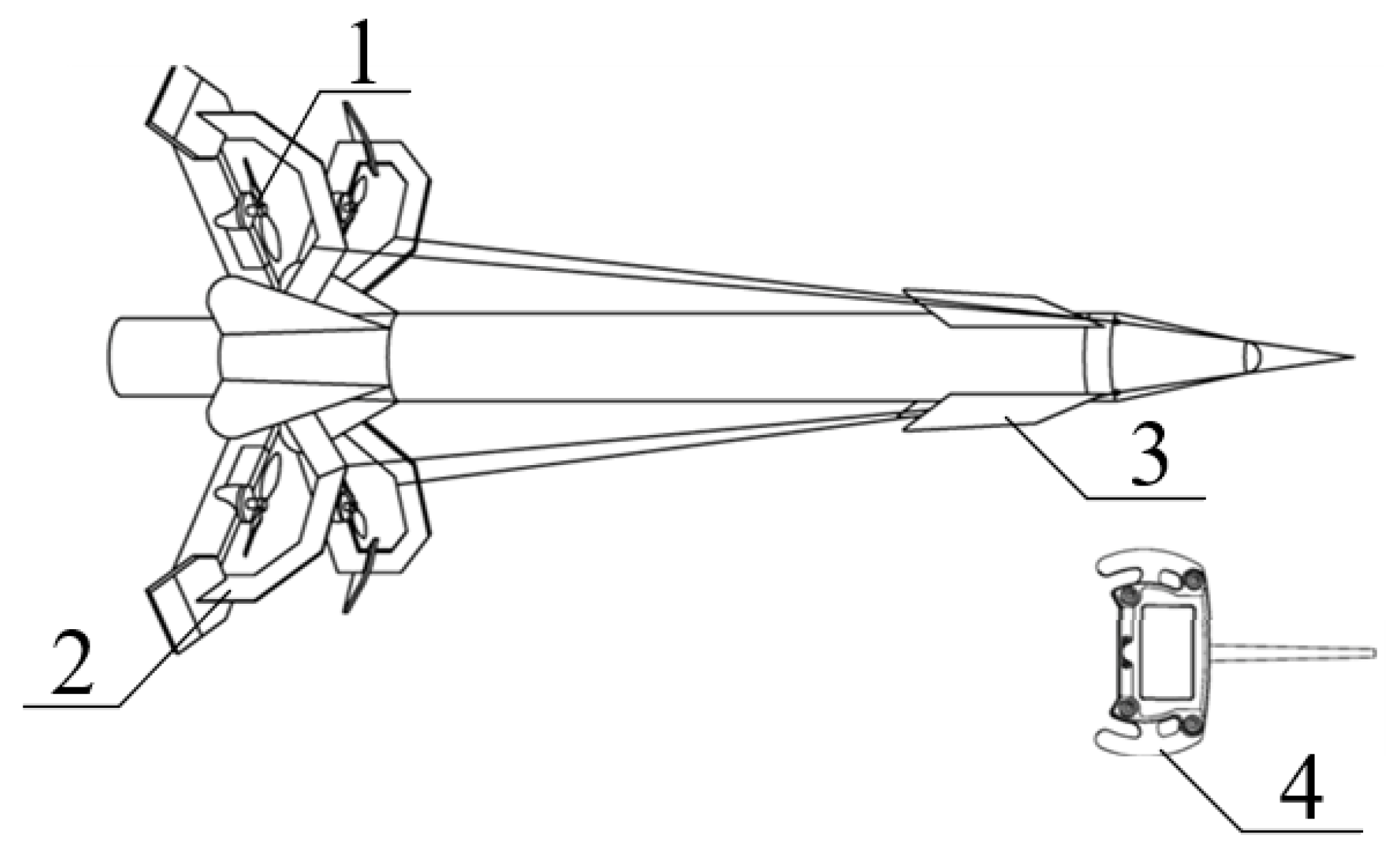
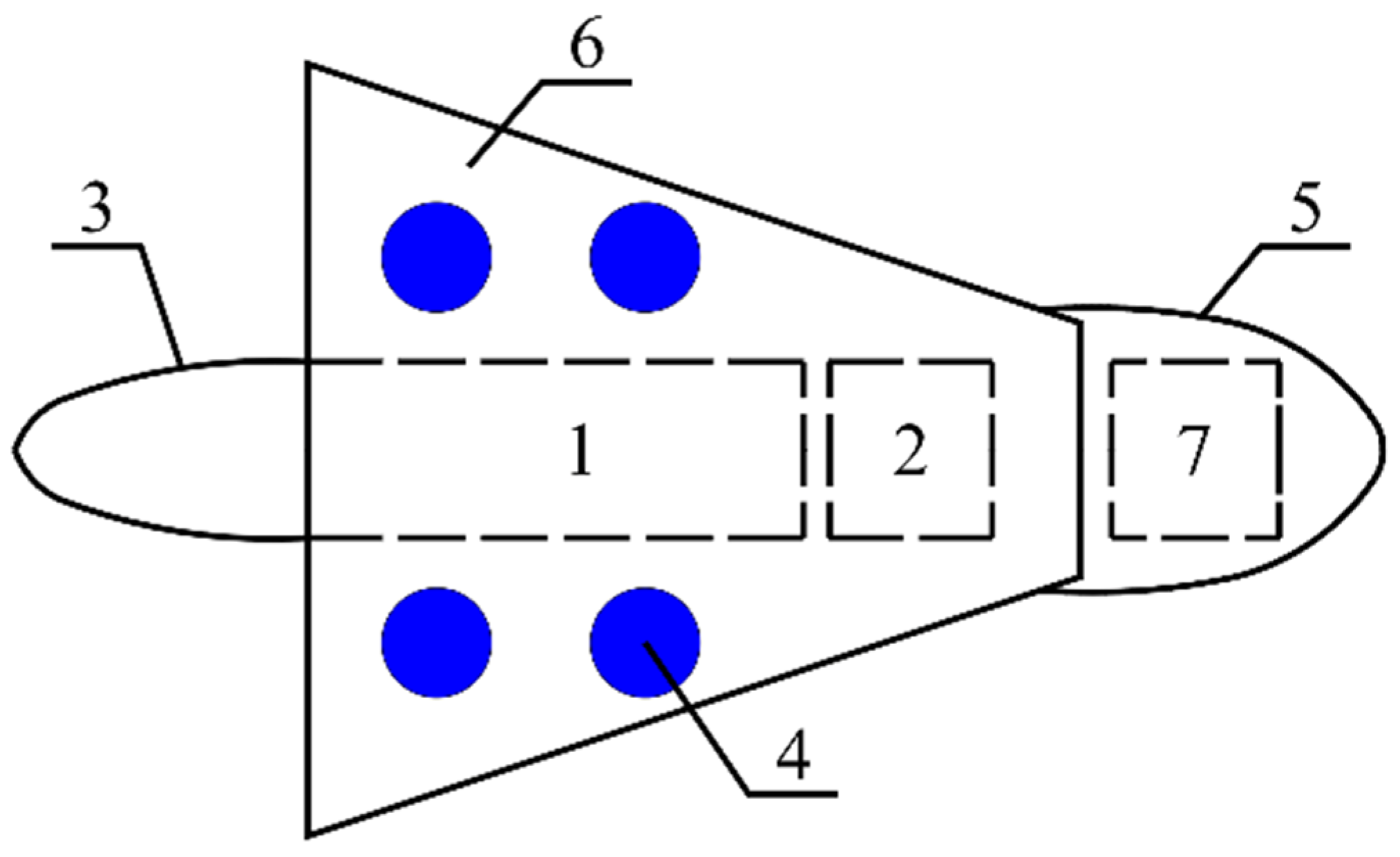
- The approach provides a scalable foundation for expanding UAV groups with nodes using directional antennas and lightweight protection mechanisms, supporting resilient architectures and advanced configurations such as jet-assisted UAV platforms.
Abstract
1. Introduction
2. Related Works
3. Methods
4. Results
5. Discussions
6. Conclusions and Future Work
Supplementary Materials
Author Contributions
Funding
Data Availability Statement
Conflicts of Interest
References
- Abdelkader, M.; Güler, S.; Jaleel, H.; Shamma, J.S. Applications and challenges. Curr. Robot. Rep. 2021, 2, 309–320. [Google Scholar] [CrossRef] [PubMed]
- Wang, C.; Su, Y.; Wang, J.; Wang, T.; Gao, Q. UAV swarm dataset: An unmanned aerial vehicle swarm dataset for multiple object tracking. Remote Sens. 2022, 14, 2601. [Google Scholar] [CrossRef]
- Mukhamediev, R.I.; Yakunin, K.; Aubakirov, M.; Assanov, I.; Kuchin, Y.; Symagulov, A.; Levashenko, V.; Zaitseva, E.; Sokolov, D.; Amirgaliyev, Y. Coverage Path Planning Optimization of Heterogeneous UAVs Group for Precision Agriculture. IEEE Access 2023, 11, 5789–5803. [Google Scholar] [CrossRef]
- Ming, R.; Jiang, R.; Luo, H.; Lai, T.; Guo, E.; Zhou, Z. Comparative analysis of different UAV swarm control methods on unmanned farms. Agronomy 2023, 13, 2499. [Google Scholar] [CrossRef]
- Ali, Z.A.; Deng, D.; Shaikh, M.K.; Hasan, R.; Khan, M.A. AI-Based UAV Swarms for Monitoring and Disease Identification of Brassica Plants Using Machine Learning: A Review. Comput. Syst. Sci. Eng. 2024, 48, 1–34. [Google Scholar] [CrossRef]
- Alqefari, S.; Menai, M.E.B. Multi-UAV task assignment in dynamic environments: Current trends and future directions. Drones 2025, 9, 75. [Google Scholar] [CrossRef]
- Lee, W. Federated reinforcement learning-based UAV swarm system for aerial remote sensing. Wirel. Commun. Mob. Comput. 2022, 2022, 4327380. [Google Scholar] [CrossRef]
- Hu, T.; Zong, Y.; Lu, N.; Jiang, B. Dynamic recovery and a resilience metric for UAV swarms under attack. Drones 2025, 9, 589. [Google Scholar] [CrossRef]
- Ju, C.; Son, H.I. A distributed swarm control for an agricultural multiple unmanned aerial vehicle system. Proc. Inst. Mech. Eng. Part I J. Syst. Control Eng. 2019, 233, 1298–1308. [Google Scholar] [CrossRef]
- Liu, J.; Liao, X.; Ye, H.; Yue, H.; Wang, Y.; Tan, X.; Wang, D. UAV swarm scheduling method for remote sensing observations during emergency scenarios. Remote Sens. 2022, 14, 1406. [Google Scholar] [CrossRef]
- Campion, M.; Ranganathan, P.; Faruque, S. UAV swarm communication and control architectures: A review. J. Unmanned Veh. Syst. 2019, 7, 93–106. [Google Scholar] [CrossRef]
- Gargalakos, M. The role of unmanned aerial vehicles in military communications: Application scenarios, current trends, and beyond. J. Def. Model. Simul. 2024, 21, 313–321. [Google Scholar] [CrossRef]
- Zieliński, T. Factors determining a drone swarm employment in military operations. Saf. Def. 2021, 7, 59–71. [Google Scholar]
- Fedorovych, O.; Kritskiy, D.; Malieiev, L.; Rybka, K.; Rybka, A. Military logistics planning models for enemy targets attack by a swarm of combat drones. Radioelectron. Comput. Syst. 2024, 1, 207–216. [Google Scholar] [CrossRef]
- Suleimenov, I.; Kadyrzhan, A.; Vitulyova, Y.; Shaltykova, D. The use of fiber optics for securing information during command transmission to UAV groups. Int. J. Inf. Technol. 2025. [Google Scholar] [CrossRef]
- Lee, J.S.; Yoo, Y.S.; Choi, H.; Kim, T.; Choi, J.K. Group connectivity-based UAV positioning and data slot allocation for tactical MANET. IEEE Access 2020, 8, 220570–220584. [Google Scholar] [CrossRef]
- Hambling, D. Israel Used World’s First AI-Guided Combat Drone Swarm in Gaza Attacks. New Scientist, 30 June 2021. Available online: https://www.newscientist.com/article/2282656-israel-used-worlds-first-ai-guided-combat-drone-swarm-in-gaza-attacks/ (accessed on 25 December 2025).
- Alqudsi, Y.; Makaraci, M. UAV swarms: Research, challenges, and future directions. J. Eng. Appl. Sci. 2025, 72, 12. [Google Scholar] [CrossRef]
- Puente-Castro, A.; Rivero, D.; Pazos, A.; Fernandez-Blanco, E. A review of artificial intelligence applied to path planning in UAV swarms. Neural Comput. Appl. 2022, 34, 153–170. [Google Scholar] [CrossRef]
- Rashid, A.B.; Kausik, A.K.; Al Hassan Sunny, A.; Bappy, M.H. Artificial intelligence in the military: An overview of the capabilities, applications, and challenges. Int. J. Intell. Syst. 2023, 1, 8676366. [Google Scholar] [CrossRef]
- McCune, R.; Purta, R.; Dobski, M.; Jaworski, A.; Madey, G.; Madey, A.; Wei, Y.; Blake, M.B. Investigations of DDDAS for command and control of UAV swarms with agent-based modeling. In Proceedings of the 2013 Winter Simulations Conference (WSC), Washington, DC, USA, 8–11 December 2013; pp. 1467–1478. [Google Scholar] [CrossRef]
- De La Torre Martín, J. Improving the Robustness of Drone Swarm Control Systems with Graph Learning. Ph.D. Thesis, University of California, Irvine, CA, USA, 2023. Available online: https://escholarship.org/uc/item/5g2676p2 (accessed on 24 November 2025).
- Guo, C.; Zhu, P.; Zhou, Z.; Lang, L.; Zeng, Z.; Lu, H. Imitation Learning with Graph Neural Networks for Improving Swarm Robustness under Restricted Communications. Appl. Sci. 2021, 11, 9055. [Google Scholar] [CrossRef]
- Chen, L.; Zhu, Y.; Liu, S.; Yu, H.; Zhang, B. PUF-based dynamic secret-key strategy with hierarchical blockchain for UAV swarm authentication. Comput. Commun. 2024, 218, 31–43. [Google Scholar] [CrossRef]
- Dong, R.; Wang, B.; Cao, K. Security enhancement of UAV swarm enabled relaying systems with joint beamforming and resource allocation. China Commun. 2021, 18, 71–87. [Google Scholar] [CrossRef]
- Wang, X.; Zhao, Z.; Yi, L.; Ning, Z.; Guo, L.; Yu, F.R.; Guo, S. A survey on security of UAV swarm networks: Attacks and countermeasures. ACM Comput. Surv. 2024, 57, 74. [Google Scholar] [CrossRef]
- Shen, D.; Chen, X.; Qi, W.; Meng, L. Task allocation for UAV swarms under communication attacks: An approach based on game theory and negotiation mechanism. J. Frankl. Inst. 2025, 362, 107417. [Google Scholar] [CrossRef]
- Jangsher, S.; Al-Dweik, A.; Iraqi, Y.; Pandey, A.; Giacalone, J.P. Group secret key generation using physical layer security for UAV swarm communications. IEEE Trans. Aerosp. Electron. Syst. 2023, 59, 8550–8564. [Google Scholar] [CrossRef]
- Raja, G.; Anbalagan, S.; Ganapathisubramaniyan, A.; Selvakumar, M.S.; Bashir, A.K.; Mumtaz, S. Efficient and secured swarm pattern multi-UAV communication. IEEE Trans. Veh. Technol. 2021, 70, 7050–7058. [Google Scholar] [CrossRef]
- Mohsan, S.A.H.; Othman, N.Q.H.; Li, Y.; Alsharif, M.H.; Khan, M.A. Unmanned aerial vehicles (UAVs): Practical aspects, applications, open challenges, security issues, and future trends. Intell. Serv. Robot. 2023, 16, 109–137. [Google Scholar] [CrossRef] [PubMed]
- Xia, B.; Mantegh, I.; Xie, W. Decentralized UAV Swarm Control: A Multi-Layered Architecture for Integrated Flight Mode Management and Dynamic Target Interception. Drones 2024, 8, 350. [Google Scholar] [CrossRef]
- Sharma, A.; Shoval, S.; Sharma, A.; Pandey, J.K. Path planning for multiple targets interception by the swarm of UAVs based on swarm intelligence algorithms: A review. IETE Tech. Rev. 2022, 39, 675–697. [Google Scholar] [CrossRef]
- Javed, S.; Hassan, A.; Ahmad, R.; Ahmed, W.; Ahmed, R.; Saadat, A.; Guizani, M. State-of-the-art and future research challenges in UAV swarms. IEEE Internet Things J. 2024, 11, 19023–19045. [Google Scholar] [CrossRef]
- Oxford Analytica. Russia’s production and use of aerial drones will rise. Expert Brief. 2025. [Google Scholar] [CrossRef]
- Martin, G. Are FPV drones the new Precision Guided Munitions? Asia-Pac. Def. Rep. 2024, 50, 22–25. Available online: https://search.informit.org/doi/abs/10.3316/informit.T2024062000001200444334835 (accessed on 25 December 2025).
- Wang, D.; Bai, B.; Zhao, W.; Han, Z. A survey of optimization approaches for wireless physical layer security. IEEE Commun. Surv. Tutor. 2018, 21, 1878–1911. [Google Scholar] [CrossRef]
- Zoli, M.; Mitev, M.; Barreto, A.N.; Fettweis, G. Estimation of the secret key rate in wideband wireless physical-layer-security. In Proceedings of the 2021 International Symposium on Wireless Communication Systems (ISWCS), Berlin, Germany, 6–9 September 2021. [Google Scholar] [CrossRef]
- Hamamreh, J.M.; Furqan, H.M.; Arslan, H. Classifications and applications of physical layer security techniques for confidentiality: A comprehensive survey. IEEE Commun. Surv. Tutor. 2019, 21, 1773–1828. [Google Scholar] [CrossRef]
- Ermukhambetova, B.; Mun, G.; Kabdushev, S.; Kadyrzhan, A.; Kadyrzhan, K.; Vitulyova, Y.; Suleimenov, I.E. New approaches to the development of information security systems for unmanned vehicles. Indones. J. Electr. Eng. Comput. Sci. 2023, 31, 810. [Google Scholar] [CrossRef]
- Kuptsov, V.; Badenko, V.; Ivanov, S.; Fedotov, A. Method for Remote Determination of Object Coordinates in Space Based on Exact Analytical Solution of Hyperbolic Equations. Sensors 2020, 20, 5472. [Google Scholar] [CrossRef] [PubMed]
- Alemdar, K.; Varshney, D.; Mohanti, S.; Muncuk, U.; Chowdhury, K. RFClock: Timing, Phase and Frequency Synchronization for Distributed Wireless Networks. In Proceedings of the 27th Annual International Conference on Mobile Computing and Networking, New Orleans, LA, USA, 25–29 October 2021; pp. 15–27. [Google Scholar]
- Marrero, L.M.; Merlano-Duncan, J.C.; Querol, J.; Kumar, S.; Krivochiza, J.; Sharma, S.K.; Ottersten, B. Architectures and Synchronization Techniques for Distributed Satellite Systems: A Survey. IEEE Access 2022, 10, 45375–45409. [Google Scholar] [CrossRef]
- Merlo, J.M.; Mghabghab, S.R.; Nanzer, J.A. Wireless Picosecond Time Synchronization for Distributed Antenna Arrays. IEEE Trans. Microw. Theory Tech. 2022, 71, 1720–1731. [Google Scholar] [CrossRef]
- Shamaei, K.; Kassas, Z.M. Receiver Design and Time of Arrival Estimation for Opportunistic Localization with 5G Signals. IEEE Trans. Wirel. Commun. 2021, 20, 4716–4731. [Google Scholar] [CrossRef]
- Zhao, W.; Panerati, J.; Schoellig, A.P. Learning-Based Bias Correction for Time Difference of Arrival Ultra-Wideband Localization of Resource-Constrained Mobile Robots. IEEE Robot. Autom. Lett. 2021, 6, 3639–3646. [Google Scholar] [CrossRef]
- Lu, Y.; Ma, H.; Smart, E.; Yu, H. Real-Time Performance-Focused Localization Techniques for Autonomous Vehicle: A Review. IEEE Trans. Intell. Transp. Syst. 2021, 23, 6082–6100. [Google Scholar] [CrossRef]
- Kuutti, S.; Fallah, S.; Katsaros, K.; Dianati, M.; McCullough, F.; Mouzakitis, A. A Survey of the State-of-the-Art Localization Techniques and Their Potentials for Autonomous Vehicle Applications. IEEE Internet Things J. 2018, 5, 829–846. [Google Scholar] [CrossRef]
- Bresson, G.; Alsayed, Z.; Yu, L.; Glaser, S. Simultaneous Localization and Mapping: A Survey of Current Trends in Autonomous Driving. IEEE Trans. Intell. Veh. 2017, 2, 194–220. [Google Scholar] [CrossRef]
- Manamperi, W.; Abhayapala, T.D.; Zhang, J.; Samarasinghe, P.N. Drone Audition: Sound Source Localization Using On-Board Microphones. IEEE/ACM Trans. Audio Speech Lang. Process. 2022, 30, 508–519. [Google Scholar] [CrossRef]
- Desai, D.; Mehendale, N. A Review on Sound Source Localization Systems. Arch. Comput. Methods Eng. 2022, 29, 4631–4642. [Google Scholar] [CrossRef]
- Yang, T.; Cabani, A.; Chafouk, H. A Survey of Recent Indoor Localization Scenarios and Methodologies. Sensors 2021, 21, 8086. [Google Scholar] [CrossRef]
- Chen, R.; Li, Z.; Ye, F.; Guo, G.; Xu, S.; Qian, L.; Huang, L. Precise Indoor Positioning Based on Acoustic Ranging in Smartphone. IEEE Trans. Instrum. Meas. 2021, 70, 9509512. [Google Scholar] [CrossRef]
- Alsolami, F.; Alqurashi, F.A.; Hasan, M.K.; Saeed, R.A.; Abdel-Khalek, S.; Ishak, A.B. Development of Self-Synchronized Drones’ Network Using Cluster-Based Swarm Intelligence Approach. IEEE Access 2021, 9, 48010–48022. [Google Scholar] [CrossRef]
- Pourranjbar, A.; Baniasadi, M.; Abbasfar, A.; Kaddoum, G. A Novel Distributed Algorithm for Phase Synchronization in Unmanned Aerial Vehicles. IEEE Commun. Lett. 2020, 24, 2260–2264. [Google Scholar] [CrossRef]
- Han, S.; Jang, B.-J. Drone’s Angle-of-Arrival Estimation Using a Switched-Beam Antenna and Single-Channel Receiver. Sensors 2025, 25, 2376. [Google Scholar] [CrossRef]
- Lutakamale, A.S.; Myburgh, H.C.; de Freitas, A. RSSI-Based Fingerprint Localization in LoRaWAN Networks Using CNNs with Squeeze and Excitation Blocks. Ad Hoc Netw. 2024, 159, 103486. [Google Scholar] [CrossRef]
- Li, M.; Chen, S.-L.; Liu, Y.; Guo, Y.J. Wide-Angle Beam Scanning Phased Array Antennas: A Review. IEEE Open J. Antennas Propag. 2023, 4, 695–712. [Google Scholar] [CrossRef]
- Chen, B.; Ma, J.; Zhang, L.; Zhou, J.; Fan, J.; Lan, H. Research Progress of Wireless Positioning Methods Based on RSSI. Electronics 2024, 13, 360. [Google Scholar] [CrossRef]
- Kadyrzhan, A.; Matrassulova, D.; Vitulyova, Y.; Suleimenov, I. Discrete Cartesian Coordinate Transformations: Using Algebraic Extension Methods. Appl. Sci. 2025, 15, 1464. [Google Scholar] [CrossRef]
- Thakor, V.A.; Razzaque, M.A.; Khandaker, M.R.A. Lightweight Cryptography for IoT: A State-of-the-Art. arXiv 2020, arXiv:2006.13813. [Google Scholar] [CrossRef]
- El Gaabouri, I.; Senhadji, M.; Belkasmi, M. A Survey on Lightweight Cryptography Approach for IoT Devices Security. In Proceedings of the 2022 5th International Conference on Networking, Information Systems and Security (NISS), Bandung, Indonesia, 30–31 March 2022; pp. 1–8. [Google Scholar] [CrossRef]
- Mouha, N.; Mennink, B.; Herrewege, A.; Watanabe, D.; Preneel, B.; Verbauwhede, I. Chaskey: An Efficient MAC Algorithm for 32-bit Microcontrollers. In Lecture Notes in Computer Science; Springer: Cham, Switzerland, 2014; pp. 306–323. [Google Scholar] [CrossRef]
- Sysoyev, A.; Nauruzov, K.; Karati, A.; Abramkina, O.; Vitulyova, Y.; Yeskendirova, D.; Popova, Y.; Abdoldina, F. Lightweight Group Signature Scheme Based on PUF for UAV Communication Security. Drones 2025, 9, 693. [Google Scholar] [CrossRef]
- Enireddy, V.; Somasundaram, K.; Prabhu, M.R.; Babu, D.V. Data obfuscation technique in cloud security. In Proceedings of the 2021 2nd International Conference on Smart Electronics and Communication (ICOSEC), Trichy, India, 7–9 October 2021; IEEE: Piscataway, NJ, USA, 2021; pp. 358–362. [Google Scholar]
- Gao, Z.; Huang, Y.; Zheng, L.; Lu, H.; Wu, B.; Zhang, J. Protecting location privacy of users based on trajectory obfuscation in mobile crowdsensing. IEEE Trans. Ind. Inform. 2022, 18, 6290–6299. [Google Scholar] [CrossRef]
- Al-Balasmeh, H.; Singh, M.; Singh, R. Framework of data privacy preservation and location obfuscation in vehicular cloud networks. Concurr. Comput. Pract. Exp. 2022, 34, e6682. [Google Scholar] [CrossRef]
- Shaltykova, D.; Vitulyova, Y.; Kadyrzhan, K.; Suleimenov, I. Application of Partial Discrete Logarithms for Discrete Logarithm Computation. Computers 2025, 14, 343. [Google Scholar] [CrossRef]
- Suleimenov, I.E.; Vitulyova, Y.S.; Kabdushev, S.B.; Bakirov, A.S. Improving the Efficiency of Using Multivalued Logic Tools: Application of Algebraic Rings. Sci. Rep. 2023, 13, 22021. [Google Scholar] [CrossRef]
- Adj, G.; Canales-Martínez, I.; Cruz-Cortés, N.; Menezes, A.; Oliveira, T.; Rivera-Zamarripa, L.; Rodríguez-Henríquez, F. Computing discrete logarithms in cryptographically-interesting characteristic-three finite fields. Cryptol. ePrint Arch. 2016, 12, 741–759. [Google Scholar] [CrossRef]
- Zhang, J.; Yang, Y.; Chen, Y.; Chen, F. A secure cloud storage system based on discrete logarithm problem. In Proceedings of the 2017 IEEE/ACM 25th International Symposium on Quality of Service (IWQoS), Vilanova i la Geltru, Spain, 14–16 June 2017; IEEE: Piscataway, NJ, USA, 2017; pp. 1–10. [Google Scholar]
- Granger, R.; Kleinjung, T.; Lenstra, A.; Wesolowski, B.; Zumbrägel, J. Computation of a 30750-bit binary field discrete logarithm. Math. Comput. 2021, 90, 2997–3022. [Google Scholar] [CrossRef]
- Wronski, M.; Dzierzkowski, L. Base of exponent representation matters—More efficient reduction of discrete logarithm problem and elliptic curve discrete logarithm problem to the QUBO problem. Quantum Inf. Comput. 2024, 24, 541–564. [Google Scholar] [CrossRef]
- Mun, G.A.; Baipakbayeva, S.T.; Kabdushev, S.B.; Kadyrzhan, K.N.; Kadyrzhan, A.B.; Vitulyova, E.S.; Suleimenov, I.E. Method for Implementing an Unmanned Aerial Vehicle Carrying Air-Launched Munition. Patent No. 286451, 14 May 2024. [Google Scholar]
- Martel, R. Rocket Propelled Drone. U.S. Patent Application US20210031913A1.



| Case | φ1, ° | φ2, ° | D | θ, ° | k | ρk/R | ψk, ° |
|---|---|---|---|---|---|---|---|
| Case 1 | 40 | 220 | 5 | 60 | 3 | 6.895 | −111.332 |
| 4 | 6.410 | −111.374 | |||||
| 2 | 5.019 | 60.016 | |||||
| 1 | 4.667 | 59.958 | |||||
| Case 2 | 60 | 200 | 6 | 300 | 3 | 6.314 | −59.706 |
| 1 | 1.331 | −53.312 | |||||
| 2 | 0.893 | −136.481 | |||||
| 4 | 0.788 | −134.831 | |||||
| Case 3 | 30 | 210 | 10 | 135 | 3 | 9.870 | 135.040 |
| 2 | 7.292 | −16.721 | |||||
| 1 | 1.648 | −39.963 | |||||
| 4 | 1.283 | 169.748 |
| Criterion | Proposed method (this paper): 3-UAV formation + intra-group fiber + hyperbola-asymptote intersections | Classical TDoA multilateration (full hyperbola intersection, numerical) | Cryptography-based secure RF control for swarms | Direct long fiber-optic control (operator–UAV tether) | Angle of Arrival/Direction of Arrival (AoA/DoA) direction-finding (directional/array-based) |
| Primary goal | Physical protection of command transmission + unambiguous emitter/operator localization | Localization accuracy (position estimation) | Confidentiality/authentication of commands | Maximal interference immunity for control link | Localization by bearing estimation |
| Main observable | TDoA/phase-difference between UAV pairs + geometric criterion via asymptotes | TDoA between multiple receivers | Crypto primitives over RF link | Wired optical channel | Angle-of-arrival/bearing |
| Minimal number of airborne nodes | 3 UAVs (two pairs) | Typically ≥3 receivers; often more for robustness | Any (depends on network topology) | 1 UAV per tethered link | Typically ≥2 bearings (or ≥1 with motion/array) |
| Time synchronization requirement | Simplified by fiber SYNC distribution; time resolution error ≤ 10% acceptable in experiments | Requires tight synchronization across receivers; accuracy strongly tied to clocking | Not a localization method; sync depends on waveform/protocol | Sync not critical for security (wired) | Sync not primary; calibration/phase coherence may be required |
| Ambiguity handling | Guaranteed disambiguation: pick the asymptote-intersection point farthest from formation center; spurious points remain near formation radius | Multiple intersections may occur; disambiguation often heuristic or via extra constraints/sensors | Does not resolve geometric ambiguity; only secures payload | No ambiguity in channel security; localization not inherent | Bearing intersections can be ambiguous under multipath/geometry |
| Computation | Light: compute asymptote directions + up to 4 intersections + select max distance | Heavier: solve nonlinear system/intersect hyperbolas numerically | Low/medium (depends on crypto suite) | Low (channel)/high mechanical burden | Medium/high (array processing, calibration) |
| Resistance to external RF interference | High for intra-group coordination (fiber) + “friend–foe” source attribution for commands under Line-of-sight (LoS) | Potentially vulnerable (RF front-ends + spoofing/jamming) | Vulnerable to jamming even if encrypted; key compromise/human factor possible | Very high against RF interference, but heavy/complex | Vulnerable to jamming and multipath; depends on SNR/array |
| Operating conditions emphasized | Line-of-sight (LoS) use case; emitter/operator/EW localization in LoS zone | Broad (LoS/Non-Line-of-Sight (NLoS), but NLoS degrades | Broad | Physical constraints dominate; cable length/weight issues | Works best in LoS; multipath degrades |
| Swarm-motion synchronization | Not required: coordinate frame defined by circle through 3 UAVs; works for any mutual geometry | Not a swarm sync method; may need stable geometry assumptions | Requires network coordination; swarm synchronization is a separate problem | Not a swarm method per se | Not a swarm sync method |
| Scalability (adding nodes) | Can expand with additional UAVs using directional antennas and low-power relays (3-UAV core as reference/relay) | Scales by adding receivers but increases sync/processing burden | Scales naturally, but attack surface grows with complexity | Poor (tethers do not scale well) | Scales with additional bearings/arrays but increases HW complexity |
| Typical trade-off | Reduced algorithmic complexity + physical protection within group; relaxed operator-localization accuracy in some scenarios | Better accuracy possible, but higher requirements for sync and robust disambiguation | Strong for confidentiality/authentication, weaker against jamming | Strong physical security, strong practical constraints (mass/length) | Good for direction cues; hardware/calibration burden |
Disclaimer/Publisher’s Note: The statements, opinions and data contained in all publications are solely those of the individual author(s) and contributor(s) and not of MDPI and/or the editor(s). MDPI and/or the editor(s) disclaim responsibility for any injury to people or property resulting from any ideas, methods, instructions or products referred to in the content. |
© 2026 by the authors. Licensee MDPI, Basel, Switzerland. This article is an open access article distributed under the terms and conditions of the Creative Commons Attribution (CC BY) license.
Share and Cite
Shaltykova, D.; Kadyrzhan, A.; Vitulyova, Y.; Suleimenov, I. The Provision of Physical Protection of Information During the Transmission of Commands to a Group of UAVs Using Fiber Optic Communication Within the Group. Drones 2026, 10, 24. https://doi.org/10.3390/drones10010024
Shaltykova D, Kadyrzhan A, Vitulyova Y, Suleimenov I. The Provision of Physical Protection of Information During the Transmission of Commands to a Group of UAVs Using Fiber Optic Communication Within the Group. Drones. 2026; 10(1):24. https://doi.org/10.3390/drones10010024
Chicago/Turabian StyleShaltykova, Dina, Aruzhan Kadyrzhan, Yelizaveta Vitulyova, and Ibragim Suleimenov. 2026. "The Provision of Physical Protection of Information During the Transmission of Commands to a Group of UAVs Using Fiber Optic Communication Within the Group" Drones 10, no. 1: 24. https://doi.org/10.3390/drones10010024
APA StyleShaltykova, D., Kadyrzhan, A., Vitulyova, Y., & Suleimenov, I. (2026). The Provision of Physical Protection of Information During the Transmission of Commands to a Group of UAVs Using Fiber Optic Communication Within the Group. Drones, 10(1), 24. https://doi.org/10.3390/drones10010024