
Abstract
In the ElectroMed project, we are interested in screening certain peptide sequences for their ability to selectively interact with antibodies or MHC proteins. This poses a combinatorial challenge that requires a highly multiplexed setup of label-free immunosensors. Label-free FET-based immunosensors are good candidates due to their high multiplexing capability and fast response time. Nanowire-based FET sensors have shown high sensitivity but are unreliable for clinical applications due to drift and gate stability issues. To address this, a label-free immuno-FET architecture based on planar junctionless FET devices is proposed. This geometry can improve the signal-to-noise ratio due to its larger planar structure, which is less prone to defects that cause noise and is better suited to the functionalization of different receptor molecules.
1. Introduction
Peptides are short protein sequences with diagnostic and therapeutic potential. However, the variability of the proteome between cells poses a significant challenge for screening and transducing interactions into readable signals. Label-free field effect transistor (FET)-based immunosensors show promise for solving this challenge due to their high sensitivity, multiplexing capabilities, and fast response time. The nanowire-based FETs have garnered significant attention due to their 3D gating effect and faster mass transport towards the sensing area. However, the low reliability and reproducibility of the nanowire-based FET sensors has prevented these structures from reaching clinical application. In this study, a label-free immuno-FET architecture based on 2D planar junctionless FET devices is proposed. This geometry improves the signal-to-noise ratio due to the lower number of surface defects because of simpler fabrication processes compared to non-planar geometries, and it can be better suited to functionalizing different receptor molecules because of its planar structure. This study aimed to fabricate and characterize planar junctionless FETs for pH sensing with the potential for future use in multiplexed sensing of biomolecular interactions.
2. Materials and Methods
Planar junctionless FETs were fabricated in a standard clean-room environment using SOI wafers from IceMOS Technology, Ltd. (Belfast, UK) To achieve a higher sensitivity suitable for detecting biomolecular interactions, a thin and lightly doped silicon device layer (thickness of 250–300 nm and resistivity of 1–10 Ohm.cm) was used [1].
3. Discussion
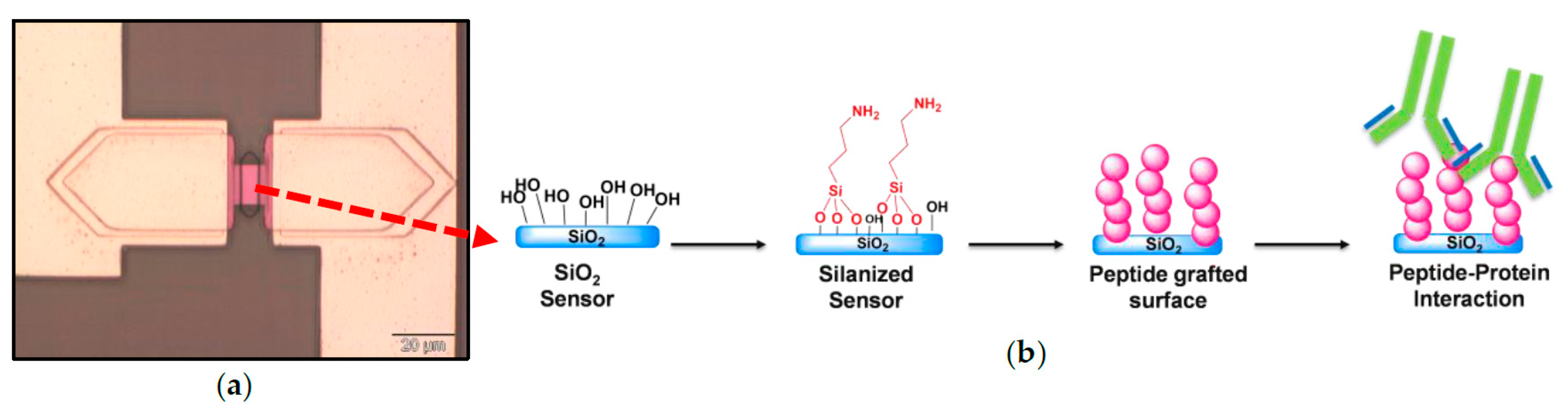
In this study, pH sensing was performed using planar junctionless field-effect transistor sensors (FETs) that were fabricated and characterized (Figure 1a). The FET device with SiO2 gate oxide displayed a voltage sensitivity of around 40 mV/pH for constant drain currents of 50 nA at a drain-to-source voltage of 0.05 V. Theoretical modeling and simulation yielded a mean value of 3.8 × 10¹⁵/cm2 for the surface states, with a standard deviation of 3.6 × 10¹⁵/cm2. With our proposed rational design, we anticipate achieving a sensitivity that is sufficient for detecting peptide–protein interactions (Figure 1b). The performance of these planar devices can be further improved by using a thin layer of high-k gate dielectrics (e.g., HfO2) and by modifying the gate area with nanomaterials that will later be used as a multiplexed set-up of immunosensors to detect biomolecular interactions.
Figure 1.
Microfabrication and surface functionalization: (a) microfabricated device with open gate area; (b) surface functionalization of Au/SiO2 SPR chips with APTES, peptide, and protein.
Author Contributions
Conceptualization, S.P., V.P.G., S.K., and C.P.G.; methodology, R.P.S., J.G.B., D.W., C.P.G., S.P., N.K., V.P.G., J.E.M., D.B., A.C.S., and S.K.; software, R.P.S. and N.K.; validation, R.P.S., N.K., J.E.M., D.B., A.C.S., and S.K.; formal analysis, R.P.S., S.P., C.P.G., N.K., V.P.G., J.E.M., D.B., A.C.S., and S.K.; data curation, R.P.S., N.K., and A.C.S.; writing—original draft preparation, R.P.S.; writing—review and editing, R.P.S., C.P.G., S.P., N.K., V.P.G., J.E.M., D.B., A.C.S., and S.K.; supervision, S.P., C.P.G., V.P.G., and S.K.; project administration, C.P.G.; funding acquisition, C.P.G.; visualization, R.P.S., S.P., N.K., J.E.M., D.B., and A.C.S. All authors have read and agreed to the published version of the manuscript.
Funding
This research was funded by the European Union’s Horizon 2020 research and innovation program, grant number 862539-Electromed-FET OPEN.
Institutional Review Board Statement
Not applicable.
Informed Consent Statement
Not applicable.
Data Availability Statement
Data are available on demand and in consultation with corresponding author.
Conflicts of Interest
The authors declare no conflicts of interest.
Reference
- Shukla, R.P.; Bomer, J.G.; Wijnperle, D.; Kumar, N.; Georgiev, V.P.; Singh, A.C.; Krishnamoorthy, S.; Pascual García, C.; Pud, S.; Olthuis, W. Planar Junctionless Field-Effect Transistor for Detecting Biomolecular Interactions. Sensors 2022, 22, 5783. [Google Scholar] [CrossRef] [PubMed]
Disclaimer/Publisher’s Note: The statements, opinions and data contained in all publications are solely those of the individual author(s) and contributor(s) and not of MDPI and/or the editor(s). MDPI and/or the editor(s) disclaim responsibility for any injury to people or property resulting from any ideas, methods, instructions or products referred to in the content. |
© 2024 by the authors. Licensee MDPI, Basel, Switzerland. This article is an open access article distributed under the terms and conditions of the Creative Commons Attribution (CC BY) license (https://creativecommons.org/licenses/by/4.0/).