Abstract
A series of imidazo[1,2-a]pyridine-chromones were synthesized by microwave-assisted Groebke–Blackburn–Bienaymeé reaction (GBBR) under eco-friendly conditions (20 mol% ammonium chloride catalyst in EtOH). Chromones and imidazo[1,2-a]pyridines are a privileged core of high interest in medicinal chemistry.
1. Introduction
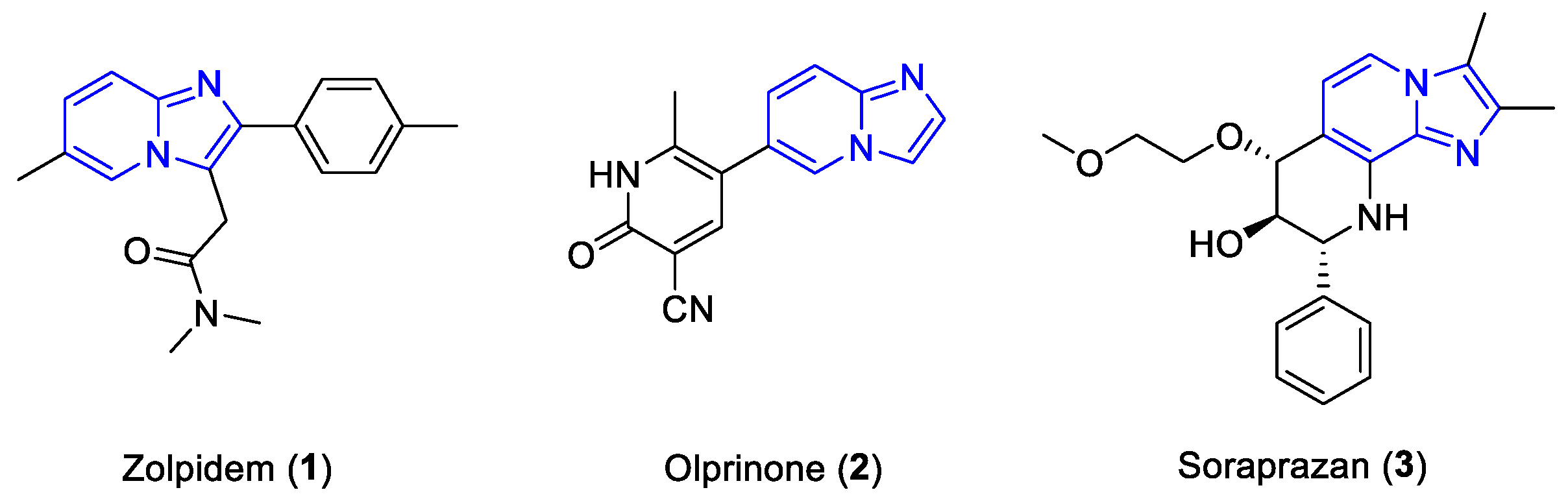
Imidazo [1,2,a]pyridines have been intensively investigated since the beginning of the 20th century, they have been of great interest in medicinal research science and a wide variety of biologically active compounds and many commercially available drugs, such as zolpidem (1), olprinone (2), and soraprazan (3), containing this core [1,2,3,4] (Figure 1). They have also been used in the development of fluorescent dyes and OLED´s, because of their luminescent properties [5,6].
Figure 1.
Some representative drugs with imidazo [1,2,a]pyridine core.
On the other hand chromones are present in natural products, this core is of great interest in medicinal chemistry and it is present in various compounds showing different biological activities such as antiparasitic (4), anticancer (5), antiplatelet (6), antiparkinson, and antimicrobial, to mention some [7,8,9,10,11] (Figure 2).
Figure 2.
Bioactive chromone compounds.
The method to access imidazo[1,2-a]pyridine core is through a multicomponent reaction GBBR [12]. Several conditions are reported, employing various catalysts, such as Lewis acids, Brönsted acids, organic bases, solid-supported, and inorganic salts. Frequently, these catalysts are expensive and long reaction times were required [13].
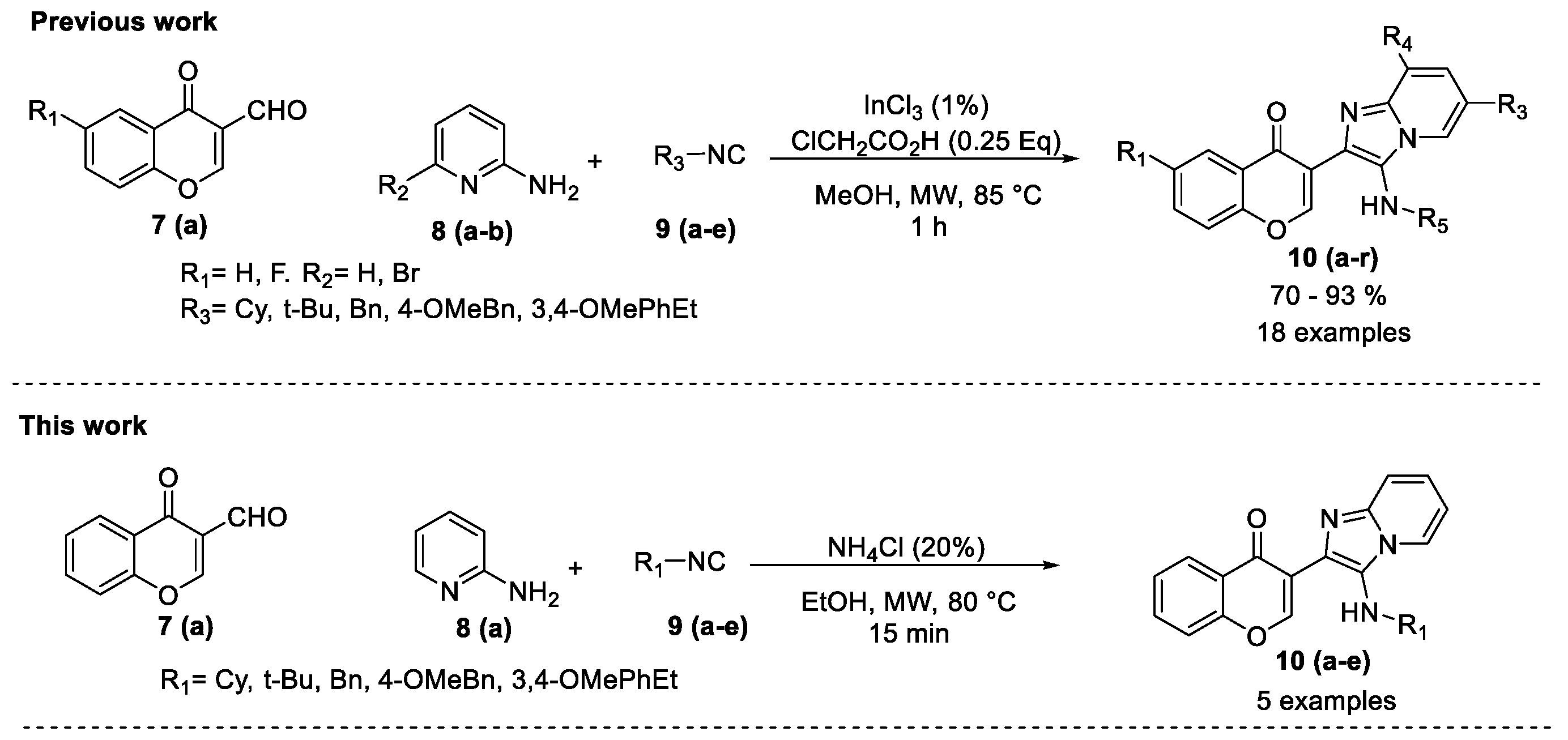
In a previous report, the synthesis of chromone and imidazo[1,2-a]pyridine was performed under non-green conditions [14]. Actually, our research group is interested in the development of eco-friendly methodologies based on I-MCR’s (isocyanide-based multicomponent reactions) for the synthesis of complex heterocyclic compounds. Herein we describe the microwave-assisted synthesis of imidazo[1,2-a]pyridin-chromones from 2-amino-pyridines, 3-formyl-chromone, and isocyanides using a green catalyst and solvents and an eco-friendly method (Scheme 1).
Scheme 1.
Previous report and our work.
2. Results and Discussion
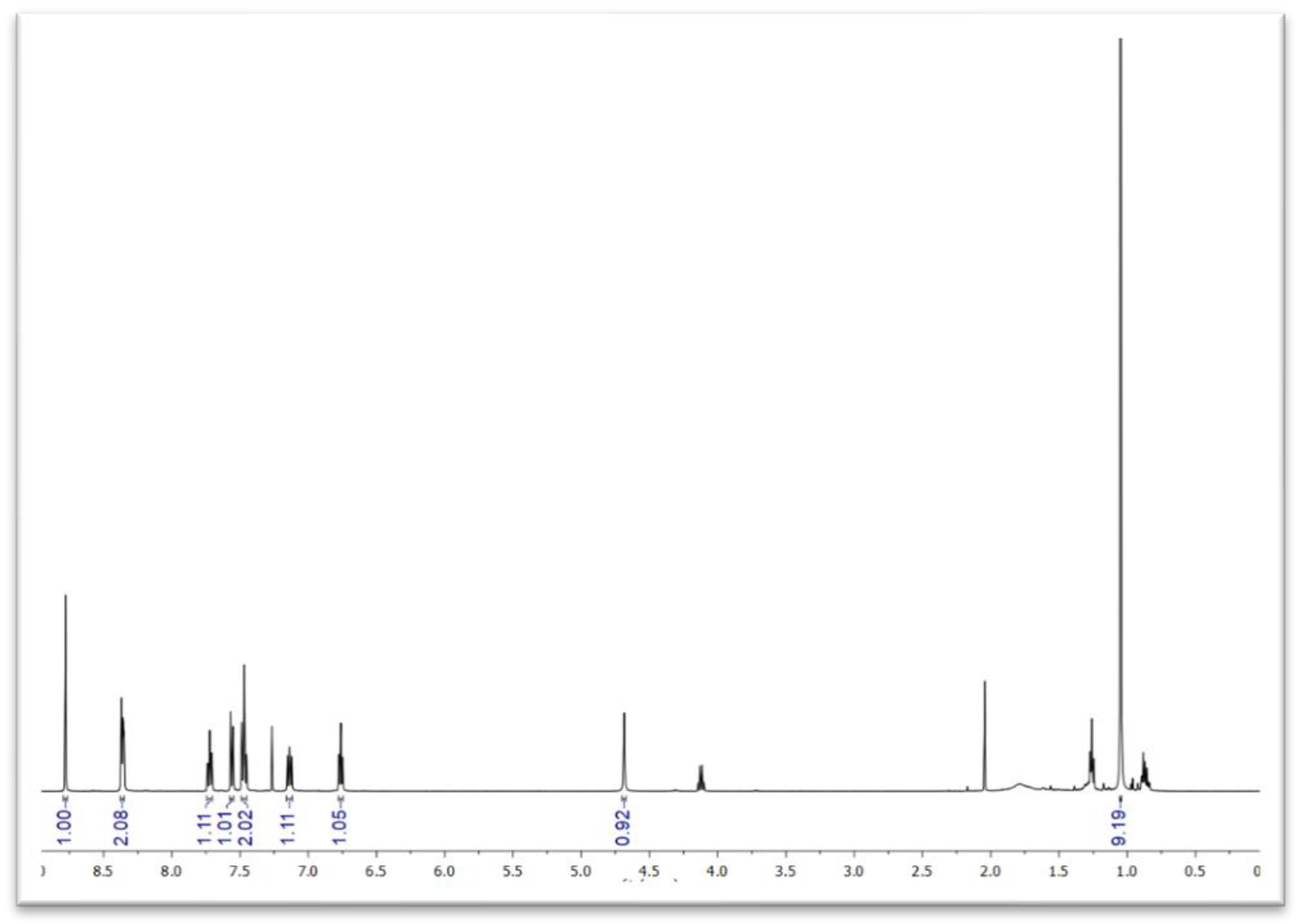
First, a model reaction was conducted using 3-formylchromone (7), amidine (8) and tert-butyl isocyanide (9a) to optimize reaction conditions. The results are shown in Table 1. As our intention was to develop an eco-friendly method, we chose EtOH as solvent. Initially, we performed the GBBR at room temperature without a catalyst, however, no reaction took place. Then, we carried out an assisted the reaction with other sources of energy, such as ultrasonic, but the product was observed in traces, then staying in the margin of the eco-friendly method, we tried NH4Cl as a catalyst. After carrying out the reaction in the same conditions, (ultrasound-assisted and NH4Cl 20%), the product 10a was isolated in 23%. When the reaction was performed using microwave-assisted synthesis with NH4Cl, the yield increased to 36%, and the reaction time decreased to 15 min. Figure 3 show the 1H NMR spectra for the representative imidazo[1,2-a]pyridine 10a.
Table 1.
Reaction optimizing conditions 10a.
Figure 3.
1H NMR spectra for 3-(3-(tert-butylamino)imidazo[1,2-a]pyridin-2-yl)-4H-chromen-4-one (10a).
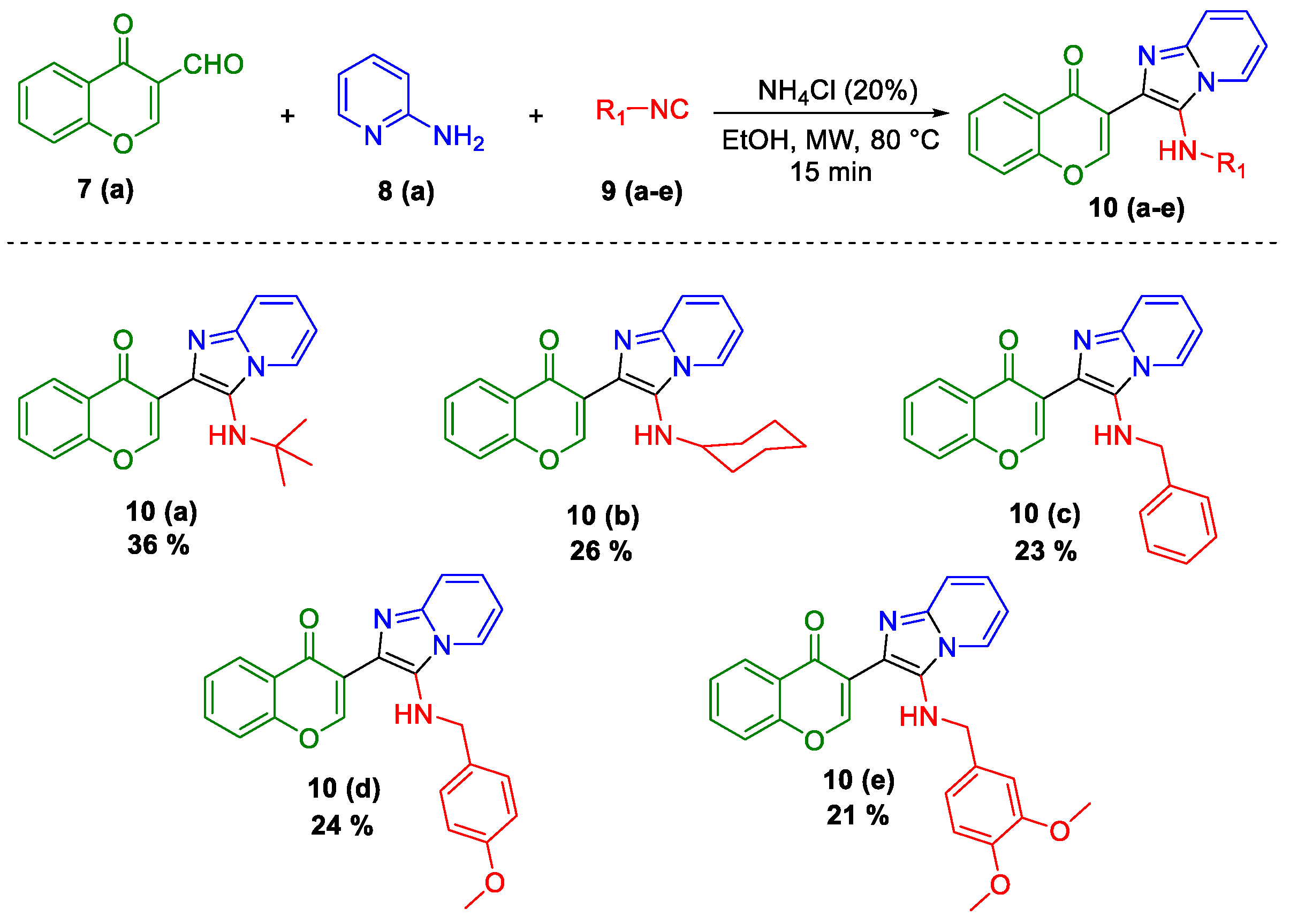
After optimizing the conditions, we explored the reaction scope with different isocyanides (9), such as cyclohexyl, benzyl, and phenethyl moieties (a–e). The respective products 9a–e (Scheme 2) were obtained in yields (21–36%).
Scheme 2.
Substrate scope.
3. Experimental Section
3.1. General Information, Instrumentation, and Chemicals
1H and 13C NMR spectra were acquired using Bruker Avance III spectrometers (500 and 125 MHz, respectively). The solvent used was deuterated chloroform (CDCl3). Chemical shifts are reported in parts per million (δ/ppm). The internal reference for 1H NMR spectra is trimethylsilane at 0.0 ppm. The internal reference for 13C NMR spectra is CDCl3 at 77.0 ppm. Coupling constants are reported in Hertz (J/Hz). Multiplicities of the signals are reported using the standard abbreviations: Singlet (s), doublet (d), triplet (t), quartet (q), and multiplet (m). NMR spectra were analyzed using the MestreNova software version 12.0.0–20080. IR spectra were acquired on a Perkin Elmer 100 spectrometer using an attenuated total reflectance (ATR) method with neat compounds. The absorbance peaks are reported in reciprocal centimeters (υmax/cm−1). Microwave-assisted reactions were performed in closed vessel mode using a monomodal CEM Discover unit. Reaction progress was monitored by thin-layer chromatography (TLC) on precoated silica-gel 60 F254 plates and the spots were visualized under UV light at 254 or 365 nm. Mixtures of hexane with ethyl acetate (EtOAc) were used to run TLC and to measure retention factors (Rf). Flash column chromatography was performed using silica gel (230–400 mesh) and mixtures of hexane with EtOAc in different proportions (v/v) as the mobile phase. All reagents were purchased from Sigma-Aldrich and were used without further purification. Chemical names and drawings were obtained using the ChemBioDraw Ultra 13.0.2.3020 software package.
3.2. General Procedure (GP)
In a microwave-assisted (MW) vial (10 mL) equipped with a magnetic stirring containing a solution of 3-formyl-chromone (1.0 equiv.) in EtOH [0.5 M], 2-amino-piridyne (1.2 equiv.) and NH4Cl (0.02 equiv.) were sequentially added and the reaction mixture was MW heated (100 W, 80 °C) for 20 min, then the corresponding isocyanide (1.2 equivalent) was added and the reaction mixture was performed in the same conditions for 15 min. The solvent was removed until dry and the crude was immediately purified by silica gel column chromatography using a mixture of hexanes with ethyl acetate (7/3 V/V) to afford the corresponding imidazo[1,2-a]pyridine-chromones 10a–e.
Synthesis and characterization of the 3-(3-(tert-butylamino)imidazo[1,2-a]pyridin-2-yl)-4H-chromen-4-one (10a)
According to the GP, 3-formylchromone (51 mg, 0.292 mmol), 2-aminopyridine (33 mg, 0.35 mmol), NH4Cl (3 mg, 0.058 mmol) and tert-butylisocyanide (39.58 µL, 0.35 mmol) were reacted together in EtOH (2.0 mL) to afford the compound 10a (35 mg, 36%) as pale yellow solid, Rf = 0.17 (Hexanes-AcOEt = 7/3 V/V); FT-IR (ATR)nmax/cm−1 3281, 2926, 1629, 1138; 1H NMR (500 MHz, CDCl3, 25 °C, TMS): δ 8.80 (s, 1 H), 8.36 (d, J = 7.0 Hz, 2 H), 7.73–7.67 (m, 1 H), 7.55 (d, J = 8.4 Hz, 1 H), 7.51–7.42 (m, 2 H), 7.16–7.10 (m, 1 H), 6.78–6.73 (m, 1 H), 4.70 (bs, 1 H), 1.05 (s, 9 H); 13C NMR (125 MHz, CDCl3; 25 °C; TMS): δ 176.7, 156.6, 156.4, 142.7, 133.9, 130.4, 128.2, 126.5, 125.5, 124.4, 124.3, 124.1, 121.6, 118.1, 116.9, 111.0, 56.0, 29.3; HRMS (ESI+): m/z calcd. for C20H20N302+ 334.1556, found 334.1553.
Synthesis and characterization of the 3-(3-(cyclohexylamino)imidazo[1,2-a]pyridin-2-yl)-4H-chromen-4-one (10b)
According to the GP, 3-formylchromone (51 mg, 0.292 mmol), 2-aminopyridine (33 mg, 0.35 mmol), NH4Cl (3 mg, 0.058 mmol) and cyclohexylisocyanide (43.51 µL, 0.35 mmol) were reacted together in EtOH (2.0 mL) to afford the compound 10a (27 mg, 26%) as brown solid, Rf = 0.15 (Hexanes-AcOEt = 7/3 V/V); FT-IR (ATR)nmax/cm−1 3278, 2920, 1629, 1143; 1H NMR (500 MHz, CDCl3, 25 °C, TMS): δ 8.82 (s, 1 H), 8.37 (dd, J = 8.0, 1.5 Hz, 1 H), 8.12 (dt, J = 6.9, 1.2 Hz, 1H), 7.75–7.70 (m, 1 H), 7.56 (dd, J = 8.4, 0.6 Hz, 1 H), 7.51–7.44 (m, 2 H), 7.15–7.10 (m, 1 H), 6.81–6.75 (m, 1 H), 5.17 (d, J = 9.1 Hz, 1 H), 2.72–2.61 (m, 1 H), 1.83 (d, J = 9.3 Hz, 2 H), 1.66 (d, J = 5.2 Hz, 2 H), 1.51 (d, J = 5.9 Hz, 1 H), 1.19–1.06 (m, 5 H); 13C NMR (125 MHz, CDCl3; 25 °C; TMS): δ 177.3, 156.8, 156.7, 142.4, 134.1, 129.9, 127.6, 126.8, 125.8, 124.6, 124.2, 123.5, 121.1, 118.6, 117.4, 111.6, 56.6, 34.0, 25.5, 25.0; HRMS (ESI+): m/z calcd. for C22H22N302+ 360.1712, found 360.1737.
Synthesis and characterization of the 3-(3-(benzylamino)imidazo[1,2-a]pyridin-2-yl)-4H-chromen-4-one (10c)
According to the GP, 3-formylchromone (34 mg, 0.195 mmol), 2-aminopyridine (22 mg, 0.234 mmol), NH4Cl (2 mg, 0.039 mmol) and benzylisocyanide (28.49 µL, 0.234 mmol) were reacted together in EtOH (2.0 mL) to afford the compound 10c (17 mg, 23%) as orange solid, Rf = 0.12 (Hexanes-AcOEt = 7/3 V/V); FT-IR (ATR)nmax/cm−1 3289, 2836, 1629, 1148; 1H NMR (500 MHz, CDCl3, 25 °C, TMS): δ 8.45 (s, 1 H), 8.28 (d, J = 8.0 Hz, 1 H), 8.17 (d, J = 6.8 Hz, 1 H), 7.72–7.67 (m, 1 H), 7.49 (d, J = 8.2 Hz, 2 H), 7.46–7.42 (m, J = 7.5 Hz, 1 H), 7.17–7.12 (m, 1 H), 7.00–6.94 (m, 5 H), 6.82–6.78 (m, 1 H), 5.48 (t, J = 7.2 Hz, 1H), 3.99 (d, J = 7.1 Hz, 2H); 13C NMR (125 MHz, CDCl3; 25 °C; TMS): δ 176.3, 156.0, 142.2, 139.4, 133.7, 129.1, 128.7, 128.2, 128.0, 127.0, 126.3, 125.4, 124.2, 124.0, 122.7, 120.1, 118.1, 117.3, 111.7, 52.5; HRMS (ESI+): m/z calcd. for C23H18N302+ 368.1399, found 368.1401.
Synthesis and characterization of the 3-(3-((4-methoxybenzyl)amino)imidazo[1,2-a]pyridin-2-yl)-4H-chromen-4-one (10d)
According to the GP, 3-formylchromone (34 mg, 0.195 mmol), 2-aminopyridine (22 mg, 0.234 mmol), NH4Cl (2 mg, 0.039 mmol) and 4-methoxybenzylisocyanide (35 mg, 0.234 mmol) were reacted together in EtOH (2.0 mL) to afford the compound 10c (19 mg, 24%) as orange solid, Rf = 0.11 (Hexanes-AcOEt = 7/3 V/V); FT-IR (ATR)νmax/cm−1 3295, 2932, 1629, 1461; 1H NMR (500 MHz, CDCl3, 25 °C, TMS): δ 8.29 (s, 1 H), 7.79 (dd, J = 8.2, 2.8 Hz, 1 H), 7.65–7.60 (m, 1 H), 7.47–7.34 (m, 3 H), 7.13–7.05 (m, 2 H), 6.63 (d, J = 8.3 Hz, 2 H), 6.25 (d, J = 8.3 Hz, 2 H), 4.77 (bs, 1 H), 3.90 (s, 2 H), 3.47 (s, 3 H); 13C NMR (125 MHz, CDCl3; 25 °C; TMS): δ 174.8, 161.1, 158.8, 158.6, 157.0, 151.8, 130.4, 130.3, 126.7, 125.3, 122.4, 122.2, 120.5, 120.4, 120.3, 115.6, 113.4, 111.1, 110.9, 55.3, 55.1; HRMS (ESI+): m/z calcd. for C24H20N303+ 398.1505, found 398.1505.
Synthesis and characterization of the 3-(3-((3,4-dimethoxyphenethyl)amino)imidazo[1,2-a]pyridin-2-yl)-4H-chromen-4-one (10e)
According to the GP, 3-formylchromone (34 mg, 0.195 mmol), 2-aminopyridine (22 mg, 0.234 mmol), NH4Cl (2 mg, 0.039 mmol) and 3,4-dimethoxyphenetylisocyanide (41 mg, 0.234 mmol) were reacted together in EtOH (2.0 mL) to afford the compound 10e (18 mg, 21%) as pale yellow oil, Rf = 0.10 (Hexanes-AcOEt = 7/3 V/V); FT-IR (ATR)nmax/cm−1 3281, 2926, 1629, 1138; 1H NMR (500 MHz, CDCl3, 25 °C, TMS): δ 8.77 (s, 1 H), 8.26 (d, J = 7.9 Hz, 1 H), 7.95 (d, J = 6.9 Hz, 1 H), 7.74–7.68 (m, 1 H), 7.54 (d, J = 8.4 Hz, 1 H), 7.50–7.43 (m, 2 H), 7.15–7.09 (m, 1 H), 6.77–6.72 (m, 1 H), 6.65–6.60 (m, 3 H), 5.44 (t, J = 7.0 Hz, 1 H), 3.78 (s, 3 H), 3.75 (s, 3 H), 3.19 (q, J = 7.0 Hz, 2 H), 2.71 (t, J = 7.1 Hz, 2 H); 13C NMR (125 MHz, CDCl3; 25 °C; TMS): δ 176.3, 156.1, 156.0, 148.8, 147.4, 141.9, 133.8, 131.9, 130.2, 126.4, 126.3, 125.5, 124.2, 123.9, 122.9, 120.7, 120.5, 118.3, 117.2, 112.0, 111.5, 111.1, 55.8, 49.2, 36.4; HRMS (ESI+): m/z calcd. for C24H20N303+ 442.1767, found 442.1798.
4. Conclusions
We have developed an efficient microwave-assisted GBB protocol for the eco-friendly synthesis of imidazo[1,2,a]pyridine-chromones, in short reaction time under a green catalyst.
Author Contributions
All authors contributed equally to this work. All authors have read and agreed to the published version of the manuscript.
Acknowledgments
C.Z.H. thanks CONACYT for a scholarship (856606). R.G.-M. thanks CONACYT-México (CB-2016-285622) and DAIP Universidad de Guanajuato (CIIC 154/2019) for financial support, the Laboratorio Nacional de Caracterización de Propiedades Fisicoquímícas y Estructura Molecular (CONACYT-México, Project: 123732) for the instrumentation time provided.
Conflicts of Interest
The authors declare no conflict of interest. The funders had no role in the design of the study; in the collection, analyses, or interpretation of data; in the writing of the manuscript; or in the decision to publish the results.
References
- Shao, T.; Gong, Z.; Su, T.; Hao, W.; Che, C. A practical and efficient approach to imidazo[1,2-a]pyridine-fused isoquinolines through the post-GBB transformation strategy. Beilstein J. Org. Chem. 2017, 13, 817–824. [Google Scholar] [CrossRef] [PubMed]
- Depoortere, H.; Zivkovic, B.; Lloyd, K.G.; Sanger, D.J.; Perrault, G.; Langer, S.Z.; Bartholini, J. Zolpidem, a novel nonbenzodiazepine hypnotic. I. Neuropharmacological and behavioral effects. Pharmacol. Exp. Ther. 1986, 237, 649–658. [Google Scholar]
- Muzushige, K.; Ueda, T.; Yukiiri, K.; Suzuki, H. Olprinone: A phosphodiesterase III inhibitor with positive inotropic and vasodilator effects. Cardiovasc. Drug Rev. 2002, 20, 163–174. [Google Scholar] [CrossRef] [PubMed]
- Simon, W.A.; Herrmann, M.; Klein, T.; Shin, J.M.; Huber, R.; Senn-Bilginger, J.; Postius. Soraprazan: Setting New Standards in Inhibition of Gastric Acid Secretion. J. Pharmacol. Exp. Ther. 2007, 321, 866–874. [Google Scholar] [CrossRef] [PubMed]
- Nagarajan, N.; Velmurugan, G.; Prakash, A.; Shakti, N.; Katiyar, M.; Venuvanalingam, P.; Renganathan. Highly emissive luminogens based on imidazo[1,2-a]pyridine for electroluminescent applications. R. Chem. Asian J. 2014, 9, 294–304. [Google Scholar] [CrossRef] [PubMed]
- Burchak, O.N.; Mugherli, L.; Ostuni, M.; Lacapere, J.J.; Balakirev, M.Y. Combinatorial Discovery of Fluorescent Pharmacophores by Multicomponent Reactions in Droplet Arrays. J. Am. Chem. Soc. 2011, 133, 10058–10061. [Google Scholar] [CrossRef] [PubMed]
- Khan, I.A.; Avery, M.A.; Burandt, C.L.; Goins, D.K.; Mikell, J.R.; Nash, T.E.; Azadegan, A.; Walker, L.A. Antigiardial activity of isoflavones from Dalbergia frutescens bark. J. Nat. Prod. 2000, 63, 1414–1416. [Google Scholar] [CrossRef] [PubMed]
- Huang, W.; Liu, M.Z.; Li, Y.; Tan, Y.; Yang, G.-F. Design, syntheses, and antitumor activity of novel chromone and aurone derivatives. Bioorg. Med. Chem. 2007, 15, 5191–5197. [Google Scholar] [CrossRef] [PubMed]
- Mazzei, M.; Balbi, A.; Roma, G.; Di Braccio, M.; Leoncini, G.; Buzzi, E.; Maresca, M. Synthesis and anti-platelet activity of some 2-(dialkylamino) chromones. Eur. J. Med. Chem. 1988, 23, 237–242. [Google Scholar] [CrossRef]
- Legoabe, L.J.; Petzer, A.; Petzer, P. Selected chromone derivatives as inhibitors of monoamine oxidase. Bioorg. Med. Chem. Lett. 2012, 22, 5480–5484. [Google Scholar] [CrossRef] [PubMed]
- Diwakar, D.D.; Bahgwat, S.S.; Shingare, M.S.; Gill, C.H. Substituted 3-((Z)-2-(4-nitrophenyl)-2-(1H-tetrazol-5-yl) vinyl)-4H-chromen-4-ones as novel anti-MRSA agents: Synthesis, SAR, and in-vitro assessment. Bioorg. Med. Chem. Lett. 2008, 18, 4678–4681. [Google Scholar] [CrossRef] [PubMed]
- Shaaban, S.; Abdel-Wahab, B.F. Groebke-Blackburn-Bienaymé multicomponent reaction: Emerging chemistry for drug discovery. Mol. Divers. 2016, 20, 233–254. [Google Scholar] [CrossRef] [PubMed]
- Boltjés, A.; Dömling, A. The Groebke-Blackburn-Bienaymé Reaction. Eur. J. Org. Chem. 2019. [Google Scholar] [CrossRef] [PubMed]
- Kishore, K.G.; Basavanag, U.M.V.; Islas, J.A.; Gámez, M.R. Synthesis of imidazo[1,2-a]pyridin-chromones by a MW assisted Groebke–Blackburn–Bienaymé process. Tetrahedron Lett. 2015, 56, 155–158. [Google Scholar] [CrossRef]
Publisher’s Note: MDPI stays neutral with regard to jurisdictional claims in published maps and institutional affiliations. |
© 2019 by the authors. Licensee MDPI, Basel, Switzerland. This article is an open access article distributed under the terms and conditions of the Creative Commons Attribution (CC BY) license (https://creativecommons.org/licenses/by/4.0/).