


The aim of the present study is to design new PEG–silica hybrids (PEGx–Si) as phase changing materials that can be integrated into construction elements for green buildings with positive impacts on different aspects such as saving of primary energy (expensive energy), reduction of maintenance costs (economic aspect), and increasing the thermal comfort of the inhabitants (environmental aspects) [1]. In order to prevent PEG’s flow or solubilization, it needs to be stabilized or incorporated in different matrices while retaining its thermal energy storage capacity [2]. Our approach to overcome these problems consists in the covalent bonding of a fraction of PEG chains to an in situ generated silica network, forming the so-called PEG–silica hybrid systems. (Figure 1).
Figure 1.
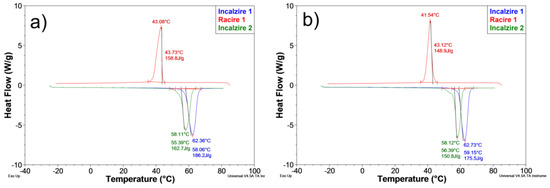
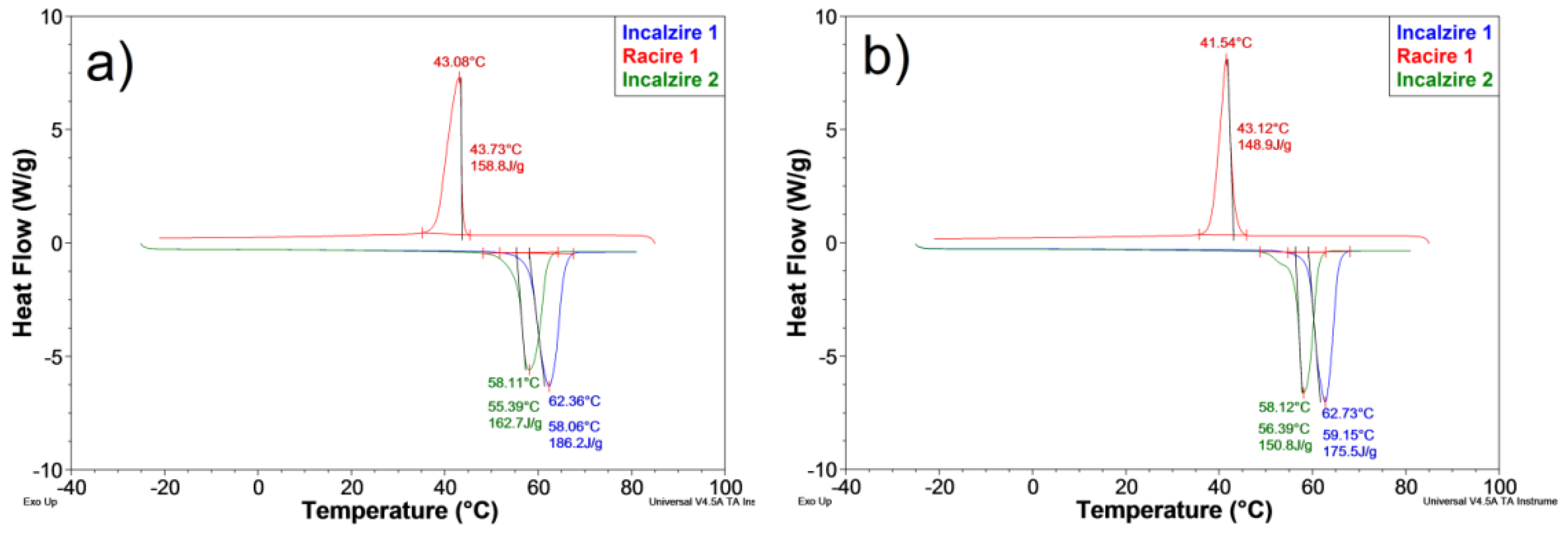
DSC curves of mixtures of PEG4000–Si with (a) PEG4000 and (b) PEG6000 at a 1:1 ratio (grav.).
Acknowledgments
This work was supported by a grant of the Romanian Ministry of Research and Innovation, CCCDI—UEFISCDI, project number PN-III-P1-1.2-PCCDI-2017-0428, contract 40PCCDI/2018, within PNCDI III and by Romanian Ministry of Research and Innovation—MCI through INCDCP ICECHIM Bucharest 2019-2022 Core Program PN. 19.23—Chem-Ergent, Project No. 19.23.02.01.
References
- Shazim, M. Phase change materials integrated in building walls: A state of the art review. Renew. Sust. Energy Rev. 2014, 31, 870–906. [Google Scholar]
- Su, X. , Jia, S., Lv, G., Yu, D., A unique strategy for Polyethylene Glycol/Hynrid carbon foam phase change materials: Morphologies, thermal properties, and energy storage behaviour. Materials 2018, 11, 2011. [Google Scholar] [CrossRef] [Scilit] [PubMed]
© 2019 by the authors. Licensee MDPI, Basel, Switzerland. This article is an open access article distributed under the terms and conditions of the Creative Commons Attribution (CC BY) license (https://creativecommons.org/licenses/by/4.0/).