


As the development of the textile industry has progressed, intense concerns have been focused on the contamination of the environment caused by dye pollutants, which can cause severe environmental pollution and health problems due to their variety, toxicity, and persistence characteristics. Therefore, in recent years, the degradation of dyes in industrial wastewaters has generated considerable attention due to the huge volume of production, slow biodegradation, low discoloration, and high toxicity [1]. This study was undertaken to determine the feasibility of oxidation processes in the treatment of textile dyes. Direct Orange 26 (DO-26) is an azo dye with potential ecotoxicity to exposed organisms [2]. Effective degradation of the DO-26 was studied by photocatalytic degradation under direct solar light.
The photocatalysts used in the study were TiO2, ferrite nanoparticles-CoFe2O4 and Fenton reagent. After the solutions were prepared, they were exposed to sunlight, between 2 h and 11 h in a Pyrex reactor of a cylindrical shape. Then, their maximum absorption at 495 nm and 519 nm (λmax) was recorded at specific times by a UV–Vis spectrophotometer.
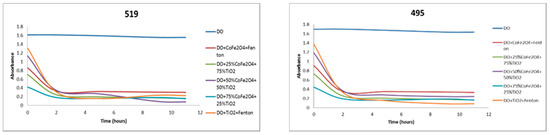
Exposure of DO-26 under direct solar light in the presence of the catalysts caused important discoloration of the dye solution in a reasonably time. Conversely, the exposure of the DO-26 to solar light without catalysts did not cause any noticeable discoloration. It can be observed that in the first 2 h, the absorbance of all DO-26 containing photocatalysts significantly decreased (Figure 1). For DO- 26+50%CoFe2O4+50%TiO2+Fenton and DO-26+TiO2+Fenton, a tendency of decrease in absorbance after 11 h could still be observed.
Figure 1.
Photo-degradation of DO-26 under direct solar light.
This work demonstrates that these new materials are effective catalysts for the destruction of the industrial dye Direct Orange 26 (DO-26) under solar irradiation.
Acknowledgments
This work was supported by a NUCLEU Program, conducted with MCI support, project number PN.19.23.03.01.04.
References
- Mehdipour Ghazi, M.; Azhdari, F. Photocatalytic degradation of textile dye direct orange 26 by using CoFe2O4/Ag2O. Adv. Environ. Technol. 2016, 2, 77–84. [Google Scholar]
- Amini, M.; Ashrafi, M. Photocatalytic degradation of some organic dyes under solar light irradiation using TiO2 and ZnO nanoparticles. Nanochem. Res. 2016, 1, 79–86. [Google Scholar]
© 2019 by the authors. Licensee MDPI, Basel, Switzerland. This article is an open access article distributed under the terms and conditions of the Creative Commons Attribution (CC BY) license (https://creativecommons.org/licenses/by/4.0/).