1. Introduction
Women’s entrepreneurship constitutes a fundamental instrument to enhance economic participation and accelerate development in the Global South. Morocco represents a burgeoning landscape for female-led entrepreneurial initiatives given its commitment to eradicating gender inequality and to achieving inclusive sustainable development. The national entrepreneurial strategy focused on reinforcing women’s contribution to both rural and urban development objectives, which has translated into a progressive growth of the proportion of women-led enterprises in recent years [
1].
However, women’s economic empowerment faces persistent structural challenges pertaining to patriarchal social norms, cultural stereotypes and disproportionate domestic responsibilities [
2]. Furthermore, women face additional barriers to ensure the scalability of their entrepreneurial ventures. They experience constrained access to finance and markets, mobility restrictions and exclusion from formal business networks [
3].
Research on women’s entrepreneurship has evolved considerably, from merely addressing gender as a demographic variable to a more elaborate field of study that encompasses contextual, institutional, socio-economic and relational dimensions [
4,
5]. Several studies have examined the strategies women have developed to reconcile their entrepreneurial endeavors with the challenges of their socio-economic environments, in North Africa and the Middle East [
6,
7]. Yet very few managed to capture the complexity of the Moroccan context, its entrepreneurship policy landscape, and its institutional ecosystem.
Research on Moroccan women’s entrepreneurship is scarce, reflecting an analytical blind spot rather than an absence of the underlying phenomena. Millet’s foundational analysis of patriarchy as a political structure provides an explanation for the underrepresentation of women’s economic agency within the entrepreneurship research field. By organizing power asymmetrically across economic, social and domestic life, patriarchal structures legitimize gendered divisions of labor and normalize gender imbalances [
8]. The European Institute for Gender Equality (EIGE) refers to similar patterns as gender blindness, where the lack of measurement of differentiated policy impacts among men and women perpetuates structural gender inequalities in research and policymaking [
9].
In the Moroccan context, Mernissi’s work on the gendered organization of public and private life serves as a foundation for the analysis of the compounded invisibility of women’s entrepreneurship in both academic literature and policy design. It provides a sociological examination of the everyday strategies through which Moroccan women progressively negotiate authority within patriarchal family structures and religious institutions, and offers a rationale for interpreting the relational autonomy strategies documented in the present study [
10,
11].
This study addresses the gender gap through a qualitative relational approach across three Moroccan regions. The central question of the study is this: How do women navigate the entrepreneurial policy/Reality paradox of progress? Sub-questions explore the role of domestic responsibilities, financial autonomy, and digital literacy in shaping Moroccan women’s entrepreneurial experiences and trajectories.
2. Literature Review
The field of entrepreneurship portrays a deficit framing attributing women’s underrepresentation to individual characteristics such as low risk tolerance, inadequate capital, and limited growth ambitions. Several studies challenged this paradigm by analyzing the cultural, institutional and relational determinants of entrepreneurial activity [
3]. In this context, institutional theory has provided a framework for examining the structural conditions that constrain women’s entrepreneurial choices across various contexts [
12].
Women’s entrepreneurship in developing nations exhibits distinctive challenges; limited access to affordable finance, gendered social and cultural norms, disproportionate domestic responsibilities and exclusion from business networks constrain entrepreneurial activity and weaken its outcomes [
13]. This multidimensional set of barriers represents a glass labyrinth that is both complex to conceptualize and difficult to dismantle [
14].
Moroccan policymakers have introduced a series of legislative and institutional reforms aimed at affirming gender equality and expanding women’s economic participation. Empirical evidence on the outcomes of these public interventions is, however, divergent. While national institutional reports indicate a progressive increase in the number of female-led enterprises and enhanced access to finance, particularly in rural areas [
15], the Global Entrepreneurship Monitor consistently ranks Morocco below regional peers on female entrepreneurial activity. Several studies attribute this situation to persistent unfavorable cultural norms, and socio-economic inequalities [
16,
17,
18].
This study is theoretically anchored in two complementary frameworks: Intersectionality theory and Sen’s capability approach [
19]. The first framework, initially developed by Crenshaw [
20] and subsequently extended to entrepreneurship contexts by Ahl and Marlow [
21] and Dy et al. [
22], examines how gender, education, marital status and geographic location jointly impact entrepreneurial outcomes. The second framework focuses on understanding the gap between formal rights, available resources and actual freedoms that women are able to exercise [
23].
3. Materials and Methods
This study adopted a qualitative relational research design to examine the social and institutional dynamics structuring women’s entrepreneurship in Morocco. The contextual focus is justified considering the study’s objective of exploring the underlying frameworks within which these entrepreneurial activities are embedded, and its abductive orientation aligning between theory and empirical patterns [
24].
A purposive sampling strategy, completed by convenience sampling, was employed to select diverse female entrepreneur profiles, across three regions: Fez-Meknès, Marrakech-Safi and Souss-Massa. In the absence of a comprehensive registry of women-led enterprises in Morocco, participants were identified through regional chambers of agriculture, commerce and industry, women’s business associations, entrepreneurship support programs, and the authors’ professional networks. Subsequently, the sample was expanded through snowball referrals. This sampling approach follows established practice in qualitative entrepreneurship research conducted in contexts lacking formal enterprise registries. The inclusion criteria for the participants were the following:
The entrepreneur is currently operating a legally registered business;
The business has been active for a minimum of one year;
The business is located in one of the selected regions.
The final sample comprised 17 female entrepreneurs (
Table 1). All participants were informed about the purpose of the study and provided informed consent prior to the conduct of the interviews. The research adhered to the principles of voluntary participation, confidentiality, and secure data processing.
The authors developed the interview guide in three iterative stages. In the first stage, they derived an initial set of open-ended questions from the study’s theoretical framework, and organized them into four thematic blocks: entrepreneurial motivations and trajectories, management of domestic responsibilities, access to financial resources and business networks, and use of digital tools.
In the second stage, they conducted an internal review of the draft guide to verify its alignment with the theoretical framework and ensure the removal of ambiguous and culturally inappropriate formulations. In the third stage, they ran a pilot test with two female entrepreneurs who were not included in the final sample. Accordingly, the feedback was used to inform rephrasing and reordering of questions, to enhance overall flow and clarity, and to confirm linguistic and cultural equivalence.
Data were collected through semi-structured interviews conducted in person between September and December 2025, in Moroccan Arabic with an average duration of 60 min. The interviews captured entrepreneurial motivations, perspectives regarding institutional support, dual management of personal and professional responsibilities, social and economic variables, and access to business networks. Saturation was reached at the fifteenth interview. Interviews were recorded, transcribed and analyzed using NVivo 15.
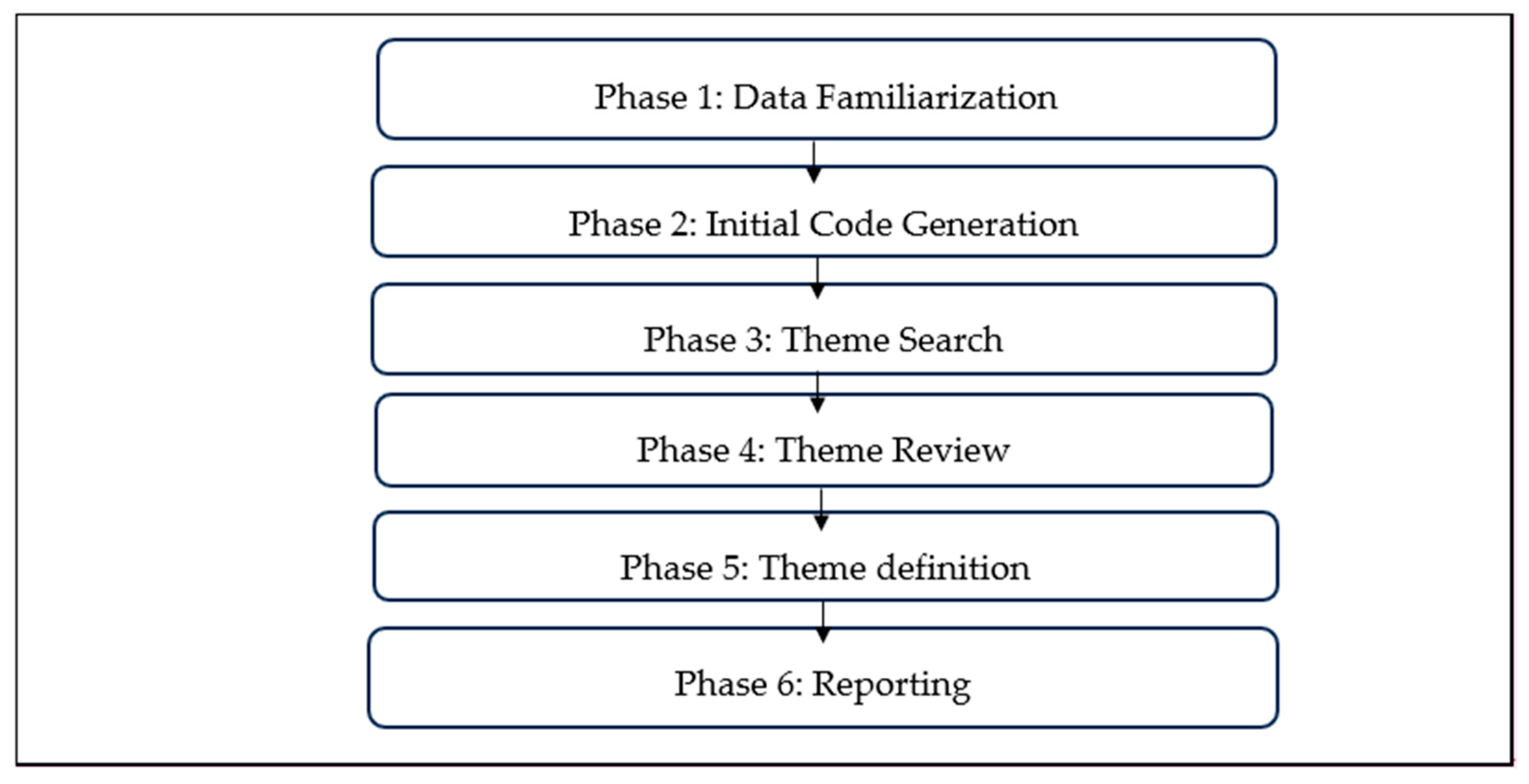
The analytical process employed intersectional thematic analysis, integrating Braun and Clarke’s reflexive thematic analysis [
25] with the intersectionality approach to examine how identity and power shape personal experience [
26].
Figure 1 illustrates the six iterative phases used to ensure analytical rigor.
4. Results
The analysis of the interviews generated four themes that captured the experiences of Moroccan women entrepreneurs in reconciling institutional opportunities with persistent structural constraints. The following subsections detail each theme according to the recurring patterns from the interviews. Subsequently, the themes are analyzed in relation to the study’s theoretical framework in
Section 5.
4.1. Entrepreneurial Negotiated Autonomy
Interviewees unanimously considered entrepreneurship a viable pathway to improve their autonomy. They reported that engaging in entrepreneurial activities has resulted in greater financial independence and social recognition among their communities. Multiple participants indicated, however, that these outcomes required a laborious negotiation through which they had to engage in ongoing relational labor to secure informal permission from male relatives, even when formal legal rights were unambiguous.
Informal authority constrained women’s capabilities and conditioned their freedoms. Participants reported that while their partners and family members did not formally prohibit their entrepreneurial endeavors, they insisted on effective household management and required that the domestic responsibilities always came first. Nevertheless, the entrepreneurial trajectories of the interviewees demonstrated a progressive evolution, from conditional agency to earned authority. Whereas this evolution was recurrent across the sample, its magnitude was modulated by marital status, educational attainment, and financial performance.
4.2. Dual Management of Productive and Reproductive Roles
Disproportionate domestic responsibilities were identified by all interviewees as a major barrier to business growth and scalability. Female entrepreneurs reported that despite extended family support in most cases, reproductive responsibilities and domestic care compressed considerably the time, cognitive and energetic bandwidth available for entrepreneurial activity. This situation was particularly exacerbated for women who operated in rural areas, where limited access to resources, infrastructure, and training opportunities further entrenched the gendered inequalities gap.
In the face of temporal and spatial constraints, women have managed to develop adaptive reproductive governance strategies aimed at making work schedules more flexible, by negotiating task redistribution within their families, temporarily halting operations and reducing work hours during school holidays. Despite their effectiveness in mitigating time deficit, several participants highlighted that the adopted resilience strategies were not sustainable and provided evidence of persistent structural injustice rather than socio-economic empowerment.
4.3. Exclusion from Social and Business Networks
Most interviewees reported that their exclusion from social and business networks had a negative impact on the success and growth of their entrepreneurial ventures. They indicated that being part of informal professional circles was decisive for regulatory navigation and market access as it often provided referrals, valuable information and market opportunities.
Informal male-centric networks created a glass labyrinth requiring a constant compensatory effort. Women’s business associations provided an alternative route to overcome network exclusion. By engaging with such associations, female entrepreneurs were able to benefit from entrepreneurial and technical support, collective action, and peer learning. However, the interviewees of this study reported that despite their valuable contribution, women’s business associations could not substitute professional business networks that provide the most significant business opportunities.
4.4. Digital Literacy as an Emancipation Strategy
Digital platforms offered a viable pathway to surmount women’s exclusion from traditional business networks. Several participants reported that using social media platforms enabled them to expand their market access and to enhance both their supplier and customer relationships. Furthermore, digital platforms allowed female entrepreneurs to overcome the geographic constraints that limited their capabilities and hindered the scalability of their ventures.
Interviewees with limited educational background reported substantial difficulties in using digital platforms. They indicated that they depended on assistance form young family members or relatives to use certain features such as e-commerce operations and electronic payment. Digital literacy and technological connectivity thus formed a prerequisite to an equitable access to digital tools and an effective presence on the market.
5. Discussion
The present study contributes to research on barriers and resilience strategies pertaining to women’s entrepreneurship in Morocco. By examining the mechanisms through which female entrepreneurs navigate the barriers of their entrepreneurial ecosystem and leverage its opportunities, the findings extend prior literature on the complexity of women’s entrepreneurial trajectories [
13,
14,
27].
The central contribution of the study corroborates Sen’s capability approach [
19]. Women’s entrepreneurial autonomy is continuously negotiated despite formal legal rights. The findings distinguish between legal frameworks and informal relational authority structures that determine women’s capability to exercise their formal rights. Furthermore, they support prior research suggesting that legal reforms remain insufficient to develop women’s agency and entrepreneurial capabilities, unless they are accompanied by favorable social conditions [
23,
28].
Women’s negotiated autonomy resonates with Millet’s characterization of patriarchy as a system that subordinates women’s agency to male authority within the household, through diffuse social arrangements rather than formal prohibition [
8]. It further echoes Mernissi’s work on how Moroccan women have managed to incrementally expand their autonomy through relational strategies that never resolved to open confrontation, but rather operated through daily negotiations within patriarchal family and religious structures [
10,
11]. These two perspectives posit jointly that achieving formal gender equality advances in Morocco remains conditioned by informal patriarchal structures that constrain women’s entrepreneurial and economic agency.
This study further advances understanding of the impact of reproductive governance on the disruption of women’s entrepreneurial activity [
29]. The alignment of domestic responsibilities with professional activities often results in a structural time scarcity which constrains considerably the sustainability of women’s professional schedules and their work–life balance [
30]. Network exclusion exacerbates these gender inequalities and further entrenches women’s economic marginalization [
18], requiring explicit policy attention to design more inclusive networking and business environments.
The findings on the contribution of digital literacy to women’s emancipation affirm the important role of digital platforms in bypassing traditional informal business structures. Nonetheless, recent scholarship on digital divides cautions against the systematic adoption of digital entrepreneurship as a gender equality strategy due to its complex and non-linear evolution [
31,
32].
The study has several limitations that should be acknowledged. The qualitative research design and the non-probability purposive sampling strategy limit the generalizability of the results beyond the context of the study. Furthermore, the selection of three regions restricts the analysis on the regional diversity of entrepreneurial contexts in Morocco. Finally, the self-reported performance indicators might introduce a subjectivity bias leading to amplifying or underestimating certain factors based on participants’ perceptions.
6. Conclusions
This study examined the mechanisms through which Moroccan female entrepreneurs expand their socio-economic opportunities despite the persisting structural barriers they face. The findings demonstrated that women’s entrepreneurship constitutes an efficient relational negotiation strategy that contributes to challenging the gendered status quo and to enhancing women’s economic participation and social position.
This relational negotiation strategy is manifested through four interconnected resilience mechanisms substantiated by the results: the incremental expansion of autonomy based on the conversion of conditional agency into earned authority within patriarchal structures, the management of structural time scarcity through the development of adaptive reproductive governance strategies, compensatory engagement with women’s business networks to mitigate exclusion from male-centric professional networks, and leveraging digital platforms to surmount geographic and relational barriers to market access.
Navigating this paradox of progress provides implications for policy and practice. The Moroccan entrepreneurial ecosystem must operate an intersectional reconfiguration of the context into which entrepreneurial activities are embedded. This reconfiguration requires coordinated institutional action to attenuate women’s social and domestic burdens, by introducing inclusive legal reforms, enhancing existing social protection schemes, and implementing targeted policy interventions to facilitate women’s integration into business networks and access to markets.
Future research could use these findings as a foundation to analyze the evolution of the identified structural constraints across the entrepreneurial cycle by employing mixed-methods longitudinal and comparative designs, in similar contexts. Furthermore, developing participatory approaches could lead to enriching the co-construction of scientific knowledge in the field of entrepreneurship.
Author Contributions
Conceptualization, N.K.; methodology, N.K.; software, N.K. and A.L.; validation, N.K. and A.L.; formal analysis, N.K.; investigation, N.K.; resources, N.K.; data curation, N.K.; writing—original draft preparation, N.K.; writing—review and editing, N.K. and A.L.; visualization, N.K.; supervision, A.L.; project administration, N.K. All authors have read and agreed to the published version of the manuscript.
Funding
This research received no external funding.
Institutional Review Board Statement
This study does not incorporate, collect, process, or relate to sensitive personal data, so there is no applicable Institutional Review Board Statement.
Informed Consent Statement
Informed consent was obtained from all subjects involved in the study.
Data Availability Statement
Data supporting reported results can be provided upon inquiry to the authors.
Acknowledgments
The authors would like to acknowledge the invaluable contribution of all the participants who took the time to engage in the interviews and provide the data.
Conflicts of Interest
The authors declare no conflicts of interest.
References
- Rharzouz, J.; Bouarir, H.; El Moutaqi, B.; Rizqi, N.; Boubker, O. Factors Influencing Women’s Entrepreneurial Success in a Patriarchal Society: Empirical Evidence from Morocco. Societies 2024, 14, 151. [Google Scholar] [CrossRef] [Scilit]
- Manhas, S. Structural and Cultural Barriers to the Economic Empowerment of Women. In Women and Empowerment; Koul, R., Gupta, R., Tandon, B., Gupta, R., Eds.; Sustainable Development Goals Series; Springer: Singapore, 2025; pp. 91–107. [Google Scholar] [CrossRef] [Scilit]
- Buvinić, M.; Furst-Nichols, R. Promoting women’s economic empowerment: What works? World Bank Res. Obs. 2016, 31, 59–101. [Google Scholar] [CrossRef] [Scilit]
- Brush, C.G.; De Bruin, A.; Welter, F. A gender-aware framework for women’s entrepreneurship. Int. J. Gend. Entrep. 2009, 1, 8–24. [Google Scholar] [CrossRef] [Scilit]
- Welter, F. Contextualizing Entrepreneurship—Conceptual challenges and ways forward. Entrep. Theory Pract. 2011, 35, 165–184. [Google Scholar] [CrossRef] [Scilit]
- Jamali, D. Constraints and opportunities facing women entrepreneurs in developing countries: A relational perspective. Gend. Manag. Int. J. 2009, 24, 232–251. [Google Scholar] [CrossRef] [Scilit]
- Bastian, B.L.; Sidani, Y.M.; El Amine, Y. Women entrepreneurship in the Middle East and North Africa: A review of knowledge areas and research gaps. Gend. Manag. Int. J. 2018, 33, 14–29. [Google Scholar] [CrossRef] [Scilit]
- Millet, K. Sexual Politics; Columbia University Press: New York, NY, USA, 1970. [Google Scholar]
- European Institute for Gender Equality (EIGE). Gender blindness. In Gender Equality Glossary & Thesaurus; EIGE: Vilnius, Lithuania, 2016; Available online: https://eige.europa.eu/publications-resources/thesaurus/terms/1250 (accessed on 21 July 2026).
- Mernissi, F. Beyond the Veil: Male-Female Dynamics in Modern Muslim Society, Revised ed.; Indiana University Press: Bloomington, IN, USA, 1987. [Google Scholar]
- Mernissi, F. Doing Daily Battle: Interviews with Moroccan Women; The Women’s Press: London, UK, 1988. [Google Scholar]
- Welter, F.; Smallbone, D. Institutional perspectives on entrepreneurial behavior in challenging environments. J. Small Bus. Manag. 2011, 49, 107–125. [Google Scholar] [CrossRef] [Scilit]
- Khayati, N.; Lahrech, A. Youth Entrepreneurship in Africa: A catalyst for Economic Development. In Critical Economic Implications of Global Demographic Changes; Christiansen, B., Branch, J., Eds.; IGI Global Scientific Publishing: Hershey, PA, USA, 2026; pp. 267–302. [Google Scholar] [CrossRef] [Scilit]
- Menzies, T.V.; Diochon, M.; Gasse, Y. Examining venture-related myths concerning women entrepreneurs. J. Dev. Entrep. 2004, 9, 89–107. [Google Scholar]
- High Commission for Planning. Moroccan Women in Figures; High Commission for Planning: Rabat, Morocco, 2025. [Google Scholar]
- Khayati, N.; Lahrech, A. Exploring the role of Rural Women in Sustainable Agriculture in Morocco. In Proceedings of the 3rd International Online Conference on Agriculture, Basel, Switzerland, 22–24 October 2025. [Google Scholar]
- Laffineur, C.; Tavakoli, M.; Fayolle, A.; Amara, N.; Carco, M. Insights from Female Entrepreneurs in MENA Countries: Barriers and Success Factors. In Entrepreneurship Ecosystem in the Middle East and North Africa (MENA); Faghih, N., Zali, M., Eds.; Springer: Cham, Switzerland, 2018; pp. 351–397. [Google Scholar] [CrossRef] [Scilit]
- Naguib, R. Motivations and Barriers to Female Entrepreneurship: Insights from Morocco. J. Afr. Bus. 2022, 25, 9–36. [Google Scholar] [CrossRef] [Scilit]
- Sen, A. Development as Freedom; Oxford University Press: Oxford, UK, 1999. [Google Scholar]
- Crenshaw, K. Mapping the Margins: Intersectionality, Identity Politics, and Violence against Women of Color. Stanf. Law Rev. 1991, 43, 1241–1299. [Google Scholar] [CrossRef] [Scilit]
- Ahl, H.; Marlow, S. Exploring the dynamics of gender, feminism and entrepreneurship: Advancing debate to escape a dead end? Organization 2012, 19, 543–562. [Google Scholar] [CrossRef] [Scilit]
- Dy, A.M.; Marlow, S.; Martin, L. A Web of opportunity or the same old story? Women digital entrepreneurs and intersectionality theory. Hum. Relat. 2017, 70, 286–311. [Google Scholar] [CrossRef] [Scilit]
- Nussbaum, M.C. Creating Capabilities: The Human Development Approach; Harvard University Press: Cambridge, MA, USA, 2011. [Google Scholar]
- Dubois, A.; Gadde, L.E. Systematic combining: An abductive approach to case research. J. Bus. Res. 2002, 55, 553–560. [Google Scholar] [CrossRef] [Scilit]
- Braun, V.; Clarke, V. Using thematic analysis in psychology. Qual. Res. Psychol. 2006, 3, 77–101. [Google Scholar] [CrossRef] [Scilit]
- Hankivsky, O.; Cormier, R. Intersectionality and public policy: Some lessons from existing models. In The Palgrave Handbook of Intersectionality in Public Policy; Hankivsky, O., Jordan-Zachery, J.S., Eds.; Palgrave Macmillan: Cham, Switzerland, 2019; pp. 69–93. [Google Scholar] [CrossRef] [Scilit]
- Rouse, J.; Kitching, J. Do enterprise support programmes leave women holding the baby? Environ. Plan. C Gov. Policy 2006, 24, 5–19. [Google Scholar] [CrossRef] [Scilit]
- Khayati, N.; Lahrech, A. The Impact of Entrepreneurship on Economic Development: Case of the Fez-Meknès region in Morocco. In Proceedings of the Scientia Iuventa, 3 April 2025; Belianum, Matej Bel University Press: Banská Bystrica, Slovakia, 2025; pp. 192–207. [Google Scholar]
- Brush, C.G.; Ali, A.; Kelley, D.; Greene, P. The influence of human capital factors and context on women’s entrepreneurship: Which matters more? J. Bus. Ventur. Insights 2017, 8, 105–113. [Google Scholar] [CrossRef] [Scilit]
- Antonopoulos, R.; Hirway, I. (Eds.) Unpaid Work and the Economy: Gender, Time Use and Poverty in Developing Countries; Palgrave Macmillan: London, UK, 2010; pp. 1–21. [Google Scholar] [CrossRef] [Scilit] [PubMed]
- Taneja, S.; Pryor, M.; Hayek, M. Leaping innovation barriers to small business longevity. J. Bus. Strategy 2016, 37, 44–51. [Google Scholar] [CrossRef] [Scilit]
- Sey, A.; Hafkin, N. (Eds.) Taking Stock: Data and Evidence on Gender Equality in Digital Access, Skills and Leadership; International Telecommunication Union: Geneva, Switzerland; UN University: Macau, China, 2019. [Google Scholar]
| Disclaimer/Publisher’s Note: The statements, opinions and data contained in all publications are solely those of the individual author(s) and contributor(s) and not of MDPI and/or the editor(s). MDPI and/or the editor(s) disclaim responsibility for any injury to people or property resulting from any ideas, methods, instructions or products referred to in the content. |