1. Introduction
Demographic and epidemiological transitions are important drivers reshaping population structures and disease patterns globally. In Brunei Darussalam, these transitions have occurred rapidly, characterized by declining fertility, increased life expectancy, and a shift from infectious diseases to chronic non-communicable conditions. While these changes are well documented through demographic and health indicators, their implications for family systems and intergenerational support structures remain less explored. In contexts where families have traditionally been the primary providers of care, such transitions may fundamentally alter caregiving capacity and the sustainability of existing support arrangements.
Although many countries are experiencing similar demographic changes, Brunei Darussalam represents a distinctive small-state context. Universal publicly funded healthcare, strong cultural expectations of family caregiving, limited formal long-term care infrastructure, and reliance on migrant domestic workers for some household care create a unique configuration of the welfare diamond. This combination differs from both larger welfare states and many neighboring Southeast Asian countries, making Brunei a useful case for examining how demographic change reshapes care responsibilities within a family-oriented welfare system.
This paper aims to examine how demographic and epidemiological changes are reshaping family support and long-term care arrangements in Brunei through the welfare diamond framework. Specifically, it seeks to describe key demographic and epidemiological transitions, analyze how these changes influence care demand and family caregiving capacity, and examine how care responsibilities are evolving across the family, state, market, and community sectors.
2. Methods
This study is based on a structured secondary analysis and thematic synthesis of national census data, population projections, mortality trends, and published local studies in Brunei Darussalam. Official national census statistics were used to describe demographic and household characteristics [
1], while the United Nations World Population Prospects 2024 Revision provided updated population estimates and future demographic projections. Additional epidemiological data were obtained from the World Health Organization Global Health Estimates [
2].
The analysis focuses on demographic structure, epidemiological patterns, and their implications for caregiving arrangements. A conceptual framework combining demographic and epidemiological transition theory with the welfare diamond is applied to map how care responsibilities are distributed and how these distributions are shifting over time.
3. Results
3.1. Demographic Ageing and Shrinking Family Capacity
Brunei has experienced a marked demographic transition, with fertility declining from 7.48 in the 1950s to approximately 1.7 in 2026, which is well below the replacement level. Population growth has slowed substantially, with annual growth rates declining from 4.4% in 1971 to 1.1% in 2021 [
3].
At the same time, the population is ageing rapidly. The old-age dependency ratio increased from 4.2% in 2001 to 8.7% in 2021 [
1], and is projected to rise to 20.2% by 2040 and 39.4% by 2060 [
3]. This indicates a substantial increase in the number of older persons supported by a shrinking working-age population.
Changes in household structures are also observed. The proportion of small households has increased, while large households are declining significantly. For example, the number of single-person households increased from 5.8% in 2001 to 10.3% in 2021 [
1]. These shifts reduce the availability of co-residing family members to share caregiving responsibilities if required.
3.2. Longevity and Expansion of Care Needs
Life expectancy in Brunei has increased over time, with overall life expectancy reaching 76.9 years in 2021 [
2]. However, gains in health-adjusted life expectancy (HALE) have been more modest, indicating that additional years of life are increasingly lived with chronic illness or disability.
The epidemiological profile is dominated by non-communicable diseases. In 2021, the leading causes of death included ischemic heart disease (55.97 per 100,000), stroke (43.84), and diabetes mellitus (32.47) [
2]. These conditions require long-term management and contribute significantly to disability.
Disability-adjusted life years (DALYs) further highlight the burden of chronic disease, reflecting both premature mortality and years lived with disability. In Brunei, ischemic heart disease, diabetes, and stroke are leading contributors, indicating a substantial burden of disability that increases long-term caregiving demands [
2].
These trends extend both the duration and complexity of caregiving, requiring sustained and often intensive involvement from family members.
3.3. Changing Family Structures and Gendered Care Dynamics
Demographic changes are accompanied by shifts in family structure. Census data indicate significant gender disparities in widowhood. Among individuals aged 65 years and older, nearly half of women were widowed compared to approximately one in eight men. This disparity increases further in those aged 80 years and above [
1].
The loss of spousal support increases reliance on children or extended family for care. At the same time, increasing female participation in the workforce reduces the availability of traditional caregivers within households.
Urbanization and changing aspirations among younger generations also influence living arrangements and intergenerational support, contributing to a gradual shift away from extended family caregiving models.
3.4. Demographic Duality and Emerging Market-Based Care
Brunei’s population structure is characterized by a substantial proportion of temporary migrant workers, the majority of whom are of working age [
1,
4]. This produces a demographic duality in which the overall population appears younger, while the citizen population is ageing more rapidly.
Migrant domestic workers may provide supplementary caregiving support, representing a market-based component within the welfare diamond. However, access to such support is uneven and dependent on household resources, limiting its scalability as a universal solution to long-term care needs.
3.5. Synthesis of Transitions and Family Impact
The relationships between these transitions and their implications for family support systems are summarized in
Table 1.
Overall, these demographic and epidemiological transitions simultaneously increase care demand while reducing the capacity of families to provide traditional informal care.
While
Table 1 summarizes the demographic and epidemiological transitions affecting family support,
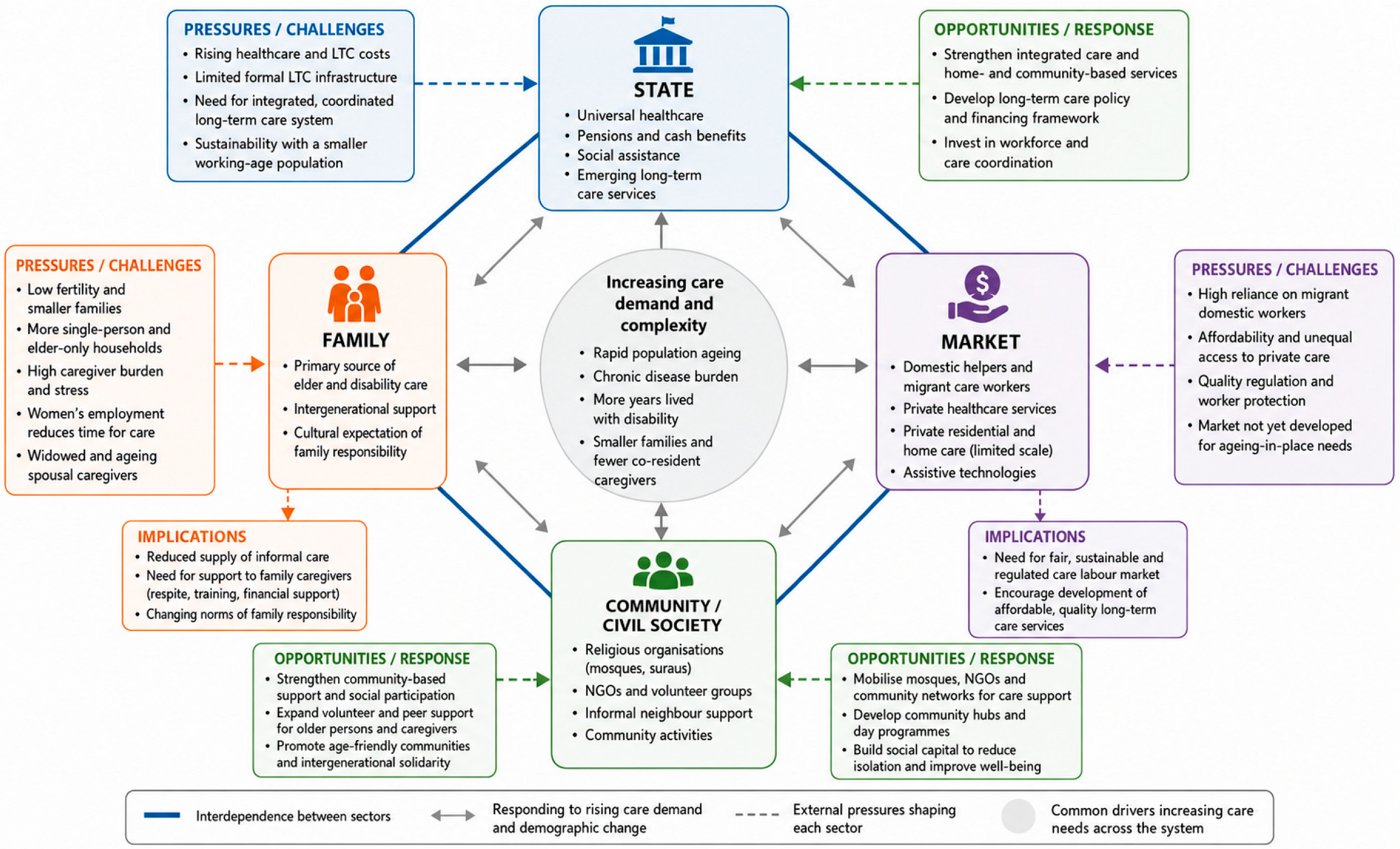
Figure 1 provides a conceptual interpretation of these findings through the welfare diamond framework. Demographic ageing and chronic disease increase care demand, while declining fertility, smaller households and changing labor-force participation reduce the capacity of families to provide informal care. As a consequence, greater contributions from the state, market and community sectors will be required to sustain long-term care provision.
4. Discussion
These findings indicate that Brunei is undergoing not only a demographic and epidemiological transition, but also a care transition, in which the traditional reliance on family-based caregiving is increasingly challenged. Viewed through the welfare diamond framework (
Figure 1), these changes illustrate how demographic and epidemiological transitions are progressively reshaping the balance of responsibilities across the family, state, market and community sectors.
As summarized in
Table 1, multiple transitions converge to simultaneously increase care demand and reduce caregiving capacity. Declining fertility and smaller households reduce the number of available caregivers, while increased longevity and chronic disease extend the duration and complexity of care. These dynamics create a structural imbalance between care needs and caregiving resources. Although families remain the cornerstone of care provision in Brunei, demographic change is reducing their capacity to meet growing care needs through informal support alone.
Gendered patterns further intensify these pressures. Higher rates of widowhood among older women increase dependency on children, while increased workforce participation among younger women reduces the availability of informal caregivers. This reflects a shift from traditional caregiving norms toward more constrained and negotiated care arrangements. These findings highlight the continued importance of the family component of the welfare diamond while suggesting that reliance on family care alone is becoming increasingly difficult to sustain.
The demographic duality created by migrant labor introduces a partial market response to caregiving needs. However, this remains uneven and insufficient to address population-level demand. Paid domestic workers and private healthcare providers may supplement family caregiving, particularly among households with greater financial resources, but market-based care alone is unlikely to provide an equitable solution to future long-term care needs. At the same time, state provision in Brunei remains strong in healthcare but less developed in long-term care infrastructure, while community-based systems are still emerging. Strengthening integration between healthcare, long-term care, caregiver support and community services will therefore become increasingly important. Community and civil society organizations, including non-governmental organizations, religious groups and volunteer networks, may play a complementary role by supporting caregivers, promoting ageing-in-place and strengthening social participation.
Within the welfare diamond framework, these findings suggest an increasing imbalance, with continued reliance on families despite declining capacity. This raises important questions about the sustainability of family-based care systems in the context of rapid demographic change. Rather than replacing family care, future policy should seek to rebalance responsibilities across the four components of the welfare diamond, ensuring that families are supported by coordinated contributions from the state, market and community sectors.
5. Policy and Research Implications
From a policy perspective, there is a need to strengthen long-term care systems that complement family-based care. Rather than replacing family caregiving, the welfare diamond framework suggests that future policy should seek to rebalance responsibilities across the family, state, market and community sectors. This includes developing community-based services, supporting informal caregivers through training, respite services, financial mechanisms, promoting flexible employment policies where feasible, and integrating health and social care systems to manage chronic conditions more effectively.
The role of migrant labor in caregiving also requires careful regulation and planning to ensure quality, equity, and sustainability. Partnerships with community and civil society organizations may further strengthen caregiver support, social participation and ageing-in-place initiatives. Strategies to promote healthy ageing and prevent or delay the onset of chronic disease are also important to reduce future care demand.
From a research perspective, further work is needed to quantify caregiving burden, understand care preferences among families, and evaluate emerging models of care in Brunei. Longitudinal studies are also important to examine how demographic and epidemiological transitions impact care needs over time.
6. Conclusions
Demographic and epidemiological transitions in Brunei Darussalam are reshaping family support systems and intergenerational caregiving arrangements. Declining fertility, increasing longevity, and a growing burden of chronic disease are intensifying care demands, while changing family structures and social roles reduce the capacity of families to provide care. Viewed through the welfare diamond framework, these transitions illustrate how the balance of care responsibilities is gradually shifting across the family, state, market, and community sectors.
Taken together, the evidence indicates the emergence of a care transition, in which traditional family-based systems are increasingly under strain. Addressing this will require coordinated efforts across family, state, market, and community sectors to ensure sustainable support for an ageing population. Rather than replacing family care, future policy should seek to strengthen and rebalance contributions across all four sectors to support sustainable long-term care in an ageing society.