1. Introduction
Preparing a new generation of web developers and training institutional IT staff are ongoing challenges for Technology-Enhanced Education. This is also a challenge with a measurable environmental impact, as the infrastructure supporting the digital sector is already estimated to consume approximately 7% of global electricity, a share that continues to rise rapidly with internet traffic [
1]. Every time a web page is loaded, each server request consumes energy, much of which is still generated from fossil fuels. Sustainable (or “green”) web development addresses this challenge by optimizing performance, architecture, and hosting choices to reduce the carbon footprint of digital products without compromising the user experience [
2,
3].
Digital sustainability has been conceptualized more as the integration of digital transformation with broader sustainability objectives than as a naturally beneficial consequence of digitalization [
4,
5]. As a multidimensional construct, it extends beyond individual technological or environmental indicators and encompasses broader dimensions of sustainability and digitalization [
5]. Green hosting represents an indicator of digital sustainability related to infrastructure, but should not be interpreted as a comprehensive measure of overall website sustainability.
Technical guidelines on sustainable web development are increasingly available, but their adoption largely depends on whether developers and institutions are aware of them and trained to implement them. In his study, Jha [
6] highlights the lack of cross-industry and emerging market evidence on green hosting. This study addresses this gap by providing, to the best of our knowledge, the first empirical analysis of green-hosting adoption in the Balkan region and discussing the potential implications of the observed patterns for web development education in the region.
Recent studies have highlighted the importance of integrating sustainability into software engineering education. These studies identify competencies related to environmental impacts, sustainability metrics, system thinking and sustainable software development [
7]. The adoption of sustainability in higher education is influenced by numerous factors, including awareness, financial constraints, technological barriers, governance structures, and changes in stakeholder priorities [
8]. Doyon [
9] argues that web development curricula should include environmental knowledge in addition to technical skills. If universities and training programs do not include sustainability criteria in web development curricula, graduates will enter the workforce without the competencies needed to build a greener web. This paper raises two related research questions: (1) How far has the adoption of green hosting progressed across institutional sectors in the region? (2) What should be taught in Balkan web development curricula and professional training? This study presents a descriptive analysis of green-hosting adoption in five Balkan countries and discusses the potential educational implications of the observed patterns for sustainable web development in the region.
2. Materials and Methods
To collect domain data, the public Certificate Transparency search platform crt.sh [
10] was used, which indexes SSL/TLS certificates issued for publicly verifiable domains according to the Certificate Transparency standard [
11]. For each of the five ccTLDs (.al, .gr, .me, .mk, .rs), I built a Python 3.11 script that queried crt.sh and saved the domain lists in CSV format. Data collection was carried out in December 2025. The resulting observational sample was based on domains available through Certificate Transparency data and was not intended to be statistically representative of all websites in the five countries.
In the final dataset, domains were retained only if they returned an active DNS record, received a valid response from the Green Web Foundation API, and were unique. Domains without a resolvable IP address were excluded, while all active domains were tested against the Green Web Foundation API [
12,
13]. The Green Web Foundation returns a green-flag Boolean and the hosting provider name for each domain. “Green hosting” is therefore an operational, database-dependent classification reflecting the provider and sustainability information available in the Green Web Foundation database rather than an independent audit of the electricity consumed.
Analysis was performed in Python 3.11 using requests, pandas, matplotlib, xlsxwriter, json, and pathlib. For each ccTLD, three summary indicators were computed: the total number of active domains, the number of green domains, and the resulting green-hosting percentage. A sectoral breakdown was produced programmatically from the domain-name structure using six categories (gov, edu, com, org, net, and other). Domains containing the predefined labels gov, edu, com, org, or net in their domain-name structure were assigned to the corresponding category, while domains not matching any of these labels were assigned to “other”. No sector was inferred from website content or through manual assessment. Green-hosting percentages were then computed for each country–sector cell. To assess the association between country and green-hosting status, a chi-square test of independence was applied to the country-by-green/non-green status contingency table. Following standard practice for categorical association testing, Cramér’s V was used to quantify effect size [
14].
Because the five ccTLD samples differ substantially in size (from 155 domains for Albania to 4602 for Serbia),
Section 3.1 reports two regional summary statistics: the pooled, domain-weighted share of green hosting across all 8976 domains and the unweighted average of the five country-level percentages, in which each country counts as one observation regardless of its sample size. These statistics are reported to avoid smaller, high-adoption countries being masked by the large Serbian sample or, conversely, large samples being masked by treating all countries as equal. The first statistic answers the question, “What share of all sampled domains is green?”, while the second asks, “How does the typical country in the region perform?”
3. Results
3.1. Regional Comparison
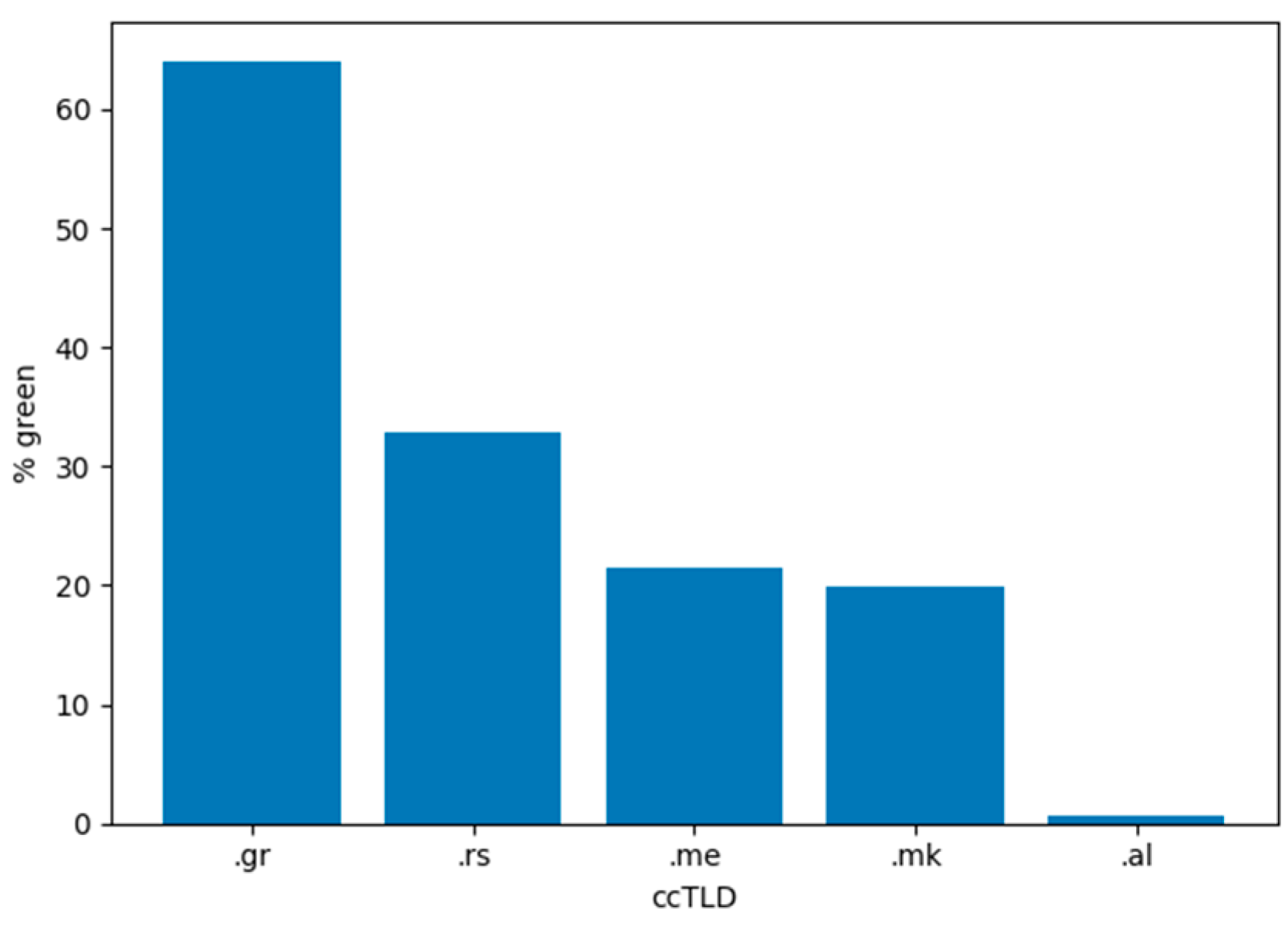
Table 1 presents the number of active domains analyzed for each ccTLD, the number classified as green, and the resulting percentage, together with the two regional summary statistics described above. This pattern is visualized in
Figure 1, which presents the green-hosting share by ccTLD.
Greece shows by far the highest green-hosting share (64.07%), followed by Serbia (32.83%), Montenegro (21.39%), and North Macedonia (19.94%), while Albania trails with 0.65%. Because Serbia’s sample is more than twice the size of the other three mid-range countries combined, its intermediate percentage carries disproportionate weight in the pooled statistic (40.34%) relative to the unweighted cross-country average (27.77%).
To test whether these cross-country differences are statistically robust rather than an artifact of sample composition, a chi-square test of independence was performed on the 5 × 2 contingency table of country by green/non-green status (
Table 1). The association between country and green-hosting status was highly significant, χ
2(4, N = 8976) = 1103.87,
p < 0.001, with a moderate-to-strong effect size (Cramér’s V = 0.35). This confirms that green-hosting adoption differs systematically across the five countries and is not explained by sampling variation alone.
3.2. Sectoral Comparison
The sectoral pattern is not uniform across countries (
Table 2).
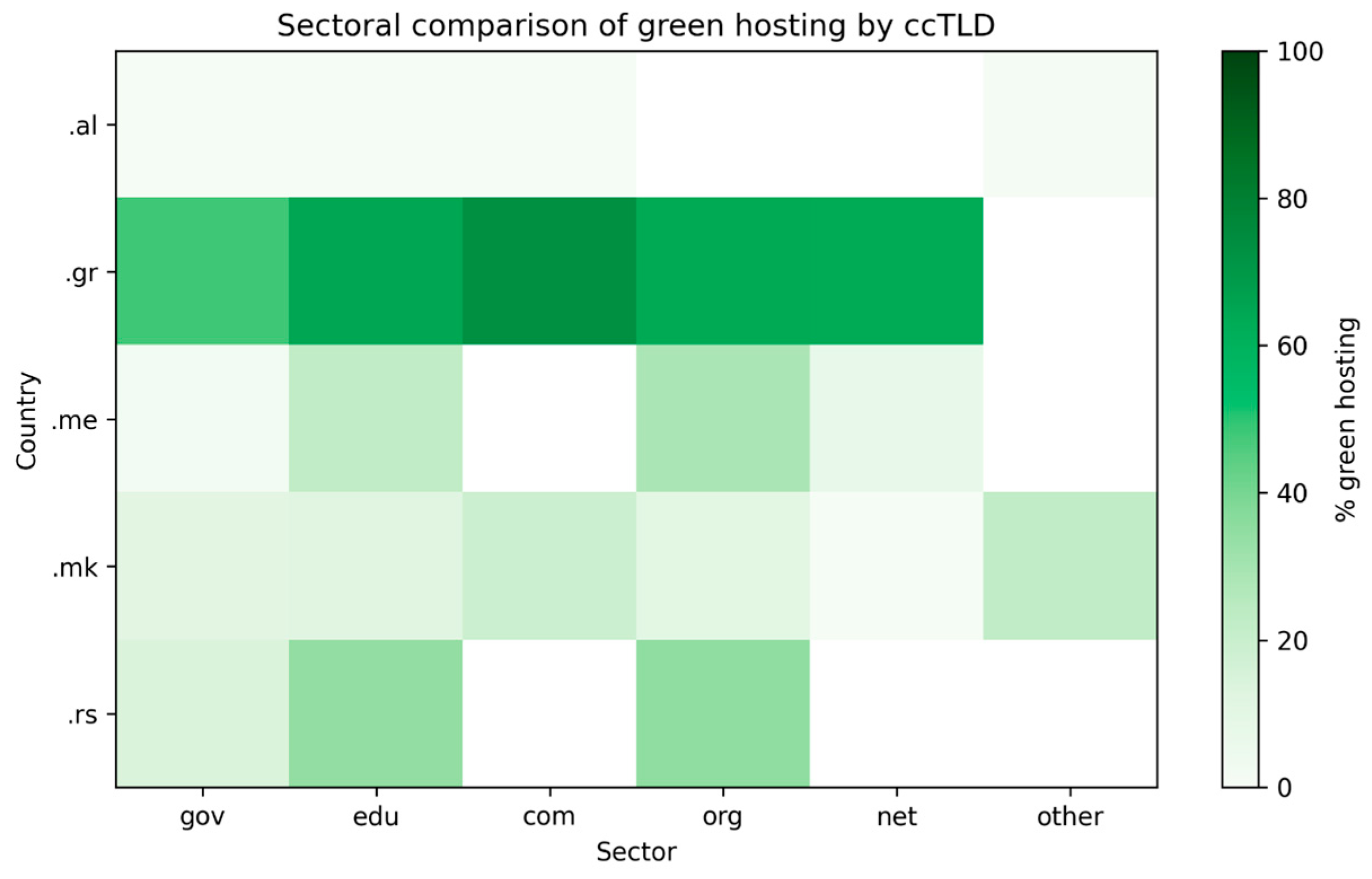
Figure 2 further breaks down green-hosting adoption by sector (.gov, .edu, .com, .org, .net) across the five ccTLDs.
Greece shows consistently high green-hosting shares across all five represented predefined sectors, ranging from 48.32% for gov domains to 73.36% for com domains. Serbia shows moderate shares in the two largest sectoral groups, edu (34.52%, N = 2251) and org (34.99%, N = 1926), while gov domains show a lower share (14.12%, N = 425). Montenegro similarly records its highest shares in org (28.30%, N = 159) and edu (22.64%, N = 159), although some sectoral estimates are based on small samples. North Macedonia displays generally lower sectoral shares, with the highest value observed in the other category (22.00%, N = 609), followed by com (18.91%, N = 275). Albania records only one green domain in the entire sample, classified as other, resulting in 0.74% for this category (N = 135), while no green domains were identified in its gov, edu, or com categories. Overall, the results demonstrate substantial cross-country and cross-sector variation; however, comparisons involving small sectoral samples or cells with no available domains should be interpreted cautiously.
Figure 2 provides a visual representation of these sectoral differences, highlighting the variation in green-hosting adoption across countries and domain-based categories.
4. Discussion
The overall picture of this research paper shows an unweighted regional average of 27.77% for green hosting, ranging from 64.07% in Greece to the lowest value, 0.65%, in Albania. These results show that green-hosting adoption is highly uneven across the region. However, this study does not directly examine the factors responsible for these differences.
The low uptake of green hosting in some countries and sectors may be associated with several technical, institutional, or educational factors. However, since this study did not directly examine developers, IT staff, or procurement officers, the results cannot determine whether differences in awareness, knowledge, or professional practices explain the observed patterns.
Nevertheless, education may represent one potential avenue for supporting sustainable web development. The importance of integrating sustainability into software engineering education was emphasized by Moriera [
7]. In this context, a practical module could be incorporated into existing web development courses. The module could teach students to check a hosting provider’s status through the Green Web Foundation API, compare providers using environmental criteria, and estimate a page’s environmental impact using tools such as Website Carbon Calculator [
15] or Lighthouse performance audits [
3].
A second potential intervention is a targeted briefing for public-sector IT staff and procurement officers. This briefing could focus on incorporating green-hosting criteria into hosting tenders and contract renewals, rather than on redesigning existing systems. Such an intervention is proposed as practical guidance for considering sustainability in technology-related decisions, rather than as a response to knowledge gaps demonstrated by the present study.
A third potential intervention involves the provision of information sessions targeted at small businesses. Such sessions could offer practical guidance regarding green-hosting alternatives, as well as the environmental criteria that should be taken into account when selecting a hosting provider. As this study did not investigate business awareness, associated costs, or the process of hosting-provider selection, further research is warranted to identify the factors that shape these decisions.
The first intervention could be integrated into existing computer science and web development curricula, as suggested by recent work on sustainability in software engineering education [
7]. The other two interventions are more suited to short, self-contained professional development sessions for the current workforce. To make the first intervention more concrete for other institutions,
Table 3 describes a proposed 2–3 h module structure designed to be integrated into an existing web development course. This module has not yet been piloted; it is presented as a literature-informed proposal motivated by the study findings and as a starting point for future implementation and evaluation.
5. Conclusions
This study builds the first regional comparative baseline for the adoption of green hosting in five Balkan ccTLDs. This study is based on 8976 active domains verified through the Green Web Foundation’s DNS solution and API. Regional approval is, on average, low and very uneven, ranging from 64.07% in Greece to 0.65% in Albania. Educational and non-profit domains generally outperform government domains.
The observed patterns also provide a basis for considering potential educational and professional initiatives related to sustainable web development. According to the literature on sustainability education and sustainable software engineering, such initiatives could include incorporating practical content on website sustainability into web development curricula, providing public-sector IT and procurement staff with guidance on environmental criteria for hosting decisions, and improving access to information on green-hosting options for small businesses. These recommendations represent broader implications of the findings rather than interventions whose need or effectiveness was directly assessed in this study.
Future work aims to directly measure the knowledge, attitudes, and practices of web developers regarding sustainable web development and green hosting through empirical investigation. The integration of sustainability into web development curricula will also be studied, including practical modules on energy efficiency, green hosting, and sustainable web practices. Future research could also evaluate whether educational interventions contribute to improvements in developers’ knowledge and practices related to sustainable web development. Small businesses can be studied to understand how they are informed and what factors influence the choice of green hosting. Green-hosting analysis can be repeated over time, so that the current snapshot can be transformed into a trend analysis, and additional sustainability sources/metrics can be used beyond the Green Web Foundation, so that green hosting is not the only indicator of website sustainability.
The findings indicate that green-hosting adoption remains low and uneven across the region. While the underlying factors were not directly examined, the results highlight the need for further research and suggest Technology-Enhanced Education as one potential avenue for supporting sustainable web development.
Limitations
In this study, I have indexed only crt.sh domains with publicly logged SSL/TLS certificates, while active domains without such certificates are not captured. This may result in incomplete coverage of active domains in each country. Because domains were identified through Certificate Transparency data rather than probability sampling or complete national registries, the dataset is observational and not statistically representative of all websites in the five countries. Therefore, the reported percentages describe the analyzed domains and may not fully reflect country-level green-hosting adoption.
In addition, Green Web Foundation classifications depend on provider coverage and available sustainability information. Consequently, domains not identified as green cannot necessarily be considered non-renewable, particularly where local or smaller providers may be underrepresented. The reported percentages should therefore be interpreted as the proportion of domains that were positively identified as using green hosting, rather than as an absolute measure of renewable versus non-renewable hosting.
Another limitation of this study is that the data collected represent a single time point (December 2025) and describe a baseline rather than a trend. Finally, country-level percentages and the pooled regional figure should be interpreted together, rather than treating either figure alone as “the” regional adoption rate, because ccTLD sample sizes differ substantially (from 155 to 4602 domains).
Funding
This research received no external funding.
Institutional Review Board Statement
Not applicable—this study analyzed publicly available domain and hosting-provider metadata and did not involve human participants.
Informed Consent Statement
Not applicable. This study did not involve human participants, animals, or identifiable personal data.
Data Availability Statement
The domain lists and analysis scripts underlying this study are available from the author upon reasonable request.
Acknowledgments
During the preparation of this manuscript, the author used ChatGPT Plus (OpenAI, GPT-5.6 Sol) and Claude (Sonnet 5, Anthropic) to improve the language, clarity, and readability of this text. All calculations and data analysis were conducted independently by the author. The author has reviewed and edited the output and takes full responsibility for the content of this publication.
Conflicts of Interest
The author declares no conflicts of interest.
Abbreviations
The following abbreviations are used in this manuscript:
| CDN | Content Delivery Network |
| DNS | Domain Name System |
| ccTLD | Country Code Top-Level Domain |
| CO2 | Carbon Dioxide |
References
- Cook, G.; Lee, J.; Tsai, T.; Kong, A.; Deans, J.; Johnson, B.; Jardim, E. Clicking Clean: Who Is Winning the Race to Build a Green Internet? Greenpeace Inc.: Washington, DC, USA, 2017; Available online: https://www.greenpeace.org.cn/wp-content/uploads/2017/01/%E3%80%8A%E7%BB%BF%E8%89%B2%E4%BA%91%E7%AB%AF2017%E3%80%8B.pdf (accessed on 11 August 2026).
- Sanchez-Cuadrado, S.; Morato, J. The Carbon Footprint of Spanish University Websites. Sustainability 2024, 16, 5670. [Google Scholar] [CrossRef] [Scilit]
- Google Developers. Lighthouse: Performance, Accessibility, Best Practices, SEO, and PWA Analysis. Available online: https://developers.google.com/web/tools/lighthouse (accessed on 8 July 2026).
- Meinhold, R.; Wagner, C.; Dhar, B.K. Digital Sustainability and Eco-Environmental Sustainability: A Review of Emerging Technologies, Resource Challenges, and Policy Implications. Sustain. Dev. 2025, 33, 2323–2338. [Google Scholar] [CrossRef] [Scilit]
- Wang, Y.; Yu, Y.; Khan, A. Digital Sustainability: Dimension Exploration and Scale Development. Acta Psychol. 2025, 256, 105028. [Google Scholar] [CrossRef] [Scilit] [PubMed]
- Jha, K. Green SEO: A Systematic Literature Review on Sustainable Web Practices and Search Engine Optimization Performance. Tech. Sicherh. 2025, 25, 702–712. [Google Scholar]
- Moreira, A.; Lago, P.; Heldal, R.; Betz, S.; Brooks, I.; Capilla, R.; Coroamă, V.C.; Duboc, L.; Fernandes, J.P.; Leifler, O.; et al. A Roadmap for Integrating Sustainability into Software Engineering Education. ACM Trans. Softw. Eng. Methodol. 2025, 34, 139. [Google Scholar] [CrossRef] [Scilit]
- Basheer, N.; Ahmed, V.; Bahroun, Z.; Anane, C. Sustainability Assessment in Higher Education Institutions: Exploring Indicators, Stakeholder Perceptions, and Implementation Challenges. Discov. Sustain. 2025, 6, 252. [Google Scholar] [CrossRef] [Scilit]
- Doyon, D.F. The Pedagogy of Sustainable Web Design. J. Sustain. Educ. 2020, 23, 1–9. [Google Scholar] [CrossRef] [Scilit]
- Crt.sh. Certificate Search Interface. Available online: https://crt.sh/ (accessed on 8 July 2026).
- Laurie, B. Certificate Transparency. Commun. ACM 2013, 57, 40–46. [Google Scholar] [CrossRef] [Scilit]
- The Green Web Foundation. The Green Web Foundation. Available online: https://www.thegreenwebfoundation.org (accessed on 8 July 2026).
- The Green Web Foundation. Green Web Foundation API Documentation. Available online: https://developers.thegreenwebfoundation.org/ (accessed on 8 July 2026).
- McHugh, M.L. The Chi-Square Test of Independence. Biochem. Med. 2013, 23, 143–149. [Google Scholar] [CrossRef] [Scilit] [PubMed]
- Website Carbon Calculator. How Does It Work? Available online: https://www.websitecarbon.com/how-does-it-work (accessed on 8 July 2026).
| Disclaimer/Publisher’s Note: The statements, opinions and data contained in all publications are solely those of the individual author(s) and contributor(s) and not of MDPI and/or the editor(s). MDPI and/or the editor(s) disclaim responsibility for any injury to people or property resulting from any ideas, methods, instructions or products referred to in the content. |