1. Introduction
The teaching of mathematics has been the subject of intense debate in recent decades due to students’ persistent difficulties in understanding and meaningfully applying the content. Within this area, statistics occupies a particularly relevant place today due to the constant presence of data, graphs, and quantitative information in daily life and in the media. However, several studies agree that basic statistical knowledge continues to be one of the least addressed areas in primary education, both in teaching practice and in curriculum materials [
1,
2]. This situation limits the development of interpretation, analysis, and reasoning skills that are fundamental to students’ statistical literacy [
3].
Furthermore, educational research has demonstrated that attitudes and motivation toward mathematics directly influence academic performance and students’ readiness to learn [
4,
5]. Perceiving mathematics as an abstract, difficult subject, detached from reality, fosters negative emotions such as anxiety or disinterest, which can become entrenched from an early age [
6]. In response to this problem, Information and Communication Technologies (ICTs) have been progressively incorporated into education to promote more meaningful learning and increase student motivation, especially when integrated into active and well-planned methodologies [
7,
8]. However, some authors caution that the motivational impact of technology is neither automatic nor guaranteed, particularly in short-term interventions or those focused solely on the instrumental component [
9].
In this context, Scratch has sparked growing educational interest by enabling the creation of interactive learning environments that combine computational thinking, creativity, and problem-solving. Various studies have demonstrated its effectiveness in developing mathematical skills at different educational levels [
10,
11]. However, most of these studies have focused on geometric or algebraic content and on higher grade levels, with research on the specific use of Scratch for teaching statistics in primary education remaining scarce [
12]. Furthermore, the literature presents contradictory results regarding its influence on affective-motivational variables: while some studies maintain that Scratch simultaneously improves performance and motivation [
11], others indicate that its benefits are mainly concentrated in conceptual learning [
13].
Therefore, this study aims to analyse the influence of a Scratch-based didactic intervention for teaching statistics in the 5th grade of Primary Education, comparing it with a traditional methodology centred on the textbook. Specifically, this study aims to evaluate its effects on academic performance, conceptual understanding of basic statistical knowledge, students’ attitudes and motivation toward mathematics, and perceived usability of the tool. The relevance of this work lies in providing evidence on the educational potential of digital tools in the teaching of statistics and in offering a didactic proposal that can be transferred to the classroom, with relevant implications for both teaching practice and future lines of research.
2. Materials and Methods
The research was conducted using a quasi-experimental pretest–posttest design with a non-equivalent control group. The objective was to analyse the impact of a Scratch-based educational intervention on the learning of statistics and the affective-motivational variables of 5th-grade primary school students. Participants were selected through convenience sampling, while the existing classroom groups were maintained. Therefore, the results should be interpreted as associations between the variables studied, not as firm causal relationships.
Furthermore, this study was conducted in accordance with the ethical principles of educational research. Written informed consent was obtained from the tutors of the student groups, who agreed to inform the students’ families, who raised no objections. Furthermore, student anonymity and the absence of negative repercussions on their educational process were always guaranteed. All materials used and anonymized data used in the analyses will be available in the repository indicated at the end of the manuscript, allowing for full replication of the research.
The study was carried out during May 2025 at the “Santa Teresa de Jesús” grant-maintained school in Badajoz. A total of 47 students participated, divided into two groups: an experimental group (n = 23), which worked on statistical content using a Scratch-based educational approach, and a control group (n = 24), which addressed the same content using a traditional methodology centered on textbooks and lectures.
The intervention consisted of 12 instructional sessions: one session for the administration of the pre-test, nine sessions devoted to the learning activities, one session for the final written assessment, and one session for the administration of the post-test. Both groups covered the same statistical content established in the current Spanish curriculum [
14], specifically frequency tables, bar charts, pie charts, and measures of central tendency (mean and mode). The only difference between the two groups was the instructional methodology employed.
In the control group, instruction followed a traditional approach based on teacher explanations, textbook activities, and paper-and-pencil exercises. In contrast, the experimental group carried out the activities in the computer laboratory using Scratch as the main instructional resource. Throughout the sessions, the researcher provided guided instruction, demonstrating the procedures required to develop the different simulations and activities in Scratch. Once students had become familiar with the software, they completed and adapted the projects by modifying variables and programming blocks to solve activities related to the statistical concepts under study using data collected from their own classroom. The Scratch programs had been designed in advance by the research team; therefore, students did not develop the programs anew.
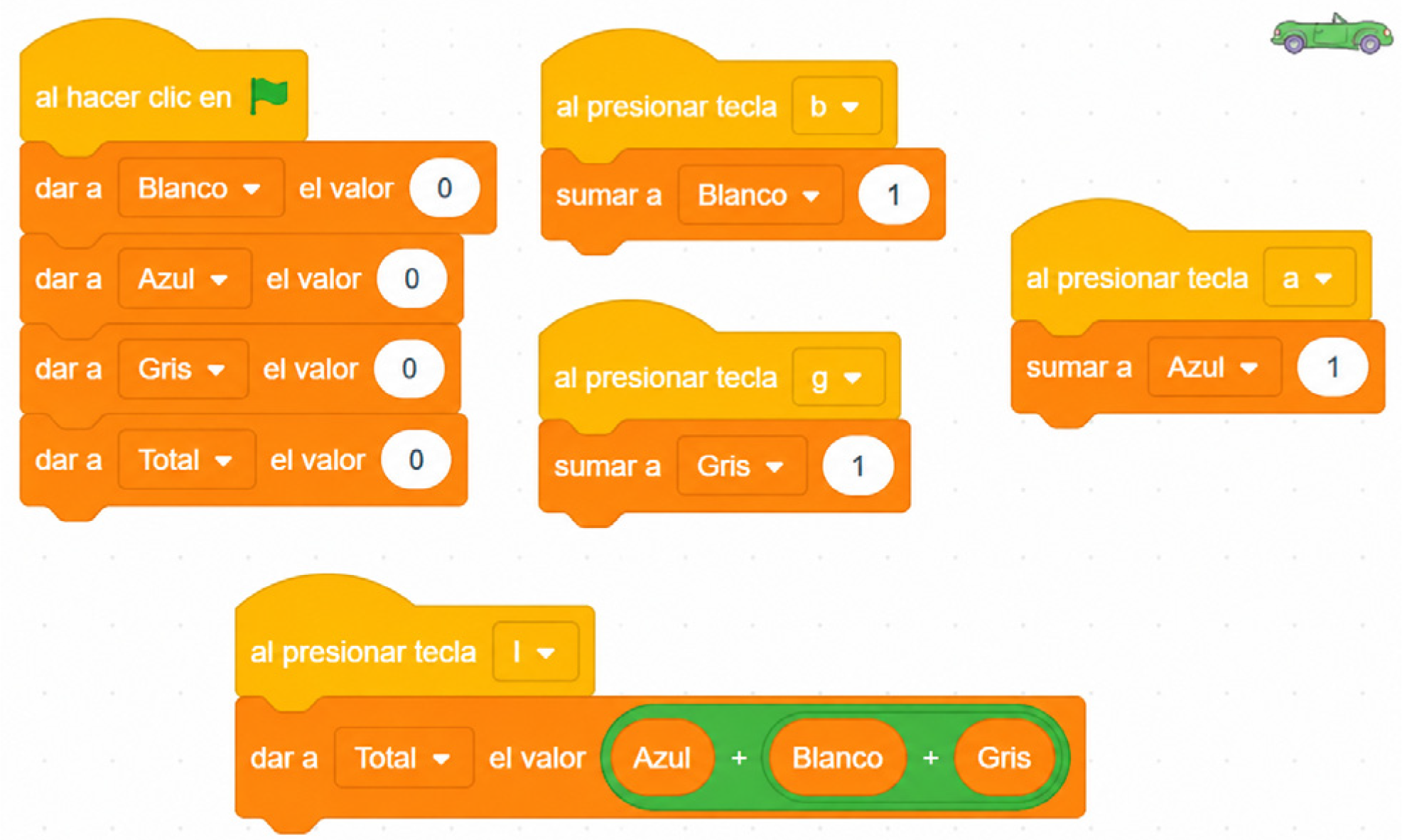
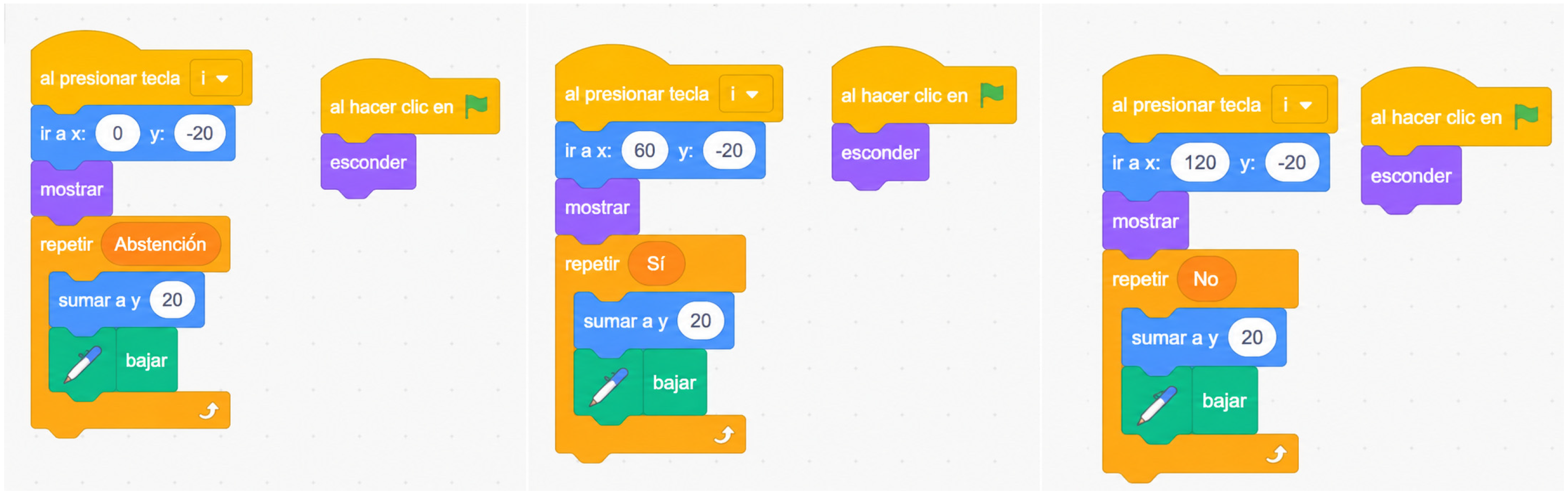
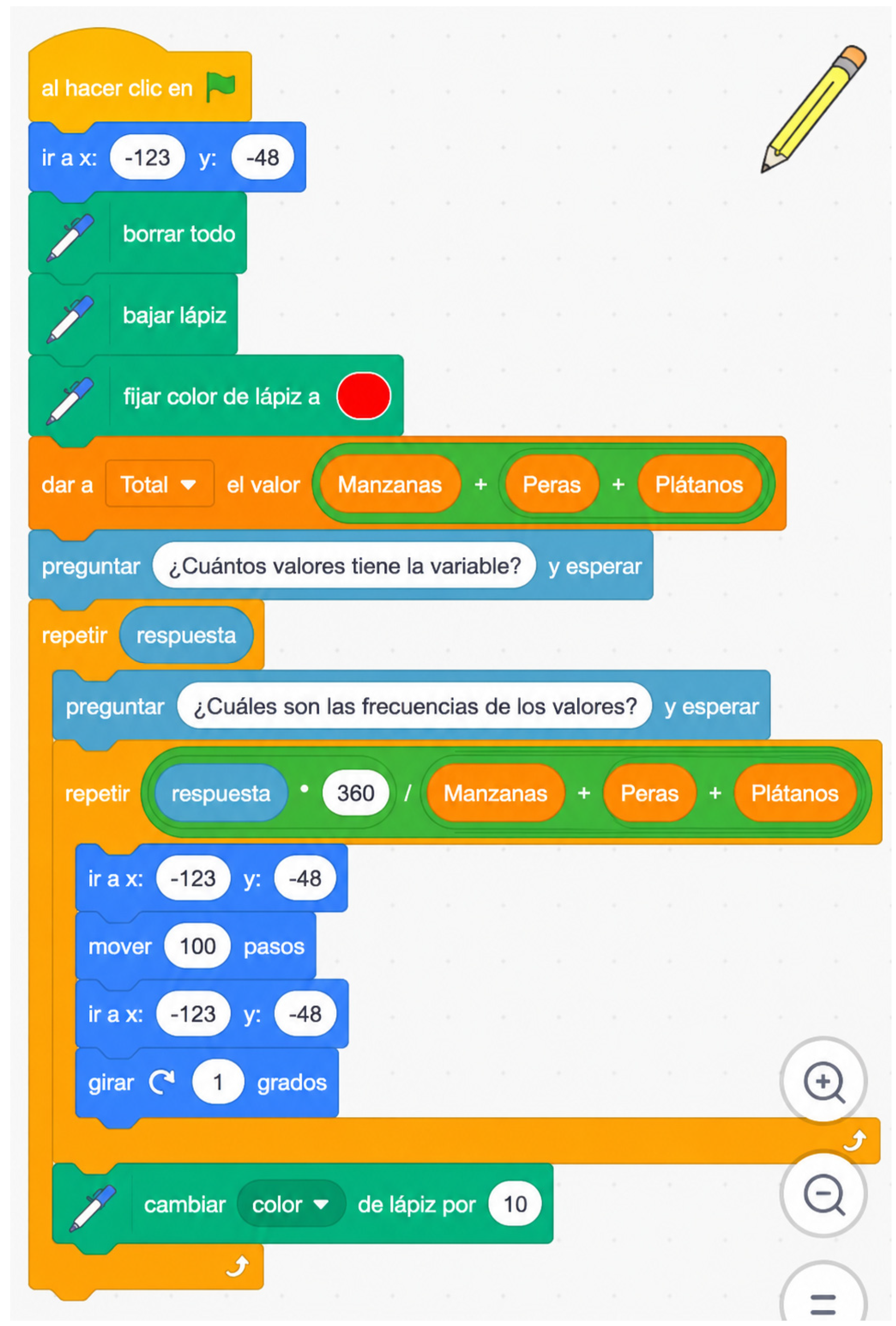
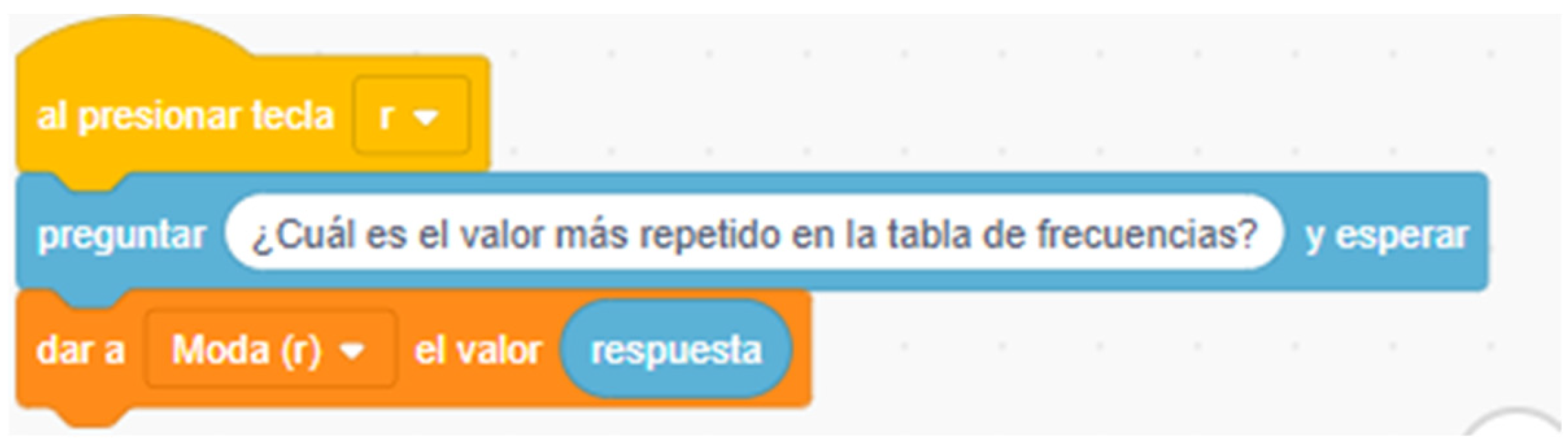
Throughout the intervention, students in the experimental group collected data through simple classroom surveys and incorporated these data into the corresponding programming blocks to construct frequency tables (
Figure 1), generate bar charts (
Figure 2), create pie charts (
Figure 3), and calculate measures of central tendency, namely the mean (
Figure 4) and the mode (
Figure 5). After each activity, students analysed and interpreted the statistical representations produced, answered questions related to the data, and discussed the meaning of the different statistical measures under the teacher’s guidance. Thus, Scratch was used not only to automate calculations and generate graphical representations but also as an instructional resource to promote students’ understanding of fundamental statistical concepts through the active manipulation and analysis of authentic classroom data.
For data collection, pretest and posttest questionnaires adapted from [
15] were used. These questionnaires consisted of Likert-type items (1–5 scale) designed to assess attitudes and motivation toward mathematics and the perceived usability of the tool used. Open-ended questions were also included to evaluate conceptual understanding of basic statistical knowledge, and the responses to these questions were subsequently categorized into ordinal variables. In addition, both groups completed a common final written test designed to evaluate academic performance in statistics.
The data obtained were analysed using IBM SPSS Statistics version 25, performing descriptive analyses, normality tests, and parametric and non-parametric inferential tests (Student’s t-test, Mann-Whitney U test, and Wilcoxon signed-rank test), establishing a significance level of p < 0.05.
3. Results
First, the reliability of the instruments used was analysed using Cronbach’s alpha coefficient, yielding a value of 0.821, which indicates good internal consistency of the scale used [
16]. Subsequently, the assumption of normality was verified using the Kolmogorov–Smirnov test, revealing that only the variable “grades” presented a normal distribution (
p = 0.200). Furthermore, this variable met the assumption of randomness and homoscedasticity using the Runs test (
p = 0.077) and Levene’s test (
p = 0.180), thus justifying the use of the Student’s
t-test for independent samples. For the remaining variables, since the assumption of normality was not met, non-parametric tests were used: the Mann–Whitney U test for comparisons between independent groups and the Wilcoxon signed-rank test for pretest–posttest comparisons within the same group. In all analyses, a significance level of
p < 0.05 was established.
Table 1 presents a summary of the descriptive and inferential analyses for the four study outcomes. It includes the pretest and posttest scores for both groups, where applicable, together with the corresponding statistical tests. The results are presented below following the order established in the study objectives.
A Student’s
t-test for the post-test showed a statistically significant difference in academic performance between the experimental and control groups (
Table 1), favouring the experimental group (
p = 0.044). As academic performance was assessed only after the intervention, these findings should not be interpreted as evidence of a causal effect.
In relation to the conceptual understanding of basic statistical knowledge, both groups initially presented similar levels of knowledge (EG = 2.54; CG = 2.57). Following the intervention, both groups showed improvement, although more pronounced in the experimental group, whose mean score decreased to 1.57 compared to 2.18 in the control group (values closer to 1 are considered more positive for this variable). Inferential analyses confirmed statistically significant differences after the intervention (p = 0.006), as well as significant improvements between the pre-test and post-test in both the experimental (p < 0.001) and control (p = 0.003) groups, with the improvement being more pronounced in the students who worked with Scratch.
Regarding attitude and motivation toward mathematics, both groups started with similar values before the intervention (M = 2.59 in each group). After the implementation of the teaching proposal, a slight descriptive improvement was observed, especially in the experimental group (M = 2.68 vs. M = 2.62 in the control group). However, inferential tests did not show statistically significant differences either between groups or between the pretest and posttest measures (p > 0.05), so the intervention did not produce significant changes in the students’ affective–motivational variables.
Finally, regarding the perceived usability of the tool used, the experimental group rated Scratch with an average of 4.02 out of 5, while the control group gave the textbook a neutral rating (M = 3). The analysis using the Mann–Whitney U test showed statistically significant differences between both groups (p < 0.001), indicating that Scratch was perceived as a significantly more usable tool than the traditional textbook.
4. Discussion
The results obtained show that the experimental group achieved significantly higher academic performance than the control group and that the Scratch-based intervention was associated with significant improvements in the conceptual understanding of basic statistical concepts. Students in the experimental group obtained better grades and more precise definitions of concepts such as mean, mode, and frequency table, in line with previous research highlighting the potential of visual programming tools to promote mathematical learning [
10,
11]. Although the difference in academic performance should be interpreted with caution, as no pretest measure was available for this outcome, these findings suggest that Scratch may facilitate the understanding of abstract content through visual and interactive experiences, fostering computational thinking and statistical reasoning [
12,
17].
However, no significant changes were observed in attitudes and motivations toward mathematics, which aligns with authors who point out that affective–motivational variables require longer interventions to produce stable changes [
13,
18]. Furthermore, the students already had a relatively positive attitude toward the subject, which may have created a ceiling effect and limited the observable potential for improvement, as noted by [
4].
On the other hand, the perception of usability was significantly more favourable in the experimental group, whose students rated Scratch as a more attractive and user-friendly tool than the textbook. These results are consistent with [
7], as well as with [
8,
9], who emphasize that interactive digital tools foster more motivating and meaningful learning experiences.
However, the results should be interpreted with caution due to the small sample size and the short duration of the intervention, factors that limit the generalizability of the findings and may have particularly influenced the lack of motivational changes. Future research should expand the sample size and extend the intervention to analyse the medium- and long-term effects, as well as study the application of Scratch to other mathematical content and teachers’ digital competence.
Overall, this study contributes to expanding the scientific evidence on the use of Scratch in teaching statistics in Primary Education and supports its incorporation as a supplementary teaching resource to traditional methodologies.
5. Conclusions
The results of this study provide preliminary evidence that the use of Scratch as a teaching resource can support the learning of statistics in Primary Education, especially in conceptual understanding of basic statistical knowledge. Furthermore, students in the experimental group achieved higher academic performance than those in the control group, although this difference should be interpreted with caution, as academic performance was only assessed after the intervention. Nevertheless, the intervention did not produce significant changes in attitude or motivation toward mathematics, suggesting that these types of variables require more prolonged didactic interventions, as indicated in the reviewed literature.
On the other hand, students perceived greater usability of this technological resource compared to traditional tools, such as textbooks. However, due to the sample size, these results should be understood as indicative and not generalizable to other contexts that do not share similar characteristics.
Therefore, this work provides relevant evidence on the potential of block programming as a didactic resource for teaching statistics in Primary Education and opens new lines of research aimed at analysing its long-term impact and its relationship with other basic mathematical skills.
Author Contributions
Conceptualization, F.Z.-R.; methodology, F.Z.-R. and A.G.-M.; software, F.Z.-R.; validation, F.Z.-R. and A.G.-M.; formal analysis, F.Z.-R.; research, F.Z.-R.; resources, F.Z.-R.; data curation, F.Z.-R. and A.G.-M.; writing: preparation of the original draft, F.Z.-R.; writing: revision and editing, A.G.-M.; visualization, F.Z.-R. and A.G.-M.; supervision, A.G.-M.; project management, F.Z.-R. and A.G.-M. All authors have read and agreed to the published version of the manuscript.
Funding
This research has been 85% funded by the European Union through the European Regional Development Fund (ERDF), as well as by the Regional Government of Extremadura, the University of Extremadura, and the Ministry of Finance, within the framework of project GR24178. This funding has supported the work of Zambrano-Romero and Gordillo-Merino. In addition, Zambrano-Romero has received further funding through a predoctoral grant for University Teaching Staff Training (FPU24/02522), awarded by the Ministry of Science, Innovation and Universities.
Informed Consent Statement
Informed consent was obtained from all study participants through authorization granted by their families or legal representatives to the centre’s management prior to the study’s commencement.
Data Availability Statement
The data presented in this study are not publicly available due to privacy and ethical restrictions but may be available from the corresponding author upon reasonable request, subject to applicable ethical and privacy requirements.
Acknowledgments
During the preparation of this study, the authors used ChatGPT (version 5.5) as a support tool for drafting and revising the manuscript. The authors reviewed and edited the generated content and assumed full responsibility for the final content of this publication.
Conflicts of Interest
The authors declare no conflicts of interest.
References
- Santaengracia, J.J.; Rodríguez-Muñiz, L.J.; del Río, B.P. Una situación de aprendizaje para el desarrollo del sentido estocástico en Educación Primaria. Números Rev. Didáctica Matemáticas 2023, 113, 63–80. [Google Scholar]
- Vásquez, C.; Alsina, Á. Creencias del profesorado de Educación Primaria en torno a la enseñanza de la estadística. Rev. Chil. Educ. Matemática 2023, 15, 90–101. [Google Scholar] [CrossRef] [Scilit]
- Carrillo-López, P.J.; Hortigüela-Alcalá, D. Prácticas evaluativas formativas del docente y rendimiento académico en escolares de Primaria. REICE Rev. Iberoam. Calid. Efic. Cambio Educ. 2023, 21, 5–20. [Google Scholar] [CrossRef] [Scilit]
- Camino, A.G.; Mantero, C.M.L.; Cezar, R.F. Actitudes hacia las Matemáticas y prácticas docentes: Un estudio exploratorio en maestros. Rev. Perspect. 2019, 4, 23–31. [Google Scholar] [CrossRef] [Scilit]
- Martín-Colomo, I.; Marbán, J.M.; Espina de la Cruz, E. Ansiedad matemática: Una aproximación bibliométrica a 70 años de investigación. REIDOCREA 2024, 13, 703–724. [Google Scholar]
- Segarra-Escandón, J.; Julià, C. Comparación sobre la actitud hacia las matemáticas en estudiantes de 5.º de Educación Primaria, 2.º de ESO y 3.º del grado de maestro. Edetania 2020, 58, 79–104. [Google Scholar] [CrossRef] [Scilit]
- Badia, A.; Meneses, J.; Sigalés, C. Percepción de los docentes sobre los factores que afectan el uso educativo de las TIC en el aula equipada de tecnología. Electron. J. Res. Educ. Psychol. 2013, 11, 787–808. [Google Scholar] [CrossRef] [Scilit]
- Amores-Valencia, A.; De-Casas-Moreno, P. El uso de las TIC como herramienta de motivación para alumnos de enseñanza secundaria obligatoria. Estudio de caso español. Hamut’ay 2019, 6, 37–49. [Google Scholar] [CrossRef] [Scilit]
- Ortega, J.C. Propuestas didácticas “motivadoras” aplicando nuevas metodologías en el área de tecnología. Master’s Thesis, Universidad Politécnica de Madrid, Madrid, Spain, 2018. [Google Scholar]
- Durango-Warnes, C.; Ravelo-Méndez, R.E. Beneficios del programa Scratch para potenciar el aprendizaje significativo de las Matemáticas en tercero de Primaria. Trilogía Cienc. Tecnol. Soc. 2020, 12, 161–184. [Google Scholar] [CrossRef] [Scilit]
- Moreno, J.; Román, M.; García, R.; Robles, G. Programar para aprender Matemáticas en 5º de Educación Primaria: Implementación del proyecto ScratchMaths en España. Rev. Educ. Distancia (RED) 2021, 21, 4. [Google Scholar] [CrossRef] [Scilit]
- García-Alonso, I.; Vásquez, C. Educación Estadística en el contexto de la sostenibilidad: Una perspectiva de formación con futuros profesores de Educación Primaria. TANGRAM-Rev. Educ. Matemática 2021, 4, 3–34. [Google Scholar] [CrossRef] [Scilit]
- Ortega, P.J. Factores asociados al rendimiento en matemáticas de estudiantes españoles en Educación Primaria. REICE Rev. Iberoam. Calid. Efic. Cambio Educ. 2023, 21, 175–191. [Google Scholar] [CrossRef] [Scilit]
- Decreto 107/2022, de 28 de julio, por el que se establecen la ordenación y el currículo de la Educación Primaria para la Comunidad Autónoma de Extremadura [Extremadura Regional Decree 107/2022, of 28 July, establishing the primary education curriculum for the Autonomous Community of Extremadura]. 5 de agosto de 2022. Diario Oficial de Extremadura, No. 151. 5 August 2022. Available online: https://doe.juntaex.es/pdfs/doe/2022/1510o/22040159C.pdf (accessed on 4 August 2026).
- Soto, L.M. Estudio Sobre la Aplicación de los Videojuegos en la Enseñanza de la Matemática: Elaboración de un Prototipo de Juego. Master’s Thesis, Universidad de Extremadura, Badajoz, Spain, 2015. [Google Scholar]
- Frías-Navarro, D. Apuntes de Estimación de la Fiabilidad de Consistencia Interna de los ítems de un Instrumento de Medida. 2025. Available online: https://www.uv.es/friasnav/AlfaCronbach.pdf (accessed on 4 August 2026).
- Hernández, D. Estudio Sobre el Impacto de un Curso de Scratch en la Creatividad de un Grupo de Alumnos de 6º de Educación Primaria. Bachelor’s Thesis, Universidad de Valladolid, Valladolid, Spain, 2016. [Google Scholar]
- Deci, E.L.; Ryan, R.M. The” what” and” why” of goal pursuits: Human needs and the self-determination of behavior. Psychol. Inq. 2000, 11, 227–268. [Google Scholar] [CrossRef] [Scilit]
| Disclaimer/Publisher’s Note: The statements, opinions and data contained in all publications are solely those of the individual author(s) and contributor(s) and not of MDPI and/or the editor(s). MDPI and/or the editor(s) disclaim responsibility for any injury to people or property resulting from any ideas, methods, instructions or products referred to in the content. |