Proceeding Paper

Extended Curriculum Programmes as a Catalyst for Building Equity and Resilience in Higher Education †

by
Andisiwe Dumako
1,*,
Olusegun Oguntona
2 and
Clinton Aigbavboa
3
1
Department of Built Environment, Faculty of Engineering, Built Environment and Information Technology, iYunivesithi Walter Sisulu, Butterworth 4960, South Africa
2
cidb-Walter Sisulu Centre of Excellence, Department of Built Environment, Faculty of Engineering, Built Environment and Information Technology, iYunivesithi Walter Sisulu, Butterworth 4960, South Africa
3
cidb Centre of Excellence, Faculty of Engineering and the Built Environment, University of Johannesburg, Johannesburg 2006, South Africa
*
Author to whom correspondence should be addressed.
Presented at the 1st International Online Conference on Education Sciences, 15–17 June 2026; Available online: https://sciforum.net/event/IOCES2026.
Proceedings 2026, 145(1), 15; https://doi.org/10.3390/proceedings2026145015
Published: 21 September 2026
(This article belongs to the Proceedings of The 1st International Online Conference on Education Sciences)

Abstract

Persistent structural inequalities continue to limit equitable access to, and success within, South African higher education, particularly for students from historically marginalised and under-resourced schooling backgrounds. Extended Curriculum Programmes (ECPs) were introduced as a national policy response to these disparities, yet they remain frequently misconceived as remedial rather than transformative pathways. This conceptual paper examines ECPs as catalysts for equity, resilience, and sustainable graduate development in South African higher education. Adopting a qualitative, reflective-practitioner approach grounded in constructivist and transformative learning theory, and informed by document and policy analysis, the paper synthesises literature on epistemic access, social justice, Education for Sustainable Development (ESD), and Universal Design for Learning (UDL) with the authors’ own teaching experience within an ECP in the built environment discipline. The analysis shows that when curricula are made responsive, contextually grounded, and asset-based rather than deficit-oriented, ECPs cultivate academic confidence, epistemic access, and a durable sense of belonging among students who might otherwise be excluded from mainstream higher education. The paper argues that embedding ESD and UDL principles within ECP pedagogy strengthens their transformative and sustainability-oriented potential, converting formal access into meaningful participation and long-term graduate resilience. It concludes with recommendations for lecturer development, curriculum design, and institutional policy that reposition ECPs as core, rather than peripheral, mechanisms of transformation in higher education.

1. Introduction

Higher education (HE) worldwide is increasingly called upon to function as an engine of social mobility, redress, and sustainable human development, yet access to it remains profoundly unequal. In South Africa, this global tension is especially acute. Three decades after the end of the apartheid era, HE continues to grapple with persistent inequalities that disadvantage large numbers of learners, particularly those from under-resourced schools and historically marginalised communities [1,2]. Each year, many prospective students are unable to access university study despite holding the requisite school-leaving qualifications, because their preparedness for mainstream programmes has been shaped by unequal schooling rather than by aptitude or potential [1,2]. This is not simply a problem of academic under-preparedness. It signals deep systemic inequities rooted in basic schooling, socio-economic structure, and the enduring legacies of colonial and apartheid-era educational planning. Widening access while safeguarding student success therefore remains one of the central imperatives for transformation in the post-apartheid HE sector [3].
The Extended Curriculum Programme (ECP) emerged as a national policy response to these challenges. Initially conceived to close academic preparedness gaps identified at the point of university entry, ECPs have since evolved into deliberate, structured interventions that broaden participation, promote inclusion, and support retention and throughput across South African HE institutions [4,5]. Beyond serving as an alternative access route, ECPs are designed to provide an extended curriculum structure, tailored pedagogical scaffolding, and comprehensive academic and psychosocial support intended to facilitate students’ successful transition into and progression through university study [4]. In this sense, ECPs occupy a strategically important space in advancing equity, redress, and institutional transformation, positioning them as more than compensatory add-ons to the mainstream curriculum.
Despite this transformative intent, ECPs continue to be misunderstood and are too often framed, both within and beyond the academy, as remedial or inferior pathways reserved for ‘weaker’ students. Such deficit framings overlook the complex, holistic contribution that ECPs make to students’ academic, social, and psychological development, and risk reproducing the very stigmatisation that these programmes were designed to counter. A growing body of research instead positions ECPs as developmental ecosystems in which students acquire foundational academic skills, build confidence, cultivate resilience, and develop a durable sense of belonging in higher education [6,7]. Empirical studies report that ECP participants frequently develop increased self-efficacy, sustained peer-mentorship networks, and coping strategies that support persistence and integration into university life [7,8]. Read through an asset-based, rather than a deficit, lens, these outcomes represent not remedial compensation but the cultivation of what Yosso [9] terms students’ ‘community cultural wealth’, the aspirational, social, and navigational capital that students from marginalised communities already bring with them into the academy. These outcomes matter not only for academic success but also for long-term personal agency and economic mobility, particularly among students from socio-economically disadvantaged and historically marginalised backgrounds [6].
Against this backdrop, this paper examines how ECPs function as catalysts for equity and resilience within South African HE. Drawing on relevant theoretical perspectives and on the authors’ reflective experience as an educator within an ECP in the built environment discipline, the paper interrogates how inclusive teaching practices, curriculum responsiveness, and student-centred pedagogies can transform learning environments for students who enter university under-prepared by systemic rather than individual circumstance. It further considers the significance of embedding Education for Sustainable Development (ESD) principles and Universal Design for Learning (UDL) approaches within ECP modules to promote accessibility, adaptability, and long-term sustainability in teaching and learning. The paper argues that for higher education to be genuinely sustainable and socially just, institutions must treat human development, rather than throughput statistics alone, as a central pillar of transformation; strengthening ECPs and recognising their developmental value can bridge systemic gaps, empower disadvantaged learners, and contribute meaningfully to a more equitable and resilient higher education system. The remainder of the paper is structured as follows: Section 2 develops the conceptual and theoretical foundations of inclusive pedagogy in ECP contexts, Section 3 outlines the reflective-practitioner methodology adopted, Section 4 discusses the implications of the analysis through illustrative classroom practice, and the last section presents the paper’s conclusions and recommendations.

2. Foundations for Inclusive Pedagogy in Extended Curriculum Programmes

2.1. Extended Curriculum Programmes as Social Justice Interventions

Equity and social justice have become central imperatives within South African HE, given persistent structural inequalities rooted in apartheid-era legacies, socio-economic disparity, and uneven schooling systems. Although access to HE has expanded substantially in the post-apartheid period, formal admission alone does not guarantee equitable academic participation or success for students from historically marginalised and under-resourced backgrounds [10,11]. Research in the South African context foregrounds the distinction between formal access and epistemological access, the ability not merely to enrol, but to engage meaningfully with disciplinary knowledge on terms that make sense within one’s own frame of reference [12]. Studies further show that students from disadvantaged schooling backgrounds often struggle to succeed academically despite enrolment, as reflected in persistently low throughput and high attrition rates [11,13]. This pattern is compounded where curricula and pedagogies remain organised around the tacit assumption of an adequately prepared, homogenous student body. This is an assumption that is argued can decontextualise learners by disregarding the cultural capital, languages, and lived knowledge they bring into the academy [14]. International evidence similarly indicates that socio-economic disadvantage continues to predict unequal completion outcomes even where formal access barriers have been reduced [15,16]. Against this backdrop, the Extended Curriculum Programme (ECP) can be understood as a sustainability mechanism within South African HE. A mechanism aimed at transforming formal access into meaningful participation, epistemological access, persistence, and long-term graduate resilience.
Within this framing, ECPs are widely understood as social justice mechanisms that address structural disadvantage rather than individual deficit. Research in the South African HE context emphasises that ECPs were intentionally designed to provide extended time, targeted academic development, and curriculum responsiveness to mitigate the effects of unequal schooling, socio-economic marginalisation, and constrained epistemic access [11,13]. By disrupting the assumption of homogenous preparedness embedded within mainstream curricula, ECPs seek to redress unequal starting points and to enable students to engage meaningfully with disciplinary knowledge, rather than merely securing formal enrolment [10]. Empirical studies demonstrate that when adequately resourced and pedagogically supported, ECPs contribute to improved student persistence, academic confidence, and throughput, particularly among students from under-resourced schooling backgrounds [6,17]. Framed in this way, ECPs align with the broader transformation and equity agendas of South African HE by prioritising fairness, inclusion, and the redistribution of educational opportunity as mechanisms for social mobility and long-term equity outcomes [11,18]. The literature nonetheless cautions that the transformative potential of ECPs is contingent on sustained institutional commitment, inclusive pedagogy, and the deliberate destigmatisation of extended curricula. Without these conditions, structural inequalities risk being reproduced within ECPs themselves rather than dismantled by them [13].

2.2. Constructivist and Transformative Learning Theories in Extended Curriculum Programmes

Constructivist learning theory posits that knowledge is actively constructed by learners through interaction, reflection, and engagement with both content and context, rather than passively received from instructors [19,20]. Within HE, constructivist approaches emphasise learner agency, prior knowledge, collaborative learning, and the co-construction of meaning, positioning students as active participants in, rather than passive recipients of, the learning process. This theoretical perspective is particularly relevant to Extended Curriculum Programme (ECP) contexts, where students enter university with diverse educational experiences and varying levels of academic preparedness shaped by structural inequalities in schooling. In extended curriculum settings, constructivist pedagogies enable students to build conceptual understanding progressively through scaffolded learning experiences that acknowledge and value their existing knowledge and lived realities [21]. By foregrounding active learning, dialogue, and reflective practice, constructivism supports deeper engagement and mitigates the alienation often experienced by students transitioning from under-resourced schooling environments into the epistemic culture of higher education. As such, constructivist approaches provide a pedagogical foundation for fostering confidence, participation, and sustained learning within ECPs.
Transformative learning theory focuses on the process through which learners critically reflect on their assumptions, beliefs, and frames of reference, leading to profound shifts in perspective and identity [22]. In HE, transformative learning extends beyond the acquisition of disciplinary knowledge to include critical consciousness, self-authorship, and personal agency, all of which are essential in contexts marked by inequality and historical exclusion. This resonates with a study that earlier articulated critical pedagogy, in which education is conceived not as the passive transmission, or ‘banking’, of knowledge, but as a dialogical and conscientising process through which learners come to read and act upon their world [23]. Within ECPs, transformative learning can occur as students begin to reframe their identities from being ‘underprepared’ or ‘at risk’ to becoming capable and legitimate participants in academic spaces. Through reflective activities, dialogic teaching, and supportive learning environments, ECPs can facilitate transformative shifts that enhance resilience, self-efficacy, and a sense of belonging, positioning ECPs not merely as academic support structures but as sites of personal and intellectual transformation and, in Freirean terms, of conscientisation.

2.3. Education for Sustainable Development and Universal Design for Learning in ECP Contexts

Education for Sustainable Development (ESD) emphasises the role of education in equipping learners with the knowledge, skills, values, and dispositions required to contribute to sustainable social, economic, and environmental futures [24]. Central to ESD is a commitment to inclusivity, critical thinking, systems awareness, and social responsibility, positioning education as a key driver of long-term human development and directly supporting Sustainable Development Goal 4 (quality education) and, through its equity dimension, Sustainable Development Goal 10 (reduced inequalities) of the United Nations’ 2030 Agenda for Sustainable Development [25]. In higher education, ESD calls for curricula and pedagogies that are responsive to complex societal challenges and attentive to issues of equity, justice, and intergenerational sustainability [26]. Integrating ESD principles within Extended Curriculum Programmes (ECPs) strengthens their transformative potential by aligning teaching and learning with these broader developmental and social justice goals. For students from historically marginalised communities, ESD-oriented approaches can foster critical awareness of structural inequality, empower learners to envision alternative futures, and connect academic learning to lived realities and community contexts [24,27]. In this way, ESD complements the equity mandate of ECPs by promoting resilience, adaptability, and sustainable participation, both within higher education and beyond the university.
Universal Design for Learning (UDL) further advances this inclusive and sustainability-oriented agenda by reducing barriers to learning through the proactive design of flexible curricula that accommodate learner variability from the outset [28]. Grounded in the principles of multiple means of engagement, representation, and expression, UDL challenges deficit-oriented models that expect students to adapt to rigid and exclusionary curricula. Instead, it promotes inclusive learning environments that recognise diversity as a resource rather than a problem to be remediated. In the context of ECPs, UDL offers a powerful framework for enhancing accessibility, participation, and success without stigmatising students. By embedding flexibility into assessment practices, instructional materials, and learning activities, UDL closely aligns with the objectives of ECPs, creating enabling conditions for epistemic access and student agency [29]. When applied thoughtfully, UDL supports confidence, reduces anxiety, and fosters resilience, reinforcing ECPs’ role as inclusive and sustainable pathways within HE.

2.4. Towards an Integrated Conceptual Framework

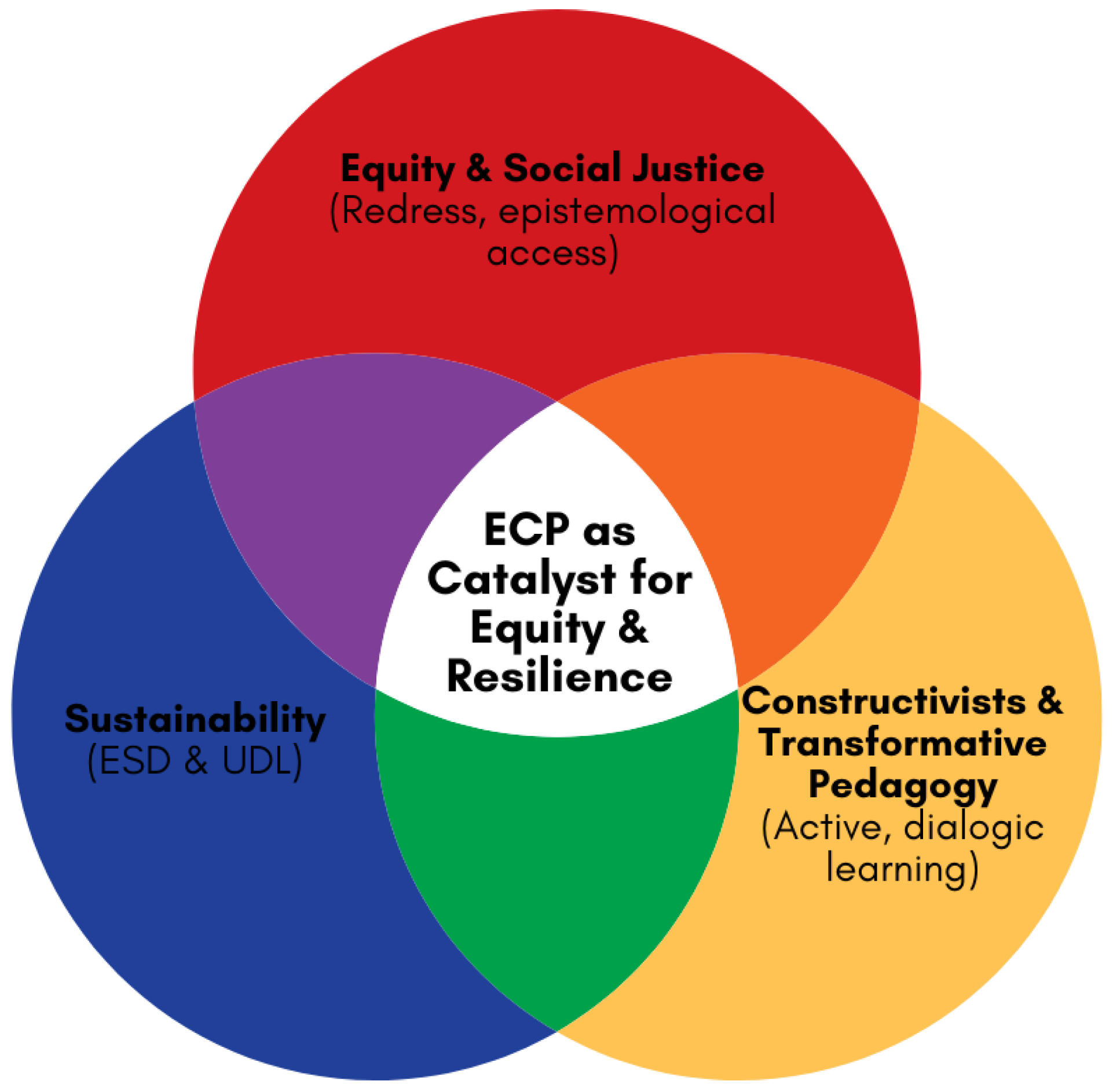
Altogether, the body of literature suggests that Extended Curriculum Programmes (ECPs) are best understood not as a single intervention but as the intersection of three interlocking dimensions. The first is a social justice and equity dimension, in which ECPs function as redress mechanisms that convert formal access into epistemological access by responding to structural, rather than individual, disadvantage [10,11,12,13,14]. The second is a pedagogical dimension, in which constructivist and transformative learning theories position students as active constructors of knowledge and potential agents of their own conscientisation, rather than as passive recipients of remediation [19,20,21,22,23]. The third is a sustainability dimension, in which ESD and UDL principles embed adaptability, inclusivity, and long-term societal relevance into curriculum design, aligning ECP practice with the global sustainable development agenda [24,25,28]. Figure 1 conceptualises the resulting framework. The three dimensions do not operate in isolation but reinforce one another, so that pedagogical practices which are constructivist and transformative in orientation simultaneously advance equity by validating students’ lived knowledge, and sustainability by cultivating the adaptive, critically conscious graduates that ESD envisions. This integrated framework, precisely because it treats equity, pedagogy, and sustainability as mutually constitutive rather than parallel concerns, informs the reflective analysis presented in the next sections of this paper and positions ECP educators as key agents in advancing sustainable, inclusive, and socially responsive HE.

3. Research Methodology

This paper adopts a qualitative, conceptual research design, undertaken from a reflective-practitioner perspective consistent with Schön’s [30] account of reflection-in-action and reflection-on-action in professional practice. Rather than generating or analysing new empirical data, the study synthesises theoretical frameworks, national and institutional policy texts, and the authors’ ongoing professional experience as lecturers within an Extended Curriculum Programme (ECP) in the built environment discipline at an historically disadvantaged South African university. This design was selected because the questions the paper addresses, namely how equity, resilience, and inclusive pedagogy are enacted in everyday ECP teaching, are not easily reducible to measurable variables; they are better illuminated through the disciplined, theoretically informed reflection of practitioners who are themselves embedded in the phenomenon under study [30].
The analysis draws on three interrelated sources of evidence. The first is a targeted narrative review of scholarly literature on ECPs, equity, epistemic access, and student success in South African and international HE. The second comprises reflective classroom accounts, drawn from the educator (authors’) own teaching practice, that illustrate inclusive pedagogy, curriculum responsiveness, and student-centred teaching within ECP modules in the built environment programmes. The third is a review of national and institutional policy texts, including instruments produced by the Department of Higher Education and Training (DHET) and the Council on Higher Education (CHE), which situates ECPs within South Africa’s broader transformation and equity agenda. Triangulating these three sources allows the analysis to move iteratively between theory, policy, and everyday pedagogical practice, producing a grounded, if necessarily interpretive, account of how ECPs function as catalysts for equity, resilience, and sustainable graduate development.
Consistent with the conventions of reflective, conceptual scholarship, the trustworthiness of the analysis rests not on statistical generalisability but on the coherence, transparency, and critical self-awareness with which the authors’ interpretations are grounded in, and checked against, the literature and policy record. As educators directly involved in ECP teaching, the authors occupy an insider position that affords rich, contextualised insight but also carries the risk of confirmation bias; this risk was mitigated by deliberately juxtaposing reflective accounts against literature that both supports and critiques the ECP model, and by foregrounding disconfirming as well as confirming evidence where it exists in the sources reviewed. The paper’s conceptual design also carries acknowledged limitations. It does not report systematically collected qualitative or quantitative data from students, and its illustrative classroom accounts, while indicative, are not intended to be generalised beyond the specific ECP context from which they are drawn. The paper’s contribution should therefore be read as theoretical and heuristic, a conceptual scaffold intended to inform future empirical research and practice, rather than as an evaluative or outcomes-based study of ECP effectiveness.

4. Discussion

Drawing on social justice-oriented theory and on the authors’ reflective experience as Extended Curriculum Programme (ECP) educators, this discussion foregrounds equity as the recognition of unequal starting points rather than as equal treatment. Equity in HE necessitates differentiated forms of academic and psychosocial support that respond to students’ diverse educational, social, and economic realities. Within this framing, ECPs function as critical equity mechanisms, creating structured opportunities for students who may not meet conventional entry requirements to access, engage with, and succeed in university learning. This understanding was reinforced through reflective classroom engagement with ECP students. In a discussion exploring the stigma often associated with ECP enrolment and the emotional implications of extended time to graduation, one student articulated a perspective that disrupted deficit-based narratives, expressing excitement at being enrolled in a university and in an engineering-related built environment programme, an opportunity they had never imagined possible. This moment illustrates that, for many students, ECPs are not experienced as remedial interventions but as transformative gateways into HE that expand aspirations and redefine what is attainable.
To render this second source of evidence more fully visible, two further anonymised episodes drawn from the same reflective classroom practice are presented here. Each corresponds directly to one element of the confidence–engagement–resilience triad advanced in this paper. On confidence, a student who consistently declined to answer questions during the first weeks of the module, citing a fear of ‘saying the wrong thing in front of engineers’, began, following several weeks of low-stakes, discussion-based tasks, to volunteer responses unprompted, and by the end of the semester elected to lead her group’s oral presentation, a task she had initially asked to be excused from. Read against constructivist and transformative learning theory [19,20,21,22,23], this shift signals more than technical skill acquisition. It reflects a change in the student’s self-positioning, from a passive recipient of remediation to an active, legitimate participant in disciplinary discourse, consistent with the epistemological access earlier described [12].
On resilience, a student who performed poorly in an early formative assessment did not withdraw from engagement, as deficit-oriented framings of ECP students might predict, but instead made use of consultation hours, revised her approach in light of feedback, and went on to pass the module’s summative assessment. In debriefing this experience with the class, the student reframed the early setback not as evidence that she did not belong in the programme, but as an expected part of the transition, a reframing consistent with the durable sense of belonging and the coping strategies reported elsewhere in the ECP literature [7,8]. Taken together with the engagement illustrated in the environmental design task discussed below, these three episodes provide the more concrete evidentiary grounding for the paper’s central claim that valuing students’ lived experience within ECPs fosters confidence, engagement, and resilience, rather than remedial compliance.
From a constructivist learning perspective, such experiences underscore the importance of pedagogies that value students’ lived realities, cultural knowledge, and prior understanding. Reflecting on teaching practice within an ECP context, a shift from traditional lecture-based delivery toward contextualised, active learning improved both engagement and conceptual understanding. When introducing environmental control and thermal design, for example, students were tasked with highlighting factors to consider when designing informal dwellings for varied climatic conditions and explaining how internal thermal comfort could be maintained despite external environmental constraints. Drawing on familiar housing contexts, students constructed disciplinary knowledge through reasoning and dialogue, allowing technical concepts to emerge organically from everyday experience rather than being imposed as abstract, decontextualised content. This approach affirmed constructivist principles [19,20,21] and enhanced students’ epistemic access as they transitioned into the academic culture of HE. This episode constitutes the engagement dimension of the confidence–engagement–resilience triad discussed above.
These pedagogical practices align strongly with Education for Sustainable Development (ESD), which emphasises socially responsive learning oriented toward long-term societal wellbeing. By situating learning within real-world environmental and housing challenges, ECP teaching fosters critical awareness, systems thinking, and the resilience capacities essential for sustainable participation in higher education and society. Universal Design for Learning (UDL) complements this approach by embedding flexibility in engagement, representation, and assessment, reducing barriers without stigmatisation and supporting student agency and confidence. Taken together, these insights suggest that the sustainability of Extended Curriculum Programmes lies not merely in extended time, but in equity-driven, inclusive pedagogies that transform structural disadvantage into meaningful educational opportunity and socially resilient graduate outcomes.
These findings should, however, be read alongside the tensions that persist in ECP practice. Chief among them is the risk that extended curricula, however well designed pedagogically, continue to be perceived, by students, peers, and sometimes by institutions themselves, as a lesser or stigmatised route into HE, undermining precisely the sense of belonging that inclusive pedagogy seeks to build [13]. A second tension concerns resourcing (the mentorship, small-group teaching, and flexible assessment practices) associated with constructivist, ESD-, and UDL-aligned pedagogy are comparatively resource- and time-intensive, and their sustainability depends on institutional commitment that extends beyond individual educators’ goodwill [6,17]. A third tension is disciplinary. The built environment context illustrated here, with its strong applied and studio-based traditions, may lend itself more readily to contextualised, constructivist pedagogy than more theory-dense or laboratory-based disciplines, suggesting that the transferability of these practices across ECP streams warrants further, discipline-specific investigation. Acknowledging these tensions does not diminish the transformative potential of ECPs. Rather, it clarifies that this potential is conditional on institutional, disciplinary, and resource contexts that must be actively cultivated rather than assumed.
A fourth, more systemic tension concerns the institutional conditions under which ECPs operate. The managerialisation of higher education, together with an intensifying emphasis on efficiency, throughput metrics, and audit culture, can incentivise institutions to treat ECPs as a compliance mechanism for meeting access and throughput targets rather than as a site of genuine pedagogical transformation. This is a dynamic consistent with what has been described elsewhere as the ‘terrors of performativity’ in education systems under performative governance [31]. Where this occurs, the transformative mission articulated throughout this paper is at risk of drifting toward a narrower, remedial, audit-driven logic, precisely the deficit framing the paper seeks to counter. Safeguarding against this mission drift requires institutional leadership that protects the developmental, relational, and reflective dimensions of ECP practice from being subordinated to purely quantitative performance indicators.

5. Conclusions and Recommendations

Extended Curriculum Programmes play a critical role in advancing sustainability in higher education when framed through an equity and human development lens. In contexts of structural inequality, widening access without addressing epistemic and pedagogical barriers risks reproducing exclusion under the guise of inclusion. This paper has shown that ECPs respond to this challenge by recognising unequal starting points and by providing inclusive, context-sensitive teaching that enables meaningful participation and success, rather than remedial compensation for presumed deficit. Drawing on constructivist and transformative learning theories, alongside reflective ECP practice in a built environment discipline, the discussion has illustrated how valuing students’ lived experiences fosters confidence, engagement, and resilience. When aligned with Education for Sustainable Development and Universal Design for Learning principles, and read through an integrated conceptual framework that treats equity, pedagogy, and sustainability as mutually reinforcing, ECPs emerge not as remedial interventions but as sustainable and transformative pathways that contribute to socially and economically resilient graduate outcomes, and, by extension, to national progress toward SDG 4 and SDG 10 of the 2030 Agenda for Sustainable Development [25]. The paper’s principal contribution lies in this integrated conceptual framing itself, by positioning equity, pedagogy, and sustainability as three mutually constitutive dimensions of ECP practice, rather than as separate policy, teaching, and environmental concerns. It offers built environment and HE scholars a coherent lens through which to design, evaluate, and advocate for extended curricula elsewhere in the sector.
Based on the analysis and reflective insights presented in this paper, five interrelated recommendations are advanced to strengthen Extended Curriculum Programmes (ECPs) as sustainable, equitable mechanisms within South African HE. First, institutions should provide ongoing, structured professional development for ECP educators, focused explicitly on inclusive pedagogies rooted in constructivist, transformative, and Universal Design for Learning (UDL) principles. Such training should equip educators with requisite capacity to design context-responsive curricula that value students’ lived experiences and promote epistemic access, rather than defaulting to deficit-oriented remediation. Second, ECP curricula should intentionally incorporate Education for Sustainable Development (ESD) principles, explicitly linking disciplinary knowledge to social, economic, and environmental challenges relevant to students’ own contexts. Embedding ESD in this way can enhance students’ critical awareness, resilience, and sense of social responsibility, positioning ECPs as contributors to long-term societal development consistent with SDG 4 and SDG 10.
Third, institutions should strengthen psychosocial, mentoring, and peer-support structures within ECPs, creating spaces for belonging and confidence-building that are essential for student persistence, particularly for students facing stigma during the transition into HE. Fourth, institutional policies and planning processes should formally recognise ECPs as core sustainability and transformation initiatives, rather than as peripheral or remedial add-ons, and should allocate adequate resources, staffing, and workload recognition to secure their long-term impact. Lastly, institutions should promote reflection and the Scholarship of Teaching and Learning (SoTL) within ECPs, encouraging Schön’s model of reflective practice among educators and supporting practitioner-led research. Such research can generate contextually relevant evidence to inform policy, improve practice, and challenge deficit narratives around extended curricula. Future empirical studies, in particular, could usefully test the integrated equity–pedagogy–sustainability framework proposed in this paper across a wider range of ECP disciplines and institutional contexts.


Author Contributions

Conceptualisation, A.D.; methodology, A.D. and O.O.; formal analysis, A.D.; investigation, A.D.; data curation, A.D.; writing—original draft preparation, A.D. and O.O.; writing—review and editing, A.D. and O.O.; supervision, O.O. and C.A.; project administration, A.D., O.O. and C.A. All authors have read and agreed to the published version of the manuscript.

Funding

This research received no external funding.

Institutional Review Board Statement

Not applicable. This study did not involve the collection of primary data from human participants. It is a conceptual paper that draws on publicly available literature and policy documents, together with the anonymised reflective teaching practice of the author-educators, consistent with recognised conventions for the Scholarship of Teaching and Learning (SoTL).

Informed Consent Statement

Not applicable. No identifiable student data are reported in this paper. The single illustrative classroom exchange discussed in Section 4 is presented in anonymised, non-identifying form as a reflective teaching account, consistent with standard Scholarship of Teaching and Learning (SoTL) practice.

Data Availability Statement

The original contributions presented in this study are included in the article. Further inquiries can be directed to the corresponding author.

Acknowledgments

The authors would like to acknowledge the cidb Centre of Excellence at the University of Johannesburg. The cidb-Walter Sisulu Centre of Excellence, Department of Built Environment, and the Directorate of Research and Innovation at the iYunivesithi Walter Sisulu are all acknowledged as well.

Conflicts of Interest

The authors declare no conflicts of interest.

Abbreviations

The following abbreviations are used in this manuscript:
CHECouncil on Higher Education
DHETDepartment of Higher Education and Training
ECPExtended Curriculum Programme
ESDEducation for Sustainable Development
HEHigher Education
SoTLScholarship of Teaching and Learning
UDLUniversal Design for Learning
SDGSustainable Development Goal

References

  1. Department of Higher Education and Training (DHET). Statistics on Post-School Education and Training in South Africa 2023; Department of Higher Education and Training: Pretoria, South Africa, 2023. Available online: https://www.dhet.gov.za/Information%20Systems%20Management/Statistics%20on%20Post-School%20Education%20and%20Training%20in%20South%20Africa%2C%202023.pdf (accessed on 29 July 2026).
  2. Council on Higher Education (CHE). VitalStats: Public Higher Education 2022; Council on Higher Education: Pretoria, South Africa, 2022. [Google Scholar]
  3. Department of Higher Education and Training. Strategic Plan 2025–2030; Department of Higher Education and Training: Pretoria, South Africa, 2025. Available online: https://www.dhet.gov.za/Strategic%20Plans/Strategic%20Plans/DHET%20TABLED%20REVISED%202025-2030%20STRATEGIC%20PLAN.pdf (accessed on 29 July 2026).
  4. Bass, G.H. Social and academic integration in an extended curriculum programme. J. Indep. Teach. Learn. 2011, 6, 45–54. [Google Scholar]
  5. Slabbert, R.; Friedrich-Nel, H. Extended curriculum programme evolution: A road map to academic success? S. Afr. J. High. Educ. 2015, 29, 45–59. [Google Scholar] [CrossRef] [Scilit]
  6. Chetty, L.; Kepkey, B. Access to and effectiveness of support services for students in extended curriculum programmes at a South African university. J. Stud. Aff. Afr. 2023, 11, 89–102. [Google Scholar] [CrossRef] [Scilit]
  7. Ogude, N.A.; Meyer, I.J.; Mwambakana, J.; Mthethwa, N.E. Can extended curriculum programmes be improved through engagement with students using appreciative inquiry? S. Afr. J. High. Educ. 2019, 33, 219–236. [Google Scholar] [CrossRef] [Scilit]
  8. Mthethwa, N.E. Developing Academic Self-Efficacy in Disadvantaged Black Students from the Extended Curriculum Programmes. Master’s Thesis, University of Pretoria, Pretoria, South Africa, 2022. [Google Scholar]
  9. Yosso, T.J. Whose culture has capital? A critical race theory discussion of community cultural wealth. Race Ethn. Educ. 2005, 8, 69–91. [Google Scholar] [CrossRef] [Scilit]
  10. Scott, I.; Yeld, N.; Hendry, J. A Case for Improving Teaching and Learning in South African Higher Education; Higher Education Monitor No. 6; Council on Higher Education: Pretoria, South Africa, 2007. [Google Scholar]
  11. Council on Higher Education (CHE). A Proposal for Undergraduate Curriculum Reform in South Africa: The Case for a Flexible Curriculum Structure; Report of the Task Team on Undergraduate Curriculum Structure; Council on Higher Education: Pretoria, South Africa, 2013. [Google Scholar]
  12. Morrow, W. Bounds of Democracy: Epistemological Access in Higher Education; HSRC Press: Cape Town, South Africa, 2009. [Google Scholar]
  13. Ogude, N.A.; Rollnick, M. Ideological positioning of extended curriculum programmes: A case study of a large South African research university. S. Afr. J. High. Educ. 2022, 36, 222–238. [Google Scholar] [CrossRef] [Scilit]
  14. Boughey, C.; McKenna, S. Academic literacy and the decontextualised learner. Crit. Stud. Teach. Learn. 2016, 4, 1–9. [Google Scholar] [CrossRef] [Scilit]
  15. Wright, H. Heterogeneous Effects of Socioeconomic Status on Postsecondary Educational Outcomes: Evidence from the Education Longitudinal Study of 2002; MPRA Paper 123438; University Library of Munich: Munich, Germany, 2025. [Google Scholar]
  16. Organisation for Economic Co-Operation and Development (OECD). Equity in Education: Breaking Down Barriers to Social Mobility; OECD Publishing: Paris, France, 2018. [Google Scholar]
  17. Mouton, M.; Rewitzky, I.M. Opportunity and outcome: A quantitative evaluation of the STEM extended curriculum programme at a research-intensive university. S. Afr. J. High. Educ. 2025, 39, 151–171. [Google Scholar] [CrossRef] [Scilit]
  18. Tinto, V. Completing College: Rethinking Institutional Action; University of Chicago Press: Chicago, IL, USA, 2012. [Google Scholar]
  19. Vygotsky, L.S. Mind in Society: The Development of Higher Psychological Processes; Harvard University Press: Cambridge, MA, USA, 1978. [Google Scholar]
  20. Biggs, J. Enhancing teaching through constructive alignment. High. Educ. 1996, 32, 347–364. [Google Scholar] [CrossRef] [Scilit]
  21. Biggs, J.; Tang, C. Teaching for Quality Learning at University, 4th ed.; Open University Press: Maidenhead, UK, 2011. [Google Scholar]
  22. Mezirow, J. Transformative Dimensions of Adult Learning; Jossey-Bass: San Francisco, CA, USA, 1991. [Google Scholar]
  23. Freire, P. Pedagogy of Hope: Reliving Pedagogy of the Oppressed; Bloomsbury Publishing: London, UK, 2021. [Google Scholar]
  24. United Nations Educational, Scientific and Cultural Organization (UNESCO). Education for Sustainable Development: A Roadmap; UNESCO: Paris, France, 2020; Available online: https://unesdoc.unesco.org/ark:/48223/pf0000374802 (accessed on 29 July 2026).
  25. United Nations. Transforming Our World: The 2030 Agenda for Sustainable Development (A/RES/70/1); United Nations: New York, NY, USA, 2015. [Google Scholar]
  26. Lotz-Sisitka, H.; Wals, A.E.J.; Kronlid, D.; McGarry, D. Transformative, transgressive social learning: Rethinking higher education pedagogy in times of systemic global dysfunction. Curr. Opin. Environ. Sustain. 2015, 16, 73–80. [Google Scholar] [CrossRef] [Scilit]
  27. Sterling, S. Transformative learning and sustainability: Sketching the conceptual ground. Learn. Teach. High. Educ. 2011, 5, 17–33. [Google Scholar]
  28. Center for Applied Special Technology (CAST). Universal Design for Learning Guidelines Version 2.2; CAST: Wakefield, MA, USA, 2018; Available online: https://udlguidelines.cast.org (accessed on 29 July 2026).
  29. Rao, K.; Ok, M.W.; Bryant, B.R. A review of research on universal design educational models. Remedial Spec. Educ. 2014, 35, 153–166. [Google Scholar] [CrossRef] [Scilit]
  30. Schön, D.A. The Reflective Practitioner: How Professionals Think in Action; Basic Books: New York, NY, USA, 1983. [Google Scholar]
  31. Ball, S.J. The teacher’s soul and the terrors of performativity. J. Educ. Policy 2003, 18, 215–228. [Google Scholar] [CrossRef] [Scilit]
Figure 1. Conceptual framework showing the three interlocking dimensions, equity and social justice, constructivist/transformative pedagogy, and sustainability (ESD/UDL), through which Extended Curriculum Programmes act as catalysts for equity and resilience.
Proceedings 145 00015 g001
Disclaimer/Publisher’s Note: The statements, opinions and data contained in all publications are solely those of the individual author(s) and contributor(s) and not of MDPI and/or the editor(s). MDPI and/or the editor(s) disclaim responsibility for any injury to people or property resulting from any ideas, methods, instructions or products referred to in the content.