
Proceeding Paper

The Role of Learning by Doing in Fostering Social Entrepreneurial Competence and Intention: A Case Study of Enactus Morocco †

Faculty of Law, Economics and Social Sciences (FSJEST), Abdelmalek Essaadi University, Tetouan 93000, Morocco
*
Author to whom correspondence should be addressed.
Presented at the 1st International Online Conference on Administrative Sciences (IOCAS 2026), 4–5 February 2026; Available online: https://sciforum.net/event/IOCAS2026.
Proceedings 2026, 140(1), 2; https://doi.org/10.3390/proceedings2026140002
Published: 1 June 2026

Abstract

Social entrepreneurship is increasingly recognized for its dual ability to address societal issues while maintaining economic value and long-term sustainability. Within this context, Learning by Doing (LBD) has been widely recognized as an effective experiential learning approach for fostering social entrepreneurial intention (SEI). However, limited research has examined how LBD operates within structured environments in the Global South. This study investigates Enactus Morocco as a structured LBD ecosystem. Adopting a qualitative exploratory design, data were collected through eleven interviews, capturing both beneficiary and organizational perspectives. The findings confirm the significant role of LBD in fostering EC and SEI, while highlighting the importance of supportive learning environments. Additionally, emergent relational and emotional variables are identified and structured through the Stimulus–Organism–Response (S-O-R) model. These results extend current understanding of experiential entrepreneurial learning and provide a foundation for future quantitative validation.

1. Introduction

Social entrepreneurship is increasingly recognized as transformative force, given its dual capacity to address complex societal challenges while contributing to sustainable development [1,2]. Higher education institutions are placing growing emphasis on fostering not only technical knowledge but also entrepreneurial competencies, civic engagement, and the capacity to contribute meaningfully to social change [3].
Experiential learning, particularly Learning by Doing (LBD), has emerged as one of the most effective experiential approaches for developing entrepreneurial competencies and intentions [4,5]. By engaging students in real-world problem-solving contexts, LBD enhances self-efficacy, adaptability, and reflective learning processes [6]. Despite its growing importance, limited research has examined how LBD operates within structured, organization-based environments, especially in the Global South [2].
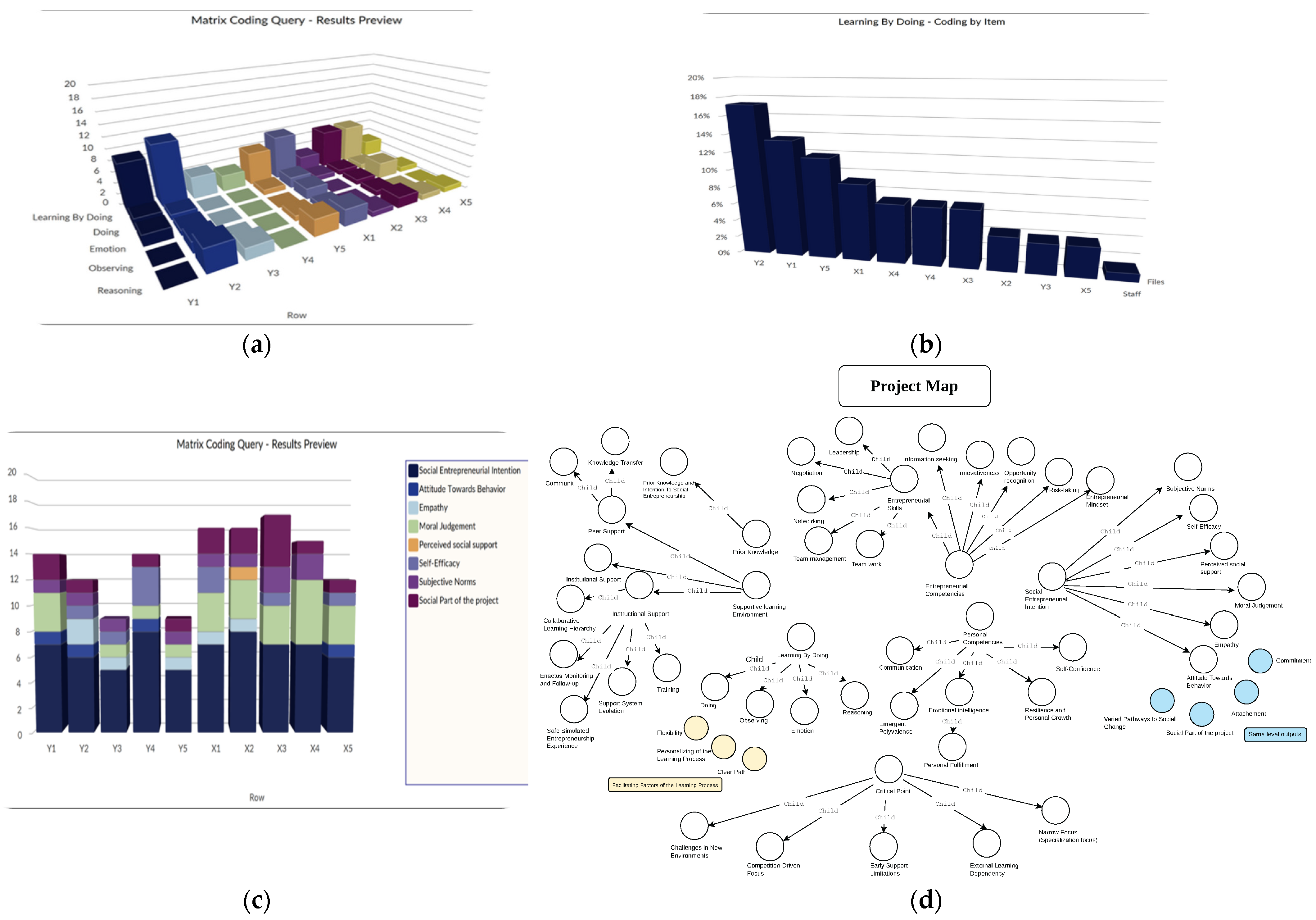
In response to this gap, our study examines Enactus Morocco case as a structured experiential learning ecosystem. It aims to understand how LBD fosters entrepreneurial competencies (EC) and social entrepreneurial intention (SEI), while also considering the role of prior knowledge and supportive learning environments. Furthermore, the study contributes by proposing an extended analytical framework integrating cognitive, emotional, and contextual dimensions of entrepreneurial learning (Figure 1).

2. Materials and Methods

This study adopts a qualitative exploratory approach, appropriate for investigating complex and underexplored phenomena such as competence and intention development [7]. To ensure a comprehensive understanding, the research integrates two complementary perspectives: (i) the organizational perspective, captured through a focus group with Enactus Morocco coordinators, and (ii) the beneficiary perspective, captured through ten semi-structured interviews with student members from diverse academic backgrounds.
Data collection followed strict ethical standards, including informed consent and confidentiality. The dataset consisted of ten individual semi-structured interviews and one focus group involving two Enactus Morocco staff members, and data saturation was reached at the ninth interview (Table 1), indicating sufficient depth and consistency in the emerging themes. The data were transcribed and analyzed using NVivo 15.
The analytical process combined multiple techniques to ensure rigor, including:
  • Thematic coding;
  • Matrix coding queries to explore relationships between variables;
  • Word frequency queries to identify dominant patterns;
  • Project mapping to visualize connections between themes.
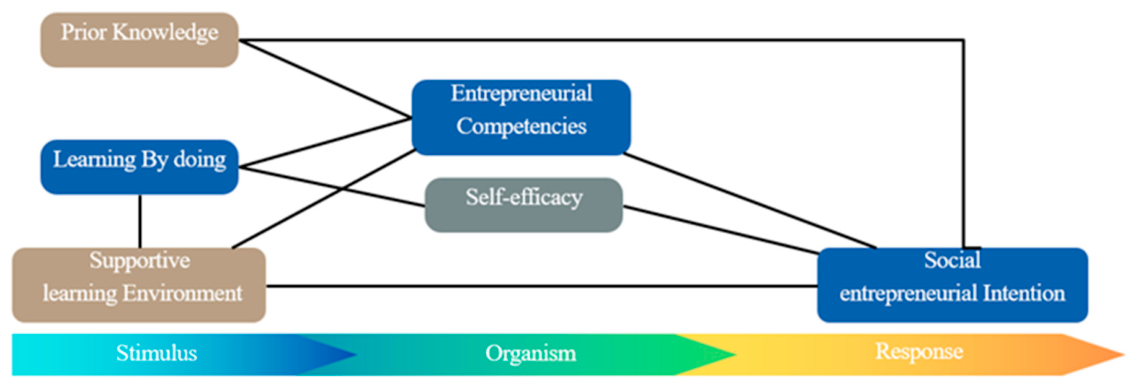
Figure 2 illustrates the analytical outputs visualized in NVivo 15 generated during the qualitative data analysis process:

3. Results and Discussion

3.1. Development of Entrepreneurial Competencies and Intention Through LBD

The findings indicate that Learning by Doing (LBD) significantly contributes to the development of entrepreneurial competencies and social entrepreneurial intention among Enactus Morocco student members. Through project-based engagement, participants developed leadership, communication, teamwork, opportunity recognition, adaptability, and problem-solving skills. These outcomes were consistently observed across participants from diverse academic backgrounds, indicating that experiential entrepreneurial learning is not limited to business-oriented disciplines or prior entrepreneurial exposure. Competencies developed progressively through exposure to real-world challenges, collaborative problem-solving, and practical decision-making situations. Experiential immersion enabled participants to transform theoretical knowledge into applied entrepreneurial capabilities while strengthening autonomy, self-confidence, and social awareness. These findings support previous research on experiential entrepreneurship education and align with Kolb’s experiential learning theory [1,6,8].

3.2. Role of the Supportive Learning Environment

A supportive learning environment emerged as a central factor influencing both competency development and entrepreneurial engagement. Participants emphasized the importance of mentorship, peer collaboration, institutional support, networking opportunities, and encouragement from personal networks. The results indicate that entrepreneurial learning within Enactus Morocco operates as a socially embedded process rather than a purely individual educational experience. At both organizational and interpersonal levels, collaborative dynamics and mentoring relationships contributed to confidence-building, emotional resilience, motivation, and a stronger sense of belonging. These findings align with previous studies highlighting the importance of educational support systems and entrepreneurial ecosystems in strengthening entrepreneurial competencies and intention formation [2,8].

3.3. Role of Prior Knowledge

Prior entrepreneurial knowledge facilitated participants’ initial adaptation to entrepreneurial activities and reduced uncertainty during the early stages of engagement. Students with previous exposure demonstrated greater familiarity with project structuring, opportunity identification, and strategic planning. However, participants without prior entrepreneurial experience were also able to develop substantial competencies through the experiential nature of the LBD process. Continuous practical engagement, collaborative learning, and iterative experimentation enabled students to progressively compensate for initial knowledge gaps. These findings highlight the inclusive potential of experiential entrepreneurship education and support social learning perspectives emphasizing learning through interaction and experiential engagement [3].

3.4. Emergent Influencing Variables Within an Extended Learning Framework

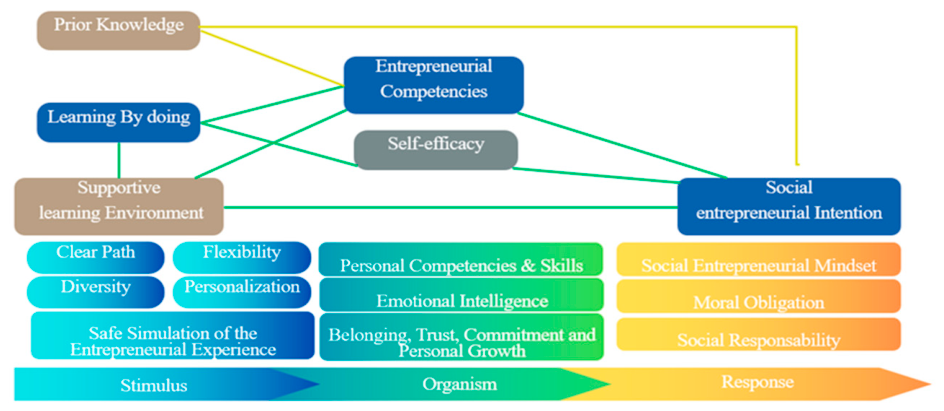
Beyond the initial analytical framework, the qualitative analysis identified additional variables influencing entrepreneurial learning outcomes and intention development. Recurring dimensions included emotional and social support, clarity of the learning process, flexibility of experiences, personalized engagement, networking opportunities, and sense of belonging (Figure 3).
These findings suggest that entrepreneurial learning extends beyond technical competency acquisition to include emotional, relational, and contextual dimensions. To conceptually structure these results, the study interprets the findings through the Stimulus–Organism–Response (S-O-R) framework developed by Mehrabian and Russell [9]. Within this framework:
  • Stimulus (S) refers to characteristics of the experiential learning environment, including structured learning pathways, flexibility, diversity of experiences, and personalized engagement.
  • Organism (O) represents participants’ internal transformations, including competency development, confidence, emotional intelligence, trust, commitment, and sense of belonging [3].
  • Response (R) corresponds to resulting attitudinal and behavioral outcomes, including entrepreneurial mindset development, social responsibility, moral engagement, and entrepreneurial intention formation [1,2].
Given the exploratory nature of this study, these relationships are presented as analytical propositions derived from qualitative evidence, and should not be interpreted as empirically validated causal mechanisms.

4. Conclusions

This study provides empirical evidence on the effectiveness of Learning by Doing in fostering entrepreneurial competencies and social entrepreneurial intention within a structured experiential environment in the Global South. By integrating both organizational and student perspectives, the research offers a comprehensive understanding of entrepreneurial learning processes. It highlights the importance of supportive environments and identifies additional emotional and relational variables that shape learning outcomes. Theoretically, the study proposes an extended framework integrating cognitive, emotional, and contextual dimensions of learning, structured through the S-O-R model.
This work represents the first phase of an ongoing research trajectory. Future research, conducted within a doctoral study, will employ a quantitative approach via structural equation modeling (SEM) to empirically test the proposed model.

Author Contributions

Conceptualization, N.S. and O.B.; methodology, N.S. and O.B.; software, N.S.; validation, N.S. and O.B.; formal analysis, N.S.; investigation, N.S.; resources, N.S.; data curation, N.S.; writing—original draft preparation, N.S. and O.B.; writing—review and editing, N.S. and O.B.; visualization, N.S. and O.B.; supervision, O.B.; project administration. All authors have read and agreed to the published version of the manuscript.

Funding

This research received no external funding.

Institutional Review Board Statement

This study does not incorporate, collect, process, or relate to sensitive personal data, so there is no applicable Institutional Review Board Statement.

Informed Consent Statement

All participants in this study provided their informed consent.

Data Availability Statement

The data from this study can be requested from the corresponding author.

Acknowledgments

We would like to thank Enactus Morocco for facilitating the data collection process during the qualitative study.

Conflicts of Interest

The authors declare no conflicts of interest.

Abbreviations

The following abbreviations are used in this manuscript:
LBDLearning by Doing
SEISocial Entrepreneurial Intention
ECEntrepreneurial Competence
SORStimulus-Organism-Response Model

References

  1. Ajzen, I. The Theory of Planned Behavior. Organ. Behav. Hum. Decis. Process. 1991, 50, 179–211. [Google Scholar] [CrossRef]
  2. Al Issa, H.-E.; Thai, M.T.T.; Saad, S. Empowering social entrepreneurial intentions through experiential learning and self-efficacy. Int. J. Manag. Educ. 2025, 23, 101154. [Google Scholar] [CrossRef]
  3. Bandura, A. Self-Efficacy: Toward a Unifying Theory of Behavioral Change. Psychol. Rev. 1977, 84, 191–215. [Google Scholar] [CrossRef] [PubMed]
  4. Branca, E.; Vanderstraeten, J.; Slabbinck, H.; Maes, I.M.R. The impact of entrepreneurial education on key entrepreneurial competencies: A systematic review of learning strategies and tools. Int. J. Manag. Educ. 2025, 23, 101144. [Google Scholar] [CrossRef]
  5. Ip, C.Y.; Zhuge, T.; Chang, Y.S.; Huang, T.-H.; Chen, Y.-L. Exploring the Determinants of Nascent Social Entrepreneurial Behaviour. Int. J. Environ. Res. Public Health 2022, 19, 3556. [Google Scholar] [CrossRef] [PubMed]
  6. Kolb, D.A. Experimental Learning: Experience as the Source of Learning and Development; Prentice-Hall: Englewood Cliffs, NJ, USA, 1984. [Google Scholar]
  7. Creswell, J.W. Qualitative Inquiry & Research Design: Choosing among Five Approaches, 2nd ed.; Sage Publications: Thousand Oaks, CA, USA, 2007. [Google Scholar]
  8. Mustafa, M.J.; Hernandez, E.; Mahon, C.; Chee, L.K. Entrepreneurial intentions of university students in an emerging economy. J. Entrep. Emerg. Econ. 2016, 8, 162–179. [Google Scholar] [CrossRef]
  9. Mehrabian, A.; Russell, J.A. An Approach to Environmental Psychology; MIT Press: Cambridge, MA, USA, 1974. [Google Scholar]
Figure 1. Proposed Theoretical Model of the Study.
Proceedings 140 00002 g001
Figure 2. NVivo 15 Functions Utilized for Qualitative Data Analysis: (a) matrix coding query examining the presence of all elements of Kolb’s experiential learning theory among students participating in the Enactus initiative, validating the fundamentally experiential nature of the program; (b) coding distribution chart illustrating the density of codes associated with the “learning by doing” node across individual participant statements; (c) matrix coding visualization displaying the distribution of emerging dimensions related to the social entrepreneurial intention construct across participant statements; and (d) thematic project map illustrating the conceptual framework of the study and the emergence of additional thematic dimensions identified during the analysis procedures.
Proceedings 140 00002 g002
Figure 3. Refined Conceptual Model Derived from Qualitative Data Analysis.
Proceedings 140 00002 g003
Table 1. Sociodemographic and Organizational Characteristics of Participants.
ParticipantGenderAcademic BackgroundOrganizational RoleEnactus ExperiencePosition Description
Laureate_1 (X1)FPhD in PhysicsTeam Leader5+ yearsStrategic vision, team guidance, and planning
Laureate_2 (X2)MMaster’s in FinanceCo-Project Leader3–4 yearsOversight, project alignment, and mentorship
Laureate_3 (X3)FPhD in FinanceProject Leader3–4 yearsProject execution and learning facilitation
Laureate_4 (X4)MState EngineerTeam Leader1–2 yearsProject management and international competition participation
Laureate_5 (X5)MPhD Student in EngineeringVice Team Leader3–4 yearsCoordination and mentorship
Student_1 (Y1)MMechanical EngineeringMedia & Design1–2 yearsVisual branding and storytelling
Student_2 (Y2)MBachelor’s Student in Life and Earth SciencesSponsorship Lead1–2 yearsResource mobilization and networking
Student_3 (Y3)MMaster’s Student in MarketingHead of Events3–4 yearsLogistics, visibility, and team management
Student_4 (Y4)MBachelor’s Student in Economic SciencesProject Leader1–2 yearsMonitoring and implementation
Student_5 (Y5)FBachelor’s Student in CybersecurityTeam Leader3–4 yearsStrategic alignment and motivational leadership
Staff_Operations (Staff 1)MProfessional Staff MemberOperations Manager5+ yearsCoordination of field teams and internal processes
Staff_Projects (Staff 2)MProfessional Staff MemberProjects Manager5+ yearsStrategic alignment with Enactus Global
Disclaimer/Publisher’s Note: The statements, opinions and data contained in all publications are solely those of the individual author(s) and contributor(s) and not of MDPI and/or the editor(s). MDPI and/or the editor(s) disclaim responsibility for any injury to people or property resulting from any ideas, methods, instructions or products referred to in the content.