1. Introduction
The rapid diffusion of disruptive technologies has intensified scholarly and managerial interest in how digital transformation affects workforce capabilities, organizational adaptation, and long-term employability. Technologies such as Artificial Intelligence, the Internet of Things, Blockchain, Extended Reality and Cloud infrastructures are fundamentally transforming how work is organized and performed. These developments reshape job roles, decision-making processes and the skill requirements of employees across sectors. As a result, organizations increasingly face pressure to reassess how digital skills are developed, supported, and strategically managed [
1,
2].
Although existing digital competence frameworks provide useful reference points, they tend to describe skills in relatively static terms and often overlook the dynamic conditions under which these skills are formed. Employees experience technological change through direct exposure in their daily work, shaping their perception of emerging skill gaps and influencing both individual and organizational responses. However, empirical research has rarely examined how exposure to disruptive technologies translates into perceived skill gaps and organizational readiness within an integrated analytical framework [
3,
4].
The present study addresses this gap by proposing and testing a structural model that connects disruptive technology exposure, perceived skill gaps, organizational readiness, strategic HR alignment, and skill update intention within a single analytical framework. In doing so, it adopts a holistic perspective, viewing workforce upskilling not merely as an individual response to technological change but as an outcome shaped by organizational conditions and HR-related strategic support. Emphasis is placed on the mediating role of strategic HR alignment in translating perceived skill gaps into concrete intentions for skill upgrading [
5,
6].
Based on this perspective, the central research question of the study is: How does exposure to disruptive technologies shape employees’ perceived skill gaps and, through organizational readiness and strategic HR alignment, influence their intention to update their skills?
2. Literature Review
Recent scholarship increasingly examines how technological disruption reshapes workforce capabilities and organizational responses. As advanced technologies become embedded in everyday work processes, employees are required to reassess whether their existing competences remain adequate, while organizations must determine their capacity to support continuous skill development.
2.1. Disruptive Technology Exposure and Perceived Skill Gaps
The rapid diffusion of artificial intelligence, automation, and data-driven systems has made skill mismatches more visible across sectors. Research on digitalization shows that technological change reveals discrepancies between existing competences and emerging job requirements, heightening awareness of missing digital and analytical skills [
7,
8]. Comparable patterns are observed in healthcare, where the integration of telemedicine tools led professionals to recognize deficiencies in technological and communication-related capabilities [
9].
Industry evidence further identifies shortages in data and AI expertise as barriers to technology adoption. Studies on digital twins emphasize that insufficient analytics skills constrain implementation and scaling [
10]. Educational research similarly reports expectation–performance gaps in robotics, artificial intelligence, and data-processing competences [
11], while many computer science postgraduates perceive their preparation as misaligned with Industry 4.0 demands [
12].
Importantly, exposure does not necessarily generate negative perceptions. When technological change is accompanied by structured training opportunities, employees are more likely to interpret digitalization as manageable and engage proactively in skill development [
13]. Overall, disruptive technology exposure appears to function as a catalyst that renders skill deficiencies visible and strategically relevant.
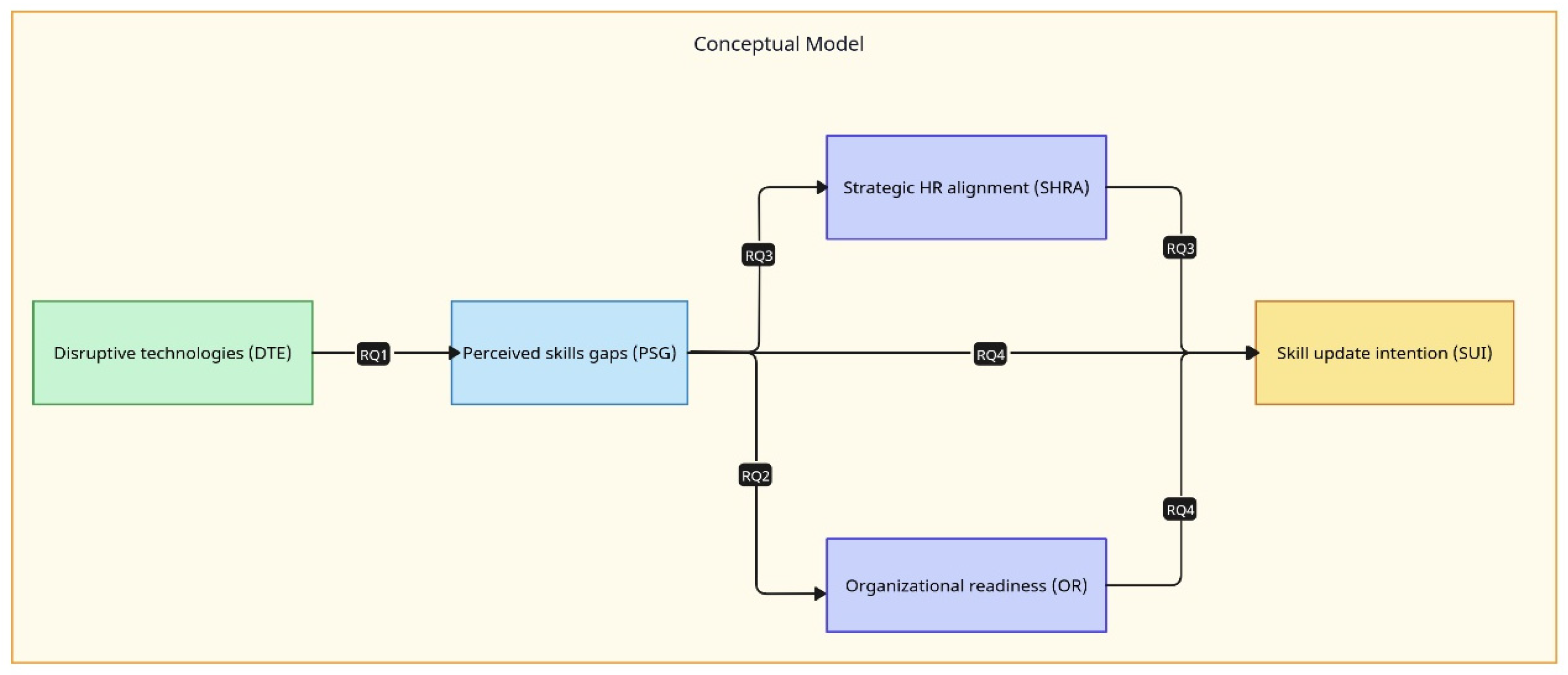
RQ1: How does exposure to disruptive technologies (DTE) affect perceived skill gaps (PSG)?
2.2. Perceived Skill Gaps and Organizational Readiness
Skill gaps extend beyond individual competence and relate directly to organizational preparedness. Reviews define such gaps as discrepancies between workforce capabilities and industry needs that reduce productivity and adaptive performance [
14]. Because adaptability is central to readiness, capability deficits may weaken an organization’s ability to respond effectively to change [
15].
Empirical work on competence mismatch links under-skilling with lower job satisfaction and performance, conditions that can undermine confidence in organizational capability [
16]. Evidence from crisis management contexts similarly associates larger perceived knowledge gaps with weaker feelings of preparation and stronger demand for additional training [
17]. Studies on expectation–performance gaps among students and practitioners further frame these deficiencies as indicators of limited readiness for future work and as priorities for redesigned learning initiatives [
11,
18].
Digital transformation frameworks position human capability alongside technology and culture as a core readiness dimension, suggesting that persistent skill gaps may erode this foundation [
15]. Although direct causal testing remains limited, converging evidence indicates that perceived gaps shape readiness through capability constraints and reduced confidence.
RQ2: To what extent do perceived skill gaps (PSG) influence organizational readiness (OR)?
2.3. Strategic HR Alignment as a Mediating Mechanism
Bridging capability deficits typically requires coordinated organizational intervention. Strategic HR alignment refers to integrating workforce planning, skill assessment, training systems, and career pathways with broader strategic priorities. Tools such as skill matrices increase the visibility of gaps and connect them to development planning, supporting more systematic responses [
19]. Industry 4.0 research likewise emphasizes that closing skill gaps depends on deliberate workforce planning aligned with future strategic requirements [
14].
Evidence from green skills initiatives shows that coordinated strategies can translate recognized shortages into structured reskilling pathways [
20]. In professional settings, acknowledgment of deficiencies combined with targeted development initiatives is associated with higher voluntary participation in training, suggesting that aligned HR practices strengthen willingness to engage in skill upgrading [
21]. Yet empirical research rarely examines HR alignment as the mechanism linking perceived gaps to behavioral intentions.
RQ3: How does strategic HR alignment (SHRA) mediate the relationship between PSG and skill update intention (SUI)?
2.4. Skill Update Intention
Perceived skill gaps often motivate employees to avoid professional obsolescence by pursuing further development. Evidence across sectors shows that stronger mismatches are associated with intentions to seek vocational and workplace learning [
22]. However, acting on this motivation depends on organizational readiness. Supportive leadership, accessible training, and learning-oriented cultures reduce perceived risk and encourage participation in development activities [
23], reinforcing continuous skill renewal [
24].
RQ4: How do PSG and OR directly affect skill update intention (SUI)?
Building on the relationships outlined above,
Figure 1 presents the conceptual model of the study and integrates the proposed research pathways. Exposure to disruptive technologies is expected to heighten perceived skill gaps, which subsequently influence both organizational readiness and strategic HR alignment. Strategic HR alignment is positioned as a mediating mechanism that converts recognized capability deficits into structured development opportunities, whereas organizational readiness reflects the supportive conditions that facilitate skill renewal. Collectively, the model captures a multilevel process linking technological change with employees’ skill update intention.
3. Methodology
This study adopted a quantitative, cross-sectional research design to examine the relationships between disruptive technology exposure, perceived skill gaps, organizational readiness, strategic HR alignment, and skill update intention. Data were collected through a structured online questionnaire administered via SurveyMonkey between May and September 2025. A non-probability convenience sampling strategy was employed to reach employees from diverse organizational contexts across Greece, Spain, and Italy. The final sample consisted of 622 respondents drawn from both public and private sector organizations.
The questionnaire comprised two sections. The first captured demographic information, including age, gender, education, work experience, organizational position, employment sector, organization size, and industry. The second section measured five latent constructs using reflective indicators assessed on a five-point Likert scale ranging from strongly disagree (1) to strongly agree (5). Disruptive Technology Exposure was measured with five items, Perceived Skill Gaps with six items, Organizational Readiness with five items, Strategic HR Alignment with four items, and Skill Update Intention with four items. The instrument was developed based on established theoretical perspectives on digital skills, organizational readiness, and strategic HR management, and was reviewed to ensure clarity and relevance for working professionals.
Participation was voluntary and anonymous, and respondents were informed about the purpose of the study prior to completion. The research adhered to the principles of the General Data Protection Regulation (GDPR), ensuring confidentiality, secure data handling, and the exclusive use of responses for academic purposes.
The proposed model was analyzed using Partial Least Squares Structural Equation Modeling (PLS-SEM) with SmartPLS v.4.1.1.7, an approach appropriate for prediction-oriented research and complex latent variable models [
25]. Internal consistency was supported by Cronbach’s alpha and composite reliability values exceeding recommended thresholds, while convergent validity was confirmed through average variance extracted (AVE) values above 0.50. Discriminant validity was assessed using both the Fornell–Larcker criterion and the heterotrait–monotrait ratio (HTMT), with all constructs meeting established guidelines. Model fit evaluation based on the standardized root mean square residual (SRMR) and the normed fit index (NFI) indicated an acceptable level of fit [
25].
4. Results
The final sample consisted of 622 employees from Greece, Spain, and Italy, representing both public and private sector organizations and a broad range of industries. Participants reflected diverse demographic and professional backgrounds, supporting the suitability of the dataset for examining workforce skill dynamics across organizational contexts.
The proposed structural model was assessed using Partial Least Squares Structural Equation Modeling (PLS-SEM). The measurement model demonstrated satisfactory levels of internal consistency, convergent validity, and discriminant validity, as all constructs met recommended methodological thresholds. These results confirmed the adequacy of the measurement properties and allowed for the evaluation of the structural relationships.
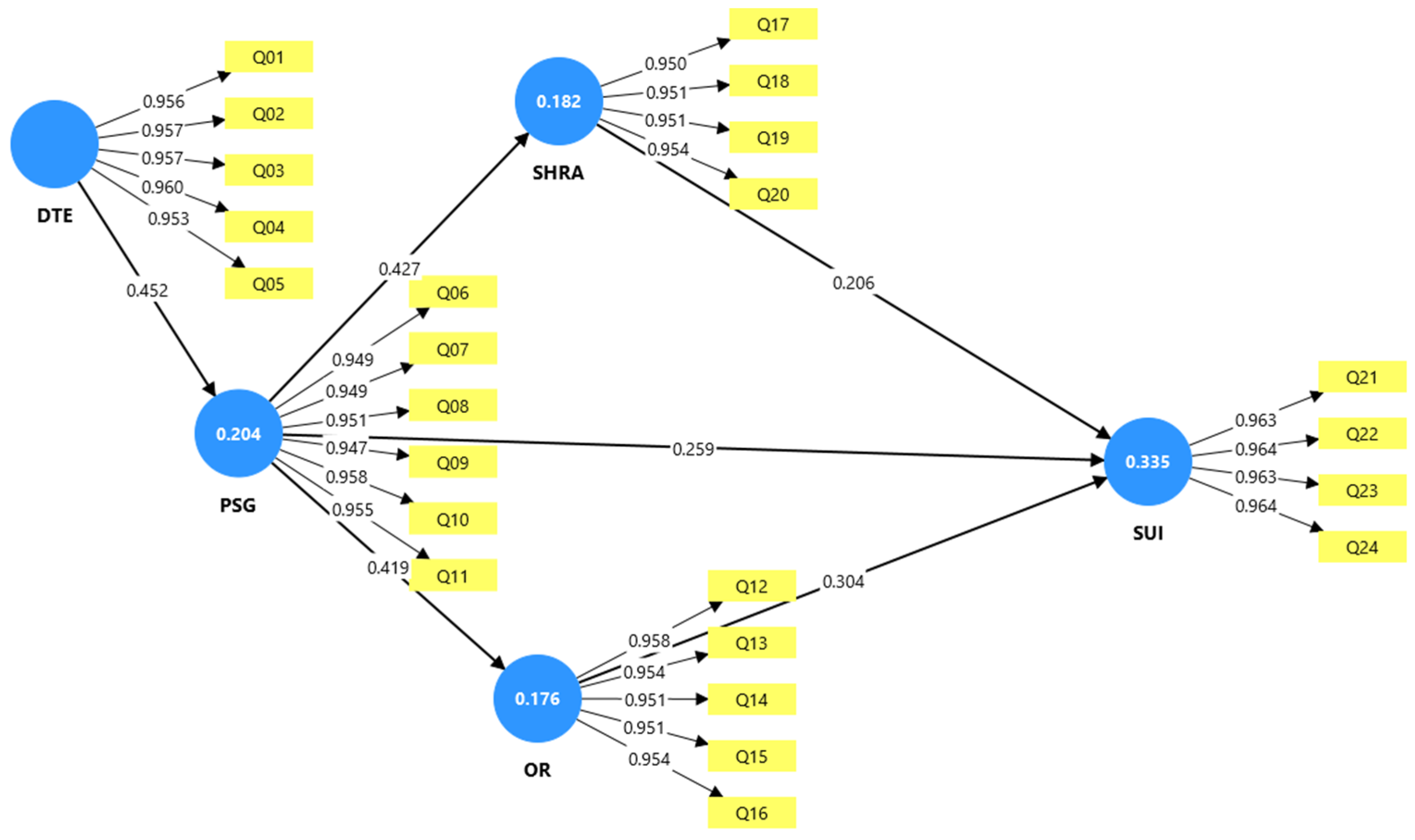
Figure 2 presents the structural model with standardized path coefficients and explained variance values. Overall, the model exhibited meaningful explanatory capacity across the endogenous constructs. Disruptive technology exposure explained 20.4% of the variance in perceived skill gaps (R
2 = 0.204). Perceived skill gaps accounted for 17.6% of the variance in organizational readiness (R
2 = 0.176) and 18.2% in strategic HR alignment (R
2 = 0.182). The model demonstrated higher explanatory power for skill update intention, explaining 33.5% of its variance (R
2 = 0.335), indicating moderate predictive capability for employee behavioral intention.
As shown in
Table 1, all structural paths were positive and statistically significant, providing empirical support for the proposed research relationships. Addressing RQ1, disruptive technology exposure had a substantial effect on perceived skill gaps (β = 0.452,
p < 0.001), suggesting that greater exposure to emerging technologies is associated with stronger awareness of capability deficiencies.
Consistent with RQ2, perceived skill gaps were positively related to organizational readiness (β = 0.419, p < 0.001), indicating that the recognition of competence shortages is linked with organizational efforts to prepare for skill development initiatives.
Regarding RQ3, perceived skill gaps demonstrated a significant effect on strategic HR alignment (β = 0.427, p < 0.001), while strategic HR alignment was positively associated with skill update intention (β = 0.206, p < 0.001). The indirect effect between perceived skill gaps and skill update intention was statistically significant, suggesting that strategic HR alignment functions as a mediating mechanism through which organizations translate recognized capability deficits into developmental action.
With respect to RQ4, both organizational readiness (β = 0.304, p < 0.001) and perceived skill gaps (β = 0.259, p < 0.001) exerted direct effects on skill update intention. Organizational readiness emerged as a particularly relevant enabling condition, implying that employees are more likely to pursue skill upgrading when supportive structures, resources, and learning opportunities are perceived to be available.
Taken together, the findings describe a multilevel process linking technological exposure with employee learning intentions. Disruptive technologies appear to shape how employees evaluate their existing competences, which subsequently relates to organizational preparedness and the strategic alignment of HR practices. These organizational mechanisms, in turn, are associated with stronger intentions to update skills in digitally evolving work environments.
5. Discussion
The present study contributes to research examining how disruptive technologies reshape workforce skill requirements and organizational responses. By integrating technological exposure with organizational readiness and strategic HR alignment, the findings extend prior work on the transformative impact of digitalization on skills and work structures [
2,
4]. In particular, the positive association between disruptive technology exposure and perceived skill gaps is consistent with earlier studies showing that digital transformation makes capability mismatches more visible across work settings [
7,
14]. The findings also support prior research suggesting that employees are more likely to engage in skill development when organizational support, leadership, and learning-oriented structures are in place [
23,
24]. Rather than viewing skill development solely as an individual responsibility, the results reinforce a systemic perspective in which organizational mechanisms play a central role in enabling adaptation.
The study further advances understanding of workforce adaptation in digitally evolving environments by empirically linking perceived skill gaps with both organizational readiness and strategic HR alignment. The mediating role of strategic HR alignment is particularly noteworthy, as it suggests that recognizing capability deficiencies is not sufficient to trigger developmental behavior unless supported by coordinated HR practices. This aligns with dynamic capability arguments that organizations must strategically reconfigure resources to remain competitive in technologically evolving environments [
6]. Additionally, the findings reinforce emerging calls to conceptualize digital competence as context-dependent rather than static [
4].
The study also offers practical implications for organizations navigating digital transformation. Exposure to disruptive technologies appears to heighten employees’ awareness of skill deficiencies, but organizational readiness and aligned HR policies function as critical enabling conditions for skill renewal. Investments in structured reskilling initiatives, learning cultures, and strategically integrated HR processes may therefore support more proactive employee engagement with continuous development. In this respect, the results echo prior research highlighting the organizational dimension of digital transformation [
2].
Several limitations should be acknowledged. The cross-sectional design restricts causal interpretation, while the use of self-reported measures introduces the possibility of perceptual bias. Furthermore, the non-probability sampling approach may limit the generalizability of the findings beyond similar organizational contexts.
Future research could adopt longitudinal designs to examine how skill perceptions evolve over time as technological exposure intensifies. Comparative studies across industries or institutional environments may also provide deeper insight into contextual differences in organizational readiness. Finally, extending the model to incorporate leadership, learning climate, or innovation-related constructs could further clarify the organizational conditions that sustain workforce adaptability in disruptive settings.
6. Conclusions
This study demonstrates that disruptive technologies reshape workforce development through interconnected technological and organizational mechanisms. Perceived skill gaps, organizational readiness, and strategic HR alignment jointly influence employees’ intention to update their skills, highlighting the importance of coordinated institutional responses. Organizations that strategically align HR practices with technological priorities are better positioned to foster continuous learning and sustain adaptability in digitally evolving environments.
Author Contributions
Conceptualization, I.Z. and E.S.; methodology, E.S.; software, I.Z.; validation, I.Z. and E.S.; formal analysis, I.Z.; investigation, E.S.; resources, I.Z.; data curation, I.Z.; writing—original draft preparation, I.Z.; writing—review and editing, E.S.; visualization, I.Z.; supervision, E.S.; project administration, I.Z.; funding acquisition, I.Z. All authors have read and agreed to the published version of the manuscript.
Funding
This research received no external funding.
Institutional Review Board Statement
This research does not incorporate, collect, process, or relate to sensitive personal data, so there is no applicable Institutional Review Board Statement.
Informed Consent Statement
ICS was obtained from all subjects involved in this study.
Data Availability Statement
Conflicts of Interest
The authors declare no conflict of interest.
References
- Aquino, J.; Alarcón, R.; Guevara, L.; Bravo-Jaico, J.; Germán, N.; Valdivia-Salazar, C.; Serquén, O.; Maquen-Niño, G.L.E.; Tesén-Arroyo, A. Impact of Digital Transformation: Assessing the Knowledge and Adoption of Disruptive Technologies in a Higher Education Institution. Front. Comput. Sci. 2025, 7, 1611952. [Google Scholar] [CrossRef]
- Vial, G. Understanding Digital Transformation: A Review and a Research Agenda. J. Strateg. Inf. Syst. 2019, 28, 118–144. [Google Scholar] [CrossRef]
- OECD. OECD Employment Outlook 2019: The Future of Work; OECD Employment Outlook; OECD: Paris, France, 2019. [Google Scholar]
- Van Laar, E.; Van Deursen, A.J.A.M.; Van Dijk, J.A.G.M.; De Haan, J. Determinants of 21st-Century Skills and 21st-Century Digital Skills for Workers: A Systematic Literature Review. SAGE Open 2020, 10, 215824401990017. [Google Scholar] [CrossRef]
- Alt, D.; Raichel, N. Enhancing Perceived Digital Literacy Skills and Creative Self-Concept through Gamified Learning Environments: Insights from a Longitudinal Study. Int. J. Educ. Res. 2020, 101, 101561. [Google Scholar] [CrossRef]
- Teece, D.; Peteraf, M.; Leih, S. Dynamic Capabilities and Organizational Agility: Risk, Uncertainty, and Strategy in the Innovation Economy. Calif. Manag. Rev. 2016, 58, 13–35. [Google Scholar] [CrossRef]
- Ciarli, T.; Kenney, M.; Massini, S.; Piscitello, L. Digital Technologies, Innovation, and Skills: Emerging Trajectories and Challenges. Res. Policy 2021, 50, 104289. [Google Scholar] [CrossRef]
- Cramarenco, R.E.; Burcă-Voicu, M.I.; Dabija, D.C. The Impact of Artificial Intelligence (AI) on Employees’ Skills and Well-Being in Global Labor Markets: A Systematic Review. Oeconomia Copernic. 2023, 14, 731–767. [Google Scholar] [CrossRef]
- Isidori, V.; Diamanti, F.; Gios, L.; Malfatti, G.; Perini, F.; Nicolini, A.; Longhini, J.; Forti, S.; Fraschini, F.; Bizzarri, G.; et al. Digital Technologies and the Role of Health Care Professionals: Scoping Review Exploring Nurses’ Skills in the Digital Era and in the Light of the COVID-19 Pandemic. JMIR Nurs. 2022, 5, e37631. [Google Scholar] [CrossRef]
- Broo, D.G.; Schooling, J. Digital Twins in Infrastructure: Definitions, Current Practices, Challenges and Strategies. Int. J. Constr. Manag. 2023, 23, 1254–1263. [Google Scholar] [CrossRef]
- Elo, T.; Pätäri, S.; Sjögrén, H.; Mättö, M. Transformation of Skills in the Accounting Field: The Expectation–Performance Gap Perceived by Accounting Students. Account. Educ. 2024, 33, 237–273. [Google Scholar] [CrossRef]
- Guzmán Sánchez-Mejorada, C.; Torres-Ruiz, M.; Quintero, R.; Chui, K.T.; Guzmán, G. Industry 4.0 Skills Assessment: A Case Study of Students’ Perceptions in Computer Science Postgraduate Programs. Sustainability 2025, 17, 4974. [Google Scholar] [CrossRef]
- Ostmeier, E.; Strobel, M. Building Skills in the Context of Digital Transformation: How Industry Digital Maturity Drives Proactive Skill Development. J. Bus. Res. 2022, 139, 718–730. [Google Scholar] [CrossRef]
- Rikala, P.; Braun, G.; Järvinen, M.; Stahre, J.; Hämäläinen, R. Understanding and Measuring Skill Gaps in Industry 4.0—A Review. Technol. Forecast. Soc. Change 2024, 201, 123206. [Google Scholar] [CrossRef]
- Michelotto, F.; Joia, L.A. Organizational Digital Transformation Readiness: An Exploratory Investigation. J. Theor. Appl. Electron. Commer. Res. 2024, 19, 3283–3304. [Google Scholar] [CrossRef]
- Škrinjarić, B. Competence-Based Approaches in Organizational and Individual Context. Humanit. Soc. Sci. Commun. 2022, 9, 28. [Google Scholar] [CrossRef]
- Titko, M.; Slemenský, M. Educational Aspects Affecting Paramedic Preparedness and Sustainability of Crisis Management: Insights from V4 Countries and the Role of Innovative Technologies. Sustainability 2025, 17, 1944. [Google Scholar] [CrossRef]
- Elo, T.; Puumalainen, K.; Sjögrén, H.; Pätäri, S. Skill Gaps in Accounting: Contrasting Stakeholder Expectations with Perceived Skills. Educ. + Train. 2025, 67, 17–39. [Google Scholar] [CrossRef]
- Hadiyanto, H.; Anggoro, Y. A Skill Matrix Chart Case Study in Global Manufacturing. Syst. Res. Behav. Sci. 2025, 42, 1902–1916. [Google Scholar] [CrossRef]
- Cook, T.; Elliott, D. Green Skills Gap—A Way Ahead. Front. Sociol. 2025, 10, 1577037. [Google Scholar] [CrossRef]
- Baez, J.; Adan, A.; Santen, S.; McDonough, E.; Fermann, G.; Leenellett, E. Enhancing Emergency Medicine Faculty Development: A Strategic Approach to Bridging Clinical Skill Gaps. AEM Educ. Train. 2025, 9, S61–S65. [Google Scholar] [CrossRef]
- Bhattarai, P.C.; Parajuli, M.N.; Gautam, S.; Paudel, P.K.; Bhurtel, A.; Sharma, A. Education–Work Transition: Skill Gaps in the Construction Industry. Front. Built Environ. 2025, 11, 1623609. [Google Scholar] [CrossRef]
- Hargitai, D.M.; Bencsik, A. The Role of Leadership in Digital Learning Organizations. Emerg. Sci. J. 2023, 7, 111–124. [Google Scholar] [CrossRef]
- Faulks, B.; Song, Y.; Waiganjo, M.; Obrenovic, B.; Godinic, D. Impact of Empowering Leadership, Innovative Work, and Organizational Learning Readiness on Sustainable Economic Performance: An Empirical Study of Companies in Russia during the COVID-19 Pandemic. Sustainability 2021, 13, 12465. [Google Scholar] [CrossRef]
- Hair, J.F.; Hult, G.T.M.; Ringle, C.M.; Sarstedt, M. A Primer on Partial Least Squares Structural Equation Modeling (PLS-SEM), 3rd ed.; SAGE: Los Angeles, CA, USA, 2022. [Google Scholar]
| Disclaimer/Publisher’s Note: The statements, opinions and data contained in all publications are solely those of the individual author(s) and contributor(s) and not of MDPI and/or the editor(s). MDPI and/or the editor(s) disclaim responsibility for any injury to people or property resulting from any ideas, methods, instructions or products referred to in the content. |