Proceeding Paper

The Role of Visual Education in Training Processes: A Systematic Review of the Use of Visual Tools to Enhance Learning and Promote the Development of Soft Skills †
by
Valentina Berardinetti
Department of Humanities, Literature, Cultural Heritage, Education, University of Foggia, Via Arpi, 176, 71121 Foggia, Italy
Presented at the Learning and Teaching Strategies Mediated by Visual Education: Horizons of Research and Action (ASTERA 2025), Bari, Italy, 2 October 2025.
Proceedings 2026, 139(1), 6; https://doi.org/10.3390/proceedings2026139006
Published: 17 April 2026

Abstract

In recent years, Visual Education has emerged as an innovative and interdisciplinary teaching approach aimed at promoting meaningful learning through the conscious use of visual tools and languages. This educational paradigm helps to facilitate the understanding of complex concepts, translating them into clear and intuitive visual representations, while enhancing memorisation skills, critical information processing and the practical application of acquired knowledge. This systematic review, conducted according to the PRISMA (2020) protocol, analyses the most recent empirical evidence on the effectiveness of Visual Education in educational contexts. The main objective is to assess how the intentional use of visual tools—images, concept maps, educational videos, interactive digital materials, and virtual manipulatives—contributes to enhancing learning processes and developing transversal skills. Through a comparative analysis of fourteen international contributions published between 2020 and 2025, selected from the Scopus, Web of Science and EBSCO databases, the research highlights how Visual Education significantly influences the improvement of academic performance, motivation and cognitive and emotional engagement of students. The results also confirm the inclusive function of visual teaching, which can encourage participation, self-esteem and cooperation even in individuals with special educational needs. The discussion emphasises the need for the systematic integration of Visual Education into school curricula as a strategy to enhance soft skills and promote more equitable, effective learning geared towards the integral development of the individual.

1. Introduction

In contemporary culture, visual language has taken on a central role not only in communication, but also in the construction of knowledge and in mediating between the individual and the world. We live immersed in a dense, hyperconnected and multisensory information ecosystem, in which images, videos and interactive digital environments shape the way we perceive, think and learn on a daily basis [1]. In this scenario, the ability to read, understand and produce visual messages—understood as visual literacy—becomes an essential condition for meaningful learning and the exercise of active citizenship.
Pedagogy and cognitive psychology have long recognised the importance of visual thinking in knowledge construction processes: according to Paivio’s dual-code theory [2], the integration of verbal and iconic information enhances comprehension and memorisation through the simultaneous activation of semantic and perceptual channels. This is the basis of Visual Education, an educational approach that uses the language of images to stimulate attention, consolidate concepts and promote more inclusive and motivating learning through the integration of visual languages and tools into teaching methodologies.
In schools, this approach cannot be reduced to the illustrative or decorative use of images, but rather takes the form of a cognitive and metacognitive strategy capable of supporting the representation and reworking of complex content through maps, symbols, infographics and visual narratives, thus developing skills of analysis, synthesis and abstraction. It acts as an interdisciplinary bridge between humanities, science and technology, promoting the convergence of analytical thinking, aesthetic sensitivity and digital skills.
Numerous studies show that visual methodologies improve critical thinking skills, linguistic comprehension and cognitive performance, while promoting transversal skills such as effective communication, creativity, mental flexibility and problem solving, which are fundamental for dealing with the complexity of the contemporary world [3]. Visual education is naturally intertwined with media literacy and media education, disciplines that promote critical understanding of the media and how they work [4]. Young people’s familiarity with digital devices, often interpreted as an acquired skill, actually conceals a widespread interpretative fragility: knowing how to use a technological tool does not mean knowing how to decode its messages or understand its socio-cultural implications. Educating the eye therefore means going beyond mere technical literacy to develop a critical, aesthetic and ethical awareness of images, recognising their power to shape values, identities and relationships [5]. In this sense, Visual Education becomes an integral part of Media Education, contributing to the formation of aware and engaged digital citizens, capable of navigating the visual flow that surrounds them with autonomy and responsibility.
The path to visual literacy begins in the family, through shared viewing and storytelling, but finds its ideal context for consistent pedagogical systematisation in school [6]. Recent studies show that visual methodologies, integrated into teaching and learning programmes, produce benefits in terms of cognitive performance, critical thinking, linguistic comprehension and emotional participation [7]. They also encourage peer collaboration and the development of transversal skills—or soft skills—such as effective communication, creativity, cognitive flexibility and problem-solving skills. The National Curriculum Guidelines [8] recognise the centrality of visual languages, but educational practices often remain episodic and fragmented.
However, despite the growing spread of teaching practices based on visual codes and digital technologies, empirical evidence on their pedagogical impact is still fragmentary and not systematically integrated.
The subject of Art and Image can represent, for example, an ideal laboratory for visual education, provided that it is renewed in an experiential and interdisciplinary way: experiences such as the photographic reinterpretation of works of art or the production of digital visual narratives take the form of “real-life tasks” capable of intertwining creativity and reflection, consolidating active observation, collaboration and aesthetic awareness. In a media environment dominated by algorithmic images that invisibly influence imagination and behaviour, training the eye means restoring cognitive depth to seeing, learning to recognise codes, intentions and power relations that permeate visual culture. Only those who have the tools to interpret, deconstruct and rework the languages of images can participate in digital culture as active subjects, not as mere consumers [9,10]. Visual Education thus also takes on an ethical and democratic value: educating about images is equivalent to educating about freedom of thought and social responsibility.
In this perspective, contemporary visual education must overcome the opposition between analogue and digital, recognising both as complementary dimensions of a single learning ecology. Manual practices—drawing, painting, photography, manipulation of materials—interact with the immersive and interactive languages of augmented reality, animation and videomaking, generating multisensory and deeply creative educational experiences.
Visual Education is therefore an integrated pedagogy of the image, capable of combining tradition and innovation, physicality and virtuality, critical reflection and aesthetic production. In 21st-century schools, this approach is not a methodological accessory but an educational necessity for training competent individuals who are aware and responsible for their own view of the digital world.
This systematic review therefore aims to fill this gap by critically and comparatively analysing the main recent research on the use of visual tools in educational processes. The objective is to understand how Visual Education can promote disciplinary learning, support inclusion and enhance learners’ soft skills, outlining theoretical and practical perspectives for innovative teaching.

2. Methodology

2.1. Methodological Approach

The review was conducted according to the PRISMA 2020 [11] protocol, adopting a systematic approach aimed at ensuring transparency, replicability and methodological rigour. The research question was defined using the PICO (Population–Intervention–Comparison–Outcome) model, structured as follows:
  • Population: primary and secondary school students, with or without special educational needs;
  • Intervention: use of visual, analogue or digital strategies and tools aimed at improving learning or promoting the development of soft skills;
  • Comparison: teaching approaches based on visual learning compared to traditional learning methods focused exclusively on verbal or textual exposure;
  • Outcome: improvement in learning effectiveness, motivation, cognitive skills, and social and communication skills.

2.2. Bibliographic Research

The research—conducted with the support of the research team at the Learning Sciences Institute of the University of Foggia—was carried out between August and October 2025 on three main international databases: Scopus, Web of Science and EBSCO. The following search string was used:
(‘Visual Education’ OR ‘visual learning’ OR ‘visual tools’) AND (‘learning’ OR ‘life skills’ OR ‘soft skills’ OR ‘emotional skills’) AND (‘student’ OR ‘adolescent’ OR “teenager”) AND (‘school’).
Peer-reviewed articles and open access contributions published in English between 2020 and 2025, relating to formal or semi-formal educational contexts and based on empirical evidence, were included. All articles resulting from systematic reviews, scoping reviews, visual tool mapping, as well as articles involving samples of university students or adults, or analysing the application of visual education and visual tools in contexts other than schools, were excluded.
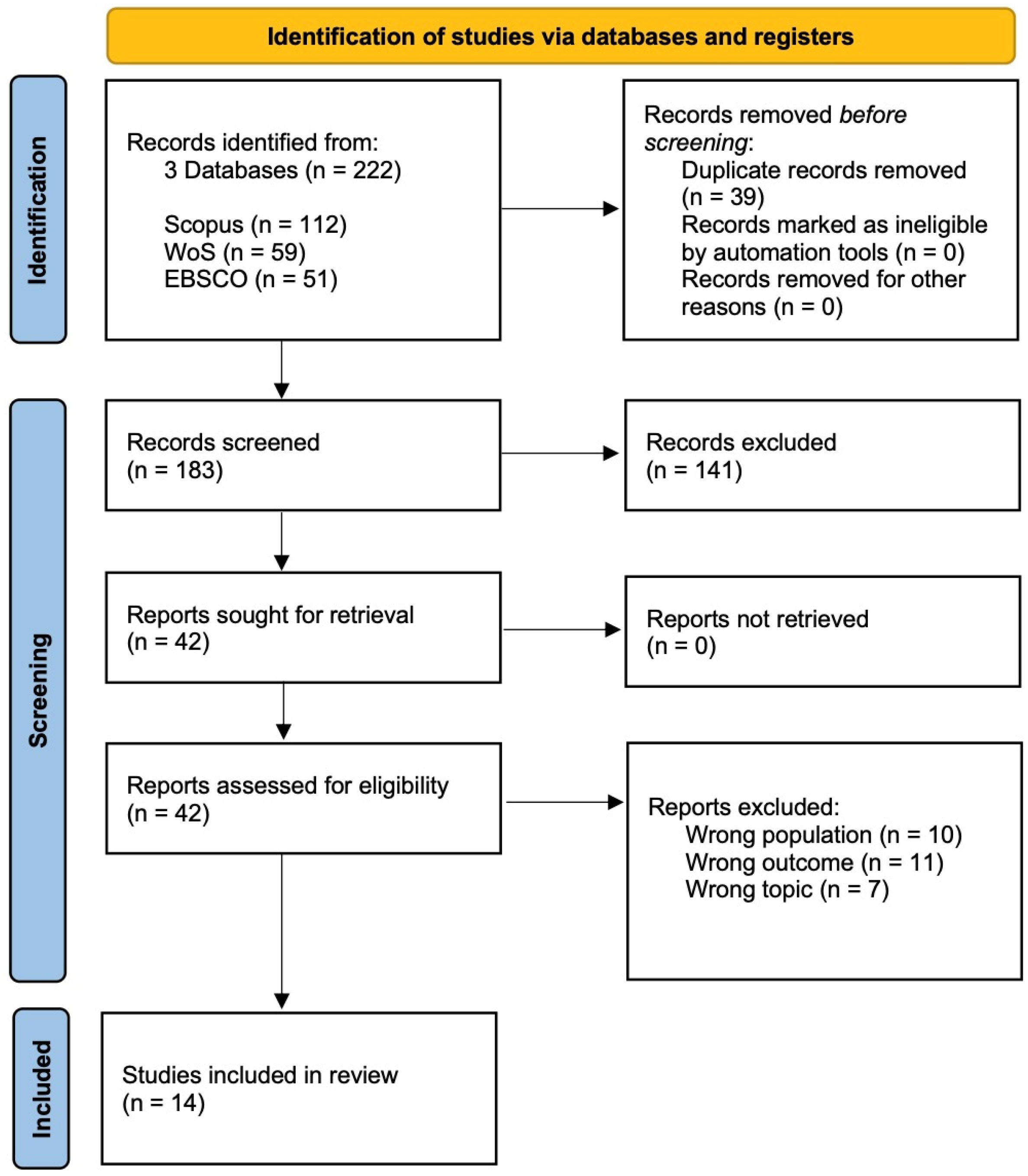
Of the 222 studies initially identified, 74 were duplicates, of which 39 were resolved. The remaining 183 were screened using the Rayyan platform, evaluating titles and abstracts. Subsequently, 42 studies were analysed in full, excluding 28 contributions that did not meet the inclusion criteria (population, topic or outcome). The final articles included were 14, which underwent a qualitative assessment based on criteria of methodological validity, clarity of the intervention and relevance of the educational outcomes (Figure 1).

2.3. Data Analysis and Categorisation

For each study, the author, year, type of design (mainly semi-experimental studies with pre- and post-tests), educational context, sample, visual tool used and main results were extracted and summarised (Table 1).
The data were then organised into four thematic categories that emerged based on semantic and epistemological similarities:
  • Effective learning, motivation and critical thinking;
  • Effectiveness in the humanities;
  • Effectiveness in the sciences;
  • Inclusion and accessibility.
The analysis integrated quantitative data (effects, p-values, eta2, Cohen’s d) and qualitative data (perceptions, classroom observations, feedback) using a descriptive-comparative approach.

3. Results

3.1. Effective Learning, Motivation and Critical Thinking

The research analysed converges in affirming that the visual dimension of teaching is one of the most effective factors in stimulating student motivation and engagement. The study by Dey and Munshi [13], conducted on 84 primary school pupils in West Bengal, shows how the use of flash cards, maps, illustrated books and ICT resources generates a strongly positive attitude towards learning and increases metacognitive skills such as problem solving and critical thinking. The high reliability of the measurement tool (α = 0.829) confirms the robustness of the empirical results.
Similarly, Mahmuti and Arifi [19] document, in a secondary school context, a significant increase in performance in area and perimeter calculation (p = 0.005) and a strengthening of motivation and enjoyment of learning through virtual manipulative tools. Qualitative data also show an increase in collaboration and active participation, indicators of socio-relational and emotional development.
In a complementary direction, Yani’s [24] study on Indonesian high schools investigated the effectiveness of comic strip worksheets applied to teaching disaster risk reduction in geography. On a sample of 103 students, analysis of pre- and post-test data (M_pre = 6.61; M_post = 7.46) using a paired t-test revealed a significant difference between the two means (t (102) = −4.158; p < 0.001), confirming a statistically significant improvement in conceptual knowledge of mitigation and prevention processes. The average N-Gain value (8.87%) classified the improvement as “effective”. Qualitative analyses of the dialogues inserted by students in the comics also highlighted an enhancement of critical and reflective thinking skills, as well as a positive evolution in collaborative attitudes and ethical awareness towards risk management. The use of comic worksheets has therefore proved to be an innovative and motivating tool, capable of integrating cognitive and educational dimensions.
Other studies [23] highlight how immersive technologies—360° videos and augmented reality—increase attention levels (A = 63.17) and produce greater cognitive engagement than traditional formats (t = −2.65; p = 0.019). The visual dimension, expressed through analogue or digital media, educational comics or virtual environments, therefore appears capable of transforming learning from passive to experiential, laying the foundations for reflective, motivated knowledge oriented towards the integral development of the student.

3.2. Effectiveness in the Humanities

Evidence from the humanities confirms that visual representation supports the decoding of linguistic structures and the construction of complex meanings.
The study by Özkara, Altıntaş and Bilişli [21] shows how narrative maps, applied to primary school students, improve the ability to identify the main idea in narrative texts, with a large effect size (η2 = 0.69). The visual organisation of information translates into improved overall comprehension and the ability to structure narratives coherently.
Similarly, Al Ashran, Shalabi and Daradkah [12] highlight the extent to which the integration of images and drawings in art lessons produces significant progress in all indicators of visual literacy (p < 0.05), with positive effects on aesthetic communication and semantic mastery of graphic codes.
In the linguistic context, Dey and Munshi [13] note that visual elements such as comics and illustrations promote not only linguistic comprehension but also second language learning by reducing anxiety and stimulating curiosity, dimensions that fall within the socio-emotional sphere of soft skills.

3.3. Effectiveness in Scientific Disciplines

Studies in science and STEM indicate that visual education can make abstract concepts accessible and promote a deep understanding of phenomena. In addition to the above-mentioned study by Mahmuti and Arifi [19], which investigated meaningful learning of area and perimeter calculation skills, Temaj, Orhani and Canhasi-Kasemi [22] documented an average improvement of 27.89% in understanding the concept of mathematical functions thanks to an approach combining graphs, simulations and practical activities. The statistical effect (Cohen’s d = 0.63) highlights a strong correlation between visualisation and conceptual learning.
Related studies [17] report that the holographic application E Visual MEL VIS, dedicated to teaching 3D shapes, produced an average increase of 36.12% in post-test scores, demonstrating that three-dimensional representation facilitates the transition from concrete to abstract thinking. Mack, Barron and Boys [18] show that the use of visual laboratories for teaching digestion and enzymes increased anatomical understanding of the gastrointestinal tract from an initial 25% to 88.6% (p < 0.001), with high student satisfaction. Consistent results also emerge from the study by Hanim et al. [15], who developed and validated the Visual Tools Screencast SketchUp Make (ViToS-SUM) strategy for learning three-dimensional geometry in the secondary school context. The programme, built according to the ADDIE model and based on the integration of van Hiele’s level of geometric thinking, visuospatial skills and digital modelling tools, produced significant results both in improving students’ visuospatial skills (t = 12.21; p < 0.05) and in increasing their level of geometric thinking (Z = −3.18; p < 0.05). The experts involved judged the content to be highly appropriate (M = 4.51) and pedagogically effective, supporting the inclusion of this approach in mathematics curricula to strengthen understanding of complex spatial concepts and promote active, technology-mediated learning.
Complementarily, research by Zorzos and Avgerinos [25] explored the role of visual representations in solving probability problems in a sample of 346 primary and secondary school students. The progressive introduction of informative images and graphic problems (such as the “wheel of fortune”) showed a differentiated impact on performance: in the presence of descriptive images, blank answers decreased (from 23.7% to 17.7%), while entirely visual representation led to a significant increase in correct answers (42.2%), indicating the extent to which visualisation promotes intuitive understanding of probability relationships. Kruskal–Wallis analysis confirmed significant differences related to student age for all activities (H = 26.227–29.824; p < 0.001), suggesting a gradual development of visual skills and mathematical data interpretation abilities. Overall, the use of visual tools in scientific and mathematical disciplines enhances spatial imagination skills, conceptual mastery and the ability to apply knowledge in experimental contexts, reinforcing the idea that visual perception is a privileged route for cognitive construction and deep understanding of complex phenomena.

3.4. Inclusion and Accessibility

The inclusive perspective is one of the most significant outcomes of the review. Studies by Haifa et al. [14], Maryanti et al. [20] and Hidayat et al. [16] converge in affirming that visual education is a decisive strategy for the learning of students with autism spectrum disorders or sensory disabilities. In the classrooms observed in China, Haifa and colleagues noted an increase in attention, participation and socialisation thanks to the use of videos and role-play activities based on visual and audiovisual models. Students showed greater confidence and interaction with their peers, highlighting how the visual component can reduce communication anxiety and promote emotional inclusion.
Maryanti and colleagues [20] applied experiments supported by educational videos in the context of science teaching to students with special educational needs, recording an average reduction in misconceptions of 19.04%. Hidayat et al. [16] confirm that participation in practical–visual activities increases conceptual understanding of Archimedes’ principle even in the presence of hearing impairments. This evidence suggests that Visual Education, due to its multisensory and analogue–digital nature, is an inclusive tool capable of creating a universal learning environment, consistent with the principles of Universal Design for Learning (UDL).

4. Discussion

The overall results of the review highlight how visual education plays a fundamental role in transforming traditional teaching paradigms. The intentional use of visual languages and tools, in combination with digital technologies, allows for the creation of cognitively stimulating and emotionally sustainable environments. Visual learning, in fact, is a multimodal process in which images, words and actions work together to construct meaning. The convergence of empirical evidence allows us to identify some guiding principles. First, the use of visual representations promotes the deep encoding of information and its retention in long-term memory. This effect is linked to Sweller’s cognitive load theory [26], according to which visual tools reduce extrinsic load and allow attention to be focused on the essential elements of the problem. Secondly, the iconic and dynamic nature of images reinforces intrinsic motivation, stimulating curiosity and epistemic pleasure.
From an epistemological point of view, Visual Education reflects the evolution of knowledge in the digital society, where knowledge is increasingly distributed across different sensory and symbolic channels. In this context, images do not play an accessory role to text, but become an integral part of the cognitive and reflective process.
Analysis of the different contexts also highlights how Visual Education acts on three synergistic dimensions: cognitive, in that it facilitates conceptual understanding and logical thinking; affective, in that it stimulates motivation, self-esteem and curiosity; and social, through its contribution to communication and inclusion.
The pedagogical value of visual tools is therefore twofold: on the one hand, they promote disciplinary acquisition through symbolic mediation; on the other, they enhance soft skills related to cooperation, creativity and emotional management. The research analysed demonstrates the extent to which students develop greater self-assessment skills and an active attitude towards knowledge, in line with the constructivist perspective of meaningful learning.
However, there are still critical issues and challenges in terms of application. Some studies [12,15,24] report that the effectiveness of visual strategies can be influenced by contextual factors, such as teacher training, the availability of technological resources and the cognitive predisposition of students. Furthermore, although many interventions have shown positive results in the short term, the literature still lacks longitudinal analyses that assess the lasting impact of visual practices on learning and personal development.
Further research is therefore needed to define more systematic visual instructional design models that integrate elements of formative assessment, adaptability, and personalised inclusion.

5. Conclusions

The systematic review conducted provides a comprehensive and up-to-date overview of the educational potential of visual education, highlighting how visual tools, in both their analogue and digital forms, represent central rather than merely ancillary aspects of teaching and learning processes. Analysis of the contributions examined indicates that the visual dimension acts as a powerful cognitive, affective and social mediator, capable of supporting the construction of deep and transferable knowledge, while promoting motivation, participation and inclusion. This evidence confirms the importance of considering visual literacy not only as a specific skill, but as a cultural and pedagogical disposition essential for learning in the 21st century.
From a theoretical point of view, Visual Education appears capable of overcoming some traditional epistemological dichotomies—text/image, body/language, theory/practice—promoting teaching methods that are more consistent with the cognitive and perceptual models emerging in the new generations [10]. From this perspective, images and visual representations become vehicles of understanding and tools of thought, capable of broadening the modes of signification and promoting a deeper relationship between the subject, knowledge and the world. The systematic integration of these approaches into curricula and educational practices is not simply a matter of methodological innovation, but rather a paradigmatic redefinition of the very concept of literacy—increasingly multimodal, intermedial and sensorially distributed.
On an operational level, the results of the review suggest some lines of action for educators, teachers and trainers. It is desirable that teaching planning consciously incorporates visual strategies not as ornamental elements, but as cognitive structures that guide thinking and conceptual processing. The use of concept maps, infographics, interactive platforms, visual narratives and digital representation tools can facilitate the understanding of abstract concepts, stimulate creativity and promote collaborative practices. Of particular relevance is the adoption of Universal Design for Learning and Design for All principles, which aim to ensure full accessibility and inclusion for learners with different cognitive, perceptual and linguistic profiles [27].
In teacher training, there is a clear need to integrate Visual Thinking and Visual Literacy skills into professional development courses in order to strengthen the critical ability to read, interpret and produce visual languages in a responsible and intentional manner. The creation of experimental laboratories, research-action spaces and communities of practice can be an effective tool for supporting methodological reflection and the dissemination of practices based on the conscious use of images as epistemic and relational tools.
Finally, the research dimension requires empirical and interdisciplinary investigation aimed at measuring the impact of visual languages on learning, motivation and inclusion in formal and informal educational contexts. It is desirable that future studies explore the link between visuality, ethics and emerging technologies—such as augmented reality, 3D representation or generative artificial intelligence—questioning the potential and risks of an increasingly visual and performative educational ecosystem.
Ultimately, the results of this review indicate that Visual Education represents a strategic frontier for contemporary education, capable of integrating cognitive, emotional and cultural dimensions into a holistic and sustainable learning model. Rethinking teaching through the lens of the visual does not only mean improving the effectiveness of educational processes, but also contributing to the formation of citizens capable of navigating hyper-visual environments consciously, developing critical, ethical and design skills that are indispensable for the cognitive society of the future.

Funding

This research received no external funding.

Institutional Review Board Statement

Not applicable.

Informed Consent Statement

Not applicable.

Data Availability Statement

The data used in this study can be found in the Scopus, Web of Science and EBSCO databases.

Conflicts of Interest

The author declares no conflict of interest.

References

  1. Rivoltella, P.C. Nuovi Alfabeti. Educazione e Culture Nella Società Post-Mediale; Scholé-Morcelliana: Brescia, Italy, 2020; Volume 124, pp. 5–220. [Google Scholar]
  2. Paivio, A. Mental Representations: A Dual Coding Approach; Oxford University Press: Oxford, UK, 1990. [Google Scholar]
  3. Troia, S. Insegnare nel XXI secolo. In Dalla Scuola Alla Cittadinanza Digitale; Pearson: Torino, Italy, 2018. [Google Scholar]
  4. Buckingham, D. The Media Education Manifesto; Polity Press: Cambridge MA, USA, 2019. [Google Scholar]
  5. Zanardo, L. Educare Alle Immagini e ai Media, Manuale per un Uso Consapevole da 0 a 11 Anni; Edizioni Junior: Bergamo, Italy, 2018. [Google Scholar]
  6. Gui, M. Benessere Digitale a Scuola e a Casa. Un Percorso di Educazione ai Media Nella Connessione Permanente; Mondadori: Milano, Italy, 2019. [Google Scholar]
  7. Montani, P. Emozioni Dell’intelligenza. Un Percorso Nel Sensorio Digitale; Meltemi: Milano, Italy, 2020. [Google Scholar]
  8. MIUR. Indicazioni Nazionali per il Curricolo Della Scuola Dell’infanzia e del Primo Ciclo, D’istruzione, in Annali Della Pubblica Istruzione—Numero Animale, a LXXXVIII. 2012. Available online: http://www.indicazioninazionali.it/wp-content/uploads/2018/08/Indicazioni Annali Definitivo.pdf (accessed on 15 September 2025).
  9. Montani, P.; Cecchi, D.; Feyles, M. Ambienti Mediali; Meltemi: Milano, Italy, 2018. [Google Scholar]
  10. Rivoltella, P.C.; Rossi, P.G. Il Corpo e la Macchina. Tecnologia, Cultura, Educazione; Scholé-Morcelliana: Brescia, Italy, 2019; pp. 5–185. [Google Scholar]
  11. Page, M.J.; McKenzie, J.E.; Bossuyt, P.M.; Boutron, I.; Hoffmann, T.C.; Mulrow, C.D.; Shamseer, L.; Tetzlaff, J.M.; Akl, E.A.; Brennan, S.E.; et al. The PRISMA 2020 statement: An updated guideline for reporting systematic reviews. BMJ 2021, 372, n71. [Google Scholar] [CrossRef] [PubMed]
  12. Al Ashran, H.S.; Shalabi, I.A.; Daradkah, A.M. The Effect of Pictures and Drawings on Developing Visual literacy in Art Education Among Fifth Grade Students in Jordan. Pak. J. Life Soc. Sci. 2024, 22, 7611–7625. [Google Scholar] [CrossRef]
  13. Dey, A.; Munshi, S.A. Fun with images: An analysis of the role of visual literacy in facilitating easy and enjoyable learning with a focus on future prospects. Libri 2025, 75, 109–127. [Google Scholar] [CrossRef]
  14. Haifa, L.; Grigoryan, G.; Karapetyan, L.; Huichun, N. Autism Spectrum Disorder: Developing ESL proficiency via visual teaching tools in International schools of China. Arab. World Engl. J. (AWEJ) 2023, 14, 252–268. [Google Scholar] [CrossRef]
  15. Hanim, Y.F.; Wasilatul, M.; Suparman, S. Experts and designated users evaluations on visual tools screencast SketchUp Make (ViToS-SUM). Perspect. Sci. Educ. 2021, 54, 460–472. [Google Scholar] [CrossRef]
  16. Hidayat, D.S.; Rahmat, C.; Fattah, N.; Rochyadi, E.; Nandiyanto, A.; Maryanti, R. Understanding Archimedes law: What the best teaching strategies for vocational high school students with hearing impairment. J. Tech. Educ. Train. 2020, 12, 229–237. [Google Scholar] [CrossRef]
  17. Khoo, S.T.; Zaman, H.B.; Mohamad, U.H.; Ahmad, A. Evaluation of the Visual Learning Application for Mathematics using Holography Display for the topic on Shape and Space. JOIV Int. J. Inform. Vis. 2023, 7, 249–257. [Google Scholar] [CrossRef]
  18. Mack, S.; Barron, S.L.; Boys, A.J. Digesting digestion: An educational laboratory to teach students about enzymes and the gastrointestinal tract. J. Chem. Educ. 2023, 100, 907–913. [Google Scholar] [CrossRef] [PubMed]
  19. Mahmuti, A.; Arifi, A. Integration of Virtual Manipulatives for Teaching and Learning Perimeter and Area in Lower Secondary Education. Innovaciencia 2025, 13, 1. [Google Scholar] [CrossRef]
  20. Maryanti, R.; Hufad, A.; Sunardi, S.; Nandiyanto, A.B.D. Teaching high school students with/without special needs and their misconception on corrosion. J. Eng. Sci. Technol. 2022, 17, 225–238. [Google Scholar]
  21. Özkara, Y.; Altıntaş, T.; Bilişli, Y. The Role of Story Maps in Improving Primary School Students’ Skills in Determining the Main Idea in Narrative Texts. Int. Electron. J. Elem. Educ. 2025, 17, 579–591. [Google Scholar] [CrossRef]
  22. Temaj, I.; Orhani, S.; Canhasi-Kasemi, E. Enhancing the Understanding of the Concept of Function through Integrated Visual and Experiential Approaches. J. Hum. Res. Rehabil. 2025, 15, 170–181. [Google Scholar] [CrossRef]
  23. Veber, M.; Pesek, I.; Aberšek, B. Assessment of supporting visual learning technologies in the immersive VET cyber-physical learning model. Educ. Sci. 2023, 13, 608. [Google Scholar] [CrossRef]
  24. Yani, A. Comic worksheets for integrated disaster risk reduction learning in the subject of Geography. Jàmbá J. Disaster Risk Stud. 2021, 13, 1149. [Google Scholar]
  25. Zorzos, M.; Avgerinos, E. Research on visualization in probability problem solving. Eurasia J. Math. Sci. Technol. Educ. 2023, 19, em2247. [Google Scholar] [CrossRef] [PubMed]
  26. Sweller, J. Cognitive load theory. In Psychology of Learning and Motivation; Academic Press: Cambridge, MA, USA, 2011; Volume 55, pp. 37–76. [Google Scholar]
  27. Hall, T.E.; Meyer, A.; Rose, D.H. (Eds.) Universal Design for Learning in the Classroom: Practical Applications; Guilford Press: New York, NY, USA, 2012. [Google Scholar]
Figure 1. PRISMA flowchart showing the article selection process.
Proceedings 139 00006 g001
Table 1. Articles included in the review.
AuthorsType of StudySampleDigital/Visual ToolDeveloped DimensionResults
Al Ashran et al. [12]Quasi-experimental60 fifth-grade students (30 EG, 30 CG)—JordanImages and drawingsVisual literacyThe experimental group achieved significantly higher results than the control group (ANCOVA F = 39.44, p < 0.05; η2 = 0.409). Increases in visual thinking (F = 19.26, p < 0.05, η2 = 0.259), visual learning (F = 40.05, p < 0.05, η2 = 0.421), and visual communication (F = 30.96, p < 0.05, η2 = 0.360). Improved motivation and participation.
Dey & Munshi [13]Quantitative survey with structured questionnaire84 primary school students (India)Flash cards, maps, illustrated books, ICT appsMotivational and metacognitiveVisual tools enhanced motivation, curiosity, and attention, improving problem-solving and critical thinking; high reliability (α = 0.829). Particularly effective in language learning, reducing anxiety and providing emotional support.
Haifa et al. [14]Qualitative study10 teachers and 10 students with ASD (international schools, China)Educational and multimedia videosInclusion and engagementAudiovisual materials enhanced attention, participation, and social interaction. Role-play and imitation reinforced vocabulary, memory, and communicative confidence, reducing isolation behaviours.
Hanim et al. [15]Quantitative pre-post with expert evaluation12 students and 3 experts (secondary school, Malaysia)Screencast SketchUp Make (ViToS-SUM)Geometric and visuospatial thinkingSignificant improvements in visuospatial skills (t = 12.21; p < 0.05) and van Hiele geometric thinking levels (Z = −3.18; p < 0.05). Confirmed pedagogical validity and alignment with math content.
Hidayat et al. [16]Single-subject experimental design (pre-post)3 students with hearing disabilities (vocational secondary school, Indonesia)Visual media and practical demonstrationsScientific learning and inclusionPractical experiences and visual demonstrations improved understanding of Archimedes’ principle and active participation (post-test 49–69%). Increased motivation and collaboration; confirmed inclusive effectiveness.
Khoo et al. [17]Semi-experimental case study80 primary school students + 10 experts (Malaysia)Holographic application E-Visual MEL-VISMathematical skills (space and form)Overall improvement of 36.12% (p < 0.05) between pre- and post-test, with up to +44% in 3D features. High perceived usability (M = 4.17) and expert rating = 4.48. Demonstrated educational and interactive effectiveness.
Mack et al. [18]Semi-experimental (pre-post)40 secondary school students (United Kingdom)Visual labs and anatomical modelsConceptual understanding (anatomy, digestion, enzymes)Anatomical understanding increased from 25% to 88.6% (p < 0.001). Improved knowledge of digestion (p = 0.032) and enzymes (p = 0.047). High satisfaction (>79%) and perceived learning effectiveness.
Mahmuti & Arifi [19]Mixed quasi-experimental32 s-grade middle school students (Kosovo)Virtual manipulativesCognitive, motivational, and socio-relational in mathematicsSignificant improvement in area and perimeter tasks (p = 0.005). Increased motivation, collaboration, enjoyment, and active participation.
Maryanti et al. [20]Demonstrative-experimental (pre-post)28 students (14 with SEN; 6 with hearing impairment, 8 with intellectual disabilities)Educational videosInclusive scientific learningAverage improvement from 17.30/74.28 to 78.56/98.57 (above threshold 75). Misconceptions reduced by −19.04%; greater conceptual clarity and participation, even among SEN students.
Özkara et al. [21]Quasi-experimental (matched groups, pre-post)80 primary school pupils (Antalya, Turkey)Narrative maps (story maps)Reading comprehensionSignificant difference between groups (t(78) = 13.142; p < 0.001; η2 = 0.69). Experimental group (M = 41.67) > control (M = 32.20). Story maps strengthen text comprehension and narrative thinking.
Temaj et al. [22]Quasi-experimental mixed analysis120 students (Kosovo; 60 EG/60 CG)Graphs, diagrams, experiential activitiesMathematical thinking and functional understandingAverage increase of 27.89% (t = 5.17; p < 0.001; d = 0.63). High correlation between visual tools and satisfaction (r = 0.98). Enhanced confidence, collaboration, and learning motivation.
Veber et al. [23]Semi-experimental research30 students (aged 17–19; 15 EG/15 CG)360° videos, augmented reality, traditional videosAttentive, motivational, cognitive360° videos generated higher attention (A = 63.17) than standard videos (A = 56.22) and AR apps (A = 53.04). Significant difference vs. traditional video (t = −2.65; p = 0.019). Immersive learning was more engaging.
Yani (2021) [24]Semi-experimental (pre-post)103 high school students (Indonesia)Comic worksheets (educational comics)Cognitive, affective, and value-basedSignificant difference between pre- and post-test (t(102) = −4.158; p < 0.001); N-Gain = 8.87%. Increased critical thinking, collaboration, ethical awareness, and value engagement.
Zorzos & Avgerinos [25]Quantitative experimental study346 elementary students (Greece; grades IV–VI)Images and visual probability problemsMathematical and visuoperceptual reasoningUse of images increased correct responses to 42.2%. Significant differences by age (H = 26–29; p < 0.001). Visual representations improved interpretation and probabilistic intuition. Progressive cognitive maturity observed in image-based reasoning.
Disclaimer/Publisher’s Note: The statements, opinions and data contained in all publications are solely those of the individual author(s) and contributor(s) and not of MDPI and/or the editor(s). MDPI and/or the editor(s) disclaim responsibility for any injury to people or property resulting from any ideas, methods, instructions or products referred to in the content.