1. Introduction
In recent years, pedagogical thinking has progressively recognised the heuristic and educational value of visual methods and iconic artefacts [
1]. Within an epistemological and methodological framework, these tools highlight the multimodal dimension of knowledge and the plurality of languages that characterise contemporary educational processes. Despite the interest in the literature towards the use of visual methods and iconic artefacts in empirical research [
2,
3], their systematic use in university-level teacher education remains limited [
4].
2. Theoretical Framework
Visual education, understood as an approach that integrates images, symbols and multimedia narratives, is part of a multimodal learning paradigm. This perspective, in line with the principles of learning by doing and active learning [
5,
6], frames teaching as a reflective and participatory process, in which visual experience and storytelling become tools for the co-construction of knowledge. Recent literature [
7,
8] also emphasises how gamification and digital storytelling enhance student engagement, motivation, and participation, fostering experiential and inclusive learning. Play has always aroused the interest of scholars from different fields of study, attracting the attention of anthropologists [
9], sociologists [
10], psychologists [
11,
12], pedagogues, and philosophers both in terms of its social and cognitive function and in terms of the surprising generative motivational drive it gives learners [
7]. Theoretical and practical research, at national and international level, has been enriched by numerous contributions to the application of the playful dimension in the field of education, which increasingly refer to play-centred learning models [
13,
14].
3. Methodology
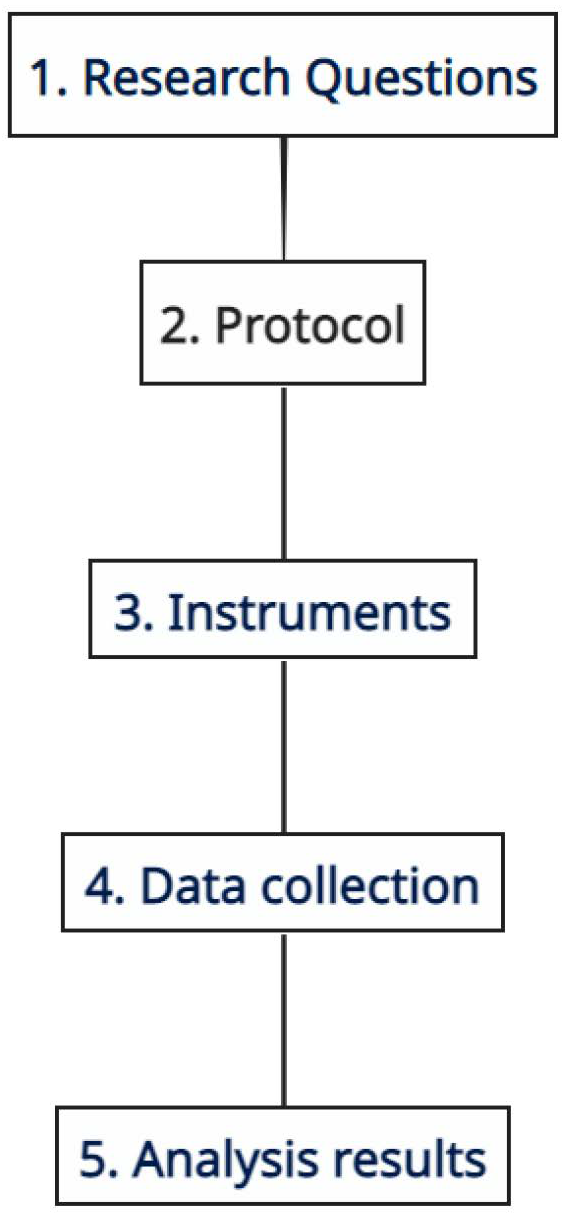
This contribution explores the role and potential of visual education as a tool in teaching–learning processes to promote inclusive training courses and innovative skills. The collaborative research was conducted according to a phenomenological self-study methodological protocol (
Figure 1).
It was conducted at an ICT laboratory at the University of Bari A. Moro, aimed at students on the specialisation course for support in the nursery school segment. To make the research design more explicit, the study was structured as a pre–post exploratory study aimed at identifying possible changes in participants’ perceptions and self-reported competences following the training intervention.
The research was developed based on a number of key questions:
How can the integration of visual digital tools affect the motivation and engagement of university students in support training? Is it possible to outline a training model that integrates these tools to support reflective, participatory and inclusion-oriented teaching?
The survey was divided into three main phases:
Ø Design and implementation of an ICT (Information and Communication Technology) workshop aimed at students enrolled in the specialisation course for support.
Ø Experimentation with digital tools geared towards visual education, digital storytelling and gamification [
4], through activities that involved the use of applications such as Book Creator and Vocaroo for the creation of multimedia narratives, and LearningApps and Panquiz for the design of educational games (visual quizzes, associations, memory and narrative sequences).
Ø Data collection and analysis, through the administration of an initial and final questionnaire with multiple-choice questions. The Computer Assisted Web Interviewing (CAWI) questionnaires, constructed using Google Forms consisting of 14 close-ended questions, complied with ethics and privacy regulations: Compliance with EU Regulation 679/2016, Legislative Decree 196/2003 and 101/2018. In addition, students were asked for their consent for the collection and anonymous use of research data.
Context, Participants
The survey targeted a sample of students enrolled in the specialisation course for support in the nursery school segment attending the ICT laboratory. The sample consisted of 70 students aged between 30 and 60. The student population involved was almost entirely female, aged between 30 and 60 (average); 65 students with secondary school qualifications (teaching diploma for access to teaching in nursery schools) and 5 students with degrees in Primary Education Sciences. The questionnaire consisted of 14 close-ended questions and was built around three analytical dimensions derived from the theoretical framework: (1) digital competences, (2) motivation and engagement in the use of educational technologies, and (3) pedagogical awareness regarding the use of visual and narrative tools in designing inclusive activities.
4. Results
The
Table 1 shows the data from the answers to the questions on which this study focuses. Data analysis was performed using descriptive statistical procedures, specifically frequency counts and percentages. The comparison between pre-intervention and post-intervention responses allowed for the identification of trends and changes in participants’ perceptions and self-reported competences
The results of the analysis conducted on the questions administered before the workshop are reported below.
In terms of digital competence, the data show that most participants are at an intermediate level (71%, or 50 students), followed by a group of beginners (21%, or 15 students) and a minority who claim to be at an advanced level (7%, or 5 students). No participant indicated an expert level, suggesting a need to strengthen more complex and reflective digital skills. Regarding initial perceptions of ICT training, 60% of participants expressed positive expectations, while a further 10% said they were confident about the effectiveness of the training programme. No respondents expressed doubts or mistrust, a sign of a favourable attitude towards learning and an overall positive perception of the educational potential of technology. The section dedicated to knowledge of specific digital applications reveals a varied picture: the Book Creator app is known “fairly well” by 60 students and “poorly” by 10; the Vocaroo app is known “fairly well” by 5 students, “poorly” by 50 and “not at all” by 10; the LearningApps app is known “fairly well” by 5 students, “a little” by 50 and “not at all” by 15;s and the PanQuiz app is indicated as known “fairly well” by 15 students, “a little” by 50 and “not at all” by 5. Overall, the data outline a predominantly intermediate level of competence, accompanied by positive attitudes towards digital training, but also by uneven knowledge of the operational tools. This suggests the need for targeted training interventions aimed at promoting a more conscious, creative and pedagogically oriented use of digital technologies in teaching practice.
The
Table 2 below shows the results after the workshop intervention.
The analysis of data relating to perceptions of the training programme paints an overall positive picture, consistent with the objectives of the course. With regard to the clarity of the training objectives, almost all participants expressed fully favourable assessments: 60 students (86%) considered them very clear, while 10 students (14%) considered them fairly clear. No one reported difficulties in understanding or perceptions of uncertainty. With regard to the duration of the course and the workload, 50 students (71%) considered them entirely adequate and 15 (21%) fairly adequate; only 5 students (7%) perceived the course as a little too demanding, and no one as definitely excessive. With regard to the effectiveness of the visual materials used to support learning, the responses indicate a high level of satisfaction: 60 students (86%) said that these materials helped them greatly in understanding the topics, and 10 (14%) considered them quite useful. Similarly, the digital applications presented in the course were rated as very interesting by 60 students (86%) and quite interesting by 9 (13%), while only 1 participant (1%) expressed limited interest. The recreational activities proposed showed strong potential for engagement: 60 students (86%) found them very engaging, 9 (13%) found them quite engaging and 1 (1%) found them not very engaging. With regard to the perceived improvement in digital skills, 60 course participants (86%) believe they have significantly improved their skills, while 10 (14%) report a partial improvement; no one stated that they had not benefited from the training. When asked about their intention to use what they had learned in their teaching practice, 50 participants (71%) answered yes, definitely and 20 (29%) answered yes, partly. No one showed resistance or lack of interest in applying the skills acquired. Finally, the data on overall satisfaction show a high level of appreciation: 60 participants (86%) said they were very satisfied and 10 (14%) were fairly satisfied. No negative responses were recorded. Overall, the results suggest a high degree of satisfaction and active participation, with general recognition of the clarity, consistency and usefulness of the training course, as well as the pedagogical value of the methodologies adopted, in particular those based on play and the conscious use of digital technologies.
5. Discussion
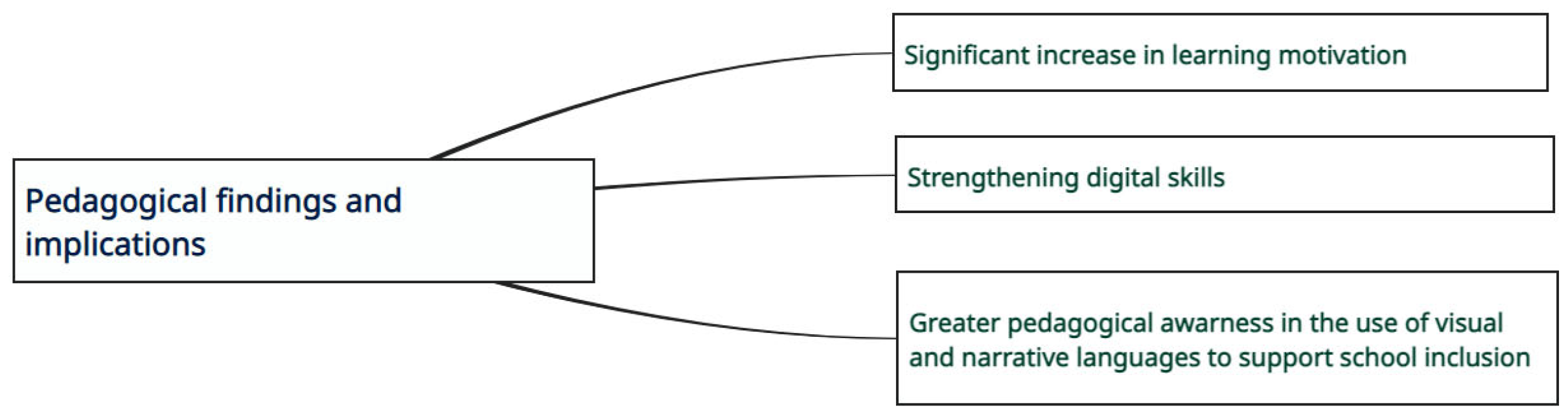
Analysis of the questionnaires revealed a significant increase in student motivation and engagement. The integration of visual tools and multimedia narratives fostered reflection on educational practices and the development of transversal skills, particularly digital and communication skills. Students also demonstrated a greater ability to design inclusive activities and improved critical and reflective use of technology. As shown in
Figure 2, these results translate into increased learning motivation, strengthened digital skills, and greater pedagogical awareness in the use of visual and narrative languages to support inclusive teaching. Although the study was conducted in a specific university context, the laboratory model described may represent an approach transferable to similar programs, particularly those focused on inclusive teaching and the pedagogical integration of digital technologies.
6. Conclusions
The survey revealed a significant increase in students’ motivation to learn, a strengthening of digital and communication skills, and greater pedagogical awareness in the use of visual and narrative languages to support school inclusion. However, some limitations should be acknowledged: the study relies mainly on self-reported data and a limited sample within a specific university training context. Additionally, the exploratory nature of the research and the absence of inferential statistical analyses limit the generalisability of the results. Future research could expand the sample and integrate methodological triangulation, for example through classroom observations or analysis of student-produced learning artefacts. The training model that emerges from the study highlights the validity of a teaching approach that integrates visual education, storytelling, and play as levers to promote active, experiential, reflective, and inclusive learning, consistent with the learning by doing paradigm [
5,
7], and highlights the potential of this model to support the development of inclusive, creative educational figures who are adaptable to the constant changes in professional contexts [
1,
8]. As illustrated in
Figure 3, the training model is based on gamification and storytelling.
Author Contributions
Conceptualization, I.A. and V.A.; methodology, I.A. and V.A.; software, I.A. and V.A.; validation, I.A. and V.A.; formal analysis, I.A. and V.A.; investigation, I.A. and V.A.; resources, I.A. and V.A.; data curation, I.A. and V.A.; writing—original draft preparation, I.A. and V.A.; writing—review and editing, I.A. and V.A.; visualization, I.A. and V.A.; supervision, I.A. and V.A.; I.A. and V.A. All authors have read and agreed to the published version of the manuscript.
Funding
This research received no external funding.
Institutional Review Board Statement
Ethical review and approval were waived for this study as it involved a non-clinical educational research design and the analysis of anonymized data.
Informed Consent Statement
Informed consent was waived for this study as it involved anonymized data and a non-clinical educational research design.
Data Availability Statement
The raw data supporting the conclusions of this article will be made available by the authors on request.
Conflicts of Interest
The authors declare no conflict of interest.
References
- Perla, L.; Vinci, V. Didattica, Riconoscimento Professionale e Innovazione in Università; Francoangeli: Milano, Italy, 2022. (In Italian) [Google Scholar]
- Sartori, R.; Gatti, M. Game-Based Learning: Il Ruolo del Gioco Nella Progettazione di Percorsi Formativi; Led: Milano, Italy, 2013. (In Italian) [Google Scholar]
- Walkington, H.; Griffin, A.L.; Keys-Mathews, L.; Metoyer, S.K.; Miller, W.E.; Baker, R.; France, D. Embedding Research-Based Learning Early in the Undergraduate Geography Curriculum. J. Geogr. High. Educ. 2011, 35, 315–330. [Google Scholar] [CrossRef]
- Occhini, L.; Bosco, N. Students as Visual Thinkers: Didattica e Apprendimento Image-Based in Higher Education. In Transformative Teaching in Higher Education; Fabbri, L., Romano, A., Eds.; Pensa Multimedia: Lecce, Italy, 2023; pp. 215–229. [Google Scholar]
- Perla, L. Didattica e Pratiche Dell’active Learning. In Apprendere a Insegnare; Crescenza, G., Volpicella, A., Eds.; Edizioni Conoscenza: Roma, Italy, 2020. [Google Scholar]
- Perla, L. DocumentAZIONE = ProfessionalizzAZIONE? Scritture per la co-formazione in servizio degli insegnanti. In La Professionalità Degli Insegnanti. La Ricerca e le Pratiche; PensaMultimedia: Lecce, Italy, 2017; pp. 69–88. (In Italian) [Google Scholar]
- Gabbi, E.; Gaggioli, C.; Ranieri, M. Active Learning and Academic Teaching: A Gamification Experience Between Game and Inclusion. J. Educ. Technol. Soc. Stud. 2023, 25, 160–176. [Google Scholar]
- Watt, S.; Wakefield, C. Teaching Visual Methods in the Social Sciences; Routledge: London, UK, 2017. [Google Scholar]
- Huizinga, J. Homo Ludens: A Study of the Play-Element in Culture; Routledge: London, UK, 1938. [Google Scholar]
- Caillis, R. I Giochi e Gli Uomini; Bompiani: Milano, Italy, 1967. (In Italian) [Google Scholar]
- Piaget, J. De la Logique de L’enfant à la Logique de L’adolescent; Puf: Paris, France, 1955. (In French) [Google Scholar]
- Wiggins, B.E. An Overview and Study on the Use of Games, Simulations, and Gamification in Higher Education. Int. J. Game-Based Learn. 2016, 6, 18–29. [Google Scholar] [CrossRef]
- Frison, D.; Menichetti, L. Metodi Ludici. Tendenze e Didattiche Innovative 0-11; Pensa Multimedia: Lecce, Italy, 2020. (In Italian) [Google Scholar]
- Winnicott, D.W. Playing and Reality; Routledge: London, UK, 1991. [Google Scholar]
| Disclaimer/Publisher’s Note: The statements, opinions and data contained in all publications are solely those of the individual author(s) and contributor(s) and not of MDPI and/or the editor(s). MDPI and/or the editor(s) disclaim responsibility for any injury to people or property resulting from any ideas, methods, instructions or products referred to in the content. |