1. Introduction
The TEAPOTS project (
https://www.teapots-project.eu/, accessed on 7 April 2025) overall aim is to meet farmers’ energy demands through the valorization of agricultural waste. The TEAPOTS Integrated Solution (TIS) technology will be able to produce renewable energy through an integrated and flexible trigeneration system to obtain heating, cooling and electricity. Furthermore, through the production of plant biostimulant products (compost and/or biochar), soil and biodiversity will also be improved. In the framework of TEAPOTS, along with the development of the TIS technology, surveys were carried out at the beginning of the project to determine the end-users’ (i.e., farmers as providers of the TIS feedstock) needs and to support the initial development of the technology.
2. Methods
To attain this target, surveys were carried out (from May to July 2024) in three European countries: Germany, Greece, and Italy. The survey questionnaire was designed by AUA with contributions from all partners. The questionnaire was based on previous versions developed and used by AUA in the projects INNOSETA and AgroFossilFree [
1,
2,
3]. The rationale is that the technology under development in the TEAPOTS project (TIS), as in the cases of INNOSETA and AgroFossilFree projects, is considered as an innovation; therefore, the main theories concerning the generation, adoption, and diffusion of technological innovations and best practices are the same. Furthermore, given the topic (waste management) of the questionnaire was adapted accordingly through a literature review [
4,
5,
6,
7,
8,
9,
10,
11,
12,
13,
14]. This endeavor (surveys) is exploratory, i.e., it is conducted to gain a deeper understanding of the topic (or problem) at hand, about which little is known, and to provide insights. Exploratory research is commonly used in various fields, including social sciences, market research, and product development, where understanding consumer behavior, attitudes, or social phenomena is essential [
15,
16].
The questionnaire comprises the following main sections: general farm information; current wastes and waste management; farmers’ willingness to participate in the TIS network; attitudes (waste management); trust; renewable energy; innovation support; innovativeness; pro-environmental attitudes; and general farmer information.
Given the technology’s main feedstock (a mix of poultry manure, food and agricultural waste, and lignocellulosic biomass), the target farms included those engaged in arboriculture, viticulture, poultry, and forestry, with on-farm processing units being an additional source. Efforts were also undertaken to include as many farmers members of cooperatives as possible due to the network character of the technology, as well as to interview small, medium, and big (farm size) farms. Overall, 190 farmer questionnaires were collected.
Data were collected by partners using the survey questionnaire (Google Forms) built by AUA; thus, data were automatically entered in an Excel database and transferred to and analyzed by AUA using SPSS.v23.
3. Results and Discussion
The interviewees’ characteristics are diversified owing to each country’s specific characteristics, especially the socio-cultural and economic peculiarities related to agriculture (agro-ecological and production systems).
Regarding crop waste (e.g., prunings, fruits, and various residues), seasonality differs between countries, following the production cycles of crops in each country. Animal waste (poultry manure) is available all year round, while processing waste (from wineries and olive mills) is mainly generated during the period from September to November.
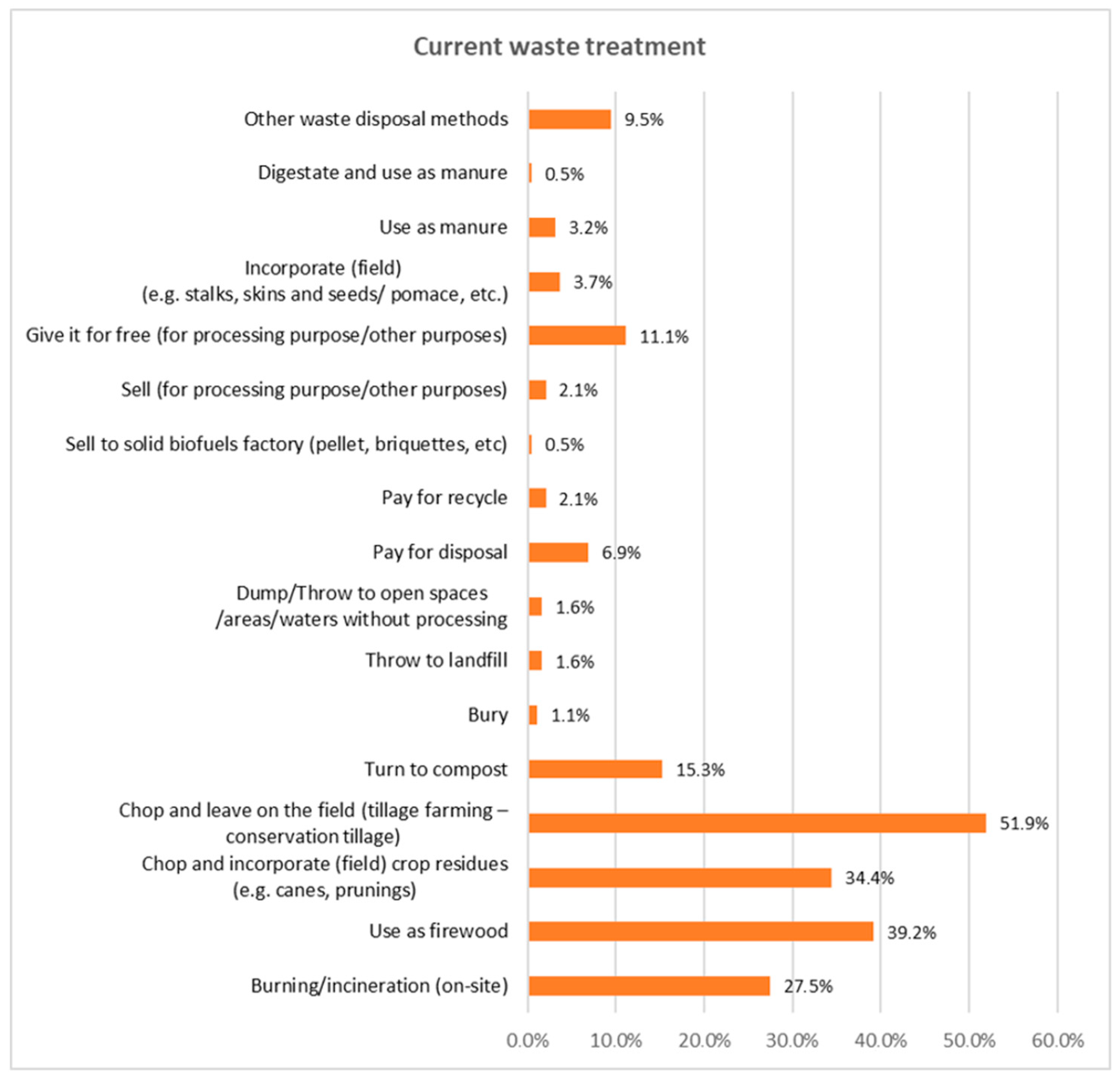
Regarding waste management, most farmers (51.9%) chop and leave it on the farm; 39.2% use it as firewood and 34.4% chop it and incorporate it. Lower percentages burn waste on-site (27.5%), turn it into compost (15.3%), or give it away for free (e.g., for processing or other purposes) to dispose of it (11.1%). Other ways referred to by the interviewees are leaving fruits in the field (n = 13) and paying someone to transfer waste to a biogas station (n = 2). The ways farmers treat waste differ, as seen in
Figure 1.
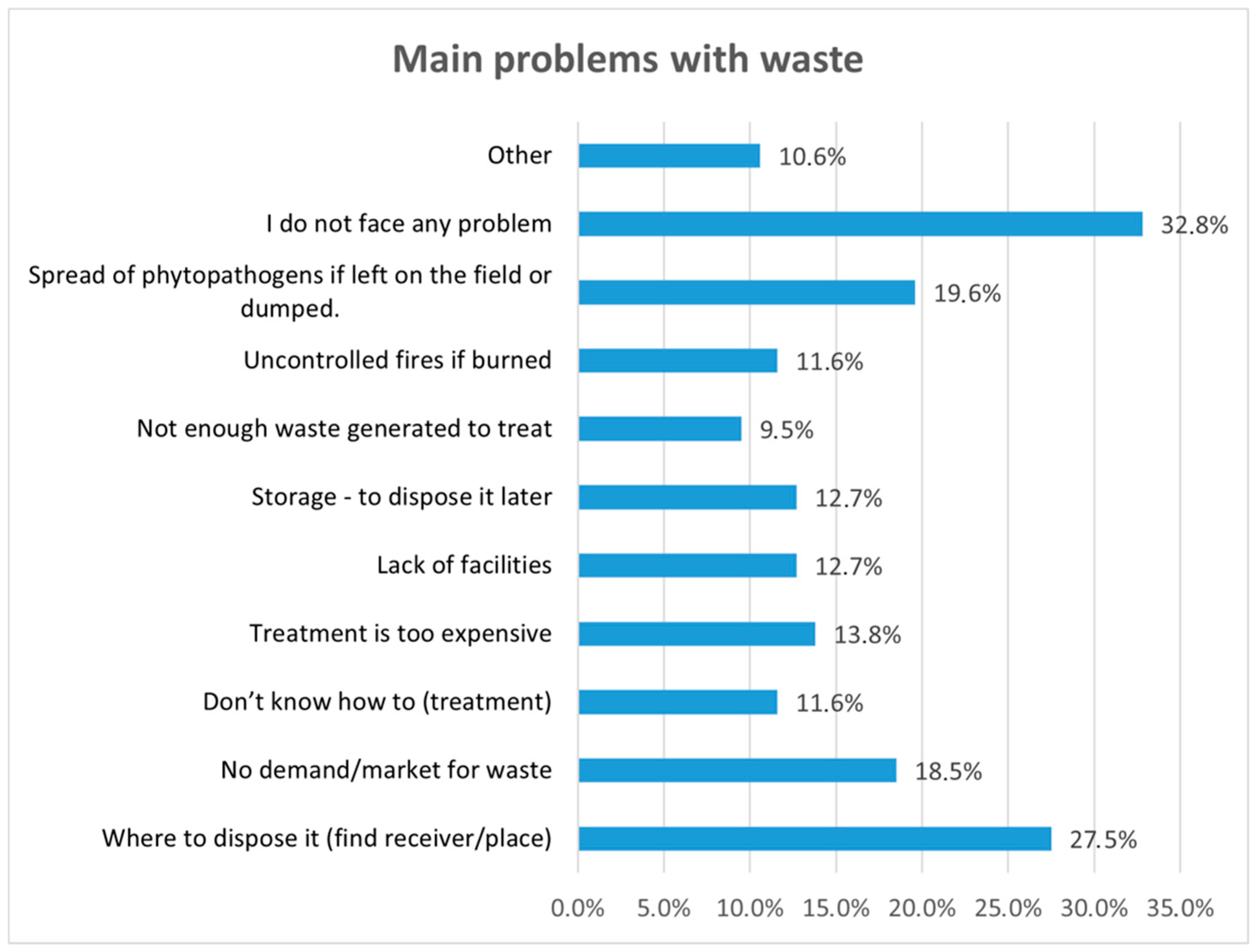
With reference to the problems the interviewees face with waste, 32.8% said they do not face any problems, with an additional 9.5% stating that the farm does not generate enough waste to treat. As far as the main problems are concerned (
Figure 2), the major ones are finding a place or someone (receiver) to dispose of it (27.5%) and the lack of demand/market (18.5%). Other difficulties concern the fact that treatment is considered too expensive (13.8%), farms lack relevant (treatment/processing) facilities (12.7%) and/or storage space to dispose of waste later (12.7%), and a lack of knowledge on how to treat waste (11.6%).
Farmers’ Willingness to Provide Their Waste to TIS Owners
The idea of TIS is positively received; seven out of ten farmers expressed their interest in providing their waste to TIS technology owners. Farmers’ interest differs by country as well as by farm size (big farms are more favorable, followed by small ones, with medium-sized farms being the least favorable; p < 0.01). Additionally, more educated farmers (p = 0.01) as well as those satisfied with farming (p = 0.000) are more favorable. Furthermore, the most and least experienced ones are more favorable than those with ‘medium’ (16–25 years) experience (p = 0.000), along with those without a successor (p < 0.05) and those who use compost (p < 0.005). On the other hand, those interested in giving their waste to a prosumer show favorable attitudes regarding waste management (all six ‘general’ items/statements) and the environment (seven out of ten items of pro-environmental attitudes)
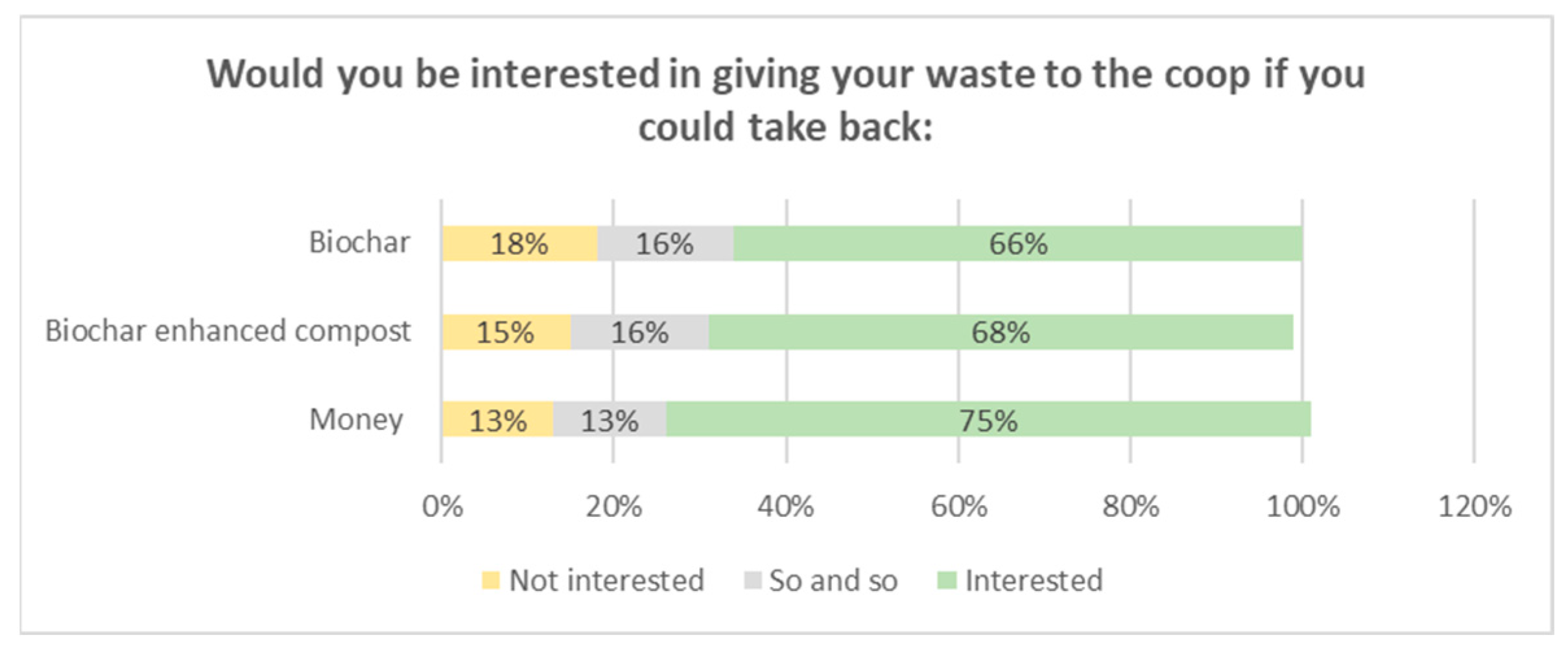
The benefits of giving their waste to a TIS owner are considered equally important by the interviewees (
Figure 3); nevertheless, receiving money for their waste is slightly preferred in comparison to receiving compost and/or biochar (75%, 68%, and 66%, respectively). Regarding the most important reason/incentive for receiving biochar/compost, 36.8% stated that they are mostly interested in selling it (for profit); for 27.2%, treating/managing (removing) their waste (vs. costs and/or risks), and for another 16.2%, improving their soil health are the most important factors.
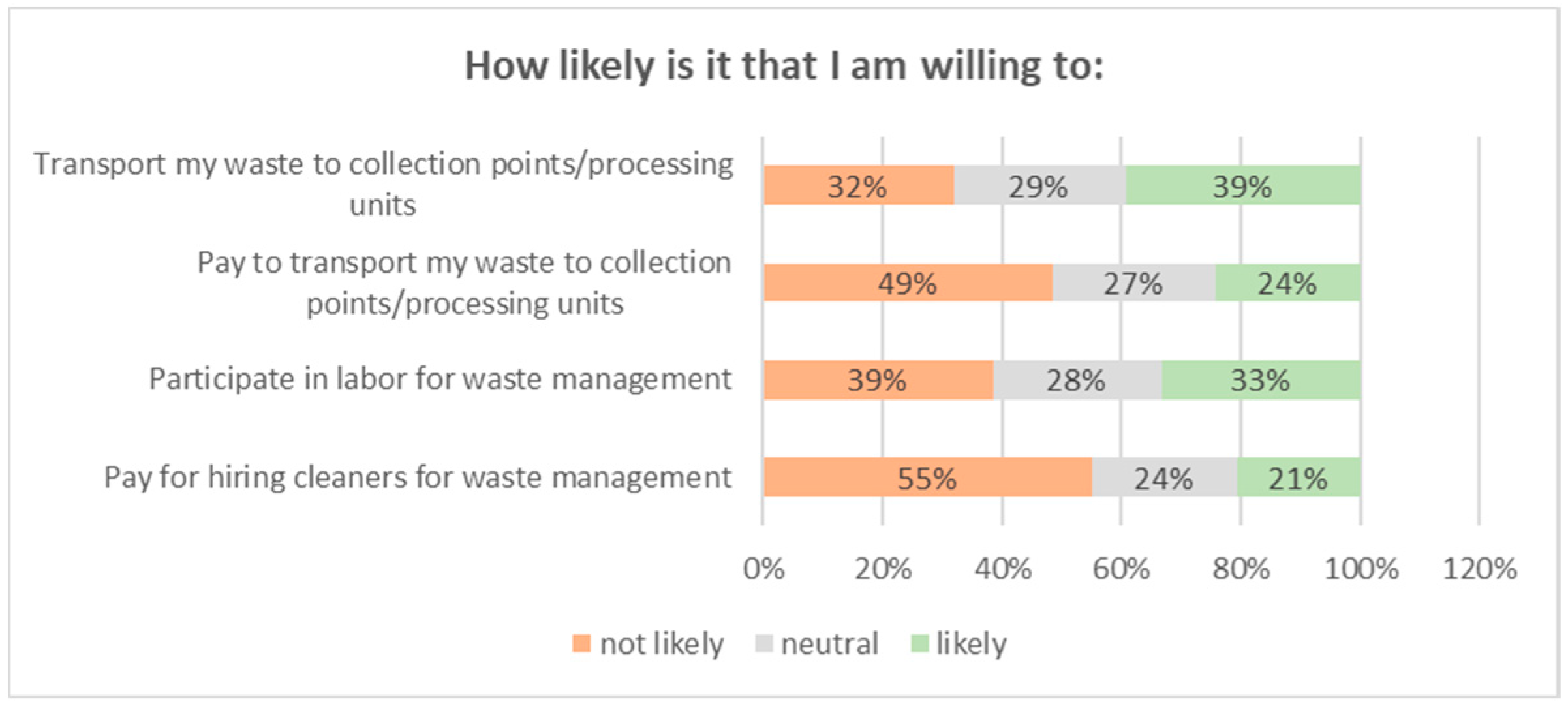
On the other hand, the logistics of waste collection and transfer seem to be a major problem (
Figure 4). Concerning their willingness to transport waste to collection points/processing units, 39% said that they would do so (likely/very likely); 24% are favorable towards paying to transport waste to collection points/processing units. Regarding the option to participate in labor for waste management, 33% of the respondents are positive, while only 21% are positive regarding the option to pay for hiring cleaners.
4. Conclusions
Current practices concerning waste treatment leave room for the utilization of waste through the TEAPOTS Integrated Solution (TIS) technology proposed by the project. This is also supported by the interviewees’ agreement that waste disposal is a serious environmental problem, as well as by their generally positive ‘general’ attitudes towards waste management. Nevertheless, attention should be paid to the logistics of waste collection and transfer, as well as to strengthening pro-environmental attitudes regarding the use of biostimulants to improve soil health (vs. monetary rewards).
Author Contributions
Conceptualization, A.K.; methodology, A.K. and V.K.; formal analysis, A.K.; Data curation, A.K.; writing—original draft preparation, A.K.; writing—review and editing, A.K. and V.K.; funding acquisition, A.K. All authors have read and agreed to the published version of the manuscript.
Funding
This research was funded by the EU (HORIZON) TEAPOTS grant agreement number 101118296.
Institutional Review Board Statement
Not applicable.
Informed Consent Statement
Informed consent was obtained from all subjects involved in the study.
Data Availability Statement
The data presented in this study are available on request from the corresponding author due to project Grant Agreement restrictions (Deliverable 7.1 of the TEAPOTS project is not awarded ‘Public’ status).
Acknowledgments
The authors acknowledge the support of the project coordinator as well as relevant project partners’ contribution in carrying out the farmer surveys.
Conflicts of Interest
The authors declare no conflict of interest.
Abbreviations
The following abbreviations are used in this manuscript:
| TIS | TEAPOTS Integrated Solution |
References
- Koutsouris, A.; Kanaki, V. Deliverable 2.2: Report on Farmers’ Needs, Innovative Ideas and Interests. 2020. Available online: http://www.innoseta.eu/wp-content/uploads/2019/08/D2.2.pdf (accessed on 15 August 2025).
- Koutsouris, A.; Kanaki, V. Deliverable 1.3: Report on Farmers’ Needs, Innovative Ideas and Interests. 2021. Available online: https://www.agrofossilfree.eu/wp-content/uploads/2021/10/D1.3.pdf (accessed on 15 August 2025).
- Koutsouris, A.; Kanaki, V. Towards a farmer-centric approach to advise provision. Proceedings 2024, 94, 45. [Google Scholar] [CrossRef]
- Atinkut, H.B.; Arega, T.Y.Y.; Raza, M.H. Farmers’ willingness-to-pay for eco-friendly agricultural waste management in Ethiopia: A contingent valuation. J. Clean. Prod. 2020, 261, 121211. [Google Scholar] [CrossRef]
- Bagheri, A.; Emami, N.; Damalas, C. Monitoring point source pollution by pesticide use: An analysis of farmers’ environmental behavior in waste disposal. Environ. Dev. Sustain. 2023, 25, 6711–6726. [Google Scholar] [CrossRef]
- Case, S.D.C.; Oelofse, M.; Hou, Y.; Oenema, O.; Jensen, L.S. Farmer perceptions and use of organic waste products as fertilisers—A survey study of potential benefits and barriers. Agric. Syst. 2017, 151, 84–95. [Google Scholar] [CrossRef]
- Dunlap, R.E. The new environmental paradigm scale: From marginality to worldwide use. J. Environ. Educ. 2008, 40, 3–18. [Google Scholar] [CrossRef]
- King, C.D.; Stephens, C.G.; Lynch, J.P.; Jordan, S.N. Farmers’ attitudes towards agricultural plastics—Management and disposal, awareness and perceptions of the environmental impacts. Sci. Total Environ. 2023, 864, 160955. [Google Scholar] [CrossRef] [PubMed]
- Stern, P.C.; Dietz, T.; Guagnano, G.A. The new ecological paradigm in social-psychological context. Environ. Behav. 1995, 27, 723–743. [Google Scholar] [CrossRef]
- Sulemana, I.; James, H.S., Jr. Farmer identity, ethical attitudes and environmental practices. Ecol. Econ. 2014, 98, 49–61. [Google Scholar] [CrossRef]
- Tao, J.; Wang, J. Farmers’ willingness to accept compensation for livestock and poultry waste resource utilization and its determinants. Chin. J. Popul. Resour. Environ. 2020, 18, 144–154. [Google Scholar] [CrossRef]
- van der Velden, R.; da Fonseca-Zang, W.; Zang, J.; Clyde-Smith, D.; Leandro, W.M.; Parikh, P.; Borrion, A.; Campos, L.C. Closed-loop organic waste management systems for family farmers in Brazil. Environ. Technol. 2022, 43, 2252–2269. [Google Scholar] [CrossRef] [PubMed]
- Ude, K.D.; Osuafor, O.O.; Ofoha Donaldson, C. Awareness, attitude and behavioural intention of medium and large scale poultry producers to poultry waste management practices in Lagos State: A principal component analysis. NASS J. Agric. Sci. 2022, 4, 64–79. [Google Scholar] [CrossRef]
- Wu, W.; Li, L.; Chen, H.; Xu, M.; Yuan, Y. Farmers’ preference for participating in rural solid waste management: A case study from Shaanxi Province, China. Int. J. Environ. Res. Public Health 2022, 19, 14440. [Google Scholar] [CrossRef] [PubMed]
- Babbie, E. The Practice of Social Research, 15th ed.; Cengage Learning: Boston, MA, USA, 2021. [Google Scholar]
- Stebbins, R.A. Exploratory Research in the Social Sciences; SAGE Publications: Thousand Oaks, CA, USA, 2001. [Google Scholar]
| Disclaimer/Publisher’s Note: The statements, opinions and data contained in all publications are solely those of the individual author(s) and contributor(s) and not of MDPI and/or the editor(s). MDPI and/or the editor(s) disclaim responsibility for any injury to people or property resulting from any ideas, methods, instructions or products referred to in the content. |