
Proceeding Paper

Bio-Based Antimicrobial Plasterboard Composites Using Natural Silkworm Cocoon Fibers: A Multi-Property Comparative Study †
by
Joana Ribeiro
1,*,
Alexandre Jerónimo
2,
Verónica de Zea Bermudez
2,3 and
Ana Briga-Sá
1,2
1
School of Science and Technology, University of Trás-os-Montes e Alto Douro, 5000-801 Vila Real, Portugal
2
CQ-VR, University of Trás-os-Montes e Alto Douro, 5000-801 Vila Real, Portugal
3
Department of Chemistry, University of Trás-os-Montes e Alto Douro, 5000-801 Vila Real, Portugal
*
Author to whom correspondence should be addressed.
Presented at the II International Meeting Molecules 4 Life, Vila Real, Portugal, 10–12 September 2025.
Proceedings 2025, 133(1), 11; https://doi.org/10.3390/proceedings2025133011
Published: 1 April 2026
(This article belongs to the Proceedings of II International Meeting Molecules 4 Life)

Abstract

This study introduces a sustainable plasterboard reinforced with natural silkworm cocoon fibers, known for their intrinsic antimicrobial properties. The composite was evaluated for flexural strength, thermal performance, fire resistance, and biological susceptibility. While a slight decrease in flexural strength was observed, the composite exhibited enhanced fire performance, improved thermal insulation, and substantially reduced fungal growth after 30 days. These findings suggest that silk-based plasterboards may offer a viable alternative to conventional materials, thereby contributing to enhanced indoor hygiene and sustainability, particularly in healthcare environments.

1. Introduction

Infections caused by antibiotic-resistant bacteria represent a serious public health concern, accounting for an estimated 33,000 deaths and €1.5 billion in healthcare costs annually in Europe [1]. Hospital surfaces, frequently in contact with patients, can act as vectors for disease transmission [2]. The COVID-19 pandemic further highlighted the critical role played by surface contamination in the spread of infectious diseases [1]. To mitigate these risks, one of the proposed solutions involves coating interior surfaces with materials that possess antifungal or antimicrobial properties [1].
Biocides are chemical agents commonly found in disinfectants, antiseptics, and other hygiene-related products [3], used to eliminate organisms that pose risks to human health or may damage materials [3]. They act by destroying or inhibiting the growth of microorganisms such as bacteria, fungi, and algae [4]. In the building sector, biocides are often applied to protect materials from biological degradation, enhancing both safety and durability [4]. However, their use has raised concerns regarding health and environmental safety, highlighting the need for alternative materials capable of preventing microbial growth without relying on harmful substances [5].
In the search for sustainable and environmentally friendly materials with similar protective properties, silk has emerged as a promising natural option. Silk cocoons contain protease inhibitors and proteins such as fibroin and sericin, which exhibit antifungal and antimicrobial activity against bacteria and viruses [6]. These cocoons also include antimicrobial peptides that inhibit fungal growth [6]. Moreover, silk’s ability to absorb and release moisture creates conditions unfavorable to fungal proliferation [6].
Based on these properties, this study investigates the incorporation of silkworm cocoon fibers into plasterboards, widely used in construction and healthcare environments, to evaluate their mechanical, thermal, and water-absorption performance, flame behavior, and biological susceptibility when compared to conventional plasterboard solutions.

2. Materials and Methods

The experimental work focused on the laboratory production of silk-fiber plasterboards, whose properties were compared with those of conventional gypsum plasterboards commonly available on the market. At this stage of the study, and given the difficulty in reproducing the formulations of commercial gypsum materials under laboratory conditions, only the mixture incorporating silk fibers was developed. For the preparation of lab-developed natural silk plasterboard samples, a mixture of 500 g of thin plaster, 500 g of slightly thicker plaster, 5 g of natural silk fibers, and 700 ml of water was produced. This mixture was then poured into different molds: three rectangular molds (150 × 150 × 150 mm) for mechanical and high-temperature exposure; two larger circular molds (90 × 20 mm) for thermal conductivity testing; and two smaller circular molds (20 × 15 mm) for biological susceptibility evaluation. For comparative analysis with the lab-developed natural silk plasterboard (NSP), three commercially available plasterboard types without silk fibers were used: conventional plasterboard (CP), hydrophobic plasterboard (HP), and fire-retardant plasterboard (FP).

Experimental Procedure

Different tests were performed to analyze the prepared samples, as described in Table 1.

3. Results and Discussion

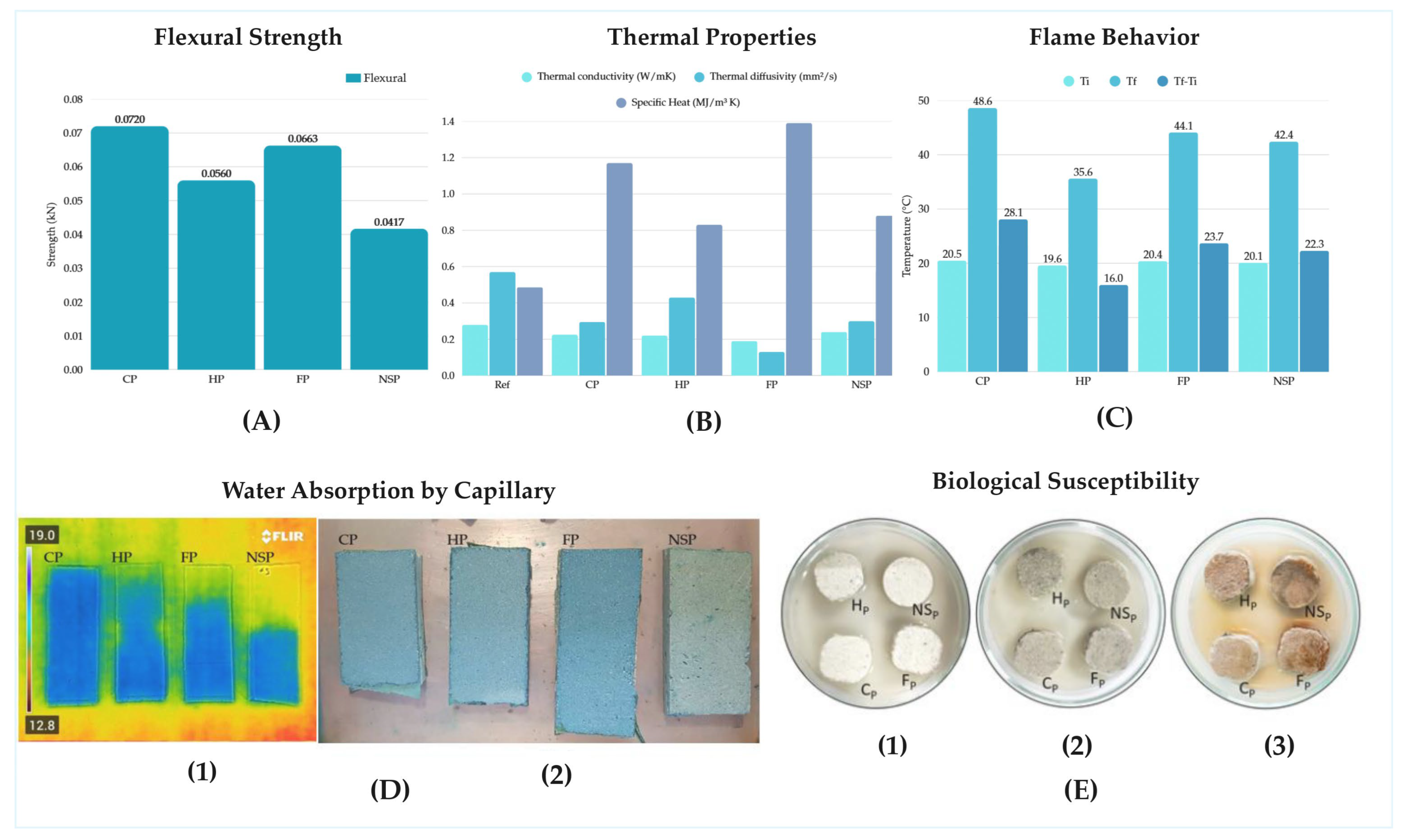
All tests were performed with different numbers of replicates: flexural strength and water absorption (n = 3), thermal properties and flame behavior (n = 2), and biological susceptibility (n = 1). Results are expressed as mean ± standard deviation when applicable. Statistical significance was not determined due to the exploratory nature of the study. The outcomes of the various experimental tests conducted in this study are summarized in Figure 1, providing a comparative overview of the samples’ performance across the evaluated parameters.
As illustrated in Figure 1A, the NSP sample exhibited the most significant reduction in mechanical performance compared to the other plasterboards, while CP demonstrated the highest flexural strength.
Regarding water absorption by capillarity (Figure 1D), the thermographic images (Figure 1(D1)) revealed that, in the NSP, the dye did not rise as uniformly as in the other samples. Full immersion tests (Figure 1(D2)) confirmed this limitation in dye uptake. Complementary experiments with intact silk cocoons suggested that the fibers may impart filtration ability to the composite.
The thermal analysis (Figure 1B) indicated that all samples exhibited conductivity and diffusivity values close to the reference material. However, the reference sample displayed a noticeably lower specific heat capacity. NSP presented lower thermal conductivity than CP and FP, with values close to HP, suggesting improved insulation performance.
In the flame resistance tests (Figure 1C), NSP recorded the second-lowest temperature rise, supporting the hypothesis of potential flame-retardant properties associated with silk fibers.
Finally, the biological susceptibility test (Figure 1E) revealed no visible contamination in any of the samples during the first week. After 30 days, fungal growth was pronounced in FP and CP, whereas NSP and HP remained largely unaffected, confirming that the incorporation of silk cocoon fibers reduces fungal proliferation and enhances biological durability.
The reduced fungal growth observed in the NSP sample is consistent with the known antifungal activity of silkworm cocoon components such as sericin, fibroin, and antimicrobial peptides. It is important to note that the present study assesses only fungal susceptibility. Although silk has documented antimicrobial activity against bacteria in the literature, these findings cannot be extrapolated to antibiotic-resistant bacteria without specific bacterial testing.

4. Conclusions

The incorporation of silkworm cocoon fibers into the plasterboard (NSP) resulted in reduced flexural strength, potentially compromising its structural performance in load-bearing applications. This decrease may be partly attributed to the absence of the paper layer present in commercial samples, which was not included in the lab-prepared NSP. The NSP exhibited higher water absorption than HP and FP; however, the limited penetration of blue dye, as observed through thermographic imaging, suggests that silk fibers may impart filtering properties to the material, giving support to further investigation. Thermally, the NSP demonstrated lower conductivity and diffusivity compared to other samples, indicating enhanced thermal insulation capacity. Regarding flame resistance tests, the NSP showed minimal temperature increase, supporting its potential use in fire-prone environments. Biologically, the NSP inhibited fungal growth for up to 1 week, with only minimal traces observed after 30 days, suggesting that silkworm cocoon fibers may reduce fungal proliferation.

Author Contributions

Conceptualization, J.R., A.J. and A.B.-S.; methodology, J.R., A.J. and A.B.-S.; validation, J.R., A.J. and A.B.-S.; formal analysis, J.R., A.J. and A.B.-S.; investigation, J.R., A.J., V.d.Z.B. and A.B.-S.; resources, J.R., A.J., V.d.Z.B. and A.B.-S.; data curation, J.R., A.J. and A.B.-S.; writing—original draft preparation, J.R., A.J. and A.B.-S.; writing—review and editing, A.B.-S.; visualization, J.R., A.J., V.d.Z.B. and A.B.-S.; supervision, A.J. and A.B.-S.; project administration, A.B.-S.; funding acquisition, V.d.Z.B. and A.B.-S. All authors have read and agreed to the published version of the manuscript.

Funding

This work was funded by National Funds from FCT—Fundação para a Ciência e Tecnologia through project UIDB/00616/2025 and UIDP/00616/2025 for the Unit Institute CQ-VR.

Institutional Review Board Statement

Not Applicable.

Informed Consent Statement

Not Applicable.

Data Availability Statement

Data sharing is not applicable to this article.

Conflicts of Interest

The authors declare no conflict of interest.

References

  1. Pietsch, F.; O’Neill, A.; Ivask, A.; Jenssen, H.; Inkinen, J.; Kahru, A.; Ahonen, M.; Schreiber, F. Selection of resistance by antimicrobial coatings in the healthcare setting. J. Hosp. Infect. 2020, 106, 115–125. [Google Scholar] [CrossRef] [PubMed]
  2. Ghaster, K. Benefits of Antimicrobial Paint for Hospitals and Homes. Available online: https://www.ghasterpaintinginc.com/blog/benefits-of-antimicrobial-paint-for-hospitals-and-homes/ (accessed on 15 November 2025).
  3. European Commission. Public Health. Available online: https://health.ec.europa.eu/biocides/overview (accessed on 15 November 2025).[Green Version]
  4. Michalak, I.; Chojnacka, K. Biocides. In Encyclopedia of Toxicology, 3rd ed.; Academic Press: Cambridge, MA, USA, 2014; pp. 461–463. [Google Scholar] [CrossRef]
  5. Hahn, S.; Schneider, K.; Gartiser, S.; Heger, W.; Mangelsdorf, I. Consumer exposure to biocides—identification of relevant sources and evaluation of possible health effects. Environ. Health 2010, 9, 7. [Google Scholar] [CrossRef] [PubMed]
  6. Dong, Z.; Xia, Q.; Zhao, P. Antimicrobial components in the cocoon silk of silkworm, Bombyx mori. Int. J. Biol. Macromol. 2023, 224, 68–78. [Google Scholar] [CrossRef] [PubMed]
  7. EN 1015-11:2019; Methods of Test for Mortar for Masonry—Part 11: Determination of Flexural and Compressive Strength of Hardened Mortar. European Committee for Standardization: Brussels, Belgium, 2019.
  8. EN 1015-18:2019; Methods of Test for Mortar for Masonry—Part 18: Determination of Water Absorption Coefficient Due to Capillary Action of Hardened Mortar. European Committee for Standardization: Brussels, Belgium, 2019.
  9. ISO 1514:2014; Plastics—Film and Sheeting—Determination of Thickness by Mechanical Scanning. International Organization for Standardization (ISO): City, Geneva, Switzerland, 2014.
Figure 1. Comparative performance of plasterboard samples: (A) flexural strength (average ± SD, n = 3); (B) thermal properties; (C) flame behavior; (D) water absorption by capillary (1—thermographic image; 2—after immersion); (E) fungal growth monitoring (1—day 1; 2—week 1; and 3—day 30). Samples: CP—conventional, HP—hydrophobic, FP—fire-retardant, and NSP—natural silk plasterboard.
Proceedings 133 00011 g001
Table 1. Description of the experimental tests performed on the plasterboard samples.
Experimental TestsDescription
Flexural StrengthThe experimental procedures were carried out in accordance with EN 1015-11:2019 [7]. Flexural strength was determined using a three-point bending test on prismatic specimens until failure.
Water Absorption by CapillaryWater absorption was measured following EN 1015-18 [8] and EN 1514 [9], with anti-humidity paint used instead of paraffin. Specimens were marked 5 mm from the base, which was submerged in blue-dyed water to easily track water rise.
Thermal PropertiesThe Hot Disk Thermal Contrast Analyzer measures thermal conductivity, diffusivity, and specific heat of samples. During a 4 s test with a 150 mW heat input, two circular samples were arranged with the sensor positioned between them. This setup allowed the precise measurement of heat flow and temperature penetration within the material.
Flame BehaviorFlame behavior was assessed by applying a blowtorch 10 cm from the plasterboard for 2 min. Sample temperatures were recorded before and after exposure using a thermometer.
Biological SusceptibilitySamples were placed on nutrient salts agar (NSA) and inoculated with Cladosporium halotolerans (4.8 × 10⁵ conidia/cm2), a commonly detected fungus in indoor environments, including hospitals; it is widely used as an indicator of material susceptibility to fungal colonization under high humidity conditions. The fungal isolate (MUM 19.43), identified molecularly and deposited in GenBank (MN839644), had a concentration of 3.15 × 10⁶ spores/mL. Samples were incubated at 25 °C and 85% relative humidity for 30 days. Positive and negative controls included NSA with and without fungal inoculation, respectively.
Disclaimer/Publisher’s Note: The statements, opinions and data contained in all publications are solely those of the individual author(s) and contributor(s) and not of MDPI and/or the editor(s). MDPI and/or the editor(s) disclaim responsibility for any injury to people or property resulting from any ideas, methods, instructions or products referred to in the content.