Proceeding Paper

Sol–Gel Derived Organic/Inorganic Hybrids Doped with a Mixture of Sodium Salt and a Commercial Ionic Liquid †
CQ-VR, University of Trás-os-Montes and Alto Douro, 5000-801 Vila Real, Portugal
*
Author to whom correspondence should be addressed.
Presented at the II International Meeting Molecules 4 Life, Vila Real, Portugal, 10–12 September 2025.
Proceedings 2025, 133(1), 10; https://doi.org/10.3390/proceedings2025133010
Published: 31 March 2026
(This article belongs to the Proceedings of II International Meeting Molecules 4 Life)

Abstract

The sol–gel method was employed to prepare organic–inorganic hybrid materials capable of accommodating large amounts of a sodium salt and a commercial ionic liquid. The resulting samples, obtained as thin and transparent films, were characterized using thermogravimetric analysis (TGA), X-ray diffraction (XRD) and atomic force microscopy (AFM). The samples exhibit thermal stability and are essentially amorphous, which encourages further investigation. Interest in sodium arises from the fundamental similarities between the electrochemistry of sodium and lithium batteries, as well as the analogous physicochemical properties shared by these two elements. Sodium-ion batteries have thus emerged as highly promising energy storage systems, particularly well-suited for stationary applications.

1. Introduction

The development of electrochemical energy storage systems is one of the pillars of the energy transition toward renewable and sustainable sources. In this context, lithium-ion batteries have dominated the market due to their high energy density, long lifespan, and proven performance in portable and vehicle applications. However, the growing demand for lithium—combined with its high cost, limited geographical distribution, and environmental concerns related to its extraction—has driven the search for more abundant and economically viable alternatives [1]. Sodium-ion batteries (Na-ion batteries, NIBs) have emerged as a promising technology [2], since sodium is widely available, low-cost, and exhibits chemical properties similar to those of lithium. Nevertheless, the larger ionic size and different electrochemical behavior of sodium introduce specific challenges, particularly regarding the stability and efficiency of the electrolyte. The electrolyte [3] plays a central role in the performance of a battery, as it is responsible for the efficient transport of ions between the electrodes, in addition to directly influencing the system’s safety, lifespan, and electrochemical operating window. Several types of electrolytes have been investigated for sodium batteries, including conventional liquid electrolytes, solid systems, and hybrid ones [3].
The sol–gel method [4] is a powerful method for preparing organic–inorganic hybrids doped with large amounts of guest components, such as salts and ionic liquids. Each class presents advantages and limitations: while liquids offer high ionic conductivity, solids emerge as safer and more stable alternatives, although they face challenges related to interfacial contact and processability.

2. Materials and Methods

O,O’-bis-(2-aminopropyl) polypropylene glycol (commercially available as Jeffamine ED-600®, Fluka (Darmstadt, Germany), average molecular weight 600 g/mol), 3-isocyanatepropyltriethoxysilane (ICPTES, Thermos scientific, Waltham, MA, USA, 95%), ethanol (CH3CH2OH, Fisher Chemical, Pittsburgh, PA, USA, 99.8%), sodium trifluoromethanesulfonate (NaCF3SO3, Acros Organics, Geel, Belgium, 98%) and 1-ethyl-3methylimidazolium chloride ([Emim]Cl, Acros Organics, 97%), were used as received. Tetrahydrofuran (THF, Fisher Chemical, 99.8%) was stored over molecular sieves. High purity distilled water was used in all experiments. The synthesis was conducted in two steps, in accordance with previously reported methods [5,6]. The experimental details of the synthesis are presented in Table 1. In the present study, the amount of sodium salt is varied, while the amount of ionic liquid (IL) was maintained at 10% of the mass of the organic precursor. The organic–inorganic hybrids are denoted as d-U(600)nNaCF3SO3_10% IL (where d = di-, U = urea group, 600 = average molecular weight of the organic precursor corresponding to 8.5 –OCH2CH2– repeat units, n = number of ether oxygen atoms per Na+ ion, 10% = IL [Emim]Cl content relative to precursor mass). Additionally, a sample without dopant and a sample containing only the same amount of IL were prepared.
TGA was conducted on a STA 449 F3 Jupiter instrument (Proteus v7.1) from 25 to 700 °C at 10 °C/min. Xerogel samples (5–10 mg) were placed in alumina crucibles, with nitrogen as purging (50 mL/min) and protective (20 mL/min) gas. XRD measurements were carried out at room temperature using a Philips X’Pert MPD powder diffractometer with monochromated Cu Kα radiation (λ = 1.541 Å) over a 2θ range of 10–60°. Samples were analyzed without any thermal pre-treatment. AFM measurements were performed in tapping mode using a Nano-Observer AFM (CSInstruments, Les Ulis, France) with a resonance frequency of 60 kHz and a spring constant of 0.3 N/m, employing a super-sharp Si HQ:NSC19/FORTA probe. Image quality was enhanced using flattening, line-noise removal and low-pass filtering tools provided by Gwyddion 2.52 software.

3. Results and Discussion

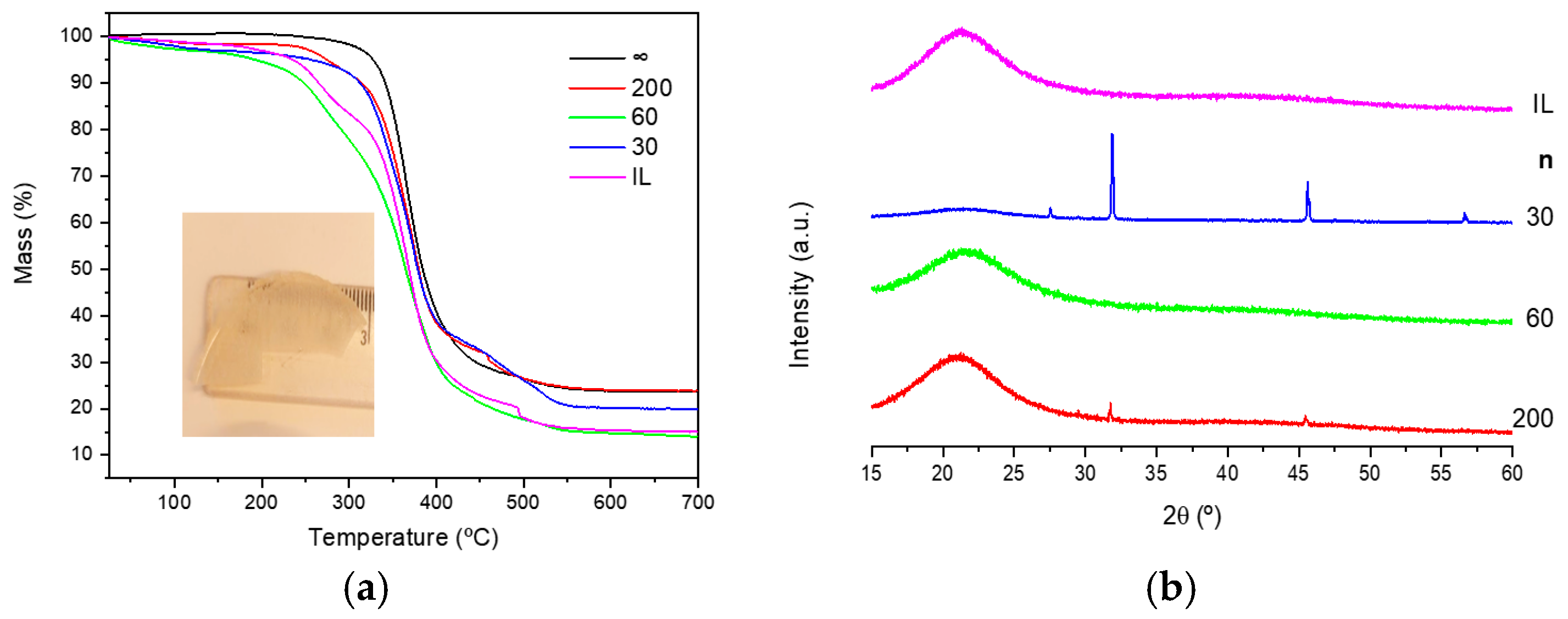
In this work, a series of samples were prepared using mixtures of sodium triflate and an ionic liquid at various concentrations. For comparison, one undoped sample and another containing only the ionic liquid at an equivalent concentration were also produced. All the samples were obtained as clear and transparent films. A representative image is presented as inset in Figure 1a.

3.1. Thermal and Structural Characterization

The thermograms of the samples shown in Figure 1 reveal the thermal stability of the samples. The undoped sample d-U(600) is stable up to 300 °C, at which point it begins to lose mass in a single step, resulting in a final residue of approximately 13%. With the incorporation of the doping agents, this thermal stability decreases, being more pronounced in the case of the sample with 10% IL and n = 60 (green line in Figure 1a). In this particular case, as well as for the sample doped only with IL (magenta line in Figure 1a), the final residue is around 15%. The remaining samples exhibit an intermediate behavior, as would be expected. The diffractograms of the samples, Figure 1b show a peak centered at 21°, corresponding to the diffraction of the siliceous domains [7]. This peak is less intense in the sample with n = 30 (blue line, Figure 1b) but remains present. The sample with n = 30 also exhibits peaks located at 27.5°, 31.83° and 45.69°, and 56.68°, these last two were also observed in the sample with n = 200. These last two peaks do not correspond to the diffractogram of the previously reported sodium salt [6] and are tentatively attributed to the formation of a complex of unknown stoichiometry, presumably formed between the di-ureasil chains and the guest sodium salt.

3.2. Morphhological Characterization

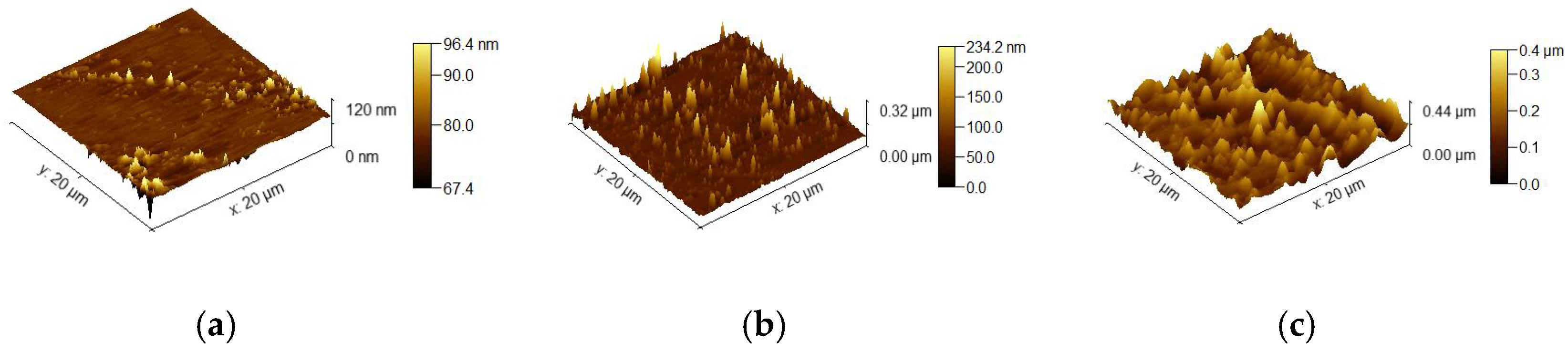
The AFM images presented in Figure 2 provide detailed insight into the surface topography of the prepared films. The undoped sample (Figure 2a) exhibited the lowest surface roughness, with a value of 4.469 nm. Upon the introduction of dopant species, a systematic increase in surface roughness (Ra) was observed. Incorporation of the 10% IL increased the roughness to 9.176 nm (Figure 2b). When both the IL and sodium salt were introduced simultaneously, the roughness rose even further, reaching 13.22 nm for the d-U(600)60 NaCF3SO3_10% IL sample (Figure 2c).
This substantial increase in surface roughness may be attributed to the formation of larger aggregates or newly developed surface structures resulting from interactions among the polymer matrix, the IL, and the salt. The vales obtained for Ra are more significative than the values reported for a di-ureasil system doped 1-butyl-3-methylimidazolium chloride ([Bmim]Cl) and lithium tetrafluoroborate (LiBF4) [8].

4. Conclusions

A set of transparent films were prepared by the sol–gel method incorporating a large amount of sodium salts and ionic liquids. The samples are thermally stable and essentially amorphous. Overall, these observations indicate that dopant incorporation plays a critical role in modulating the surface morphology of the films, thereby influencing their physical, chemical, and electrochemical properties—this will be further explored.

Author Contributions

A.P. investigation, writing—original draft preparation. M.F. Conceptualization, methodology, validation, formal analysis; writing—original draft preparation, writing—review and editing, supervision. All authors have read and agreed to the published version of the manuscript.

Funding

This work was funded by CQ-VR (CQVR-UIDB/0616, https://doi.org/10.54499/UID/PRR/00616/2025) and developed under the project A-MoVeR—“Mobilizing Agenda for the Development of Products & Systems towards an Intelligent and Green Mobility”, operation n.º 02/C05-i01.01/2022.PC646908627-00000069, approved under the terms of the call n.º 02/C05-i01/2022—Mobilizing Agendas for Business Innovation, financed by European funds provided to Portugal by the Recovery and Resilience Plan (RRP), in the scope of the European Recovery and Resilience Facility (RRF), framed in the Next Generation UE, for the period from 2021 to 2026.

Institutional Review Board Statement

Not applicable.

Informed Consent Statement

Informed consent was obtained from all subjects involved in the study.

Data Availability Statement

Data sharing is not applicable to this article.

Acknowledgments

Thanks to the Electron Microscopy Unit (UME) at UTAD for collecting the XRD data.

Conflicts of Interest

The authors declare no conflicts of interest.

References

  1. Nitta, N.; Wu, F.; Lee, J.T.; Yushin, G. Li-ion battery materials: Present and future. Mater. Today 2015, 18, 252–264. [Google Scholar] [CrossRef]
  2. Roberts, S.; Kendrick, E. The re-emergence of sodium ion batteries: Testing, processing, and manufacturability. Nanotechnol. Sci. Appl. 2018, 11, 23–33. [Google Scholar] [CrossRef] [PubMed]
  3. Ponrouch, A.; Monti, D.; Boschin, A.; Steen, B.; Johansson, P.; Palacín, M.R. Non-aqueous electrolytes for sodium-ion batteries. J. Mater. Chem. A 2015, 3, 22–42. [Google Scholar] [CrossRef]
  4. Brinker, C.J.; Scherer, G.W. Sol-Gel Science: The Physics and Chemistry of Sol–Gel Processing; Academic Press: San Diego, CA, USA, 1990. [Google Scholar] [CrossRef]
  5. Bermudez, V.d.Z.; Carlos, L.D.; Alcácer, L. Sol−Gel Derived Urea Cross-Linked Organically Modified Silicates. 1. Room Temperature Mid-Infrared Spectra. Chem. Mater. 1999, 11, 569–580. [Google Scholar] [CrossRef]
  6. Correia, S.G. Sol–gel-derived POE/siliceous hybrids doped with Na+ ions: Morphology and ionic conductivity. Solid State Ionics 2003, 156, 85–93. [Google Scholar] [CrossRef]
  7. Carlos, L.D.; Bermudez, V.d.Z.; Ferreira, R.A.S.; Marques, L.; Assunção, M. Sol−Gel Derived Urea Cross-Linked Organically Modified Silicates. 2. Blue-Light Emission. Chem. Mater. 1999, 11, 581–588. [Google Scholar] [CrossRef]
  8. Nunes, P.J.; Pereira, R.F.P.; Pereira, S.; Silva, M.M.; Fortunato, E.; Bermudez, V.d.Z.; Fernandes, M. Sol-Gel Derived Di-Ureasil Based Ormolytes for Electrochromic Devices. Energies 2023, 16, 426. [Google Scholar] [CrossRef]
Figure 1. Thermograms (a) and XRD patterns (b) of the di-ureasil system doped with IL and a mixture of IL and sodium salt. The inset in Figure 1a shows a representative image of the films obtained.
Proceedings 133 00010 g001
Figure 2. 3D AFM images of d-U(600) (a) d-U(600)_10% IL (b) and d-(600)10NaCF3SO3_10% IL (c).
Proceedings 133 00010 g002
Table 1. Experimental details of the synthesis.
Mass
Jeffamine (g)
Volume ICPTES (μL)Volume H2O (μL)Volume
Ethanol (μL)
Mass Salt (g)nMass IL (g)% IL
1.013983791798---
1.0196842928030.01242000.102010
1.0771889978480.0438600.107710
1.16919651059210.0950300.116910
2.045716891841611--0.204610
Disclaimer/Publisher’s Note: The statements, opinions and data contained in all publications are solely those of the individual author(s) and contributor(s) and not of MDPI and/or the editor(s). MDPI and/or the editor(s) disclaim responsibility for any injury to people or property resulting from any ideas, methods, instructions or products referred to in the content.