You are currently viewing a new version of our website. To view the old version click .
Proceedings
  • Proceeding Paper
  • Open Access

22 August 2017

The Effect of Monolayer Graphene on the UV Assisted NO2 Sensing and Recovery at Room Temperature †

,
,
,
,
and
1
Department of Electronic Engineering, Chang Gung University, Taoyuan, Taiwan
2
Graduate Institute of Electro-Optical Engineering, Chang Gung University, Taoyuan, Taiwan
3
Center for Nanotechnology, NASA Ames Research Center, Moffett Field, CA 94035, USA
*
Author to whom correspondence should be addressed.
This article belongs to the Proceedings Proceedings of Eurosensors 2017, Paris, France, 3–6 September 2017

Abstract

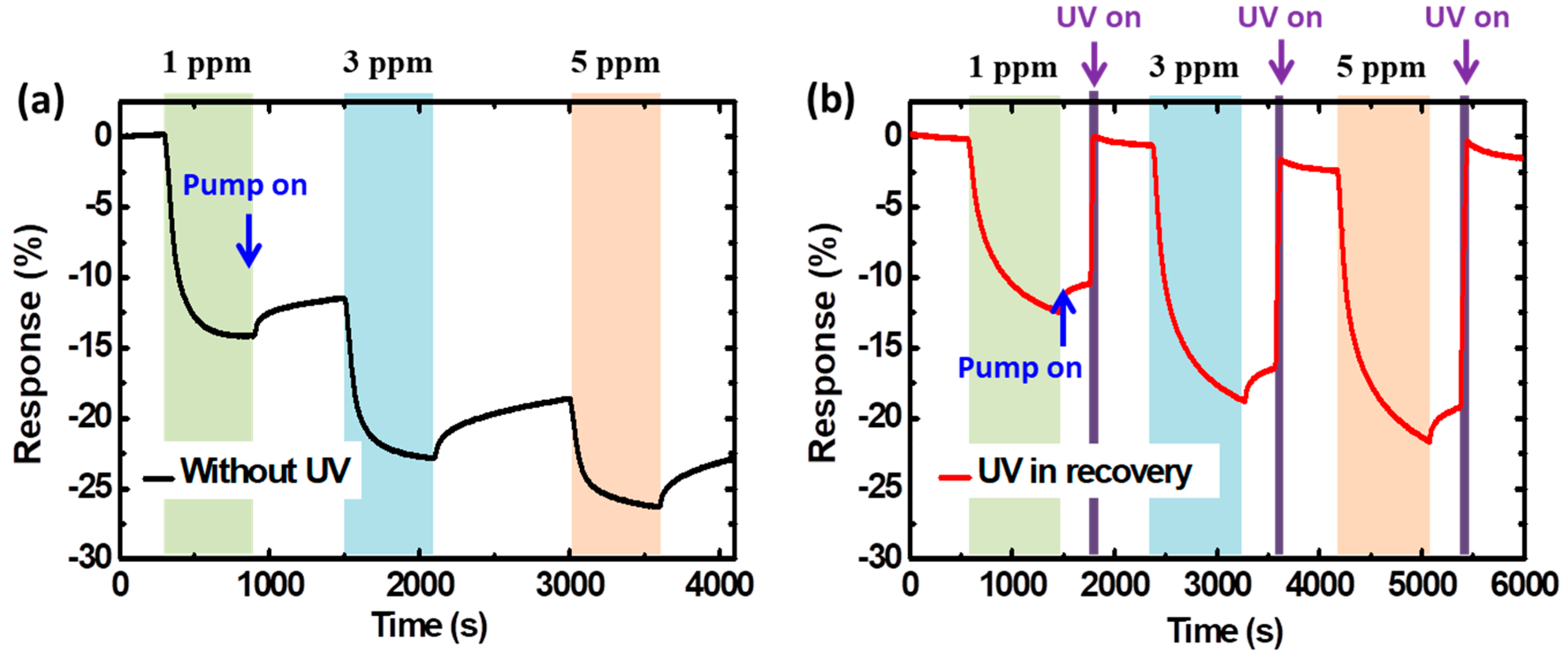
In the present study, UV light induced desorption of nitrogen dioxide (NO2) on pristine graphene based gas sensor is used to improve the sensing performance. Compared to the sample without UV light exposure, the response is 12%, 18% and 21% for NO2 concentrations of 1, 3 and 5 ppm. In addition, the recovery could be speeded up by UV irradiation. The sensor shows good behavior of repeatability when tested for 1 ppm of NO2 in 3 cycles. The graphene sensor with UV irradiation has a higher sensitivity to NO2 than to other gases under higher concentrations.

1. Introduction

Nitrogen dioxide (NO2) is a pollutant with negative effects on soil, plants, animals and human health. It causes acid rain and photochemical smog. It is necessary to develop highly sensitive and inexpensive NOx gas sensors capable of detecting low concentrations of NO2 [1]. Metal oxides have been used as sensing materials in solid-state gas sensors. However, these sensors work only at high temperatures due to the high activation energy of reactions with gas molecules [2]. Gas sensors based on graphene is suitable for NO2 sensor, mainly due to its two-dimensional single atomic layer thickness, large specific surface area, excellent temperature and electrical tolerance properties [3]. In this work, we demonstrate the impact of UV exposure on graphene sensor recovery for NO2 gas detection.

2. Experimental

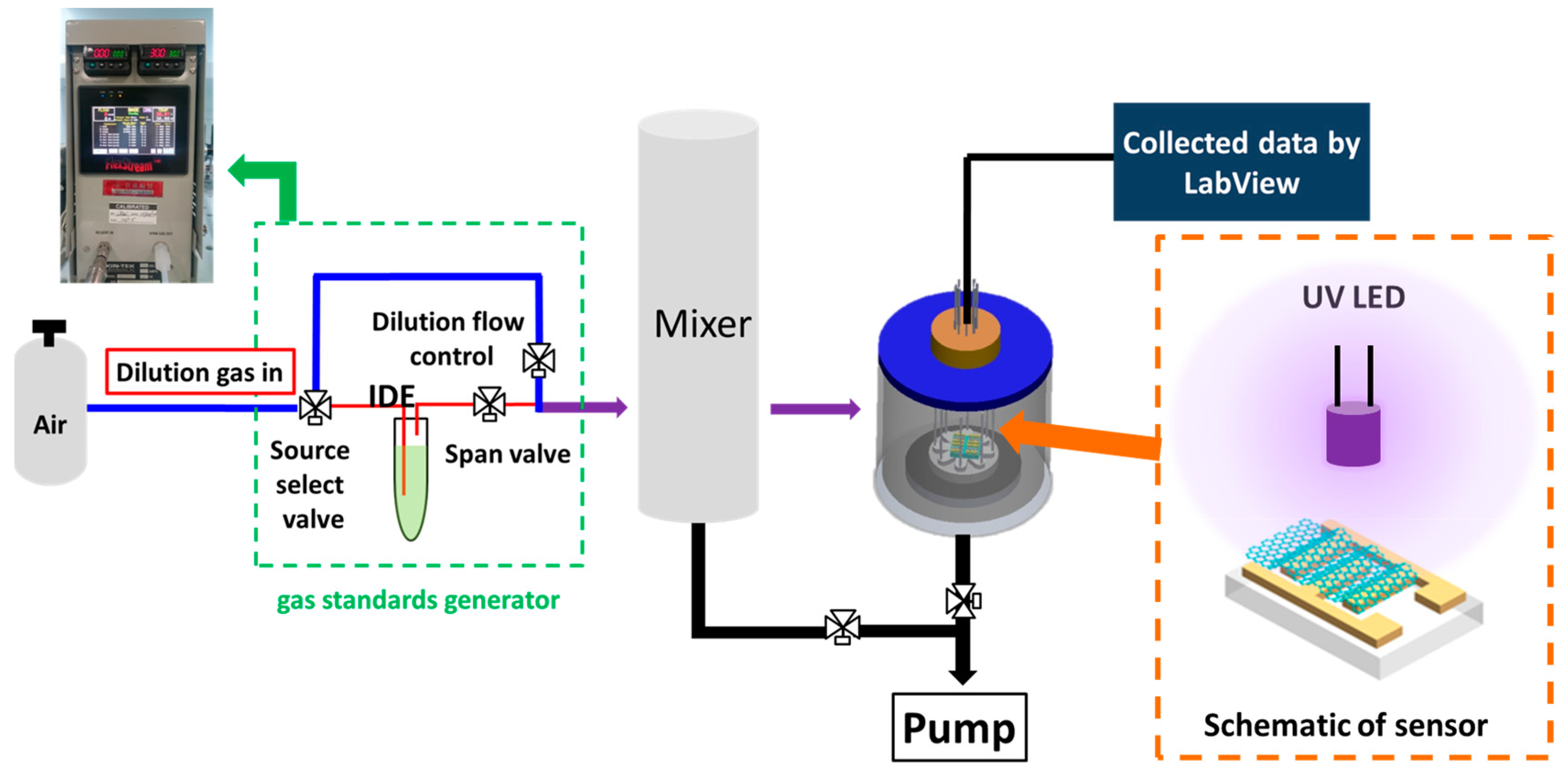
The interdigitated electrodes were fabricated by a lift off process. Chromium and gold layers with thickness of 30 and 120 nm were deposited on glass. Graphene films were grown on a copper (Cu) substrate by chemical vapor deposition (CVD). Transfer of graphene from Cu to the interdigitated electrodes was done by standard transfer process. The sensor and measurement setup are shown in Figure 1. The NO2 concentration was controlled by Flexstream Module Instrument that modulates the flow rate of air through the NO2 permeation tube to get ppm level, and a mechanical pump was used to remove the residual gas. The gas sensing response was measured by monitoring the change in resistance of the graphene film.
Figure 1. Schematic of sensor measurement setup.

3. Results and Discussion

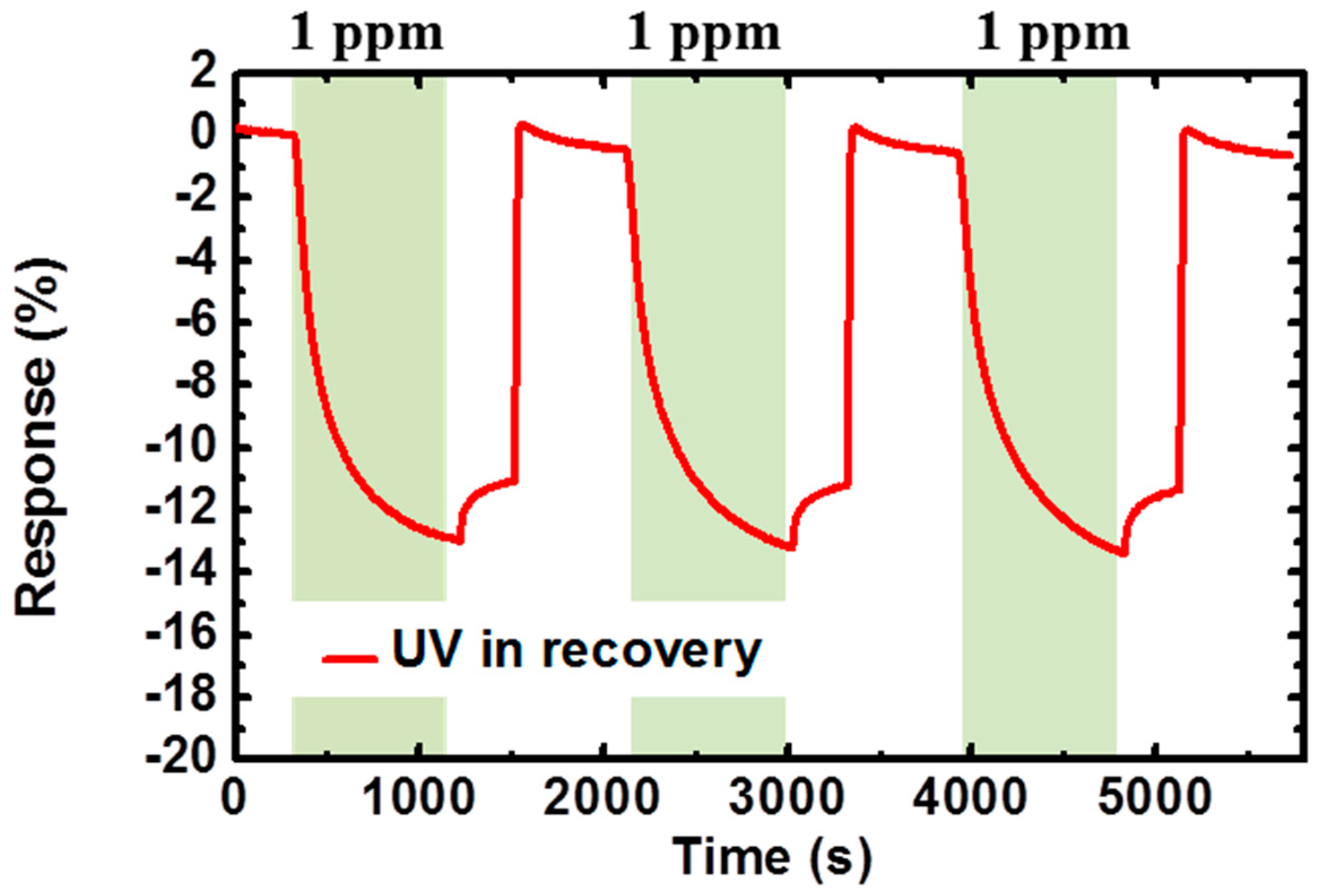
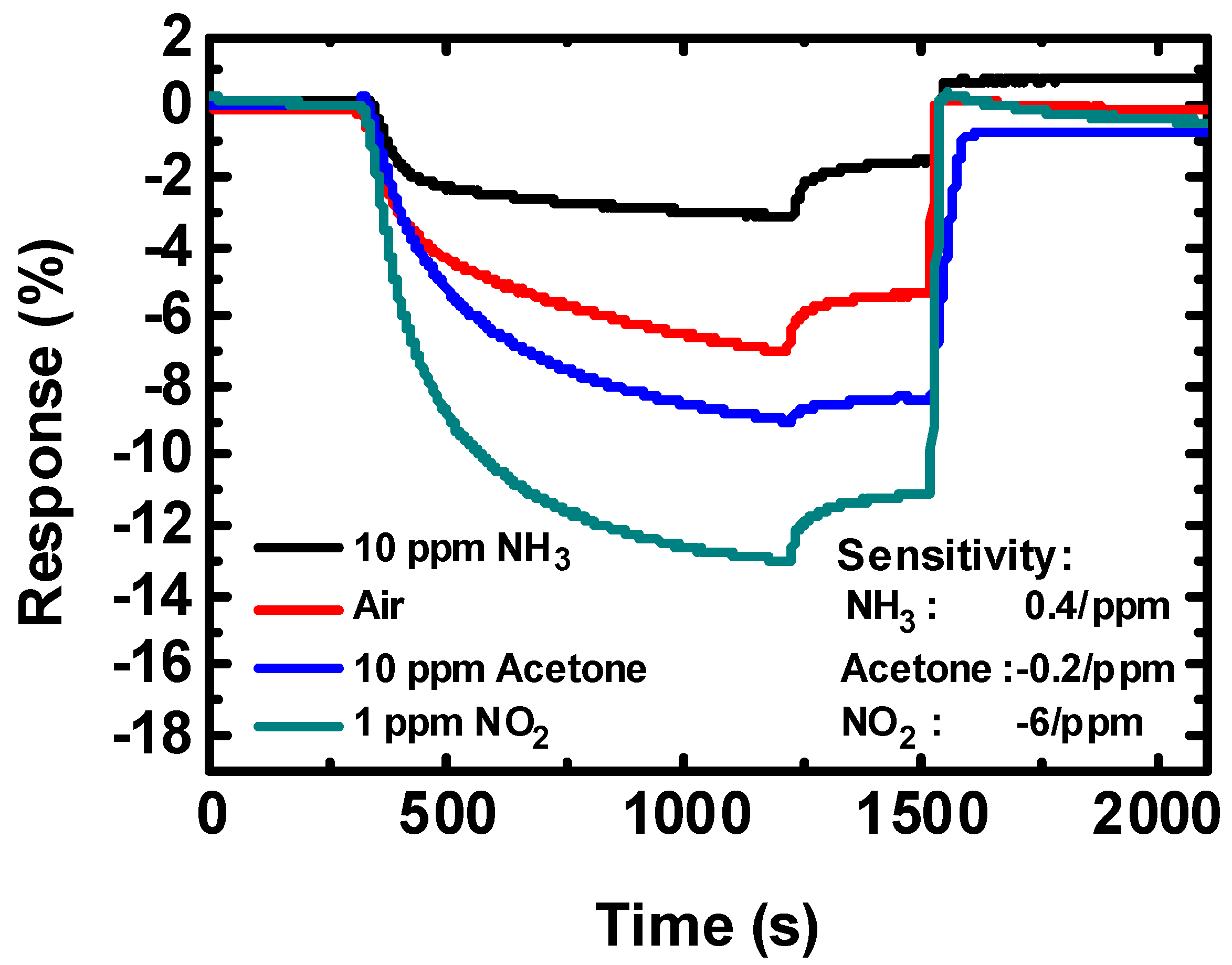
Figure 2a,b display the comparison of the dynamic response with and without UV irradiation for NO2 concentration from 1 to 5 ppm. As shown in Table 1. The results show a significant effect of UV irradiation on the sensor response: 12, 18 and 21% for concentrations of 1, 3 and 5 ppm. This can be explained by the UV irradiation induced molecular desorption from the graphene surface. As shown in Figure 3, the sensor was exposed to 1 ppm NO2 with UV irradiation for 3 cycles. A good repeatability is evident from the cycle variation of response within 0.4%. To investigate the selectivity, the sensor was also tested for 10 ppm NH3, 10 ppm acetone, air and 1 ppm NO2. The sensor exhibits a higher response for NO2 compared to other gas, as shown in Figure 4.
Figure 2. Dynamic responses for different NO2 concentrations for (a) without and (b) with UV irradiation.
Table 1. Gas sensing properties of UV light and without.
Figure 3. Repeatability and stability studies of the graphene sensor exposed to NO2 gas of 1 ppm.
Figure 4. Selectivity of the NO2 graphene sensor to different gases.

4. Conclusions

In summary, UV irradiation is shown to improve the sensor recovery during NO2 detection in a chemiresistive sensor with pristine graphene as the sensing material. The sensor recovers to the original value in a few seconds due to the pump and UV light induced residual gas desorption. The response change is 12, 18 and 21% with UV irradiation for NO2 concentrations of 1, 3 and 5 ppm with UV exposure. In addition, this effect enables the sensor to provide good repeatability and high selectivity to different gases.

Acknowledgments

This work was supported in part by the Ministry of Science and Technology of the Republic of China under the Contract No. of MOST 105-2632-E-182-001, 105-2221-E-182-066, and 105-2221-E-182-057-MY3 and the Chang Gung Memorial Hospital under the contacts of CMRPD2F0062, CMRPD2F0022 and CMRPD3D0112.

Conflicts of Interest

The authors declare no conflict of interest. The founding sponsors had no role in the design of the study; in the collection, analyses, or interpretation of data; in the writing of the manuscript, and in the decision to publish the results.

References

  1. Li, J.; Lu, Y.; Ye, Q.; Delzeit, L.; Meyyappan, M. A gas sensor array using carbon nanotubes and microfabrication technology. Electrochem. Solid State Lett. 2005, 8, H100–H102. [Google Scholar] [CrossRef]
  2. Gu, D.; Li, X.; Zhao, Y.; Wang, J. Enhanced NO2 sensing of SnO2/SnS2 heterojunction based sensor. Sens. Actuators B Chem. 2017, 244, 67–76. [Google Scholar] [CrossRef]
  3. Long, H.; Harley-Trochimczyk, A.; Pham, T.; Tang, Z.; Shi, T.; Zettl, A.; Carraro, C.; Worsley, M.A.; Maboudian, R. High Surface Area MoS2 / Graphene Hybrid Aerogel for Ultrasensitive NO2 Detection. Adv. Funct. Mater. 2016, 26, 5158–5165. [Google Scholar] [CrossRef]
Publisher’s Note: MDPI stays neutral with regard to jurisdictional claims in published maps and institutional affiliations.

Article Metrics

Citations

Article Access Statistics

Multiple requests from the same IP address are counted as one view.