Abstract
We report herein the efficiency of microwave-assisted synthesis for obtaining ZnO/SnO2 heterostructures for room-temperature gas-sensing applications. The sensing performances of the traditional oxide materials have been found for applications above 200 °C. However, these temperatures were here reduced to room temperature by considering sensing activity photoactivated by UV light, even for ppb ozone (O3) levels. The heterojunctions exhibited a fast response, total reversibility, and selectivity to oxidizing gases, especially O3 gas. This investigation provides an efficient way to obtain heterostructures exhibiting remarkable properties for practical applications as O3 gas sensor devices.
1. Introduction
Metal oxide semiconductors (MOS) have attracted considerable interest from many researchers due to their unique properties that allow numerous practical applications [1,2]. Among the MOS, zinc oxide (ZnO) and tin oxide (SnO2) are n-type wide band-gap semiconductors (Eg = 3.2 and 3.6 eV, at 300 K) [4,5]. These compounds have attracted much interest due to their wide range of applications, mainly as chemoresistors [1,6]. The traditional semiconductor gas sensors (e.g., ZnO, WO3, SnO2, and In2O3) have generally found application for use at temperatures >200 °C, hindering the monitoring of gas composition in an environment containing explosive species since high temperature could trigger an explosion [7]. In this way, the UV-light irradiation becomes an efficient and low-cost approach for the activation of the chemical reactions at room temperature [7,8,9]. Despite the potential application of pristine ZnO and SnO2 as UV-activated gas sensors, the high charge carrier recombination rates impair their efficiency [9]. Therefore, great efforts have been made to improve the performance of these semiconductors, for example, the coupling or creation of junctions between semiconductors (heterojunctions) has been a promising way to retard the charge recombination and thus enhancing the gas sensing activity [9,10].
The heterojunctions have been prepared by a variety of physical and/or chemical routes [4,5,9,10,11]. Recently, we reported the UV-assisted gas sensing properties of ZnO/SnO2 heterojunctions prepared via conventional hydrothermal method [9]. Despite the remarkable properties of the heterojunctions as sensing materials [9,10], the controlled and reproductive synthesis of these compounds, to ensure reliable operation of the sensors, has been the main difficulty for technological applications.
Therefore, we report herein the efficiency of microwave-assisted treatment for obtaining of ZnO/SnO2 heterostructures exhibiting remarkable properties as UV-assisted ozone gas sensor working at room-temperature. Gas sensing measurements under continuous UV irradiation proved the ability of heterojunction for detecting ppb ozone levels (20 to 385 ppb). Additionally, the heterojunction also exhibited total reversibility, repeatability, and selectivity to oxidizing gases.
2. Materials and Methods
2.1. Samples Preparation
ZnO/SnO2 heterojunctions with the composition 50 wt % ZnO: 50 wt % SnO2, were prepared via microwave-assisted method (CEM Discover; 2.45 GHz). The appropriate amounts of nanocrystalline ZnO and SnO2 powders were added into 20 mL of Milli-Q water and kept under continuous stirring. Then, the solution was transferred to a 35 mL vessel sealed with a Teflon cap and treated in the microwave reactor for 20 min at 200 °C.
2.2. Characterization Techniques
X-ray diffraction (XRD) patterns were determined using a PANalytical Empyrean operating in Bragg-Bretano mode using a CuKα radiation source. The microstructural properties of the ZnO-SnO2 heterojunction were analyzed using a transmission electron microscopy (TEM, FEI TECNAI G2 F30) operating at 300 kV. Gas sensing measurements were performed at room temperature (24 °C) under a UV-light irradiation provided by an UV light-emitting diode (LED, Nichia, λ = 325 nm; 200 µW). The distance between the UV-LED and the sensing material was kept at 10 mm. A 1 V dc voltage was applied to the sample while the electrical resistance was monitored by using an electrometer (HP4140B Source/Pico-ammeter). Dry air was used as both the reference and the carrier gas, maintaining a constant total flow of 500 SCCM via mass flow controllers. The O3 gas was generated by oxidizing oxygen using a pen-ray UV lamp, resulting in an O3 output level from 20 to 385 ppb. To evaluate the selectivity, NO2, NH3, and CO gas-sensing measurements were performed for concentrations ranging from 100 to 500 ppb (NO2), 1 to 5 ppm (NH3), and 5 to 10 ppm (CO).
3. Results and Discussion
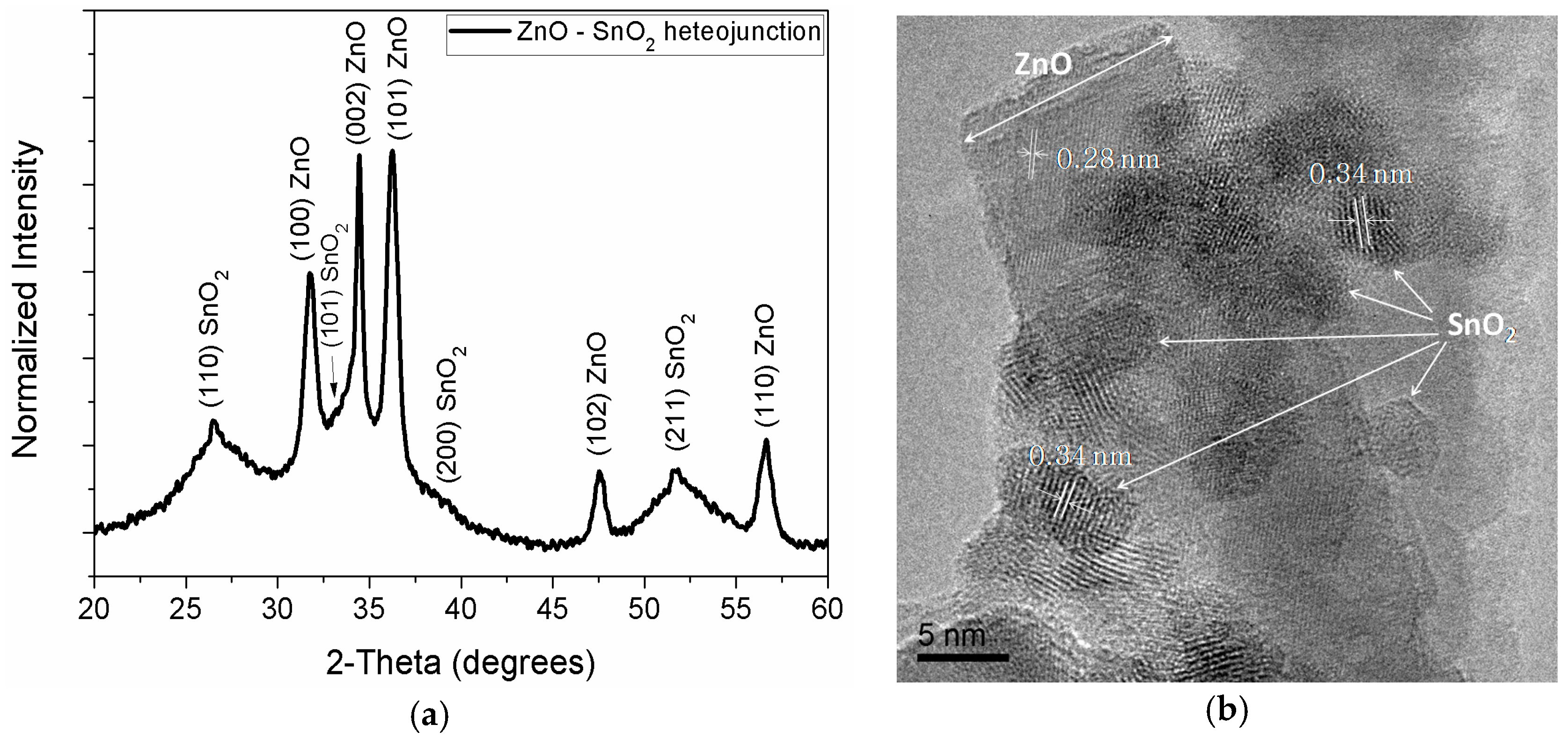
Figure 1a displays the XRD pattern of ZnO/SnO2 heterojunction, being all peaks indexed to crystalline ZnO and SnO2 phases, respectively. HRTEM image obtained from the ZnO/SnO2 heterojunction showed that the microstructure consists of SnO2 nanoparticles (of ca. 5 nm), coalesced over ZnO rod-like structures of ca. 13 nm, as illustrated in Figure 1b. Additionally, Figure 1b revealed the existence of junction between ZnO and SnO2 nanoparticles, indicating the formation of junction between the oxide semiconductors.
Figure 1.
ZnO-SnO2 heterojunction prepared via microwave-assisted method. (a) XRD pattern; and (b) HRTEM image.
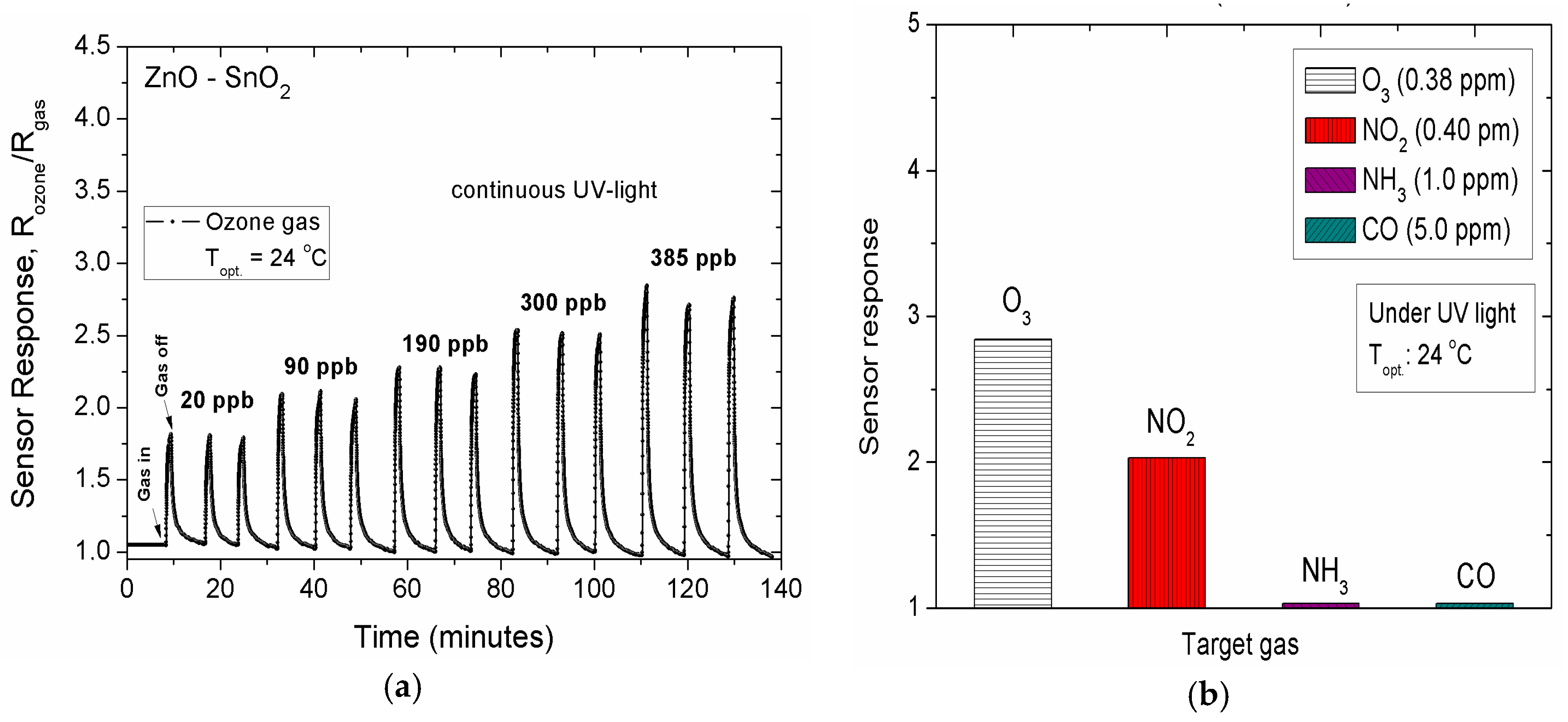
Figure 2a presents the gas sensor responses of the ZnO/SnO2 heterojunction exposed to various O3 levels under continuous UV irradiation.
Figure 2.
(a) Room-temperature gas sensing response of ZnO-SnO2 heterojunction as a function of ozone gas concentration; (b) Comparison of the sensor responses to different gases (O3, NO2, NH3, and CO) under continuous UV illumination.
We observed that the heterojunction exhibited a good sensor response even for the lowest O3 level (20 ppb), and also a total reversibility, and good repeatability. It is important to remember that ozone levels higher than 100 ppb are known to be harmful to human health [6]. To evaluate the selectivity, the heterojunction was exposed to oxidizing (NO2) and reducing gases (NH3, and CO). A good response to NO2 was obtained, and the response to both reducing gases was low, suggesting a selectivity towards oxidizing gases. Figure 2b displays the comparison of sensor responses of the heterojunction to different gases.
4. Conclusions
This paper reports a versatile and efficient approach for preparing ZnO/SnO2 heterojunctions for use as room-temperature ozone gas sensors. HRTEM analysis revealed the existence of junction between ZnO and SnO2 particles, respectively. The UV-assisted gas sensing experiments confirmed the sensing performance of the ZnO/SnO2 heterojunction, exhibiting a good sensor response in detection of oxidizing gases, especially, at the ppb ozone levels. The improvement of gas sensing performance was attributed to the good charge separation, which was motivated by the formation of ZnO/SnO2 heterojunction. These findings show that ZnO/SnO2 heterojunctions present a potential for practical applications as ozone gas sensors operated at room-temperature.
Acknowledgments
The authors thank Valmor R. Mastelaro for the use of CCMC/USP group installations. We are also grateful for the financial support from Brazilian research funding institutions CNPq, CAPES, and FAPESP (under grants No. 2017/ 10313-7, 2015/20124-1, and 2013/07296-2).
Conflicts of Interest
The authors declare no competing financial interest.
References
- Kim, H.-J.; Lee, J.-H. Highly sensitive and selective gas sensors using p-type oxide semiconductors: Overview. Sens. Actuators B Chem. 2014, 192, 607–627. [Google Scholar] [CrossRef]
- Zhou, X.; Lee, S.; Xu, Z.; Yoon, J. Recent progress on the development of chemosensors for gases. Chem. Rev. 2015, 115, 7944–8000. [Google Scholar] [CrossRef] [PubMed]
- Janáky, C.; Rajeshwar, K.; de Tacconi, N.R.; Chanmanee, W.; Huda, M.N. Tungsten-based oxide semiconductors for solar hydrogen generation. Catal. Today 2013, 199, 53–64. [Google Scholar] [CrossRef]
- Uddin, M.T.; Nicolas, Y.; Olivier, C.; Toupance, T.; Servant, L.; Müller, M.M.; Kleebe, H.-J.; Ziegler, J.; Jaegermann, W. Nanostructured SnO2–ZnO heterojunction photocatalysts showing enhanced photocatalytic activity for the degradation of organic dyes. Inorg. Chem. 2012, 51, 7764–7773. [Google Scholar] [CrossRef] [PubMed]
- Huang, X.; Shang, L.; Chen, S.; Xia, J.; Qi, X.; Wang, X.; Zhang, T.; Meng, X.-M. Type-II ZnO nanorod-SnO2 nanoparticle heterostructures: characterization of structural, optical and photocatalytic properties. Nanoscale 2013, 5, 3828–3833. [Google Scholar] [CrossRef] [PubMed]
- Catto, A.C.; da Silva, L.F.; Bernardi, M.I.B.; Bernardini, S.; Aguir, K.; Longo, E.; Mastelaro, V.R. Local structure and surface properties of CoxZn1–xO thin films for ozone gas sensing. ACS Appl. Mater. Interfaces 2016, 8, 26066–26072. [Google Scholar] [CrossRef] [PubMed]
- Comini, E.; Faglia, G.; Sberveglieri, G. UV light activation of tin oxide thin films for NO2 sensing at low temperatures. Sens. Actuators B Chem. 2001, 78, 73–77. [Google Scholar] [CrossRef]
- Fan, S.-W.; Srivastav, A.K.; Dravid, V.P. UV-activated room-temperature gas sensing mechanism of polycrystalline ZnO. Appl. Phys. Lett. 2009, 95, 142106. [Google Scholar] [CrossRef]
- Da Silva, L.F.; M’Peko, J.-C.; Catto, A.C.; Bernardini, S.; Mastelaro, V.R.; Aguir, K. Ribeiro, C.; Longo, E. UV-enhanced ozone gas sensing response of ZnO-SnO2 heterojunctions at room temperature. Sens. Actuators B Chem. 2017, 240, 573–579. [Google Scholar] [CrossRef]
- Park, S.; An, S.; Mun, Y.; Lee, C. UV-enhanced NO2 gas sensing properties of SnO2-Core/ZnO-shell nanowires at room temperature. ACS Appl. Mater. Interfaces 2013, 5, 4285–4292. [Google Scholar] [CrossRef] [PubMed]
- Da Silva, L.F.; Lopes, O.F.; Catto, A.C.; Avansi, W., Jr.; Bernardi, M.I.B.; Li, M.S.; Ribeiro, C.; Longo, E. Hierarchical growth of ZnO nanorods over SnO2 seed layer: Insights into electronic properties from photocatalytic activity. RSC Adv. 2016, 6, 2112–2118. [Google Scholar] [CrossRef]
Publisher’s Note: MDPI stays neutral with regard to jurisdictional claims in published maps and institutional affiliations. |
© 2017 by the authors. Licensee MDPI, Basel, Switzerland. This article is an open access article distributed under the terms and conditions of the Creative Commons Attribution (CC BY) license (https://creativecommons.org/licenses/by/4.0/).