Article

Assessing the Performance of Bio-Based Nitrogen Fertilisers Under Salinity and Drought Stress in Spinach: A Preliminary Trial


RE-Source Lab, Laboratory for BioResource Recovery, Department of Green Chemistry and Technology, Faculty of Bioscience Engineering, Ghent University, Coupure Links 653, 9000 Ghent, Belgium
*
Author to whom correspondence should be addressed.
Nitrogen 2026, 7(1), 14; https://doi.org/10.3390/nitrogen7010014
Submission received: 11 October 2025 / Revised: 29 November 2025 / Accepted: 14 January 2026 / Published: 16 January 2026

Abstract

Recently, the EU approved RENURE-criteria materials to be used as substitutes for synthetic N fertilisers. Several studies have been performed on the agronomic efficacy and potential environmental impacts of different bio-based fertilisers (BBFs) from biomass recovery, including the RENURE-criteria materials. But information is lacking about their effectiveness under abiotic stress conditions like salinity and drought. The predictions for climate change-induced increased drought and soil salinisation for the European soils have also increased, making it inevitable to understand BBF performance in these impending situations. Two RENURE-criteria top-priority materials (ammonium nitrate (AN) and ammonium sulphate (AS) and another commercially used BBF—an evaporator concentrate (CaE)) were evaluated in a pot trial growing spinach under salinity and drought stress with a reference ‘no stress’ condition to examine crop growth, nutrient uptake, and nitrogen fertiliser replacement value (NFRV). Agronomically, BBFs performed at par with the synthetic fertiliser (SF) under unstressed and salt-stressed conditions, whereas, under drought stress, BBFs outperformed the SF treatment. AS exhibited the highest yield and nutrient uptake, displaying an NFRV of 3.1 and 1.8 under no-stress and salt-stress conditions, respectively. Salt stress did not negatively impact the crops grown in this trial, potentially due to the higher potassium content in the system, which alleviated the possible negative impacts of high sodium. This study delves into the agronomic response, without evaluating crop physiological changes, and, hence, should be taken as a preliminary step into further investigation of observed elemental interactions (that could be potentially driving stress mitigation) while also examining the crop physiology during the duration of stress.

1. Introduction

Nitrogen (N) is one of the key nutrients with the ability to limit plant growth, when insufficiently applied. Currently, agricultural production rests largely on the shoulders of synthetically manufactured N fertilisers, obtained from the carbon dioxide (CO2)-intensive Haber–Bosch process. Consuming 1% of the global energy supply [1], the Haber–Bosch process produces ~180 million tonnes of ammonia (NH3) annually [2] and generates 1.87 tonnes of CO2 per tonne of NH3 produced [1]. Next to these environmental concerns, Europe also faced brutal ramifications of the ongoing war between Russia and Ukraine. The fertiliser price hike in 2022 resulted in affordability as well as availability crunches in Europe, causing farmers to cut back on field applications of fertilisers. The sharp increase in natural gas prices led to decreased production of NH3 needed to produce synthetic N fertilisers [3]. In the wake of these effects, it is inevitable that feasible substitutes to the current N fertilisers are identified to avoid impedance to the European agricultural sector. Animal manure, sewage sludge, and food and other organic wastes are categorised as the most promising biomass streams to extract agricultural nutrients [4]. The European Union’s (EU) Circular Economy Action Plan urges avoiding nutrient leakage from the agricultural sector and closing the nutrient loop by recycling, recovering, and processing nutrients for use as fertilisers [5]. Supported by improvements in regulations like the EU Fertilising Products Regulation (FPR 2019/1009) and the now-approved introduction of recovered nitrogen from manure (RENURE) material categorisation [6,7], dependency on the Haber–Bosch-derived synthetic N fertilisers could be reduced. These recovered nutrients, referred to as bio-based fertilisers (BBFs) in this study, can be defined as ‘materials or products derived from biomaterials (plant, animal or microbial origin, often wastes, residues or side-streams from agriculture, industry or society) with a content of bioavailable plant nutrients suitable to serve as a fertiliser for crops’ [8]. These fertilisers are derived from using different nutrient recovery technologies (physical/chemical/thermal/biological) in order to up-concentrate nutrients from the initially treated biomaterials, thus improving their nutrient efficiency. Ashes, struvites, ammonium (NH4+) salts (ammonium nitrate/sulphate), evaporator concentrate, etc., are examples of different types of BBFs.
Studies in the past have tested the agronomic efficacy and environmental impacts of various N-based BBFs (including the RENURE-materials), both under controlled and uncontrolled conditions [9,10,11,12,13,14]. Although previous research expounds upon fertiliser performance under regular and unstressed experimental conditions, their behaviour under situations of abiotic stress is currently unexplored. Salinity and drought stress are two known abiotic stresses that can significantly limit crop growth and productivity [15]. Soil salinity, a key constraint to crop production, affects millions of hectares of land globally, and costs billions of euros annually [16,17,18]. Increased temperature and evapotranspiration as a result of global climate change can increase soil salinity, thus negatively impacting crop production [19]. While the present extent of salinisation on the surface or underground European soil profile is uncertain, the common consensus is on the increasing trend of soil salinisation in the last few decades; this can be attributed to the changing climate, land use and management practices [20]. Similarly, drought is another important abiotic stress limiting agricultural production, especially in the arid and semi-arid regions of the world [21], and considered to be the primary destructive crop yield-limiting factor [22]. Adverse impacts on crop production might increase owing to climate change, which is predicted to increase the frequency and severity of crop water stress [23,24]. A study involving future drought predictions for Europe under different CO2 emission scenarios among other factors predicts more frequent and severe drought conditions for Western Europe even under moderate emission conditions [25].
Under such circumstances, it is vital to test the alternative nutrients that could replace the commonly used synthetic N fertilisers to understand their behaviour, performance, and impacts (if any) under potential conditions of stress. With this goal at hand, the current study tested three N-based BBFs—two of which are the RENURE-criteria high-priority materials- ammonium nitrate (AN) from stripping/scrubbing of liquid fraction (LF) of digestate and ammonium sulphate (AS) from air washing of pig stable. The third BBF tested is a concentrate after evaporation (CaE) of LF of digestate, a product already locally marketed as an N and potassium (K) fertiliser, with traces of phosphorus (P). In this study, these three BBFs were tested to determine their fertiliser performance against the commercially used N synthetic fertiliser (SF) calcium ammonium nitrate (30% N) under two stressors: salinity and drought. A plant growth experiment with spinach (Spinacia oleracea L.) was performed to answer the following research questions:
(i)
Do N-based BBFs, specifically the RENURE-criteria NH4+ salts, exhibit similar performance to SF in terms of crop yield and N uptake under salinity and drought stress?
(ii)
Do N-BBFs change soil parameters like pH and EC under abiotic stressors compared to the SF fertilisation?
(iii)
Can N-based BBFs replace their synthetic counterparts as a better choice of N fertilisation in areas prone to abiotic stresses?

2. Materials and Methods

2.1. BBF Collection and Characterisation

The AN tested in this study was obtained from the stripping/scrubbing unit of a pig farm with an anaerobic digestion (AD) plant located in Gistel, Belgium, with a capacity of 11,000 fattening pigs, and a manure capacity of 60,000 tonnes y−1. The AS was obtained from air washing stable air of a pig farm in Belgium, by capturing the NH3-rich air using sulphuric acid. The CaE is the residual concentrate after evaporation process in an AD plant in Belgium that processes different types of organic wastes. More details on these BBFs and their origin can be found in previous studies [13,14]. All BBFs were collected in air-tight polyethylene sampling bottles of 1 L each and stored at 4 °C.
All the BBFs were physio-chemically characterised to determine their dry matter (DM), pH, electrical conductivity (EC), total elemental composition, and mineral N (NH4+-N and (nitrate) NO3-N) as per the protocols mentioned in the earlier study [13] (Table 1).

2.2. Soil Sampling and Characterisation

The soil used for this study was collected from the top layer (0–30 cm) of an arable field in Wingene, West Flanders, Belgium, in March 2021. Predominantly sandy in nature, soil in this part of Flanders is characterised as the Z.c.h. soil type (soil with sandy texture and a moderately poor drainage class with signs of rust deeper than 60 cm and a post-podzol B-horizon) [26]. Spinach was grown in 2020, harvested in early June and followed with maize, which was harvested in late September. The soil was sampled from the field before fertilisation for an impending field trial and air-dried in a greenhouse, where it was sieved using a 2 mm mesh and mixed thoroughly for homogeneity. The soil was stored in the greenhouse until the experiment commenced. Sub-samples of the soil were taken for measurement of pH-potassium chloride (KCl), EC, total elemental composition and mineral N content [13] (Table 2).

2.3. Experimental Set-Up

The air-dried soil was moved from the greenhouse to a basement, four days before the start of experiment, and water was added to the soil to reach 50% water holding capacity (WHC). After a thorough mixing of the soil, the containers were covered with pin-holed parafilm and left in the dark to activate microbial activity in the dry soil.
The experiment tested five treatments, each with four replicates under two stressors (salt and drought) and one without any stress (5 × 4 × 3), i.e., a total of 60 pots. Seeds of spinach were used, which were previously tested for their germination potential. The treatments tested in the experiment were as follows: (i) unfertilised control; (ii) synthetic N (synthetic ammonium nitrate; 30% N); (iii) AN; (iv) AS; (v) CaE. To supplement the growth of crops and ensure an equal application of P and K in all treatments, synthetic fertilisation was performed using triple super phosphate (46% P2O5) and potassium sulphate (K2SO4) (PAT; 30% K2O, 10% MgO, and 42.5% SO3). An important point to be considered here is the additional application (23% more than the recommended dosage) of K2O from the treatment with CaE—a consequence of satisfying the N requirements of the crop. Hence, to ensure that every treatment received equal K application, additional K2SO4 was added to all other fertilised treatments, accordingly, using PAT. This led to an over-fertilisation with S in the case of treatment with AS (~115% more than SF and AN, and ~1265% more than CaE). The nutrient application dosage was determined based on the crop requirement for spinach (200 kg N ha−1, 55 kg P2O5 ha−1 and 250 kg K2O ha−1; personal communication with Inagro vzw).
For application in the current pot trial, only a very small quantity of the AN was needed (Table 3) due to its high N content, which necessitated mixing AN with demineralised water (to reach the required concentration), thus enabling a substantial quantity of the product (4.17 mL of product) to be pipetted out and mixed with the soil homogenously. All the synthetic fertilisers were also handled similarly; the granules were first ground into a fine powder, which was mixed with demineralised water and added to the soil, enabling a thorough homogenous mixing of the fertilisers with the soil. At the onset of the experiment, each pot (height = 18 cm; top diameter = 12.6 cm) was filled, firstly, with one kg of the pre-incubated soil. BBFs were added to the remaining 600 g of the soil in a container and thoroughly mixed for homogeneity before adding it to the pots. After water addition, 10 seeds were placed in each pot evenly using a pair of forceps, slightly pushing them under the soil surface. Each pot was covered with a pin-holed plastic bag to avoid loss of moisture and placed in the dark for seed germination. Since none of the pots exhibited any seed germination in the first 10 days, the moisture content was reduced, and five seeds were sown in each pot. Within 4–6 days of resowing, germination was observed in all pots. The pots were watered thrice a week, or as per loss of moisture, and the position of pots was randomised during each watering session throughout the experimental duration.
The two stressors were applied after six weeks of resowing the seeds, to ensure that plants in all pots reached similar growth phase and to avoid loss of plants at their initial vulnerable stage. Salt stress application was performed in stages to avoid sudden shock to the plants. Sodium chloride (NaCl) solution was prepared and applied during watering sessions in increasing concentrations of 25 mM to a final concentration of 200 mM, within a period of 25 days. The concentration of NaCl application was decided as per practice from the literature, where successful salinity impact was created by applying this level of salt [27,28,29]. Moisture in these pots was adjusted considering the addition of NaCl solution. Drought stress was imposed by reducing water application to 30% of actual crop requirement.

2.3.1. Plant and Soil Analyses Post-Harvest

The plants were harvested 75 days after the resowing of seeds by clipping the spinach at the stem above the soil using trimming scissors. Any residual soil on the stem was wiped off using tissues and cleaned well. The number of plants in each pot, along with the fresh weight (FW), was recorded. The DM of plants was estimated by oven-drying the samples at 50 °C for five days, after which the dried plant material was finely ground using a mortar and pestle. These ground samples were then analysed to determine the total elemental composition of the plant matter. Total N, P, K, S, Mg, sodium (Na), and calcium (Ca), along with heavy and trace elements were determined [13].
Soil samples from each pot were transferred to plastic bags and the roots were separated. The soil was thoroughly mixed before a sub-sample was transferred to smaller plastic bags and frozen for mineral N analysis. At this point, the moisture content in the soil samples was determined by drying sub-samples of soil at 105 °C for 24 h. The remaining soil was air-dried and sieved using 2 mm mesh to remove smaller roots. Sub-samples from the sieved soil were transferred to 100 mL plastic containers to perform physio-chemical characterisation of soil (as mentioned in Section 2.2).

2.3.2. Calculations and Statistical Analysis

After obtaining results from plant analyses, yield, N, K, S and Na uptake in plant matter, and parameters of fertiliser efficiency like apparent nitrogen recovery (ANR) and nitrogen fertiliser replacement value (NFRV) were determined. The calculations for ANR and NFRV [30,31,32] were performed as follows:
ANR   =   ( N   u p t a k e   T R E A T M E N T   k g   h a 1 ) ( N   u p t a k e   C O N T R O L   k g   h a 1 ) T o t a l   N   a p p l i e d   T R E A T M E N T   ( k g   h a 1 )
NFRV = A N R   B B F A N R   s y n t h e t i c   N   f e r t i l i s e r  
Results were statistically processed using the statistical software Sigmaplot 14. Both yield types (fresh and dry yield) of all three stressor categories (except dry yield of non-stressed category) were evaluated using non-parametric ANOVA (Kruskal–Wallis test) since the conditions for parametric ANOVA were not met. Either the normality test (Shapiro–Wilk) failed (p < 0.05), or the test of Variance (Brown–Forsythe) failed (p < 0.05) for these comparisons. Multiple comparisons using Dunn’s post hoc test followed the Kruskal–Wallis test. In the case of dry yield under the unstressed category, parametric ANOVA was performed after the conditions of normality and variance were met, and this was followed by multiple comparisons by Tukey’s post hoc analysis. For nutrient uptake, similarly, parametric and non-parametric ANOVA was performed depending on the fulfilment of assumptions, particularly the test of normality and variance. A two-way ANOVA was also performed to confirm the effects of NaCl application for salinity stress creation by using fertiliser treatments and stressors as the two fixed factors, and Na uptake was evaluated as the dependent variable. For ANR and NFRV, parametric ANOVA followed by Tukey’s test was performed.
Soil parameters after harvest were analysed using two-way ANOVA (p = 0.05), followed by Bonferroni’s multiple comparison post hoc test to understand how the effect of stressor, fertiliser and their interaction (treatment × Stressor) could have potentially impacted the mineral N, pH, and EC of the soil. Correlations between yield and nutrient uptake, and between elemental interactions were estimated using Pearson’s Correlation (p = 0.05).

3. Results and Discussion

3.1. Yield and Elemental Uptake

Fertiliser effect on crop growth was compared individually under each stressor category. Firstly, fresh and dry yield of crops per pot was determined and differences between treatments were statistically determined. The unfertilised plants (control treatment) demonstrated a fresh yield of 13 ± 7.8, 11 ± 10, and 9.4 ± 0.45 g pot−1 and dry yield of 0.89 ± 0.58, 0.99 ± 0.98, and 0.79 ± 0.16 g pot−1 under unstressed, salt-stressed and drought-stressed conditions, respectively (Table 4).
The control treatment exhibited high variabilities within replicates under both ‘no stress’ and ‘salt stress’ conditions. AS-treated plants had significantly higher fresh yield compared to control under ‘no stress’, whereas, under ‘salt stress’ conditions, AS and CaE-treated plants had significantly higher fresh yield. No differences were observed between the different BBFs or between the SF-treated plants relative to BBF-treated plants’ yield. Although the AS-treated crops showcased higher mean fresh yield (34 ± 2 g pot−1) than the other fertilisations (SF (22 ± 1 g pot−1) and both BBFs (25 ± 5.8 and 24 ± 1.1 g pot−1 for AN and CaE, respectively)), this was not detectable statistically in this trial. Under ‘salt stress’, both AS and CaE-treated plants have significantly higher fresh yield compared to the control.
In the case of drought-stressed plants, it can be seen how the crops suffered under the stress of water shortage, but specifically the pots treated with SF succumbed to the drought stress. In this treatment, all the plants started to wither within the first week of stress application and eventually died in the following weeks. Hence, no plant material from this treatment was available at the time of harvest for further analyses. Under drought stress, CaE exhibited significantly higher fresh yield (16 ± 3.6 g pot−1) in comparison to the control (9.4 ± 0.45 g pot−1). It is already known that drought interferes with many important growth functions like photosynthesis, nutrient and water relations, and ultimately reduces productivity [33,34]. The low water potential in the soil and in the plant reduces developmental activities of the plant cells and tissues [35]. Although not significantly higher, the improved mean yield of plants fertilised with CaE compared to the other treatments could be potentially attributed to the presence of organic matter (OM) in this BBF. As per the product information provided by the producer for an earlier batch of the same product, the CaE contains about ~20% OM, and this product is sold as a commercial (organic) fertiliser. Application of organic amendments has exhibited ameliorative effects on plant growth under drought stress in some studies [36,37] and has also shown to improve soil microbial functions by enhancing the stability of the soil microbiome [38]. These effects of organic fertilisers could be due to the modulation of nutrient mobility and availability under varying soil moisture conditions resulting in enhanced plant growth [39,40]. In this trial, CaE is the only organic BBF, and, compared to the mineral treatments (both SF and mineral BBFs), CaE contributes OM into the soil (~0.6 g OM/1.6 kg soil), potentially benefiting the condition of induced drought stress in this scenario. The results of the current trial demonstrate that fertilisation with BBFs yielded noticeably resilient spinach in terms of withstanding drought stress, relative to spinach fertilised with SF. Since plant responses to drought stress depend on the plant species, intensity and duration of stress and also on the period of plant growth when affected by stress [41,42,43], further research on the tested BBFs and SF observing growth of different crops could give additional insights into the poor performance of SF under drought stress seen in this trial.
Uptake of N, S, Na and K in each pot was calculated from the elemental content detected in the analysed plant matter (Table 5). As expected, N uptake was lowest in the control treatment under unstressed and salt-stressed conditions. However, under unstressed conditions, the N uptake in the control was similar to that of SF and CaE. Plants treated with AS exhibited high N uptake in unstressed and salt-stressed plants, similar to AN under unstressed and similar to SF under salt-stressed conditions.
Drought-stressed plants had poor nutrient uptake, in general, and due to high variability within treatments, significant differences were not observed between treatments for N uptake. However, in the case of S uptake, it could be observed that SF, AS and CaE-fertilised drought-stressed plants had comparable S uptake, and significantly higher S uptake compared to control and AN-fertilised plants. The same trend was observed in the case of salt-stressed plants, whereas unstressed crops showed no significant differences between treatments for S uptake.
K uptake only exhibited differences under the unstressed category, where control treatment had significantly lower K uptake compared to SF, AN and AS. Although CaE seemingly exhibits higher mean K uptake compared to control, there was no significant difference between the two treatments for K uptake (p = 0.102 by Tukey’s pairwise comparison).
All sets of stressor categories demonstrate significantly higher Na uptake in CaE-fertilised plants compared to the control. While mean Na uptake in CaE was markedly higher relative to other fertilisations, statistical evaluation did not mirror these findings (p > 0.05 by Dunn’s pairwise comparison). To ensure that the added NaCl produced the intended salinity effect, a two-way ANOVA test was performed (excluding the SF treatment due to missing values under SF-drought-stressed plants, which precluded interaction analysis) to evaluate the effects of BBF treatment and stressor on Na uptake. This indicated that applied salt stress led to higher Na uptake rates in all treatments in the salt-stress category (p < 0.001), and, among the BBF treatments, this effect was most pronounced in CaE, followed by AS and AN.
Induced salinity stress, as mentioned earlier, seemed to have no negative impact on the yield of spinach, as compared to the unstressed set of treatments. However, studies that followed a similar set-up and NaCl application rates were able to see more pronounced effects [27,29,44]. This could be potentially explained by the nutrient uptake interactions that were observed in these plants. High concentrations of NaCl exposure known to adversely affect crop performance due to the salinity-induced nutritional imbalance like the Na+ antagonism to K+ and Cl antagonism to NO3 [45] were the reason to choose this compound as a salt stressor in this experiment. But, under the current experimental conditions, it was observed that plants were not impacted by the applied salt stress, and exhibited yield at par with the unstressed set of treatments. Previous studies have tried to evaluate the impact of different levels of K to alleviate the induced salt toxicity from NaCl and have found some incongruous conclusions [46,47,48,49]. Although the 2018 study [49] concluded that the observed salt tolerance in spinach was a result of specific gene expressions and that spinach is possibly more salt-tolerant than previously thought, the other three studies pointed to a correlation between increasing K+ observed to be alleviating the higher Na+ found in plant tissues. In this experiment, since K was added in excess to the actual crop requirement as mentioned in the experimental description, all fertilised plants received 23% additional K (than the recommended/optimal K dose).
Generally, in an event of induced salt-stress, the plants could have an inhibition in the translocation of mineral nutrients, especially K+. Due to their similar physiochemical properties, Na+ can compete with K+ for the binding sites in metabolic processes in plants, thus disturbing different metabolic processes [50,51]. Increased saline conditions can interfere with the K functioning in multiple ways: (i) high Na+ can inhibit K+ activity in soil reducing K uptake; (ii) in low K systems, Na+ interferes with K+ translocation from root to shoot, and, in general, Na+ also competes with K+ for uptake sites at the plasma membrane, again reducing K uptake [52]; (iii) salinity stress can cause plasma membrane disruption and favours K+ leakage that results in rapid cytosolic K+ reduction [53]; (iv) significant membrane depolarisation and K+ leaking through depolarisation-activated outward-rectifying K+ channels [51]. A solution to dealing with the aforementioned Na+ and K+ interactions is stated in a study [46], as maintenance of K+ level above a threshold and maintaining a high cytosolic K+/Na+. Upon examining the correlation between yield and K uptake, strong positive correlation was observed in all cases with an r value of 0.838, 0.936 and 0.974 for crops grown under no stress, salt-stress and drought stress conditions, respectively (p < 0.001 in all cases). A higher K supply corresponded to increased K+ in the plant tissues, potentially reducing the negative impacts associated with Na+ concentration. On the other hand, it has been deduced in studies that, in K-deficient systems, the negative impacts of salinity were significantly increased during photosynthetic activity and were accompanied by increased salt sensitivity, inhibition of N and photosynthetic C assimilation [54,55,56]. In the context of the tested BBFs, these findings highlight the potential value of products like CaE with high K to be used in regions with higher soil salinity. Additionally, this strategy can also be incorporated when fertilising with RENURE-criteria materials like the two NH4+ salts (AN and AS) tested in this study. Incorporating K-rich BBFs into fertilisation plans may provide both essential nutrient support and help mitigate salt stress. It is well established that NH4+ salts can contribute to increased soil salinity, particularly during dry seasons or in saline soils. Therefore, supplementing K under these conditions could be advantageous for salt-sensitive crops.
Although this trial primarily focusses on yield and nutrient uptake to draw conclusions, it is strongly recommended that future research investigate the plant physiological changes, stomatal conductance, chlorophyll index, etc., to monitor the impacts of stress.

3.2. ANR and NFRV

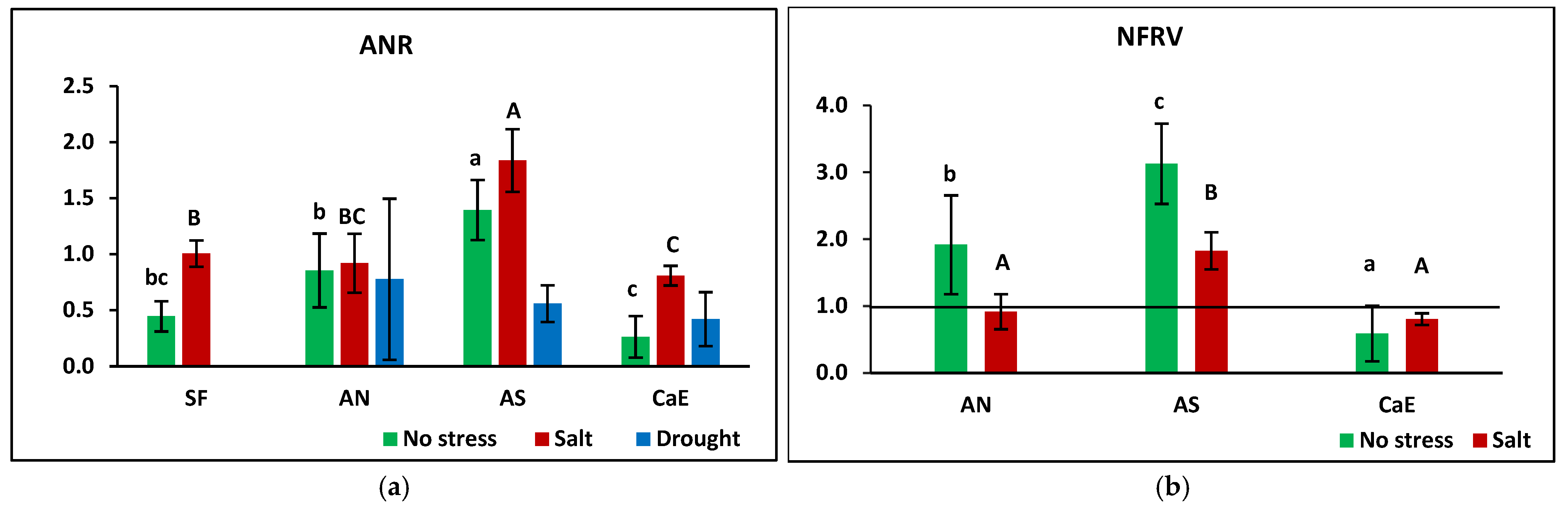
The calculation of ANR was done to understand how efficiently the crop utilises the applied N within the induced stress conditions. Unstressed and salt-stressed plants treated with AS exhibited significantly higher ANR (1.4 and 1.8, respectively) compared to the other fertilisations (Figure 1). This outcome could be attributed to the higher N uptake observed in these plants, which could be a potential consequence of the higher S fertilisation and uptake in AS-fertilised crops. Increasing S application dosage has been observed to positively impact the N uptake in certain crops, where, specifically in the case of spinach, there was an observed considerable increase in the amino acid cysteine in a past study [57]. In the current experiment, the salt-stressed plants demonstrate this N-S interaction more prominently and with statistical significance, where a positive correlation between the N and S uptake was observed for the salt-stressed plants (Pearson’s co-efficient r = 0.72, p < 0.001).
NFRV signifies the amount of synthetic fertiliser saved when replaced with a BBF while attaining the same crop yield, i.e., this indicator demonstrates the suitability of a BBF relative to a synthetic N fertiliser [13]. This indicator is commonly used to assess the agronomic suitability of BBFs compared to conventional synthetic N fertilisers, due to its direct reflectivity on the practical substitution potential of alternative products. Hence, this indicator is very relevant to the RENURE-criteria products tested in this study. NFRV depends on ANR and, hence, the N uptake results, thus showcasing a similar pattern in outcome. Both the unstressed and salt-stressed AS-treated plants exhibited significantly higher NFRV (3.1 and 1.8, respectively), compared to AN (1.9 and 0.91, respectively) and CaE-treated plants (0.59 and 0.80, respectively). Overall, the NH4+ salts show better performance and potential compared to the tested SF based on their NFRV. Since NFRV is a direct comparison of the BBF with SF, and no live plants were obtained for the drought-stressed SF treatment, NFRV could not be calculated for drought-stressed BBF-fertilised plants. And this directly indicates that, for drought-stressed plants, BBF performance can be said to be better compared to the SF treatment under the current experimental conditions.

3.3. Effect of BBF Application on Soil

Soil from each pot was assessed to determine effects, if any, of fertiliser application and induced stress (two-way ANOVA followed by multiple comparisons using the Bonferroni post hoc test). Table 6 presents the results of mineral N, pH and EC of soil, the key parameters that were seen to exhibit noticeable differences between treatments. Mineral N (NH4+-N and NO3-N) analysis of soil post-harvest helped to shed light on the impacts of stress on N use by plants. The two-way ANOVA test was performed on soil mineral N to understand effects of both fertiliser application and stressor used. Most NH4+-N would have converted to NO3-N, which the plant utilised for its growth; no significant differences under any of the treatment or stressor conditions were observed. However, large variabilities within and differences between treatments were observed in the soil NO3-N results. Within unstressed and drought-stressed conditions, SF-treated soil exhibited the highest NO3-N, albeit the very high variability seen under unstressed (also in salt-stressed) SF treatments. Soil samples from this treatment were analysed twice to rule out analytical errors, but both analyses gave similar outcomes. The wide spread of data appears to reflect inherent variability rather than measurement inconsistencies, making it inappropriate to exclude any values as outliers. Under drought-stressed conditions, the high-soil NO3-N in the SF-treated soil further validates the poor growth and eventual wilting of the crops, which is potentially an aftermath of low N mobility under low moisture-conditions. In general, higher variability is common in the case of soil NO3-N, but no specific reasons could be pointed to in this trial. Comparison of stressors within individual treatment (treatment × stressor) showed significantly higher NO3-N in the case of water-stressed soil samples in SF (p < 0.001) and AN treatment (p < 0.05), as expected, due to lower uptake. Salt-stressed soil had similar NO3-N comparable to their unstressed counterparts, indicating no effect on N mobility under conditions of higher than usual salinity.
From interaction with local farmers, it has been understood that there is concern about the potential of recovered nutrients’ impact on soil pH, especially for RENURE materials like AS that can acidify soils (when the NH4+ is converted to NO3, an H+ is released into the soil, thus increasing its pH). In this trial, it can be observed that, among pots fertilised with different BBFs, AS was seen to have significantly lower pH between the tested treatments but at par with the synthetic N treatment. Using AS on acidic soils could use some caution, especially if liming is not a common practice. Additionally, it is recommended to validate these results in fields, especially under long-term application of BBFs.
EC of soil was monitored to oversee the impacts of the RENURE NH4+ salts like AN and AS tested in this trial, i.e., if these high-salt BBFs change the soil EC. Also, EC analysis was another parameter used to ensure that the inducement of salt stress was performed adequately in the experiment to satisfy the stress condition. Despite the recommended dose of NaCl application for stress inducement, we find that the soil EC values were relatively lower at the time of analysis. This could be attributed to loss of some of the salt solution as a leachate and/or because of the air-drying and long storage of the soil samples before analyses (due to practical limitations). It has been reported that the handling and storage of samples could affect the EC in soil extracts [58,59]. This could lead to redistribution or precipitation of soluble salts, thus resulting in lower EC. Hence, the reported EC values could likely underestimate the actual salinity experienced by the plants during the experimental duration. Nevertheless, the stressed soil samples were found to have higher EC than the unstressed soil samples by a factor of ~5, 2, 4, 3, and 4 times for control, SF, AN, AS and CaE, respectively.
It was observed that, among the fertilised unstressed plants, SF-treated soil had high EC, comparable to both AS and CaE. In the case of SF, this is in tandem with the exceptionally high NO3-N observed in the soil as mentioned earlier. Nitrate loading in groundwater from agricultural use has been shown to have a direct effect on groundwater EC [60]. Among the RENURE-criteria NH4+ salts, soil treated with AN had significantly lower EC (102 µS cm−1), relative to the SF treatment (223 µS cm−1). The higher EC in the SF (CAN) can be attributed to the additional ionic strength imparted by the Ca ions in CAN.
Among drought-stressed treatments, AS had significantly higher EC compared to the other treatments (283 µS cm−1). This can be attributed to the high salt index of AS, which can increase the concentration of soluble ions in the soil, which accumulates further during lack of moisture due to drought [61]. The AS would dissociate into NH4+ and sulphate (SO42−) ions, compared to the AN that dissociates into NH4+ and NO3 ions. Since SO42− ions have a higher charge relative to the NO3 ions, the ionic strength of AS application would be stronger than that of AN application. Comparison between different stressors on the same treatment was performed, and as expected, all salt-stressed soil samples exhibited significantly higher EC compared to their unstressed and drought-stressed counterparts (p < 0.05).
It can be concluded that, for this trial, the treatment with the RENURE-criteria NH4+ salts, or induced salinity by NaCl addition did not negatively affect the soil parameters in a way that could compromise agronomic performance of the fertilisers. However, nitrate content variability requires further study.

4. Conclusions

This study evaluated the effect of N-based BBFs, specifically two high-priority RENURE materials like AN and AS, and another commercial BBF (CaE) in the growth of spinach under induced abiotic stressors like salinity and drought. Overall, the results of this study indicate comparable agronomic performance demonstrated by all three tested BBFs, compared to the SF. Plants fertilised with the BBFs exhibited comparable yield and N, K, S and Na uptake. Under drought stress, all the SF-fertilised plants withered away, leaving no plant biomass for further analyses. On the other hand, plants fertilised with BBFs could withstand the condition of drought, although with a poorer yield than their unstressed and salt-stressed counterparts. The lack of sufficient moisture stunted their growth and gave poor quality and minimal biomass, which were indicative of poor nutrient uptake. The possible reason for the resilience of crops grown in salinity stress is the increased K in plant tissues, which could have alleviated the negative impacts of increased Na in the system. However, we recommend stricter salinity control during the experiment to also ensure that the plant is subjected to sufficient stress to make stronger conclusions. Significantly higher N recovery (measured by ANR) and N replaceability value (measured by NFRV) were observed in AS-treated plants, potentially from the excessive S fertilisation that could have boosted the N uptake, which was observed especially in the salt-stressed plants. The interactions of Na-K and N-S, under salinity stress need to be further delved into, to understand how to alleviate and manage abiotic stress conditions, which can be expected globally in the near future. The aim of this study was to learn about agronomic performance of novel BBFs, specifically of the RENURE products, under stress conditions, which have yielded favourable outcomes for these materials. BBFs such as CaE with high K content warrant further study to better understand their role in reducing abiotic stress and enhancing both crop fertilisation and resilience to soil or climate changes.
We recommend further trials that can also evaluate plant physiological indicators, like chlorophyll index, stomatal conductance, etc. which can give a deeper understanding of stress effects, and identify the absence of this information as a limitation in the current trial.

Author Contributions

A.S.: Conceptualisation, Methodology, Data Curation, Writing—Original Draft Preparation, Editing and Draft Finalisation. I.S.: Conceptualisation, Methodology, Writing—Reviewing and Editing. E.M.: Supervision, Conceptualisation, Writing: Reviewing. All authors have read and agreed to the published version of the manuscript.

Funding

This research was performed as a part of the Nutri2Cycle project funded by HORIZON 2020 RESEARCH AND INNOVATION PROGRAMME, grant number 773682, and co-financed by VLAIO and the Province of West Flanders.

Data Availability Statement

The datasets generated during and/or analysed during the current study are available from the corresponding author upon reasonable request.

Conflicts of Interest

The authors declare that they have no known competing financial interests or personal relationships that could have appeared to influence the work reported in this paper.

Abbreviations

The following abbreviations are used in this manuscript:
ADAnaerobic digestion
ANAmmonium nitrate
ANRApparent nitrogen recovery
ASAmmonium sulphate
BBFBio-based fertiliser
CaCalcium
CaEConcentrate after evaporation
CANCalcium ammonium nitrate
CO2Carbon dioxide
DMDry matter
ECElectrical conductivity
EUEuropean Union
KPotassium
K2SO4Potassium sulphate
NNitrogen
NaSodium
NaClSodium chloride
NH3Ammonia
NH4+Ammonium
NFRVNitrogen fertiliser replacement value
NO3Nitrate
OCOrganic carbon
OMOrganic matter
PPhosphorus
RENURERecovered nitrogen from manure
SSulphur
SFSynthetic fertiliser
TSPTriple super phosphate

References

  1. Wang, Y.; Meyer, T.J. A Route to Renewable Energy Triggered by the Haber-Bosch Process. Chem 2019, 5, 496–497. [Google Scholar] [CrossRef]
  2. Statista. Global Ammonia Production 2010–2024. Available online: https://www.statista.com/statistics/1266378/global-ammonia-production/ (accessed on 5 March 2025).
  3. Baffes, J.; Chian Koh, W. Fertilizer Prices Ease but Affordability and Availability Issues Linger. World Bank 2023. Available online: https://blogs.worldbank.org/opendata/fertilizer-prices-ease-affordability-and-availability-issues-linger (accessed on 7 June 2024).
  4. Buckwell, A.; Nadeu, E. Nutrient Recovery and Reuse (NRR) in European Agriculture. In A Review of the Issues, Opportunities, and Actions; RISE Foundation: Brussels, Belgium, 2016. [Google Scholar]
  5. European Commission. Circular Action Economy Plan for a Cleaner and More Competitive Europe. 2015. Available online: https://faolex.fao.org/docs/pdf/eur199856.pdf (accessed on 7 June 2024).
  6. EU. Regulation (EU) 2019/1009 of the European Parliament and of the Council of 5 June 2019—Laying Down Rules on the Making Available on the Market of EU Fertilising Products and Amending Regulations (EC) No 1069/2009 and (EC) No 1107/2009 and Repealing Regulation (EC) No 2003/2003. Off. J. Eur. Union 2019, L170, 1–114. Available online: https://eur-lex.europa.eu/legal-content/EN/TXT/?uri=CELLAR:e351eb07-9713-11e9-9369-01aa75ed71a1 (accessed on 7 June 2024).
  7. Huygens, D.; Orveillon, G.; Lugato, E.; Tavazzi, S.; Comero, S.; Jones, A.; Gawlik, B.; Saveyn, H.G.M. Technical Proposals for the Safe Use of Processed Manure Above the Threshold Established for Nitrate Vulnerable Zones by the Nitrates Directive (91/676/EEC); JRC121636; Publications Office of the European Union: Luxembourg, 2020; Volume 170. [Google Scholar]
  8. Wester-Larsen, L.; Müller-Stöver, D.S.; Salo, T.; Jensen, L.S. Potential Ammonia Volatilization from 39 Different Novel Biobased Fertilizers on the European Market—A Laboratory Study Using 5 European Soils. J. Environ. Manag. 2022, 323, 116249. [Google Scholar] [CrossRef] [PubMed]
  9. Sigurnjak, I.; Brienza, C.; Snauwaert, E.; De Dobbelaere, A.; De Mey, J.; Vaneeckhaute, C.; Michels, E.; Schoumans, O.; Adani, F.; Meers, E. Production and Performance of Bio-Based Mineral Fertilizers from Agricultural Waste Using Ammonia (Stripping-) Scrubbing Technology. Waste Manag. 2019, 89, 265–274. [Google Scholar] [CrossRef] [PubMed]
  10. Luo, H.; Robles-Aguilar, A.A.; Sigurnjak, I.; Michels, E.; Meers, E. Assessing Nitrogen Availability in Biobased Fertilizers: Effect of Vegetation on Mineralization Patterns. Agriculture 2021, 11, 870. [Google Scholar] [CrossRef]
  11. Reuland, G.; Sigurnjak, I.; Dekker, H.; Michels, E.; Meers, E. The Potential of Digestate and the Liquid Fraction of Digestate as Chemical Fertiliser Substitutes under the RENURE Criteria. Agronomy 2021, 11, 1374. [Google Scholar] [CrossRef]
  12. Hendriks, C.M.J.; Shrivastava, V.; Sigurnjak, I.; Lesschen, J.P.; Meers, E.; van Noort, R.; Yang, Z.; Rietra, R.P.J.J. Replacing Mineral Fertilisers for Bio-Based Fertilisers in Potato Growing on Sandy Soil: A Case Study. Appl. Sci. 2022, 12, 341. [Google Scholar] [CrossRef]
  13. Saju, A.; Ryan, D.; Sigurnjak, I.; Germaine, K.; Dowling, D.N.; Meers, E. Digestate-Derived Ammonium Fertilizers and Their Blends as Substitutes to Synthetic Nitrogen Fertilizers. Appl. Sci. 2022, 12, 3787. [Google Scholar] [CrossRef]
  14. Saju, A.; Van De Sande, T.; Ryan, D.; Karpinska, A.; Sigurnjak, I.; Dowling, D.N.; Germaine, K.; Kakouli-Duarte, T.; Meers, E. Exploring the Short-Term in-Field Performance of Recovered Nitrogen from Manure (RENURE) Materials to Substitute Synthetic Nitrogen Fertilisers. Clean. Circ. Bioecon. 2023, 5, 100043. [Google Scholar] [CrossRef]
  15. Wang, W.; Vinocur, B.; Altman, A. Plant Responses to Drought, Salinity and Extreme Temperatures: Towards Genetic Engineering for Stress Tolerance. Planta 2003, 218, 1–14. [Google Scholar] [CrossRef]
  16. Munns, R. Genes and Salt Tolerance: Bringing Them Together. New Phytol. 2005, 167, 645–663. [Google Scholar] [CrossRef]
  17. Munns, R.; Tester, M. Mechanisms of Salinity Tolerance. Annu. Rev. Plant Biol. 2008, 59, 651–681. [Google Scholar] [CrossRef] [PubMed]
  18. Zhang, Y.; Fang, J.; Wu, X.; Dong, L. Na+/K+ Balance and Transport Regulatory Mechanisms in Weedy and Cultivated Rice (Oryza sativa L.) under Salt Stress. BMC Plant Biol. 2018, 18, 375. Available online: https://link.springer.com/article/10.1186/s12870-018-1586-9 (accessed on 13 January 2026). [CrossRef] [PubMed]
  19. Ullah, A.; Bano, A.; Khan, N. Climate Change and Salinity Effects on Crops and Chemical Communication between Plants and Plant Growth-Promoting Microorganisms under Stress. Front. Sustain. Food Syst. 2021, 5, 618092. [Google Scholar] [CrossRef]
  20. EIP-AGRI. EIP-AGRI Focus Group: Soil Salinisation—Final Report; European Commission: Brussels, Belgium, July 2020; Available online: https://eu-cap-network.ec.europa.eu/sites/default/files/publication/2023-05/eip-agri_fg_soil_salinisation_final_report_2020_en.pdf (accessed on 7 June 2024).
  21. Seymen, M. Comparative Analysis of the Relationship between Morphological, Physiological, and Biochemical Properties in Spinach (Spinacea oleracea L.) under Deficit Irrigation Conditions. Turk. J. Agric. For. 2021, 45, 55–67. [Google Scholar]
  22. Avramova, V.; AbdElgawad, H.; Zhang, Z.; Fotschki, B.; Casadevall, R.; Vergauwen, L.; Knapen, D.; Taleisnik, E.; Guisez, Y.; Asard, H. Drought Induces Distinct Growth Response, Protection, and Recovery Mechanisms in the Maize Leaf Growth Zone. Plant Physiol. 2015, 169, 1382–1396. [Google Scholar] [CrossRef]
  23. Trenberth, K.E.; Dai, A.; Van Der Schrier, G.; Jones, P.D.; Barichivich, J.; Briffa, K.R.; Sheffield, J. Global Warming and Changes in Drought. Nat. Clim. Change 2014, 4, 17–22. [Google Scholar] [CrossRef]
  24. McFadden, J.; Smith, D.; Wechsler, S.; Wallander, S. Development, Adoption, and Management of Drought-Tolerant Corn in the United States; Report number: EIB-204; United States Department of Agriculture: Washington, DC, USA, 2019. [Google Scholar]
  25. Spinoni, J.; Vogt, J.V.; Naumann, G.; Barbosa, P.; Dosio, A. Will Drought Events Become More Frequent and Severe in Europe? Int. J. Climatol. 2018, 38, 1718–1736. [Google Scholar] [CrossRef]
  26. Van Ranst, E.; Sys, C. Eenduidige Legende Voor de Digitale Bodemkaart van Vlaanderen (Schaal 1: 20,000); Laboratorium voor Bodemkunde: Gent, Belgium, 2000. (In Dutch) [Google Scholar]
  27. Turhan, A.; Kuscu, H.; Ozmen, N.; Asik, B.B.; Serbeci, M.S.; Seniz, V. Alleviation of Deleterious Effects of Salt Stress by Applications of Supplementary Potassium–Calcium on Spinach. Acta Agric. Scand. Sect. B—Soil Plant Sci. 2013, 63, 184–192. [Google Scholar] [CrossRef]
  28. Liu, J.; Shao, Y.; Feng, X.; Otie, V.; Matsuura, A.; Irshad, M.; Zheng, Y.; An, P. Cell Wall Components and Extensibility Regulate Root Growth in Suaeda Salsa and Spinacia Oleracea under Salinity. Plants 2022, 11, 900. [Google Scholar] [CrossRef]
  29. Downton, W.J.S.; Grant, W.J.R.; Robinson, S.P. Photosynthetic and Stomatal Responses of Spinach Leaves to Salt Stress. Plant Physiol. 1985, 78, 85–88. [Google Scholar] [CrossRef] [PubMed]
  30. Cavalli, D.; Cabassi, G.; Borrelli, L.; Geromel, G.; Bechini, L.; Degano, L.; Gallina, P.M. Nitrogen Fertilizer Replacement Value of Undigested Liquid Cattle Manure and Digestates. Eur. J. Agron. 2016, 73, 34–41. [Google Scholar] [CrossRef]
  31. Schröder, J.J.; De Visser, W.; Assinck, F.B.T.; Velthof, G.L. Effects of Short-term Nitrogen Supply from Livestock Manures and Cover Crops on Silage Maize Production and Nitrate Leaching. Soil Use Manag. 2013, 29, 151–160. [Google Scholar] [CrossRef]
  32. Tampio, E.; Salo, T.; Rintala, J. Agronomic Characteristics of Five Different Urban Waste Digestates. J. Environ. Manag. 2016, 169, 293–302. [Google Scholar] [CrossRef]
  33. Praba, M.L.; Cairns, J.E.; Babu, R.C.; Lafitte, H.R. Identification of Physiological Traits Underlying Cultivar Differences in Drought Tolerance in Rice and Wheat. J. Agron. Crop Sci. 2009, 195, 30–46. [Google Scholar] [CrossRef]
  34. Farooq, M.; Wahid, A.; Kobayashi, N.; Fujita, D.; Basra, S.M.A. Plant Drought Stress: Effects, Mechanisms and Management. Agron. Sustain. Dev. 2009, 29, 185–212. [Google Scholar] [CrossRef]
  35. Dubey, R.; Srivastava, R.; Pessarakli, M. Physiological Mechanisms of Nitrogen Absorption and Assimilation in Plants under Stressful Conditions. In Handbook of Plant and Crop Physiology, 4th ed.; Pessarakli, M., Ed.; CRC Press: Boca Raton, FL, USA, 2021; pp. 579–616. [Google Scholar]
  36. Geremew, A.; Carson, L.; Woldesenbet, S.; Carpenter, C.; Peace, E.; Weerasooriya, A. Interactive Effects of Organic Fertilizers and Drought Stress on Growth and Nutrient Content of Brassica Juncea at Vegetative Stage. Sustainability 2021, 13, 13948. [Google Scholar] [CrossRef]
  37. Guasconi, D.; Cousins, S.A.O.; Manzoni, S.; Roth, N.; Hugelius, G. Experimental Drought and Soil Amendments Affect Grassland Above- and Belowground Vegetation but Not Soil Carbon Stocks. SOIL 2025, 11, 233–246. [Google Scholar] [CrossRef]
  38. Sun, Y.; Tao, C.; Deng, X.; Liu, H.; Shen, Z.; Liu, Y.; Li, R.; Shen, Q.; Geisen, S. Organic Fertilization Enhances the Resistance and Resilience of Soil Microbial Communities under Extreme Drought. J. Adv. Res. 2023, 47, 1–12. [Google Scholar] [CrossRef]
  39. Dimkpa, C.O.; Fugice, J.; Singh, U.; Lewis, T.D. Development of Fertilizers for Enhanced Nitrogen Use Efficiency—Trends and Perspectives. Sci. Total Environ. 2020, 731, 139113. [Google Scholar] [CrossRef]
  40. Moreno-Jiménez, E.; Plaza, C.; Saiz, H.; Manzano, R.; Flagmeier, M.; Maestre, F.T. Aridity and Reduced Soil Micronutrient Availability in Global Drylands. Nat. Sustain. 2019, 2, 371–377. [Google Scholar] [CrossRef]
  41. Maghsoudi, K.; Emam, Y.; Niazi, A.; Pessarakli, M.; Arvin, M.J. P5CS Expression Level and Proline Accumulation in the Sensitive and Tolerant Wheat Cultivars under Control and Drought Stress Conditions in the Presence/Absence of Silicon and Salicylic Acid. J. Plant Interact. 2018, 13, 461–471. [Google Scholar] [CrossRef]
  42. Mardani, S.; Pessarakli, M.; McDaniel, R. Growth Responses of Pepper Plant (Capsicum annuum L.) in Terms of Biomass Production and Water Uptake under Deficit Irrigation System, Mild Water Stress Conditions. In Handbook of Plant and Crop Stress, 4th ed.; CRC Press: Boca Raton, FL, USA, 2019; pp. 681–688. [Google Scholar]
  43. Zheng, Y.; Xia, Z.; Ma, H.; Yu, Z. The Combined Effects of Water Deficit and Heat Stress on Physiological Characteristics of Endangered Nouelia Insignis. Acta Physiol. Plant. 2019, 41, 177. Available online: https://link.springer.com/article/10.1007/s11738-019-2955-1 (accessed on 13 January 2026). [CrossRef]
  44. Xu, C.; Mou, B. Responses of Spinach to Salinity and Nutrient Deficiency in Growth, Physiology, and Nutritional Value. J. Am. Soc. Hortic. Sci. 2016, 141, 12–21. [Google Scholar] [CrossRef]
  45. Ors, S.; Suarez, D.L. Spinach Biomass Yield and Physiological Response to Interactive Salinity and Water Stress. Agric. Water Manag. 2017, 190, 31–41. [Google Scholar] [CrossRef]
  46. Wang, M.; Zheng, Q.; Shen, Q.; Guo, S. The Critical Role of Potassium in Plant Stress Response. Int. J. Mol. Sci. 2013, 14, 7370–7390. [Google Scholar] [CrossRef]
  47. Cakmak, I. The Role of Potassium in Alleviating Detrimental Effects of Abiotic Stresses in Plants. J. Plant Nutr. Soil Sci. 2005, 168, 521–530. [Google Scholar] [CrossRef]
  48. Zheng, Y.; Jia, A.; Ning, T.; Xu, J.; Li, Z.; Jiang, G. Potassium Nitrate Application Alleviates Sodium Chloride Stress in Winter Wheat Cultivars Differing in Salt Tolerance. J. Plant Physiol. 2008, 165, 1455–1465. [Google Scholar] [CrossRef]
  49. Ferreira, J.F.S.; Sandhu, D.; Liu, X.; Halvorson, J.J. Spinach (Spinacea oleracea L.) Response to Salinity: Nutritional Value, Physiological Parameters, Antioxidant Capacity, and Gene Expression. Agriculture 2018, 8, 163. [Google Scholar] [CrossRef]
  50. Marschner, P. (Ed.) Marschner’s Mineral Nutrition of Higher Plants; Elsevier: Amsterdam, The Netherlands, 2012. [Google Scholar] [CrossRef]
  51. Shabala, S.; Cuin, T.A. Potassium Transport and Plant Salt Tolerance. Physiol. Plant. 2008, 133, 651–669. [Google Scholar] [CrossRef]
  52. Botella, M.A.; Martinez, V.; Pardines, J.; Cerdá, A. Salinity Induced Potassium Deficiency in Maize Plants. J. Plant Physiol. 1997, 150, 200–205. [Google Scholar] [CrossRef]
  53. Coskun, D.; Britto, D.T.; Kronzucker, H.J. Regulation and Mechanism of Potassium Release from Barley Roots: An in Planta 42K+ Analysis. New Phytol. 2010, 188, 1028–1038. [Google Scholar] [CrossRef]
  54. Chen, Z.; Zhou, M.; Newman, I.A.; Mendham, N.J.; Zhang, G.; Shabala, S. Potassium and Sodium Relations in Salinised Barley Tissues as a Basis of Differential Salt Tolerance. Funct. Plant Biol. 2007, 34, 150. [Google Scholar] [CrossRef]
  55. Qu, C.; Liu, C.; Ze, Y.; Gong, X.; Hong, M.; Wang, L.; Hong, F. Inhibition of Nitrogen and Photosynthetic Carbon Assimilation of Maize Seedlings by Exposure to a Combination of Salt Stress and Potassium-Deficient Stress. Biol. Trace Element Res. 2011, 144, 1159–1174. [Google Scholar] [CrossRef] [PubMed]
  56. Qu, C.; Liu, C.; Gong, X.; Li, C.; Hong, M.; Wang, L.; Hong, F. Impairment of Maize Seedling Photosynthesis Caused by a Combination of Potassium Deficiency and Salt Stress. Environ. Exp. Bot. 2012, 75, 134–141. [Google Scholar] [CrossRef]
  57. Smatanová, M.; Richter, R.; Hlušek, J. Spinach and Pepper Response to Nitrogen and Sulphur Fertilization. Plant Soil Environ. 2004, 50, 303–308. [Google Scholar] [CrossRef]
  58. Ilyas, S.; de la Loma, M.C. Salinity Measurement in Soils: Effects of Sample Handling and Preparation; Food and Agriculture Organization of the United Nations: Rome, Italy, 1986. [Google Scholar]
  59. Rhoades, J.D. Methods of Soil Analysis: Part 3—Chemical Methods. In Salinity: Electrical Conductivity and Total Dissolved Solids; Sparks, D.L., Page, A.L., Helmke, P.A., Loeppert, R.H., Soltanpour, P.N., Tabatabai, M.A., Johnston, C.T., Sumner, M.E., Eds.; Soil Science Society of America: Madison, WI, USA, 1996; pp. 417–435. [Google Scholar]
  60. Mahanta, A.R.; Rawat, K.S.; Singh, S.K.; Sanjeevi, S.; Mishra, A.K. Evaluation of Long-Term Nitrate and Electrical Conductivity in Groundwater System of Peninsula, India. Appl. Water Sci. 2022, 12, 17. [Google Scholar] [CrossRef]
  61. Buck, G.B.; de Castro, G.F.; Mattiello, E.M.; Zotarelli, L. Applications of Gypsum and Ammonium Sulfate Change Soil Chemical Properties of a Salt-Affected Agricultural Soil. J. Agric. Sci. 2020, 12, 1. [Google Scholar] [CrossRef]
Figure 1. (a) Mean apparent nitrogen recovery (ANR) of fertilised treatments and (b) mean nitrogen fertiliser replacement value (NFRV) of all tested BBFs with standard deviation (n = 4). Significant differences between treatments within individual stressor categories are compared for both parameters using standard ANOVA, followed by Tukey’s post hoc pairwise comparison. The differences between treatments within individual stressors are indicated using lower-case letters for the ‘no stress category’ and using upper-case letters for the ‘salt-stress’ category. The horizontal line at Y axis = 1 for NFRV indicates the point of comparison for all BBFs relative to the SF. Drought-stressed SF plants were dead at harvest and are not included in the data interpretation of ANR, consequently, having no NFRV calculated. SF: Synthetic fertiliser; AN: Ammonium nitrate; AS: Ammonium sulphate; and CaE: Concentrate after evaporation.
Nitrogen 07 00014 g001
Table 1. Physio-chemical characterisation of tested BBFs on fresh weight basis.
BBFs Tested
ParametersAmmonium NitrateAmmonium SulphateConcentrate After Evaporation
pH6.56.29.4 *
EC (mS cm−1)312211102
DM (%)272118
Total N (g kg−1)100426.9
NH4+-N (g kg−1)44422
NO3-N (g kg−1)56<0.002<0.002
Total P (g kg−1)0.010.071.4
Total K (g kg−1)0.030.2314
Total Na (g kg−1)0.092.120
*: pH-KCl for concentrate after evaporation. EC: electrical conductivity; and DM: dry matter.
Table 2. Physio-chemical characterisation of soil before start of experiment.
pH-KClEC
(µS cm−1)
OM
(%)
OC
(%)
Total N
(g kg−1)
NH4+-N (mg kg−1)NO3-N (mg kg−1)Total P
(g kg−1)
Total K
(g kg−1)
Total Na
(g kg−1)
5.61221.90.931.314411.21.00.05
EC: electrical conductivity; OM: organic matter; and OC: organic carbon.
Table 3. Application rates of products (g pot−1) and macronutrients (mg pot−1) in the pots as per recommended nutrient dosage.
TreatmentsProduct Application (g pot−1)Nutrients Applied
(mg pot−1)
CANTSPPATANASCaENtotalP2O5K2OSO3
Control000000000
SF0.240.100.64---7320112158
AN0.120.050.32---7320112158
AS-0.100.640.88--7320112339
CaE-0.030.16-0.123.9732011225
CAN: Calcium ammonium nitrate; TSP: Triple super phosphate; PAT: Potassium sulphate; SF: Synthetic fertiliser (CAN); AN: Ammonium nitrate; AS: Ammonium sulphate; CaE: Concentrate after evaporation.
Table 4. Mean fresh and dry yield (g pot−1) of spinach presented with their standard deviation (n = 4).
Treatments
StressorYield Type
(g pot−1)
ControlSynthetic FertiliserAmmonium NitrateAmmonium SulphateConcentrate After Evaporation
No stressFresh yield13 ± 7.8 a22 ± 1.0 ab25 ± 5.8 ab 34 ± 2.0 b24 ± 1.1 ab
Dry yield0.89 ± 0.58 A2.1 ± 0.19 B2.1 ± 0.56 B2.8 ± 0.19 B 2.1 ± 0.33 B
Salt stressFresh yield11 ± 10 a26 ± 3.2 ab 28 ± 3.6 ab 33 ± 7.3 b 32 ± 1.0 b
Dry yield1.0 ± 0.98 A2.4 ± 0.37 AB2.3 ± 0.37 AB2.8 ± 0.58 B2.8 ± 0.15 B
Drought stressFresh yield9.4 ± 0.45 aNo biomass at harvest14 ± 3.8 ab10 ± 1.4 ab 16 ± 3.6 b
Dry yield0.79 ± 0.16 ANo biomass at harvest1.6 ± 1.0 AB1.2 ± 0.17 AB1.8 ± 0.39 B
For both yield types, the treatments under each category of stress are compared amongst each other using the non-parametric ANOVA (Kruskal–Wallis test) due to failure of the normality test (p < 0.050) or failure of the test of Variance (p < 0.050) (except for dry yield under no stress—tested by parametric ANOVA, followed by pairwise comparison by Tukey’s post hoc test). When significant differences between treatments are found after the Kruskal-Wallis test (p < 0.05), post hoc testing with Dunn’s pairwise comparison is performed. Significant differences between treatments of each category of stress are indicated by lower-case letters for fresh yield and upper-case letters for dry yield. Comparisons between treatments are performed within the same stressor category only (e.g., the treatment ‘Control’ is compared with the treatment ‘SF’ under ‘No stress’ only and not with SF under ‘Salt stress’ OR ‘Drought stress’).
Table 5. Mean N, S, K and Na uptake (g pot−1) of spinach presented with their standard deviation (n = 4).
Treatments
StressorNutrient Uptake
(g pot−1)
ControlSynthetic FertiliserAmmonium NitrateAmmonium SulphateConcentrate After Evaporation
No stressN0.05 ± 0.03 c0.09 ± 0.01 bc0.11 ± 0.02 ab0.14 ± 0.02 a0.07 ± 0.01 bc
S0.003 ± 0.0020.009 ± 0.0010.005 ± 0.0050.008 ± 0.0060.008 ± 0.001
K0.09 ± 0.06 α0.24 ± 0.05 β0.23 ± 0.08 β0.28 ± 0.04 β0.21 ± 0.05 αβ
Na0.002 ± 0.001 *0.004 ± 0.002 *°0.004 ± 0.001 *°0.009 ± 0.002 *°0.015 ± 0.003 °
Salt stressN0.03 ± 0.03 a0.11 ± 0.01 bc0.10 ± 0.02 c0.14 ± 0.02 b0.10 ± 0.01 c
S0.003 ± 0.002 B0.009 ± 0.002 A0.002 ± 0.000 B0.013 ± 0.002 A0.009 ± 0.000 A
K0.13 ± 0.140.26 ± 0.060.26 ± 0.070.30 ± 0.060.30 ± 0.01
Na0.009 ± 0.006 *0.019 ± 0.007 *°0.014 ± 0.002 *°0.021 ± 0.006 *°0.035 ± 0.014 °
Drought stressN0.03 ± 0.00n.a.0.09 ± 0.050.07 ± 0.010.07 ± 0.02
S0.003 ± 0.001 Cn.a. 0.001 ± 0.001 B0.006 ± 0.001 A0.006 ± 0.001 A
K0.10 ± 0.02n.a.0.17 ± 0.100.13 ± 0.010.17 ± 0.04
Na0.002 ± 0.00 *n.a.0.004 ± 0.00 *°0.002 ± 0.00 *°0.013 ± 0.00 °
n.a.: not applicable. All treatments are compared at individual stress categories for differences in each nutrient uptake using the parametric ANOVA test (p < 0.05) followed by Tukey’s post hoc pairwise comparison. When the assumptions for the standard ANOVA are unmet, i.e., the Normality test (p < 0.050) or the test of Variance (p < 0.050) failed, the non-parametric ANOVA (Kruskal–Wallis test) is performed (p < 0.05) followed by Dunn’s post hoc pairwise comparison. Significant differences between treatments of each category of stress are indicated by lower-case letters for N uptake, upper-case letters for S uptake, symbols α and β for K uptake and the symbols * and ° for Na uptake. Comparisons between treatments are performed within the same stressor category only (e.g., treatment ‘Control’ is compared with treatment ‘SF’ under ‘No stress’ only and not with SF under ‘Salt stress’ OR ‘Drought stress’). Drought-stressed SF plants are dead at harvest; hence, no nutrient uptake can be calculated.
Table 6. Mean ± standard deviation of mineral N (NH4+-N and NO3-N) on fresh weight and pH and electrical conductivity (EC) of air-dried soil (n = 4) presented for each stress category.
Treatments
StressorSoil ParametersControlSynthetic FertiliserAmmonium NitrateAmmonium SulphateConcentrate After Evaporation
No stressNH4+-N (mg kg−1)2.7 ± 0.973.0 ± 1.11.9 ± 0.412.3 ± 1.02.2 ± 0.62
NO3-N (mg kg−1)4.6 ± 6.9 a51 ± 51 b0.60 ± 0.29 a11 ± 20 ab1.7 ± 2.9 a
pH5.69 ± 0.06 C5.34 ± 0.05 A5.57 ± 0.09 C5.21 ± 0.03 A5.84 ± 0.09 B
EC (µS cm−1)92 ± 25 α223 ± 32 β102 ± 12 α168 ± 13 αβ146 ± 13 αβ
Salt stressNH4+-N (mg kg−1)2.3 ± 0.282.0 ± 0.382.3 ± 0.452.2 ± 0.762.2 ± 0.77
NO3-N (mg kg−1)7.8 ± 9.918 ± 16 1.8 ± 2.812 ± 211.7 ± 2.9
pH5.74 ± 0.02 A5.41 ± 0.08 C5.64 ± 0.07 AB5.31 ± 0.04 C5.69 ± 0.08 B
EC (µS cm−1)440 ± 26 αβ530 ± 68 αβ427 ± 51 β483 ± 68 αβ551 ± 165 α
Drought stressNH4+-N (mg kg−1)2.9 ± 0.612.8 ± 0.62 3.1 ± 1.12.2 ± 0.422.6 ± 0.68
NO3-N (mg kg−1)1.2 ± 0.36 c132 ± 32 a46 ± 22 b26 ± 19 bc2.1 ± 2.2 c
pH5.76 ± 0.045.41 ± 0.055.48 ± 0.06 5.30 ± 0.045.79 ± 0.10
EC (µS cm−1)91 ± 29 γ263 ± 32 αβ151 ± 11 βγ283 ± 30 α120 ± 20 γ
All soil parameters are compared based on both the effect of treatment and effect of stress using the two-way ANOVA, followed by multiple comparison using the Bonferroni post hoc stress, where effect of treatment, stress and Treatment × Stress are determined (p < 0.05). In the case of NO3-N, the normality and variability test failed (p < 0.05) due to high variability between replicates. The ANOVA test for independent factors and factor interactions were significant (p < 0.01). Lower-case letters indicate significant differences for NO3N, upper-case letters for pH and symbols α, β, γ indicate differences in the case of EC of soil. Significant differences between interactions (Treatment × Stressor) are not indicated in the table.
Disclaimer/Publisher’s Note: The statements, opinions and data contained in all publications are solely those of the individual author(s) and contributor(s) and not of MDPI and/or the editor(s). MDPI and/or the editor(s) disclaim responsibility for any injury to people or property resulting from any ideas, methods, instructions or products referred to in the content.