


Finite-Time Stability Analysis for Delayed Fuzzy Hadamard Fractional-Order Systems


Abstract
1. Introduction
- The FTSA problem of delayed fractional-order systems with the Caputo–Hadamard derivative has not yet been addressed in the literature. Accordingly, this issue is resolved in this work.
- The issue of FTSA is similarly explored in [20] for delayed fractional-order systems utilizing the Caputo derivative. Like this work, an interval time-varying delay is considered in this paper. The LMI conditions in [20] are formulated with a tuning parameter that must represent the lower bound of the time delay. In this paper, this restriction is overcome and the tuning parameter can be any positive scalar.
- In the existing results that consider the Caputo derivative, the problem of FTS is solved in two steps [6,20,21,22]. Firstly, the LMI conditions are solved. Then, conditions containing Mittag-Leffler functions are verified. In contrast to these works, we address the drawback of the two-step results by proposing one-step results that require solving LMIs and verifying the conditions containing Mittag-Leffler functions in only a single step.
2. Preliminaries
- The solution of the FOS
- Plant Rule : If is and … and is , then
- The global DTSFM is
- , in which and .
3. Main Results
- Then,
- It follows from Lemma 2 that
3.1. Nominal Case
- Step 1: For a given scalar , there such that LMIs (12) are satisfied.
- Step 2: P consists of a known matrix obtained in step 1. Minimize subject to (13).
3.2. Uncertain Case
- Step 1: For a given scalar , there such that these LMIs are satisfied:
- Step 2: P consists of a known matrix obtained in step 1. Minimize subject to (13).
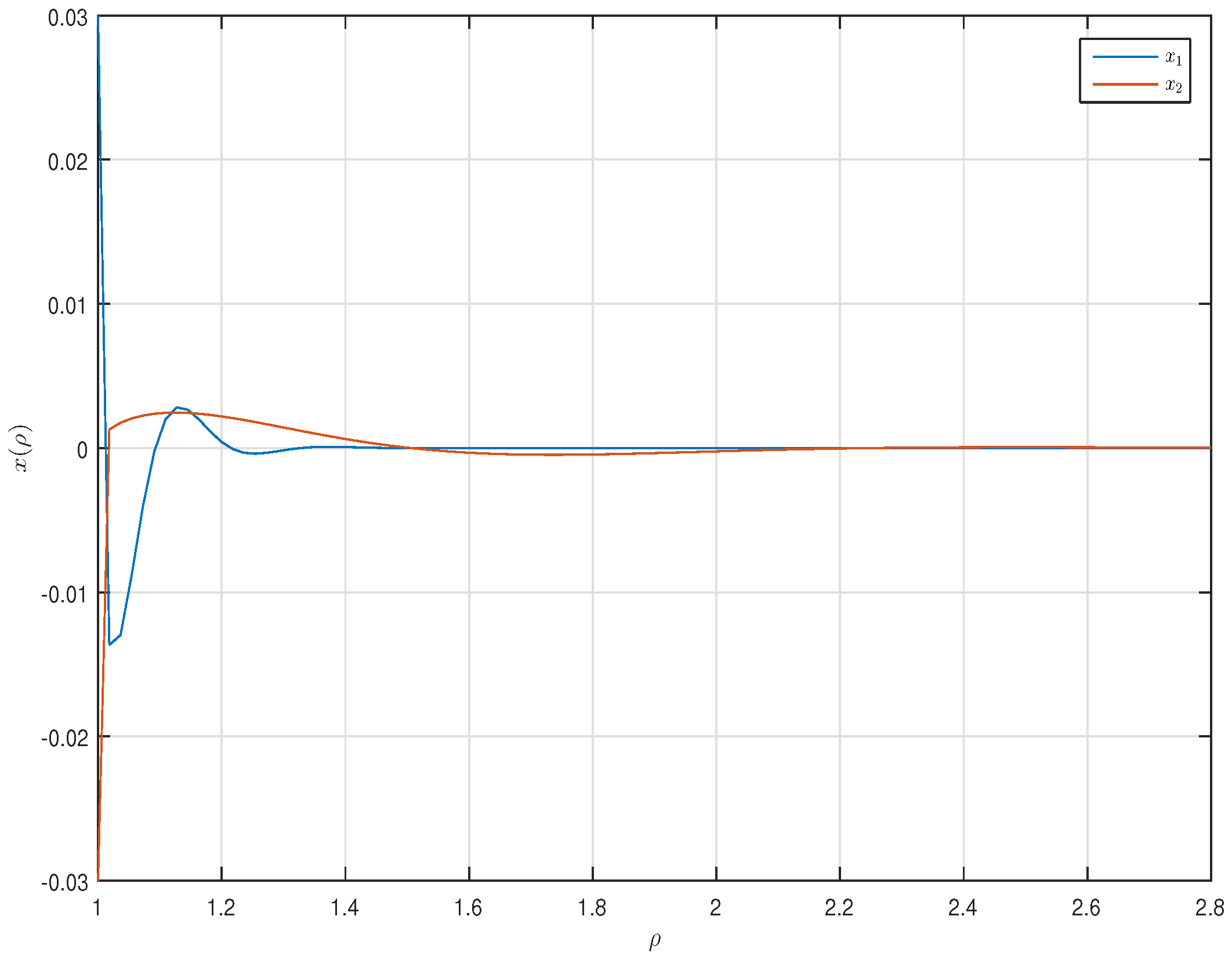
4. Illustrative Example
5. Conclusions
Author Contributions
Funding
Data Availability Statement
Acknowledgments
Conflicts of Interest
References
- Yang, R.; Liu, S.; Li, X.; Huang, T. Stability analysis of delayed fractional-order switched systems. Trans. Inst. Meas. Control 2023, 45, 502–511. [Google Scholar] [CrossRef]
- Yang, X.; Wu, X.; Song, Q. Caputo-Wirtinger integral inequality and its application to stability analysis of fractional-order systems with mixed time-varying delays. Appl. Math. Comput. 2024, 460, 128303. [Google Scholar] [CrossRef]
- Alalyani, A.; Saber, S. Stability analysis and numerical simulations of the fractional COVID-19 pandemic model. Int. J. Nonlinear Sci. Numer. Simul. 2023, 24, 989–1002. [Google Scholar] [CrossRef]
- Wang, F.X.; Zhang, J.; Shu, Y.J.; Liu, X.G. Stability analysis for fractional-order neural networks with time-varying delay. Asian J. Control 2023, 25, 1488–1498. [Google Scholar] [CrossRef]
- Ben Makhlouf, A. Partial practical stability for fractional-order nonlinear systems. Math. Methods Appl. Sci. 2022, 45, 5135–5148. [Google Scholar] [CrossRef]
- Thanh, N.T.; Phat, V.N.; Niamsup, P. New finite-time stability analysis of singular fractional differential equations with time-varying delay. Fract. Calc. Appl. Anal. 2020, 23, 504–519. [Google Scholar] [CrossRef]
- He, B.B.; Zhou, H.C.; Kou, C.H. Stability analysis of Hadamard and Caputo-Hadamard fractional nonlinear systems without and with delay. Fract. Calc. Appl. Anal. 2022, 25, 2420–2445. [Google Scholar] [CrossRef]
- Wang, G.; Pei, K.; Chen, Y.Q. Stability analysis of nonlinear Hadamard fractional differential system. J. Frankl. Inst. 2019, 356, 6538–6546. [Google Scholar] [CrossRef]
- Chen, L.; He, Y.; Chai, Y.; Wu, R. New results on stability and stabilization of a class of nonlinear fractional-order systems. Nonlinear Dyn. 2013, 75, 633–641. [Google Scholar] [CrossRef]
- Boucenna, D.; Ben Makhlouf, A.; Naifar, O.; Guezane-Lakoud, A.; Hammami, M.A. Linearized stability analysis of Caputo-Katugampola fractional-order nonlinear systems. J. Nonlinear Funct. Anal. 2018, 2018, 27. [Google Scholar]
- Mchiri, L.; Ben Makhlouf, A.; Baleanu, D.; Rhaima, M. Finite-time stability of linear fractional-order time-delay systems. Adv. Differ. Equ. 2021, 2021, 345. [Google Scholar] [CrossRef]
- Ben Makhlouf, A. A novel finite time stability analysis of nonlinear fractional-order time delay systems: A fixed point approach. Asian J. Control 2022, 24, 3580–3587. [Google Scholar] [CrossRef]
- Takagi, T.; Sugeno, M. Fuzzy identification of systems and its applications to modeling and control. IEEE Trans. Syst. Man Cybern. 1985, 15, 116–132. [Google Scholar] [CrossRef]
- Ruan, Y.; Huang, T.; Zhou, K. Finite-time Control for Takagi-Sugeno Fuzzy Systems with Time-varying Delay. Int. J. Control Autom. Syst. 2020, 18, 1353–1366. [Google Scholar] [CrossRef]
- Kaviarasan, B.; Kwon, O.-M.; Park, M.J.; Sakthivel, R. Input–Output Finite-Time Stabilization of T–S Fuzzy Systems Through Quantized Control Strategy. IEEE Trans. Fuzzy Syst. 2022, 30, 3589–3600. [Google Scholar] [CrossRef]
- Ma, T.; Wang, B.; Zhang, Z.; Ai, B. A Takagi-Sugeno fuzzy-model-based finite-time H∞ control for a hydraulic turbine governing system with time delay. Int. J. Electr. Power Energy Syst. 2021, 132, 107152. [Google Scholar] [CrossRef]
- Jin, Q.; Sun, L.; Yang, R. Finite-time H∞ control for a class of Takagi–Sugeno fuzzy singular systems. Proc. Inst. Mech. Eng. Part I J. Syst. Control Eng. 2023, 4, 737–743. [Google Scholar] [CrossRef]
- Lv, C.; Chen, J.; Lv, X.; Zhang, Z. Finite-time H∞ control for interval type-2 fuzzy singular systems via switched fuzzy models and static output feedback. Nonlinear Anal. Hybrid Syst. 2022, 45, 101206. [Google Scholar] [CrossRef]
- Liu, L.; Wang, B.; Wang, S.; Chen, Y.; Hayat, T.; Alsaadi, F.E. Finite-time H-infinity control of a fractional-order hydraulic turbine governing system. IEEE Access 2018, 6, 57507–57517. [Google Scholar] [CrossRef]
- Thanh, N.T.; Phat, V.N. Improved approach for finite-time stability of nonlinear fractional-order systems with interval time-varying delay. IEEE Trans. Circuits Syst. II Express Briefs 2019, 66, 1356–1360. [Google Scholar] [CrossRef]
- Phuong, N.T.; Thuan, M.V.; Sau, N.H.; Muoi, N.H. Non-fragile Finite-Time Guaranteed Cost Control for a Class of Singular Caputo Fractional-Order Systems with Uncertainties. Circuits Syst. Signal Process. 2024, 43, 795–820. [Google Scholar] [CrossRef]
- Thanh, N.T.; Niamsup, P.; Phat, V.N. New results on finite-time stability of fractional-order neural networks with time-varying delay. Neural Comput. Appl. 2021, 33, 17489–17496. [Google Scholar] [CrossRef]
- He, B.B.; Zhou, H.C. Caputo-Hadamard fractional Halanay inequality. Appl. Math. Lett. 2022, 125, 107723. [Google Scholar] [CrossRef]
- Shi, G.; Zou, Y.; Wang, C. An algebraic approach to robust H∞ control via state feedback. Syst. Control Lett. 1992, 18, 365–370. [Google Scholar] [CrossRef]
- Choi, S.K.; Kang, B.; Koo, N. Stability for Caputo Fractional Differential Systems. Abstr. Appl. Anal. 2014, 2014, 631419. [Google Scholar] [CrossRef]
- Du, F.; Lu, J.G. Finite-time stability of fractional-order fuzzy cellular neural networks with time delays. Fuzzy Sets Syst. 2022, 438, 107–120. [Google Scholar] [CrossRef]
- Luo, D.; Tian, M.; Zhu, Q. Some results on finite-time stability of stochastic fractional-order delay differential equations. Chaos Solitons Fractals 2022, 158, 111996. [Google Scholar] [CrossRef]
- Du, F.; Lu, J.G. New Criteria on Finite-Time Stability of Fractional-Order Hopfield Neural Networks With Time Delays. IEEE Trans. Neural Netw. Learn. Syst. 2021, 32, 3858–3866. [Google Scholar] [CrossRef]
- Du, F.; Lu, J.G. Finite-time stability of fractional-order delayed Cohen–Grossberg memristive neural networks: A novel fractional-order delayed Gronwall inequality approach. Int. J. Gen. Syst. 2022, 51, 27–53. [Google Scholar] [CrossRef]
- Phat, V.N.; Thanh, N.T. New criteria for finite-time stability of nonlinear fractional-order delay systems: A Gronwall inequality approach. Appl. Math. Lett. 2018, 83, 169–175. [Google Scholar] [CrossRef]
Disclaimer/Publisher’s Note: The statements, opinions and data contained in all publications are solely those of the individual author(s) and contributor(s) and not of MDPI and/or the editor(s). MDPI and/or the editor(s) disclaim responsibility for any injury to people or property resulting from any ideas, methods, instructions or products referred to in the content. |
© 2025 by the authors. Licensee MDPI, Basel, Switzerland. This article is an open access article distributed under the terms and conditions of the Creative Commons Attribution (CC BY) license (https://creativecommons.org/licenses/by/4.0/).
Share and Cite
Gassara, H.; Tlija, M.; Mchiri, L.; Ben Makhlouf, A. Finite-Time Stability Analysis for Delayed Fuzzy Hadamard Fractional-Order Systems. Fractal Fract. 2025, 9, 63. https://doi.org/10.3390/fractalfract9020063
Gassara H, Tlija M, Mchiri L, Ben Makhlouf A. Finite-Time Stability Analysis for Delayed Fuzzy Hadamard Fractional-Order Systems. Fractal and Fractional. 2025; 9(2):63. https://doi.org/10.3390/fractalfract9020063
Chicago/Turabian StyleGassara, Hamdi, Mehdi Tlija, Lassaad Mchiri, and Abdellatif Ben Makhlouf. 2025. "Finite-Time Stability Analysis for Delayed Fuzzy Hadamard Fractional-Order Systems" Fractal and Fractional 9, no. 2: 63. https://doi.org/10.3390/fractalfract9020063
APA StyleGassara, H., Tlija, M., Mchiri, L., & Ben Makhlouf, A. (2025). Finite-Time Stability Analysis for Delayed Fuzzy Hadamard Fractional-Order Systems. Fractal and Fractional, 9(2), 63. https://doi.org/10.3390/fractalfract9020063

