Article

Effect of Magnetic Field Inclination on Radiative MHD Casson Fluid Flow over a Tilted Plate in a Porous Medium Using a Caputo Fractional Model


by
Mehari Fentahun Endalew
* and
Xiaoming John Zhang
Beijing Institute of Mathematical Sciences and Applications (BIMSA), Beijing 101408, China
*
Author to whom correspondence should be addressed.
Fractal Fract. 2025, 9(12), 809; https://doi.org/10.3390/fractalfract9120809
Submission received: 6 October 2025 / Revised: 7 December 2025 / Accepted: 7 December 2025 / Published: 10 December 2025

Abstract

This research employs a Caputo fractional-derivative model to investigate the effects of magnetic field inclination and thermal radiation on the unsteady flow of a Casson fluid over an inclined plate in a porous medium. The model incorporates memory effects to generalize the classical formulation, while also accounting for internal heat generation and a chemical reaction. The governing equations are solved analytically using the Laplace transform, yielding power-series solutions in the time domain. Convergence analysis and benchmarking confirm the reliability and accuracy of the derived solutions. Key physical parameters are analyzed, and their impacts on the system are presented both graphically and in tabular form. The results indicate that increasing the inclination of the plate and magnetic field significantly suppresses the velocity distribution and reduces the associated boundary-layer thickness. Conversely, a higher fractional-order parameter enhances the velocity, temperature, and species concentration profiles by reducing memory effects. This study makes a significant contribution to the fractional modeling of unsteady heat and mass transfer in complex non-Newtonian fluids and provides valuable insights for the precise control of transport processes in industrial, chemical, and biomedical applications.

1. Introduction

The application of fractional calculus has expanded significantly beyond traditional integer-order models, proving to be a powerful tool for simulating complex system behaviors [1,2,3,4]. A key benefit of time-fractional derivatives is their ability to represent systems with memory, where the future state depends on the entire history of past states, not just the present condition [5,6]. This capability leads to more accurate representations of various phenomena, as demonstrated in research on Casson fluid flow by Sadia et al. [7]. Originally developed in the late 20th century, fractional calculus is now widely applied across disciplines from physics to biology. A consensus in the literature suggests that for many physical systems—particularly those involving viscoelastic fluids and anomalous transport—fractional derivatives offer a more effective modeling framework than their integer-order counterparts [8,9,10,11,12].
A common methodology for analyzing porous configurations involves defining a porous region with volume-averaged characteristics, effectively treating it as a uniform continuum. Within this framework, closure in the momentum equation is achieved via resistance source terms. The incorporation of time-fractional derivatives has significantly improved these models, offering a more generalized alternative to integer-order calculus that better characterizes the complex dynamics of flow and transport in porous media [13,14,15,16].
Fractional models of natural convection provide a powerful framework for tackling complex heat and mass transfer challenges, especially those featuring anomalous diffusion, non-local interactions, and memory effects [17]. Although these models can provide superior accuracy in certain situations, their mathematical complexity often leads to significant computational costs. Despite these challenges, ongoing advancements in fractional calculus continue to enhance our understanding of intricate physical processes [18,19]. Scholars such as Sene [20], Vieru et al. [21], and Asjad et al. [22] have applied this approach to investigate natural convection of an incompressible viscous fluid along a vertical plate. These studies incorporated Newtonian heating effects and chemical reactions, successfully establishing closed-form solutions using the Laplace transform method.
A further significant aspect of this research involves modeling the hydrodynamic flow of a Casson fluid. This time-fractional model analyzes flow under an inclined magnetic field, incorporating thermal radiation, heat generation, and coupled heat-mass transport [23,24]. The problem’s complexity is substantial, as it requires advanced analysis of viscous fluid behavior alongside thermal and solute transport. Such sophisticated models have considerable relevance for numerous scientific and industrial applications, including heat exchangers, biomedical systems, plasma dynamics, and cooling technologies [25,26,27].
This research presents an analytical investigation of a time-dependent viscous Casson fluid flowing over an inclined plate through a porous medium using Caputo fractional derivatives. The Caputo operator is chosen for its physical interpretability and compatibility with standard initial conditions, which ensures a unique solution. The novelty of this study lies in the integrated analysis of multiple coupled effects. These include plate inclination, an inclined magnetic field, Casson rheology, thermal radiation, and internal heat sources. This specific combination has not been previously addressed in the literature. While prior works have considered fractional Casson fluids or MHD flows individually, the simultaneous incorporation of all these effects within a single analytical framework represents a significant advancement. To clearly position our work, Table 1 provides a concise comparison with recent studies, highlighting that our model is the first to integrate these physical phenomena completely.
The problem is solved analytically via the Laplace transform, yielding series solutions for the velocity, temperature, and concentration fields. Convergence analysis and benchmarking support the reliability of the results. Our approach provides new physical insights into transient flow behavior and key engineering parameters, including skin friction, Nusselt, and Sherwood numbers. Numerical results, presented in tables and graphs, demonstrate the model’s capability to accurately capture complex flow dynamics. These findings are relevant for diverse applications, from industrial processes to geophysics and biomedical engineering. The unique configuration also enables new insights into the synergy between plate inclination and magnetic field orientation, offering practical guidance for optimizing systems where these coupled effects are significant.

2. Problem Formulation

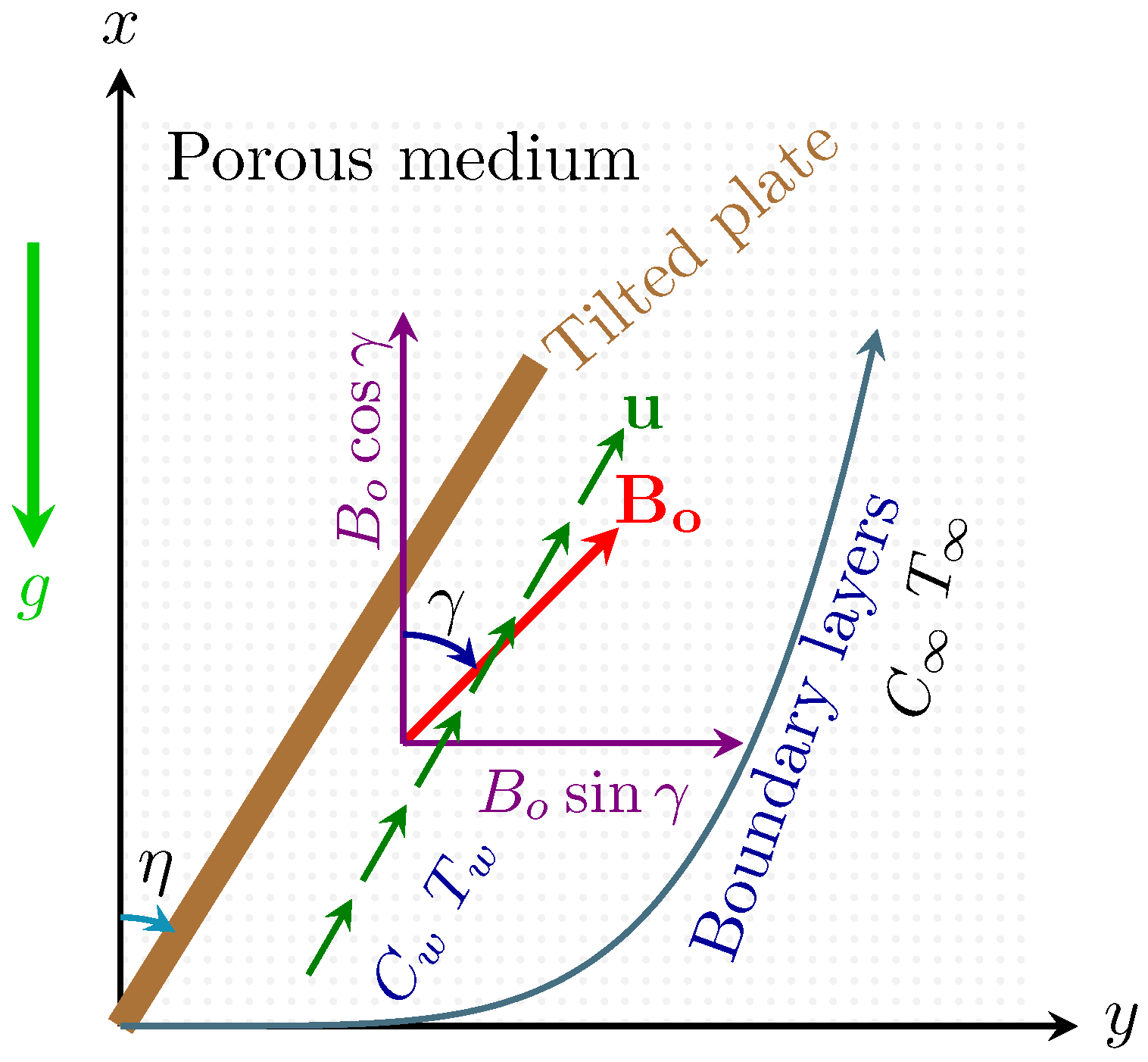
The flow is modeled as unsteady, incompressible, and viscous, considering a radiative magnetohydrodynamic Casson fluid past a tilted plate in a permeable medium. The governing equations incorporate buoyancy forces, a heat source, a uniform magnetic field inclined at an angle γ (where B = ( B 0 cos γ , B 0 sin γ , 0 ) ), and thermal radiation. In the dimensional formulation, the plate is impulsively started from rest at τ = 0 and thereafter moves with a constant velocity U. This motion is modeled by the boundary condition u ( y = 0 , τ ) = U for τ > 0 , corresponding to the classical no-slip condition. Both the plate and the magnetic field are inclined at arbitrary angles η and γ , respectively, as depicted in Figure 1. The far-field conditions are:
u 0 , T T , C C as y .
In this study, the governing parameters are varied over ranges that capture their essential physical influences—from negligible to dominant effects—as is standard in parametric analyses of such flows.
The rheological model for the Casson fluid is described by the piecewise relation [31,32,33]:
τ i j = Y s 2 π + μ P 2 r i j , π > π c , Y s 2 π c + μ P 2 r i j , π < π c ,
where τ i j represents the ( i , j ) -th component of the shear stress tensor, r i j denotes the deformation rate tensor, and π = r i j r i j is the second invariant of the deformation rate tensor. The parameter π c is the critical value of this invariant, μ P is the plastic dynamic viscosity, and Y s is the yield stress. A key dimensionless parameter arising from this model is the Casson parameter ϵ , defined as:
ϵ = μ P 2 π c Y s .
The yield stress, Y s , represents the critical shear stress that must be exceeded for fluid flow to commence. This gives the Casson fluid its distinctive yield-stress behavior: it behaves as a rigid solid when the applied shear stress is below Y s and flows as a liquid once the stress exceeds this critical yield value.
Based on the preceding assumptions, the governing equations for this particular problem are defined as [28,29,34,35]:
u τ = ν 1 + 1 ϵ 2 u y 2 σ B o 2 sin 2 γ ρ + μ k 1 ρ k o u + ( cos η ) g β T T T + β C C C ,
ρ c p T τ = κ 2 T y 2 + Q T T q r y ,
C τ = D m 2 C y 2 r c C C .
The initial and boundary conditions [28,29] are given as follows:
u ( y , 0 ) = 0 , T ( y , 0 ) = T , C ( y , 0 ) = C , y 0 , u ( 0 , τ ) = U , T ( 0 , τ ) = T w , C ( 0 , τ ) = C w , τ > 0 , u ( , τ ) = 0 , T ( , τ ) = T , C ( , τ ) = C , τ > 0 .
Note that u , y , T , C , ν , ρ , B o , k 1 , k o , σ , ρ c p , κ , q r , D m and τ are defined as dimensional velocity, coordinate axis, temperature, concentration, kinematic viscosity, fluid density, magnetic field, porosity, permeability, electrical conductivity, specific heat capacity, thermal conductivity, thermal radiation flux, molar diffusion and time, respectively.
Based on Rosseland’s assumption, the radiative heat flux is expressed as [36]:
q r = 4 δ 3 δ T 4 y ,
where δ is the Stefan–Boltzmann constant and δ denotes the mean absorption coefficient.
The Rosseland diffusion approximation is valid for optically thick media, where the photon mean free path is much smaller than the characteristic system length (i.e., optical depth τ 1 ). Under these conditions, radiative transport can be accurately modeled as a diffusive process.
To simplify the nonlinear dependence on temperature, the term T 4 is linearized about the ambient temperature T :
T 4 4 T 3 T 3 T 4 ,
yielding the linearized radiative heat flux:
q r = 16 δ T 3 3 δ T y .
The Rosseland approximation assumes an optically thick medium ( τ 1 ), and the linearization of T 4 is valid for moderate temperature differences, where ( T T ) / T 1 . These conditions ensure that radiative transport can be accurately described as diffusive and that the linearized form of the radiative heat flux provides a physically consistent representation for flows with moderate thermal gradients.
Substituting Equation (9) in (4) results in:
ρ c p T τ = κ + 16 δ T 3 3 δ 2 T y 2 + Q ( T T ) .
The dimensionless physical quantities are defined as:
ϕ = C C C w C , p = u U , ζ = y U ν , t = U 2 τ ν , θ = T T T w T .
Substituting these into the dimensional transport equations, the system reduces to the following dimensionless form:
p t = C a 2 p ζ 2 b p + cos η G r θ + G m ϕ ,
θ t = 1 Pr eff 2 θ ζ 2 + Q o θ ,
S c ϕ t = 2 ϕ ζ 2 S c R ϕ ,
where Pr eff = Pr 1 + 4 3 R d , b = F p + sin 2 γ F m .
The system is subject to the following transformed conditions:
p ( ζ , 0 ) = θ ( ζ , 0 ) = ϕ ( ζ , 0 ) = 0 , ζ 0 ,
p ( 0 , t ) = θ ( 0 , t ) = ϕ ( 0 , t ) = 1 ,
p ( , t ) = θ ( , t ) = ϕ ( , t ) = 0 ,
where
R = ν r c U 2 , Q o = Q ν ρ c p U 2 , C a = 1 + 1 ϵ , G r = ν g β T ( T w T ) U 3 , F p = ν 2 k 0 U 2 , F m = ν σ B 0 2 ρ U 2 , Pr = ρ c p ν κ , R d = 4 δ T 3 κ δ , G m = ν g β C ( C w C ) U 3 , S c = ν D m .
Here, Pr eff , C a , G r , G m , F p , F m , R d , P r , Q o , S c , and R denote the effective Prandtl number (including radiation), Casson parameter, thermal Grashof number, molar Grashof number, porosity parameter, magnetic field parameter, radiation parameter, Prandtl number, heat source parameter, Schmidt number, and chemical reaction parameter, respectively.

3. Fractional Modeling Framework and Physical Interpretation

This study employs the Caputo fractional derivatives to capture the hereditary (memory-dependent) dynamics of momentum, heat, and mass transfer in an MHD Casson fluid flowing through a porous medium. The formulation accounts for intrinsic memory effects arising from several coupled physical mechanisms: (i) microstructural memory of the yield-stress network; (ii) path-dependent hydraulic history of the porous matrix; (iii) cumulative Lorentz-force effects on velocity evolution; and (iv) retention of thermal and solutal histories.
For a sufficiently smooth function f ( t ) , the Caputo fractional derivative of order α > 0 is defined as
D t α C f ( t ) = 1 Γ ( k α ) 0 t f ( k ) ( τ ) ( t τ ) α + 1 k d τ , k 1 < α k ,
where k = α and Γ ( · ) is the Gamma function. For 0 < α 1 ( k = 1 ), this reduces to
D t α C f ( t ) = 1 Γ ( 1 α ) 0 t f ( τ ) ( t τ ) α d τ .
The kernel ( t τ ) α weights the influence of past states on the current dynamics. Smaller values of α correspond to stronger memory effects and anomalous (sub-diffusive) behavior, whereas α 1 recovers classical, memoryless transport. The exponent α thus serves as a memory index quantifying the system’s retention of its history.
For many viscoelastic materials and complex fluids such as Casson fluids, the memory effects in momentum, heat, and mass transport often originate from similar underlying microstructural relaxation mechanisms. Therefore, a single fractional order α is applied to all three transport equations (momentum, energy, and concentration). This unified approach offers multiple benefits: analytical tractability for obtaining closed-form solutions via the Laplace transform, systematic convergence analysis of multi-series solutions, capture of dominant memory effects across coupled transport processes, and clear physical interpretation by highlighting the primary memory mechanism. Physically, this single- α formulation corresponds to materials where thermal and mass diffusion time scales are coupled to mechanical relaxation of the fluid microstructure. Although distinct fractional orders ( α 1 for momentum, α 2 for heat transfer, and α 3 for mass transfer) could in principle be assigned, employing a single α ensures mathematical manageability while capturing the essential memory characteristics of Casson fluid transport in porous media.
To maintain dimensional consistency, a characteristic time scale T 0 is introduced:
D t α C f ( t ) 1 T 0 1 α D t α C f ( t ) ,
resulting in history-dependent transport coefficients:
ν α = ν T 0 1 α , κ α = κ T 0 1 α , D α = D T 0 1 α ,
where ν , κ , and D are the classical kinematic viscosity, thermal diffusivity, and mass diffusivity. This formulation explicitly incorporates the system’s memory into the transport properties while preserving the nondimensional structure of the governing equations, allowing classical dimensionless parameters to be naturally generalized to their fractional-order counterparts.

3.1. General Solution Methodology

The fractional-order models for concentration, temperature, and velocity are solved using a unified analytical procedure based on the Laplace transform. The general strategy consists of the following four steps, which will be applied systematically in the subsequent subsections:
  • Laplace Transform in Time: The Caputo fractional derivative in Equation (20) is transformed using the identity
    L D t α C f ( t ) = s α F ( s ) s α 1 f ( 0 + ) , for 0 < α 1 ,
    which converts the time-fractional partial differential equation into an ordinary differential equation in the spatial variable. This step encapsulates the temporal memory effects within algebraic terms involving s α , significantly simplifying the subsequent analytical procedure.
  • Solve the Spatial ODE: The resulting ODE is solved analytically, subject to the transformed boundary conditions, to obtain the solution in the Laplace domain F ( ζ , s ) .
  • Series Expansion: To prepare for the inverse transform, the Laplace-domain solution is expressed as an infinite series. This typically involves expanding exponential terms and using the generalized binomial theorem to handle fractional powers of s.
  • Inverse Laplace Transform: Using the identity L 1 { s β } = t β 1 / Γ ( β ) , the inverse transform is applied term-by-term to the series, yielding the final time-domain solution as a convergent infinite series involving the Gamma function.

3.2. Fractional Reaction-Diffusion Model

For subdiffusive transport with memory effects, the mass balance with first-order reaction is [37,38]:
D τ α C C ( y , τ ) = D α 2 C y 2 r c C ( y , τ ) , 0 < α 1 ,
where D α is the fractional diffusivity (see Equation (22)). The fractional dimensional concentration model becomes:
D t α C ϕ ( ζ , t ) = 1 S c 2 ϕ ζ 2 R ϕ .
Applying the Laplace transform with respect to time converts the fractional-time derivative into an algebraic term, reducing Equation (25) to a second-order ordinary differential equation in ζ :
d 2 Φ d ζ 2 S c ( s α + R ) Φ = 0 ,
whose general solution is
Φ ( ζ , s ) = A 1 ( s ) e ζ S c ( s α + R ) + A 2 ( s ) e ζ S c ( s α + R ) .
Imposing the Laplace-domain boundary conditions from Equations (16) and (17) yields:
Φ ( ζ , s ) = 1 s e ζ S c ( s α + R ) .
Factoring s α / 2 from the square root:
s α + R = s α / 2 1 + R s α ,
expanding the exponential and applying the generalized binomial theorem (see Appendix A (A1) and (A3)) leads to
ϕ ( ζ , s ) = l 1 = 0 l 2 = 0 ( 1 ) l 1 ζ l 1 S c l 1 / 2 l 1 ! l 2 ! Γ ( l 1 / 2 + 1 ) Γ ( l 1 / 2 l 2 + 1 ) R l 2 s α ( l 1 / 2 l 2 ) 1 .
Finally, applying the inverse Laplace transform term-by-term gives the double-series solution for the fractional concentration field:
ϕ ( ζ , t ) = l 1 = 0 l 2 = 0 ( 1 ) l 1 ζ l 1 S c l 1 / 2 l 1 ! l 2 ! Γ ( l 1 / 2 + 1 ) Γ ( l 1 / 2 l 2 + 1 ) R l 2 t α l 2 α l 1 2 Γ 1 + α l 2 α l 1 2 .
This solution captures the memory effects inherent in fractional diffusion through its double-series representation.

3.3. Fractional Temperature Model

To incorporate memory effects in heat conduction, the classical energy equation with heat generation is generalized using Caputo fractional derivatives [37,38]:
D τ α C T ( y , τ ) = κ α 2 T y 2 + Q T ( y , τ ) , 0 < α 1 ,
where the fractional thermal diffusivity κ α is defined in Equation (22).
After nondimensionalization with appropriate characteristic scales, the equation becomes:
D t α C θ ( ζ , t ) = 1 P r eff 2 θ ζ 2 + Q o θ ( ζ , t ) ,
or equivalently:
P r eff D t α C θ ( ζ , t ) = 2 θ ζ 2 + P r eff Q o θ , 0 < α 1 .
Applying the Laplace transform Θ ( ζ , s ) = L { θ ( ζ , t ) } with zero initial condition reduces the fractional derivative to an algebraic term, yielding:
d 2 Θ d ζ 2 P r eff s α Q o Θ = 0 .
The general solution satisfying the decay condition as:
Θ ( ζ , s ) = A 1 ( s ) e ζ P r eff ( s α Q o ) + A 2 ( s ) e ζ P r eff ( s α Q o ) .
Imposing the Laplace-domain boundary conditions from Equations (16) and (17) yields:
Θ ( ζ , s ) = 1 s exp ζ P r eff s α Q o .
Expanding the exponential and applying the generalized binomial theorem (see Appendix A (A1) and (A3)), the Laplace-domain solution can be expressed as a double series:
Θ ( ζ , s ) = l 1 = 0 l 2 = 0 ( 1 ) l 1 ζ l 1 P r eff l 1 / 2 l 1 ! l 2 ! Γ l 1 2 + 1 Γ l 1 2 l 2 + 1 Q o l 2 s α l 1 / 2 α l 2 1 .
Finally, applying the inverse Laplace transform term-by-term yields the time-dependent fractional temperature distribution:
θ ( ζ , t ) = l 1 = 0 l 2 = 0 ( 1 ) l 1 ζ l 1 P r eff l 1 / 2 l 1 ! l 2 ! Γ l 1 2 + 1 Γ l 1 2 l 2 + 1 Q o l 2 t α l 2 α l 1 / 2 Γ 1 + α l 2 α l 1 / 2 .
This double-series solution captures the memory effects inherent in fractional heat conduction, analogous to the fractional concentration field.

3.4. Fractional Velocity Model

The momentum balance for a fluid with memory effects is generalized using the Caputo fractional derivatives as [38]:
D τ α C u = D 2 u y 2 R u + B ,
where D = ν ( 1 + 1 / ϵ ) is the modified diffusivity, R = σ B 0 2 sin 2 γ / ρ + ν k 1 / k o is the total resistance, and B = g cos η [ β T ( T T ) + β C ( C C ) ] represents the buoyancy force. The Caputo derivative D τ α C introduces temporal memory, reflecting that the velocity depends not only on the current state but also on its past evolution, which is relevant for complex fluids and porous media.
After nondimensionalization and comparison with the integer-order momentum equation (Equation (12)), the fractional velocity equation becomes
α p t α = C a 2 p ζ 2 b p + cos η G r θ + G m ϕ ,
where α / t α is the Caputo fractional derivative, C a and b represent diffusion and damping, and the last term includes thermal and solutal buoyancy contributions.
Applying the Laplace transform and using the initial condition (Equation (15)) yields
d 2 p ( ζ , s ) d ζ 2 1 C a ( s α + b ) p ( ζ , s ) = cos η C a G r Θ ( ζ , s ) + G m Φ ( ζ , s ) ,
which can be rewritten compactly as
d 2 p d ζ 2 a ( s α + b ) p + a 1 Θ + a 2 Φ = 0 ,
with a = 1 / C a , a 1 = G r cos η / C a , and a 2 = G m cos η / C a .
The solution to Equation (42) is obtained using the method of variation of parameters. Applying the boundary conditions from Equations (16) and (17) yields the solution in the s-domain as:
p ( ζ , s ) = 1 s e a ( s α + b ) ζ + G r cos η ( C a P r eff 1 ) ( s α c ) e a ( s α + b ) ζ s e P r eff ( s α + Q o ) ζ s + G m cos η ( C a S c 1 ) ( s α c 1 ) e a ( s α + b ) ζ s e S c ( s α + R ) ζ s ,
where c = ( C a P r eff b Q o ) / ( C a P r eff 1 ) and c 1 = ( C a S c b R ) / ( C a S c 1 ) .
Expanding the exponentials using the generalized binomial theorem and applying the geometric series for the fractional powers (see Appendix A (A1) and (A3)), the solution can be expressed as a triple series in s:
p ( ζ , s ) = l 1 = 0 l 2 = 0 ( a ζ ) l 1 b l 2 l 1 ! l 2 ! Γ ( l 1 / 2 + 1 ) Γ ( l 1 / 2 l 2 + 1 ) s α ( l 1 / 2 l 2 ) 1 + b 1 l 3 = 0 l 1 = 0 l 2 = 0 c l 3 ( a ζ ) l 1 b l 2 l 1 ! l 2 ! Γ ( l 1 / 2 + 1 ) Γ ( l 1 / 2 l 2 + 1 ) s α ( l 1 / 2 l 2 l 3 1 ) 1 l 3 = 0 l 1 = 0 l 2 = 0 c l 3 ( P r eff ζ ) l 1 Q o l 2 l 1 ! l 2 ! Γ ( l 1 / 2 + 1 ) Γ ( l 1 / 2 l 2 + 1 ) s α ( l 1 / 2 l 2 l 3 1 ) 1 + b 2 l 3 = 0 l 1 = 0 l 2 = 0 c 1 l 3 ( a ζ ) l 1 b l 2 l 1 ! l 2 ! Γ ( l 1 / 2 + 1 ) Γ ( l 1 / 2 l 2 + 1 ) s α ( l 1 / 2 l 2 l 3 1 ) 1 l 3 = 0 l 1 = 0 l 2 = 0 c 1 l 3 ( S c ζ ) l 1 R l 2 l 1 ! l 2 ! Γ ( l 1 / 2 + 1 ) Γ ( l 1 / 2 l 2 + 1 ) s α ( l 1 / 2 l 2 l 3 1 ) 1
where b 1 = G r cos η / ( C a P r eff 1 ) and b 2 = G m cos η / ( C a S c 1 ) .
Finally, applying the inverse Laplace transform term-by-term produces the time-dependent fractional velocity field:
p ( ζ , t ) = l 1 = 0 l 2 = 0 ( a ζ ) l 1 b l 2 l 1 ! l 2 ! Γ ( l 1 / 2 + 1 ) Γ ( l 1 / 2 l 2 + 1 ) t α ( l 1 / 2 l 2 ) Γ ( 1 α ( l 1 / 2 l 2 ) ) + b 1 l 3 = 0 l 1 = 0 l 2 = 0 c l 3 ( a ζ ) l 1 b l 2 l 1 ! l 2 ! Γ ( l 1 / 2 + 1 ) Γ ( l 1 / 2 l 2 + 1 ) t α ( l 1 / 2 l 2 l 3 1 ) Γ ( α ( l 1 / 2 l 2 l 3 1 ) + 1 ) l 3 = 0 l 1 = 0 l 2 = 0 c l 3 ( P r eff ζ ) l 1 Q o l 2 l 1 ! l 2 ! Γ ( l 1 / 2 + 1 ) Γ ( l 1 / 2 l 2 + 1 ) t α ( l 1 / 2 l 2 l 3 1 ) Γ ( α ( l 1 / 2 l 2 l 3 1 ) + 1 ) + b 2 l 3 = 0 l 1 = 0 l 2 = 0 c 1 l 3 ( a ζ ) l 1 b l 2 l 1 ! l 2 ! Γ ( l 1 / 2 + 1 ) Γ ( l 1 / 2 l 2 + 1 ) t α ( l 1 / 2 l 2 l 3 1 ) Γ ( α ( l 1 / 2 l 2 l 3 1 ) + 1 ) l 3 = 0 l 1 = 0 l 2 = 0 c 1 l 3 ( S c ζ ) l 1 R l 2 l 1 ! l 2 ! Γ ( l 1 / 2 + 1 ) Γ ( l 1 / 2 l 2 + 1 ) t α ( l 1 / 2 l 2 l 3 1 ) Γ ( α ( l 1 / 2 l 2 l 3 1 ) + 1 )

3.5. Convergence Analysis and Computational Efficiency

This section establishes the convergence properties of the multi-series solutions for the concentration ϕ ( ζ , t ) (Equation (30)), temperature θ ( ζ , t ) (Equation (38)), and velocity p ( ζ , t ) (Equation (45)), ensuring these solutions are well-defined and their numerical evaluation is reliable.
Theorem 1
(Convergence of the Series Solutions). Let α ( 0 , 1 ) , ζ R be finite, and t > 0 , with all physical parameters a , b , S c , P r eff , Q o , R being positive constants. Assume further that | c | < 1 and | c 1 | < 1 , where
c = C a P r eff b Q o C a P r eff 1 , c 1 = C a S c b R C a S c 1 .
( a )
The double series for the temperature θ ( ζ , t ) and concentration ϕ ( ζ , t ) converge absolutely and uniformly for any finite ζ and t > 0 .
( b )
The triple series for the velocity  p ( ζ , t ) converges absolutely and uniformly for any finite ζ and t > 0 .
Proof. 
Part (a): Double series for θ and ϕ . Consider a typical term from the temperature solution (Equation (38)):
T ( l 1 , l 2 ) = ( 1 ) l 1 ζ l 1 Pr eff l 1 / 2 l 1 ! l 2 ! · Γ l 1 2 + 1 Γ l 1 2 l 2 + 1 · Q o l 2 · t α l 2 α l 1 2 Γ 1 + α l 2 α l 1 2 .
We analyze the sum in two stages. First, fix l 1 and examine the inner sum over l 2 . For large l 2 , the ratio of consecutive terms satisfies
T ( l 1 , l 2 + 1 ) T ( l 1 , l 2 ) Q o t α l 2 + 1 · Γ ( l 1 / 2 l 2 ) Γ ( l 1 / 2 l 2 1 ) · Γ ( 1 + α ( l 2 l 1 / 2 ) ) Γ ( 1 + α ( l 2 + 1 l 1 / 2 ) ) .
Using Stirling’s approximation Γ ( z ) 2 π z z 1 / 2 e z , we find
T ( l 1 , l 2 + 1 ) T ( l 1 , l 2 ) Q o t α l 2 α 0 as l 2 .
Hence, for each fixed l 1 , the inner series converges absolutely.
Now consider the outer sum over l 1 . The factor | P r eff ζ | l 1 l 1 ! decays factorially. The inner sum S ( l 1 ) = l 2 | T ( l 1 , l 2 ) | is bounded by a constant independent of l 1 because the ratio test shows super geometric decay in l 2 . Consequently,
l 1 = 0 S ( l 1 ) M l 1 = 0 | P r eff ζ | l 1 l 1 ! = M e | P r eff ζ | < .
By the Weierstrass M test, the double series converges absolutely and uniformly. The same argument applies to the concentration series (Equation (30)) with P r eff S c and Q o R . Part (b): Triple series for p . The velocity solution (Equation (45)) consists of terms of the form
P ( l 1 , l 2 , l 3 ) = K | κ ζ | l 1 l 1 ! β l 2 l 2 ! Γ ( l 1 / 2 + 1 ) Γ ( l 1 / 2 l 2 + 1 ) γ l 3 t α ( l 1 / 2 l 2 l 3 1 ) Γ α ( l 1 / 2 l 2 l 3 1 ) + 1 ,
with κ { a , P r eff , S c } , β { b , Q o , R } , γ { c , c 1 } , and K a constant. For fixed l 1 , l 2 , the sum over l 3 is dominated by | γ | l 3 times a factor that decays super exponentially in l 3 because of the gamma function in the denominator. The condition | γ | < 1 ensures the geometric convergence of this sum. For fixed l 1 , the sum over l 2 behaves as in part (a): the ratio test gives decay like l 2 α , guaranteeing convergence. Finally, the outer sum over l 1 is controlled by the factorial decay of 1 / l 1 ! . Thus, there exists a constant M such that
l 1 , l 2 , l 3 | P ( l 1 , l 2 , l 3 ) | M l 1 = 0 | κ ζ | l 1 l 1 ! = M e | κ ζ | < .
Hence, by the Weierstrass M-test, the triple series converges absolutely and uniformly for any finite ζ and t > 0 .  □

3.6. Numerical Implementation and Validation

For validation, the fractional temperature equation is solved numerically using a finite-difference method (FDM). The spatial domain ζ [ 0 , ζ max ] is discretized uniformly, with the diffusion term approximated by second-order central differences. The Caputo derivative of order β = 1 α is discretized via the L1 scheme:
D t β C θ ( t n ) ( Δ t ) β Γ ( 2 β ) j = 0 n 1 b j θ n j θ n j 1 , b j = ( j + 1 ) 1 β j 1 β .
This leads to an implicit time-marching scheme solved efficiently using the Thomas algorithm. The initial and boundary conditions are:
θ ( ζ , 0 ) = 0 , θ ( 0 , t ) = 1 , θ ( ζ max , t ) = 0 ,
with parameters Δ ζ = 0.1 , Δ t = 0.01 , and ζ max = 10 ensuring stability.
The finite-difference validation presented for the temperature equation extends naturally to the velocity and concentration equations, since all three governing relations share the same fractional-order structure and differ only in their coefficient sets. The temperature field is selected as the representative case because it includes the strongest combination of physical effects—radiation and internal heat generation—thereby providing the most stringent test of the numerical procedure. Moreover, the comparable convergence behavior of all series solutions, established in Theorem 1, ensures that validation of the temperature field offers indirect but reliable validation for the velocity and concentration fields as well.

Error Analysis and Series Convergence

The FDM solution is compared with the analytical series solution using global error metrics: MAE = 1 N i = 1 N | θ Series ( ζ i ) θ FDM ( ζ i ) | , RMSE = 1 N i = 1 N ( θ Series ( ζ i ) θ FDM ( ζ i ) ) 2 , MaxErr = max i | θ Series ( ζ i ) θ FDM ( ζ i ) | .
Table 2 shows representative comparisons at t = 3.0 for various α values, demonstrating excellent agreement. The largest discrepancies occur in regions with steep gradients ( ζ 1 –2), where fractional memory effects amplify differences between series truncation and L1 discretization.
The convergence behavior of the series solution is analyzed in Table 3 for the representative case ζ = 1.0 , t = 3.0 , and α = 0.6 . Using the solution at N = 60 as the reference, the results exhibit rapid factorial-type convergence. The incremental differences between successive terms fall below 10 4 for N 50 , while the relative error compared to the reference solution drops below 10 3 for N 30 . This confirms the computational efficiency of the series solution, as accurate results can be obtained with moderate truncation orders.

4. Skin Friction, Heat, and Mass Transfer Rate Analysis

4.1. Coefficient of Friction

The dimensionless coefficient of friction, quantifying the frictional force from the fluid on the plate, is derived from Equation (45) as:
τ s = C a p ( ζ , t ) ζ | ζ = 0 = C a l 1 = 0 l 2 = 0 ( a ) l 1 ( l 1 ζ l 1 1 ) b l 2 l 1 ! l 2 ! Γ ( l 1 / 2 + 1 ) Γ ( l 1 / 2 l 2 + 1 ) t α ( l 1 / 2 l 2 ) Γ ( 1 α ( l 1 / 2 l 2 ) ) + C a b 1 l 3 = 0 l 1 = 0 l 2 = 0 c l 3 ( a ) l 1 ( l 1 ζ l 1 1 ) b l 2 l 1 ! l 2 ! Γ ( l 1 / 2 + 1 ) Γ ( l 1 / 2 l 2 + 1 ) t α ( l 1 / 2 l 2 l 3 1 ) Γ ( α ( l 1 / 2 l 2 l 3 1 ) + 1 ) l 3 = 0 l 1 = 0 l 2 = 0 c l 3 ( P r eff ) l 1 ( l 1 ζ l 1 1 ) Q o l 2 l 1 ! l 2 ! Γ ( l 1 / 2 + 1 ) Γ ( l 1 / 2 l 2 + 1 ) t α ( l 1 / 2 l 2 l 3 1 ) Γ ( α ( l 1 / 2 l 2 l 3 1 ) + 1 ) + C a b 2 l 3 = 0 l 1 = 0 l 2 = 0 c 1 l 3 ( a ) l 1 ( l 1 ζ l 1 1 ) b l 2 l 1 ! l 2 ! Γ ( l 1 / 2 + 1 ) Γ ( l 1 / 2 l 2 + 1 ) t α ( l 1 / 2 l 2 l 3 1 ) Γ ( α ( l 1 / 2 l 2 l 3 1 ) + 1 ) l 3 = 0 l 1 = 0 l 2 = 0 c 1 l 3 ( S c ) l 1 ( l 1 ζ l 1 1 ) R l 2 l 1 ! l 2 ! Γ ( l 1 / 2 + 1 ) Γ ( l 1 / 2 l 2 + 1 ) t α ( l 1 / 2 l 2 l 3 1 ) Γ ( α ( l 1 / 2 l 2 l 3 1 ) + 1 ) | ζ = 0
For the expression to contribute at ζ = 0 , it is necessary that l 1 = 1 . When l 1 > 1 , the factor ζ l 1 1 vanishes, and thus only the case l 1 = 1 remains relevant. Therefore,
τ s = C a p ( ζ , t ) ζ | ζ = 0 = C a a π 2 l 2 = 0 b l 2 l 2 ! Γ ( 3 / 2 ) Γ ( 3 / 2 l 2 ) t α ( 1 2 l 2 ) Γ ( 1 α ( 1 2 l 2 ) ) C a b 1 a π 2 l 3 = 0 l 2 = 0 c l 3 b l 2 l 2 ! Γ ( 3 / 2 ) Γ ( 3 / 2 l 2 ) t α ( 1 2 l 2 l 3 1 ) Γ ( α ( 1 2 l 2 l 3 1 ) + 1 ) P r eff π 2 l 3 = 0 l 2 = 0 c l 3 Q o l 2 l 2 ! Γ ( 3 / 2 ) Γ ( 3 / 2 l 2 ) t α ( 1 2 l 2 l 3 1 ) Γ ( α ( 1 2 l 2 l 3 1 ) + 1 ) C a b 2 a π 2 l 3 = 0 l 2 = 0 c 1 l 3 b l 2 l 2 ! Γ ( 3 / 2 ) Γ ( 3 / 2 l 2 ) t α ( 1 2 l 2 l 3 1 ) Γ ( α ( 1 2 l 2 l 3 1 ) + 1 ) S c π 2 l 3 = 0 l 2 = 0 c 1 l 3 R l 2 l 2 ! Γ ( 3 / 2 ) Γ ( 3 / 2 l 2 ) t α ( 1 2 l 2 l 3 1 ) Γ ( α ( 1 2 l 2 l 3 1 ) + 1 ) .
Note that the known value of the Gamma function, Γ 3 2 = π 2 , is used to obtain the above equation.

4.2. Nusselt Number

The local Nusselt number, representing the ratio of convective to conductive heat transfer, quantifies the surface heat transfer rate and is derived from the temperature gradient at the surface as:
N u = θ ( ζ , t ) ζ | ζ = 0 = Pr eff π 2 l 2 = 0 Q o l 2 l 2 ! Γ 3 2 l 2 t α l 2 α 2 Γ 1 + α l 2 α 2 .

4.3. Sherwood Number

The local Sherwood number, which characterizes the surface mass transfer rate as the ratio of convective to diffusive mass transport, is defined by:
S h = ϕ ( ζ , t ) ζ | ζ = 0 = S c π 2 l 2 = 0 R l 2 l 2 ! Γ 3 2 l 2 t α l 2 α 2 Γ 1 + α l 2 α 2 .

5. Special Conditions

5.1. Classical Derivative Case

In the classical case where α = 1 , the fractional governing equations for velocity, temperature, and concentration simplify to their standard integer-order forms.
p ( ζ , t ) = l 1 = 0 l 2 = 0 ( a ζ ) l 1 b l 2 l 1 ! l 2 ! Γ ( l 1 / 2 + 1 ) Γ ( l 1 / 2 l 2 + 1 ) t ( l 1 / 2 l 2 ) Γ ( 1 ( l 1 / 2 l 2 ) ) + b 1 l 3 = 0 l 1 = 0 l 2 = 0 c l 3 ( a ζ ) l 1 b l 2 l 1 ! l 2 ! Γ ( l 1 / 2 + 1 ) Γ ( l 1 / 2 l 2 + 1 ) t ( l 1 / 2 l 2 l 3 1 ) Γ ( ( l 1 / 2 l 2 l 3 1 ) + 1 ) l 3 = 0 l 1 = 0 l 2 = 0 c l 3 ( P r eff ζ ) l 1 Q o l 2 l 1 ! l 2 ! Γ ( l 1 / 2 + 1 ) Γ ( l 1 / 2 l 2 + 1 ) t ( l 1 / 2 l 2 l 3 1 ) Γ ( ( l 1 / 2 l 2 l 3 1 ) + 1 ) + b 2 l 3 = 0 l 1 = 0 l 2 = 0 c 1 l 3 ( a ζ ) l 1 b l 2 l 1 ! l 2 ! Γ ( l 1 / 2 + 1 ) Γ ( l 1 / 2 l 2 + 1 ) t ( l 1 / 2 l 2 l 3 1 ) Γ ( ( l 1 / 2 l 2 l 3 1 ) + 1 ) l 3 = 0 l 1 = 0 l 2 = 0 c 1 l 3 ( S c ζ ) l 1 R l 2 l 1 ! l 2 ! Γ ( l 1 / 2 + 1 ) Γ ( l 1 / 2 l 2 + 1 ) t ( l 1 / 2 l 2 l 3 1 ) Γ ( ( l 1 / 2 l 2 l 3 1 ) + 1 )
θ ( ζ , t ) = l 1 = 0 l 2 = 0 ( 1 ) l 1 ζ l 1 P r eff l 1 / 2 l 1 ! l 2 ! Γ ( l 1 / 2 + 1 ) Γ ( l 1 / 2 l 2 + 1 ) Q o l 2 t l 2 l 1 / 2 Γ ( 1 + l 2 l 1 / 2 )
ϕ ( ζ , t ) = l 1 = 0 l 2 = 0 ( 1 ) l 1 ζ l 1 S c l 1 / 2 l 1 ! l 2 ! Γ ( l 1 / 2 + 1 ) Γ ( l 1 / 2 l 2 + 1 ) R l 2 t l 2 l 1 / 2 Γ ( 1 + l 2 l 1 / 2 )
A crucial consistency check for the fractional series solutions in Equations (51)–(53) is their behavior in the classical limit α 1 . For the temperature and concentration solutions, the series terms contain the factor 1 / Γ ( 1 + α l 2 α l 1 / 2 ) , which is well-defined for α ( 0 , 1 ) . When α = 1 , this becomes 1 / Γ ( 1 + l 2 l 1 / 2 ) . Since Γ ( z ) has simple poles at non-positive integers z = 0 , 1 , 2 , , the reciprocal 1 / Γ ( 1 + l 2 l 1 / 2 ) vanishes whenever 1 + l 2 l 1 / 2 is a non-positive integer, i.e., when l 1 / 2 l 2 1 . Consequently, only terms with l 2 l 1 / 2 contribute to the sum, and the series automatically reduce to their classical integer-order counterparts. For the velocity solution, the first series contains 1 / Γ ( 1 α ( l 1 / 2 l 2 ) ) , which becomes 1 / Γ ( 1 ( l 1 / 2 l 2 ) ) when α = 1 . This factor vanishes when l 1 / 2 l 2 is a positive integer (i.e., l 1 / 2 l 2 1 ), again restricting the summation to terms with l 2 l 1 / 2 . The remaining velocity terms follow a similar pattern with 1 / Γ ( α ( l 1 / 2 l 2 l 3 1 ) + 1 ) . Thus, in the classical limit α = 1 , the fractional series representations naturally truncate to sums over indices satisfying l 2 l 1 / 2 , recovering the expected classical solutions without imposing any external constraints. This demonstrates the mathematical consistency of the fractional formulation with the well-known integer-order theory. To further illustrate this reduction, consider the concentration field in Mittag–Leffler form:
ϕ ( ζ , t ) = n = 0 ( ζ S c ) n n ! t n α / 2 E α , 1 + n α / 2 ( R t α ) ,
which is analytic for α ( 0 , 1 ) . Setting α = 1 gives E 1 , β ( z ) = k = 0 z k / Γ ( k + β ) , which leads to the classical series:
ϕ ( ζ , t ) = e R t n = 0 ( ζ S c ) n n ! Γ ( 1 + n / 2 ) t n / 2 .
An equivalent classical expression can also be obtained via Laplace transform. For α = 1 , the transformed solution of Equation (14) with the associated initial and boundary conditions is
ϕ ¯ ( ζ , s ) = 1 s exp ζ S c s + R ,
whose inverse transform yields the closed-form solution:
ϕ ( ζ , t ) = 1 2 e ζ S c R erfc ζ S c 2 t R t + e ζ S c R erfc ζ S c 2 t + R t .
Similarly, the classical solution for the temperature field, governed by Equation (13) with the corresponding initial and boundary conditions, is obtained by setting α = 1 in the fractional series or via Laplace transform. The Laplace-domain solution is
θ ¯ ( ζ , s ) = 1 s exp ζ P r eff s Q o ,
and its inversion gives the closed-form time-dependent solution:
θ ( ζ , t ) = 1 2 e ζ P r eff Q o erfc ζ P r eff 2 t Q o t + e ζ P r eff Q o erfc ζ P r eff 2 t + Q o t .
These three representations—the fractional series, the Mittag–Leffler form, and the classical closed-form solution—are mathematically equivalent. Their agreement confirms the correctness and internal consistency of the fractional model. Since the momentum and temperature fields share the same fractional structure and limiting behavior, the analysis for these fields is omitted for conciseness.

5.2. Newtonian Fluid and Omission of Free Convection Case

When ϵ and G r = G m = 0 , the velocity solution (51) reduces to
p ( ζ , t ) = l 1 = 0 l 2 = 0 ( ζ ) l 1 b l 2 l 1 ! l 2 ! Γ ( l 1 / 2 + 1 ) Γ ( l 1 / 2 l 2 + 1 ) t ( l 1 / 2 l 2 ) Γ ( 1 ( l 1 / 2 l 2 ) )
Thus, the series representation in Equation (59) can be expressed in exact form as
p ( ζ , t ) = 1 2 erfc ζ 2 t b t e ζ b + erfc ζ 2 t + b t e ζ b
It should be noted that Equations (59) and (60) are equivalent. The validity of Equation (60) is further supported by the results of Pattnaik et al. [39], who obtained the same velocity expression when a = G r = G c = 0 in their formulation.
If we consider a non-porous plate and a non-conducting fluid, the governing momentum equation (Equation (12)) reduces to that of the classical Stokes’ first problem [40]. The corresponding velocity solution is obtained from the general form (Equation (60)) by setting b = 0 . To demonstrate this explicitly, we consider the limit b 0 . In this limit, b t 0 and e ± ζ b 1 , which causes both complementary error function terms in Equation (60) to converge to erfc ζ 2 t . Consequently,
lim b 0 p ( ζ , t ) = 1 2 erfc ζ 2 t + erfc ζ 2 t = erfc ζ 2 t .
This result is the well-known similarity solution for Stokes’ first problem [40], thereby confirming the physical consistency of the general model as it correctly reduces to the established classical case.

6. Results and Discussion

Within a Caputo fractional derivative framework, this work provides an analytical series solution for the transient natural convective, hydromagnetic flow of a Casson fluid over a tilted surface in a permeable medium. The transport phenomena are analyzed with emphasis on the interplay between fractional time derivatives, thermal radiation, and magnetic effects. The derived closed-form solutions, obtained via Laplace transforms, are rigorously presented and physically interpreted, highlighting their relevance for applied sciences and engineering.
The analytical series solution offers an efficient alternative to fully numerical schemes for fractional PDEs. Thanks to the factorial-type denominators ( l 1 ! l 2 ! ) , the series exhibits super-exponential convergence, achieving accurate results with only N max = 20 –30 terms. Each term in the double series can be computed independently, making the approach naturally suited for parallel computation. Comparison with finite-difference solutions confirms that the series maintains high accuracy with reduced computational effort. These solutions can also serve as benchmarks for numerical solvers, providing guidance for algorithm validation and applications such as thermal management in porous media and MHD control in industrial processes involving non-Newtonian fluids with memory effects.
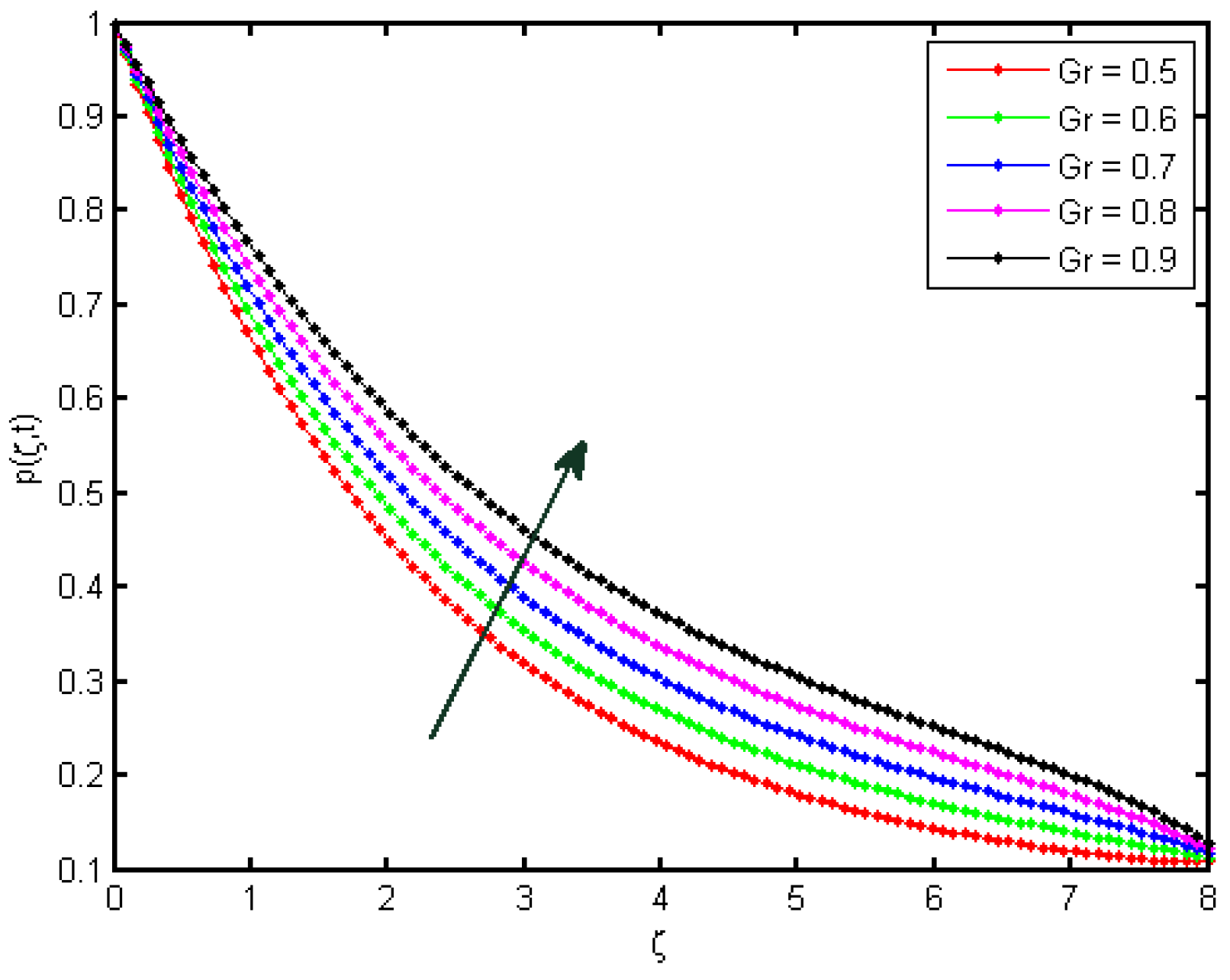
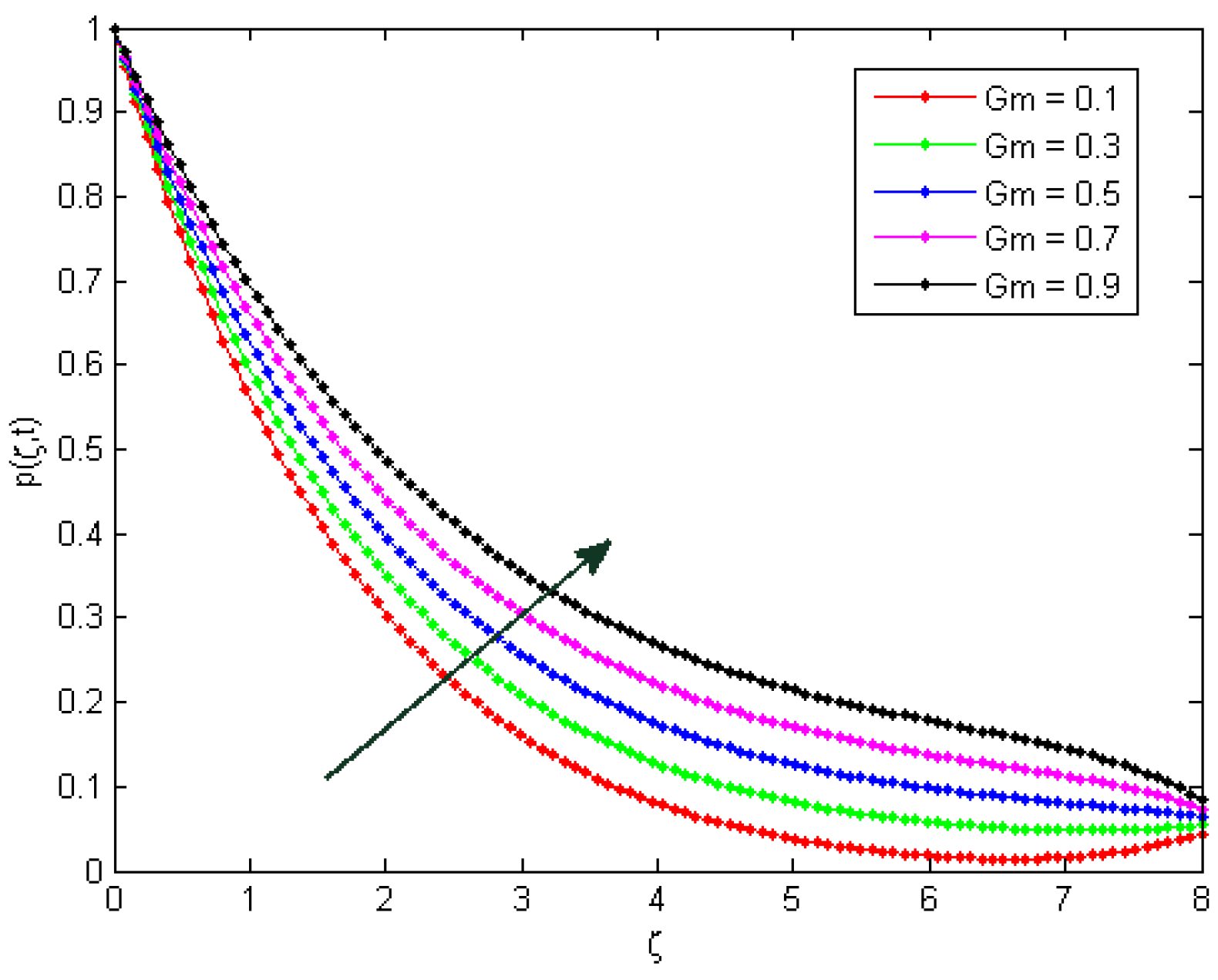
As shown in the momentum Equation (3), the flow is driven by two buoyancy forces arising from differences in both temperature and concentration fields. The primary influences on the velocity profile are the thermal Grashof number ( G r ) and the molar Grashof number ( G m ), dimensionless parameters that measure the strength of buoyancy from heat and mass transfer relative to viscous damping. Figure 2 and Figure 3 show that the fractional velocity increases with higher values of G r and G m . This occurs because a higher G r corresponds to a stronger thermal buoyancy force, which accelerates the fluid. Similarly, increasing G m enhances the solutal buoyancy effect due to concentration gradients, further promoting fluid motion. These numerical findings are in excellent agreement with the theoretical expectation that stronger buoyancy effects overcome viscous resistance, leading to higher velocities.
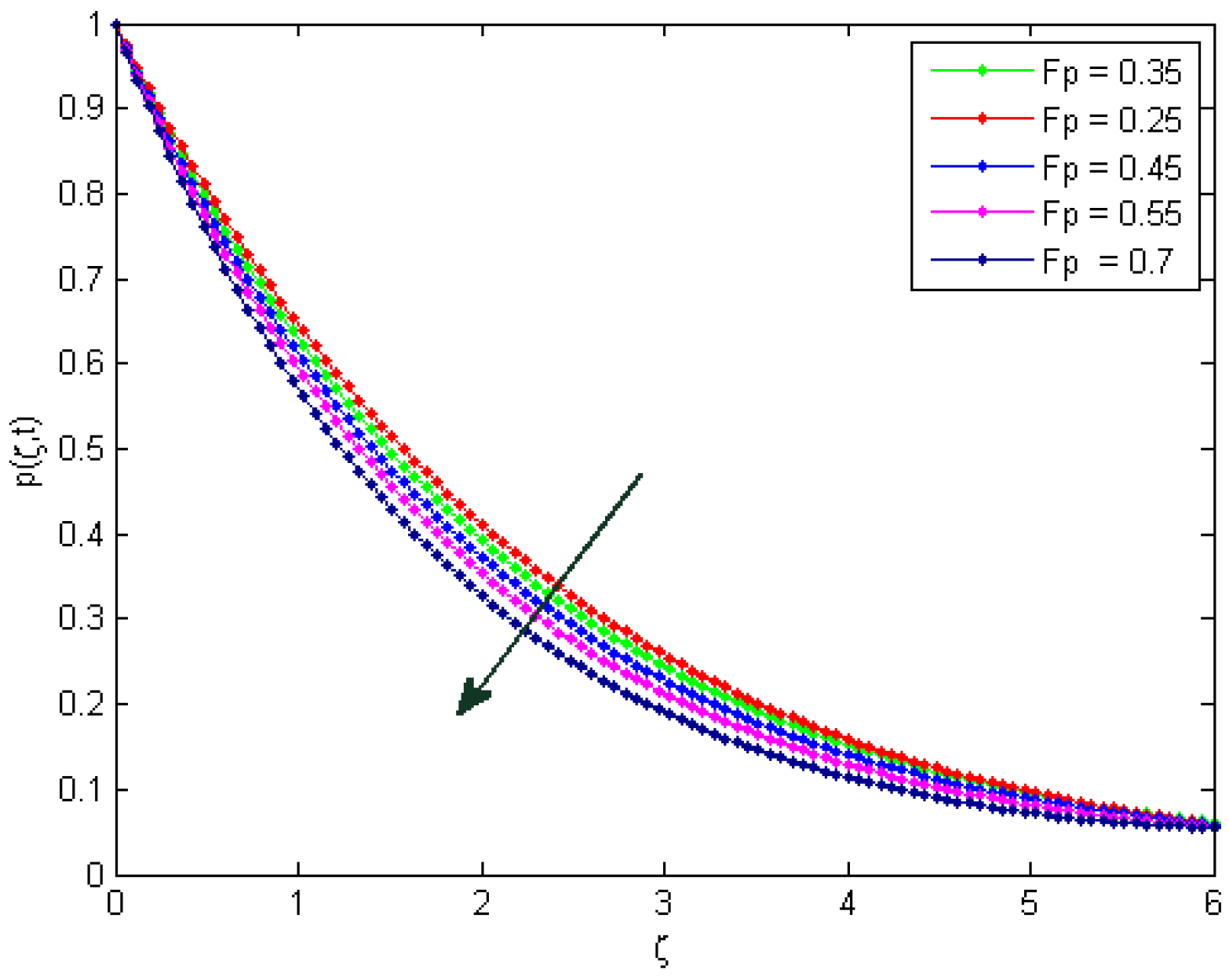
Figure 4 illustrates the retarding effect of the porosity parameter F p on the fluid velocity, showing that higher porosity values correspond to a slower motion of the Casson fluid. Physically, increased porosity introduces more void spaces within the porous medium, which disrupts flow pathways and lowers the overall permeability. Consequently, the fluid experiences greater resistance, resulting in diminished velocity profiles.
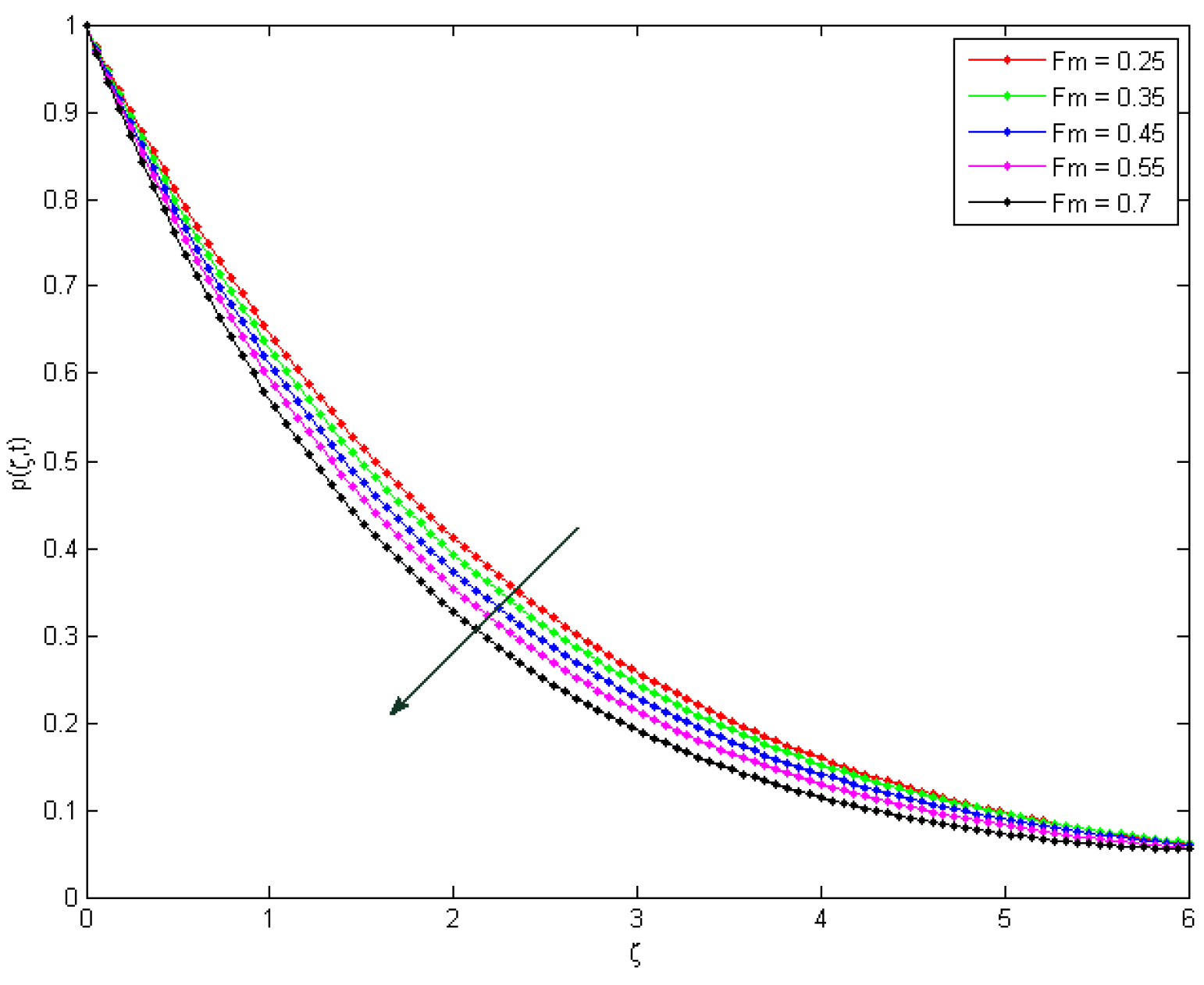
The presence of a magnetic field slows the flow of an electrically conducting fluid. This occurs because the magnetic field induces a Lorentz force that opposes the motion. As shown in Figure 5, stronger magnetic fields produce a more pronounced reduction in velocity.
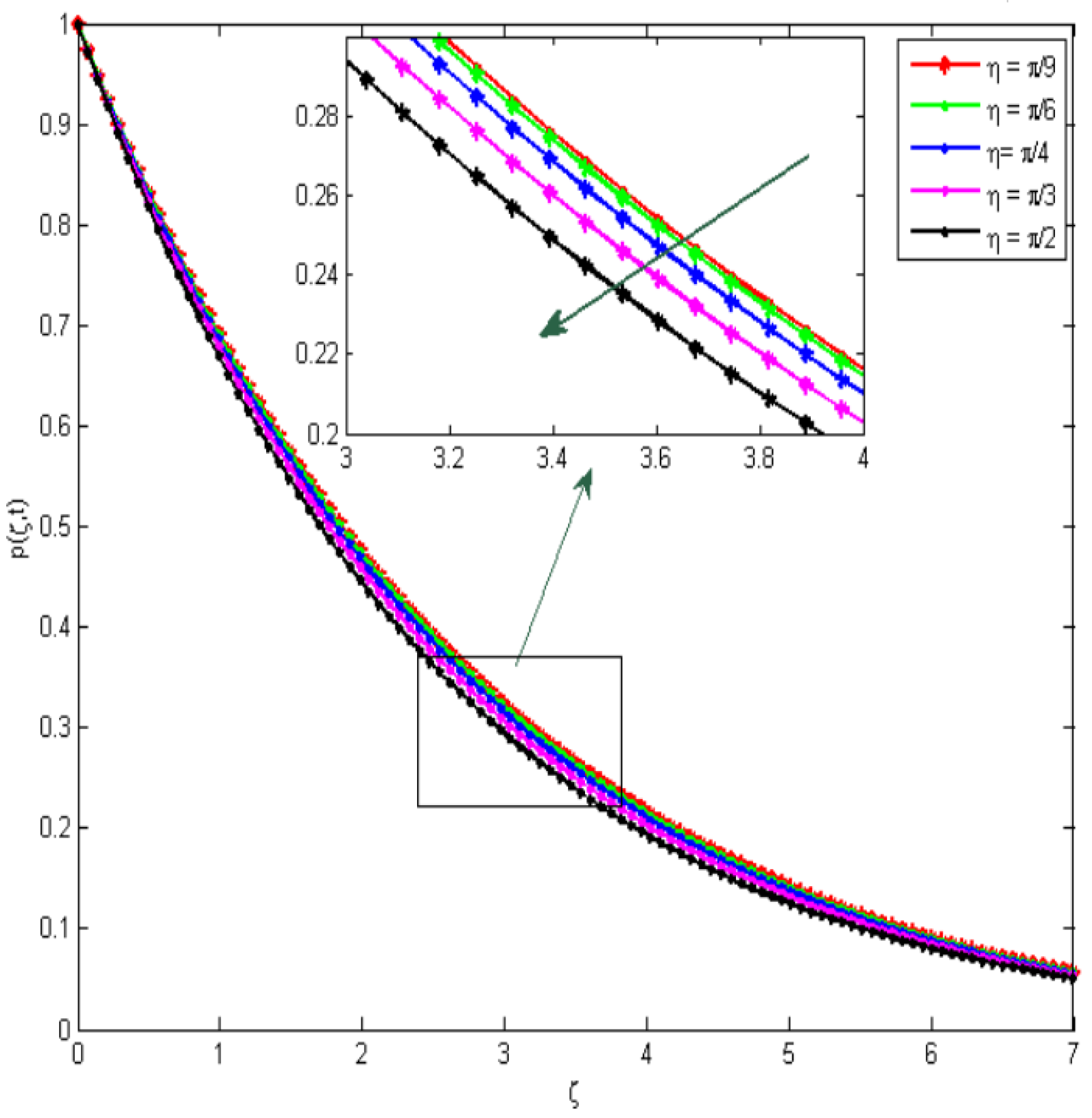
The dependence of the velocity distribution on the plate’s inclination is presented in Figure 6. The observed decrease in velocity with increasing plate inclination can be explained by the balance of forces acting along the plate. For a horizontal plate, the full buoyancy force drives the fluid motion. However, as the inclination angle increases, the component of buoyancy along the flow direction decreases, reducing the net driving force and consequently the fluid velocity.
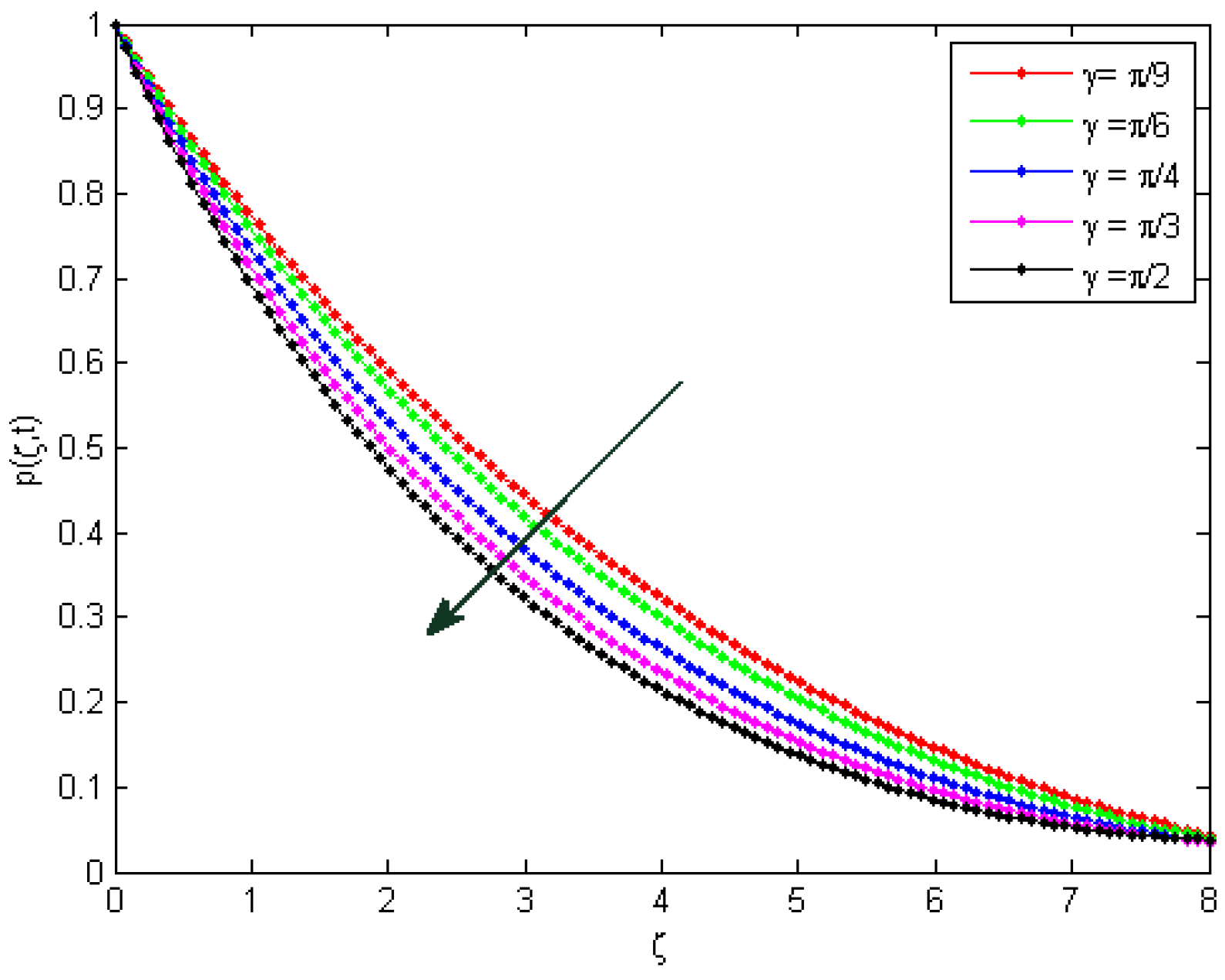
The orientation of the magnetic field significantly influences the flow, as shown in Figure 7, where a change in the inclination angle γ alters the velocity profile. With increasing inclination, the resistive Lorentz force intensifies, leading to greater energy dissipation and ohmic (Joule) heating, which further reduces fluid velocity by enhancing momentum loss.
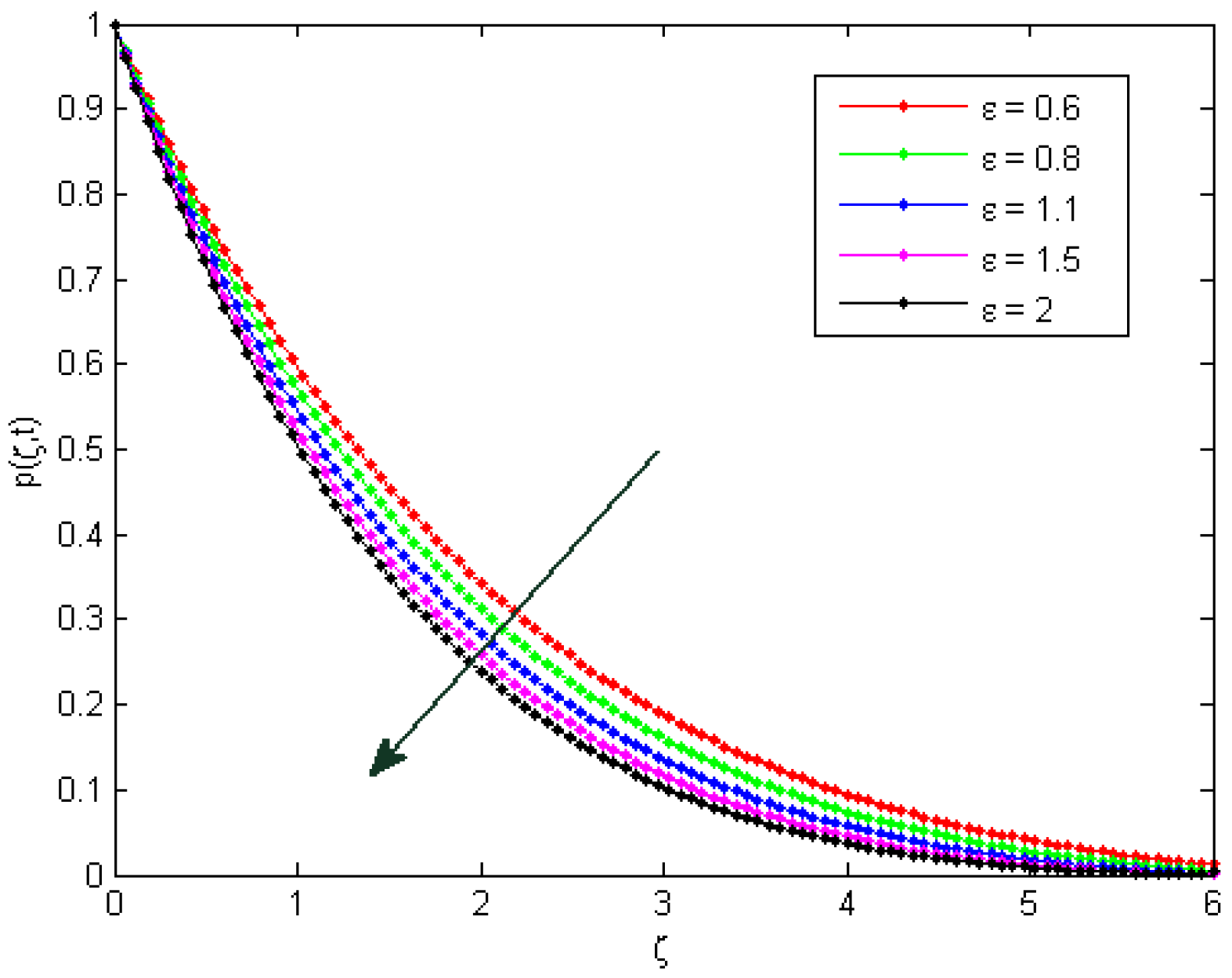
The observed velocity reduction with an increasing Casson parameter (Figure 8) is a direct consequence of the heightened yield stress. This elevated stress threshold must be overcome for flow to initiate, thereby suppressing the overall fluid motion.
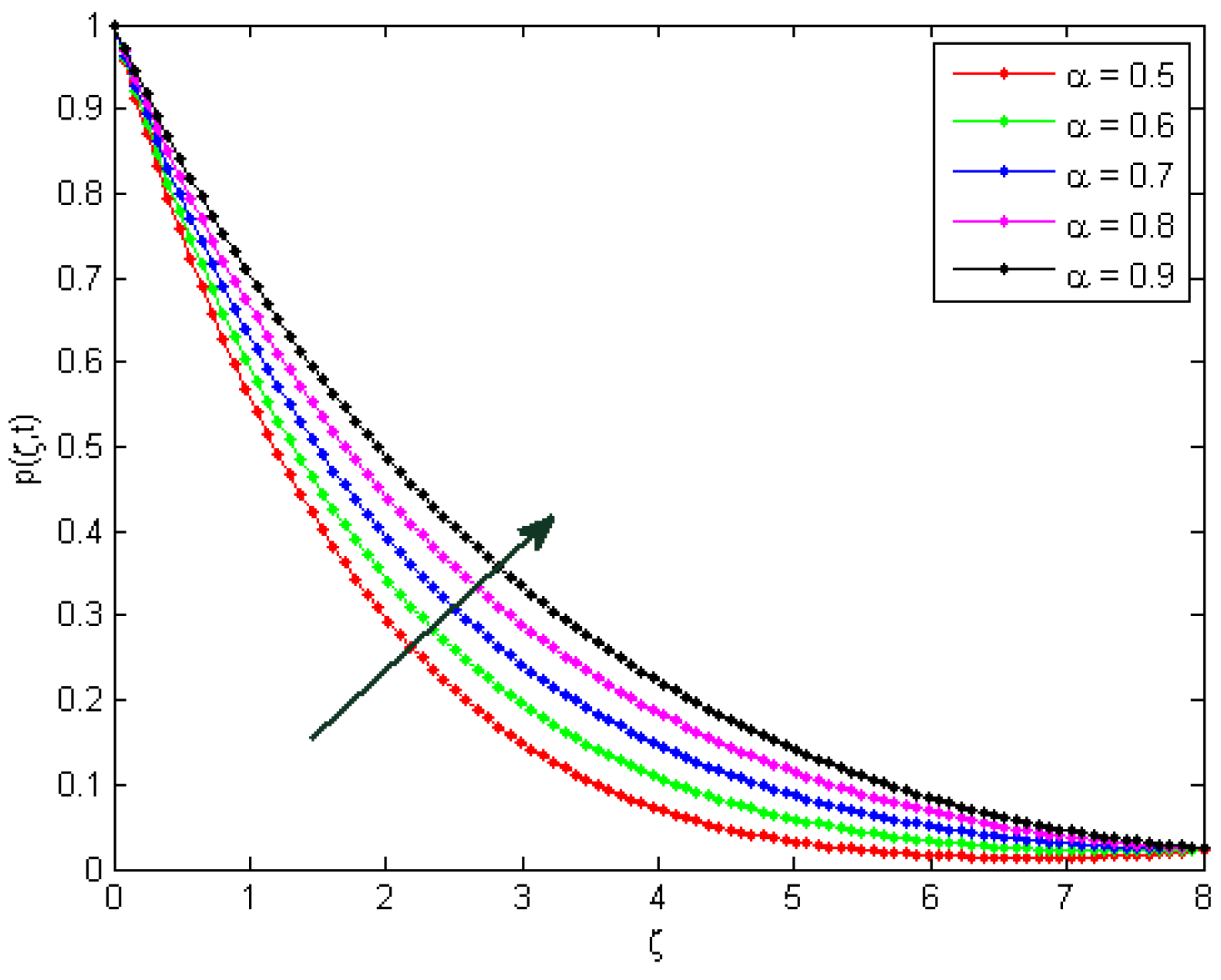
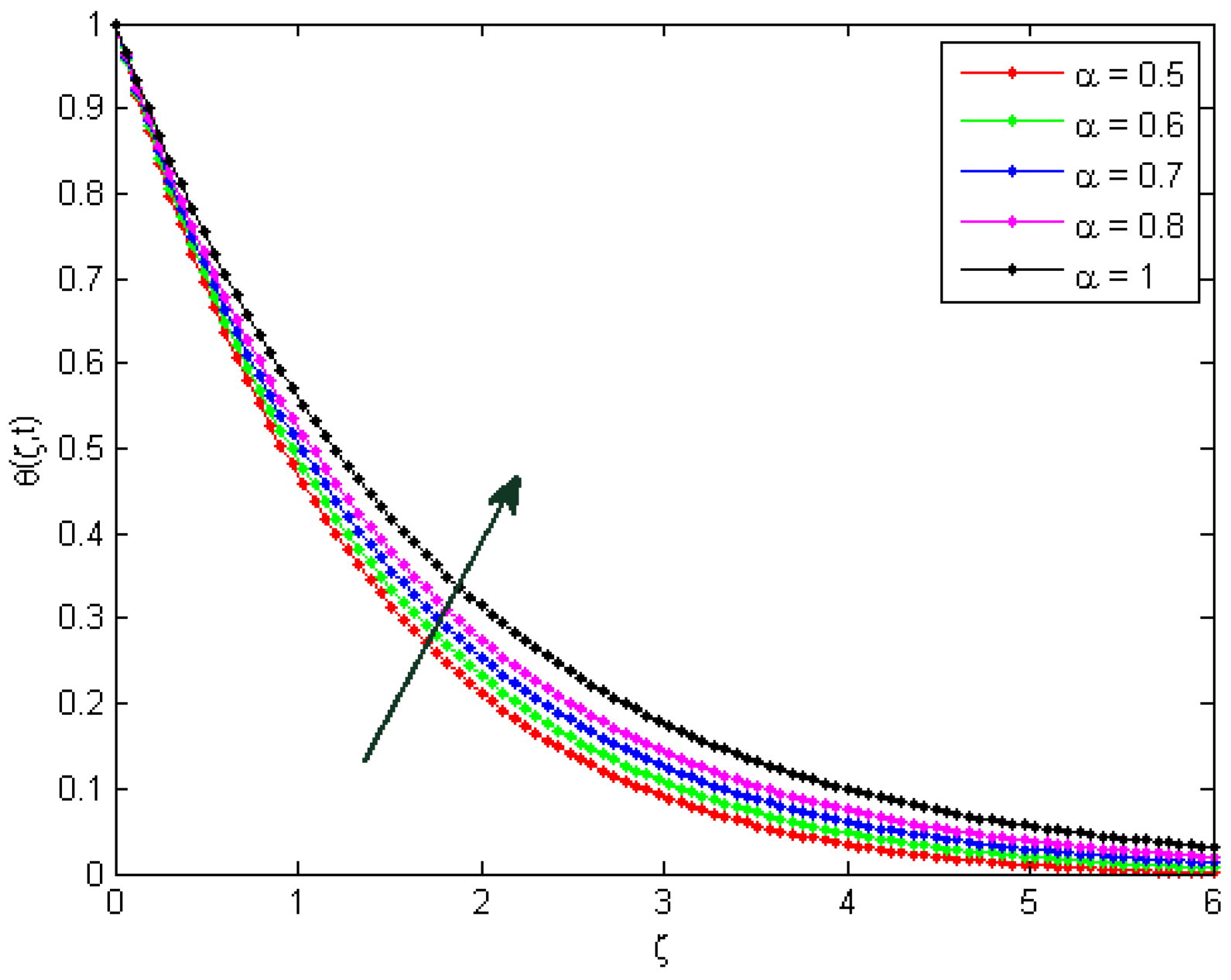
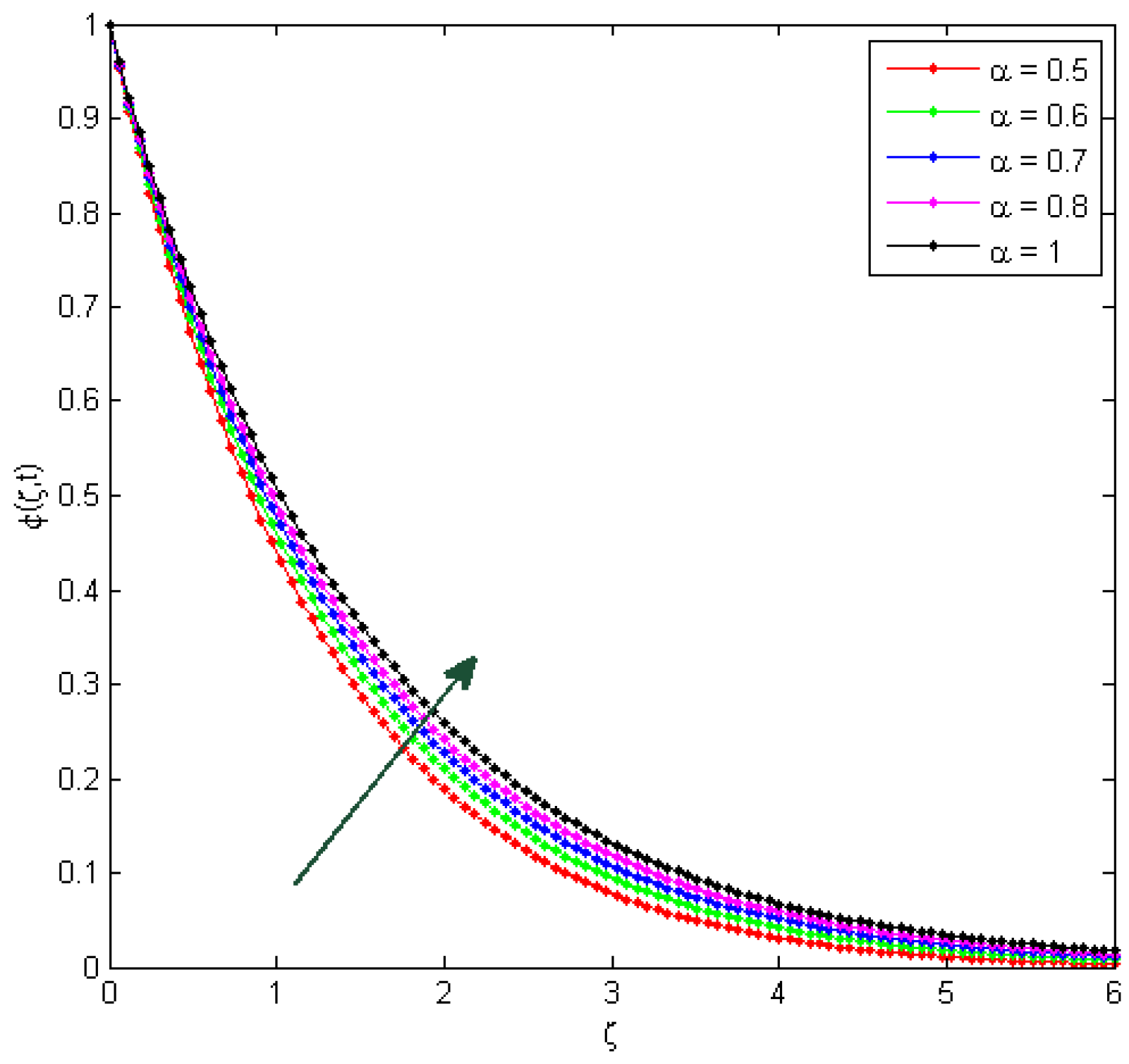
The impact of the fractional-order parameter α on the flow and transport fields is illustrated in Figure 9, Figure 10 and Figure 11, revealing its governing influence on the velocity, temperature, and concentration distributions. The analysis, conducted at time t = 2.0 , considers α values from 0.5 to 0.9 for the velocity field and 0.5 to 1.0 for the temperature and concentration fields. A consistent trend is observed: the magnitudes of the velocity, temperature, and concentration profiles increase with α . This behavior is attributed to the memory effect inherent in the fractional model, which originates from the kernel ( t τ ) α in the Caputo derivative. Smaller values of α (e.g., α = 0.5 ) correspond to a slower kernel decay, assigning greater weight to past states and producing pronounced sub-diffusive behavior. In this regime, the fluid’s historical resistance to motion, heat, and mass transfer dominates, resulting in lower and delayed profiles. As α increases towards 0.9, the kernel decays more rapidly, diminishing the influence of past states. Consequently, the fluid responds more freely to the applied boundary gradients, enhancing the velocity, thermal, and solutal boundary layers. Thus, the fractional order α directly governs the transition from a strongly memory-dominated, slow-response regime to a faster, more classical-like behavior, a finding fully consistent with the weighting mechanism of the Caputo derivative.
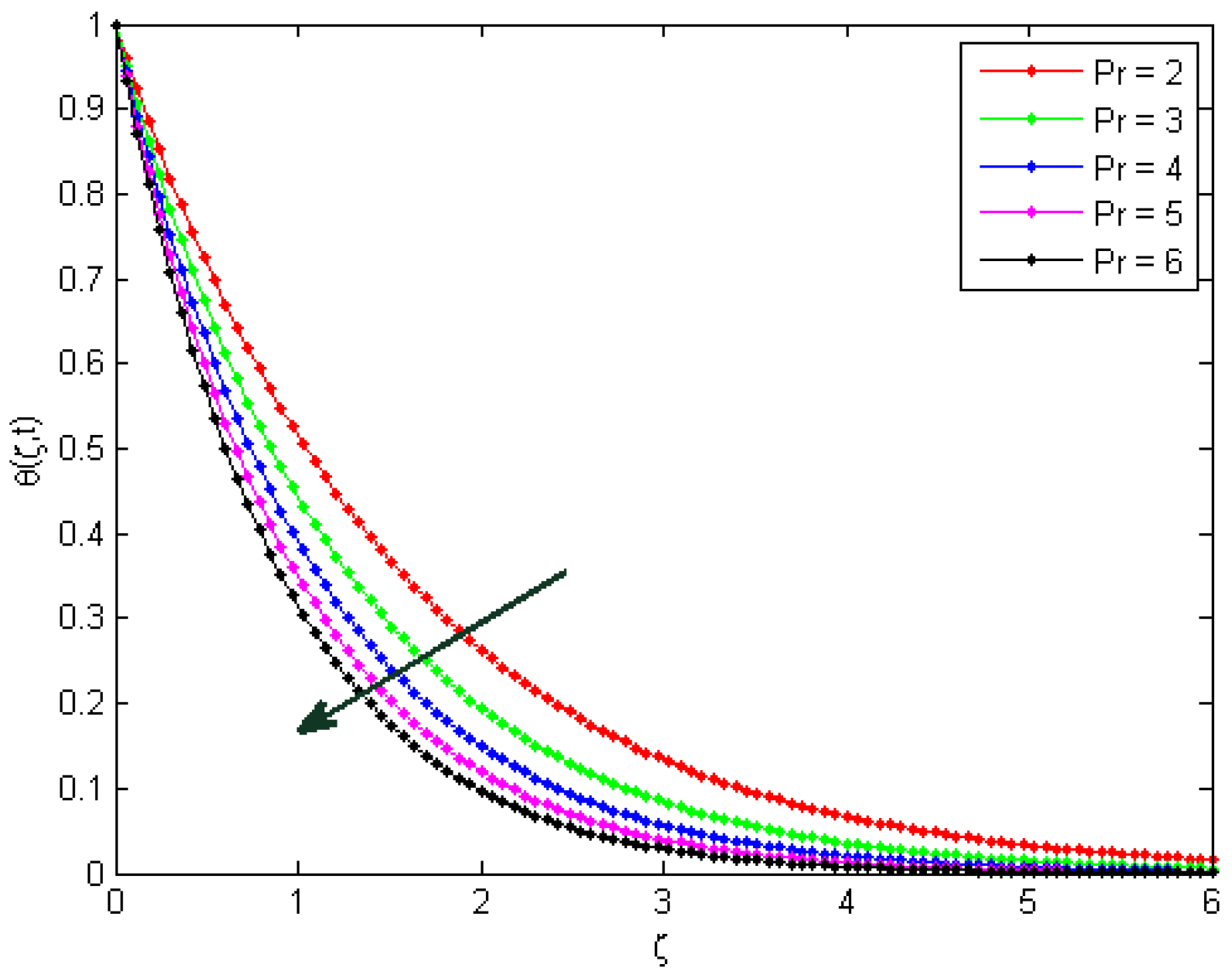
As the fractional Prandtl number (Pr) increases, the fluid temperature decreases, a trend illustrated in Figure 12. This is a direct consequence of the definition Pr = ν α κ α ; a higher Pr signifies a lower fractional thermal diffusivity relative to the fractional momentum diffusivity. This reduced thermal diffusivity restricts how quickly heat can spread, resulting in a cooler fractional temperature distribution.
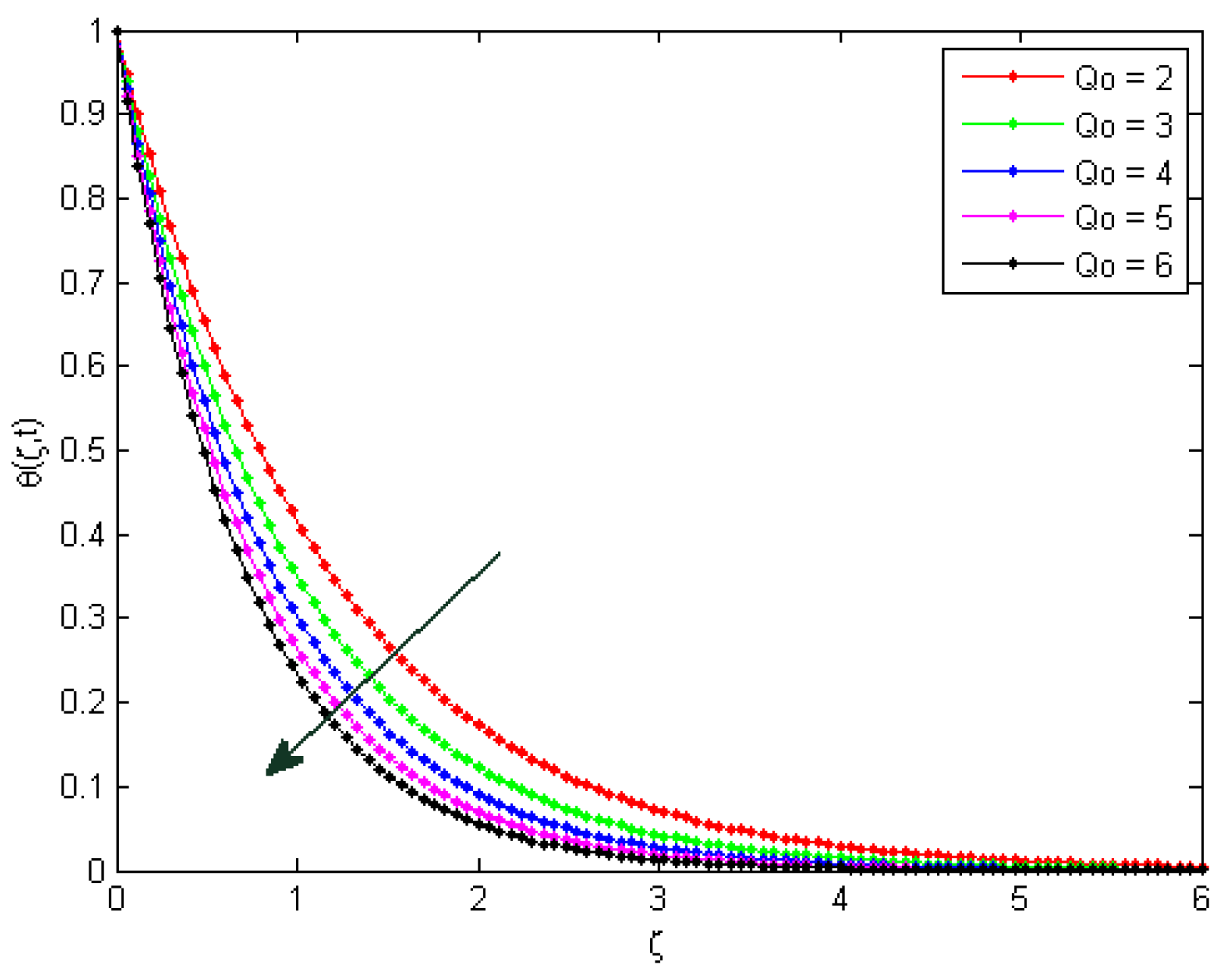
Contrary to what might be expected, a higher heat generation parameter ( Q o ) results in a lower temperature, as depicted in Figure 13. The parameter Q o characterizes the intensity of internal heat sources. Its increase promotes the thickening of the thermal boundary layer, which enhances convective cooling and ultimately leads to a net decrease in the system’s temperature.
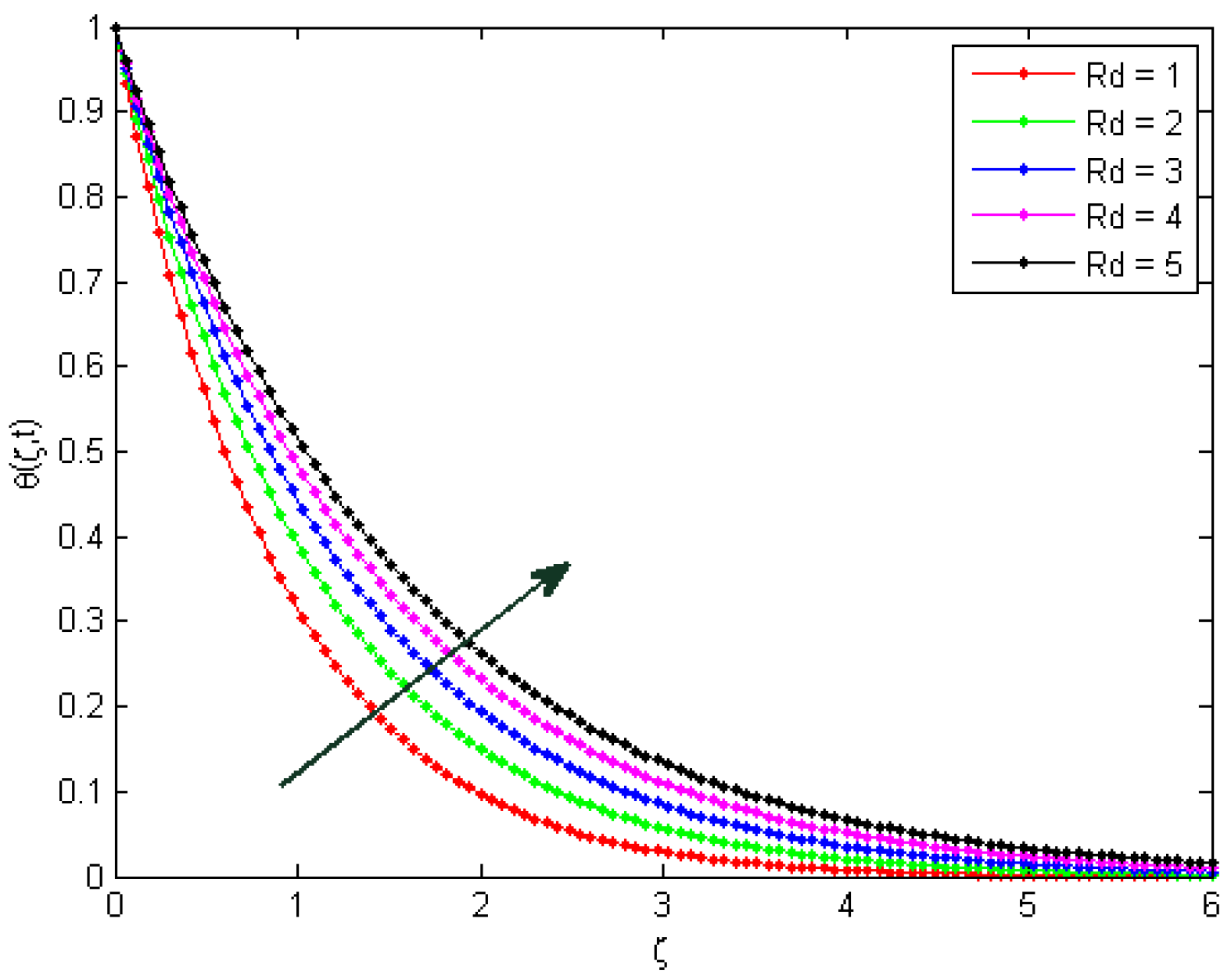
Figure 14 illustrates the effect of thermal radiation on the temperature profiles. It is observed that an increase in thermal radiation leads to higher temperature values. This behavior occurs because enhanced thermal radiation increases the thermal energy within the system, resulting in a rise in fluid temperature.
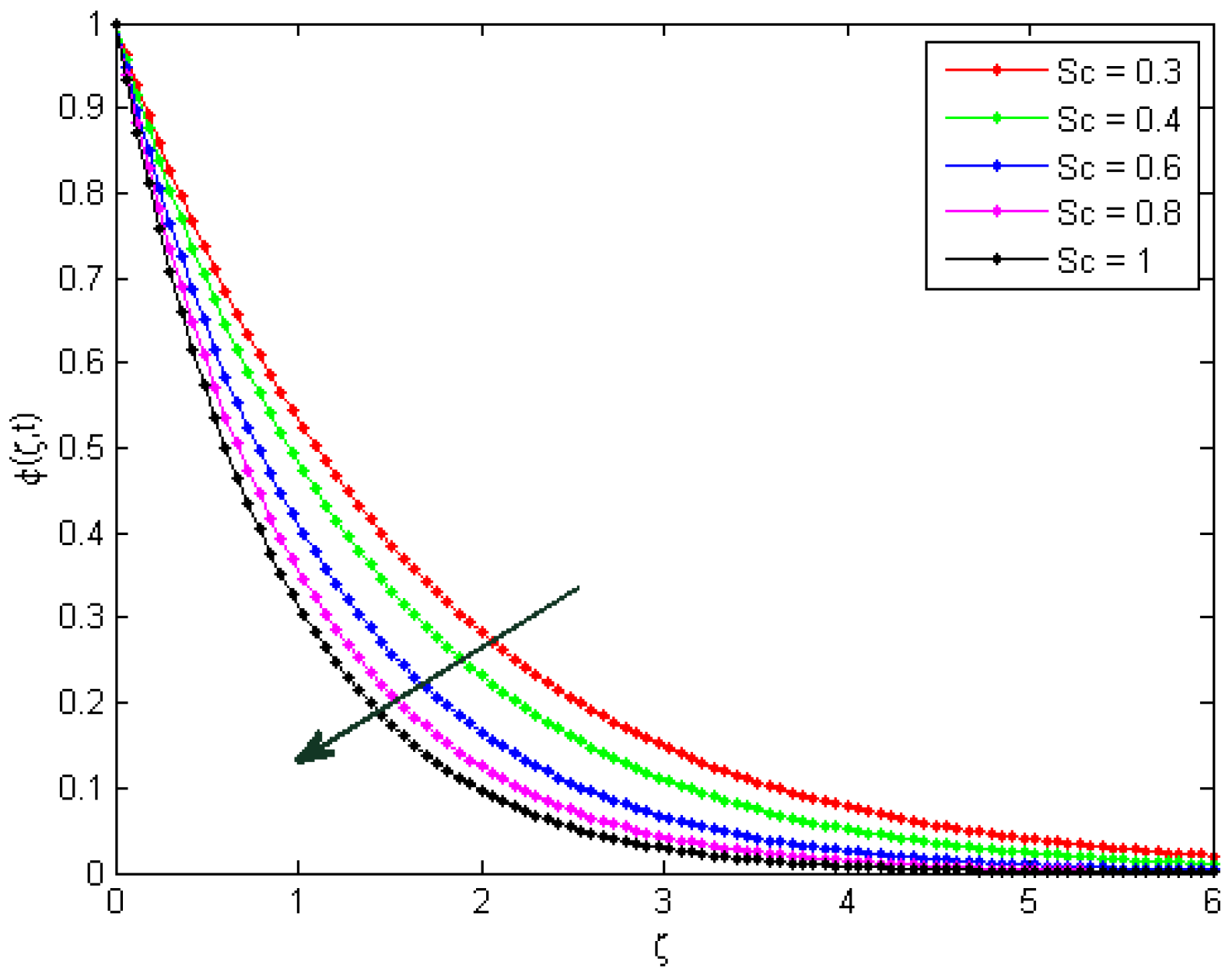
The concentration profile exhibits a strong dependence on the fractional Schmidt number ( S c ), as presented in Figure 15. In this study, the Schmidt number is defined as S c = ν α D α , where T 0 denotes a characteristic time. This formulation generalizes the standard Schmidt number within the fractional calculus framework, remaining inversely related to the effective mass diffusivity. Consequently, an elevated S c α value signifies a dominance of viscous diffusion over mass diffusion, which suppresses species transport and results in a lower concentration distribution.
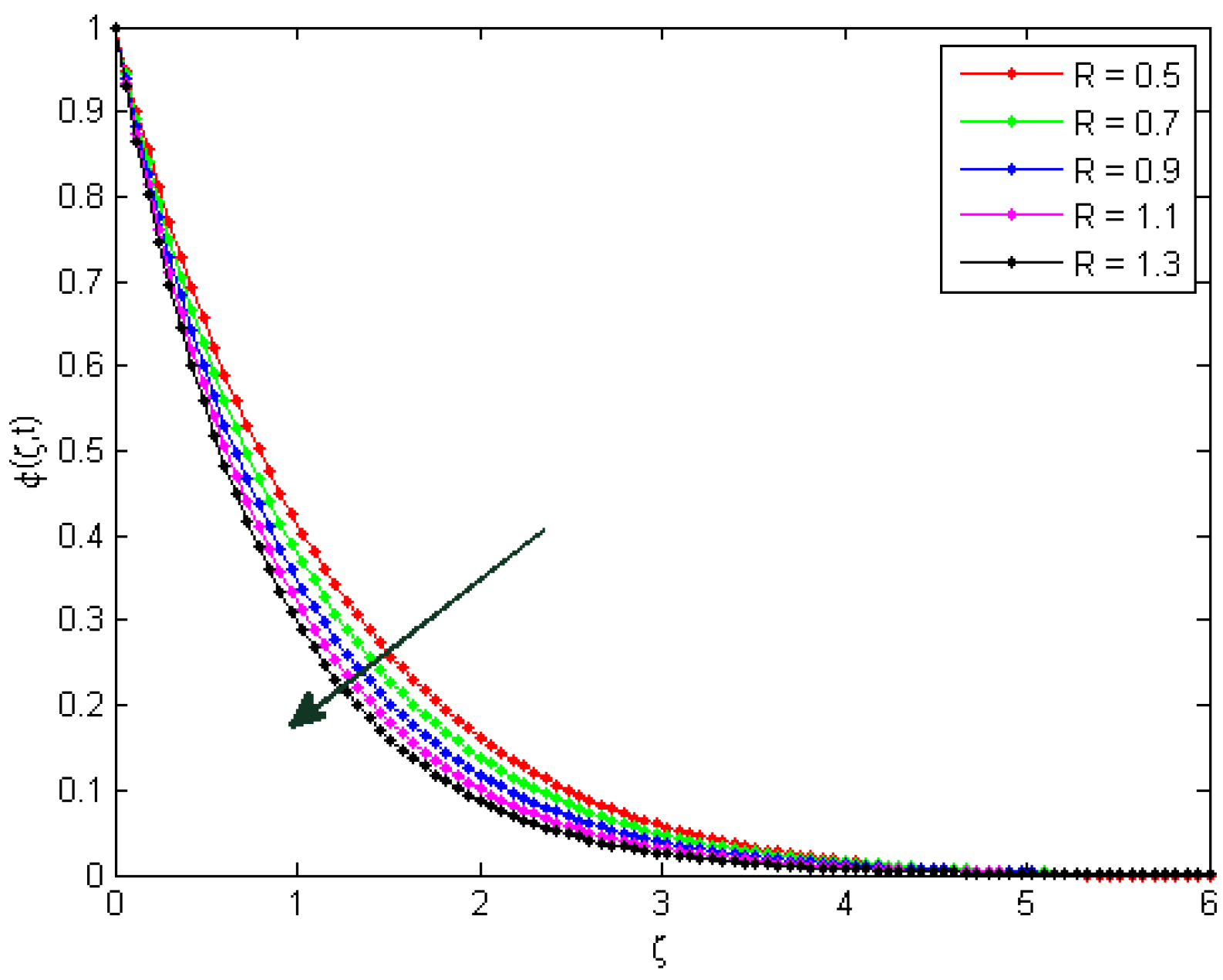
The evolution of the concentration profile with varying chemical reaction rates is depicted in Figure 16. A chemical reaction involves the consumption or production of species, which directly influences the concentration within the fluid. This process can alter the local density or reduce the buoyancy force, leading to a decrease in concentration.
Table 4 summarizes the influence of key parameters on the skin friction, Nusselt number, and Sherwood number at the surface of the inclined porous plate.
The skin friction coefficient, a critical metric for evaluating the shear stress at the boundary, is derived from the velocity gradient as τ s = p ( ζ , t ) ζ | ζ = 0 , whose analytical expression is given by Equation (48). This expression accounts for the combined effects of thermal diffusion, chemical reaction, and fractional-order temporal dynamics through multiple summations involving key physical parameters. Analysis of Equation (48) reveals clear parametric trends: the skin friction is accentuated by an increase in the Casson parameter ( ϵ ), radiation ( R d ), heat generation ( Q o ), chemical reaction rate (R), fractional parameter ( α ), and time (t). Physically, this indicates that higher values of these parameters enhance the velocity gradient at the wall, thereby intensifying the wall shear stress. Conversely, the skin friction coefficient decreases with increasing magnetic field ( F m ) and its inclination angle ( γ ), plate inclination angle ( η ), porosity ( F p ), Prandtl number ( P r ), and Schmidt number ( S c ). These factors suppress the flow motion, reducing momentum transfer near the wall and consequently lowering the surface shear stress. Therefore, Equation (48) provides a comprehensive series solution that quantitatively captures the interplay of physical forces governing wall shear stress in this complex flow system.
The rate of heat transfer, quantified by the Nusselt number, is enhanced by thermal radiation ( R d ) and internal heat generation ( Q o ), but is reduced by a higher Prandtl number ( P r ), fractional parameter ( α ), and time (t).
Finally, the mass transfer rate, expressed by the Sherwood number, increases with the Schmidt number ( S c ) and chemical reaction parameter (R), but decreases with the fractional parameter ( α ) and time (t).

7. Conclusions

This study presented an analytical framework for the transient free-convective flow of a hydromagnetic Casson fluid over an inclined plate embedded in a porous medium using Caputo fractional derivatives. The model integrates the effects of thermal radiation, chemical reaction, an inclined magnetic field, and internal heat generation, effectively capturing memory-dependent transport behavior. The major contributions and findings are summarized below.

7.1. Modeling and Mathematical Contributions

  • A comprehensive fractional-order model was formulated to represent memory effects and anomalous diffusion in a complex multi-physics flow configuration.
  • Closed-form analytical series solutions for velocity, temperature, and concentration fields were derived through the Laplace transform method, and their convergence was examined and verified using limiting classical cases.

7.2. Key Physical Insights

  • The simultaneous inclination of both the plate and the magnetic field generates a combined retarding effect, suppressing velocity and thinning the hydrodynamic boundary layer.
  • The fractional parameter α enhances velocity, temperature, concentration, and their respective boundary layer thicknesses, confirming its role as a memory- and diffusion-regulating index.
  • Increasing magnetic field strength and porosity parameters reduces velocity due to the strengthening of Lorentz and Darcy resistive forces.
  • Increasing Prandtl number ( P r ) decreases temperature and thermal boundary layer thickness, whereas larger Schmidt number ( S c ) reduces concentration and contracts the solutal boundary layer.
  • The skin friction coefficient decreases with increasing inclination angle ( η ) and magnetic field parameter ( F m ).

7.3. Practical Applications

The outcomes of this work have direct relevance to engineering and biomedical systems where non-Newtonian, magnetohydrodynamic, and porous effects are significant:
  • Thermal management in porous MHD devices: including nuclear reactor cooling, MHD power generators, and aerospace thermal control systems, where magnetic fields interact with non-Newtonian fluids flowing through porous structures.
  • Biomedical transport processes involving Casson-type fluids: such as blood flow in arteries, targeted drug delivery through porous tissues, and synovial fluid dynamics in joints, where yield-stress behavior and memory effects play key physiological roles.

7.4. Future Research Directions

The fractional-order modeling framework established here opens several avenues for further investigation:
  • Extended fractional modeling: introducing distinct fractional orders for velocity ( α u ), temperature ( α T ), and concentration ( α C ) to reflect different memory behaviors in each transport mechanism.
  • Realistic boundary conditions: incorporating time-dependent thermal and concentration boundary conditions to capture transient operating conditions in practical applications.
  • Experimental validation: comparison with laboratory measurements from MHD or biomedical flow experiments to further evaluate predictive capability.
  • Advanced numerical implementation: extending the model to complex geometries using meshless methods and virtual element methods, including the CVEM scheme [41] for fractional PDEs.
  • Additional physical mechanisms: investigating the effects of multiphase flow, nonlinear radiation, hybrid nanofluids, and cross-diffusion processes.
Beyond analytical relevance, the closed-form solutions derived in this study serve as benchmark cases for validating numerical solvers for fractional hydrodynamics. Furthermore, the analytical kernel can generate high-quality synthetic datasets for machine-learning-based frameworks such as Physics-Informed Neural Networks, enabling real-time prediction of fractional MHD flows in engineering and biomedical contexts.

Author Contributions

M.F.E. contributed to the main idea, conducted all analytical and numerical steps of the research, and was responsible for writing—original draft preparation and writing—review and editing. X.J.Z. edited the draft and all the steps. All authors have read and agreed to the published version of the manuscript.

Funding

Unfortunately, no funding was received to help prepare this manuscript.

Data Availability Statement

Data will be made available on request.

Conflicts of Interest

The authors declare that they have no competing interests.

Appendix A

Appendix A.1. Generalized Binomial Theorem

The generalized binomial theorem extends the classical binomial expansion to real-valued exponents. For any real number p and | x | < | y | :
( y + x ) p = k = 0 p k y p k x k ,
where the generalized binomial coefficient is defined as:
p k = Γ ( p + 1 ) k ! Γ ( p k + 1 ) .
This identity is fundamental for expanding terms involving fractional powers in the Laplace-domain solutions, particularly in handling expressions of the form ( s α + c ) p that arise from the boundary conditions.

Appendix A.2. Geometric Series Expansion

The geometric series expansion in the Laplace domain is crucial for inverting transformed solutions containing rational expressions. For | c s α | < 1 :
1 s α c = s α k = 0 c s α k = k = 0 c k s α ( k + 1 ) .
This expansion converts fractional operators into infinite series of standard Laplace transforms, facilitating term-by-term inversion and enabling the construction of series solutions in the time domain.

Appendix A.3. Stirling’s Approximation and Series Convergence

Stirling’s approximation for the Gamma function provides the asymptotic behavior essential for convergence analysis:
Γ ( z + 1 ) 2 π z z e z 1 + 1 12 z + O 1 z 2 , | z | .
When applied to the series coefficients arising from combinations of generalized binomial coefficients and Gamma functions, Stirling’s approximation demonstrates super-exponential decay of the terms. This guarantees the absolute and uniform convergence of all infinite series solutions derived for the concentration, temperature, and velocity fields, thereby validating the analytical methodology employed in this work.

References

  1. Debnath, L. Recent applications of fractional calculus to science and engineering. Int. J. Math. Math. Sci. 2003, 2003, 3413–3442. [Google Scholar] [CrossRef]
  2. Sehra; Iftikhar, W.; Haq, S.U.; Jan, S.U.; Khan, I.; Mohamed, A. Caputo–Fabrizio fractional model of MHD second grade fluid with Newtonian heating and heat generation. Sci. Rep. 2022, 12, 22371. [Google Scholar] [CrossRef] [PubMed]
  3. Khan, M.; Nadeem, S.; Hayat, T.; Siddiqui, A.M. Unsteady motions of a generalized second-grade fluid. Math. Comput. Model. 2005, 41, 629–637. [Google Scholar] [CrossRef]
  4. Jha, B.K.; Gambo, D.; Adam, U.M. Fractional order analysis of unsteady pressure-driven flow in an annulus with momentum slip. Partial. Differ. Equations Appl. Math. 2023, 7, 100474. [Google Scholar] [CrossRef]
  5. Kilbas, A.A.; Srivastava, H.M.; Trujillo, J.J. Theory and Applications of Fractional Differential Equations; Elsevier: Amsterdam, The Netherlands, 2006; Volume 204. [Google Scholar]
  6. Podlubny, I. Fractional Differential Equations: An Introduction to Fractional Derivatives, Fractional Differential Equations, to Methods of Their Solution and Some of Their Applications; Elsevier: Amsterdam, The Netherlands, 1998. [Google Scholar]
  7. Sadia, H.; Haq, S.U.; Khan, I.; Ashmaig, M.A.M.; Omer, A.S. Time fractional analysis of generalized Casson fluid flow by YAC operator with the effects of slip wall, and chemical reaction in a porous medium. Int. J. Thermofluids 2023, 20, 100466. [Google Scholar]
  8. Jafari, H.; Mehdinejadiani, B.; Baleanu, D. Fractional calculus for modeling unconfined groundwater. Appl. Eng. Life Soc. Sci. 2019, 7, 119–138. [Google Scholar]
  9. Alwuthaynani, M.; Ishtiaq, U.; El-Wahed Khalifa, H.A.; Alburaikan, A.; Idress, R.; Popa, I.L. Fractional-order modelling and analytical solutions for MHD casson fluid flow in an inclined channel with heat and mass transfer. Sci. Rep. 2025, 15, 39790. [Google Scholar] [CrossRef]
  10. He, J. Some applications of nonlinear fractional differential equations and their approximations. Bull. Sci. Technol. 1999, 15, 86–90. [Google Scholar]
  11. He, J.H. Approximate analytical solution for seepage flow with fractional derivatives in porous media. Comput. Methods Appl. Mech. Eng. 1998, 167, 57–68. [Google Scholar] [CrossRef]
  12. Grigorenko, I.; Grigorenko, E. Chaotic dynamics of the fractional Lorenz system. Phys. Rev. Lett. 2003, 91, 034101. [Google Scholar] [CrossRef]
  13. Moreles, M.A.; Peña, J.; Botello, S.; Iturriaga, R. On modeling flow in fractal media form fractional continuum mechanics and fractal geometry. Transp. Porous Media 2013, 99, 161–174. [Google Scholar] [CrossRef]
  14. Carcione, J.M.; Sanchez-Sesma, F.J.; Luzón, F.; Gavilán, J.J.P. Theory and simulation of time-fractional fluid diffusion in porous media. J. Phys. A Math. Theor. 2013, 46, 345501. [Google Scholar] [CrossRef]
  15. Choudhary, A.; Kumar, D.; Singh, J. A fractional model of fluid flow through porous media with mean capillary pressure. J. Assoc. Arab. Univ. Basic Appl. Sci. 2016, 21, 59–63. [Google Scholar] [CrossRef]
  16. Endalew, M.F.; Sarkar, S. A numerical study of forced convection casson nanofluid flow past a wedge with melting process. In ASME International Mechanical Engineering Congress and Exposition; American Society of Mechanical Engineers: New York, NY, USA, 2020; Volume 84584, p. V010T10A018. [Google Scholar]
  17. Iftikhar, N.; Baleanu, D.; Riaz, M.B.; Husnine, S.M. Heat and Mass Transfer of Natural Convective Flow with Slanted Magnetic Field via Fractional Operators. J. Appl. Comput. Mech. 2020, 7, 189–212. [Google Scholar]
  18. Rehman, A.U.; Jarad, F.; Riaz, M.B.; Shah, Z.H. Generalized Mittag-Leffler Kernel form solutions of free convection heat and mass transfer flow of Maxwell fluid with Newtonian heating: Prabhakar fractional derivative approach. Fractal Fract. 2022, 6, 98. [Google Scholar] [CrossRef]
  19. Saqib, M.; Ali, F.; Khan, I.; Sheikh, N.A.; Jan, S.A.A. Exact solutions for free convection flow of generalized Jeffrey fluid: A Caputo-Fabrizio fractional model. Alex. Eng. J. 2018, 57, 1849–1858. [Google Scholar] [CrossRef]
  20. Sene, N. Fractional model and exact solutions of convection flow of an incompressible viscous fluid under the Newtonian heating and mass diffusion. J. Math. 2022, 2022, 8785197. [Google Scholar] [CrossRef]
  21. Vieru, D.; Fetecau, C.; Fetecau, C. Time-fractional free convection flow near a vertical plate with Newtonian heating and mass diffusion. Therm. Sci. 2015, 19, 85–98. [Google Scholar] [CrossRef]
  22. Asjad, M.I.; Karim, R.; Hussanan, A.; Iqbal, A.; Eldin, S.M. Applications of fractional partial differential equations for MHD Casson fluid flow with innovative ternary nanoparticles. Processes 2023, 11, 218. [Google Scholar] [CrossRef]
  23. Islam, M.R.; Reza-E-Rabbi, S.; Yousuf Ali, M.; Rasel, M.M.H.; Ahmmed, S.F. Numerical simulation of mass and heat transport phenomena of hydromagnetic flow of Casson fluid with sinusoidal boundary conditions. Eng. Rep. 2023, 5, e12659. [Google Scholar] [CrossRef]
  24. Saeed, S.T.; Inc, M.; Alqarni, M.Z.; Radwan, N. Series solution of time-fractional MHD viscoelastic model through non-local kernel approach. Opt. Quantum Electron. 2024, 56, 861. [Google Scholar] [CrossRef]
  25. Sehra; Sadia, H.; Haq, S.U.; Khan, I. Time fractional Yang–Abdel–Cattani derivative in generalized MHD Casson fluid flow with heat source and chemical reaction. Sci. Rep. 2023, 13, 16494. [Google Scholar] [CrossRef] [PubMed]
  26. Maiti, S.; Shaw, S.; Shit, G. Caputo–Fabrizio fractional order model on MHD blood flow with heat and mass transfer through a porous vessel in the presence of thermal radiation. Phys. Stat. Mech. Its Appl. 2020, 540, 123149. [Google Scholar] [CrossRef]
  27. Jamil, D.F.; Saleem, S.; Roslan, R.; Al-Mubaddel, F.S.; Rahimi-Gorji, M.; Issakhov, A.; Din, S.U. Analysis of non-Newtonian magnetic Casson blood flow in an inclined stenosed artery using Caputo-Fabrizio fractional derivatives. Comput. Methods Programs Biomed. 2021, 203, 106044. [Google Scholar] [CrossRef]
  28. Abbas, S.; Nisa, Z.U.; Nazar, M.; Metwally, A.S.M.; Kędzia, K.; Jan, A.Z.; Kamolova, N. Effect of chemical reaction on MHD Casson natural convection flow over an oscillating plate in porous media using Caputo fractional derivative. Int. J. Therm. Sci. 2025, 207, 109355. [Google Scholar] [CrossRef]
  29. Abbas, S.; Nisa, Z.U.; Nazar, M.; Amjad, M.; Ali, H.; Jan, A.Z. Application of heat and mass transfer to convective flow of Casson fluids in a microchannel with Caputo–Fabrizio derivative approach. Arab. J. Sci. Eng. 2024, 49, 1275–1286. [Google Scholar] [CrossRef]
  30. Endalew, M.F.; Zhang, X. Unsteady Radiative MHD Casson Fluid Flow Over an Impulsively Started Porous Plate with Caputo Fractional Derivatives. Eng. Rep. 2025, 7, e70308. [Google Scholar] [CrossRef]
  31. Nandy, S.K. Analytical solution of MHD stagnation-point flow and heat transfer of Casson fluid over a stretching sheet with partial slip. ISRN Thermodyn. 2013, 2013, 108264. [Google Scholar] [CrossRef]
  32. Mukhopadhyay, S.; De, P.R.; Bhattacharyya, K.; Layek, G. Casson fluid flow over an unsteady stretching surface. Ain Shams Eng. J. 2013, 4, 933–938. [Google Scholar] [CrossRef]
  33. Endalew, M.F.; Sarkar, S.; Seth, G.S. Convective and dissipative temporal flow of Casson nanofluid past a tilted plate in a porous medium with Navier’s slip and slanted magnetic field. Spec. Top. Rev. Porous Media: Int. J. 2021, 12, 43–64. [Google Scholar] [CrossRef]
  34. Endalew, M.F. Analytical study of heat and mass transfer effects on unsteady Casson fluid flow over an oscillating plate with thermal and solutal boundary conditions. Heat Transf. 2021, 50, 6285–6299. [Google Scholar] [CrossRef]
  35. Endalew, M.F.; Goshu, M.D.; Tegegne, Y.C. Unsteady MHD Thin Film Flow of a Second-Grade Fluid past a Tilted Plate under the Impact of Thermal Radiation and Chemical Reaction. J. Appl. Math. 2022, 2022, 9491308. [Google Scholar] [CrossRef]
  36. Endalew, M.F.; Sarkar, S. Modeling and analysis of unsteady casson fluid flow due to an exponentially accelerating plate with thermal and solutal convective boundary conditions. J. Appl. Math. 2023, 2023, 3065357. [Google Scholar] [CrossRef]
  37. Ahmad, J.; Ali, F.; Murtaza, S.; Khan, I. Caputo time fractional model based on generalized Fourier’s and Fick’s laws for Brinkman-type fluid: Exact solution via integral transform. Fractals 2023, 31, 2340163. [Google Scholar]
  38. Sene, N. Solution procedure for fractional Casson fluid model considered with heat generation and chemical reaction. Sustainability 2023, 15, 5306. [Google Scholar] [CrossRef]
  39. Pattnaik, J.R.; Dash, G.C.; Singh, S. Radiation and mass transfer effects on MHD flow through porous medium past an exponentially accelerated inclined plate with variable temperature. Ain Shams Eng. J. 2017, 8, 67–75. [Google Scholar] [CrossRef]
  40. Hu, S.; Fan, C.; Chen, C.; Young, D. Method of fundamental solutions for Stokes’ first and second problems. J. Mech. 2005, 21, 25–31. [Google Scholar] [CrossRef]
  41. Desiderio, L.; Falletta, S.; Ferrari, M.; Scuderi, L. CVEM-BEM coupling for the simulation of time-domain wave fields scattered by obstacles with complex geometries. Comput. Methods Appl. Math. 2023, 23, 353–372. [Google Scholar] [CrossRef]
Figure 1. Geometrical illustration of the problem.
Fractalfract 09 00809 g001
Figure 2. Dimensionless velocity p ( ζ , t ) versus ζ for various G r . Other parameters: γ = η = π / 3 , ϵ = α = 0.5 , G m = 0.05 , F m = F p = 0.2 , Pr = 0.9 , Q o = 2 , S c = 0.01 , R = 1 , R d = 30 , and t = 2 . Series truncated at N max = 25 terms.
Fractalfract 09 00809 g002
Figure 3. Dimensionless velocity p ( ζ , t ) versus ζ for various G m . Other parameters: γ = η = π / 3 , ϵ = α = 0.5 , G r = 0.05 , F m = F p = 0.2 , Pr = 0.9 , Q o = 2 , S c = 0.01 , R = 1 , R d = 30 , and t = 2 . Series truncated at N max = 25 terms.
Fractalfract 09 00809 g003
Figure 4. Dimensionless velocity p ( ζ , t ) versus ζ for various F p . Other parameters: γ = η = π / 3 , ϵ = α = 0.5 , G r = G m = 0.05 , Pr = 0.9 , Q o = 2 , F m = 0.2 , S c = 0.01 , R = 1 , R d = 30 , and t = 2 . Series truncated at N max = 25 terms.
Fractalfract 09 00809 g004
Figure 5. Dimensionless velocity p ( ζ , t ) versus ζ for various F m . Other parameters: γ = η = π / 3 , ϵ = α = 0.5 , G r = G m = 0.05 , Pr = 0.9 , Q o = 2 , F p = 0.2 , S c = 0.01 , R = 1 , R d = 30 , and t = 2 . Series truncated at N max = 25 terms.
Fractalfract 09 00809 g005
Figure 6. Dimensionless velocity p ( ζ , t ) versus ζ for various η . Other parameters: γ = π / 3 , ϵ = α = 0.5 , G r = G m = 0.05 , Pr = 0.9 , Q o = 2 , F m = F p = 0.2 , S c = 0.01 , R = 1 , R d = 30 , and t = 2 . The series solution is truncated at N max = 25 .
Fractalfract 09 00809 g006
Figure 7. Dimensionless velocity p ( ζ , t ) versus ζ for various γ . Other parameters: η = π / 3 , ϵ = α = 0.5 , G r = G m = 0.05 , Pr = 0.9 , Q o = 2 , F m = F p = 0.2 , S c = 0.01 , R = 1 , R d = 30 , and t = 2 . The series solution is truncated at N max = 25 .
Fractalfract 09 00809 g007
Figure 8. Dimensionless velocity p ( ζ , t ) versus ζ for various ϵ . Other parameters: η = γ = π / 3 , α = 0.5 , G r = G m = 0.01 , P r = 0.9 , Q o = 2 , F p = 0.1 , S c = 0.01 , R = 0.5 , F m = 0.2 , R d = 10 , N max = 20 , and t = 3 . The series solution is truncated at N max = 20 .
Fractalfract 09 00809 g008
Figure 9. Dimensionless velocity p ( ζ , t ) versus ζ for various α . Other parameters: η = γ = π / 3 , ϵ = 0.5 , G r = G m = 0.01 , P r = 0.9 , Q o = 2 , F p = 0.1 , S c = 0.01 , R = 0.5 , F m = 0.2 , R d = 10 , N max = 20 , and t = 3 . The series solution is truncated at N max = 20 .
Fractalfract 09 00809 g009
Figure 10. Dimensionless temperature θ ( ζ , t ) versus ζ for various α . Other parameters: Q o = 1 , P r = 2 , R d = 5 , and t = 1 . The series solution is truncated at N max = 25 .
Fractalfract 09 00809 g010
Figure 11. Dimensionless concentration ϕ ( ζ , t ) versus ζ for various α . Other parameters: S c = 0.65 , R = 0.7 , and t = 2 . The series solution is truncated at N max = 25 .
Fractalfract 09 00809 g011
Figure 12. Dimensionless temperature θ ( ζ , t ) versus ζ for various Pr. Other parameters: Q 0 = 1 , α = 0.5 , R d = 5 , and t = 1 . The series solution is truncated at N max = 25 .
Fractalfract 09 00809 g012
Figure 13. Dimensionless temperature θ ( ζ , t ) versus ζ for various Q o . Other parameters: Pr = 2 , α = 0.5 , R d = 5 , and t = 1 . The series solution is truncated at N max = 25 .
Fractalfract 09 00809 g013
Figure 14. Dimensionless temperature θ ( ζ , t ) versus ζ for various R d . Other parameters: P r = 2 , α = 0.5 , Q o = 1 , and t = 1 . The series solution is truncated at N max = 25 .
Fractalfract 09 00809 g014
Figure 15. Dimensionless concentration ϕ ( ζ , t ) versus ζ for various S c . Other parameters: α = 0.5 , R = 0.7 , and t = 2 . The series solution is truncated at N max = 25 .
Fractalfract 09 00809 g015
Figure 16. Dimensionless concentration ϕ ( ζ , t ) versus ζ for various R. Other parameters: α = 0.5 , S c = 0.65 , R = 0.7 , and t = 2 . The series solution is truncated at N max = 25 .
Fractalfract 09 00809 g016
Table 1. Comparison of the present work with recent studies on fractional Casson fluid flow.
StudyGeometryFractional OperatorCasson FluidMagnetic Field InclinationRadiationConvergence Analysis
Abbas et al. [28]Oscillating plateCaputoYesNoNoNot reported
Abbas et al. [29]MicrochannelCaputo–FabrizioYesNoYesNot reported
Endalew and Zhang [30]Horizontal plateCaputoYesNoYesYes
Present workTilted plateCaputoYesYesYesYes
Table 2. Comparison of series and FDM solutions for θ ( ζ , t ) at t = 3.0 .
ζ θ Series θ FDM | Error |
α = 0.10 , MAE = 3.30 × 10 2 , RMSE = 5.60 × 10 2 , MaxErr = 9.00 × 10 2
0.01.0000001.0000000.000000
1.00.2789860.1889930.089983
2.00.0303720.0351060.004734
4.00.0000150.0011590.001144
6.00.0000000.0000150.000015
8.00.0000000.0000000.000000
α = 0.40 , MAE = 1.54 × 10 1 , RMSE = 1.56 × 10 1 , MaxErr = 1.67 × 10 1
0.01.0000001.0000000.000000
1.00.4364990.2718570.164642
2.00.1196520.0613880.058264
4.00.0018550.0020880.000233
6.00.0000230.0000470.000024
8.00.0000000.0000000.000000
α = 0.60 , MAE = 7.70 × 10 2 , RMSE = 8.80 × 10 2 , MaxErr = 1.42 × 10 1
0.01.0000001.0000000.000000
1.00.5123020.3452610.167041
2.00.1900210.0848330.105188
4.00.0087660.0023980.006368
6.00.0000840.0000310.000053
8.00.0000000.0000000.000000
α = 0.80 , MAE = 1.70 × 10 2 , RMSE = 2.60 × 10 2 , MaxErr = 6.80 × 10 2
0.01.0000001.0000000.000000
1.00.5714590.4372420.134217
2.00.2577150.1152260.142489
4.00.0235980.0023310.021267
6.00.0006850.0000110.000674
8.00.0000060.0000000.000006
Table 3. Convergence analysis of the series solution for θ ( ζ = 1.0 , t = 3.0 , α = 0.6 ) , using θ N = 60 as the reference solution.
N θ N | θ N θ N 1 | | θ N θ 60 |
TruncationSeries SolutionIncremental ChangeError vs. Reference
100.4723181.8 × 10 2 4.0 × 10 2
150.4896238.4 × 10 3 2.3 × 10 2
200.5001563.5 × 10 3 1.2 × 10 2
250.5068711.7 × 10 3 6.2 × 10 3
300.5098248.5 × 10 4 3.3 × 10 3
350.5112484.3 × 10 4 1.9 × 10 3
400.5119622.1 × 10 4 9.8 × 10 4
450.5121641.1 × 10 4 6.1 × 10 4
500.5122775.6 × 10 5 3.3 × 10 4
550.5123252.9 × 10 5 1.5 × 10 4
600.5123411.6 × 10 5 0.0 × 10 0
Table 4. Changes in skin friction, heat transfer rate, and mass transfer rate.
ϵ Fm Fp γ η Pr Rd Q o Sc R α t τ s Nu Sh
0.50.10.2 π / 3 π / 3 0.75520.120.520.803
10.20.2 π / 3 π / 3 0.75520.120.520.98875
0.50.10.2 π / 3 π / 3 0.75520.120.520.803
0.50.20.2 π / 3 π / 3 0.75520.120.520.74706
0.50.10.1 π / 3 π / 3 0.75520.120.520.89367
0.50.10.2 π / 3 π / 3 0.75520.120.520.803
0.50.10.2 π 3 π / 3 0.75520.120.520.803
0.50.10.2 π 2 π / 3 0.75520.120.520.7834
0.50.10.2 π / 3 π 3 0.75520.120.520.803
0.50.10.2 π / 3 π 2 0.75520.120.520.74158
0.50.10.2 π / 3 π / 3 0.5520.120.520.782351.7037
0.50.10.2 π / 3 π / 3 0.95520.120.520.736681.6351
0.50.10.2 π / 3 π / 3 0.75520.120.520.769561.6557
0.50.10.2 π / 3 π / 3 0.751020.120.520.775481.7504
0.50.10.2 π / 3 π / 3 0.75520.120.520.769561.6557
0.50.10.2 π / 3 π / 3 0.75540.120.520.878642.2353
0.50.10.2 π / 3 π / 3 0.75520.120.520.769560.65597
0.50.10.2 π / 3 π / 3 0.75520.1520.520.733890.92768
0.50.10.2 π / 3 π / 3 0.75520.120.520.769560.48047
0.50.10.2 π / 3 π / 3 0.75520.140.520.881510.65597
0.50.10.2 π / 3 π / 3 0.75520.120.520.769561.65570.49182
0.50.10.2 π / 3 π / 3 0.75520.120.620.789931.61750.48047
0.50.10.2 π / 3 π / 3 0.75520.120.520.8031.61750.48047
0.50.10.2 π / 3 π / 3 0.75520.120.530.84111.59330.47329
Note. The boldface symbols in Table 4 indicate the parameter being varied in each corresponding set of rows, while all other parameters remain fixed.
Disclaimer/Publisher’s Note: The statements, opinions and data contained in all publications are solely those of the individual author(s) and contributor(s) and not of MDPI and/or the editor(s). MDPI and/or the editor(s) disclaim responsibility for any injury to people or property resulting from any ideas, methods, instructions or products referred to in the content.