Article

Chaotic Heat Flows and Kolmogorov Entropy in a Basin Geomorphology: A First Approximation Study of Their Effects on the Fractal Dimension


by
Patricio Pacheco
1,2,*,
Eduardo Mera
1,2,
Denisse Cartagena-Ramos
3,
Javier Wachter
1 and
Constanza Salinas
3
1
Departamento de Física, Facultad de Ciencias Naturales, Matemáticas y Medio Ambiente, Universidad Tecnológica Metropolitana, Las Palmeras 3360, Ñuñoa, Santiago 7750000, Chile
2
Research Laboratory on Environment and Learning (RLEL), Underground Building M1, Universidad Tecnológica Metropolitana, J.Alessandri 1242, Ñuñoa, Santiago 7750000, Chile
3
Facultad de Enfermería, Universidad Andrés Bello República 217, Santiago 8320000, Chile
*
Author to whom correspondence should be addressed.
Fractal Fract. 2026, 10(4), 240; https://doi.org/10.3390/fractalfract10040240
Submission received: 4 February 2026 / Revised: 25 March 2026 / Accepted: 28 March 2026 / Published: 3 April 2026
(This article belongs to the Special Issue Complexity, Fractals, and Nonlinear Phenomena Across Disciplines)

Abstract

This study investigates, at a microscale, urban sensible heat flux and Kolmogorov entropy in locations with varying degrees of urban densification according to regular geometries, and examines their effect on fractal dimension. To this end, an ultrasonic anemometer was installed in each of four locations spread across a 648 km2 area within a basin geomorphology. This anemometer measures the horizontal and vertical components of wind speed and sonic temperature. The measurements for each variable constitute hourly time series of 3968 data points. From the time series of vertical wind speed and sonic temperature, the hourly sensible heat flux was calculated using the statistical technique of covariances. The total heat calculated for each location during the measurement period indicates which location contributes the greatest heat flux to the boundary layer. Applying chaos theory to the hourly sensible heat time series shows that all series are chaotic, and the Kolmogorov entropy can be obtained for each. The chaotic analysis of data from different locations reveals a proportional relationship between heat flux emissions, Kolmogorov entropy, and urban densification, amplifying the Kolmogorov cascade effect. The vertical components of the wind studied result from the interaction of the wind with the geometric regularity of the buildings, which causes increases in both heat flow and Kolmogorov entropy, suggesting a relationship of these quantities with the decay of the fractal dimension.

1. Introduction

Observations of mesoscale sensible heat flux variation, according to urban areas, as an urban heat island effect are widely documented [1,2,3,4], Q* + QF = QH + QE +Qc + ΔQS + ΔQA (W/m2), where Q* is the net radiation (the net balance of received and reflected radiant fluxes), QF is the anthropogenic heat flux (the energy flux released by human activities), QH is the turbulent sensible flux (the energy that heats the air), QE is the latent heat flux (energy consumed during the phase change of water, e.g., evaporation and condensation), QG is the heat conduction with the surfaces in contact with the ground, ΔQS is the net heat storage (the energy that heats and is stored in the urban fabric and volumes), and ΔQA is the horizontal displacement of heat by advection (in meteorology, the process of transport of an atmospheric property, such as heat or humidity, by the effect of the wind).
Microscale variations in heat flux, such as those observed between adjacent roads or even between pavement and road surface or between nearby residential buildings, have long been explored using various techniques [5,6,7,8]. Early studies by Grimmond [9] of urban geometric form sought to establish relationships with winds and turbulence. Masson [10] developed an urban surface scheme for mesoscale atmospheric models that allows for the refinement of radiative balances, as well as momentum, turbulent heat, and ground fluxes. Grimmond [11] presents a linked set of simple equations designed specifically to calculate heat fluxes for the urban environment, requiring only standard meteorological observations and basic knowledge of surface cover. Using a novel scheme to define the Holtslag and van Ulden parameters α and β for urban environments, α is empirically related to the fraction of the plan area that is vegetated or irrigated, and a new urban value of β captures the observed delay in the sign reversal of sensible heat flux at night. It was shown to outperform the standard HPDM (Hybrid Plume Dispersion Model) preprocessor scheme. Thermal remote sensing [12] has been used in urban areas to assess the urban heat island effect, to classify land cover, and as input for urban surface atmospheric exchange models. Kravenhoff [13] developed a microscale, three-dimensional (3D) urban energy balance model, using 3D Urban Facet temperatures, to predict urban surface temperatures for various geometries and surface properties, climatic conditions, and solar angles. The model has several potential applications, such as calculating radiative loads and investigating effective thermal anisotropy (when combined with a sensor view model). From a more current perspective, and as urbanization progresses, more objective methods are needed to analyze the urban microclimate. Nazarian [14,15] considered a more realistic representation of surface heating in an idealized three-dimensional urban configuration and evaluated the spatial variability of flow statistics (mean flow and turbulent flows) in urban streets. Large eddy simulations were used in conjunction with an urban energy balance model, and the distribution of urban surface heating was parameterized using sets of horizontal and vertical Richardson numbers, which characterize thermal stratification and the orientation of heating with respect to wind direction. Lee’s [16] model fits real urban meteorological and environmental applications and is capable of representing urban radiative, convective, and conductive energy transfer processes, along with their interactions, and is compatible with Cartesian grid microscale atmospheric models. Validation with the measurements demonstrated that the model is able to predict surface temperatures and energy balance fluxes at scale in heterogeneous urban surfaces thanks to the interactive representation of urban physical processes.
Rapid urbanization, coupled with the formation of surface urban heat islands (SUHIs) and the sudden increase in land surface temperature (LST), has substantial socioeconomic and environmental impacts. This is the reason for conducting studies that simulate the impacts of rapid urbanization on LST and SUHI patterns. Saha [17] applies these considerations to the city of Sylhet, Bangladesh, in a model that goes from 1995 to 2030.
These phenomena that attract the interest of the scientific community, apart from many others, directly affect people at street level, since people live, work, move, study, etc., in the urban environment; Figure 1:

1.1. Building Materials and Climate Change

Concrete is one of the main materials used in construction due to its mechanical properties: compressive strength, tensile strength, and modulus of elasticity. It also possesses ductility, toughness, and fatigue resistance—important properties that influence concrete’s performance in various applications. However, concrete production significantly contributes to climate change due to the substantial carbon dioxide emissions associated with cement production. While concrete is a versatile and durable building material, its high carbon footprint necessitates exploring decarbonization strategies within the concrete and construction industries [18]. The vast majority of the world’s cities have been extensively built with concrete structures according to regular geometric volumes. Urban infrastructure both generates and is negatively affected by the urban heat island (UHI) effect, which raises localized temperatures, in addition to the increase caused by the impact of climate change due to CO2 emissions. This impacts concrete durability by accelerating carbonation and corrosion. This can lead to reduced service life and potential structural failures of concrete infrastructure. The effect of temperature on carbonation is experimentally based, but there are few specific analytical engineering methods that evaluate the consequences of temperature on natural carbonation. Developing countermeasures and design provisions for the climate resilience of concrete structures is a challenging task [19,20]. From a thermodynamic perspective, concrete has high thermal conductivity and low heat capacity. Concrete’s ability to absorb and retain heat influences its temperature [21].

1.2. Temperature in Concrete Buildings in Santiago, Chile

The average radiant temperature of a concrete wall in Santiago, Chile during winter can vary, but it is generally expected to be close to ambient temperature. In winter, average minimum temperatures in Santiago can be around 3 °C, while maximum temperatures can reach 15 °C [22]. Since concrete walls have some thermal inertia, they tend to stabilize at a temperature between the day’s high and low, but this temperature will not necessarily match the ambient temperature at any given time. During autumn, the average temperature of a concrete wall can vary, but it will generally remain close to the outside ambient temperature, which at this time of year can fluctuate between 7 and 10 °C for highs and below 7 °C for lows. The thermal mass of concrete helps moderate these fluctuations, but it does not prevent the wall from reaching temperatures similar to the surrounding environment. In spring, the average temperature of a concrete wall can vary, but it generally falls between 10 °C and 25 °C, with fluctuations due to daytime and nighttime variations in the weather. In spring, Santiago experiences a mild climate, with cool mornings and warm afternoons, which affects the wall’s temperature. Daytime highs can exceed 25 °C, especially in November, while nighttime lows can drop to around 10 °C. Finally, during the summer, the average temperature of a concrete wall can vary, but it is usually between 30 °C and 36 °C, with highs that can exceed 40 °C on very hot days. In summer, temperatures in Santiago can exceed 30 °C during the day, and surfaces like cement or concrete can reach even higher temperatures, reaching 50 °C or more, especially in areas exposed to direct sunlight, such as plazas or streets. The pavement temperature in Santiago can be significantly higher than the air temperature, often exceeding 50 °C, especially in areas with a lot of asphalt and little vegetation. This difference is due to the urban heat island effect, where dark surfaces like asphalt absorb and retain more heat than lighter surfaces or vegetation.

1.3. The Nature of Urban Heat Islands

Luke Howard was the first to provide evidence that air temperatures are often higher in a city than in its surroundings [23]. The characteristics of this urban heat island effect have been demonstrated and documented for many towns and cities for some time [24,25,26,27]. Following this pattern, it is possible to offer some general observations. These refer, as an initial condition, to the characteristics of the heat island scenario for a large city in a temperate climate (population ≥ 100,000), located in a watershed-type area during a typical summer day (clear skies and light or very light winds). These restrictions can be relaxed to show the vertical extent of heat and the effects of geographic location, city size, season, and climate. This division fits the concept of two distinct layers [28]: one, called the urban building or canopy layer (UCL), extending from the ground to approximately a mid-level roof, rather like a vegetation canopy layer; the other, called the urban boundary layer (UBL), is an internal mesoscale boundary layer whose characteristics are determined, at least in part, by the presence of the city below. Different measurements [29] support these concepts.

1.4. Some Concepts for Heat Flow Modeling

Knowing the surface radiant temperature at nearby sites (e.g., eight or more) within an urban area allows for combining this data with air and wind temperature data and applying it to various models for sensible surface heat flux. These models can then be compared, using approximate data, with the data that would be provided by a sonic anemometer located at a height of 3.5 m in the study area.
Including excess drag in the heat flux term, in addition to aerodynamic drag, allows us to verify its significance in urban areas. Furthermore, it enables us to study the effects of urban and solar geometry as important factors in microscale surface radiative temperature variations and, consequently, in sensible heat flux during favorable climatic conditions [16].
The surface sensible heat flux (QH) using the surface radiative temperature (TR):
P = Q H = Q t = C P m T R T a t = C P ρ V T R T a t = C P ρ A L T R T a t = C P ρ A T R T a L t ,
where v = speed = L/t, ρ = mass density = m/V and with V = volume of a cylinder (approximation) = AL, then:
Q H = Q H A = C P ρ T R T a v = C P ρ T R T a 1 v
Finally,
Q H = ρ C p ( T R T a ) r ,
where ρ = air density = 1.29 kg/m3 at sea level, Cp = specific heat of dry air = 1005 J/kg K, TR and Ta denote the radiometric surface temperature (temperature at the surface) and the air temperature, respectively, and r is a form of resistance to heat transfer (in units of sm−1). QH is in W/m2 in the International System of Units (SI). The difference in procedures lies in the calculation of r. The mixing of turbulent flows on a surface acts similarly to an engine that transfers heat along a temperature gradient; the random nature of the phenomenon and the extent of the magnitude of individual turbulence favor individual resistance.
The speed v is related to the resistance r:
r = 1 v = v l a r g e r s m a l l Q H g r o w s g r e a t e r   h e a t   f l o w   v s m a l l r l a r g e Q H d e c r e a s e s l o w e r   h e a t   f l o w ,
r has a resistance effect on the heat flow.

1.4.1. Turbulent Flows and Friction Velocity

Turbulence is characterized by chaotic movements, high Reynolds numbers, rapid velocity fluctuations, and high mixing, which, when averaged over time, can approximate laminar flow influenced by additional forces arising from the turbulence. In this case, the stress and strain distribution in the continuous medium can be arranged in a 3 × 3 matrix:
τ x x τ x y τ x z τ y x τ y y τ y z τ z x τ z y τ z z = ρ u u ¯ ρ u v ¯ ρ u w ¯ ρ v u ¯ ρ v v ¯ ρ v w ¯ ρ w u ¯ ρ w v ¯ ρ w w ¯
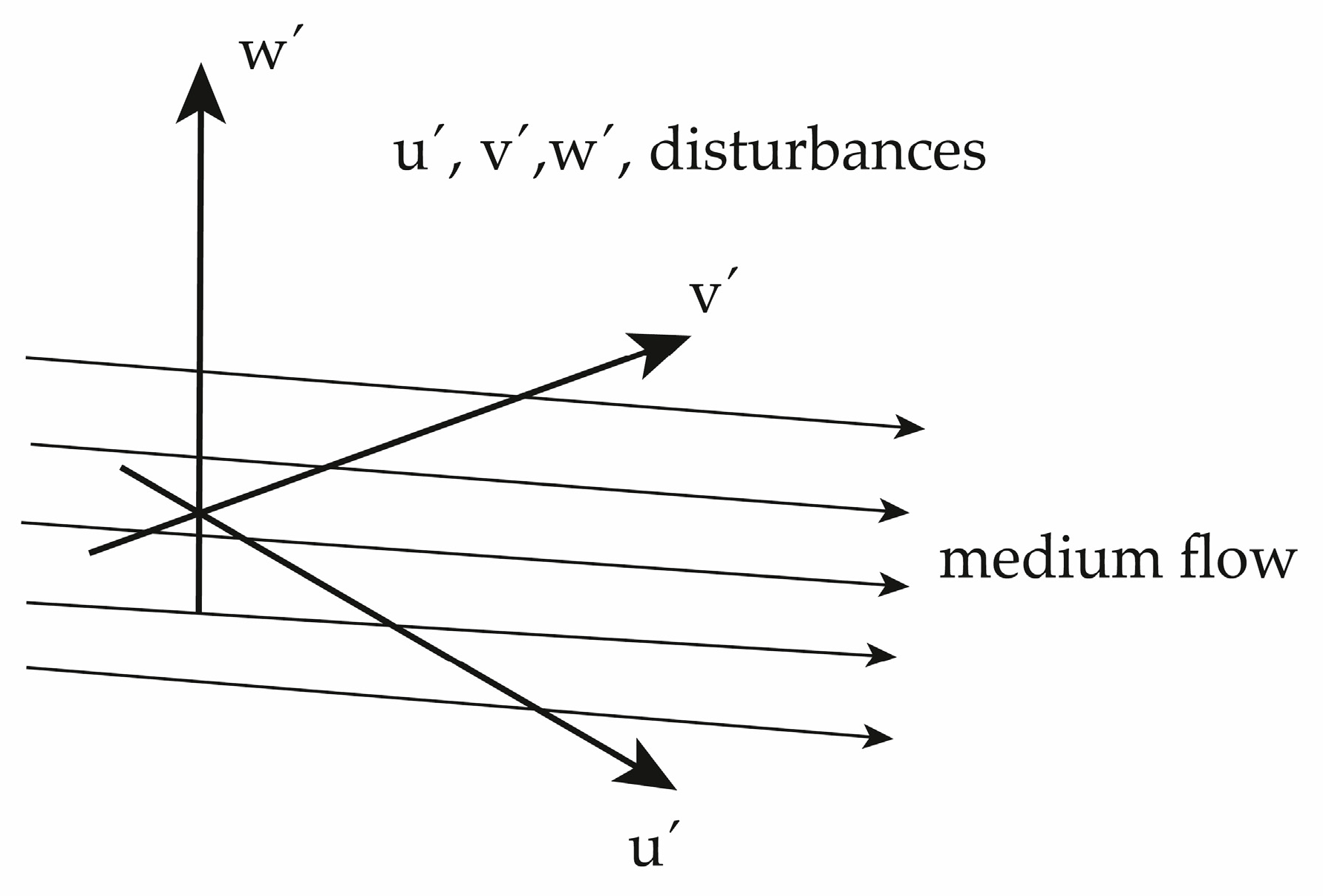
where u′ and v′ represent the horizontal disturbance of the wind with respect to the mean flow, and w′ represents the vertical disturbance with respect to the same flow; Figure 2:
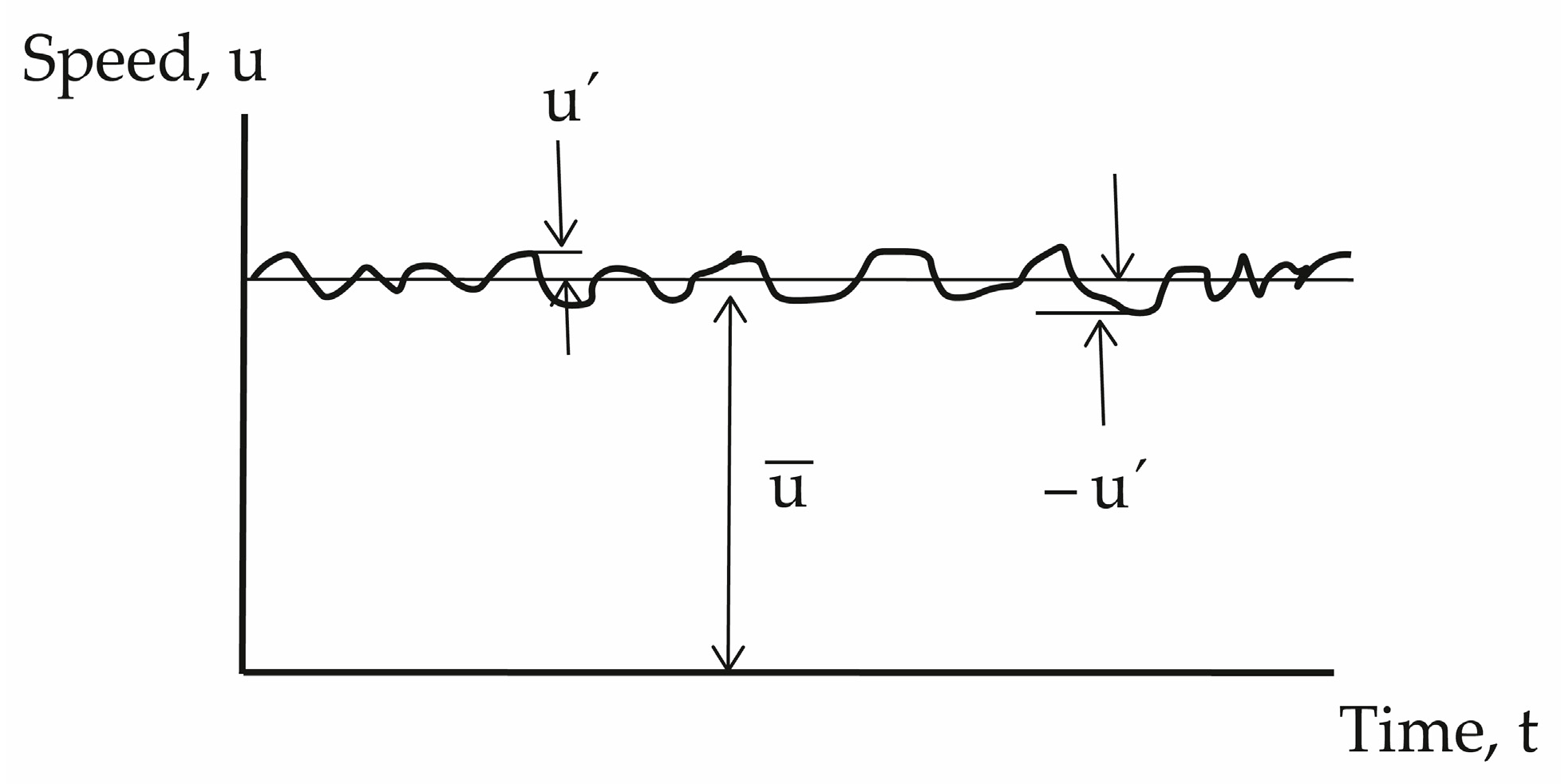
The disturbances can be averaged over a time t. In general, if u = u ¯ + u , , where u ¯ is the average value, u is the instantaneous velocity, and u′ is the velocity of the fluctuation with respect to the average value, graphically for turbulent flow; Figure 3:
Where
u ¯ = 1 T 0 t t + T 0 u d t
Similarly for the other components:   v = v ¯ + v and w = w ¯ + w . In the study of turbulence, the covariances u w ¯ , v w ¯ ,   T w ¯ , etc., are related, and sometimes referred to as turbulent flows of momentum, heat, etc. Covariances are averages of the products of two fluctuating variables and depend on the correlations between the variables involved. These can be positive, negative, or zero, depending on the type of flow and the symmetry conditions.
The velocity component in the direction of flow is responsible for transport of a scalar c (a concentration variable (mass per unit volume)) and, consequently, for the flow. For the case, in the vertical direction, the flow at any instant is cw, and the mean flow of interest is c w ¯ . By Reynolds decomposition,
c w ¯ = ( c ¯ + c ) ( w ¯ + w ) ¯ = c ¯ w ¯ + c w ¯
where c ¯ is equivalent to the average value of the mass concentration per unit volume. Thus, the total scalar flux = the mean transport (transport produced by the mean motion) + the turbulent transport (dominant transport term). For the flow associated with the mean wind (i.e., advection), we have the following:
vertical kinematic advective heat flux: w ̿ T ¯ ; vertical kinematic advective moisture flux: w ̿ q ¯ ; x-direction kinematic advective heat flux: u ̿ T ¯ ; vertical kinematic advective flux of u ̿ -momentum: w ̿ u ̿ ;
Following Stull [30], a term like w T ¯ resembles the terms of kinematic flow, except disturbance values are used instead of average values w ¯ and T ¯ . If the turbulence is completely random, a positive w′T′ at one instant could cancel a negative w′T′ at a later instant, resulting in a value close to zero for the average turbulent heat flux. However, there are situations where the average turbulent flux could be significantly different from zero.
During the day, the ground can often be warmer than the air, especially at the surface. This is because solar radiation directly heats the Earth’s surface, which in turn transfers that heat to the surrounding air by conduction. At night, the ground can be cooler than the air because it cools faster than the air through conduction and radiation of heat into space, causing the air in direct contact with it to also cool (temperature inversion).
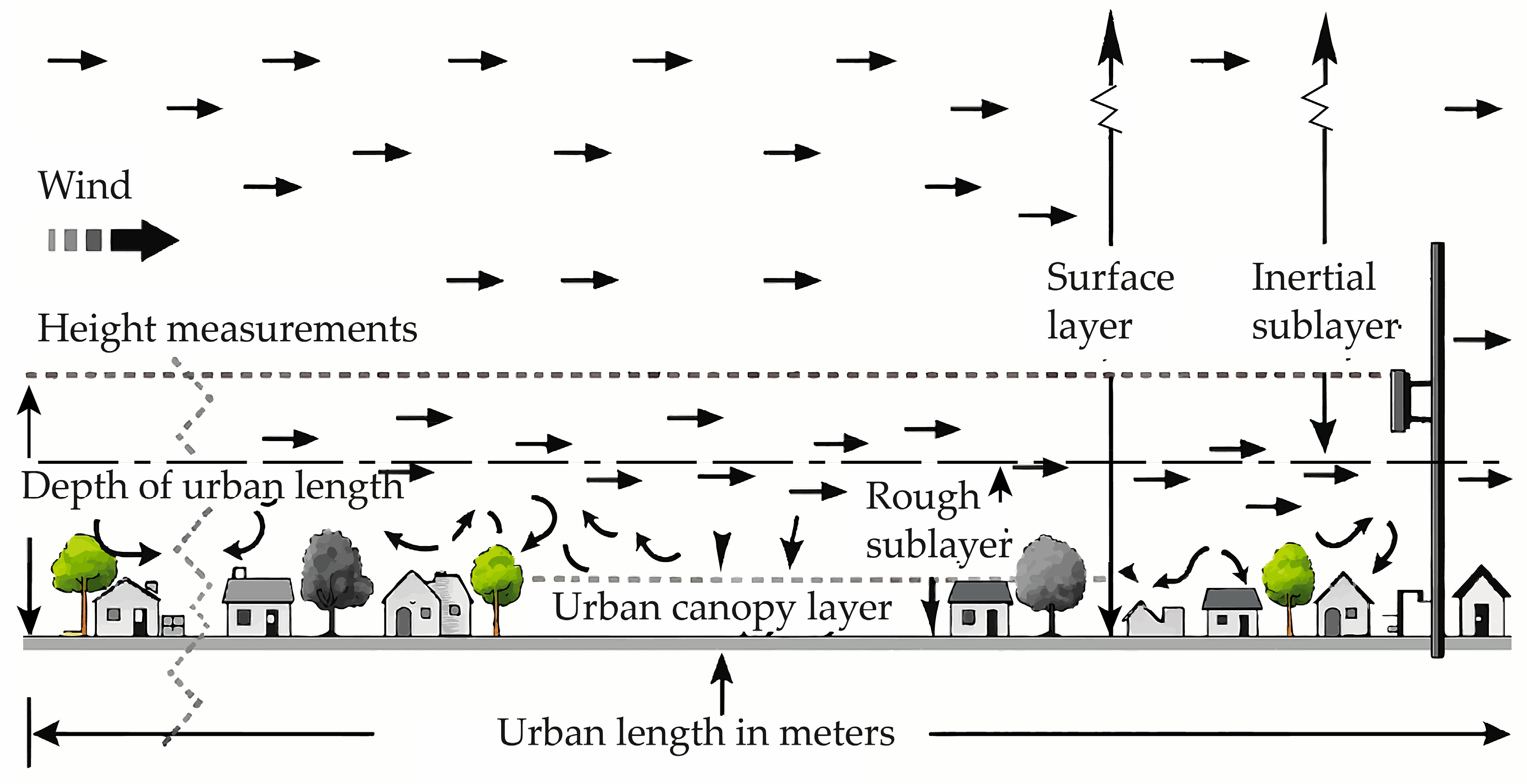
From the perspective of a small, idealized vertical vortex near the ground on a hot summer day, as shown in Figure 2.12(a), page 52 [30], the average potential temperature distribution with height is usually superadiabatic in such surface layers. If the vortex is a rotary motion, some of the air from the upper portion will mix downwards (i.e., w′ is negative), while some of the air from the lower portion will mix upwards (i.e., w′ is positive) to take its place. The average motion caused by the turbulence is w ¯ = 0.
The fraction of air moving downwards (negative w′) ends up being cooler than its surroundings (T′ < 0, assuming T′ was conserved during its motion), resulting in an instantaneous product w′T′ > 0. The air moving upwards (w′ > 0) is warmer than its surroundings (T′ > 0), also resulting in an instantaneous product w′T′ > 0. The result is that both upward-moving and downward-moving air positively contribute to the flow, w′T′. It is concluded that the average kinematic heat flux w T ¯ > 0 for this small eddy mixing process. What is remarkable about this result is that turbulence can cause a net transport of a quantity such as heat ( w T ¯ 0 ), even though there is no net transport of mass ( w ¯ = 0). Turbulent eddies, by transporting heat upwards, make it possible for the thermal gradient to be more adiabatic.
When studying what happens on a night with a statically stable thermal gradient, as shown in Figure 2.12(b), page 52 [30], it is possible to think of a small eddy that moves a fraction of the air upwards and another fraction downwards. The portion that moves upwards ends up cooler than its surroundings (w′T′ < 0, w′ < 0, T′ > 0), while the portion that moves downwards is warmer (w′T′ < 0, w′ < 0, T′ > 0). The net effect of the small eddy is to cause w T ¯ < 0, indicating a transport of heat towards the surface.
If the scalar under consideration is the potential temperature T’, or the enthalpy ρcpT’, the corresponding vertical turbulent flow is T w ¯ , or ρ c p T w ¯ . In this manner, the covariance T w ¯ can be understood as the turbulent heat flow (in kinematic units). Correspondingly, u w ¯ can be estimated as the turbulent flow of horizontal momentum (in the x-direction) or, similarly, the horizontal flow (in the x-direction) of vertical momentum, since u w ¯ = w u ¯ .
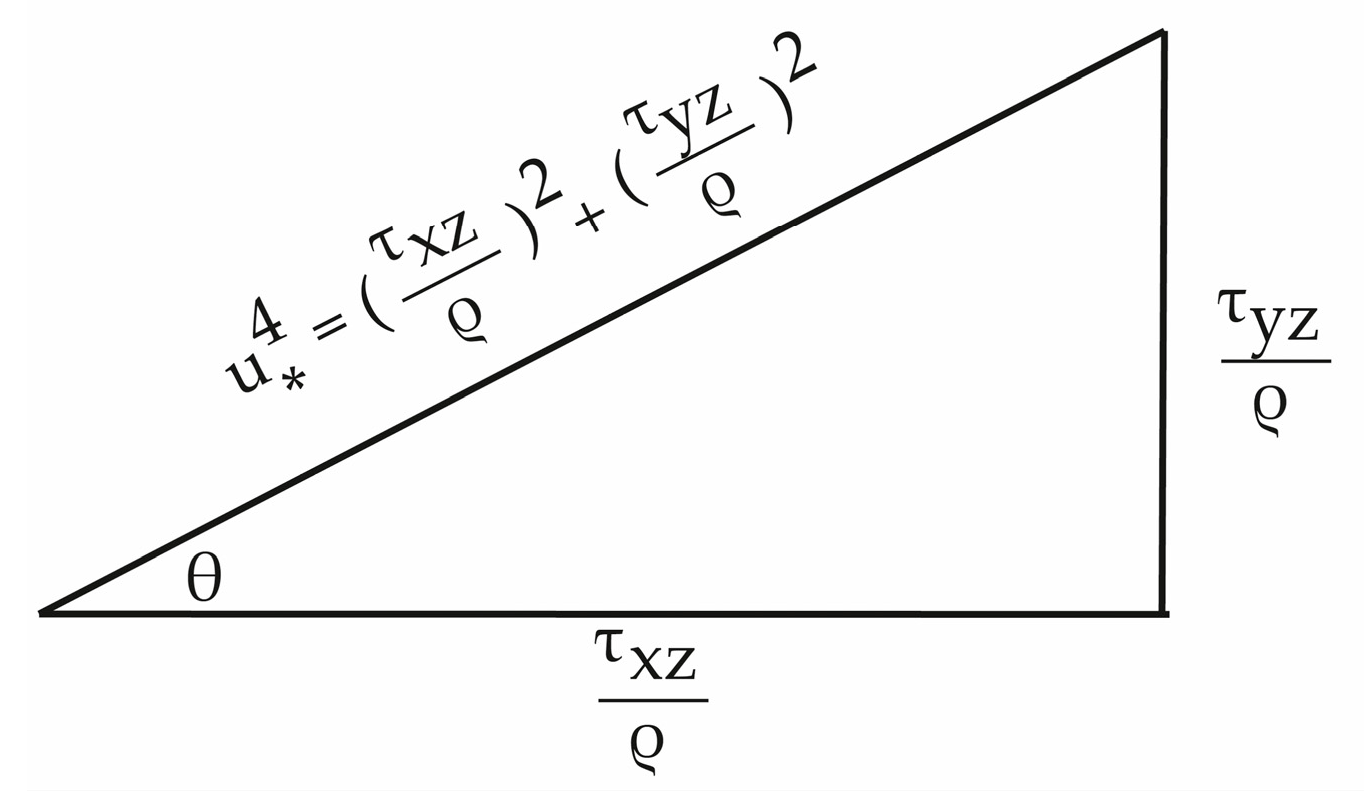
From Newton’s second law, the change over time (flux) of linear momentum is equal to the force per unit area or tensor; thus, turbulent tensors can also be expressed as follows (Figure 4 is a geometric representation):
τ x z ρ = u * y 2 = u w ¯ / ( ) 2 u * y 4 = u w ¯ 2
τ y z ρ = u * x 2 = v w ¯ / ( ) 2 u * x 4 = v w ¯ 2
which, for most turbulent flows, have much larger magnitudes than the viscosity tensors (τ), and, consequently, the latter can be neglected compared to the former.
u * x 4 + u * y 4 = u * 4 = u w ¯ 2 + v w ¯ 2
The effect of surface roughness, boundary layer height, and geostrophic winds (assuming a balance between the Coriolis force and the force generated by the pressure gradient) is present in the friction velocity:
u * = u w ¯ 2 + v w ¯ 2 4   or   also   u * 4 = τ x z ρ 2 + τ y z ρ 2

1.4.2. Heat Generation in Urban Environments

Method 1
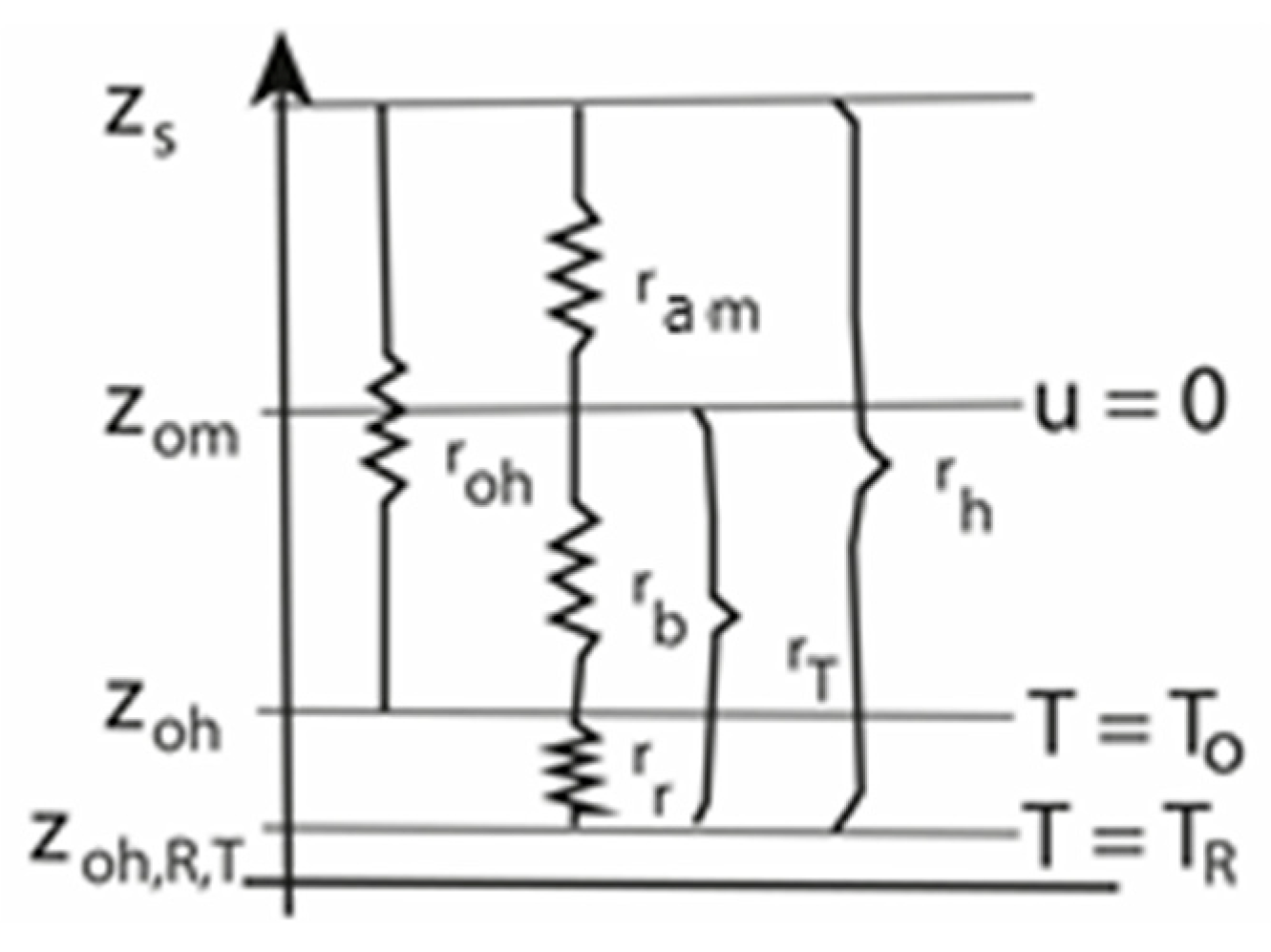
When considering B−1 [31,32], the roughness length for heat (Z0 h) must be calculated. A procedure [33] to determine Z0 h uses the Reynolds number (Re) = u D/ν, with u friction velocity, ν molecular kinematic viscosity of air, and D roughness length for momentum ≈ Z0 m, parameters that are simpler to obtain [34,35,36]. From Figure 5, rh = aerodynamic drag for momentum + additional drag (heat transfer from radiative surface temperature and by the roughness length for momentum) = ram + rT [32]. In turn, rT [31] contains the supplementary volumetric aerodynamic drag plus drag due to the distributed positions of the heat sources and momentum dissipation = rb + rr; Figure 5:
From the perspective of equations:
r T = B 1 / u * ,
where
B 1 = 1 K l n Z 0 m Z 0 h ,
k = Von Karman constant (0.35 < k < 0.41). The roughness length for heat (Z0h) according to [33]:
Z 0 h = Z 0 m 7.4   e 2.46   R e * 0.25 ,
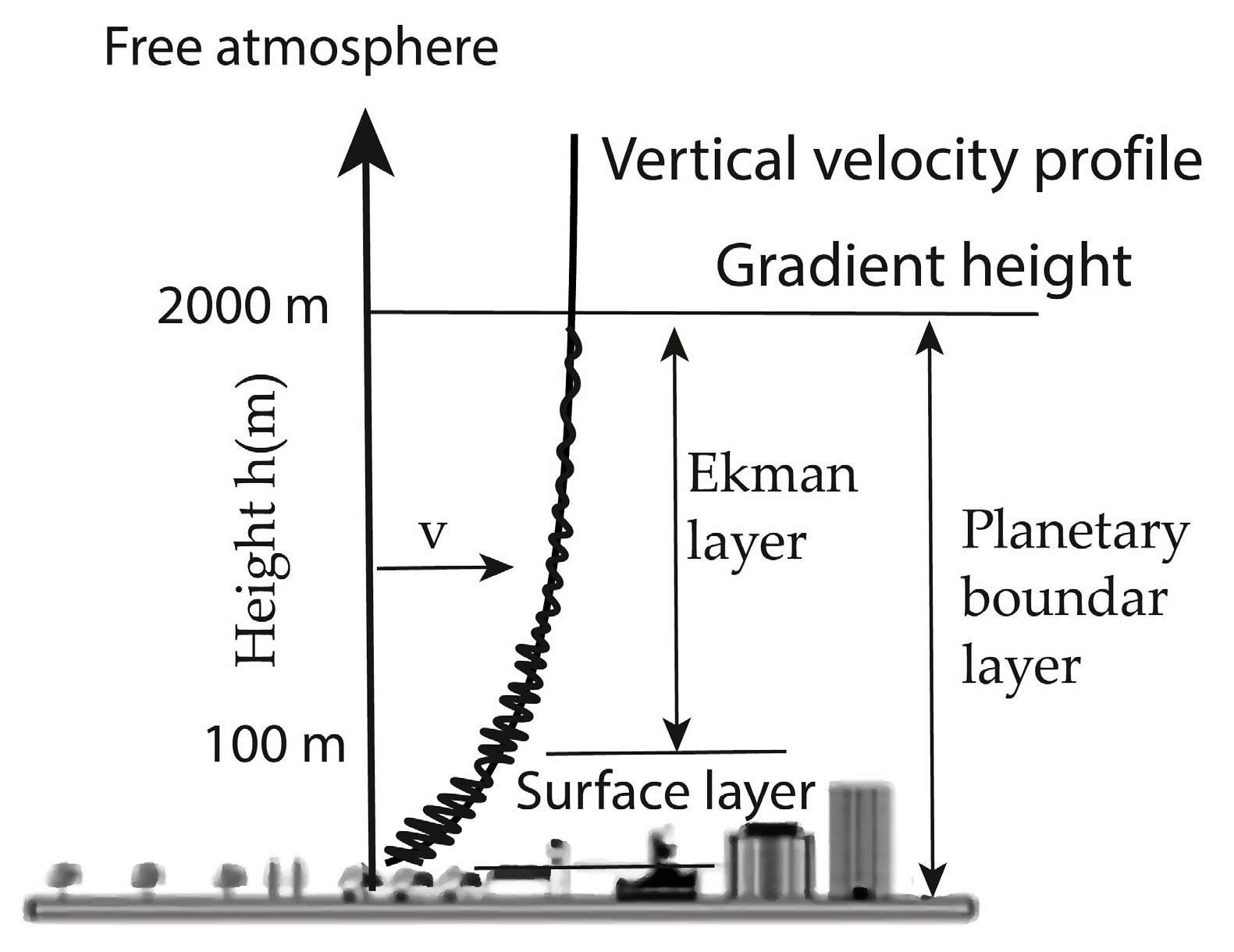
With Z0 m ≈ 1 m (similar to other urban meteorology studies), considering the lack of a precise vertical profile (Figure 6) for horizontal wind speed:
Converting the Reynolds number to a rough version ( R e * ) yields
R e * = Z 0 m u * / ν ,
ν = molecular kinematic viscosity of air = 1.461 × 10⁻⁵ m2 s−1. ram is
r a m = u ( z ) / u * 2 ,
u(z) = w is the value of the average vertical velocity at a certain level.
Finally, the heat flow is calculated using Equation (2) with r h = r a m + r T :
Q H = ρ C p ( T R T a ) / r h ,
Method 2
The resistance for the surfaces of an urban canyon (roads and walls) and the air canyon according to [34] adjusted for calculating a city energy budget (TEB) [16] is as follows:
R E S r = R E S w = 1 11.8 + 4.2 U c a n 2 + W c a n 2 ,
The same value is assumed for wall resistance (w) and road resistance (r). According to [16]:
Q H , r = ρ C p T r T a / R E S r     r = r o a d , a = e n v i r o n m e n t ,
Q H , w = ρ C p T w T a / R E S w     w = w a l l , a = e n v i r o n m e n t ,
Ucan and Wcan are the average horizontal and vertical wind speeds of the urban canyon, respectively (measured by the sonic anemometer). The value of this resistance is used in Equation (1) [16]. This method is semi-empirical and does not require estimating the roughness length.
Method 3
The third calculation procedure, for the sake of continuity in the presentation, was not applied because, in general, its results are very dissimilar to the others. Applying Equation (2) without considering the additional resistance term from Method 1, under the assumption that heat and momentum are transported equally. Since the density of air (ρ) is a function of temperature, it is permissible to use the ideal gas law:
ρ = P R T a ,
P = atmospheric pressure = 1020 hPa, which is the surface pressure considered for the period of measurements), R = ideal gas constant for dry air = 287 JKg−1K−1, and Ta is the air temperature.
Method 4
Method 4 uses the calculation of covariances of sonic temperature (TS) and the vertical component of wind speed (w). The horizontal and vertical components of wind speed measured by the ultrasonic anemometer are used in Methods 1 and 2.
The associated heat can be calculated using w and TS. With virtual wind and temperature data for high frequency, the friction velocity, the average horizontal and vertical wind velocities, and the turbulent heat flux can be determined.
C o v u , w = i = 1 N ( u i u ¯ ) ( w i w ¯ ) N = u w ¯ ,
C o v v , w = i = 1 N ( v i v ¯ ) ( w i w ¯ ) N = v w ¯ ,
u and v′ represent horizontal wind disturbances (north and east, respectively) of the mean flow, and w′ represents the vertical disturbance.
The acoustic virtual temperature (Tv) is the temperature a sample of dry air would need to have to match the density of humid air at the same pressure. In other words, the addition of water vapor makes the air lighter, and calculating the acoustic virtual temperature raises that temperature so that the corresponding air mass has the same density as if it were dry air. At higher temperatures, the control volume containing more water vapor increases. Why is this useful? It simplifies calculations because, by using the acoustic virtual temperature, humid air can be treated as if it were dry air, using the gas constants for dry air in the ideal gas law, which simplifies thermodynamic calculations. Furthermore, the acoustic virtual temperature is crucial in turbulence studies involving vertical air movement. Appendix A shows the difference between sonic temperature and absolute air temperature
The turbulent heat flux (in W/m2) is calculated from the data recorded by the ultrasonic anemometer in the equation
Q H = Q S O N = ρ c p w T s ¯
where T s is the hourly sonic temperature and T ¯ S is the average sonic temperature for the same period (it should be noted that this is assumed to be approximately equal to the absolute temperature perturbation as described above). Determining Q H requires time-synchronized, high-frequency measurements (≥10 Hz) of   T and w , making ultrasonic anemometers convenient.
As with the calculation of the friction velocity, the covariance is
C o v w , T S = i = 1 N ( w i w ¯ ) ( T S , i T S ¯ ) N = w T s ¯ ,
It is assumed that the values taken at a height between 3.5 and 4.0 m represent street surface phenomena.
For comparison purposes, heat fluxes are calculated from wind speed and temperature fluctuation data (which in this work will be extracted from a database generated by a sonic anemometer).

1.5. Numerical Models of Geological Fluids

Numerical models of geological fluids have become an important method for exploring energy extraction and heat transfer. These models can contribute to understanding heat transfer from densely populated urban areas to the atmospheric boundary layer. They are crucial for optimizing Enhanced Geothermal Systems (EGSs) and heat transfer in fractured reservoirs by simulating coupled thermohydraulic–mechanical (THM) processes. These simulations suggest ways to improve energy efficiency, predict geothermal system behavior, and guide well design, enhancing the sustainability of geothermal extraction. Common techniques include finite element, finite difference, and finite volume methods, which simulate heat transfer in geothermal wells, reservoirs, and energy storage facilities. Modeling parameters include permeability, fluid flow rate, fracture aperture, and rock thermal properties. In its applications, it allows for the study and optimization of heat extraction in closed circuits, such as in U-shaped wells and coaxial heat exchangers. Water is commonly used as the fluid, but supercritical CO2 is suitable due to its potential to enhance energy extraction through thermal expansion and thermosiphon effects (although CO2 is a potent greenhouse gas) [37,38,39].

1.6. Kolmogorov Entropy (SK) and Loss of Information (<ΔI>) in the Boundary Layer Subjected to Thermal Flows

Entropy is part of various processes in nature, and its study and current utility appears in different areas such as biology, medicine, heat flows, economics and stock market movements, turbulence, etc. [40,41,42,43]. This study, applying chaos theory, addresses the interaction of heat with the atmosphere in the boundary layer, a topic that has been little explored [44,45].
Kolmogorov–Sinai (KS) entropy (SKS o SK) measures the rate of information production (or unpredictability) in chaotic dynamical systems, with SK > 0 indicating chaos and SK = 0 indicating regular motion. It acts as a bridge between dynamical systems theory and information theory, quantifying how fast a system loses memory of its initial conditions [46,47,48]. SK is a central measure of complexity in chaotic systems, often calculated via the sum of positive Lyapunov exponents. It represents the average amount of information required to track the system’s trajectory per unit of time. Conceptually, the explanation of metric entropy corresponds to Shannon [49] and is applied in dynamical systems. Kolmogorov [50] and Sinai [51] found that it is a topological invariant (SKS) [52,53,54]. The dependence on initial conditions can be visualized by considering points very close to each other but separated in time. The dependence would show that, as time passes, the initially undifferentiated digits will show their importance [55].
A source of information (the text of a magazine, for example) corresponds to a Markovian process that randomly produces a symbol n at discrete times [52,56]. Performing sequential measurements allows us to associate symbols with each measurement [46]. For a sequence h, the sequence that includes the h − 1 preceding symbols, S h 1 h , is the proportion h of numbers in base n, an estimate that gives the state of the source [48], can be evaluated as symbols arising from a Markovian source [46]. When measuring at t = 0, the state of the dynamic system is in a characteristic element of the segmentation. At another finite time ∆t, for another measurement, it would indicate that the state is discovered in a different element of the segmentation. The measurements would be related to a sequence of symbols. This proportion with respect to time for the sequence as m→∞ is ∆Im/m∆t = ∆I/∆t. The entropy metric is the maximum proportion of information when varying the segmentation and continuity of allocation of representative samples of the measurement [51]:
h μ = s u p   β , t lim m I m m t
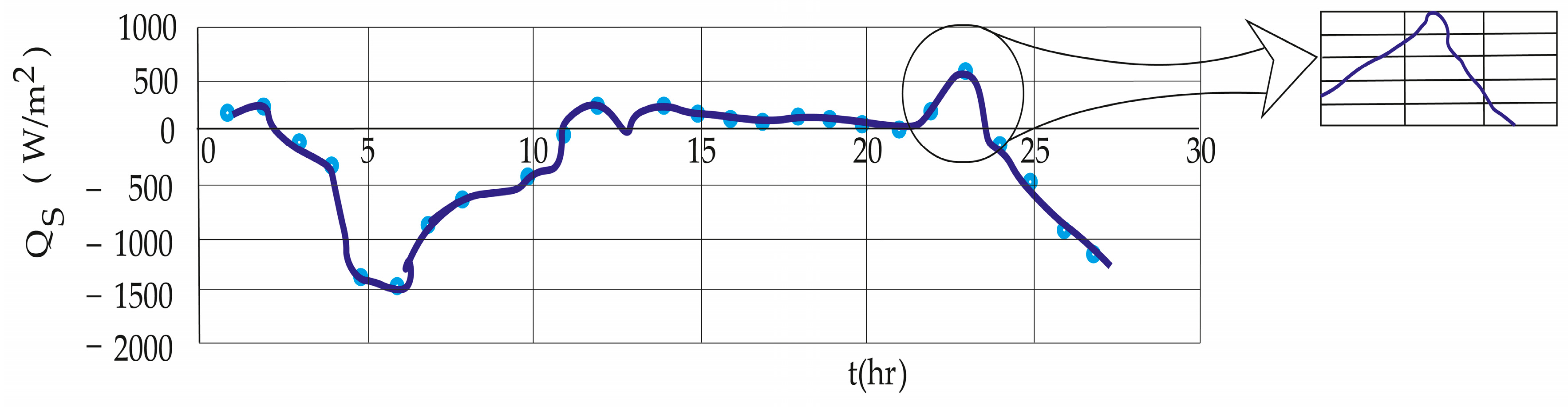
For ideal instruments and measurement rates, hμ is the average of the new information for each sample. A dynamic system evolves according to x(t) = x ( t ) 1 d , in a phase space of dimension d. Figure 7 represents the time evolution of the heat flow. By subdividing the space into cells of size ld (d being the dimension of space), the joint probability of the system, Pi, will be associated with regular fractions of time τ, from the initial time t = 0 in cell i0, t = τ in cell i1 to nτ in cell in. The information to locate the system on a particular path of the in cells, with reduced uncertainty (k is for choosing the unit of measurement), is [49]:
K n = k i n l o g P i P i
Let us consider that Kn+1 − Kn = the amount of information that the system lost when l and τ tend to 0:
S K = lim τ 0   lim l 0   lim n n τ - 1 i = 1 n ( log P i ) P i   ,
SK bits of information/time and bits/iteration case of discrete system [57,58]. The average loss of information (I) [48] is:
< I >   =   < I 2 n e w   i n f o r m a t i o n I 1 ( o l d   i n f o r m a t i o n ) >   =   λ x 0 log 2 b i t s h ,
The Lyapunov exponent, λ(x0), indicates the exponential divergence between two paths, that were initially very close, after N steps or iterations, and it contains information, I, regarding the divergence I(x0). Making the notation change λ0 = λ(x0), we get:
< I = I 2 I 1 > =   λ 0 log 2 0 ,   c h a o t i c   s y s t e m ,   d e t e r m i n i s t i c
Chaos, as it evolves, is usually calculated according to (1) (λ, SK), parameters that quantify the loss of information. In chaotic systems, the exponential divergence of trajectories leads to a continuous loss of information about the initial state, denoted as < ΔI > < 0; (2) those parameters that assess the fractal nature of the signal or attractor. This research used case (1).

2. Materials and Methods

2.1. Used Equipment

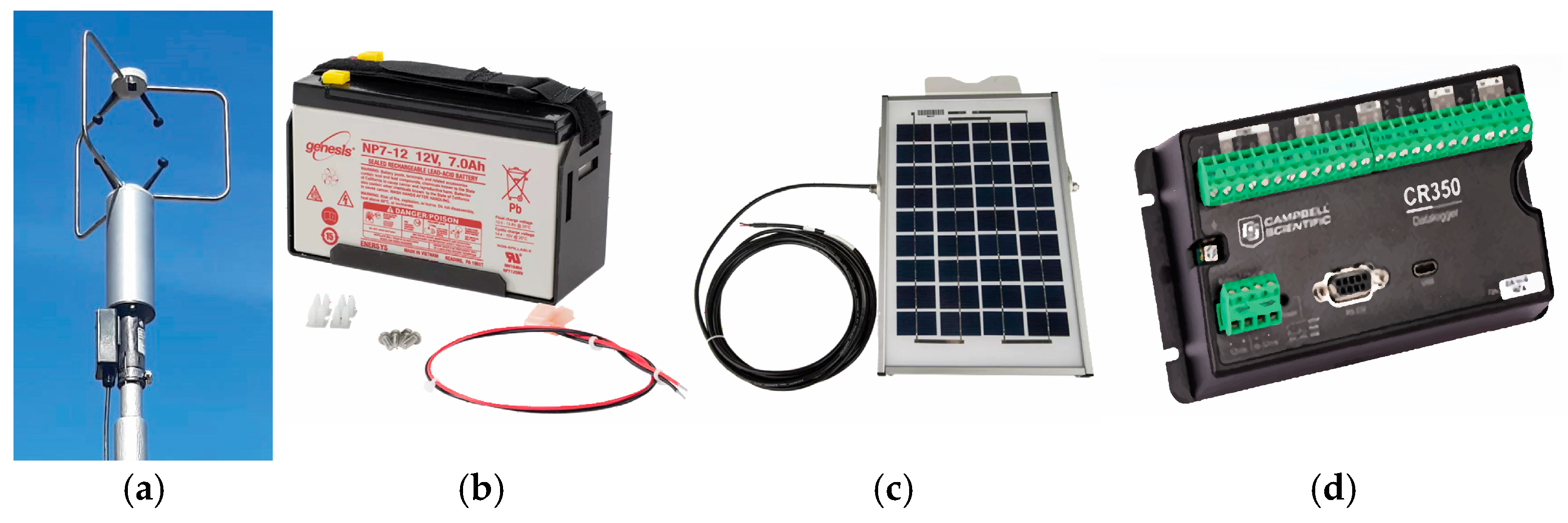
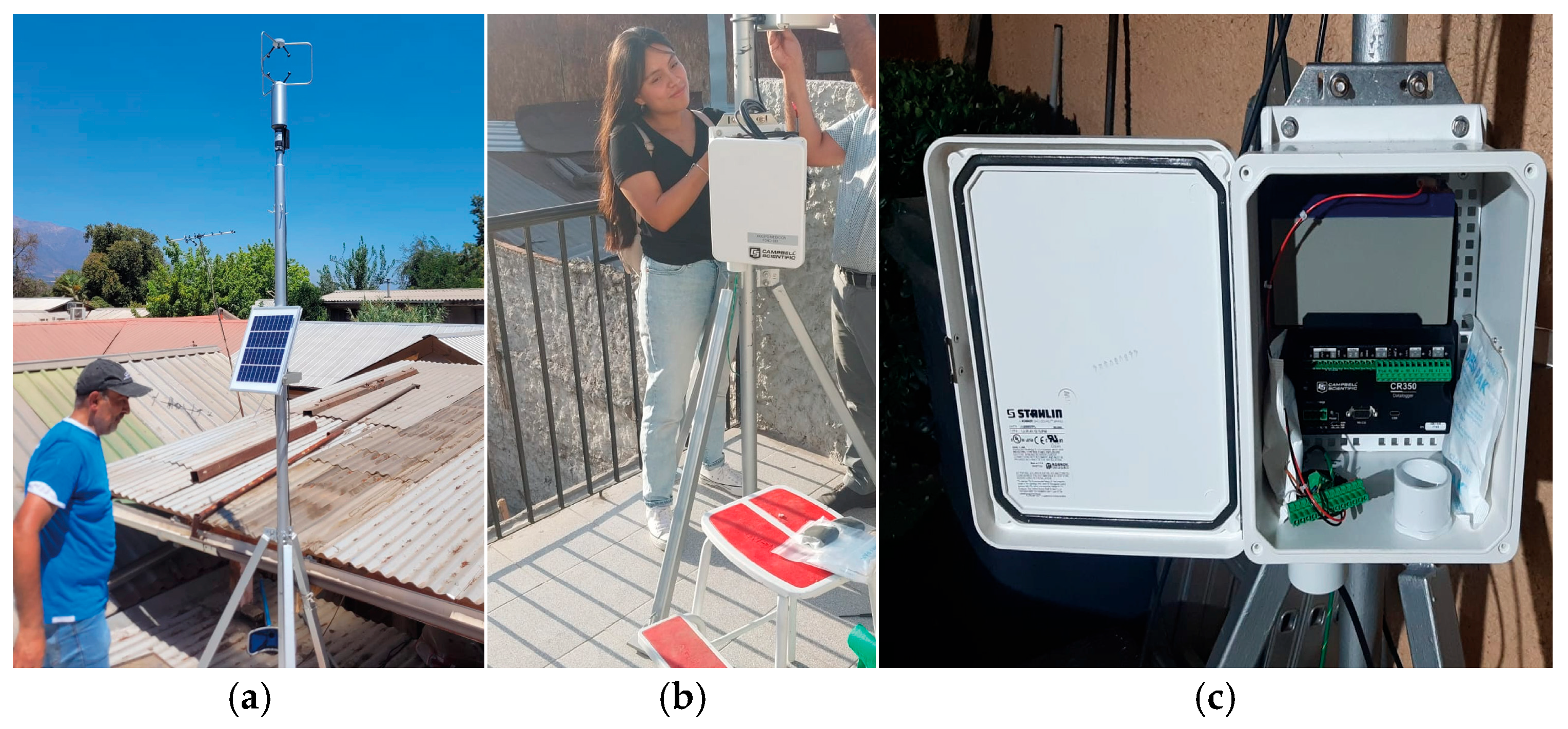
Figure 8 and Figure 9 show the equipment used in the measurements:

2.2. Study Area

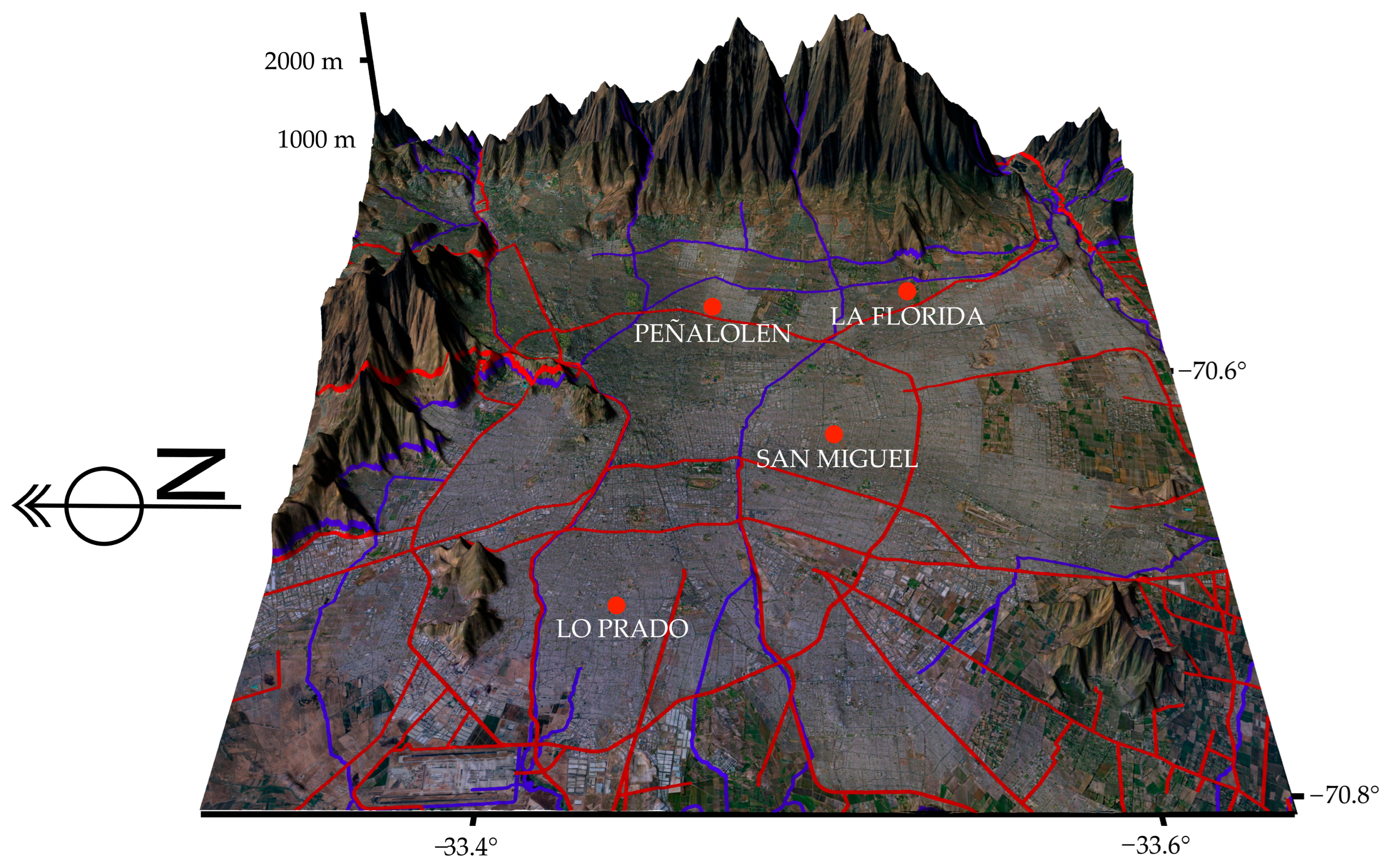
The city of Santiago is the capital of Chile. It is located in a basin geomorphology: a central depression surrounded by the snow-capped Andes Mountains and the hills that are the main components of the Coastal Range (Figure 10). Its approximate geographic coordinates, centered on the Plaza de Armas, are 33°26′16″ S 70°39′01″ W, and it has an average elevation between 526 and 567 m above sea level. Its area of 837.89 km2 is home to 8,420,000 inhabitants (2024 census), representing 41.9% of the country’s total population. The city’s climate is classified as temperate with winter rains and a prolonged dry season, more commonly known as a warm-summer Mediterranean climate.

2.3. Mathematical Methods

The data from the TS and w′ measurements form time series of approximately 4000 hourly data points (just over five months) which, using (18) and (19), generate the QS (=QH) time series. This time series (TS), one for each measurement location, is analyzed according to chaos theory to determine if its chaotic parameters are within the appropriate ranges and, in particular, to obtain the Kolmogorov entropy.
The time delay (τ) method is applied, a fundamental parameter in the reconstruction of the phase space (of embedding dimension m) for analyzing time series [55], Sn: S n 1 n composed of n measured elements. This method allows for the analysis of complex dynamical systems, enabling the identification of chaotic behaviors (highly dependent on initial conditions (IC)). τ determines the time separation between the components of the reconstructed state vectors ( S m : S m 1 m ), with the first local minimum of mutual information being the usual method for finding its optimal value, ensuring that the components of the delay vector are independent (25). The embedding dimension (m) is usually determined using the False Nearest Neighbor (FNN) method or the Cao method. Once the space is reconstructed, the maximum Lyapunov exponent ( λ L ) is calculated. If it is positive, it indicates sensitivity to IC, which confirms the presence of chaos.
S n : S n 1 n S m S m 1 m
While τ can be chosen randomly [56] under noiseless and infinitely long series conditions, this is not a realistic condition. This is why mutual information is used for nonlinear distributions in the reconstruction process (in the m-dimensional phase space). If m is chosen too small, the attractors will not be able to adapt to the dynamics of the heat flows in the air system, leaving the dynamics incompletely analyzed. If m is too large, the extent of the data used is reduced, decreasing the formation of points in phase space, which will likely generate noise and interference due to the complementary dimension. Ref [56] showed that if m > 2DC + 1, an attractor value m can be obtained, where DC is the correlation dimension (sufficient condition). While the FNN fraction method is commonly used to determine a value of m, it can be affected by noise in the TS data, the amount and magnitude of the data, the sampling interval, etc., yielding incorrect results. In [57], a modified version of the FNN method is proposed that allows a rigorous examination of the chaotic nature of TS.
The maximum and positive Lyapunov exponent ( λ L ) accounts for the chaotic nature of the system and the divergence between orbits [58,59]. In a one-dimensional dynamical system xn+1 = f(xn), λ is defined as follows:
λ = lim n l n i = 1 n 1 d f ( x ) d x x = x i   = lim n l n i = 0 n 1 l n d f ( x ) d x x = x i
The Kolmogorov–Sinai entropy (SKS or simply SK) was introduced by Kolmogorov [60] and developed by Sinai [40,41,42,43]. It measures the rate of disorder creation or information loss in dynamical systems (loss of predictability) and is an important concept for characterizing dissipative chaotic dynamical systems. It defines chaotic complexity, being zero for regular systems and positive for chaotic systems. It is commonly calculated by summing the positive Lyapunov exponents [61], representing the rate of trajectory divergence. It is related to thermodynamic entropy (S), which calculates the disorder of a system by measuring the expansion of trajectories into new regions of the state space. However, SKS has inverse time units (or inverse iterations). If τ K = 1/SK = maximum time for a reasonable prediction.
The correlation entropy, K2 [55] can be written as
K 2 = lim m lim r 0 lim n l o g C o r r m , r C o r r m + 1 , r ~ S K
K2 = lower bound of Kolmogorov entropy (SK). Corr (m, r) in (27) is the correlation sum of the reconstructed trajectory of a time series for an embedding dimension m [55]. It is defined as
C o r r _ d i m r = 2 n n 1 j = 1 n i = j + 1 n u r r i j = lim n 2 n ( n 1 ) i j n u r k = 0 m 1 ( X i k X j k ) 2
Corr_dim(r) will represent the number of points inside the circles of radius r normalized to 1, if r is large enough to include all points without counting them twice; n is the number of data points; u is the step function (or Heaviside function); rij = spatial distance between two points of subscripts i and j, belonging to an m-dimensional time-delay embedding using the Euclidean norm, r is a real number whose choice is important; if r 0 , then Corr_dim(r) may lose meaning, and if r large values, the information provided by Corr_dim(r) is not useful. Equation (28) can also be written as
C o r r _ d i m r = lim n 0 1 n 2 n u m b e r   o f   p a i r s x i , x j   s u c h   t h a t   r i j < r
Corr_dim(r) is calculated by varying r from 0 to the largest possible value of r i j . If we consider suitably small values of r and very large values of n, Corr_dim (r) tends to behave as a power of r:
C o r r _ d i m r ~ r D C ,
In the logarithmic approach for Equation (30), if log (Corr_dim (r)) is graphic against log (r), the slope of this line will be DC = the correlation dimension. In chaotic time series, DC   5.0 [55,62]. DC  > 5, which is essentially random data.
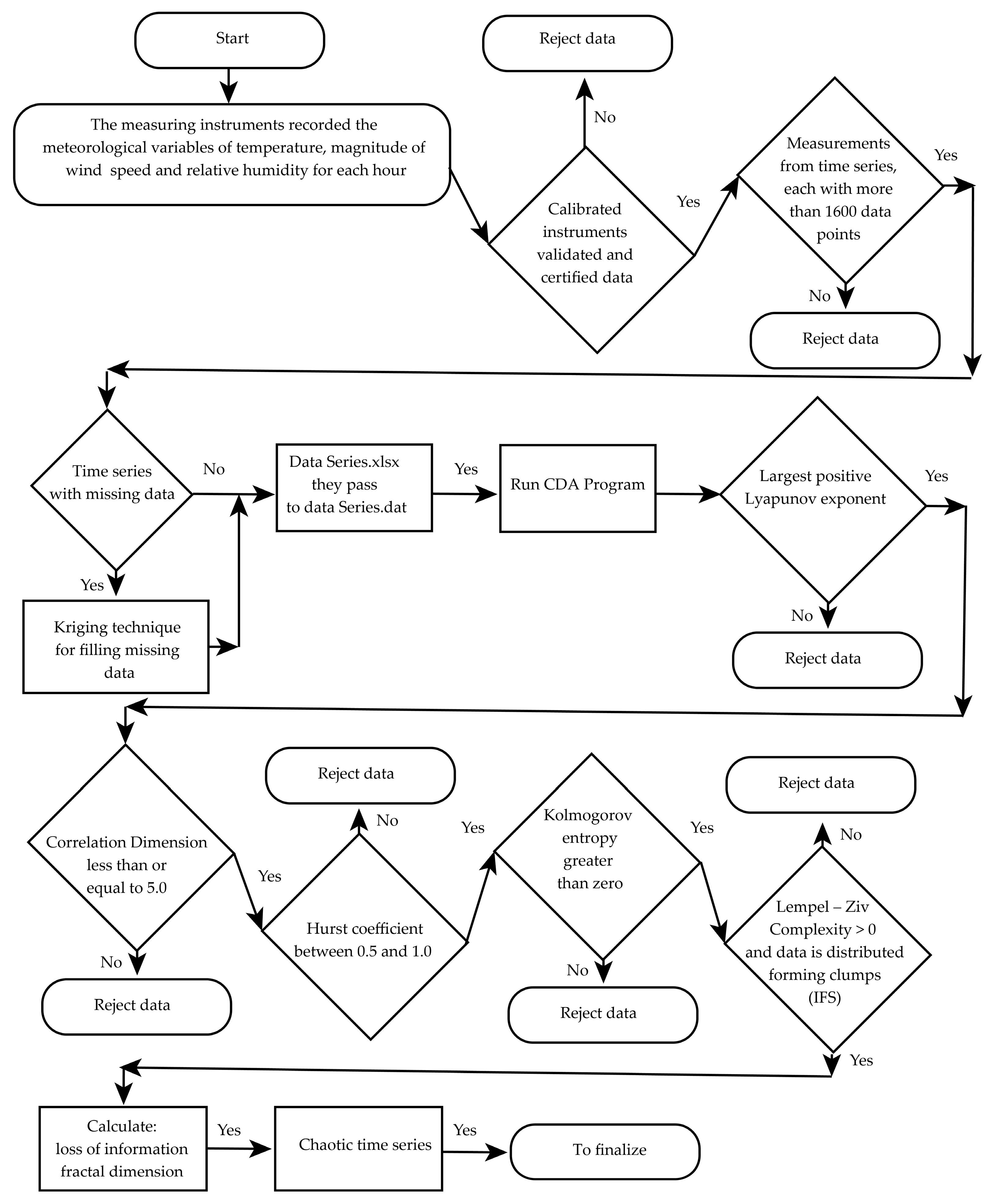
In fractal geometry, the Hurst exponent (H) [63] and the fractal (or Mandelbrot) dimension (D) are of great relevance. H of a time series is calculated by a statistical method without assuming stationarity and allows its long-term behavior to be classified according to persistence (0.5 < H < 1.0, the series has memory, the past influences the future), randomness (H = 5), and antipersistence (0 < H < 0.5) [64]. D = 2 − H is a statistic that describes objects of high complexity, self-similarity, or chaos. Estimating H and D of a time series allows us to know if the series has memory and is fractal. Another test of the chaotic nature of a time series is the fragmentation test of iterated function systems (IFSs). Through symbolic dynamics [65,66], the Lempel–Ziv (LZ) complexity of the series is estimated in relation to white noise. If the data are chaotic, they are distributed in localized clusters. All these conditions were met for the periods studied. If the time series had missing data [67,68], for example, due to a power outage, a defect in the measuring equipment, etc., it was completed using the Kriging technique [69,70,71] (this is indicated in the flow diagram in Figure 11).
The flowchart shows the process of verifying the chaotic nature of time series.

3. Results

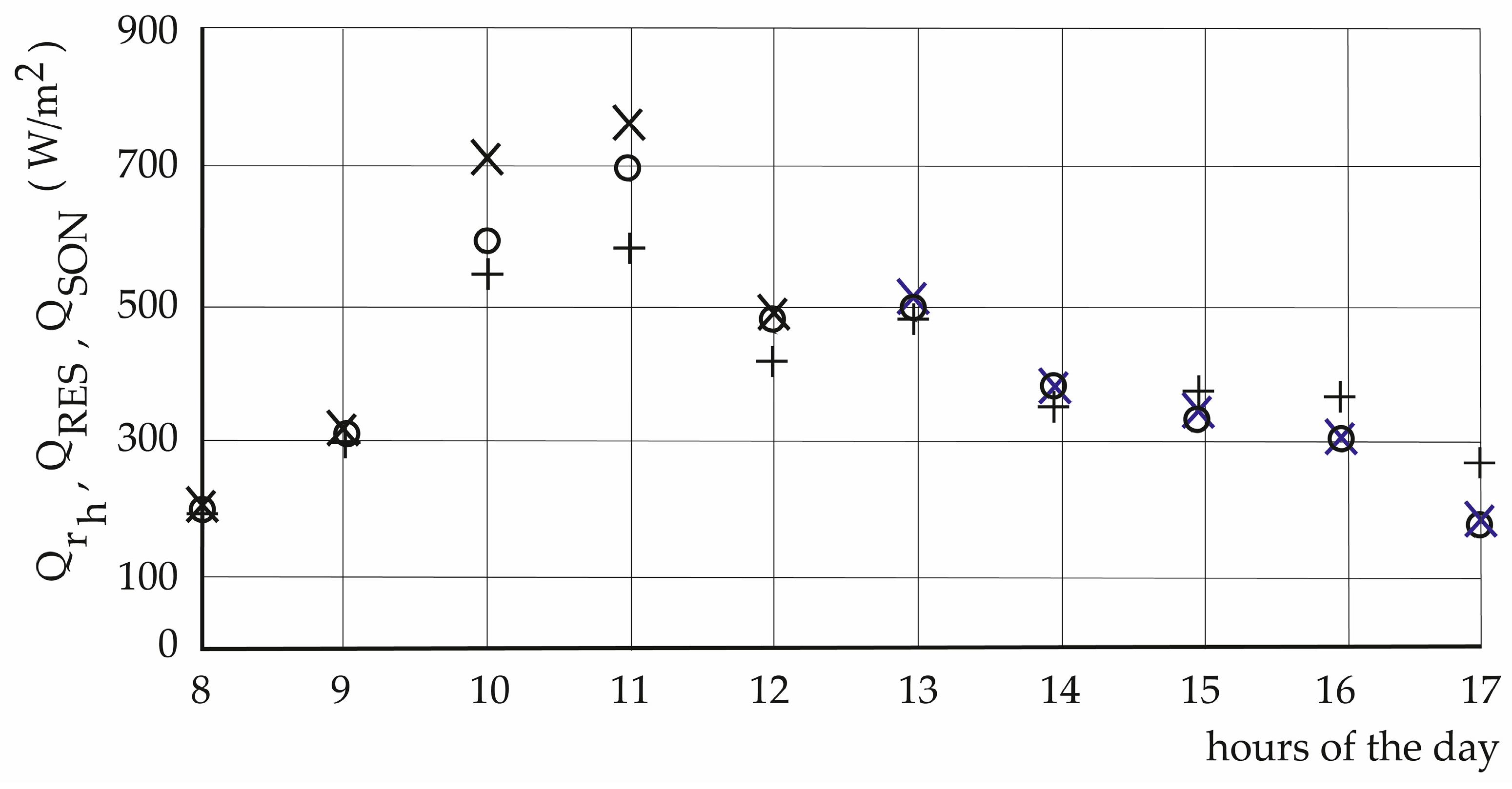
3.1. Comparison Between Methods 1, 2, and 4 Using One Day’s Measurements

As a first activity, the heat flows modeled with methods 1, 3, and 4 were compared (method 3 is very imprecise), obtaining Figure 12:
The agreement between methods (1, 2, and 4) is adequate, which stimulates the next activity using ultrasonic anemometers located in four different communes.

3.2. Measurements with Sonic Anemometers During 3968 Hours in Four Communes

To calculate the heat flows of the communes of Peñalolén, La Florida, Lo Prado, and San Miguel, the covariance equation (Equations (18) and (19)) was applied to the data measured by the ultrasonic anemometer.
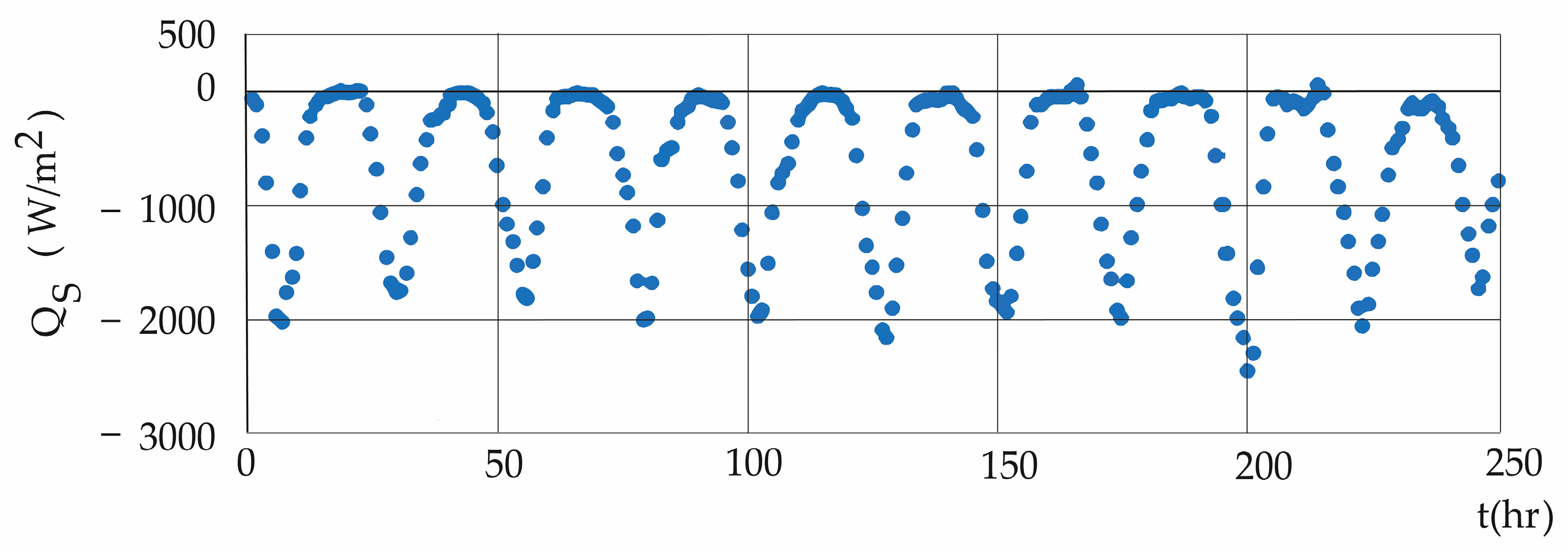
Completing those time series (each on the order of 3968 hourly measurements) that had missing data, the figures presented later, showing the evolution of the time series over time, consider only about 250 h (the fluctuations in the points are due to the natural variation between morning, midday, afternoon, and night, and are repeated with different amplitudes for the entire measurement period).
Peñalolén:
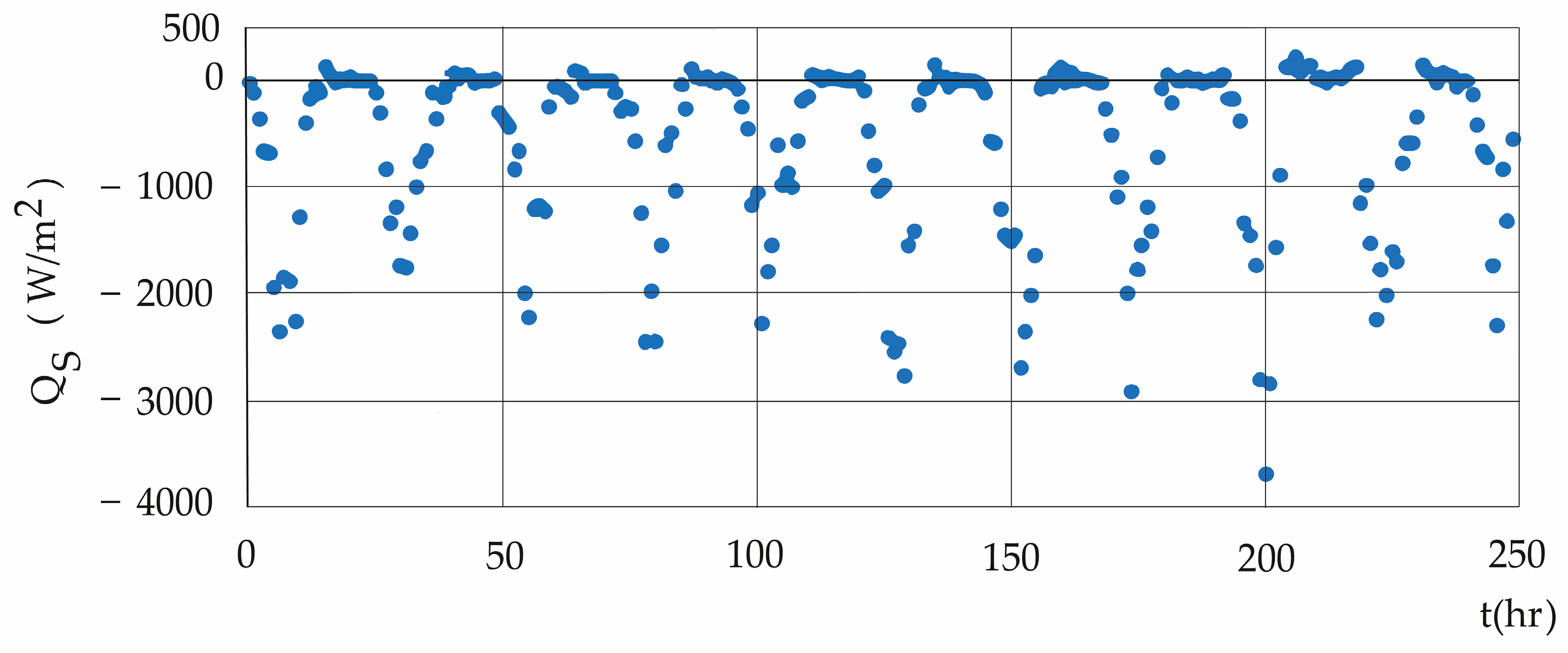
Is a commune in the southeastern part of Santiago, characterized by its sloping geography, with a gently sloping western area and a steep eastern area that reaches the foothills of the Andes mountain range. The commune is divided into zones of varying altitude. For example, the area extending between 900 masl (meters above sea level) and the mountain peak is significantly higher than the urban area located below the San Carlos Canal, which has an average altitude of 520 masl. Its territory is divided between a densely built-up urban area and large expanses of green and natural areas, such as Quebrada de Macul Park. Peñalolén covers an area of 54.8 km2 and its projected population for 2024 is 272,913 inhabitants. Until 2017, the total area approved for new construction (considering all uses) remained fairly constant, hovering around 100,000 m2 annually. In contrast, 2018 saw a sharp break in this trend, with a year-on-year increase of over 500%, after which it fell below the average of previous years, likely reflecting the effects of the successive social and health crises (COVID-19) of 2019 and 2020. In recent years, a sustained upward trend in the construction of multi-family housing (residential buildings) has been evident. Preliminary data on building permits approved since the first half of 2021 show a significant increase in the amount of new construction approved, allowing us to project a recovery to pre-pandemic levels. Figure 13 shows, for a fraction of the total time, the heat flows QS:
La Florida:
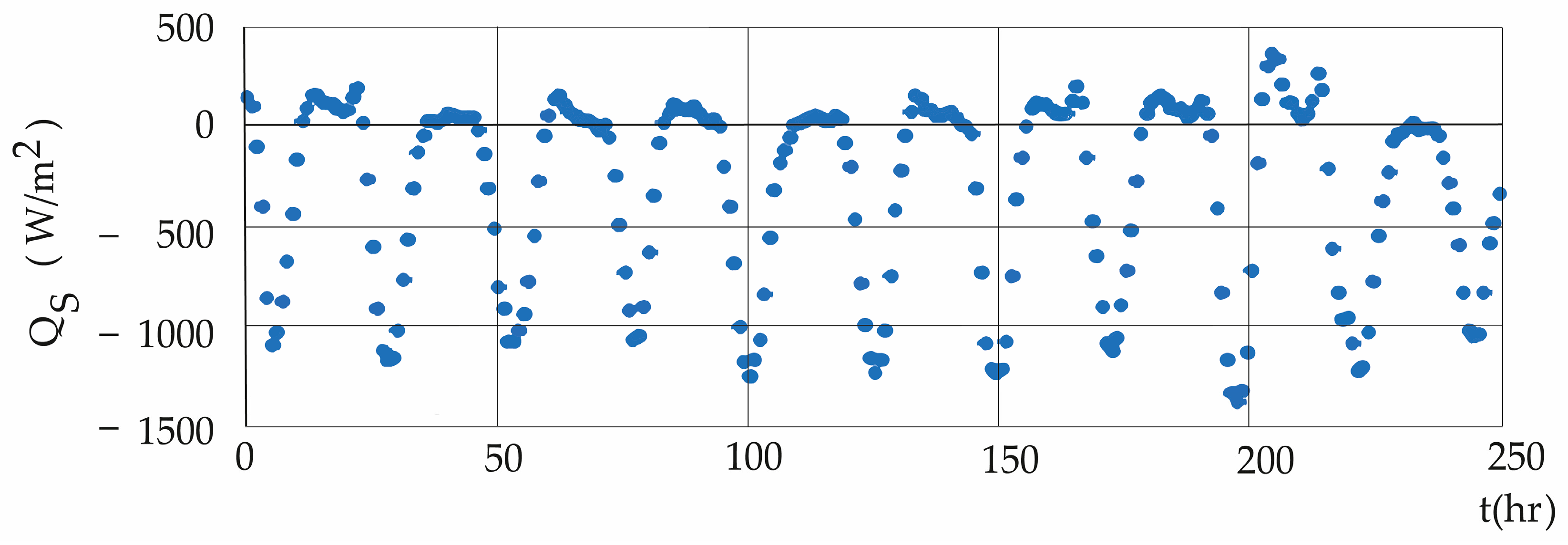
Located in the southeastern sector of Santiago (Metropolitan Region), it has an average altitude of 784 masl and its topography comprises the Intermediate Depression and the Andean foothills. The La Florida commune covers an area of 70.2 km2 and has a projected population of 374,836 inhabitants by 2024. It is experiencing urban densification, primarily in its central zone, where an increase in high-rise buildings is observed in response to the growing demand for housing and services. This process involves the construction of buildings with higher land-use density, seeking to maximize the use of space and improve the supply of services, although it has also generated debate due to the potential reduction of green areas and the need for balanced planning. Regarding the height of authorized buildings, the La Florida commune leads nationally with an average of five floors and a maximum of twenty-six. Figure 14 shows, for a fraction of the total time, the QS,LF thermal flows:
Lo Prado
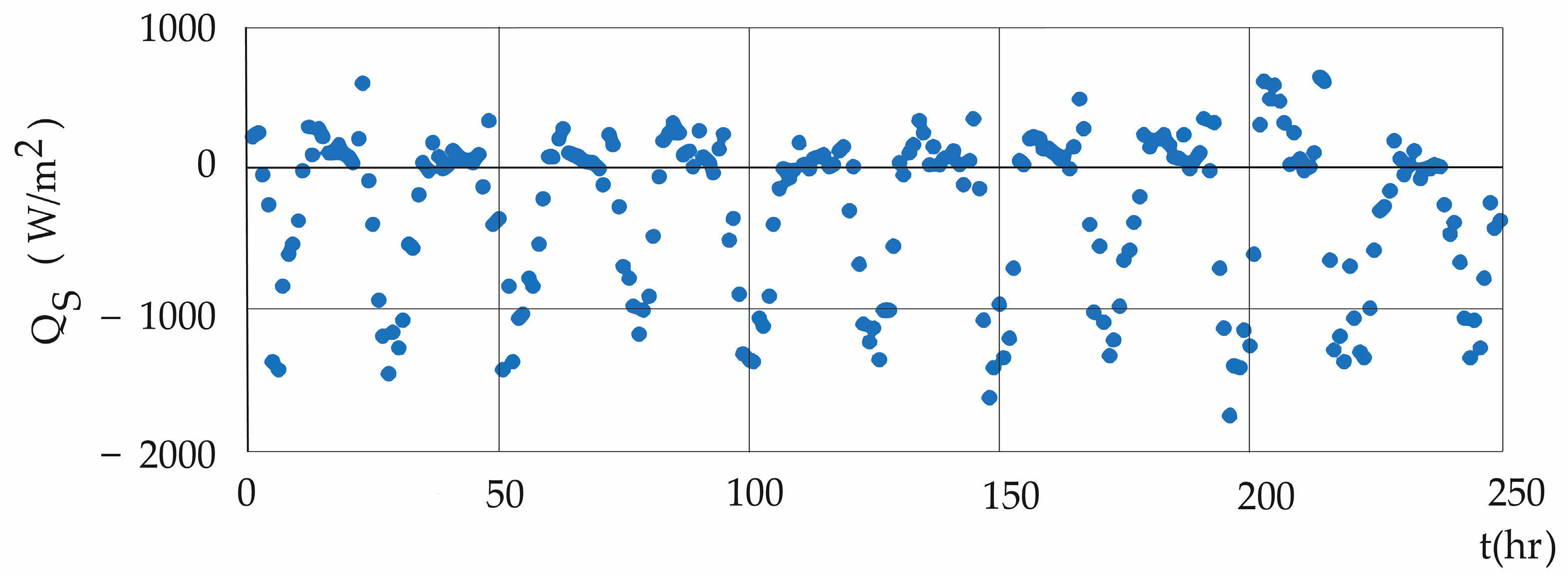
It has an area of 6.7 km2 and, according to projections by the INE (National Institute of Statistics of Chile) for 2024, has a population of 102,078 inhabitants. The altitude of the Lo Prado commune is an average of 508 masl. No specific urban densification projects are identified in Lo Prado for 2024; however, the commune has experienced a population decrease according to the 2024 Census and is implementing a Health and Environment Plan focused on climate and environmental policies. Urban densification generally involves construction and redevelopment projects in existing areas. Figure 15 shows, for a fraction of the total time, the QS,LP heat flows:
San Miguel:
It has an area of 10.78 km2 and a projected population of 150,829 inhabitants in 2024, according to the 2024 Census conducted by the National Institute of Statistics (INE). This population represents a 39.7% increase compared to the 107,954 inhabitants recorded in the 2017 Census. Its terrain is flat, forming part of the central valley of Santiago, characteristic of the Metropolitan Region. It is located in the south-central part of the Santiago metropolitan area, within the Metropolitan Region. The average elevation of the district is 550 masl. It is known for its green character, with tree-lined streets, alleyways, and the presence of El Llano Park on the Gran Avenida boulevard. Urban densification in San Miguel is characterized by the coexistence of traditional residential neighborhoods with more recent construction in areas with high connectivity, especially near Gran Avenida. This has led to a planning policy that seeks to manage growth, protecting low-rise residential areas and promoting mixed-density commercial and residential development in other areas. The commune experiences significant pressure to consolidate housing and services around major roads, generating debates about quality of life and urban growth management. Figure 16 shows, for a fraction of the total time, the QS,SM heat flows:
Summary: The World Health Organization (WHO) recommends a minimum of 9 to 15 m2 (on average 12 m2) of green areas per inhabitant to guarantee physical and mental health, a figure that is considered the ideal standard.
CommuneVegetation Fraction Per InhabitantPercentage with Respect to 12 m2 (100%)
Peñalolen5.65 m247.08
La Florida3.70 m230.83
Lo Prado6.99 m258.25
San Miguel2.70 m222.50
First, a chaotic analysis is performed, using CDA software 2.2 [62], on the time series of the vertical component of wind speed and sonic temperature, representative of the turbulent regime of the measurement area, verifying that they are chaotic as indicated in Table 1.
To analyze the time series of sonic heat flow, chaos theory was applied using the CDA software [62], obtaining the results presented in Table 2.
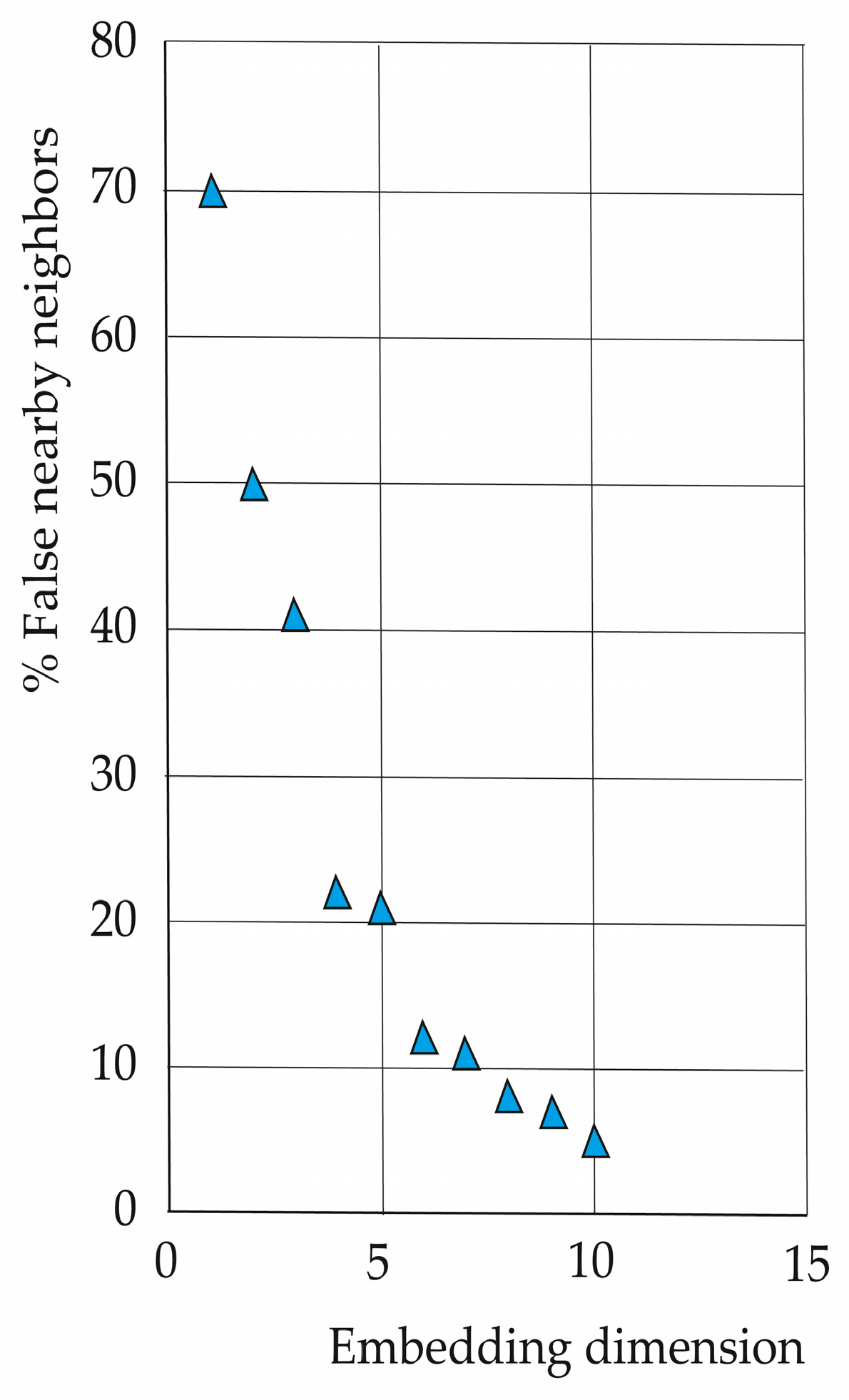
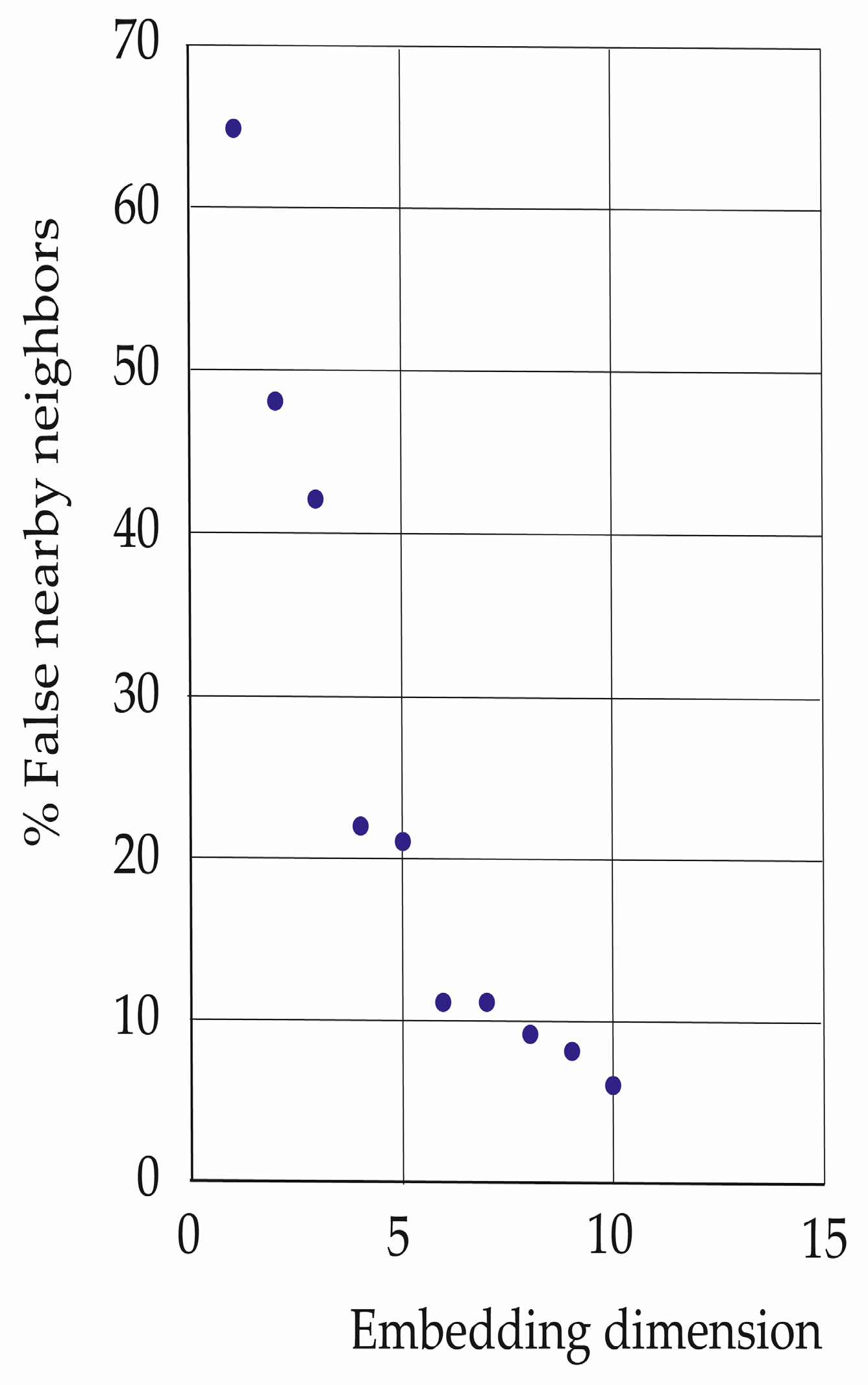
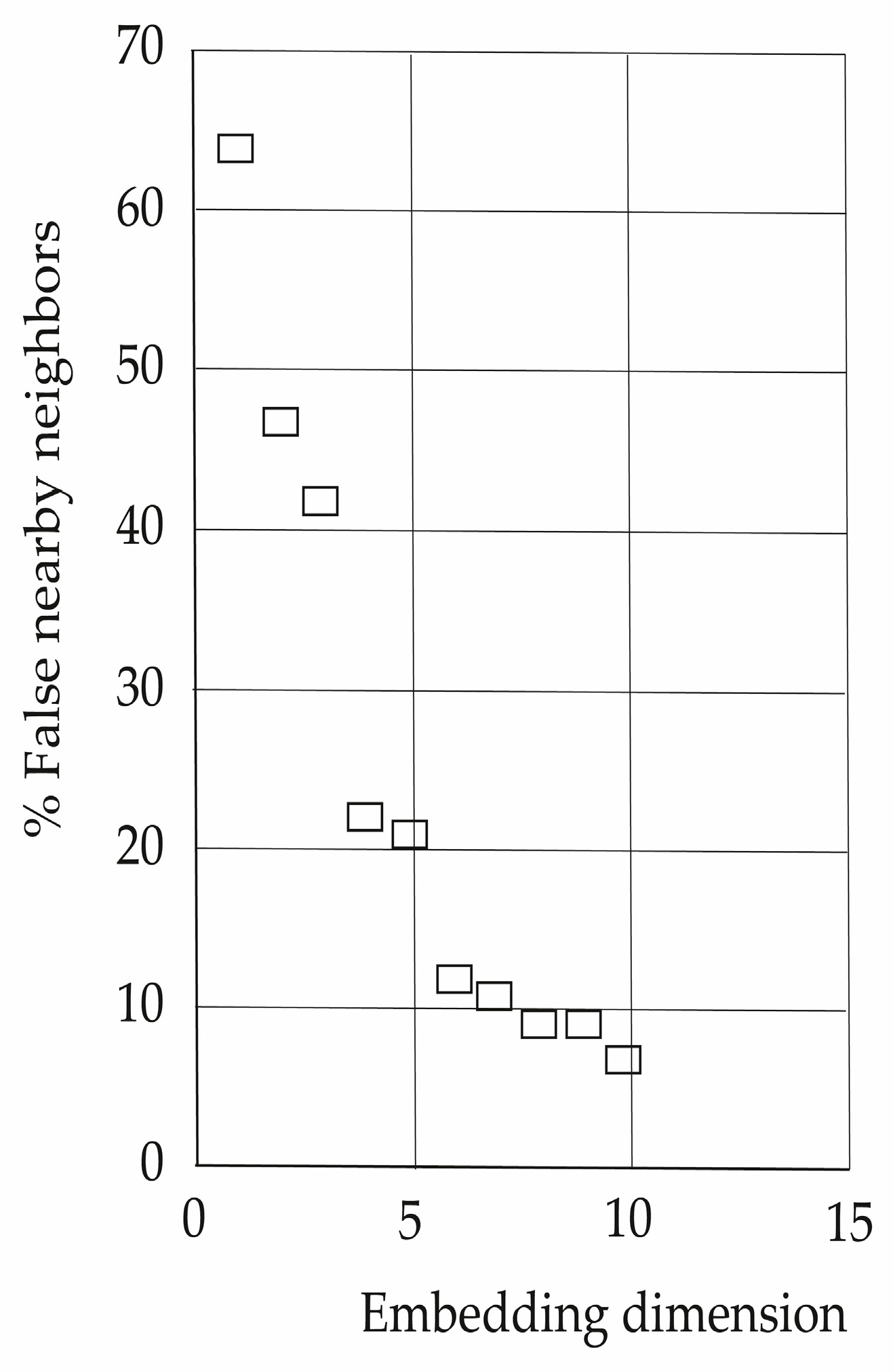
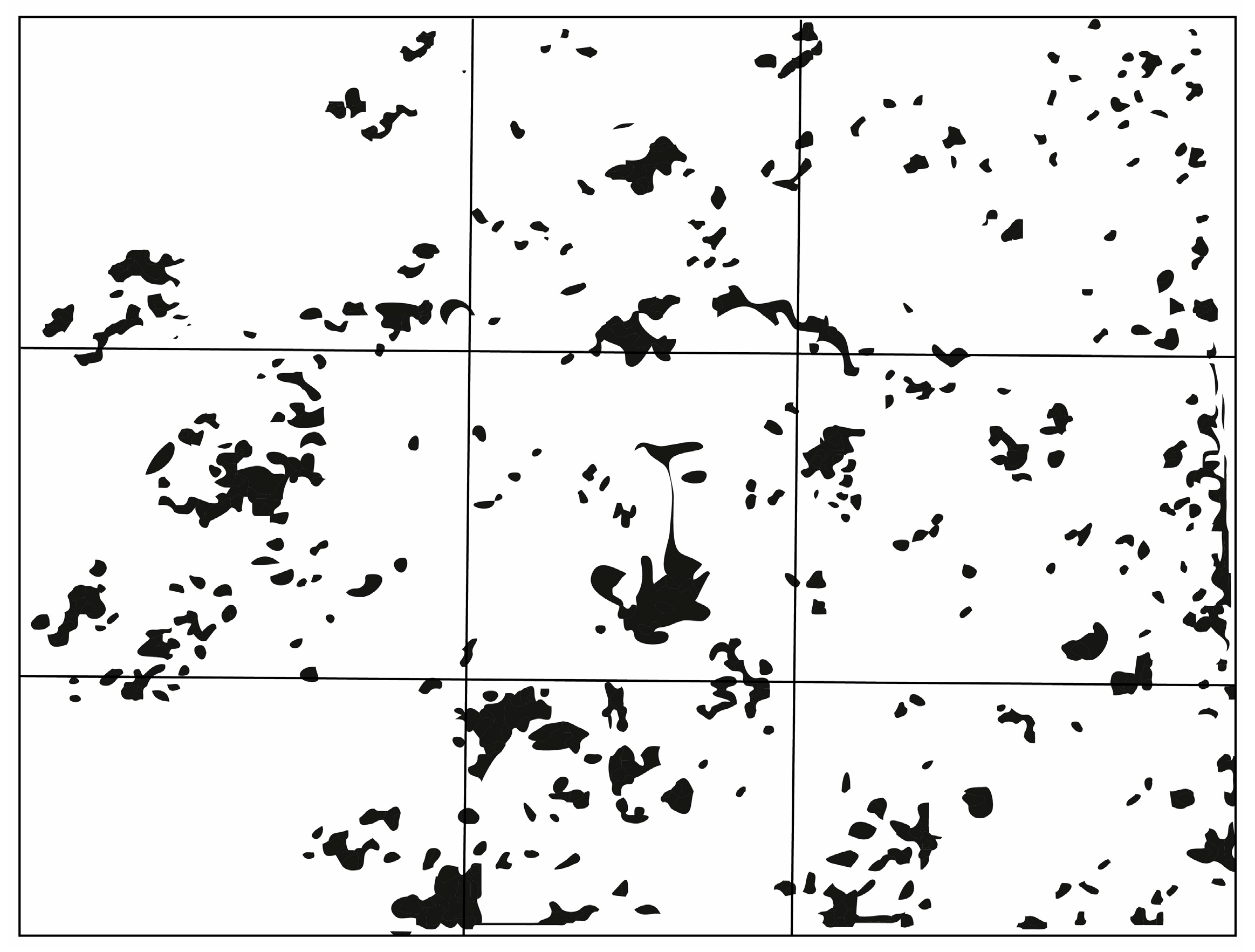
The method of false nearest neighbors (FNNs) [55,62,72,73] yielded the figures shown in Appendix C. The same appendix presents the IFS cluster test for the San Miguel commune, which shows that chaotic data produce localized clusters. For the other communes in the study, it yielded similar point distributions [74,75,76,77].
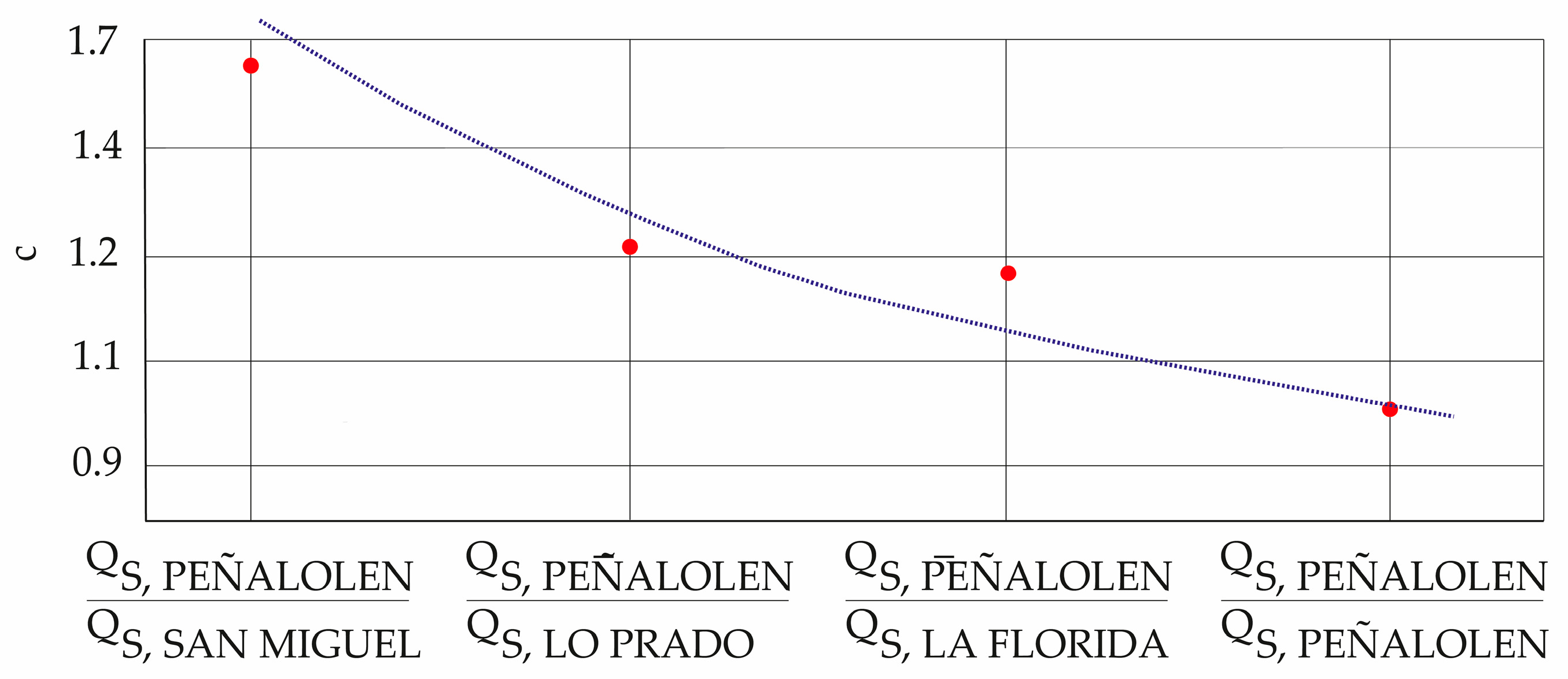
The Table 3 shows a comparative study between the communes in the study, using the commune of Peñalolén, which had the highest heat flow, as a reference.
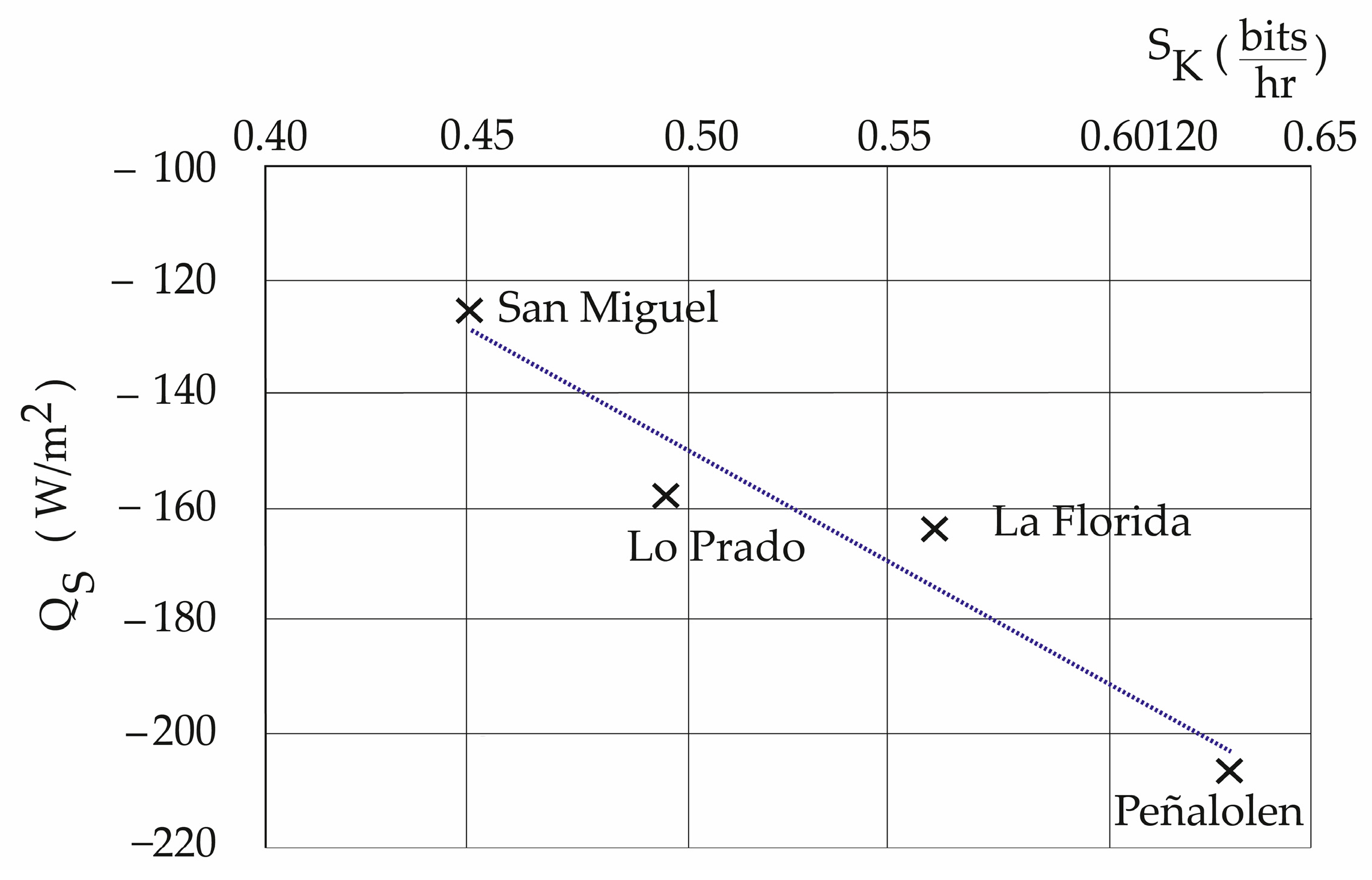
Figure 17 presents the variation of thermal flows according to the Kolmogorov entropy of four communes of the basin geomorphology in which the city of Santiago de Chile is located.
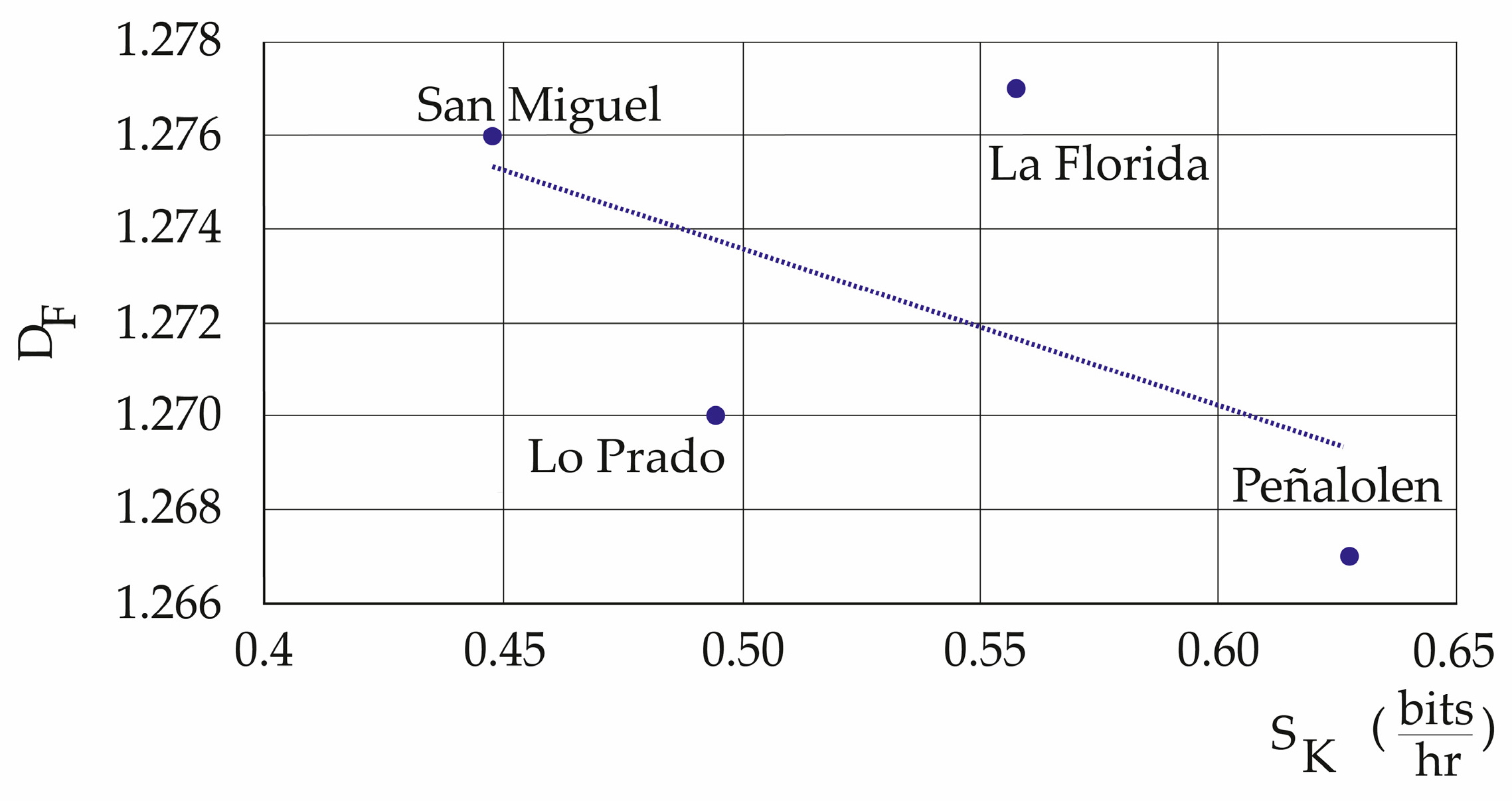
Figure 18 presents the fractal dimension (DF) versus Kolmogorov entropy, according to Table 1 and Table 2.
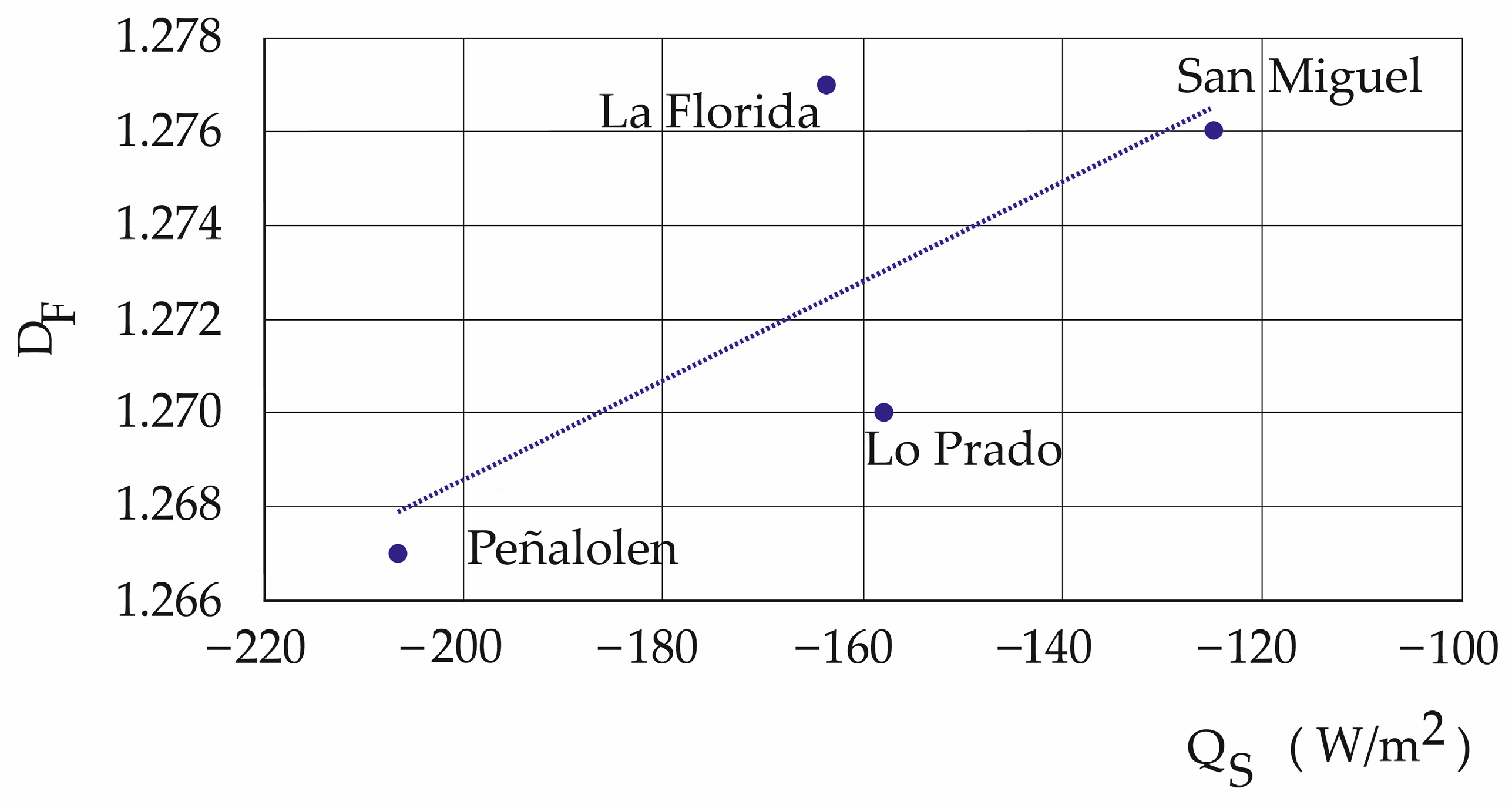
Figure 19 shows the Fractal Dimension (DF) versus the heat flow, according to Table 1 and Table 2.
According to Figure 18 and Figure 19, the urban system, with its predominantly regular geometric constructions (parallelepipeds), enhances heat at a small scale, suggesting a decrease in the fractality associated with meteorology. From a geometric perspective, this could be related to a trend toward the degradation of fractal geometries (present in meteorological time series) in favor of regular geometry, which is dominant in human constructions [78,79]. The relationship between heat and geometry is fundamental in heat transfer, where the shape (geometry) of an object determines how quickly it gains or loses heat by influencing surface area and conduction/radiation.
This evidence supporting correlation, not causation, makes it possible to propose the following corollary:
If the different domains of a surface in R3 contain varieties of regular volumetric geometries that radiate heat towards fractal variables, then the radiated heat could be associated with a decrease in fractal dimensions.
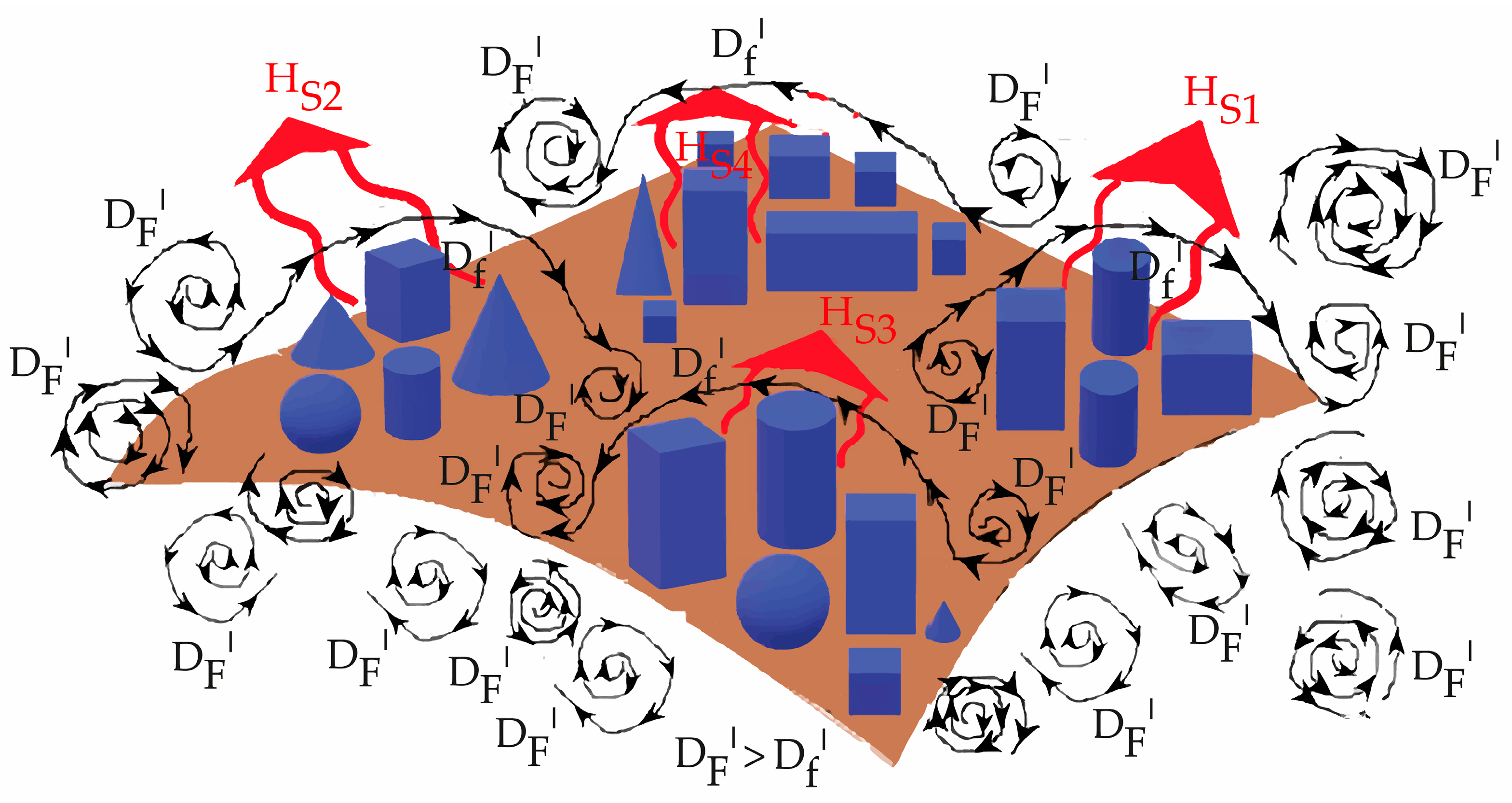
Figure 20 explains the process summarized in the corollary.
Figure 20 highlights the strong contribution to the Kolmogorov cascade effect of the surrounding areas of districts with the greatest changes in soil roughness due to high-rise buildings, increasing heat fluxes to the atmosphere. Figure 21 shows the decrease in heat fluxes when comparing the district with the highest heat flux to the other districts (Table 3).

4. Discussion

A negative heat flow indicates that heat is leaving a system (a geographical surface where a large artificial layer has been constructed using high-albedo materials such as houses, sheds, high-rise buildings, paved roads, walls, etc., for example), that is, it is being transferred from a higher temperature area to a lower temperature area (the atmosphere). In other words, the system is losing thermal energy to its surroundings. Ultrasonic anemometers provide a measure of the thermal disturbance affecting the boundary layer due to heat transfer from the ground [3].
Heat flow refers to the transfer of thermal energy between two areas at different temperatures. The negative sign, in thermodynamics, is used to indicate that heat is leaving the system, meaning that the system’s internal energy decreases. In short, a negative heat flow simply means that heat is leaving a system, losing thermal energy to its surroundings [80].
The chaotic treatment of localized measurements suggests a relationship between heat and fractal dimension, particularly its decrease. This could be associated with changes in the irregularity and complexity of a system (boundary layer), as observed in atmospheric phenomena (where the decrease in the fractal dimension of clouds, for example, suggests a relationship with periods of increased temperature) or in materials (fractures in compounds that become simpler), although the precise relationship depends on the system studied; that is, more heat may be related to less fractal detail.
Similarly, measurements suggest that fractal dimension and entropy may be connected. Both measure the complexity or disorder of a system, where entropy (disorder) often decreases as fractal dimension (self-similarity/space filling) increases in critical systems and natural processes, especially in the context of Chaos Theory and multifractal systems. In such contexts, an inverse relationship is observed, although regularity (low entropy) can sometimes appear during periods of high turbulence, complicating the direct relationship. However, the general trend is that a more complex structure (higher fractal dimension) can coexist with relative order (lower entropy) in certain states.
The warming of the boundary layer, and of the atmosphere by extension, has an impact on climate change (effects/causes), extreme temperatures, low relative humidity, heat waves, heat islands, drought, deforestation, deterioration of atmospheric resilience and sustainability, changes in geomorphological characteristics, alteration of urban meteorology, etc.; changes in soil roughness due to high-rise buildings, air pollution, poor urban planning, excessive urban densification, low electric mobility, high-albedo construction materials, reduction of cropland, channeling and piping of water tributaries with concrete or metal, etc. [81,82].
Heat flows and their increase have a high impact on human health: lung diseases, cardiovascular diseases, diabetes, learning disabilities, dehydration, strokes, migration, the relationship between extreme heat and violence, disruption of the food cycle, pandemics, presence of disease-transmitting vectors, etc. [83].
People with diabetes should take extra care during heat waves. Heat can affect how the body uses insulin and can cause dehydration, which in turn can affect blood sugar levels. In addition, complications of diabetes, such as damage to blood vessels and nerves, can make it harder for the body to cool down, increasing the risk of heat exhaustion and heatstroke [84].
Exposure to high temperatures can significantly worsen cardiovascular health, especially for individuals with pre-existing conditions. Heat stress puts extra strain on the heart and cardiovascular system, potentially leading to heat exhaustion, heat stroke, and exacerbation of existing cardiovascular diseases. Factors like dehydration, electrolyte imbalances, and increased inflammation can contribute to these adverse outcomes [85,86].
There is a relationship between heat and violence. High temperatures can increase aggression and violent behavior, according to scientific studies. This relationship is known as the temperature aggression hypothesis [56]. Heat can be a contributing factor to cerebral hemorrhage, particularly in the context of heatstroke. While heatstroke itself can cause various complications, including disseminated intravascular coagulation (DIC) and multi-organ failure, it can also lead to cerebral hemorrhage, especially in vulnerable individuals [87,88].
Heat negatively affects learning, and air conditioning in schools can mitigate these effects. Research shows that high temperatures on school days can reduce performance on standardized tests and impair cognitive development. Low-income and minority students, who often attend schools without air conditioning, are particularly vulnerable [89,90].
Warm weather, especially heat waves, often leads to increased pest activity due to the cold-blooded nature of insects. As temperatures rise, their metabolism increases, causing them to reproduce more rapidly and shortening their life cycles. This can result in more pests entering homes as they search for food, water, and shelter from the heat [91,92,93].

5. Conclusions

The thermal fluxes to the atmosphere, calculated using covariances and sonic temperature at four locations spread over 650 km2, show a greater presence on surfaces with a higher density of tall buildings of regular geometry.
The increase in thermal energy towards the boundary layer (closer to the surface) leads to a more turbulent and disordered layer (Figure 16); a relationship is revealed between thermal fluxes and an increase in entropic fluxes represented by Kolmogorov entropy. The Kolmogorov cascade effect is amplified, with more turbulence near the ground surface.
The thermal flows coming from each location suggest an inverse effect on the fractal dimension.
Ultrasonic anemometers, through the measurement of the vertical component of wind speed, allow quantification of the thermal effect that affects the boundary layer due to reconfiguration of the surface volumetric geometry, the materials used in the construction of artificial sediment, the creation of urban wind corridors, favoring the installation of heat islands (both in intensity and frequency), etc.
Comparatively, regarding the communes that contribute the most heat flux to the boundary layer, which can contribute to climate change, the measurements taken in the different communes are (Figure 20) San Miguel < Lo Prado < La Florida < Peñalolén. According to measurements taken in a basin geomorphology, the municipality that produces the greatest emission of heat fluxes is Peñalolén, which has a large number of high-rise buildings. The municipality that produces the least is San Miguel, where, in the measurement area, there were practically no high-rise buildings. In the boundary layer of the studied basin geomorphology, it is demonstrated that the vertical component of the wind generates thermal pollution. This has serious implications for human health.

Author Contributions

Conceptualization, P.P.; methodology, P.P.; software, P.P. and E.M.; validation, P.P. and E.M.; formal analysis, P.P., E.M., and J.W.; investigation, P.P., D.C.-R., J.W., and C.S.; resources, P.P.; data curation, P.P., E.M.; writing—original draft preparation, P.P. and E.M.; writing—review and editing, P.P. and E.M.; visualization, P.P. and E.M.; supervision, P.P.; project administration, P.P.; funding acquisition, P.P. All authors have read and agreed to the published version of the manuscript.

Funding

This research was supported by ANID/CONICYT/FONDECYT Regular 1240127.

Data Availability Statement

Research Laboratory on Environment and Learning (RLEL), Underground Building M1, Universidad Tecnológica Metropolitana. https://www.researchgate.net/lab/Research-Laboratory-on-Environment-and-Learning-RLEL-Patricio-Pacheco (accessed on 31 January 2025). https://doi.org/10.13140/RG.2.2.16200.38402.

Acknowledgments

To the Department of Physics of the UTEM, to the Universidad de San Sebastian and to the Facultad de Enfermería of the Universidad Andrés Bello for their collaboration.

Conflicts of Interest

The authors declare no conflicts of interest. The funders had no role in the design of the study; in the collection, analyses, or interpretation of data; in the writing of the manuscript; or in the decision to publish the results.

Appendix A

Sonic temperature and absolute temperature
Humid air can be considered to be composed of dry air and water vapor. Both components, dry air and water vapor, behave as ideal gases.
P d V = n R d T = m M W S u b s t a n c e R d T P d = m V R d T M W S u b s t a n c e = ρ d   R d T M W S u b s t a n c e
P v V = n R v T = m M W S u b s t a n c e R v T P v = m V R v T M W S u b s t a n c e = ρ v R v T M W S u b s t a n c e
The dry air constant, or specific gas constant for air, is approximately Rd = 287 J/(kg·K) or 287 m2/(s2·K). This value represents the ideal gas constant divided by the molecular weight of dry air and is used in equations for air, treating it as a perfect gas.
The specific gas constant for water vapor is an important value and is Rv = 461.5 J/(kg·K). This constant is used in the ideal gas law and is relevant for calculating thermodynamic properties of water vapor, such as its behavior as a gas under various temperature and pressure conditions.
Humid air is lighter than dry air because water vapor molecules replace heavier nitrogen and oxygen molecules in the atmosphere:
At IUPAC (International Union of Pure and Applied Chemistry) standard conditions, 0 °C, 100 kPa, ρd~1.2754 kg/m3 (dry air).
At conditions of 20 °C, 101.326 kPa and 50% RH, ρv~1.1993 kg/m3 (humid air)
Virtual temperature answers the question: what temperature must dry air have to possess the same density as moist air at the same pressure?
The virtual temperature (TV) is that of dry air when its pressure and density are equal to those of the mixture of dry air and water vapor (moist air). Thus, the virtual temperature allows, as a first approximation, the use of the equation of state for dry air for moist air by replacing T with TV. The pressure of moist air, P, can then be expressed as a function of the total density of moist air, ρ = ρd + ρv, the dry air constant, Rd, and the virtual temperature, TV, as
P = m V R d T M W S u b s t a n c e = ρ R d T V M W S u b s t a n c e
The pressure of humid air can be written as the sum of the pressures of dry air, Pd, and water vapor, PV (Law of partial pressures or Dalton’s Law):
P = P d + P v ,
ρ R d   T V M W S u b s t a n c e = ρ d R d   T M W S u b s t a n c e + ρ v R v   T M W S u b s t a n c e
ρ R d   T V = ρ d R d   T + ρ v R v   T
( ρ d + ρ v ) R d   T V = ρ d R d   T + ρ v R v   T
R d   T V = ρ d ( ρ d + ρ v ) R d   T + ρ v ( ρ d + ρ v ) R v   T
e = R d R v ~ 0.622 , q = ρ v ( ρ d + ρ v ) ~ 0.485
T V = ρ d ( ρ d + ρ v ) T + q e T = ρ ρ v ( ρ d + ρ v ) T + q e T = 1 q T + q e T
T V = 1 + 1 e 1 q T = T S = s o n i c   t e m p e r a t u r e ( v i r t u a l )
T is the temperature that would be measured with a thermometer (ambient temperature, Ta), writing:
T = T a = T V 1 + 1 e 1 q = T S 1 + 1 e 1 q
The sonic anemometer measures virtual (sonic) temperature, not the absolute air temperature. The difference between the two, as noted, depends on humidity. The difference is small, since the relative humidity was quite low (consistent with the urban environment during the summer measurement period). If the effect of humidity is small, disturbances in the average temperature are more likely to occur frequently (these would be almost linear compared to the disturbances in the absolute temperature within the small range of values), potentially making the air turbulent. Turbulence is a disturbance in air movement, characterized by chaotic and disordered eddies. The disturbance is the process that causes the turbulence, which manifests as abrupt changes in air speed and direction. In other words, turbulence is the visible effect (the eddies), and the disturbance is the cause (the dynamics that cause the disorder).

Appendix B

Model 81000 Ultrasonic Anemometer
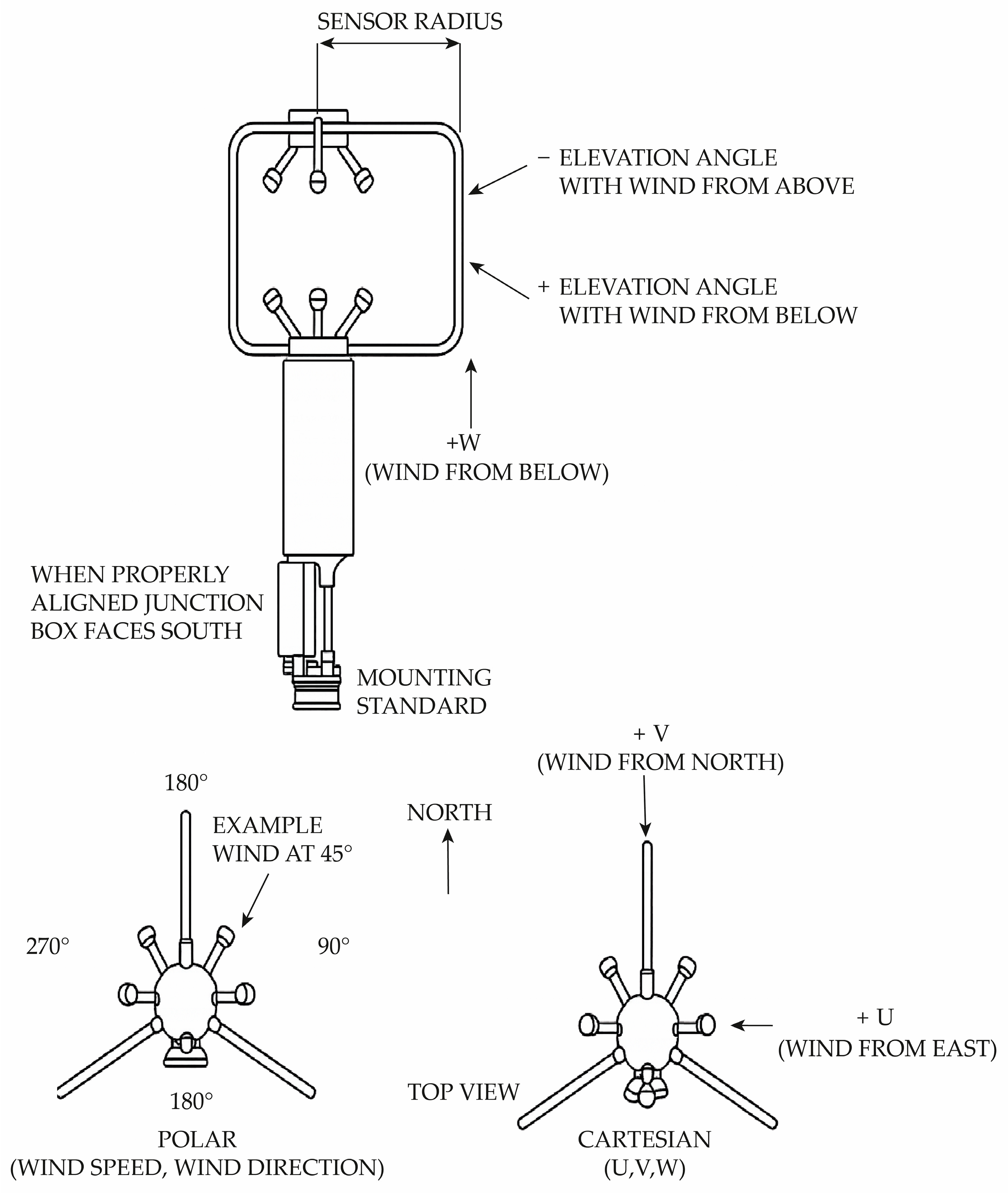
The instrument records three-dimensional wind speed using the time of movement of ultrasonic acoustic signals. Sonic temperature is related to the speed of sound, which is corrected for crosswind effects, Figure A1. Output frequency, serial sample transmission rate: 32.
u, v, and w are the orthogonal wind velocities. The instrument is oriented with its u-axis aligned east–west and its v-axis aligned north–south. +u indicates wind from the east; +v indicates wind from the north. Wind from below (updraft) is +w.
Sonic Temperature
−50 < Range (Ra) < +50 °C; Resolution (R): 0.01 °C, Accuracy (A): ± 2°C (0 to 30 m/s wind)
Wind Speed
0 < Ra < 40 m/s; R: 0.01 m/s; Threshold: 0.01 m/s; A: ±1% rms ±0.05 m/s (between 0 and 30 m/s); ±3% rms (between 30 and 40 m/s)
Wind Direction
0.0° < Azimuth Ra < to 359.9°; Elevation Ra: ±60.0°; R: 0.1°; A: ±2° (between 1 and 30 m/s); ±5° (between 30 and 40 m/s)
The values are greater than 0 when the wind comes from below (updraft) and less than 0 when it comes from above (downdraft).
Figure A1. Diagram showing the main parts of the ultrasonic anemometer used and orientation and dimensions.
Fractalfract 10 00240 g0a1

Appendix C

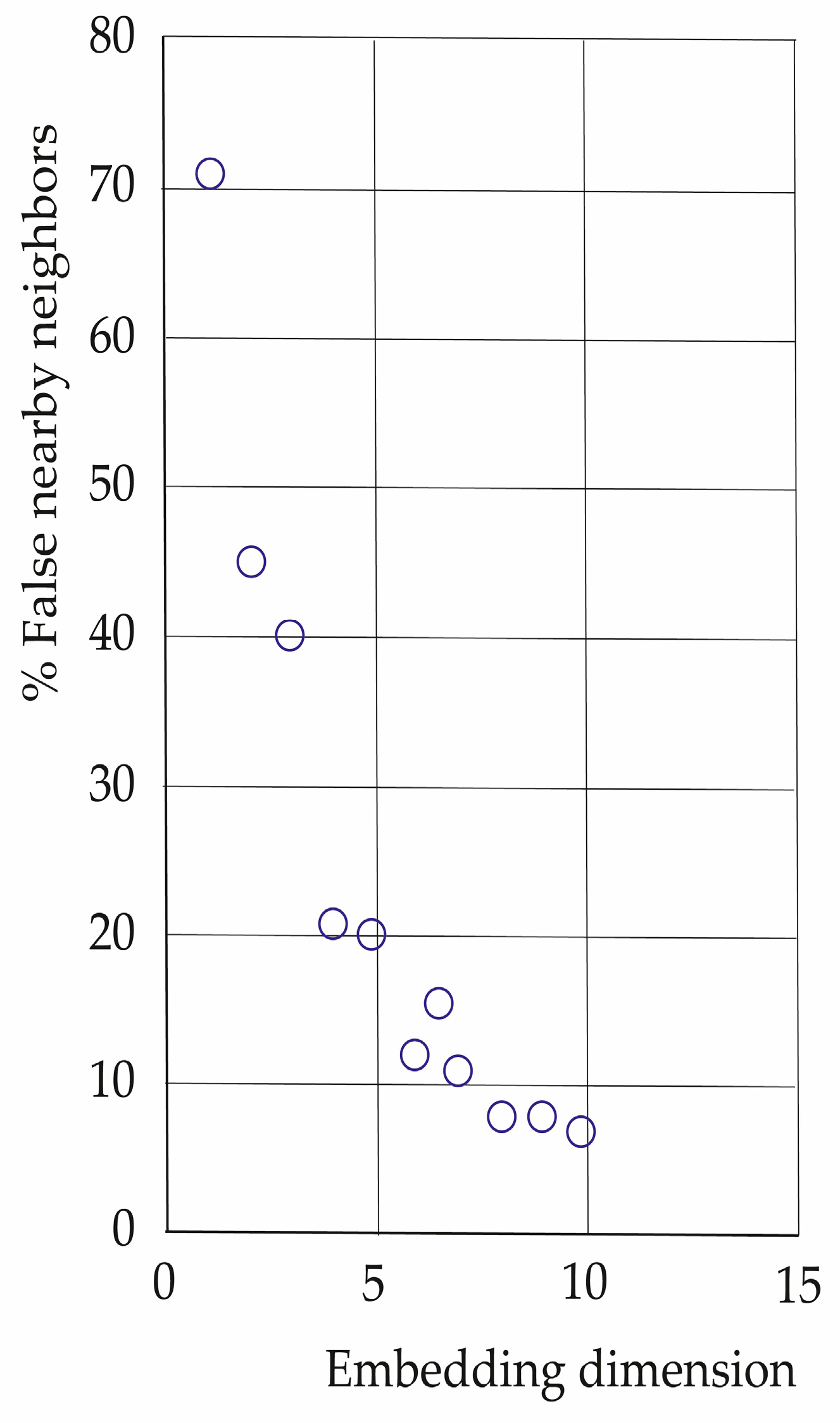
False nearest neighbors and the embedding dimension at the minimum (D). To explore the embedding dimension, a range of 1 to 10 with delay N = 1 was used in all cases. The resulting correlation dimension is noted D C , R = D C ± D C with relative percentage error % r = D C D C .
San Miguel Commune (D = 4, N = 1, D C , R = 1.917 ± 0.116 , % r = 6.05 % )
Figure A2. The figure shows the percentage decay of false nearest neighbors with increasing embedding dimension for the commune San Miguel.
Fractalfract 10 00240 g0a2
La Florida Commune (D = 2, N = 1), D C , R = 1.079 ± 0.083 , % r = 7.70 % )
Figure A3. The figure shows the percentage decay of false nearest neighbors with increasing embedding dimension for the commune La Florida.
Fractalfract 10 00240 g0a3
Lo Prado Commune (D = 5, N = 1, D C , R = 1.815 ± 0.048 , % r = 2.64 % )
Figure A4. The figure shows the percentage decay of false nearest neighbors with increasing embedding dimension for the commune Lo Prado.
Fractalfract 10 00240 g0a4
Peñalolén (D = 5, N = 1, D C , R = 1.626 ± 0.243 , % r = 14.94 % )
Figure A5. The figure shows the percentage decay of false nearest neighbors with increasing embedding dimension for the commune Peñalolen.
Fractalfract 10 00240 g0a5
IFS Clumpiness Test
Iterated Function System (IFS) also suggest a data–analysis method. If values are uncorrelated, then the points will be uniformly dense. White noise fills the screen uniformly. Colored noise or chaotic data produces localized clumps.
San Miguel Commune
Figure A6. What this figure presents was also manifested, in a similar way, in the other communes where the measurements were carried out: Lo Prado, La Florida, and Peñalolén.
Fractalfract 10 00240 g0a6

References

  1. Wilson, C.; Shonk, J.K.P.; Bohnenstengel, S.I.; Paschalis, A.; van Reeuwijk, M. Microscale to neighbourhood scale: Impact of shading on urban climate. Build. Environ. 2025, 275, 112721. [Google Scholar] [CrossRef]
  2. Zhu, Z.; Wang, M.; Wang, J.; Ma, X.; Luo, J.; Yao, X. Diurnal Variation Characteristics of the Surface Sensible Heat Flux over the Tibetan Plateau. Atmosphere 2023, 14, 128. [Google Scholar] [CrossRef]
  3. Wong Kim, S.; Brown, R.D. Development of a micro-scale heat island (MHI) model to assess the thermal environment in urban street canyons. Renew. Sustain. Energy Rev. 2023, 184, 113598. [Google Scholar] [CrossRef]
  4. Oke, T.R. The Energetic Basis of the Urban Heat Island. Q. J. R. Meteorol. Soc. 1982, 108, 1–24. [Google Scholar] [CrossRef]
  5. Oke, T.R. Boundary Layer Climates, 2nd ed.; Routledge: London, UK, 1987. [Google Scholar]
  6. Velázquez-Lozada, A.; Gonzalez, J.E.; Amos Winter, A. Urban heat island effect analysis for San Juan, Puerto Rico. Atmos. Environ. 2006, 40, 1731–1741. [Google Scholar] [CrossRef]
  7. Stone, B.; Norman, J.M. Land use planning and surface heat island formation: A parcel-based radiation flux approach. Atmos. Environ. 2006, 40, 3561–3573. [Google Scholar] [CrossRef]
  8. Lin, C.Y.; Chen, F.; Huang, J.C.; Chen, W.C.; Liou, Y.A.; Chen, W.N.; Liu, S.C. Urban heat island effect and its impact on boundary layer development and land–sea circulation over northern Taiwan. Atmos. Environ. 2008, 42, 5635–5649. [Google Scholar] [CrossRef]
  9. Grimmond, C.S.B.; Oke, T.R. Aerodynamic Properties of Urban Areas Derived from Analysis of Surface Form. J. Appl. Meteorol. Clim. 1999, 38, 1262–1292. [Google Scholar] [CrossRef]
  10. Masson, V. A Physically-Bases Scheme for the Urban Energy Budget in Atmospheric Models. Bound.-Layer Meteorol. 1999, 94, 357–397. [Google Scholar] [CrossRef]
  11. Grimmond, C.S.B.; Oke, T.R. Turbulent Heat Fluxes in Urban Areas: Observations and a Local-Scale Urban Meteorological Parameterization Scheme (LUMPS). J. App. Meteorol. 2002, 41, 792–810. [Google Scholar] [CrossRef]
  12. Voogt, J.A.; Oke, T.R. Thermal remote sensing of urban climates. Remote Sens. Environ. 2003, 86, 370–384. [Google Scholar] [CrossRef]
  13. Krayenhoff, E.S.; Voogt, J.A. A microscale three-dimensional urban energy balance model for studying surface temperatures. Bound.-Layer Meteorol. 2007, 123, 433–461. [Google Scholar] [CrossRef]
  14. Nazarian, N.; Martilli, A.; Kleissl, J. Impacts of Realistic Urban Heating, Part I: Spatial Variability of Mean Flow, Turbulent Exchange and Pollutant Dispersion. Bound.-Layer Meteorol. 2017, 166, 367–393. [Google Scholar] [CrossRef]
  15. Nazarian, N.; Martilli, A.; Norford, L.; Kleissl, J. Impacts of realistic urban heating, part II: Air quality and city breathability. Bound.-Layer Meteorol. 2018, 168, 321–341. [Google Scholar] [CrossRef]
  16. Lee, D.I.; Lee, S.H. The Microscale Urban Surface Energy (MUSE) Model for Real Urban Application. Atmosphere 2020, 11, 1347. [Google Scholar] [CrossRef]
  17. Saha, M.; Kafy, A.A.; Bakshi, A.; Faisal, A.A.; Almulhim, A.I.; Rahaman, Z.A.; Rakib, A.A.; Fattah, M.A.; Akter, K.S.; Rahman, M.T.; et al. Modelling microscale impacts assessment of urban expansion on seasonal surface urban heat island intensity using neural network algorithms. Energy Build. 2022, 275, 112452. [Google Scholar] [CrossRef]
  18. Eštoková, A.; Wolfová Fabiánová, M.; Ondová, M. Concrete Structures and Their Impacts on Climate Change and Water and Raw Material Resource Depletion. Int. J. Civ. Eng. 2022, 20, 735–747. [Google Scholar] [CrossRef]
  19. Ekolu, S.O. Temperature-Induced Effect of Climate Change on Natural Carbonation of Concrete Structures. Mater. J. 2023, 129, 101–116. [Google Scholar] [CrossRef]
  20. Medeiros-Junior, R.A. 3—Impact of climate change on the service life of concrete structures. In Woodhead Publishing Series in Civil and Structural Engineering, Eco-Efficient Repair and Rehabilitation of Concrete Infrastructures; Pacheco-Torgal, F., Melchers, R.E., Shi, X., De Belie, N., Van Tittelboom, K., Sáez, A., Eds.; Woodhead Publishing: Cambridge, UK, 2018; pp. 43–68. [Google Scholar] [CrossRef]
  21. Kaewunruen, S.; Wu, L.; Goto, K.; Najih, Y.M. Vulnerability of Structural Concrete to Extreme Climate Variances. Climate 2018, 6, 40. [Google Scholar] [CrossRef]
  22. Available for Public Use at the Library of the National Congress of Chile. Available online: https://www.bcn.cl/siit/nuestropais/region13/clima.htm#:~:text=La%20temperatura%20media%20anual%20es%20de%2013%2C9%C2%B0C%2C,corresponde%20al%20mes%20de%20julio%20con%207%2C7%C2%B0C.&text=Este%20tipo%20de%20clima%20se%20desarrolla%20en%20todo%20el%20territorio%20regional (accessed on 9 September 2025).
  23. Howard, L. The Climate of London; Vols. I–III; W. Phillips: London, UK, 1833. [Google Scholar]
  24. Chander, T.J. Selected Bibliography on Urban Climate, Tech. Note No. 155, WMO No. 276; World Meteorological Organization: Geneva, Switzerland, 1970; 383p. [Google Scholar]
  25. Chandler, T.J.; Gregory, S. The Climate of the British Isles; Addison-Wesley Longman Ltd.: London, UK, 1976. [Google Scholar]
  26. Oke, T.R. Review of Urban Climatology, 1968–1973, Tech. Note No. 134, WMO No. 303; World Meteorological Organization: Geneva, Switzerland, 1974; 132p. [Google Scholar]
  27. Oke, T.R. Review of Urban Climatology, 1973–1976, Tech. Note No. 169, WMO No. 539; World Meteorological Organization: Geneva, Switzerland, 1979; 100p. [Google Scholar]
  28. Oke, T.R. The distinction between canopy and boundary-layer urban heat islands. Atmosphere 1976, 14, 268–277. [Google Scholar] [CrossRef]
  29. Högström, U.; Taesler, R.; Karlsson, S.; Enger, L.; Högström, A.O.S. The Uppsala urban meteorology project. Bound.-Layer Meteorol. 1978, 15, 69–80. [Google Scholar] [CrossRef]
  30. Stull, R.B. An Introduction to Boundary Layer Meteorology; Kluwer Academic Publishers: Dordrecht, The Netherlands; Boston, MA, USA; London, UK, 2003. [Google Scholar]
  31. Voogt, J.A.; Grimmond, C.S.B. Modelling Surface Sensible Heat Flux Using Surface Radiative Temperatures in a Simple Urban Area. J. Appl. Meteorol. Clim. 2000, 39, 1679–1699. [Google Scholar] [CrossRef]
  32. Stewart, J.B.; Kustas, W.P.; Humes, K.S.; Nichols, W.D.; Moran, M.S.; de Bruin, H.A.R. Sensible Heat Flux-Radiometric Surface Temperature Relationship for Eight Semiarid Areas. J. Appl. Meteorol. Clim. 1994, 33, 1110–1117. [Google Scholar] [CrossRef]
  33. Brutsaert, W.H. Evaporation into the Atmosphere. Theory, History and Applications; D. Reidel: Dordrecht, The Netherlands, 1982; 299p. [Google Scholar]
  34. Rowley, F.B.; Eckley, W.A. Surface Conductances as Affected by Wind Direction. ASHRAE Trans. 1930, 38, 33–46. [Google Scholar]
  35. Owen, P.R.; Thompson, W.R. Heat Transfer Across Rough Surfaces. J. Fluid Mech. 1963, 15, 321–334. [Google Scholar] [CrossRef]
  36. Chamberlain, A.C. Transport of Gases to and from Grass and Grass-Like Surfaces. Proc. R. Soc. London 1966, 290, 236–265. [Google Scholar] [CrossRef]
  37. Yang, Y.; Huang, F.; Kang, S. Mechanism of Penetration Rate Improvement in Hot Dry Rock Under the Coupling of Impact Load and Confining Pressure Release. Reserv. Sci. 2026, 2, 52–64. [Google Scholar] [CrossRef]
  38. Tahir, M.U.; Guo, S. Preliminary Investigation of Fracture Behavior during Carbon Dioxide Fracturing of Natural Hydrogen Reservoir with Hard-Core Imperfections. Reserv. Sci. 2026, 2, 34–51. [Google Scholar] [CrossRef]
  39. He, R.; Rong, G.; Tan, I.; Phoon, K.-K.; Quan, J. Numerical evaluation of heat extraction performance in enhanced geothermal system considering rough-walled fractures. Renew. Energy 2022, 188, 524–544. [Google Scholar] [CrossRef]
  40. Chen, Y.; Wang, J.; Feng, J. Understanding the Fractal Dimensions of Urban Forms through Spatial Entropy. Entropy 2017, 19, 600. [Google Scholar] [CrossRef]
  41. Martínez, J.A.; Vinagre, F.A. La Entropía de Kolmogorov; su Sentido Físico y su Aplicación al Estudio de Lechos Fluidizados 2D; Departamento de Química Analítica e Ingeniería Química, Universidad de Alcalá, Alcalá de Henares: Madrid, Spain, 2019. Available online: https://www.academia.edu/2479372 (accessed on 23 September 2025).
  42. Singh, P.; Sharma, A.; Sur, U.; Rai, P.K. Comparative landslide susceptibility assessment using statistical information value and index of entropy model in Bhanupali-Beri región, Himachal Pradesh, India. Environ. Dev. Sustain. 2021, 23, 5233–5250. [Google Scholar] [CrossRef]
  43. Fei, X.; Lou, Z.; Lv, X.; Ren, Z.; Xiao, R. Pollution threshold assessment and risk area delineation of heavy metals in soils through the finite mixture distribution model and Bayesian maximum entropy theory. J. Hazard. Mater. 2023, 452, 131231. [Google Scholar] [CrossRef]
  44. Hu, H.; Tan, Z.; Liu, C.; Wang, Z.; Cai, X.; Wang, X.; Ye, Z.; Zheng, S. Multi-timescale analysis of air pollution spreaders in Chinese on a transfer entropy network. Front. Environ. Sci. 2022, 10, 970267. [Google Scholar] [CrossRef]
  45. Alifa, M.; Castruccio, S.; Bolster, D.; Bravo, M.; Crippa, P. Information entropy tradeoffs for efficient uncertainty reduction in estimates of air pollution mortality. Environ. Res. 2022, 212, 113587. [Google Scholar] [CrossRef] [PubMed]
  46. Pacheco, P.; Mera, E. Evolution over Time of Urban Thermal Conditions of a City Immersed in a Basin Geography and Mitigation. Atmosphere 2023, 14, 777. [Google Scholar] [CrossRef]
  47. Hernández, P.R.P.; Calderón, G.A.S.; Garrido, E.M.M. Entropía y neguentropía: Una aproximación al proceso de difusión de contaminantes y su sostenibilidad. Rev. Int. Contam. Ambient. 2021, 37, 167–185. [Google Scholar] [CrossRef]
  48. Pacheco, P.; Mera, E.; Salini, G. Urban Densification Effect on Micrometeorology in Santiago, Chile: A Comparative Study Based on Chaos Theory. Sustainability 2022, 14, 2845. [Google Scholar] [CrossRef]
  49. Dijkstra, H.A.; Viebahn, J.P. Sensitivity and resilience of the climate system: A conditional nonlinear optimization approach. Commun. Nonlinear Sci. Numer. Simul. 2015, 22, 13–22. [Google Scholar] [CrossRef]
  50. Pacheco, P.; Mera, E.; Fuentes, V. Intensive Urbanization, Urban Meteorology and Air Pollutants: Effects on the Temperature of a City in a Basin Geography. Int. J. Environ. Res. Public Health 2023, 20, 3941. [Google Scholar] [CrossRef]
  51. Pacheco, P.; Mera, E.; Fuentes, V.; Parodi, C. Initial Conditions and Resilience in the Atmospheric Boundary Layer of an Urban Basin. Atmosphere 2023, 14, 357. [Google Scholar] [CrossRef]
  52. Farmer, J.D. Chaotic attractors of an infinite dimensional dynamical system. Phys. D 1982, 4, 366–393. [Google Scholar] [CrossRef]
  53. Farmer, J.D.; Otto, E.; Yorke, J.A. The dimension of chaotic attractors. Phys. D 1983, 7, 153–180. [Google Scholar] [CrossRef]
  54. Yu, B.; Huang, C.; Liu, Z.; Wang, H.; Wang, L. A chaotic analysis on air pollution index change over past 10 years in Lanzhou, northwest China. Stoch. Environ. Res. Risk Assess. 2011, 25, 643–653. [Google Scholar] [CrossRef]
  55. Sprott, J.C. Chaos and Time-Series Analysis, 1st ed.; Oxford University Press: Oxford, UK, 2003. [Google Scholar]
  56. Takens, F. Detecting strange attractors in turbulence. In Dynamical Systems and Turbulence, Warwick 1980; Lecture Notes in Mathematics; Rand, D., Young, L.S., Eds.; Springer: Berlin/Heidelberg, Germany, 1981; Volume 898. [Google Scholar] [CrossRef]
  57. Cao, L. Practical method for determining the minimum embedding dimension of a scalar time series. Phys. D Nonlinear Phenom. 1997, 110, 43–50. [Google Scholar] [CrossRef]
  58. Wolf, A.; Swift, J.B.; Swinney, H.L.; Vastano, J.A. Determining Lyapunov exponents from a time series. Phys. D 1985, 16, 285 317. [Google Scholar] [CrossRef]
  59. Grassberger, P.; Procaccia, I. Characterization of strange attractors. Phys. Rev. Lett. 1983, 50, 346–349. [Google Scholar] [CrossRef]
  60. Kolmogorov, A.N. On Entropy per unit Time as a Metric Invariant of Automorphisms. Dokl. Akad. Nauk. SSSR 1959, 124, 754–755. [Google Scholar]
  61. Ruelle, D. Thermodynamic Formalism: The Mathematical Structures of Classical Equilibrium Statistical Mechanics; Addison-Wesley Pub Co.: Reading, MA, USA, 1978. [Google Scholar]
  62. Sprott, J.C. Chaos Data Analyzer Software 1995. Available online: http://sprott.physics.wisc.edu/cda.htm (accessed on 16 October 2025).
  63. Horna, J.; Dionicio, J.; Martínez, R.; Zavaleta, A.; Brenis, Y. Dinámica simbólica y algunas aplicaciones. Sel. Mat. 2016, 3, 101–106. [Google Scholar] [CrossRef]
  64. Ziv, J.; Lempel, A. A Universal Algorithm for Sequential Data Compression. IEEE Trans. Inf. Theory 1977, 23, 337–343. [Google Scholar] [CrossRef]
  65. Hurst, H.E. Long-Term Storage Capacity of Reservoirs. Trans. Am. Soc. Civ. Eng. 1951, 116, 770–799. [Google Scholar] [CrossRef]
  66. Pacheco, P.; Mera, E. Study of the Effect of Urban Densification and Micrometeorology on the Sustainability of a Coronavirus-Type Pandemic. Atmosphere 2022, 13, 1073. [Google Scholar] [CrossRef]
  67. Asa, E.; Saafi, M.; Membah, J.; Billa, A. Comparison of linear and nonlinear Kriging methods for characterization and interpolation of soil data. J. Comput. Civ. Eng. 2012, 26, 11–18. [Google Scholar] [CrossRef]
  68. Norazian, M.N.; Shruki, Y.A.; Azam, R.M.; Mustafa Al Bakri, A.M. Estimation of missing values in air pollution data using single imputation techniques. Sci. Asia 2008, 34, 341–345. [Google Scholar] [CrossRef]
  69. Junninen, H.; Niska, H.; Tuppurainen, K.; Ruuskanen, J.; Kolehmainen, M. Methods for imputation of missing values in air quality data sets. Atmos. Environ. 2004, 38, 2895–2907. [Google Scholar] [CrossRef]
  70. Emery, X. Simple and Ordinary Multigaussian Kriging for Estimating Recoverable Reserves. Math. Geol. 2005, 37, 295–319. [Google Scholar] [CrossRef]
  71. Kyriakidis, P.; Journel, A. Geostatistical space-time models: A review. Math. Geol. 1999, 6, 651–684. [Google Scholar] [CrossRef]
  72. Fathima, T.A.; Nedumpozhimana, V.; Lee, Y.H.; Winkler, S.; Dev, S. A Chaotic Approach on Solar Irradiance Forecasting. arXiv 2019, arXiv:1912.07184v1. [Google Scholar] [CrossRef]
  73. Sangiorgio, M.; Dercole, F.; Guariso, G. Forecasting of noisy chaotic systems with deep neural networks. Chaos Solitons Fractals 2021, 153, 111570. [Google Scholar] [CrossRef]
  74. Özgür, E.; Yilmaz, M.U. Using Chaos Theory to Determine Average Prediction Times of Different Meteorological Variables: A Case Study in Sivas. Int. J. Adv. Eng. Pure Sci. 2022, 34, 101–106. [Google Scholar] [CrossRef]
  75. Xu, X.; Niu, D.; Fu, M.; Xia, H.; Wu, H. A Multi Time Scale Wind Power Forecasting Model of a Chaotic Echo State Network Based on a Hybrid Algorithm of Particle Swarm Optimization and Tabu Search. Energies 2015, 8, 12388–12408. [Google Scholar] [CrossRef]
  76. Theiler, J. Spurious dimension from correlation algorithms applied to limited time-series data. Phys. Rev. A 1986, 34, 2427–2432. [Google Scholar] [CrossRef]
  77. Duan, Y.; Zhang, Z.; Guo, Y. Wasserstein Geometry of Information Loss in Nonlinear Dynamical Systems. arXiv 2026, arXiv:2601.22814v1. [Google Scholar] [CrossRef]
  78. Mannattil, M.; Gupta, H.; Chakraborty, S. Revisiting Evidence of Chaos in X-Ray Light Curves: The case of GRS 1915 + 105. Astrophys. J. 2016, 833, 208. [Google Scholar] [CrossRef]
  79. Hernández, P.P.; Ahumada, G.N.; Garrido, E.M.; de la Cerda, D.Z. Influence of Volumetric Geometry on Meteorological Time Series Measurements: Fractality and Thermal Flows. Fractal Fract. 2025, 9, 639. [Google Scholar] [CrossRef]
  80. Morán, M.J.; Shapiro, H.N. Fundamentos de Termodinámica Técnica, 8th ed.; Reverte: Barcelona, Spain, 2015. [Google Scholar]
  81. Bilgili, M.; Tumse, S.; Nar, S. Comprehensive Overview on the Present State and Evolution of Global Warming, Climate Change, Greenhouse Gasses and Renewable Energy. Arab. J. Sci. Eng. 2024, 49, 14503–14531. [Google Scholar] [CrossRef]
  82. Rossati, A. Global Warming and Its Health Impact. Int. J. Occup. Environ. Med. 2017, 8, 7–20. [Google Scholar] [CrossRef]
  83. Baker, L.; Sturm, R. Mortality in extreme heat events: An analysis of Los Angeles County Medical Examiner data. Public Health 2024, 236, 290–296. [Google Scholar] [CrossRef]
  84. Feldscher, K. Climate Change is Worsening Diabetes Worldwide. HSPH 2025. Available online: https://hsph.harvard.edu/news/extreme-heat-can-worsen-diabetes/ (accessed on 20 November 2025).
  85. Bogar, K.; Brensinger, C.M.; Hennessy, S.; Flory, J.H.; Bell, M.L.; Shi, C.; Bilker, W.B.; Leonard, C.E. Climate Change and Ambient Temperature Extremes: Association With Serious Hypoglycemia, Diabetic Ketoacidosis, and Sudden Cardiac Arrest/Ventricular Arrhythmia in People With Type 2 Diabetes. Diabetes Care 2022, 45, e171–e173. [Google Scholar] [CrossRef]
  86. Liu, J.; Varghese, B.M.; Hansen, A.; Zhang, Y.; Driscoll, T.; Morgan, G.; Dear, K.; Gourley, M.; Capon, A.; Bi, P. Heat exposure and cardiovascular health outcomes: A systematic review and meta-analysis. Lancet Planet. Health 2022, 6, e484–e495. [Google Scholar] [CrossRef]
  87. Anderson, C.A.; Anderson, K.B.; Dorr, N.; DeNeve, K.M.; Flanagan, M. Temperature and aggression. Adv. Exp. Soc. Psychol. 2000, 32, 63–133. [Google Scholar] [CrossRef]
  88. Lin, G.; Xu, C.; Wu, J.; Peng, H.; Liu, A.; He, X.; Chen, W.; Hou, X.; Wen, Q.; Pan, Z. Risk factors for and outcomes of heatstroke-related intracerebral hemorrhage. Medicine 2024, 103, e37739. [Google Scholar] [CrossRef] [PubMed] [PubMed Central]
  89. Jisung Park, R.; Goodman, J.; Hurwitz, M.; Smith, J. Heat and Learning. AEJ Econ. Policy 2020, 12, 306–339. [Google Scholar] [CrossRef]
  90. Park, R.J.; Behrer, A.P.; Goodman, J. Learning is inhibited by heat exposure, both internationally and within the United States. Nat. Hum. Behav. 2021, 5, 19–27. [Google Scholar] [CrossRef] [PubMed]
  91. Lo, Y.T.E.; Mitchell, D.M.; Gasparrini, A. Compound mortality impacts from extreme temperatures and the COVID-19 pandemic. Nat. Commun. 2024, 15, 4289. [Google Scholar] [CrossRef]
  92. Ford, J.D.; Zavaleta-Cortijo, C.; Ainembabazi, T.; Anza-Ramirez, C.; Arotoma-Rojas, I.; Bezerra, J.; Chicmana-Zapata, V.; Galappaththi, E.K.; Hangula, M.; Kazaana, C.; et al. Interactions between climate and COVID-19. Lancet Planet. Health 2022, 6, e825–e833. [Google Scholar] [CrossRef]
  93. Acosta, N.C.; Zehr, L.N.; Snook, J.S.; Szendrei, Z.; Kalwajtys, M.; Wetzel, W.C. Heat wave impacts on crop-pest dynamics are dependent upon insect ontogeny and plant resistance. Ecosphere 2024, 15, e70028. [Google Scholar] [CrossRef]
Figure 1. Layer diagram according to urban meteorological parameterization at local scale. The curved arrows near the surface represent turbulent wind. As the distance from the ground increases, the wind becomes more uniform, represented by the straight arrows.
Fractalfract 10 00240 g001
Figure 2. Disturbance diagram in the plane and perpendicular to the mean flow.
Fractalfract 10 00240 g002
Figure 3. Fluctuation with respect to the mean value of the disturbance.
Fractalfract 10 00240 g003
Figure 4. Determination of the friction speed ( I t   i s   s y m b o l i z e d   w i t h   a   s u b s c r i p t   * : u * ).
Fractalfract 10 00240 g004
Figure 5. The resistors used in modeling urban sensible heat flow [31].
Fractalfract 10 00240 g005
Figure 6. Vertical wind speed profile.
Fractalfract 10 00240 g006
Figure 7. The temporal change in heat flow in one of the communes is highlighted as an example. The trajectory, shown in blue, is located in a phase space where n cells are arranged.
Fractalfract 10 00240 g007
Figure 8. (a). Young Model 81,000 ultrasonic anemometer; (b) BP7 is a 12 Vdc, 7 Ah rechargeable battery typically used with a CR6 or CR300-series datalogger; (c) SP10 is a 10-W photovoltaic power source capable of recharging batteries. Its 6.1 m (20 ft) cable has stripped and tinned leads that connect to the PS150, PS200, CH150, CH200, or battery base of the CRVW3, CR3000, CR5000, CR7, CR9000X, SP10 10 W Solar Panel or CR6; (d) CR350 Series CompactDatalogger. Information from the scientific equipment company: R.M. Young Company 2801 Aero Park Drive, Traverse City, Michigan 49686, USA WEB: www.youngusa.com (Appendix B).
Fractalfract 10 00240 g008
Figure 9. (a). Mounting mast; (b) installation of the 81,000 ultrasonic anemometer measurement system; (c) datalogger security cabinet.
Fractalfract 10 00240 g009
Figure 10. Represents the geography of the city of Santiago, Chile, with the monitoring stations that carried out the measurements for this study (red dots): Peñalolén, La Florida, Lo Prado, and San Miguel. Furthermore, according to the Santiago Building Report of March 2024 from the Chilean Chamber of Construction, the apartment market is concentrated mainly in Santiago Centro (21%) and Ñuñoa (13%), followed by La Florida (11%) and Puente Alto (9%).
Fractalfract 10 00240 g010
Figure 11. The flowchart shows the procedure applied that allows for validating a time series as chaotic. The explored range for the embedding dimension is from 1 to 10, with a delay of 1.
Fractalfract 10 00240 g011
Figure 12. Graphical representation of the heat flow modeling due to aerodynamic drag and additional drag from surface heat transfer and roughness length associated with momentum ( Q r h ), urban canyon components (walls and roads) (QRES), and covariant calculation using ultrasonic anemometer measurements (QSON). In symbols: o: Q r h ; +: Q R E S ; x: Q S O N .
Fractalfract 10 00240 g012
Figure 13. Represents the sonic heat flux of 6.3% of the total data (3968) recorded by the ultrasonic anemometer. The calculation of the heat flux using the covariance between w and TS for the entire measurement period is QS,P = −206.3 W/m2.
Fractalfract 10 00240 g013
Figure 14. Represents the calculation of the sonic heat flux for 6.3% of the total data (3968) recorded by the ultrasonic anemometer. The calculation of the heat flux using the covariance between w and TS for the entire measurement period is: QS,LF = −163.50 W/m2.
Fractalfract 10 00240 g014
Figure 15. Represents the sonic heat flux of 6.3% of the total data (3968) recorded by the ultrasonic anemometer. The calculation of the heat flux using the covariance between w and TS for the entire measurement period is QS,LP = −157.90 W/m2.
Fractalfract 10 00240 g015
Figure 16. Represents the sonic heat flux of 6.3% of the total data (3968) recorded by the ultrasonic anemometer. The calculation of the heat flux using the covariance between w and TS for the entire measurement period is QS,SM = −125.05 W/m2.
Fractalfract 10 00240 g016
Figure 17. Indicates that the commune that produces the most heat is the one that generates the most disorder in the atmosphere, at least for the sample studied and in the boundary layer (near the ground). If the relationship is approximately proportional, as the graph indicates, between heat flow and Kolmogorov entropy, then Kolmogorov entropy is an acceptable representative of thermal processes, as is thermodynamic entropy.
Fractalfract 10 00240 g017
Figure 18. Shows the decay of the fractal dimension as the Kolmogorov entropic flux increases.
Fractalfract 10 00240 g018
Figure 19. In the context and the measured data and given that heat is escaping from the urban system into the atmosphere, the decay of the fractal dimension could be related to the thermal emission favored by the concentration of regular geometry.
Fractalfract 10 00240 g019
Figure 20. It shows how the heat flow (Hsi, i = 1, 2, 3, 4) could smooth the fractal dimension variables DF’, taking them to a lower fractal dimension, Df’. This process can favor the stability of heat islands, for example. The red arrows above the regular geometry constructions symbolize their heat flows, which influence the meteorology by reducing its complexity. This effect is attenuated at the periphery of the urban system, while the wind maintains a certain degree of turbulence.
Fractalfract 10 00240 g020
Figure 21. The comparison ratio (c) of decay of thermal fluxes with respect to the commune of maximum thermal flux shows an asymptotic trend. The dots represent the result of the ratio of heat flows for the various communes.
Fractalfract 10 00240 g021
Table 1. Contains the calculation of the chaotic parameters of the time series (each of 3986 data points) of the vertical wind speed (w) and sonic temperature (TS), per hour, for the total measurement period. D is the embedding dimension and N is delay.
CommuneVariablesλ (D = 3, N = 3)DcSKLZH
San Miguelw0.343 ± 0.0452.664 ± 0.042 (D = 2, N = 2)0.318 (D = 3, N = 2)0.102840.808673
TS0.374 ± 0.0421.175 ± 0.320 (D = 6, N = 1)0.302 (D = 2, N = 1)0.037690.909939
Lo Pradow0.356 ± 0.0404.010 ± 0.106 (D = 6, N = 2)0.436 (D = 6, N = 2)0.081620.820472
TS0.233 ± 0.0361.055 ± 0.053 (D = 6, N = 1)0.321 (D = 6, N = 1)0.042630.916008
La Floridaw0.609 ± 0.0463.433 ± 0.181 (D = 6, N = 2)0.386 (D = 6, N = 2)0.084880.884107
TS0.371 ± 0.0421.251 ± 0.434 (D = 5, N = 1)0.349 (D = 5, N = 1)0.052520.907682
Peñalolenw0.373 ± 0.0433.749 ± 0.086 (D = 5, N = 2)0.425 (D = 5, N = 2)0.094680.837772
TS0.259 ± 0.0361.059 ± 0.062 (D = 6, N = 1)0.214 (D = 6, N = 1)0.049200.913652
Table 2. Contains the calculation of the chaotic parameters of the time series of the heat flow, per hour, for the total measurement period (DF is the fractal dimension).
CommuneλDcSKLZHDF = 2 − H
San Miguel0.584 ± 0.0481.917 ± 0.1160.4480.470160.72313041.276
Lo Prado0.510 ± 0.0451.815 ± 0.0480.4950.381970.72962981.270
La Florida0.526 ± 0.0461.079 ± 0.0830.5580.476640.72213721.277
Peñalolen0.683 ± 0.0531.626 ± 0.2430.6280.326470.73279121.267
Table 3. Presents the Qs and SK values for each commune and the comparison between the one with the maximum thermal flow and the other communes.
CommuneSKQs (Thermal Flows) (W/m2)C:Comparison of Thermal Flows
San Miguel0.448−125.05QS,P/QS,SM ~ 1.65
Lo Prado0.495−157.9QS,P/QS,LP ~ 1.31
La Florida0.558−163.5QS,P/QS,LF ~ 1.26
Peñalolen0.628−206.3QS,P/QS,P ~ 1.00
Disclaimer/Publisher’s Note: The statements, opinions and data contained in all publications are solely those of the individual author(s) and contributor(s) and not of MDPI and/or the editor(s). MDPI and/or the editor(s) disclaim responsibility for any injury to people or property resulting from any ideas, methods, instructions or products referred to in the content.