1. Introduction
Studying the phase transition problem of biomimetic swarms is an important research topic for solving the phase transition control of unmanned flight swarms.
Let’s first take a look at the phase transition problem of bird flight in nature.
In the natural world, meticulously coordinated group behavior is essential for the survival of certain animal species. For example, starlings gather in large flocks annually and engage in highly synchronized movements. During flight, these flocks form fascinating and dynamic patterns—sometimes resembling hearts, hourglasses, or even various animal shapes—producing spectacular and visually captivating scenes. So, what is the secret of their collective dance? What is the mechanism behind the rapid collective formation change of starlings when encountering natural enemies?
Current research on the behavioral dynamics of bird flocks predominantly focuses on individual-level interactions and coordination [
1,
2]. These studies mainly address aspects such as the flock morphology and the spatial distances associated with rapid fluctuations of individual birds. However, investigations into the collective behavior of bird flocks as a unified entity remain limited. Giorgio Parisi, the 2021 Nobel Laureate in Physics, in collaboration with Cavagna and others, successfully reconstructed the three-dimensional trajectories of birds, observed critical phenomena, and computed the positions of individuals within the flock at each time point. By analyzing successive video frames, they were able to derive the velocity of each bird [
3]. Despite these advancements, research on the phase transition processes in starling murmurations and unmanned aerial swarms remains imprecise and underdeveloped. Christodoulidi et al. [
4] investigated phase transitions in bird flocking models using the Vicsek model, demonstrating that starling flocks exhibit order-disorder transitions characterized by critical phenomena. Bountis et al. [
5] further explored the collective dynamics of bird flocks, revealing that phase transitions in these systems are closely related to the emergence of long-range correlations and scale-free behavior.
In everyday life, we frequently encounter irregular and complex patterns-such as snowflakes in winter, fluctuations in stock market indices, or electrocardiogram (ECG) signals. These complex, non-smooth curves prompt the question of how best to characterize them, which is a challenge that also arises in the study of collective systems. Due to the inherent complexity of such swarms, simple functions may not suffice to capture their underlying characteristics. Therefore, this paper focuses on employing fractal functions to describe and identify the patterns and laws governing phase transitions in collective behaviors.
Phase transitions represent fundamental phenomena in statistical physics, characterized by abrupt changes in system properties. The theoretical framework for understanding phase transitions has been extensively developed through scaling theory and renormalization group methods [
6]. Suzuki [
7] established important connections between phase transitions and fractal geometry, demonstrating that critical phenomena exhibit self-similar structures across multiple scales. Recent advances in percolation theory have further elucidated the relationship between critical exponents and fractal dimensions [
8,
9], identifying multiple distinct fractal dimensions that characterize different aspects of critical behavior.
When facing unmanned clusters, due to the large number of individuals and the complex and diverse forms of motion, the data will become even more complex and diverse. It is difficult to use general methods to intuitively and effectively describe the phase transition process, and the research on the stability of phase transition is not deep enough. This requires a higher complexity of the function used to fit the data. Research has revealed that fractal geometry provides a powerful framework for characterizing abstract morphological structures [
10]. The self-affine fractal function has self-fitting properties. Its function is more complex and can be applied to this situation. Additionally, previous studies have shown that the fractal dimension value [
11] has a certain degree of recognizability for different things. Hence, this study proposes to explore phase transition behaviors in starling flocks through the analysis of the rate of change in the fractal dimensions of self-affine functions. The theoretical foundations of fractal geometry and its applications to complex systems have been extensively developed [
12,
13], providing a solid basis for our approach.
The structure of this paper is as follows:
Section 2 presents the theoretical foundation, including self-affine fractal functions, dimension computation methods, and a classification of phase transitions.
Section 3 describes the method for fitting images of starling flocks using self-affine fractal functions based on least squares optimization.
Section 4 presents the computed fractal dimensions for different time intervals.
Section 5 constructs a time-dimension dynamic model to identify critical points of phase transitions.
Section 6 provides a discussion including connections to percolation theory. Finally, conclusions are presented.
2. Preliminary Concepts and Related Foundations
This section aims to systematically introduce and summarize several fundamental methodologies and relevant theoretical concepts employed in the modeling of phase transitions in starling flocks.
2.1. Self-Affine Fractal Functions
2.1.1. Definition of Self-Affine Fractal Functions
We commence with an introduction to self-affine fractal functions employed in this study. Self-similar sets [
14,
15] represent a particular subclass of self-affine sets. Often, the graph of a self-affine set can be interpreted as the graph of an associated function, which is termed a self-affine fractal function. We begin by formalizing the definition of a self-affine set.
Notation Convention. To ensure clarity and avoid ambiguity in the mathematical formulation, we establish the following notational conventions. Throughout this paper, denotes spatial coordinates in the two-dimensional plane, where x and y represent the horizontal and vertical coordinates, respectively. The variable t is reserved exclusively for time and should not be interpreted as a spatial coordinate.
We observe the starling flock at discrete time instants for , where denotes the total number of observation times (equivalently, the number of images captured). Here, i serves as the time index. At each time instant , we extract spatial coordinate points from the corresponding image, where is the spatial point index.
The self-affine function at time , denoted by , is characterized by a set of parameters obtained through least squares fitting of the N spatial points. As time evolves from to , we obtain K different self-affine functions with corresponding parameter sets . Each function is constructed as the attractor of an iterated function system (IFS) consisting of affine transformations, where m is a fixed constant throughout the analysis.
It is important to distinguish between the different indices used in this work: i indexes time instants (), while j indexes spatial points within each image (). The parameter represents the fixed number of transformations in the IFS and should not be confused with either the time index or the spatial point index. In our experiments, typically –7000 spatial points are extracted from each image, while K ranges from 10 to 20 time instants.
The physical interpretation of this framework is as follows. The starling flock’s spatial configuration evolves over time. At each observation time , we capture an image containing N spatial points and fit these points using a self-affine fractal function with parameters . By analyzing how these parameters and the corresponding fractal dimensions change across the K time instants, we characterize the phase transition dynamics of the flock.
Definition 1
([
15])
. Let
be a collection of affine transformations defined by the matrix representation, with
being a fixed positive integer:
where
and
are arbitrary constants, and the scale parameters satisfy
.
Denote by
and
the fixed points of
and
, respectively. Suppose the parameters of the matrices are chosen such that the following compatibility condition holds:
where
is the fixed point corresponding to the transformation
. The line segments connecting
for
together form a polygonal curve denoted by
. For further details and notation, the reader is referred to Falconer’s monograph [
15].
2.1.2. The Self-Affine Fractal Function Utilized in This Study
For the purpose of our analysis, we consider a specific class of self-affine fractal functions that can be extended to the entire real line. Let
,
, and define the boundary points
,
. Denote by
the self-affine fractal function constructed under these conditions as described in
Section 2.1.1.
The construction of proceeds through an iterative process. Starting from the initial line segment connecting and , we apply the affine transformations to generate a polygonal approximation . Repeated application of these transformations yields a sequence of polygonal curves that converges uniformly to the graph of . The resulting function is continuous but nowhere differentiable, exhibiting self-affine scaling properties characterized by the parameters , , and .
The fractal nature of arises from the recursive structure of the iterated function system. At each scale, the graph of displays similar geometric features, with the vertical scaling controlled by the parameters . This self-affine property makes such functions particularly suitable for modeling complex natural phenomena that exhibit scale-invariant characteristics, such as the spatial configurations of bird flocks during collective motion.
For the purpose of our analysis, we extend the self-affine fractal function to the entire real line by defining the extended function
as follows:
2.2. General Formula for the Computation of Dimension
2.2.1. Bouligand Dimensions
Let
A be a nonempty bounded subset of
,
, where
is the set of real numbers. Denote by
the minimal number of balls of diameter
required to cover the set
A. The upper and lower Bouligand dimensions of
A are defined, respectively, as
If these two values coincide, the common value is called the Bouligand dimension of
A, denoted by
2.2.2. Hausdorff Dimension
The Hausdorff dimension provides a rigorous theoretical foundation for measuring fractal complexity. For a set , we first define the s-dimensional Hausdorff measure.
Given
, let
denote the collection of all
-covers of
F, where a
-cover is a countable collection
of sets satisfying
and
. The
s-dimensional Hausdorff measure is defined by
with the limiting value
A key property is that
exhibits a phase transition: there exists a critical value
such that
This critical exponent defines the Hausdorff dimension:
2.3. Phase Transition Theory and Fractal Dimension Dynamics
Phase transitions are broadly classified into two categories based on the behavior of thermodynamic quantities at the transition point [
6]:
First-order phase transitions are characterized by discontinuities in the first derivatives of the free energy, such as entropy and volume. These transitions involve latent heat and exhibit phase coexistence at the transition point. In the context of collective behavior, first-order transitions manifest as abrupt structural reorganizations.
Second-order (continuous) phase transitions are characterized by two main features [
7]: the order parameter tends continuously to zero as the system approaches the critical point from the ordered phase, and the correlation length diverges at the critical point, which guarantees scale invariance and the emergence of fractal structures.
In our analysis of starling flocks, the rapid structural changes observed during predator evasion events exhibit characteristics consistent with first-order phase transitions, where the flock undergoes abrupt reorganization between distinct collective states. However, the scale-free correlations observed in starling flocks [
3] suggest that the system may also exhibit features of critical phenomena associated with second-order transitions. A comprehensive theoretical framework integrating both perspectives represents an important direction for future investigation.
References [
7,
8,
9] have employed various types of fractal dimensions to investigate the relationship between critical exponents and fractal dimensions in equilibrium phase transitions.
Recently, using a Riesz fractional Laplacian approach, Lima et al. [
16] introduced a new fractional dimension, which they termed the Riesz fractional dimension
, related to the Fisher exponent via
. This new fractal dimension is distinct from all previously known definitions.
Based on recent developments from Lima et al. [
16], we propose the following conjecture regarding the potential connection between our fractal dimension analysis and fractional Laplacian formulations:
Conjecture 1.
Let
denote the box dimension of the self-affine fractal function fitted to the starling flock configuration at time instant
(where
). There exists a fractional Laplacian operator
with order
such that the collective dynamics of the flock near phase transition points can be described by a fractional diffusion equation of the form:
where
represents the local density field of the flock at time
,
D is a diffusion coefficient, and
captures nonlinear interaction effects.
This conjecture is motivated by the observation that the fractal dimension changes we detect at different time instants correlate with structural reorganization events in the flock. Establishing this connection rigorously would require additional theoretical development and is proposed as a direction for future research.
2.4. The Dynamical Dimension of Self-Affine Fractal Functions over Time
2.4.1. Techniques for Computing the Dimension of Self-Affine Fractal Functions
Suppose there exists a nonempty bounded open set
V and an open interval
such that the family of mappings
satisfy the open set condition as
Theorem 1.
Assuming the open set condition (
12) holds for similarity transformations
[
15] on
with contraction ratios
for
, let
F be the attractor of the iterated function system
, satisfying
then the Hausdorff dimension and the Bouligand dimension of
F coincide and equal
s, i.e.,
where
s is the unique solution to the equation
Moreover, , where denotes the s-dimensional Hausdorff measure.
Upon completion of fitting cluster patterns with self-affine fractal functions, we can utilize the dimension of such functions as a quantitative measure of the complexity of the cluster. Generally speaking, the more complex the overall cluster structure, the more irregular the motion of points within the cluster, and correspondingly, the higher the fractal dimension of the fitting self-affine function. Conversely, a simpler cluster structure exhibits more regular or ordered motion among points, resulting in a lower fractal dimension.
By applying fractal dimension theory, the dimension calculation formulas for self-affine functions can be extended to three-dimensional settings to compute the box-counting dimension of fitted self-affine fractal functions.
Let
denote the self-affine curve described above. Its dimension is given by
2.4.2. Definition and Interpretation of
Based on the dimension values of self-affine functions computed at different time instants, one can construct a time-dependent function for , where K is the total number of observation times.
Monitoring the temporal evolution of this function provides an approximate quantification of the cluster’s stability. By computing the rate of change , we can characterize the dynamical behavior of the dimension over time.
If the dimension remains nearly constant or its variation rate is slow over a certain time interval—that is, the absolute value is small—this indicates that the cluster maintains a relatively stable formation during that period. Conversely, if the dimension changes rapidly in a short time interval, i.e., is large, it suggests a possible phase transition in the cluster structure. Moreover, a smaller phase transition time interval indicates that the cluster can realize such a transition more quickly.
2.5. Image Acquisition Techniques
Step 1: Extract critical images capturing the phase transition of the starling flocks in flight to serve as the original image data.
Step 2: Utilize the GETDATA tool to collect actual effective points from the images. Establish a coordinate system using the ground level and points where complete, effective data can be obtained as the origin, and record the coordinates of these effective points.
2.6. Least Squares Method for Function Graph Fitting
Consider
as an approximation to
. The smaller the distance between
and
, measured by the norm
, the better the approximation. The general least squares problem seeks to find a vector
that minimizes
. The term “least squares” derives from the fact that
represents the square root of the sum of squared residuals [
17].
Definition 2.
For an
matrix
A and a vector
, the least squares solution to the equation
is a vector
such that
for all
.
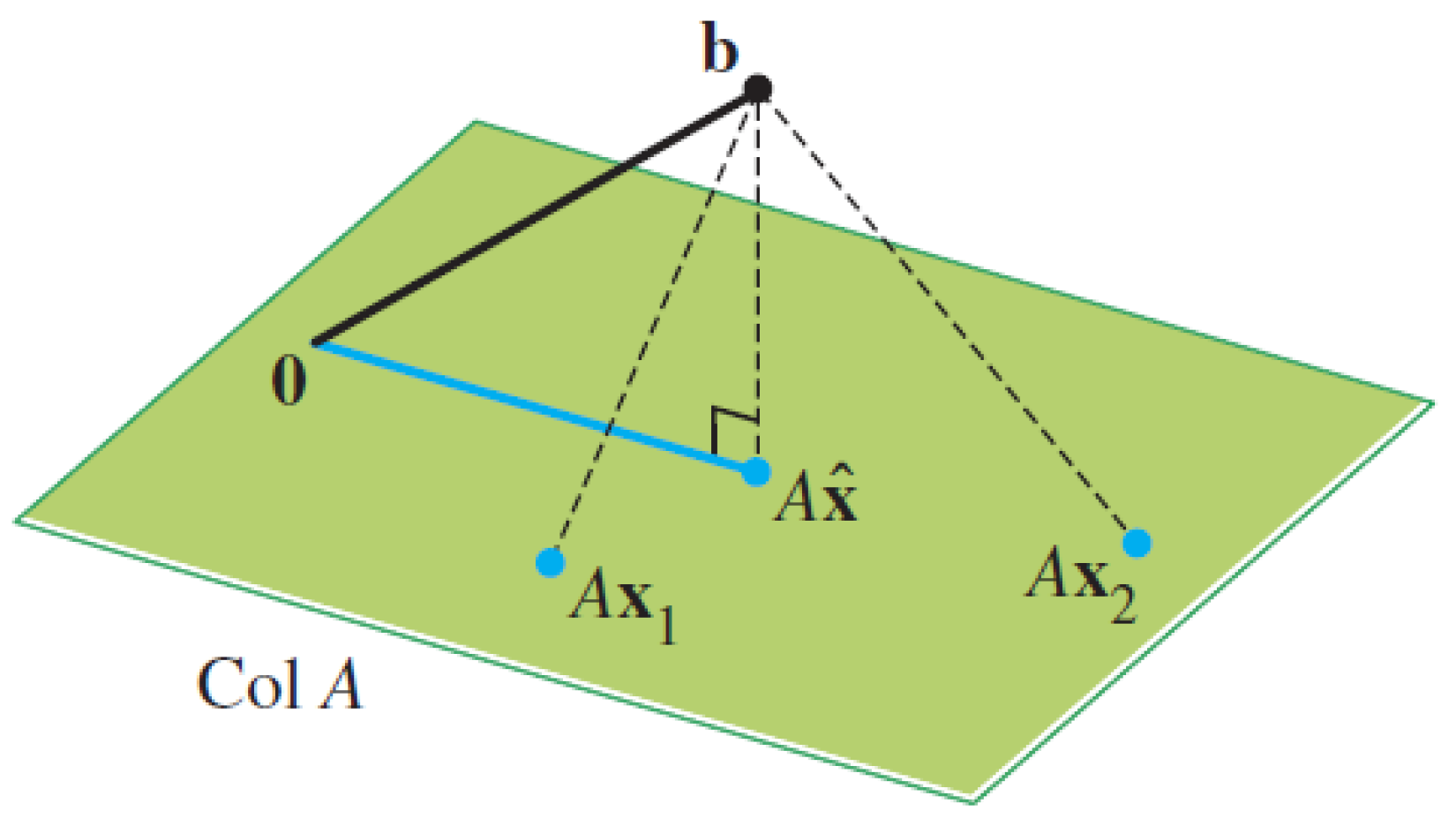
A key characteristic of the least squares problem is that the vector
always lies in the column space of
A, denoted
. Thus, we seek an
such that
is the point in
closest to
. See
Figure 1 for an illustration. (Note that if
, then there exists an
such that
, and such an
is a least squares solution).
To solve the general least squares problem for a given matrix
A and vector
, we apply the Best Approximation Theorem [
17] to the subspace
. Let
where
lies in
. Hence, the equation
is consistent, and there exists a vector
such that
Since
is the point in
closest to
, a vector
is a least squares solution to
if and only if it satisfies Equation (
19). This
represents the coefficients of
constructed from the columns of
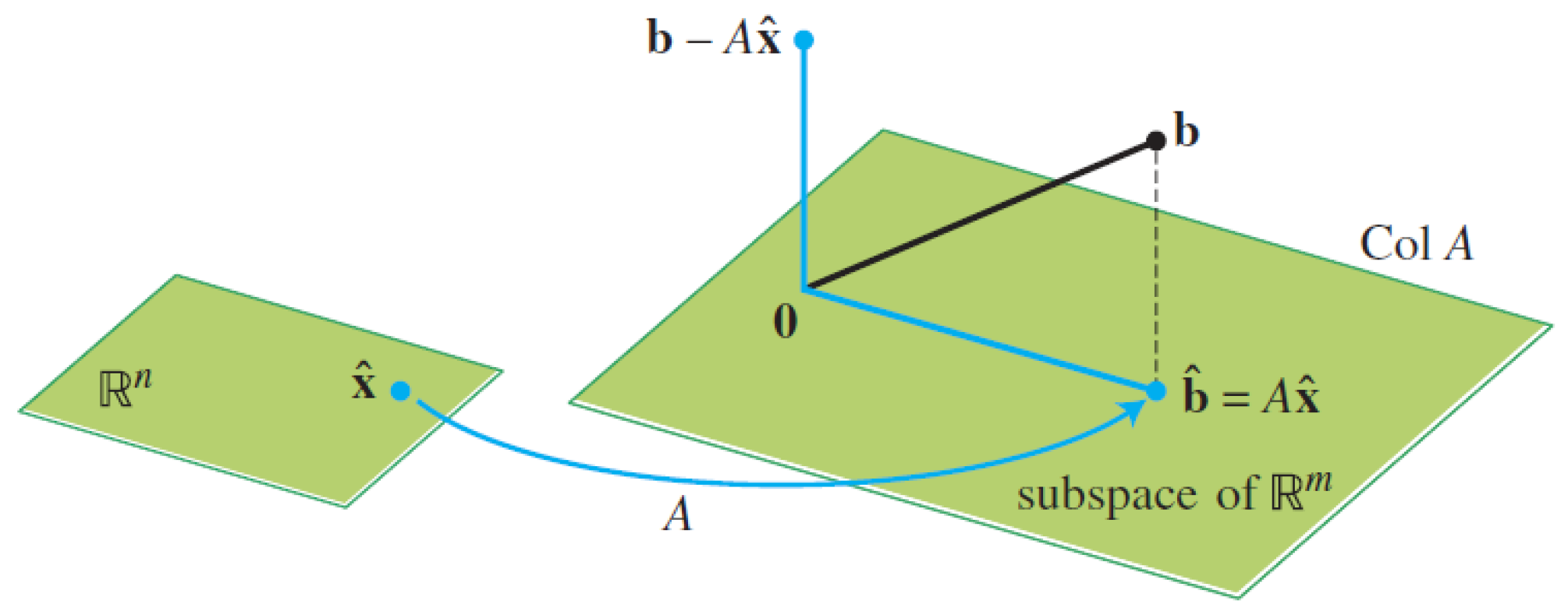
A. See
Figure 2 for a visualization. (If Equation (
19) has free variables, it may admit multiple solutions.)
If
satisfies
, then, by the Orthogonal Decomposition Theorem [
17], the projection
has the property that
is orthogonal to
. That is,
is orthogonal to every column of
A. Let
denote the
j-th column of
A. Then,
, or equivalently,
. Since each
is a row of
, it follows that
Thus, every least squares solution to
satisfies the matrix Equation (
22), commonly referred to as the normal equations of
. The solution to Equation (
22) is typically denoted by
.
Theorem 2.
The set of least squares solutions to coincides with the nonempty set of solutions to the normal equations .
2.7. General Method for Fitting Images with Self-Affine Functions
The general method for fitting fractal images with self-affine functions involves using the expression of a self-affine fractal function and applying the least squares method, as detailed in the following
Section 3.
3. Fitting Starling Flocks Images with Self-Affine Fractal Functions
The previous section addressed the fitting of images using simple functions. In practical scenarios, such as modeling unmanned swarms, the data is significantly more complex and diverse. For instance, starling flocks exhibit large collective motion datasets and rapid phase transitions, necessitating functions with higher complexity. Self-Affine functions, by virtue of their self-similarity properties, offer the required complexity for such applications.
This section focuses on addressing the problem of characterizing instantaneous images of starling flocks using self-affine fractal functions.
Overview of the Fitting Procedure. Our approach proceeds in several stages. First, we capture K images of the starling flock at discrete time instants . From each image at time , we extract N spatial coordinate points for . At each time , we fit the N spatial points using a self-affine fractal function by minimizing a least squares objective function . The fitting procedure yields a set of parameters that characterize the self-affine function at time . By repeating this process for all K time instants, we obtain K sets of parameters. The temporal evolution of these parameters and the corresponding fractal dimensions reveals the phase transition dynamics of the flock.
We emphasize that the index i in refers to the time instant , not to individual transformations within the IFS. Each time instant has its own set of parameters obtained by fitting the spatial data at that time.
3.1. Principles of Fitting Images with Self-Affine Fractal Functions
3.1.1. Mathematical Framework
We model the spatial distribution of starling flocks using self-affine fractal functions constructed via an iterated function system (IFS). Following the theory of Falconer [
15], we define:
Function Definition. We denote by the self-affine fractal function at time instant , where . This function characterizes the spatial configuration of the flock at time , with x representing the normalized horizontal coordinate and the corresponding vertical position.
Time Evolution. As time evolves from
to
, the spatial configuration of the flock changes, resulting in a sequence of self-affine functions:
each characterized by its own set of parameters:
IFS Construction. Each function is constructed as the attractor of an iterated function system consisting of affine transformations. The number m is fixed throughout the analysis and represents the complexity of the fractal structure, not a time-varying quantity.
3.1.2. Least Squares Fitting Formulation
At each time instant (), we observe N spatial points with . Fitting these points using the self-affine function yields the parameter set at time . Repeating this procedure across all K time instants produces the sequence . In our experiments, each image contains approximately 6000–7000 spatial points. The parameter denotes the number of affine transformations in the IFS.
Optimization Conditions. At each time instant
, according to the least squares principle, the optimal parameters are obtained by setting the partial derivatives of
with respect to each parameter to zero:
Solving these equations yields the optimal parameter values
at time
. This procedure is repeated for all
K time instants, resulting in
K sets of parameters:
Time Evolution and Phase Transition Analysis. As the starling flock moves through time
, the spatial coordinates
change at each time instant. Consequently, the fitted parameters
also change, resulting in different self-affine functions
and fractal dimensions
at each time instant. By analyzing the temporal evolution of these parameters and dimensions,
we can characterize the phase transition dynamics of the flock. Rapid changes in the fractal dimension indicate phase transitions, while stable dimensions suggest steady-state configurations.
3.2. Fitting Method
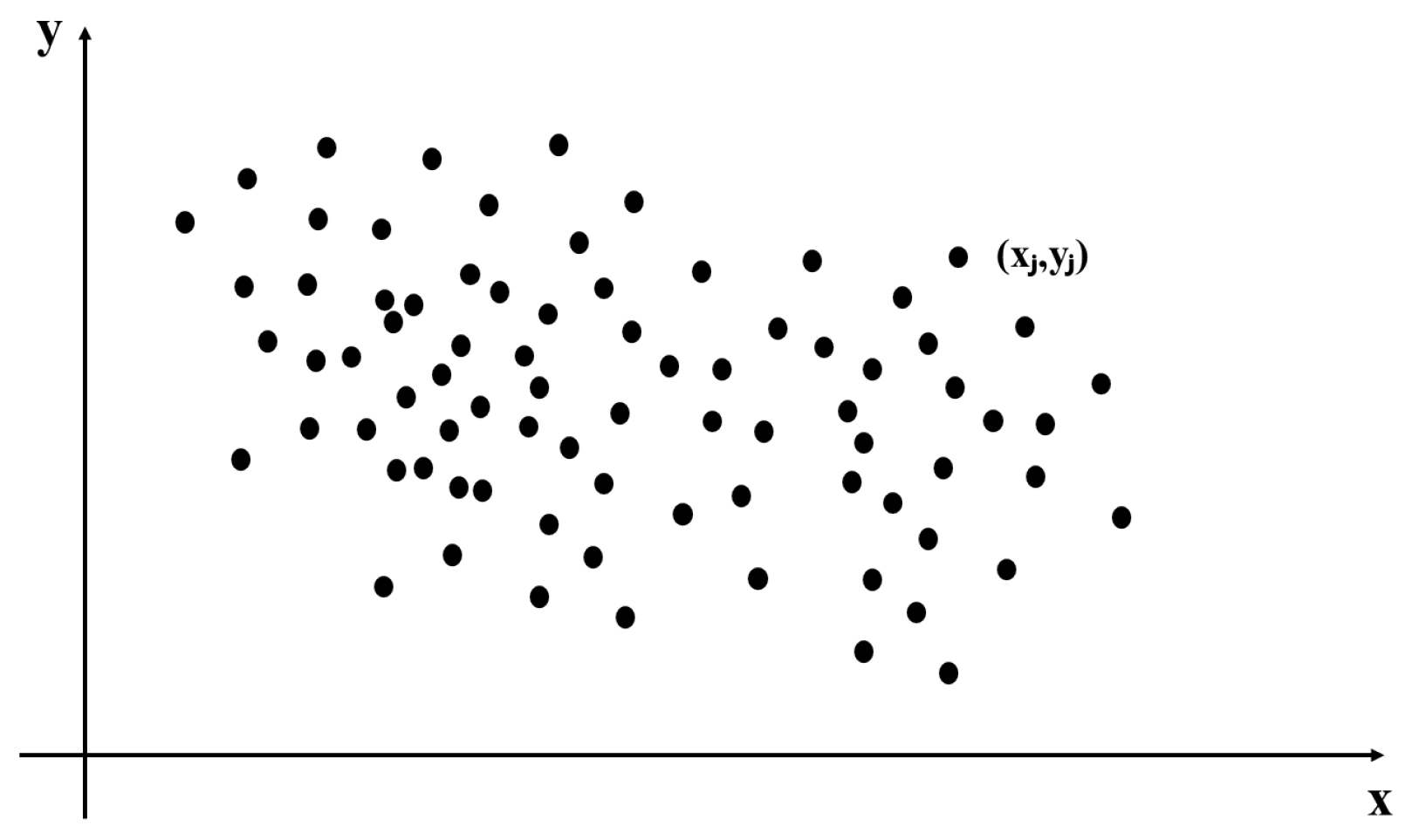
Assume the cluster distribution shown in
Figure 3.
Following the theoretical framework established in
Section 2.1, at each time instant
(where
), the self-affine fractal function
is constructed using an iterated function system (IFS) consisting of
affine transformations. Each transformation
(for
) is defined as follows:
where
are spatial coordinates.
At a given time instant, suppose we observe
N spatial coordinate points extracted from the starling flock image:
where
is the spatial point index. The objective function for least squares fitting is as follows:
where
represents the observed vertical coordinate of the
j-th spatial point, and
is the value of the self-affine function evaluated at horizontal coordinate
with parameters
. The least squares method minimizes this objective function to find the optimal parameters.
3.3. Instantaneous Image Acquisition of Starling Flocks
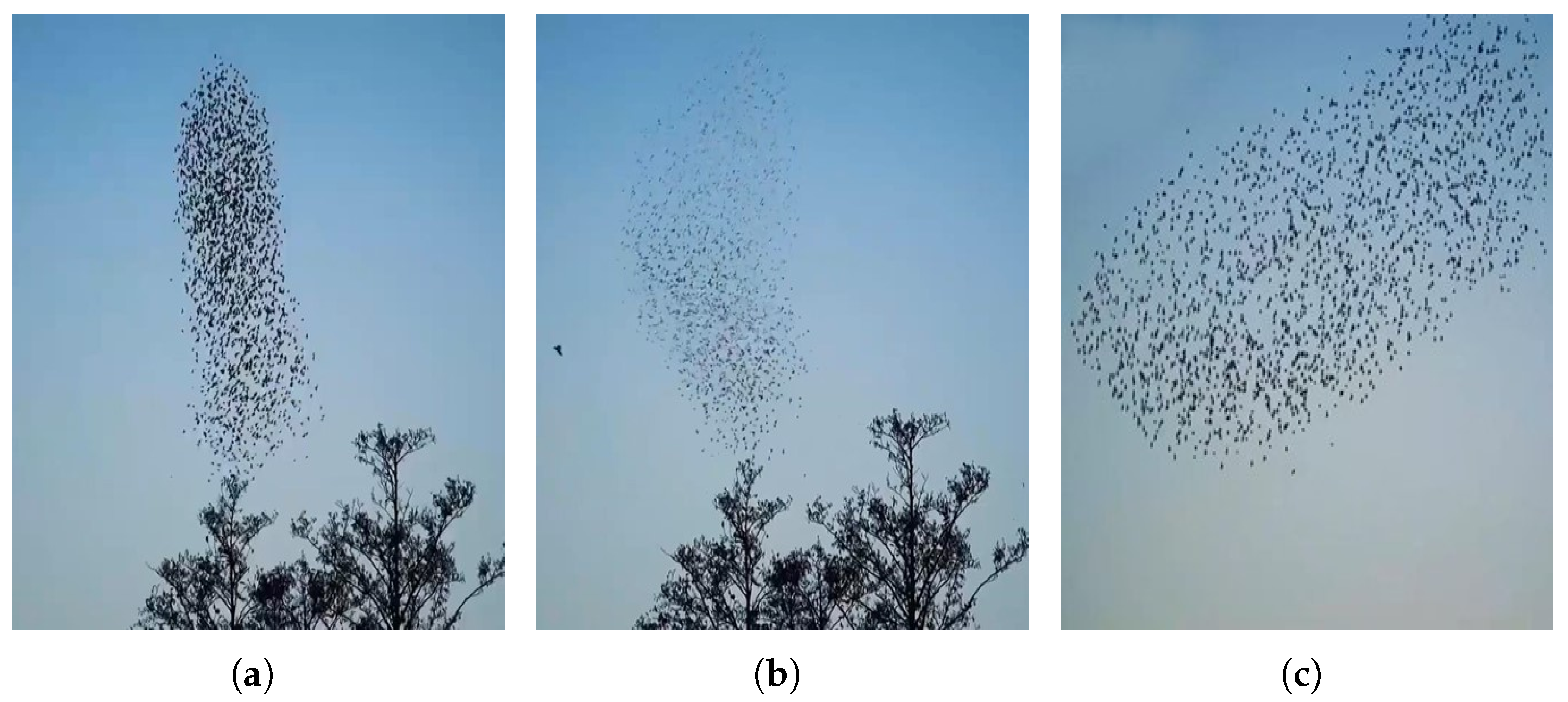
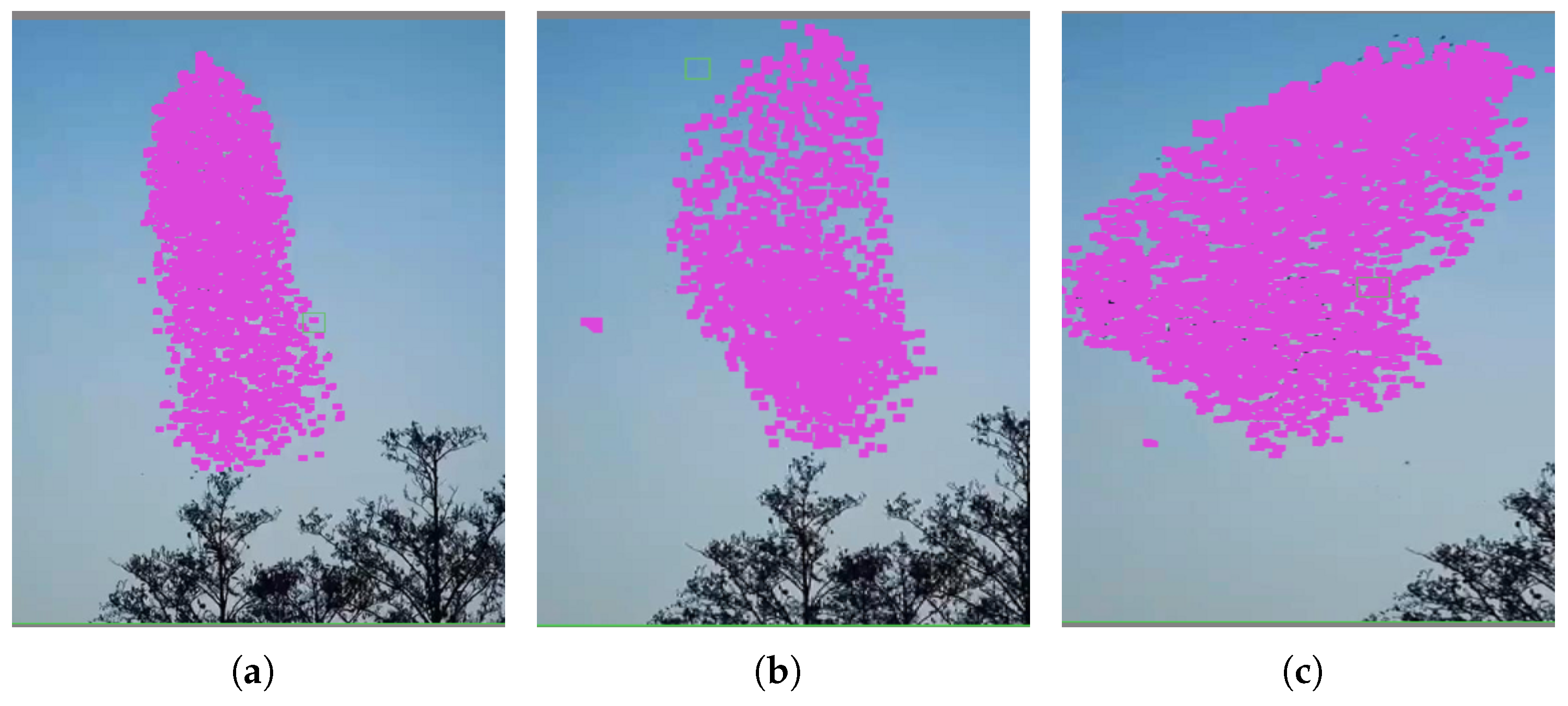
The phase transitions observed in the collective flight of starling flocks are particularly fascinating. The dark silhouettes in the images discussed below represent the starling flocks at various temporal states. Research indicates that these large-scale “vortices” serve to confuse and deter predators. At dusk, starlings aggregate in communal roosts, reaching a state of maximal relaxation. When frightened, they collectively take flight to evade danger, a behavior strikingly similar to the survival strategies of fish schools in the ocean, reflecting a complex adaptive mechanism.
Studies suggest that the dynamic “dance” of starlings in the air is a strategy to evade predators such as hawks or falcons. When thousands of starlings take flight simultaneously, they form various shapes in the air to intimidate and repel attackers. However, solitary starlings are vulnerable, so to avoid being isolated, starlings can instantaneously synchronize their movements. If one starling alters its speed or direction, the others immediately follow.
This raises the question of when starling flocks exhibit significant phase transitions, when these transitions are minor, and whether data analysis can provide insights for modeling other unmanned swarms. In this study, we employ self-affine functions to fit the flight trajectories of starling flocks and compute the rate of change in the fractal dimension to analyze the dynamics of their collective motion.
The original images of starling flocks’ flight at various time points were acquired, as shown in
Figure 4.
3.4. Image Fitting Procedure and Data Analysis
3.4.1. Coordinate Point Acquisition
Using the GETDATA tool, a coordinate system was established for images of the starling flocks’ motion, and coordinate points were collected, as shown in
Figure 5.
Given the large volume of data, only one representative set of coordinates is listed here. Suppose a set of target points is identified in a specific region, denoted as
for
, where
N is the total number of spatial points. The coordinates of the starling flocks at time
are presented in
Table 1.
3.4.2. Parameters Estimation for Self-Affine Fractal Functions
Since the starling flock’s spatial configuration changes continuously at different time instants , the spatial coordinates for change at each time instant, leading to variations in the fitted parameters and, consequently, different self-affine functions and fractal dimensions . To fit the starling flocks’ flight trajectories at various time instants, we apply the least squares method, implemented in Python3.9, to estimate the parameters. The procedure for determining the parameters of the self-affine fractal function at each time instant is as follows:
Define the objective function at time
as
Using the least squares method, we minimize the objective function by computing its partial derivative with respect to each parameter and setting it to zero:
Solving these equations yields the parameters , , and at time instant , which are functions of the spatial data points observed at that time.
For simplicity, we fix the parameter
and compute the corresponding parameter
c, as shown in
Table 2.
4. The Fractal Dimension of Instantaneous Images of Starling Flocks’ Flight
4.1. Principle
Based on the results in
Section 3, the relevant parameters
of the self-affine fractal function at each time instant
(for
) were identified. The fractal dimension
at each time instant was then calculated using Equation (
16).
4.2. Data Analysis
According to the self-affine fractal function dimension formula
a large number of coordinate data points were imported via Python scripts to compute the fractal dimension
at different time instants
. The results after fitting the images are presented in
Table 3.
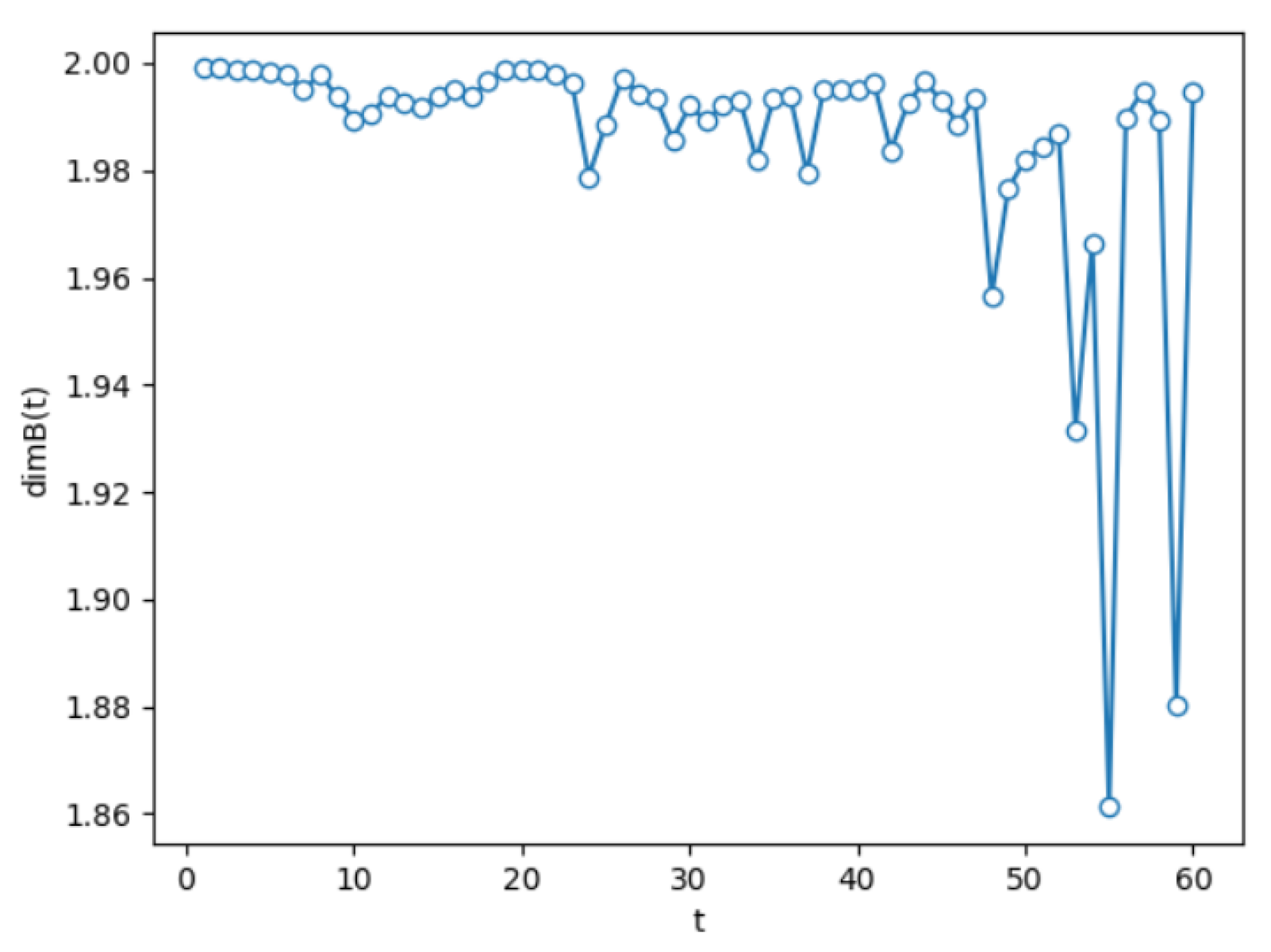
To visually represent the data, the fractal dimension
of the self-affine function as a function of time is illustrated in
Figure 6.
5. Time-Dimension Dynamic Curve Characterizing Flight Phase Transition
5.1. Time-Dimension Dynamic Model
The stability of the cluster has been expressed by the rate of change of the fractal dimension with respect to time, defined as
which allows for identification of instantaneous transition points (critical points) during the starling flocks’ flight process. The computed results are listed in
Table 4.
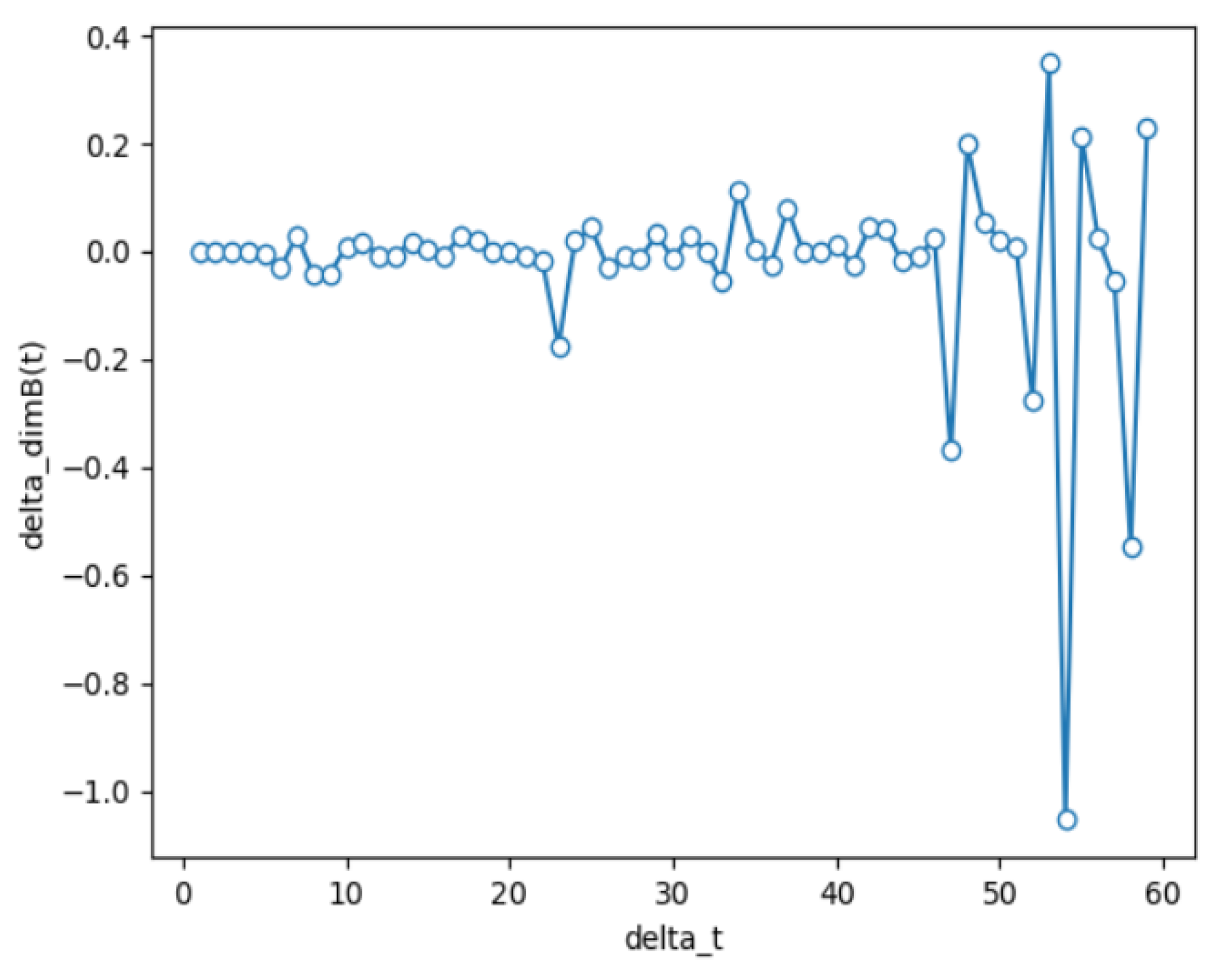
For clarity, the curve of the fractal dimension change rate with respect to time is plotted in
Figure 7 for observation and analysis:
5.2. Numerical Result Analysis
Combining images of starling flocks’ flight with the experimental results, it is observed that the fractal dimension undergoes changes at time intervals –, –, –, and –, but these changes are relatively mild and the rate of change is small in absolute value. This indicates the flock maintains a comparatively stable formation during these intervals. The flock reacts to external disturbances by quickly adapting to a new stable formation to resist threats.
In contrast, a greater and more rapid change occurs during –, where the fractal dimension changes significantly over a short time interval. Here, the cluster experiences a phase transition, shifting from a concentrated state to a dispersed state. The shorter the time interval of the phase transition, the less time the flock requires to complete it, signifying a capability of rapid adaptation.
6. Discussion
This paper investigates the phase transition process in starling flock behavior, proposing a characterization method based on the fractal dimension of self-affine functions. By employing self-affine fractal functions fitted through the least squares method, we quantitatively characterize the intrinsic nonlinear dynamics within the system. The critical points of phase transitions during starling flight are identified and analyzed through the rate of change of the fractal dimension.
Recently, Lima et al. [
16] proposed the Riesz Laplacian operator and established certain relationships between fractal dimensions and critical exponents in non-integer-dimensional Ising models. In our computation of critical points for starling flock phase transitions, the data appear to suggest a similar relationship may exist. However, the precise mathematical formulation of this relationship remains an open question. There may exist some form of linear relationship between the fractal dimension dynamics and the Riesz fractional framework, but the exact nature of this connection requires further investigation. We invite researchers to explore this intriguing theoretical direction.
For starling flocks, the most intelligent state is a “tense and united” condition. This state lies precisely between order and disorder, resembling the critical point of a phase transition. Under such conditions, the flock maintains stability while ensuring effective transmission of individual information within the group. Through extensive data acquisition and experimental analysis, it is observed that the fractal dimension changes modestly during intervals –, –, –, and – with relatively slow variation rates, indicating the flock maintains a relatively stable formation during these periods. The flock’s response to external disturbances at these moments involves quickly adjusting the original formation to sustain stability against potential threats.
In contrast, a more pronounced change occurs during –, where fractal dimension changes rapidly over a short duration, signifying a phase transition from a cohesive state to a dispersed state. A lower rate of fractal dimension change corresponds to a more stable formation, indicating readiness to resist predators; conversely, a larger rate implies potential phase transitions and increased instability, correlating with a relaxed state as external threats diminish. Additionally, shorter time intervals for phase transitions imply that the flock requires less time to accomplish these transitions, demonstrating rapid adaptability.
In nature, predators may approach the flock from various directions to hunt individuals or, at times, attack the entire group. This situation demands swift collective responses, reflected in the flock’s continuous dynamic changes in formation mid-flight. Such flexible adaptability exemplifies a form of collective intelligence that neither purely ordered nor disordered states can achieve. This leads to critical changes in state, manifesting as phase transitions.
Correlation with Percolation Theory Predictions
The percolation theory applied to equilibrium phase transitions has revealed important relationships between critical exponents and fractal dimensions [
8,
9]. In particular, five distinct fractal dimensions have been identified in percolation systems: the fractal dimension of the infinite cluster, the backbone dimension, the red bond dimension, the chemical dimension, and the spreading dimension.
An intriguing observation from our analysis is that the box dimension
obtained from the self-affine function fitting appears remarkably stable and approximates the integer dimension 2 during stable flight periods (see
Table 3). This raises the question of whether this dimension can be associated with any of the fractal dimensions defined in percolation theory.
To quantify the relationship between our fractal dimension approach and structural reorganization measures, we define the following vectors:
Let denote the vector of phase transition indicators obtained from direct observation of flock structural changes at time points , and let denote the vector of fractal dimension values computed by our method at the corresponding time points.
The Pearson correlation coefficient between these two vectors is computed as follows:
where
and
represent the centered values (deviations from the mean) of the respective vectors, and
denotes the Euclidean norm.
The analysis yields
demonstrating a strong correlation between the two approaches. This high correlation suggests that the fractal dimension of self-affine functions captures essential features of the collective phase transition process, potentially providing a bridge between geometric characterization and the theoretical framework of percolation theory.
These promising findings warrant further investigation in our subsequent studies.
Author Contributions
Conceptualization, K.L. (Kunyuan Li) and X.Z.; writing—review and editing, X.Z. and K.Y.; methodology, K.Y.; mathematical inference, K.L. (Kunyuan Li) and K.Y.; resources, M.S.; data curation, K.Z.; writing—original draft preparation, K.L. (Kunyuan Li); project support, M.H.; visualization, K.L. (Kefeng Liu) and M.S.; supervision, Y.W. and M.H. All authors have read and agreed to the published version of the manuscript.
Funding
This research was funded by the National Natural Science Foundation of China (NSFC), numbers 12371089, 62371469 and 62273356, and the Natural Science Foundation of Jiangsu Province(NSF), number BK20180080.
Data Availability Statement
Data are contained within the article.
Acknowledgments
The authors would like to thank anonymous referees for their valuable comments and suggestions.
Conflicts of Interest
The authors declare no conflicts of interest.
References
- Pearce, D.; Miller, A.; Rowlands, G.; Turner, M. Role of projection in the control of bird flocks. Proc. Natl. Acad. Sci. USA 2014, 111, 10422–10426. [Google Scholar] [CrossRef] [PubMed]
- Mora, T.; Walczak, A.; Castello, L.; Ginelli, F.; Melillo, S.; Parisi, L.; Viale, M.; Cavagna, A.; Giardina, I. Local equilibrium in bird flocks. Nat. Phys. 2016, 12, 1153–1157. [Google Scholar] [CrossRef] [PubMed]
- Cavagna, A.; Cimarelli, A.; Giardina, I.; Parisi, G.; Santagati, R.; Stefanini, F.; Viale, M. Scale-free correlations in starling flocks. Proc. Natl. Acad. Sci. USA 2010, 107, 11865–11870. [Google Scholar] [CrossRef] [PubMed]
- Christodoulidi, H.; Van der Weele, K.; Antonopoulos, C.G.; Bountis, T. Phase transitions in models of bird flocking. In Chaos, Information Processing and Paradoxical Games: The Legacy of John S. Nicolis; Nicolis, G., Basios, V., Eds.; World Scientific: Singapore, 2014; pp. 383–398. [Google Scholar]
- Bountis, T.; Christodoulidi, H.; Van der Weele, K.; Antonopoulos, C.G. Collective dynamics and phase transitions in bird flocking models. Eur. Phys. J. Spec. Top. 2022, 231, 167–175. [Google Scholar]
- Cardy, J. Scaling and Renormalization in Statistical Physics; Cambridge University Press: Cambridge, UK, 1996; Volume 5. [Google Scholar]
- Suzuki, M. Phase transition and fractals. Prog. Theor. Phys. 1983, 69, 65–76. [Google Scholar] [CrossRef]
- Kröger, H. Fractal geometry in quantum mechanics, field theory and spin systems. Phys. Rep. 2000, 323, 81–181. [Google Scholar] [CrossRef]
- Coniglio, A. Fractal structure of Ising and Potts clusters: Exact results. Phys. Rev. Lett. 1989, 62, 3054–3057. [Google Scholar] [CrossRef] [PubMed]
- Fan, J.A.; Yeo, W.-H.; Su, Y.; Hattori, Y.; Lee, W.; Jung, S.-Y.; Zhang, Y.; Liu, Z.; Cheng, H.; Falgout, L.; et al. Fractal design concepts for stretchable electronics. Nat. Commun. 2014, 5, 3266. [Google Scholar] [CrossRef] [PubMed]
- Qiu, Y.; Liang, Y. Progress on fractal dimensions of the Weierstrass function and Weierstrass-type functions. Fractal Fract. 2025, 9, 143. [Google Scholar] [CrossRef]
- Cattani, C. Fractal and fractional. Fractal Fract. 2017, 1, 1. [Google Scholar] [CrossRef]
- Cattani, C.; Spigler, R. Fractional dynamics. Fractal Fract. 2018, 2, 19. [Google Scholar] [CrossRef]
- Zähle, U. Self-similar random measures. II-A generalization to self-affine measures. Math. Nachr. 1990, 146, 85–98. [Google Scholar] [CrossRef]
- Falconer, K. Fractal Geometry, 3rd ed.; John Wiley & Sons Ltd.: Chichester, UK, 2014; pp. 1–337. [Google Scholar]
- Lima, H.A.; Carrasco, I.S.S.; Santos, M.; Oliveira, F.A. Scaling, fractal dynamics, and critical exponents: Application in a noninteger-dimensional Ising model. Phys. Rev. E 2025, 112, 044109. [Google Scholar] [CrossRef] [PubMed]
- Lay, D.; Lay, S.; McDonald, J. Linear Algebra and Its Applications, 5th ed.; Pearson Education: New York, NY, USA, 2016. [Google Scholar]
| Disclaimer/Publisher’s Note: The statements, opinions and data contained in all publications are solely those of the individual author(s) and contributor(s) and not of MDPI and/or the editor(s). MDPI and/or the editor(s) disclaim responsibility for any injury to people or property resulting from any ideas, methods, instructions or products referred to in the content. |




 ,
,