1. Introduction
The digitization of legal systems has led to an exponential growth in unstructured text data, creating significant retrieval challenges for legal professionals. In the Hungarian context alone, the public repository of anonymized court decisions currently contains 235,310 documents. Navigating this massive corpus requires tools that go beyond simple keyword matching to understand the semantic structure of case law. By processing and structuring these documents, legal systems can enable advanced downstream tasks such as semantic search [
1], legal case classification [
2], and automatic summarization [
3]. A fundamental step in structuring legal text is Rhetorical Role Labeling (RRL). RRL is a natural language processing task, which is a sequential classification problem, classifying each textual segment into its role in the given text. RRL has been in focus in the legal domain in recent years [
4,
5,
6,
7,
8]. This segmentation provides immediate practical value; for instance, by isolating the “Facts” of a case, a system can allow lawyers to search specifically for cases with similar factual backgrounds rather than just similar keywords, significantly facilitating their daily workflow [
1]. While RRL has been a focus of the legal domain in recent years, current solutions are predominantly designed for English [
4,
5,
6,
7,
8], leaving a gap for non-English jurisdictions with distinct legal traditions [
9,
10].
While these legal-system-specific factors require tailored approaches, technological advances in textual embeddings have also significantly improved the modeling side of RRL. Recent advances have introduced “late chunking,” a technique where token-level representations are computed over a long context before chunking, preserving contextual information across boundaries. While late chunking has demonstrated consistent improvements in information retrieval tasks [
11], its utility for sentence-level classification remains an open question. This study empirically tests whether the gains seen in retrieval transfer to the RRL task as well.
In this paper, we introduce an in-production RRL classifier for Hungarian judicial decisions. Our contributions are as follows:
We introduce a human-annotated, sentence-level RRL corpus validated by legal experts, sharing Inter-Annotator Agreement (IAA) scores for tracking consistency.
We compare multiple neural architectures, including BiLSTM and attention-based networks, against support vector machine baselines using two embedding strategies (huBERT CLS vs. Jina v3 with/without late chunking and with/without a positional feature).
We provide a critical evaluation of late chunking, offering empirical evidence that, contrary to retrieval benchmarks, it does not yield consistent improvements for sentence-level RRL in legal texts.
Finally, we present a system that moves beyond theory; the best-performing model is currently deployed at the National Office for the Judiciary, powering a Rhetorical Augmented Generation (RAG) pipeline that improves the searchability of court decisions.
This paper is structured as follows:
Section 2 gives an overview of RRL in the legal domain.
Section 3 describes the dataset, the labels and the annotator agreement, the used embeddings, and the classifier models. The results are presented in
Section 4 and discussed in
Section 5. The paper concludes in
Section 6.
2. Relevant Works
Beyond machine learning-oriented approaches, RRL draws on discourse and rhetorical theory. Rhetorical Structure Theory (RST) formalized coherence via functional relations (nucleus/satellite) [
12]. Follow-up surveys and applications [
13,
14] documented annotation challenges and showed the value of rhetorical relations for summarization, knowledge extraction, and text generation. These perspectives frame sentence-level role labeling within document-level coherence, motivating alignment of role categories with established discourse-analytic frameworks.
Related literature highlights linguistic indicators (especially cue phrases) as signals of rhetorical function. Early work linked coherence relations to lexical and syntactic correlates, showing connectives and discourse markers as reliable cues [
15,
16]. Teufel and Moens operationalized this in argumentative zoning for scientific articles, with annotation schemes and evidence that rhetorical status aids summarization [
17]. In law, Hachey and Grover found rhetorical/topical cues improve extractive case-law summaries [
18]. Together, these results support integrating cue phrases and rhetorical markers as complementary evidence for role labeling in legal texts, bridging discourse theory with practical annotation and modeling.
RRL on long legal cases has steadily shifted toward methods that better capture local sequential dependencies and document structure. Prior to deep neural architectures, early work relied on handcrafted and rule-based systems. Saravanan et al. [
19] proposed SLIPPER, a thematic segmentation method in legal tax texts based on expert-coded linguistic patterns, lacking scalable context modeling. Walker et al. [
20] created manually labeled classifiers for U.S. judgments, focusing on small, script-driven samples without robust neural encoding. Sanchez et al. [
21] used Conditional Random Field (CRF) and rule-based sentence boundary detection, segmenting text rather than modeling rhetorical functions. Kalamkar et al. [
22] introduced a rhetorical role corpus and SciBERT-HSLN baselines, emphasizing document transfer but without chunk-aware or retrieval-based adaptations. These approaches typically operated on narrow features, small datasets, and lacked retrieval or chunking-aware design that drives current large-scale neural research.
Early work such as Bhattacharya et al. [
4] pioneered neural sequence learning for sentence-level rhetorical role annotation in Indian Supreme Court judgments, demonstrating that BiLSTM models and deep architectures outperform CRF baselines and feature engineering. Their approach provided an initial human-annotated dataset and systematic inter-annotator agreement analysis, which laid the methodological foundation for subsequent neural sentence classification pipelines. Building on these first neural methods, Malik et al. [
5] introduced a 13-role annotated corpus and multi-task deep learning models, systematically exploring transfer protocols, labeling granularity, and domain adaptation. This work enabled studies of domain robustness and transferability that shaped later directions in rhetorical segmentation and classification.
Hierarchical or curriculum-based training has recently shown measurable gains: Hierarchical Curriculum Learning for RRL (HiCuLR) integrates document- and role-level curricula to expose models from easy to hard instances while leveraging neighborhood context, improving performance on long judgments [
6]. Large, newly released benchmarks (e.g., LegalSeg) similarly report that encoding broader local context and inter-sentence relations outperforms sentence-isolated approaches [
8]. Earlier work on structural segmentation of legal documents motivates exploiting headings, paragraph boundaries, and rhetorical blocks during modeling [
23].
Parallel to advances in sequence modeling, long-context embedding models and chunking strategies have been explored to improve retrieval and representation of lengthy texts. The late chunking technique proposes to first compute token-level representations with a long-context encoder and only then perform chunking prior to pooling, thereby yielding chunk vectors that retain document-level context. Results of late chunking show consistent gains in retrieval tasks across datasets and architectures [
11]. Our study does not assume these gains transfer to sentence-level RRL, where the prediction target is a single sentence’s rhetorical role rather than passage relevance. Instead, we treat late chunking as a testable hypothesis for RRL, asking under what conditions, if any, contextualized chunk embeddings can help model sentence-level roles.
On the multilingual front, models such as LEGAL-BERT have demonstrated that context-aware RRL is feasible across major European languages, including Italian and English legal cases [
9]. Alongside these, alternative segmentation pipelines, such as named entity recognition-driven segmentation, offer complementary perspectives for discovering rhetorical structure in legal texts [
24].
More broadly, new multilingual, multi-function, multi-granularity models (e.g., M3-Embedding) now explicitly support inputs ranging from sentences to documents of 8k tokens while targeting dense, multi-vector, and sparse retrieval in a unified framework [
25]. Recent multilingual evaluations have confirmed that long-context embeddings can generalize successfully across diverse court decisions and legal traditions [
26]. Similarly,
jinaai/jina-embeddings-v3 introduces long-context multilingual embeddings with task-specific adapters for retrieval, clustering, classification, and matching [
27]. These models make it technically feasible to test context-aware chunking in domains beyond retrieval, including sentence-level classification on long legal documents. Recent RRL-focused architectures (e.g., MARRO) further indicate that attention mechanisms and auxiliary tasks can contribute to stronger role-aware sentence representations [
7].
Concurrently, the Retrieval-Augmented Generation (RAG) literature has begun to argue that “one-size-fits-all” chunking is suboptimal and that granularity should be query- or task-adaptive. Mix-of-Granularity (MoG) and its graph extension (MoGG) route queries to different chunk scales and show improvements by dynamically selecting chunk size [
28]. Broader retrieval studies likewise find that enhancing retrieval through better chunking, expansion, and re-ranking can have larger impact than tuning the generator alone [
29]. These findings suggest that chunking benefits are highly task-dependent, reinforcing the need to examine late chunking specifically for RRL, rather than assuming transfer from retrieval benchmarks.
3. Materials and Methods
3.1. Dataset
Our goal was to provide rhetorical role labels for all of the currently publicly available 235,310 anonymized Hungarian court decisions [
30]. There are five major areas of law in the Hungarian court decisions, namely: administrative, civil, economic, labor, and criminal, counting military criminal cases as part of the criminal area of law.
The structures of legal cases are usually quite similar to each other: they open with information about the two parties, the court, prior courts and case numbers, and the subject matter, then they provide a short description of the decision. After that, usually, the facts and the ruling(s) of previous court(s) are described, next the arguments of each side, then the decision again, and finally the ratio of the decision. Hungarian courts structured these documents differently before the year 2016, not providing clear section titles in the documents, and after 2016, only the Supreme Court was obliged to provide such descriptive section titles, slowly followed by lower courts as well. From now on, we refer to the documents not containing these descriptive titles as old-type and the ones that contain this as new-type.
Since an RRL dataset for Hungarian did not exist, involving human annotators was necessary. However, human annotation is costly and time-consuming. Therefore, we asked annotators to focus on “old-type” data, where easily identifiable section titles were absent. New-type documents with descriptive titles can be labeled automatically using simple heuristics.
We performed the automatic labeling as follows:
The first step was filtering for documents newer than 2016 and collecting the section titles by keyword/phrase matching in sentences.
A list of candidate section titles was created for each label.
While iterating through the document, if a sentence matched one of the titles from the list of feasible section titles, all subsequent sentences up to the next section title were assigned the corresponding label.
The Cost of the Case and Decision of the Court labels were identified using regular expressions.
Finally, we only retained those documents that contained all the required section titles for our labeling scheme. This filtering step reduced the chance of mislabeling by ensuring that each label could be assigned based on the presence of its corresponding section title in the document.
The automatic labeling procedure generally produced reliable results, but it was applicable primarily to Supreme Court documents. In total, around 10,000 documents were labeled automatically. For our experiments, however, we used only about 30 documents per area of law, in order to avoid biasing the models toward relying too heavily on the presence of descriptive titles. Each of the documents was validated by a legal expert. As guidelines for the annotation process, the annotators were given the list of the available labels (described in
Section 3.3) that are easily understandable for a legal expert, and the annotators were instructed to give only one label for each sentence, selecting the most appropriate if more labels could apply. Finally, we managed to create a training (+dev) set containing 299 documents and a test set containing 120 documents.
The distribution of areas of law in the training and testing datasets was different, as
Table 1 shows. During training, the areas of law were almost equally distributed, counting the Military criminal cases as criminal cases, while the test dataset followed the distribution of the whole (ca. 235k) dataset to be able to estimate real performance in a production environment. The training set contained almost equal numbers of old and new-type documents for each area of law, except for the administrative and military criminal areas. As discussed earlier, the old-type documents were particularly important for evaluation because, unlike the new-type documents, they did not contain easily identifiable section titles that could artificially simplify the labeling task.
3.2. Sentence Splitting
Sentence splitting in legal documents is challenging since legal documents contain significantly more dot characters compared to corpora from other domains. These include different legal or statutory references (e.g. II. Pfv.35.125/2010/4, BH 2010.21, KGD 2013.2345, 32/2008. (VII. 19.) IM rendelet 8. § etc.) and as a result of anonymization, monograms and three dots are also present. The sentences were split using a heuristic splitter specifically modified for judicial documents described in [
31]. This sentence splitter could achieve state-of-the-art results on legal documents and could perform significantly better compared to the transformer-based solution provided by the Hungarian version of HuSpaCy [
32], while also being significantly faster.
3.3. Labels
As in many previous studies [
4,
9,
10], we have also decided to classify the documents at the sentence level. We classified the sentences into one of the following eight labels:
Facts (FAC): description of the events leading to the case.
Case History (CH): sentences referring to decisions of the lower courts.
Arguments of the parties (ARG): arguments from both the plaintiff and defendant sides.
Decision of the Court (DEC): the declaration for which side the court ruled. Usually one or two sentences.
Discussion of the Decision (DISC): discussing the reasons and rationale of the decision in detail.
Cost of the Case (COST): The costs of the case decided by the Court.
Operative Part of the Judgment (OP): this is a bigger section in the cases appearing after the header and before the justification. In this section, the decision of the court and the costs are usually also mentioned, labeled accordingly, and any remaining sentences were labeled as OP.
OUT: sentences that do not belong to any of the categories mentioned above, e.g., header and footer of the case, section titles, date, signatures, etc.
Due to differences in the structures of the Hungarian cases, the labels did not match the labels mentioned in other studies. For instance, Malik et al. [
5] also used the Arguments of the Parties label, but further split it into Argument-Petitioner and Argument-Respondent labels. In contrast, we did not include Statutes, Dissent and Precedent (also split into three sub-labels: Relied and Not relied on and Overruled) because recent reforms have moved Hungarian law toward precedent and dissenting opinions are issued only by the Constitutional Court of Hungary; they do not appear in the anonymized ordinary court decisions we analyze in this study. Our labels are closer to the label set presented by Bhattacharya et al. [
4], but we also used Cost of the Case and OUT labels while not using any Statutory label.
The distribution of labels, the corresponding number of sentences, their ratio in the dataset, and the number of tokens per sentence are shown in
Table 2. Token counts were calculated using the
jina-embeddings-v3 huggingface model.
3.4. Annotator Agreement
To validate our label system, 10 documents were selected to measure Inter-Annotator Agreement (IAA), each labeled independently by two legal expert annotators. The 10 documents contained 2734 sentences altogether. We selected the average agreement (accuracy) and Krippendorff’s alpha score [
33] measures for comparison and calculated them at the sentence level. Krippendorff’s alpha is a widely used metric for measuring IAA since it works with multiple annotators, missing data points, and corrects for chance, while it is robust under imbalance [
33,
34]. The scores are presented in
Table 3.
All metrics show good inter-annotator agreement. We have also investigated these metrics label-wise. For this, the labels were binarized before the calculation of agreement metrics. The results are shown in
Table 4.
Six out of eight labels show good agreement (above 0.67 Krippendorff’s alpha score) (Arguments of the Parties, Case History, Cost of the Case, Discussion of the Decision, Operative Part, OUT). Two labels reached only moderate agreement (around 0.4). Upon manual inspection of the annotated documents, we identified one case that largely explained the low agreement: it contained a 70-sentence-long list of evidence, which the two legal experts had labeled differently. The other disagreement was in a section that belonged to the Discussion of the Decision unit but contained many sentences discussing the Facts. This unit consisted of 273 sentences. The difference here was again the result of two different decisions by the annotators, resulting in a major disagreement in scores. However, the annotators agreed afterwards that both labels would have been acceptable.
3.5. Vectorization
3.5.1. Jina Embeddings with and Without Late Chunking
Generally, embedding models map a given text into a fixed-size vector representation. For longer texts, it is often necessary to split the input into smaller chunks so that each fits within the model’s context window. However, embedding these chunks independently reduces the available document-level context, since relationships across chunk boundaries are no longer captured. A common mitigation strategy is to overlap some tokens between adjacent chunks [
1,
35], but this only partially preserves contextual information and does not fully resolve the problem.
Günther et al. [
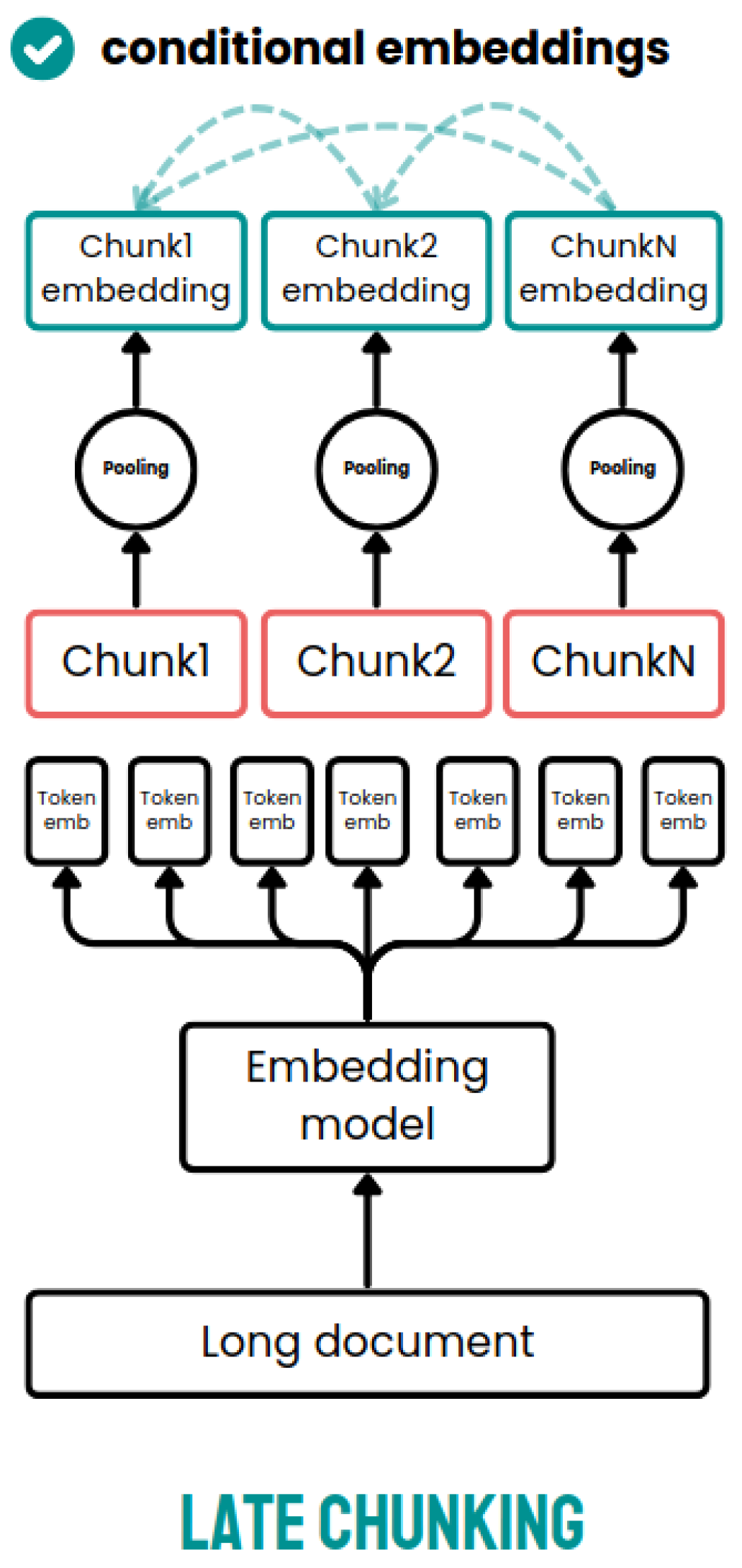
11] from JinaAI came up with an excellent yet simple idea of late chunking. The concept can be seen in
Figure 1.
During late chunking, the whole text is given to the embedder model and the token-level embeddings are calculated. After the calculation of token-level embeddings, the chunks are formed and the chunk-level embeddings are calculated by pooling the token-level embeddings. This way, it is ensured that the context between chunks is captured in the embeddings. To calculate this, the embedder model should return token-level embeddings as well and cover a relatively bigger number of tokens.
Currently, there are embedding models that can cover up to 8192 tokens. Some examples would be OpenAI’s
text-embedding-3-large model, Gemini’s
gemini-embedding-001, Beijing Academy of Artificial Intelligence’s BGE-M3 [
25], and JinaAI’s
jina-embeddings-v3 [
27] and
jina-embeddings-v4 models [
36]. Nevertheless, from the above-mentioned models, only the Jina and BGE embeddings can return token-level embeddings, while Jina also provides late chunking behavior in its API by setting the late chunking flag.
Since we wanted to embed sentences that are contextually highly related, we chose the
jina-embeddings-v3 model with a
classification task setting to embed our sentences, since use of the API late chunking is also provided. The model supports Hungarian language, although it was not fine-tuned specifically for tasks in Hungarian [
37]. This model can cover 8192 tokens and returns 1024 dimensional vectors. We vectorized both with and without the late chunking setting.
3.5.2. BERT CLS
As a second embedding model, we used the classification (CLS) token representation from the Hungarian BERT-base variant
SZTAKI-HLT/hubert-base-cc model [
38]. Since it was pre-trained exclusively on Hungarian data, including legal documents, it provided some advantage for our task. The model has a maximum context window of 512 tokens and produces CLS embeddings of 768 dimensions. We did not fine-tune the model.
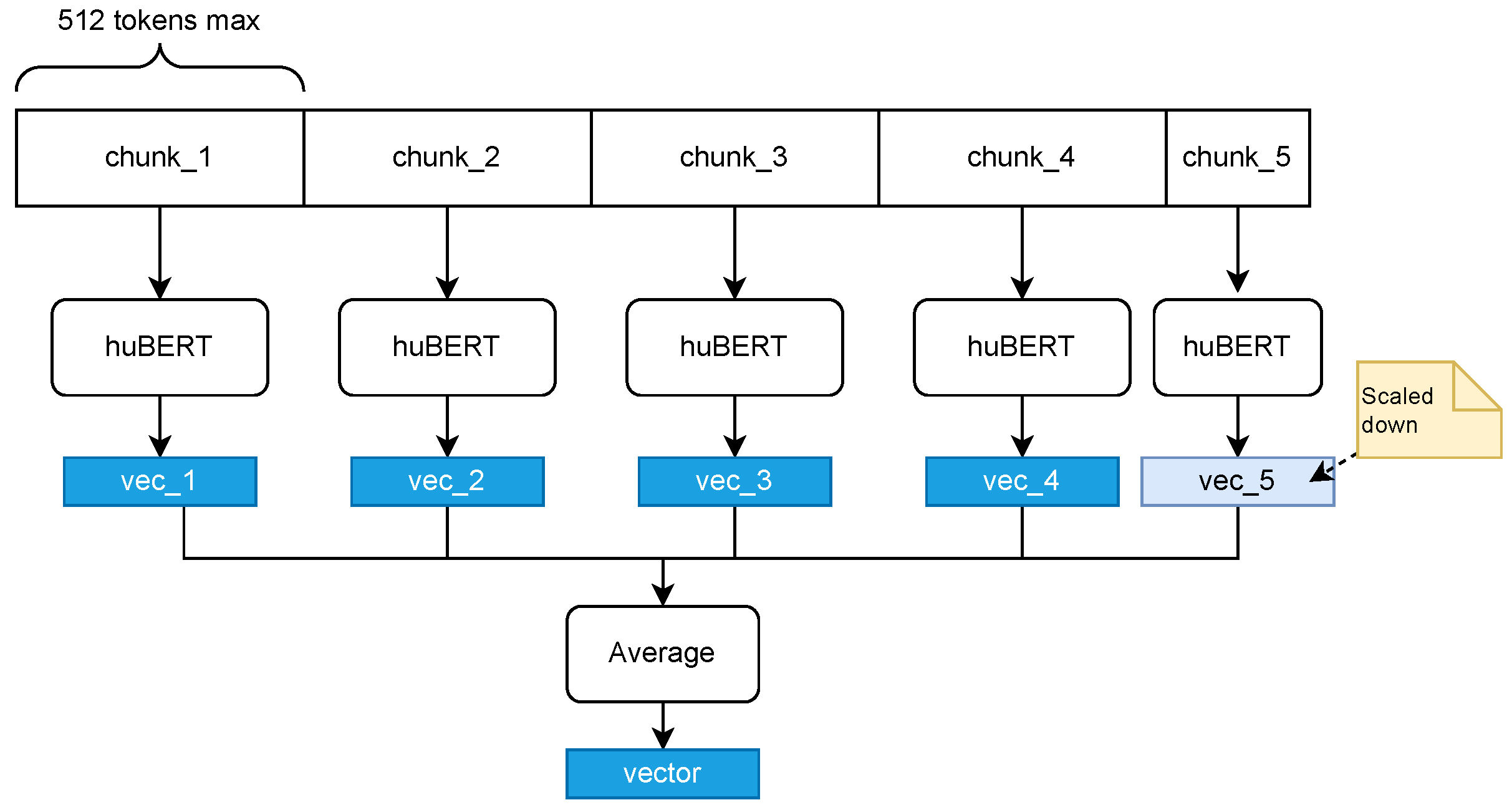
Sentences longer than the context window were split into maximum of 512 token-wide chunks, splitting the text only on word borders without any overlapping between the chunks. For each of these chunks, the BERT CLS embedding was calculated. The final embedding for the sentence was the average of these embeddings of the split data except for the last chunk, where the chunk’s vector was scaled by the ratio of the number of tokens and the context window, similarly to [
1]. The process is shown in
Figure 2.
3.5.3. Position Feature
When the sentences are embedded and no late chunking is applied, the position of the sentence in the document is completely lost alongside the context. Hence, we calculated the Position feature, which is the relative position of the given sentence in the document, which was a value between 0 and 1. This value was appended to the already available embeddings.
3.6. Models Used for Classification
The RRL task is a sequential classification task, and the sentences are not independent of one another in meaning. As a consequence, the same applies to the labels. To validate this, we have tried SVMs, which cannot harness this dependence, as baseline and neural models that are good for sequential labeling: Bidirectional Long-Short Term Memory (BiLSTM) [
39], attention [
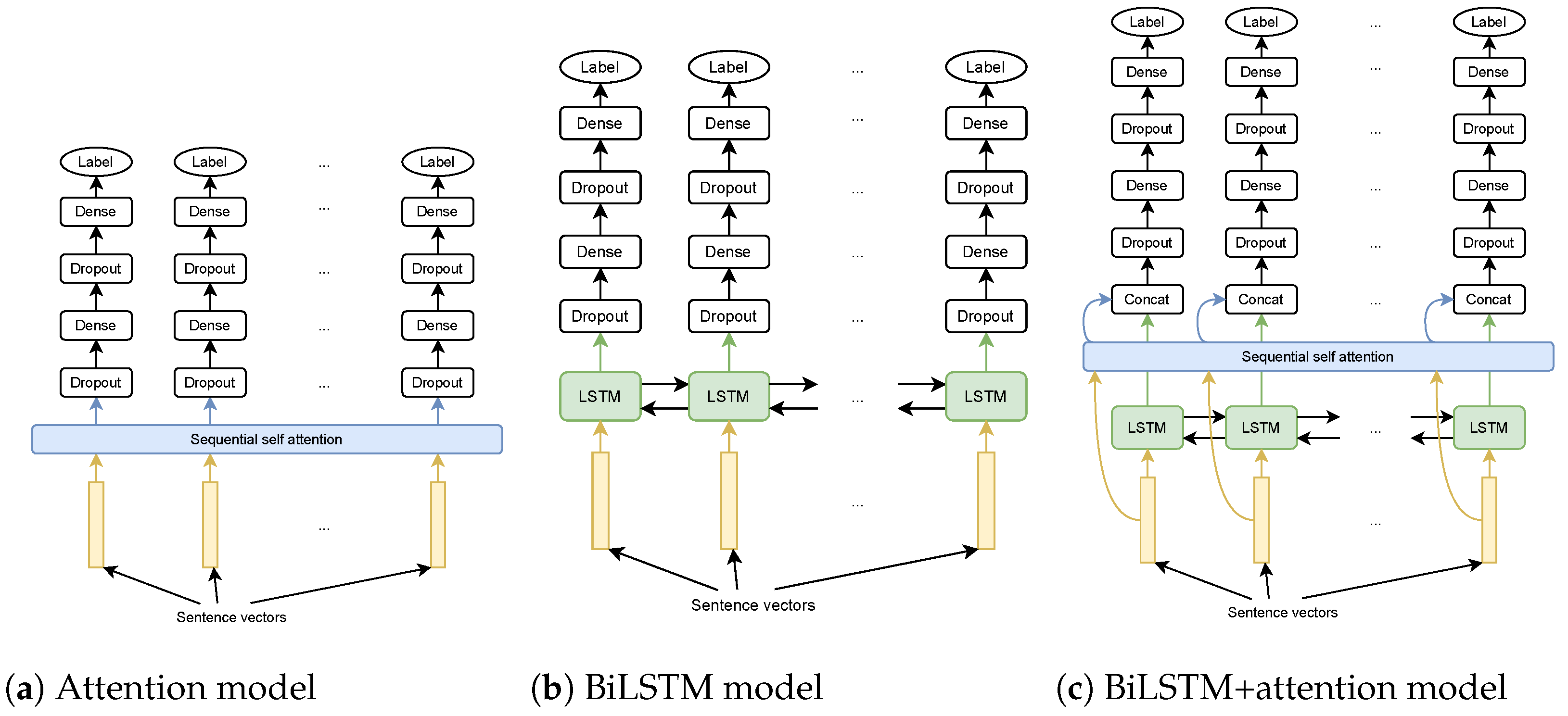
40] and BiLSTM+attention networks. The structure of each architecture can be seen in
Figure 3.
Earlier studies have shown that using a CRF layer in a sequence classification task would be beneficial [
41]. However, this can be counterproductive when the labels are not following each other as label blocks but can fluctuate between two labels depending on the meaning of the sentences, and this can happen in old-type documents. That is why we decided to omit the addition of a CRF layer. In all architectures, each sentence is first mapped to a fixed vector (e.g., BERT/Jina embedding). These embeddings are fed into the sequential neural architectures. Each sequential output vector was fed to stacked Dense and Dropout layers, with a per-sentence softmax with eight neurons as the classification layer.
In the attention architecture (shown in
Figure 3a), the self-attention layer attends over the entire sentence sequence to produce context-aware representations. Self-attention allows every sentence to condition on any other, which is crucial for roles whose identity depends on distant cues. Moreover, the model can learn position-dependent patterns such as the tendency of Facts to appear early and Discussion late.
The BiLSTM architecture (shown in
Figure 3b) produces context-enriched states. BiLSTM summarizes past and future sentence context that can encode typical narrative flow of judgments. The network can struggle on very long sequences.
The BiLSTM+attention architecture has complementary strengths: the LSTM provides order-aware representations and smooths local transitions, while the subsequent attention bridges long distances (e.g., linking a concluding dispositive formula to earlier legal grounds).
For implementing the neural architectures, we used the
keras framework (version 2.15.0). For sequential self attention, the
keras-self-attention (version 0.51.0) package was used.
Scikit-learn (version 1.6.1) [
42] was used for the cross-validation and the linear SVM classifier.
4. Results
4.1. Baselines
As a baseline, we classified the sentence vectors using a SVM with linear kernel. We fine-tuned the C parameter that was best at C = 1 setting and also tried the
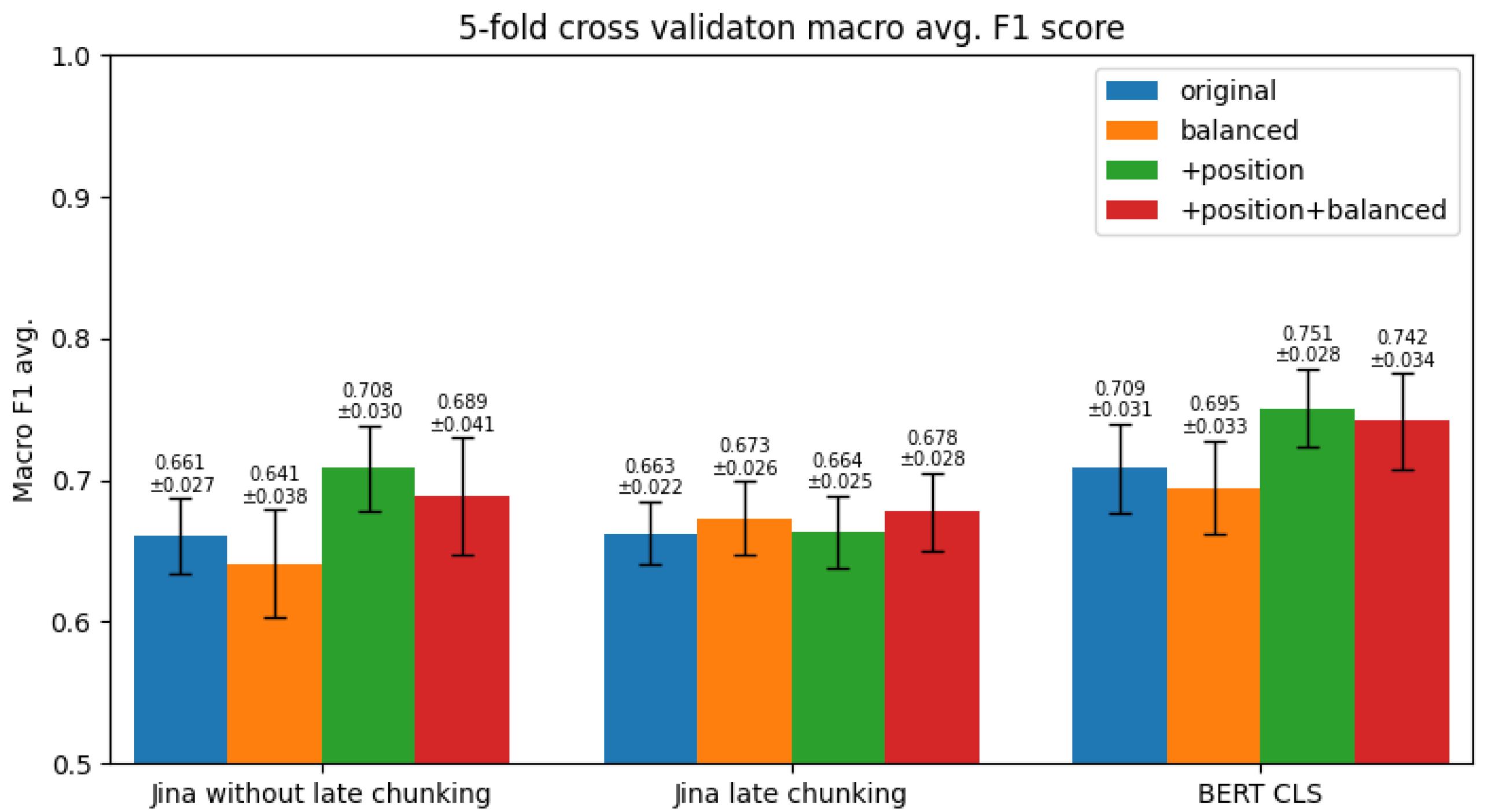
class_weight="balanced" setting since we had an imbalanced dataset. This classifier is not able to harness the information from the sequential characteristics, except when using the Jina late chunking embeddings. We performed 5-fold stratified cross-validation in the training+validation set with 299 documents and tested the Jina and BERT CLS embeddings with and without position features and the
class_weight="balanced" setting. As a metric, macro F1 average was chosen. The results are shown in
Figure 4.
The embeddings without late chunking (Jina without late chunking and BERT CLS) followed a similar pattern: using the class_weight="balanced" setting decreased the performance with and without adding the position feature. In these cases, the addition of the position feature was also beneficial, raising the macro F1 average by 4.76% (from 66.07% to 70.83%) and 4.25% (from 70.85% to 75.1%), respectively.
In contrast, in case of late chunking, the class_weight="balanced" setting increased the results to some extent, and adding the position feature also had positive but marginal effects; meanwhile, the best late chunking result remained below the best result without late chunking (70.83% vs. 67.77%).
The results show that there is a significant number of sentences that can be classified correctly without fully harnessing any additional sequential information. However, the results proved that the sequential information is important since by adding the positional feature, the results improved significantly. Hence, the main room for improvement points towards neural structures that are capable of capturing the sequential information.
4.2. Neural Models
Since the results with the linear SVM suggested that the Jina embeddings may not perform well in our RRL task, we compared the embeddings using only BiLSTM models. Note that during training, the train data was split into 85% training set, 15% validation set using a stratified split by area of law and by old vs. new data type as well. During training, in each epoch, the documents (but not the sentences inside the documents) were shuffled, and categorical cross entropy loss was used. The models were fine-tuned using the validation set, trying to minimize both bias and variance errors.
Table 5 shows the parameters used during training.
We compared the models using the test set since we wanted to obtain performance estimations for the whole dataset. The evaluation was done using the following metrics:
Document Average Accuracy (DAA), which is the average of accuracies calculated at the document level,
Accuracy at sentence level,
Macro F1 average among labels averaged at document level,
and the Weighted F1 average averaged at document level.
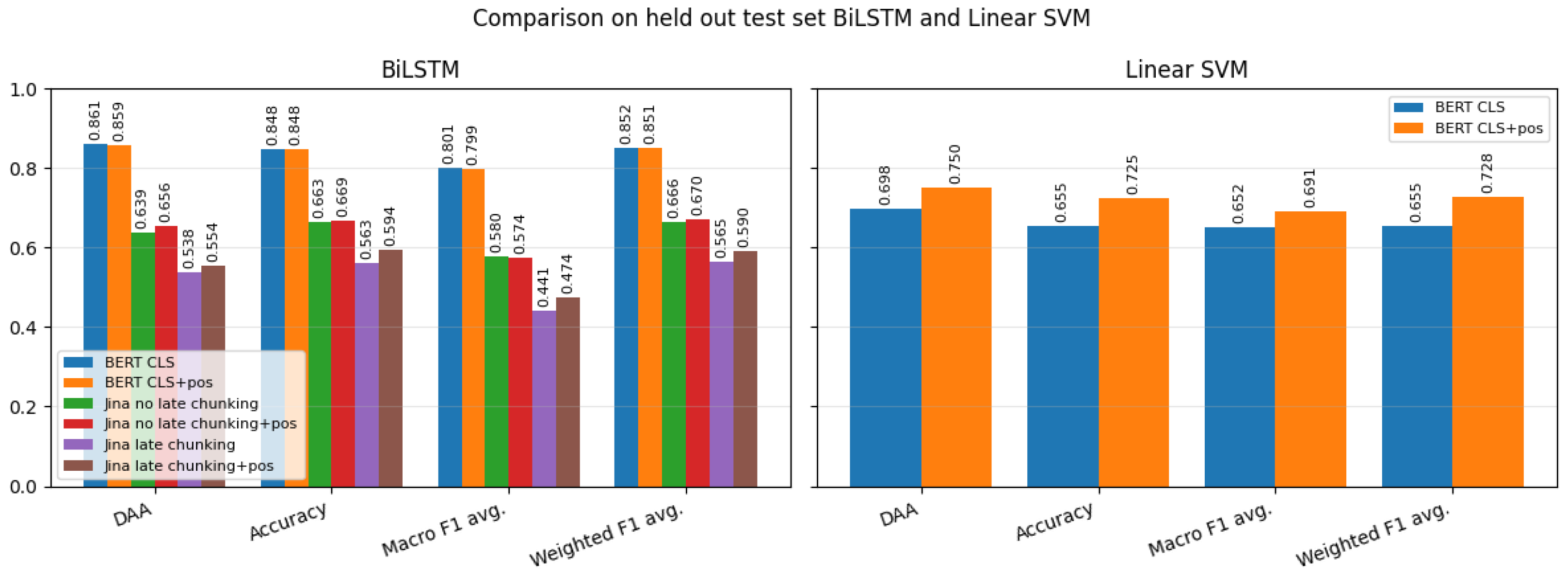
The results for the best SVM baselines (BERT CLS and BERT CLS+pos) are also shown. The results can be seen in
Figure 5.
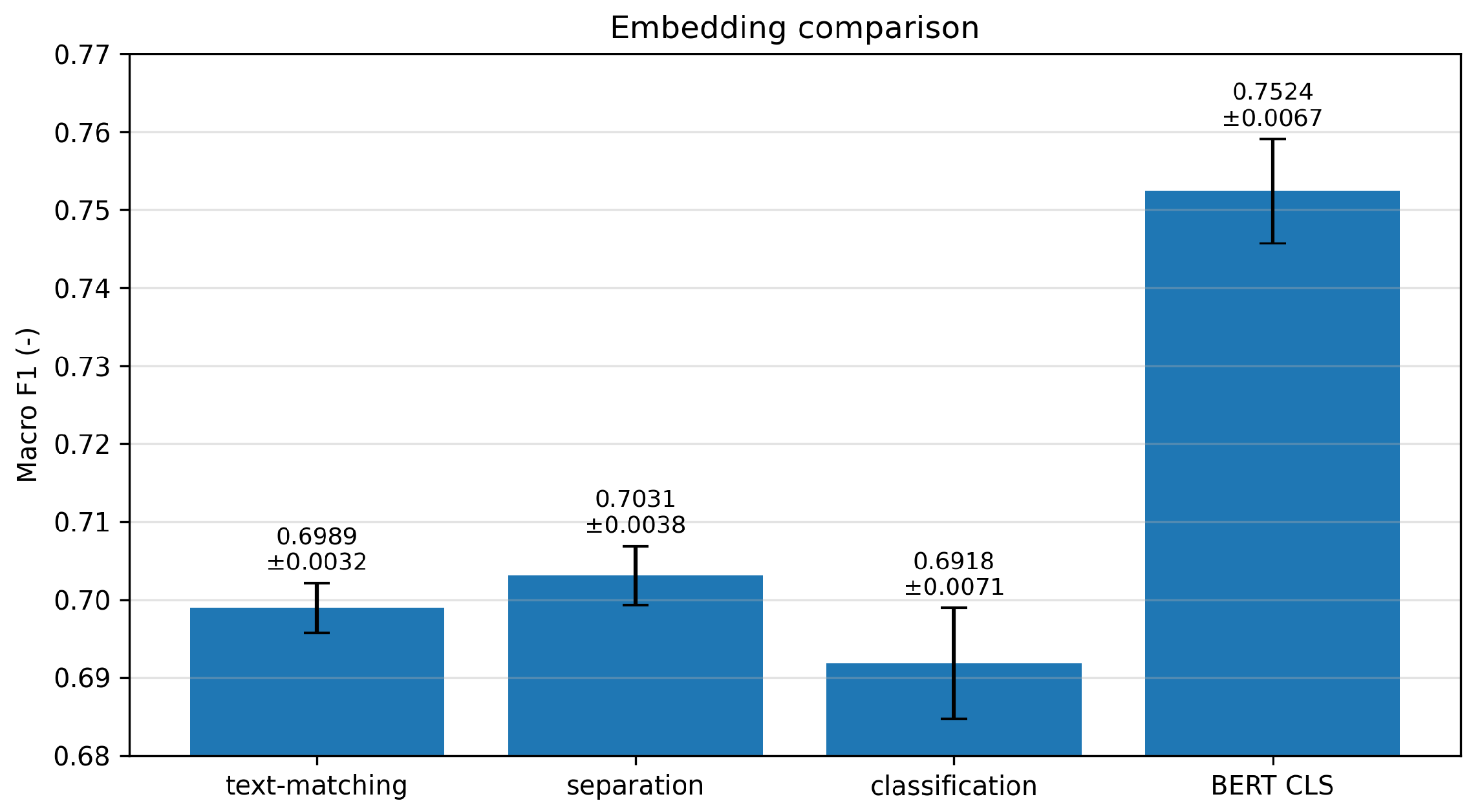
It can be seen that late chunking had the same effect on performance as in the SVMs: the best results could be achieved by the BERT CLS embeddings, then the Jina without late chunking and Jina with late chunking embeddings. Adding the positional features resulted in negligible effect for BERT CLS and Jina when no late chunking embeddings were used, while minor gains were measured with the Jina late chunking setup.
When compared to the baseline results calculated using linear SVMs, it was possible to beat the baselines by 11.1% in DAA, 12.3% in accuracy, 11% in macro F1 avg., and 12.4% in weighted F1 avg. This was expected since the information from the surrounding sentences is gathered by the BiLSTM network, and this is required in this task for better performance. Surprisingly, none of the Jina embeddings could perform better than the best baseline model. This was particularly surprising in the case of the Jina no late chunking setting since the BiLSTMs are capable of capturing the relevant information from the surrounding sentences, and the Jina embeddings are capable of providing meaningful interpretations for Hungarian texts for retrieval settings, as shown in [
1].
Since we measured significant inferiority of the Jina embeddings in our RRL task, and our main goal was to train a model for deployment, we decided to compare the neural architectures using only the BERT CLS and BERT CLS+pos embeddings.
4.3. Comparing Neural Models
We trained three neural models using the BERT CLS and BERT CLS+pos setups, with the settings shown in
Table 6, while keeping the 85–15% train–validation split during training. Each training was performed three times, setting three different random states for the train–validation splits, using a stratified split by area of law and by old vs. new data type as well.
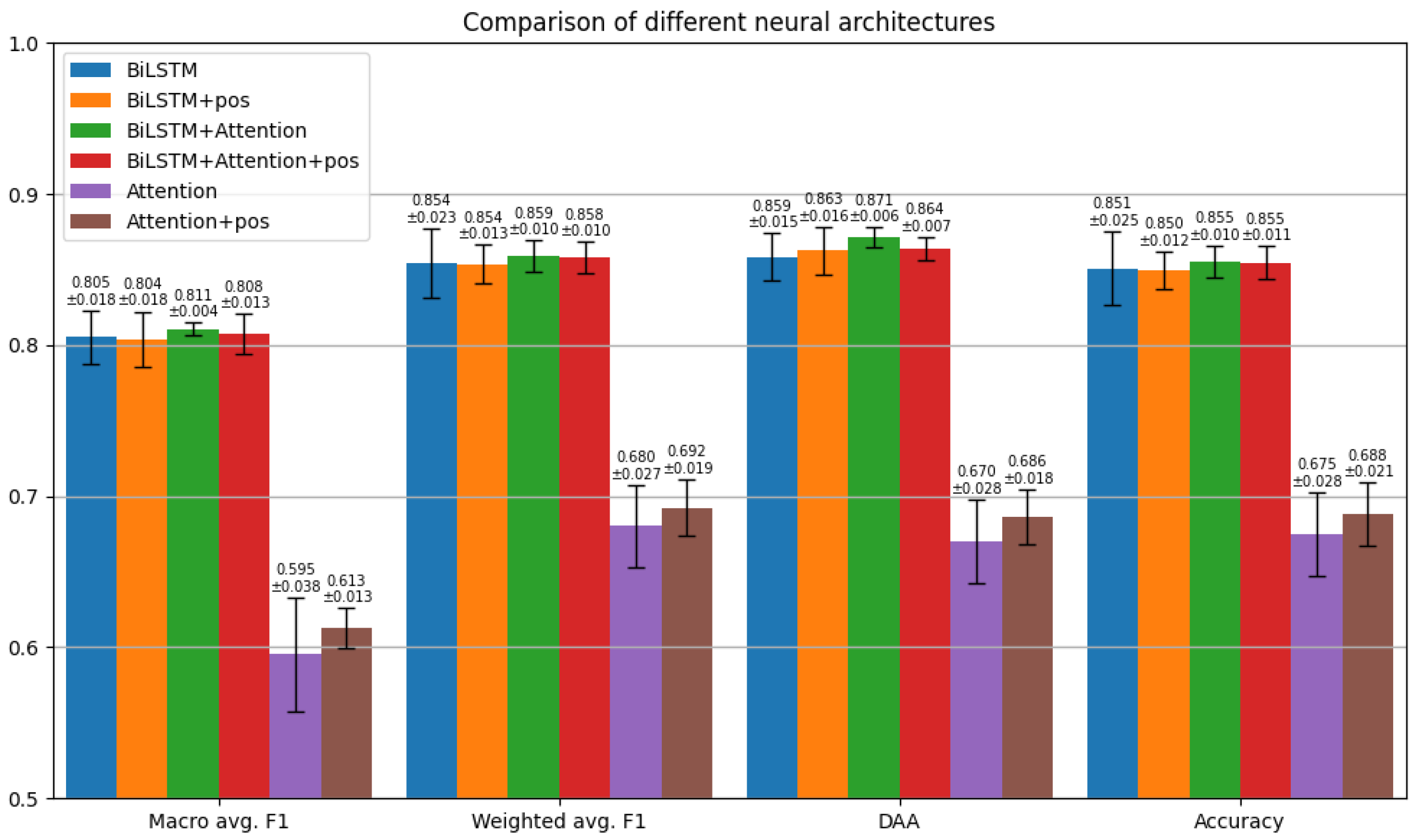
For the main comparison metric, we selected the macro F1 average and weighted F1 average metrics, averaged on a document level, and the DAA and accuracy scores as a secondary metric. The results on the test set are shown in
Figure 6.
The results suggest that the attention network is capable of learning the regularities of a legal case, but only to a limited extent. The addition of the position feature slightly improved the performance across all metrics. Meanwhile, the BiLSTM and BiLSTM+attention networks captured these regularities significantly better. This is illustrated by the fact that the effect of adding the positional feature was negligible in both architectures.
Hence, we compared only the BiLSTM and BiLSTM+attention networks (as the best candidates for high performance) on the test set.
4.4. Results on the Test Set
Our training and validation dataset has a different distribution of areas of law than the test set. The test set was created in a way to give an estimation for the performance on the entire corpus; hence, the different areas of law do not appear homogeneously. We retrained the BiLSTM and BiLSTM+attention networks on the joined training and validation sets using the same setups shown in the previous section. The resulting models were then evaluated on the test set. The corresponding evaluation metrics can be seen in
Table 7.
The results showed that the BERT CLS+BiLSTM setup worked the best, although all setups performed relatively similarly, all showing very good performance on the RRL task.
The results of the models on different areas of law are shown in
Table 8.
According to the evaluation, the BiLSTM with BERT CLS embeddings outperformed all other models across every legal domain and metric. The BiLSTM+attention with BERT CLS+pos embeddings followed closely, achieving strong results in four of the five domains. Yet, in the criminal law domain, disregarding the DAA metric, the model performed less effectively. Criminal cases stand out from other legal areas because they are generally longer, frequently involve several defendants or plaintiffs, and their operative parts are considerably more extensive. In many instances, they also include exhaustive evidence lists, which further complicates the texts.
4.5. Label-Level Results
The label-level results can be seen in
Table 9.
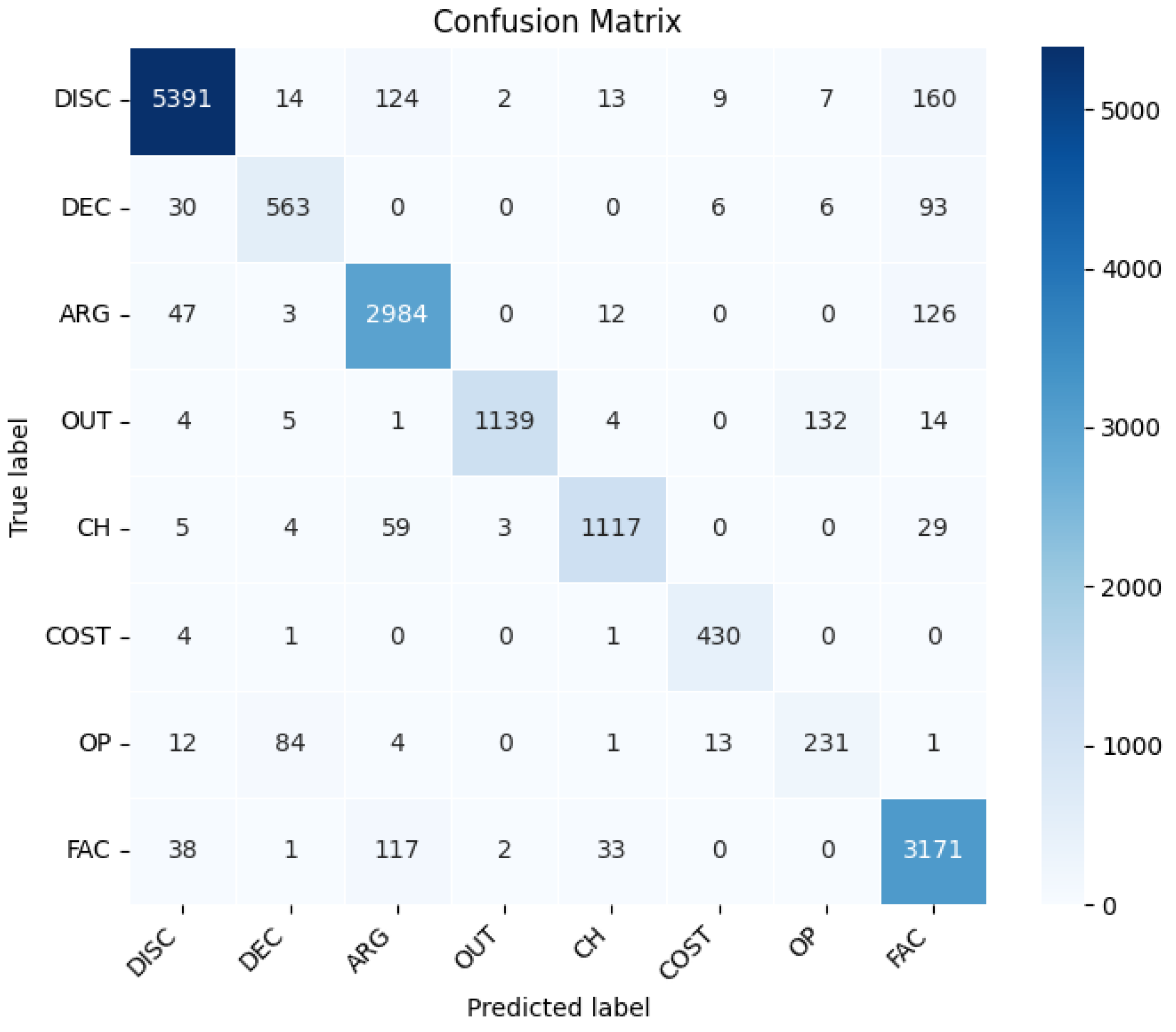
The model performed well across the majority of the labels: only two labels performed worse than 0.9 F1 score, namely the Operative Part (OP) (0.6399) and the Decision of the Court (DEC) (0.8201) labels. The confusion matrix can be seen in
Figure 7.
The confusion matrix shows that the OP labels were predicted mainly as DEC labels (84 sentences), and many OUT labels were predicted as OP (132 sentences), explaining the lower F1 results on the OP label. The moderate F1 score of the DEC label was mainly because it was predicted as Facts (FAC) in 93 sentences, and in 84 sentences, OP sentences were predicted as DEC. It is important to point out that from a practical application perspective, correct predictions in the case of OP and OUT labels are less crucial since filtering for these labels is not supported in the deployed application, so the best model was selected for deployment. In our system, filtering for these labels is unnecessary because the OUT class consists of section titles, headers and footers, dates, and signatures. Although these segments may contain metadata (e.g., judges’ names), such metadata are extracted separately and made available for filtering. The OP category is similar to OUT but is confined to the section between the header and the justification. This section contains COST and DEC sentences, and the remaining sentences (often none) within it were labeled as OP.
6. Conclusions
We presented, to our knowledge, the first sentence-level Rhetorical Role Labeling (RRL) system on Hungarian legal decisions, evaluated on a newly curated corpus and compared across classical and neural architectures. In production settings, the model supports role-aware retrieval for legal retrieval setup, enabling downstream tasks that benefit from filtering by rhetorical roles.
Empirically, sequential encoders that model local order and document-internal regularities proved to be the most effective. A BiLSTM fed with Hungarian BERT (huBERT) CLS embeddings achieved the strongest overall results on the held-out test set, clearly surpassing a linear SVM baseline, which validates the importance of sequence information for this task.
Contrary to recent findings in retrieval, late chunking hurt performance for sentence-level RRL, and multilingual Jina v3 embeddings did not outperform Hungarian BERT CLS, suggesting that injecting broad document-level context into fixed sentence vectors introduces noise for role prediction.
Label-wise analysis indicates consistently high scores on major categories (e.g., Discussion, Arguments, Case History), with Decision and Operative Part remaining comparatively difficult.
The work has immediate operational impact: the best model is deployed at the National Office for the Judiciary and already powers a rhetorical role-conditioned RAG pipeline, improving searchability and explainability of Hungarian court decisions.




 ,
,