3.1. Pervasive Auto-Scaling Method (PASM) for Computing Resource Allocation (CRA)
The design goal of the manuscript is to verify the quality of resource allocation for performing multiple application services to provide adaptable load balancing at different application traffic intervals using deep reinforcement learning. The proposed PASM for CRA is to improve the application quality of services. The PASM processes two concepts, namely the auto-scaling concept and migration concept, performed from the current cloud resource provider.
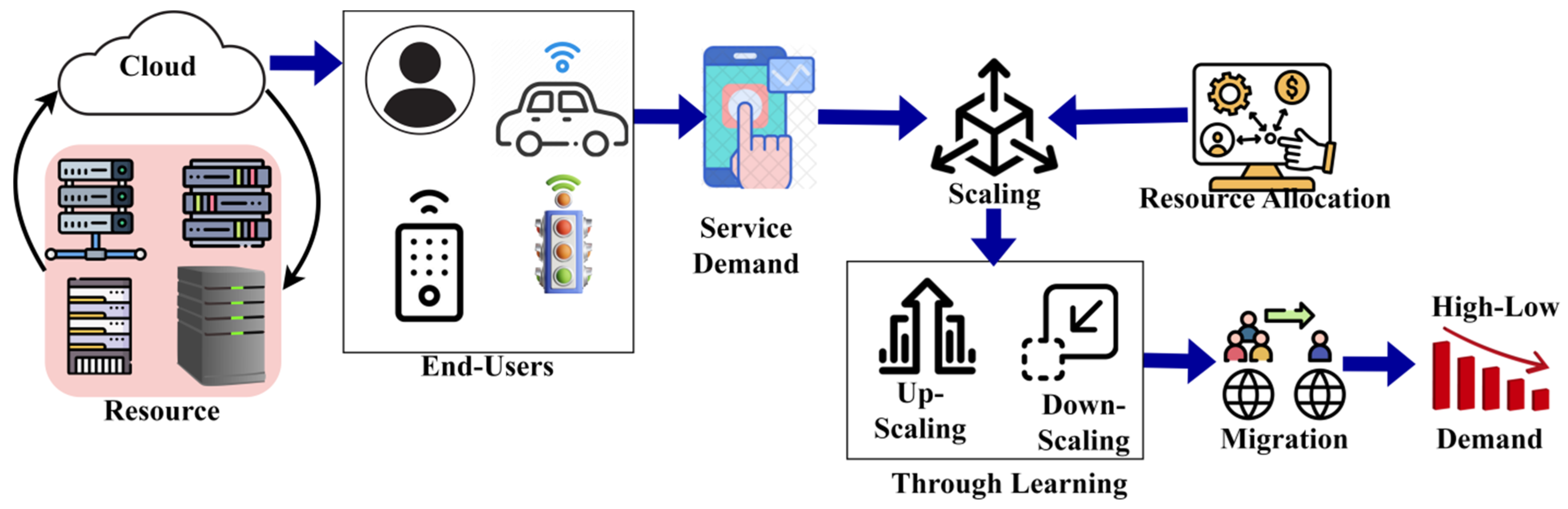
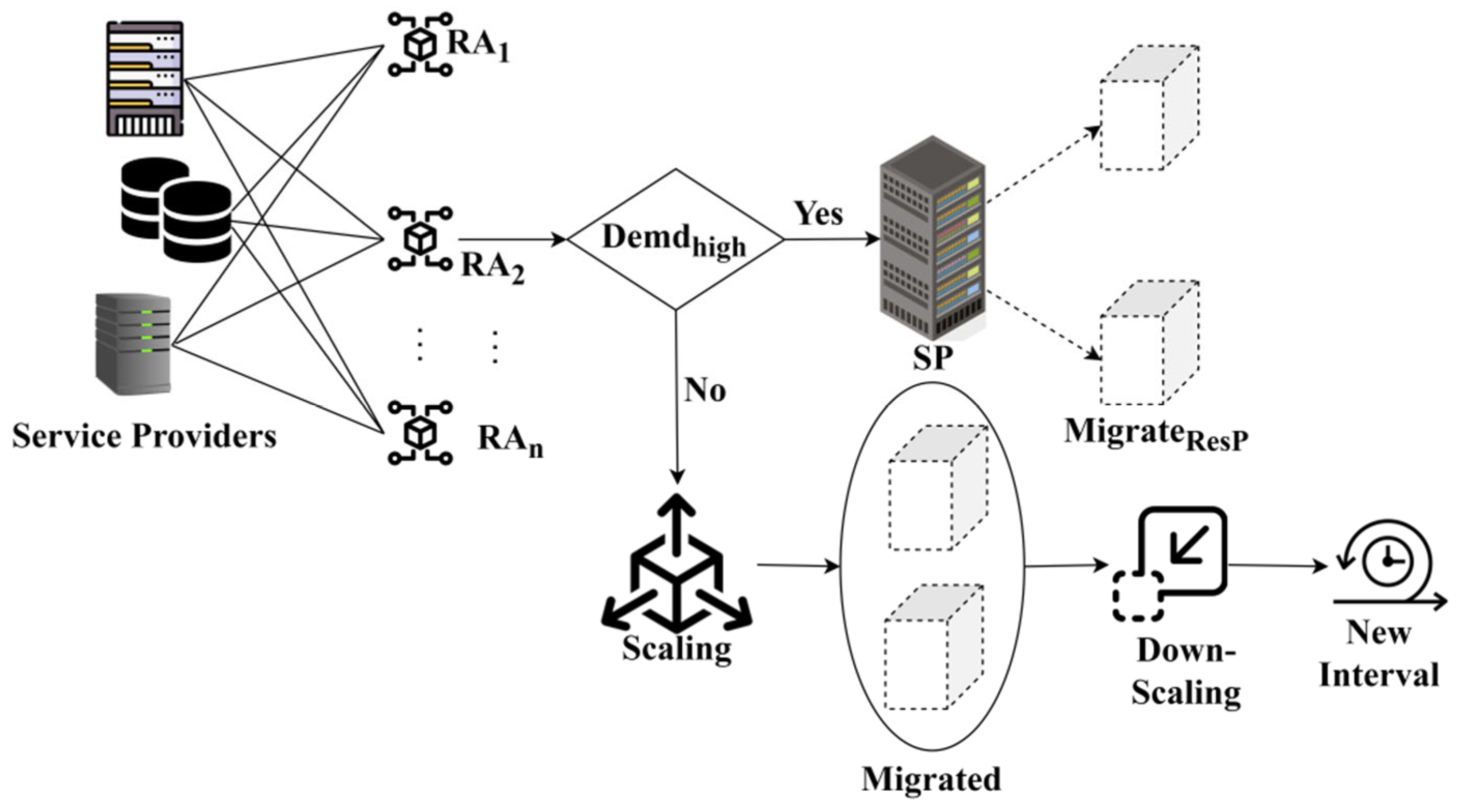
Figure 1 presents the diagrammatic illustration of the proposed method.
The Auto-scaling concept is used to give adaptable load balancing in the varying application traffic intervals. In this concept, the learning network is used to accurately classify and verify up-scaling and down-scaling sharing instances. These instances are used for identifying the overflow in application demands based on service failures and wait time. The wait time and failures are aided by training the learning network. Deep reinforcement learning employs the computation of resource allocation without failure and waiting time. The high-quality resources are allocated using the auto-scaling method through the proposed method for migrating resource providers based on the high/low application demands. The service demands serve as the input for verifying up-scaling and down-scaling output. The up-scaling and down-scaling sharing instances output is used to identify the overflowing application demands. The service demands are serving inputs to the scaling process, which involves computing resource allocation for their service demand ratio. The PASM is used to analyze the application service demands via a learning network to improve the quality of services. Both auto-scaling and cloud computing are balanced to maximize computing resource allocation that augments application service quality. The scaling is decided based on the resource allocation to the application demand ratio by the learning network according to the successive computing intervals. The service demands serve as the input of an auto-scaling method to avoid service failures and wait time.
The concept of “pervasive” pertains to the Pervasive Auto-Scaling Method (PASM) for Computing Resource Allocation (CRA) in cloud environments. This approach offers flexible load balancing in response to fluctuating application traffic intervals and consistently checks the sharing of instances for scaling up and down over different time frames. PASM enhances the quality of service for applications by improving resource distribution and allows the system to continuously evaluate and adapt to evolving application needs and service demands. It supports the transition of resource providers based on the ratio of high to low demand between consecutive computing intervals and promotes ongoing training of the learning network to optimize resource distribution, thereby minimizing wait times and service disruptions. The pervasive characteristic of this method ensures that auto-scaling and resource allocation are continuous, adaptive processes that cater to the dynamic requirements of the system, enabling repeated processes that optimize resource allocation with high sharing ratios.
3.3. Quality of Service Analysis
In this quality-of-service analysis, deep reinforcement learning is used to compute the overflow in application demands for their service failure and wait time. The actual process of cloud computing identifies the application demands for the auto-scaling method output at different application demand intervals. A maximum CRA is identified in any application demand intervals to improve the quality of service
of the cloud resources. The main aim of reinforcement learning is to avoid wait time. Hence, the
of resource allocation, which is computed from the auto-scaling method output
.
Here,
and
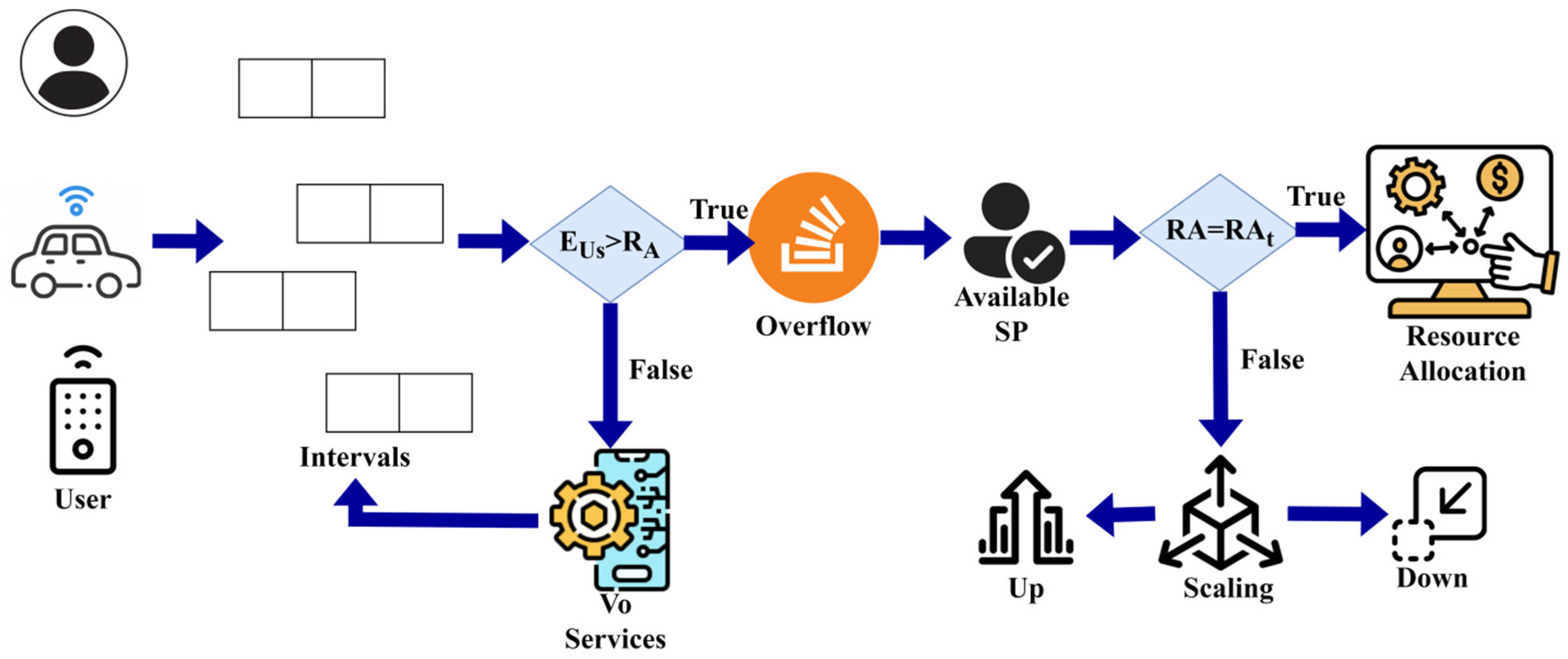
are the overall application demand intervals and overflowing demands are computed using the reinforcement learning process. Equation (3) addresses the overflow in application demands, tackling service failure and wait time using deep reinforcement learning. The demands and services are computed from the available cloud resources that are used for the following resource allocation through learning. The learning-based quality resource allocation is performed to avoid service failures between the up-scaling and down-scaling sharing instances in cloud platforms. For instance, the overflowing application demands are addressed to improve the CRA to the demand ratio that results in either
or
. The scaling process flow is represented in
Figure 2.
The initial interval allocation process relies on the
until
is true. If this condition is true, then overflow is experienced, after which the available service providers (SP) are identified. The condition
expresses the overflow suppression by sharing
to the
with new
. Therefore, the scaling is demanding if
for up and down processes. If
, upscaling is required;
demands downscaling (
Figure 2).
3.4. Identifying the Overflowing Application Demands
In this step, the application demands observed from the cloud platform are used for identifying overflow. The application demands are observed from the users based on their services in the cloud platform and then computing overflow. This computing interval is utilized to identify the wait time and service failures in cloud computing through learning. Therefore, the
and
at a random location for the varying application traffic intervals is given as
where the variables
and
represent wait time and service failures detected from cloud computing.
Here, and is defined as resource allocation failure, and service delay is detected for accurate computation of scaling rate with the following CRA. Equations (4) and (5) assess wait time, service failures, resource allocation failure, and service delay to precisely determine the scaling rate.
3.5. Auto-Scaling Method
The Auto-Scaling method is a prominent consideration here for the proposed method. The main role of the proposed method is to verify the up-scaling and down-scaling ratios based on the available application demands and the services observed from the cloud resources. Different application demands are observed from the random locations, which helps to train the learning process for maximizing resource allocation with adaptable load balancing and previous resource allocation under varying application traffic intervals. For instance, the appropriate training and computing resource allocation are performed to reduce service delays and failures. This computation generates the number of users, number of application demands, scaling rate, number of resource allocations, number of users waiting for resource allocations, and number of services in the learning network. The reinforcement learning provides less allocation wait time, service delay, allocation failures, and resource utilization, thereby maximizing resource allocation. The learning process provides high computing resource allocation. Based on the demands and services, the final scaling rate is given as
and
Here, the variable
,
and
represent the two random variables and previously completed allocation intervals contain the associated cloud resource information at random locations, regardless of the application demand intervals. Equation (6) illustrates the verification output associated with the processes of up-scaling and down-scaling observed at various time intervals for computing resource distribution. The function used integrates these two variables to generate the verification output
. This output likely acts as a metric or indicator of the effectiveness of resource up-scaling and down-scaling in relation to the allocation time intervals. This equation is instrumental in assessing the efficiency and effectiveness of dynamic resource allocation in computing systems, especially in scenarios where quality of service is a crucial consideration. It facilitates the evaluation of how well the system adjusts its resource allocation over time to satisfy service demands or performance criteria. The auto-scaling process decision is illustrated in
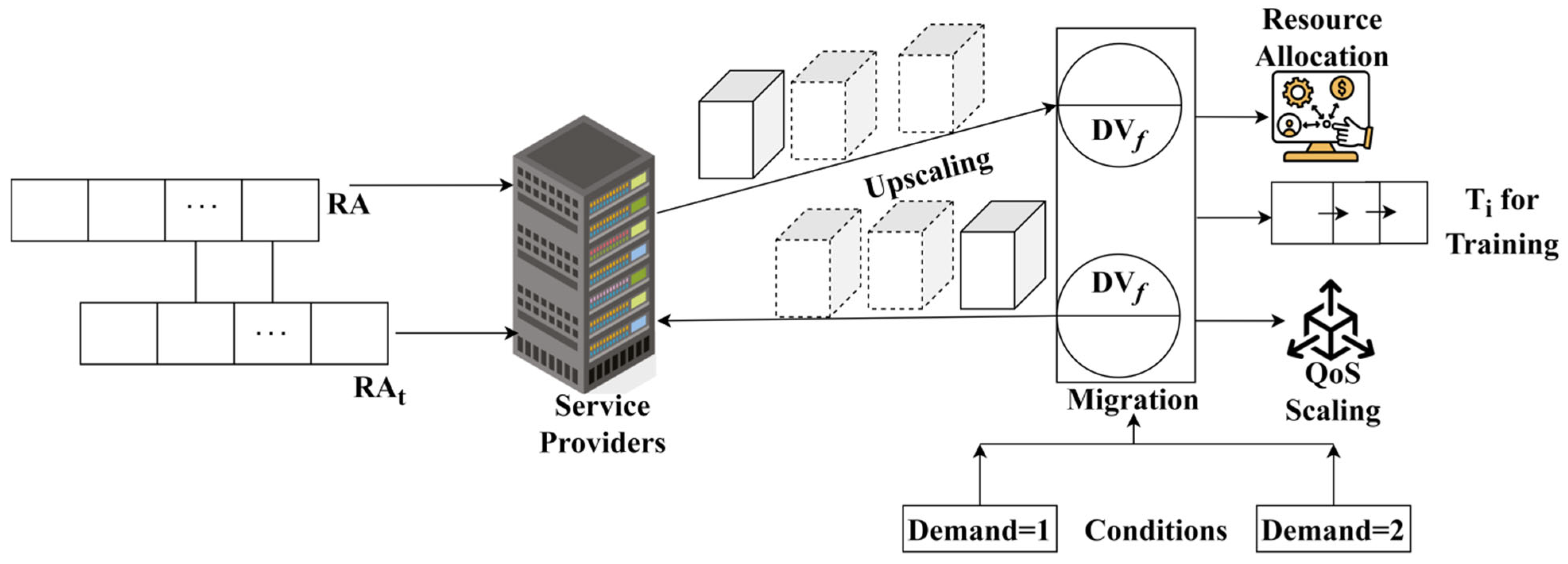
Figure 3.
The auto-scaling process illustration is presented in
Figure 3. This auto-scaling relies on
and
for the different service providers (allocated and unallocated). If both the allocations are concurrent, for upscaling under
and downscaling for
. This refers to
demands for upscaling to reduce wait time and therefore the migration for
is pursued. The alternate case of
is alone used for downscaling, which reduces service failures. This demands Qos-based scaling where migration is optimal for fewer scaling rates.
3.6. Training the Learning Network
The appropriate and accurate resource allocation is performed based on training the learning network and the auto-scaling method output, without overflowing application demands, which is a reliable output. The overflow of application demands is identified and reduced to improve the quality of resource allocation with the computed scaling rate pursued using deep reinforcement learning, respectively. The scaling output is supported by all the computing resource allocation intervals at different application demand intervals, for which the wait time and service failure are reduced. The scaling verification is performed to achieve the maximum computing resource allocation at random locations. In CRA, the multiple services of
which are processed and
,
are also processed to avoid further service failures during the training process to improve the quality of resource allocation in cloud computing. All the resources are arranged as a priority and trained based on scaling output for achieving a high sharing ratio. Both demands and services are observed to prevent service failures and delays in cloud computing. That observation-based resource allocation with scaling output is performed to reduce service failures, delays, and wait time, also maximizing the demand and sharing ratio based on migrating resource providers. This process is recurrent until maximum resource allocation with a high sharing ratio is the optimal output. The resource allocation rate differs based on the scaling output, which uses the high quality of services for maximizing the resource allocation rate for random locations and application traffic intervals. The proposed PASM is designed to train the learning network to reduce service, demand delays, and failures. Hence, the scaling output is performed by migrating the resource providers depending on the training and computing resource allocation. This row of resource allocation
sequence with a high sharing ratio is expressed as
As per Equation (8),
,
and
are the recurrent training of learning networks under varying application traffic intervals with fewer service failures. Equation (8) explains the ongoing training of learning networks under different application traffic intervals with minimized service failures. For which the scaling rate using learning network training is pursued from the previous (completed) allocation intervals.
,
and
are computed from the completed resource allocation time intervals based on the migration of resource providers for a high-to-low demand ratio.
,
and
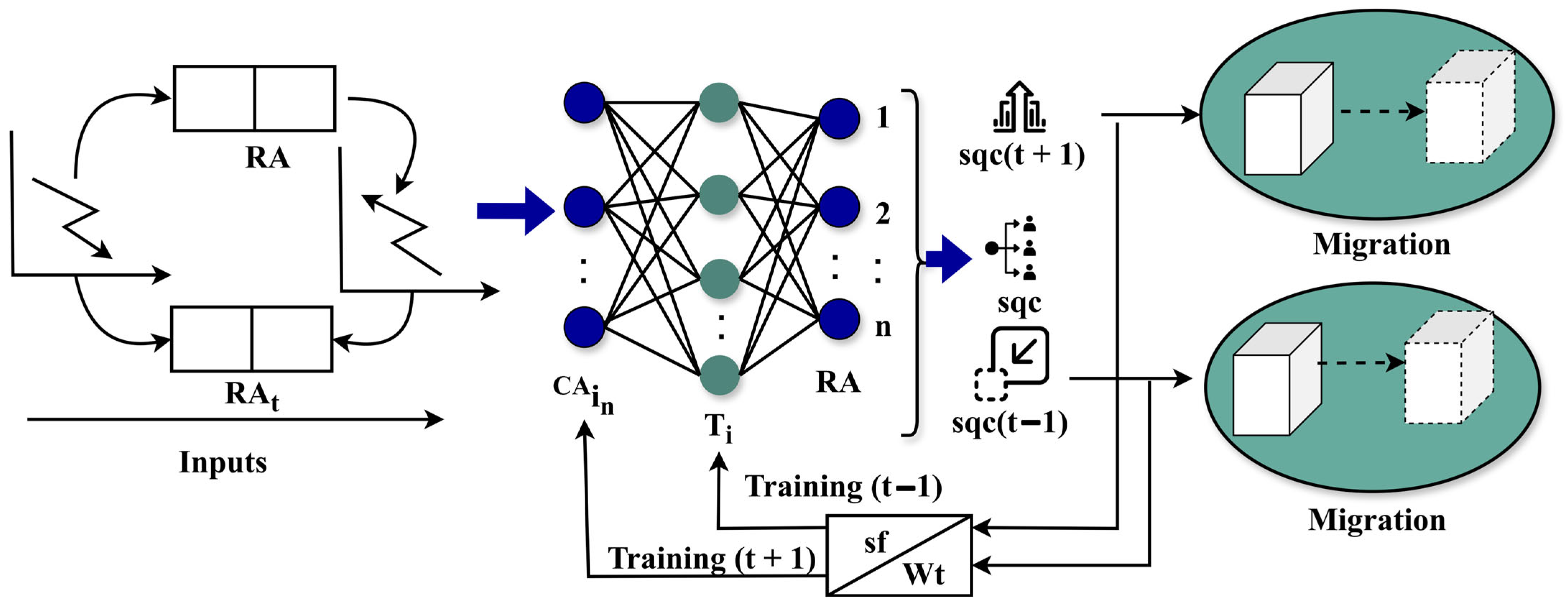
are the service and demand computed from the current resource allocation intervals, using neural network learning. Equation (8) (non-linear) describes a recurrent training process for a learning network with varying application traffic intervals. The equation involves several variables and operations, indicating a complex interplay between different elements in the auto-scaling method. Without additional context or specific details about the variables and their interconnections, it is challenging to definitively determine the linearity or non-linearity of this equation. It appears to be part of a more intricate system that includes resource allocation, scaling rates, and application demands within a cloud computing environment. The network training process is illustrated in
Figure 4.
The learning process relies on two training instances:
and
for
and
reduction. The
(up/down) are the inputs for
are verified for
to identify
for
. If the demand is validated, then
for different
is observed to reach
. If this output is different from
and
the migration is performed. Such migration mismatch validates the need for recurrent training under various
. Therefore, the learning network’s training is inducted until
is reduced from
or increased from
(
Figure 4).
3.7. Resource Allocation
The learning network identifies the service failures and delays in any cloud resources. Based on the instance, the scaling is decided to generate a successive allocation interval that performs the appropriate resource provider migration. An auto-scaling method is proposed to achieve high-quality resource allocation in the cloud platform. Based on the method, up-scaling and down-scaling are prominent in the following resource utilization and allocation processes that are used for improving . The service failures and delays are reduced to better meet application demands from the cloud users. To eliminate such issues, this manuscript proposes that training-assisted CRA is pursued based on application demands and its services through learning.
First, the application demands are observed from the cloud users through the available devices or resources. Maximum resource allocation with sharing accuracy is achieved, and the overflowing application demands are reduced to prevent service delays and failures. The proposed method used to compute resource allocation with service failure instances is recurrently trained between the up-scaling and down-scaling to achieve a maximum sharing ratio. Here, the application demands and services an input via scaling verification, which is computed for resource allocation.
3.8. Migration Process
The actual aim of the proposed method is to achieve high resource utilization and allocation depending on the high-to-low demand ratio between successive computing intervals using a reinforcement learning process by migration of resource providers to reduce wait time. This computation enhances the resource allocation based on the recurrent training and scaling rate. This process aims to reduce the number of service demand failures and wait time. Therefore, the migration of resource providers is expressed as
In Equation (10),
used to represent the resource provider is migrated based on the demand ratio between computing intervals. Computing the application demand ratio for achieving high-quality resource allocation with sharing is to improve the overall performance. Equation (10) details the migration of resource providers according to the demand ratio between computing intervals. The conditions of
and
shows the migration of up-scaling to down-scaling and migration of down-scaling to up-scaling are pursued by a learning network for maximizing resource allocation in cloud resources. The accurate demands and services of the cloud users are observed to allocate resources with a high sharing ratio. Based on the high-to-low demand ratio, the failure and wait time addressed resource providers are migrated to their location between successive computing intervals. The service provider migration process is given in
Figure 5. This migration process is different for up-scaling and down-scaling resources.
The service providers are validated to ensure maximum
to satisfy the service demands. Across the allocation instances, the
and
are the
constraints that are to be satisfied. Therefore if
persists apart from the scaling process, and then
is performed. If the demand is under less consent, then the previously migrated resources are scaled to a new interval. Such down-scaled resources are migrated for
user services (
Figure 5).
3.9. Allocation Wait Time and Failure Detection
The recurrent process is performed to reduce the wait time and operation costs of the application demand intervals and maximize resource allocation. It is maximized by reducing the wait time, failures, and operation costs regardless of the application demand intervals. It also reduces the wait time during the migration process until maximum resource allocation with high sharing is achieved. The high quality of services provides maximum resource utilization and allocation from the learning network.
and,
In this, the wait time and service failure between the current computing allocation interval
and the successive computing allocation interval
is to achieve maximum resource allocation in the cloud platform. Equations (11) and (12) compute wait time and service failure between the current and next computing allocation intervals to enhance resource allocation. The proposed PASM is used to ensure the quality of resource allocation with recurrent training and scaling verification, assisted by a high-to-low demand ratio, which reduces wait time and failure. The optimal output is less wait time and operation costs to perform multiple services in a cloud platform using scaling and migration, which is fed to the learning process for achieving high-quality services with less wait time. The proposed method is described in Algorithm 1.
| Algorithm 1. Proposed PSAM-CRA. |
| Initialize cloud_environment with service_providers and users |
| Step 1: For each application_demand_interval: |
| Observe user_service_demands |
| Compute overflow in application_demands |
| Identify wait_time and service_failures |
| Step 2: Train learning_network: |
| Use scaling_rates from previous allocation_intervals |
| Verify up_scaling and down_scaling sharing_instances |
| Compute resource_allocation_to_demand_ratio |
| Step 3: Perform auto_scaling: |
| If overflow is detected: |
| Adjust scaling |
| Compute new resource_allocation |
| Update learning_network |
| Step 4: Migrate resource_providers: |
| Calculate the high-to-low-demand ratio between intervals |
| Migrate providers to reduce wait time |
| Update resource_allocation |
| Step 5: Repeat steps 3–5 until maximum resource allocation with high sharing is achieved |
| Continuously monitor and adjust for QoS improvement. |
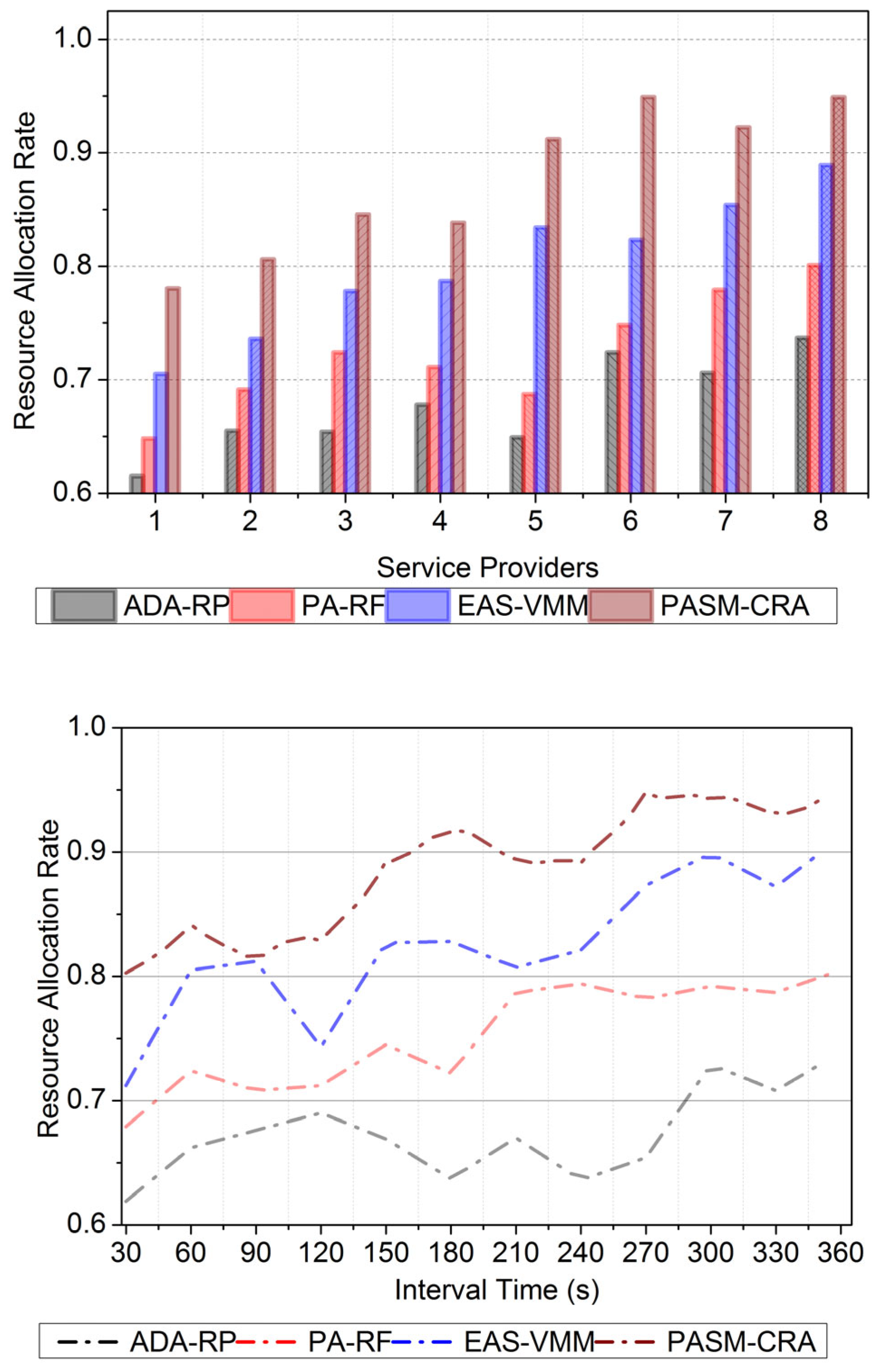
The balancing of up-scaling and down-scaling sharing instances enhances the resource allocation rate. The proposed method improves resource allocation with a sharing ratio and thereby reduces wait time and failures. The proposed method is analyzed for self-assessment using the metrics used internally. These metrics are identified as a part of the comparative analysis under the same simulation/experimental environment. Therefore, the parameters such as resource allocation rate, demand estimated, and the resource factors are considered for evaluating the methods. Similarly, the number of service providers involved in the scaling process is also a numerical parameter used in this assessment. The connection between the number of service providers, the allocation factor, and the scaling rate is used to evaluate the following metrics. In the first analysis, the and for different is presented.
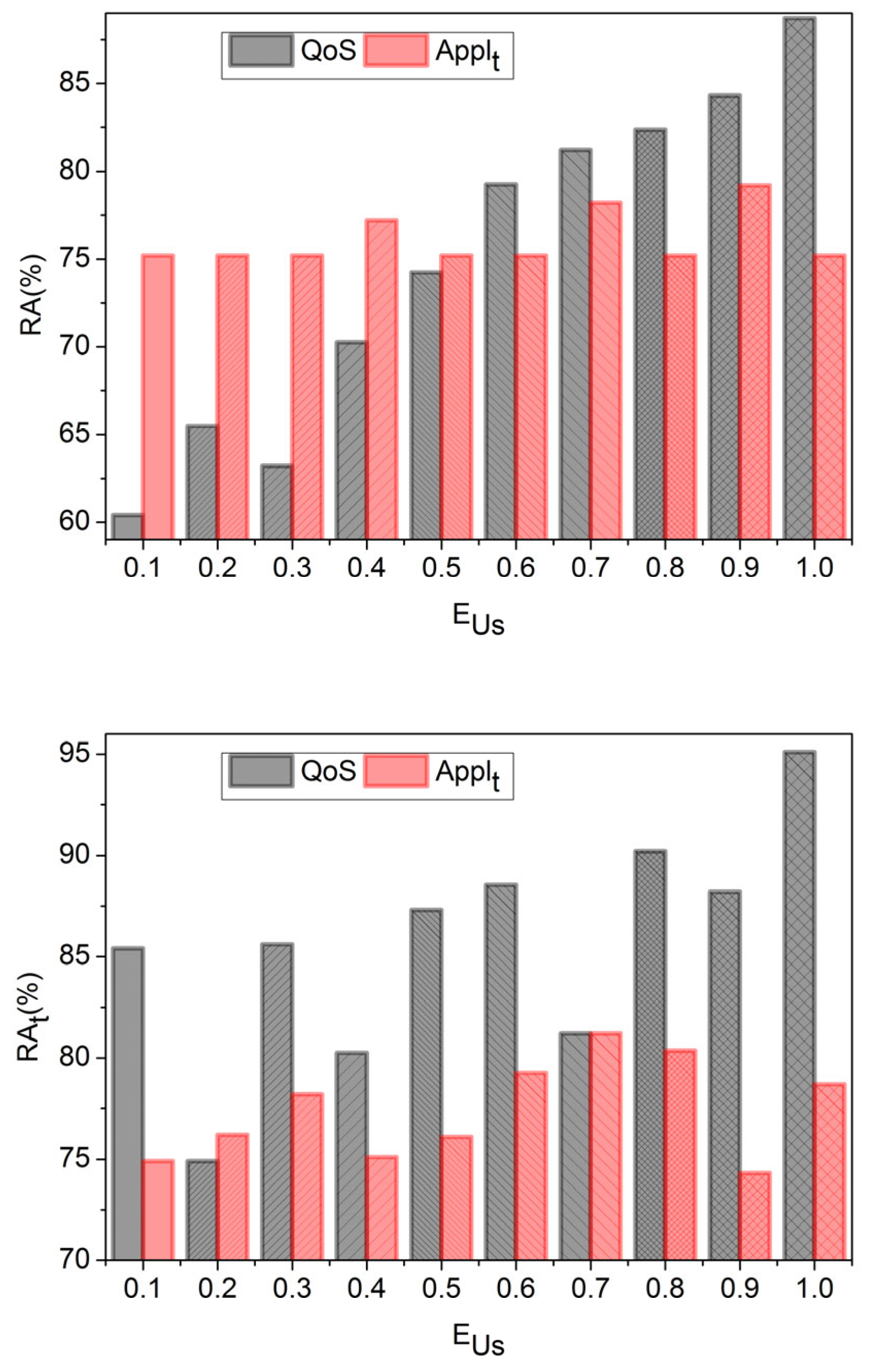
In the below comparison (
Figure 6), the QoS and the application response for different
factor is presented. The comparison takes place for the QoS requirement factor and the application response factor independently. This does not consider the QoS and the application; rather, the variables used represent the QoS factor and the application response factor estimated from the maximum requests/demands received in
. The rate of resource allocated is validated for both factors across allocation and response. The
and
are applicable for down and up-scaling processes, respectively. In this case, the training using
and
are independent for maximizing allocation. The migration and
are defined at high levels to increase the
. However, if the learning process identifies
then migration to balance
is performed. This migration is consented to reduce
until a better allocation is sustained. Therefore, the
until
instances follow
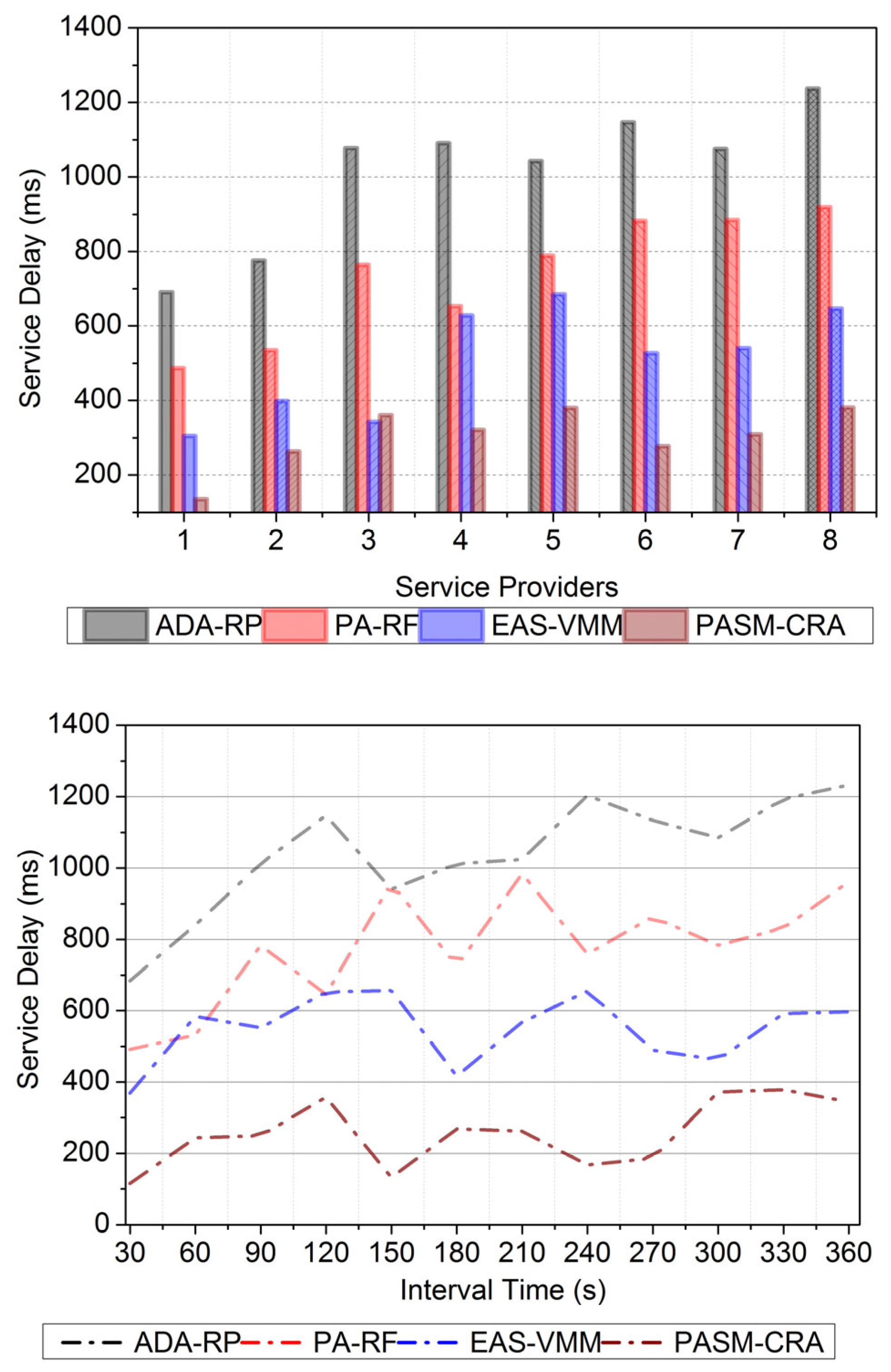
for which migration is performed alone. For the varying service providers, the
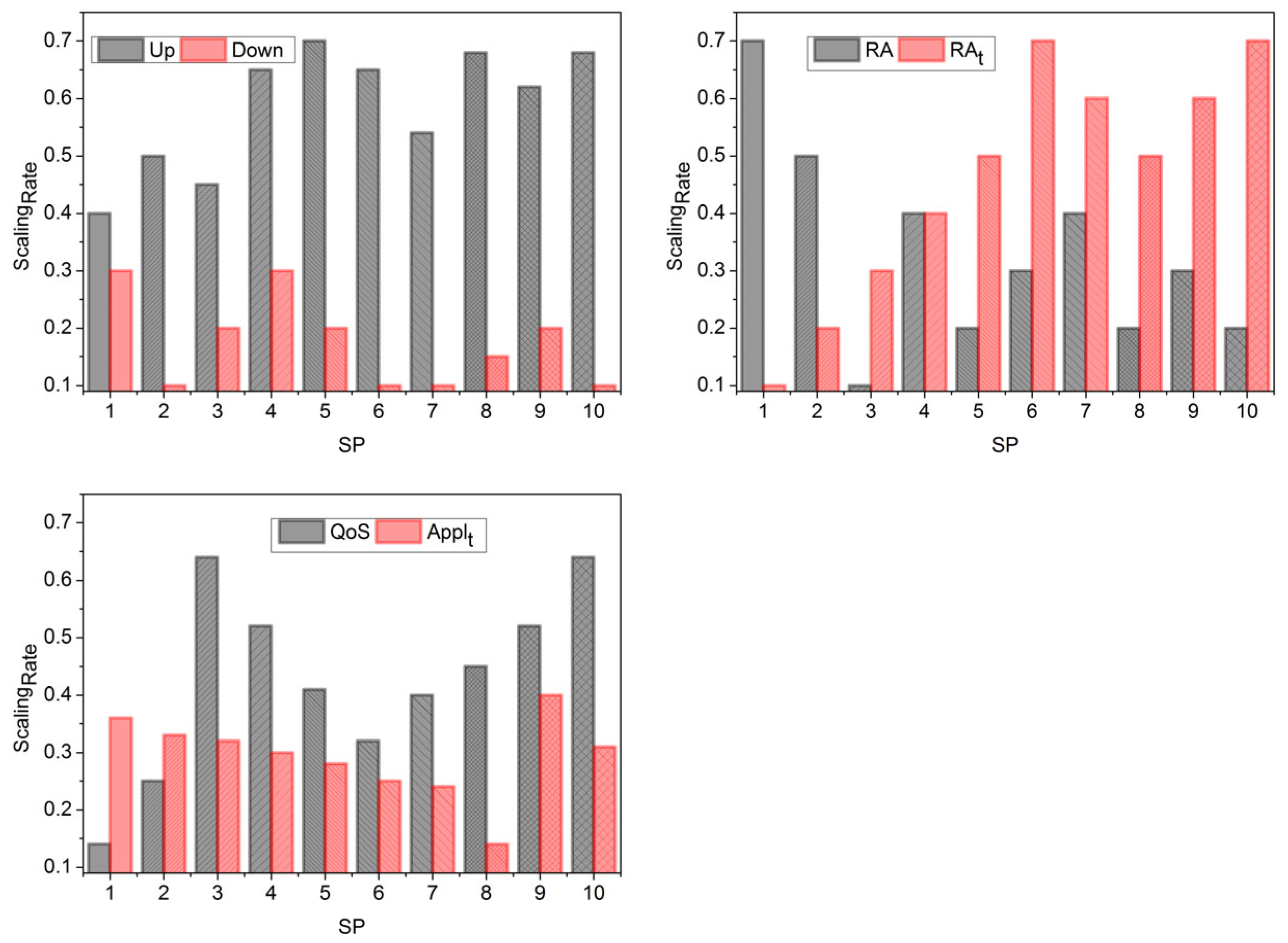
analysis is presented in
Figure 7 below.
The
is analyzed under (up, downscaling),
and (QoS,
) for the varying service providers. The learning process identifies
and
condition satisfaction is overflow and migration assessment. In the distinguishable learning process, the
and
differentiation is mandatory. Based on these conditions and constraints, the QoS and
based scaling is induced for
and
sequences. Therefore, the scaling down process is pursued for distinguishable intervals. This enhances the
migration and scaling across various QoS demands (
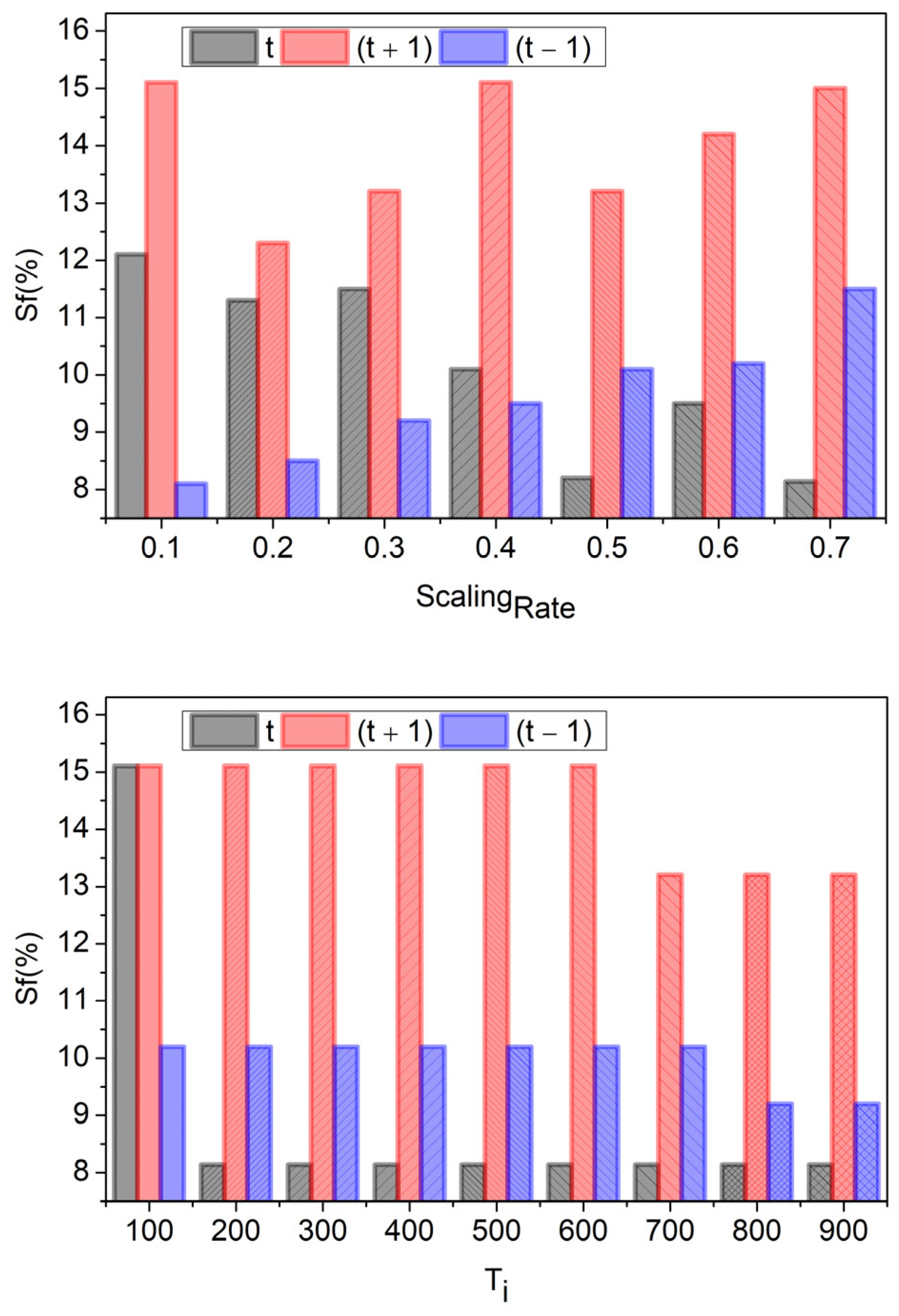
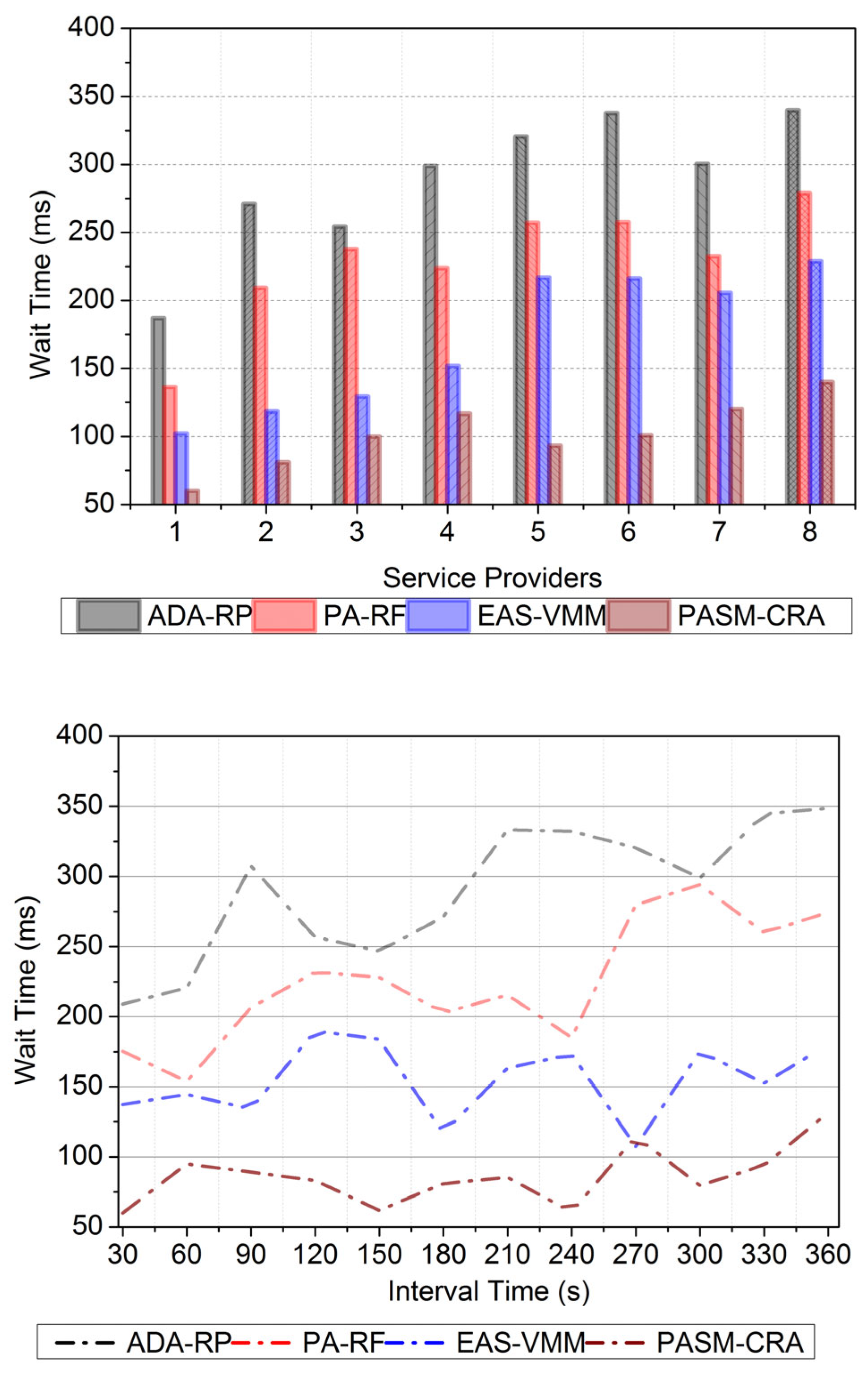
Figure 7). The
for the
and
sequences are analyzed under
and
iterations in
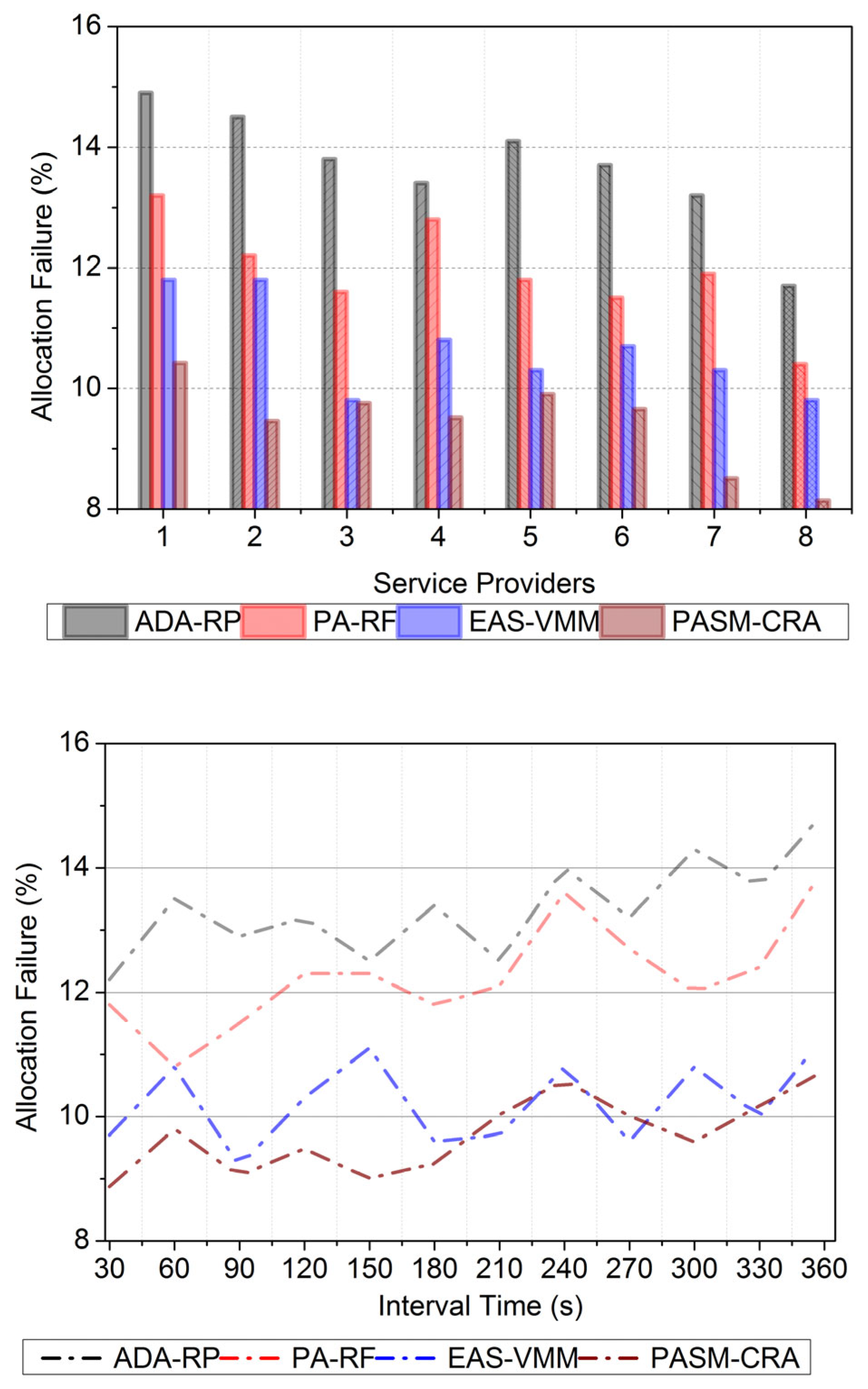
Figure 8.
The scaling rate varies the allocation under and to reduce the failures through classified learning. The and are the corresponding factors to increase resource allocation. In this allocation, and are consented to leverage the allocation regardless of the demand. Therefore, the new is validated for and to reduce the . The proposed method is reliable across different and allocation intervals.