1. Introduction and Background Information
Video-based performance analysis is widely used across sports, but it often still depends on manual review and subjective tagging, especially when dedicated multi-camera systems are not available. In sports such as football, basketball, and tennis, vision-based solutions are already integrated into professional workflows. Indicative examples include optical tracking platforms such as TRACAB and Second Spectrum, which provide detailed spatiotemporal data for tactical analysis and broadcast augmentation, as well as systems such as Hawk-Eye that support officiating and performance evaluation. These developments have enabled the introduction of advanced metrics, such as expected goals in football or spatial shot quality models in basketball, fundamentally altering how teams evaluate performance and make strategic decisions, even for amateur events [
1].
In contrast, team handball remains relatively underexplored in automated video-based analytics. Although it is a fast-paced and tactically rich sport, it lacks the widespread availability of tracking data that exists in other sports. This gap is mainly explained by practical constraints. Multi-camera tracking systems are expensive and are rarely deployed outside elite competitions. In addition, handball is played indoors on a relatively small court of 40 × 20 m, which leads to high player density and frequent physical contact. As a result, detections are often ambiguous, and occlusions are common. Finally, broadcast footage typically includes camera panning and zooming, as well as strong perspective changes, which makes stable spatial analysis more difficult.
Due to these conditions, many handball teams still rely on manual video review and basic event statistics. This limits the analysis of spatial structure, player movement, and tactical organization. Modern computer vision methods could extract rich spatiotemporal information even from single-camera broadcast video, provided that the pipeline is designed to handle camera motion, perspective effects, and frequent occlusions.
Recent progress in sports analytics has been enabled by object detection and multi-object tracking. One-stage detectors such as the YOLO family are often selected because they offer a practical balance between accuracy and speed. Tracking-by-detection methods then associate detections across frames to build trajectories that support motion analysis. SORT introduced a lightweight baseline, while DeepSORT extended it with appearance-based association and improved identity stability in crowded scenes [
2,
3]. To move beyond pixel coordinates, a common step is to map image positions to standardized court coordinates. This allows physically meaningful measurements, such as distance in meters and speed in meters per second, using planar homography under the assumption that the playing surface is approximately planar.
Action recognition in team sports has been studied with deep spatiotemporal networks and with hybrid pipelines that incorporate pose, ball information, or trajectory representations. However, for less studied sports and limited datasets, interpretable feature-based classifiers remain a strong and practical baseline. The use of lightweight classifiers is also motivated by the limited size of available annotated handball datasets, where training large spatiotemporal deep models reliably remains challenging. They require fewer training samples, support clearer error analysis, and keep intermediate representations transparent. In this work, action recognition is treated as a comparative learning task at the clip level using engineered descriptors to quantify tradeoffs between classical model families under identical inputs and a common evaluation protocol.
Handball-specific studies highlight the difficulty of broadcast conditions and the importance of tailored components. Prior work examined active player detection using activity measures [
4] and explored dataset construction and action recognition using automatic annotation and classical motion features [
5]. Despite these efforts, handball is still underrepresented in end-to-end single-camera pipelines that connect detection, tracking, court mapping, and coach-oriented outputs under realistic broadcast conditions. Results are reported under a single fixed protocol and are compared against standard tracking and classification baselines, while prior handball studies are used primarily as methodological reference points due to differences in data, labels, and evaluation settings [
2,
3,
4,
5,
6,
7].
The main contributions of this paper are summarized as follows:
- ○
End-to-end pipeline for monocular handball analytics. We present a complete workflow that processes raw broadcast video into court-referenced player trajectories, kinematic motion metrics, and coaching-oriented visual summaries.
- ○
Spatial calibration for metric motion analysis. A homography-based court projection enables the transformation of image coordinates into real-world court coordinates, allowing physically meaningful measurements of player motion and comparisons across clips.
- ○
Interpretable action recognition. Player actions are recognized using trajectory-derived kinematic features combined with lightweight tree-based classifiers, prioritizing interpretability and robustness under limited training data.
- ○
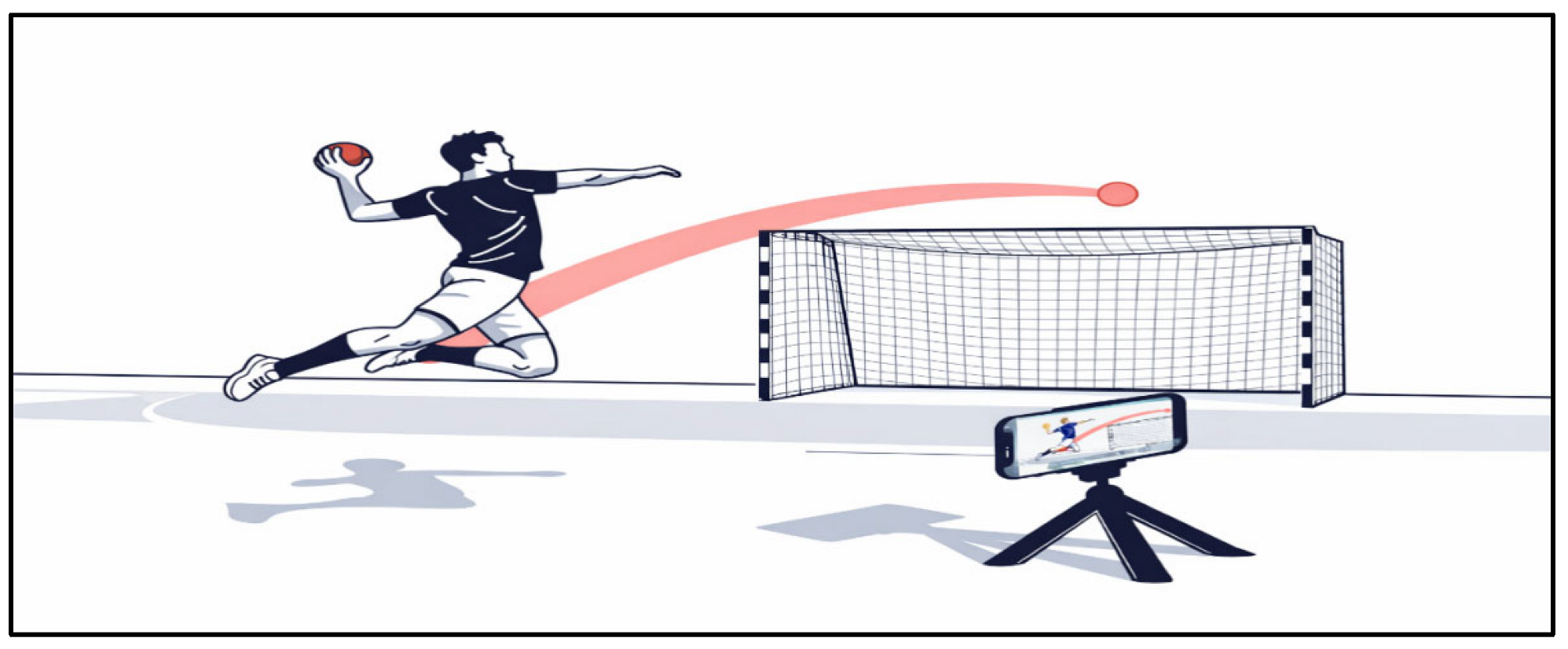
Evaluation under real broadcast conditions. The proposed framework is evaluated on annotated handball broadcast clips, providing quantitative analysis of tracking performance and action recognition accuracy under realistic broadcast scenarios (
Figure 1).
The remainder of this paper is organized as follows:
Section 2 describes the proposed methodology.
Section 3 presents the experimental setup, including dataset characteristics and evaluation metrics, and reports quantitative and qualitative results.
Section 4 discusses the implications, strengths, and limitations of the proposed approach.
Section 5 concludes the paper.
2. Materials and Methods
2.1. Overview of the Proposed Pipeline
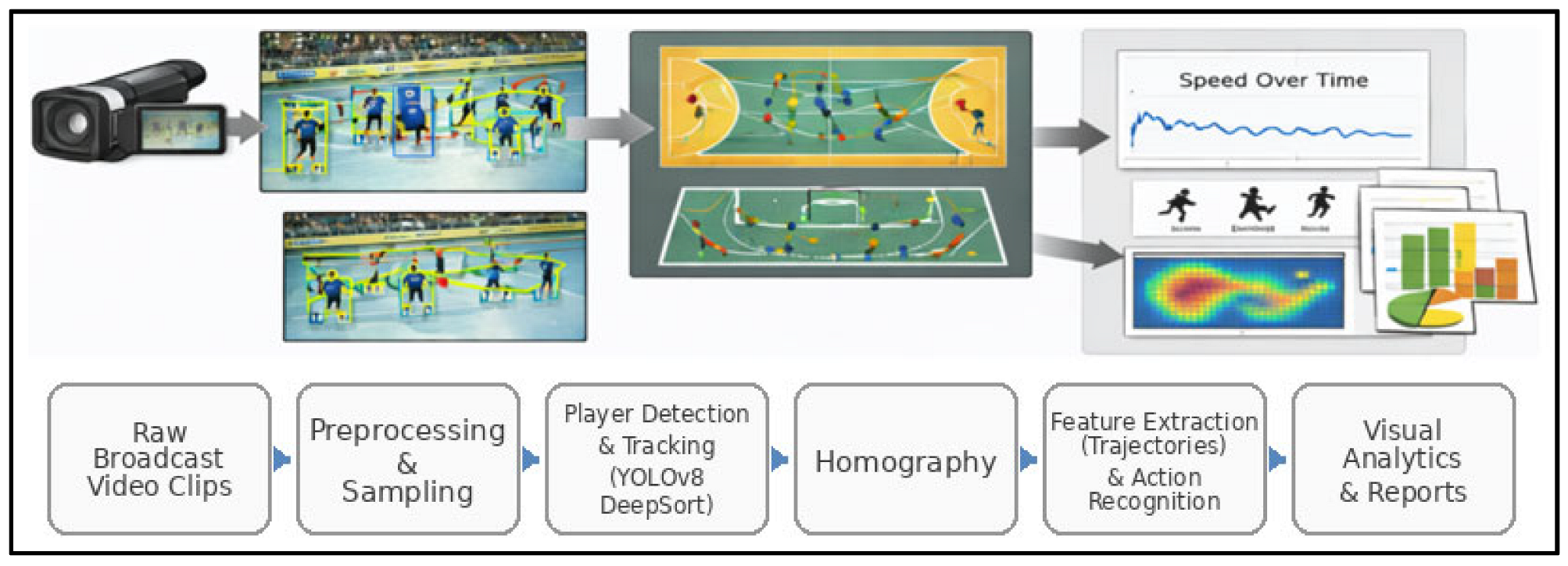
The proposed workflow processes each video clip through a modular four-stage pipeline that produces explicit intermediate outputs at every step. Given a monocular broadcast clip , the goal is to transform pixel-level observations into court-referenced trajectories in metric units and to derive quantitative and visual analytics, along with clip-level action recognition.
In Stage 1, a deep detector is applied independently to each frame to localize players and output bounding boxes with confidence scores. In Stage 2, a tracking-by-detection method associates detections over time to form trajectories with persistent identities, enabling temporal continuity under short occlusions. In Stage 3, player image positions are mapped to a standardized court coordinate system using homography-based camera calibration under the planar court assumption, producing trajectories in meters.
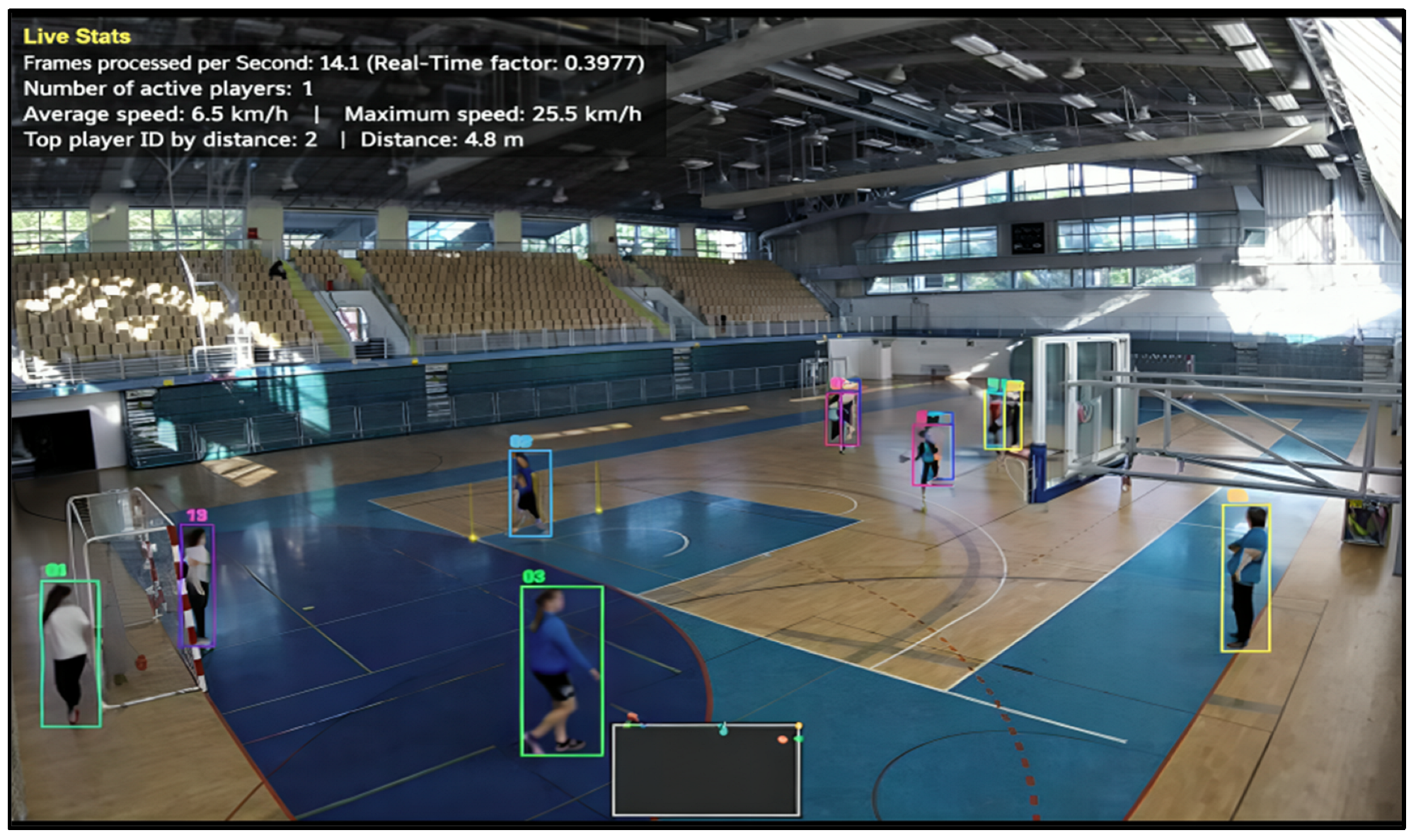
In Stage 4, the court-referenced trajectories are used to compute motion indicators such as distance covered and speed, generate coaching-oriented visual summaries such as trajectory overlays and heatmaps, and extract interpretable clip-level features for action classification, which are evaluated with multiple lightweight classifiers under a common protocol.
A key design choice is modularity: each stage can be replaced independently while maintaining the same intermediate representations (detections, tracks, court-projected trajectories, and feature vectors). This structure supports reproducibility and systematic troubleshooting since errors can be localized by inspecting the outputs of each stage before propagating to subsequent components (
Figure 2).
2.2. Player Detection and Tracking
Players are detected independently in each frame using a fine-tuned YOLOv8n model (Ultralytics, v8.0, San Diego, CA, USA) [
8]. Given a frame
, the detector returns a set of
detections
, where each detection includes a bounding box
in pixel coordinates and a confidence score
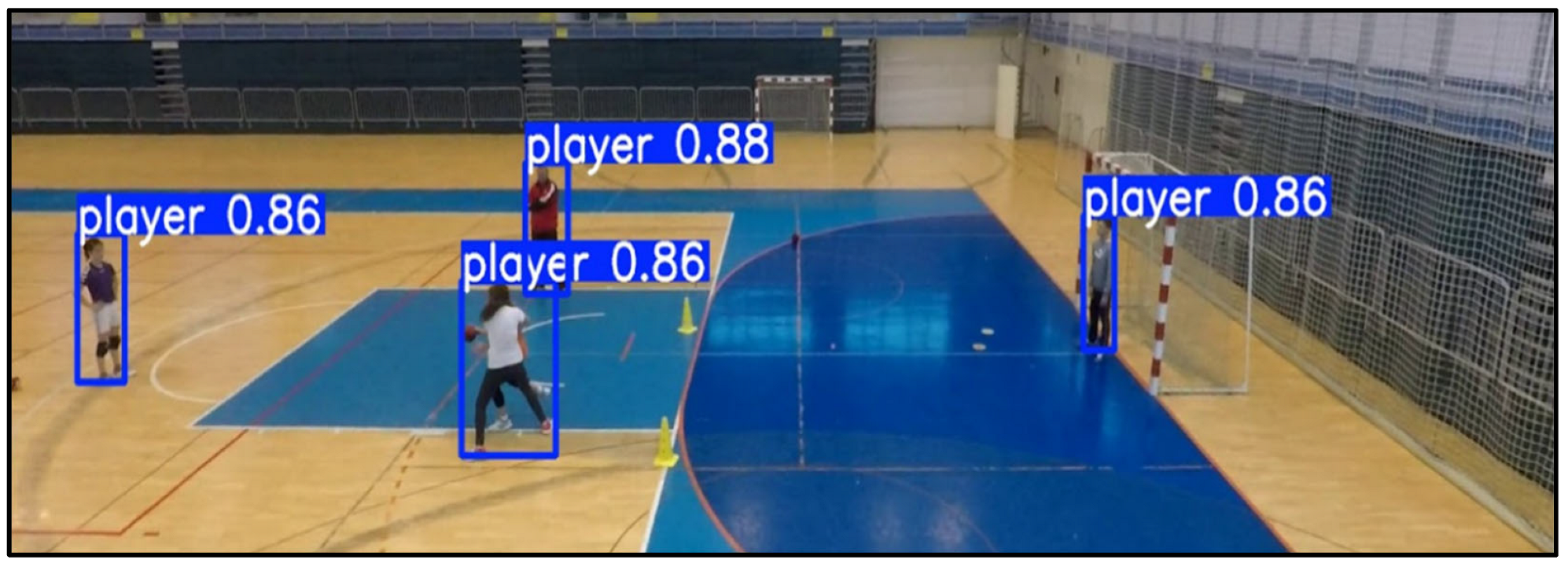
. The model is trained as a single-class detector (player) to maximize detection stability for subsequent tracking. The detector is used as a pre-trained detection module whose outputs consist of bounding boxes and confidence scores for each frame. For each frame, it outputs a finite set of bounding boxes and confidence scores, which form the observable input to the tracking stage.
To provide comparable inputs for the tracking stage, a fixed confidence threshold is selected on the validation set and then kept constant across all experiments. After thresholding, non-maximum suppression (NMS) is applied to remove duplicate detections. The overlap between two boxes A and B is quantified by the Intersection over Union
. When
exceeds a predefined NMS threshold, the lower-confidence detection is suppressed. Finally, detections are filtered with basic sanity checks to discard degenerate boxes, such as invalid dimensions or boxes outside image boundaries. The final output of Stage 1 is the per-frame detection set
, which is passed unchanged to the tracker (
Figure 3).
Frame-level detections are linked into trajectories using DeepSORT (v1.0) [
3] under a tracking-by-detection paradigm. DeepSORT was selected because broadcast handball footage includes frequent short occlusions and close player interactions. In such conditions, appearance-based association reduces identity switches compared to purely motion-based trackers. This is important because identity instability and track fragmentation propagate to downstream trajectory features and can degrade the reliability of clip-level action recognition.
The input to the tracker at time t is the per-frame detection set . The output is a set of tracks with persistent identities. For each track, the tracker provides a state estimate per frame, which includes the predicted location and bounding box in image coordinates. For each frame, the tracker maintains a set of active track identities . Each track state is propagated with a Kalman filter motion model, which predicts the next state and defines a motion-based gating region for plausible matches.
Data association combines spatial consistency with appearance similarity to reduce identity switches in crowded scenes and under short occlusions. This mechanism helps maintain identity consistency during short occlusions and close player interactions, which are common in broadcast handball scenarios. Matching between predicted tracks and current detections is obtained by solving an assignment problem, typically with the Hungarian algorithm. This produces matched track–detection pairs, along with unmatched detections and unmatched tracks. Unmatched detections may initialize new tracks. Unmatched tracks may remain active for a limited number of frames, controlled by a maximum age parameter.
DeepSORT was selected as the tracking component because it explicitly integrates appearance embeddings for identity association across frames. In sports analytics scenarios, identity consistency is particularly important since trajectory-derived motion indicators such as speed, distance covered, and spatial occupancy depend on stable identity assignment over time. While recent trackers such as ByteTrack and BoT-SORT focus on maximizing detection recall through score-based association, they rely primarily on motion cues and confidence thresholds. In contrast, DeepSORT combines motion prediction with appearance-based matching, which improves robustness under frequent player interactions and short-term occlusions that commonly occur in broadcast handball footage. For the trajectory-based analysis considered in this work, maintaining stable player identities is more critical than maximizing short-term detection recall, making DeepSORT a suitable choice for the proposed pipeline. Nevertheless, identity switches and track fragmentation may still occur in challenging situations, such as heavy occlusions or dense player interactions, which can propagate to the trajectory-derived motion features and affect downstream action recognition. Evaluating alternative trackers is an interesting direction for future work. A systematic comparison with alternative tracking frameworks such as ByteTrack or BoT-SORT is left for future work, as the primary goal of this study is to analyze trajectory-derived motion descriptors within a stable identity-preserving pipeline.
Tracking is performed independently for each clip because persistent identities across clips are not required for downstream analytics. Conservative association settings are used to reduce false track initiations during dense interactions, prioritizing identity stability when players are in close proximity. The explicit track representation supports systematic troubleshooting because errors can be traced to missed detections, track fragmentation, or identity switches before court projection and motion analytics are applied.
2.3. Court Projection via Homography
To express movement in metric units, image coordinates are mapped onto a standardized 40 × 20 m handball court using planar homography, under the assumption that the playing surface is approximately planar. A top-down court reference is used to reduce perspective effects and to make distances and speeds comparable across clips, regardless of camera zoom and viewpoint. This representation also supports coaching-oriented visualizations, such as trajectory overlays and heatmaps on the court template.
Let denote a point in the image homogeneous coordinates (pixels) and let denote the corresponding point on the court template. The homography matrix satisfies the projective mapping where is a non-zero scale factor. The input to the homography estimation consists of image-to-court point correspondences derived from visible court landmarks, such as line intersections and characteristic marking points. The output is the 3 × 3 matrix H, which maps pixel coordinates to metric court coordinates and enables computation of kinematic quantities in meters and seconds.
For each tracked player, a single representative point is extracted from the bounding box and projected to the court plane. The bottom-center point is used as an approximation of the ground contact point. This choice reduces systematic perspective error compared to using the box center, which lies above the court plane. Court-referenced coordinates are obtained by applying the homography and converting from homogeneous to Euclidean coordinates, yielding positions in meters for each tracked identity and frame.
The calibration quality is verified through complementary checks. First, a visual overlay is performed by projecting the court template lines back onto the image and inspecting their alignment with visible markings (
Figure 4). Second, plausibility checks are applied to the resulting trajectories and motion signals, including consistency with court bounds and speed values that remain within realistic ranges. When the camera’s zoom or viewpoint changes significantly, a new homography must be estimated because a single planar homography cannot represent multiple camera geometries. Minor geometric inaccuracies may arise when camera zoom or perspective changes occur within a clip, which may introduce small distortions in the projected trajectories.
2.4. Trajectory Processing and Motion Indicators
Court-referenced trajectories are post-processed to reduce high-frequency jitter introduced by detection and tracking noise, and to stabilize derivative quantities such as speed and acceleration. Let
denote the projected court position in meters of track k at frame t. A short temporal smoothing filter is applied to the sequence {} to suppress frame-to-frame fluctuations while preserving the overall motion pattern. This step is important because raw coordinate jitter can produce unrealistically large spikes in numerical derivatives. In practice, smoothing can be implemented using a short moving average or a low-pass filter applied independently to X and Y.
Motion indicators are then computed from the optionally smoothed trajectories. The distance covered by track k over the interval is defined as the cumulative Euclidean displacement between consecutive points . Instantaneous speed is computed as displacement over time , where . Speed is expressed in meters per second. Clip-level speed statistics, such as the mean, median, maximum, and percentiles, are computed per track and can also be aggregated across tracks to summarize the movement intensity within a clip.
To ensure physically plausible outputs, basic sanity checks are applied. Trajectory points are constrained to remain within court bounds, and unrealistic speed spikes are flagged as outliers and excluded from summary statistics when they exceed a plausible threshold. This filtering reduces the impact of occasional tracking fragmentation or identity switches on downstream motion analytics.
2.5. Visual Analytics Outputs
To support coaching-oriented interpretation, the pipeline produces court-referenced trajectory plots and heatmaps from projected trajectories
in meters. Trajectory plots visualize the motion paths of tracked identities on a standardized 40 × 20 m court template. Each track is rendered as a polyline by connecting consecutive positions over time. When smoothing is enabled, the plotted paths reflect the stabilized trajectories and allow qualitative inspection of movement patterns such as runs, cuts, and positional changes.
Heatmaps provide a compact summary of spatial occupancy by aggregating projected positions over time and across tracked players. The court is discretized into a two-dimensional grid of cells, denoted as cell (m, n). For each cell, an unnormalized occupancy count is computed as in , where 1 {⋅} is the indicator function. To reduce discretization artifacts and improve interpretability, H can be spatially smoothed and then normalized. A simple normalization divides by producing a relative occupancy distribution. The resulting heatmaps highlight frequently visited court regions and support qualitative comparisons between clips and action categories. Since heatmaps are derived from tracked and projected positions, their quality depends on tracking stability and calibration accuracy, especially under heavy occlusions and rapid camera motion.
2.6. Action Recognition Using Trajectory-Derived Features
Each clip is represented by a fixed-dimensional vector x that summarizes player motion on the court and the reliability of the underlying detections. The representation is computed from court-referenced trajectories and frame-level detection statistics. The resulting features remain physically interpretable and support diagnostic analysis when recognition errors occur. The feature set targets three aspects. Motion intensity and motion dynamics describe the kinematics of play. Scene reliability describes how stable and consistent the detections are. This combination is useful in broadcast clips where viewpoint changes, occlusions, and variable scene density can mask action-specific motion patterns.
The projected court position of track k at frame t is denoted by
in meters. The temporal sampling step is . For detections, denotes the number of detections in frame t, and the feature-based classifiers operating on interpretable trajectory-derived motion descriptors provide a more data-efficient solution.
The total number of detections across the clip is . Each bounding box provides width , height and confidence . From these, the box area and the aspect ratio are derived to capture apparent scale and shape consistency.
Trajectory-derived features are computed from consecutive projected positions and encode motion intensity and motion dynamics. The frame-to-frame displacement vector is , which describes how the player position changes between adjacent frames in the court plane. The displacement magnitude is , which gives the traveled distance per frame in meters. Instantaneous speed is then , transforming a geometric displacement into a physically meaningful rate of motion (m/s). To characterize direction, the motion angle is computed as , which yields a stable representation of direction on the court. Turning behavior is captured by the direction change . Large absolute values of correspond to sharper turns, while values near zero indicate approximately straight movement.
Because action labels are clip-level, per-frame quantities are aggregated to obtain a fixed-dimensional descriptor. Aggregation is performed in two stages to handle variability in the number of visible players. First, track-level summaries are computed over the temporal extent of each track. The distance covered by track k is , which measures how much the tracked identity moved during its presence in the clip.
Speed behavior is summarized per track using statistics of including mean speed, speed variability, maximum speed, and a high percentile, such as the 90th percentile. These descriptors emphasize high-activity segments while remaining robust to occasional spikes. Directional dynamics are summarized similarly by computing statistics of , the mean turning intensity quantifies how frequently and strongly a player changes direction, while captures variability in turning patterns.
Second, track-level values are pooled across tracks to form clip-level features. The mean and maximum distance across tracks, and , summarize typical and extreme movement within the clip. In parallel, global kinematic statistics are computed directly over all valid (t, k) pairs to capture clip-wide activity independent of track segmentation. These include the global mean speed , global variability and the global maximum . High-intensity bursts are summarized by the global percentile . Turning behavior at the clip level is characterized by and . This two-level aggregation strategy produces a consistent feature vector even when some players are missing, tracks are fragmented, or the number of visible identities differs across clips.
Detection-derived features complement the motion descriptors by quantifying scene conditions and detection stability. Detection density is captured by the mean number of detections per frame and by its variability , which often increase under occlusions and crowded scenes. Geometric statistics of bounding boxes serve as proxies for camera zoom and scale changes. Mean and variability of box height and width , describe how large players appear in the image. Mean and variability of area provide an additional scale descriptor that is sensitive to both width and height. Shape consistency is captured by aspect ratio statistics , which can reflect pose changes and partial occlusions. Finally, detection reliability is summarized by robust confidence descriptors: the median confidence reflects typical detector certainty and captures the upper tail of confident detections. Together, these features help disentangle genuine motion patterns from errors caused by unstable detections and provide additional context for interpreting classifier behavior.
To facilitate reproducibility,
Table 1 summarizes the detection-derived features used in our clip-level representation. The features quantify detection density, bounding-box geometry, and confidence statistics aggregated over time. Since they are computed independently of the classifier, the same feature set is used across all evaluated models. Feature-importance analysis is presented in the Results section for the model that achieves the best overall performance.
The final feature vector x is used for clip-level action classification. The input to every classifier is the clip representation x. The output is a predicted action label among the predefined classes. When available, models also output class scores or posterior probabilities p (y|x). The evaluated classifiers include Random Forest, Extra Trees, Logistic Regression, XGBoost, Gradient Boosting, and Gaussian Naive Bayes. Each model is trained with hyperparameter tuning on the training data using cross-validation. Class imbalance is handled using class weighting or balanced sample weights, where supported. This feature-based formulation maintains interpretability throughout the pipeline and supports traceable error analysis by linking misclassifications to measurable properties of trajectories and detections.
All classifiers are trained and tuned under a single shared protocol. The training split is used for model fitting and cross-validation-based hyperparameter selection. The validation split is used only when an explicit validation-based selection step is required, such as selecting the number of boosting rounds for boosted trees. Reporting and comparison of model performance are presented in the Results section using accuracy and macro-averaged metrics to account for class imbalance.
Model evaluation uses accuracy and macro-averaged precision, recall, and F1 score to account for class imbalance. The chosen metrics are defined as follows. For each class c, precision is defined as , and recall is . The class-wise F1 score is , and the macro-averaged F1 is computed as , ensuring equal weighting across action categories regardless of frequency.
2.7. Evaluation Metrics
Performance is evaluated at three levels: detection, tracking, and action recognition.
For detection, we report precision, recall, and mean average precision. Precision and recall are defined using true positives, false positives, and false negatives as and A predicted detection is considered correct if its Intersection over Union (IoU) with the corresponding ground-truth bounding box exceeds a predefined threshold. For a predicted box A and a ground-truth box B, IoU is defined . Average precision is computed as the area under the precision–recall curve, and mean average precision is obtained by averaging AP across classes. These metrics capture detection accuracy and sensitivity to missed players, particularly under occlusions and motion blur.
Tracking performance is evaluated using CLEAR MOT metrics, with emphasis on MOTA and IDF1 to reflect overall tracking quality and identity stability. Multi-Object Tracking Accuracy is defined as , where , , and denote the numbers of false negatives, false positives, and identity switches at frame t, respectively, and is the number of ground-truth objects at frame t. Identity F1 measures identity consistency and is defined as , where IDTP, IDFP, and IDFN denote identity-based true positives, false positives, and false negatives. The use of lightweight classifiers is also motivated by the limited size of available annotated handball datasets, where training deep spatio-temporal architectures reliably remains challenging.
Action recognition is evaluated using accuracy and macro-averaged precision, recall, and F1 score to account for class imbalance. For each class c, class-wise precision and recall are defined as and. The class-wise F1 score is then computed as. Macro-averaged scores are obtained by averaging class-wise values over all C classes. For example, macro-averaged F1 is defined as . In addition, confusion matrices are reported to visualize error patterns and highlight which action classes are most frequently confused. This evaluation setup supports systematic error analysis and helps link downstream recognition failures to upstream issues such as detection reliability, tracking stability, and court projection accuracy.
To assess the statistical robustness of the reported results, bootstrap 95% confidence intervals for accuracy are estimated using 2000 resamples of the test set. In addition, pairwise Wilcoxon signed-rank tests are applied to evaluate whether performance differences between classifiers are statistically supported. The Wilcoxon signed-rank test is a non-parametric procedure that compares per-sample correctness vectors between two classifiers without assuming a normal distribution of differences, making it appropriate for small and imbalanced test sets.
2.8. Implementation Details and Reproducibility
All clips are processed at a fixed spatial and temporal resolution of 960 × 540 pixels and 25 fps. Interlaced footage is first deinterlaced prior to analysis to reduce motion artifacts that may affect detection and tracking. Each clip is processed independently using the same pipeline stages, namely detection, multi-object tracking, court-plane projection via homography, and action recognition. The same data splits and evaluation protocol are used across all experiments to ensure direct comparability.
To ensure reproducibility, operating parameters are selected on the validation set and then kept constant during testing. This includes the detector confidence threshold used to filter detections before tracking, as well as tracking parameters that control track initiation and termination under occlusions. When frame subsampling with step s is applied, tolerance parameters are adjusted consistently to preserve comparable temporal behavior. The implementation is modular and produces explicit intermediate outputs, including per-frame detections, per-clip trajectories with persistent identities, and court-projected trajectories in metric units. Configuration files store the experimental settings and enable exact replication of the results, as also described in the Data Availability Statement.
In terms of runtime, the dominant cost is the detector. Using YOLOv8n (Ultralytics, v8.0, San Diego, CA, USA) on a CPU with an inference input size of 512, after resizing the 960 × 540 frames for model inference, the validation run reports average speeds of 0.4 ms for preprocessing, 19.7 ms for inference, and 0.5 ms for postprocessing per frame, which corresponds to approximately 20.6 ms per frame for detection. This establishes an approximate upper bound on the achievable throughput of the full pipeline, since subsequent stages operate on detector outputs and are computationally lighter. Detection cost scales primarily with input resolution, while tracking by detection increases with the number of active tracks and detections due to the association step. Homography projection is linear in the number of transformed points and is typically negligible after calibration. Action recognition cost depends mainly on the temporal window length and the feature dimensionality, with classifier inference remaining comparatively lightweight for shallow models.
For the action recognition stage, several classical machine learning classifiers were evaluated using using scikit-learn (v1.3, Python Software Foundation) implementations. The Random Forest classifier was configured with 400 trees, using sqrt feature sampling and a minimum of two samples per leaf, with balanced class weights. The Extra Trees classifier used an ensemble of 600 trees with similar feature sampling and balanced weighting. Logistic Regression was implemented within a pipeline that included feature standardization, using the lbfgs solver with a maximum of 5000 iterations, while the regularization parameter C was selected through validation. Gradient Boosting and XGBoost (v2.0, XGBoost developers) models were evaluated using hyperparameter search procedures to determine suitable configurations on the validation set. In addition, Gaussian Naive Bayes and a Dummy classifier using the most frequent class strategy were included as lightweight baselines. All model parameters were selected on the validation set and then kept fixed during testing to ensure a fair comparison across classifiers.
All experiments were executed in the Google Colab environment (Google LLC, Mountain View, CA, USA) using a high-RAM CPU runtime. The reported results do not rely on GPU acceleration, allowing the proposed pipeline to be reproduced using widely available cloud notebook environments.
3. Results
Experiments were conducted on the UNIRI-HBD handball dataset [
9], which consists of monocular broadcast handball clips annotated with action labels. In the version used in this study, the dataset contains 751 clips comprising 59,641 frames. Each clip is associated with a single dominant action label, following a clip-level annotation scheme. Although the clips are annotated with a single dominant action label, each clip typically contains multiple players and interactions. The provided label refers to the clip as a whole and not to a specific tracked identity. Therefore, the pipeline detects and tracks all visible players and aggregates motion information across tracks to build a single clip-level representation for action recognition. This formulation aligns the learning target with the available supervision and supports the use of lightweight, interpretable classifiers on engineered clip descriptors. The dataset covers seven action categories: crossing, defense, dribbling, jump-shot, passing, running, and shot.
To reduce contextual leakage between training and evaluation, we applied a match-wise split, ensuring that clips originating from the same match do not appear in multiple subsets. The resulting partition includes 525 clips for training, 113 clips for validation, and 113 clips for testing. Hyperparameter selection was performed on the validation set. Final models were then retrained on the combined training and validation set (n = 638 clips) and evaluated on the held-out test set (n = 113 clips). Since the class distribution is strongly imbalanced, evaluation for action recognition is reported using macro-averaged metrics, which assign equal importance to each action category irrespective of its frequency. All compared classifiers are trained and evaluated under this same split and metric protocol to ensure a fair comparison.
3.1. Player Detection Performance
This subsection reports the performance of the player detector under broadcast conditions, where rapid camera motion, motion blur, scale variation, and frequent inter-player occlusions make consistent localization challenging. On the test split, the detector achieves a precision of 0.896 and a recall of 0.768, as summarized in
Table 1. The high precision indicates that most predicted bounding boxes correspond to true players, which is desirable for downstream tracking because false positives tend to generate short-lived tracks and increase the likelihood of identity switches. The lower recall suggests that some players are missed, primarily in dense scenes and during heavy occlusions where partial visibility reduces detector confidence. These missed detections may lead to fragmented trajectories in the subsequent tracking stage.
Mean average precision further characterizes detection quality across confidence thresholds. The detector reaches mAP@0.5 of 0.858, indicating strong detection and localization performance under a moderate IoU requirement that is commonly sufficient for reliable track association. Under the stricter COCO-style metric mAP@0.5:0.95, performance decreases to 0.562, as expected. Higher IoU thresholds penalize even small localization errors. The gap between mAP@0.5 and mAP@0.5:0.95 suggests that most detections overlap the ground truth adequately for tracking, while bounding-box tightness and precise alignment remain limiting factors in difficult frames such as fast motion, partial occlusions, and small-scale players.
From a pipeline perspective, these results define a practical operating point. Prioritizing precision over recall is appropriate because false positives tend to be more harmful to tracking stability than occasional missed detections. Nevertheless, missed detections can cause track fragmentation when players are absent for consecutive frames. This propagates to court-projected trajectories as discontinuities and can reduce the reliability of motion-derived features used for action recognition. For this reason, the subsequent tracking and trajectory-processing stages incorporate robustness mechanisms, including association over short gaps and feature aggregation based on robust statistics, to mitigate the impact of intermittent misses.
Overall, the detector provides a reliable input for tracking and downstream analytics, with remaining errors concentrated in predictable broadcast-specific failure cases. Detection results are summarized in
Table 2.
3.2. Multi-Object Tracking Performance
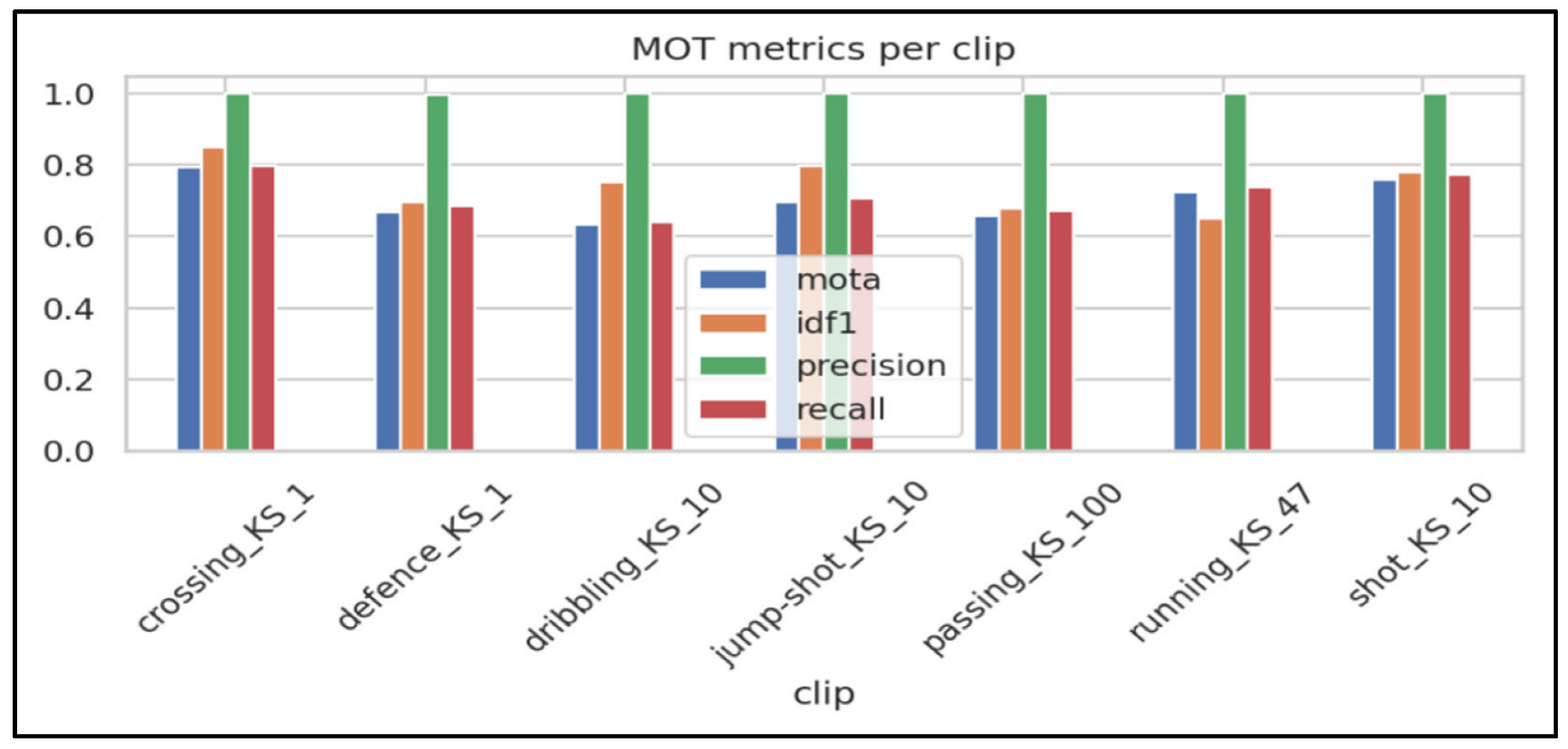
Tracking performance is evaluated using CLEAR MOT metrics to quantify overall association quality and identity stability across time. On the test split, the tracker achieves MOTA 0.71 and IDF1 0.74, as summarized in
Table 3. These values indicate that the system maintains coherent trajectories for a substantial portion of each clip, while still being affected by typical broadcast challenges such as occlusions, rapid camera motion, and dense player interactions.
Tracking precision reaches 1.00 (near-perfect precision), indicating that the produced track associations are highly reliable, and that false positive tracks or spurious associations are rare in this configuration. This behavior is consistent with a conservative tracking regime, where track initiation and association are accepted only when matching confidence is sufficiently high. In contrast, tracking recall is 0.72, suggesting that the dominant source of error is missed associations rather than false associations. In practice, recall degradation is primarily caused by prolonged occlusions and tightly clustered formations, where detections become intermittent or ambiguous. These conditions lead to fragmented track segments and reduced trajectory continuity, which can propagate to downstream court-projected motion analysis. From a pipeline perspective, this precision–recall profile is appropriate for trajectory-based analytics. False tracks and identity switches tend to contaminate motion-derived features more severely than short gaps, which can be partially mitigated through robust aggregation and temporal filtering.
Figure 5 provides a clip-wise breakdown of tracking performance. Precision remains consistently near-perfect across clips, whereas MOTA, IDF1, and recall vary across action scenarios. This variation is expected because clips with higher interaction density and frequent occlusions impose stricter requirements on data association and identity maintenance. Overall, the clip-level results confirm that identity stability is reasonably preserved, while residual errors concentrate in visually challenging situations rather than being uniformly distributed. All experiments are conducted using a fixed train–validation–test split, defined by the UNIRI-HBD dataset protocol. The same data partitions are used for all evaluated models to ensure fair comparison. Repeated cross-validation was not applied because the dataset is organized at the match level, and a match-wise split is necessary to prevent contextual leakage between training and test segments. Under this constraint, k-fold partitioning would either violate temporal boundaries between matches or produce folds too small to be representative. Instead, evaluation is performed on a fixed held-out test set of 113 clips, and statistical robustness is assessed through bootstrap confidence intervals and pairwise Wilcoxon signed-rank tests, as described in
Section 2.7.
Ablation Study: Effect of Temporal Sampling
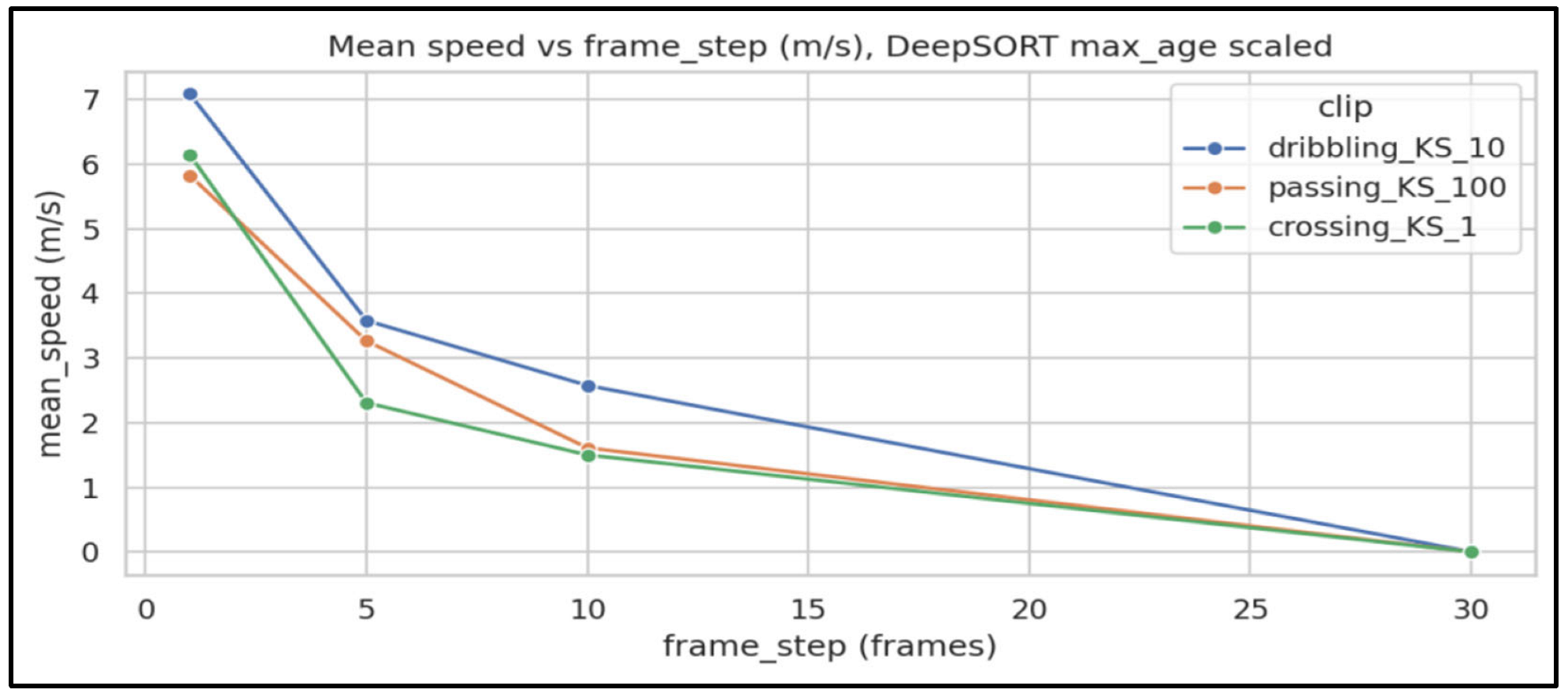
Beyond overall tracking accuracy, it is also important to analyze how sensitive the derived motion indicators are to temporal sampling. To analyze the sensitivity of the proposed pipeline to temporal sampling, an ablation experiment was conducted by varying the frame sampling step (frame_step) while keeping all other components of the pipeline fixed. The baseline configuration processes every frame (frame_step = 1), preserving the full temporal resolution of the broadcast video. All other configurations are evaluated relative to this baseline in order to quantify the impact of temporal subsampling on reconstructed trajectories and motion statistics. Frame steps of 1, 5, 10, and 30 were evaluated using representative clips from the evaluation dataset. For each configuration, the same detection outputs were used, and the tracking stage was executed with identical parameters. The DeepSORT temporal tolerance parameter (max_age) was scaled proportionally to the frame step in order to preserve a comparable association horizon between detections. For each configuration, trajectories were reconstructed in court coordinates and motion statistics were computed from the resulting track segments. The evaluated indicators include the mean player speed aggregated across all reconstructed tracks, the number of reconstructed trajectories, and the mean total distance per track. The quantitative results of the temporal sampling ablation experiment are summarized in
Table 4.
The ablation experiment shows a clear decrease in estimated mean speed as temporal sampling becomes coarser. Increasing the frame step from 1 to 5 reduces the estimated mean speed by approximately 50%. Further subsampling to frame_step = 10 results in an additional decrease, reaching approximately 64% lower mean speed relative to the baseline. This behavior occurs because sparse temporal sampling reduces the ability to capture curved trajectories, short accelerations, and frequent direction changes. When positions are sampled less frequently, the reconstructed path approximates straight segments between distant observations, which systematically underestimates the true traveled distance. At extreme subsampling (frame_step = 30), the temporal resolution becomes insufficient for stable tracking. In this configuration, the tracker fails to maintain consistent trajectories due to the large temporal gaps between detections, resulting in the disappearance of valid tracks. These results highlight that temporal sampling is a critical parameter in trajectory-based sports analytics pipelines and must remain consistent across experiments to ensure reproducible motion estimates.
Figure 6 illustrates the sensitivity of the estimated mean player speed to temporal sampling. The plot reports the estimated mean speed as a function of the frame step, while scaling DeepSORT temporal parameters accordingly to maintain a comparable association horizon. Even under this scaling, the mean speed decreases as the frame step increases. Coarser sampling reduces temporal resolution and tends to underestimate path length when motion includes curved trajectories, short accelerations, or frequent direction changes. This observation is important for reproducibility. For fair comparisons, the same frame step and feature computation protocol should be used for all reported results.
These results justify the use of full temporal resolution (frame_step = 1) in the main experiments reported in this study.
3.3. Court Projection and Visual Analytics Outputs
Court projection converts image-plane tracks into a common metric reference frame, enabling movement interpretation in meters and a consistent comparison across clips and action categories. After homography-based calibration, projected trajectories are expressed on a standardized 40 × 20 m court template. Motion indicators such as distance covered, speed percentiles, and turning intensity then reflect physical quantities rather than camera-dependent pixel measurements. This step is critical in broadcast settings because zoom and viewpoint changes would otherwise make image-space motion statistics difficult to interpret and not comparable between clips.
Beyond quantitative features, court projection also enables visual analytics for qualitative validation and coaching-oriented interpretation. Trajectory plots provide a direct view of the spatial paths followed by tracked identities. Occupancy heatmaps summarize spatial utilization by accumulating projected positions over time, followed by smoothing and normalization. These heatmaps highlight frequently visited regions, reveal coarse tactical structure such as preferred zones and transitions, and act as a diagnostic tool. Localized artifacts, discontinuities, or implausible concentrations can indicate tracking fragmentation, identity switches, or calibration drift. Since these outputs depend on both tracking and projection, their interpretability requires stable detections, reliable identity maintenance, and accurate homography estimation, especially under heavy occlusion and rapid camera motion.
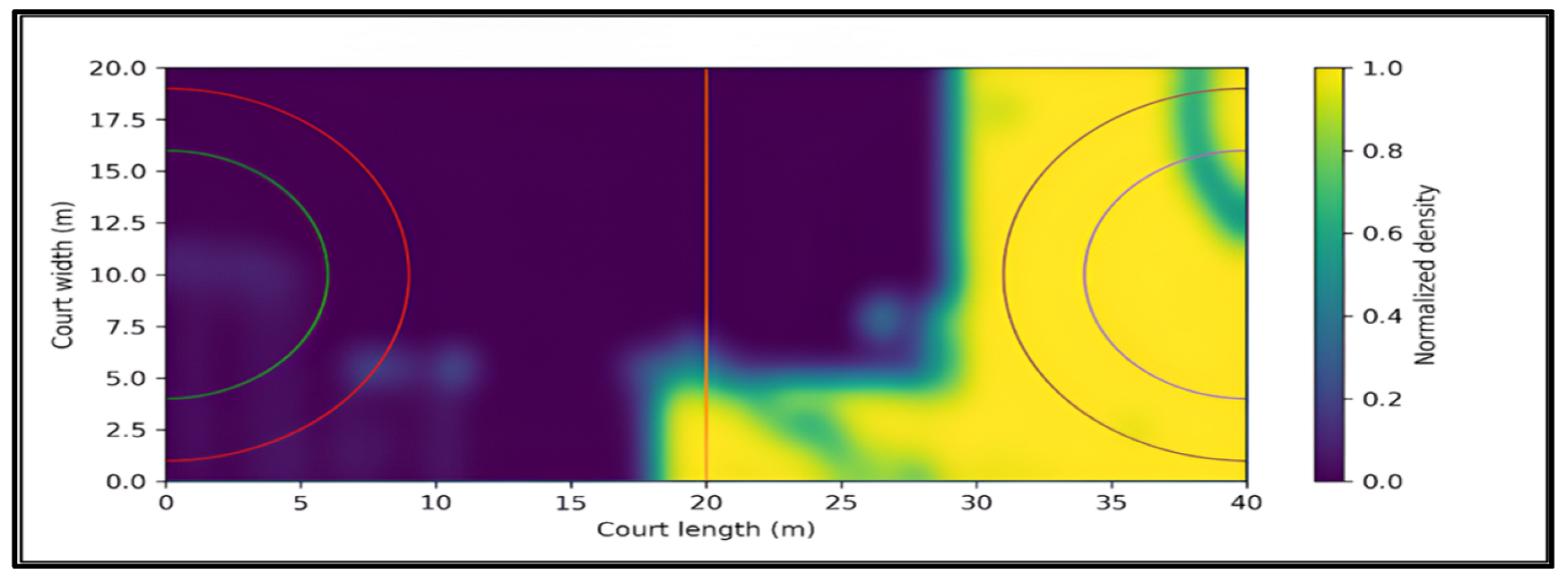
A representative heatmap is shown in
Figure 7. The visualization reports a normalized density over the court plane, where brighter regions correspond to higher accumulated occupancy. To ensure fair comparisons, the same court coordinate system and normalization procedure are used throughout. When clips include attacks in opposite directions, the court coordinates are flipped so that the attacking direction is fixed, ensuring that left–right asymmetries reflect movement tendencies rather than camera orientation. Since heatmaps and trajectory-based indicators rely on the geometric projection, projection reliability is assessed using manually annotated court landmark correspondences on a subset of evaluation clips. For N equals 20 clips, visible court intersections are annotated and mapped to their known template coordinates. For each annotated landmark, the homography projection is applied, and the reprojection error is computed as the Euclidean distance between the projected point and the corresponding ground-truth template point, reported in pixels. The mean reprojection error and its standard deviation are then calculated across all annotated landmarks and clips. Using the adopted court template and resolution, pixel errors can be approximately interpreted in metric units by using a reference scale of about 0.04 m per pixel in court space, so that 5 pixels correspond to about 0.2 m and 10 pixels correspond to about 0.4 m.
This level of geometric error is acceptable for motion indicators such as distance covered and average speed, where accumulated displacements typically exceed several meters. Overall, these results support the use of homography-based projection as a reliable step for obtaining stable metric coordinates under broadcast conditions.
3.4. Action Recognition Results
Table 5 summarizes clip-level action recognition performance on the held-out test set (n = 113 clips) using the proposed trajectory-derived representation described in
Section 2.6. Among the evaluated classifiers, Random Forest and Gradient Boosting achieve the strongest overall performance, both reaching an accuracy of 0.805. Random Forest attains the highest macro-F1 of 0.745, while Gradient Boosting yields a very similar macro-F1 of 0.743, indicating comparable effectiveness under the same feature representation and protocol. Extra Trees follows closely with an accuracy of 0.791 and a macro-F1 of 0.719, suggesting that increased split randomization leads to a small reduction in macro-averaged performance in this setting.
Boosting with XGBoost achieves an accuracy of 0.761 and a macro-F1 of 0.693, providing competitive performance but remaining below the best-performing tree ensembles in macro-averaged scores. Logistic Regression reaches an accuracy of 0.619 and a macro-F1 of 0.540, reflecting the limitations of a linear decision boundary for the proposed descriptors. Gaussian Naive Bayes yields an accuracy of 0.451 and a macro-F1 of 0.431, serving as a low-complexity probabilistic baseline under strong independence assumptions.
Because the dataset is class-imbalanced, macro-averaged precision, recall, and F1 are emphasized. Unlike accuracy, macro-averaged metrics assign equal weight to each class and therefore better reflect performance on minority categories. In this setting, Random Forest reaches macro-precision 0.813, macro-recall 0.712, and macro-F1 0.745. This indicates that the model generalizes reasonably well across categories, while recall remains weaker for rare actions.
Bootstrap 95% confidence intervals for accuracy were computed using 2000 resamples of the held-out test set (n = 113 clips) to quantify the uncertainty associated with each point estimate. Pairwise Wilcoxon signed-rank tests were applied to assess whether performance differences between classifiers are statistically supported. The results indicate that no statistically significant difference is observed among the top-performing tree-based ensembles at α = 0.05 (Random Forest vs. Extra Trees: p = 0.655; Random Forest vs. Gradient Boosting: p = 1.000; Random Forest vs. XGBoost: p = 0.059). The overlapping confidence intervals across the leading models are consistent with this finding and reflect the limited discriminative power of the test set under the current sample size. These results suggest that the observed ranking among tree-based classifiers should be interpreted with caution, and that a larger annotated dataset would be required to establish statistically reliable performance differences between closely performing models.
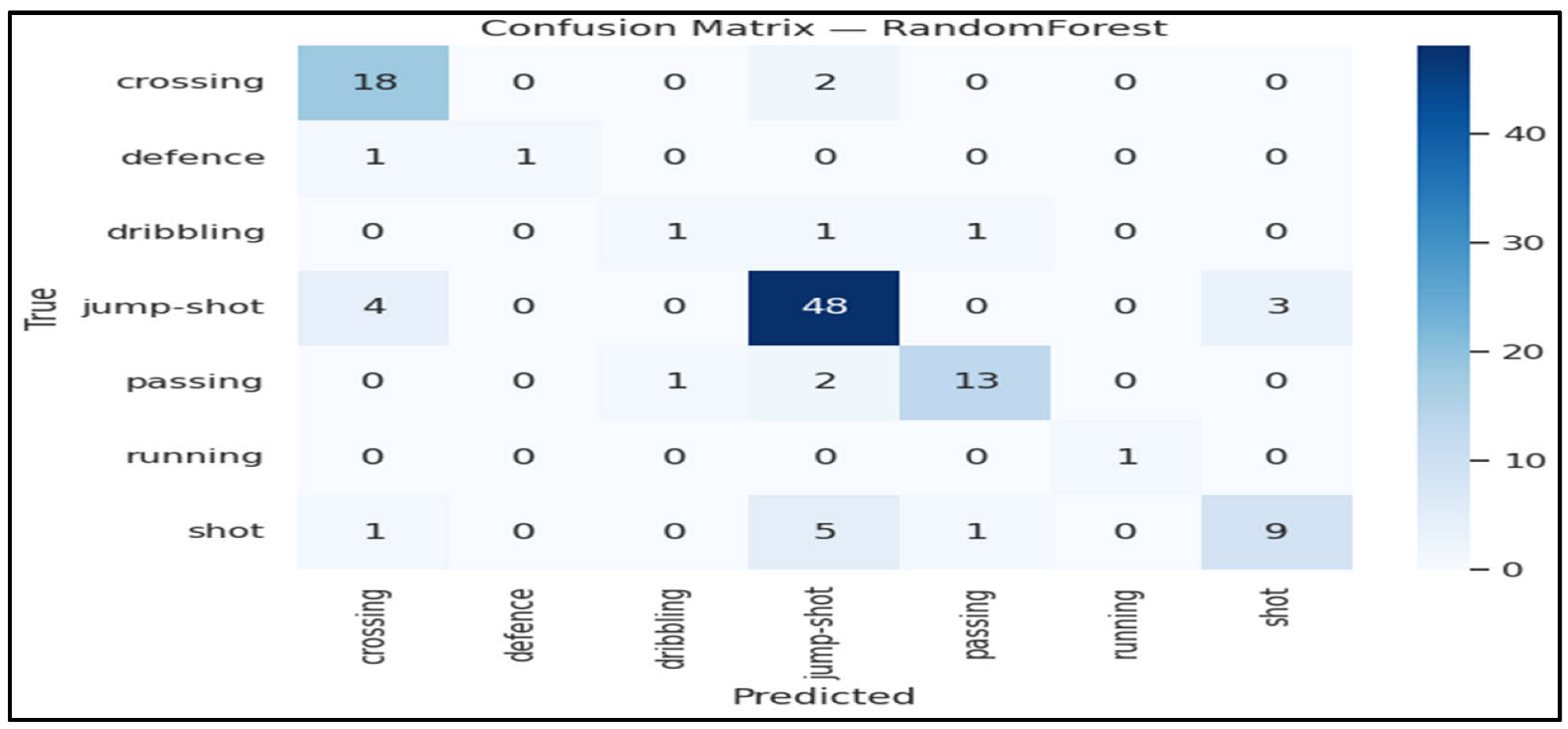
Figure 8 reports the confusion matrix of the best-performing Random Forest classifier on the held-out test set. The strong diagonal structure indicates robust recognition for the most frequent categories. Jump-shot is recognized reliably, with 48 correct predictions. Crossing and passing also show stable performance, with 18 and 13 correct predictions, respectively.
The most prominent confusions occur between a shot and jump-shot. Several shot instances are predicted as jump shots, and a smaller number of jump-shot instances are predicted as shots. This behavior is consistent with broadcast footage, where the two actions may share similar short-term kinematic signatures. Camera zoom and viewpoint changes can further reduce the discriminative power of trajectory-only cues. Additional errors include crossing predicted as a jump-shot, which can arise in fast transitions that exhibit high-speed bursts and abrupt direction changes.
Minority classes remain the main challenge. Categories with very low support, such as defense and running, yield few correct predictions. This directly lowers macro-recall and helps explain why macro-F1 remains substantially below accuracy.
The confusion matrix shows that most errors occur between kinematically similar actions, such as a shot and a jump-shot, where the underlying player motion differs subtly, and ball-related cues are not explicitly modeled. Misclassifications are also more frequent for low-support classes, which reduces macro-recall and macro-F1. This suggests that additional cues, such as explicit ball tracking or richer temporal descriptors, could improve separation between visually similar actions.
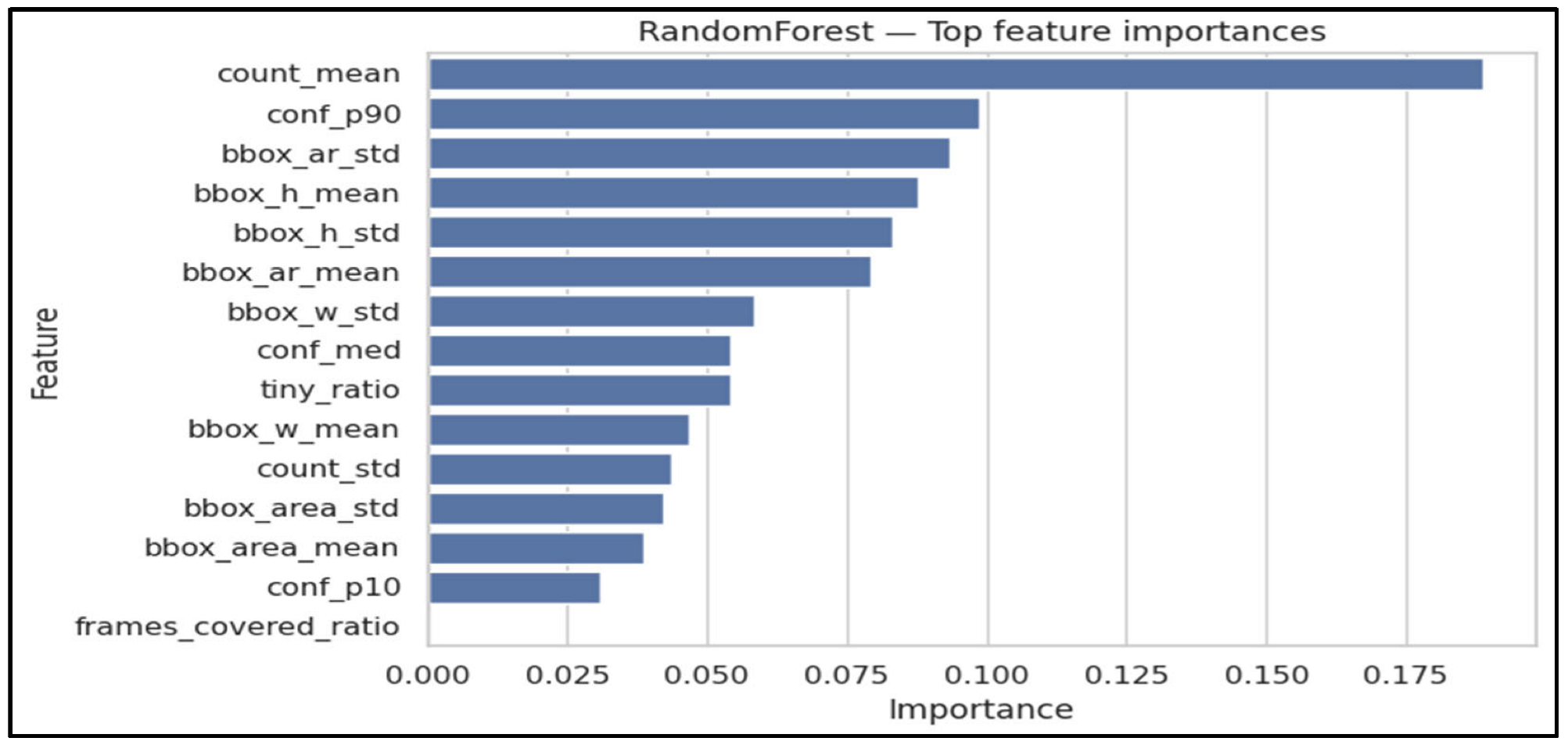
Feature importance for Random Forest is shown in
Figure 9 and indicates that scene-density and detection-stability descriptors play a major role in the model decisions. The most influential feature is count_mean, the mean detections per frame, which acts as a proxy for scene density and often correlates with crowded phases of play. High importance is also assigned to confidence percentiles such as conf_p90 and conf_med, as well as scale and shape statistics such as bbox_h_mean and bbox_ar_std. These features capture camera zoom effects and detection consistency under motion blur and partial occlusion.
Importantly, these importance scores reflect how strongly a feature is used by the model in this dataset and configuration and should not be interpreted as causal evidence. The prominence of scene-density and detection-stability descriptors suggests that part of the classification signal is linked to upstream detection and tracking reliability under specific viewing conditions, including crowding, zoom, and occlusion, rather than purely action-specific motion patterns. This observation motivates future extensions that incorporate more action-specific cues, such as longer temporal context or ball-related information, to reduce ambiguity between kinematically similar classes.
Across the evaluated clips, the pipeline produces stable court-referenced trajectories that support quantitative motion indicators and coaching-oriented visualizations. Homography-based calibration maps image-plane detections to a standardized 40 × 20 m court, enabling metric interpretation of movement and consistent comparison across clips.
Detection and tracking performance remain the primary drivers of downstream reliability. The detector operates in a high-precision regime, while missed detections and prolonged occlusions are the main sources of trajectory fragmentation. Tracking results indicate generally stable identity maintenance, with errors concentrated in dense and visually challenging scenes. These limitations propagate to projected trajectories and can increase sensitivity to calibration noise when detections become unstable.
Action recognition results show that the interpretable trajectory-derived feature set provides a practical baseline under broadcast conditions and limited labeled data. Tree-based ensembles achieve the strongest macro-averaged performance, with Random Forest and Gradient Boosting performing best overall, followed by Extra Trees. XGBoost provides competitive results but remains below the best-performing ensembles, while Logistic Regression and Gaussian Naive Bayes serve as weaker baselines for the proposed descriptors. The main confusions occur between kinematically similar actions, especially shot versus jump-shot, and class imbalance further increases difficulty for rare categories. Overall, the most promising improvements are expected from more robust tracking under occlusions and more stable court calibration, together with richer action cues that reduce ambiguity between similar motions.
4. Discussion
4.1. Explanation of Results and Implications
The results demonstrate that a modular monocular broadcast pipeline can reliably extract metrically consistent handball analytics if detection and tracking maintain sufficient temporal stability. Under broadcast conditions, detection performance achieves a precision of 0.896 and a recall of 0.768, which provides a reliable input to the tracking stage. This matters because detection errors propagate directly to tracking and trajectory quality. Missed detections tend to create gaps that fragment trajectories, while false positives can introduce spurious short tracks and increase the risk of identity instability.
Tracking performance, with MOTA 0.71 and IDF1 0.74, indicates that identity consistency is generally maintained across many clips, but performance degrades in the most difficult situations. In handball, dense interactions and prolonged occlusions are frequent and can interrupt association over multiple frames. This behavior is reflected in the tracking recall of 0.72 and in occasional trajectory fragmentation. These discontinuities reduce the reliability of motion indicators that rely on temporal continuity and can also weaken the stability of aggregated trajectory-derived features used for recognition.
Court projection is critical for interpretability because it converts image-plane tracks into a common metric coordinate system. Homography-based calibration enables movement indicators in meters and supports coaching-oriented visual outputs such as court-referenced trajectories and heatmaps. This step also enables consistent comparison across clips since motion descriptors become less sensitive to camera zoom and viewpoint changes. In practice, calibration quality depends on the visibility of court landmarks and the magnitude of camera motion. When calibration is accurate, the resulting analytics align with meaningful tactical regions of the court rather than pixel coordinates. When calibration is imperfect, projection noise can distort trajectory geometry and inflate derived quantities such as speed and turning, especially when combined with tracking gaps.
Action recognition results indicate that interpretable kinematic and detection-derived features provide a practical baseline for clip-level classification under limited and imbalanced data. Among the evaluated models, tree-based ensembles achieve the strongest macro-averaged performance. Random Forest reaches an accuracy of 0.805 and macro-F1 of 0.745, while Gradient Boosting performs comparably with an accuracy of 0.805 and macro-F1 of 0.743. Extra Trees follows with an accuracy of 0.791 and a macro-F1 of 0.719. XGBoost achieves an accuracy of 0.761 and macro-F1 of 0.693, whereas Logistic Regression and Gaussian Naive Bayes provide weaker baselines for the proposed descriptors. Overall, these outcomes suggest that the feature set captures informative motion cues, but confusion between visually and kinematically similar actions remains, particularly under occlusion and viewpoint variation and for low-support classes. This limitation is expected in broadcast settings where ball cues are not explicitly modeled and where tracking fragmentation can obscure action-specific motion patterns.
Overall, the findings support the hypothesis that modular components with explicit intermediate representations can deliver useful coaching-oriented analytics from broadcast footage. At the same time, the results clarify the main bottlenecks for further improvement. The dominant limitations are robust tracking under prolonged occlusion and more stable court calibration under fast camera motion. Addressing these issues is likely to improve both the quality of motion analytics and the discriminative power of trajectory-derived action recognition features.
4.2. Comparison with Related Works
Direct comparison with prior handball studies should be interpreted with care because experimental conditions are not fully aligned across datasets and pipelines. Differences in frame rates, camera viewpoints, annotation policies, label definitions, and evaluation splits can substantially affect both the difficulty of the task and the interpretation of the reported metrics. As a result, studies may report metrics with the same name while evaluating different operational problems, such as player detection in controlled capture environments versus identity stability during multi-object tracking in broadcast footage.
Another aspect worth discussing concerns the choice of lightweight classifiers instead of end-to-end deep action recognition models such as 3D convolutional networks or transformer-based architectures. These models typically require substantially larger annotated datasets to achieve stable training and reliable generalization. The UNIRI handball dataset used in this study contains 751 annotated clips comprising 59,641 frames, and exhibits strong class imbalance, which limits the effectiveness of data-hungry deep temporal models. Under these conditions, interpretable motion descriptors combined with classical machine learning classifiers provide a more stable and data-efficient solution. Moreover, the proposed pipeline focuses on extracting explicit trajectory-based motion features that remain interpretable for coaching and sports analytics applications. Future work may explore hybrid approaches that combine trajectory-based descriptors with deep spatiotemporal representations.
A major source of mismatch across studies is the data acquisition setting and the intended output of each work. The UNIRI-HBD line of work by Maja Ivašić-Kos and Mirko Pobar focuses on handball-specific dataset construction and player-centric labeling strategies, including active player identification and annotation approaches that often rely on capture conditions different from broadcast video, such as fixed viewpoint recordings [
4,
5,
9]. These contributions are highly relevant for defining action labels and building handball datasets, and they support detection-oriented evaluation and player selection criteria. However, they do not define a single end-to-end broadcast protocol that jointly evaluates tracking, court projection, and downstream analytics under conditions such as camera motion, zoom changes, motion blur, and dense player occlusions.
Within this family of work, active player detection is typically addressed using handball-specific cues and activity measures that help identify the most relevant players in a scene [
4]. Related dataset construction approaches combine detector outputs with additional spatiotemporal cues to accelerate labeling and improve annotation consistency [
5]. These directions align with the present study at the level of label definition and annotation logic. However, they remain only partially comparable to a broadcast pipeline, where identity continuity and calibration robustness strongly influence the quality of trajectories and the reliability of downstream interpretation.
Other handball studies broaden the scope to movement analysis and action recognition, yet comparability remains limited because the representation and evaluation targets differ. Movement analysis studies often focus on describing activities and motion patterns using deep learning approaches with their own annotation handling and experimental protocols [
6]. Action recognition work in handball scenes also varies in action taxonomy, clip definition, and dataset split strategy, which directly affects class balance and task difficulty and makes headline performance numbers sensitive to protocol choices [
7]. Consequently, similarities in task naming do not necessarily translate into comparable experimental evidence.
Among the cited handball works, PlayNet is one of the closest to an integrated real-time workflow because it aims to map video streams to play-level categories using tracking-related modeling and learned embeddings under latency constraints [
10]. This makes it conceptually related in terms of the broader “video-to-semantics” objective. However, it differs from a modular broadcast pipeline that explicitly evaluates intermediate representations such as identity-consistent trajectories expressed in metric units. This distinction is important because a modular design allows upstream failure modes to be separated from downstream modeling limitations and supports coaching-oriented interpretation and targeted debugging.
A second line of research adopts pose-based reasoning. Monocular 3D pose estimation and tracking in handball shifts the intermediate representation from court-plane trajectories to articulated body configurations and their temporal dynamics [
11]. Such approaches can provide detailed cues for fine-grained action recognition, but they change the error budget and the evaluation perspective. In pose-based pipelines, pose quality, visibility, and scale become primary factors affecting performance, while court-plane calibration and metric trajectories play a different role. Consequently, pose-based results are best considered complementary rather than directly comparable to trajectory-derived feature pipelines.
At the tracking layer, many sports analytics systems still rely on established online baselines such as SORT and DeepSORT, which combine Kalman filtering with assignment strategies and optionally appearance embeddings for re-identification across short occlusions [
2,
3]. Tracking performance is commonly evaluated using CLEAR MOT metrics, which explicitly quantify identity switches and trajectory fragmentation—two failure modes that are particularly critical in multi-player sports scenes [
12]. Recent tracking-by-detection advances aim to improve identity continuity under occlusions and varying detection confidence, which are common challenges in broadcast sports footage. These methods, therefore, represent plausible upgrade paths for the tracking stage even when they are not handball-specific [
13,
14,
15,
16]. Sports-oriented multi-object tracking datasets further show that tracking performance can shift substantially across domains and protocols, reinforcing the need for caution when interpreting cross-paper comparisons [
17,
18].
Court projection is typically formulated as homography-based registration that maps image coordinates to field or court coordinates, enabling the reconstruction of metric trajectories when calibration is stable. Handball-specific broadcast calibration is less represented in the cited literature, but closely related methodological work exists in other sports, such as soccer. These studies propose robust calibration strategies for moving cameras, partial field visibility, and broadcast artifacts, including sequential homography estimation and calibration-aware localization methods [
19,
20,
21]. End-to-end soccer analytics pipelines that reconstruct game state and generate top-view representations further illustrate how calibration, localization, and identity tracking can be integrated within a unified system [
22]. While such systems are not directly comparable to handball pipelines, they provide useful methodological references. Additional work on homography estimation has also explored strategies that improve robustness when classical feature matching becomes unreliable [
23].
In contrast, the present study evaluates a complete monocular pipeline on broadcast footage under a single fixed experimental protocol across all stages. The evaluation includes player detection, multi-object tracking assessed with CLEAR MOT metrics [
12], homography-based court projection that produces trajectories in metric units, and clip-level action recognition using interpretable trajectory-derived features. The central contribution lies in the modular design with explicit intermediate representations. This structure supports coaching-oriented interpretation and systematic error analysis by tracing downstream failures to concrete upstream causes, including missed detections, identity fragmentation that is typical of SORT- and DeepSORT-style tracking, and calibration noise in the projection stage [
2,
3]. Therefore, the proposed evaluation is not intended as a leaderboard-style comparison with prior handball studies, but rather as a controlled assessment of how errors propagate across detection, identity tracking, spatial projection, and action recognition under realistic broadcast constraints.
4.3. Limitations
This study is evaluated on broadcast handball footage, where performance can degrade under heavy player occlusions, rapid viewpoint changes, and zoom events that affect court calibration and tracking stability. Court projection relies on homography estimation, which becomes less reliable when court markings are only partially visible or when camera motion is abrupt. In the current implementation, court calibration relies on manually annotated court landmarks, which may limit scalability for large-scale deployments or fully automated analysis pipelines. In such cases, projection noise can distort trajectories and influence derived motion indicators such as speed and turning.
Tracking quality also depends strongly on detector performance. Missed detections can interrupt associations, fragment trajectories, and reduce the continuity required for stable motion descriptors. Although high precision limits spurious tracks, reduced recall in dense scenes remains a practical source of downstream errors.
The action recognition component relies primarily on trajectory-derived motion features and is constrained by the available labeled data and class imbalance. As a result, rare action categories remain challenging, and generalization may be limited across competitions, camera setups, and filming conditions. In addition, the current representation does not explicitly model ball context or fine-grained pose cues, which can increase ambiguity between actions with similar movement patterns. Trajectory-based motion descriptors capture a substantial portion of player dynamics. However, additional contextual cues such as ball trajectory, player pose, and interaction patterns may further improve the discrimination of semantically similar actions in dense team sport scenarios. Future work may therefore explore hybrid approaches that combine trajectory-based motion features with appearance-based deep video representations.
Finally, the reported results are tied to the adopted data split and evaluation protocol. While these are kept fixed for comparability across stages, alternative splits or more diverse datasets could lead to different performance profiles and may change which failure modes dominate.
4.4. Future Work
Future work can improve robustness and extend the analytics in several directions. Tracking can be strengthened under heavy occlusion by using improved re-identification, explicit occlusion handling, and camera motion compensation. These additions can reduce identity switches and trajectory fragmentation. Integrating appearance cues more effectively with motion-based association is also expected to increase tracking recall in dense interactions.
Court calibration can be made more scalable by reducing manual effort and improving stability under viewpoint changes. One direction is automatic or semi-automatic detection of court key points, followed by robust homography estimation that remains stable during zoom events and rapid camera motion. Temporal smoothing of calibration parameters across frames can further reduce projection jitter and improve the reliability of metric trajectories.
Action discrimination and event understanding can be enhanced by incorporating cues beyond player trajectories. Future work may also investigate hybrid approaches combining trajectory-based motion descriptors with appearance-based deep video representations, which could further improve action recognition in complex interaction scenarios. Ball detection and ball–player interaction signals would help disambiguate actions with similar kinematic patterns. Broader context, such as team formation descriptors or phase-of-play indicators, could also improve recognition and support richer tactical analytics. A further direction for future work is a more detailed ablation analysis at the feature level. While the current study combines trajectory-derived motion features with detection-based descriptors, future experiments could isolate the contribution of different feature groups. This would allow a more precise evaluation of the relative importance of motion dynamics and detection-related context in action recognition performance. The current feature design prioritizes interpretability, enabling direct inspection of motion-related quantities such as speed and trajectory patterns.
Finally, with larger labeled datasets, stronger temporal modeling can be explored for action recognition, including sequence-based classifiers that explicitly capture motion evolution over time. Such models should be introduced in a controlled way that preserves interpretability. This can be supported through feature attribution, systematic error analysis, and a fixed evaluation protocol to maintain reproducibility.