
An Experimental and Numerical Investigation into Compressor Casing Heat Shield Effectiveness †
 ,
,
Abstract
1. Introduction
2. Experimental Investigation
2.1. Test Facility
2.2. Instrumentation
2.3. Test Conditions
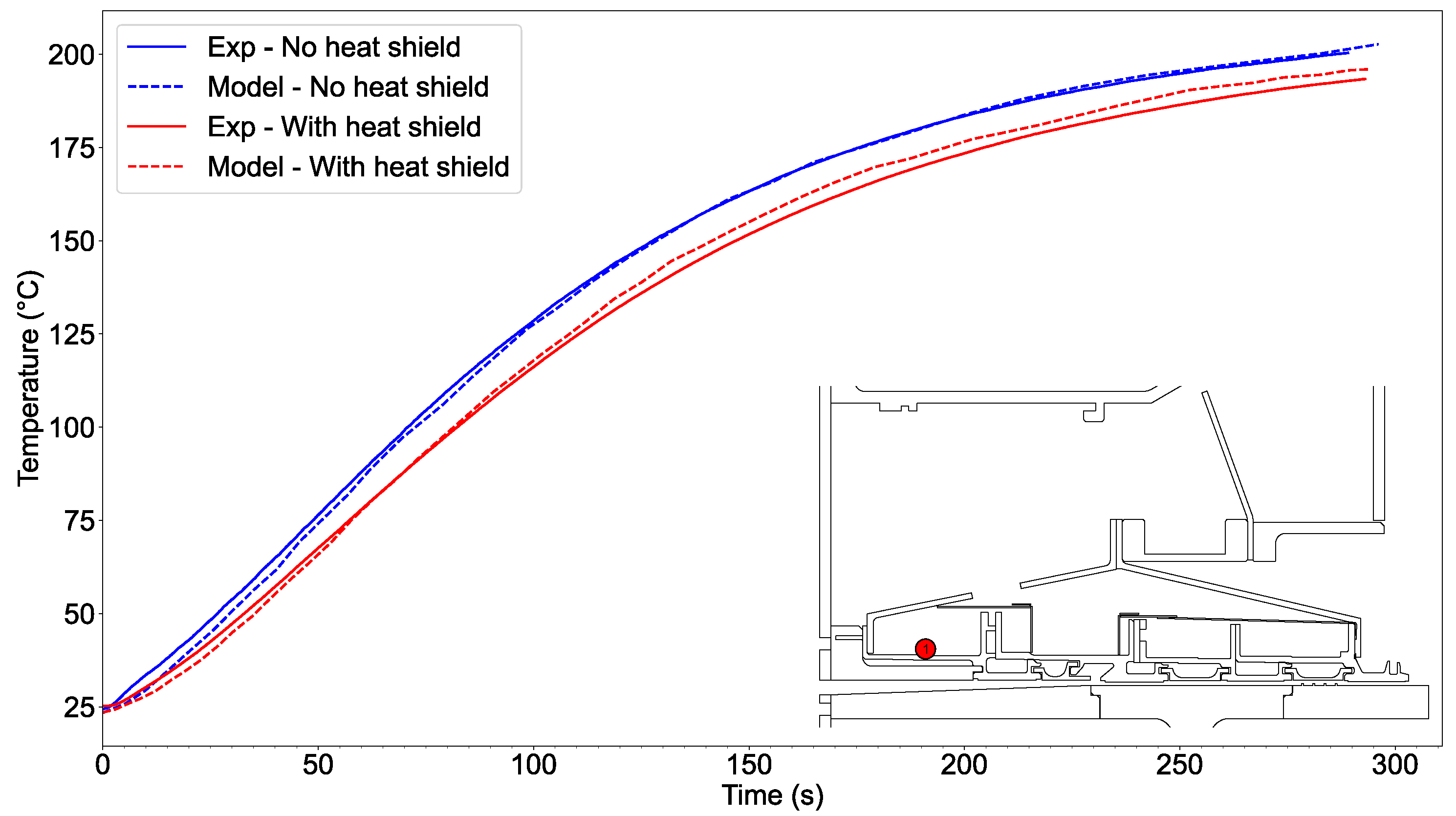
2.4. Experimental Results
3. Numerical Investigation
3.1. Method
- Use ANSYS SpaceClaim to simplify the CAD geometry used in the experiment, making it water-tight, extracting fluid volume and preparing it for meshing.
- Use ANSYS Fluent to generate the CFD mesh with multiple layers of prismatic cells at the wall boundaries, ensuring appropriate mesh resolution to capture the heat transfer behaviour and filling the remaining volume with poly-hexa cells.
- Apply boundary conditions and converge the CFD model—first steady state and unsteady if required.
- Identify dominant flow structures by post-processing the CFD results. Extracting data from the CFD model to define boundary condition positions, mass flow splits, recirculations and heat transfer coefficients in SC03.
- Create the SC03 model and run through the transient cycle.
- Compare the SC03 model results to the test data. Make physically justifiable modifications to the model if necessary, to match the numerical results to measurements.
3.2. CFD Setup
3.3. CFD Results
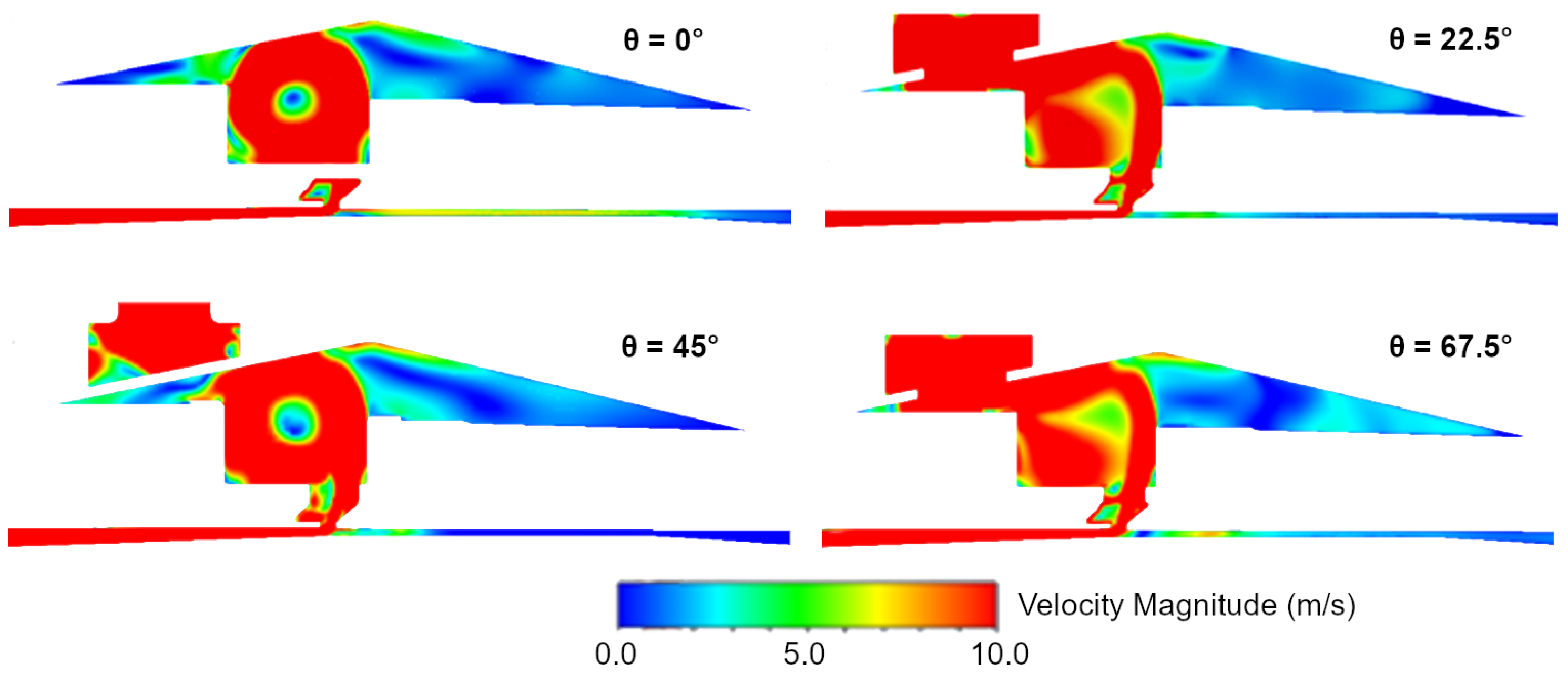
3.3.1. Non-Heat Shielded Cavity
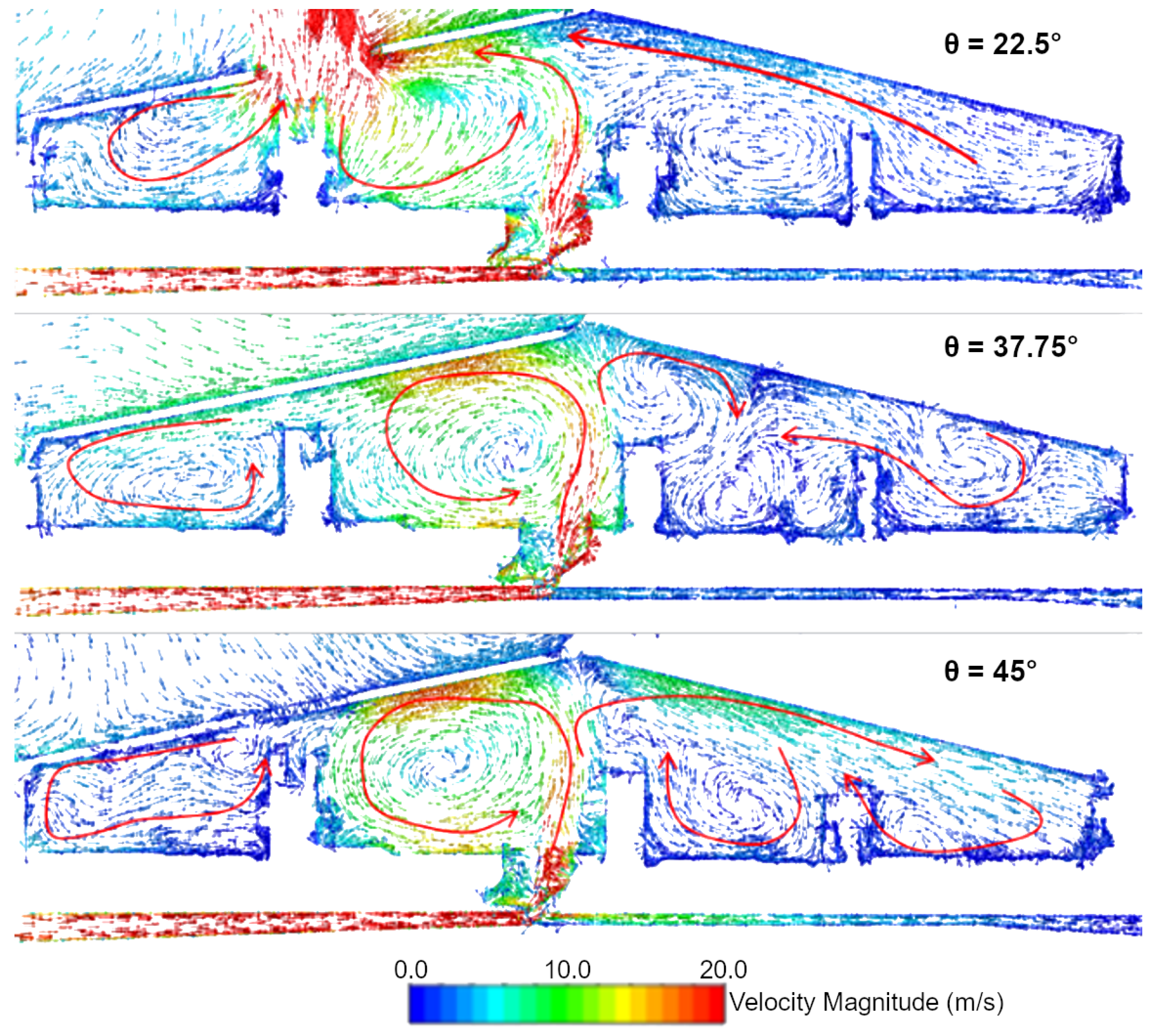
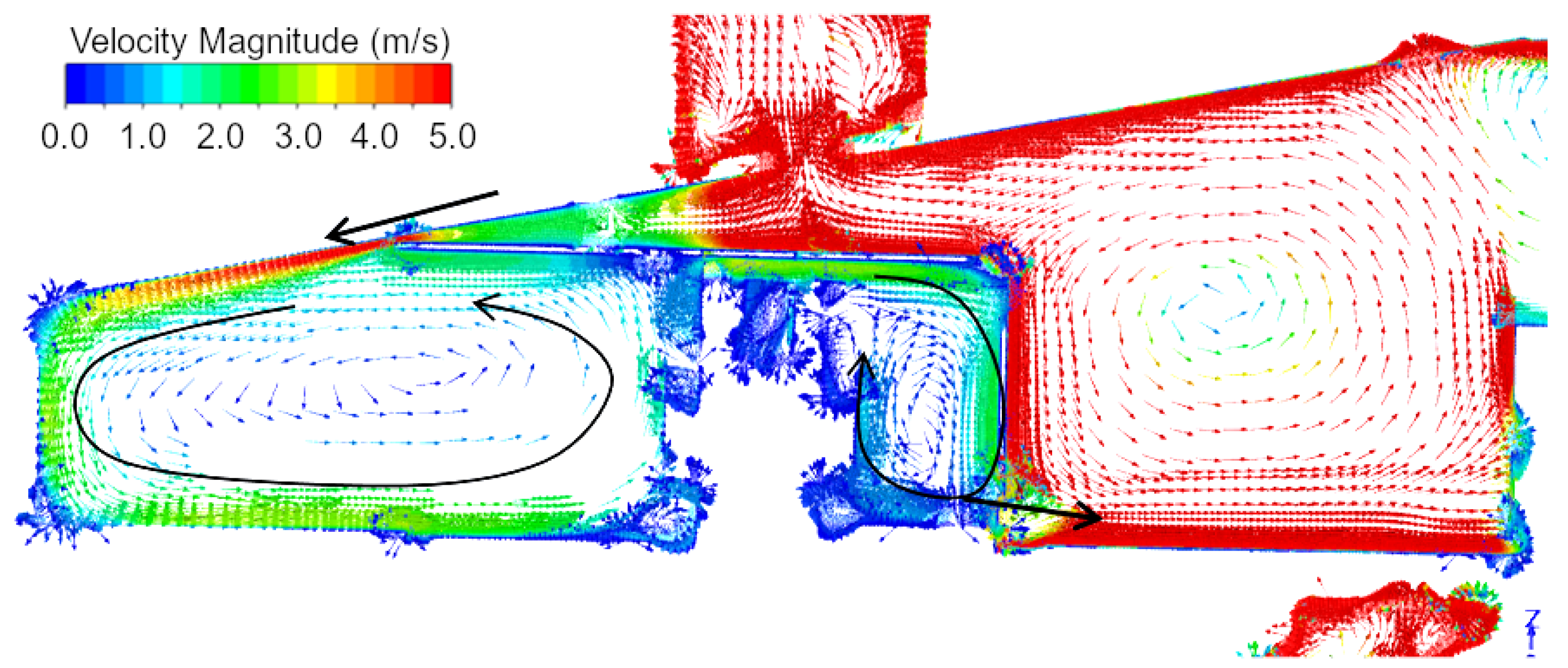
3.3.2. Heat Shielded Cavity
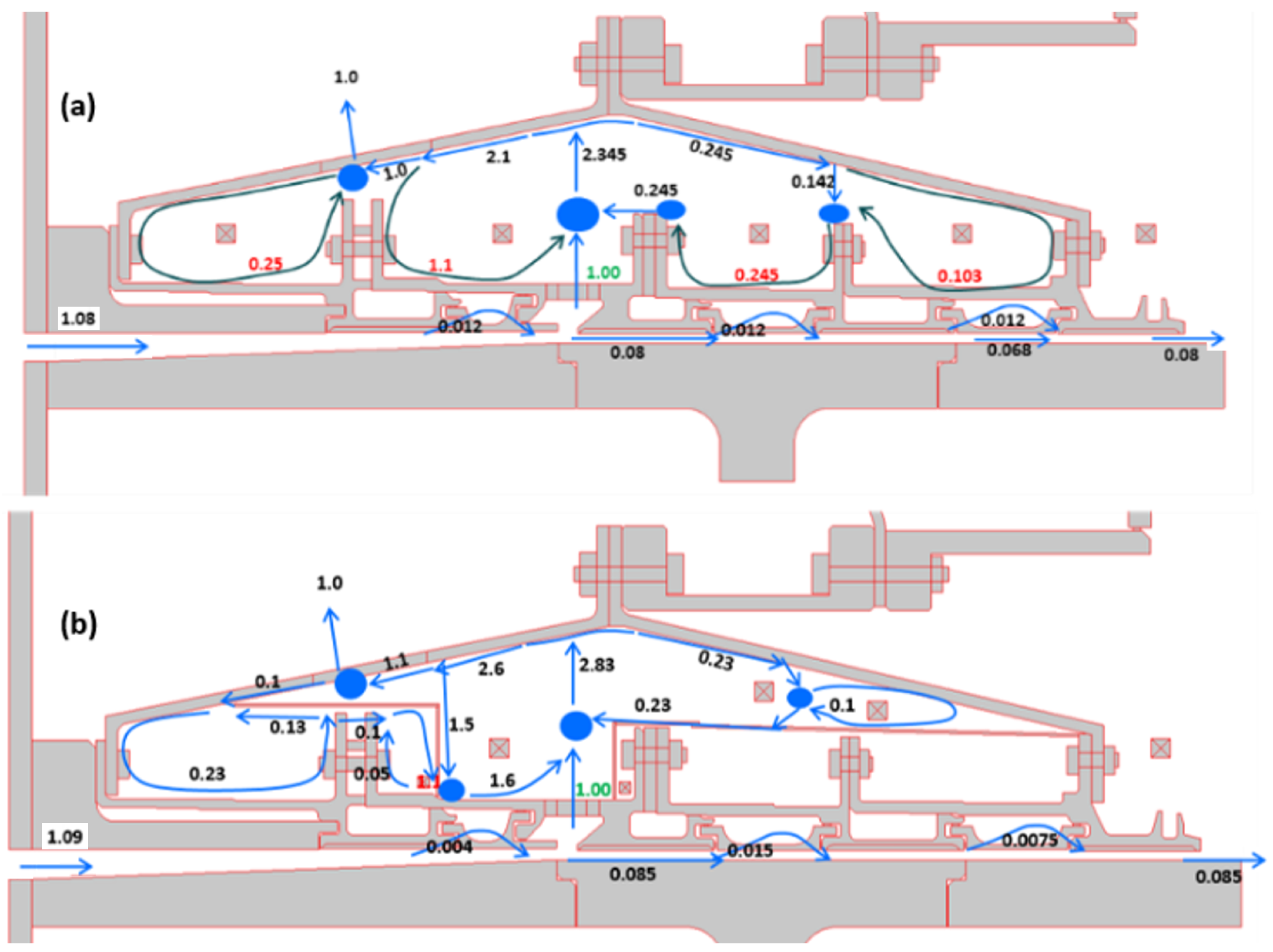
3.4. The 2D Flow Network Model
3.5. Finite Element Modelling
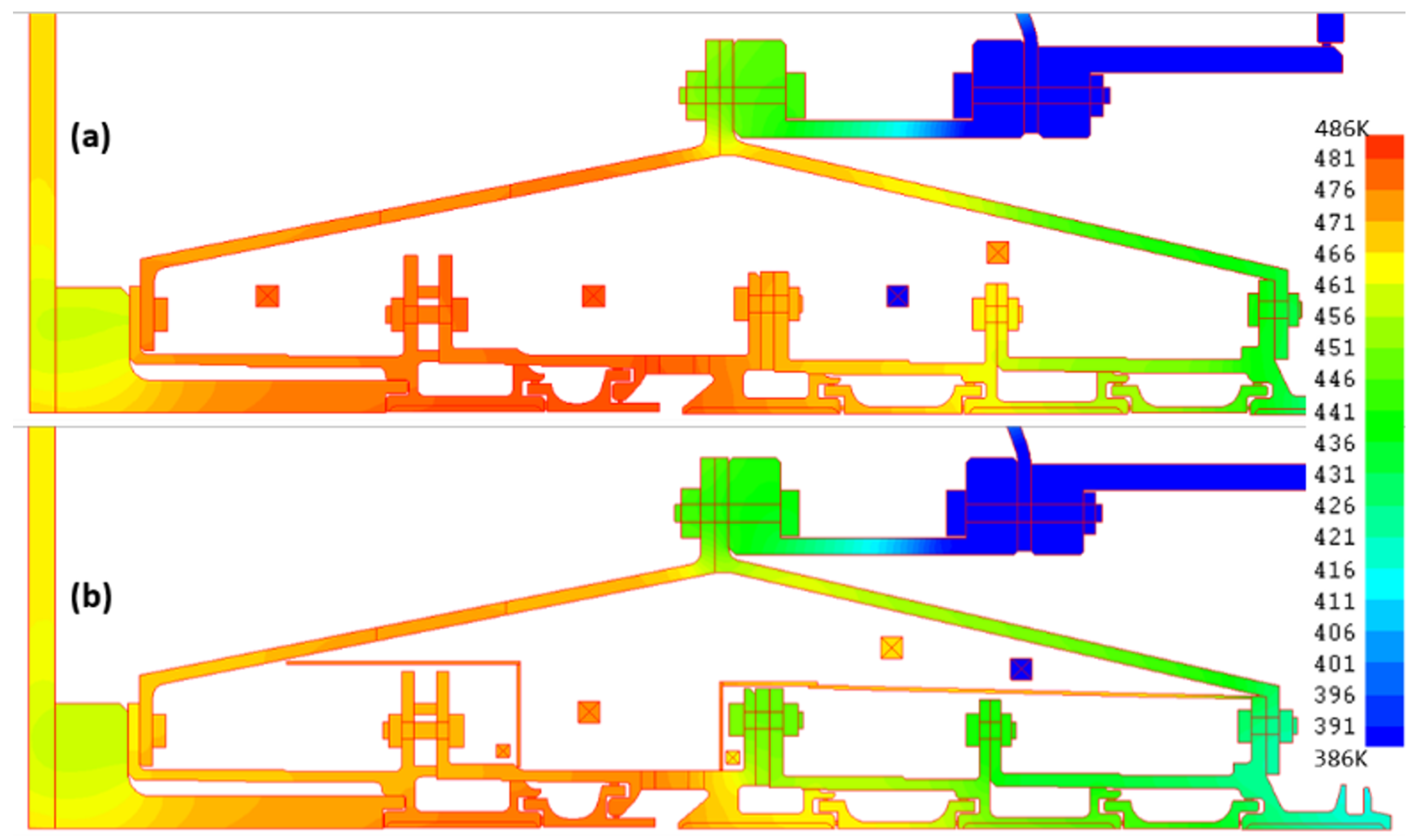
3.6. Thermal Matching
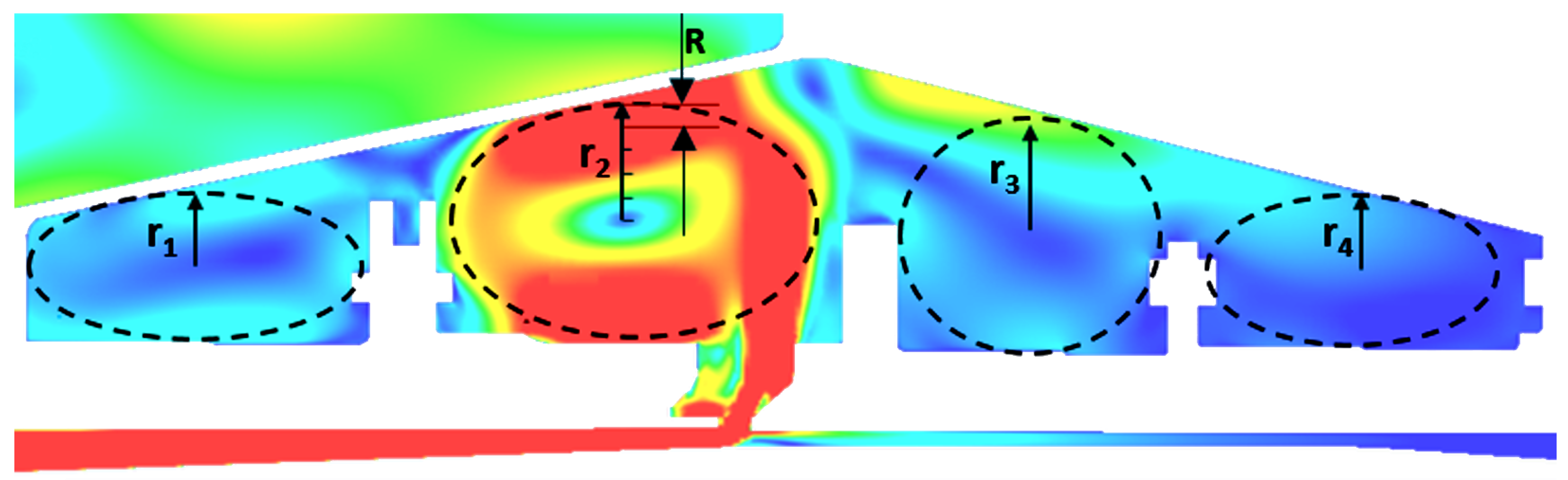
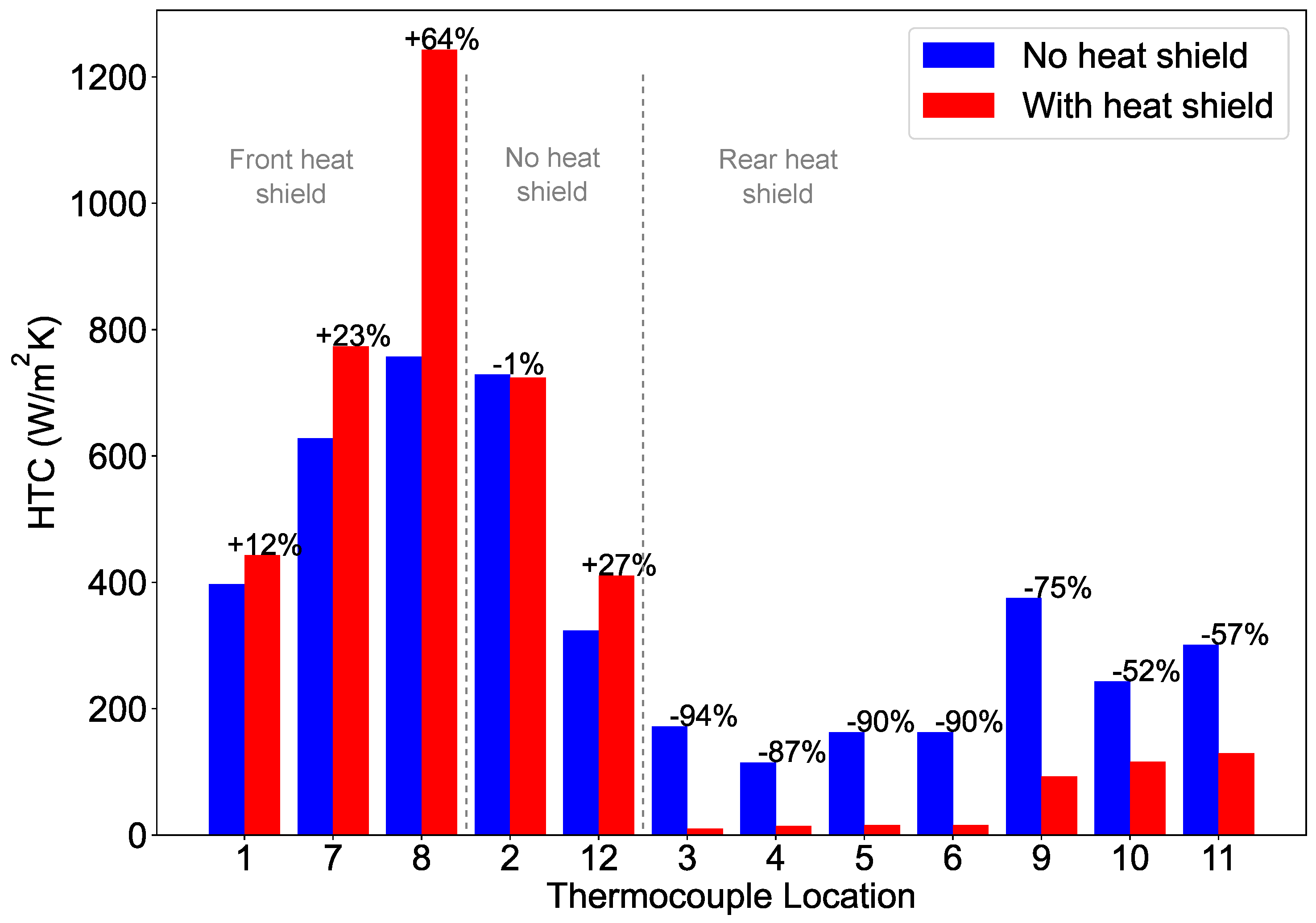
3.7. HTC Comparison
4. Conclusions
Author Contributions
Funding
Data Availability Statement
Conflicts of Interest
Nomenclature
| a | Heat transfer source strength |
| b | Intrinsic time constant |
| Specific heat capacity | |
| A | Area for convective heat transfer |
| M | Mass of solid |
| Hydraulic diameter | |
| h | Heat transfer coefficient |
| k | Thermal conducivity |
| Mass flow rate | |
| Nusselt Number | |
| Prandtl Number | |
| Reynolds Number | |
| Initial temperature | |
| Metal temperature | |
| Driving air temperature | |
| V | Flow velocity |
| Darcy friction factor (rough duct) | |
| Darcy friction factor (smooth duct) | |
| Dynamic viscosity | |
| Density | |
| Thermal time constant | |
| Wall shear stress | |
| CFD | Computational Fluid Dynamics |
| FEM | Finite Element Model |
| HTC | Heat Transfer Coefficient |
| THTF | Transient Heat Transfer Facility |
| HPC | High Pressure Compressor |
References
- Kiss, A.; Spakovszky, Z. Effects of transient heat transfer on compressor stability. J. Turbomach. 2018, 140, 121003. [Google Scholar] [CrossRef]
- Crawford, R.; Burwell, A. Quantitative evaluation of transient heat transfer on axial flow compressor stability. In Proceedings of the 21st Joint Propulsion Conference, Monterey, CA, USA, 8–11 July 1985; p. 1352. [Google Scholar]
- Malavade, P.; Babu, S.G.; Frosini, L.; Marchetti, S. Design of Heat Shield for Compressor Case of Industrial Gas Turbine to Meet Clearance Requirement. In Proceedings of the Turbo Expo: Power for Land, Sea, and Air, Online, 21–25 September 2020; American Society of Mechanical Engineers: New York, NY, USA, 2020; Volume 84225. [Google Scholar]
- Riahi, A.; Borns, F.G. Gas turbine combustor heat shield impingement cooling baffle. In Proceedings of the Turbo Expo: Power for Land, Sea, and Air, Vienna, Austria, 14–17 June 2004; Volume 41685, pp. 113–123. [Google Scholar]
- Pilkington, A.; Gopalkrishna, V.; Barnes, C.; Lewis, L.; Bacic, M. An experimental and numerical investigation into compressor casing heat shield effectiveness. In Proceedings of the 16th European Conference on Turbomachinery Fluid dynamics and Thermodynamics, Hannover, Germany, 24–28 March 2025. [Google Scholar]
- Pilkington, A.; Lewis, L.; Bacic, M.; Dann, A. Experimental measurement and characterisation of the effect of offtake flow on the time constants of a compressor casing. In Proceedings of the ETC14 (2021) European Turbomachinery Conference, Online, 12–16 April 2021. [Google Scholar]
- Van Paridon, A.; Dann, A.; Ireland, P.; Bacic, M. Design and development of a full-scale generic transient heat transfer facility (THTF) for air system validation. In Proceedings of the Turbo Expo: Power for Land, Sea, and Air, Montreal, QC, Canada, 15–19 June 2015; American Society of Mechanical Engineers: New York, NY, USA, 2015; Volume 56727. [Google Scholar]
- Dann, A.; Dhopade, P.; Bacic, M.; Ireland, P.; Lewis, L. Experimental and numerical investigation of annular casing impingement arrays for faster casing response. J. Eng. Gas Turbines Power 2017, 139, 092603. [Google Scholar] [CrossRef]
- Nunner, W. Heat Transfer and Pressure Drop in Rough Tubes; Atomic Energy Research Establishment: Harwell, UK, 1958. [Google Scholar]



| Mass Flow | 2.4 kg/s |
| Temperature | 200 °C |
| Pressure | 12 bara |
| Casing diameter | 597 mm |
| Offtake Reynolds No. | 8.1 × 10 6 |
| Location | Nunner Multiplier |
|---|---|
| 1 | 1.1 |
| 2 | 1.15 |
| 3 | 0.8 |
| 5 | 0.85 |
| 12 | 0.9 |
| Location | HTC () | Difference | |
|---|---|---|---|
| Thermal Model | Reynolds Analogy | ||
| 1 | 397 | 375 | −5.5% |
| 2 | 729 | 783 | +7.4% |
| 3 | 172 | 153 | −11.0% |
| 5 | 163 | 162 | −0.1% |
| 12 | 324 | 291 | −10.2% |
Disclaimer/Publisher’s Note: The statements, opinions and data contained in all publications are solely those of the individual author(s) and contributor(s) and not of MDPI and/or the editor(s). MDPI and/or the editor(s) disclaim responsibility for any injury to people or property resulting from any ideas, methods, instructions or products referred to in the content. |
© 2026 by the authors. Published by MDPI on behalf of the EUROTURBO. Licensee MDPI, Basel, Switzerland. This article is an open access article distributed under the terms and conditions of the Creative Commons Attribution (CC BY-NC-ND) license.
Share and Cite
Pilkington, A.; Gopalkrishna, V.; Barnes, C.; Lewis, L.; Bacic, M. An Experimental and Numerical Investigation into Compressor Casing Heat Shield Effectiveness. Int. J. Turbomach. Propuls. Power 2026, 11, 9. https://doi.org/10.3390/ijtpp11010009
Pilkington A, Gopalkrishna V, Barnes C, Lewis L, Bacic M. An Experimental and Numerical Investigation into Compressor Casing Heat Shield Effectiveness. International Journal of Turbomachinery, Propulsion and Power. 2026; 11(1):9. https://doi.org/10.3390/ijtpp11010009
Chicago/Turabian StylePilkington, Andrew, Vinod Gopalkrishna, Christopher Barnes, Leo Lewis, and Marko Bacic. 2026. "An Experimental and Numerical Investigation into Compressor Casing Heat Shield Effectiveness" International Journal of Turbomachinery, Propulsion and Power 11, no. 1: 9. https://doi.org/10.3390/ijtpp11010009
APA StylePilkington, A., Gopalkrishna, V., Barnes, C., Lewis, L., & Bacic, M. (2026). An Experimental and Numerical Investigation into Compressor Casing Heat Shield Effectiveness. International Journal of Turbomachinery, Propulsion and Power, 11(1), 9. https://doi.org/10.3390/ijtpp11010009