1. Introduction
Noise on ships is primarily generated by the engines and propeller drives (see Wittekind et al. [
1]). In the vicinity of the propeller, the flow is displaced by the rotating blades, leading to the formation of the dominant blade-passing frequency in its noise spectrum; see also Ross [
2].
In a non-cavitating and symmetrical open-water setup, periodic pressure fluctuations are initiated by the separation of the turbulent boundary layer due to high load on the propeller blades. This occurs as a result of an excessive local angle of attack on the hydrofoil leading edge (see also Kerwin and Hadler [
3]). The pressure fluctuations on the propeller blades are transmitted as structure-borne noise into the surrounding components, potentially reducing their durability and increasing noise emissions due to the oscillation of the hull. The fluctuations in the wake increase the load on downstream components, such as the rudder, which can also contribute to higher overall noise emissions.
As long as the propeller operates at its design point, the separations are minimal, and so are the pressure fluctuations. However, for various reasons, propellers often do not operate under optimal conditions. For example, at ports and harbors, or to save docking costs, operating outside their design point can become necessary. This may be addressed by using variable-pitch propellers; see also Newman [
4]. However, under regular conditions, more flow separations occur with these propeller designs, leading to a situation where only a limited area of the propeller blade experiences ideal flow conditions. The remaining areas are subject to pressure fluctuations due to boundary layer separations.
Blade modifications at the leading and trailing edges, inspired by nature, have proven to be an effective way to compensate for pressure fluctuations and reduce flow-induced noise emissions. For example, according to Sarradj et al. [
5], owl wings generate less noise than those of other birds due to their specialized feathers. This principle has been applied to wind turbine and fan blades, demonstrating a significant reduction in noise emissions; see also Oerlemans et al. [
6].
These filigree modifications, such as trailing-edge serrations, frequently used in aerodynamics, are impractical in water for various reasons. One major reason is due to the high erosion from, for example, cavitation, which will diminish the effectiveness of the modification soon after its installation.
Furthermore, the differences in the fluid properties between water and air, such as density and viscosity, result in distinct flow conditions, since the variables differ by orders of magnitude. The different fluid properties also lead to a non-identical formation of acoustic sources and wave propagation. According to Ianniello et al. [
7] and Ianniello [
8], the formation of dipole and quadrupole sources has a dissimilar contribution to the overall noise spectrum in water compared to air. It was noted that the proportion of noise emissions from the wake of a propeller in a water environment is more significant than in air. Thus, the advantages of trailing-edge serrations for airfoils (see also Kelso et al. [
9]) are unlikely to have a sustainable or significant impact on pressure fluctuations in water without taking these differences into account.
The modification of the blade leading edge can lead to a reduction of boundary layer separations at a high angle of attack and thus reduce the periodic pressure fluctuations linked to flow-induced noise emissions. This bionic feature, known as a tubercle, can be found on the leading edge of humpback whale fins. It improves the lift above the stall angle of the whale fins and is thus believed to enhance the maneuverability of this huge marine mammal; see also Miklosovic et al. [
10].
Applied to the technical field, tubercles are usually designed as a uniform sine wave along the leading edge for practical reasons. The tubercles that occur in nature, however, are rather irregular and also include individual tubercles that are significantly larger than the others; see Fish and Battle [
11], Fish et al. [
12]. It remains conceivable that this additional tubercle feature further optimizes the flow properties.
Joharib et al. [
13] compared the drag and lift of three tubercle cases to a baseline case. It was shown that tubercles improve lift above the stall angle in all cases. According to Joharib et al. [
13], the modification of the wavelength of the tubercle has no significant influence on boundary layer separation, whereas higher amplitudes do. However, it was also observed that higher amplitudes change the lift-to-drag ratio for the worse. This means that the improvement of the stall angle with tubercles leads to an overall higher drag and lower lift compared to the baseline case.
Zhaoyu et al. [
14] conducted a detailed analysis of the flow field of four cases with two variations in tubercle wavelength and two in changing amplitude. Similar to delta wings, tubercles initiate counter-rotating vortex pairs at high Reynolds numbers, which stabilize the flow and thus reduce boundary layer separation. Separation can be reduced by a higher amplitude-to-wavelength ratio (
). A reduction in boundary layer separation implies that periodic pressure fluctuations should also be reduced due to the attached flow on the wing.
Applied to a propeller, separations of the turbulent boundary layer initiated by a high local angle of attack can be reduced compared to a non-modified propeller. Therefore, propellers operating off their design point may have reduced noise emissions with this modification. Studies on airfoils with leading-edge tubercles have shown that pressure fluctuations and the resulting noise emissions can be reduced.
For example, Clair et al. [
15] compared a modified and non-modified NACA 65121 airfoil in a wind tunnel experiment, supplemented by CFD and CAA simulations. Their results demonstrated that leading-edge tubercles reduced noise emissions by approximately 6 dB in the mid-frequency range. The tubercles followed a sinusoidal distribution along the leading edge.
Similarly, Hintzen et al. [
16] tested a leading-edge modification on an axial fan and observed a noise reduction of up to 7 dB in specific frequency ranges. The lowest sound pressure levels were associated with the highest wavelength and mid-amplitude configuration, which also exhibited the highest efficiency.
Stark and Shi [
17] investigated the flow field of a ducted propeller with tubercles on the duct’s leading edge using the DES method. Their findings revealed that the tubercles reduced flow separation at the outer duct and introduced instabilities into the helical tip-leakage vortex, leading to its earlier decay downstream. Additionally, a slight improvement in integral parameters, such as thrust, was observed. Using the acoustic FW-H analogy, they determined noise reductions of approximately 3.5 dB, 4 dB, and 11 dB at J = 0.1, 0.3, and 0.55, respectively.
In a water environment, tubercle modifications can also lead to a reduction in cavitation, which is often the dominant source of ship noise.
Custodioa et al. [
18] conducted measurements on a series of modified NACA 634-021 hydrofoils, varying the tubercle amplitude and wavelength across different cases while testing under changing angles of attack. Their results showed that the distribution of cavitation regions changed, and in some cases, the development of cavitation on the propeller’s suction side was reduced. Hydrofoils with higher tubercle amplitudes exhibited smaller cavitation regions. However, it should be noted that these modifications also led to a reduction in the lift-to-drag ratio. In summary, greater tubercle amplitudes resulted in lower cavitation but also a lower lift-to-drag ratio, while the wavelength of the tubercles had virtually no effect on cavitation formation.
Stark et al. [
19] performed measurements and DES simulations to investigate the influence of tubercles on cavitation. Two different tubercle arrangements on a Kaplan propeller were compared to a baseline case. Their findings indicated that tubercles reduced sheet cavitation development by up to 50% while enhancing the total thrust coefficient by a maximum of 10% across all operating conditions. Although no significant differences were found between the two tubercle variations, the positioning of the tubercles—particularly near the blade root and tip—was observed to have a significant influence on cavitation formation under different flow conditions.
It should be noted that cavitation is not the primary focus of this study. Additionally, due to the use of these propulsion systems in Autonomous Underwater Vehicles (AUVs) and Remotely Operated Vehicles (ROVs) operating at significant depths, the risk of cavitation is effectively negligible.
In previous studies the velocity and pressure fluctuation fields and the resulting hydroacoustics of a hubless propeller have been analyzed (see Hieke et al. [
20], Hieke [
21], Sultani et al. [
22]). The calculations were performed using a hydroacoustic splitting technique, specifically the Expansion about Incompressible Flow (EIF) approach, to calculate the acoustics separately based on the transient pressure and velocity fields of a previous performed CFD simulation. The analysis with the POD method has revealed that the specific shedding order could be detected in the spectra of the the POD time coefficient within the whole wake of the hubless propeller. The results have also shown that the overall hydroacoustic noise emissions are closely related to pressure fluctuations at the walls and in the wake.
The aim of this study is to demonstrate that leading-edge tubercles can reduce pressure fluctuations, using a hubless propeller based on an in-house design as a case study.
A numerical model was created to calculate the turbulent flow field using the Stress Blended Eddy Simulations (SBES) turbulence model, as described by Menter [
23]. The SBES is a further development of the Detached Eddy Simulation (DES) turbulence model, according to Spalart [
24]. The transient pressure and velocity fields were then filtered to isolate their periodic, coherent flow structures using the Proper Orthogonal Decomposition (POD) method. The POD method enables the separation of modes with specific frequencies from the spectrum of the time coefficients of the pressure fluctuations, which are otherwise difficult to identify. Parts of this work have been presented previously at the 16th European Turbomachinery Conference [
25].
2. Numerical Setup and Analyse Methods
The analysis is conducted on a hubless propeller based on an in-house design, comparing two different blade-leading edge variations: a reference case and a tubercle case.
First, the propeller geometry, including the blade configurations of both cases and the mesh setup, is described. The flow calculations for both cases are performed using the SBES model in ANSYS CFX.
Additionally, this section provides a description of the simulation model and the setup for computing the flow field. Finally, the fundamental equations used for the POD analysis are presented at the end of this section.
2.1. Propeller Setup and Configurations
The hubless propeller was designed using an in-house lifting-line tool based on the open-source software OpenProp, as described by Epps et al. [
26]. A series of parameter studies using the
-Shear Stress Transport (SST) turbulence model were conducted to determine the angle of attack that yields the optimal lift-to-drag ratio of the NACA4412 profile used.
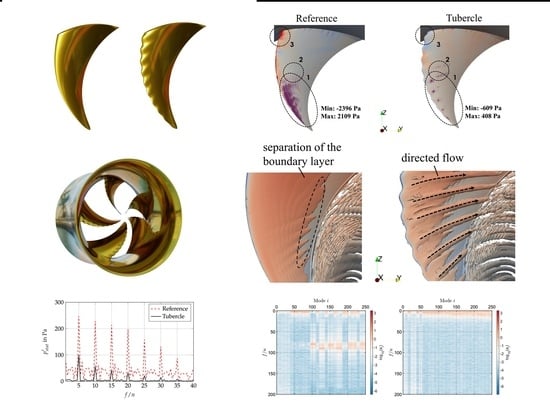
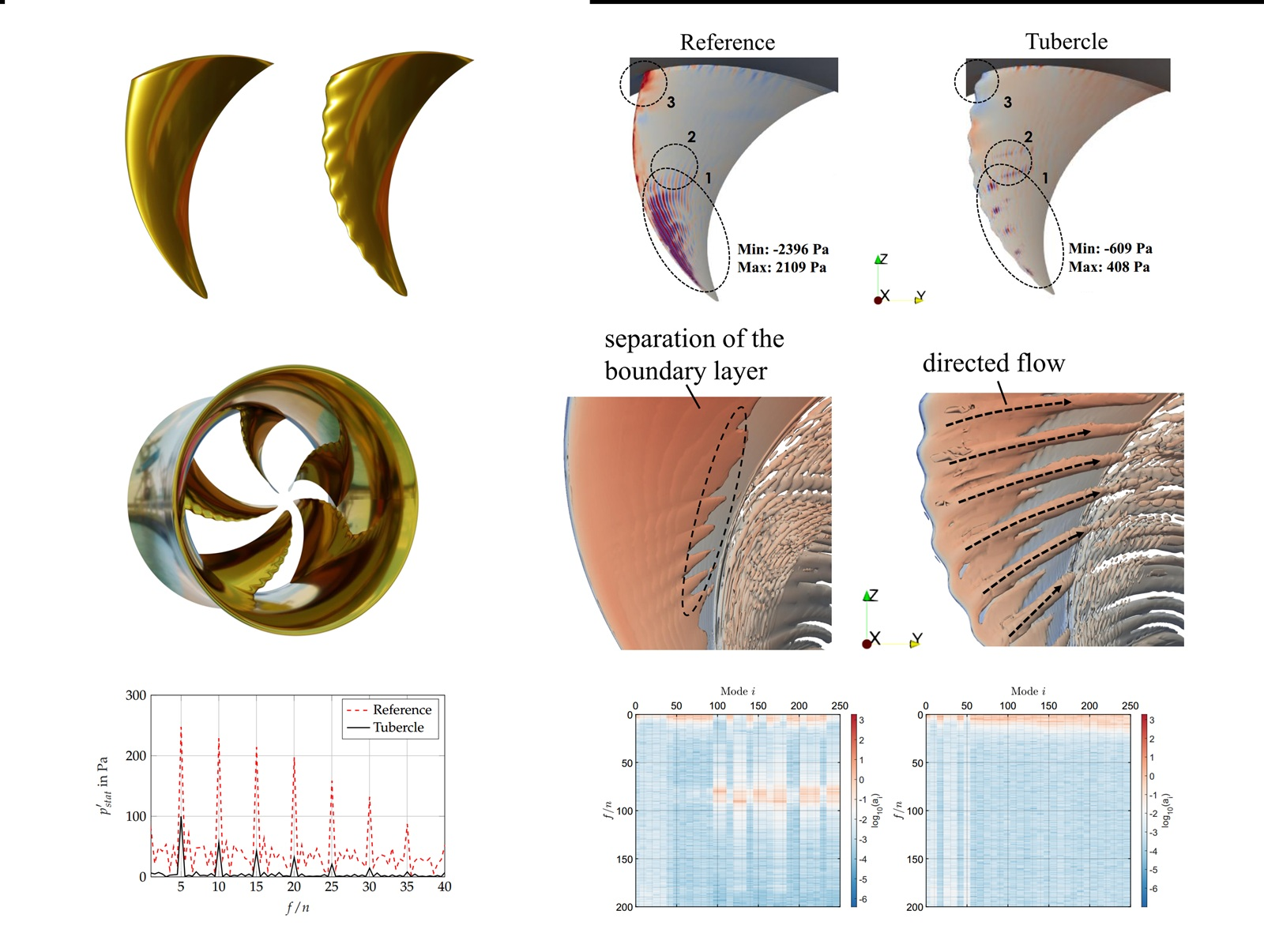
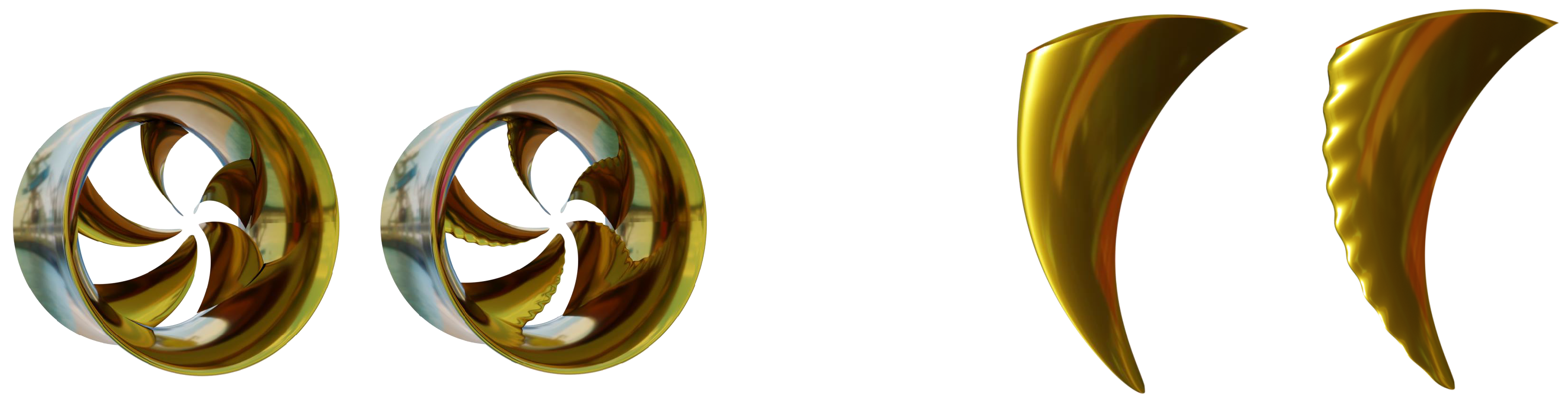
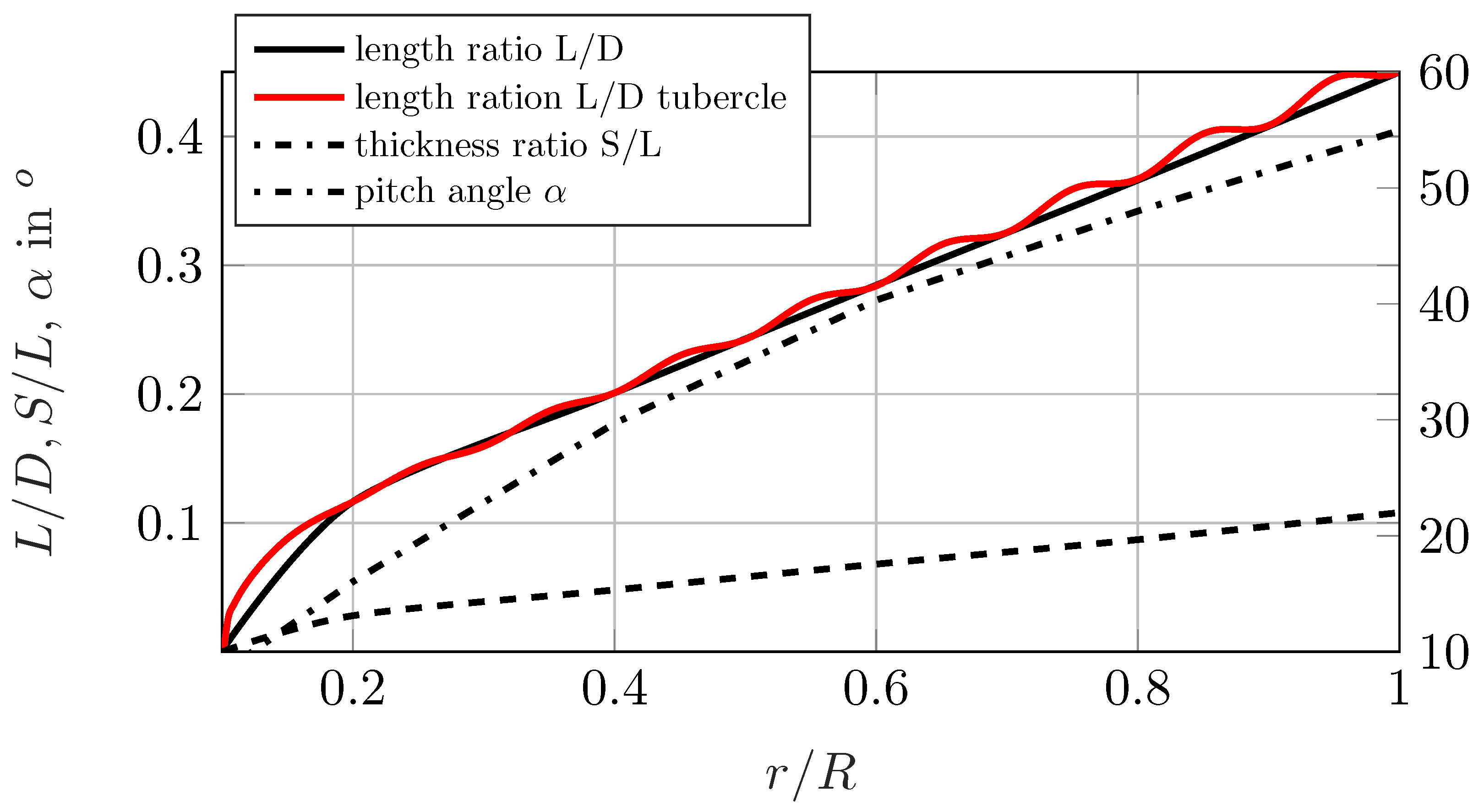
Figure 1 shows the reference and the tubercle setup of the hubless propeller used for the investigations. The configuration of the blade profiles, such as the chord ratio
and the thickness ratio
, can be seen in
Figure 2 along the radial position
. In the modified setup, the tubercle extend beyond the leading edge, increasing the chord length accordingly (see the red graph in
Figure 2).
In
Figure 2, it can be seen that the tubercles have a sinusoidal shape along the leading edge, featuring ten humps. From the sectional view, the tubercle profile has an elliptical shape at its tip, which is described by the equation
, where
x and
y are directed towards the length and the thickness of the section profile, respectively. The parameters
a and
b can be any real numbers.
The arrangement of the tubercle was determined based on the parameter studies, with the goal of achieving the lowest amplitudes of pressure fluctuations on the walls. In this context, the tubercle design was fully implemented in a separate program routine, enabling precise alignment. The tubercle are oriented perpendicular to the underlying profile, ensuring that, even with a curved leading edge, they remain tangentially aligned with the flow direction.
The amplitude of the tubercle is related to the chord length and decreases smoothly toward the blade tip. A window function smooths the leading edge on both the suction and pressure sides of the blade. In this configuration, the outermost tubercle often reached a height of 2.5 mm, which are about 5% of the chord length. Thus, in
Figure 2, the length ratio (red curve) of the tubercle can also be seen. In contrast the boundary layer at the blade leading edges has an height of about ≤
m, based on the
value as well as the wall shear stresses, which means that the tubercle are within the boundary layer.
The propeller has a diameter of
mm. Its field of application is focused on small, mostly remote-controlled underwater vehicles. An overview of the propeller data can be seen in
Table 1.
The propeller is encased by a Kort duct, which is based on a NACA a = 0.8 meanline and the NACA 65A010 thickness profile. The total length of the asymmetrical duct is . The setup is carried out in an open-water simulation without any vessel or mounting linkage. The Reynolds number is , based on the propeller tip speed.
2.2. CFD Setup
2.2.1. CFD Model
Due to the high Reynolds number in the current case and the associated high demands of an LES computational grid, the effort required to calculate and store the data for the transient flow fields becomes very large. Thus, the estimated number of computational cells for an LES grid in the current case is approximately 300 to 700 million.
In contrast, the requirements for the DES or the SBES computational grid are significantly lower, particularly in the region near the walls. As a result, the estimated number of computational cells for the SBES grid is approximately 30 to 90 million.
The SBES, as described by Menter [
23], used for flow simulation is a further development of DES, according to Spalart [
24], where the flow field is separated into an LES region close to the walls and a URANS region farther away. Both methods belong to the group of hybrid and scale-resolving flow simulation techniques. In contrast to the classical DES method, where the separation of LES and URANS regions is strictly based on grid size, the SBES method additionally initializes this region based on shear stresses at each time step. This has the advantage that large, cohesive flow structures, such as vortex tubes, are fully captured by the LES model, even if these structures propagate into the URANS region. The shear stress tensor
is calculated from the respective shear stress tensors of the URANS and LES models, with the shielding function
determining the transition between the two models. The total turbulent kinetic energy (TKE) can be computed as
with the modeled TKE of URANS
and LES
. Thus, the resolved TKE
is also affected by the individual TKE terms of both models. The modeled TKE for the LES is computed as
where
is the subgrid-scale viscosity,
is the lattice width, and
is a constant. The influence of non-resolved turbulent flow structures is treated using the standard Smagorinsky subgrid-scale model within the LES region. According to Menter [
27], the calculation of
is determined from the solutions of the
k-equations of URANS. The advection and diffusion fluxes were discretized using a bounded central differentiation scheme (BCDS) of second order for the SBES. To discretize the transient term, a second-order implicit method was employed. The convergence criterion was set to
for the RMS residuals, which offers a good compromise between computation time and accuracy.
The cylindrical simulation domain is divided into a rotating and a stationary part. The rotating part includes all five propeller blades, as well as the inflow and outflow sections. The rotating part is connected to the stationary part via the lateral cylinder surface. The total length of the domain is , with the outflow section accounting for . The diameter of the entire domain is . The coupling between the two sections is handled using the general grid interface (GGI) method.
The inlet, outlet, and cylinder walls are defined as “openings,” resulting in a non-zero flow velocity
m/s after a run-in period. The walls at the duct and propeller blades are defined as smooth walls with no-slip conditions. The turbulence intensity is set to zero because the flow velocity is also zero at some distance from the propeller. Consequently, the turbulent kinetic energy
k at the inlet is also zero. A zero-gradient boundary condition is applied to the turbulence variables at the inlet, outlet, and the outer walls of the measurement section. The time increment
is calculated based on the rotation speed. The time step size was chosen to ensure a Courant–Friedrichs–Lewy (CFL) number of CFL ≤ 1, in accordance with the recommendations of Menter et al. [
28]. For this case, an angular increment of
was used.
2.2.2. CFD Mesh
A block-structured hexahedral computational grid was created for the propeller section as well as the outer static section to ensure the highest possible grid quality. The numerical grid was generated in accordance with the recommendations of Menter [
29] for scale-resolved flow simulations.
RANS simulations were performed using an initial computational grid to estimate the final grid. Based on the maximum possible value and the local Reynolds number, the maximum height y of the first computational cells at the walls was calculated.
In line with the recommendations of Menter [
29], the computational cells in an SBES grid should not exceed an aspect ratio of 60 for best practices. The wall boundary layer is then extrapolated into the propeller flow domain with a bias factor of 5% growth rate until the cells reach their maximum height. The remaining volume of the domain is filled according to the cell density at the edge of the boundary layer. Estimates based on the operating point of the propeller showed that a LES grid requires at least 400 million cells, whereas an SBES grid requires at least 35 million cells. In total, the computational mesh contains around 40 million cells, most of which are concentrated around the duct and propeller walls, as well as in the propeller wake.
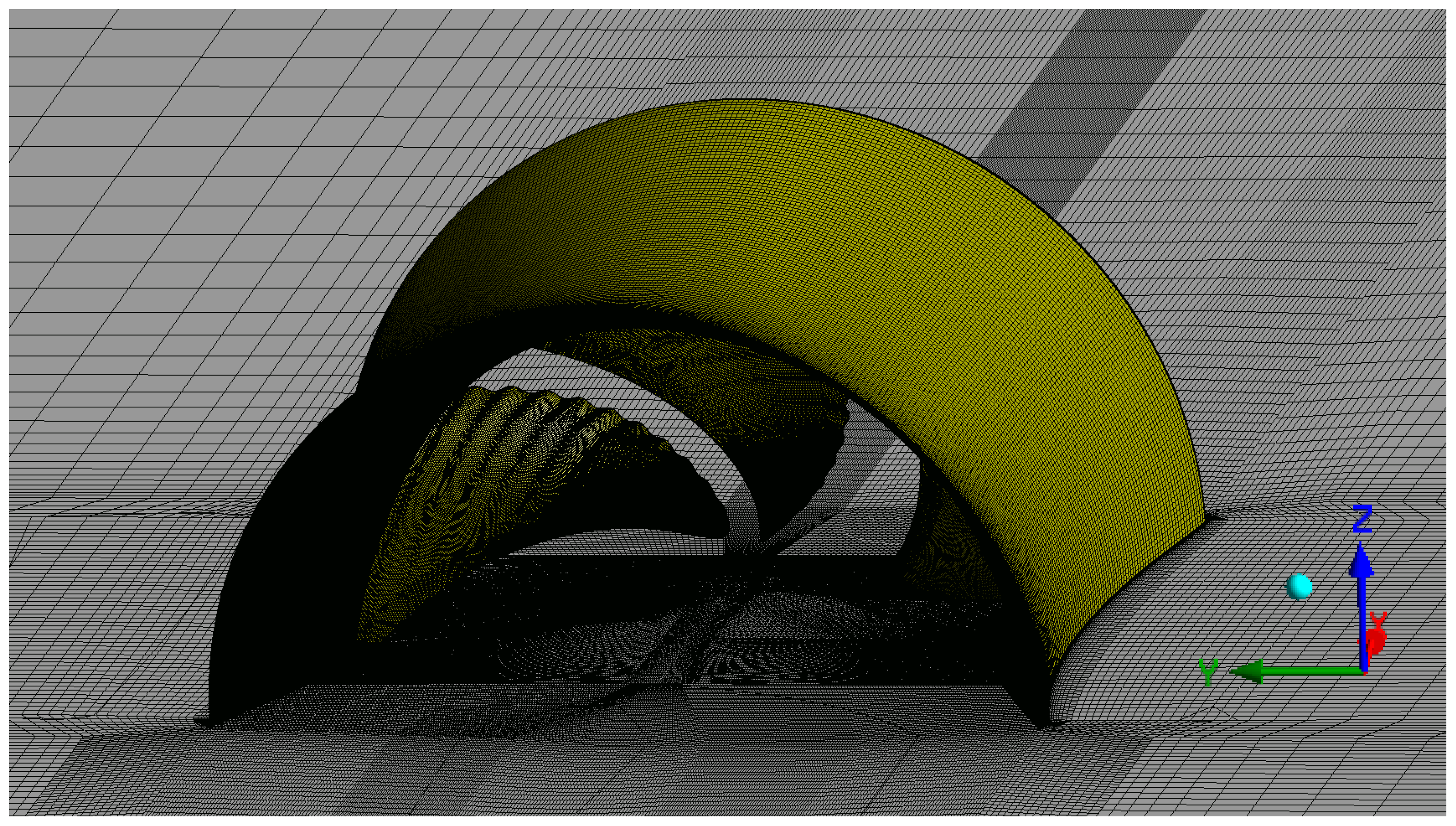
Figure 3 illustrates the structure of the computational grid used to calculate the transient pressure and velocity fields in this study. The figure shows that the computational cell density is particularly high in the region around the propeller and duct (yellow), as well as in the wake (gray plane). The gradients of the flow variables are significantly lower outside the propeller and wake regions, allowing for a coarser grid in those areas.
2.3. Proper Orthogonal Decomposition (POD) Analysis
The POD analysis is employed in this work to separate the flow field with respect to its periodic, coherent, and aperiodic, incoherent flow structures. The mathematical approach in the field of hydrodynamics was introduced by Reynolds and Hussain [
30]. The flow fluctuations are divided into an average
, an incoherent part
, and a coherent part
as an extension of the Reynolds decomposition, resulting in
The POD decomposition of a transient field quantity is given by
which results in a set of orthogonal modes
and time coefficients
over
K. The field quantity
can be a tensor of arbitrary order and is represented in the sense of a Galerkin approximation based on the modes and time coefficients. The POD modes and time coefficients are calculated by solving an eigenvalue problem:
This involves approximating the eigenvalues
, the eigenvectors
, and the correlation matrix
Here,
represents the Kronecker delta. The POD modes and time coefficients are subsequently calculated based on the eigenvalues and eigenvectors:
A ‘snapshot POD’ according to Sirovich [
31] is used for the correlation matrix in Equation (
8). The matrix is calculated via a temporal cross-correlation of the field quantity, where the number of time coefficients equals the number of time steps used within the decomposition process.
3. Simulation
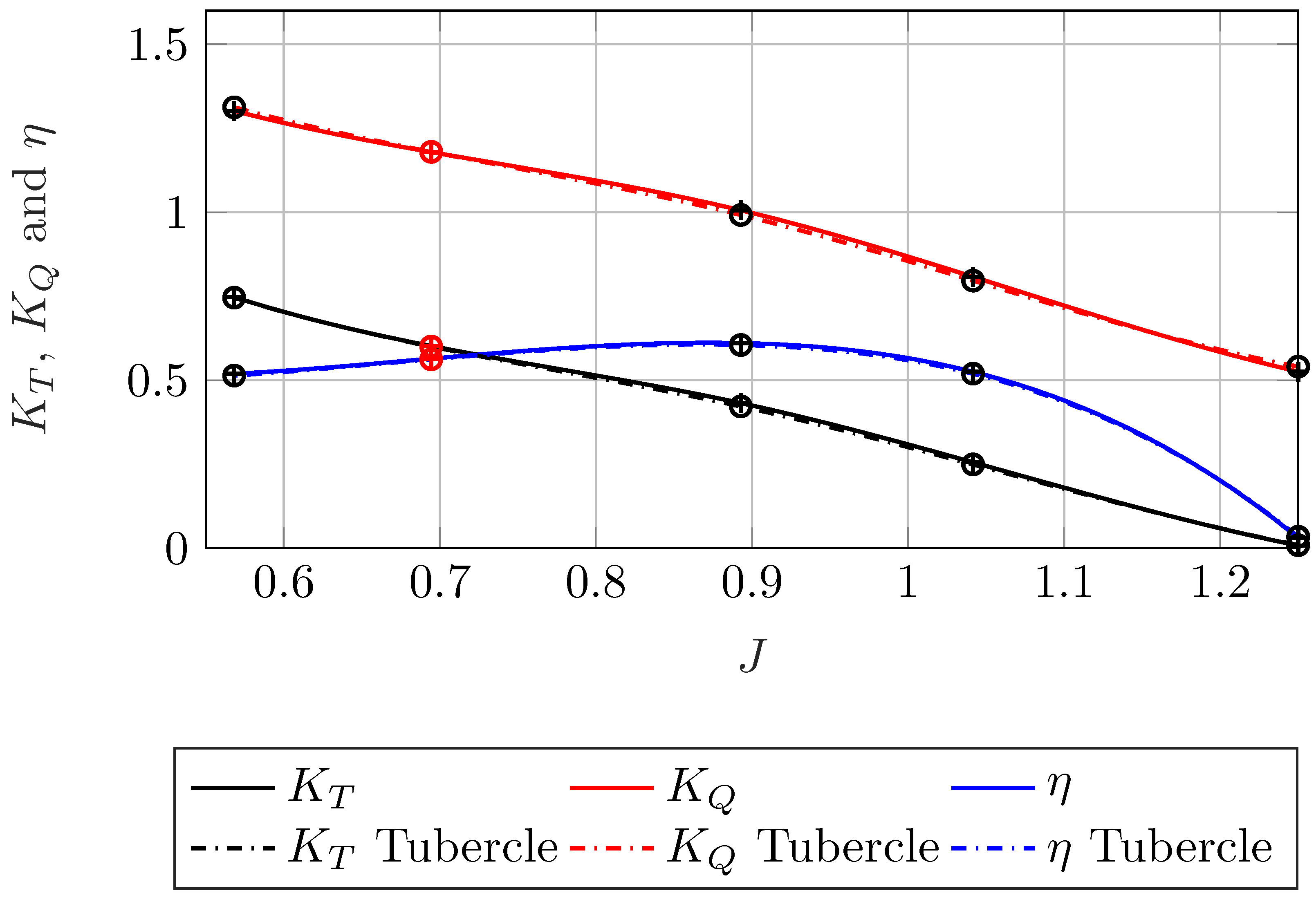
The following section presents the results from the hydrodynamic simulations of both propeller cases. Both propellers achieve nearly the same values concerning their integral parameters such as thrust and torque, as illustrated in
Figure 4. The cases are sorted by the advance coefficients
. It can be seen that the efficiency of the tubercle case is the same as for the reference case up to the second digit after the decimal point. In this context, it is important to note that improving efficiency is not the focus of this work.
For the investigations in this work, the case was selected because the propeller does not operate under its ideal design conditions, and therefore, separation of the turbulent boundary layers on the propeller blades is expected.
The aim of this section is to analyze the flow field in terms of flow structures and pressure fluctuations in the vicinity of both hubless propeller cases. Additionally, a POD analysis of the transient pressure field was performed to determine the overall energy contribution of each coherent and incoherent flow structure. A coherent flow structure is characterized by a specific frequency within the spectrum of its associated time coefficients, shared by at least two different modes.
3.1. Flow Field Analysis
The flow field of both propeller cases is characterized by periodic flow structures that form in the vicinity of the propeller blades and the duct, propagating downstream until they gradually decay. Similar to propellers with a hub, helix-shaped flow structures develop at the blade tips, trailing edges, and blade roots.
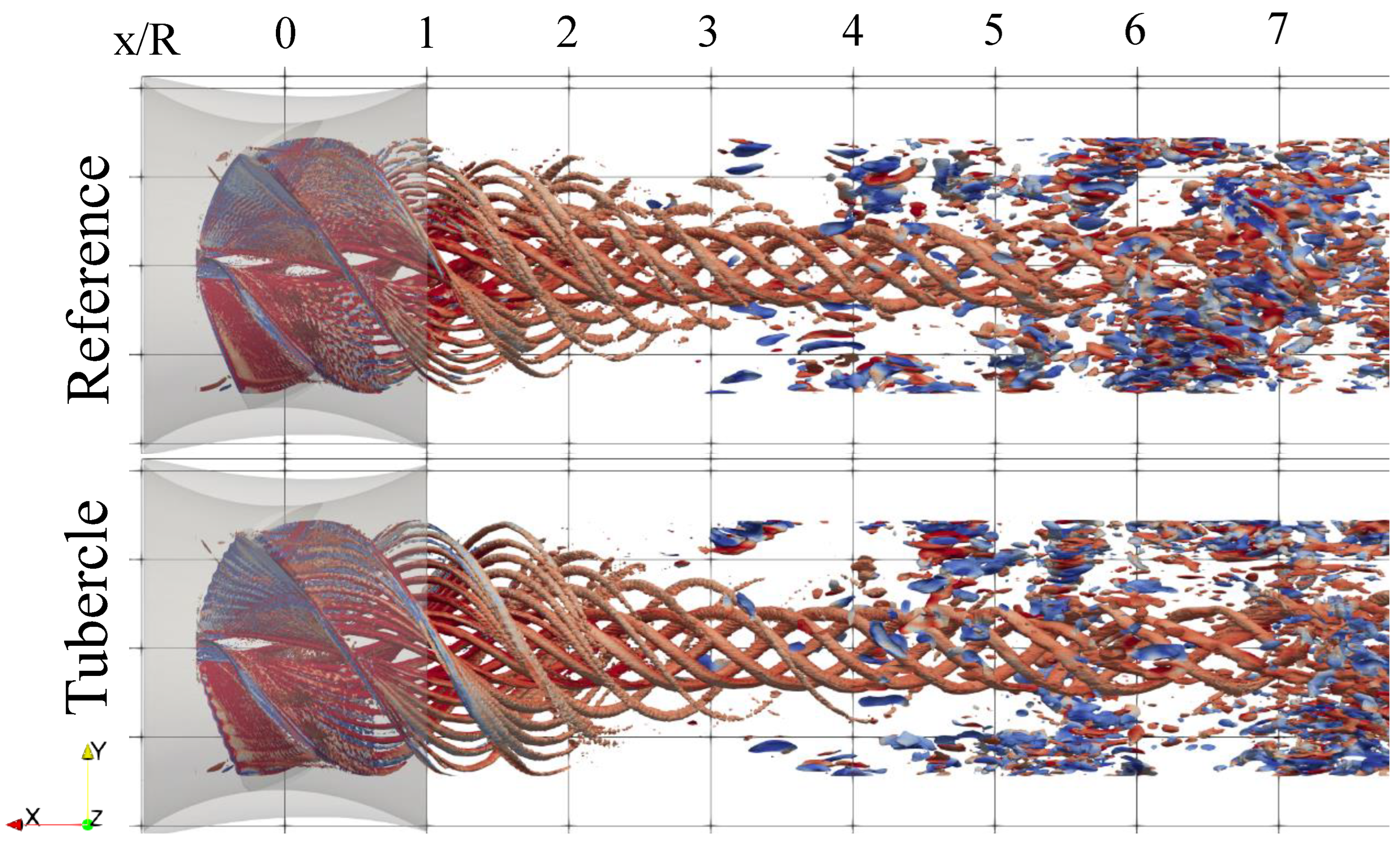
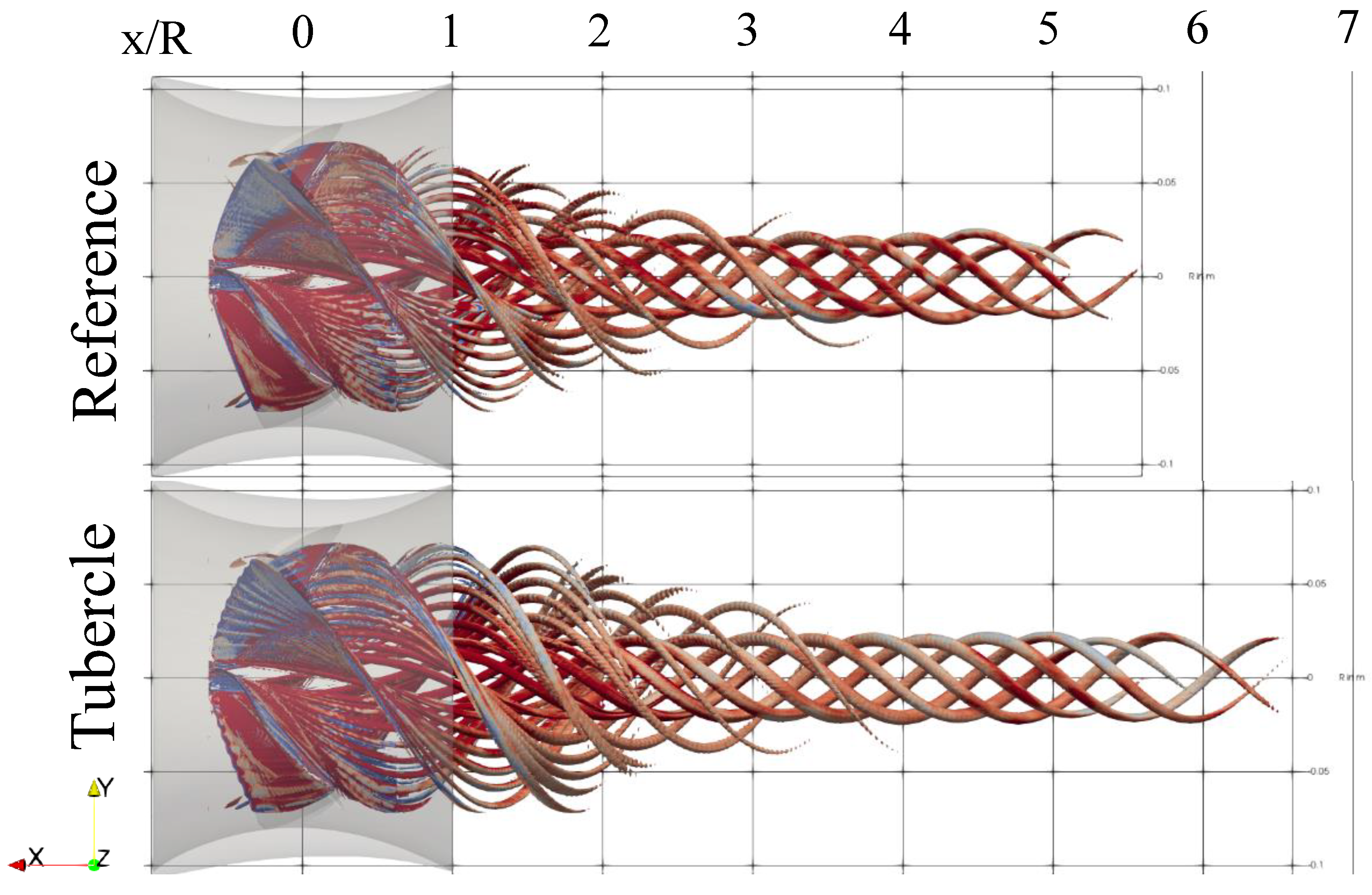
Figure 5 shows the propeller wake of both cases, mapped by an iso-surface of the Q-criterion vortex identification; see also Hunt et al. [
32].
Q is related to the square of the rotational speed
n, and is set to the value
. Furthermore, the vorticity in the x-direction is applied to the iso-surface. The outer part of the
Q-criterion was clipped at a radial distance from the rotating axis of
to allow for an internal view, with the variable
. In the flow direction, the axial distance was also normalized to the propeller radius
R.
As can be seen, the helix-shaped structures around the outer diameter vanish quickly at a distance from the propeller disc, specifically within in both cases. Although it is evident that the vortex structures in the tubercle case persist for a slightly longer duration within the wake. The same observation applies to the central helix-shaped vortex, which remains the longest in the wake.
Since both the inflow and the outflow regions of the simulation domain, and thus the entire velocity field, are co-rotating, it is possible to calculate the
Q-criterion based on the average velocity field. The vortex structures can be considered static within the rotating mesh parts. Therefore, it is possible to determine the exact location where the decay is initiated, as shown in
Figure 6.
The figure shows that the helical tip vortex begins to decay at approximately in the reference case and at approximately in the tubercle case.
One major difference between both cases is that the vortex field persists longer in the case of the tubercle modification. In contrast, it was observed that the pressure fluctuations are significantly lower in the tubercle case.
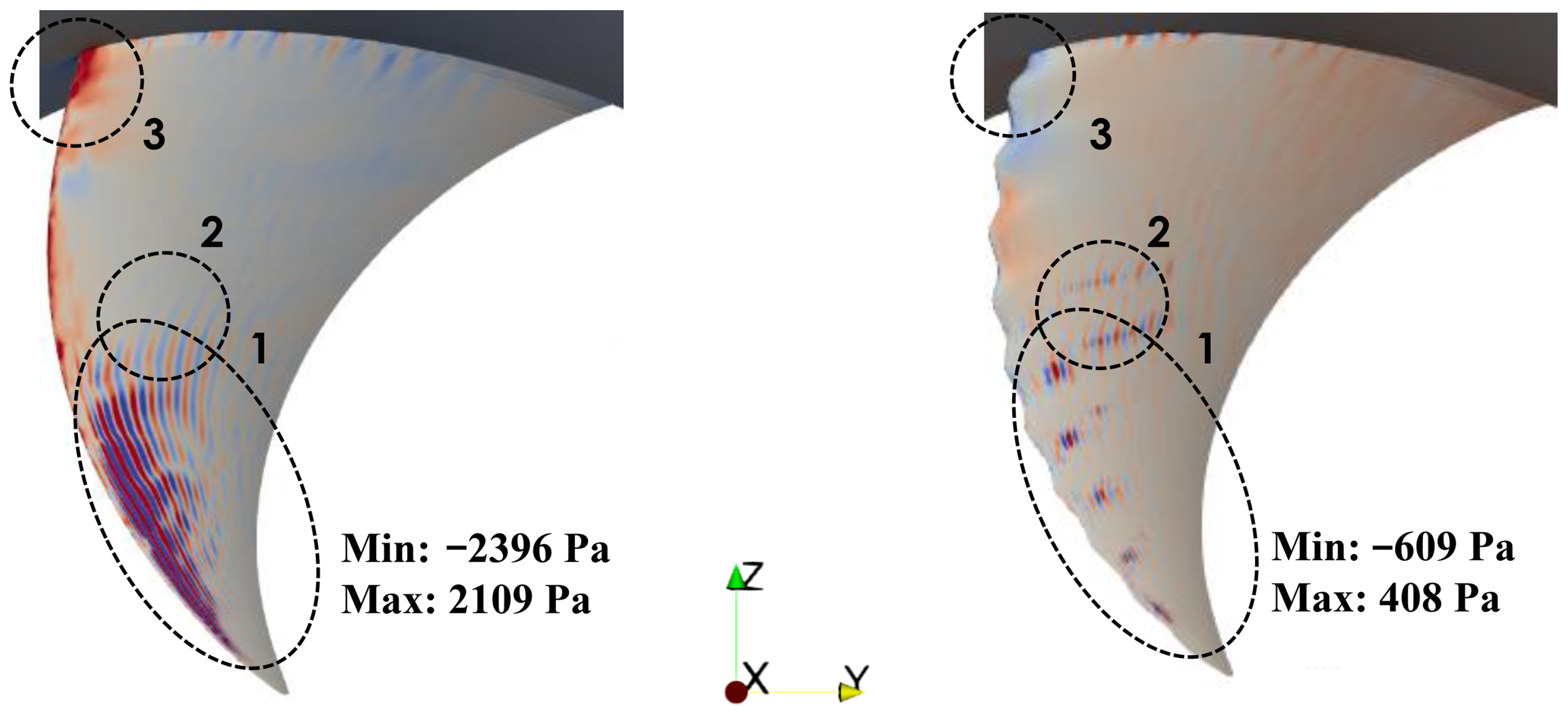
For example, in
Figure 7, it can be seen that on the blade leading edge of the propeller suction side (see
Figure 7 (1)), the pressure fluctuations appear to be lower and more localized in their distribution. A closer look reveals that the visible fluctuation patterns occur behind a minimum region of the tubercle amplitude within the local flow direction. In the mid-blade area, fluctuation patterns emerge in the region behind two tubercle (see
Figure 7 (2)), indicates periodically boundary layer separations and therefore also an point of interest.
Differences can also be observed in the blade root region at the leading edge (see
Figure 7 (3)). In this section, the fluctuation amplitude seems to be lower in the tubercle case as well.
The differences between both cases in the decay process and the resulting longer duration of the flow structures in the tubercle case can be explained by mutual induction between the individual strands of the helical vortex structure, as described in more detail by Widnall [
33] and Felli et al. [
34]. In the tubercle case, as shown in
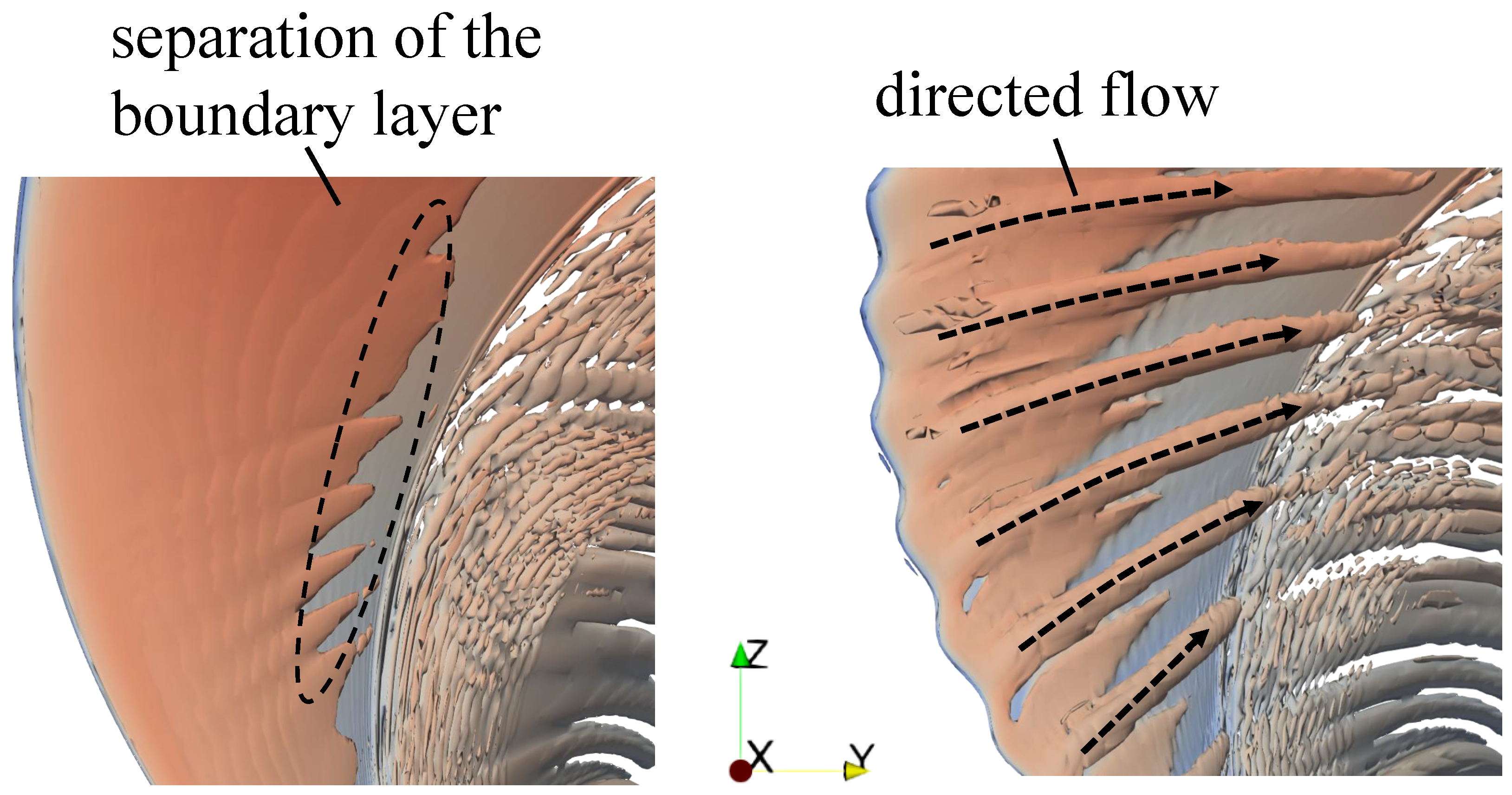
Figure 8 as a Q-criterion iso-surface, the flow is directed through the tubercle minima. In contrast, in the reference case, the structures are arranged closer together and irregularly, which increases the likelihood of interaction and promotes mutual decay. The greater distance between the trailing edge vortex structures in the tubercle case leads to less interaction in the wake, allowing the helical vortex structures to persist longer in the flow.
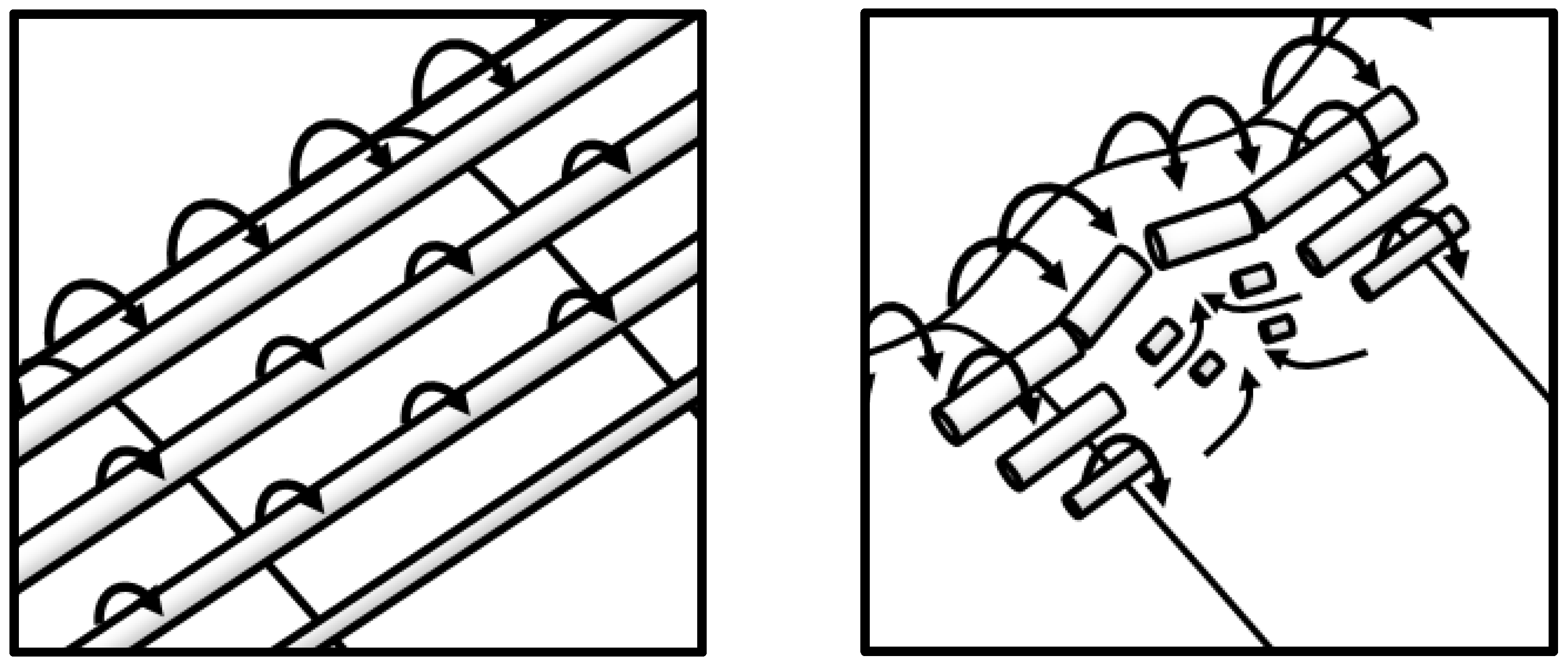
Figure 9 shows a sketch of the vortex system of both the reference case and the case with the tubercle modification on the propeller blade. The modification change the vortex system in the region of the leading edge compared to the reference case, creating a wavy pattern in the periodic boundary layer separations just behind the leading edge, according to the contour of the leading edge. Due to the tubercle shape, the flow at the leading edge is redirected. The leading edge geometry causes the formation of V-shaped valleys between each tubercle, where the flow velocity is higher compared to the region behind the tubercle. Since the flow velocity behind a tubercle is lower, the flow tends to reattach locally in this area. As a result, the pressure fluctuations behind the tubercle are generally lower than in the adjacent areas, which can also be seen
Figure 7. In the wake of the tubercle minima, the flow reattaches due to laterally induced compensating flows, thereby reducing the pressure fluctuations.
Figure 10 and
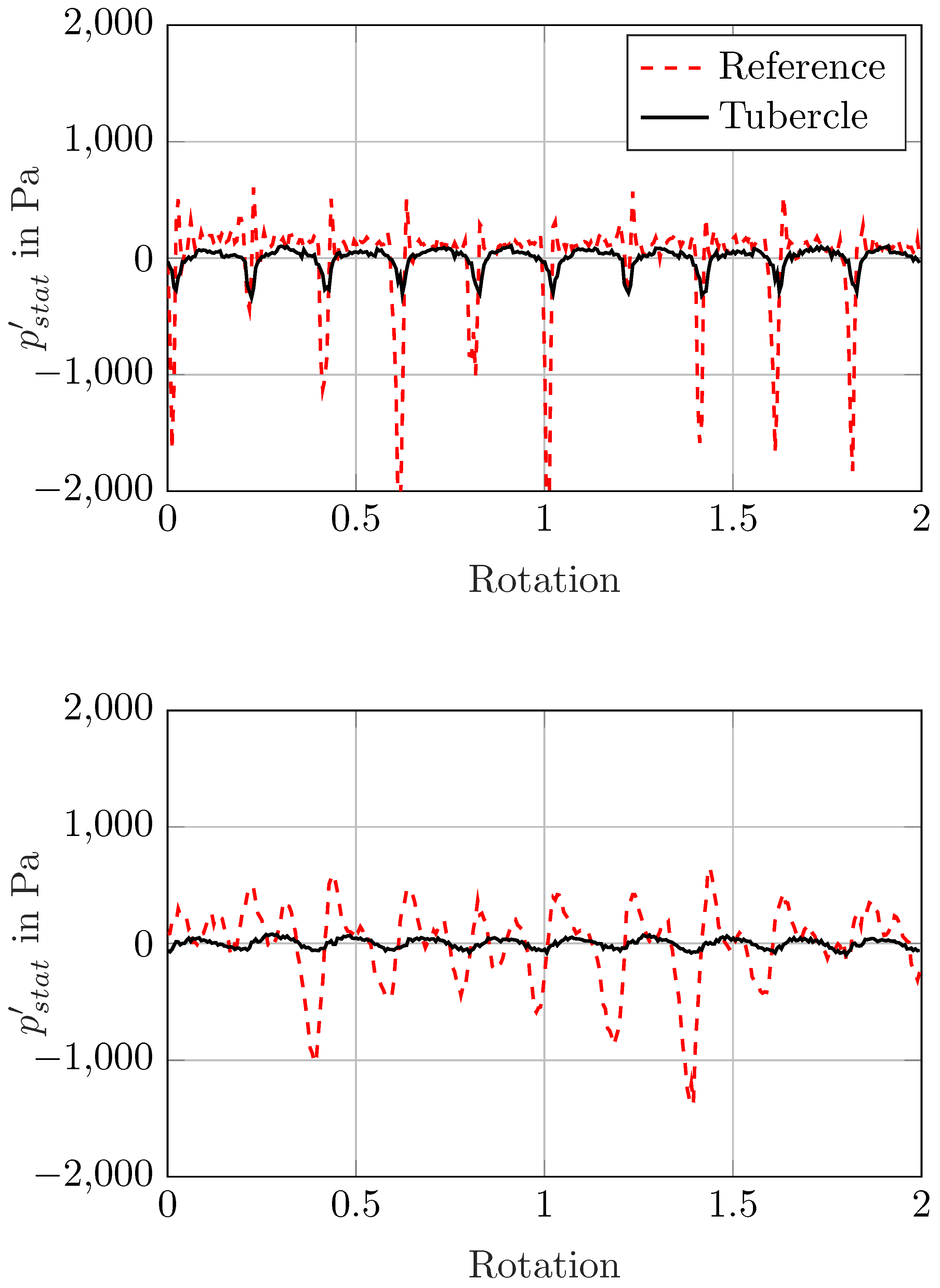
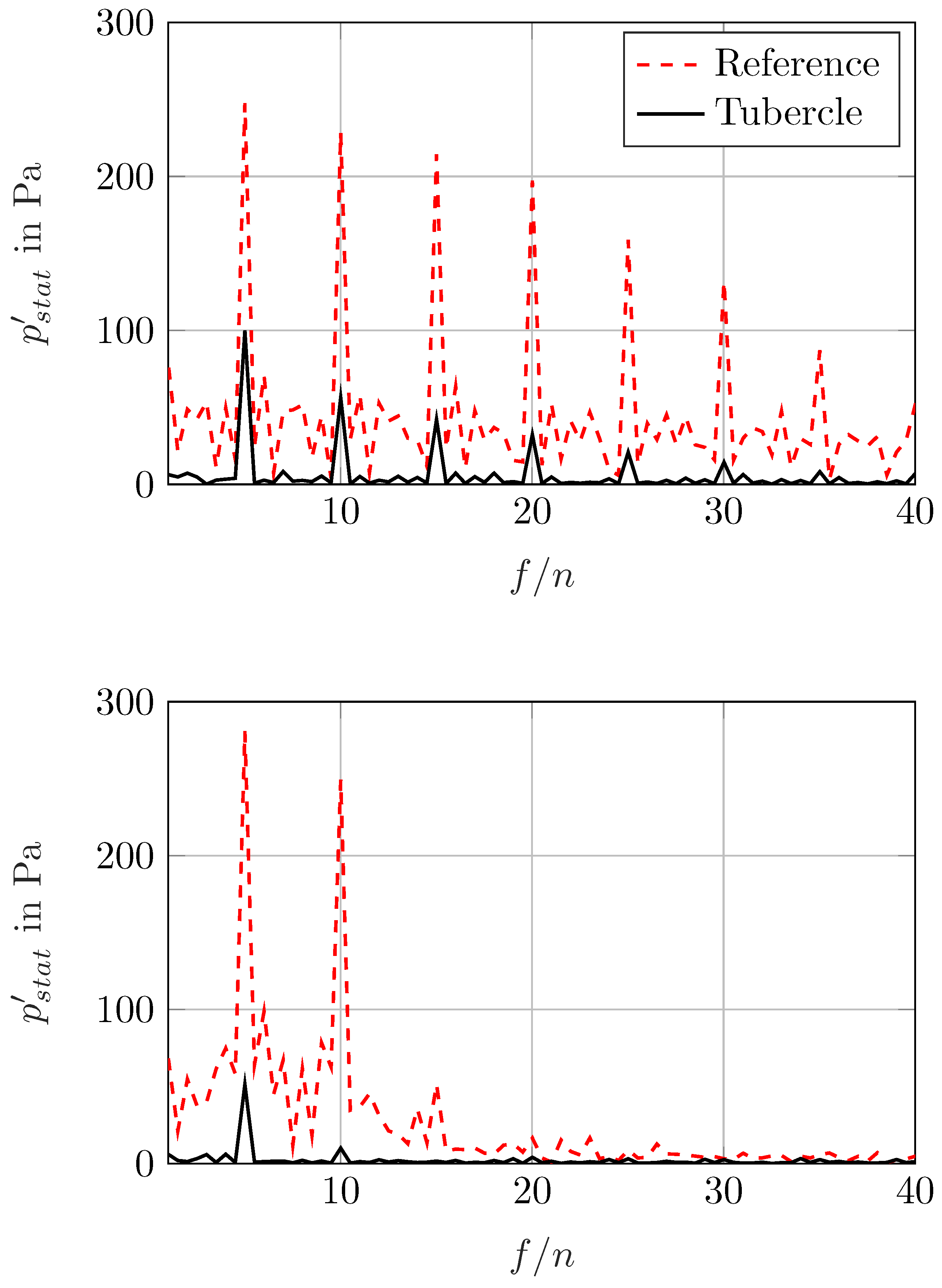
Figure 11 show the static pressure and the associated order spectrum at two points in the propeller wake of both cases. The radial (
) and axial (
) positions of the measurement points are referenced based on the propeller radius
m. Accordingly, the points are located radially at a radius of
. Axially, the points are spaced 0.08 m apart according to the same criterion.
In both cases, peaks corresponding to the blade passing frequency (BPF) can be seen in the order spectrum in
Figure 11. In the top section of
Figure 11, orders from the fifth up to the 8th BPF at the fortieth order can be observed in the spectrum. It is noteworthy that the tubercle case shows a significantly lower amplitude of pressure fluctuations in comparison to the reference case. For example, the first BPF order has an amplitude 2.5 times lower than the reference case, while the second BPF has an amplitude five times lower than the reference case. This difference can also be clearly seen in the time-dependent values of the pressure fluctuations in
Figure 10.
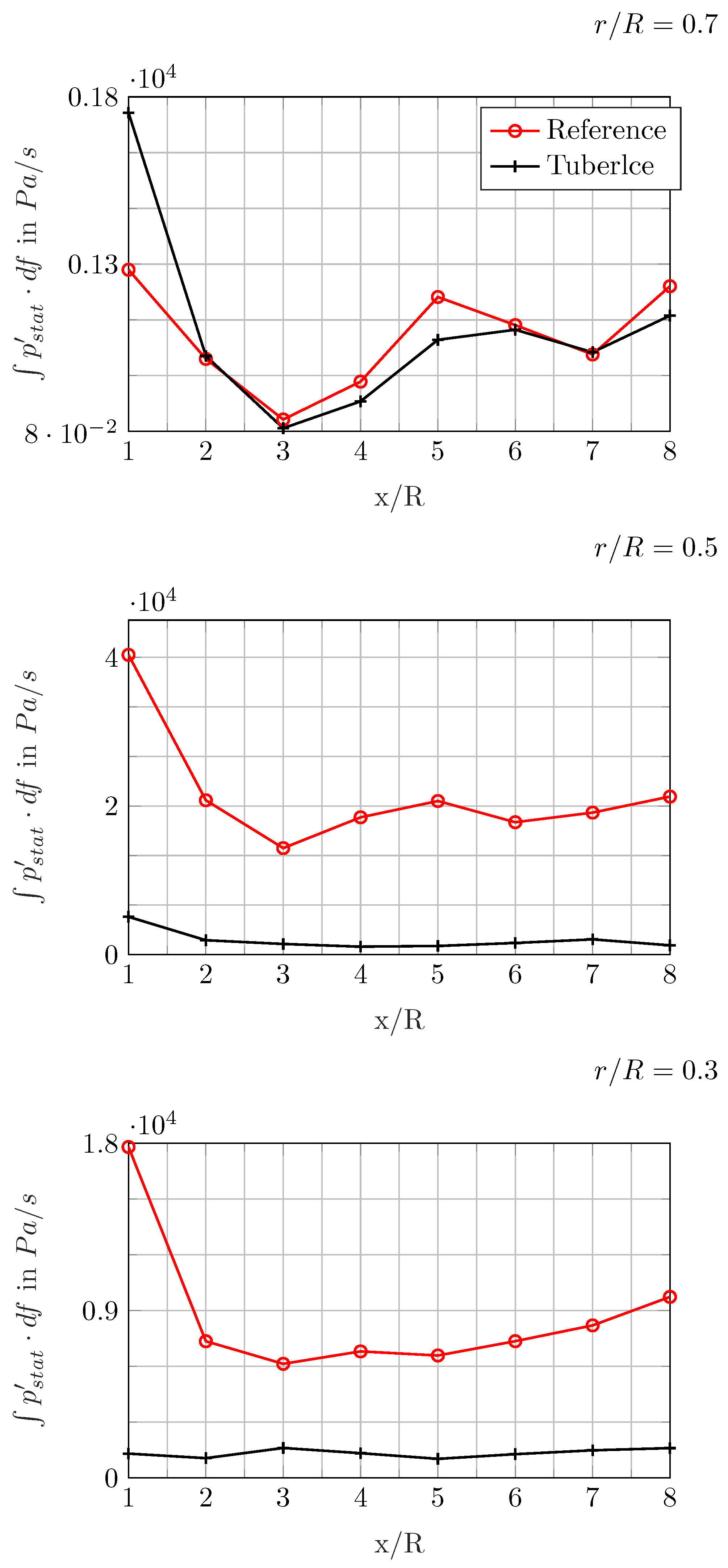
The trend of lower pressure fluctuations can also be confirmed for the points further downstream, as shown in
Figure 12. For this figure, an integral of the frequency spectrum between 1 and 1800 Hz was calculated for each monitor point and summarized for comparison between both propeller cases.
Figure 12 also shows the integral at the radial distance of
,
and
. While a significant reduction in the pressure fluctuations can also be seen for
and
no significant reductions can are observable for
. This is due to a more optimal flow vector at the leading edge of the propeller blade at
.
Therefore, the effect does not take place in this region because there is no boundary layer separation. The fluctuations increase as a result of the decay of the helix-shapes vortex as can be seen at for the distance of and of both cases. Overall, the fluctuation energy starts with high values, then decreases up to , and then rises steadily due to the dissipation of parts of the helical vortex structures () as well as the expanding wake of the duct (from to ).
The flow analyses show a clear result. A slightly realignment of the leading edge is able to damp the formation of periodic boundary layer separation, which could otherwise result in high pressure fluctuation at the walls and the wake flow, as can be seen at the reference case. Furthermore, the wavy leading edge contour seems additionally reduce the overall BPF fluctuation energy, which is why the comparison of the order spectra show such a high difference. It is therefore likely that these modifications will also have a positive impact on the hydroacoustic noise emissions in this case. However, without further simulations or measurements, it is not possible to precisely quantify the acoustic benefit.
3.2. POD Analysis
In this section, the POD results for both propeller cases are presented. POD analyses have been performed on the wall pressure fluctuations at the blades as well as the duct. The analysis provides an overview of the degree of improvement and identifies the frequencies present.
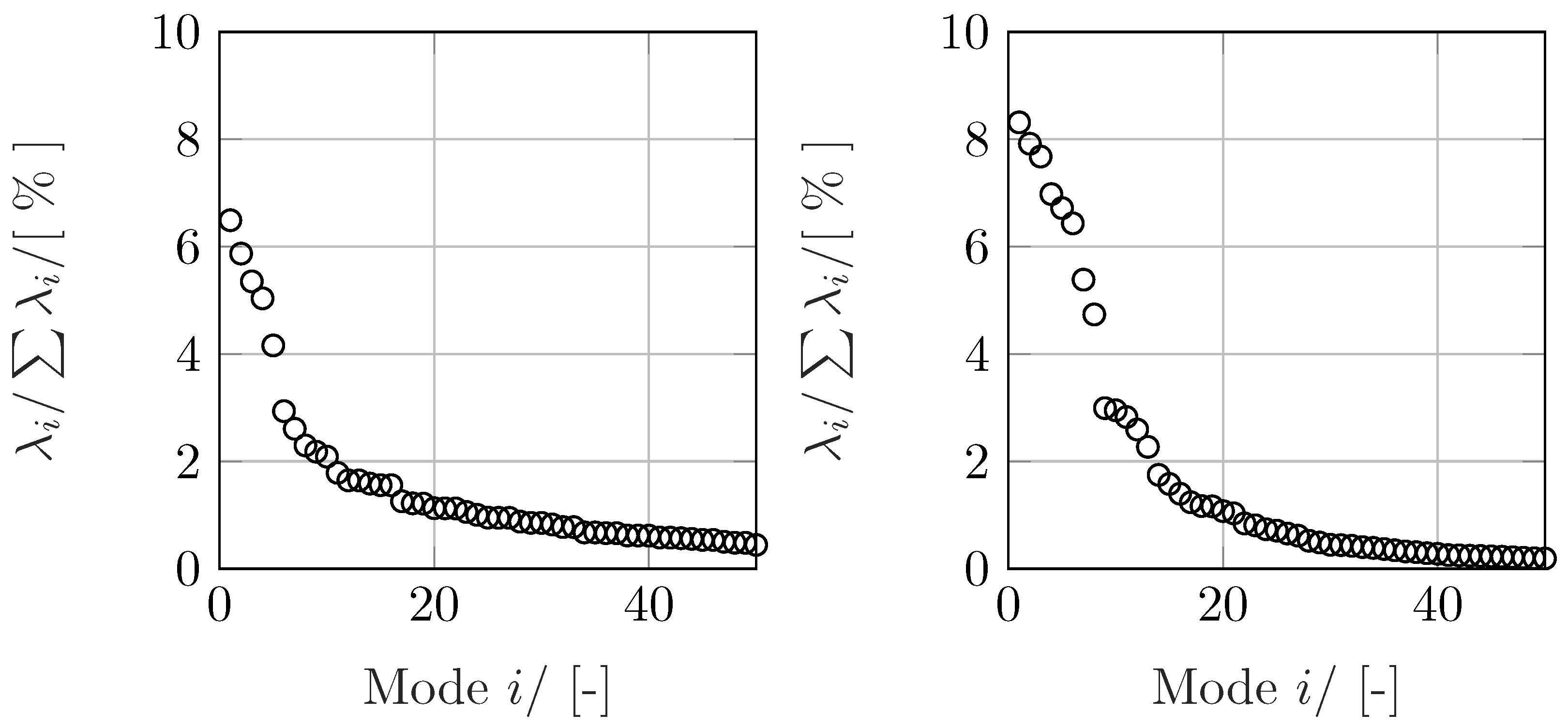
First, the POD eigenvalues of the blade and duct boundary surfaces are shown in
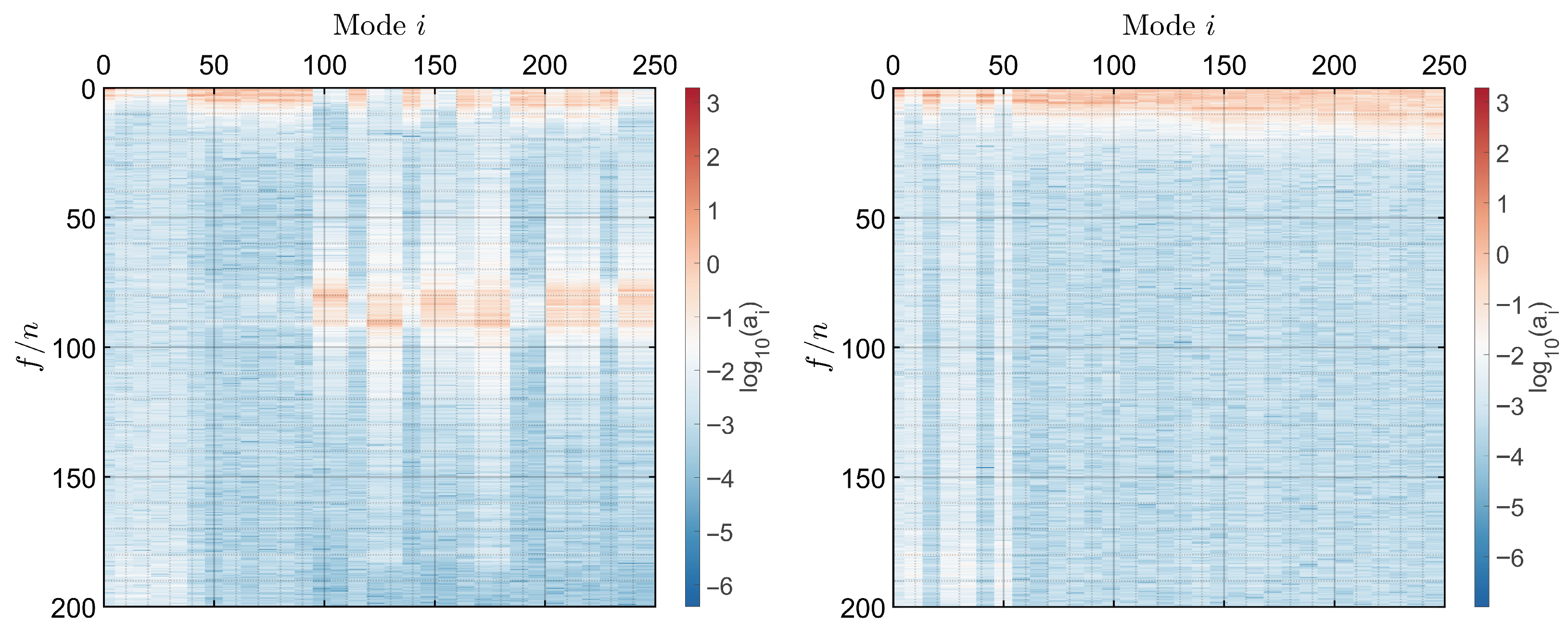
Figure 13. The eigenvalues correspond to the energy associated with each POD mode. It can be observed that the modes are ordered by the amplitude of their eigenvalues within the eigenvalue spectrum. From the eigenvalue distribution, it can be seen that in the initial case, the energy is more evenly distributed across the existing modes than in the tubercle case. The higher-order modes, in particular, have a lower energy level in the tubercle case than in the initial case. The associated time coefficient spectra are shown in
Figure 14.
It is apparent that in the initial case, starting from mode 100, several peaks are found in the range between the 80th and 90th order of the POD time coefficient. These peaks can be attributed to the flow separations on the blades. The occurrence of sidebands is due to the fact that different flow conditions apply at the blade leading edge over the radius, resulting in different separation frequencies being present in the spectrum. However, due to the modification by the leading edge tubercle, these separations are reduced, making them no longer visible in the spectrum of the POD time coefficients. This figure shows that there is a reduction in periodic separations in the entire wall pressure spectrum and thus also a reduction in pressure fluctuations.
4. Conclusions
In this work, the influence of leading-edge tubercles on the pressure fluctuations of a hubless propeller was investigated. Two configurations were considered: a reference case and a tubercle-modified case. The unsteady flow was simulated using the hybrid SBES turbulence model.
The results demonstrate that the use of tubercles significantly reduces pressure fluctuations on both the propeller surfaces and in the wake flow.
The reduction of boundary layer separation on the propeller’s suction side results in more stable flow behavior around the blades, particularly when the propeller operates outside its optimal conditions. Consequently, lower amplitudes of pressure fluctuations in the wake flow were observed for individual BPF orders, with reductions ranging from three to ten times lower.
To summarize the order analysis, an integral of the spectra was calculated at each of the 24 monitoring points, up to a frequency of 1.8 kHz. The integral supports the observed trend of reduced pressure fluctuations. It also indicates that the tubercle at has a reduced influence on the pressure fluctuation reduction, likely due to a more favorable flow at the leading edge at this operating point.
This reduction in pressure fluctuations is further confirmed by the POD analysis of the wall pressure. The pressure fluctuations on the propeller blade are observed in the range from the 80th to 90th order, which can be attributed to separation on the blade’s suction side. These orders are no longer present in the spectrum of the tubercle-modified case.
This work has demonstrated that tubercles have significant potential for reducing pressure fluctuations and, consequently, vibrations on the ship. Due to their straightforward integration into the design, they offer the potential to enhance the durability and performance of individual components or to meet required noise emission standards. It can be inferred that this modification also influences noise generation. Future studies will compute the acoustic field based on the existing CFD data and explore this assumption in greater detail. No improvement in efficiency is expected from this modification, as the analysis of the open-water characteristics in this example has shown. What this ultimately means for the dynamic behavior of the propeller, including aspects such as maneuverability, can only be determined through further investigation.
For future work, measurements of the hubless propeller are planned within the duration of the current project. In this context, the objective is to validate the numerical simulations and compare the hydroacoustic noise emissions of both configurations.