
Article

ERCP Beyond the Ninth Decade: Frailty, Treatment Strategy, and Outcomes in Octogenarians, Nonagenarians, and Centenarians

1
Department of Gastroenterology, Mugla Training and Research Hospital, 48000 Mugla, Türkiye
2
Department of Gastroenterology, Faculty of Medicine, Mugla Sitki Kocman University, 48000 Mugla, Türkiye
*
Author to whom correspondence should be addressed.
J. Gerontol. Geriatr. 2026, 74(4), 37; https://doi.org/10.3390/jgg74040037
Submission received: 8 August 2026 / Revised: 22 September 2026 / Accepted: 25 September 2026 / Published: 30 September 2026
(This article belongs to the Section Clinical Sciences)

Abstract

Evidence regarding endoscopic retrograde cholangiopancreatography (ERCP) in adults in their 90s and 100s remains limited, and chronological age may not adequately reflect procedural vulnerability. We compared ERCP strategy and short-term outcomes across advanced age strata and included a contemporary younger reference cohort. This retrospective cohort included 48 patients aged ≥80 years undergoing ERCP for choledocholithiasis or stone-related acute cholangitis between 2023 and 2025: 80–89 years (n = 20), 90–99 years (n = 21), and ≥100 years (n = 7). A reference group of 15 consecutive patients aged <80 years treated during the same period under the same eligibility criteria was added. Only the first eligible ERCP per patient during the study period was analyzed as the index procedure; subsequent ERCPs were outcomes rather than additional observations. Clinical Frailty Scale (CFS), stone burden, treatment strategy, drainage, adverse events, intensive care use, and 30-day mortality were analyzed using nonparametric and Fisher–Freeman–Halton methods. Frailty–outcome analyses were restricted to the ≥80-year primary cohort and were exploratory and unadjusted. Median CFS was 4.0, 4.5, 6.0, and 8.0 in the <80, 80–89, 90–99, and ≥100-year groups, respectively (p < 0.001). Complete index stone clearance was 93.3%, 90.0%, 76.2%, and 71.4% (p = 0.358), while stenting was used in 6.7%, 10.0%, 33.3%, and 42.9% (p = 0.055). Successful biliary drainage remained 100%, 95.0%, 95.2%, and 100% (p = 1.000). Repeat ERCP occurred in 0%, 0%, 14.3%, and 28.6% (p = 0.027), and median length of stay increased from 3 to 4, 5, and 6 days (p < 0.001). Within the ≥80-year cohort, higher CFS remained associated with failed index clearance, stenting, post-procedure ICU requirement, and 30-day mortality in exploratory analyses. ERCP achieved high biliary drainage rates across age strata, including centenarians. The small younger reference cohort provided clinical context, while the ≥80-year analyses continued to show increasing frailty and more frequent staged management in the oldest groups. The retrospective design, small reference cohort, sparse events, and strong age–frailty correlation preclude causal or independent prognostic claims.

1. Introduction

Population aging has increased the number of adults in their 80s, 90s, and beyond 100 years who present with common bile duct stones and acute cholangitis. ERCP remains the established therapeutic approach for choledocholithiasis when intervention is indicated and is central to biliary drainage in acute cholangitis [1,2,3,4]. However, older adults have heterogeneous physiologic reserves, and the consequences of sedation, cardiopulmonary instability, bleeding, pancreatitis, or prolonged hospitalization may be greater than in younger patients [5].
Available studies generally support the technical feasibility of ERCP in older adults and nonagenarians, although one-session stone clearance may be lower and cardiopulmonary or sedation-related events may become relatively more important [6,7,8,9,10,11]. Recent meta-analyses similarly report acceptable overall efficacy in patients aged ≥80 years while showing lower complete clearance and more frequent stent use in the oldest groups [12,13]. Urgent ERCP appears useful in selected patients aged ≥90 years with stone-related acute cholangitis, and recent cohorts in very long-lived populations also demonstrate high technical feasibility [14,15]. Direct evidence in centenarians remains exceptionally sparse [16].
The current geriatric endoscopy literature therefore increasingly emphasizes physiologic vulnerability rather than chronological age alone. A recent review of choledocholithiasis in older adults recommends integrating overall physical condition and frailty into treatment selection [17]. ERCP-specific studies have associated frailty with complications, mortality, healthcare utilization, and selection of biliary drainage strategies [18,19]. The Clinical Frailty Scale (CFS) is a pragmatic nine-point global measure of fitness and frailty and is widely used in older adults [20,21]. These observations support evaluating frailty alongside age, comorbidity, acute illness severity, and procedural complexity rather than treating age as an isolated decision rule.
We therefore compared octogenarians (80–89 years), nonagenarians (90–99 years), and centenarians (≥100 years) undergoing ERCP for choledocholithiasis or stone-related acute cholangitis and included a contemporary < 80-year reference cohort to contextualize age-related patterns. The primary outcome was complete stone clearance at index ERCP. Secondary outcomes included biliary stenting, successful drainage, repeat ERCP, adverse events, post-procedure ICU requirement, length of stay, and 30-day mortality. We additionally examined stone burden, indications for stenting, previous ERCP indications, and timing of ERCP in patients with documented acute cholangitis. The prespecified frailty analyses remained focused on the ≥80-year primary cohort and were considered exploratory rather than confirmatory because of the small number of events.

2. Materials and Methods

2.1. Study Design and Population

This single-center retrospective observational cohort evaluated therapeutic ERCP performed at Mugla Training and Research Hospital, a tertiary-care teaching hospital, between 2023 and 2025. Eligible patients underwent ERCP for choledocholithiasis or stone-related acute cholangitis. Patients with known or newly diagnosed malignancy, including malignant biliary obstruction, and those presenting with acute pancreatitis were excluded. To ensure independence of observations, the database was re-audited at the patient level and only the first eligible ERCP for choledocholithiasis or stone-related acute cholangitis during the study period was retained as the index procedure. One later repeat encounter in a patient with a prior eligible ERCP in 2024 was therefore excluded. Historical ERCPs performed before the study period were retained only as baseline history, and subsequent ERCPs after the index procedure were recorded only as the outcome ‘repeat ERCP’ rather than as additional observations. The primary ≥80-year cohort consequently comprised 48 unique patients across three age groups: 80–89 years (n = 20), 90–99 years (n = 21), and ≥100 years (n = 7). To provide a contemporary younger reference, 15 consecutive patients aged <80 years who underwent ERCP during the same study period and met the same eligibility criteria were included, yielding a total analytic sample of 63 unique patients. Untreated patients were not included; therefore, the study cannot estimate the comparative benefit of ERCP versus non-ERCP management.

2.2. Clinical and Geriatric Variables

The database included age, sex, ERCP indication, baseline ICU status, American Society of Anesthesiologists (ASA) class, Charlson Comorbidity Index (CCI), antithrombotic treatment, laboratory variables, common bile duct diameter, periampullary diverticulum, previous ERCP and its documented indication, and CFS. Additional variables abstracted for the revision included Tokyo Guidelines cholangitis severity when documented, time from recorded cholangitis onset to ERCP, stone number, largest stone diameter category, whether stone extraction was attempted, and the documented reason for biliary stent placement. Laboratory variables included total bilirubin, white blood cell count, C-reactive protein, creatinine, international normalized ratio, and platelet count. Cholangitis severity was not imputed when a Tokyo grade was absent.
CFS was not retrospectively reconstructed by the study investigators. As part of routine clinical care, a single CFS form is completed at hospital admission by the ward nurse and gastroenterology fellow, and one final score is entered into the electronic medical record. The admission CFS value was extracted for this retrospective study. Because only one final clinical score was stored rather than two independent ratings, inter-rater agreement could not be calculated. CCI quantified comorbidity burden [22], whereas ASA class represented systemic disease relevant to procedural and anesthetic risk.

2.3. ERCP Technique and Outcomes

Procedures were performed under conscious or moderate sedation administered by an anesthesiologist with standard cardiorespiratory monitoring. Selective biliary cannulation used a wire-guided technique. Sphincterotomy and/or sphincteroplasty was performed when indicated, and stones were extracted with balloon catheters and/or retrieval baskets according to anatomy and stone characteristics. All patients routinely received 100 mg rectal indomethacin for post-ERCP pancreatitis prophylaxis. Treatment strategy was not protocolized according to CFS alone. The recorded reasons for stenting included severe cholangitis or clinical instability, incomplete stone clearance, technical difficulty, large or multiple stones, and other procedural considerations. The analysis therefore evaluates associations between frailty and the treatment selected, not a causal effect of frailty on operator decision-making.
The primary outcome was complete stone clearance during index ERCP. Secondary procedural outcomes were biliary stent placement, successful biliary drainage, procedure duration, and repeat ERCP. Successful biliary drainage was defined separately from complete clearance as achievement of endoscopic biliary decompression by stone extraction and/or effective biliary stent placement. Safety outcomes included post-ERCP pancreatitis (PEP), bleeding, perforation, cardiopulmonary adverse events, and a composite of any ERCP-related adverse event. Clinical outcomes were post-procedure ICU requirement, hospital length of stay, in-hospital mortality, and 30-day all-cause mortality. Thirty-day deaths were not assumed to be procedure-related without specific supporting documentation.

2.4. Statistical Analysis

Continuous variables are presented as median and interquartile range (IQR) and were compared across the four age groups (<80, 80–89, 90–99, and ≥100 years) with the Kruskal–Wallis test. Categorical variables are reported as number and percentage and were compared using Fisher–Freeman–Halton tests with Monte Carlo estimation (500,000 replicates) because of sparse cell counts. The younger group was included as a contextual reference cohort. Exploratory analyses of ERCP timing and all frailty–outcome associations were restricted to the primary ≥80-year cohort so that the post hoc younger reference group did not drive these secondary analyses. Among ≥80-year patients with a documented Tokyo cholangitis grade, outcomes according to ERCP timing (≤6 h vs. >6–24 h) were compared with Fisher exact tests. Spearman correlation assessed relationships between age and CFS and between CFS and length of stay within the ≥80-year cohort.
Exploratory associations between CFS and binary outcomes within the ≥80-year primary cohort used the Mann–Whitney U test. To provide an effect estimate with uncertainty, rank-biserial correlation (r_rb) and an approximate tie-corrected 95% confidence interval were reported; positive values indicate higher CFS when the outcome is present. Multivariable regression was not performed because only three 30-day deaths, three post-procedure ICU admissions, five composite adverse events, and five repeat ERCP events occurred in the primary cohort, making adjusted models unstable and prone to overfitting. The strong correlation between age and CFS further limited separation of their independent effects. Secondary and exploratory analyses were not adjusted for multiplicity and should be interpreted as hypothesis-generating. Two-sided p < 0.05 was used as the conventional significance threshold.

3. Results

3.1. Cohort Characteristics

The revised analytic cohort comprised 63 unique patients: 15 patients aged <80 years, 20 octogenarians, 21 nonagenarians, and 7 centenarians. Median age was 88.3 years (IQR, 80.2–96.4), and 35 patients (55.6%) were women. Seventeen patients (27.0%) underwent ERCP with acute cholangitis as the recorded primary indication. A Tokyo severity grade was documented in 17 patients overall: Grade I in 3, Grade II in 11, and Grade III in 3.
Frailty and procedural-risk burden differed across age groups (Table 1). Median CFS was 4.0 (IQR, 3.0–5.0), 4.5 (4.0–5.0), 6.0 (6.0–7.0), and 8.0 (7.5–8.0) in the <80, 80–89, 90–99, and ≥100-year groups, respectively (p < 0.001). ASA class also differed (p < 0.001), as did CCI (p = 0.001). Periampullary diverticula were more frequent in older strata (p = 0.042), whereas stone number and largest stone diameter category did not differ significantly (p = 0.671 and p = 0.819, respectively). Previous ERCP was documented in 11 included patients: 10 for choledocholithiasis and 1 for acute cholangitis. Baseline bilirubin, inflammatory markers, creatinine, INR, platelet count, and common bile duct diameter did not differ significantly.

3.2. Procedural Strategy and Efficacy

Stone extraction was attempted in all 63 index procedures. Complete stone clearance was achieved in 53 of 63 patients (84.1%): 93.3% in the <80-year reference group, 90.0% of octogenarians, 76.2% of nonagenarians, and 71.4% of centenarians (p = 0.358; Table 2). Biliary stents were placed in 1/15 (6.7%), 2/20 (10.0%), 7/21 (33.3%), and 3/7 (42.9%), respectively (p = 0.055). Among the 13 stented patients, documented reasons were severe cholangitis or clinical instability (n = 5), incomplete stone clearance (n = 3), technical difficulty (n = 3), large or multiple stones (n = 1), and other procedural considerations (n = 1). Successful biliary drainage remained 100%, 95.0%, 95.2%, and 100%, respectively (p = 1.000).
Repeat ERCP was required in five patients (7.9%): none in the <80-year reference group or octogenarians, three nonagenarians (14.3%), and two centenarians (28.6%) (global p = 0.027). Median procedure duration was 20 min in all four strata (p = 0.941). In the prespecified timing analysis restricted to the 15 ≥80-year patients with a documented Tokyo grade, 12 underwent ERCP within 6 h and 3 during >6–24 h after recorded cholangitis onset. Complete clearance was 75.0% versus 33.3% (p = 0.242), post-procedure ICU requirement 0% versus 33.3% (p = 0.200), and 30-day mortality 8.3% versus 33.3% (p = 0.371), respectively. Successful drainage was 100% versus 33.3% (p = 0.029); because the later-treatment subgroup contained only three patients, this isolated finding was considered exploratory and was not interpreted causally.

3.3. Adverse Events and Short-Term Outcomes

Five patients (7.9%) experienced at least one ERCP-related adverse event (Table 2), all within the ≥80-year primary cohort. PEP occurred in two octogenarians, one bleeding event occurred in a nonagenarian, and no perforations occurred. Cardiopulmonary adverse events were recorded in one nonagenarian and one centenarian. The composite adverse-event rate did not differ across the four age groups (p = 0.518).
Three patients required ICU care after ERCP: two nonagenarians and one centenarian (p = 0.193). There were no in-hospital deaths. Three patients died within 30 days (4.8% of the total analytic cohort; 6.3% of the ≥80-year primary cohort): one from a cerebrovascular event, one from pulmonary embolism, and one from an undetermined cause. No death was documented as an immediate procedural complication; because formal causal adjudication was not performed and one cause remained unknown, 30-day mortality is reported as all-cause mortality. Patient-level characteristics of these deaths are shown in Table 3 Median length of stay increased from 3 days in the <80-year reference group to 4, 5, and 6 days in octogenarians, nonagenarians, and centenarians, respectively (p < 0.001).

3.4. Frailty and Outcomes

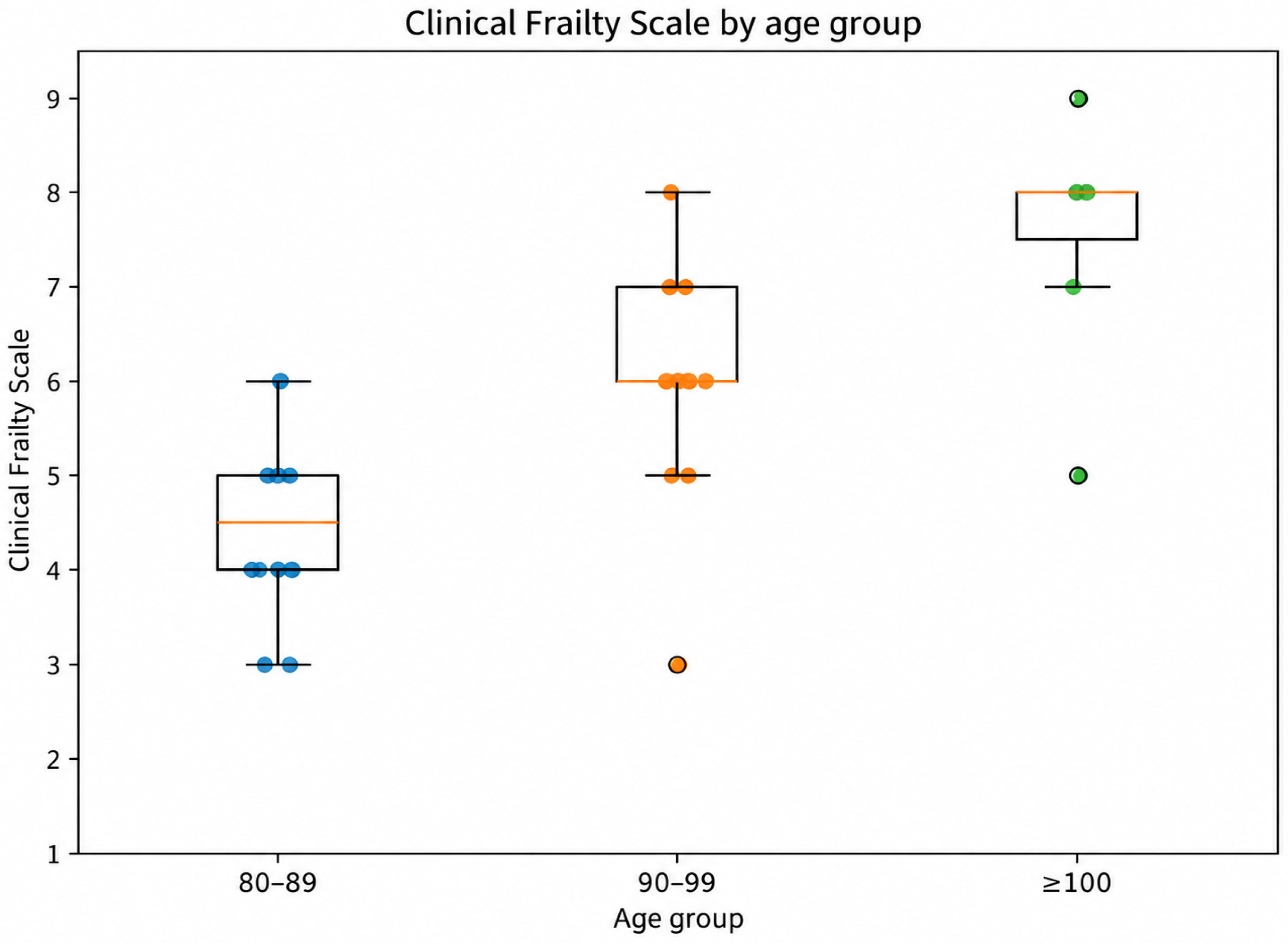
Within the ≥80-year primary cohort (n = 48), chronological age correlated strongly with CFS (Spearman ρ = 0.672, p < 0.001), and frailty increased markedly from octogenarians to centenarians (Figure 1). CFS also correlated with length of stay (ρ = 0.351, p = 0.014). Patients with successful index clearance had lower CFS scores than those without clearance (median 5 vs. 6; p = 0.020), while patients receiving a biliary stent had higher CFS (median 6 vs. 5; p = 0.030; Table 3).
Higher CFS was also observed among patients requiring post-procedure ICU care (median 8 vs. 6; p = 0.008) and those who died within 30 days (median 8 vs. 6; p = 0.030). The association with repeat ERCP was borderline (p = 0.050), and CFS was not associated with the composite ERCP-related adverse-event outcome (p = 0.891). Effect estimates with 95% confidence intervals are shown in Table 4. These analyses were unadjusted, were based on few events for several outcomes, and should not be interpreted as evidence that CFS independently predicts outcome.

3.5. Centenarian Subgroup

The seven centenarians ranged from 100 years and 17 days to 104 years and 10 days; five were women and median CFS was 8. Two underwent ERCP with acute cholangitis as the recorded primary indication, while three had a documented Tokyo grade. Complete stone clearance was achieved in five of seven, all seven achieved biliary drainage, three received biliary stents, and two underwent repeat ERCP. One centenarian experienced transient hypoxemia/hypotension with post-procedure ICU care. No centenarian had PEP, bleeding, perforation, or in-hospital death; one died within 30 days from a cerebrovascular event.

4. Discussion

This study evaluated 48 selected adults aged ≥80 years undergoing ERCP and added 15 consecutive patients aged <80 years as a contemporary reference cohort. Of the 48 patients in the primary cohort, 28 were at least 90 years old, including 7 centenarians. Three findings are most relevant. First, frailty increased sharply across the older age strata. Second, complete index clearance decreased numerically, while stenting and repeat ERCP became more frequent in the oldest groups; the younger reference cohort had no repeat ERCP. Third, biliary drainage remained highly successful across all age groups, whereas hospital stay increased progressively with age. These observations are descriptive and do not establish comparative treatment benefit or causality.
Within the primary ≥80-year cohort, the overall index clearance rate was 81.3% (39/48), which is compatible with recent evidence. A 2025 meta-analysis reported pooled clearance of approximately 77% in patients aged ≥80 years and 65% in nonagenarians, with improved eventual clearance when multiple sessions were permitted [12]. In our revised cohort, clearance was 90.0% in octogenarians, 76.2% in nonagenarians, and 71.4% in centenarians, compared with 93.3% in the small <80-year reference group. Stone number and largest stone diameter category did not differ significantly across age strata, reducing—but not eliminating—the possibility that the age pattern was explained simply by measured stone burden. The study was not powered to demonstrate equivalence or small between-group differences.
Biliary stent use was 6.7% in the <80-year reference group, 10.0% in octogenarians, 33.3% in nonagenarians, and 42.9% in centenarians (p = 0.055). Stone extraction was attempted in all included index procedures, and stent placement had documented procedural or clinical reasons rather than being assigned on the basis of age or CFS alone. The most common reasons were severe cholangitis or clinical instability, incomplete stone clearance, and technical difficulty. These data support interpreting the association between higher CFS and stenting as non-causal treatment-selection information. Long-term stenting should not become the default solely because of age, because recurrent obstruction and cholangitis remain concerns when definitive extraction is feasible [17,23].
Repeat ERCP increased across the age strata, occurring in none of the <80-year reference patients or octogenarians, 14.3% of nonagenarians, and 28.6% of centenarians (p = 0.027). This may reflect staged management after incomplete clearance or temporary stenting, but the retrospective design does not allow us to determine whether frailty itself motivated the decision. The patient-level audit also clarified prior ERCP exposure: among the included ≥ 80-year patients, nine had an ERCP history before the index procedure, eight for choledocholithiasis and one for acute cholangitis. Historical ERCPs outside the study period were retained only as baseline history, whereas repeated encounters within the study period were not counted as additional observations.
The high drainage rate, including drainage in all 7 centenarians and all 15 patients in the younger reference group, is clinically reassuring but should not be interpreted as proof of equivalent safety across age groups. With only 7 centenarians and 15 younger reference patients, both estimates are imprecise. Among the ≥80-year patients with documented Tokyo grading, most underwent ERCP within 6 h. The timing analysis was extremely sparse; although drainage differed between the ≤6 h and >6–24 h groups, only three patients were in the later group. This result is therefore hypothesis-generating and cannot establish an optimal timing threshold. The broader literature continues to support timely drainage when acute cholangitis or persistent obstruction creates substantial risk from non-intervention [3,4,8,11,14].
Frailty may help characterize heterogeneity that is not captured by chronological age or comorbidity alone. Within the primary ≥80-year cohort, CFS rose from a median of 4.5 in octogenarians to 8 in centenarians, while CCI did not increase monotonically. Age and CFS remained strongly correlated (ρ = 0.672), so the present data cannot separate their independent effects. CFS, CCI, and ASA should therefore be viewed as complementary descriptors of vulnerability rather than interchangeable predictors.
Exploratory analyses within the ≥80-year cohort showed higher CFS among patients with failed index clearance, biliary stenting, post-procedure ICU requirement, and 30-day mortality. Similar associations between frailty, resource use, complications, and mortality have been reported in larger ERCP datasets [18,19]. Nevertheless, only three deaths and three post-procedure ICU admissions occurred. The resulting estimates are unstable, unadjusted, and vulnerable to confounding by age, acute cholangitis severity, comorbidity, procedural complexity, and treatment selection. We therefore report effect estimates and 95% confidence intervals but deliberately avoid multivariable modeling or claims that CFS independently predicts outcome.
The adverse-event pattern also deserves a geriatric perspective. Five ERCP-related adverse events occurred, all in the ≥80-year cohort (10.4% of 48 patients), while none occurred in the 15-patient younger reference group; however, the between-group comparison was not significant. The older cohort included two PEP events, one bleeding event, no perforation, and two cardiopulmonary events. Three 30-day deaths occurred, from a cerebrovascular event, pulmonary embolism, and an undetermined cause. None was documented as an immediate ERCP complication, but formal causal adjudication was not performed. This distinction is important because mortality after ERCP in the oldest-old may reflect acute biliary illness, frailty, multimorbidity, and competing disease as well as procedure-related factors [6,7,12].
These findings have practical but limited implications. Chronological age alone should not be treated as a sufficient description of procedural vulnerability, yet the present study does not prove that a frailty-guided strategy improves outcomes. In a patient who requires biliary intervention, the intended procedural goal should be individualized according to acute illness severity, stone burden and anatomy, procedural tolerance, cardiopulmonary reserve, life expectancy, and patient goals. The younger reference cohort provides context for age-related procedural patterns but does not address whether ERCP itself is preferable to observation. Recent comparative-effectiveness work has questioned routine early ERCP for some uncomplicated stones in older adults [24], but our study included only ERCP-treated patients and therefore cannot address observation versus intervention.
This study has several limitations. First, its retrospective single-center design creates selection bias and limits generalizability, particularly because patients referred for ERCP at extreme ages are selected on perceived benefit and procedural tolerability. Second, the <80-year reference cohort consisted of only 15 consecutive patients, was added for contextual comparison, was not matched to the older groups, and should not be considered representative of all younger ERCP recipients. Third, no untreated comparator cohort was available, so the study cannot estimate comparative treatment benefit. Fourth, a separate numerical screening log of all excluded patients was not retained; we therefore removed the previous flow diagram rather than reconstructing unsupported exclusion counts. Fifth, the primary ≥80-year cohort remained small, especially the centenarian subgroup, and sparse adverse events and deaths precluded reliable adjusted analyses. Sixth, age and CFS were strongly correlated, limiting separation of their independent effects. Seventh, CFS was recorded contemporaneously as a single routine admission score rather than reconstructed for research, which reduces retrospective reconstruction bias but does not permit assessment of inter-rater reliability. Finally, stone number and diameter, stent reasons, previous ERCP indication, cholangitis severity, and timing were available, but other technical variables such as cannulation difficulty, lithotripsy, sedation dose, and fluoroscopy time were not systematically available; delirium, functional decline, discharge destination, readmission, recurrent cholangitis, stent dysfunction, and quality of life were also not analyzed.

5. Conclusions

In a revised cohort of 48 selected adults aged ≥80 years plus a small contemporary reference group of 15 patients aged <80 years, ERCP achieved high biliary drainage rates across age strata. Complete index stone clearance decreased numerically, while repeat ERCP and length of stay increased in the oldest groups. Frailty remained associated with treatment strategy and selected short-term outcomes within the ≥80-year cohort, but these associations were exploratory and cannot be separated reliably from age, acute illness severity, procedural complexity, or treatment selection. The younger reference cohort provides context rather than causal evidence, and the findings support further prospective evaluation of frailty as one component of individualized ERCP assessment rather than use of chronological age or CFS as a stand-alone decision rule.

Author Contributions

M.B.: Conceptualization, methodology, investigation, data curation, formal analysis, writing—original draft, writing—review and editing, project administration. M.K. (Mehmet Kapan): Investigation, data curation, methodology, writing—review and editing. N.K.: Investigation, data curation, methodology, writing—review and editing. E.M.: Investigation, data curation, writing—review and editing. H.U.K.: Investigation, data curation, writing—review and editing. M.K. (Mustafa Koc): Investigation, data curation, writing—review and editing. M.S.Y.: Methodology, formal analysis, validation, writing—review and editing. B.O.: Conceptualization, methodology, supervision, validation, writing—review and editing. All authors have read and agreed to the published version of the manuscript and agree to be accountable for all aspects of the work.

Funding

This research received no external funding. No sponsor had any role in the study design; collection, analysis, or interpretation of data; preparation of the manuscript; or the decision to submit the manuscript for publication.

Institutional Review Board Statement

The study was conducted in accordance with the Declaration of Helsinki, and the protocol was approved by the Muğla Sıtkı Koçman University Medical and Health Sciences Research Ethics Committee, Protocol/Application No.: 260161, Decision/Approval No.: 287. Ethics application had been submitted on 13 April 2026, and underwent several rounds of review before the final approval was issued on 5 August 2026.

Informed Consent Statement

Patient consent was waived due to the retrospective nature of the study and the use of anonymized routinely collected clinical data, in accordance with the approval of the institutional ethics.

Data Availability Statement

The data supporting the findings of this study are available from the corresponding author upon reasonable request, subject to institutional and ethical restrictions and applicable data-protection regulations.

Acknowledgments

The authors have no additional acknowledgments to report. Generative artificial intelligence (ChatGPT, OpenAI (Version GPT-5.6) was used during manuscript preparation to assist with language refinement, organization of the manuscript, and presentation of the statistical results. All scientific content, statistical findings, interpretations, references, and final wording were critically reviewed and verified by the authors. The authors take full responsibility for the accuracy, integrity, originality, and content of the final manuscript.

Conflicts of Interest

The authors declare no conflicts of interest.

References

  1. Manes, G.; Paspatis, G.; Aabakken, L.; Anderloni, A.; Arvanitakis, M.; Ah-Soune, P.; Barthet, M.; Domagk, D.; Dumonceau, J.M.; Gigot, J.F.; et al. Endoscopic management of common bile duct stones: European Society of Gastrointestinal Endoscopy (ESGE) guideline. Endoscopy 2019, 51, 472–491. [Google Scholar] [CrossRef] [Scilit] [PubMed]
  2. ASGE Standards of Practice Committee; Buxbaum, J.L.; Fehmi, S.M.A.; Sultan, S.; Fishman, D.S.; Qumseya, B.J.; Cortessis, V.K.; Schilperoort, H.; Kysh, L.; Matsuoka, L.; et al. ASGE guideline on the role of endoscopy in the evaluation and management of choledocholithiasis. Gastrointest. Endosc. 2019, 89, 1075–1105.e15. [Google Scholar] [CrossRef] [Scilit] [PubMed]
  3. Kiriyama, S.; Kozaka, K.; Takada, T.; Strasberg, S.M.; Pitt, H.A.; Gabata, T.; Hata, J.; Liau, K.H.; Miura, F.; Horiguchi, A.; et al. Tokyo Guidelines 2018: Diagnostic criteria and severity grading of acute cholangitis (with videos). J. Hepato-Biliary-Pancreat. Sci. 2018, 25, 17–30. [Google Scholar] [CrossRef] [Scilit] [PubMed]
  4. Buxbaum, J.L.; Buitrago, C.; Lee, A.; Elmunzer, B.J.; Riaz, A.; Ceppa, E.P.; Al-Haddad, M.; Amateau, S.K.; Calderwood, A.H.; Fishman, D.S.; et al. ASGE guideline on the management of cholangitis. Gastrointest. Endosc. 2021, 94, 207–221.e14. [Google Scholar] [CrossRef] [Scilit] [PubMed]
  5. Dumonceau, J.M.; Kapral, C.; Aabakken, L.; Papanikolaou, I.S.; Tringali, A.; Vanbiervliet, G.; Beyna, T.; Dinis-Ribeiro, M.; Hritz, I.; Mariani, A.; et al. ERCP-related adverse events: European Society of Gastrointestinal Endoscopy (ESGE) Guideline. Endoscopy 2020, 52, 127–149. [Google Scholar] [CrossRef] [Scilit] [PubMed]
  6. Day, L.W.; Lin, L.; Somsouk, M. Adverse events in older patients undergoing ERCP: A systematic review and meta-analysis. Endosc. Int. Open 2014, 2, E28–E36. [Google Scholar] [CrossRef] [Scilit] [PubMed]
  7. Finkelmeier, F.; Tal, A.; Ajouaou, M.; Filmann, N.; Zeuzem, S.; Waidmann, O.; Albert, J. ERCP in elderly patients: Increased risk of sedation adverse events but low frequency of post-ERCP pancreatitis. Gastrointest. Endosc. 2015, 82, 1051–1059. [Google Scholar] [CrossRef] [Scilit] [PubMed]
  8. Iqbal, U.; Anwar, H.; Khan, M.A.; Weissman, S.; Kothari, S.T.; Kothari, T.H.; Confer, B.D.; Khara, H.S. Safety and efficacy of ERCP in nonagenarians: A systematic review and meta-analysis. Dig. Dis. Sci. 2022, 67, 1352–1361. [Google Scholar] [CrossRef] [Scilit] [PubMed]
  9. Saito, H.; Koga, T.; Sakaguchi, M.; Kadono, Y.; Kamikawa, K.; Urata, A.; Imamura, H.; Tada, S.; Kakuma, T.; Matsushita, I. Safety and efficacy of endoscopic removal of common bile duct stones in elderly patients ≥90 years of age. Intern Med. 2019, 58, 2125–2132. [Google Scholar] [CrossRef] [Scilit] [PubMed]
  10. Hu, L.; Sun, X.; Hao, J.; Xie, T.; Liu, M.; Xin, L.; Sun, T.; Liu, M.; Zou, W.; Ye, B.; et al. Long-term follow-up of therapeutic ERCP in 78 patients aged 90 years or older. Sci. Rep. 2014, 4, 4918. [Google Scholar] [CrossRef] [Scilit] [PubMed]
  11. Etchegaray, A.; Mudaliar, S.; Ryan, K.; Kadono, Y.; Kamikawa, K.; Urata, A.; Imamura, H.; Tada, S.; Kakuma, T.; Matsushita, I. Safety, efficacy and post-ERCP survival in nonagenarians: A retrospective cohort study. Intern Med. J. 2025, 55, 435–443. [Google Scholar] [CrossRef] [Scilit] [PubMed]
  12. Wang, L.; Chen, Z. Outcomes of therapeutic endoscopic retrograde cholangiopancreatography in elderly patients (≥80 years) with choledocholithiasis: A comprehensive meta-analysis. Dig. Dis. Sci. 2025, 43, 718–730. [Google Scholar] [CrossRef] [Scilit] [PubMed]
  13. Wang, B.; Cheng, J. Comparison of efficacy and safety of ERCP in patients with choledocholithiasis according to age: A meta-analysis. Turk. J. Gastroenterol. 2025, 36, 398–407. [Google Scholar] [CrossRef] [Scilit] [PubMed]
  14. Kazumori, H.; Fukuda, K.; Onishi, K.; Ohno, Y. Urgent endoscopic retrograde cholangiopancreatography is useful for acute cholangitis caused by bile duct stones in patients aged 90 years or older. Gerontology 2024, 70, 1258–1266. [Google Scholar] [CrossRef] [Scilit] [PubMed]
  15. He, J.L.; Zhu, L.; Yang, Z.Z.; Hong, J.B.; Xing, Y.W.; Zhang, S.Y.; Wang, Y.H.; Wang, Y.W.; Zhou, X.D.; Zhou, X.J.; et al. Efficacy and safety of ERCP for the longevous population. Clin. Interv. Aging. 2025, 20, 1835–1846. [Google Scholar] [CrossRef] [Scilit] [PubMed]
  16. Antonini, F.; Donnarumma, D.; Buono, T. Is ERCP safe for centenarians? World J. Gastrointest. Endosc. 2025, 17, 106142. [Google Scholar] [CrossRef] [Scilit] [PubMed]
  17. Hakuta, R.; Nakabayashi, R.; Otsuka, N.; Ishigaki, N.; Takayama, Y.; Nakai, Y. Endoscopic management of choledocholithiasis in the elderly: Balancing safety and effectiveness in the aging era. Dig. Endosopy 2026, 38, e70220. [Google Scholar] [CrossRef] [Scilit] [PubMed]
  18. Ramai, D.; Heaton, J.; Ofosu, A.; Gkolfakis, P.; Chandan, S.; Tringali, A.; Barakat, M.T.; Hassan, C.; Repici, A.; Facciorusso, A. Influence of frailty in patients undergoing endoscopic retrograde cholangiopancreatography for biliary stone disease: A nationwide study. Dig. Dis. Sci. 2023, 68, 3605–3613. [Google Scholar] [CrossRef] [Scilit] [PubMed]
  19. Jaan, A.; Zubair, A.; Farooq, U.; Nadeem, H.; Chaudhary, A.J.; Shahzil, M.; Dhawan, A.; Zafar, H.; Rahman, A.U.; Shah, T. Impact of frailty on outcomes and biliary drainage strategies in acute cholangitis. Clin. Res. Hepatol. Gastroenterol. 2025, 49, 102568. [Google Scholar] [CrossRef] [Scilit] [PubMed]
  20. Rockwood, K.; Song, X.; MacKnight, C.; Bergman, H.; Hogan, D.B.; McDowell, I.; Mitnitski, A. A global clinical measure of fitness and frailty in elderly people. CMAJ 2005, 173, 489–495. [Google Scholar] [CrossRef] [Scilit] [PubMed]
  21. Kim, D.H.; Rockwood, K. Frailty in older adults. N. Engl. J. Med. 2024, 391, 538–548. [Google Scholar] [CrossRef] [Scilit] [PubMed]
  22. Charlson, M.E.; Pompei, P.; Ales, K.L.; MacKenzie, C.R. A new method of classifying prognostic comorbidity in longitudinal studies: Development and validation. J. Chronic Dis. 1987, 40, 373–383. [Google Scholar] [CrossRef] [Scilit] [PubMed]
  23. Chua, Z.J.; Ho, S.H. Outcome analysis of palliative endoscopic biliary stenting for frail elderly patients aged 80 years or older with choledocholithiasis. Cureus 2026, 18, e101378. [Google Scholar] [CrossRef] [Scilit] [PubMed]
  24. Smith, Z.L.; Amjad, T.; Hoard, M.; Thorgerson, A.; Chisholm, P.R.; Dua, K.S.; Elmunzer, B.J.; Forbes, N.; Madhavan, S.; Keswani, R.N.; et al. Uncomplicated choledocholithiasis in elderly patients: Target trial emulation comparing observation versus ERCP. Clin. Gastroenterol. Hepatol. Endosc. 2026, 24, 2129–2139. [Google Scholar] [CrossRef] [Scilit] [PubMed]
Figure 1. Distribution of Clinical Frailty Scale scores across the ≥80-year primary cohort. Frailty increased markedly from octogenarians to centenarians (Kruskal–Wallis p < 0.001).
Jgg 74 00037 g001
Table 1. Baseline clinical, geriatric, cholangitis, and stone characteristics by age group.
Variable<80 y (n = 15)80–89 y (n = 20)90–99 y (n = 21)≥100 y (n = 7)p Value
Patients, n1520217—
Age, years69.9 [64.3–74.5]83.7 [81.5–88.1]96 [94.1–97.5]101.2 [100.5–103.1]<0.001
Female sex, n (%)7 (46.7)10 (50.0)13 (61.9)5 (71.4)0.634
Acute cholangitis indication, n (%)2 (13.3)8 (40.0)5 (23.8)2 (28.6)0.374
Baseline ICU, n (%)01 (5.0)1 (4.8)01.000
ASA class2 [2–3]3 [2–3]3 [3–4]4 [3–4]<0.001
Charlson Comorbidity Index5 [5–5.5]5.5 [4.75–7]8 [6–9]6 [5.5–8.5]0.001
Clinical Frailty Scale4 [3–5]4.5 [4–5]6 [6–7]8 [7.5–8]<0.001
Antithrombotic therapy, n (%)3 (20.0)5 (25.0)3 (14.3)3 (42.9)0.463
Total bilirubin2 [1.58–2.74]2.23 [1.59–3.29]2.87 [2.14–4.38]3.01 [2.88–3.37]0.121
WBC7400 [6500–8800]9635 [7470–10,680]7840 [5590–14,010]10,460 [7165–13,405]0.548
CRP8 [5.5–13]43.5 [1.75–79.25]32 [1–80]78 [24.5–118]0.548
Creatinine0.99 [0.91–1.23]1.13 [0.83–1.64]1.41 [0.98–1.67]0.96 [0.77–1.92]0.800
INR1.05 [0.96–1.21]1.08 [0.99–1.22]1.07 [0.99–1.26]1.13 [1.02–1.36]0.873
Platelet count231,000 [176,500–252,000]220,500 [170,500–246,750]211,000 [185,000–239,000]196,000 [155,500–209,500]0.720
CBD diameter, mm11 [10–12]14 [9.75–16]13 [11–15]10 [9.5–13]0.129
Periampullary diverticulum, n (%)2 (13.3)7 (35.0)10 (47.6)5 (71.4)0.042
Previous ERCP, n (%)2 (13.3)3 (15.0)2 (9.5)4 (57.1)0.058
Tokyo severity I/II/III, n0/2/02/4/11/3/10/2/11.000
Stone number 1/2/3/≥4, n5/9/1/08/8/4/05/11/4/14/3/0/00.671
Largest stone diameter <10/10–15/>15 mm, n9/5/114/6/015/6/04/3/00.819
Data are median [IQR] unless otherwise stated. Continuous variables: Kruskal–Wallis test. Categorical variables: Fisher–Freeman–Halton test with Monte Carlo estimation (500,000 replicates). Tokyo severity cells show Grade I/II/III counts among patients with a documented grade (<80 y, n = 2; 80–89 y, n = 7; 90–99 y, n = 5; ≥100 y, n = 3). Stone-number cells show 1/2/3/≥4 stones; stone-diameter cells show <10/10–15/>15 mm. ASA, American Society of Anesthesiologists; CFS, Clinical Frailty Scale; CCI, Charlson Comorbidity Index; CRP, C-reactive protein; WBC, white blood cell count; INR, international normalized ratio; CBD, common bile duct; ICU, intensive care unit.
Table 2. ERCP strategy, procedural efficacy, adverse events, and short-term outcomes.
Outcome<80 y (n = 15)80–89 y (n = 20)90–99 y (n = 21)≥100 y (n = 7)p Value
Complete stone clearance at index ERCP, n (%)14 (93.3)18 (90.0)16 (76.2)5 (71.4)0.358
Biliary stent placement, n (%)1 (6.7)2 (10.0)7 (33.3)3 (42.9)0.055
Successful biliary drainage, n (%)15 (100.0)19 (95.0)20 (95.2)7 (100.0)1.000
Procedure duration, min20 [20–20]20 [15–25]20 [20–25]20 [12.5–27.5]0.941
Repeat ERCP, n (%)003 (14.3)2 (28.6)0.027
Post-ERCP pancreatitis, n (%)02 (10.0)000.364
Bleeding, n (%)001 (4.8)01.000
Perforation, n (%)0000—
Cardiopulmonary adverse event, n (%)001 (4.8)1 (14.3)0.266
Any ERCP-related adverse event, n (%)02 (10.0)2 (9.5)1 (14.3)0.518
Post-procedure ICU, n (%)002 (9.5)1 (14.3)0.193
Length of stay, days3 [3–3]4 [4–5.25]5 [4–6]6 [5–7]<0.001
In-hospital mortality, n (%)0000—
30-day mortality, n (%)002 (9.5)1 (14.3)0.193
Data are median [IQR] or n (%). Continuous variables: Kruskal–Wallis test. Categorical variables: Fisher–Freeman–Halton test with Monte Carlo estimation (500,000 replicates). PEP, post-ERCP pancreatitis; ICU, intensive care unit.
Table 3. Clinical characteristics of the three patients who died within 30 days.
AgeTokyo GradeCFSIndex Clearance/Stent/
Drainage
Post-ERCP ICURecorded 30-Day Cause
101 y 2 mII8No/Yes/YesNoCerebrovascular event
93 y 0 mIII8No/Yes/NoYesUnknown
95 y 2 mNone documented7Yes/No/YesNoPulmonary embolism
Thirty-day mortality is reported as all-cause mortality. No formal independent causal adjudication of relationship to ERCP was performed; one cause remained undetermined.
Table 4. Exploratory associations between Clinical Frailty Scale and selected outcomes, with effect estimates and 95% confidence intervals.
OutcomeCFS When Outcome
Present
CFS When Outcome
Absent
p Valuer_rb (95% CI)
Complete stone clearance5 [4–6.5]6 [6–8]0.020−0.50 (−0.91 to −0.08)
Biliary stent placement6 [6–8]5 [4–6.25]0.0300.42 (0.04 to 0.79)
Repeat ERCP7 [6–8]6 [4.5–6.5]0.0500.53 (0.01 to 1.00)
Post-procedure ICU8 [8–8.5]6 [5–6]0.0080.91 (0.24 to 1.00)
30-day mortality8 [7.5–8]6 [5–6]0.0300.75 (0.08 to 1.00)
Any ERCP-related adverse event5 [5–8]6 [5–7]0.8910.04 (−0.49 to 0.57)
CFS values are median [IQR]. Analyses are restricted to the ≥80-year primary cohort (n = 48). Mann–Whitney U tests; r_rb, rank-biserial correlation (positive values indicate higher CFS when the outcome is present). Approximate 95% confidence intervals are tie-corrected large-sample intervals. Analyses are unadjusted and hypothesis-generating; no multiplicity correction was applied.
Disclaimer/Publisher’s Note: The statements, opinions and data contained in all publications are solely those of the individual author(s) and contributor(s) and not of MDPI and/or the editor(s). MDPI and/or the editor(s) disclaim responsibility for any injury to people or property resulting from any ideas, methods, instructions or products referred to in the content.