1. Introduction
Population aging has made it increasingly important to identify social conditions that sustain well-being in later life [
1,
2]. Happiness and subjective well-being reflect how individuals evaluate their lives, relationships, and daily experiences beyond the presence or absence of disease [
3,
4]. Among community-dwelling older adults, an unresolved question is whether two distinct relational positions—having access to someone to consult and being consulted by others—show mutually adjusted associations with happiness [
5,
6].
Social relationships have long been recognized as important determinants of health and well-being in older age [
7]. Previous studies have shown that social isolation, loneliness, and lack of social support are associated with poorer physical and psychological outcomes among older adults. In Japan, social isolation has also been linked to care dependency risk among community-dwelling older adults, although psychosocial resources such as sense of coherence may buffer this association [
8]. Conversely, having family members, friends, neighbors, or professionals to consult when facing difficulties may provide emotional security, access to information, and a sense of being connected to others [
9,
10]. From this perspective, the availability of someone to consult represents an important aspect of social relationships in later life [
10,
11,
12].
However, older adults are often examined primarily as recipients of support. Research and practice frequently focus on whether older adults are isolated, whether they have someone to rely on, or whether they can receive help when needed. These perspectives are essential, but they may overlook another important aspect of social relationships: older adults may also be persons whom others rely on. They may provide advice, listen to concerns, support family members or friends, and contribute to their communities. In other words, older adults are not only potential recipients of support, but also participants who may seek consultation and be consulted by others [
10,
11,
13].
Being consulted by family or friends may be relevant to theories of social roles and mattering [
14,
15,
16]. A possible interpretation is that the experience accompanies feelings of usefulness or recognition. However, this study measured a single consultation activity, not perceived trust, meaningfulness or mattering; these concepts provide theoretical context rather than operational definitions.
Social contribution activities may represent a broader form of role engagement beyond close interpersonal relationships [
17,
18]. Whereas being consulted by family or friends reflects a role within personal networks, social contribution activities may reflect participation in community or societal contexts. Examining these factors together may help clarify whether different dimensions of social connection—access to consultation, being consulted by others, and social contribution—are associated after mutual adjustment with well-being among older adults.
Self-rated health is also an important outcome in gerontological research because it captures a broad subjective evaluation of health, including physical, functional, and psychological aspects [
19,
20]. However, the association between consultative relationships and self-rated health may be more complex than the association with happiness. Being consulted by others may overlap with functional capacity and social activity; older adults with better functional capacity may be more likely to maintain relationships in which they are consulted [
21]. Therefore, it is important to consider functional capacity when examining the relationship between being consulted and health-related outcomes.
Despite growing interest in social relationships and well-being in later life, less is known about whether older adults’ roles as persons who are consulted by others are associated with happiness and self-rated health. In particular, it remains unclear whether being able to consult someone and being consulted by family or friends are associated after mutual adjustment with happiness and self-rated health in a nationwide sample of older adults.
This study aimed to examine whether having someone to consult, being consulted by family or friends, and engagement in social contribution activities were associated with happiness and self-rated health among older adults in Japan. We hypothesized that having someone to consult and being consulted by others would be associated with higher happiness. We also examined whether these associations differed according to the definition of functional capacity and explored descriptive differences across consultative relationship types.
2. Materials and Methods
2.1. Study Design
This study was a cross-sectional secondary analysis of an existing nationwide survey dataset. The study examined the associations of consultative relationships and social contribution activities with happiness and self-rated health among older adults in Japan. Happiness was treated as the primary outcome, and self-rated health was examined as a secondary outcome.
2.2. Data Source and Participants
Data were obtained from the Survey of Elderly People’s Attitudes on Life Management, 2023, conducted by the Japan Institute of Life Insurance [
22]. Anonymized individual-level data were provided through the Social Science Japan Data Archive (SSJDA), Center for Social Research and Data Archives, Institute of Social Science, The University of Tokyo. The survey targeted adults aged 60 years or older across Japan. Stratified two-stage random sampling selected 200 locations, with stratification by 13 geographic blocks and four municipality-size categories, proportional allocation by the older population, and systematic selection of individuals from resident registers. Fieldwork was conducted from 6 April to 28 May 2023 using paper questionnaires left with respondents and subsequently collected.
The supplied dataset contained 2084 respondents aged 60–104 years. Age corresponded to the end of May 2023, as specified in the data documentation. The reviewed survey overview and sampling-design documentation reported the returned sample but did not provide a denominator from which a response rate could be calculated. The supplied files did not include survey weights or sampling-cluster and stratum identifiers. Analyses were unweighted and did not account for the complex sampling design; nationwide coverage should not be interpreted as ensuring national representativeness. Codes −9999 (nonresponse) and −8888 (not applicable) were treated as missing. Explicit nonresponse flags for multiple-response questions were also respected.
2.3. Outcomes
The primary outcome was happiness. Happiness was assessed using a single item scored from 0 to 10. In the original dataset, response codes ranged from 1 to 11, corresponding to happiness scores from 0 to 10. Therefore, the analytic variable was created by subtracting 1 from the original response code and was treated as a continuous variable.
Self-rated health had five categories: good, somewhat good, fair, somewhat poor and poor. The binary outcome contrasted an explicitly favorable assessment (good or somewhat good) with fair or poorer health. This contrast was retained for comparability with the original analysis, while recognizing that it discards ordering information. A sensitivity analysis retained all five ordered categories, from poor to good, using proportional-odds ordinal logistic regression.
2.4. Main Explanatory Variables
The main explanatory variables were having someone to consult, being consulted by family or friends, and engagement in social contribution activities.
Having someone to consult was derived from Q21, which asked whom respondents would consult if they experienced difficulties in their future daily life. Multiple selections were permitted: spouse, children, other relatives, neighbors or neighborhood association members, friends, care or welfare offices, care or welfare professionals, other professionals, or another source. Selecting at least one source was coded 1; selecting no consultation partner was coded 0. The explicit nonresponse flag was coded as missing. This item measures anticipated consultation sources rather than observed receipt of support. Source-specific frequencies were tabulated descriptively.
Being consulted by family or friends was assessed by Q02_11, asking whether respondents sometimes listened to or advised family members or friends about their concerns. Yes was coded 1 and no 0, with nonresponse treated as missing. The item does not identify frequency, the seriousness of concerns, perceived usefulness, or the identity of the person involved. It was analyzed as a specific consultation indicator, not a validated measure of social role or mattering.
Social contribution activity was assessed by Q05, asking whether respondents had engaged in activities such as volunteering during the preceding year. Yes was coded 1 and no 0; nonresponse was missing.
2.5. Definition of Consultative Relationship Types
For exploratory descriptive analysis, a four-category variable was created by combining having someone to consult and being consulted by family or friends. The four categories were: can consult and is consulted; can consult and is not consulted; cannot consult and is consulted; and cannot consult and is not consulted. This variable was used to describe differences in happiness and self-rated health across consultative relationship types. Because the two groups without someone to consult were small, these analyses were treated as exploratory and descriptive.
2.6. Covariates
Covariates included age, sex, education, income, marital status, employment status, living arrangement, family or relative contact, functional capacity, walking, healthy dietary habits, and receipt of care.
Age was continuous. Sex, education, income, marital status and walking categories were modeled categorically with all category degrees of freedom retained. Employment status, living alone, family or relative contact, healthy dietary habits and receipt of care were binary. Household and family-contact nonresponse flags were assigned missing values rather than interpreted as substantive responses. The exploratory personality sensitivity analysis additionally entered the ten Q6 responses as separate numeric covariates; no composite personality scale was constructed. Detailed categories and reference levels are provided in
Table S1.
2.7. Functional Capacity
Two study-specific functional composites were constructed from the 15 Q2 items. These items cover domains related to the TMIG Index of Competence, which was validated as a 13-item measure [
23], but the present composites are not the original TMIG total or validated subscale scores. Their item selection and scoring are specified below and in
Table S1; validity evidence for the original scale cannot be assumed to apply unchanged.
The broader composite summed Q02_01–Q02_15 excluding Q02_11 (being consulted), yielding a possible range of 0–14. It included transport, shopping, boiling water, bills, banking, forms, reading newspapers, reading books or magazines, interest in health information, visiting friends, visiting sick people, initiating conversations with younger people, telephone use and medication use. The exposure item was excluded to prevent direct inclusion of the predictor in the adjustment score.
The basic composite summed Q02_01–Q02_06, Q02_14 and Q02_15 (range 0–8): transport, shopping, boiling water, bills, banking, forms, telephone use and medication use. It excluded reading, health-information and interpersonal activity items to examine sensitivity to adjustment for broader activities. Each observed yes contributed 1 and no 0. For either composite, the total was missing if any included item was missing; missing answers were not assigned a zero contribution.
The broader composite was used in the main adjusted specification and the basic composite in an alternative specification. Demographic, socioeconomic and family factors were treated as potential common correlates of consultation indicators and outcomes. Functional and behavioral variables may also reflect overlapping constructs, reverse causality or intermediate pathways. The models therefore estimate conditional associations rather than identified causal effects, and differences between specifications are not interpreted as mediation estimates.
2.8. Statistical Analysis
Continuous variables were summarized as means and standard deviations, and categorical variables as counts and percentages. Percentages used variable-specific nonmissing denominators, which are reported in
Table 1 and
Table 2. Missingness and model sample sizes are provided in
Table S5.
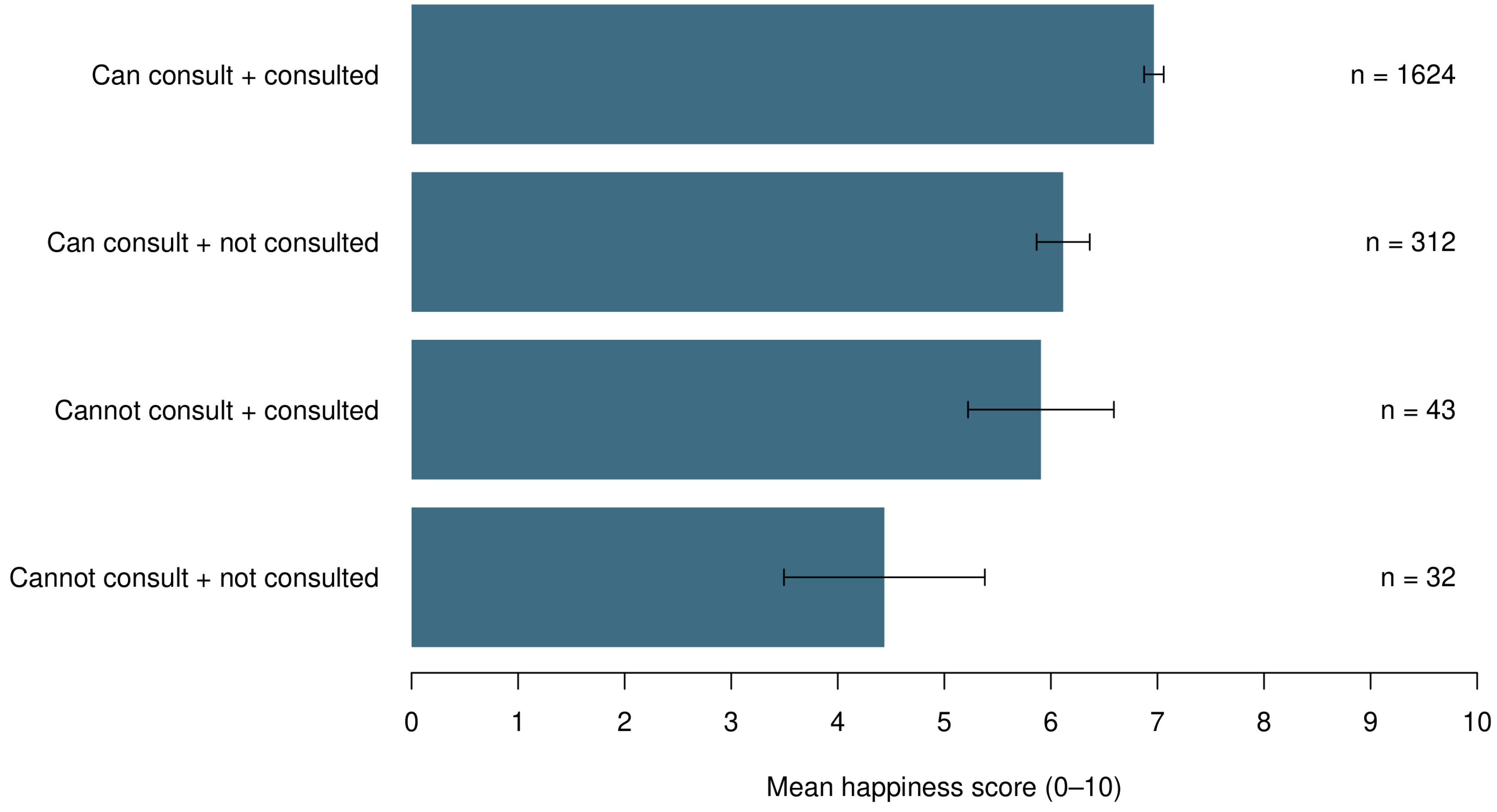
The four combinations of consultation access and being consulted were examined descriptively. Mean happiness was plotted over the full 0–10 scale with 95% t confidence intervals using the number of observed happiness responses in each group. These comparisons were exploratory, especially for the two small groups without a consultation source. The two items do not establish reciprocity involving the same people.
Multivariable linear regression examined happiness. Having someone to consult, being consulted by family or friends, and social contribution activity were entered simultaneously, with age, sex, education, income, marital status, employment status, living alone, family or relative contact, functional score, walking, healthy diet and receipt of care. One model used the broader functional score and one the basic score. Results are unstandardized coefficients (B) on the original happiness scale, with t-based 95% confidence intervals. “Mutually adjusted” describes adjustment within these models and does not imply elimination of confounding. Full coefficients are provided in
Table S3a,b.
Binary logistic regression examined good self-rated health with the same explanatory variables and covariates. Odds ratios (ORs) and Wald 95% confidence intervals are reported; full coefficients are provided in
Table S4a,b. The five-category sensitivity analysis used proportional-odds models, with ORs above 1 indicating better health. Expected-information score diagnostics assessed departures from proportional odds globally and for each main exposure (
Table S7). These diagnostics are approximate and do not establish that the assumption holds.
Sequentially adjusted logistic models for self-rated health were fitted on the same complete-case sample as the final broader-function model. All stages included consultation access and being consulted. Model 1 adjusted for age and sex; Model 2 added socioeconomic and family factors; Model 3 added broader function, walking, healthy diet and receipt of care; and Model 4 added social contribution activity. Holding the sample constant separates changes due to covariate adjustment from changes in case inclusion (
Table S2). No automated variable-selection procedure was used.
Missing data were handled by complete-case analysis separately for each model; incomplete functional scores were also missing. Exploratory checks included HC3 standard errors for happiness, a consultation-access × being-consulted interaction, and adjustment for the ten personality items. Personality models were compared with otherwise identical models fitted to the same respondents (
Table S8). Descriptive comparisons of included and excluded respondents are reported in
Table S9. Analyses were performed in R (version 4.6.1) [
24], with two-sided
p < 0.05 as the significance threshold. Secondary and exploratory analyses were interpreted cautiously without adjustment for multiple testing.
3. Results
3.1. Participant Characteristics
The source sample comprised 2084 adults aged 60–104 years (mean 73.0, SD 8.10); 1088 (52.2%) were women. Among respondents with observed household information, 347/2049 (16.9%) lived alone. Family or relative contact was reported by 1986/2031 respondents (97.8%). The broader and basic happiness models included 1806 and 1817 respondents, respectively; the corresponding binary and ordinal health models included 1802 and 1813. Missingness was greatest for income (106/2084, 5.1%) among the covariates. Model exclusions and component-item missingness are detailed in
Table S5.
Overall, 1989/2067 respondents (96.2%) reported at least one anticipated consultation source, while 78 (3.8%) reported none; Q21 was missing for 17 respondents. Being consulted was reported by 1713/2066 (82.9%). The most frequently selected consultation sources were children (67.5%) and spouses (55.9%); care or welfare offices were selected by 33.3%. Multiple selections were possible (
Table S6). Participant characteristics are summarized in
Table 1.
Table 1.
Characteristics of the source sample.
Table 1.
Characteristics of the source sample.
| Variable | Nonmissing N | Value |
|---|
| Age, mean ± SD | 2084 | 73.0 ± 8.10 |
| Female | 2084 | 1088 (52.2) |
| Living alone | 2049 | 347 (16.9) |
| Family or relative contact | 2031 | 1986 (97.8) |
| Having someone to consult | 2067 | 1989 (96.2) |
| Being consulted by family or friends | 2066 | 1713 (82.9) |
| Happiness, mean ± SD | 2045 | 6.76 ± 2.03 |
| Good self-rated health | 2037 | 906 (44.5) |
| Social contribution activity | 2075 | 458 (22.1) |
3.2. Consultative Relationship Types
Participants were categorized into four consultative relationship types according to whether they had someone to consult and whether they were consulted by family members or friends. The largest group was those who both had someone to consult and were consulted by others (n = 1656). This was followed by those who had someone to consult but were not consulted by others (n = 318). The groups without someone to consult were small: 43 participants were consulted by others despite not having someone to consult, and 32 participants neither had someone to consult nor were consulted by others.
Mean happiness differed across the four consultative relationship types. Participants who both had someone to consult and were consulted by others had the highest mean happiness score (mean = 6.97, SD = 1.89). Those who had someone to consult but were not consulted by others had a mean happiness score of 6.12 (SD = 2.24), and those who did not have someone to consult but were consulted by others had a mean score of 5.91 (SD = 2.22). The lowest happiness score was observed among participants who neither had someone to consult nor were consulted by others (mean = 4.44, SD = 2.61).
A similar descriptive pattern was observed for self-rated health. The proportion of participants with good self-rated health was highest among those who both had someone to consult and were consulted by others (48.1%). In contrast, only 20.0% of those who neither had someone to consult nor were consulted by others reported good self-rated health. These descriptive findings are shown in
Table 2 and
Figure 1. Because the two groups without someone to consult were small, these results should be interpreted as exploratory.
Table 2.
Happiness and self-rated health by consultative relationship type.
Table 2.
Happiness and self-rated health by consultative relationship type.
| Consultation Combination | Group N | Happiness Mean ± SD (n) | Good Health n/N (%) |
|---|
| Can consult and is consulted | 1656 | 6.97 ± 1.89 (1624) | 782/1625 (48.1) |
| Can consult but is not consulted | 318 | 6.12 ± 2.24 (312) | 89/310 (28.7) |
| Cannot consult but is consulted | 43 | 5.91 ± 2.22 (43) | 18/41 (43.9) |
| Cannot consult and is not consulted | 32 | 4.44 ± 2.61 (32) | 6/30 (20.0) |
3.3. Associations with Happiness
Table 3 shows the associations of having someone to consult, being consulted by family or friends, and engagement in social contribution activities with happiness.
In the broader-function model (N = 1806), having someone to consult was associated with higher happiness (B = 1.14, 95% CI 0.68–1.61, p < 0.001). Being consulted by family or friends was also associated with higher happiness (B = 0.49, 95% CI 0.22–0.76, p < 0.001), as was social contribution activity (B = 0.39, 95% CI 0.17–0.60, p < 0.001).
The basic-function model (N = 1817) showed a similar pattern: B = 1.15 (95% CI 0.68–1.62) for consultation access, B = 0.58 (0.33–0.84) for being consulted, and B = 0.41 (0.20–0.62) for social contribution activity (all p < 0.001).
All three indicators were positively associated with happiness after mutual adjustment. HC3 intervals for being consulted also excluded zero in both models. Its association remained positive after additional adjustment for personality items on identical complete-case samples: B = 0.33 (95% CI 0.07–0.59,
p = 0.013; broader) and B = 0.36 (0.12–0.61,
p = 0.004; basic). The exploratory interaction did not provide clear evidence of an additional combined association (
p = 0.269 and 0.288); the estimates were imprecise (
Table S8).
3.4. Associations with Self-Rated Health
Table 4 shows the associations with good self-rated health.
In the broader-function model (N = 1802), associations with good self-rated health were not clear for consultation access (OR = 1.14, 95% CI 0.63–2.05, p = 0.661), being consulted (OR = 1.03, 0.74–1.43, p = 0.857), or social contribution activity (OR = 1.11, 0.88–1.41, p = 0.380).
In the basic-function model (
N = 1813), being consulted was associated with good self-rated health (OR = 1.37, 95% CI 1.01–1.86,
p = 0.043). Associations were not clear for consultation access (OR = 1.23, 0.69–2.20,
p = 0.475) or social contribution activity (OR = 1.22, 0.97–1.54,
p = 0.097). Five-category ordinal models showed a similar pattern for being consulted: OR = 1.23 (0.93–1.63,
p = 0.144) with broader function and OR = 1.57 (1.21–2.04,
p < 0.001) with basic function. Global score diagnostics did not detect nonproportionality (
p = 0.329 and 0.309), although this does not prove proportional odds (
Table S7).
3.5. Sequentially Adjusted Models for Self-Rated Health
Sequential models used a fixed complete-case sample of 1802 respondents. Results and the adjustment sequence are reported in
Table S2.
The OR for being consulted was 2.31 (95% CI 1.75–3.04, p < 0.001) after age and sex adjustment and 2.03 (1.53–2.69, p < 0.001) after adding socioeconomic and family factors. After broader function, walking, healthy diet and receipt of care were added, the OR was 1.04 (0.75–1.44, p = 0.832). Adding social contribution activity yielded OR = 1.03 (0.74–1.43, p = 0.857).
The attenuation persisted when case inclusion was held constant. These comparisons do not distinguish confounding, overlapping measures, reverse causality or possible overadjustment, and are not evidence of mediation.
4. Discussion
4.1. Principal Findings
By examining both relational positions in the same models, this study found that having someone to consult, being consulted by family or friends, and engagement in social contribution activities were associated after mutual adjustment with higher happiness among older adults in Japan. The association with being consulted remained after adjustment for access to consultation, social contribution, and two alternative definitions of functional capacity. For self-rated health, the association with being consulted was present only in the basic functional capacity model and was attenuated when broader functional capacity was included.
The findings are consistent with considering older adults as people who may both seek consultation and be consulted by others. Theories of support exchange and social roles provide possible explanations [
10,
16,
25], but the survey did not establish reciprocity between the same people or measure the subjective meaning of these experiences. The observed indicators and these theoretical interpretations therefore need to remain distinct.
4.2. Having Someone to Consult and Happiness
Having someone to consult when facing difficulties was strongly associated with higher happiness. This finding is consistent with the broader literature suggesting that social relationships and perceived access to support are important for well-being in later life [
26,
27,
28]. The ability to consult someone may provide emotional security, practical information, and reassurance that help would be available when needed. Even if older adults do not frequently seek help, the perceived availability of someone to consult may contribute to a sense of safety and connectedness [
29,
30].
The association with happiness persisted after adjustment for the measured covariates. However, 96.2% reported having someone to consult, leaving only 78 respondents without a source before further missing-data exclusions. The estimate depends on this small comparison group. Moreover, the binary indicator combines informal and professional sources, which may differ in accessibility, quality and meaning.
Table S6 describes their frequencies; it does not estimate source-specific effects.
4.3. Being Consulted by Family or Friends
A contribution of this study is its examination of being consulted by family or friends alongside having someone to consult. This extends attention beyond the availability of help to an activity in which older adults may participate in their close relationships [
31,
32]. The mutually adjusted associations support examining these indicators separately, without treating them as evidence of reciprocal exchanges.
One possible explanation is that being consulted accompanies feelings of usefulness or recognition, concepts discussed in the literature on mattering and social roles [
14,
16,
33]. These possibilities may be relevant when retirement, bereavement or declining health changes social participation [
34,
35]. However, the present item does not show whether respondents felt trusted, valued or useful. Occasional everyday conversation, unwanted demands and meaningful advice may all generate the same yes response.
Being consulted by family or friends remained associated with happiness after adjustment for the other indicators and measured covariates. Exploratory adjustment for the ten personality items attenuated this association, although its confidence interval still excluded zero in both functional specifications (
Table S8). This does not exclude residual confounding. Mattering and generativity remain possible theoretical interpretations [
36,
37], rather than constructs tested by this analysis.
4.4. Social Contribution Activities and Happiness
Engagement in social contribution activities was also associated with higher happiness. This finding suggests that broader forms of participation and contribution may be related to well-being in older age. Social contribution activities may provide opportunities for social interaction, a sense of purpose, recognition from others, and continued involvement in the community [
16,
38,
39].
The association with social contribution activity persisted after adjustment for being consulted by family or friends. These items address different reported activities: consultation within family or friendship relationships and participation in activities such as volunteering. The distinction is compatible with research on participation across social settings [
17,
18], but the single items cannot identify activity intensity, motivation, perceived benefit or burden.
4.5. Differences Between Happiness and Self-Rated Health
The findings differed between happiness and self-rated health. For happiness, the associations of having someone to consult, being consulted, and social contribution activities were consistent across models using both broader and basic functional capacity scores. In contrast, the associations with self-rated health were less consistent.
Being consulted by family or friends was associated with good self-rated health in the basic-function model, while the broader-function estimate was close to the null and imprecise. The fixed-sample sequential models showed attenuation after function, walking, healthy diet and receipt of care were added. Ordinal analyses retaining all five health categories showed a similar dependence on the functional specification. A difference in statistical significance between models does not itself establish that their coefficients differ.
Several explanations are compatible with this pattern. Better health and functioning may allow people to maintain social contact and be consulted, producing health-related selection or reverse causality [
21]. The broader score also includes visiting friends, visiting sick people and initiating conversations with younger people. These activities can overlap with the interpersonal circumstances in which consultation occurs. Although the items concern domains related to competence [
23], the study-specific composites are not validated TMIG scores.
Broader social engagement could be a common cause, a consequence, or an intermediate process connecting consultation and health. Adjustment could therefore reduce confounding, remove overlapping information, or introduce overadjustment. Cross-sectional measurement cannot distinguish these explanations; reverse causality could account for the entire observed association. Longitudinal research measuring health, function and consultation repeatedly would be needed to examine temporal ordering and possible mediation. The fixed-sample comparison addresses changes in case inclusion, not these causal ambiguities.
4.6. Interpretation of the Four Consultation Groups
The group reporting both having someone to consult and being consulted by family or friends had the highest observed mean happiness, while the group reporting neither had the lowest. These unadjusted descriptions summarize the sample and should not be interpreted as evidence of an additional benefit from having both characteristics.
The two items do not establish whether consultation occurred between the same people. For example, a respondent could anticipate consulting a professional while being consulted by a family member. Thus, theoretical work on support exchange [
11] offers context, but the four groups do not measure dyadic reciprocity.
The groups without someone to consult contained only 43 and 32 respondents before outcome-specific exclusions. Their means and percentages are imprecise. Exploratory interaction tests did not provide clear evidence of an additional combined association, and their wide intervals do not establish the absence of interaction (
Table S8). The primary interpretation rests on the mutually adjusted main associations, subject to the observational limitations.
4.7. Practical Implications
The findings suggest questions for community and rehabilitation research. Alongside asking whether an older adult has someone to consult [
40], practitioners could explore whether family or friends consult the person and whether this is welcome or burdensome. Research should first examine whether these questions identify perceived opportunities for participation; this study did not validate them as screening tools.
One testable practice model would offer voluntary peer-support or experience-sharing sessions in day-care or community rehabilitation programs. Participants could share experience on topics they choose, with accessibility and support adapted to their abilities. A prospective comparison could assess changes in perceived usefulness, happiness and rehabilitation motivation, as well as fatigue and unwanted responsibility. These are proposed outcomes for future evaluation, not benefits demonstrated by the present data. Attention to individual strengths offers related context [
41].
Participation should reflect the older adult’s preferences and capacity, including the choice not to advise others. Neither assigning a consultation role nor preserving an existing one can be expected to improve well-being on the basis of these results. Happier and healthier people may already have more opportunities to participate, so any intervention study should account for baseline health and well-being and examine change over time.
4.8. Strengths
The study considered having someone to consult, being consulted by family or friends and social contribution activity simultaneously in a survey with nationwide geographic coverage. Alternative functional specifications, fixed-sample sequential models and ordinal health analyses helped clarify the dependence of results on analytic choices. Reporting nonmissing denominators, model sample sizes and full covariate estimates improves transparency. These features do not remove the limitations of cross-sectional, unweighted secondary analysis.
4.9. Limitations
First, the cross-sectional design does not establish temporal order or causal effects. Happier or healthier adults may be more likely to retain social contact and be consulted by family or friends. Health-related selection or reverse causality could explain the observed associations entirely. Adjustment for concurrent functional and behavioral measures cannot resolve this problem and may involve overlapping constructs or overadjustment.
Second, the principal exposures and outcomes were represented by single survey indicators. Having someone to consult reflects anticipated sources, not observed support receipt. Being consulted by family or friends does not measure frequency, emotional depth, decision-making reliance, relationship quality or perceived burden; it may include ordinary conversation. Social contribution activity does not measure its intensity or subjective meaning. These indicators do not establish trust, mattering, generativity, meaningful roles or dyadic reciprocity. The study-specific functional composites also require separate validity evaluation.
Third, the small group without someone to consult limits precision and the stability of group comparisons and interaction estimates. Combining multiple consultation sources may obscure meaningful differences. Source-specific descriptive frequencies do not resolve this heterogeneity. Some covariate categories were also sparse, with extremely wide logistic confidence intervals, especially for not going out or being unable to go out (
Table S4a,b); those individual estimates should not be interpreted substantively.
Fourth, residual confounding remains possible. The exploratory analysis incorporating ten personality responses did not eliminate the association with being consulted by family or friends, but did not constitute comprehensive personality adjustment. Depressive symptoms, cognitive function, relationship quality and other contextual factors were not included in the adjusted models. Shared self-report methods and current emotional state may also contribute to the observed associations.
Fifth, complete-case analysis excluded approximately 13% of respondents, and included and excluded respondents differed descriptively in age and health (
Tables S5 and S9). Missingness could therefore bias estimates; no assumption that data were missing completely at random is made. Survey weights and design identifiers were absent from the supplied files, and the reviewed documentation did not provide a response-rate denominator. Unweighted estimates and conventional model intervals do not account for complex sampling, limiting population inference. Finally, the additional sensitivity analyses were exploratory and not adjusted for multiple testing.
5. Conclusions
In this cross-sectional secondary analysis of Japanese adults aged 60–104 years, having someone to consult, being consulted by family or friends and social contribution activity were associated with higher happiness after mutual adjustment for the measured covariates. The association between being consulted by family or friends and self-rated health depended on the functional adjustment specification, including when all five health categories were retained.
These findings support further investigation of consultation access and being consulted by family or friends as distinct survey indicators. They do not demonstrate dyadic reciprocity, a meaningful-role mechanism, or benefits from increasing opportunities to be consulted. Longitudinal and intervention research is needed to distinguish selection and reverse causality from possible effects of participation.