1. Introduction
Dementia represents a growing public health challenge globally, with the number of people living with dementia projected to triple from 57 million in 2019 to 153 million by 2050 [
1]. This rise is more marked in low- and middle-income countries, particularly in Asia and the Western Pacific [
2]. Brunei Darussalam is a small nation in Southeast Asia with a population of approximately 442,000 [
3]. Based on the Global Burden of Disease Study 2019, there were an estimated 1574 people living with dementia in Brunei in 2019, which is projected to increase nearly five-fold to 7317 by 2050 [
4]. This reflects the rapidly ageing population and high prevalence of vascular risk factors including hypertension, diabetes mellitus and cardiovascular disease in the country [
3].
Early identification of cognitive impairment is a priority of the World Health Organization (WHO) Global action plan on the public health response to dementia 2017–2025, which aims for at least 50% of people with dementia to be diagnosed by at least 50% of member states by 2025 [
4]. However, dementia was significantly underdiagnosed in Brunei, with only 18.5% of estimated cases identified through national electronic health records in 2022 [
5]. Furthermore, many individuals with dementia present late to clinical services, often with complications such as falls, immobility, or aspiration pneumonia, rather than with early cognitive symptoms [
6].
This diagnostic gap reflects multiple factors, including limited public awareness of dementia symptoms, cultural attitudes towards cognitive decline as a normal part of ageing and a lack of routine cognitive screening in primary care and community settings [
7]. During the COVID-19 pandemic, efforts were made to disseminate dementia information through social media platforms [
8]. The post-pandemic period presents an opportunity to strengthen community engagement and early detection strategies, particularly given the advances in disease-modifying treatments for Alzheimer’s disease [
9] and increasing evidence for dementia risk reduction through management of modifiable risk factors [
10].
Brief cognitive screening tools, such as the Mini-COG, offer a practical approach to identifying possible cognitive impairment in community and clinical settings. The Mini-COG combines three-word recall with a clock-drawing test, which can be administered in approximately three minutes with minimal training [
11]. While cognitive assessment tools have not been formally validated in Brunei [
12], the simplicity and cross-cultural applicability of the Mini-COG make it suitable for opportunistic screening across diverse settings and populations.
While many dementia risk factors are well established in the literature, there is limited evidence describing their distribution in Southeast Asian populations or examining how community-based cognitive screening can be implemented in real-world settings. The pilot phase of community-based dementia screening conducted in senior citizen activity centres in Brunei was previously reported [
13]. This pilot demonstrated the feasibility and acceptability of screening, and identified a high prevalence of dementia risk factors and cognitive symptoms among these socially active older adults. Brunei represents a distinct sociocultural and healthcare context, with strong primary care coverage, a high non-communicable disease burden and an evolving public awareness of dementia.
Following this pilot, the screening initiative was expanded to a broader range of community and healthcare settings to reach a larger group. This paper reports the final results from the expanded community dementia screening initiative. The aims were to describe the demographic characteristics and distribution of dementia risk factors and cognitive symptoms across the full cohort, examine associations between participant characteristics and suspected cognitive impairment using multivariable analysis and provide implementation-level evidence to inform community-based dementia detection strategies in Brunei.
2. Materials and Methods
The cross-sectional community-based screening initiative was conducted between June 2022 and May 2023. The study design and screening approach have been described in detail previously [
13]. Participants were recruited through consecutive sampling at designated screening venues during organised sessions. They completed a structured questionnaire covering basic demographics, risk factors for dementia, ten warning signs or symptoms of dementia [
14] and the Mini-COG as a brief cognitive screening tool. The questionnaire was developed by the research team. Content validity was ensured through expert review by clinicians involved in geriatric medicine and primary care. As the questionnaire was designed for pragmatic community screening, formal psychometric validation was not performed. Screening was conducted face-to-face by trained volunteers under the supervision of the research team. For participants who had difficulty reading or writing, all questions were asked verbally to ensure comprehension and accurate recording of responses.
The Mini-COG was administered according to standard published procedures [
11]. Participants were asked to recall three unrelated words, draw a clock with numbers correctly placed and set the hands to a specified time (10 past 11). Scoring followed established criteria: participants recalling all three words were classified as unlikely to have dementia; those recalling none were classified as likely dementia; and those recalling one or two words were further evaluated based on their clock-drawing performance. All screeners received structured training prior to data collection to ensure consistency in administration and scoring. The research team was also available for clarification of uncertain scoring during screening sessions.
The inclusion criteria were older adults aged 60 years and above, or those aged at least 50 years old who reported one or more risk factors for dementia. The inclusion of individuals aged 50–59 years was intended to facilitate early identification of at-risk individuals rather than to estimate the population prevalence of late-onset dementia. The locations for screening included public spaces (churches, mosques, libraries, community centres and government ministries), places where older people frequent (Senior Citizen Activity Centres, pension collection locations and marketplaces) and places where people with risk factors attend for evaluation (primary care, dialysis centres, hospital outpatient clinics and hospital lobbies). After completing the questionnaire, participants were given brief tailored advice on dementia risk reduction and were encouraged to discuss with their doctor if they had poorly controlled risk factors, symptoms or cognitive concerns identified on the Mini-COG.
Data collected were entered into Microsoft Excel and analysed using RStudio version 4.5.2. Descriptive statistics were used to summarise participant characteristics, while multivariable logistic regression examined adjusted associations between demographics, education and multimorbidity with suspected cognitive impairment based on the Mini-COG. The significance threshold was p < 0.05.
3. Results
Screening was undertaken in a range of community and healthcare settings.
Table 1 shows the number of participants recruited from each category.
There were 1962 participants screened, out of which 1358 (69.2%) were included for analysis. The median age of included participants was 60 years (range 50 to 91 years). There were 490 (36.1%) males, 862 (63.5%) females and 6 (0.4%) participants who did not disclose gender. The majority, 988 (72.8%) participants had at least a primary school education, with 584 (43.0%) having secondary education and 269 (19.8%) having tertiary education. In terms of occupation, participants included retirees, government employees, private sector workers and homemakers, which reflected the diverse recruitment settings.
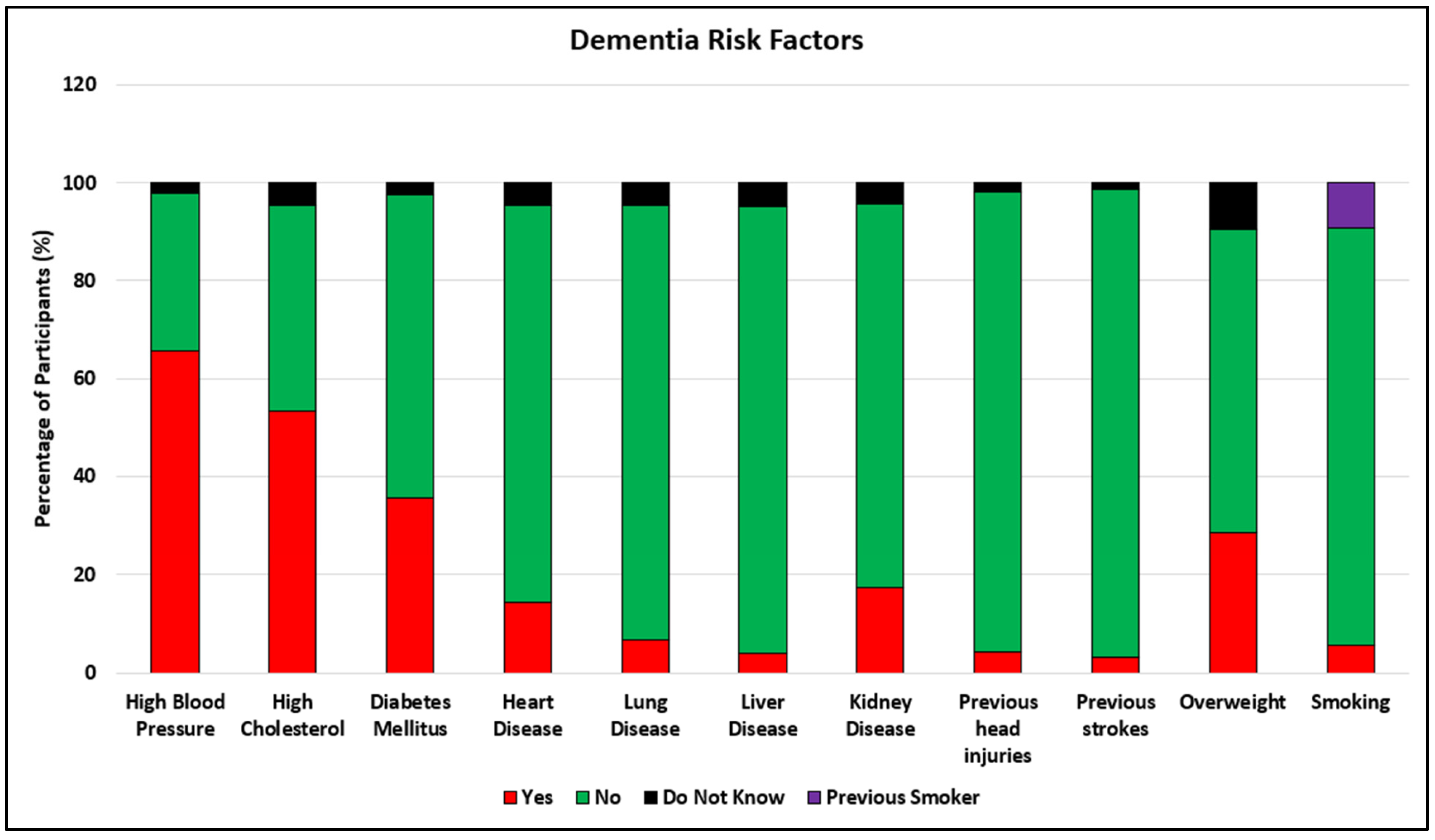
The prevalence of self-reported dementia risk factors was high across the cohort (
Figure 1). Hypertension was the most common risk factor in 892 (65.7%), followed by high cholesterol in 723 (53.2%), diabetes mellitus in 484 (35.6%) and overweight in 386 (28.4%). The main differences between male and female participants (shown in
Table 2) were that males had significantly higher rates of heart disease (20.4% vs. 10.8%,
p < 0.001), kidney disease (20.8% vs. 15.4%,
p = 0.01) and smoking (13.1% vs. 1.3%,
p < 0.001), while females had higher rates of being overweight (30.9% vs. 24.7%,
p = 0.02).
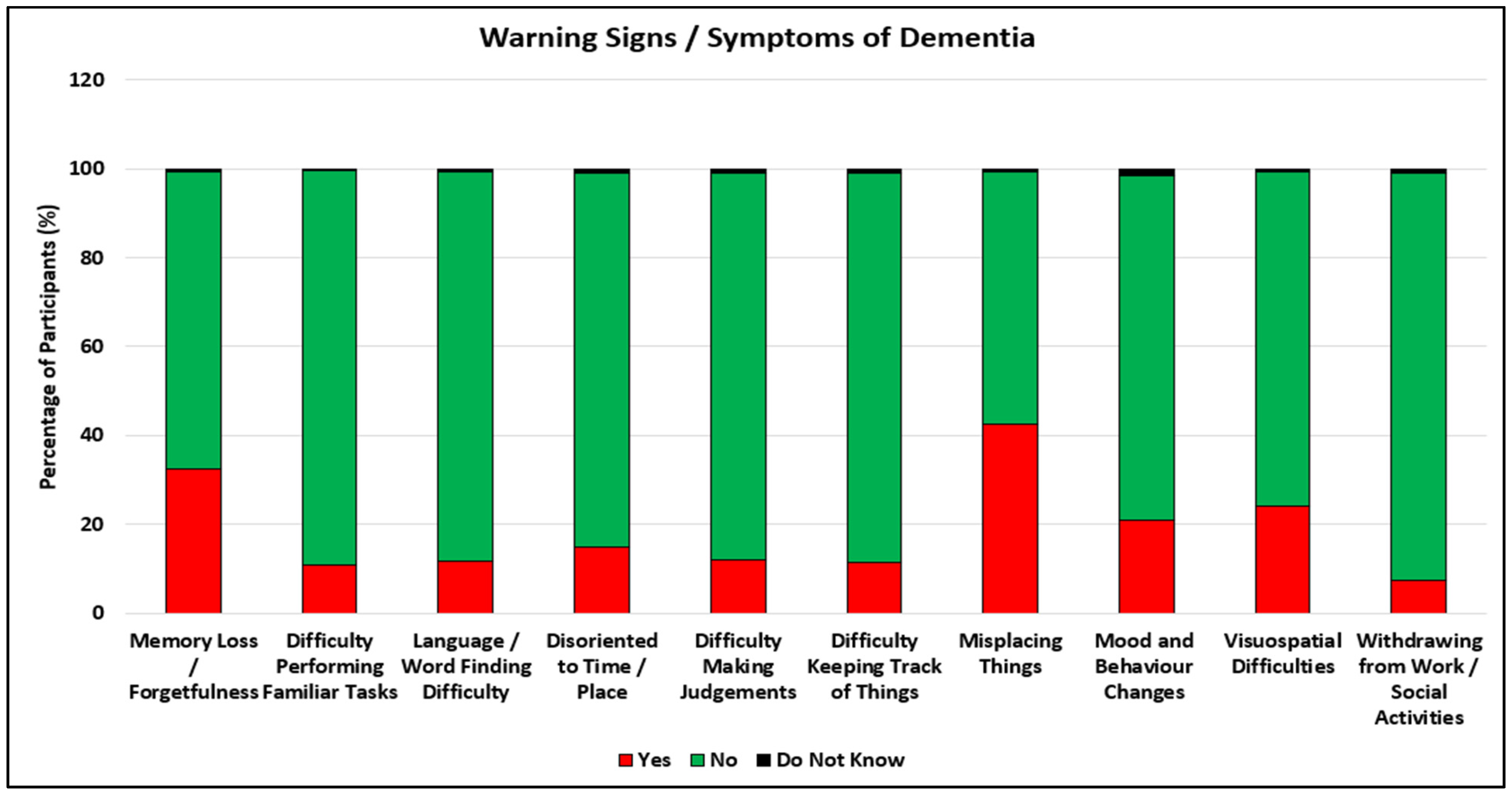
The distribution of self-reported cognitive symptoms is shown in
Figure 2. The most commonly reported symptom was misplacing things in 578 (42.6%) of participants, followed by forgetfulness in 441 (32.5%), visuospatial difficulties in 328 (24.2%) and mood or behaviour changes in 283 (20.8%). Among participants who reported cognitive symptoms, 104 (14.5%) stated that they were getting worse, while 90 (12.0%) admitted to symptoms affecting their activities of daily living (ADLs). There were 235 (17.3%) who thought they should get their memory checked. There were no significant differences between genders for cognitive symptoms (
Table 2). While females showed a trend towards higher reporting of changes in mood or behaviour, this did not reach statistical significance. There were 197 (14.5%) with suspected cognitive impairment based on the Mini-COG.
Multivariable logistic regression analysis adjusting for age, gender, education level and vascular risk factors found that increasing age and lower education level were independently associated with suspected cognitive impairment on the Mini-COG. Increasing age was associated with a higher likelihood of Mini-COG impairment (adjusted OR 1.06 per year, p < 0.001). Education level had a strong graded association, where participants with only primary education had more than twice the odds of Mini-COG impairment compared to tertiary education (adjusted OR 2.25, p = 0.007). Gender was not significantly associated with Mini-COG impairment (adjusted OR for males 1.21, p = 0.26). None of the vascular risk factors showed statistically significant associations with Mini-COG impairment after adjustment: hypertension (adjusted OR 1.15, p = 0.44), hypercholesterolaemia (adjusted OR 1.08, p = 0.64), diabetes mellitus (adjusted OR 0.91, p = 0.54), previous stroke (adjusted OR 1.43, p = 0.38), kidney disease (adjusted OR 1.12, p = 0.55) and smoking (adjusted OR 0.78, p = 0.42).
4. Discussion
This study reports the final results of a large-scale community dementia screening initiative in Brunei, expanding upon the previously reported pilot phase [
13]. Senior citizen activity centres and community venues provided access to socially engaged older adults who may not regularly attend healthcare services. Workplace screening at government ministries captured a younger high-risk population who would not typically present for cognitive concerns. Clinical settings, such as dialysis centres and outpatient clinics enabled screening of individuals with established vascular comorbidities during routine medical visits. This diverse range of recruitment settings demonstrates that opportunistic cognitive screening can be embedded within public health activities, medical follow-ups and non-healthcare environments.
Similar community-based screening initiatives reported comparable feasibility and acceptability. A primary-care-based screening programme in India found that over 40% of screened individuals had possible dementia, and detection of vascular risk factors facilitated integrated the management of both cognitive and non-communicable disease risk [
15]. Similar case-finding programmes in Singapore and other Southeast Asian settings have likewise demonstrated that brief cognitive tools can be utilised outside memory services [
16,
17]. Our findings add to this evidence base by showing the screening can be delivered across a wider range of venues, from religious and social gathering places to workplace health promotion events.
Findings from this study reveal a high prevalence of vascular risk factors and cognitive symptoms among participants. This was consistent with the pilot study findings and national non-communicable disease prevalence data from Brunei [
3,
13], and underscores the importance of considering dementia risk reduction messaging in existing vascular disease management programmes. While there were a significant number of participants with cognitive symptoms, only 17.3% felt they should have their memory checked. This suggests that many individuals may not recognize the significance of these symptoms or may be reluctant to seek formal assessment. This supports the need for proactive screening to identify individuals who may benefit from further evaluation but would not otherwise present to health services.
Age and education level were the strongest predictors of suspected cognitive impairment on the Mini-COG, while vascular risk factors showed no independent associations in this study. Each additional year of age was associated with 6% higher odds of impairment on the Mini-COG, consistent with the known relationship between advancing age and cognitive decline. The association with education level indicates the protective effect of higher educational attainment, through improvement in cognitive reserve [
18,
19]. The lack of association of vascular risk factors was unexpected; longitudinal studies consistently demonstrate that midlife hypertension, diabetes and other vascular risk factors predict later dementia risk, even when cross-sectional associations may be weak [
20,
21]. This may be partly attributable to the cross-sectional nature of this study and the reliance on self-reported comorbidities. Undiagnosed or unrecognized hypertension, diabetes and hyperlipidaemia are common in community populations, particularly among individuals who do not undergo regular health screening. Such non-differential misclassification may also attenuate observed associations between vascular risk factors and cognitive outcomes.
In addition, the Mini-COG is a brief screening instrument that primarily assesses memory recall and basic visuospatial function. It does not comprehensively evaluate executive function, processing speed, or attention, which are domains commonly affected in vascular cognitive impairment. Thus, the absence of independent associations in this study may also partly reflect the measurement limitations of the screening tool, rather than a true lack of a relationship between vascular risk burden and cognitive function.
While universal population screening for dementia in low-prevalence community settings may have limited benefit, a case-finding approach targeting individuals with risk factors, symptoms or specific healthcare encounters is more appropriate and cost-effective [
22]. Our experience supports a pragmatic model, where cognitive screening is embedded within existing health contacts and community platforms. Opportunistic screening opportunities include non-communicable disease clinics, workplace health screening programmes and community events. In each of these settings, screening can be combined with brief education on brain-health lifestyles and dementia risk reduction [
23]. The screening must be coupled with referral pathways for confirmatory assessment. The screening questionnaire was designed to be easily adapted into a self-referral form. Participants could take their questionnaire to their healthcare provider, which summarised their risk factors, symptoms and Mini-COG score as a basis for clinical discussion. In Brunei, this involves primary care physicians for initial evaluation and risk factor management, with onward referrals to specialist geriatric or neurology services for comprehensive cognitive assessment and diagnosis if indicated.
Strengths of this study include the large sample size, diverse recruitment settings and systematic collection of data on demographics, risk factors, symptoms and objective cognitive screening. Limitations include the cross-sectional design precluding conclusions about causality or prognostic significance of screening findings. Risk factors and symptoms were self-reported for practicality, which may lead to recall bias or underreporting. The Mini-COG is a brief screening tool and may not capture subtle or domain-specific cognitive deficits, particularly executive function that is commonly affected in vascular cognitive impairment. The convenience sampling approach may limit generalisability, as individuals who are home-bound, institutionalised, socially isolated, or less likely to attend organised community events or healthcare venues may have been underrepresented.
Areas for future research include longitudinal follow-up of screened participants to determine the prognostic value of the Mini-COG and subjective symptoms for subsequent dementia diagnosis. Comparative studies across Southeast Asian countries could explore how education systems and health system structures influence screening outcomes and pathways to care. Finally, research on culturally appropriate post-screening interventions, such as cognitive stimulation, lifestyle modification programmes and caregiver support, may complement early detection efforts.
5. Conclusions
Community-based dementia screening using a brief questionnaire and Mini-COG was feasible across multiple settings in Brunei. There was a high prevalence of vascular risk factors and cognitive symptoms. Age and educational attainment were stronger predictors of abnormal Mini-COG results compared to vascular risk factors in this study. These findings support opportunistic screening in healthcare and community settings, and emphasise the need for public education on dementia symptoms and risk reduction.
Author Contributions
Conceptualization, S.P.T., J.Y.L., M.B.H., S.M.T., N.K., N.B.A. and A.H.; methodology, S.P.T., J.Y.L., M.B.H., S.M.T., N.K., N.B.A. and A.H.; software, S.P.T.; validation, S.P.T., J.Y.L., M.B.H., S.M.T., N.K., N.B.A. and A.H.; formal analysis, S.P.T., J.Y.L., M.B.H., S.M.T., N.K., N.B.A. and A.H.; investigation, S.P.T., J.Y.L., M.B.H., S.M.T., N.K., N.B.A. and A.H.; resources, S.P.T., S.M.T., N.K., N.B.A. and A.H.; data curation, S.P.T., J.Y.L., M.B.H., S.M.T., N.K., N.B.A. and A.H.; writing—original draft preparation, S.P.T., J.Y.L., M.B.H., S.M.T., N.K., N.B.A. and A.H.; writing—review and editing, S.P.T., J.Y.L., M.B.H., S.M.T., N.K., N.B.A. and A.H.; visualization, S.P.T., J.Y.L., M.B.H., S.M.T., N.K., N.B.A. and A.H.; supervision, S.P.T., N.K. and A.H.; project administration, S.P.T., N.B.A. and A.H.; funding acquisition, S.P.T. All authors have read and agreed to the published version of the manuscript.
Funding
This study was supported by a grant received from the Davos Alzheimer’s Collaborative under the Healthcare System Preparedness Early Detection programme. The sponsor was not involved in the research process, such as study design, data analysis, interpretation or writing the manuscript.
Institutional Review Board Statement
The study was conducted in accordance with the Declaration of Helsinki, and approved by the Medical and Health Research Ethics Committee (MHREC), Ministry of Health, Brunei Darussalam; Ref: MHREC/MOH/2022/14(1). Approved on 1 August 2022.
Informed Consent Statement
Informed consent was obtained from all subjects involved in the study.
Data Availability Statement
The data that support the findings of this study are not available for sharing due to institutional restrictions.
Acknowledgments
The authors would like to acknowledge the stakeholders: [Demensia Brunei, Health Promotion Centre, Ministry of Health, Ministry of Culture Youth and Sports and Universiti Brunei Darussalam]; participating centres [Prime Minister’s Office, Ministry of Home Affairs, Ministry of Education, Ministry of Religious Affairs, Radio Television Brunei, RIPAS Hospital, Cardiology Services, Respiratory Services, Pantai Jerudong Specialist Centre, Panaga Health Centre and primary care centres (Berakas, Muara, Sungai Asam, Pangkalan Batu, Sengkurong and Rimba); dialysis centres (Kiarong, RIPAS, Rimba, Tutong, Kuala Belait and Temburong), Pusat Kegiatan Warga Emas (Brunei–Muara, Tutong, Belait and Temburong); Pertubuhan Warga Emas; Halaqah International; Masjid Ash-Shaliheen, Masjid Kampong Ayer; St Andrew’s Church, Christian Fellowship Centre of Brunei Evergreen Church Group; Language and Literature Bureau; Muara Library; Pusat Insani; Yayasan mall; The Mall Gadong; Times Square Mall, village heads (Lambak, Mengkubau and Sungai Tilong)] and research coordinators, volunteers and participants for their support with this project.
Conflicts of Interest
The authors declare no conflicts of interest.
Abbreviations
The following abbreviations are used in this manuscript:
| WHO | World Health Organisation |
| COVID-19 | Coronavirus disease 2019 |
| ADL | Activities of Daily Living |
References
- GBD 2019 Dementia Forecasting Collaborators. Estimation of the global prevalence of dementia in 2019 and forecasted prevalence in 2050: An analysis for the Global Burden of Disease Study 2019. Lancet Public Health 2022, 7, E105–E125. [Google Scholar] [CrossRef] [PubMed]
- World Health Organisation. Regional Action Plan on Healthy Ageing in the Western Pacific; WHO: Geneva, Switzerland, 2021; Available online: https://iris.who.int/bitstream/handle/10665/339869/9789290619352-eng.pdf?sequence=5 (accessed on 1 March 2026).
- Ong, S.K.; Lai, D.T.C.; Wong, J.Y.Y.; Si-Ramlee, K.A.; Razak, L.A.; Kassim, N.; Kamis, Z.; Koh, D. Cross-sectional STEPwise approach to surveillance (STEPS) population survey of noncommunicable diseases (NCDs) and risk factors in Brunei Darussalam 2016. Asia Pac. J. Public Health 2017, 29, 635–648. [Google Scholar] [CrossRef] [Scilit] [PubMed]
- World Health Organisation. Global Action Plan on the Public Health Response to Dementia 2017–2025; WHO: Geneva, Switzerland, 2017; Available online: https://iris.who.int/server/api/core/bitstreams/2098e5be-c7f3-4365-aebf-36204459794f/content (accessed on 1 March 2026).
- Teo, S.P. Use of ICD-10 coding in electronic records to monitor progress towards global dementia targets. Asian J. Gerontol. Geriatr. 2022, 17, 72–73. [Google Scholar] [CrossRef] [Scilit]
- Teo, S.P. Geriatrics inpatients in RIPAS Hospital, Brunei: Patient characteristics and rehabilitation needs. J. Clin. Gerontol. Geriatr. 2018, 9, 52–58. [Google Scholar] [CrossRef] [Scilit]
- Pacifico, D.; Fiordelli, M.; Fadda, M.; Serena, S.; Piumatti, G.; Carlevaro, F.; Magno, F.; Franscella, G.; Albanese, E. Dementia is (not) a natural part of ageing: A cross-sectional study on dementia knowledge and misconceptions in Swiss and Italian young adults, adults and older adults. BMC Public Health 2022, 22, 2176. [Google Scholar] [CrossRef] [Scilit] [PubMed]
- Bacsu, J.D.; Fraser, S.A.; Jamali, A.A.; Conanan, C.; Chasteen, A.L.; Vellani, S.; Gowda-Sookochoff, R.; Berger, C.; Mah, J.C.; Fehr, F.; et al. Navigating awareness and strategies to support dementia advocacy on social media during World Alzheimer’s Month: Infodemiology study. JMIR Infodemiol. 2024, 4, e63464. [Google Scholar] [CrossRef] [Scilit] [PubMed]
- O’Callaghan, C.; Michaelian, J.C.; Alhara, Y.; Anlacan, V.M.; Chen, C.; Cheung, G.; Ma’u, E.; Nguyen, T.A.; Pai, M.-C.; Palagyi, A.; et al. Dementia diagnostic and treatment services in the Western Pacific: Challenges, preparedness and opportunities in the face of amyloid-targeting therapies. Lancet Reg. Health West. Pac. 2024, 50, 101183. [Google Scholar] [CrossRef] [Scilit] [PubMed]
- Livingston, G.; Huntley, J.; Sommerlad, A.; Ames, D.; Ballard, C.; Banerjee, S.; Brayne, C.; Burns, A.; Cohen-Mansfield, J.; Cooper, C.; et al. Dementia prevention, intervention and care: 2020 report of the Lancet Commission. Lancet 2020, 396, 413–446. [Google Scholar] [CrossRef] [Scilit] [PubMed]
- Borson, S.; Scanlan, J.M.; Chen, P.; Ganguli, M. The Mini-Cog as a screen for dementia: Validation in a population-based sample. J. Am. Geriatr. Soc. 2003, 51, 1451–1454. [Google Scholar] [CrossRef] [Scilit] [PubMed]
- Teo, S.P. Challenges in identifying cognitive assessment tools prior to validation studies. Asian J. Psychiatry 2018, 35, 76. [Google Scholar] [CrossRef] [Scilit] [PubMed]
- Teo, S.P.; Lei, Y.J.; Han, M.B.; Tarif, S.M.; Kassim, N.; Ali, N.B.; Husaini, A. Community-based dementia screening initiative in Brunei: Pilot study. J. Gerontol. Geriatr. 2025, 73, 82–88. [Google Scholar] [CrossRef] [Scilit]
- Alzheimer’s Association. 10 Warning Signs of Alzheimer’s Worksheet. April 2023. Available online: https://www.alz.org/getmedia/15db9fd4-81c7-449d-a4a8-1db2b9f8707b/alzheimers-dementia-10-warning-signs-worksheet.pdf (accessed on 22 March 2026).
- Dhikav, V.; Jadeja, B.; Gupta, P. Community screening of probable dementia at primary care center in Western India: A pilot project. J. Neurosci. Rural Pract. 2022, 13, 490–494. [Google Scholar] [CrossRef] [Scilit] [PubMed]
- Lim, J.P.; Lau, S.; Lun, P.; Tang, J.Y.; Chan, E.S.-Y.; Shi, L.; Guo, L.; Ding, Y.Y.; Tay, L.; Merchant, A.R.; et al. Optimising dementia screening in community-dwelling older adults: A rapid review of brief diagnostic tools in Singapore. Ann. Acad. Med. Singap. 2024, 53, 742–753. [Google Scholar] [CrossRef] [Scilit] [PubMed]
- Subramaniam, M.; Chong, S.A.; Vaingankar, J.A.; Abdin, E.; Chua, B.Y.; Chua, H.C.; Eng, G.K.; Heng, D.; Hia, S.B.; Huang, W.; et al. Prevalence of dementia in people aged 60 years and above: Results from the WiSE study. J. Alzheimer’s Dis. 2015, 45, 1127–1138. [Google Scholar] [CrossRef] [Scilit] [PubMed]
- Sharp, E.S.; Gatz, M. Relationship between education and dementia: An updated systematic review. Alzheimer Dis. Assoc. Disord. 2011, 25, 289–304. [Google Scholar] [CrossRef] [Scilit] [PubMed]
- Stern, Y. Cognitive reserve in ageing and Alzheimer’s disease. Lancet Neurol. 2012, 11, 1006–1012. [Google Scholar] [CrossRef] [Scilit] [PubMed]
- Gottesman, R.F.; Albert, M.S.; Alonso, A.; Coker, L.H.; Coresh, J.; Davis, S.M.; Deal, J.A.; McKhann, G.M.; Mosley, T.H.; Sharrett, A.R.; et al. Associations between midlife vascular risk factors and 25-year incident dementia in the Atherosclerosis Risk in Communities (ARIC) cohort. JAMA Neurol. 2017, 74, 1246–1254. [Google Scholar] [CrossRef] [Scilit] [PubMed]
- Kivipelto, M.; Helkala, E.L.; Laakso, M.P.; Hänninen, T.; Hallikainen, M.; Alhainen, K.; Soininen, H.; Tuomilehto, J.; Nissinen, A. Midlife vascular risk factors and Alzheimer’s disease in later life: Longitudinal, population based study. BMJ 2001, 322, 1447–1451. [Google Scholar] [CrossRef] [Scilit] [PubMed]
- Lin, J.S.; O’Connor, E.; Rossom, R.C.; Perdue, L.A.; Burda, B.U.; Thompson, M.; Eckstrom, E. Screening for Cognitive Impairment in Older Adults: An Evidence Update for the U.S. Preventive Services Task Force; Evidence Synthesis No. 107. AHRQ Publication No. 13-05188-EF-1; Agency for Healthcare Research and Quality: Rockville, MD, USA, 2013.
- Van Asbroeck, S.; van Boxtel, M.P.; Steyaert, J.; Köhler, S.; Heger, I.; de Vugt, M.; Verhey, F.; Deckers, K. Increasing knowledge on dementia risk reduction in the general population: Results of a public awareness campaign. Prev. Med. 2021, 147, 106522. [Google Scholar] [CrossRef] [Scilit] [PubMed]
| Disclaimer/Publisher’s Note: The statements, opinions and data contained in all publications are solely those of the individual author(s) and contributor(s) and not of MDPI and/or the editor(s). MDPI and/or the editor(s) disclaim responsibility for any injury to people or property resulting from any ideas, methods, instructions or products referred to in the content. |
© 2026 by the authors. Published by MDPI on behalf of the Italian Society of Gerontology and Geriatrics (SIGG). Licensee MDPI, Basel, Switzerland. This article is an open access article distributed under the terms and conditions of the Creative Commons Attribution (CC BY) license.




 ,
,