INTRODUCTION
Telemedicine was first recognized in the 1960s and consistently increased
1. The global spread of COVID-19 accelerated the widespread use of telehealth and telepharmacy services
2-6. These services gained significant attention during the pandemic due to movement restrictions, emphasising the importance of accessing healthcare remotely from home. Nonetheless, studies revealed that older adults were less inclined to be engaged in telemedicine, despite their higher vulnerability to chronic conditions
2,5,7. Like many other countries, Malaysia underwent population ageing contributing to an increase in the number of older persons with chronic health illnesses
8. Telehealth services have expanded widely in Malaysia since the COVID-19 pandemic. Previous studies found that interventions using mobile technology are promising in terms of improving treatment outcomes for individuals with chronic conditions, particularly those from underserved communities
9. Telepharmacy services may achieve convenience, timeliness, cost-effectiveness, privacy, and healthcare affordability
2,4,7,10. Moreover, pharmacist-led interventions using virtual platforms were found to be effective in optimization of medications in patients with chronic diseases
11. In fact, telepharmacy services became more robust; thus, understanding how the patients perceive telepharmacy services is crucial to ensuring that these services meet their specific requirements and preferences. Existing studies have largely concentrated on the perceptions of the general public or healthcare providers. While some research has explored the perceptions of older adults, none have specifically targeted Malaysian seniors. Since the onset of the COVID-19 pandemic, several startup companies have emerged in Malaysia to provide telemedicine services, with a particular focus on older adults. These services include online medication reviews and other telepharmacy solutions. However, older adults may face several barriers to adopting telepharmacy services, such as difficulties in using technology, visual impairments, and other challenges. Therefore, it is essential to explore the perceptions of the older population regarding the adoption of telepharmacy services and to identify potential hurdles to their use in Malaysia. Thus, this study aimed to investigate the Malaysian older adults’ opinions concerning telepharmacy services. This included their knowledge, perception, willingness, readiness, and the factors influencing their opinions.
MATERIALS AND METHODS
STUDY SETTINGS AND DATA COLLECTION
This is a cross-sectional study that was conducted in Kuantan, Pahang, involving Malaysian citizens aged 60 and above with chronic diseases who provided consent. The data were collected using a self-administered questionnaire through in-person interviews with the patients attending the outpatient clinics at Sultan Ahmad Shah Medical Centre (SASMEC) from October to December 2023. Patients with dementia, mental disabilities, or residing in nursing homes were excluded. Convenient sampling technique was used to recruit patients in the study. Participation was voluntary, and no compensation was provided. The survey was available in both English and Malay to ensure broader participation.
SAMPLE SIZE
The sample size for the study was determined using the Raosoft
®, Inc. (2004) and Select Statistical Consultants (2015) calculator. Parameters were set at a 95% confidence level, a 5% margin of error and a 70% response distribution
12. According to Population Stat, the population size in the Kuantan Area in 2023 was 537,000 and the percentage of older adults is 11.8%
13. Thus, our target population was 63,366 older adults living in Kuantan. Therefore, based on the final calculation, a minimum recommended sample size of at least 322 respondents.
STUDY INSTRUMENT
The process of development and validation of the used tool consisted of various stages, including Phase I: Development of the English version of the questionnaire and Phase II: Translation and validation.
During Phase I, materials and data related to the research were identified compiled into a practical instrument. Drawing from existing literature, an adapted questionnaire was formulated. The subsequent steps of translation and validation encompassed expert evaluations of the produced content to ensure its significance and inclusiveness while eliminating any ambiguity.
Phase I: development and validation of questionnaires
Development of the English version of questionnaires
The questionnaire development process was guided by a known theoretical framework, which is the technology readiness and acceptance model (TRAM)
14. The TRAM framework hypothesizes that customers’ intention to use a new electronic service (e-service) is determined by technology readiness -based on their knowledge and experience- as well as their perceptions about the usefulness and ease of use of the provided e-service
14. Literature was reviewed, and questions were selected to fit the TRAM theoretical framework from previous studies addressing the same issue
4,6,7,15. Subsequently, the survey consists of four sections. Section A for demographic information; Section B for knowledge about telepharmacy services measured on yes, no and not sure scales; Section C for the perception: perceived benefits which represents the usefulness of the telepharmacy services, and barriers on the use of these services which reflects the participants’ opinion about the ease to use the proposed telepharmacy services. This assessment employed a five-point Likert-type scale including agree, somewhat agree, neutral, somewhat disagree and disagree. Lastly, Section D focused on willingness and readiness to use of telepharmacy services, utilizing the same Likert scale as Section C.
Face and content validation
The initial version of the questionnaire underwent content and face validity by six experts in the field of pharmacy practice research to assess its language, clarity, and relevance to the constructs of interest. The content validity index for items (I-CVI) and content validity index for scales (S-CVI) were utilized for content validity. The I-CVI values for all items range between 0.83 and 1.00, which are above the recommended value (0.78)
16. The S-CVI was 0.93 which is also above the recommended value (0.80)
16. Some items were linguistically revised based on the experts’ feedback. After revision, all items were rated “clear” by the expert panel.
Phase II: translation and validation
The questionnaire was provided in both languages, English and Malay, to prevent bias and increase the target population. Besides, the main objective of the translation was to convey the true context while preserving the original essence, style, and impact of the text
17. Thus, to create questionnaires in two languages, paraphrasing and translating approach between the two languages was employed. The translation process followed the guidelines of translation and cross-culture adaptation
18,19 using forward translation and backward translation process.
The validated English version of the questionnaire was translated into Malay by two translators, with one of them being a professional translator
17. This step results in two versions of the Malay language questionnaire (M1 & M2). Both versions of the translated Malay questionnaires (M1 & M2) were compared with each other as well as with the original English version by an expert in pharmacy practice whose mother tongue is Malay. Subsequently, a harmonized Malay version was produced (M12). The M12 version was then translated backward to the original language (English) by two independent translators who never seen the original English version. After the backward translation process, two translated English versions (E1 and E2) were produced. Then, a pharmacy practice lecturer compared the two versions and synthesized the final backward translated version (E12). No significant discrepancies were detected between E12 and the original English questionnaire. Subsequently, a preliminary final version (PFV) of Malay language questionnaire was produced.
Pilot study
Before distributing the questionnaire, the PFV was first piloted on 30 respondents. Following the completion of the pilot study, Cronbach’s alpha was utilized to assess the internal consistency of each questionnaire section. Alpha coefficients of 0.873, 0.824, and 0.838 were attained for the sections on perceived benefits, perceived concerns, and willingness respectively. All sections demonstrated Cronbach’s alpha values exceeding 0.8, indicating a high level of internal consistency within the questionnaire. Constructive feedback was received from participants and used to refine the questionnaire, including adjustments to the structure and clearness to statement wording. This is to enhance comprehension before the main study commenced. A final validated version of the questionnaire was produced after the completion of this step.
Scoring system for perception items
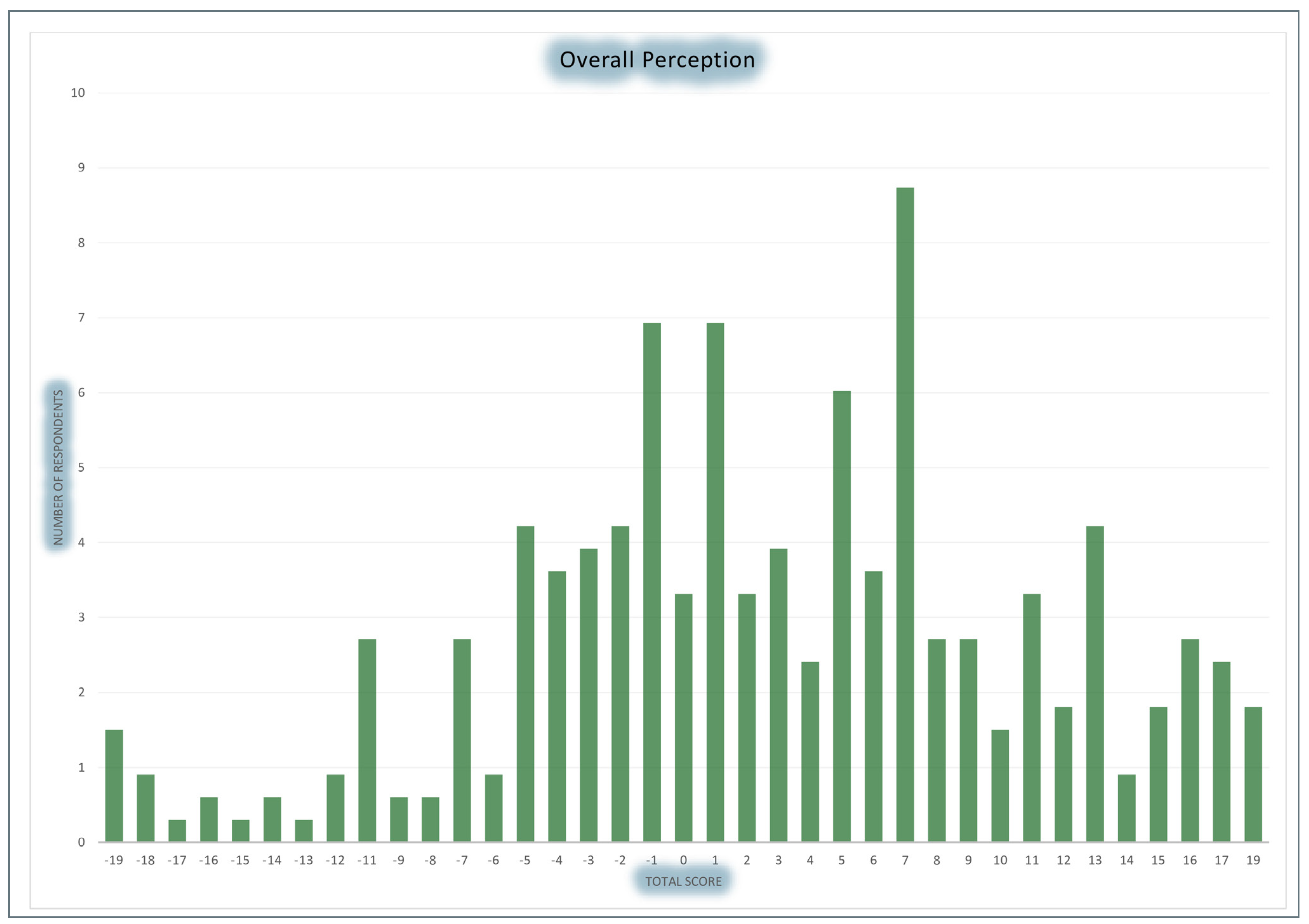
The perceived benefits and barriers were compiled to come out with a meaningful overall perception score. For the benefits items, +1 point was given for ‘strongly agree’ or ‘agree’ answers, while -1 point was considered for “disagree’ or ‘strongly disagree’. Zero point was given for ‘neutral’ answers. Inversely, -1 point was given for agreement on barriers and +1 point for disagreement with no score for neutral answers. Thus, the total score ranges between -19 and +19. The higher the score, the more positive the perception.
STATISTICAL ANALYSIS
The data were analyzed using SPSS software, version 22. Data analysis involved summarizing participants’ demographic characteristics, knowledge and willingness using descriptive statistics. The descriptive data were presented using percentages and frequencies. The normality of the data was tested using the Kolmogorov-Smirnov. Associations between demographic characteristics and perception to use telepharmacy services were examined using Mann-Whitney U Test and Kruskal-Wallis Test, considering the non-normal distribution of the data. Further, multiple linear regression analysis was performed to explore factors influencing perception towards telepharmacy services, with results presented using unstandardized coefficient, significance value along with 95% confidence intervals for each variable investigated. A p-value below 0.05 indicated statistical significance.
DISCUSSIONS
The current study sheds light on the knowledge, perception, readiness and willingness of Malaysian older adults towards telepharmacy services. The research uncovered a notable gap in the knowledge and experience about telepharmacy services among older adults. Most of the participants have never used or even been aware of telepharmacy services in Malaysia. General population in Malaysia had slightly better knowledge compared with older adults as reported by a recent study
12. That study showed that about half of the participants were aware of telepharmacy term, and one-quarter of them had enough information about telepharmacy services. This difference in the knowledge between our participants and those involved in that study could be attributed to the difference in age. A study from the USA found that only 21.14% of 3257 older adults are telehealth users
2. In fact, older adults are less likely to prefer being engaged in using technologies
20. The observed lack of knowledge and experience among participants raises questions about the fair access and use of telepharmacy services, especially among vulnerable groups. On top of that, this finding highlights the need for customized interventions to overcome specific adoption barriers among different population segments.
The findings from perception section were aligned with the existing literature where most of the participants had generally positive perception towards telepharmacy services
4,7,9,12. The participants believed that telepharmacy services offer significant advantages in terms of convenience, saving time and money as well as accessibility to healthcare services. The convenience and accessibility provided by telepharmacy services, particularly for those living in rural or remote areas, have been positively perceived by the participants. Additionally, the potential for cost savings and time efficiency associated with telepharmacy services may have appealed to respondents, especially those facing financial or time constraints. However, the majority of older participants do not think that telepharmacy services are as effective as conventional ones in terms of building rapport with pharmacists and having fast response from them. A study from the USA revealed that older adults were generally disinterested in using telemedicine services because they doubted that healthcare goals could be effectively achieved remotely
21. Likewise, about half of the general public sample in Malaysia considered physical attendance to pharmacy necessary for effective assessment and consultation
12. These findings demonstrate that people still believe that traditional pharmacy services are more effective than telepharmacy ones in achieving the desired outcomes.
Potential barriers to the widespread adoption of telepharmacy services were identified, including the mental effort required, confidentiality concerns, possible communication/dispensing errors and a potential decrease in the social aspects of care. These barriers were previously shared by older adults and those with chronic conditions
2,5,6,22. Younger populations had less concern about mental efforts required for telepharmacy services; (58.1
vs 86.1%)
15. This can be explained by the fact that older adults usually lack confidence in setting up and using technology
2. Likewise, younger populations were less concerned about communication/dispensing errors and social/empathic aspects of care compared with our patients
15. On the other hand, concerns related to potential confidentiality/privacy were shared -to similar extents- by other age populations
15. These concerns about the mental effort required, issues of confidentiality, and the potential reduction in the social aspects of care underscore the need for further investigation and mitigation of these barriers to ensure the widespread acceptance and effectiveness of telepharmacy services. Additionally, these findings emphasize the importance of addressing such barriers to ensure the effectiveness of telepharmacy services. They support the hypothesis that alleviating concerns and enhancing accessibility might lead to greater acceptance and utilization of telepharmacy services, ultimately leading to improved health outcomes for patients. This points out the need for targeted strategies and interventions to promote the adoption and effective use of telepharmacy services.
The overall perception score presented in
Figure 1 shows the predominance of positive perceptions among participants. It proves a general acceptance and favorability towards telepharmacy services. This is consistent with existing literature
4,9 indicating a growing recognition of the benefits and potential of telehealth interventions across diverse patient populations. The applied regression model showed that the age and level of education were significant factors associated with the perception score. Younger individuals and those with higher levels of education tended to have more positive perceptions of telepharmacy services. The reasons for these results could be multifaceted. It is suggested that education level can shape attitudes towards healthcare technologies
23. Individuals with higher education levels may have a better understanding of telepharmacy services, leading to a more positive perception. They may also be more likely to have the necessary skills to navigate telepharmacy platforms
24. On the other hand, those with lower education levels may find telepharmacy more challenging, leading to a less positive perception. Related to age, older individuals may have less familiarity or comfort with technology, which could influence their perceptions to telepharmacy
25. Meanwhile, younger individuals, may have a more positive perception of telepharmacy services. Older adults may also have more health concerns and thus may value the personal interaction with healthcare providers that telepharmacy might not fully replicate
4.
The findings also suggest a high level of readiness among the participants for telepharmacy services, as indicated by their ownership of technology devices and their level of experience. This readiness suggests a favorable environment for the successful implementation of telepharmacy services. However, it is essential to acknowledge potential disparities in technology access and digital literacy, particularly among older adults or individuals from socioeconomically disadvantaged backgrounds. Addressing these disparities through targeted education and support programs may be necessary to ensure equitable access to telepharmacy services
5,22. Moreover, the findings showed a positive inclination towards embracing telepharmacy services among the respondents. More than half of the participants were willing to receive telepharmacy services and to share their data with the healthcare providers through online sessions. The high willingness expressed by a significant majority to utilize various telepharmacy services, such as remote patient counselling, medication dispensing, and monitoring of medication adherence and adverse drug reactions, suggests a growing acceptance and recognition of the benefits of telehealth interventions. This aligns with existing literature where most of the participants from different populations and backgrounds were willing to receive telepharmacy services
7,12. However, only about one-third of our participants expressed their willingness to pay for such services. This result aligns with the finding reported by the general Malaysian population, where only 30.2% agreed to pay for telepharmacy services
12. The relatively lower willingness to pay for these services in Malaysia indicates a potential barrier that needs to be addressed for widespread adoption. These findings agree with the previous studies highlighting the cost as a significant factor influencing patient acceptance and utilization of telehealth services
9. Strategies aimed at addressing cost concerns, such as implementing affordable pricing models or incorporating telepharmacy services into existing healthcare plans, may help mitigate this barrier and enhance the accessibility of telepharmacy services. In fact, the integration of telepharmacy services in the Malaysian healthcare system holds immense potential to improve access to essential pharmaceutical care, especially in rural and underserved areas. Malaysia’s rural areas often face challenges in accessing healthcare services due to a lack of infrastructure and trained professionals
26. Therefore, implementing telepharmacy may bridge the gap between pharmacists and patients, ensuring that everyone has access to professional advice and medication management, regardless of geographical constraints.
LIMITATION OF THE STUDY
The study primarily focused on respondents from SASMEC, Kuantan, potentially limiting the generalisability of the findings. Future research could aim for a more diverse sample to enhance representativeness. Not only that, relying on self-reported data may introduce response bias or inaccuracies due to subjective interpretations or social desirability bias. Employing additional validation measures or objective assessments could strengthen reliability.
Figures and tables
Figure 1.
Scores of the overall perception of the respondents (n = 332).
Figure 1.
Scores of the overall perception of the respondents (n = 332).
Table I.
Demographic and medical characteristics of the participants (n = 332).
Table I.
Demographic and medical characteristics of the participants (n = 332).
| Demographics characteristics | Participants, n (%) |
|---|
| Gender | N = 332 |
| Male | 158 (47.6) |
| Female | 174 (52.4) |
| Age1 | |
| 60-69 | 220 (66.3) |
| 70-79 | 101 (30.4) |
| 80-92 | 11 (3.3) |
| Level of education | |
| No formal education | 6 (1.8) |
| Primary school or below | 91 (27.4) |
| Secondary school | 132 (39.8) |
| Diploma | 31 (9.3) |
| Bachelor’s degree | 53(16) |
| Postgraduate degree | 19 (5.7) |
| Medical background | |
| No | 319 (96.1) |
| Yes | 13 (3.9) |
| Marital status | |
| Married | 242 (72.9) |
| Divorced/widow/widower | 82 (24.7) |
| Single | 8 (2.4) |
| Residential status | |
| Living with a spouse | 117 (35.2) |
| Living with children | 76 (22.9) |
| Living with a spouse and children | 121 (26.4) |
| Living alone | 12 (22.9) |
| Living with other family members | 6 (35.2) |
| Residential area | |
| Urban | 111 (33.4) |
| Suburban | 136(41) |
| Rural | 85 (25.6) |
| Chronic conditions | |
| 1 | 188 (56.6) |
| 2 | 97 (29.2) |
| 3 | 37 (11.1) |
| ≥ 4 | 10(3) |
| Number of hospital admissions during the last year | |
| 0 | 188 (56.6) |
| 1 | 49 (14.8) |
| 2 | 51 (15.4) |
| 3 | 23 (6.9) |
| ≥ 4 | 21 (6.3) |
| Pharmacy visit per year | |
| 1-10 | 158 (47.5) |
| 11-20 | 143 (43.1) |
| 21-30 | 23 (6.9) |
| 31-40 | 8 (2.4) |
| 1Median age (IQR) 66.5(8) years; range 60-92 years old. |
Table II.
Responses to telepharmacy knowledge statements (n = 332).
Table II.
Responses to telepharmacy knowledge statements (n = 332).
| Statements | Not sure, No N (%) | Yes N (%) |
|---|
| K1. Have you ever heard of telepharmacy or telepharmacy services? | 283 (85.2%) | 49 (14.8%) |
| K2. Are telepharmacy services available in Malaysia? | 276 (83.2%) | 56 (16.9%) |
| K3. Have you ever used a telepharmacy services? | 305 (91.8%) | 27 (8.1%) |
| K4. Does telepharmacy require a fast internet connection and high-performance technology (devices)? | 137 (41.2%) | 195 (58.7%) |
Table III.
Responses to perceived benefits of telepharmacy (n = 332).
Table III.
Responses to perceived benefits of telepharmacy (n = 332).
| Statements | Agree, somewhat agree N (%) | Neutral N (%) | Somewhat disagree, disagree N (%) |
|---|
| B1. Telepharmacy reduces unnecessary visits to pharmacies | 282 (84.9) | 23 (6.9) | 27 (8.1) |
| B2. Telepharmacy enhances the patient’s access to pharmacy services, especially for those who are in rural areas | 260 (78.3) | 29 (8.7) | 43 (12.9) |
| B3. Telepharmacy can provide a complete privacy setting during the consultation session | 199 (59.9) | 65 (19.6) | 68 (20.5) |
| B4. Telepharmacy can provide a longer consultation session compared to a face-to-face session | 224 (67.5) | 44 (13.3) | 64 (19.3) |
| B5. Telepharmacy can help patients save money to reach healthcare facilities | 303 (91.3) | 11 (3.3) | 18 (5.4) |
| B6. Telepharmacy can help patients save their travel time to reach healthcare facilities | 313 (94.3) | 10(3) | 9 (2.7) |
| B7. Telepharmacy solves the waiting time problem in most pharmacies/hospitals | 306 (92.2) | 13 (3.9) | 13 (3.9) |
| B8. Telepharmacy can help patients avoid contact with other people and thus avoid possible contracting of contagious diseases | 308 (92.8) | 8 (2.4) | 16 (4.8) |
| B9. Telepharmacy services eases patients’ communication with their healthcare providers | 145 (43.7) | 28 (8.4) | 159 (47.9) |
| B10. Telepharmacy services allow prompt patient interventions (fast response by the doctor/pharmacist) | 120 (36.1) | 60 (18.1) | 152 (45.8) |
| B11. Telepharmacy is effective in providing health education and patient counselling | 181 (54.5) | 54 (16.3) | 97 (29.2) |
| B12. Telepharmacy services will be as effective as the traditional method | 121 (36.4) | 76 (22.9) | 135 (40.7) |
| B13. Telepharmacy improves patients’ medication adherence | 168 (50.6) | 67 (20.2) | 97 (29.2) |
Table IV.
Responses to perceived barriers and concerns on telepharmacy services (n = 332).
Table IV.
Responses to perceived barriers and concerns on telepharmacy services (n = 332).
| Statements | Agree, somewhat agree N (%) | Neutral N (%) | Somewhat disagree, disagree N (%) |
|---|
| CB1. Telepharmacy services require a lot of mental effort by the patient | 286 (86.1) | 19 (5.7) | 27 (8.1) |
| CB2. Telepharmacy may threaten information confidentiality and patients’ privacy | 197 (59.3) | 59 (17.8) | 76 (22.9) |
| CB3.Telepharmacy may contribute to communication errors between the patient and pharmacist/medical practitioners | 256 (77.1) | 17 (5.1) | 59 (17.8) |
| CB4. Patients might be unable to build a rapport with pharmacists/medical practitioners using telepharmacy services | 244 (73.5) | 30 (9.0) | 58 (17.5) |
| CB5. Telepharmacy may lead to medication dispensing errors due to the nature of virtual interaction | 239 (72.0) | 38 (11.4) | 55 (16.6) |
| CB6. Telepharmacy reduces the social and empathic aspects of care | 243 (73.2) | 47 (14.2) | 42 (12.6) |
Table V.
Multiple linear regression on the correlation between perception score and participants’ characteristics (n = 332).
Table V.
Multiple linear regression on the correlation between perception score and participants’ characteristics (n = 332).
| Independent variable | Unstandardized coefficient (B) | 95% Confidence Interval (CI) | P value |
|---|
| Constant | 5.804 | - 6.307 | 17.916 | 0.346 |
| Age | -0.180 | -0.337 | -0.024 | 0.024 |
| Level of education | 1.442 | 0.633 | 2.252 | 0.001 |
| Marital status | 2.149 | 0.4 | 3.89 | 0.16 |
| Residential status | -0.568 | -1.468 | 0.332 | 0.215 |
| Residential area | 0.529 | -0.747 | 1.805 | 0.415 |
| Number of diseases | -0.267 | -1.257 | 0.723 | 0.596 |
Table VI.
Responses on the willingness, readiness and preparation items (n = 332).
Table VI.
Responses on the willingness, readiness and preparation items (n = 332).
| Statements | Agree, somewhat agree N (%) | Neutral N (%) | Somewhat disagree, disagree N (%) |
|---|
| WR1. I am willing to use telepharmacy | 203 (61.1) | 28 (8.4) | 101 (30.5) |
| WR2. I am willing to share my personal information on the online database when using telepharmacy services | 188 (56.6) | 40 (12.0) | 104 (31.4) |
| WR3. I am willing to pay for telepharmacy services | 121 (36.4) | 53 (16.0) | 158 (47.6) |
| WR4. I will recommend telepharmacy services to my family and friends | 195 (58.7) | 71 (21.4) | 66 (19.8) |
| WR5. I am ready to receive telepharmacy services | 186 (56.0) | 40 (12.0) | 106(32) |
Table VII.
Responses on the willingness to receive different type of telepharmacy services (n = 332).
Table VII.
Responses on the willingness to receive different type of telepharmacy services (n = 332).
| Statements | No N (%) | Yes N (%) |
|---|
| PS1. Remote patient counselling | 132 (39.8) | 200 (60.2) |
| PS2. Remote medication dispensing (medications be delivered to your home) | 77(23.2) | 255 (76.8) |
| PS3. Remote home medication review | 124 (37.3) | 208 (62.7) |
| PS4. Remote monitoring of medication adherence | 134 (40.4) | 198 (59.6) |
| PS5. Remote monitoring of adverse drug reactions | 131 (39.5) | 201 (60.5) |