Next Article in Journal
Depressive Symptoms Score Predicts Incident Type 2 Diabetes in Community Dwelling Old Icelandic People
Previous Article in Journal
Perceptions of Workload in Caregivers Involved in the Care of Patients with Parkinson’s Disease: An Exploratory - Correlational Study
 
 
Journal of Gerontology and Geriatrics is published by MDPI from Volume 74 Issue 1 (2026). Previous articles were published by another publisher in Open Access under a CC-BY (or CC-BY-NC-ND) licence, and they are hosted by MDPI on mdpi.com as a courtesy and upon agreement with Pacini Editore.
Article

Dizziness, Physical Capacity, and Health-Related Aspects Among 70-Year-Olds in an Urban Population

by
Ellen Lindell
1,2,3,
Caterina Finizia
1,4,
Kerstin Frändin
5,
Hanna Falk Erhag
5,
Therese Rydberg Sterner
5,
Ingmar Skoog
5,6 and
Lena Kollén
4,6,*
1
Department of Otorhinolaryngology, Head and Neck Surgery, Institute of Clinical Sciences, Sahlgrenska Academy, University of Gothenburg, Gothenburg, Sweden
2
Region Västra Götaland, Södra Älvsborg Hospital, Department of Otorhinolaryngology, Borås, Sweden
3
Region Västra Götaland, Södra Älvsborg Hospital, Department of Research, Education and Innovation, Borås, Sweden
4
Region Västra Götaland, Sahlgrenska University Hospital, Department of Otorhinolaryngology, Gothenburg, Sweden
5
Neuropsychiatric Epidemiology Unit, Institute of Neuroscience and Physiology, Sahlgrenska Academy, Centre for Ageing and Health (AgeCap) at the University of Gothenburg, Gothenburg, Sweden
6
Department of Occupational Therapy and Physiotherapy, Institute of Neuroscience and Physiology, Sahlgrenska Academy, University of Gothenburg, Sweden
7
Region Västra Götaland, Sahlgrenska University Hospital, Psychiatry, Cognition and Old Age, Psychiatry Clinic, Gothenburg, Sweden
*
Author to whom correspondence should be addressed.
J. Gerontol. Geriatr. 2024, 72(3), 130-138; https://doi.org/10.36150/2499-6564-N636

Submission received: 10 May 2022 / Accepted: 3 June 2024 / Published: 31 July 2024

Dizziness is a common complaint among older adults and one of the most important risks for falls.

Objectives

This study aimed to report falls, physical capacity, and self-rated health in men and women with and without dizziness in a population-based sample of 70-year-olds, and to investigate which factors may be associated with falls and dizziness.

Methods

A cross-sectional population-based sample from 1203 70-year-olds (644 women, 559 men, response rate 72%) was surveyed regarding dizziness, falls, physical capacity, medications, and self-rated health. Physical capacity level was assessed using the six-minute walk test, chair stand test, and tandem standing test with eyes opened and closed.

Results

Dizziness was more commonly reported among women than among men (p < 0.0001) and associated with decreased self-rated health and physical levels among both men and women. Dizzy women tended to fall more often, performed worse in fitness measurements (chair stand, tandem standing), exercised less frequently, and went for walks less often than non-dizzy women. The number of medications and dizziness were identified as having significant associations with falls.

Conclusions

To experience dizziness already at the age of 70 affects health and physical levels in both men and women, and dizzy women tended to fall more often than non-dizzy women. We suggest that dizziness among older adults should be carefully evaluated regarding medications, physical function, and treatable causes, and when needed, postural training and vestibular rehabilitation should be initiated to avoid future falls and improve quality of life.

INTRODUCTION

The proportion of adults reaching older ages has increased worldwide, with life expectancy rising to over 70 years of age in most countries 1. With longer life expectancy, the occurrence of dizziness will most likely be a growing health problem as dizziness tends to increase with age 2,3. An earlier population-based study from Sweden showed that dizziness among older adults (75 years) was experienced in 34% of women and 23% of men 4. The ability to walk, stand, and move safely is fundamental for an independent and active life. Symptoms that can reduce physical activity and impairment in daily life are dizziness, instability, and imbalance 5. Since dizziness is one of the most critical risk factors for falls 6,7, it may not only result in reduced physical performance, but persons who experience dizziness may also voluntarily limit their walking speed and mobility due to fear of losing balance and falling, thereby leading to more sedentary behavior 8. Living with dizziness is also associated with reduced quality of life 9-11. The most common cause of dizziness originating from the vestibular system is benign paroxysmal positional vertigo (BPPV) 12. Prior research has shown that BPPV is underdiagnosed in older individuals 4 and that the symptoms are more diffuse in older than younger people 13. Another common cause of dizziness in older adults is multisensory dizziness 14. There is no accepted definition of multisensory dizziness, but it often described as dizziness or instability attributed to older adults and impairment in several sensory organs 14. Postural control, or the act of maintaining balance, involves the interaction of dynamic sensorimotor processes, including the interpretation of convergent sensory information from the somatosensory, vestibular, and visual systems coupled with the coordination of movement strategies to stabilize the center of body mass 15. Biomechanical limitations that can affect an individual’s balance include decreased leg strength and reduced mobility in the knees and ankles 15. Dizziness is more often reported in women, which is well known, at least until age 75 16,17. Reasons for this gender difference are not well explored. However, vestibular diseases, like BPPV and Meniere’s disease, are more common among women than men 16. Together with postural training, vestibular rehabilitation can reduce dizziness, improve walking ability, and potentially reduce falls 18-20. The concept of vestibular rehabilitation not only means restoring the vestibular system but also includes postural training and compensation for other causes of vertigo, dizziness, and general instability 21. We believe that dizziness already at the age of 70 negatively affects health and should therefore be taken seriously and assessed for treatable causes, like BPPV, or addressed with rehabilitation to avoid fall accidents and the development of fear of falling. This study aimed to report falls, physical capacity, and self-rated health in men and women with and without dizziness in a population-based sample of 70-year-olds, and to investigate which factors may be associated with falls and dizziness.

MATERIALS AND METHODS

SETTING AND STUDY POPULATION

The study comprised the baseline examination of the sixth cohort in the Gothenburg H70 Birth cohort studies (the H70 studies) in Sweden. The H70 studies are multidisciplinary population studies examining representative birth-cohorts of older populations in Gothenburg, Sweden. The present study uses data from the 1944 birth cohort examined in 2015-16 at age 70. Study participants born on pre-specified birth dates and registered as residing in ordinary or special housing in Gothenburg, Sweden, were invited to participate. The design, procedures, and methods for data collection have been reported elsewhere 22. Information regarding date of birth and address was obtained from the Swedish Population Register, covering all persons registered in Sweden. Invitations to participate in the study were first sent by letter, including the consent form, and then all invited participants were contacted by telephone. Participants were considered eligible for the study regardless of residence (i.e., private households or special housing for the elderly). A total of 1667 individuals (894 women, 773 men) were invited, and 1203 (644 women, 559 men, response rate 72%) agreed to participate. Reasons for refusal to participate were not registered due to lack of consent.

DEMOGRAPHICS AND STUDY-SPECIFIC QUESTIONS

Participants were asked about marital status, country of birth, and educational level (Tab. I) and answered questions regarding dizziness, falls, and physical fitness (Tab. II). Participants were divided into groups depending on their answer to the question, “Do you have any problems with dizziness?” with response options “yes” or “no.” They were also asked whether they had fallen in previous years and if so, how many times. Participants were also asked to list their medications.

TESTS OF PHYSICAL CAPACITY AND BALANCE

Training nurses, public health professionals, or physiotherapists performed fitness and balance tests at the neuropsychiatric outpatient clinic at Sahlgrenska University Hospital (Gothenburg, Sweden).
To test physical capacity, the participants walked alone at their own maximal pace for the six-minute walk test (6-MWT) and were instructed to walk back and forth along a 30-m long corridor, for six minutes 23. Lengths in meters and walking speed were calculated. The 6-MWT has good test-retest reliability (ICC = 0.95) for community-dwelling older adults 24.
The chair stand test was used to test the participants’ ability to rise from a 45-cm high chair without support. Participants were instructed to perform the test as quickly as possible five times in a row, and the total time in seconds was calculated 25. Stair climbing was used to test the participants’ ability to climb onto boxes of varying heights (10, 20, 30, 40, and 50 cm) 25. The height from the strongest leg was used in the analysis.
Grip strength was tested with a Martin Vigorimeter (KLS Mar Group Tuttlingen, Germany), with three balloon sizes. The medium-sized balloon was used for women, and the larger balloon was used for men. Grip strength was measured at an elbow angle of 90 degrees, with the shoulder joint in a neutral position. The test was repeated three times for each hand, and the highest value of the hand with the strongest grip strength was included in the analyses (kPa). This method has been shown to have good psychometric properties 26,27. Regarding physical activity levels, the participants were asked about their walking habits, how often they exercised, and their self-rated fitness level on a four-item scale. Balance function was tested using the tandem standing test, without shoes, with eyes open, and with eyes closed. The tests were performed with the heel of the dominant foot directly in front of the toe of the non-dominant foot and the participants’ arms alongside their body. The tests were terminated when the person lost balance when moving one foot or both feet. The best result of three trials was recorded, and the maximum time for the test was 30 s.

SELF-RATED HEALTH

Self-rated health was measured using the question,” How is your general health?” with response options ranging from “very good”, “good”, “fairly good”, “bad” to “very bad”. Self-rated physical level was measured using the question, “How would you rate your current physical level?” with response options ranging from “miserable”, “bad”, “pretty good” to “good”.

STATISTICAL ANALYSES

For descriptive purposes, frequency and proportions are reported for categorical variables and mean and standard deviation (SD) for continuous variables. Tests for univariate difference between those with and without dizziness or between men and women included Fisher’s exact test for dichotomous variables, Mantel-Haenzel Chi-square test for ordered variables, Chi-square test for non-ordered variables, and t-tests for continuous variables. Significance was reported for two-tailed tests, and p < 0.05 was considered significant. To identify variables related to falls and dizziness and how they were interrelated, unit- and multivariable binary logistic regression analyses were performed. Potential risk factors in multivariable regression were sex, vision impairment, hearing impairment, body weight, number of drugs, walking speed, chair stand, and tandem standing. Backward stepwise regression was conducted (p < 0.05) to identify the most important risk factors within the models tested. Results are presented as odds ratios (OR) with 95% confidence intervals (CI). The software used for the statistical analysis was SPSS and a statistics program package developed at the Department of Geriatrics at the University of Gothenburg (GIDSS for Windows).

RESULTS

DEMOGRAPHIC CHARACTERISTICS

Characteristics of the cohort from which the study population was selected are presented in Table II.

DIZZINESS AND FALLS

More women than men reported problems with dizziness (27% of the women and 16% of the men, p < 0.0001). Women also reported more problems with dizziness, where 13% compared to 6% of the men (p < 0.001) reported dizziness on a daily or weekly basis, and more women had fallen more than once during the last year compared to men (23 vs 15%, p = 0.002). Concerning the type of dizziness, no significant difference was observed between sexes (Tab. III). Women sought medical care for dizziness more often and felt, to a greater extent, more inhibited in activities due to dizziness than men. Women who reported dizziness had also fallen significantly more often than women without dizziness (p = 0.0004), but no significant difference in the number of falls was observed among dizzy and non-dizzy men (Tab. IV). The most frequently reported type of dizziness by all participants was unsteadiness followed by rotational symptoms. Women reported taking more medications than men, and both men and women who reported dizziness were prescribed more medications than participants without dizziness.
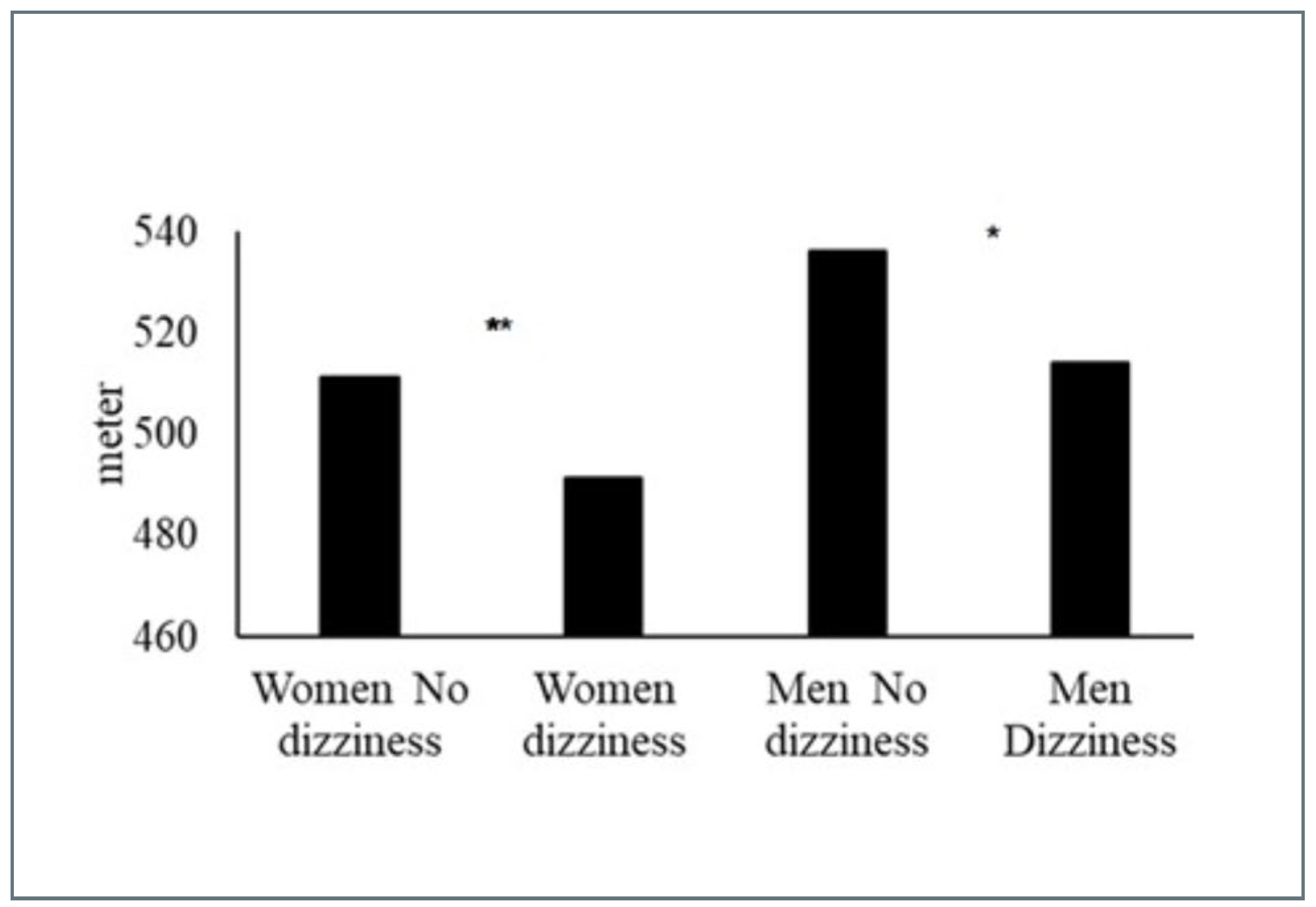
Both women and men with dizziness performed worse in the 6-MWT than participants without dizziness, p < 0.003 (Fig. 1). However, no significant differences were observed between participants with or without dizziness according to the box climbing or grip strength tests. In the chair stand test and tandem standing tests (both with eyes open and closed), significant differences between dizzy and non-dizzy women were observed, but not between dizzy and non-dizzy men.
Self-reported levels of fitness as well as self-rated health were significantly lower in participants reporting dizziness. Women with dizziness exercised less than women without dizziness, a trend not seen among men.
In univariate logistic regression analyses, previous falls were associated with being female (OR 1.6 [CI: 1.20-2.24], p = 0.002); having many medications (OR for every medication added 1.1 [CI: 1.06-1.15], p < 0.0001), dizziness (OR 2.1 [CI: 1.54-2.99], p < 0.0001); and time to complete the chair stand test (OR 1.3 [CI: 1.54-2.24], p = 0.002). However, in adjusted models, only the number of medications and dizziness were identified as having significant associations with falls.
For dizziness, univariate analyses revealed significant relationships with being female (OR 1.9 [CI: 1.40-2.54], p < 0.0001) and the number of medications (OR for every medication added 1.12 [CI: 1.08-1.17], p < 0.0001) which also remained significant in multivariate analyses.

DISCUSSION

In this study investigating a population-based sample of 70-year-olds, dizzy women tended to fall more often than non-dizzy women, and both men and women with dizziness had lower physical capacity than participants without dizziness. Self-rated health and fitness level were lower in participants who reported dizziness. Women with dizziness exercised less than women without dizziness, a trend not seen among men. An increased number of medications was significantly associated with an increased number of falls.
Dizziness is one of the most frequent conditions associated with falling, and other symptoms, such as loss of balance, disturbance of gait, and reduced muscle strength, increase the risk for falls 7,28. In this study one-third (33%) of the women with dizziness had fallen during the last year, which was almost twice as often as among women without dizziness (19%), in line with previous reports.
The association between dizziness and falls among women, but not among men, has been reported previously10, but the reasons for these sex differences are little explored. One possible explanation could be that men do not remember falls, if the fall cause them no harm. Riva et al. 29 found older women to be significantly less stable than older men, potentially explaining why falls are reported more often among women than among men. Riva and colleagues also showed that the decreased stability in older persons may be explained by impaired proprioceptive control and a decrease in compensatory visual stabilization 29. Another explanation can be that men have better endurance and muscle strength in the lower extremities 30, also seen here, where men performed better on the box climbing test.
We found that women with dizziness were less physically active than those without dizziness, which is in line with prior population-based research from the same area showing that persons with dizziness are less physically active than non-dizzy individuals 5. Prior falls are an important risk factor for future falls, indicating that this sex difference regarding falls might continue in later years, at least if imbalance symptoms are not treated. Unfortunately, avoidance of activity and movement might lead to further adverse effects of balance and potentially even more sedentary behavior.
Both women and men with dizziness performed worse on the 6-MWT than their non-dizzy counterparts. The 6-MWT was chosen as a physical capacity measure because of its ease of administration and similarity to normal daily activities 27. The participants in the current study showed a high walking speed, representing an overall high level of fitness and health in relation to other age-related reference groups 31, and around half of the participants reported regular exercise. Despite this high level of functioning, more than one quarter of the female participants reported dizziness.
Women with dizziness performed significantly worse on the chair stand test than women without dizziness, indicating a difference in muscular strength in the lower extremities between the two groups. The chair stand test measures endurance and leg muscle strength as well as balance. Good muscle strength in the lower extremities is essential for maintaining balance and avoiding falls when stumbling and losing equilibrium and a study from 2014 by Maarsingh et al. found impaired function of the lower extremities to be an important predictor of dizziness in older adults at 7- and 10-year follow-ups 32. No difference regarding grip strength between participants with and without dizziness was observed in this study, even though it has been shown that hand strength can be used to identify participants that need to improve muscle strength and function in general 27,33.
Study participants could generally only manage tandem standing for a short period, possibly due to age and the high demand on balance in this test. Tandem standing with eyes opened or closed is a more difficult test than the Romberg test when standing with the feet together. Tandem standing indicates balance, while standing in an upright position provides information about postural control. Tandem standing with eyes closed is often a difficult test, especially for persons with balance issues since visual cues are not present, and thus full trust of the vestibular and proprioception systems is required.
Women in this study took more medications and reported seeking medical care more often than men. Women also reported experiencing dizziness and that dizziness impacts their daily lives more often than men, as reported by others 34. Women seek medical care due to fall-related injuries more often than men, while men die due to fall-related injuries more often than women 35. Preventing falls is, and will continue to be, a major concern since fall-related accidents entail enormous costs for society, both economically and considering patient pain and morbidity 21,36. As dizziness and imbalance are some of the absolute most important risk factors for falls, preventing dizziness and enhancing balance will be major challenges for society in the future.
A 2018 study by Marcos Rossi-Izquierdo et al. showed that vestibular rehabilitation can decisively improve balance and hopefully even reduce dizziness, in older individuals with instability, which can lead to a significant reduction of falls 37. Vestibular rehabilitation with balance enhancement training and strength training, especially for lower extremities, can reduce the number of falls while promoting balance and increasing the number of healthy active years at older ages 21,36. Exercise is effective in preventing injuries due to falls 38 and may possibly be effective if started as late as age 70.

STRENGTHS AND LIMITATIONS

The strength of this study is the population-based sample with high response rate, selected through date of birth in the population registry. The examinations were carried out by physiotherapists and specially trained nurses, public health professionals or physicians. Due to the cross-sectional design of the study, the direction of the associations cannot be established. This study has not investigated sensibility in lower extremities, which would have been interesting when evaluating balance.

CONCLUSIONS

In this population-based sample of 70-year-olds, one-third of the women with dizziness had fallen during the last year, which was almost twice as often as women without dizziness. Both men and women with dizziness reported lower health and physical capacity than those without dizziness. The number of medications and dizziness were identified to have significant associations with falls. We believe that postural- and weight training as vestibular rehabilitation may be effective already at age 70 to avoid future falls and enhance overall well-being.

Acknowledgements

The authors thank Valter Sund for statistical support

Conflict of interest statement

The authors declare no conflict of interest.

Funding

The study was financed by grants from the Swedbank Sjuhärad foundation as well as Local Research and Development Council, Södra Älvsborg, the Amlöv’s foundation.

Ethical considerations

The study was conducted according to the Declaration of Helsinki and was approved by the Regional Ethical Review Board in Gothenburg, Sweden (approval number 869-13). All participants provided written informed consent before inclusion in the study.

Figures and tables

Figure 1. Six-minute walking test results between participants with and without dizziness. *P < 0.001
Jgg 72 00130 g001
Table I. Response alternatives for study-specific questions.
Study-specific questionsResponse alternatives
Questions about dizziness
Do you have any problems with dizziness?Yes
No
Have you experienced dizziness or balance problems in the last three months?Yes
No
How often do you have symptoms of dizziness?Less than once a week
Every week
Daily
Do you have problems with dizziness preventing you from performing certain activities?Yes
No
What kind of dizziness do you have?Vertigo
Unsteadiness
Another type of dizziness
How long have you had dizziness?Less than 2 years
More than 2 years
Have you sought medical care for your dizziness?Yes
No
Questions about falls
Have you fallen during the last year?Yes
No
How many times have you fallen?Number of falls
Questions about physical fitness
Do you generally take daily walks?Yes
No
How would you judge your present physical fitness?Very poor
Poor
Quite good
Good
Very good
How often do you exercise?
Once per month
Once per week
2-4 times per week
Daily
Questions about health
How would you rate your health?Very good
Good
Fairly good
Bad
Very bad
Bad
Do you generally feel tired?Yes
No
Table II. Demographic characteristics of the cohort of the 70-year-olds in the Gothenburg H70 Birth cohort studies.
VariableWomenMenTotal
n = 644 (%)n = 559 (%)n = 1203 (%)
Marital status
Having a partner405(64)462(84)867(73)
Widowed75(12)20(4)95(8)
Divorced136(21)49(9)185(16)
Single19(3)19(4)38(3)
Country of birth
Sweden551(87)455(82)1006(85)
Other Nordic countries34(5)29(5)63(5)
Other non-Nordic countries50(8)69(13)119(10)
Education
Primary education ≤ 9 years164(26)185(34)349(30)
Primary education > 9 years205(33)125(23)330(28)
University degree262(42)240(44)502(43)
Table III. Study-specific characteristics of the study population.
VariableWomenMenP-value
n = 644 (%)n = 559 (%)
Having problem with dizziness177(27)89(16)< 0.0001
Dizziness during the last 3 months107(19)55(11)0.0004
Frequency of symptoms of dizzinessn = 156n = 82
Less than once a week84(54)49(60)
All week34(22)18(22)
Daily38(24)15(18)0.0002
Prevented from doing activities by dizziness40(7)9(2)0.0002
Dizziness typen = 159n = 82
Rotational vertigo59(37)22(27)
Unsteadiness85(53)48(59)
Other type15(9)12(15)0.2
Length of time experiencing dizziness
≤ 2 years46(30)33(40)
> 2 years108(70)50(60)0.1
Seeking medical care due to dizziness64(11)28(6)0.002
Fallen during the last year131(23)77(15)0.002
Number of falls last year
0448(78)429(85)
178(14)45(9)
229(5)14(3)
> 220(4)15(3)0.02
Number of medications
069(11)95(17)
1-5366(57)320(58)
> 5203(32)138(25)0.0002
aP-values represent differences between women and men.
Table IV. Physical capacity and balance among participants with and without dizziness.
WomenMen
No dizzinessDizzinessP-valueNo dizzinessDizzinessP-value
n = 422n = 155n = 425n = 83
Fallen last year, n (%)80(19)51(33)0.000458(14)19(23)0.03
Number of falls last year, n (%)
0341(81)107(69)365(87)64(77)
155(13)23(15)32(8)13(16)
215(4)14(9)12(3)2(2)
> 29(2)9(6)0.000111(3)4(5)0.07
Six-minute walking test
Number of meters (SD)511(85)491(73)0.001536(96)514(95)0.01
Speed mean, m/s1.421.360.0051.491.430.03
Box climbing, n (%)
50 cm height155(80)42(79)304(98)51(93)
40 cm height28(14)8(15)6(2)4(7)
30 cm height5(3)1(2)00
20 cm height5(3)1(2)00
10 cm height1(1)1(2)0.91 (0)00.6
Chair stand test 5 times
Mean in s (SD)12(3)14(4)0.000212(4)13(4)0.06
Tandem standing, eyes open
Mean in s (SD)27(7)24(10)0.00126(8)26(7)0.9
Tandem standing, eyes closed
Mean in s (SD)12(10)9(9)0.0112(10)10(11)0.2
Grip strength, kPa, mean (SD)73(14)71(15)0.184(17)85(17)0.5
Vision impairment, n (%)96(23)35(23)1.062(15)20(24)0.01
Taking daily walks, n (%)243(54)79(46)0.08194(43)33(38)0.4
Self-rated fitness level, n (%)
Miserable16(4)8(5)13(3)2(2)
Bad78(17)44(26)75(17)27(31)
Pretty good203(45)85(49)198(44)42(48)
Good145(32)32(19)151(34)16(18)
Very good10(2)3(2)0.0114(3)1(1)0.001
Exercise frequency, n (%)
Never192(43)95(53)190(42)38(43)
Once per month6(1)6(4)15(3)2(2)
Once per week84(19)27(16)72(16)12(14)
2-4 times per week158(35)45(26)158(35)35(40)
Daily11(2)3(2)0.0119(4)1(1)0.9
Self-rated health, n (%)
Very good52(12)9(6)63(16)6(7)
Good178(43)36(25)158(39)25(31)
Fairly good137(33)61(42)151(37)30(37)
Bad46(11)38(26)31(8)17(21)
Very bad3(1)3(2)0.00014(1)3(4)0.0001
Nr of medications, n (%)
060(13)9(5)83(18)12(13)
1-5276(60)90(51)274(59)46(52)

References

  1. Sweden S. The future population of Sweden 2015-2060. Statistics Sweden 2015.
  2. Jonsson R Sixt E Landahl S, et al. Prevalence of dizziness and vertigo in an urban elderly population. J Vestibular Research 2004;14:47-52.
  3. Dutt D. Care for the growing number of elderly people in developing countries needs to be addressed. Bmj 1998;316:1387-1388.
  4. Kollen L Frandin K Moller M, et al. Benign paroxysmal positional vertigo is a common cause of dizziness and unsteadiness in a large population of 75-year-olds. Aging clinical and experimental research 2012;24:317-323. https://doi.org/10.1007/BF03325263 10.1007/BF03325263
  5. Kollen L Horder H Moller C, et al. Physical functioning in older persons with dizziness: a population-based study. Aging clinical and experimental research 2017;29:197-205. https://doi.org/10.1007/s40520-016-0567-9 10.1007/s40520-016-0567-9
  6. Rubenstein LZ. Falls in older people: epidemiology, risk factors and strategies for prevention. Age Ageing 2006;35(Suppl 2):ii37-ii41. https://doi.org/10.1093/ageing/afl084 10.1093/ageing/afl084
  7. Boelens C Hekman EE Verkerke GJ. Risk factors for falls of older citizens. Technol Health Care 2013;21:521-533. https://doi.org/10.3233/THC-130748 10.3233/THC-130748
  8. Schniepp R Wuehr M Huth S, et al. Gait characteristics of patients with phobic postural vertigo: effects of fear of falling, attention, and visual input. Journal of neurology. 2014;261:738-746. https://doi.org/10.1007/s00415-014-7259-1 10.1007/s00415-014-7259-1
  9. Lindell E Kollén L Johansson M, et al. Benign paroxysmal positional vertigo, dizziness, and health-related quality of life among older adults in a population-based setting. European archives of oto-rhino-laryngology 2021;278:1637-1644. https://doi.org/10.1007/s00405-020-06357-1 10.1007/s00405-020-06357-1
  10. Lindell E Kollén L Johansson M, et al. Dizziness and its association with walking speed and falls efficacy among older men and women in an urban population. Aging clinical and experimental research 2020;32:1049-1056. https://doi.org/10.1007/s40520-019-01303-6 10.1007/s40520-019-01303-6
  11. Weidt S Bruehl AB Straumann D, et al. Health-related quality of life and emotional distress in patients with dizziness: a cross-sectional approach to disentangle their relationship. BMC Health Serv Res 2014;14:317. https://doi.org/10.1186/1472-6963-14-317 10.1186/1472-6963-14-317
  12. Furman JM Cass SP. Benign paroxysmal positional vertigo. N Engl J Med 1999;341:1590-1596. https://doi.org/10.1056/NEJM199911183412107 10.1056/NEJM199911183412107
  13. Piker EG Jacobson GP. Self-report symptoms differ between younger and older dizzy patients. Otology & neurotology 2014;35:873-879. https://doi.org/10.1097/MAO.0000000000000391 10.1097/MAO.0000000000000391
  14. Geser R Straumann D. Referral and final diagnoses of patients assessed in an academic vertigo center. Frontiers in neurology 2012;3:169. https://doi.org/10.3389/fneur.2012.00169 10.3389/fneur.2012.00169
  15. Horak FB. Postural orientation and equilibrium: what do we need to know about neural control of balance to prevent falls? Age Ageing 2006;35(Suppl 2):ii7-ii11. https://doi.org/10.1093/ageing/afl077 10.1093/ageing/afl077
  16. Hülse R Biesdorf A Hörmann K, et al. Peripheral vestibular disorders: an epidemiologic survey in 70 million individuals. Otology & neurotology 2019;40:88-95. https://doi.org/10.1097/MAO.0000000000002013 10.1097/MAO.0000000000002013
  17. Tamber B. Self-reported faintness or dizziness – comorbidity and use of medicines. An epidemiological study. Scandinavian Journal of Public Health 2009:613-620. https://doi.org/10.1177/1403494809105026 10.1177/1403494809105026
  18. Hansson EE Mansson NO Hakansson A. Balance performance and self-perceived handicap among dizzy patients in primary health care. Scand J Prim Health Care 2005;23:215-220. https://doi.org/10.1080/02813430500287299 10.1080/02813430500287299
  19. Kammerlind AS Ernsth Bravell M Fransson EI. Prevalence of and factors related to mild and substantial dizziness in community-dwelling older adults: a cross-sectional study. BMC geriatrics 2016;16:159. https://doi.org/10.1186/s12877-016-0335-x 10.1186/s12877-016-0335-x
  20. Dunlap PM Holmberg JM Whitney SL. Vestibular rehabilitation: advances in peripheral and central vestibular disorders. Curr Opin Neurol 2019;32:137-144. https://doi.org/10.1097/WCO.0000000000000632 10.1097/WCO.0000000000000632
  21. Tjernström F Zur O Jahn K. Current concepts and future approaches to vestibular rehabilitation. Journal of neurology. 2016;263(Suppl 1):S65-S70. https://doi.org/10.1007/s00415-015-7914-1 10.1007/s00415-015-7914-1
  22. Rydberg Sterner T Ahlner F Blennow K, et al. The Gothenburg H70 Birth cohort study 2014-16: design, methods and study population. Eur J Epidemiol 2019;34:191-209. https://doi.org/10.1007/s10654-018-0459-8 10.1007/s10654-018-0459-8
  23. Guyatt GH Sullivan MJ Thompson PJ, et al. The 6-minute walk: a new measure of exercise capacity in patients with chronic heart failure. Can Med Assoc J 1985;132:919-923.
  24. Steffen TM Hacker TA Mollinger L. Age- and gender-related test performance in community-dwelling elderly people: Six-Minute Walk Test, Berg Balance Scale, Timed Up & Go Test, and gait speeds. Phys Ther 2002;82:128-137. https://doi.org/10.1093/ptj/82.2.128 10.1093/ptj/82.2.128
  25. Guralnik JM Seeman TE Tinetti ME, et al. Validation and use of performance measures of functioning in a non-disabled older population: MacArthur studies of successful aging. Aging 1994;6:410-419. https://doi.org/10.1007/BF03324272 10.1007/BF03324272
  26. Bellace JV Healy D Besser MP, et al. Validity of the Dexter Evaluation System’s Jamar dynamometer attachment for assessment of hand grip strength in a normal population. J Hand Ther 2000;13:46-51. https://doi.org/10.1016/s0894-1130(00)80052-6 10.1016/s0894-1130(00)80052-6
  27. Alley DE Shardell MD Peters KW, et al. Grip strength cutpoints for the identification of clinically relevant weakness. The journals of gerontology Series A, Biological sciences and medical sciences 2014;69:559-566. https://doi.org/10.1093/gerona/glu011 10.1093/gerona/glu011
  28. Deandrea S Lucenteforte E Bravi F, et al. Risk factors for falls in community-dwelling older people: a systematic review and meta-analysis. Epidemiology 2010;21:658-668. https://doi.org/10.1097/EDE.0b013e3181e89905 10.1097/EDE.0b013e3181e89905
  29. Riva D Mamo C Fanì M, et al. Single stance stability and proprioceptive control in older adults living at home: gender and age differences. J Aging Res 2013;2013:561695. https://doi.org/10.1155/2013/561695 10.1155/2013/561695
  30. Hall CD Heusel-Gillig L Tusa RJ, et al. Efficacy of gaze stability exercises in older adults with dizziness. JNPT 2010;34:64-69. https://doi.org/10.1097/NPT.0b013e3181dde6d8 10.1097/NPT.0b013e3181dde6d8
  31. Bohannon RW. Comfortable and maximum walking speed of adults aged 20-79 years: reference values and determinants. Age Ageing 1997;26:15-19. https://doi.org/10.1093/ageing/26.1.15 10.1093/ageing/26.1.15
  32. Maarsingh OR Stam H van de Ven PM, et al. Predictors of dizziness in older persons: a 10-year prospective cohort study in the community. BMC geriatrics 2014;14:133. https://doi.org/10.1186/1471-2318-14-133 10.1186/1471-2318-14-133
  33. Frändin K Sonn U Svantesson U, et al. Functional balance tests in 76-year-olds in relation to performance, activities of daily living and platform tests. Scandinavian journal of rehabilitation medicine 1995;27:231-241.
  34. Craftman AG Johnell K Fastbom J, et al. Time trends in 20 years of medication use in older adults: findings from three elderly cohorts in Stockholm, Sweden. Arch Gerontol Geriatr 2016;63:28-35. https://doi.org/10.1016/j.archger.2015.11.010 10.1016/j.archger.2015.11.010
  35. Shylander J. Fall accidents. Swedish Civil Contingencies Agency 2014.
  36. Sherrington C Fairhall NJ Wallbank GK, et al. Exercise for preventing falls in older people living in the community. Cochrane Database Syst Rev 2019;1:Cd012424. https://doi.org/10.1002/14651858.CD012424.pub2 10.1002/14651858.CD012424.pub2
  37. Rossi-Izquierdo M Gayoso-Diz P Santos-Pérez S, et al. Vestibular rehabilitation in elderly patients with postural instability: reducing the number of falls-a randomized clinical trial. Aging clinical and experimental research 2018;30:1353-1361. https://doi.org/10.1007/s40520-018-1003-0 10.1007/s40520-018-1003-0
  38. Moncada LVV Mire LG. Preventing falls in older persons. American family physician 2017;96:240-247.