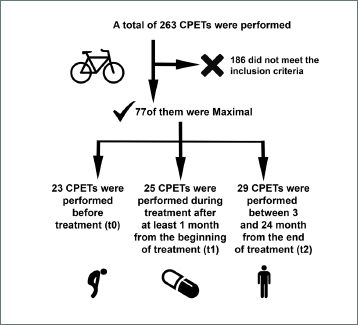
Evaluation of exercise capacity by means of cardiopulmonary exercise testing (CPET) in older adult cancer patients undergoing antineoplastic treatments

Background and aims
Material and methods
Results
Conclusions
INTRODUCTION
MATERIALS AND METHODS
STUDY DESIGN AND POPULATION
CARDIOPULMONARY EXERCISE TEST
OUTCOMES
STATISTICAL ANALYSIS
RESULTS
CLINICAL CHARACTERISTICS OF THE STUDY SAMPLE
CPET AND CARDIOVASCULAR FOLLOW-UP OF ONCOLOGIC PATIENTS
CPET AND OUTCOME OF ONCOLOGIC PATIENTS
DISCUSSION
FUTURE PERSPECTIVES
LIMITATIONS AND CONCLUSIONS
Acknowlegments
Conflict of interest statement
Funding
Author contributions
Ethical consideration
Figures and tables


| T0 (n = 23) | T1 (n = 25) | T2 (n = 29) | P-value | |
|---|---|---|---|---|
| Age, years | 69.3-3.97 | 69.76-3.86 | 70.45-3.99 | 0.57 |
| Female, n (%) | 10 (43%) | 15 (60%) | 13 (45%) | 0.43 |
| Cancer site, n (%) | ||||
| Gastrointestinal | 6 (26%) | 11 (44%) | 11 (38%) | 0.31 |
| Breast | 2 (8%) | 2 (8%) | 5 (17%) | 0.49 |
| Hematological | 9 (40%) | 7 (28%) | 11 (38%) | 0.66 |
| Melanoma | 6 (26%) | 5 (20%) | 2 (7%) | 0.16 |
| Cancer stage, n (%) | ||||
| I-II | 5 (22%) | 12 (48%) | 12 (41%) | 0.15 |
| III | 12 (52%) | 4 (16%) | 11 (38%) | 0.02 |
| IV | 6 (26%) | 9 (36%) | 6 (21%) | 0.42 |
| Antineoplastic protocol, n (%) | ||||
| Anthracyclines | 7 (30%) | 8 (32%) | 13 (45%) | 0.48 |
| Antimetabolites | 5 (22%) | 5 (20%) | 8 (28%) | 0.78 |
| Pyrimidine analogues + bevacizumab | 0 (0%) | 7 (28%) | 2 (7%) | 0.03 |
| Target therapy | 5 (22%) | 5 (20%) | 6 (20%) | 0.98 |
| Immunotherapy | 6 (26%) | 0 (0%) | 0 (0%) | 0.01 |
| Comorbidities, n (%) | ||||
| Diabetes | 5 (21.7%) | 1 (4%) | 3 (10.3%) | 0.16 |
| Hypertension | 10 (43.4%) | 13 (52%) | 9 (31%) | 0.39 |
| Dyslipidemia | 8 (34.8%) | 8 (32%) | 6 (20.6%) | 0.58 |
| Smoking habit | 9 (39%) | 6 (24%) | 3 (10.3%) | 0.07 |
| COPD | 3 (13%) | 1 (4%) | 1 (3.44%) | 0.34 |
| Cardiovascular therapy, n% | ||||
| Beta-blockers | 9 (39%) | 10 (40%) | 13 (44.8%) | 0.81 |
| Diuretics | 2 (8.7 %) | 0 (0%) | 4 (13.8%) | 0.14 |
| CCBs | 3 (13 %) | 4 (16%) | 0 (0%) | 0.10 |
| ARBs or ACE-Is | 8 (34.8%) | 11 (44%) | 18 (62%) | 0.13 |
| No cardiologic therapy | 8 (34.8%) | 9 (36%) | 4 (13.8%) | 0.16 |
| Patients who showed CVEs during follow-up | 0 (0%) | 7 (28%) | 0 (0%) | 0.01 |
| Patients dead for all causes during follow-up | 9 (39%) | 11 (44%) | 4 (13.8%) | 0.06 |
| Abbreviations: COPD: chronic obstructive pulmonary disease; CCBs: Calcium-channel blockers; ARBs: Angiotensin II Receptor Blockers; ACE-Is: Angiotensin Converting Enzyme-inhibitors; CVEs: cardiovascular events. | ||||
| T0(23) | T1(25) | T2(29) | P-value | |
|---|---|---|---|---|
| RER | 1.16 [1.13-1.28] | 1.19 [1.14-1.26] | 1.12 [1.1-1.2] | 0.04 |
| peak VO2, ml/kg/min | 18.2 [16.5-24.2] | 18.1 [16-22.3] | 20.1 [17.5-26.9] | 0.03 |
| %-predicted peak VO2, % | 70.3 ± 20.4 | 70.8 ± 18.37 | 81.18 ± 16.72 | 0.06 |
| VO2-AT, ml/kg/min | 14.34 ± 4.94 | 13.1 ± 3.69 | 16.61 ± 4.39 | 0.01 |
| %-predicted VO2-AT, % | 51.78 ± 21 | 52 ± 15.46 | 58.55 ± 13.51 | 0.24 |
| VE/VCO2 slope | 28.44 ± 3.15 | 29.4 ± 5.11 | 28.36 ± 4.73 | 0.65 |
| Ex time, min | 8.22 ± 1.91 | 8.99 ± 1.74 | 9.87 ± 1.20 | < 0.01 |
| Workload, Watts | 109 [73-119] | 80 [73-108] | 125 [95-145] | < 0.01 |
| Maximal HR, bpm | 126 ± 18.2 | 134 ± 16.6 | 138 ± 19.4 | 0.055 |
| VO2/HR, ml/kg/min/bpm | 11 [10-13] | 9 [6-11] | 12 [10-13] | < 0.01 |
| %-pred VO2/HR, ml/kg/min/bpm | 91.35 ± 20.65 | 86.32 ± 22.46 | 99.9 ± 18.68 | 0.06 |
| ΔVO2/ΔW slope | 8.5 [8-10.3] | 8.2 [7.6-9.6] | 9.3 [8.6-9.9] | 0.16 |
| fcmt | 79 [72-85] | 85 [80-92] | 85 [81-88] | 0.04 |
| EF % | 58.05 ± 3.22 | 57.34 ± 3.35 | 57.44 ± 4.05 | 0.78 |
| Abbreviations: RER: Respiratory Exchange Ratio; VO2-AT: peak V O2 at anaerobic threshold; HR: Heart rate. | ||||
| Variable | T0 | T1 | T2 | P-value |
|---|---|---|---|---|
| RER | 1.19 ± 0.11 | 1.22 ± 0.14 | 1.13 ± 0.07 | 0.12 |
| peak VO2, ml/kg/min | 21.65 ± 6.17 | 20.9 ± 2.39 | 24.6 ± 4.43 | 0.13 |
| %-predicted peak VO2, % | 71± 23 | 70 ± 13.9 | 83.33 ± 10.73 | 0.046 |
| VO2-AT, ml/kg/min | 16.7± 5.48 | 14 ± 3.99 | 17.22 ± 4.2 | 0.22 |
| %-predicted VO2-AT, % | 55.89 ±22.19 | 51.3 ± 20.7 | 58 ± 11.72 | 0.5 |
| VE/VCO2 slope | 26.8 ± 5.28 | 26.8 ± 4.81 | 27.05 ± 3.77 | 0.98 |
| Ex time, min | 8.4 ± 1.81 | 8.43 ± 2.14 | 10.22± 1.09 | 0.01 |
| Work load, Watts | 105.78 ± 18 | 107 ± 21 | 123.44 ± 32 | 0.17 |
| Maximal HR, bpm | 147 ± 23 | 145 ± 10 | 150 ± 14.89 | 0.78 |
| VO2/HR, ml/kg/min/bpm | 9.44 ± 1.81 | 9.88 ± 1.69 | 11.48 ± 2.7 | 0.02 |
| %-pred VO2/HR, ml/kg/min/bpm | 85 ± 20 | 86 ± 16.48 | 100 ± 12.6 | 0.02 |
| ΔVO2/ΔW slope | 9.28 ± 1.39 | 8.65 ± 1.42 | 9.7 ± 0.43 | 0.22 |
| fcmt | 81.55 ± 11.9 | 83 ± 7 | 81.8 ± 7.53 | 0.13 |
| EF % | 58.22 ± 3.8 | 56.7 ± 2.78 | 59.11 ± 4.25 | 0.28 |
| Abbreviations: RER: Respiratory Exchange Ratio; VO2-AT: peak V O2 at anaerobic threshold; HR: Heart rate. | ||||
| T0 | T1 | T2 | P-value | ||||
|---|---|---|---|---|---|---|---|
| G1(9) | G2(14) | G1(11) | G2(14) | G1(4) | G2(25) | ||
| VO2-peak, ml/kg/min | 18.2 [17.6-20.7] | 20.4 [16.5-25.3] | 15.7 [13.1-22.3] | 18.1 [16.8-24] | 19.3 [17.7-23.6] | 20.3 [17.5-26.9] | 0.25 |
| VO2-peak % predicted, ml/kg/min | 46 [46-53] | 71 [63-88] | 61 [55-75] | 73 [58-93] | 61.5 [54-77] | 87 [69-92] | < 0.01 |
| VO2-AT, ml/kg/min | 11.5 [11.5-12.5] | 15.4 [13.1-20.3] | 11.7 [8.6-15.5] | 13.45 [11.5-14.9] | 13.7 [12.5-26.9] | 17.1[13.3-19.6] | < 0.01 |
| VO2-AT % pred, ml/kg/min | 26 [26-43] | 61 [57-80] | 51 [37-56] | 57 [44-70] | 44 [39-54] | 60 [50-70] | < 0.01 |
| VE/VCO2 slope | 29.2 [26-29.2] | 27.8 [27.3-29] | 32 [25.7-38.5] | 28 [27-30] | 29.95 [29-35.7] | 26.9 [24-31.6] | 0.23 |
| Ex time, min | 6 [6-6.4] | 9 [7.85-10.75] | 8.25 [8-9.3] | 9.45 [8-10.5] | 10.4 [9.67-10.5] | 10 [9.15-10.6] | < 0.01 |
| Workload, Watts | 73 [73-109] | 113.5 [104-125] | 77 [73-102] | 104.5 [61-128] | 117.5 [89-126] | 125 [95-145] | 0.01 |
| RER | 1.44 [1.28-1.46] | 1.14 [1.12-1.15] | 1.23 [1.18-1.27] | 1.18 [1.13-1.25] | 1.18 [1.18-1.19] | 1.12 [1.09-1.21] | < 0.01 |
| Maximal HR, bpm | 134 [104-145] | 121 [112-121] | 139 [100-139] | 139 [130-153] | 116 [111-127] | 142 [124-155] | < 0.01 |
| VO2/HR, ml/kg/min/bpm | 9 [8-11] | 13 [10-13] | 8 [6-10] | 9.5 [7-12] | 13.5 [10-15] | 12 [10-13] | < 0.01 |
| VO2/HR % predicted, ml/kg/min/bpm | 58 [58-86] | 100 [96-107] | 79 [72-93] | 80 [78-114] | 83 [80-92.5] | 104 [88-119] | < 0.01 |
| ΔVO2/ΔW slope | 8 [8-8.5] | 10 [8.5-11] | 8.2 [7-11] | 8.6 [8-9.6] | 9.3 [9.3-9.5] | 9.3 [8.4-9.9] | 0.03 |
| Cancer site, n (%) | |||||||
| Gastrointestinal | 5 (55.6%) | 1 (7.1%) | 9 (81.8%) | 2 (14.3%) | 4 (100%) | 7 (28%) | 0.01 |
| Breast | 0 (0%) | 2 (14.3%) | 0 (0%) | 2 (14.3%) | 0 (0%) | 5 (20%) | 0.57 |
| Hematological | 2 (22.2%) | 7 (50%) | 0 (0%) | 7 (50%) | 0 (0%) | 11 (44%) | 0.03 |
| Mela1noma | 2 (22.2%) | 4 (28.6%) | 2 (18.2%) | 3 (21.4%) | 0 (0%) | 2 (8%) | 0.54 |
| Cancer stage, n (%) | |||||||
| I-II | 0 (0%) | 5 (35.7%) | 2 (18.2%) | 10 (71.5%) | 0 (0%) | 12 (48%) | 0.027 |
| III | 5 (55.6%) | 7 (50%) | 1 (9.1%) | 3 (21.4%) | 3 (75%) | 8 (32%) | 0.01 |
| IV | 4 (44.4%) | 2 (14.3%) | 8 (72.7%) | 1 (7.1%) | 1 (25%) | 5 (20%) | 0.01 |
| Antineoplastic protocol, n (%) | |||||||
| Anthracyclines | 2 (22.2%) | 5 (35.7%) | 0 (0%) | 8 (57.2%) | 0 (0%) | 13 (52%) | 0.01 |
| Antimetabolites | 5 (55.6%) | 0 (0%) | 4 (36.4%) | 1 (7.1%) | 3 (75%) | 5 (20%) | 0.01 |
| pyrimidine analogues + bevacizumab | 0 (0%) | 0 (0%) | 5 (45.4%) | 2 (14.3%) | 1 (25%) | 1 (4%) | 0.01 |
| Target therapy | 0 (0%) | 5 (35.7%) | 2 (18.2%) | 3 (21.4%) | 0 (0%) | 6 (24%) | 0.04 |
| Immunotherapy | 2 (22.2%) | 4 (28.6%) | 0 (0%) | 0 (0%) | 0 (0%) | 0 (0%) | 0.01 |
| Age | 66 [66-67] | 69.5 [67-75] | 72 [68-75] | 68.5 [65-70] | 72 [67.5-75] | 70 [68-74] | 0.18 |
| Abbreviations: RER: Respiratory Exchange Ratio; VO2-AT: peak V O2 at anaerobic threshold; HR: Heart rate. | |||||||
References
- Cuomo A, Mercurio V, Varricchi G, et al. Impact of a cardio-oncology unit on prevention of cardiovascular events in cancer patients. ESC Hear Fail 2022;9:1666-1676. https://doi.org/10.1002/ehf2.13879 10.1002/ehf2.13879
- Lyon AR, López-Fernández T, Couch LS, et al. 2022 ESC Guidelines on cardio-oncology developed in collaboration with the European Hematology Association (EHA), the European Society for Therapeutic Radiology and Oncology (ESTRO) and the International Cardio-Oncology Society (IC-OS). Eur Heart J 2022;43:4229-4361. https://doi.org/10.1093/eurheartj/ehac244 10.1093/eurheartj/ehac244
- Attanasio U, Pirozzi F, Poto R, et al. Oxidative stress in anticancer therapies-related cardiac dysfunction. Free Radic Biol Med 2021;169:410-415. https://doi.org/10.1016/j.freeradbiomed.2021.04.021 10.1016/j.freeradbiomed.2021.04.021
- Herrmann J(Chair), Lenihan D(Co-chair), Armenian S, et al. Defining cardiovascular toxicities of cancer therapies: an International Cardio-Oncology Society (IC-OS) consensus statement. Eur Heart J 2022;43:280-299. https://doi.org/10.1093/eurheartj/ehab674 10.1093/eurheartj/ehab674
- Moslehi JJ. Cardiovascular toxic effects of targeted cancer therapies. N Engl J Med 2016;375:1457-1467. https://doi.org/10.1056/NEJMra1100265 10.1056/NEJMra1100265
- Čelutkienė J, Pudil R, López-Fernández T, et al. Role of cardiovascular imaging in cancer patients receiving cardiotoxic therapies: a position statement on behalf of the Heart Failure Association (HFA), the European Association of Cardiovascular Imaging (EACVI) and the Cardio-Oncology Council of the European Society of Cardiology (ESC). Eur J Heart Fail. 2020;22:1504-1524. https://doi.org/10.1002/ejhf.1957 10.1002/ejhf.1957
- Pudil R, Mueller C, Čelutkienė J, et al. Role of serum biomarkers in cancer patients receiving cardiotoxic cancer therapies: a position statement from the Cardio-Oncology Study Group of the Heart Failure Association and the Cardio-Oncology Council of the European Society of Cardiology. Eur J Heart Fail 2020;22:1966-1983. https://doi.org/10.1002/ejhf.2017 10.1002/ejhf.2017
- Ameri P, Canepa M, Anker MS, et al. Cancer diagnosis in patients with heart failure: epidemiology, clinical implications and gaps in knowledge. Eur J Heart Fail 2018;20:879-887. https://doi.org/10.1002/ejhf.1165 10.1002/ejhf.1165
- Liberale L, Montecucco F, Tardif JC, et al. Inflamm-ageing: the role of inflammation in age-dependent cardiovascular disease. Eur Heart J 2020;41:2974-2982. https://doi.org/10.1093/eurheartj/ehz961 10.1093/eurheartj/ehz961
- Meijers WC, De Boer RA. Common risk factors for heart failure and cancer. Cardiovasc Res 2019;115:844-853. https://doi.org/10.1093/cvr/cvz035 10.1093/cvr/cvz035
- de Boer RA, Hulot JS, Tocchetti CG, et al. Common mechanistic pathways in cancer and heart failure. A scientific roadmap on behalf of the Translational Research Committee of the Heart Failure Association (HFA) of the European Society of Cardiology (ESC). Eur J Heart Fail 2020;22:2272-2289. https://doi.org/10.1002/ejhf.2029 10.1002/ejhf.2029
- Mercurio V, Cuomo A, Dessalvi CC, et al. Redox imbalances in ageing and metabolic alterations: implications in cancer and cardiac diseases. An overview from the working group of cardiotoxicity and cardioprotection of the Italian society of cardiology (SIC). Antioxidants 2020;9:1-20. https://doi.org/10.3390/antiox9070641 10.3390/antiox9070641
- Arena R, Myers J, Williams MA, et al. Assessment of functional capacity in clinical and research settings. Circulation 2007;116:329-343. https://doi.org/10.1161/CIRCULATIONAHA.106.184461 10.1161/CIRCULATIONAHA.106.184461
- Jessup Likoff M, Chandler SL, Kay HR. Clinical determinants of mortality in chronic congestive heart failure secondary to idiopathic dilated or to ischemic cardiomyopathy. Am J Cardiol 1987;59:634-638. https://doi.org/10.1016/0002-9149(87)91183-0 10.1016/0002-9149(87)91183-0
- Cohn JN, Johnson GR, Shabetai R, et al. Ejection fraction, peak exercise oxygen consumption, cardiothoracic ratio, ventricular arrhythmias, and plasma norepinephrine as determinants of prognosis in heart failure. The V-HeFT VA Cooperative Studies Group. Circulation 1993;87(Suppl 6):VI5-VI16.
- Szlachcic J, Masse BM, Kramer BL, et al. Correlates and prognostic implication of exercise capacity in chronic congestive heart failure. Am J Cardiol 1985;55:1037-1042.
- Corrà U, Agostoni PG, Anker SD, et al. Role of cardiopulmonary exercise testing in clinical stratification in heart failure. A position paper from the Committee on Exercise Physiology and Training of the Heart Failure Association of the European Society of Cardiology. Eur J Heart Fail 2018;20:3-15. https://doi.org/10.1002/ejhf.979 10.1002/ejhf.979
- Taylor RS, Walker S, Smart NA, et al. Impact of exercise rehabilitation on exercise capacity and quality-of-life in heart failure. J Am Coll Cardiol 2019;73:1430-1443. https://doi.org/10.1016/j.jacc.2018.12.072 10.1016/j.jacc.2018.12.072
- Laoutaris ID, Piotrowicz E, Kallistratos MS, et al. Combined aerobic/resistance/inspiratory muscle training as the ‘optimum’ exercise programme for patients with chronic heart failure: ARISTOS-HF randomized clinical trial. Eur J Prev Cardiol 2021;28:1626-1635. https://doi.org/10.1093/eurjpc/zwaa091 10.1093/eurjpc/zwaa091
- Sinagra G, Carriere C, Clemenza F, et al. Risk stratification in cardiomyopathy. Eur J Prev Cardiol 2020;27(Suppl 2):52-58. https://doi.org/10.1177/2047487320961898 10.1177/2047487320961898
- Arena R, Lavie CJ, Milani RV, et al. Cardiopulmonary exercise testing in patients with pulmonary arterial hypertension: an evidence-based review. J Hear Lung Transplant 2010;29:159-173. https://doi.org/10.1016/j.healun.2009.09.003 10.1016/j.healun.2009.09.003
- Vallerand JR, Weatherald J, Laveneziana P. Pulmonary hypertension and exercise. Clin Chest Med 2019;40:459-469. https://doi.org/10.1016/j.ccm.2019.02.003 10.1016/j.ccm.2019.02.003
- Weatherald J, Farina S, Bruno N, et al. Cardiopulmonary exercise testing in pulmonary hypertension. Ann Am Thorac Soc 2017;14(Suppl 1):S84-S92. https://doi.org/10.1513/AnnalsATS.201610-788FR 10.1513/AnnalsATS.201610-788FR
- Sabbahi A, Severin R, Ozemek C, et al. The role of cardiopulmonary exercise testing and training in patients with pulmonary hypertension: making the case for this assessment and intervention to be considered a standard of care. Expert Rev Respir Med 2020;14:317-327. https://doi.org/10.1080/17476348.2020.1708196 10.1080/17476348.2020.1708196
- Nicol M, Deney A, Lairez O, et al. Prognostic value of cardiopulmonary exercise testing in cardiac amyloidosis. Eur J Heart Fail 2021;23:231-239. https://doi.org/10.1002/ejhf.2016 10.1002/ejhf.2016
- Sun X-G, Hansen JE, Oudiz RJ, et al. Gas exchange detection of exercise-induced right-to-left shunt in patients with primary pulmonary hypertension. Circulation 2002;105:54-60. https://doi.org/10.1161/hc0102.101509 10.1161/hc0102.101509
- Radtke T, Crook S, Kaltsakas G, et al. ERS statement on standardisation of cardiopulmonary exercise testing in chronic lung diseases. Eur Respir Rev 2019;28:180101. https://doi.org/10.1183/16000617.0101-2018 10.1183/16000617.0101-2018
- Hebestreit H, Hulzebos EHJ, Schneiderman JE, et al. Cardiopulmonary exercise testing provides additional prognostic information in cystic fibrosis. Am J Respir Crit Care Med 2019;199:987-995. https://doi.org/10.1164/rccm.201806-1110OC 10.1164/rccm.201806-1110OC
- Wensel R, Francis DP, Meyer FJ, et al. Incremental prognostic value of cardiopulmonary exercise testing and resting haemodynamics in pulmonary arterial hypertension. Int J Cardiol 2013;167:1193-1198. https://doi.org/10.1016/j.ijcard.2012.03.135 10.1016/j.ijcard.2012.03.135
- Laviolette L, Laveneziana P. Exercise testing in the prognostic evaluation of patients with lung and heart diseases. In: Clinical exercise testing. Sheffield, UK: European Respiratory Society, pp. 222-234.
- O’Donnell DE, Elbehairy AF, Berton DC, et al. Exercise testing in the evaluation of pharmacotherapy in COPD. In: Clinical exercise testing. Sheffield, UK: European Respiratory Society, pp. 235-250.
- Balady GJ, Arena R, Sietsema K, et al. Clinician’s guide to cardiopulmonary exercise testing in adults. Circulation 2010;122:191-225. https://doi.org/10.1161/CIR.0b013e3181e52e69 10.1161/CIR.0b013e3181e52e69
- Kupsky DF, Ahmed AM, Sakr S, et al. Cardiorespiratory fitness and incident heart failure: the Henry Ford Exercise Testing (FIT) Project. Am Heart J 2017;185:35-42. https://doi.org/10.1016/j.ahj.2016.12.006 10.1016/j.ahj.2016.12.006
- Forman DE, Arena R, Boxer R, et al. Prioritizing functional capacity as a principal end point for therapies oriented to older adults with cardiovascular disease: a scientific statement for healthcare professionals from the American Heart Association. Circulation 2017;135:E894-E918. https://doi.org/10.1161/CIR.0000000000000483 10.1161/CIR.0000000000000483
- Howden EJ, Foulkes S, Dillon HT, et al. Traditional markers of cardiac toxicity fail to detect marked reductions in cardiorespiratory fitness among cancer patients undergoing anti-cancer treatment. Eur Hear J – Cardiovasc Imaging 2021;22:451-458. https://doi.org/10.1093/ehjci/jeaa421 10.1093/ehjci/jeaa421
- Ansund J, Mijwel S, Bolam KA, et al. High intensity exercise during breast cancer chemotherapy – effects on long-term myocardial damage and physical capacity – data from the OptiTrain RCT. Cardio Oncology.2021;7:7. https://doi.org/10.1186/s40959-021-00091-1 10.1186/s40959-021-00091-1
- Guazzi M, Arena R, Halle M, et al. 2016 focused update: clinical recommendations for cardiopulmonary exercise testing data assessment in specific patient populations. Eur Heart J 2018;39:1144-1161. https://doi.org/10.1093/eurheartj/ehw180 10.1093/eurheartj/ehw180
- Guazzi M. Exercise VE/VCO2 slope: an endurance marker of prognosis also in patients with HFpEF and pulmonary hypertension, at least! J Card Fail 2017;23:783-785. https://doi.org/10.1016/j.cardfail.2017.09.003 10.1016/j.cardfail.2017.09.003
- Corrà U, Piepoli MF, Adamopoulos S, et al. Cardiopulmonary exercise testing in systolic heart failure in 2014: the evolving prognostic role. A position paper from the committee on exercise physiology and training of the heart failure association of the ESC. Eur J Heart Fail 2014;16:929-941. https://doi.org/10.1002/ejhf.156 10.1002/ejhf.156
- Farina S, Correale M, Bruno N, et al. The role of cardiopulmonary exercise tests in pulmonary arterial hypertension. Eur Respir Rev 2018;27:1-10. http://dx.doi.org/10.1183/16000617.0134-2017 10.1183/16000617.0134-2017
- Meilhac A, Cautela J, Thuny F. Cancer therapies and vascular toxicities. Curr Treat Options Oncol 2022;333-347. https://doi.org/10.1007/s11864-022-00964-2 10.1007/s11864-022-00964-2
- Hendrickse P, Degens H. The role of the microcirculation in muscle function and plasticity. J Muscle Res Cell Motil 2019;40:127-140. https://doi.org/10.1007/s10974-019-09520-2 10.1007/s10974-019-09520-2
- Hirai DM, Musch TI, Poole DC. Exercise training in chronic heart failure: improving skeletal muscle O2 transport and utilization. Am J Physiol – Hear Circ Physiol 2015;309:H1419-H1439. https://doi.org/10.1152/ajpheart.00469.2015 10.1152/ajpheart.00469.2015
- Yu AF, Flynn JR, Moskowitz CS, et al. Long-term cardiopulmonary consequences of treatment-induced cardiotoxicity in survivors of ERBB2-positive breast cancer. JAMA Cardiol 2020;5:309-317. https://doi.org/10.1001/jamacardio.2019.5586 10.1001/jamacardio.2019.5586
- Beaudry RI, Kirkham AA, Thompson RB, et al. Exercise intolerance in anthracycline-treated breast cancer survivors: the role of skeletal muscle bioenergetics, oxygenation, and composition. Oncologist 2020;25:E852-E8560. https://doi.org/10.1634/theoncologist.2019-0777 10.1634/theoncologist.2019-0777
- Reding KW, Brubaker P, D’Agostino R, et al. Increased skeletal intermuscular fat is associated with reduced exercise capacity in cancer survivors: a cross-sectional study. Cardio Oncology 2019;5:1-6. https://doi.org/10.1186/s40959-019-0038-5 10.1186/s40959-019-0038-5
- Zieff GH, Wagoner CW, Paterson C, et al. Cardiovascular consequences of skeletal muscle impairments in breast cancer. Sports 2020;8:1-12. https://doi.org/10.3390/sports8060080 10.3390/sports8060080
- Koelwyn GJ, Jones LW, Moslehi J. Unravelling the causes of reduced peak oxygen consumption in patients with cancer: complex, timely, and necessary. J Am Coll Cardiol 2014;64:1320-1322. https://doi.org/10.1016/j.jacc.2014.07.949 10.1016/j.jacc.2014.07.949
- Beaudry RI, Howden EJ, Foulkes S, et al. Determinants of exercise intolerance in breast cancer patients prior to anthracycline chemotherapy. Physiol Rep 2019;7:1-8. https://doi.org/10.14814/phy2.13971 10.14814/phy2.13971
- McSorley ST, Roxburgh CSD, Horgan PG, et al. The relationship between cardiopulmonary exercise test variables, the systemic inflammatory response, and complications following surgery for colorectal cancer. Perioper Med 2018;7:1-7. https://doi.org/10.1186/s13741-018-0093-8 10.1186/s13741-018-0093-8
- Lanser L, Kink P, Egger EM, et al. Inflammation-induced tryptophan breakdown is related with anemia, fatigue, and depression in cancer. Front Immunol 2020;11:1-21. https://doi.org/10.3389/fimmu.2020.00249 10.3389/fimmu.2020.00249
- Cramer L, Hildebrandt B, Kung T, et al. Cardiovascular function and predictors of exercise capacity in patients with colorectal cancer. J Am Coll Cardiol 2014;64:1310-1319. https://doi.org/10.1016/j.jacc.2014.07.948 10.1016/j.jacc.2014.07.948
- Barkhudaryan A, Scherbakov N, Springer J, et al. Cardiac muscle wasting in individuals with cancer cachexia. ESC Hear Fail 2017;4:458-467. https://doi.org/10.1002/ehf2.12184 10.1002/ehf2.12184
- Taegtmeyer H, Karlstaedt A, Rees ML, et al. Oncometabolic Tracks in the heart. Circ Res 2017;120:267-269. https://doi.org/10.1161/CIRCRESAHA.116.310115 10.1161/CIRCRESAHA.116.310115
- Anker MS, Sanz AP, Zamorano JL, et al. Advanced cancer is also a heart failure syndrome: a hypothesis. Eur J Heart Fail 2021;23:140-144. https://doi.org/10.1002/jcsm.12694 10.1002/jcsm.12694
- Karlstaedt A, Moslehi J, de Boer RA. Cardio-onco-metabolism: metabolic remodelling in cardiovascular disease and cancer. Nat Rev Cardiol 2022;19:414-425. https://doi.org/10.1038/s41569-022-00698-6. 10.1038/s41569-022-00698-6
- da Fonseca GWP, Farkas J, Dora E, et al. Cancer cachexia and related metabolic dysfunction. Int J Mol Sci 2020;21:1-19. https://doi.org/10.3390/ijms21072321 10.3390/ijms21072321
- Vaupel P, Schmidberger H, Mayer A. The Warburg effect: essential part of metabolic reprogramming and central contributor to cancer progression. Int J Radiat Biol 2019;95:912-919. https://doi.org/10.1080/09553002.2019.1589653 10.1080/09553002.2019.1589653
- O’Donnell DE, Webb KA, Langer D, et al. Respiratory factors contributing to exercise intolerance in breast cancer survivors: a case-control study. J Pain Symptom Manage 2016;52:54-63. http://dx.doi.org/10.1016/j.jpainsymman.2016.01.004 10.1016/j.jpainsymman.2016.01.004
- Fabi A, Bhargava R, Fatigoni S, et al. Cancer-related fatigue: ESMO Clinical Practice Guidelines for diagnosis and treatment. Ann Oncol 2020;31:713-723. https://doi.org/10.1016/j.annonc.2020.02.016 10.1016/j.annonc.2020.02.016
- Songwei Y, Chu S, Gao Y, et al. A narrative review of cancer and its possible pathogenesis. Cells 2019;8:1-19. https://doi.org/10.3390/cells8070738 10.3390/cells8070738
- Agostoni P, Dumitrescu D. How to perform and report a cardiopulmonary exercise test in patients with chronic heart failure. Int J Cardiol 2019;288:107-113. https://doi.org/10.1016/j.ijcard.2019.04.053 10.1016/j.ijcard.2019.04.053
- Allen SK, Brown V, White D, et al. Multimodal prehabilitation during neoadjuvant therapy prior to esophagogastric cancer resection: effect on cardiopulmonary exercise test performance, muscle mass and quality of life – a pilot randomized clinical trial. Ann Surg Oncol 2022;29:1839-1850. https://doi.org/10.1245/s10434-021-11002-0 10.1245/s10434-021-11002-0
- Palomo A, Ray RM, Johnson L, et al. Associations between exercise prior to and around the time of cancer diagnosis and subsequent cardiovascular events in women with breast cancer: a Women’S Health Initiative (Whi) analysis. J Am Coll Cardiol 2017;69:1774. http://dx.doi.org/10.1016/S0735-1097(17)35163-X 10.1016/S0735-1097(17)35163-X
- Smuder AJ. Exercise stimulates beneficial adaptations to diminish doxorubicin-induced cellular toxicity. Am J Physiol – Regul Integr Comp Physiol 2019;317:R662-R672. https://doi.org/10.1152/ajpregu.00161.2019 10.1152/ajpregu.00161.2019
- Marques-Aleixo I, Santos-Alves E, Torrella JR, et al. Exercise and doxorubicin treatment modulate cardiac mitochondrial quality control signaling. Cardiovasc Toxicol 2018;18:43-55. https://doi.org/10.1007/s12012-017-9412-4 10.1007/s12012-017-9412-4
- Dolinsky VW, Rogan KJ, Sung MM, et al. Both aerobic exercise and resveratrol supplementation attenuate doxorubicin-induced cardiac injury in mice. Am J Physiol – Endocrinol Metab 2013;305:243-253. https://doi.org/10.1152/ajpendo.00044.2013 10.1152/ajpendo.00044.2013
- Hubbard G, Adams R, Campbell A, et al. Is referral of postsurgical colorectal cancer survivors to cardiac rehabilitation feasible and acceptable? A pragmatic pilot randomised controlled trial with embedded qualitative study. BMJ Open 2016;6:1-12. https://doi.org/10.1136/bmjopen-2015-009284 10.1136/bmjopen-2015-009284
- De Jesus S, Fitzgeorge L, Unsworth K, et al. Feasibility of an exercise intervention for fatigued breast cancer patients at a Community-Based cardiac rehabilitation program. Cancer Manag Res 2017;9:29-39. https://doi.org/10.2147/CMAR.S117703 10.2147/CMAR.S117703
- Dittus KL, Lakoski SG, Savage PD, et al. Exercise-based oncology rehabilitation: leveraging the cardiac rehabilitation model. J Cardiopulm Rehabil Prev 2015;35:130-139. https://doi.org/10.1097/HCR.0000000000000091 10.1097/HCR.0000000000000091
- Gilchrist SC, Barac A, Ades PA, et al. Cardio-oncology rehabilitation to manage cardiovascular outcomes in cancer patients and survivors: a scientific statement from the American Heart Association. Circulation 2019;139:E997-E1012. https://doi.org/10.1161/CIR.0000000000000679 10.1161/CIR.0000000000000679
- Pollán M, Casla-Barrio S, Alfaro J, et al. Exercise and cancer: a position statement from the Spanish Society of Medical Oncology. Clin Transl Oncol 2020;22:1710-1729. https://doi.org/10.1007/s12094-020-02312-y 10.1007/s12094-020-02312-y
- Scott JM, Nilsen TS, Gupta D, et al. Exercise therapy and cardiovascular toxicity in cancer. Circulation 2018;137:1176-1191. https://doi.org/10.1161/CIRCULATIONAHA.117.024671 10.1161/CIRCULATIONAHA.117.024671
- Murray J, Bennett H, Bezak E, et al. The role of exercise in the prevention of cancer therapy-related cardiac dysfunction in breast cancer patients undergoing chemotherapy: systematic review. Eur J Prev Cardiol 2022;29:463-472. https://doi.org/10.1093/eurjpc/zwab006 10.1093/eurjpc/zwab006
- Díaz-Balboa E, González-Salvado V, Rodríguez-Romero B, et al. A randomized trial to evaluate the impact of exercise-based cardiac rehabilitation for the prevention of chemotherapy-induced cardiotoxicity in patients with breast cancer: ONCORE study protocol. BMC Cardiovasc Disord 2021;21:1-12. https://doi.org/10.1186/s12872-021-01970-2 10.1186/s12872-021-01970-2
- Foulkes SJ, Howden EJ, Antill Y, et al. Exercise as a diagnostic and therapeutic tool for preventing cardiovascular morbidity in breast cancer patients – the BReast cancer EXercise InTervention (BREXIT) trial protocol. BMC Cancer 2020;20:1-16. https://doi.org/10.1186/s12885-020-07123-6 10.1186/s12885-020-07123-6
Società Italiana di Gerontologia e Geriatria (SIGG) This is an open access article distributed in accordance with the CC-BY-NC-ND (Creative Commons Attribution-NonCommercial-NoDerivatives 4.0 International) license. The article can be used by giving appropriate credit and mentioning the license, but only for non-commercial purposes and only in the original version. For further information: https://creativecommons.org/licenses/by-nc-nd/4.0/deed.en
Share and Cite
Carannante, A.; Attanasio, U.; Cuomo, A.; Parrella, P.; Campi, G.; Iengo, M.; Fiore, F.; Cicia, L.; Topa, E.; Poto, R.; et al. Evaluation of exercise capacity by means of cardiopulmonary exercise testing (CPET) in older adult cancer patients undergoing antineoplastic treatments. J. Gerontol. Geriatr. 2023, 71, 207-217. https://doi.org/10.36150/2499-6564-N638
Carannante A, Attanasio U, Cuomo A, Parrella P, Campi G, Iengo M, Fiore F, Cicia L, Topa E, Poto R, et al. Evaluation of exercise capacity by means of cardiopulmonary exercise testing (CPET) in older adult cancer patients undergoing antineoplastic treatments. Journal of Gerontology and Geriatrics. 2023; 71(4):207-217. https://doi.org/10.36150/2499-6564-N638
Chicago/Turabian StyleCarannante, Antonio, Umberto Attanasio, Alessandra Cuomo, Paolo Parrella, Giacomo Campi, Martina Iengo, Francesco Fiore, Lidia Cicia, Ester Topa, Remo Poto, and et al. 2023. "Evaluation of exercise capacity by means of cardiopulmonary exercise testing (CPET) in older adult cancer patients undergoing antineoplastic treatments" Journal of Gerontology and Geriatrics 71, no. 4: 207-217. https://doi.org/10.36150/2499-6564-N638
APA StyleCarannante, A., Attanasio, U., Cuomo, A., Parrella, P., Campi, G., Iengo, M., Fiore, F., Cicia, L., Topa, E., Poto, R., Marone, G., Formisano, L., Bianco, R., Carlomagno, C., Picardi, M., Della Corte, C. M., Fasano, M., Martinelli, E., Napolitano, S., ... Tocchetti, C. G. (2023). Evaluation of exercise capacity by means of cardiopulmonary exercise testing (CPET) in older adult cancer patients undergoing antineoplastic treatments. Journal of Gerontology and Geriatrics, 71(4), 207-217. https://doi.org/10.36150/2499-6564-N638