

Association between potentially inappropriate prescribing, polypharmacy, and functional/cognitive impairment among Egyptian geriatric patients

Background and aims
Methods
Results
Conclusions
INTRODUCTION
PATIENTS AND METHODS
STATISTICAL ANALYSIS
RESULTS
DISCUSSION
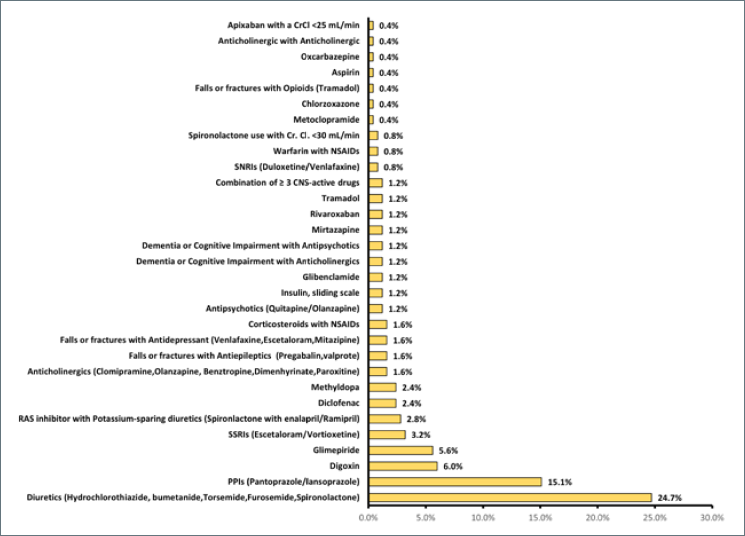
First, PIM; drugs to be avoided
PIM use due to drug-syndrome interactions
PIM; drugs to be used with caution
Potentially clinically important drug-drug interactions
Medications need adjustment according to renal function
Medications with strong anticholinergic effects
Strengths and limitations
CONCLUSIONS
Acknowledgements
Conflict of interest statement
Funding
Author contributions
Ethical consideration
Figures and tables

| Participant’s characteristics | Total N = 251 (100%) | No PIM use N = 125 (49.8%) | PIM use N = 126 (50.2%) | Univariate analysis | |
|---|---|---|---|---|---|
| OR 95% C.I. | P value | ||||
| Age | 73.31 ± 8.368 | 73.13 ± 8.423 | 73.49 ± 8.342 | 1.005 (.976-1.035) | .730 |
| Mean ± SD | |||||
| Male/female | 99 (39.4)/152 (60.6) | 47 (47.5)/78 (51.3) | 52 (52.5)/74 (48.7) | 1.166 (.703-1.936) | .552 |
| Charlson comorbidity index | 6.30 + 2.119 | 5.99 ± 2.012 | 6.61 ± 2.188 | 1.152 (1.007-1.319) | .039 |
| Co-mordidities | |||||
| Hypertension | 160 (63.7) | 72 (45.0) | 88 (55.0) | 1.705 (1.013-2.868) | .044 |
| Diabetes mellitus | 125 (49.8) | 54 (43.2) | 71 (56.8) | 1.697 (1.030-2.796) | .038 |
| Chronic hepatic disease | 58 (23.1) | 33 (56.9) | 25 (43.1) | .690 (.382-1.247) | .219 |
| Chronic kidney disease (CKD/ESRD) | 54 (21.5) | 25 (46.3) | 29 (53.7) | 1.196 (.654-2.187) | .561 |
| Malignancy | 41 (16.3) | 18 (43.9) | 20 (56.1) | 1.327 (.677-2.603) | .410 |
| Old stroke | 56 (22.3) | 25 (44.6) | 31 (55.4) | 1.305 (.718-2.371) | .382 |
| Cardiac disease | 106 (42.2) | 39 (36.8) | 67 (63.2) | 2.504 (1.496-4.193) | .000 |
| (CHF/AF/ISHD) | |||||
| Respiratory disease | 37 (14.7) | 17 (45.9) | 20 (54.1) | 1.199 (.595-2.414) | .612 |
| Thyroid disease | 25 (10.0) | 11 (44.0) | 14 (56.0) | 1.284 (.559-2.950) | .556 |
| Geriatric syndromes | |||||
| Falls | 51 (22.7) | 26 (51.0) | 25 (49.0) | .918 (.492-1.714) | .789 |
| Fracture | 37 (18.3) | 19 (51.4) | 18 (48.6) | .959 (.470-1.957) | .908 |
| Pressure ulcer | 46 (21.1) | 18 (39.1) | 28 (60.9) | 1.789 (.921-3.474) | .086 |
| Incontinence (urinary/fecal) | 45 (24.5) | 21 (46.7) | 24 (53.3) | 1.127 (.574-2.209) | .729 |
| Polypharmacy | 85 (33.9) | 18 (21.2) | 67 (78.8) | 6.750 (3.669-12.420) | .000 |
| Dementia | 43 (19.0) | 23 (53.5) | 20 (46.5) | .842 (.432-1.637) | .611 |
| Geriatric assessment | |||||
| MMSE | 23.98 ± 6.933 | 24.85 ± 7.206 | 23.23 ± 6.680 | .965 (.904-1.030) | .285 |
| Mean ± SD | |||||
| ADL | 3.60 ± 2.412 | 3.51 ± 2.467 | 3.69 ± 2.369 | 1.032 (.912-1.168) | .615 |
| Mean ± SD | |||||
| IADL | 3.87 ± 3.073 | 3.76 ± 3.257 | 3.98 ± 2.900 | 1.023 (.928-1.127) | .647 |
| Mean ± SD | |||||
| PIM: Potentially Inappropriate Medications; CKD: Chronic Kidney Disease; ESRD: End-Stage Renal Disease; CHF: Congestive Heart Failure; AF: Atrial Fibrillation; ISHD: Ischemic Heart Disease; MMSE: Mini-Mental State Examination; ADL: Activities of Daily Living; IADL: Instrumental Activities of Daily Living. | |||||
| *Bold numbers mean significant value. | |||||
| Risk factors of PIM use | Multivariate analysis | |
|---|---|---|
| OR 95% C.I. | P value | |
| Polypharmacy | 5.514 (2.776-10.952) | .000 |
| Charlson comorbidity index | 1.105(.945-1.292) | .212 |
| Hypertension | 1.444 (.725-2.873) | .296 |
| Diabetes mellitus | 1.294 (.667-2.511) | .447 |
| Cardiac disease | 2.359 (1.239-4.490) | .009 |
| (CHF/AF/ISHD) | ||
| PIM: Potentially Inappropriate Medications; CHF: Congestive Heart Failure; AF: Atrial Fibrillation; ISHD: Ischemic Heart Disease. | ||
| *Bold numbers mean significant value. | ||
| PIM defined by AGS Beers criteria-2019 | Total No. | % |
|---|---|---|
| PIM; drugs to be avoided | 80 | 31.9 |
| Antipsychotics (quitapine/olanzapine) | 3 | 1.2 |
| Anticholinergics (clomipramine, olanzapine, benztropine, dimenhyrinate, paroxitine) | 4 | 1.6 |
| Glimepiride | 14 | 5.6 |
| Digoxin | 15 | 6.0 |
| Insulin, sliding scale | 3 | 1.2 |
| Glibenclamide | 3 | 1.2 |
| Diclofenac | 6 | 2.4 |
| Methyldopa | 6 | 2.4 |
| Metoclopramide | 1 | .4 |
| Chlorzoxazone | 1 | .4 |
| Proton-pump inhibitors (pantoprazole/lansoprazole) | 38 | 15.1 |
| PIM due to drug-syndrome interactions | 9 | 3.6 |
| Dementia or cognitive impairment with anticholinergics | 3 | 1.2 |
| Dementia or cognitive impairment with antipsychotics | 4 | 1.6 |
| Falls or fractures with antidepressants (venlafaxine, escitalopram, mirtazapine) | 4 | 1.6 |
| Falls or fractures with opioids (tramadol) | 1 | .4 |
| PIM; drugs to be used with caution | 76 | 30.3 |
| Selective serotonin reuptake inhibitors (escitalopram/vortioxetine) | 8 | 3.2 |
| Serotonin-norepinephrine reuptake inhibitors (duloxetine/venlafaxine) | 2 | .8 |
| Mirtazapine | 3 | 1.2 |
| Rivaroxaban | 3 | 1.2 |
| Aspirin | 1 | .4 |
| Tramadol | 3 | 1.2 |
| Oxcarbazepine | 1 | .4 |
| Diuretics (hydrochlorothiazide, bumetanide, torsemide, furosemide, spironolactone) | 62 | 24.7 |
| Potentially clinically important drug-drug interactions | 17 | 6.8 |
| Inhibitors of the renin-angiotensin system with potassium-sparing diuretics (enalapril/ramipril with spironlactone) | 7 | 2.8 |
| Corticosteroids with a non steroidal anti-inflammatory drug | 4 | 1.6 |
| Combination of ≥ 3 central nervous system-active drugs | 3 | 1.2 |
| Anticholinergic with anticholinergic | 1 | .4 |
| Warfarin with a non steroidal anti-inflammatory drug | 2 | .8 |
| Medications need adjustment according to renal function | 3 | 1.2 |
| Spironolactone with creatinine clearance < 30 mL/min | 2 | .8 |
| Apixaban with creatinine clearance < 25 mL/min | 1 | .4 |
| Medications with strong anticholinergic effects | ||
| (clomipramine, olanzapine, benztropine, dimenhyrinate, paroxitine) | 4 | 1.6 |
| PIM: Potentially Inappropriate Medications; AGS Beers criteria-2019: American Geriatrics Society Beers criteria-2019. | ||
| MMSE | ADL | IADL | |||
|---|---|---|---|---|---|
| Whole sample | Number of PIM | r | -.252 | -.048 | -.043 |
| P-value | .019 | .529 | .571 | ||
| No. | 87 | 175 | 174 | ||
| PIM: Potentially Inappropriate Medications; MMSE: Mini-Mental State Examination; ADL: Activities of Daily Living; IADL: Instrumental Activities of Daily Living. | |||||
| *Bold numbers mean significant value. | |||||
SUPPLEMENTARY MATERIALS
| Rank | Drug | % |
|---|---|---|
| 1 | Beta blockers (bisoprolol/carvidilol/propranolol/atenolol/nivolol) | 33.9 |
| 2 | Acetylsalicylic acid | 22.3 |
| 3 | Insulin isophane/NPH | 16.7 |
| 4 | Omeprazole/pantoprazole/lansoprazole | 15.9 |
| 4 | Furosemide/torasemide | 15.9 |
| 5 | ACEIs (enalapril/captopril/ramipril) | 14.3 |
| 6 | Atorvastatin | 11.2 |
| 7 | Amlodipine | 10.8 |
| 8 | Metformin | 10.4 |
| 9 | Nitroglycerin | 9.6 |
| 10 | Hydrochlorothiazide/metolazone | 9.2 |
| 10 | Clopidogrel | 9.2 |
| 11 | Vitamin B12 | 8.4 |
| 11 | Gliclazide | 8.4 |
| 12 | Formoterol/salbutamol | 7.2 |
| 13 | Glimepiride | 6.8 |
| 13 | ARBs (valsartan/losartan/olmisartam/irbisartan) | 6.8 |
| 14 | Spironolactone | 6.4 |
| 14 | Calcium and vitamin D | 6.4 |
| 15 | Apixaban | 6 |
| 15 | Digoxin | 6 |
| 15 | Levothyroxine | 6 |
| 16 | Doxazosin/tamsulosin | 5.6 |
| 17 | Warfarin | 5.2 |
| 18 | Trimetazidine | 4.8 |
| 18 | Sitagliptin/vildagliptin | 4.8 |
| 19 | Memantine | 3.6 |
| 20 | SSRIs (escitalopram/vortioxetine/paroxetine/sertraline) | 2.8 |
| 20 | Paracetamol | 2.8 |
| 21 | Prednisolone/dexamethasone | 2.4 |
| 21 | Amantadine | 2.4 |
| 21 | Enoxaparin/heparin | 2.4 |
| 21 | Itopride | 2.4 |
| 22 | Laxatives | 2 |
| 22 | Ivabradine | 2 |
| 22 | Valproate | 2 |
| 23 | Theophylline | 1.6 |
| 23 | Gabapentin/pregabalin | 1.6 |
| 23 | Diclofenac topical | 1.6 |
| 23 | Methotrexate | 1.6 |
| 23 | Methyldopa | 1.6 |
| 24 | Rivaroxaban | 1.2 |
| 24 | Rapid-acting insulin | 1.2 |
| 24 | Carbimazole | 1.2 |
| 24 | Iron supplements | 1.2 |
| 24 | Finasteride | 1.2 |
| 24 | Mebeverine | 1.2 |
| 24 | Pentoxifylline | 1.2 |
| 24 | Mertazipine | 1.2 |
| 24 | Cerebrolysin | 1.2 |
| 24 | Tramadol | 1.2 |
| 24 | Ursodeoxycholic acid | 1.2 |
| 25 | Glibenclamide | 0.8 |
| 25 | Insulin glargine | 0.8 |
| 25 | Carbidopa/levodopa | 0.8 |
| 25 | Risperidone | 0.8 |
| 25 | Levetiracetam | 0.8 |
| 25 | Dapagliflozin | 0.8 |
| 25 | Allopurinol | 0.8 |
| 25 | Verapamil | 0.8 |
| 25 | Venlafaxine/duloxetine | 0.8 |
| 25 | Diclofenac | 0.8 |
| 25 | Nicorandil | 0.8 |
| 25 | Quitapine/olanzapine | 0.8 |
| 25 | Famotidine/rebamipide | 0.8 |
| 26 | Colchicine | 0.4 |
| 26 | Donepezil | 0.4 |
| 26 | l-ornithine-l-aspartate | 0.4 |
| 26 | Betahistine | 0.4 |
| 26 | Multi amino acids chelated antioxidant | 0.4 |
| 26 | Ginkgo biloba | 0.4 |
| 26 | Chloroxazone | 0.4 |
| 26 | Nystatin | 0.4 |
| 26 | Sotalol | 0.4 |
| 26 | Loratadine | 0.4 |
| 26 | Fexofenadine | 0.4 |
| 26 | Chymotrypsin | 0.4 |
| 26 | Denosumab | 0.4 |
| 26 | Benzatropine | 0.4 |
| 26 | Cilostazol | 0.4 |
| 26 | Eplerenone | 0.4 |
| 26 | Diltiazem | 0.4 |
| 26 | Verapamil | 0.4 |
| 26 | Venlafaxine | 0.4 |
| 26 | Duloxetine | 0.4 |
| 26 | hydroxyurea | 0.4 |
| 26 | Montelukast | 0.4 |
| 26 | Leflunomide | 0.4 |
| 26 | Oxcarbazepine | 0.4 |
| 26 | Lithium | 0.4 |
| 26 | Erythropoitin | 0.4 |
| 26 | Propafenone | 0.4 |
| 26 | Dimenhydrinate | 0.4 |
| 26 | Cinnarizine | 0.4 |
| 26 | L carnitine | 0.4 |
| 27 | Pramipexol | 0 |
References
- Loddo S, Salis F, Rundeddu S, et al. Nutritional status and potentially inappropriate medications in elderly. J Clin Med 2022;11:3465. https://doi.org/10.3390/jcm11123465 10.3390/jcm11123465
- Kucukdagli P, Bahat G, Bay I, et al. The relationship between common geriatric syndromes and potentially inappropriate medication use among older adults. Aging Clin Exp Res 2020;32:681-687. https://doi.org/10.1007/s40520-019-01239-x 10.1007/s40520-019-01239-x
- Rochon PA, Gurwitz JH. The prescribing cascade revisited. Lancet 2017;389:1778-1780.
- Bolt J, Park E, Wong K, et al. Retrospective cross-sectional analysis of potentially inappropriate medication use in ambulatory seniors with geriatric syndromes. Drugs Ther Perspect 2022;38:156-163. https://doi.org/10.1007/s40267-022-00904-y 10.1007/s40267-022-00904-y
- Muhlack DC, Hoppe LK, Stock C, et al. The associations of geriatric syndromes and other patient characteristics with the current and future use of potentially inappropriate medications in a large cohort study. Eur J Clin Pharmacol 2018;74:1633-1644. https://doi.org/10.1007/s00228-018-2534-1 10.1007/s00228-018-2534-1
- Beers MH, Ouslander JG, Rollingher I, et al. Explicit criteria for determining inappropriate medication use in nursing home residents. UCLA division of geriatric medicine. Arch Intern Med 1991;151:1825-1832.
- Spinewine A, Schmader KE, Barber N, et al. Appropriate prescribing in elderly people: how well can it be measured and optimised? Lancet 2007;370:173-184. https://doi.org/10.1016/s0140-6736(07)61091-5 10.1016/s0140-6736(07)61091-5
- Kaufmann CP, Tremp R, Hersberger KE, et al. Inappropriate prescribing: a systematic overview of published assessment tools. Eur J Clin Pharmacol 2014;70:1-11. https://doi.org/10.1007/s00228-013-1575-8 10.1007/s00228-013-1575-8
- By the 2019 American Geriatrics Society Beers Criteria® Update Expert Panel. American Geriatrics Society 2019 Updated AGS Beers Criteria® for potentially inappropriate medication use in older adults. J Am Geriatr Soc 2019;67:674-694. https://doi.org/10.1111/jgs.15767 10.1111/jgs.15767
- Folstein MF, Folstein SE, McHugh PR. ’Mini mental state’. A practical method for grading the cognitive state of patients for the clinician. J Psychiatr Res 1975;12:189-198.
- Katz S, Ford AB, Moskowitz RW, et al. Studies of illness in the aged: the index of ADL: a standardized measure of biological and psychosocial function. JAMA 1963;185:914-919. https://doi.org/10.1001/jama.1963.03060120024016 10.1001/jama.1963.03060120024016
- Lawton MP, Brody EM. Assessment of older people: self-maintaining and instrumental activities of daily living. The Gerontologist 1969;9(3 Part 1):179-186. https://doi.org/10.1093/geront/9.3_Part_1.179 10.1093/geront/9.3_Part_1.179
- Assis DL, Chagas VO, Valente M, et al. Uso de medicamentos inapropriados em idosos institucionalizados: lições ainda não aprendidas. Geriatr Gerontol Aging 2016;10:126-131.
- Charlson ME, Pompei P, Ales KL, et al. A new method of classifying prognostic comorbidity in longitudinal studies: development and validation. J Chronic Dis 1987;40:373-383. https://doi.org/10.1016/0021-9681(87)90171-8 10.1016/0021-9681(87)90171-8
- de Oliveira RMA, Gorzoni ML, Rosa RF. Potentially inappropriate medication use in hospitalized elderly patients. Rev Assoc Med Bras 2022;68:797-801.
- Alshammari H, Al-Saeed E, Ahmed Z, et al. Prevalence and predictors of potentially inappropriate medications among patients aged ≥ 65 years on hospital admissions in Kuwait. Clin Interv Aging 2022;17:1025-1036. https://doi.org/10.2147/CIA.S328693 10.2147/CIA.S328693
- Bhagavathula AS, Vidyasagar K, Chhabra M, et al. Prevalence of polypharmacy, hyperpolypharmacy and potentially inappropriate medication use in older adults in India: a systematic review and meta-analysis. Front Pharmacol 202112:685518. https://doi.org/10.3389/fphar.2021.685518 10.3389/fphar.2021.685518
- Caçador C, Teixeira-Lemos E, Oliveira J, et al. The prevalence of polypharmacy and potentially inappropriate medications and its relationship with cognitive status in portuguese institutionalized older adults: a cross-sectional study. Int J Environ Res Public Health 2022;19:2637. https://doi.org/10.3390/ijerph19052637 10.3390/ijerph19052637
- Ramsdale E, Mohamed M, Yu V, et al. Polypharmacy, potentially inappropriate medications, and drug-drug interactions in vulnerable older adults with advanced cancer initiating cancer treatment. The Oncologist 2022;27:E580-E588. https://doi.org/10.1093/oncolo/oyac053 10.1093/oncolo/oyac053
- Maes ML, Fixen DR, Linnebur SA. Adverse effects of proton-pump inhibitor use in older adults: a review of the evidence. Therap Adv Drug Safety 2017;8:273-297.
- Eshetie TC. Potentially inappropriate prescribing before and after initiation of medicines for dementia: an Australian population-based study. Geriatr Gerontol Int 2019;19:654-659.
- Liantonio JJ, Brent Simmons ŸB. NSAIDs and the geriatric patient: a cautionary tale (https://www.consultant360.com/articles/nsaids-and-geriatric-patient-cautionary-tale, accessed on 13/10/2022).
- Pilotto A, Franceschi M, Leandro G, et al. NSAID and aspirin use by the elderly in general practice: effect on gastrointestinal symptoms and therapies. Drugs Aging 2003;20:701-710.
- Aljadhey H, Tu W, Hansen RA, et al. Comparative effects of non-steroidal anti-inflammatory drugs (NSAIDs) on blood pressure in patients with hypertension. BMC Cardiovasc Disord 2012;12:93.
- Klotz U. Pharmacokinetics and drug metabolism in the elderly. Drug Metab Rev 2009;41:67-76. https://doi.org/10.1080/03602530902722679 10.1080/03602530902722679
- Luukkanen MJ, Uusvaara J, Laurila JV, et al. Effects of anticholinergic drugs on delirium and mortality. Dement Geriatr Cogn Disord Extra 2011;1:43-50. https://doi.org/10.1159/000322883 10.1159/000322883
- Onder G, Giovannini S, Sganga F, et al. Interactions between drugs and geriatric syndromes in nursing home and home care: results from Shelter and IBenC projects. Aging Clin Exp Res 2018;30:1015-1021. https://doi.org/10.1007/s40520-018-0893-1. 10.1007/s40520-018-0893-1
- Musich S, Wang SS, Slindee LB, et al. Concurrent use of opioids with other central nervous system-active medications among older adults. Popul Health Manag 2020;23:286-296. https://doi.org/10.1089/pop.2019.0128 10.1089/pop.2019.0128
- Villa Zapata L, Hansten PD, Panic J, et al. Risk of bleeding with exposure to warfarin and nonsteroidal anti-inflammatory drugs: a systematic review and meta-analysis. Thromb Haemost 2020;120:1066-1074. https://doi.org/10.1055/s-0040-1710592 10.1055/s-0040-1710592
- Woodford HJ, Stevenson JM. Anticholinergic drugs and dementia: time for transparency in the face of uncertainty. Cochrane Database System Rev 2021;9:ED000154. https://doi.org/10.1002/14651858.ED000154 10.1002/14651858.ED000154
- Durán CE, Azermai M, Vander Stichele RH. Systematic review of anticholinergic risk scales in older adults. Eur J Clin Pharmacol 2013;69:1485-1496. https://doi.org/10.1007/s00228-013-1499-3 10.1007/s00228-013-1499-3
- López-Álvarez J, Sevilla-Llewellyn-Jones J, Agüera-Ortiz L. Anticholinergic drugs in geriatric psychopharmacology. Front Neurosci 2019;13:1309. https://doi.org/10.3389/fnins.2019.01309 10.3389/fnins.2019.01309
- Wood S, Petty D, Glidewell L, et al. Application of prescribing recommendations in older people with reduced kidney function: a cross-sectional study in general practice. Br J Gen Pract 2018;68:E378-E387. https://doi.org/10.3399/bjgp18X695993 10.3399/bjgp18X695993
- Sharma R, Bansal P, Garg R, et al. Prevalence of potentially inappropriate medication and its correlates in elderly hospitalized patients: a cross-sectional study based on Beers criteria. J Family Community Med 2020;3:200-207. https://doi.org/10.4103/jfcm.JFCM_175_20 10.4103/jfcm.JFCM_175_20
- Riedel WJ, van Praag HM. Avoiding and managing anticholinergic effects of antidepressants. CNS Drugs 1995;245-259. https://doi.org/10.2165/00023210-199503040-00002 10.2165/00023210-199503040-00002
- Chew ML, Mulsant BH, Pollock BG. Anticholinergic activity of medications. J Am Geriatr Soc 2008;56:1333-1341. https://doi.org/10.1111/j.1532-5415.2008.01737.x 10.1111/j.1532-5415.2008.01737.x
- Fujishiro J, Imanishi T, Onozawa K, et al. Comparison of the anticholinergic effects of the serotonergic antidepressants, paroxetine, fluvoxamine and clomipramine. Eur J Pharmacol 2002;454:183-188. https://doi.org/10.1016/s0014-2999(02)02557-8 10.1016/s0014-2999(02)02557-8
- Page AT, Clifford RM, Potter K, et al. The feasibility and effect of deprescribing in older adults on mortality and health: a systematic review and meta-analysis. Br J Clin Pharmacol 2016;82:583-623.
- Mizokami F, Koide Y, Noro T, et al. Polypharmacy with common diseases in hospitalized elderly patients. Am J Geriatr Pharmacother 2012;10:123-128.
- Guisado-Clavero M, Roso-Llorach A, López-Jimenez T, et al. Multimorbidity patterns in the elderly: a prospective cohort study with cluster analysis. BMC Geriatr 2018;18:16.
- Jackson CF, Wenger NK. Cardiovascular disease in the elderly. Rev Española Cardiol (English Ed) 2011;64:697-712.
- Guisado-Clavero M, Violán C, López-Jimenez T., et al. Medication patterns in older adults with multimorbidity: a cluster analysis of primary care patients. BMC Fam Pract 2019;20:82. https://doi.org/10.1186/s12875-019-0969-9 10.1186/s12875-019-0969-9
- Reporting and learning systems for medication errors: the role of pharmacovigilance centres, 2014 (https://www.who.int/publications/i/item/9789241507943).
Società Italiana di Gerontologia e Geriatria (SIGG) This is an open access article distributed in accordance with the CC-BY-NC-ND (Creative Commons Attribution-NonCommercial-NoDerivatives 4.0 International) license. The article can be used by giving appropriate credit and mentioning the license, but only for non-commercial purposes and only in the original version. For further information: https://creativecommons.org/licenses/by-nc-nd/4.0/deed.en
Share and Cite
Elsorady, K.E.; El-Mohsen, M.A. Association between potentially inappropriate prescribing, polypharmacy, and functional/cognitive impairment among Egyptian geriatric patients. J. Gerontol. Geriatr. 2023, 71, 141-151. https://doi.org/10.36150/2499-6564-N585
Elsorady KE, El-Mohsen MA. Association between potentially inappropriate prescribing, polypharmacy, and functional/cognitive impairment among Egyptian geriatric patients. Journal of Gerontology and Geriatrics. 2023; 71(3):141-151. https://doi.org/10.36150/2499-6564-N585
Chicago/Turabian StyleElsorady, Khalid Elsayed, and Mohamed Abd El-Mohsen. 2023. "Association between potentially inappropriate prescribing, polypharmacy, and functional/cognitive impairment among Egyptian geriatric patients" Journal of Gerontology and Geriatrics 71, no. 3: 141-151. https://doi.org/10.36150/2499-6564-N585
APA StyleElsorady, K. E., & El-Mohsen, M. A. (2023). Association between potentially inappropriate prescribing, polypharmacy, and functional/cognitive impairment among Egyptian geriatric patients. Journal of Gerontology and Geriatrics, 71(3), 141-151. https://doi.org/10.36150/2499-6564-N585

