Next Article in Journal
A Survey of Knowledge, Attitude and Practice of the Older People About COVID-19 Pandemic in Isfahan, Iran
Previous Article in Journal
Risk Factors of Intraoperative and 24-Hour Postoperative Cardiac Arrest in Geriatric Patients in Non-Cardiac Surgery
 
 
Journal of Gerontology and Geriatrics is published by MDPI from Volume 74 Issue 1 (2026). Previous articles were published by another publisher in Open Access under a CC-BY (or CC-BY-NC-ND) licence, and they are hosted by MDPI on mdpi.com as a courtesy and upon agreement with Pacini Editore.
Article

Tocilizumab and Corticosteroids for COVID-19 Treatment in Elderly Patients

by
Flavia Balena
1,*,
Davide Fiore Bavaro
1,
Claudia Fabrizio
2,
Irene Francesca Bottalico
3,
Angela Calamo
4,
Carmen Rita Santoro
2,
Gaetano Brindicci
1,
Giuseppe Bruno
2,
Antonio Mastroianni
5,
Sonia Greco
5,
Giovanni Battista Buccoliero
2,
Sergio Carbonara
4,
Sergio Lo Caputo
3,
Teresa Santantonio
3,
Laura Monno
1,
Gioacchino Angarano
1 and
Annalisa Saracino
1
1
Clinic of Infectious Diseases, University of Bari, University Hospital Policlinico, Bari, Italy
2
Malattie Infettive e Tropicali, Ospedale Oncologico San Giuseppe Moscati, Taranto, Italy
3
Clinic of Infectious Disease, University of Foggia, Ospedali Riuniti, Foggia, Italy
4
UOC Malattie Infettive, ASL BAT, P.O. V. Emanuele II, Bisceglie, Italy
5
Unit of Infectious and Tropical Diseases, St. Annunziata Hospital, Cosenza, Italy
*
Author to whom correspondence should be addressed.
J. Gerontol. Geriatr. 2020, 68(4), 197-203; https://doi.org/10.36150/2499-6564-283

Submission received: 1 October 2020 / Accepted: 3 December 2020 / Published: 22 December 2020

Background

The mortality rate for coronavirus disease-19 (COVID-19) increases with age. Some anti-inflammatory drugs such as tocilizumab or steroids have been proposed for the treatment of severe disease; however, few data are available in the elderly.

Methods

A retrospective case-series of patients hospitalized between March 1st and June 15th, 2020 with confirmed COVID-19 by RT-PCR testing on throat/nasopharyngeal swabs and age ≥ 65 years was analysed. Patients were retrospectively divided into three groups according to the chosen treatment [standard of care (SOC), tocilizumab or corticosteroids] and patient characteristics and occurrence of adverse events were compared among groups.

Results

Overall, 206 patients were included, 148 treated with standard of care, 42 with steroids and 16 with tocilizumab. Patients treated with steroids or Tocilizumab presented more frequently with fever (p = .003), dyspnea (p < .001), bilateral opacities/infiltrates at chest X-ray (p =.026) or CT-scan (p = .020), and more frequently required non-invasive/invasive ventilation (p < .001). Crude mortality was 27%, without differences among groups (p = .074). No specific adverse events were observed during/after the administration of steroids or tocilizumab; however, a trend towards an increased risk of secondary infections was described compared to SOC (p = .097). At multivariate logistic regression, only tocilizumab administration was an independent predictor of secondary infections (aOR = 6.72, 95% CI = 1.43-31.39, p = .015).

Conclusions

Tocilizumab and corticosteroid could have a possible role for severe form of pneumonia in course of COVID-19 also in elderly patients, even if great attention to the monitoring of infectious complications should be paid in this special population.
Key words:
COVID-19; tocilizumab; corticosteroids; elderly

INTRODUCTION

The coronavirus disease 2019 (COVID-19), initially described in Wuhan (China) in December 2019, is known to be caused by a novel beta-coronavirus, named as Severe Acute Respiratory Syndrome Coronavirus 2 (SARS-CoV-2) 1.
On 11th March 2020, the World Health Organization (WHO) announced COVID-19 outbreak a pandemic, that counts until now more than 30.000.000 of cases and almost 950.000 of deaths 2.
COVID-19 includes a wide spectrum of clinical features and variable outcome due to many underlying conditions, such as age, cardiovascular or respiratory comorbidities, diabetes mellitus, obesity and others 1,3,4. Older age, which was already reported as an independent predictor of mortality in SARS and MERS, is certainly one among the most important prognostic variables also for COVID-19 3. In fact, elderly patients are more susceptible in terms of severity of illness, percentage of admission to the intensive care unit (ICU), and mortality rate 5. This could be explained by age-dependent defects of the immune system and an excess of type 2 cytokines production, which would lead to an increase in viral replication and a more prolonged pro-inflammatory response 3.
Indeed, it had been demonstrated that the inflammatory reaction is the main driver of pulmonary damage, with the recruitment of a wide spectrum of pro-inflammatory cytokines 6. Therefore, in this scenario, a lot of therapeutic strategies had been studied to calm down the cytokine cascade. Due to the central role of IL-6 in the inflammatory reaction, a recombinant humanized anti-human IL-6 receptor monoclonal antibody called Tocilizumab has been one of the first explored options. Tocilizumab binds the soluble interleukin-6 receptor (sIL-6R) and inhibits signal transduction 6. The effectiveness of this therapeutic strategy is still debated. In fact, an international study performed by Xu et al, in Shanghai 6 shows that Tocilizumab effectively improves clinical symptoms and represses the deterioration of severe COVID-19 patients. Similar results were obtained by Biran et al. 7, who demonstrated a reduction in mortality rate for patients with COVID-19 treated with Tocilizumab in ICU. In Brescia (Italy) the monoclonal antibody against sIL-6R was employed in 100 patients with COVID-19 pneumoniae with encouraging results 8. However, other studies showed discordant results, such as that of Campochiaro et al., in which no difference in terms of outcome was found between patients who received tocilizumab and those treated with standard management. Moreover, in the first group, the occurrence of opportunistic infections like candidemia and pulmonary aspergillosis was reported 9.
Another therapeutic intervention proposed to mitigate inflammatory organ injury in SARS-CoV-2 infection is the use of glucocorticoids. The New England Journal of Medicine reported the preliminary results of the controlled, open-label Randomized Evaluation of COVID-19 Therapy (RECOVERY) trial of dexamethasone in patients hospitalized with COVID-19 10. Dexamethasone is a synthetic adrenal corticosteroid that has both anti-inflammatory as well as immunosuppressive properties 11. The mean age of the patients was 66.1 +/- 15.7. This study shows an improvement of clinical conditions in terms of a reduction of 28 days mortality in patients that were treated with oxygen support (invasive or non - invasive ventilation) 10. Another study carried by Villar et al. on a sample of 277 patients showed that the early use of dexamethasone could increase ventilator-free days compared to patients who did not receive this treatment 12.
None of these studies, however, was focused on the elderly, and the efficacy and safety of tocilizumab and corticosteroids in these patients in the setting of COVID-19 is currently unknown.
Therefore, we aimed to describe the safety profile of these therapeutic strategies in a cohort of COVID-19 patients older than 65 years of age treated in five large Infectious Disease Centers in Southern Italy.

PATIENTS AND METHODS

STUDY DESIGN

A retrospective case-series of all consecutive patients with age ≥ 65 years, hospitalized between March 1st and June 15th 2020, with confirmed SARS-CoV-2 infection by PCR on nasopharyngeal swabs was analyzed across five COVID-19 hospitals in Southern Italy.
Patient demographics, clinical and microbiological characteristics were retrieved, by reviewing all available medical records.
Patients were retrospectively divided into three groups according to the chosen treatment [standard of care (SOC), tocilizumab or corticosteroids].
All medical supportive care and antivirals in use in Italy during the first months of COVID-19 pandemics in Italy (such as lopinavir/ritonavir and hydroxychloroquine) were defined as “standard of care”, including also the use of empiric antibiotic therapy.
Steroid therapy was prescribed according to treating physician; therefore, the dosage was not standardized. However, at least 10 mg/day of dexamethasone for 5 days were usually prescribed at that time.
Tocilizumab was administered at the dosage of 8 mg/kg as a single infusion. All patients treated with tocilizumab (excluding 2) were also under steroid therapy.
In general, steroid treatment were administered to patients considered affected by a moderate to severe COVID-19, while tocilizumab was prescribed to patients with severe or critical disease, after informed consent and as compassionate use.

LABORATORY DIAGNOSIS OF COVID-19

Nasopharyngeal swabs were used to diagnose COVID-19 in all patients. Tests were performed at a central hub laboratory using real-time reverse transcriptase PCR [real-time PCR assay targeting E-gene, RdRP-gene and N-gene, performed with the protocol previously reported by the WHO (https://www.who.int/docs/default-source/coronaviruse/uscdcrt-pcr-panel-for-detection-instructions.pdf?sfvrsn=3aa07934_2)].

DEFINITIONS OF CO-INFECTIONS AND SECONDARY INFECTIONS

Co-infections were defined as all other diseases caused by a pathogen different from SARS-CoV-2 at the time of COVID-19 diagnosis.
Secondary infections were defined as all other diseases caused by a pathogen different from SARS-CoV-2 occurring in course of COVID-19, which were not present at the moment of admission for COVID-19.
During analysis, five independent reviewers evaluated microbiology isolates to determine the clinical significance; pathogens identified but not warranting targeted therapy were defined as commensal and nonsignificant infective pathogens and were not reported in this study.

DATA ANALYSIS

All data were anonymized and collated on an electronical database.
Descriptive statistics were produced for demographic, clinical and laboratory characteristics of cases. Mean and standard deviation (SD) were obtained for normally distributed variables, and median and interquartile range (IQR) for non-normally distributed variables, number and percentages for categorical variables.
The distribution between groups (according to treatment administered) of clinical conditions and laboratory findings was analyzed by univariable parametric or nonparametric tests, Kruskal Wallis or Mann Whitney Test (where appropriate) for continuous variables and with Pearson’s χ2 test (Fisher’s exact test where appropriate) for categorical variables, according to data distribution.
Survival analysis (Kaplan-Meier curves estimates) was performed to explore the impact of different therapies on patient overall survival probability.
Finally, univariate logistic regression was performed in order to assess predictors of secondary infections elderly; then a stepwise multivariate logistic regression model was applied to control for potential confounders and was adjusted for variables associated (p value < 0.1) at univariable analysis with endpoint at univariable analysis.

ETHICS

The research did not require a formal approval from the ethics committee according to the Italian law since it was performed as an observational retrospective study in the context of normal clinical routines (art. 1, leg. decree 211/2003). However, the study was conducted in accordance with the Declaration of Helsinki and national and institutional standards. All patients provided informed consent for the use of their data for research purposes. In any case, data were previously anonymized, according to the requirements set by Italian Data protection Code (leg. Decree 196/2003).

RESULTS

GENERAL CHARACTERISTICS OF THE STUDY POPULATION

A total of 206 patients with confirmed SARS-CoV-2 infection and age > 65 years [median (IQR) age 80 (72 – 86) years, males in 48% of cases] were included.
Overall, 148 (72%) subjects were treated only with supportive care, antivirals, and antibiotics according to the physician judgment. Conversely, 42 (20%) and 16 (8%) were treated with steroid therapy and Tocilizumab, respectively. In Table I, the general features of the study population according to the administered treatment are resumed.
One third of patients suffered from a severe respiratory failure: 83 (40%) required at least 10 lt/min of oxygen therapy, 58 (28%) non-invasive mechanical ventilation (NIV), and 14 (9%) invasive mechanical ventilation.
Notably, patients treated with steroid or Tocilizumab had a more severe disease presentation; in fact, they were more frequently affected by fever > 38°C (p = .003), cough (p = .030) and dyspnoea (p < .001) and prevalently presented bilateral opacities/infiltrates at chest X-Ray (p = .026) or chest computed tomography (p = .020), or a severe respiratory disease requiring high flux oxygen therapy (> 10 lt/min, NIV or invasive mechanical ventilation, p < .001 in all cases) if compared with those assigned to standard of care.
Crude in-hospital mortality was 27% (23%, 40% and 31% for standard of care, steroids and Tocilizumab group respectively, p = 0.074).
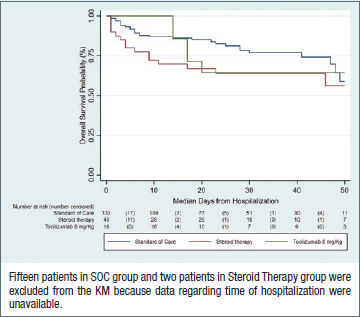
Kaplan-Meier curves estimated of survival probability of patients, according to therapy prescribed, was made. As shown in Figure 1, no significant difference in risk of death among patients affected by COVID-19 (log rank p-value = .195) was observed in our cohort, after stratification for standard of care, steroid therapy or tocilizumab ± steroids.

ADVERSE EVENTS AND SECONDARY INFECTIONS DURING OR AFTER STEROID/TOCILIZUMAB ADMINISTRATION

The 25% of patients in this cohort suffered from at least one secondary infection during hospitalization. No other adverse events except than secondary infections were recorded in course of steroid therapy or after Tocilizumab administration.
In Table II, all secondary infections occurring during or after steroid/tocilizumab administration are shown.
A trend towards a higher incidence of infections in both the tocilizumab/corticosteroids group and in the only corticosteroid arm compared to SOC was noticed at univariable analysis (p = .097). By conducting a stepwise multivariable logistic regression model (Tab. III), adjusted for age, sex, comorbidity, clinical picture at admission, severity of respiratory failure, and treatment administered, only Tocilizumab treatment [adjusted Odds Ratio (aOR) = 6.72, 95% Confidence Interval (95%CI) = 1.43-31.39, p = .015] was associated with an increased risk of secondary infections during hospitalization.
“Invasive mechanical ventilation during hospitalization” was dropped in the final multivariable analysis due to the high number of missing cases. However, by performing the analysis after including this variable, the association between tocilizumab and secondary infections was confirmed (data not shown).

DISCUSSION

The clinical spectrum of COVID-19 is wide and includes asymptomatic infection, fever without respiratory problems or even severe pneumonia with respiratory failure and necessity of non-invasive or invasive ventilation 3.
Many studies demonstrated that the mortality rate in patients over 60 years old is much higher than overall mortality 4 and it has been investigated a lot regarding the risk predictors of elderly patients. Several factors were related to poor outcomes in this population such as symptoms of dyspnea, comorbidities like cardiovascular disease, diabetes mellitus or obesity 13.
Despite gaps in understanding all pathogenic mechanisms causing COVID-19, it is now clear that immune system response plays a central role in development of pulmonary damage 1. Some studies have shown a significant relationship between the disease severity and levels of pro-inflammatory cytokines and subsets of immune cells, suggesting that the immune dysregulation and the high level of pro-inflammatory cytokines could be the main cause of tissue injury 14.
Considering this background, we aimed to describe safety profile of two anti-inflammatory drugs like tocilizumab and steroids focusing on elderly patients infected with SARS-CoV-2 and treated using these strategies. Although previous studies investigated the role of these drugs in preventing the worsening of the disease, even with discordant results 6-8,10,14, none of them was focused on the elderly, and the efficacy and safety of tocilizumab and corticosteroids in these patients in the setting of COVID-19 is unknown.
It should be underlined that, due to its retrospective nature, this is not a study aiming to assess the efficacy of tocilizumab and steroids against COVID-19, as, of course, patients who underwent to these therapeutic strategies were more severe than those who were only treated with the standard of care; however, our results show no association between mortality rate and type of administered therapy.
Regarding the safety profile of these drugs, we did not observe the emergence of any specific adverse effect in patients treated with tocilizumab and steroids apart from infections, confirming what found in previously studies 6,10.
A quarter of patients (25%) suffered for secondary infections. According to the multivariable logistic regression model, tocilizumab treatment was associated with an increased risk of secondary infection during hospitalization. This in line with the paper of Toniati et al. 8, in which a similar rate of secondary infections was reported in a population with a median age of 62 (57-71) years. Conversely, in other studies regarding the use of Tocilizumab and steroids in COVID-19 patients younger than our population, no evidence of a higher frequency of secondary infections was reported compared to the standard of care 6,15.
The strengths of this study are represented by its quite large “real life” cohort focused on elderly, and its evaluation of possible adverse events during/after administration of anti-inflammatory treatment for COVID-19. However, it has also some limitations. First, its retrospective nature and all related biases; second, the inadequate design to evaluate the efficacy of anti-inflammatory treatment on mortality.
In conclusion, despite a likely increased risk of secondary infections after Tocilizumab administration, no other adverse events were recorded in this study. Therefore, tocilizumab and corticosteroid therapies could have a possible role for severe form of pneumonia in course of COVID-19 also in elderly patients, even if great attention to the monitoring of infectious complications should be paid in this special population.

Figures and tables

Figure 1. Survival probability of patients, according to therapy prescribed.
Jgg 68 00197 g001
Table I. General features of the study population according to the administered treatment.
Overall
(n. 206)
Standard of care
(n. 148)
Steroid therapy
(n. 42)
Tocilizumab
(n. 16)
P-value
Median Age (IQR), years80 (72-86)80 (72-86)81 (72-86)75 (70-85).543
Male sex - n (%)98(48)65(44)22(52)11(69).131
Comorbidity - n (%)
Hypertension122(60)82(55)28(68)12(75).139
Any heart disease92(45)59(40)24(59)9(56).066
Diabetes (pts. 161)50(24)31(21)14(34)5(31).176
Chronic obstructive lung disease46(22)27(18)12(29)7(44).034
Chronic kidney disease (KDOQI stage III or more)23(11)16(11)6(15)1(6).637
Any neurologic disease48(23)36(24)10(24)2(12).562
Concurrent cancer - n (%)27(13)17(11)9(22)1(6).149
Immunocompromised state - n (%) (pts. 203)7(3)3(2)4(10)0.042
Living in a health care facility - n (%) (pts. 197)96(49)70(48)22(59)4(27).098
Signs and symptoms around the time of hospitalization - n (%)
Fever (> 38°C)114(55)71(48)31(74)12(75).003
Cough82(40)51(34)21(50)10(62).030
Dyspnea126(61)78(53)35(83)12(81)< .001
Chest X-ray positive for opacities on admission - n (%) (pts. 179)(n. 135)(n. 34)(n. 10)
No opacities23(13)23(17)00.026
Monolateral opacities40(22)32(24)7(21)1(10)
Bilateral opacities116(65)80(59)27(79)9(90)
Chest CT-Scan positive for infiltrates/consolidations on admission - n (%) (pts. 74)(n. 46)(n. 17)(n. 11)
No infiltrates/consolidations13(18)13(28)00.020
Monolateral infiltrates/consolidations5(7)2(4)1(6)2(18)
Bilateral infiltrates/consolidations56(76)31(67)16(94)9(82)
Antiviral treatment during hospitalization - n (%)
Lopinavir/r93(46)60(41)21(51)12(75).026
Hydroxychloroquine147(72)101(69)32(76)14(87).240
Azithromycin (pts. 163)37(23)24(21)7(19)6(43).162
> 10 L/min of O2 therapy during hospitalization - n (%)83(40)49(33)22(52)12(75).001
Non-invasive ventilation during hospitalization - n (%)58(28)31(21)17(40)10(62)< .001
Invasive mechanical ventilation during hospitalization - n (%) (n. 150)14(9)4(4)5(17)5(36)< .001
At least one secondary infection - n (%).52(25)32(21)13(31)7(43).097
Median Hospitalization Days (IQR), days (pts. 190)22 (12-39)22 (12-39)26 (7-41)20 (15-44).697
In-Hospital Mortality- n (%) -56(27)34(23)17(40)5(31).074
Boldface means statistically significant (p < .05)
Table II. Secondary infections recorded during hospitalization
Standard of care (n. 148)Steroid therapy (n. 42)Tocilizumab (n. 16)
Type of infection, n (%)
No infections116(78)29(69)9(56)
Bacterial Sepsis11(8)4(10)2(13)
Fungal Sepsis (Candida spp.)02(5)1(6)
Bacterial Pneumonia3(2)2(5)3§ (19)
CA-UTI15(10)3(6)1(6)
Other infections3* (2)2** (5)0
CA-UTI: catheter associated urinary tract infections;
§: 1 case of pulmonary aspergillosis;
*: 2 cases of C.difficile colitis and 1 skin and soft tissue infection;
**: 1 case of C.difficile colitis and 1 case of dental abscess
Table III. Univariate and multivariate logistic regression for predictors of secondary infections.
Univariable analysisMultivariable analysis
OR95% C.I.P-valueaOR95% C.I.P-value
Age (per 1 year increase)1.000.97-1.04.6720.980.94-1.03.608
Male sex0.750.39-1.41.3800.470.21-1.08.076
Hypertension1.50.77-2.91.2311.150.52-2.54.728
Diabetes0.810.37-1.73.5890.640.25-1.64.355
Chronic kidney disease (KDOQI stage III or more)1.720.68-4.34.2481.880.62-5.64.259
Chronic obstructive lung disease2.151.06-4.37.0342.300.97-5.43.057
Any neurologic disease1.160.55-2.42.6861.230.49-3.09.658
Any immunosuppressive condition0.510.06-4.37.5420.410.42-4.12.454
Signs and symptoms around the time of hospitalization
Fever (> 38°C)0.920.40-1.73.8020.950.41-2.19.915
Dyspnea1.800.91-3.55.0901.370.58-3.21.467
Chest X-ray positive for opacities on admission - n (%)
No opacities11
Monolateral opacities0.660.22-1.95.4600.440.13-1.50.195
Bilateral opacities0.510.20-1.32.1690.310.10-0.98.046
>10 L/min of O2 Therapy during hospitalization1.891.00-3.56.0501.610.71-3.64.247
Treatment administered
Standard of care11
Steroid therapy1.620.75-3.48.2122.410.91-6.37.074
Tocilizumab - 8 mg/kg -2.810.97-8.15.0566.721.43-31.39.015
Invasive mechanical ventilation during hospitalization5.611.75-17.94.004/
OR: odds ratio; 95% C.I.: 95% confidence interval; aOR: adjusted odds ratio; Boldface means statistically significant (p < .05)

References

  1. Bhimraj A, Morgan RL, Hirsch Shumaker A, et al. Infectious Diseases Society of America Guidelines on the treatment and management of patients with COVID-19. Clin Infect Dis 2020;Apr 27;ciaa478. https://doi.org/10.1093/cid/ciaa478 10.1093/cid/ciaa478
  2. WHO. Weekly Operational Update on COVID-19. 2020;Sep 25.
  3. Zhou F, Yu T, Du R, et al. Clinical course and risk factors for mortality of adult inpatients with COVID-19 in Wuhan, China: a retrospective cohort study. Lancet 2020;395:1054-62. https://doi.org/10.1016/S0140-6736(20)30566-3 10.1016/S0140-6736(20)30566-3
  4. Leung C. Risk factors for predicting mortality in elderly patients with COVID-19: a review of clinical data in China. Mech Ageing Dev 2020;188:111255. https://doi.org/10.1016/j.mad.2020.111255 10.1016/j.mad.2020.111255
  5. Niu S, Tian S, Lou J, et al. Clinical characteristics of older patients infected with COVID-19: a descriptive study. Arch Gerontol Geriatr 2020;89:104058. https://doi.org/10.1016/j.archger.2020.104058 10.1016/j.archger.2020.104058
  6. Xu X, Han M, Li T, et al. Effective treatment of severe COVID-19 patients with tocilizumab. Proc Natl Acad Sci U S A 2020;117:10970-5. https://doi.org/10.1073/pnas.2005615117 10.1073/pnas.2005615117
  7. Biran N, Ip A, Ahn J, et al. Tocilizumab among patients with COVID-19 in the intensive care unit: a multicentre observational study. Lancet Rheumatol 2020;2:e603-12. https://doi.org/10.1016/S2665-9913(20)30277-0 10.1016/S2665-9913(20)30277-0
  8. Toniati P, Piva S, Cattalini M, et al. Tocilizumab for the treatment of severe COVID-19 pneumonia with hyperinflammatory syndrome and acute respiratory failure: A single center study of 100 patients in Brescia, Italy. Autoimmun Rev 2020;19:102568. https://doi.org/10.1016/j.autrev.2020.102568 10.1016/j.autrev.2020.102568
  9. Campochiaro C, Della-Torre E, Cavalli G, et al. Efficacy and safety of tocilizumab in severe COVID-19 patients: a single-centre retrospective cohort study. Eur J Intern Med 2020;76:43-9. https://doi.org/10.1016/j.ejim.2020.05.021 10.1016/j.ejim.2020.05.021
  10. The RECOVERY Collaborative Group. Dexamethasone in hospitalized patients with COVID-19 – preliminary report. N Engl J Med 2020;Jul 17;NEJMoa2021436. https://doi.org/10.1056/NEJMoa2021436 10.1056/NEJMoa2021436
  11. Selvaraj V, Dapaah-Afriyie K, Finn A, et al. Short-term dexamethasone in SARS-CoV-2 patients. R I Med J 2020;103:39-43.
  12. Villar J, Ferrando C, Martínez D, et al. Dexamethasone treatment for the acute respiratory distress syndrome: a multicentre, randomised controlled trial. Lancet Respir Med 2020;8:267-76. https://doi.org/10.1016/S2213-2600(19)30417-5 10.1016/S2213-2600(19)30417-5
  13. Zhang J, Zhou L, Yang Y, et al. Therapeutic and triage strategies for 2019 novel coronavirus disease in fever clinics. Lancet Respir Med 2020;8:e11-2. https://doi.org/10.1016/S2213-2600(20)30071-0 10.1016/S2213-2600(20)30071-0
  14. Tufan A, Guleri AA, Matucci-Cerinic M, et al. COVID-19, immune system response, hyperinflammation and repurposing antirheumatic drugs. Turk J Med Sci 2020;50(SI-1):620-32. https://doi.org/10.3906/sag-2004-168 10.3906/sag-2004-168
  15. Rodríguez-Baño J, Pachón J, Carratalà J, et al. Treatment with tocilizumab or corticosteroids for COVID-19 patients with hyperinflammatory state: a multicentre cohort study (SAM-COVID-19). Clin Microbiol Infect 2020;S1198-743X(20)30492-4. https://doi.org/10.1016/j.cmi.2020.08.010 10.1016/j.cmi.2020.08.010