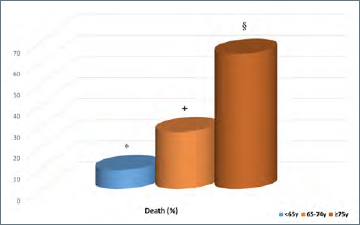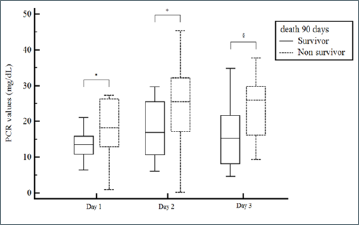
Prognostic Factors in Older Patients Admitted in ICU with Diagnosis of Abdominal Sepsis (Sepsis-3 Criteria)

Background & aims
Methods
Results
Conclusions
INTRODUCTION
MATERIALS AND METHODS
- demographic information: age, sex, weight and height;
- admission to ICU: date, type of admission (medical, surgical in election, emergency surgery), the most common comorbidities (cancer, chronic renal failure, heart failure, diabetes, obesity);
- diagnosis of abdominal sepsis: diagnostic tools (clinical, abdominal X-ray, abdominal Ultrasound, exploratory laparoscopy, exploratory laparotomy), anatomical integrity (presence or absence of perforation – localized or diffuse peritonitis), diagnosis (primary – secondary – tertiary peritonitis);
- microbiology: cultures with antibiogram either on intra- and post-operative peritoneal fluid (on surgical wound tampons), or on BronchoAlveolar Lavage (BAL), or on urine/ blood cultures, distinguished among multidrug-resistant, extensively drug-resistant and pandrug-resistant bacteria 16;
- anti-infective treatment: antimicrobial therapy: drug, daily dose, type of administration (intermittent intravenous, continuous intravenous, oral, intramuscular), duration, type of prescription (empirical or targeted); source control: drainage techniques (percutaneous drainage without surgery, surgical drainage, peritoneal lavage, post-operative drainage), necrotic tissue resection, decompression with laparostomy, reconstruction of normal anatomy; use of additional sepsis therapies: immunoglobulins, hydrocortisone, others;
- severity of sepsis: in pre-operative period (6 hours before surgery), in early post-operative period (24 hours after surgery) and in late post-operative (72 hours after the surgery). The diagnosis was performed evaluating: SOFA score, organ support (mechanical ventilation, vasoactive amines, dialysis), pH, serum lactates, C-reactive protein (CRP), procalcitonin (PCT), white blood cells;
- fluid balance during the first 5 days of ICU admission;
- 30-day and 90-day survival.
STATISTICAL ANALYSIS
RESULTS
DISCUSSION
Figures and tables



| Score | |||||
|---|---|---|---|---|---|
| 0 | 1 | 2 | 3 | 4 | |
| Respiratory system | |||||
| PaO2/FiO2 (mmHg) | ≥ 400 | < 400 | < 300 | < 200 with respiratory support | < 100 with respiratory support |
| Coagulation | |||||
| Platelets x 103/μL | ≥ 150 | < 150 | < 100 | < 50 | < 20 |
| Hepatic system | |||||
| Bilirubin (mg/dL) | < 1.2 | 1.2-1.9 | 2.0-5.9 | 6.0-11.9 | ≥ 12.0 |
| Cardiovascular system | |||||
| MAP ≥ 70 mmHg | MAP < 70 mmHg | Dopamine < 5 or Dobutamine (any dose) a | Dopamine 5,1-15 or norepinephrine ≤ 0.1 or epinephrine ≤ 0.1a | Dopamine > 15 or norepinephrine > 0.1 or epinephrine > 0.1a | |
| Central nervous system | |||||
| Glasgow Coma Scale | 15 | 13-14 | 10-12 | 6-9 | < 6 |
| Renal system | |||||
| Creatinine (mg/dl) | < 1.2 | 1.2-1.9 | 2.0-3.4 | 3.5-4.9 | > 5.0 |
| Urine output (ml/day) | < 500 | < 200 | |||
| Variables | Survivor N = 19 | Non survivor N = 11 | P |
|---|---|---|---|
| Age ≥ 65 years n,(%) | 14(73) | 10(91) | 0.26 |
| Gender (female) n,(%) | 7(37) | 5(45) | 0.46 |
| Comorbidity | |||
| Chronic renal disease n,(%) | 1(5) | 6(54) | 0.004 |
| Heart failure n,(%) | 1(5) | 1(9) | 0.6 |
| Diabetes mellitus n,(%) | 2(10) | 6(54) | 0.015 |
| Obesity (BMI > 30) n,(%) | 5(26) | 2(18) | 0.48 |
| Neoplasia n,(%) | 5(26) | 2(18) | 0.48 |
| MV n,(%) | 5(26) | 4(36) | 0.43 |
| Inotropes n,(%) | 0 (0) | 1(9) | 0.37 |
| qSOFA ≥ 2 n,(%) | 6(31) | 5(45) | 0.35 |
| Lac (mmol/L) | 2.4 ± 1.8 | 2.7 ± 1,1 | 0.62 |
| pH | 7.1 ± 0.3 | 7.0 ± 0,1 | 0.19 |
| CRP (mg/dL) | 13 ± 5 | 18.8 ± 8 | 0.03 |
| WBC (109/L) | 14.7 [10-22] | 12.6 [12-18] | 0.61 |
| SOFA score | 7.1 ± 3 | 7.55 ± 3.6 | 0.77 |
| Variables | Survivor N = 19 | Non survivor N = 11 | P |
|---|---|---|---|
| MV n,(%) | 19 | 11 | 0.99 |
| Inotropes n,(%) | 5(26) | 6(54) | 0.46 |
| Lac (mmol/L) | 2.3 ± 1 | 2.4 ± 1.1 | 0.91 |
| pH | 7.35 ± 0.06 | 7.33 ± 0.09 | 0,58 |
| CRP (mg/dL) | 17.0 [10.7-25.0] | 26.0 [17.2-32.0] | 0.01 |
| PCT (ng/mL) | 7.0 [1.7-33.0] | 9.1 [3.5-22.6] | 0.14 |
| WBC (109/L) | 13.1 [11.6-17.3] | 12.5 [11.8-18.6] | 0.94 |
| Dialysis n,(%) | 6(32) | 2(19) | 0.12 |
| Variables | Survivor N = 19 | Non survivor N = 11 | P |
|---|---|---|---|
| VM n,(%) | 16(84) | 10(91) | 0.53 |
| Inotropes n,(%) | 6(32) | 5(45) | 0.35 |
| Lac (mmol/L) | 1.1 ± 0.5 | 1.62 ± 0.6 | 0.05 |
| pH | 7.4 ± 0.04 | 7.37 ± 0.09 | 0.15 |
| CRP (mg/dL) | 16.6 ± 4.5 | 24.0 ± 8.1 | 0.06 |
| PCT (ng/mL) | 6.0 [0.7-15.1] | 10.0 [2.8-18.5] | 0.10 |
| WBC (109/L) | 13.6 [11.6-17.1] | 12.6 [11.8-18.3] | 0.94 |
| Dialysis n, (%) | 0 (0) | 2(18) | 0.12 |
References
- Iwashyna TJ, Cooke CR, Wunsch H, et al. Population burden of long-term survivorship after severe sepsis in older Americans. J Am Geriatr Soc 2012;60:1070-7. https://doi.org/10.1111/j.1532-5415.2012.03989. 10.1111/j.1532-5415.2012.03989
- Gaieski DF, Edwards JM, Kallan MJ, et al. Benchmarking the incidence and mortality of severe sepsis in the United States. Crit Care Med 2013;41:1167-74. https://doi.org/10.1097/CCM.0b013e31827c09f8. 10.1097/CCM.0b013e31827c09f8
- Martin GS, Mannino DM, Moss M. The effect of age on the development and outcome of adult sepsis. Crit Care Med 2006;34:15-21. https://doi.org/10.1097/01.ccm.0000194535.82812.ba. 10.1097/01.ccm.0000194535.82812.ba
- Singer M, Deutschman CS, Seymour CW, et al. The Sepsis definitions Task Force The Third International Consensus Definitions for Sepsis and Septic Shock (Sepsis-3). JAMA 2016; 315:762-74. https://doi.org/10.1001/jama.2016.0288. 10.1001/jama.2016.0288
- Levy MM, Fink MP, Marshall JC, et al. SCCM/ESICM/ACCP/ATS/SIS. 2001 SCCM/ESICM/ACCP/ATS/SIS International Sepsis Definitions Conference. Crit Care Med 2003;31:1250-6. https://doi.org/10.1097/01.CCM.0000050454.01978.3B. 10.1097/01.CCM.0000050454.01978.3B
- Vincent JL, Moreno R, Takala J, et al. The SOFA (Sepsis-related Organ Failure Assessment) score to describe organ dysfunction/failure. On behalf of the Working Group on Sepsis-Related Problems of the European Society of Intensive Care Medicine. Intensive Care Med 1996;22: 707-10. https://doi.org/10.1007/bf01709751. 10.1007/bf01709751
- Ferreira FL, Bota DP, Bross A, et al. Serial evaluation of the SOFA score to predict outcome in critically ill patients. JAMA 2001;286:1754-8. https://doi.org/10.1001/jama.286.14.1754. 10.1001/jama.286.14.1754
- Karlsson S, Varpula M, Ruokonen E, et al. Incidence, treatment, and outcome of severe sepsis in ICU-treated adults in Finland: the Finnsepsis study. Intensive Care Med 2007;33:435-43. https://doi.org/10.1007/s00134-006-0504-z. 10.1007/s00134-006-0504-z
- Montravers P, Blot S, Dimopoulos G, et al. Therapeutic management of peritonitis: a comprehensive guide for intensivists. Intensive Care Med 2016;42:1234-47. https://doi.org/10.1007/s00134-016-4307-6. 10.1007/s00134-016-4307-6
- Vincent JL, Rello J, Marshall J, et al. International study of the prevalence and outcomes of infection in intensive care units. JAMA 2009;302:2323-9. https://doi.org/10.1001/jama.2009.1754. 10.1001/jama.2009.1754
- Bastoni D, Ticinesi A, Lauretani F, et al. Application of The Sepsis-3 Consensus Criteria in a geriatric acute care unit: a prospective study. J Clin Med 2019;8:359. https://doi.org/10.3390/jcm8030359. 10.3390/jcm8030359
- Tolonen M, Coccolini F, Ansaloni L, et al. Getting the invite list right: a discussion of sepsis severity scoring systems in severe complicated intra-abdominal sepsis and randomized trial inclusion criteria. World J Emerg Surg 2018;13:17. https://doi.org/10.1186/s13017-018-0177-2. 10.1186/s13017-018-0177-2
- Eckmann C, Dryden M, Montravers P, et al. Antimicrobial treatment of “complicated” intra-abdominal infections and The New IDSA Guidelines - a commentary and an alternative European approach according to clinical definitions. Eur J Med Res 2011;16:115-26. https://doi.org/10.1186/2047-783x-16-3-115. 10.1186/2047-783x-16-3-115
- Rhodes A, Evans L, Alhazzani W, et al. Surviving sepsis campaign: international guidelines for management of sepsis and septic shock: 2016. Crit Care Med 2017;45:486-552. https://doi.org/10.1097/CCM.0000000000002255. 10.1097/CCM.0000000000002255
- Levy MM, Evans LE, Rhodes A. The Surviving Sepsis Campaign Bundle: 2018 Update. Crit Care Med 2018;46:997-1000. https://doi.org/10.1097/CCM.0000000000003119. 10.1097/CCM.0000000000003119
- Magiorakos AP, Srinivasan A, Carey RB, et al. Multidrug-resistant, extensively drug-resistant and pandrug-resistant bacteria: an international expert proposal for interim standard definitions for acquired resistance. Clin Microbiol Infect 2012;18:268-81. https://doi.org/10.1111/j.1469-0691.2011.03570.x. 10.1111/j.1469-0691.2011.03570.x
- Leligdowicz A, Dodek PM, Norena M, et al. Association between source of infection and hospital mortality in patients who have septic shock. Am J Respir Crit Care Med 2014;189:1204-13. https://doi.org/10.1164/rccm.201310-1875OC. 10.1164/rccm.201310-1875OC
- Poutsiaka DD, Davidson LE, Kahn KL, et al. Risk factors for death after sepsis in patients immunosuppressed before the onset of sepsis. Scand J Infect Dis 2009;41:469-79. https://doi.org/10.1080/00365540902962756. 10.1080/00365540902962756
- Chirillo F, Bacchion F, Pedrocco A, et al. Infective endocarditis in patients with diabetes mellitus. J Heart Valve Dis 2010;19:312-20.
- Kip MM, Kusters R, Izerman MJ, et al. A PCT algorithm for discontinuation of antibiotic therapy is a cost-effective way to reduce antibiotic exposure in adult intensive care patients with sepsis. A PCT algorithm for discontinuation of antibiotic therapy is a cost-effective way to reduce antibiotic exposure in adult intensive care patients with sepsis. J Med Econ 2015;18:944-53. https://doi.org/10.3111/13696998.2015.1064934. 10.3111/13696998.2015.1064934
- Casserly B, Phillips GS, Schorr C, et al. Lactate measurements in sepsis-induced tissue hypoperfusion: results from the Surviving Sepsis Campaign database. Crit Care Med 2015;43:567-73. https://doi.org/10.1097/CCM.0000000000000742. 10.1097/CCM.0000000000000742
- Vincent JL, Moreno R, Takala J, et al. The SOFA (Sepsis-related Organ Failure Assessment) score to describe organ dysfunction/failure. On behalf of the Working Group on Sepsis-Related Problems of the European Society of Intensive Care Medicine. Intensive Care Med 1996;22:707-10. https://doi.org/10.1007/bf01709751. 10.1007/bf01709751
- Ferreira FL, Bota DP, Bross A, et al. Serial evaluation of the SOFA score to predict outcome in critically ill patients. JAMA 2001;286:1754-8. https://doi.org/10.1001/jama.286.14.1754. 10.1001/jama.286.14.1754
- Ibrahim EH, Sherman G, Ward S, et al. The influence of inadequate antimicrobial treatment of bloodstream infections on patient outcomes in the ICU setting. Chest 2000;118:146-55. https://doi.org/10.1378/chest.118.1.146. 10.1378/chest.118.1.146
- Barie PS, Hydo LJ, Shou J, et al. Influence of antibiotic therapy on mortality of critical surgical illness caused or complicated by infection. Surg Infect 2005;6:41-54. https://doi.org/10.1089/sur.2005.6.41. 10.1089/sur.2005.6.41
- Shorr AF, Tabak YP, Killian AD, et al. Healthcare-associated bloodstream infection: a distinct entity? Insights from a large U.S. database. Crit Care Med 2006;34:2588-95. https://doi.org/10.1097/01.CCM.0000239121.09533.09. 10.1097/01.CCM.0000239121.09533.09
- Boyd JH, Forbes J, Nakada TA, et al. Fluid resuscitation in septic shock: a positive fluid balance and elevated central venous pressure are associated with increased mortality. Crit Care Med 2011;39:259-65. https://doi.org/10.1097/CCM.0b013e3181feeb15. 10.1097/CCM.0b013e3181feeb15
Società Italiana di Gerontologia e Geriatria (SIGG) This is an open access article distributed in accordance with the CC-BY-NC-ND (Creative Commons Attribution-NonCommercial-NoDerivatives 4.0 International) license. The article can be used by giving appropriate credit and mentioning the license, but only for non-commercial purposes and only in the original version. For further information: https://creativecommons.org/licenses/by-nc-nd/4.0/
Share and Cite
Remelli, F.; Fogagnolo, A.; Zurlo, A.; Volta, C.A.; Spadaro, S.; Volpato, S. Prognostic Factors in Older Patients Admitted in ICU with Diagnosis of Abdominal Sepsis (Sepsis-3 Criteria). J. Gerontol. Geriatr. 2020, 68, 152-158. https://doi.org/10.36150/2499-6564-391
Remelli F, Fogagnolo A, Zurlo A, Volta CA, Spadaro S, Volpato S. Prognostic Factors in Older Patients Admitted in ICU with Diagnosis of Abdominal Sepsis (Sepsis-3 Criteria). Journal of Gerontology and Geriatrics. 2020; 68(3):152-158. https://doi.org/10.36150/2499-6564-391
Chicago/Turabian StyleRemelli, Francesca, Alberto Fogagnolo, Amedeo Zurlo, Carlo Alberto Volta, Savino Spadaro, and Stefano Volpato. 2020. "Prognostic Factors in Older Patients Admitted in ICU with Diagnosis of Abdominal Sepsis (Sepsis-3 Criteria)" Journal of Gerontology and Geriatrics 68, no. 3: 152-158. https://doi.org/10.36150/2499-6564-391
APA StyleRemelli, F., Fogagnolo, A., Zurlo, A., Volta, C. A., Spadaro, S., & Volpato, S. (2020). Prognostic Factors in Older Patients Admitted in ICU with Diagnosis of Abdominal Sepsis (Sepsis-3 Criteria). Journal of Gerontology and Geriatrics, 68(3), 152-158. https://doi.org/10.36150/2499-6564-391