Article

Sero-Surveillance of Lyssavirus Specific Antibodies in Nigerian Fruit Bats (Eidolon helvum)


by
Dinchi A. Tyem
1,
Banenat B. Dogonyaro
1,2,
Timothy A. Woma
1,
Ernest Chuene Ngoepe
3 and
Claude Taurai Sabeta
2,3,*
1
National Veterinary Research Institute, P.M.B. 1, Vom-Jos Plateau State, Nigeria
2
University of Pretoria, Faculty of Veterinary Sciences, Department of Veterinary Tropical Diseases, P Bag X04, Onderstepoort 0110, South Africa
3
OIE Rabies Reference Laboratory, Agricultural Research Council-Onderstepoort Veterinary Research, Onderstepoort 0110, South Africa
*
Author to whom correspondence should be addressed.
Trop. Med. Infect. Dis. 2017, 2(3), 26; https://doi.org/10.3390/tropicalmed2030026

Submission received: 30 May 2017 / Revised: 4 June 2017 / Accepted: 4 June 2017 / Published: 9 July 2017
(This article belongs to the Special Issue Rabies Symptoms, Diagnosis, Prophylaxis and Treatment)

Abstract

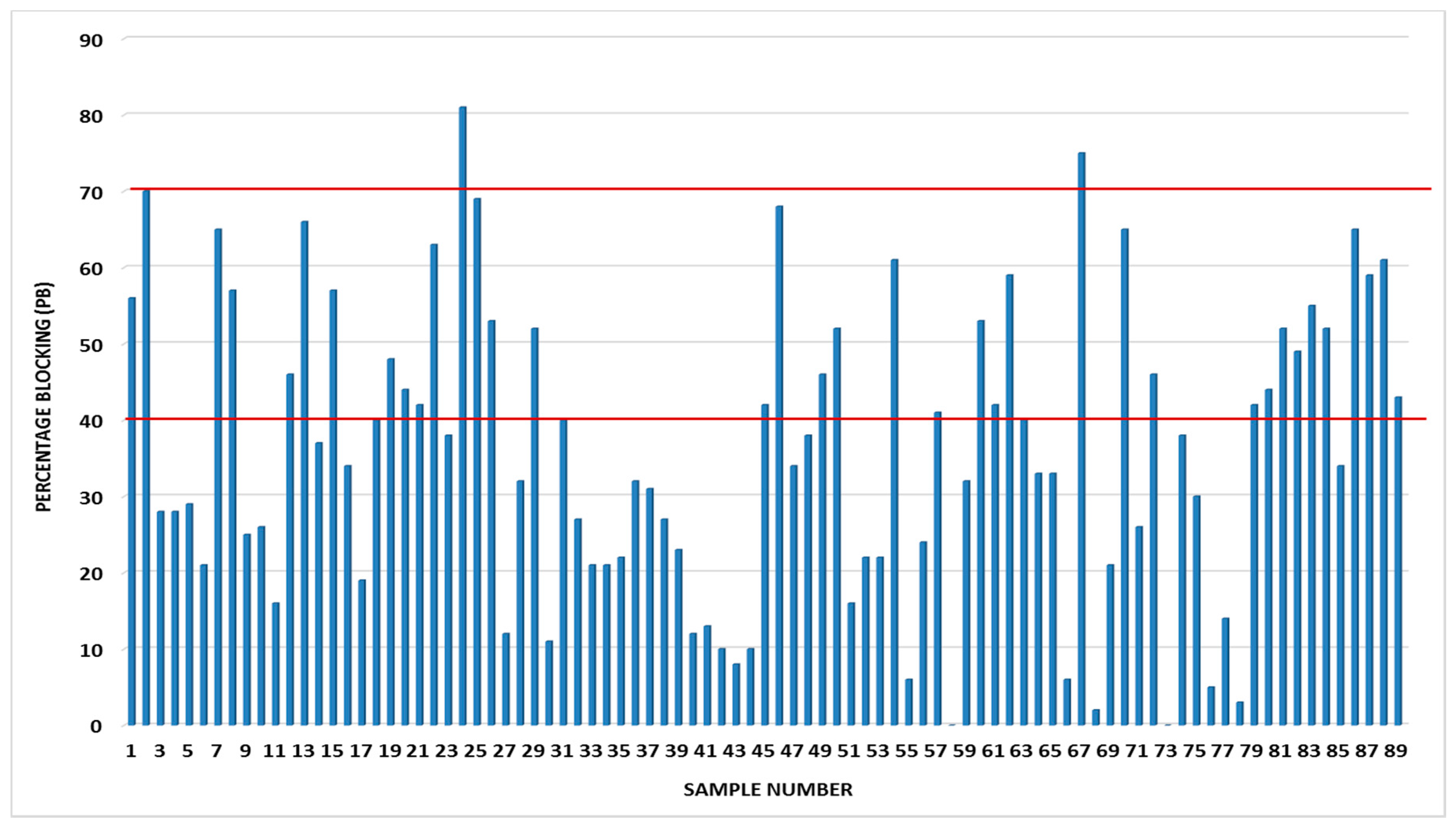
The aetiological agent of rabies is a member of the Lyssavirus genus (Rhabdoviridae family, order Mononegavirales). The disease (rabies) is endemic in many parts of Asia and Africa and still remains an important public and veterinary health threat. In Nigeria, there is a dearth of information on the natural infection and/or exposure of bat species to lyssaviruses. Therefore, this study was undertaken to assess the prevalence of rabies virus (RABV) neutralizing antibodies in sera obtained from bats from the central Plateau and North-East Bauchi States in Nigeria. Two hundred serum samples were collected from Nigerian fruit bats from six different locations and tested for anti-RABV antibodies using a commercial blocking ELISA. Of the 200 bat serum samples collected, one batch consisting of 111 samples did not meet the validation criteria and hence was not included in the final analysis. Of the remaining 89, only three (3.4%) contained anti-lyssavirus antibodies, demonstrating a low prevalence of lyssavirus antibodies in the study population. In order to further understand the exposure of bat species to phylogroup II lyssaviruses (Lagos bat virus and Mokola virus), the same panel of samples will be tested for neutralizing antibodies to phylogroup II members, viruses that do not cross-neutralize with members of phylogroup I.
Keywords: lyssavirus; rabies; Eidolon helvum; Nigeria; blocking ELISA; phylogroup I; phylogroup II lyssavirus; rabies; Eidolon helvum; Nigeria; blocking ELISA; phylogroup I; phylogroup II