1. Introduction
Cutaneous leishmaniasis (CL), one of the vector-borne neglected tropical diseases (NTDs), is caused by infection with protozoan parasites of the genus
Leishmania and transmitted via the bites of infected female sand flies [
1]. The disease is endemic in more than 90 countries worldwide. There are approximately 0.7 to 1.2 million new cases annually across the globe and around 350–430 million people are estimated to be at risk of infection [
2,
3,
4,
5]. Furthermore, about 40 million people globally are living with CL scars from past infections [
6] and both active disease and scars from previous infections can lead to significant stigma of individuals and their communities [
7]. However, there is substantial underreporting of this disease, with only 200,000 cases per annum being reported to the World Health Organization (WHO) [
3,
8,
9].
In Ethiopia, reports of CL date back at least to the early 1900s, with the first case reported from the northern part of the country and described as “Oriental sore in Agamé (Abyssinia)” [
10]. Since then, the disease has been reported from the highlands of the country and over 170 districts are suspected to be endemic [
11]. In Ethiopia, CL presents in three clinical forms, localized (LCL), diffused (DCL), and mucocutaneous (MCL) [
12], of which MCL and DCL present significant therapeutic challenges [
13]. Studies have estimated that 20,000 to 50,000 people per year are infected in Ethiopia [
2,
14]. However, in 2022, only 913 CL cases were reported to the WHO [
8], suggesting a gross underreporting of the disease in Ethiopia. The primary etiological agent of CL in Ethiopia is
L. aethiopica [
12]. Transmission is driven by the sand fly vectors
Phlebotomus longipes in the north of the country and
P. pedifer in the south, which are both zoophilic and anthropophilic. A major reservoir host for
L. aethiopica is the rock hyrax (
Procavia capensis), a rodent which resides in rocky mountainous regions in close proximity to the sand fly vector [
12].
We recently published findings from a cross-sectional household study in Tigray, where we identified a high prevalence of CL particularly in children and the presence of the more severe forms, MCL and DCL [
15]. We found that 12.7% of participants had clinical signs of CL, with active lesions (4.5%) or characteristic scars (8.2%). Cases were clustered in highland zones (93% at 2000–3000 m altitude above sea level) and risk factors included age, outdoor sleeping, poor housing, and proximity to caves [
15]. Our research indicates that CL is a major health issue in the region and that efforts need to be increased to address the disease.
A critical factor in addressing the burden of infectious diseases is to improve community awareness, behaviours, and prevention practices [
16,
17]. Knowledge, attitude, and practice (KAP) evaluation surveys provide fundamental evidence for health promotion campaigns, enabling health education messages to be specifically tailored to address gaps in public knowledge and awareness. Several studies indicate a direct relationship between community awareness on CL and effectiveness of control strategies [
18,
19]. Understanding and practices around infectious diseases such as CL are heavily influenced by socio-cultural settings and widely vary among communities across different regions of the country; however, only a small number of KAP studies have been conducted in CL-endemic regions in northern Ethiopia [
20,
21,
22] and community health education towards prevention and control of the disease is lacking [
12]. Furthermore, the first line biomedical treatment for CL in Ethiopia is multiple injections with pentavalent antimonial drugs, which can present major challenges regarding administration and treatment access for remote rural communities.
In the present study, we evaluated the knowledge, attitude, and practice (KAP) and treatment-seeking behaviours and prevention practices of communities located in CL-endemic districts of the Tigray region in order to inform disease control interventions. This work was carried out as part of a wider interdisciplinary study, ECLIPSE, which aimed to improve the patient journey and reduce stigma for people living with CL in endemic regions of Brazil, Ethiopia, and Sri Lanka.
2. Methods
2.1. Study Setting
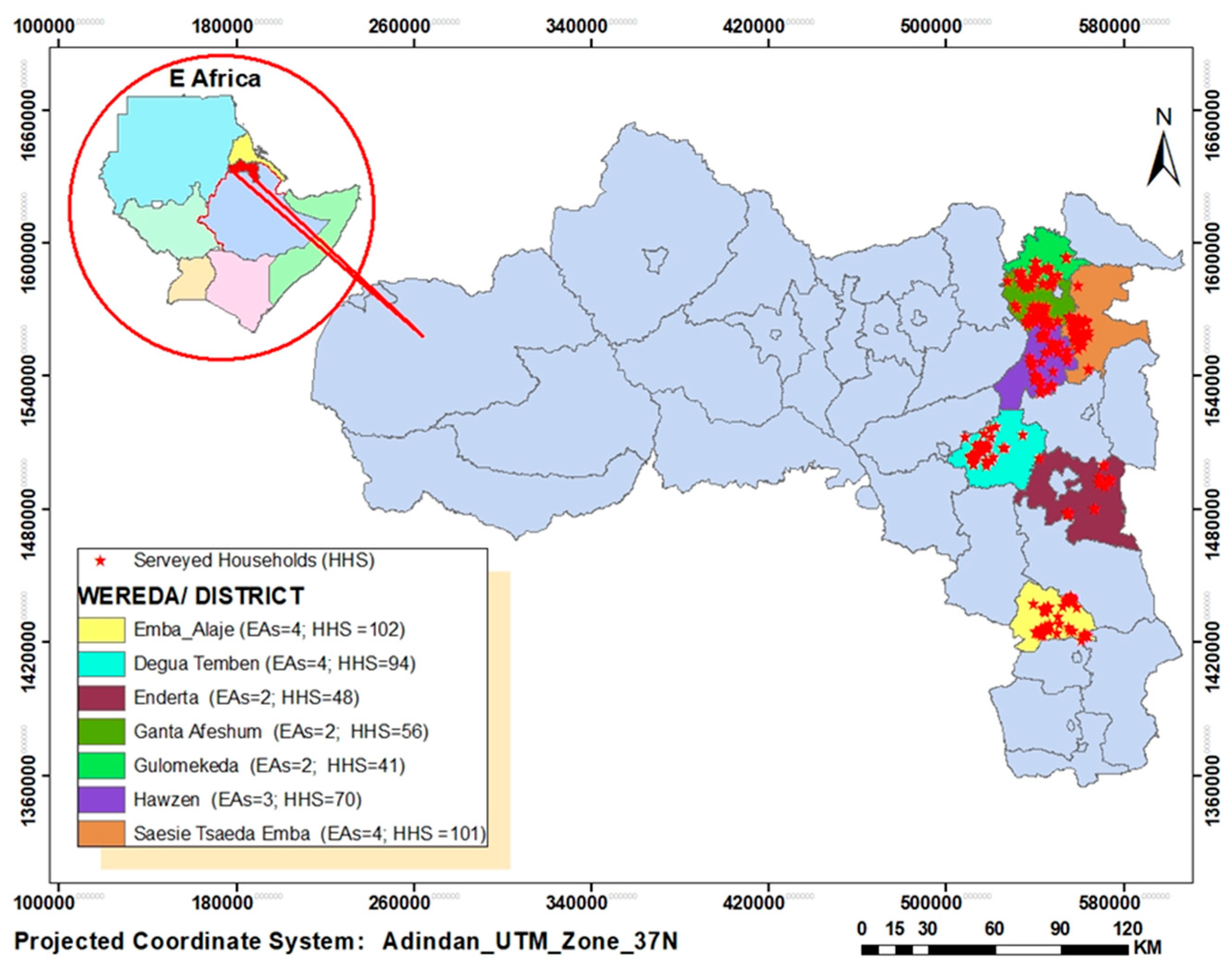
The Tigray region is located in the northern part of Ethiopia between 12O 15′ N and 14O 57′ N latitude and 36O 27′ E and 39O 59′ E longitude. The Tigray region has 7 administrative zones namely Central, Eastern, Mekelle, North Western, Southern, South Eastern, Western, and Mekelle; 52 districts (locally known as woredas); and 799 sub-districts or kebeles (locally, Tabias). A Tabia is the smallest administrative unit in the region which consists of 8 to 10 small villages (called kushets) and a kushet comprises on average from 150 to 250 households. The topography of Tigray consists of high plateaux and mountains with much of the land lying between 1000 and 3900 m above sea level altitude. This study was conducted in seven CL-endemic districts found in three zones of Tigray, namely Ganta Afeshum, Gulomekeda, Hawzen and Saesie Tsaeda-emba located in the Eastern zone, Degua Temben and Enderta in the South Eastern zone, and Emba-alaje situated in the Southern zone.
2.2. Study Design and Study Period
A cross-sectional survey was carried out between November and December 2022, in seven districts located in three zones of Tigray, northern Ethiopia.
2.3. Sample Size
The minimum sample size required for this survey was calculated according to the WHO’s practical manual for sample size determination in health studies [
23]. As previous data towards the level of community awareness and practices related to CL in the study areas were unavailable, we assumed a 50% level of awareness and practices in the targeted area study communities. The sample size was calculated using a single population proportion formula, assuming 95% CI with 0.05 margin of error and a 1.3 design effect.
The minimum sample size required for this study was 499 respondents using the following assumption: n = the number of study subjects (household heads), Z is a critical value (1.96) at 95% confidence level, P = anticipated population proportion (50%), D = design effect and e = margin of error (5%). To the calculated minimum sample size (n = 499), 5% of non-response rate was added and the total sample size was determined to be 524 individual participants.
2.4. Sampling Procedure
Between November and December 2022, a cross-sectional survey was conducted among communities living in seven districts located in three zones of Tigray. In the first stage of sampling, CL-endemic districts [
15], namely Ganta Afeshum, Gulomekeda, Hawzen and Saesie Tsaeda-emba districts (from the Eastern zone); Degua Temben and Enderta (South Eastern zone); and Emba-alaje district from the Southern zone. In the next stage, utilizing data from the Central Statistics Agency (ECSA, 2012) [
24], cluster Tabias or Enumeration Areas (EAs) were selected using probability proportionate to size (PPS). Accordingly, Enumeration Areas (EAs) from Degua Temben (
n = 4), Emba-alaje (
n = 4), Enderta (
n = 2), Ganta Afeshum (
n = 2), Gulomekeda (
n = 2), Hawzen (
n = 3), and Saesie Tsaeda-emba (
n = 4) were included. Larger population size Tabias or Enumeration Areas (EAs,
n = 21) were included so as to reach the number of households (HHs;
n = 25) required to achieve the overall sample size [(21 clusters 25 households) = 524 HHs] needed in this study (
Figure 1). Then, a simple random sampling was used to select households and finally, the most knowledgeable family member or the head of a household (one individual per household) was approached for an interview. Both male and female adults aged 18 years and above were eligible in this study.
2.5. Data Collection Tools and Procedures
Data were collected using a structured questionnaire adopted from similar studies [
16,
18,
21,
25], pre-tested on fifteen individuals recruited from households in the seven study districts. The questionnaire was designed to obtain information on participants’ socio-demographic characteristics; knowledge, attitude and practices (KAP); and treatment-seeking behaviour towards CL. The questionnaire was developed in English and then translated into the participants’ native language (Tigrigna), and the local name for CL (Guzwa, ጉዝዋ) was used to refer to the disease. The questionnaire was composed of four sections.
Section 1 of the questionnaire consisted of information on participants’ socio-demographic characteristics.
Section 2 contained questions on knowledge about CL that were designed to identify the primary sources of information used, to understand participants’ ability to identify the disease and explore their knowledge of aspects of CL, including signs and symptoms, local name of the disease, transmission mechanisms, treatment options, modern healthcare facilities, the existence of hyrax (the main reservoir host) and its relation with CL, and whether CL can be prevented.
Section 3 contained questions designed to determine the participants’ attitudes towards CL as a health concern, stigma, whether the disease is curable by treatment, feelings on seeing people with CL, primary care provider choices, and attitudes towards use of biomedical treatment for CL.
Section 4 consisted of questions designed to evaluate the treatment-seeking and prevention practices of the participants, such as primary healthcare options for active CL, reasons to choose a care provider, and distance from healthcare facilities. Additional questions were included to assess potential risk factors, such as occupation, time spent working outside (including overnight stays), use of hyrax dung as fertilizer, outdoor sleeping habits, and preventive measures.
Questionnaires were administrated by a team of trained and experienced senior health professional data collectors who had previously been involved in leishmaniasis-related household surveys. Data was primarily collected from the head of a household; when the head was not available, any responsible adult above 18 years selected by the family as the most knowledgeable person of the household was approached by the survey team for participation in the survey.
2.6. Scoring Methods
Scores for the KAP of respondents were developed using methods described in previous studies [
16,
20]. In brief, from the KAP questionnaire, a composite score of each question or item was calculated for each participant where each correct (or positive) response was assigned a score of 1 and each incorrect or unsure response was assigned a score of 0. The total scores were further dichotomized based on the overall scores of each item. The total knowledge scores ranged from 0 to 9, and scores between 0 and 4 were categorized as poor knowledge, while scores between 5 and 9 were considered indicative of good knowledge, as described previously [
9]. Similarly, the total attitude scores ranged from 0 to 6; scores between 0 and 3 were categorized as a negative attitude, while scores between 4 and 6 were considered to denote a positive attitude. With regard to treatment-seeking behaviour and prevention practices, scores ranged from 0 to 12. Scores between 0 and 6 were considered to indicate poor prevention practices, while scores between 7 and 12 were considered to be good prevention practices. While this scoring method has been used previously, we acknowledge that there are some limitations to this approach and that some areas of knowledge have greater relevance to the affected communities than others.
2.7. Data Analysis
The collected data were entered into EPI Info version 20.1.14 statistical package (Centers for Disease Control and Prevention) and exported to SPSS version 25.0 (SPSS, IBM Inc., Chicago, IL, USA) for statistical analysis. Descriptive statistics such as frequency, percentage, and mean (standard deviation) were used, where applicable, to describe the KAP components with the explanatory (independent) variables. A chi-square test was used to examine the associations between KAP scores and the explanatory variables such as study area settings, age, gender, education level, occupation, and CL infection episode in a household. A multivariate logistic regression analysis was performed to identify the significant predictors of good knowledge on CL, positive attitude, and good practices towards CL treatment-seeking behaviour and prevention. Variables with a p value of ≤0.25 in the chi-square test were included in the logistic regression analyses. Adjusted odd ratios (AORs) and their corresponding 95% confidence intervals (CIs) were calculated based on the final models. The significance level for all tests was set at p < 0.05.
3. Results
3.1. Socio-Demographic Characteristics of the Study Participants
A total of 512 individuals from different households (52.3% male and 47.7% female) participated in the study, with a 97.7% response rate. Of these, 70.5% were between 18 and 40 years old. More than half (52.3%) of the participants were from the eastern zone, a majority were rural inhabitants, and over three quarters (79.3%) were farmers by occupation. With respect to education level, 69.9% of the participants had attended modern schools and 30.1% of them had not received any formal education. Of the 358 educated participants, 39.4% and 29.1% had completed primary (1–6th grades) and secondary (7–10th grades) school levels, respectively. Only seven (1.4%) respondents had completed college and university education level. Out of all participants, about 61% acknowledged that one or more CL episodes (at least one case identified through symptoms or diagnosed at healthcare) had occurred within their household during the period of the last five years (
Table 1), showing that this disease is highly endemic in the region, in agreement with our recent epidemiological study [
15].
3.2. Knowledge About Cutaneous Leishmaniasis
In the present study, a large majority of participants, 97.3% (498/512), had some prior knowledge about the disease. The main sources of information around CL were household family members who had experience of the disease, and neighbours. Most participants (96.8%) described the disease using its local name “Guzwa” or ጉዝዋ (the local name for CL, in Tigrigna language), while only 16 (3.2%) respondents had heard of the term “leishmaniasis”, the scientific name for the disease. A majority of the participants (71.5%) responded that skin lesions were the main sign of CL and over 95% described that the lesions appear on the face (
Table 2).
While the clinical signs of the disease were recognized, very few participants knew the biological cause and transmission route for CL. Only six (1%) participants were able to name the sand fly vector and 21.1% did not name any transmission mechanisms. While 32.3% and 17.5% of the participants named bats and moths/butterflies as being disease vectors, respectively, 24.9% believed that CL was a genetically acquired disease. A majority of participants (73.6%) had seen rock hyrax (the major reservoir host for Leishmania in this region) in their localities; however, only twelve respondents (3.2%) knew that the hyrax was linked to risk of CL.
In response to questions on treatment priorities, traditional healers (herbalists) were the primary choice for the majority (62.9%) of participants followed by religious healers/faith remedies (14.1%). Over 67% of the participants did not know about biomedical treatments for CL and about two thirds (68.2%) did not name any CL prevention measures. Based on the overall scoring analysis, 219 (42.8%) participants had what we defined as a relatively “good” level of knowledge about CL (with scores of 5–9), while 293 (57.2%) had a “poor” level of knowledge (scores of 0–4) towards the disease (
Table 2).
3.3. Attitudes Towards CL, Its Treatment, and Care Provider Priorities
Most participants (96%) perceived CL to be a serious public health concern in their locality. Over 67% of the participants responded that CL is a stigmatizing disease. However, when participants were asked a subsequent question about their personal feelings when meeting people with a CL lesion, most of the participants (87.1%) responded that they felt uncomfortable.
Traditional healers (herbalists) were the primary choices for 73.6% of the participants and faith healers (religious remedies) were named as the first choice by 16.4%. Formal healthcare settings (defined here as community health posts, health centres, and hospitals at all levels) were the first point of contact for only 45 (10%) respondents. Based on the scoring analysis, 187 (36.5%) participants had a positive attitude toward CL (scores of 4–6 for selected questions), while 325 (63.5%) had a negative attitude (scores of 1–3) (
Table 3). The majority of respondents (87.8%) perceived CL to be a curable disease but only 27.3% stated that CL could be prevented, with 68% replying that they did not know.
3.4. Treatment-Seeking Behaviours and Practices
Most participants (83%) stated that people used homemade herbal remedies as the primary method of care, while 63.3% used traditional remedies from a healer (herbalist), 13.7% used religious healing (faith remedies), and 17.4% of the participants used cauterization of lesions using very hot metal, a practice which is highly likely to cause pain and skin damage.
About 27.3% (136/498) of the participants stated that they had used CL treatments at formal healthcare facilities, either for themselves or members of their household/families. Of those (n = 136) who had used a formal CL healthcare facility, about 85% had used one or more traditional remedies before receiving biomedical treatment, 66.9% had delays of 1–6 months, and 14.7% had delays longer than 6 months before receiving this form of treatment. Regarding the nearest formal CL healthcare facility, 60.4% of participants stated this was 61–90 km away from home and 26.8% responded that it was 30–60 km away.
Participants were asked about situations where people prefer to seek formal healthcare for CL treatment; interestingly, this question revealed a concept of gendered lesions: 237 participants (47.6%) stated that they would seek healthcare when the CL lesion is a “male” type, wording used to describe a more severe type of lesion that does not heal easily (potentially MCL or DCL types of the disease). Some respondents also mentioned a “runner” or wet type of lesion. In addition, 78 (15.7%) indicated that they would seek healthcare when the wound failed to heal using traditional treatments (
Table 4). Based on the scoring analysis outcome, while 173 participants (33.8%) had a good level of treatment-seeking behaviour and practices towards CL, 339 (66.2%) had a poor level of practices (
Table 5).
Almost half (45.3%) of the participants reported that they were commonly engaged working in fields from early morning until late evening, and 23.1% of the participants worked in fields during both daytime and at night, potentially increasing the risk of sand fly bites. Over half (58.2%) of the participants had outdoor sleeping habits and over one third (37.9%) of them used hyrax dung as fertilizer, potentially attracting sand flies. These were identified as key risk factors in our epidemiology study in Tigray [
15].
Over 71% of the participants did not apply any known CL preventive measures; however, about 28.6% (140/489) of the participants stated one or more mechanisms. Of those, 28%, 10.6%, and 7.4% of the participants mentioned using bed nets, improving environmental hygiene, and wearing long sleeves/trousers, respectively, as preventive measures for the disease. Based on the scoring analysis outcome, while 173 (33.8%) participants had a good level of prevention practices towards CL, 339 (66.2%) had a poor level of prevention practices (
Table 5).
3.5. Factors Associated with Knowledge About CL
Males were less likely to have good knowledge of CL compared to females (
p = 0.004) (
Table 6). Farmers were also less likely to have good knowledge than those in other occupations (
p = 0.021), while rural residents were 1.6 times more likely to have good knowledge than urban or semi-urban participants (
p = 0.049). Participants from households with a previous CL case were over ten times more likely to have good knowledge (
p < 0.001), representing the strongest association observed.
After adjustment for confounding, gender, occupation, rural residence, and prior household CL experience remained independently associated with knowledge, with prior CL exposure showing the strongest effect (AOR 10.19). In contrast, age and education were not significant in the adjusted model, suggesting that their crude associations were explained by other correlated factors (
Table 6).
3.6. Factors Associated with Participants’ Attitude Towards CL
Occupation and household setting were significant factors associated with attitudes towards CL
Table 7;
p < 0.05). Participants engaged in farming were 1.6 times more likely to have an unfavourable attitude compared with those in other occupations, while those from urban and semi-urban areas were around 2.2 times more likely to have a favourable attitude than rural residents (
Table 7). These findings contrast with the higher levels of knowledge observed among rural populations (
Table 6).
Together, these results suggest that knowledge and attitudes could be influenced by different underlying factors or combinations of competing factors, and that greater disease awareness alone does not necessarily translate into more favourable perceptions of affected individuals.
3.7. Factors Associated with Treatment-Seeking and Prevention Practices
Male participants were about 1.5 times more likely to have poor treatment-seeking and prevention practices compared to female counterparts (
p = 0.044). Participants with some formal education were 2.6 times less likely to have poor practices than those with no formal education (
p < 0.001). The likelihood of good practices was also approximately threefold higher among participants from households with previous or current CL cases (
p < 0.001), representing the strongest association observed (
Table 8).
These findings are consistent with the higher levels of knowledge observed among educated participants and those with prior household CL exposure (
Table 6), suggesting that both formal education and lived experience play key roles in shaping health behaviours. However, the persistence of poor practices among a substantial proportion of participants indicates that knowledge alone is insufficient, and that structural barriers such as access to healthcare and reliance on traditional treatments may also influence behaviour.
4. Discussion
4.1. High Burden of CL in Tigray
The current study revealed that a large proportion (61%) of participants in our study sites had experienced one or more CL episodes within their household during the last five years. This agrees with our recent epidemiological study in Tigray [
15] in showing that this disease is highly endemic and a serious public health challenge in the region. This remains in stark contrast to the low numbers of cases officially reported annually to the WHO from Ethiopia [
8]. The results from the current study also revealed that, despite the relatively high prevalence of the disease, many participants had a poor level of knowledge relating to CL transmission and negative attitudes towards people with CL lesion. Over 67% of the participants believed that CL is a stigmatizing disease and over 87% acknowledged that they felt uncomfortable when meeting people with active lesions, indicating that stigma associated with this disease is common in this region. The study findings also showed that many participants had a poor level of treatment-seeking and prevention practices. These findings are likely to be deeply rooted in the neglected nature of CL in government health policies and a lack of available information on disease control measures and healthcare options.
4.2. Knowledge of CL in Communities in Tigray
Using the KAP scoring system described previously [
9], we designated scores to a subset of questions and separated the responders into those with “good” and “poor” levels of knowledge. While having some limitations, this method allowed for the analysis of factors contributing to the overall levels of knowledge around CL. Around 42.8% of the current participants were defined as having a “good” level of knowledge about CL. This finding was higher than in comparable studies in the Delanta district, northeast Ethiopia (where 27.65% of respondents had good knowledge) [
26]; the Wolaita zone, southern Ethiopia (19%) [
20]; the Kutaber district, northeast Ethiopia (22.9%) [
22]; and in the Shara’b district, southwestern Yemen (22.3%) [
16]. However, the current finding was lower than the knowledge level (67.6%) found in Ochello, Gamo Gofa zone, southern Ethiopia [
18] and a study among communities in hyperendemic areas in western Yemen, where 51.2% of participants had overall “good” knowledge about CL [
9]. This knowledge-level discrepancy could be due to multiple factors, including differences in study areas and methodologies, variations in magnitudes of CL prevalence among investigated countries, and the socio-demographic and socio-cultural variations in each studied population.
In the current study, the highest scores were achieved for questions around the clinical signs of the disease, which is a reflection of the high prevalence and visibility of lesions. A large majority of participants were familiar with the disease, had seen cases in their community, and described the condition using a common local term “Guzwa” (a name for CL in Tigrigna language), while only very few had heard the scientific name of the disease, “leishmaniasis”. Our findings are consistent with studies carried out in other CL-endemic regions including Amhara, Ethiopia [
22], the Volta region of Ghana [
16], and southwestern Yemen [
27], and in contrast to a study in a non-endemic area of Alexandria, Egypt, where most participants (90%) had never encountered CL [
28]. Further, we found that households who had experienced at least one case of CL during the last five years were significantly more likely to have a good knowledge level.
While most of the participants in our study showed the ability to recognize the clinical signs of CL, they had a very poor level of knowledge around its transmission mechanisms and only six participants (1%) mentioned the sand fly vector by name. This finding is comparable with a similar study conducted in the Wolaita zone, southern Ethiopia, where none of the participants had heard of the sand fly [
20] and is also consistent with other similar studies conducted in Ethiopia [
18,
21]. Sand flies are very small insects (typically 1 mm in length) and difficult to see without magnification, which is likely to be a key contributing factor to this knowledge gap, in addition to a lack of locally available public health information on the disease. While knowing the specific vector species might not be essential for community members, wide recognition that CL is spread by an insect vector will be critical for the successful implementation of disease prevention strategies.
Participants in the current study had high levels of misconceptions around transmission mechanisms of the disease: one quarter of the current participants considered CL to be a genetically acquired disease, about one third considered bats to be the disease vector, and about one fifth of the participants believed that butterflies or moths could be responsible for spreading the disease. These findings are similar to previous studies conducted in Ethiopia. For example, 61.6% of study participants in the Kutaber district had misconceptions on the mode of transmission [
22] and 19.5% of participants in a study in the Delanta district responded that CL is transmitted via bat urine [
26]. However, unlike the findings in our study, a similar KAP study in central Iran found that 97.9% of the participants had a theoretical knowledge of the sand fly vector [
29]. The differences could be due to variations in socio-demographic factors, including the study settings and education level of participants and also the availability of accurate information on the disease. The study in Iran was institution-based and conducted with student participants [
29], whereas the current study was conducted in CL-endemic community settings where 30% of participants had not received formal education.
A recent study in Sri Lanka [
30] took a different approach to knowledge around CL, defining “CL disease awareness” through a public health lens and incorporating three fundamental elements that are important for affected communities to know. These were: (1) being aware of the disease name or local name; (2) being aware that the disease is spread by a sand fly vector; and (3) being aware that the disease is characterized by a long-lasting skin lesion. Using these criteria, the study in the Anuradhapura district (a CL-endemic region) identified that only 3.5% of participants had CL disease awareness, with very low scores for questions on two of these elements, transmission mode and recognizing clinical signs [
30]. While many CL cases in Sri Lanka present with a single lesion localized on the limbs [
31], our recent epidemiological study showed that the majority of cases in Tigray are found on the face and include more severe forms such as DCL and MCL [
15], which may help to explain the differences in community awareness of clinical signs between the two geographical regions.
4.3. Attitudes Around CL in Tigray
In the current study, only 36.5% of participants had an overall favourable or positive attitude towards individuals with CL. This finding is comparable with earlier studies undertaken in northeast Ethiopia and studies in western Yemen [
9,
26]. Another study carried out in the Kutaber district of Ethiopia showed even greater effects, with only 18.2% of the study participants having a favourable attitude towards people showing signs of the disease [
22].
Over two-thirds of the participants in the current study perceived CL to be a stigmatizing disease. A number of other studies have described the different types of stigmas associated with CL (reviewed by the authors [
7]). Stigma is highly context-specific and has been linked to a fear of contagion and social rejection. Affected individuals may anticipate avoidance, experience shame, and internalize fear of disfigurement and others’ reactions, while also experiencing direct discrimination and exclusion [
7,
32,
33,
34]. In studies carried out in Morocco and Tunisia, CL has been linked to intense psychosocial distress, while low disease awareness and fear of person-to-person transmission can lead to discrimination and rejection [
35,
36,
37]. These effects are strongly gendered, with women disproportionately affected due to facial scarring, undermining perceived beauty and marriage prospects, leading to greater social exclusion and constraints on participation and care-seeking [
38,
39]. The stigma associated with CL may also exacerbate health outcomes and influence the educational attainment of children [
7].
A conceptual framework developed from a study in rural Sri Lanka highlights the complex drivers of CL-associated stigma [
32]. Consistent with this and previous evidence, the high levels of perceived stigma observed in the current study are likely to be associated with poor understanding of disease transmission, local beliefs and misconceptions, and fear of the disease and its visible effects. However, our findings also suggest that unfavourable attitudes are not solely explained by low levels of knowledge, as rural participants, who demonstrated relatively higher knowledge, were more likely to report negative attitudes towards CL (
Table 6 and
Table 7). A substantial proportion of participants believed that CL is genetically acquired, which may influence social interactions, including relationships and marriage. In addition, stigma may be underestimated when assessed through direct questioning alone. When asked about personal reactions, the majority of participants reported feeling uncomfortable when encountering individuals with CL lesions, suggesting that enacted and internalized stigma may be more pervasive than indicated by reported attitudes.
The stigma associated with CL may lead to social discrimination, isolation, and reduced care-seeking, and can exacerbate health outcomes and affect educational attainment, particularly among children [
7,
32,
33,
34]. This study forms part of the wider ECLIPSE program, and further qualitative work will explore the complex social and cultural drivers of CL-related stigma in greater depth.
4.4. CL Treatment-Seeking Behaviours
Our multivariate analysis identified gender, education, and prior household CL experience as significant predictors of treatment-seeking and prevention practices (
Table 8). Male participants were more likely to report poor practices, while formal education was strongly associated with improved behaviours, suggesting that both gendered roles and access to information influence health decision-making. In addition, participants from households with previous or current CL cases were significantly more likely to report good practices, indicating that lived experience of the disease plays a critical role in shaping behaviour.
These findings align with the associations observed for knowledge (
Table 6), where prior CL exposure and education were also key determinants, highlighting a consistent pathway linking experience and awareness to behavioural outcomes. However, despite these associations, a substantial proportion of participants continued to demonstrate poor treatment-seeking and prevention practices, suggesting that knowledge alone is insufficient. Structural barriers, including distance to healthcare facilities, cost, and reliance on traditional healers, are likely to mediate this relationship and limit translation of knowledge into practice.
Our study showed that only 34% of participants had a good level of treatment-seeking behaviour and prevention practices, which is comparable to a similar study carried out in southern Ethiopia [
18]. However, this is higher than a KAP study undertaken in western Yemen, where only 16.3% of the study participants had good levels of treatment-seeking and prevention practices [
9]. This is heavily influenced by the prolonged civil war in Yemen which brought the public health system to collapse [
9,
40], therefore severely impacting healthcare access for CL and other chronic health conditions.
Likewise, over two-thirds of the present study participants had a poor level of formal healthcare-seeking behaviour for CL. The recent war in the Tigray region of northern Ethiopia (2020–2022) brought unimaginable humanitarian crisis and enormous damage to the health system in the region [
41]. About 80% of the primary hospitals and 86% of the secondary and tertiary hospitals including the CL care provider hospitals were fully or partially damaged and/or vandalized/looted during the war and the majority of the health facilities became non-functional [
42]. This is likely a key factor in the healthcare-seeking behaviours seen in affected communities.
Our findings showed that over 63% of participants preferred to seek remedies from traditional healers (herbalists) rather than formal CL healthcare facilities. This could be due to several factors, including local beliefs, low awareness about biomedical treatments available, and poor access to facilities. These findings are consistent with many community-based studies in Ethiopia: traditional remedies were the primary choice for 67.6% of participants in the Gamo-Gofa zone [
18], 68.3% of participants in the Amhara region [
21], and about 77% of participants in the Wolaita zone [
20]. A study in Nigeria also found that participants preferred to seek CL treatments with traditional healers rather than formal healthcare services [
43]. It is important to recognize that traditional healers have an important role within many African communities and often act as the first point of contact for health issues. However, we found evidence in our study of high-risk practices such as burning lesions with hot metal, which could cause substantial skin damage and scarring.
The current findings revealed that religious/faith healers (locally named “Tsebel”) offered traditional treatments specifically called “Tsebel Senbet Senabti”, which were among the most common traditional methods used to treat CL in the study sites. These findings are consistent with previous studies in southern Ethiopia [
20]. Moreover, over 60% of the current participants acknowledged that the nearest formal CL healthcare facility is located approximately 61 to 90 km away from home. Most formal CL healthcare in Ethiopia, including in Tigray, is centralized and located in regional or zonal capital cities [
44], a long distance from endemic areas. Decentralization of the current CL treatment facilities to the disease endemic localities could be one of the most important measures needed to improve biomedical treatment access for the most affected communities.
4.5. Practices Around CL Prevention
Our findings showed that most participants had no knowledge about CL prevention mechanisms, which is consistent with poor levels of understanding around the mode of disease transmission. A very small proportion of participants mentioned bed nets or other preventive methods. These findings are consistent with similar studies conducted in southern Ethiopia and western Yemen [
9,
20]. About three quarters of participants in the current study had seen rock hyraxes in their localities and over one third of them also responded that they used hyrax dung as a fertilizer in their farm plots. Hyrax species have been shown to be the primary reservoir hosts of CL parasites in Ethiopia [
45] and two studies conducted in Tigray have indicated that the presence of hyraxes close to resident houses was significantly associated with CL infections [
15,
46]. However, only a very small number of our participants were informed regarding hyraxes as potentially involved in CL transmission.
Considering the present findings, the communities living in CL-endemic areas of Tigray do not have adequate information on prevention and control of the disease. Providing more education on CL transmission, the insect vector (sandfly), the reservoir hosts (hyrax), and activities/times that are associated with a greater risk of CL would help communities to take preventive measures against the disease.
4.6. Limitations of the Current Study
This study included participants from seven districts within Tigray and may not capture localized differences in knowledge, attitudes, treatment-seeking behaviours, and prevention practices, although it provides an overall regional perspective. The findings may also not be generalizable to the wider population of Ethiopia. As this was a cross-sectional study, recall bias is a potential limitation, and social desirability bias may have influenced responses, particularly for questions related to treatment-seeking behaviours.
The categorisation of participants into “good” and “poor” knowledge and “positive” and “negative” attitudes and practices enabled the identification of key associated factors, notably the strong association between prior household CL experience and improved knowledge. However, this approach may mask important nuances, including very low levels of understanding of disease transmission. In addition, knowledge and attitudes towards CL are shaped by multiple interacting social and contextual factors that were not fully captured in this study and require more in-depth investigation.
Therefore, the findings should be interpreted with caution. This work forms part of the wider ECLIPSE program, and further insights from ongoing qualitative research will help to contextualize and extend these findings.
5. Conclusions
In this study, more than half of participants from a CL-endemic region of Tigray had an overall poor level of knowledge about the disease. While the local name (Guzwa) and the main clinical signs were widely recognized, understanding of disease transmission, including the sand fly vector and reservoir host, was very limited, with likely implications for prevention efforts. More than two-thirds of participants exhibited unfavourable attitudes towards CL, and a majority perceived the disease to be highly stigmatizing.
Most participants also had a poor understanding of available biomedical treatments, with traditional methods remaining the primary care choice. In addition, prevention and treatment-seeking practices were generally suboptimal. Occupation and household setting were significantly associated with attitudes, while gender, education level, and prior household CL experience were key determinants of treatment-seeking and prevention practices.
These findings highlight a disconnect between high disease burden, perceived seriousness and stigma, and limited knowledge and appropriate health behaviours. They reflect a lack of effective CL awareness and prevention programs in the region and underscore the need for targeted, community-based interventions. In particular, improved health education focusing on transmission, prevention measures, and access to effective treatment, alongside strategies to address stigma and structural barriers to care, will be essential to support CL control in affected communities.