
Series 2: Invisible Threats: A Global Scoping Review of Risk Factors for Tuberculosis Infection
 ,
,  , , , , ,
Abstract
1. Introduction
2. Materials and Methods
2.1. Search Strategy and PEOS Questions
- Population: Individuals of all ages and risk groups at risk of TBI.
- Exposure: Any risk factors for TBI
- Outcome: TBI
- Study Design: Systematic reviews published within the specified timeframe (2000–2024)
2.2. Inclusion and Exclusion Criteria
2.3. Data Extraction, Synthesis, and Reporting
2.4. Use of Non-Stigmatising Language
3. Results
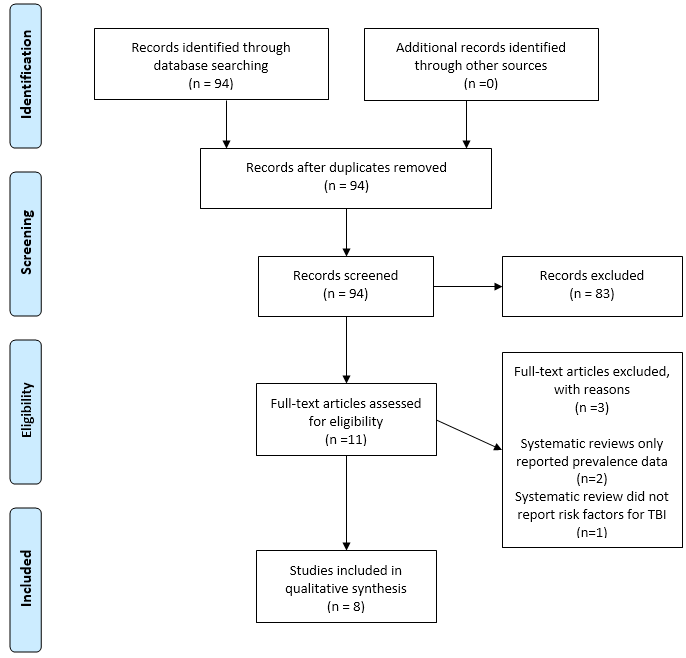
3.1. PRISMA Flow Diagram and Systematic Review Characteristics
3.2. Proximity and Behavioural Risk Factors
3.3. Environmental Risk Factors
3.4. Host Immune Vulnerability
4. Discussion
4.1. Summary of Results
4.2. Public Health Impact
4.3. Research Gaps
4.3.1. Behavioural Risk Factors in High-Density Settings
4.3.2. Immune-Suppressing Conditions and TBI
4.3.3. Vitamin D and TBI
4.3.4. Domestic Solid Fuel Use and TBI
4.3.5. Air Pollution
4.4. Strengths and Limitations
5. Conclusions
Supplementary Materials
Author Contributions
Funding
Institutional Review Board Statement
Informed Consent Statement
Data Availability Statement
Conflicts of Interest
References
- World Health Organization (WHO). Global Tuberculosis Report 2025; World Health Organization: Geneva, Switzerland, 2025. Available online: https://www.who.int/teams/global-tuberculosis-programme/tb-reports (accessed on 19 February 2026).
- Heidary, M.; Shirani, M.; Moradi, M.; Goudarzi, M.; Pouriran, R.; Rezaeian, T.; Khoshnood, S. Tuberculosis challenges: Resistance, co-infection, diagnosis, and treatment. Eur. J. Microbiol. Immunol. 2022, 12, 1–17. [Google Scholar] [CrossRef]
- Dheda, K.; Limberis, J.D.; Pietersen, E.; Phelan, J.; Esmail, A.; Lesosky, M.; Fennelly, K.P.; te Riele, J.; Mastrapa, B.; Streicher, E.M.; et al. Outcomes, infectiousness, and transmission dynamics of patients with extensively drug-resistant tuberculosis and home-discharged patients with programmatically incurable tuberculosis: A prospective cohort study. Lancet Respir. Med. 2017, 5, 269–281. [Google Scholar] [CrossRef]
- Hauck, F.R.; Neese, B.H.; Panchal, A.S.; El-Amin, W. Identification and management of latent tuberculosis infection. Am. Fam. Phys. 2009, 79, 879–886. [Google Scholar]
- Salgame, P.; Geadas, C.; Collins, L.; Jones-López, E.; Ellner, J.J. Latent tuberculosis infection—Revisiting and revising concepts. Tuberculosis 2015, 95, 373–384. [Google Scholar] [PubMed]
- Abubakar, I.; Stagg, H.R.; Whitworth, H.; Lalvani, A. How should I interpret an interferon gamma release assay result for tuberculosis infection? Thorax 2013, 68, 298–301. [Google Scholar] [CrossRef] [PubMed]
- Cohen, A.; Mathiasen, V.D.; Schön, T.; Wejse, C. The global prevalence of latent tuberculosis: A systematic review and meta-analysis. Eur. Respir. J. 2019, 54, 1900655. [Google Scholar] [CrossRef]
- Smith, I. Mycobacterium tuberculosis pathogenesis and molecular determinants of virulence. Clin. Microbiol. Rev. 2003, 16, 463–496. [Google Scholar] [CrossRef]
- World Health Organization. Tuberculosis Handbook; WHO: Geneva, Switzerland, 1998. Available online: https://iris.who.int/bitstream/handle/10665/65434/WHO_TB_98.253.pdf?sequence=1 (accessed on 13 June 2025).
- Jones-López, E.C.; Namugga, O.; Mumbowa, F.; Ssebidandi, M.; Mbabazi, O.; Moine, S.; Mboowa, G.; Fox, M.P.; Reilly, N.; Ayakaka, I.; et al. Cough aerosols of Mycobacterium tuberculosis predict new infection: A household contact study. Am. J. Respir. Crit. Care Med. 2013, 187, 1007–1015. [Google Scholar] [CrossRef]
- Horsburgh, C.R., Jr.; Rubin, E.J. Clinical practice. Latent tuberculosis infection in the United States. N. Engl. J. Med. 2011, 364, 1441–1448. [Google Scholar] [CrossRef]
- Center for Disease Control and Prevention. Tuberculosis Risk Factors. 2024. Available online: https://www.cdc.gov/tb/risk-factors/index.html (accessed on 13 June 2025).
- Blount, R.J.; Phan, H.; Trinh, T.; Dang, H.; Merrifield, C.; Zavala, M.; Zabner, J.; Comellas, A.P.; Stapleton, E.M.; Segal, M.R.; et al. Indoor Air Pollution and Susceptibility to Tuberculosis Infection in Urban Vietnamese Children. Am. J. Respir. Crit. Care Med. 2021, 204, 1211–1221. [Google Scholar] [CrossRef] [PubMed]
- Guo, T.; Tian, S.; Xin, H.; Du, J.; Cao, X.; Feng, B.; He, Y.; He, Y.; Wang, D.; Zhang, B.; et al. Impact of fine particulate matter on latent tuberculosis infection and active tuberculosis in older adults: A population-based multicentre cohort study. Emerg. Microbes Infect. 2024, 13, 2302852. [Google Scholar] [CrossRef]
- Tricco, A.C.; Lillie, E.; Zarin, W.; O’Brien, K.K.; Colquhoun, H.; Levac, D.; Moher, D.; Peters, M.D.; Horsley, T.; Weeks, L. PRISMA extension for scoping reviews (PRISMA-ScR): Checklist and explanation. Ann. Intern. Med. 2018, 169, 467–473. [Google Scholar]
- Stop TB Partnership. Words Matter: Suggested Language and Usage for Tuberculosis Communications. 2022. Available online: https://www.stoptb.org/words-matter-language-guide (accessed on 13 June 2025).
- Yuan, Y.; Wang, X.; Zhou, Y.; Zhou, C.; Li, S. Prevalence and risk factors of latent tuberculosis infection among college students: A systematic review and meta-analysis. Public Health 2022, 213, 135–146. [Google Scholar] [CrossRef]
- Lee, S.; Lee, W.; Kang, S.K. Tuberculosis infection status and risk factors among health workers: An updated systematic review. Ann. Occup. Environ. Med. 2021, 33, e17. [Google Scholar] [CrossRef] [PubMed]
- Kawatsu, L.; Uchimura, K.; Izumi, K.; Ohkado, A. A systematic review on the prevalence and incidence of latent tuberculosis infection among prison population. Kekkaku 2016, 91, 457–464. [Google Scholar]
- Diefenbach-Elstob, T.R.; Alabdulkarim, B.; Deb-Rinker, P.; Pernica, J.M.; Schwarzer, G.; Menzies, D.; Shrier, I.; Schwartzman, K.; Greenaway, C. Risk of latent and active tuberculosis infection in travellers: A systematic review and meta-analysis. J. Travel Med. 2021, 28, taaa214. [Google Scholar] [CrossRef]
- Freeman, R.J.; Mancuso, J.D.; Riddle, M.S.; Keep, L.W. Systematic review and meta-analysis of TST conversion risk in deployed military and long-term civilian travelers. J. Travel Med. 2010, 17, 233–242. [Google Scholar]
- Meregildo-Rodriguez, E.D.; Ortiz-Pizarro, M.; Asmat-Rubio, M.G.; Rojas-Benites, M.J.; Vásquez-Tirado, G.A. Prevalence of latent tuberculosis infection (LTBI) in healthcare workers in Latin America and the Caribbean: Systematic review and meta-analysis. Infez. Med. 2024, 32, 292–311. [Google Scholar] [PubMed]
- Patra, J.; Bhatia, M.; Suraweera, W.; Morris, S.K.; Patra, C.; Gupta, P.C.; Jha, P. Exposure to second-hand smoke and the risk of tuberculosis in children and adults: A systematic review and meta-analysis of 18 observational studies. PLoS Med. 2015, 12, e1001835. [Google Scholar]
- Zhou, G.; Guo, X.; Cai, S.; Zhang, Y.; Zhou, Y.; Long, R.; Zhou, Y.; Li, H.; Chen, N.; Song, C. Diabetes mellitus and latent tuberculosis infection: An updated meta-analysis and systematic review. BMC Infect. Dis. 2023, 23, 770. [Google Scholar] [CrossRef]
- Ito, Y.; Nagao, M.; Iinuma, Y.; Matsumura, Y.; Yamamoto, M.; Takakura, S.; Igawa, J.; Yamanaka, H.; Hashimoto, A.; Hirai, T.; et al. Risk factors for nosocomial tuberculosis transmission among health care workers. Am. J. Infect. Control 2016, 44, 596–598. [Google Scholar] [CrossRef] [PubMed]
- Mathew, A.; David, T.; Thomas, K.; Kuruvilla, P.J.; Balaji, V.; Jesudason, M.V.; Samuel, P. Risk factors for tuberculosis among health care workers in South India: A nested case-control study. J. Clin. Epidemiol. 2013, 66, 67–74. [Google Scholar] [CrossRef] [PubMed]
- World Health Organization. WHO Policy on TB Infection Control in Health Facilities, Congregate Settings and Households; WHO/HTM/TB/2009.419; WHO: Geneva, Switzerland, 2009. Available online: https://www.who.int/publications/i/item/9789241598323 (accessed on 23 June 2025).
- World Health Organization. WHO Guidelines on Tuberculosis Infection Prevention and Control, 2019 Update; License: CC BY-NC-SA 3.0 IGO; World Health Organization: Geneva, Switzerland, 2019. Available online: https://iris.who.int/handle/10665/311259 (accessed on 23 June 2025).
- Gopal, S. The case for prioritizing malignant hematology services in low- and middle-income countries. Semin. Hematol. 2023, 60, 189–191. [Google Scholar] [CrossRef] [PubMed]
- Morales, F.; Montserrat-de la Paz, S.; Leon, M.J.; Rivero-Pino, F. Effects of Malnutrition on the Immune System and Infection and the Role of Nutritional Strategies Regarding Improvements in Children’s Health Status: A Literature Review. Nutrients 2023, 16, 1. [Google Scholar] [CrossRef]
- Cao, Y.; Wang, X.; Liu, P.; Su, Y.; Yu, H.; Du, J. Vitamin D and the risk of latent tuberculosis infection: A systematic review and meta-analysis. BMC Pulm. Med. 2022, 22, 39. [Google Scholar] [CrossRef]
- Lin, H.H.; Suk, C.W.; Lo, H.L.; Huang, R.Y.; Enarson, D.A.; Chiang, C.Y. Indoor air pollution from solid fuel and tuberculosis: A systematic review and meta-analysis. Int. J. Tuberc. Lung Dis. 2014, 18, 613–621. [Google Scholar] [CrossRef]


| Author of Systematic Review | Date Range of Eligible Studies | Number of Studies | Objective | Methodology Assessment | Conclusion |
|---|---|---|---|---|---|
| Yuan et al. (2022) [17] | Until 2022 | 50 studies | Estimate the pooled prevalence of LTBI and identify its risk factors. | Cochrane collaboration for analytical studies and STROBE; the quality scores of 10 studies were low | The prevalence of TBI among college students was 20% (95% CI: 17–23%) by TST and 9% (95% CI: 7–11%) by IGRA. Significant risk factors included older age, lack of BCG vaccination, contact with TB cases, clinical training, and overweight/obesity. Prevalence varies by region. Infection control measures are recommended for college students with LTBI. |
| Lee et al. (2022) [18] | August 2010–Dec 2018 | 61 studies | Understand the status and risk factors of TBI among health workers | Not available | In 2014, the global prevalence of latent TBI was estimated at 23.0% (95% uncertainty interval: 20.4–26.4%). Among healthcare workers, risk factors for TB include older age, longer duration of employment, being a nursing professional, lack of BCG vaccination, and low BMI. Healthcare workers are at increased risk of TBI, which can lead to secondary transmission to patients or colleagues. Implementing effective prevention strategies is essential to ensure early diagnosis and prompt treatment. |
| Kawatsu et al. (2016) [19] | Cannot access full article (Japanese) | 12 studies | Report on the prevalence and risk factors for LTBI. | Full article was not accessible. Authors have been contacted | The prevalence of TBI among college students was 20% (95% CI: 17–23%) by TST and 9% (95% CI: 7–11%) by IGRA. Significant risk factors included older age, lack of BCG vaccination, contact with TB cases, clinical training, and overweight/obesity. Infection control measures are recommended for college students with TBI. |
| Diefenbach-Elstob et al. (2021) [20] | 1994–2013 | 10 studies | Estimate incident LTBI and active TB among individuals travelling from low to higher TB incidence countries | 2 studies were of moderate risk of bias and 1 of high risk of bias | A total of 1,154,673 travellers were observed between 1994 and 2013. The overall LTBI incidence was 2.3%, with HCWs at the highest risk (4.3%), followed by military (2.5%) and general travellers (1.6%). No significant differences in LTBI risk were found based on travel duration or destination TB burden. |
| Freeman et al. (2010) [21] | 1995–2007 | 9 studies | Determine the risk for TST conversion, used as a surrogate for LTBI, in long-term travellers from low- to high-risk countries | Not available | The cumulative TBI risk, measured by TST conversion, was 2.0% (99% CI: 1.6–2.4%), with significant heterogeneity (p < 0.0001). Risk was 2.0% (99% CI: 1.6–2.4%) for military and 2.3% (99% CI: 2.1–2.5%) for civilians. TST conversion may overestimate LTBI risk in low-prevalence populations like travellers due to its low positive predictive value. A targeted testing strategy for long-term travellers is recommended, with further studies needed to identify high-risk groups and locations. |
| Mergildo-Rodriguez et al. (2024) [22] | 2000–2020 | 38 studies | Estimate the prevalence of LTBI among HCWs and by specific role across Latin American and the Caribbean | Certainty of evidence was very low | Analysis of 15,236 HCWs, 6728 LTBI cases) across 7 LAC countries found a pooled LTBI prevalence of 34.5% (95% CI: 25.4–44.1%) for IGRA and 43.0% (95% CI: 35.5–50.7%) for TST. Overall prevalence using both tests was 40.98% (95% CI: 34.77–47.33%). LTBI was linked to longer employment, patient exposure, older age, nurses, physicians, smoking, and poor infection control. |
| Patra et al. (2015) [23] | 1996–2014 | 18 studies | Explore the role of SHS exposure as a risk factor for TB among children and adults. | Newcastle-Ottawa Scale (score range: 3–9) | Children exposed to second-hand smoke exposure had a significantly higher risk of TBI (RR 1.64, 95% CI 1.00–2.83). Associations for TBI remained significant after adjustment for age, fuel use, and presence of a TB patient in the household. There was a loss of association with after adjustment for socioeconomic status and study quality. |
| Zhou et al. (2023) [24] | 2006–2021 | 22 studies | Explore the association between DM and LTBI and provide essential reference for future research. | 6 studies have a high risk of bias using the Cochrane Rob2 tool | The meta-analysis consisting of 68,256 participants found that DM increases TBI risk. Three cohort studies were eligible, with a pooled aRR of 1.26 (95% CI: 0.71–2.23). 19 cross-sectional studies were eligible, with a pooled aOR of 1.21 (95% CI: 1.14–1.29). In the diagnosis of DM, the pooled aOR of the HbA1c group was higher than that of self-reported group (pooled aOR: 1.56, 95% CI: 1.24–1.96 vs. 1.17, 95% CI: 1.06–1.28). |
Disclaimer/Publisher’s Note: The statements, opinions and data contained in all publications are solely those of the individual author(s) and contributor(s) and not of MDPI and/or the editor(s). MDPI and/or the editor(s) disclaim responsibility for any injury to people or property resulting from any ideas, methods, instructions or products referred to in the content. |
© 2026 by the authors. Licensee MDPI, Basel, Switzerland. This article is an open access article distributed under the terms and conditions of the Creative Commons Attribution (CC BY) license.
Share and Cite
Menon, S.; Harries, A.D.; Dlodlo, R.A.; Badoum, G.; Dogo, M.F.; Mbitikon, O.B.; Sinha, P.; Lin, Y.; Jaju, J.; Soe, A.N.; et al. Series 2: Invisible Threats: A Global Scoping Review of Risk Factors for Tuberculosis Infection. Trop. Med. Infect. Dis. 2026, 11, 87. https://doi.org/10.3390/tropicalmed11040087
Menon S, Harries AD, Dlodlo RA, Badoum G, Dogo MF, Mbitikon OB, Sinha P, Lin Y, Jaju J, Soe AN, et al. Series 2: Invisible Threats: A Global Scoping Review of Risk Factors for Tuberculosis Infection. Tropical Medicine and Infectious Disease. 2026; 11(4):87. https://doi.org/10.3390/tropicalmed11040087
Chicago/Turabian StyleMenon, Sonia, Anthony D. Harries, Riitta A. Dlodlo, Gisèle Badoum, Mohammed F. Dogo, Olivia B. Mbitikon, Pranay Sinha, Yan Lin, Jyoti Jaju, Aung Naing Soe, and et al. 2026. "Series 2: Invisible Threats: A Global Scoping Review of Risk Factors for Tuberculosis Infection" Tropical Medicine and Infectious Disease 11, no. 4: 87. https://doi.org/10.3390/tropicalmed11040087
APA StyleMenon, S., Harries, A. D., Dlodlo, R. A., Badoum, G., Dogo, M. F., Mbitikon, O. B., Sinha, P., Lin, Y., Jaju, J., Soe, A. N., Singh, A., Kalottee, B., & Koura, K. G. (2026). Series 2: Invisible Threats: A Global Scoping Review of Risk Factors for Tuberculosis Infection. Tropical Medicine and Infectious Disease, 11(4), 87. https://doi.org/10.3390/tropicalmed11040087