
Epidemiological Characteristics of Human Rabies in Chongqing, China, 2016–2024
Abstract
1. Introduction
2. Materials and Methods
2.1. Ethics Statement
2.2. Data Collection
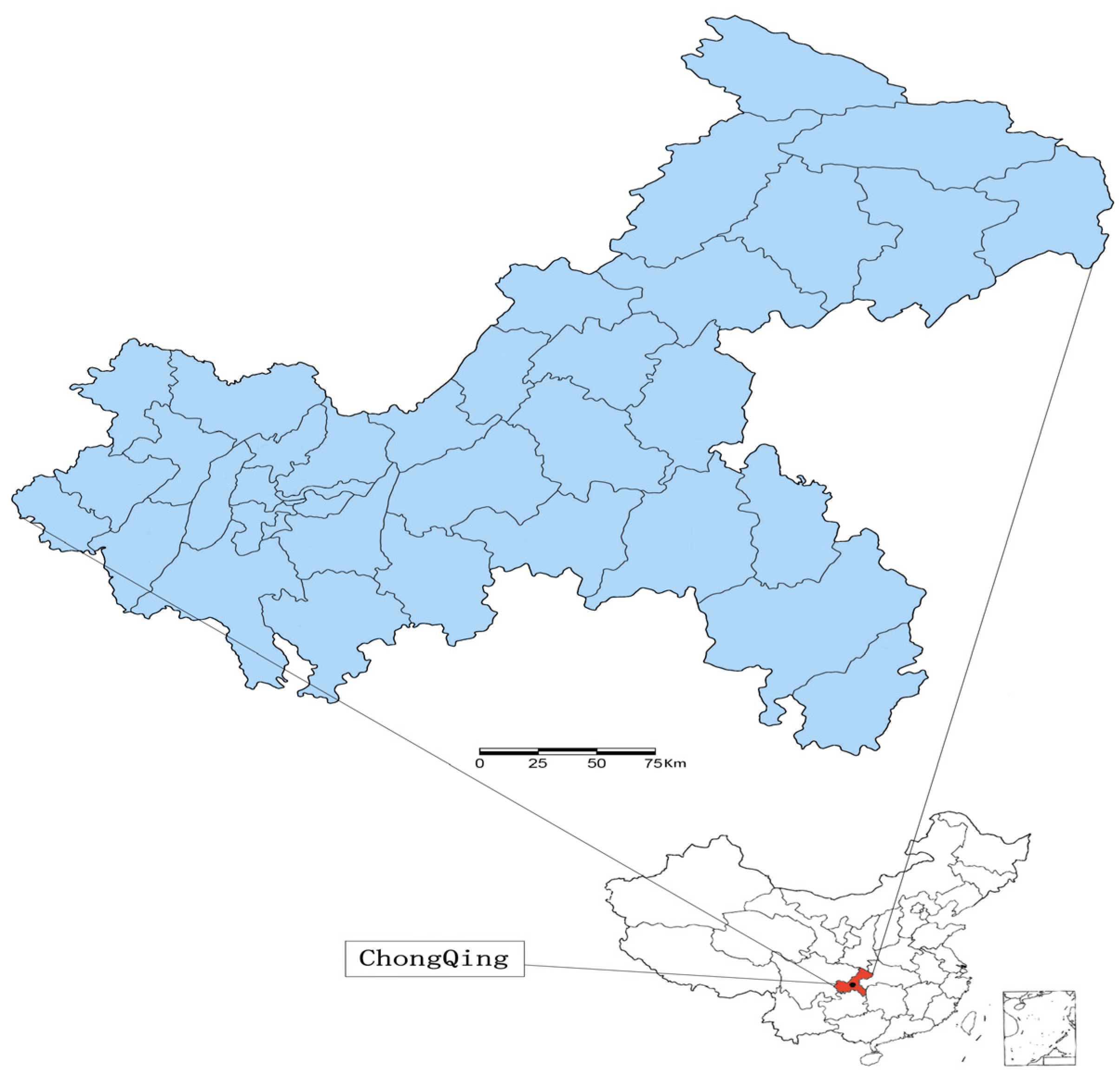
2.3. Study Area
2.4. Diagnostic Criteria for Rabies
- (1)
- A clear epidemiological history, namely a history of being bitten, scratched, or having mucous membranes licked by a suspected animal such as a dog or cat prior to the onset of illness;
- (2)
- Typical clinical manifestations, such as hydrophobia, aerophobia, pharyngeal muscle spasms, progressive paralysis, and other rabies-specific symptoms;
- (3)
- The preliminary exclusion of other known etiologies.
- (1)
- Positive isolation of the rabies virus;
- (2)
- Positive detection of rabies virus antigen by the fluorescent antibody test (FAT), direct rapid immunohistochemical test (dRIT), or enzyme-linked immunosorbent assay (ELISA);
- (3)
- Positive detection of rabies virus nucleic acid;
- (4)
- Positive detection of rabies virus-neutralizing antibodies, as determined by the mouse neutralization test (MNT) or the rapid fluorescent focus inhibition test (RFFIT), in an individual without a history of rabies vaccination.
2.5. Exposure Category
2.6. Statistical Analysis
3. Results
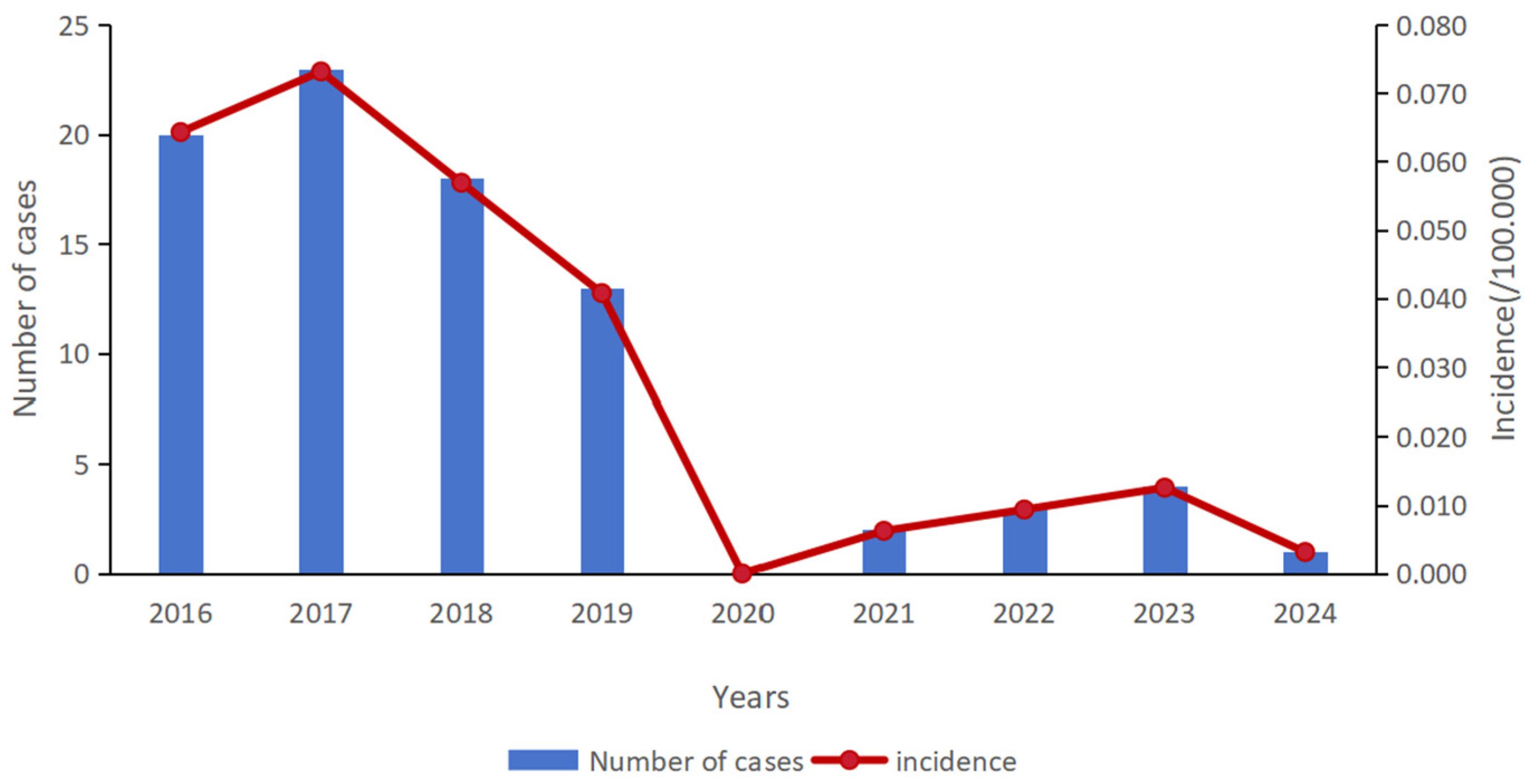
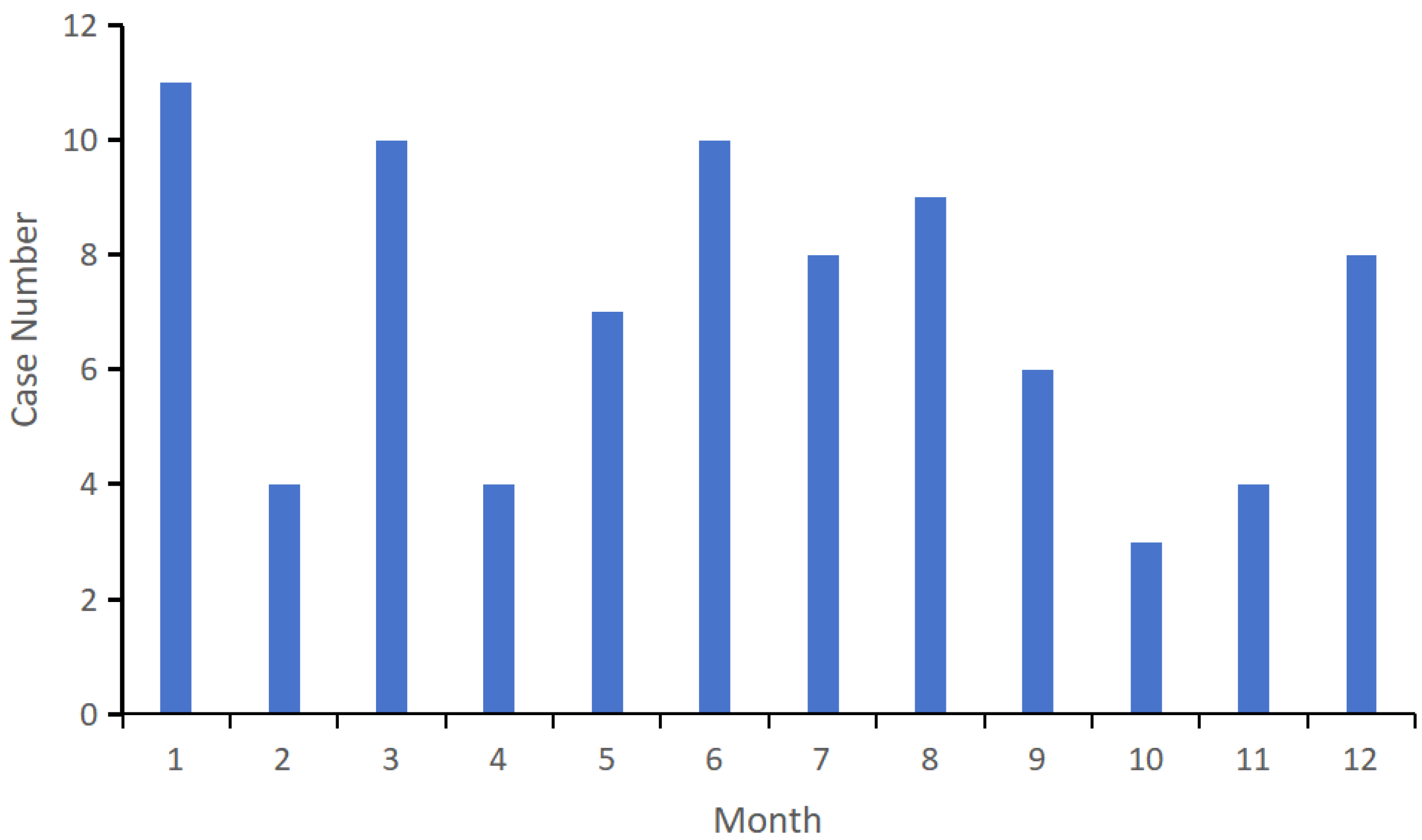
3.1. Epidemiological Characteristics
3.2. Exposure and Incubation
4. Discussion
5. Conclusions
Author Contributions
Funding
Institutional Review Board Statement
Informed Consent Statement
Data Availability Statement
Conflicts of Interest
Abbreviations
| PEP | Post-exposure prophylaxis |
| RIG | Immunoglobulin |
| WHO | World Health Organization |
| NNDRS | China’s National Notifiable Disease Reporting System |
References
- Fooks, A.R.; Banyard, A.C.; Horton, D.L.; Johnson, N.; McElhinney, L.M.; Jackson, A.C. Current status of rabies and prospects for elimination. Lancet 2014, 384, 1389–1399. [Google Scholar] [CrossRef]
- Hemachudha, P.; Hemachudha, T. Rabies: Presentation, case management and therapy. J. Neurol. Sci. 2021, 424, 117413. [Google Scholar] [CrossRef]
- Singh, R.; Singh, K.P.; Cherian, S.; Saminathan, M.; Kapoor, S.; Reddy, G.M.; Panda, S.; Dhama, K. Rabies-epidemiology, pathogenesis, public health concerns and advances in diagnosis and control: A comprehensive review. Vet. Q. 2017, 37, 212–251. [Google Scholar] [CrossRef] [PubMed]
- World Health Organization. Rabies. WHO. Available online: https://www.who.int/news-room/fact-sheets/detail/rabies (accessed on 2 September 2024).
- Müller, T.; Freuling, C.M.; Wysocki, P.; Roumiantzeff, M.; Freney, J.; Mettenleiter, T.C.; Vos, A. Terrestrial rabies control in the European Union: Historical achievements and challenges ahead. Vet. J. 2015, 203, 10–17. [Google Scholar] [CrossRef] [PubMed]
- Hampson, K.; Coudeville, L.; Lembo, T.; Sambo, M.; Kieffer, A.; Attlan, M.; Barrat, J.; Blanton, J.D.; Briggs, D.J.; Cleaveland, S.; et al. Estimating the global burden of endemic canine rabies. PLoS Neglected Trop. Dis. 2015, 9, e0003709. [Google Scholar] [CrossRef]
- World Health Organization; Food and Agriculture Organization of the United Nations; World Organisation for Animal Health. Zero by 30: The Global Strategic Plan to End Human Deaths from Dog-Mediated Rabies by 2030; World Health Organization: Geneva, Switzerland, 2018; Available online: https://iris.who.int/handle/10665/272756 (accessed on 24 October 2025).
- Shen, T.; Welburn, S.C.; Sun, L.; Yang, G.-J. Progress towards dog-mediated rabies elimination in PR China: A scoping review. Infect. Dis. Poverty 2023, 12, 30. [Google Scholar] [CrossRef]
- Qin, Y.; Zhang, Q.; Lai, S.J.; Chen, Q.; Ren, Q.; Yin, W.; Mu, D.; Zhang, Y. Analysis of epidemic characteristics of human rabies in China in 2007–2023. Chin. J. Exp. Clin. Virol. 2024, 38, 373–377. [Google Scholar] [CrossRef]
- Chen, X.; Zhang, J.; Lyu, S.; Zheng, C.; Yin, W.; Mu, D.; Zhang, Y. Epidemiological Characteristics and Spatiotemporal Clustering Analysis of Human Rabies-China, 2005–2024. China CDC Wkly. 2025, 7, 1350–1356. [Google Scholar] [CrossRef]
- Gan, H.; Hou, X.; Wang, Y.; Xu, G.; Huang, Z.; Zhang, T.; Lin, R.; Xue, M.; Hu, H.; Liu, M.; et al. Global burden of rabies in 204 countries and territories, from 1990 to 2019: Results from the Global Burden of Disease Study 2019. Int. J. Infect. Dis. 2023, 126, 136–144. [Google Scholar] [CrossRef]
- National Health Commission of the People’s Republic of China. Rabies Diagnosis and Treatment Guideline (2021 Edition). Chin. Pract. J. Rural. Dr. 2022, 29, 1–4. [Google Scholar] [CrossRef]
- WHO. WHO Expert Consultation on Rabies: WHO TRS No. 1012; Third Report; World Health Organization: Geneva, Switzerland, 2018; Available online: https://www.who.int/publications/i/item/WHO-TRS-1012 (accessed on 24 October 2025).
- Meng, W.; Shen, T.; Ohore, O.E.; Welburn, S.C.; Yang, G. Spatiotemporal Distribution of Human Rabies and Identification of Predominant Risk Factors in China from 2004 to 2020. PLoS Neglected Trop. Dis. 2024, 18, e0012557. [Google Scholar] [CrossRef]
- Liu, J.J.; Zhang, N.; Ding, S.J.; Kou, Z.-Q.; Tao, X.-Y.; Zhu, W.-Y. Epidemiological characteristics of human rabies cases reported by sites in China from 2006 to 2022. BMC Infect. Dis. 2024, 24, 966. [Google Scholar] [CrossRef] [PubMed]
- Zhang, N.; Xu, X.; Zhang, M.; Xie, Y.; Yu, P.; Liu, S.; Liu, Q.; Tao, X.; Zhu, W. A Comprehensive Analysis and Forecast of Rabies Epidemic and Elimination Challenges-China, 2005–2023. China CDC Wkly. 2025, 7, 967–972. [Google Scholar] [CrossRef] [PubMed]
- Liu, Q.; Wang, X.; Liu, B.; Gong, Y.; Mkandawire, N.; Li, W.; Fu, W.; Li, L.; Gan, Y.; Shi, J.; et al. Improper wound treatment and delay of rabies post-exposure prophylaxis of animal bite victims in China: Prevalence and determinants. PLoS Neglected Trop. Dis. 2017, 11, e0005663. [Google Scholar] [CrossRef] [PubMed]
- Lu, W.G.; Ai, D.; Song, H.; Xie, Y.; Liu, S.; Zhu, W.; Yang, J. Epidemiological and numerical simulation of rabies spreading from canines to various human populations in mainland China. PLoS Neglected Trop. Dis. 2021, 15, e0009527. [Google Scholar] [CrossRef]
- Zhao, J.; Luo, M.; Tan, X.; Zhu, Z.; Zhang, M.; Liu, J.; Lin, W.; Yang, Y.; Li, X.; Zeng, W.; et al. Spatial accessibility and inequality analysis of rabies-exposed patients to rabies post-exposure prophylaxis clinics in Guangzhou City, China. Int. J. Equity Health 2024, 23, 122. [Google Scholar] [CrossRef]
- Wang, D.L.; Zhang, X.F.; Jin, H.; Cheng, X.Q.; Duan, C.X.; Wang, X.C.; Bao, C.J.; Zhou, M.H.; Ahmad, T. Post-exposure prophylaxis vaccination rate and risk factors of human rabies in mainland China: A meta-analysis. Epidemiol. Infect. 2018, 147, e64. [Google Scholar] [CrossRef]
- Guo, C.; Li, Y.; Huai, Y.; Rao, C.Y.; Lai, S.; Mu, D.; Yin, W.; Yu, H.; Nie, S. Exposure history, post-exposure prophylaxis use, and clinical characteristics of human rabies cases in China, 2006–2012. Sci. Rep. 2018, 8, 17188. [Google Scholar] [CrossRef]
- Qiao, Y.C.; Wang, F.; He, Y.L.; Yang, Q.; Yang, J.; Wei, Y.-S. Regional and age difference of human rabies prevalence of the past fourteen years in China. Prev. Vet. Med. 2021, 187, 105161. [Google Scholar] [CrossRef]
- Janeaim, N.; Suwanwong, C.; Prasittichok, P.; Mohan, K.P.; Hudrudchai, S. Effectiveness of educational interventions for improving rabies prevention in children: A systematic review and meta-analysis. J. Educ. Health Promot. 2024, 13, 497. [Google Scholar] [CrossRef] [PubMed]
- Alemayehu, T.; Oguttu, B.; Rupprecht, C.E.; Niyas, V.K.M. Rabies vaccinations save lives but where are the vaccines? Global vaccine inequity and escalating rabies-related mortality in low- and middle-income countries. Int. J. Infect. Dis. 2024, 140, 49–51. [Google Scholar] [CrossRef] [PubMed]
- Cai, L.; Wang, L.; Guan, X.; Wang, L.; Hu, X.; Wu, Y.; Tong, Y.; Wang, P. Epidemiological Analysis of Rabies in Central China from 2013 to 2018. Infect. Drug Resist. 2021, 14, 2753–2762. [Google Scholar] [CrossRef] [PubMed]
- Whitehouse, E.R.; Mandra, A.; Bonwitt, J.; Beasley, E.A.; Taliano, J.; Rao, A.K. Human rabies despite post-exposure prophylaxis: A systematic review of fatal breakthrough infections after zoonotic exposures. Lancet Infect. Dis. 2023, 23, e167–e174. [Google Scholar] [CrossRef]
- Jane Ling, M.Y.; Halim, A.F.N.A.; Ahmad, D.; Ramly, N.; Hassan, M.R.; Rahim, S.S.S.A.; Jeffree, M.S.; Omar, A.; Hidrus, A. Rabies in Southeast Asia: A systematic review of its incidence, risk factors and mortality. BMJ Open 2023, 13, e066587. [Google Scholar] [CrossRef]
- Tu, C.; Feng, Y.; Wang, Y. Animal rabies in the People’s Republic of China. Rev. Sci. Tech. 2018, 37, 519–528. [Google Scholar] [CrossRef]
- Sun, S.; Ma, J.; Xu, Y.; Zeng, Z.; Liu, J.; Hada; Tu, Z.; Xu, W.; Feng, H.; Zhao, Z.; et al. Surveillance and Analysis of Animal Rabies-China, 2004–2024. China CDC Wkly. 2025, 7, 1235–1240. [Google Scholar] [CrossRef]
- Qi, L.; Su, K.; Shen, T.; Tang, W.; Xiao, B.; Long, J.; Zhao, H.; Chen, X.; Xia, Y.; Xiong, Y.; et al. Epidemiological characteristics and post-exposure prophylaxis of human rabies in Chongqing, China, 2007–2016. BMC Infect. Dis. 2018, 18, 6. [Google Scholar] [CrossRef]
- Standing Committee of the Chongqing Municipal People’s Congress. Chongqing Dog Breeding Management Regulations. 2022. Available online: https://gaj.cq.gov.cn/zwgk/zfxxgkml/zcwj/dfxfg/202507/t20250723_14838390.html (accessed on 12 October 2025).
- Sambo, M.; Hampson, K.; Johnson, P.C.D.; Johnson, O.O. Understanding and overcoming geographical barriers for scaling up dog vaccinations against rabies. Sci. Rep. 2024, 14, 30975. [Google Scholar] [CrossRef]
- Chongqing Municipal People’s Government. Report on the Handling of Deliberation Opinions Regarding the Implementation of the Chongqing Canine Management Regulations. Chongqing Municipal People’s Congress Website. (26 November 2024). Available online: https://www.cqrd.gov.cn/web/article/1361739635167019008/web/content_1361739635167019008.html (accessed on 25 October 2025).
- Ortiz, D.D.; Lezcano, F.O. Dog and Cat Bites: Rapid Evidence Review. Am. Fam. Physician 2023, 108, 501–505. [Google Scholar]
- Zhou, T.; Li, X.M.; Pan, J.B.; Lu, L.; Zhao, D.; Yu, R.; Liu, W.; Li, Z. Epidemiological characteristics of population exposed to rabies in Beijing, 2017–2021. Int. J. Virol. 2024, 31, 150–155. [Google Scholar] [CrossRef]
- Lu, R.; Lin, J.; Zhou, Y.; Chen, Q.; Fan, Z.; Wu, S.; Qin, P.; Li, L. Rabies vaccination adherence and associated factors among rabies-exposed patients in Shenzhen, China: A hospital-based cross-sectional study. Epidemiol. Infect. 2024, 152, e15. [Google Scholar] [CrossRef]


| Number of Human Rabies Cases | Proportion (%) | |
|---|---|---|
| Age group | ||
| 0–14 years | 9 | 10.7 |
| 15–29 years | 5 | 6.0 |
| 30–44 years | 9 | 10.7 |
| 45–59 years | 17 | 20.2 |
| ≥60 years | 44 | 52.4 |
| Gender | ||
| Male | 56 | 66.7 |
| Female | 28 | 33.3 |
| Occupation | ||
| Farmer | 62 | 73.8 |
| Students and children | 9 | 10.7 |
| Housewife or unemployment | 5 | 6.0 |
| Worker | 2 | 2.4 |
| Others | 6 | 7.1 |
| No. of Human Rabies Cases | Proportion (%) | |
|---|---|---|
| Exposure method | ||
| Bite | 55 | 83.3 |
| Scratch | 8 | 12.1 |
| Others | 3 | 4.5 |
| Exposure level | ||
| I | 1 | 1.5 |
| II | 18 | 27.3 |
| III | 47 | 71.2 |
| Exposure site | ||
| Head, neck and Trunk | 6 | 9.1 |
| Upper limb | 43 | 65.2 |
| Lower limb | 23 | 34.8 |
| Exposure of multiple parts | 3 | 4.5 |
| Wound treatment method | ||
| Unprocessed | 34 | 51.5 |
| Handle it by yourself | 28 | 42.4 |
| Medical institution handling | 4 | 6.1 |
| Animal vector | ||
| Dog | 61 | 92.4 |
| Cat | 5 | 7.6 |
| Animal source | ||
| Domesticated animal | 43 | 65.2 |
| Stray animals | 21 | 31.8 |
| Wild animals | 0 | 0.0 |
| Other | 2 | 3.0 |
| Exposure reasons | ||
| Active attack by the vector | 35 | 52.2 |
| Defensive attack by the vector | 10 | 14.9 |
| Playing with the vector | 13 | 19.4 |
| Other | 6 | 9.0 |
| Median (Interquartile Range) (Days) | p Value | |
|---|---|---|
| Exposure method | >0.05 | |
| Bite | 69 (41.75, 135.25) | |
| Scratch | 151.5 (83.5, 229.25) | |
| Others | 38.5 (28.75, 48.25) | |
| Exposure level | >0.05 | |
| II | 120 (69, 272) | |
| III | 62 (41.5, 125) | |
| Exposure site | <0.05 | |
| Upper limb | 63 (41.5, 125) | |
| Lower limb | 120 (64.5, 263) | |
| Head, neck and Trunk | 14 (13.2, 22) |
Disclaimer/Publisher’s Note: The statements, opinions and data contained in all publications are solely those of the individual author(s) and contributor(s) and not of MDPI and/or the editor(s). MDPI and/or the editor(s) disclaim responsibility for any injury to people or property resulting from any ideas, methods, instructions or products referred to in the content. |
© 2026 by the authors. Licensee MDPI, Basel, Switzerland. This article is an open access article distributed under the terms and conditions of the Creative Commons Attribution (CC BY) license.
Share and Cite
Chen, L.; Yuan, Y.; Xia, Y.; Long, J.; Li, Z.; Li, T.; Qi, L. Epidemiological Characteristics of Human Rabies in Chongqing, China, 2016–2024. Trop. Med. Infect. Dis. 2026, 11, 30. https://doi.org/10.3390/tropicalmed11010030
Chen L, Yuan Y, Xia Y, Long J, Li Z, Li T, Qi L. Epidemiological Characteristics of Human Rabies in Chongqing, China, 2016–2024. Tropical Medicine and Infectious Disease. 2026; 11(1):30. https://doi.org/10.3390/tropicalmed11010030
Chicago/Turabian StyleChen, Longyu, Yi Yuan, Yu Xia, Jiang Long, Zhijin Li, Tingting Li, and Li Qi. 2026. "Epidemiological Characteristics of Human Rabies in Chongqing, China, 2016–2024" Tropical Medicine and Infectious Disease 11, no. 1: 30. https://doi.org/10.3390/tropicalmed11010030
APA StyleChen, L., Yuan, Y., Xia, Y., Long, J., Li, Z., Li, T., & Qi, L. (2026). Epidemiological Characteristics of Human Rabies in Chongqing, China, 2016–2024. Tropical Medicine and Infectious Disease, 11(1), 30. https://doi.org/10.3390/tropicalmed11010030